







Abstract
The Massachusetts Affordable Housing Policy of 1969 (known as the ‘Anti-Snob Zoning Act’, or simply 40B), is one of the most admirable and controversial acts in the history of the state. It was intended to break through the exclusionary ‘snob’ zoning that was customary in United States suburbs at the time, and to open the suburbs to low- and moderate-income residents by encouraging the production of affordable housing statewide. The paper analyses 40B and the modifications it has undergone over the years in light of the relation between centralized state power and decentralized local government power with regard to planning. Understanding of the changes in local–state power relations can provide an explanation for the changes that have occurred over the years in implementing the law. The findings suggest that mutual learning, and understandings developed over the years among all involved, can provide the greatest benefit to low- and moderate-income residents.
Keywords
Introduction
With the world’s rapidly growing population and the recurrent crises in the world markets in recent decades, many societies worldwide are suffering from a massive housing crisis. The 2007 collapse of some of the largest global financial institutions and markets has made the housing crunch even worse. Although it differs from one place to another, it has been characterised globally by a severe shortage of suitable and affordable housing. In many Western, developed countries, a growing number of people have fallen behind on rent or mortgage payments, many have lost their homes, and others have had to put up with poor living conditions (Calavita and Mallach, 2010; Gurran, 2008). 1
Consequently, many states and cities around the globe have begun to develop inclusionary housing policies. Inclusionary housing is ‘a means of using the planning system to create affordable housing and foster social inclusion by capturing resources created through the market place’ (Calavita and Mallach, 2010: 1).
This paper focuses on an interesting and early example of an inclusionary housing policy, which was enacted in Massachusetts in August 1969. The law, which is known as the Massachusetts Comprehensive Permit Act, the ‘Anti-Snob Zoning Act’, or simply 40B (the relevant section of the Massachusetts General Laws), 2 was intended to break through the exclusionary ‘snob’ zoning that was commonplace in United States suburbs at the time, and to open affluent suburbs to low- and moderate-income residents by encouraging the construction of affordable housing statewide.
During the Act’s 43 years of existence, it has succeeded in producing more than 60,000 housing units statewide, 32,500 of them reserved for households with less than 80% of the median income. More important is the geographical aspect. When 40B was enacted in 1969, in only 3 out of a total of 351 localities in Massachusetts was more than 10% of the housing affordable by low- and moderate-income households. As of 2010, in 54 (15%) of all Massachusetts municipalities more than 10% of the housing is affordable by low- and moderate-income households. Furthermore, 14 localities are at 9%−9.9%, and another 54 are at 7%−8.9%. Altogether, 35% (121 of 351) of the localities in the state are over 7%, and half of all Massachusetts cities and towns (176 of 351) are now over 5% (Krefetz, 2010).
Following the Massachusetts Act, similar statutes modelled on it were enacted in three other states (Connecticut, 1989; Rhode Island, 1991; and most recently, Illinois, 2002) (Devitt, 2005; Krefetz, 2001; Meck et al., 2003; Payne, 2001, 2008). In all cases, the statutes have been, and remain, controversial, and have been criticised by various groups, including developers and entrepreneurs, residents of both suburban and urban communities, local government officials, advocacy urban planners, social- and environmental-change movements, academic researchers, and both local and state politicians across the political spectrum. 3
This paper presents an aspect of the Act that, to date, has not received adequate attention in housing and urban studies literature. This paper analyses Chapter 40B and the modifications, both substantive and quantitative, it has undergone over time, in light of the relation between centralized state power and decentralized local government power with regard to planning. Although the statute itself has hardly been modified since it was enacted, the regulations regarding its implementation have been revised several times and have altered the local–state power relation. These changes have influenced the Act’s outcomes substantively, as shown in this study. An understanding of the changes in the local–state power relation can help provide an interesting explanation for the changes that have occurred over the years in implementing the law and in the attitudes of various groups – such as local officials, entrepreneurs, developers, and affluent members of the local community – to the law and to each other. The findings also reflect mutual learning, compromises, and understandings developed over the years among all involved, which make it possible to provide the greatest benefit to low- and moderate-income residents.
The theoretical framework of the study, presented in the next section, is based on an analysis of power relations between state and local government and focuses on the international trend toward decentralization, that is, the state’s delegation of its authority to local government. The following sections examine the implications of this trend for housing policy in general and for the state of Massachusetts in particular. The fourth section reviews the Act’s characteristics and provisions. The main section analyses the way in which changes in the regulations have influenced the power relation between state and local government and how they have affected the outcomes of the Act. The concluding section summarises the findings in an attempt to determine whether centralization and decentralization can coexist and benefit public welfare.
Centralization, decentralization and welfare
Over the past three decades, countries around the world have substantially reformed the relations between the central (state) government and local government. In most cases, political power has been decentralized, and both power and responsibilities have been transferred from the central government to local authorities (Sellers and Lidstrom, 2007).
The most important goals of these reforms are the strengthening of local democracy and the empowerment of local communities. These goals are positively correlated with the sovereignty and independence of each local authority and its decision-makers in various areas of governance, including the political, financial, economic, and urban planning spheres. They are based on the assumption that decentralization of government activity will increase efficiency in public services, will increase public participation in local agendas, and will lead to policies that reflect local communal interests and needs (Azis, 2008). Moreover, decentralization encourages revitalization and local entrepreneurship, and thus increases competition between local authorities in the same region, especially with regard to revenue-generating land use and planning projects (for example, industrial and commercial areas) (De Vries, 2000).
Like any policy, decentralization entails risks. One is that local government will create obstacles to particular local activity in order to increase its revenue. Thus, in the case of residential development, local authorities would probably prefer development of single-family homes for wealthy households, which would generate higher property taxes and raise the socioeconomic level of the locality, to development of affordable housing for lower-income brackets, which would be likely to create a financial burden on the locality. In fact, this trend is seen increasingly, and in the United States it has been seen earlier and to a greater extent. One possible explanation is that mainly upper- and middle-class people participate in local politics and that they support the policies they view as most favourable to their needs and interests (Danielson and Wolpert, 1992).
Conversely, at least theoretically, policies that enhance centralization tend to reduce socioeconomic gaps and thus prevent competition between localities over revenue-generating land use in their region. Moreover, centralized systems, in contrast to decentralized ones, are broader and more comprehensive, and thus promote social and economic equality and welfare, in part through the development of programmes for low- and moderate-income residents (Azis, 2008).
A unique combination of centralization and decentralization can be found in the Massachusetts Affordable Housing Policy (40B). The high degree of planning autonomy (in the sense of decentralization) of local governments in the United States, and specifically in the state of Massachusetts, has enabled many cities and towns to incorporate exclusionary zoning, thus preventing unprofitable developments – including affordable housing for low- and moderate-income residents – from being located in their communities.
Decentralization, exclusionary zoning and housing policy
Housing is a basic necessity for every individual. Affordability of housing is defined by means of a ratio of sale or rental prices of housing to the gross income of buyers. In many countries, such as the United States, it is customary to measure access to housing by the level of the housing-cost burden, which is defined as a percentage of household expenditure on housing. Affordable housing is thus defined as housing for which a household pays no more than 30% of its gross income, for rent or mortgage payments and regular maintenance costs, such as taxes, electricity, and water (Krefetz, 2010; Parker, 2009).
The literature suggests various causes for the crisis in affordable housing. Quigley (2007) attributes it to two principal factors: land use regulations that drive up housing prices (on the supply side) and the growth of low-wage jobs (on the demand side). My study focuses on the supply side, especially on the effect of land use regulations known as exclusionary zoning on the production of affordable housing. These regulations make it virtually impossible for anyone without a relatively high income to buy (or rent) housing in a particular locality (Krefetz, 2010), and they usually include a large minimum lot size, large minimum floor space, and a ban on multifamily housing and mobile homes (Danielson, 1976; Meck et al., 2003).
After World War II, these techniques, also referred to as snob-zoning, had a greater direct influence on spatial differentiation and residential segregation in the United States than any other factor. During that period, local autonomy on land use decisions typically resulted in widespread racial discrimination, and localities could effectively exclude low-income minority groups (mostly black and Hispanic people) from their communities. This, together with the explosion of suburban growth, created a geography of inequality that led to the Kerner Commission’s statement (US Kerner Commission, 1968) that American society was ‘moving toward two societies, one black and one white – separate and unequal’. The commission identified local government zoning and land use policy as the major cause of segregation in metropolitan areas and noted that continuation of this policy would make the division into two societies permanent – one largely black and poor, located in the city centres, and the other predominantly white and affluent, located in the suburbs (Krefetz, 2010; Stockman, 1992; Stonefield, 2001).
This situation led some states to seek a variety of solutions. New Jersey, for instance, adopted a top-down approach to affordable housing as a consequence of a series of state Supreme Court rulings known as Mount Laurel I and II.
The petitions were submitted by a coalition of social activists and developers aiming to open affluent New Jersey communities to low- and middle-income households despite the stubborn resistance of residents, the governor, and many legislators. The first Mount Laurel decision of 1975 4 was very dramatic, stating that every community was responsible for having its fair share of affordable housing. But the court did not say how this was to happen. The second New Jersey Supreme Court decision in 1983 (known as Mount Laurel II) 5 laid out the mechanism for achieving the fair-share goal. In July 1985, the Fair Housing Act (FHA) was passed, creating a local fast-track to review the proposals for affordable housing – the Council on Affordable Housing (COAH). The developer could obtain the state’s involvement only if the municipality did not have a reasonable amount of affordable units (no specific number was stated) or a plan for the production of such units (Bratt et al., 2012; Payne, 2001, 2008). 6
California, one of the states that suffered most from the affordable-housing crisis, had developed a progressive housing policy as early as the late 1960s. The Housing Element Law of 1969 mandates that local governments adequately plan to meet the existing and projected housing needs of all economic segments of the community. 7 The law acknowledges that in order for the private market to adequately address housing need and demand, local governments must adopt land use plans and regulatory systems that provide opportunities for housing development, particularly of affordable housing (Lerman, 2006; Parker, 2009). But despite the existence of the California state policy, no agency is responsible for monitoring its implementation.
The most effective and controversial act regarding exclusionary zoning regulations is the Massachusetts Affordable Housing Act of 1969 (40B). As described below, like the New Jersey law but unlike the California law it has established a specific fast-track mechanism for affordable-housing proposals. However, in contrast to the New Jersey law, the Act was always supported by the governor and the majority of legislators. As a result, unlike the case in New Jersey, the state of Massachusetts enacted the law and it was not imposed by the state’s Supreme Court. Moreover, the initiator of the law was actually a Republican lawmaker, and over the years a Republican majority continued to support the law. Chapter 40B is far from being a perfect policy for affordable housing, but it has succeeded in producing some affordable housing, and more than in New Jersey and California.
Chapter 40B: Goals, characteristics, and provisions
In August 1969, a group of young, liberal state legislators, led by Marty Linsky (Republican) and Michael Dukakis (Democrat), joined forces to enact a Massachusetts state law encouraging the development of affordable housing projects for low- and moderate-income households: Chapter 40B. 8
Chapter 40B has three main characteristics and a threshold provision, which together created an interesting triangular relationship between state control, municipal autonomy, and developers’ interests. First, the bill allows a ‘qualified developer’ 9 of subsidized housing to apply for all necessary local approvals in a single comprehensive permit (CP) from one local authority, the Zoning Board of Appeals (ZBA). A basic criterion for a CP application is that at least 25% of the units in a proposed project be made available to low- and moderate-income households. 10 This creates a ‘fast-track’ for such housing projects, replacing the usual process of securing separate approvals from local boards and departments. Upon receiving a CP application, the ZBA is required to notify other local boards and hold a public hearing within 30 days. It must grant or deny the CP within 40 days of the hearing.
The second characteristic of the Act relates to the fact that affordable units cost more to build than they will return, either in sale price or in rent. To make the project economically viable and to encourage developers to produce affordable housing, the law enables the ZBA to grant qualified developers additional development rights, such as higher density of units on the land, that deviate from their town’s zoning and other restrictions (Heudorfer, 2007).
The third, and most controversial characteristic, is the granting to qualified developers of the right to appeal to the state-level Housing Appeals Committee (HAC) following a ZBA rejection of an application for a CP, or following a CP’s approval with conditions that the developer deems ‘uneconomic’ (Krefetz, 2010).
The HAC is authorised to conduct a hearing to determine whether a ZBA decision is reasonable and consistent with local needs, and it has the right to override the ZBA decision and order the granting of a CP to the developer. This is a reassertion of the state’s authority with regard to zoning and land use and is perceived by many municipalities as an encroachment on the power of local government and a violation of home rule (Krefetz, 2010).
However, a ZBA may turn down a CP application without the developer being able to appeal that decision to the HAC, if at least 10% of all housing in the locality is affordable for low- and moderate-income households. In other words, 40B set a minimum of 10% affordable housing as the goal for all cities and towns. Communities that do not meet the 10% threshold (safe harbour) must demonstrate to the HAC why they have denied a CP or approved a CP with conditions the developer considers uneconomic. 11 Thus, this provision encourages localities to make 10% of their housing available to low- and moderate-income households.
Changes in local and state government power to control and direct 40B over the years
Although the statute itself has not been modified since it was passed, important changes in economic and political conditions, turnovers in government personnel, and shifts in approaches, programmes, and funding have substantially affected local, state, and developers’ attitudes toward the Act over the years. These changes have influenced state-and-local-government relationships as well as the outcomes of the Act. An analysis of the trajectory of changes over time can provide us with a better understanding of the Act’s ability to achieve its goals and to serve the interests of low- and moderate-income households.
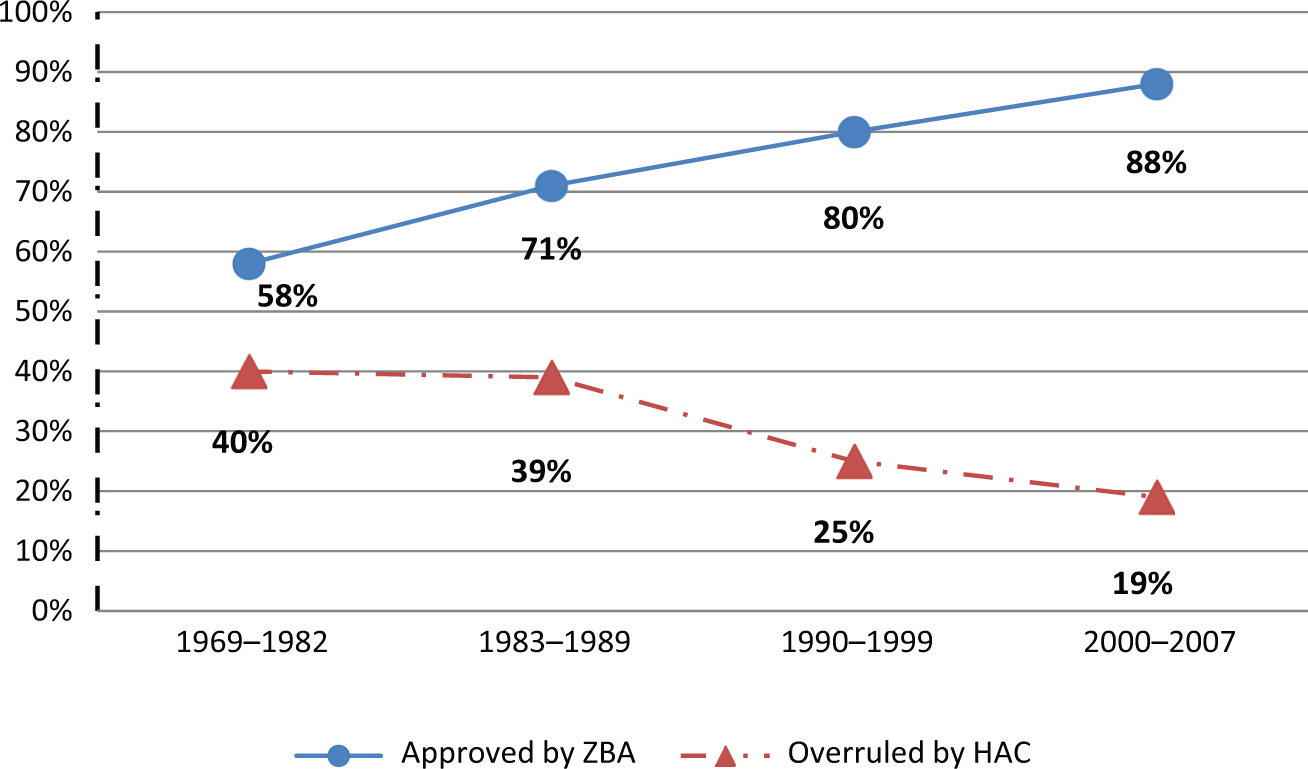
These changes have occurred in four distinct periods: (1) 1969–1984; (2) 1985–1989; (3) 1990–1999; and (4) since 2000. The changes in local–state power relations in the four periods are represented by two quantitative measures: the percentage of applications for a CP that were approved by the ZBA in each period, and the percentage of ZBA decisions overruled by the HAC in each period (as shown in Figure 1). Each variable represents a different theoretical pillar of the Act: decentralization and centralization, respectively.
Changes in state and local government power to control and direct 40B over the years.
Surprisingly, Figure 1 shows that as local government has gained more power, in the sense of the ability to influence the implementation of the Act, the ZBA has approved more CP applications (with and without conditions). As we shall see below, over the years local governments and developers have learned to live with the Act. Thus, over time, the centralized mechanism has given both local governments and developers an incentive to negotiate and agree on liveable compromises. However, the state’s direct influence has decreased and the number of overruled ZBA decisions has decreased markedly. The following section provides an explanation for these changes by analysing briefly the changes in each period.
The first period (1969–1982)
This period, which began directly after the passage of the Act and ended in the early 1980s, can be divided into two phases. During the first phase, 40B generated few proposals and few developments, nearly all of which were subsidized rental housing, built almost exclusively by local housing authorities and non-profit organisations under various subsidy programmes.
The second phase of this period is reflected in two landmark rulings of the Massachusetts Supreme Court. In these two rulings, the Massachusetts Supreme Court upheld and reinforced the power of the HAC to override local ZBA decisions on CP applications. The first ruling is in the Concord and Hanover cases of 1973, namely, that 40B did not violate the state’s Home Rule Amendment.12,13 The second ruling is in the Wellesley case of 1982, 14 which upheld the HAC’s decision to override the Wellesley ZBA’s refusal to grant a CP for a private developer’s project for mixed-income housing. 15
During this period, local government’s power with regard to zoning and land use gradually decreased. Evidence of this is the percentage of ZBA decisions (37%) overruled by the HAC during this period (1973–1982), while only 18% were settled after negotiation between the parties. At the local level, ZBAs rejected 40% of the CP applications, granted about 44% provisionally, and approved only 16% unconditionally. Most of the conditions imposed by the ZBA were considered uneconomical, and most of the developers appealed to the HAC (Heudorfer, 2007; Krefetz, 2001).
In addition to these rulings, starting in the 1970s under President Nixon and increasingly in the 1980s under President Reagan, the federal government began to step back from assisting in the creation and maintenance of affordable housing and sharply reduced subsidies for affordable housing. The general perception was that housing was a problem. Large public housing projects create ghettos of poverty and slums, and therefore the federal government should step back and leave the creation of affordable housing to market forces. This enabled the private sector to become involved in affordable-housing production. The federal programme known as the Low Income Housing Tax Credit (LIHTC 1986–1990) became the major form of financial assistance for housing and was used primarily by private developers who built mainly mixed-income units for rental. With regard to 40B specifically, this situation enabled private developers to use 40B to gain entry to exclusionary communities by including affordable-housing units in their larger market-rate housing projects (Krefetz, 2001; Schwartz, 2010: 103–125).
The second period (1983–1989)
In the second period, local government’s power was minimal. Various state subsidy programmes initiated by the Massachusetts executive branch under Governor Michael Dukakis 16 made production of affordable housing more attractive to developers. The key feature of such programmes was the promotion of mixed-income housing projects (including home-ownership units) rather than the traditional, exclusively low-income rental-housing projects (Stockman, 1992). These programmes encouraged 40B activity, especially by private developers (Heudorfer, 2007). In some municipalities, multi-unit 40B projects were proposed in rapid succession, for 800, 1100, or 1600 housing units, sometimes several in the same locality. This era, dubbed ‘the Massachusetts Miracle’, was characterised by an economic boom and a liberal, activist Democratic state administration that encouraged the production of affordable housing for low- and moderate-income households (Krefetz, 2001).
However, the large number of applications and the large size of the developments aroused opposition of local residents and officials who feared a significant change in the structure of the city and the local community, as well as the impact of such vast increases in the number of residents and vehicles on traffic, infrastructure, and density. As a result, in the second part of the decade many bills aiming to repeal 40B were proposed. In response, in 1988, the governor appointed a commission to review 40B, known as the Grace Commission (Krefetz, 2001; Stockman, 1992). Later, as we shall see, the law’s regulations created a limitation of quantity, which greatly reduced the resistance of local communities to the law. During this period, 27% of all CP applications to the ZBA were rejected, only 11% were granted, and 62% were granted conditionally. Again, in most cases the developers considered the ZBA’s conditions uneconomical, and most of them appealed to the HAC. At the state level, the great reduction in local government’s power was expressed in the high rate (41%) of ZBA decisions that were overruled by the HAC. However, this lack of power encouraged local governments to negotiate with the developers, and about 25% of all cases were resolved through direct negotiation (Krefetz, 2001). 17 These figures indicate attempts by developers and local officials to learn the rules of the game and act accordingly. As shown below, the numbers changed in the next two periods, when local governments understood that they needed to negotiate compromises with developers to avoid state intervention in the form of the HAC overruling local ZBA decisions.
An important landmark in the history of the Act was the Grace Commission report, published in 1989. The report focused on 40B’s contribution to the production of affordable housing, but it recommended some modifications in the regulations so as to give greater weight to local needs and desires (such as broadening the definition of low- and moderate-income housing in such a way that a locality could meet the 10% affordable-housing threshold by including privately developed housing units). These modifications encouraged local communities to support such projects and dramatically increased the number of private developers submitting CP applications (Stockman, 1992).
The third period (1990–1999)
The third period began with the 1989 regulations that gave local communities more control over 40B by requiring developers to seek out and consider the views of local officials and to be more sensitive to the specific needs and concerns of the community.
During the early 1990s, as a result of an economic recession and falling housing prices, housing activity slowed considerably and most of the state housing-subsidy programmes were eliminated (Heudorfer, 2007; Krefetz, 2001). An exception was the newly established Local Initiative Program (LIP), 18 created by the Department of Housing and Community Development (DHCD) in 1990 on the recommendation of the Grace Commission (Heudorfer, 2007; Stockman, 1992). The programme’s aim was to encourage local communities to become proactive in shaping affordable housing proposals, rather than having them imposed by ‘outsiders’. Its key features were a government subsidy, broadly defined; technical assistance provided by the DHCD; the possibility of using an approved CP in the LIP; and preference for local residents in 70% of the units (Krefetz, 2001: 410).
In essence, the LIP gave local governments a means of exerting power to control and direct the implementation of 40B. For the most part, this enabled local officials to ensure that the projects would be relatively small, so as to avoid a major strain on infrastructure and protests from local residents, who objected to large developments. The programme limits construction of housing for the elderly (which was viewed as a drain on local finance) and encourages family-housing production. However, in 90% of these projects, local officials made sure they would serve ‘deserving’ local families, that is, moderate- (not low-)income residents, at the top of the allowable range (80% of the area’s median income), such as municipal employees and upwardly mobile younger families (Heudorfer, 2007; Krefetz, 2001: 412). Almost all the LIP proposals were made by private developers and had fewer than 25 units (that is, only 6–8 affordable units per project).
During the 1990s, the local ZBA granted 27% of all CP applications outright and approved more than half the applications (53%) conditionally. In contrast to the developers’ actions in the first two periods, in this period they accepted the conditions, because often they were able to negotiate unofficially with town officials. At the state level, the number of appeals to the HAC decreased dramatically, from 165 to 56, of which more than 38% were settled through negotiations between the local government and the developers, and only 25% of the appeals against ZBA decisions were overruled by the HAC (Heudorfer, 2007; Krefetz, 2001).
However, by the end of the decade, when an economic recovery occurred and there was a dramatic increase in CP applications, many local officials again were resentful of 40B and began protesting against the law. This led to another slew of bills initiated in the state legislature, aimed at gutting or repealing 40B. This then led to the creation of another commission to review the law, resulting in the introduction of new regulations in 2001, which made the policy less objectionable to local communities.
The fourth period (2000–2010)
The fourth phase began with the modifications of 2001, which continued the trend of the 1989 and 1999 regulations, giving more weight to local government in two distinct ways. First, they made it easier for localities to avoid appeals by lowering the number of subsidized housing units to be created annually to meet the agreed-upon 10% threshold, 19 and they granted more flexibility concerning when units were first counted toward the 10% goal. 20 Second, and more important, they limited the project size to 150–300 units, depending on the size of the locality, and also limited the number of 40B proposals that could be submitted to a ZBA per annum. 21
During this period, CPs proposals tended to be less objectionable to local officials, which led ZBAs to approve CPs for many new development proposals. Consequently, the number of appeals to the state HAC gradually declined and only in 19% 22 of all appeals that resulted in a formal decision were ZBA decisions overturned. Moreover, of all the projects built after 2000, only 12% were approved following appeals to the HAC (as compared with 33% during the first 30 years). Most of the remaining 88% were approved at the local level, suggesting that municipalities and developers were willing to make compromises they could live with. It is important to note that during this period increased training, guidance, and resources were made available by the state’s housing agencies to help municipalities navigate the complexities of 40B (Fisher, 2007; Heudorfer, 2007: 19).
In addition, the significant increase in US housing prices in general, and in Massachusetts in particular, increased the percentage of families in need of housing assistance. This external factor changed the attitude of many municipalities toward the Act and enabled them to support 40B projects in order to produce affordable housing units for their residents.
Since 2000, production under 40B has almost attained that of the previous 30 years taken together (Heudorfer, 2007), and the stream of proposals led to an attempt to repeal the law in a referendum scheduled for November 2008. Although the proponents of repeal failed to collect enough valid signatures to secure a referendum, after the referendum attempt the regulations changed to give more power to local communities for rejecting or modifying 40B proposals. 23 Moreover, because 40B is primarily market driven and relies mostly on private developers, the slowdown in the economy since 2005 has again dramatically reduced the number of 40B applications (Heudorfer, 2007).
Although the number of 40B proposals declined, another attempt to repeal 40B was made by persistent opponents of the Act. This time they succeeded in getting enough signatures to place a repeal 40B referendum on the state election ballot for November 2010. However, this referendum was defeated by a 58% vote to retain the Affordable Housing Act, and the repeal was rejected by voters in the overwhelming majority of cities and towns (Krefetz and Furman, 2011). 24
In sum, as shown in Figure 1, until the 1990s, local governments had no formal means of control over 40B projects. However, since that time, and especially since the beginning of the new millennium, as local power has gradually increased, local governments have tended to approve more CP applications. These findings reflect a long mutual-learning process for local officials, developers, and state officials. Because the HAC consistently overruled ZBA decisions that did not fit the local housing needs of low- and moderate-income residents, eventually local officials realised that it was in their interest to negotiate the conditions with the developers and make compromises. This can explain the increasing number of approvals with conditions that are now accepted by the local zoning board. The players – the state officials, the local officials, and the developers – have learned each other’s strategies and have changed the lose–lose situation to a win–win one, which has produced more affordable units and also benefited the low- and moderate-income residents.
Overall 40B outcomes
The analysis of 40B outcomes can be divided into two categories: the geography, and the supply of affordable housing. As mentioned in the beginning, in terms of geography, the Act succeeded in changing, at least partially, the dispersal of affordable units in Massachusetts. In 1969, in only 3 localities in Massachusetts was more than 10% of the housing affordable by low- and moderate-income households; in 2010, the number of such localities was 54; 14 localities were at 9%−9.9%, and another 54 were at 7%−8.9%. Altogether, 35% (121 of 351) of the localities in the state were over 7%, and half of all Massachusetts cities and towns (176 of 351) were over 5%. Even more impressive, many of the municipalities that passed the 10% threshold are affluent suburbs of Boston, such as Lexington, Concord and Lincoln (Krefetz, 2010).
More than 60,000 housing units have been built statewide under 40B since 1969; the vast majority (more than 42,000) are apartments and almost 18,000 are home-ownership units (either single-family homes or condominiums) (CHAPA, 2011). The number of affordable units is far from meeting the need, which in 2010 was estimated at more than 100,000 units (Krefetz, 2010). But the anti-snob zoning law in Massachusetts created substantially more low- and moderate-income housing in the suburbs than would have been created if the statute had not been enacted (Cowan, 2006).
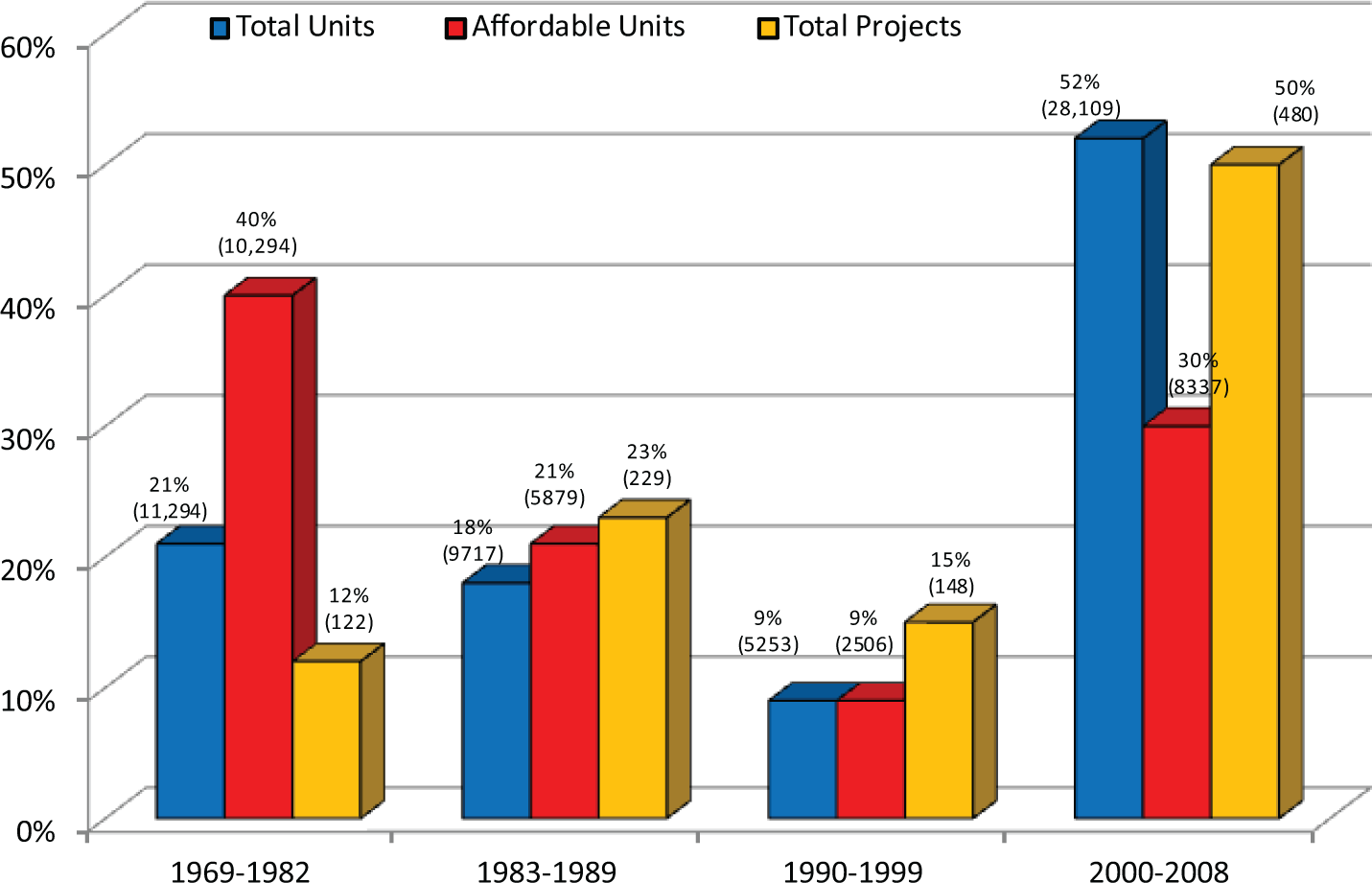
However, understanding the power relations between local and state government with regard to the production of affordable housing requires an analysis of additional categories, such as the total number of units produced in a total number of projects, the average size of the project, the type of developer, the target population, the total number of affordable housing units produced, and the localities involved. Figure 2 presents the total number of units, the total number of projects, and the total number of affordable units that were produced in each period.
Total units, affordable units, and projects in each period.
During the first period (1969–1982), 40B was used almost exclusively by public housing authorities and non-profit organisations under programmes that were heavily subsidized, usually by the federal government (Krefetz, 2001). About half of these were relatively large projects (more than 100 units each), and another third comprised 50–99 units each. Almost all of these units (95%) were affordable for low- and moderate-income households. Thus, they constituted 45% of all affordable units produced during the 43 years of the law’s existence (but only 24% of all units produced, and only 15% of all developed projects). About half of the units were for elderly residents, a quarter were for families, and another quarter were for mixed family/elderly.
During the second period (1983–1989), in which the federal government cut funding for housing, production by public housing authorities and non-profit organisations decreased drastically, as did the larger projects. However, the Massachusetts state government initiated several new housing programmes (such as the HOP), and encouraged private developers to participate, using internal subsidies. Thus, 40B was an important tool for allowing private developers entry into affluent communities and the possibility of building profitable projects. Due to more local control (mainly through the LIPs), almost half (43%) of all projects comprised up to 24 units only, 25 and only 8% of the projects comprised more than 100 units. The target population was mostly (65%) mixed-income families.
During the 1990s, with the increase in local power to control and direct CP proposals and to modify them according to local community needs, two trends became apparent. On the one hand, local authorities granted many more CP approvals, thereby increasing the number of 40B projects that were built. On the other hand, most of the CPs granted were for small projects (fewer than 24 units), built by private developers, with relatively few affordable units – often only 25%, which is the minimum required for a 40B project.
Since the beginning of the new millennium, these trends have become even more evident. More than half of all the units (52%) built under 40B over a period of 40 years and 50% of completed projects comprise less than 30% of all affordable units (Heudorfer, 2007). Moreover, these affordable units were built mainly for moderate-income rather than low-income residents. Moderate-income households were viewed as more ‘deserving’ of the housing because they included young local families that had been priced out of the housing market and municipal employees, including teachers, police officers, and firefighters, in contrast to ‘undeserving families and individuals’, that is, mainly low-income households that tend to be perceived as a drain on society and that tend to be disproportionally black and Latino (Krefetz, 2010). This may be due to modifications in the Act that allow local residents to define who deserves to be part of their community and who can be kept out. 26
However, those modifications, and especially the increase in local power to control and direct the Act, opened up more localities to affordable-housing production. Since 2000, 75% (263) of all Massachusetts localities have had CP projects, as compared with 52% (181) during the law’s first 30 years (Heudorfer, 2007). Moreover, since 2000, more localities have developed affordable-housing policies. Thus, increased local power in combination with state support has encouraged local governments to take an active role in shaping affordable housing proposals, rather than having them imposed by outsiders (Krefetz, 2001).
Can centralization, decentralization, and welfare go together? Looking back for the future
Chapter 40B was intended to overcome snob zoning in Massachusetts and to open up the suburbs to low- and moderate-income residents by encouraging the production of affordable housing statewide. I set out to examine whether the combination of centralization and decentralization in this early and unique legislation could provide housing solutions for low- and moderate-income residents and to discover lessons for other governments.
As we have seen, the answer is not simple. Throughout the 43 years of the Act’s existence, it has undergone modifications that have affected its implementation and outcomes in various ways. The outcomes and the interpretations of them are highly controversial, as is the answer to the question.
Although the Act itself has not been modified since it was passed, major changes have been made in its regulations, reflecting and creating changes in the power relations between local and state government over time. As we have seen, when the state’s centralized power was greater, 40B produced greater local resistance. However, it resulted in production of a greater number of affordable units, in large projects created by public housing authorities and non-profit organisations.
Since the 1990s, local communities have begun to regain some control over 40B projects, and less opposition to them has come from local residents and officials. But the projects built under 40B have been smaller than earlier ones, have been built mainly by private developers, and for the most part have served the upper levels of the defined target population. The developers would rather build as many large projects as they can, but local authorities have gradually begun to limit the number of units and the percentage of approval of projects.
This relationship between centralized and decentralized policies can be described as a pendulum: the degree to which the needs of the target population are met changes as the pendulum changes position. When it is closer to centralization it produces more units of affordable housing for low-income residents but also encounters more resistance from local residents and officials. When it is closer to decentralization, it produces fewer affordable-housing units but generates less discontent in local communities.
The overall picture, however, is not so dichotomous, because the public benefits cannot be measured only by the number of affordable units. Other substantive (often conflicting) variables must be taken into account, such as the target population, the characteristics of the locality and its experience with affordable-housing production, local community needs and vision, and willingness to accept low- and moderate-income residents. Opening up the suburbs to low-income households is important; however, a suburban location is not necessarily the best and only environment for all lower-income householders. A comprehensive policy should also generate affordable housing – especially rental housing – inside the cities, to provide low-income households a choice of various locations.
It is also evident that, in many cases, fear of state intervention in local zoning power has induced some municipalities to adopt a proactive approach to the issue by initiating their own affordable-housing policies. It has also motivated an increasing number of municipalities to be more willing to negotiate informally with developers than to deny them a CP. As a result, the number of appeals to the state HAC has decreased dramatically, and the approval process has become faster and more efficient on both sides. Thus, the law’s impact is seen not only in its direct outcomes, but also in the institutional behaviours adopted indirectly, as by-products of it.
In sum, 40B provides an interesting case study for examining the relationship between two contradictory concepts: centralization and decentralization. My findings indicate that a combination of centralized state power and local government authority can open up some suburban areas, thereby benefiting lower-income households, but mainly moderate-income households, which local communities consider less ‘undesirable’ and for which private developers are more interested in building housing.
The findings also show that leaving the responsibility for the production of affordable housing entirely to local governments or private developers is not effective. Centralized (state and federal) power is needed to create housing solutions for low-income residents.
Furthermore, the need for centralized intervention is more important today than ever before in light of the global economic crisis that began in 2007. The crisis has increased the need for affordable housing but has also decreased the incentive of local governments and private developers to be involved in affordable-housing production in general and under 40B in particular.
Thus, the production of affordable housing for moderate-income residents and, even more crucially, for those of low income, should not be based mainly on the economic interests of private developers. A good example is Connecticut’s new regulation (July 2013), which is modelled on 40B and requires a substantial percentage of the units to be set aside for low-income residents. 27 A comprehensive affordable-housing policy must include a package solution of laws and regulations. The Massachusetts Anti-Snob Zoning Act (40B) is an effective tool, but it is only a small part of an overall strategy that must be implemented to ensure affordable housing for all who need it.
Footnotes
Acknowledgements
My sincere thanks to Susan Fainstein who introduced me to the Massachusetts Affordable Housing Policy, and to the leading scholars in this field, and encouraged me to study the issue during my Fulbright post-doctorate period at Harvard Graduate School of Design under her supervision. Special thanks to Sharon Perlman Krefetz for helping me to understand the political and social complexity of the Act, and its outcomes and changes over the years; and to Naomi Carmon, who inspired me to publish the paper. I also thank Norman Fainstein, Rachel Bratt, Rachelle Alterman, Gila Menahem, Itai Sened, and the anonymous Urban Studies reviewers for their useful and challenging comments which have strengthened the article.
Funding
This research benefited from a generous grant from the Gazit-Glob Real Estate Institute of the Interdisciplinary Center (IDC), Herzliya.