







Abstract
This paper looks at the impacts of the 2008 global financial crisis on Leeds, a medium sized city in northern England, which in the last decades has specialised in finance-related economic activities. Our aim is to understand if the largely neoliberal pre-crisis urban growth model pursued in Leeds, based significantly on real estate speculation, retail and finance, was put at risk by the crisis and whether a collective reflection by local leaders took place about the need to change direction. To do that we have conducted interviews with experts in the city and analysed policy documents in detail. We focus, in particular, on how the crisis was constructed as affecting Leeds and more specifically if the socio-economic development trajectory and associated urban governance model have changed. We conclude that there has been little reflection and questioning of the underlying principles of the urban growth and governance model in Leeds.
Keywords
Don’t get me wrong. It’s been the worst recession we’ve ever known. But it’s been worse elsewhere. (Interview with a Leeds businessman, 17 May 2011)
Post-crisis local governance
Cities are and have been at the root of the recent global financial crisis (Oosterlynck and Gonzalez, 2013). In this paper we analyse what the crisis has done to a middle sized European city such as Leeds in terms of questioning (or not) the previous urban growth model and its associated governance mode and whether the crisis has served as a critical reflection point for the main political and economic figures in the city. These questions sit within the broader inquiry of the changing nature of urban neoliberalization.
In their seminal paper on the fate of local governance in the era of neoliberalization, Peck and Tickell described the situation as one of ‘global-local disorder’, in which the lack of supra-local regulation constraining the logic of market competition leads local authorities to be governed by the ‘jungle law’ of inter-local competition (Peck and Tickell, 1994). In subsequent work, Peck and various co-authors have continued to stress the crisis-induced nature of neoliberalization (Peck and Tickell, 2002; Peck et al., 2010) and, as the debate proceeded, have paid increasing attention to its systematic geo-institutional variation as a source of its continued vitality (Brenner et al., 2010; Peck and Theodore, 2007). They call for a variegated approach to the study of neoliberalization, which focuses simultaneously on three different spatial registers, namely local regulatory experimentation, supra-local rule regimes and inter-local transfer of policy ideas and practices. This multi-scalar and networked approach addresses a more sustained analysis of the contextual specificity of local experiments in neoliberalization.
In this way, Peck and co-authors have created – at least in theoretical terms – some conceptual space to accommodate Wilson’s (2012) recent suggestion to look at local authorities as active participants in inter-local competition. According to Wilson, local authorities do make political choices to engage with particular fractions of capitals and disengage from others. One can focus on how the scope for action of local authorities is constrained and limited by the parameters of inter-local competition, pushing them towards entrepreneurial forms of local governance. However, we should not overlook how this constant drive for inter-local competition also allows for a wide array of local economic development and governance strategies. Peck et al.’s variegated approach, plus Wilson’s call for taking local agency seriously, ties in with a post-structuralist critique of ‘monolithical’ accounts of neoliberalism (Larner, 2003). The challenge, Larner argues, is not so much to account for ‘the rolling out of a coherent programme’ (Larner, 2003: 512) but rather to look at the different, hybrid and contradictory forms it assumes, chart the intellectual, professional and policy agencies that make it travel across space and analyse the experiments through which new spaces and subjects are produced. Along the same lines, Ong stresses that neoliberalism does not produce the same results everywhere. She pleads for an analytical focus on how neoliberalism ‘is selectively taken up in diverse political contexts’ and on neoliberal encounters with other political rationalities (Ong, 2007: 3). She refers to this as ‘neoliberalism with a small n’ in contrast to Neoliberalism as a global form that imposes its rationalities on each and everywhere.
The global financial-economic crisis gives us a good opportunity to explore the historical contingency of neoliberalization, the specific agencies that drive it and the way it unfolds through experiments and combines with other political rationalities. More specifically, as the crisis gives rise to strategic disorientation (Jessop and Oosterlynck, 2008), it provides a privileged entry point through which to analyse how local authorities do make political choices and strategically reflect on which particular forms of capital to align with.
This paper attempts to take local politics seriously in the neoliberalization process by analysing how, first, key actors in the city of Leeds have discursively constructed the global financial-economic crisis and what it meant for their local development strategies and associated mode of local governance, and second, if and how the city has adapted its imaginaries, either in ways that deepen the pre-existing socio-economic development trajectory and associated urban governance model or in ways that create a clear discontinuity with the pre-crisis economic and political trajectory of the city. In order to do so, we use an interpretivist approach. This approach is here based on interviews with key persons from the city council and regional authorities, the financial and consultancy industry, the real estate sector, business associations and local development experts 1 and document analysis of national and local policy and think tank reports, strategy documents, policy briefs and press coverage. We have also attended and participated in many local economic development-related events, as well as critical/radical events and actions organised by trades unions and anti-cuts groups. We analysed how actors at the urban scale have tried to make sense of the global financial-economic crisis, identified the most important discursive sites in the city region and beyond from which the crisis as it pertained to the city was narrated (Dixon and Hapke, 2003). We also observed how urban actors discursively repositioned the city, both in terms of its local economic development strategy and the associated governance model.
We will analyse in depth the particular local context in which crisis narratives are forged. Although we converge with post-structuralism on the contingent, experimental and selective nature of processes of neoliberalization, we do not want to ignore that neoliberalism is also shaped by and durably inscribed in broader macro-institutional and economic structures and processes. The latter set the parameters within which this discursive variation of crisis interpretations can unfold and which structure the field on which crisis narratives find vehicles for their implementation.
It is important to note, though, that these macro-level institutional and economic structures and processes impact differentially on particular localities (Brenner et al., 2010). To analyse how this local mediation shapes local agency, we use Cox’s concept of space of dependence (Cox, 1998: 2). Spaces of dependence are ‘those more-or-less localised social relations upon which we depend for the realisation of essential interests and for which there are no substitutes elsewhere’. The spaces of dependence of different actors vary in reach widely. The local economy is a crucial space of dependence for local government, as for example the number of unemployed and the tax base constituted by the income of local residents and businesses directly determine its capacity for action. Real estate agents are often also highly dependent on the local property market dynamics, whereas the spaces of dependence of financial institutions may vary dependent on where their business operations and funding sources are located. Since the global financial-economic crisis is unfolding unevenly across space (and time), we hypothesise that the narration of the crisis will vary between different actors dependent on the timing and intensity of the impact on their space of dependence. Our analysis is inspired by these concerns but first we provide an account of the pre-crisis socio-economic development trajectory of Leeds.
The ‘boom times’: Leeds Corporate City
Leeds is a city in northern England with a growing population of around 750,000 within its municipal boundaries but about 3 million residents in the wider city region, which comprises 11 local authorities (Leeds City Council (LCC), 2012). It is the biggest city in the region of Yorkshire and one of the fastest growing economies in Britain in a relatively less wealthy region. It is also a diverse city with 11% of the population being from black and minority ethnic origin. Traditionally a textile, trade and manufacturing centre, a deindustrialisation process and a shift towards service-based employment took place from the 1970s onwards. By 2011, 86% of the total jobs in Leeds were in small businesses in the service sector (Leeds City Council, 2013a) with a lower share of public-sector jobs than other northern British cities (Centre for Cities, 2011). Leeds City Region’s GDP per capital is 95% of the average EU27 and similar to other major British cities beyond London (Eurostat, 2013).
Over the course of the last three decades Leeds has particularly expanded in the financial services sector with a 68% growth between 1981 and 1991, making Leeds the fastest growing financial centre outside London (Tickell, 1996: 103) while between 2003 and 2013 employment in manufacturing fell by 29% (Leeds City Council, 2013a). This distinguishes Leeds from other cities in the north and the city has explicitly marketed itself as a ‘financial city’. The growth of the sector is partly due to the decentralisation of offices from London, but also the tradition of building societies in the Leeds region (e.g. Halifax, and Bradford and Bingley). Leeds has also built up strength in the legal aspects of finance, mortgage-based and retail finance and call centres (Henderson, 2005).
Apart from finance, property-led regeneration has been another important pillar of Leeds ‘skyscraper city’ (Chatterton and Hodkinson, 2007) local development strategy. Over the last decades, Leeds has been promoting apartment ‘city living’, a strategy to attract young, educated, middle class and mainly childless professionals to otherwise depopulated city centres (Nathan and Urwin, 2005). In Leeds, 9500 apartments were built between 2003 and 2009 but many more were planned (Unsworth, 2010) in a property boom, fuelled amongst other things by the inflow of investment capital released by the collapse of stock markets after the 9/11 (11 September 2001) events. Many city centre apartments in Leeds were bought as ‘buy-to-let’ investment opportunities (Unsworth, 2010). Property development was, however, not limited to apartment construction. Shopping and retail has also been a major focus for the city, which has an aspiration to climb up the national retail league table ahead of Manchester (Locate in Leeds, 2012). Testimony to this strategy is the recent opening of the biggest urban shopping mall in Western Europe in March 2013.
But beyond this ‘success story’ of Leeds’ financial centre there is also a divided city. Of Leeds’ Super Output Areas 2 19% are in the 10% most deprived nationally (Leeds City Council, 2013a). It is also a segregated city with most of the ethnic minority population concentrating in a few neighbourhoods in the inner city and relatively big pockets of white working-class-dominated social housing areas, while more affluent residents live in outer suburbs.
In terms of local governance, Leeds has historically had a lower external profile than cities such as Manchester, which have been more entrepreneurial and developed more coherent city marketing strategies (Haughton, 1996; Ward, 2003). However, according to Haughton (1996) in the 1990s the city developed a ‘Corporate City’ model, establishing formal partnership mechanisms between the public and private sectors to steer local economic development strategies. The core of this partnership has been the ‘Leeds Initiative’, established in 1990 with important economic development visioning and coordinating duties. As part of this corporate network, in 1993 the Leeds Financial Service Initiative was established, a membership organisation of the leading financial companies in Leeds with participation from Leeds City Council (Tickell, 1996). Both of these organisations have now been dismantled and their functions absorbed by Leeds City Council and the Chamber of Commerce, respectively, as part of local austerity cuts.
In terms of the governance of economic development, Leeds has been subject to recurrent changes. While the Labour governments from 1997 to 2010 established regional governance structures, such as Regional Development Agencies (RDAs) (Yorkshire Forward in the case of Leeds/Yorkshire), the Liberal Democrat–Conservative government coalition abolished the regional structures (Yorkshire Forward in March 2012), purportedly as a cost-saving measure, but equally so to finish the top-down regional approach of New Labour (Allmendinger et al., 2013). The new government followed a supposedly ‘new localism’ approach that increased financial autonomy of cities such as Leeds over transport, training, infrastructure and employment and created a new subregional planning level with the Local Enterprise Partnerships (LEPs), which aim to give private business more power over planning and economic development issues.
So Leeds has developed its own variety of urban entrepreneurial development, based on property-led regeneration, particularly around speculative and narrowly designed apartment construction, iconic tall buildings and finance-related jobs employment. It has strived to develop a Corporate City with public–private partnership at its heart. In short, a finance and real estate-led urban growth model.
And then the crisis arrives …
When the property bubble burst in the USA in 2007 and its consequences began to reverberate through the international financial sector, it seemed sure that this property-led regeneration and financial industry-based local development strategy of Leeds was unsustainable and would be fundamentally reoriented. Our interviews with key persons and document analysis reveal a more nuanced picture, highlighting the strategic choices made by local politicians to maintain their allegiance with the financial industry, real estate and retail. The narrative of the crisis in Leeds for most actors we interviewed started with the collapse of Lehman Brothers in September 2008, with the Northern Rock bank crisis earlier in 2007 seen as something relatively disconnected. It is interesting that the collapse of many of the key real estate projects that symbolised the ‘boom times’ did not seem to register as big markers in the crisis narrative in Leeds.
In November 2007, before the Lehman Brothers collapse and just after the Northern Rock crisis, the Green Bank project was shelved (Yorkshire Evening Post (YEP), 2007a) as a ‘result of the current uncertain market conditions for high-rise apartments in central Leeds’ (YEP, 2007a). In December 2007, Leeds University academics (including an author of this paper) wrote a public letter exposing many of the excesses from the urban development boom (YEP, 2007b) and held a well-attended public meeting. But reflections were dismissed by the leader of the council who, in a public response, confirmed Leeds’ urban development path (Yorkshire Evening Post (YEP), 2007c).
In January 2008 a conference held by Leeds City Council on the future of the city centre showed no doubts on the sustainability of the property-led growth model. Equally, internal minutes of the Leeds Initiative showed no discussion on the recession or on the sustainability of Leeds’ growth until September 2008. There were some signs of the slowing down of the city-centre apartment market boom but publicly the message was ‘business as usual’ (Outside, 2007).
In July 2008 two of the more iconic real estate projects in the city centre (Lumière Towers and Criterion Place) were put on hold, but they did not feature prominently in the crisis narrative amongst our interviewees. When asked why, some of our interviewees described them as extravaganzas from the boom times but not related to a wider problem in the model of economic growth in the city or the wider worries in the global economy.
However, we identified differences in the analysis of the start of the crisis between local actors that are related to different economic sectors. This emerging variety in discourse highlights how the different spaces of dependence of local actors shape their narration of the crisis. A prominent player within the Leeds financial accounting and legal service sector noted that business for corporations had been very good in 2008 and there was little to announce the imminent collapse (see also Financial Times, 2008). In contrast, a leading actor in the apartment renting business in Leeds told us that he could see the crisis coming much earlier: We were at the sharper end and we could see demand falling, […] looking objectively at the schemes plotted on the map, […] they cannot build 800 flats, yet the banks would fund it, big businesses was all over it […] who wants to believe it is going to stop? (Interview, 17 May 2012a)
Another important local property director also took special measures after the Northern Rock crisis and started selling property and stopped all expansions but ‘could not find anyone else that was as worried as us’ (Interview, 16 May 2011), either locally or nationally. The lack of discussion in Leeds between business and political leaders about the global economic situation was also noticed by other interviewees. Although this in part signals a lack of strategic leadership in Leeds, it has also to do with not wanting to disrupt the markets which function on trust. As another interviewee pointed out ‘nobody locally wanted to be held responsible for “scaring the markets”’ (Interview, 4 February 2011).
What seems to be a more relevant turning point for the Leeds economic elites were the crises in the financial sector. Tellingly, the head of a legal accountancy firm told us that the crash of Lehman Brothers was the most significant event signaling the coming of the crisis in Leeds. In his words: ‘In Autumn 2008 here in Leeds it was almost as if the economy went in panic mode […] what was happening is that transactions, businesses, deals were stopping mid-track [property and corporate transactions]. All relied on finance, so they just stopped’ (Interview, 16 May 2011). The impact of the Lehman Brothers’ bankruptcy was immediate in the finance sector in Leeds, which reflects the dependence of the Leeds financial sector on the space of operation of international finance and its concomitant disconnection from the local economy.
If the Lehman Brothers event affected the corporate heart of the financial sector in Leeds, the ‘socialisation’ of this crisis in terms of job losses did not take long to materialise as the banking crisis spread. In September 2008, Halifax and Bank of Scotland (HBOS), the UK’s first retail mortgage lender, was taken over by the Lloyds bank to prevent another ‘Northern Rock’ (BBC, 2008). Immediately after, the superbank had to be bailed out by the Bank of England. With the merger more jobs were at risk in the region, particularly in Halifax, a town in the Leeds City Region where the bank employed 6300 and accounted for 36% of the town’s ‘output’ (LCC, 2008: 306). The Regional Development Agency and its Chief Executive Tom Riordan and the then (Labour) Regional Minister Rosie Winterton drafted a document to convince Lloyds/HBOS bosses to keep jobs in the Leeds region (FDI Matters, 2008). Yorkshire was presented as a ‘team’ where private and public sector ‘were united around one vision […]: to deliver business friendly growth and opportunity based on a clear understanding of business needs’ (Yorkshire Forward, 2008: 3).
It is interesting to note that at this crucial time it was the regional governance structures that were mobilised while the local authorities took less of a leadership role. As mentioned before, Leeds has historically been seen as a city with weak leadership and visibility. Many of our interviewees mentioned the lack of leadership by the local authority in the beginning of the crisis. In contrast to other cities that prepared anti-crisis packages and plans (Clark, 2009), there were no significant taskforces, meetings of economic and political leaders or public plans in Leeds that addressed the crisis. This can be explained partially by the English local governance system where there are no strong mayors and, in particular for Leeds, the sharing of the leadership in the local authority between two different parties. But our analysis shows that even despite the existence of a long-standing private–public partnership that informs the strategic policy direction of the city (Leeds Initiative), there is a lack of semi-formal governance structures that bring together decision makers from different sectors.
The comparison between different versions of the crisis narrative in Leeds leads us to some theoretical reflections. In Leeds, many financial businesses are branches of national and multi-national companies, with clients involved mainly in international and national rather than local transactions. Hence, although many of these actors are physically based in Leeds their business is not spatially dependent on the local or regional political economy nor linked to local real estate developments. The difference in crisis narratives among Leeds-based actors can hence be explained by the differences in their diverse spaces of dependence. One may also hypothesise that the lack of strong local strategic leadership in Leeds is due to the strength of the financial sector, which is less locally dependent and hence does not take strong interest in the fate of the local economy. Financial businesses were involved in national and international financial networks and their narrative of the crisis very much followed events in the international financial markets, while local real estate companies are directly involved in the local urbanisation process and consequently had a more direct view on the ground, seeing the slow-down in the property market coming much earlier.
Leeds, still a finance-city? The resilience of the Leeds’ diverse economy
In this section we concentrate on the changes in the local socio-economic development strategy and its associated economic imaginary in Leeds and whether this has been challenged with the crisis.
An important impact of the global financial crisis and the HBOS problems were that they directly questioned the image of Leeds as a financial centre. Banks were being blamed in the media for causing the financial crisis. This was echoed locally by critical voices coming from the margins of the local governance network. The Civic Trust, a heritage local civil society group, published a report in 2009 asking ‘how sustainable is this dependency on circulating money and not actually producing things?’ (Civic Trust, 2009: 4). They saw the crisis as an opportunity to rethink Leeds as more sustainable, green, family friendly, with less focus on retail and finance.
However, the local political elite did not have any intention to change its alliances with the financial and property development fractions of capital. A campaign to save the image of Leeds as a financial city was put in motion by business and political leaders (Interview 17 May 2011b) explaining that the financial and banking sector in Leeds was more ‘ethical’ than the London City model, with interviewees stressing the regional ‘mutual’ tradition. The sectoral diversity of the economy was also stressed where also manufacturing is still important.
But it was not just an ‘image’ crisis, the global financial crisis also meant actual job losses in the Leeds financial sector. Various interviewees mentioned the autumn/winter of 2008/2009 as a key period. In January 2009 a report by the national think tank Centre for Cities predicted that cities such as Leeds, disproportionally based on the financial sector, would be hit hard by the global crisis with a worst case scenario of 28,000 job losses, 30–40% of which would be in the financial sector (Larkin and Cooper, 2009). This report triggered a response from the Leeds City Region that tried to mitigate the pessimistic predictions: We agree with the Centre for Cities report that financial and professional services will remain critically important to the city region economy. However, we also recognise that a number of other areas of the economy are important […] we are in the process of identifying activity that in the short to medium term will help the city region improve its economic resilience during the current downturn. (emphasis added, Leeds City Region, 2008)
Here we see the effort by Leeds’ leading economic actors to discursively diversify the economic base of the city to minimize the impact of the crisis in the financial sector.
Starting from March 2008 and by December 2008 a clear trend of unemployment growth had been established, accompanied by a growth in people claiming unemployment benefits (see Figure 1). In March 2009 a report commissioned by Yorkshire Forward highlighted the extent to which the Leeds financial sector had been affected by the crisis. It noted that the sector employed 240,000 in the Leeds City Region area, 20% in terms of workforce and 27% in terms of output and that as many as 97,000 jobs could be lost in the worst-case scenario (Hansard Commons Debate, 2010). However, our interviewee at Deloitte, which authored the report, recognised that these predictions had been too pessimistic. In fact, in December 2009 these forecasts were revised down as expressed in January 2010 by Rosie Winterton, Labour Regional Minister for Yorkshire in Parliament: […] the likely impact of the recession on financial services industry in Leeds will be less than had been expected. […] The sector has proved resilient through the downturn and over the longer term it is expected to continue to lead the growth of the regional economy. (emphasis added, Hansard Commons Debate, 2010: Column 944W)
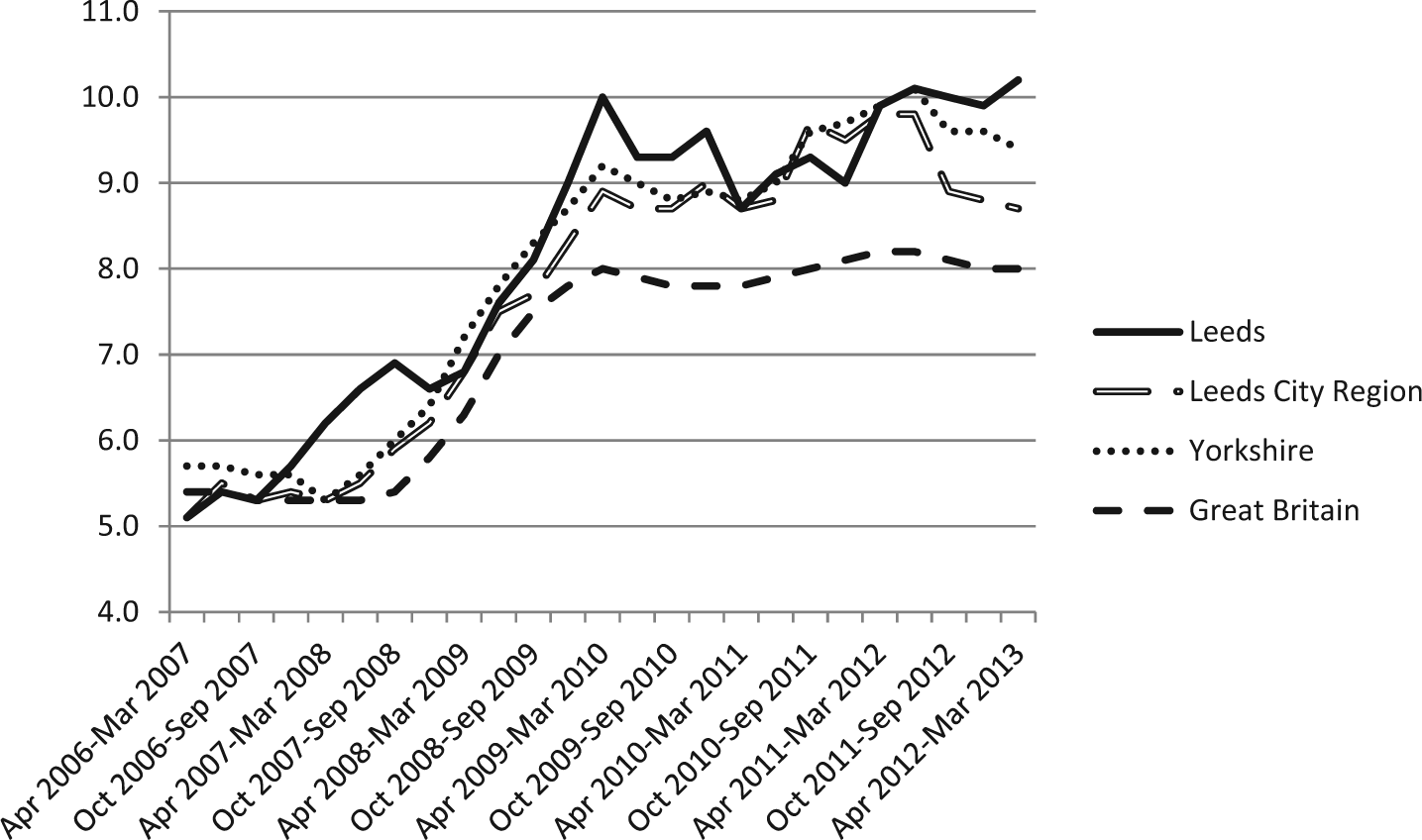
Unemployment rates in Leeds, Leeds City Region, Yorkshire and Great Britain.
What the variations in the story around financial job losses show is that despite the initial shock and forecasts the financial sector lost fewer jobs than expected; one source mentioned 8000 jobs between May 2008 and July 2009 (Insider Media Limited, 2010), actually fewer than job losses in manufacturing, which did not attract as much attention. This reduced impact on financial sector jobs has strengthened the discourse of the resilience of the financial sector in particular but more in general to the whole economy in Leeds. In terms of the financial sector one interviewee, working in an international accountancy consultancy, in fact pointed out that that their businesses had not necessarily worsened but changed (Interview, 9 May 2011). Rather than providing advice on how to grow they now gave more advice on business restructuring. So although big mortgage lenders might have been affected very negatively, other parts of the sector found opportunities in the crisis.
The resilience of the local economy has become a fashionable metaphor amongst national and local policy makers since 2008. Its adoption by local elites in Leeds has helped them to maintain pre-crisis alliances and pre-crisis economic development trajectories and obscure its adverse impact on already disadvantaged places and social groups in the city. Although there has been a wealth of critical work within the academia on resilience recently, often policy makers have used the term in a narrower way, assuming the neoclassical economic principles of the existence of an equilibrium to which the economy would ‘bounce back’ after a period of crisis (Pike et al., 2010). This of course obscures any problems with the pre-existing neoliberal conception of local and regional development and indeed that the cause of the crisis might lie in that ‘normalcy’ that is hoped to return to.
In Leeds, the resilience discourse has been constructed by a series of local, regional and national think tanks and policy actors and has been particularly sticky. Only since the crisis has the term been fully incorporated into economy policy discourse but it has also shifted meaning. The Leeds Agenda for Improved Economic Performance, effectively the economic strategy document for Leeds which was revised in the midst of the crisis, for example begins: ‘Our Agenda for improved economic performance and a diverse and resilient economy Leeds must be a great place with skilled people and competitive businesses’ (Leeds City Council, 2011a).
As the crisis deepened and shifted from the financial sphere to the sovereign debt and austerity measures the concept of resilience has also adapted with several studies looking at the abilities of cities and local economies to adapt to public-sector cuts. All the studies that looked at Leeds highlighted the resilience of its economy to adapt to public-sector cuts because of the strength of the financial sector (Ecosgen, 2009) and higher proportion of business in high-growth sectors (BBC, 2010). The Centre for Cities (2011: 37) highlighted Leeds as best placed ‘for a private sector-led recovery’. The term resilience has therefore changed and adapted to wider economic and political processes but still shows, in the hands of policy makers and think tanks, a rather narrow view of ‘bouncing back’.
What this narrow notion of resilience obscures is that both the impact of the crisis and the resources to address it are unevenly spread across the city and that not every neighbourhood and social group is equally well equipped to be ‘resilient’ in the face of the crisis. As for the uneven impact of the crisis in Leeds, the resilience discourse is heavily biased towards its most visible (or most showcased) part, namely the financial industry. Still, job losses in Leeds have been worse than in many of the other major English cities during the recession. Between 2008 and 2011 5% of the jobs in Leeds have been lost, higher than the average for Great Britain (1.6% loss) and of the major six English cities (2.5%) (Leeds City Council, 2012). Highest job losses have been in construction (23% reduction between 2008 and 2011), accommodation and food services, wholesale and retail and manufacturing – so, arguably, lower qualification jobs (Leeds City Council, 2012).
A noisy campaign in Leeds to save a sports centre from closure has further highlighted how the crisis is affecting much more those who live in the south of Leeds, a traditionally much poorer area, with overlapping cuts to services affecting those more in need (Peacock, 2011). Those more ‘resilient’ residents will be those who are able to replace those services with services provided by private companies, family support and by spending more money on transport. An interview with a council officer (Interview 27 July 2012) also revealed that levels of indebtedness have shot up with more residents in Leeds borrowing money from loan sharks or companies that charge extortionate rates partly to make up for cuts in state subsidies. The Council expects, for example, the proliferation of food banks as further cuts in the welfare system hit those more vulnerable (Leeds City Council, 2013b).
Leeds City Council: A new ‘civic entrepreneur’ in austerity times?
This section traces changes in the mode of governance in the city as a consequence of the crisis. These changes are embedded in wider international trends of austerity politics and national changes in governance rescaling and the particular constellation of political leadership and culture in Leeds.
Just as the Conservative–Liberal Democrat coalition gained national power in May 2010, the same coalition lost the local elections in Leeds and a Labour government was formed. This labour government has had to implement the especially deep local government cuts required from central government that have badly affected poorer cities such as Leeds. In effect, as the labour leader of Leeds City Council put it ‘the cities with the greater needs were hit hardest [because] the cuts were targeted at the social dimension’ (Interview 31 July 2012). In Leeds the direct impact of the first round of central government cuts has been: reduction of council staff by 10%; limited investment for capital projects; increase in public housing rents; closure of leisure centres, libraries, residential care and hostels for vulnerable people; and the reduction of culture, marketing and consultancy budgets (Leeds City Council, 2011b).
Despite the negative social consequences of these cuts, Labour local leaders have not directly contested them locally or nationally beyond electoral rhetoric. A new austerity rationality has become common sense, accepting that ‘we cannot continue with the traditional municipal model’ (Local Government Information Unit, 2011). Various new austerity governance ‘models’ have been discussed nationally. The Conservative Party has presented the London Borough of Barnet, dubbed ‘easyborough’, as a blueprint. It follows a budget airline model, providing the minimum service and charging for extras (Leach and Roberts, 2011: 130). In contrast to this, the Labour party has presented a cooperative model with the London Borough of Lambeth where residents could run community centres, housing associations or primary schools in partnership with the council (Leach and Roberts, 2011).
Within this debate, Leeds developed its own discourse as to how the local authority will adapt. Key in this re-imagination has been the arrival of a new Chief Executive, 3 who jumped ship as Chief Executive of the RDA before it was closed down, in the spring of 2010. He has been promoting the concept of Leeds as a ‘civic entrepreneur’. Actively seeking to influence the national debate, the public leaders launched a national Commission promoting their own view of the future of local government as a ‘civic entrepreneur’. The final report of this commission portrays a positive view of local government which must ‘seize the opportunity’, i.e. the crisis, ‘to shape its own future’ (Commission on the Future of Local Government, 2012: 3). From interviews with leaders of Leeds local governemnt council and analysis of key policy documents we understand this new slogan to mean:
A more pro-business and pro-active role regarding planning and development. An example here would be the construction of an Arena in Leeds. Plans by a private company were developed at the height of the construction boom but were deemed unsustainable. In December 2008, at the peak of the financial and banking crisis in Leeds, the City Council announced that they would step in to develop the Arena themselves (YEP, 2008). This intervention is considered by senior council officers as a symbol of a new post-crisis government style where the council sometimes needs to take the direction of a project to fill the gaps in an uncertain investment environment by ‘de-risking’ a development (Interview, 27 May 2011). Another symptom of this new approach, mentioned by the Chief Executive (Interview, 25 July 2012) is how pro-active the local authority has recently been in attracting two enormous retail projects, whereas before the crisis they would have taken a back seat.
A trimming down of local authority responsibilities to focus on key basic functions (such as children and adult social care) while outsourcing or sharing other functions with private and third sectors. This is what the latest Council Budget document calls a ‘less is more approach’ (Leeds City Council, 2013c) which ‘will help reduce reliance on services where it is not needed’ (Leeds City Council, 2013c: 14).
A nurturing and encouraging of the ‘civic’ spirit of businesses who are meant to ‘put something back into the community’ (Interview, Riordan 25 July 2013) in the style of Victorian philanthropist capitalists (e.g. Titus Salt) and business statesmen (e.g. Joseph Chamberlain). Examples include the need to include apprenticeships and jobs for local people in new projects but also the engagement of the private sector in governance (see, e.g. the involvement of private sector (male) managers in the Board of the Leeds City Region Local Enterprise Partnership, with responsibilities for transport, planning and economic development). Featherstone et al. (2012: 178) refer to this trend as ‘austerity localism […] decentralizing power to certain people’.
Promotion of an ‘enterprising organisational culture that has the needs of our community and anti-poverty as its heart’ (Leeds City Council, 2013c: 15). This, according to the Chief Executive, is an approach where despite the public-sector cuts (which are not challenged) local authorities should not become less relevant or smaller but more enterprising and quicker to adapt (Riordan, 2011; Interview 25 July 2012).
The ‘civic entrepreneur’ discourse signifies the re-imagination of the local authority, not at the centre of policy-making in the city, but as one actor focused on reduced functions and in partnership to deliver others. What the crisis seems to have done is narrow down, once more, the scope of action of the local authority and veered it towards private-sector interests. Leeds’ local leaders are proud to maintain a positive attitude towards the future of local government as risk taking but were unable to conceive challenging central government cuts and the austerity rationality or radically rethink the local economic strategy and instead praised their own efforts to attract big retailers and find funds for a concert arena.
There has been no real public debate on this supposed new role of the local authority. In Leeds, contestation of austerity politics from the civil society has remained too fragmented to leave an imprint on the re-articulation of the urban governance system. On the one hand, there have been local actions linked to national campaigns to fight cuts on education, public health and welfare rights highlighting tax evasion and corruption (e.g. against hikes in university fees in the winter of 2010). On the other hand, there have been a range of small localised public-service anti-closure campaigns such as libraries, sports centres or mental health centres, some of which have managed to keep services open by taking over their management. Finally, there is the presence of union-related anti-austerity resistance which has targeted job and pension benefits cuts including those in the local authority. Although it was potentially aimed at coordinating all anti-austerity resistance in the city, it has remained rather disparate. Although we have seen a re-politicisation of many spheres of life in the city, this has had little impact on actual policies and decisions.
In terms of governance, therefore, the global financial crisis and the subsequent austerity measures have triggered a reflection on the nature and form of local government. Many are seeing the crisis as an opportunity (Oosterlynck and Gonzalez, 2012) to experiment with reforms in the public sector that deepen pre-existing neoliberal trends or privatization. In Leeds, politicians and officers are moulding a new discourse of the local authority as an entrepreneur, with reduced and more focused functions but more interventionist in order to enable private-sector development.
Conclusion
In this paper we have explored how actors in Leeds have discursively constructed the crisis and produced particular imaginaries on how to respond to it. We aimed to show how neoliberalization is a contingent and experimental process, pushed forward by the strategic choices of a variety of actors. The main agency-related factors shaping the particular response to the crisis in Leeds is the weak strategic urban leadership (which differs from the classical neoliberal rationality of the assertive entrepreneurial city), the established public–private partnership between the political elite and the financial and real estate sector (and the concomitant weak dialogue with critical voices from local civil society) and the presence of a regional – and later subregional – level of economic development planning. Although there was an initial sharp and strong impact from the crisis on Leeds, with the collapse of several real-estate development projects, the breakdown in corporate transactions in the financial world and job losses across different parts of the diverse financial sector, this did not undermine the public–private partnership with the financial and real estate sector. There was an attempt to re-imagine the Leeds economy, distancing the local financial sector from ‘exotic’ and ‘risky’ financial practices in global financial cities and stressing its diversity, but the crisis did not trigger a collective reflection by the local leaders in the political and economic spheres about the economic growth model that had sustained the previous boom in Leeds. Regional development institutions responded quickly regarding financial-sector job losses but no major documents, meetings, events or statements regarding the crisis and its effect in Leeds can be found. The lack of strategic urban leadership and the strength of the public–private partnership seemed to have foreclosed a fundamental debate on Leeds’ socio-economic development trajectory.
From early 2010 onwards and reflecting a more general optimistic outlook in the global economy the discourse shifted towards a highlighting of the resilience of the Leeds economy, particularly of the financial sector in which there were less job losses that initially reported. This discourse served to obscure the severe impact of the crisis on the overall economy of Leeds and of austerity measures on the population, but contestation of the latter has not been able to make its imprint on the urban governance system. Quite to the contrary, Leeds city council is trying to reinvent itself as a ‘civic entrepreneur’, which involves a new post-crisis government style where the government steps to ‘derisk’ certain ventures in the absence of appetite with private developers.
We have taken particular care in this paper to link the agency of local actors to their position in wider political and economic structures and processes, using the concept of ‘spaces of dependence’. We have, for example, shown how the crisis was narrated differently by representatives of the real estate sector compared with representatives of the financial industry. Whereas the former indicated the awareness of an imminent crisis early on, the latter did not see the slowing of the Leeds real estate market as a sign of crisis or something particularly relevant to them but only became aware of the crisis later on when Lehman Brothers went bankrupt. We have argued here that this is due to the fact that many actors in the Leeds real estate sector are locally dependent becaused of their strong and direct involvement in the process of urbanisation on the ground in Leeds, thus picking up signals of the overheating of the real estate market quite early on. In contrast, the financial industry in Leeds is not strongly spatially dependent on the local market and oriented towards the spaces of operation of international finance and, as a result, only picked up the crisis when it hit the international financial sector.
Our analysis shows that the global financial-economic crisis and its impact on Leeds has not been seized upon as an opportunity to align with different fractions of capital, despite the fact that the fractions of capital Leeds based its urban development strategy on were centrally implicated in the global financial-economic crisis. Of course, these results cannot be easily generalised to other cities, despite the fact that conditions such as austerity politics and the continued strength of pre-crisis public–private alliances with the financial and real estate sector are present in many other Western cities. What this analysis serves to underline however is that the sustained force with which processes of neoliberalization keep on operating in urban political economies and their systems of governance is not automatic or self-evident, but does require the strategic choices and reflexive agency of a variety of localised actors. In this paper, we hope to have shown (part of) the discursive work and governance re-building that went into what may appear on the surface as a mere automatic reproduction of urban neoliberalism. This insight certainly applies to many other cities in crisis.
Footnotes
Funding
This research received no specific grant from any funding agency in the public, commercial, or not-for-profit sectors.