







Abstract
This paper aims to analyse the possibilities for deploying participative arrangements in French urban projects by focusing on the potential for a shift towards a ‘negotiated project’-type model. Taking the ‘concertation process’ deployed as part of the City of Paris’ plan to redevelop the Les Halles district between 2002 and 2010, the article sheds light on the two regulatory systems existing side by side, namely, urban project development and consultation. The article discusses a number of explanatory factors: structural aspects linked to how French public bodies are organised, the positions of actors vis-à-vis urban development practices and how these are represented, which is related to the prevalence of a model based on a process of dual delegation of power and know-how. Finally, the paper will demonstrate the key importance of a private partner in the whole decision-making process via ‘institutional consultation’ to the detriment of ‘citizen concertation’. Setting up participative arrangements does not substantially modify planning processes or decision-making systems for French urban development projects. Indeed, changes apparently at work in urban production governance processes raise questions concerning the possibility of incorporating inhabitant participation into public–private partnerships that may minimise public actors’ room for manoeuvre in terms of any dialogue with local residents. With regard to urban design research, this problem suggests a need to rethink the whole urban planning system and to look at all aspects of urban planning organisation, including the interaction between the public, civil society and private actors.
Keywords
Introduction
Since the 1990s, French urban planning process theory has tended to move away from a hierarchical model in which changes to the built environment are imposed on inhabitants, towards a ‘negotiated planning’ model (Callon, 1997; Novarina, 1998). These changes introduce new urban planning practices by developing broad partnerships, even to the extent of integrating citizens into urban project development systems that traditionally comprise three types of actors: project owners, project managers and projects designers. 1 As a result, urban projects can no longer be perceived as the outcome of strictly unilateral and hierarchical actions, but as a process of negotiation and adjustments between parties, and of a ‘project’ in the sense of the simultaneous and long-term management of multiple factors (Boutinet, 2001; Camus et al., 2010; Zepf, 2004). This understanding of urban projects focuses on a process of definition and design situated not directly in action but ‘in a representation of a result deemed desirable and desired, before emerging as a possible outcome’ 2 (Avitabile, 2005). In other words, planning should be not so much about a product as about a process (Roncayolo, 2000) which, by nature, should be a collective production. From this perspective, the notion of ‘urban project’ involves civil society. Some even believe that citizen participation should become one of the central planks of urban project processes (Arab, 2004; Pinson, 2004; Sanoff, 2000). Similarly, in Anglo-Saxon planning studies, so-called collaborative approaches – in which urban planning is seen as a process of interaction and cooperation with inhabitants – have emerged in opposition to a highly rational and technocratic planning model (Alexander, 1984; Allmendinger, 2002; Fainstein, 2000; Forester, 1999; Innes and Booher, 2010; Rogers, 2005).
However, the question of how to open up the spatial planning decision-making process to citizens was raised in Anglo-Saxon research during the 1960s, notably through the study of ‘advocacy planning’ (Davidoff, 1965). In the same way, it was a major focus of French urban sociology in the 1960s and 1970s (Castells, 1975; Chombart de Lauwe, 1965; Lefebvre, 1968; Meister, 1974). However, French research interest in citizen involvement in public action waned over the next two decades as urban conflicts abated within a context of decentralisation, and discussions have focused more on the relations between project owners and designers (Zetlaoui-Léger, 2007). In the 2000s, it resurfaced as a central issue in urban research both in France (Bacqué and Gauthier, 2011; Blondiaux, 2005, 2008) and elsewhere (Forester, 2008; Fung, 2006; Gauthier et al., 2011; Lyons, 2006; Raco, 2012a; Smith, 2009). This revival of interest has coincided with a resurgence of experimentation in different spheres of spatial development over the last ten years or so, marked by new legislative and regulatory developments (Zetlaoui-Léger, 2007). Today, most French urban planning publications – whether their focus is sociological or operational – can no longer ignore the question of citizen participation (Blanc, 2007; Fijalkow, 2004; Frebault, 2005). Nonetheless, little research has been conducted so far into how inhabitant participation can influence the development of urban projects or work with or against the grain of urban planning processes.
Within this context, our research has sought to analyse whether the deployment of participative arrangements for urban projects actually changes development and decision-making processes and if so, the range of actors involved. Does the development of participation-based approaches represent a reorientation of French public urban action towards a ‘negotiated project’-type system?
To study this question, participatory processes should not be considered as independent mechanisms but as being embedded in a particular context. Some Anglo-Saxon work has already taken this approach, arguing ‘for putting both urban leadership and community involvement at the centre of research on the conditions of good governance’, considering the complementarity between both aspects as ‘a crucial question’ (Haus et al., 2005).
This initial contention involves formulating the central issue of this article around the fit between urban project management and participative arrangements: what are the interactions and links between citizen participation and urban planning and decision-making procedures in France? How do these two processes coexist through the different sets of actors that structure them? Does this coexistence affect the systems of actors in urban planning; are inhabitants recognised as fully fledged stakeholders in the urban project with the same status as the private actors involved in the project, for example?
The ‘concertation’ 3 process presented in this article, set up by the City of Paris for the Les Halles 4 redevelopment project between 2002 and 2010, provides a suitable framework for exploring possibilities and forms of change in urban planning processes brought about by inhabitant involvement. The purpose of the analysis is to identify the collective modes of representation and action, the mechanisms that structure inhabitant participation processes in France, and the characteristics of the systems of urban planning actors. Indeed, significant issues relating to the introduction of participatory urban planning processes are embodied in this redevelopment project. It was supposed to reflect a new form of local governance based in particular on citizen involvment, as stressed by the City of Paris when the Les Halles redevelopment plan was announced in 2002. The project was all the more strategic in that it was located in an area with iconic status in the history of Paris and a site of significant urban conflict in the 1960s. Moreover, because of the district’s interconnected spaces and multiplicity of uses, many different public and private actors were affected by the redevelopment, including owners, project managers and inhabitants.
This article covers the entire planning and ‘concertation’ processes from 2002 to 2010, employing a research protocol that combines several methodological techniques: direct observation (at official ‘consultation’ meetings and informal discussions, in particular within resident groups), semi-directive interviews (with political, professional and civil society stakeholders involved in the project), and analysis of a significant corpus of documents (project- and concertation-related technical documents and the working documents of civil society bodies). Our analytical approach considers both institutional and contextual aspects, such as the timeframes of the processes and the diversity of the issues and actors involved (this approach is based around the ‘actor-centred instutionnalism’ described by Mayntz and Scharpf, 1995). In this way, several factors that specifically highlight the connection between participatory and urban project processes were identified. The article begins with an overview of the Les Halles de Paris development project, specifying the elements of participatory systems, the actors involved, the subjects covered and their interactions with the planning process. After this brief introduction, the paper outlines the interactions between the project process and the urban planning approach, showing how the coexistence of two parallel systems in the Les Halles de Paris project precluded the inclusion of inhabitants as partners in the project. The next section identifies the factors explaining this difficulty in combining the two processes. Furthermore, the analysis stresses the crucial importance of the private partner in the project, as reflected in a process of ‘institutional’ consultation. New research avenues emerge from this demonstration based around current developments in how urban production is organised. These are set out in the Discussion section – notably in relation to another major urban development project in Northern Paris: the Europa City privately funded project. The concluding section looks at the article’s key findings in terms of the questions initially posed: basically this article demonstrates that the concept of ‘negotiated planning’ does not fit with the empirical findings of our research on participatory processes in urban planning.
Key stages in Les Halles redevelopment project and the participatory systems introduced between 2002 and 2010
Early in the 2000s, the need to redevelop the Les Halles area of Paris seemed pressing in light of the problems described by the site operators. The operation was officially launched in December 2002 by a vote of the City Council and accompanied by the announcement of a ‘wide-ranging consultation process with all of the people concerned’. 5 The project was headed up by a partnership since the on-site amenities are owned/operated by different public and private entities: the shopping centre held under an administrative long lease 6 by Unibail (a publicly quoted commercial property group and operator of the Forum des Halles shopping centre); the transport hub run by the RATP (Régie Autonome des Transports Parisiens– Paris transport authority); and the public spaces, streets and gardens all under the responsibility of the City of Paris.
Figure 1 gives an overview of the complex system of multiple actors involved in the Les Halles project. To keep things simple this article places the different actors in broad categories: project owners (public and private); project managers (planners); project designers (architects); and civil society/inhabitants. Obviously, this approach risks over-simplification and blunting the edge of the analysis so clarifications are provided within the text when necessary (in particular other professionals apart from planners may have been involved in project management functions, while on the inhabitant side we distinguish between residents’ associations and unorganised métropolitains).
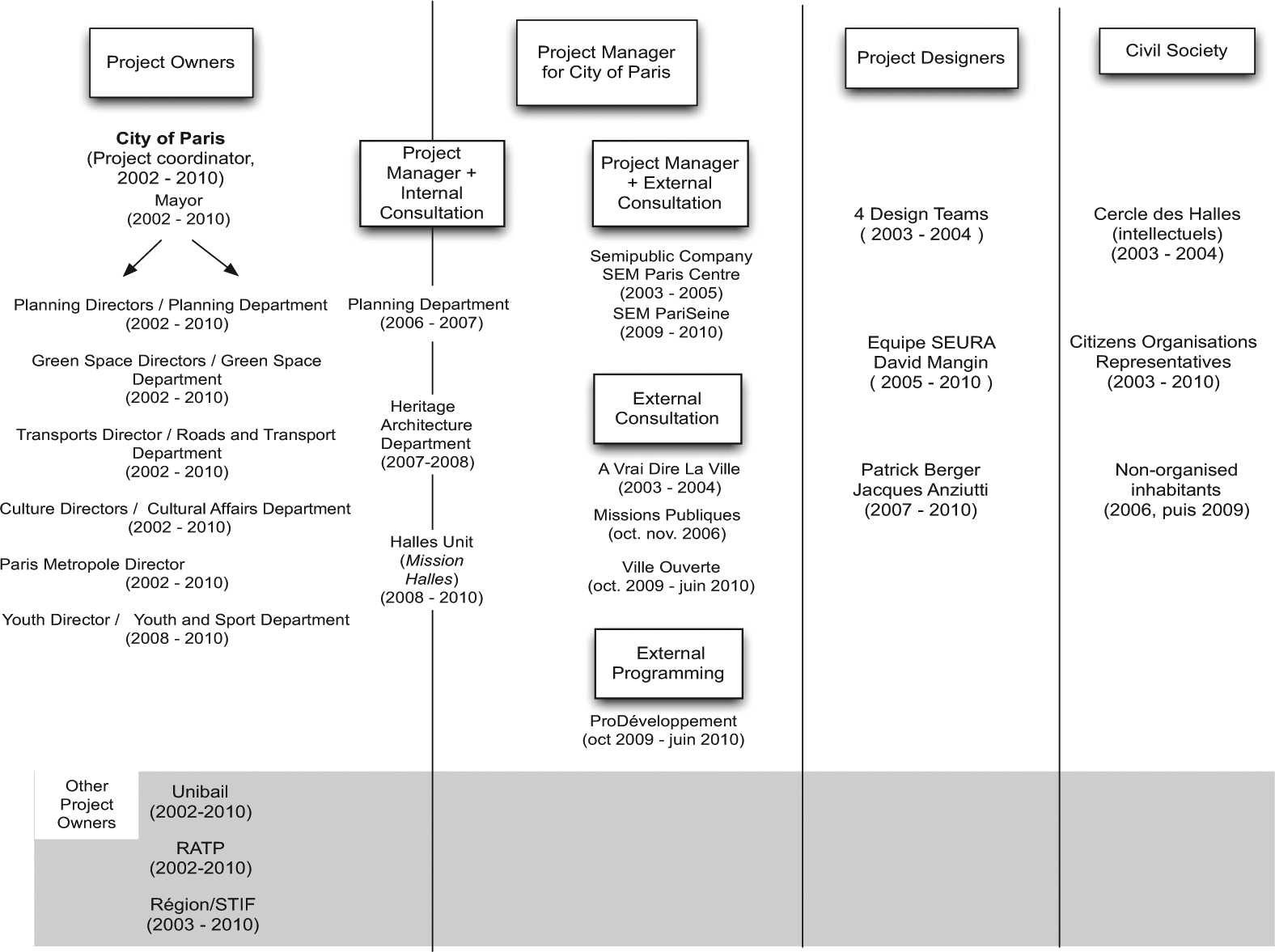
The general system of actors involved in the Halles project, 2002–2010.
2002–2004: Definition studies and initial ‘consultation’ procedures
The Paris Centre SEM (semi-public company) was mandated to carry out simultaneous definition studies and with organising the ‘concertation’ process. Until 2004, the consultative approaches distinguished between ‘locals’ and the ‘general public’ 7 (Parisians, residents of the region and tourists). Although the Mayor of Paris had declared at the launch of the operation in 2002 that it would consist of a ‘broad concertation process involving all users, Parisians and inhabitants of the surrounding region’, 8 not all of these groups were involved to the same degree in the different stages of the definition studies: only organised residents’ associations were invited to meetings with the project designers, project managers and City officials representing the public project owners. The involvement of the general public – subsequently referred to as métropolitains– was confined to information and dialogue, in particular at the event organised in spring 2004 where the four shortlisted projects were displayed and visitors were asked to vote on them. Following the definition studies, David Mangin, SEURA, was chosen as project designer for the general urban development phase.
2005: Start of design work on Les Halles Garden and reorganisation of the ‘consultation’ process
Upon completion of the definition studies, the City representatives considered that the ‘concertation process’ had been a success 9 as three public meetings had been held and 12,500 people had voted on the projects presented at the exhibition. However, the verdict of residents associations on this first phase in early 2005 was far more critical. Thus, there were numerous discussions in that year between the authorities and civil society groups on how to involve inhabitants. These led to the enactment in January 2006 of a ‘Consultation Charter’ (Charte de la concertation). 10 At the same time, the SEURA team moved ahead with the garden project, working only with project managers from the municipal Urban Planning Department.
2006–2009: Specifications, competition and programming for the future Forum des Halles and development of the Garden project
The ‘Consultation Charter’ introduced more formal procedures, in particular GTT (Groupes de Travail Thématiques– thematic working groups) involving representatives of local people, project designers and owners (of City of Paris). During this second ‘consultation’ phase organised by municipal technical departments, the most visible players in the participative process, through regular attendance at meetings (a hundred or so meetings between 2006 and 2010), were still local residents associations together with a few activists and academics. The métropolitains were briefly brought into the process in autumn 2006 through footfall surveys and a two-day workshop. Alongside these surveys however, the project continued to move forward: the specifications for the architecture competition on the future Forum were largely drawn up without any reference to the survey findings. The winning design for the building (chosen in July 2007) was by Patrick Berger and Jacques Anziutti (la Canopée).
As for the garden project, civil society groups learned about its ongoing progress – without consultation of any kind – at the first GTT meeting in June 2006. They reacted critically, condemning a plan that they found ‘very rigid and likely to disrupt the habits and movements of local people’ (Citizens Organisation Representative, Garden Working Group, 26 June 2006). From this point on, some local residents groups began to develop initiatives to oppose the SEURA team’s garden project.
From 2007 to 2010, the primary function of the working groups was to approve the plans presented by the designers, whether for the building or the garden. Representatives of local residents associations declared themselves increasingly disappointed in the ‘concertation’ process: they could not see how their contributions had been taken into account in the project development process.
October 2009–June 2010: discussions on services for métropolitains: widening of the ‘consultation’ process (in parallel with the building permit phases for the future Forum and garden).
The project changed direction in 2008 with the arrival of a new municipal team. Against a background of national political and media focus on the Grand Paris building programme, upon taking office, elected representatives immediately began to label the Les Halles operation as a ‘metropolitan’ project. Consequently, in October 2009, a new ‘consultation’ process was assigned to non-municipal teams comprising young urban planners specialised in the participative processes with a preference for a qualitative approach (focus groups and on-site interviews). However, the proposals that emerged from this approach had nothing to do with any changes to the project designs since the rules of the game from the outset had been not to ‘jeopardize the planned programme or timetable’ (‘ne pas remettre en question la programmation ni le calendrier prévus’ 11 ). In parallel, ‘consultation’ with residents groups ended in 2010 amid a tense climate of power struggles and conflicts that sometimes spilled over beyond the participatory arena.
This brief summary of Les Halles redevelopment project is sufficient to reveal the huge complexity of the operation, which from 2005 involved handling multiple factors at the same time, according to different patterns and using different procedures. There were changes to the participatory processes themselves which affected the different phases and components of the project in varying ways. Not all users of Les Halles were equally involved. The inhabitants directly involved in the participatory process along with the project owner decision-makers in the structures provided for by the Charter were almost all from local organisations, whereas the site’s main users – who were neither local nor organised – were hardly involved at all and their contributions received only marginal consideration. This unequal access to participative arrangements was a problem for three reasons of a territorial, political and theoretical nature. Territorial because in view of its location and frequentation, the project actually concerned inhabitants from all over the Greater Paris region and not just local inhabitants. Political because at the project launch, the City of Paris had announced that it would be implemented in consultation with all of the inhabitants of Paris and its surrounding region. And theoretical because research into inhabitant participation has highlighted the importance of the criterion of inclusion (Reber, 2005): in the field of urbanism, this criterion assumes that the legitimacy of the participative arrangement depends on the mechanism being open to all of the publics concerned (Gardesse, 2013).
The difficulty of incorporating the participatory approach into the urban planning process: Two parallel and coexisting systems
To identify the interactions between participatory and urban planning processes, we applied the ladder of citizen participation model to the participatory procedures (Dimeglio, 2005; Zetlaoui-Léger, 2005; Figure 2) 12 as well as studying project-related documentation (technical documents and formal proposals) and how these reflected contributions by inhabitants (Fareri, 2000).
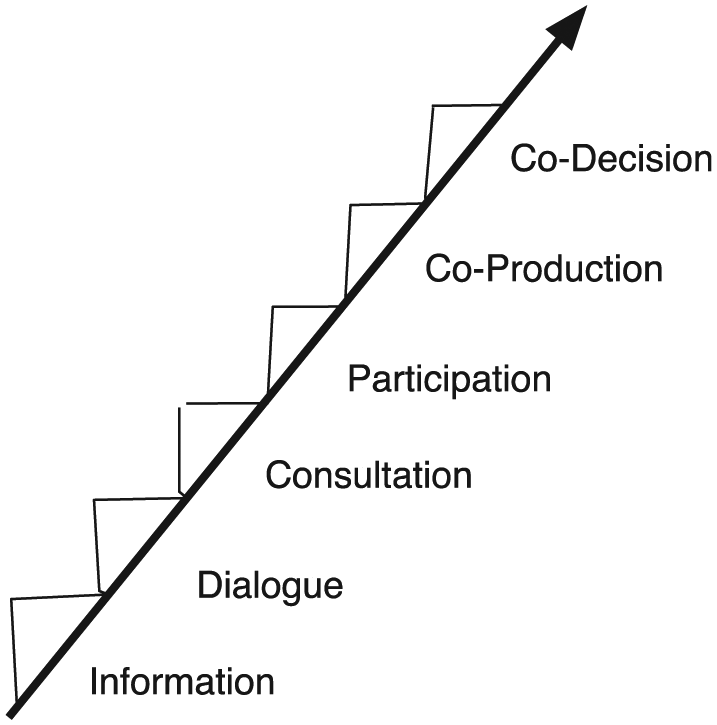
The different levels and forms of inhabitants’ participation.
This analysis demonstrated the difficulty of providing a uniform description of the extent of inhabitant involvement in a long and complex urban planning operation. It also highlighted the uneven nature of the term ‘concertation’ as used by the City to describe its approach. The levels and forms of involvement varied from one stage of the project to another. At certain times, with specific civil society actors and on certain issues, the system came indeed close to ‘consultation’– i.e. half way up the citizen participation ladder. In other phases however, levels of inhabitant involvement were much lower. Moreover, the fact that the system sometimes came close to consultation does not mean that it actually gave inhabitants the opportunity to collaborate in the project’s development, as evidenced by the approach aimed at métropolitains established in 2009. Breaking the urban project down into phases not only reveals the varying levels of involvement, but also a degree of change in the systems actually established. These findings clearly show the importance of observing precisely how the participatory arrangements were (or were not) articulated with the planning process in terms of the timeframes, the actors involved, the procedures and the issues, as well as the level of participation expected by different actors.
However, a more global finding emerges from the analysis of the participatory mechanisms and their effects: the level of participation in the Les Halles operation fluctuated primarily between processes of information (information in French) and dialogue (consultation in French). An overall trend thus clearly emerges: the processes described in terms of ‘concertation’ by the Paris authorities did not really involve any negotiation of the nature of the project or its main principles. The inhabitants were generally invited to respond to proposals but very rarely to contribute to developing them. The tendency was for the project managers to present results and invite civil society representatives to propose amendments rather than seeking their analysis of the initial situation or their needs or expectations. This perhaps explains the very critical attitude of resident association representatives to the ‘concertation’ process in which they had taken part. Their descriptions of the experience suggest a very strong feeling of frustration because of the gap between expectation and reality. In fact a strong feeling of mistrust developed during the process between civil society and urban planning actors (both professional and political), expressed by the former in terms of a lack of transparency or clarity concerning the decisions taken and their link to the ‘consultation’ procedures (interviews with representatives of residents associations, April 2009–December 2010).
This general tendency for participation to be limited to information and dialogue can be explained by the disconnect between the planning process and the participatory process. Ultimately, there were only a few moments of interconnection during the Les Halles operation. In reality, there were two distinct systems of ‘regulation’ (Reynaud, 1987) at work (Figure 3):
- On the one hand the ‘concertation’ system, with its own actors, timetable and structures with nothing in its organisational procedures to show how it was linked to the planning process. This system was almost tautological in nature because at times its sole purpose was to make ‘consultation’ work rather than to seek to influence the development of the project in any way.
- On the other hand, the planning system, with its mode of regulation structured by urban design procedures and methods dictated by legal regulations. Some stakeholders, in particular the municipal representatives, were also involved in the ‘consultation’ process and the two timetables overlapped to some degree, however there was nothing to show how local involvement influenced this planning system or its stakeholders.
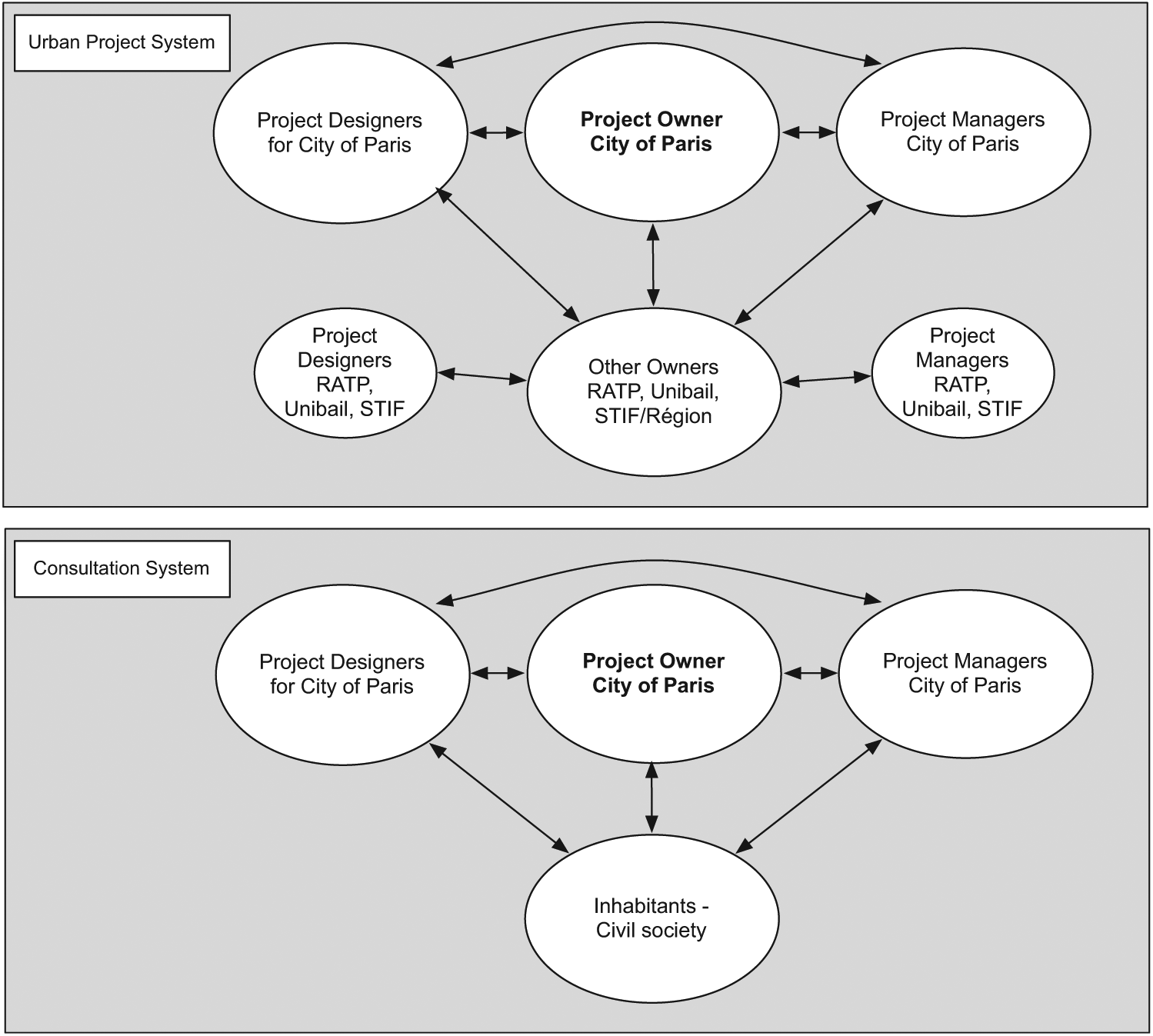
Two parallel systems: The planning system and the ‘consultation’ system.
There were occasional areas of overlap between these two systems but despite the introduction of the ‘Consultation Charter’ in 2006, there were very few links between the participatory bodies and the decision-making and institutional partnership processes. Planning was often at an advanced stage before it was discussed in the participatory process, leaving little room for manoeuvre. In fact, it is clear from the views expressed by politicians and professionals that they perceived the idea of consulting the inhabitants more in terms of subsequent adjustments to decisions rather than any involvement in actual decision-making.
Factors explaining the disconnect between the participatory and urban planning processes
This lack of integration can be partly explained by the way in which the Paris Council is organised, in other words by structural factors specific to the municipal context which were not specific to the Les Halles project or its subsystems of actors. Indeed, the structure of the municipal technical departments (Busquet et al., 2007; Nez, 2008) responsible for urban project participatory arrangements is vertical and compartmentalised within a complex, multi-actor structure that is difficult for project managers to understand. A participative engineering section known as the ‘Municipal Local Democracy Unit’ was set up by the new left-wing team at the beginning of the 2000s within the Direction Usagers Citoyens et Territoires (citizen and territories users department). But at the same time, many technical departments such as the Department of Planning have in-house services dedicated to participation-based approaches. Although this breakdown of roles may give rise to a certain complementarity in the actions of these different departments, in reality, they remain relatively disconnected. The local democracy unit (Mission Démocratie Locale) can only deal with urban projects if they have been referred to them by project managers and there is no requirement to use the instruments they provide. In the case in point, the Municipal Local Democracy Unit did not get involved in deploying any participative arrangements for the Les Halles project. Its members were not contacted by those in charge of organising such mechanisms and they did not engage in training or in any new ideas around the theme of participation. For these reasons, there is a disconnect between initiatives to increase participation in Paris and the way urban planning is organised. Moreover, the possibilities for inhabitant participation dynamics in France are largely influenced by systems and attitudes specific to the urban planning process. In other words, urban planning procedures and the way planners conceive and implement urban design methods can clash with the conditions necessary for citizen participation. The arguments developed by planners – particularly municipal technical-administrative project managers – and by project designers, indicate that their priorities were procedural and technical (interviews with professional actors involved in the urban project, April 2009–December 2010). Aside from statutory compliance concerns, a ‘technical reason’ appears to be the argument that trumps any possibilities for collective discussion or coordination (Genard, 2005). This results in a contradiction between the perceptions of the professional in charge of urban project planning and the habits and representations of actors from civil society. Such a mismatch restricts the possibilities for ‘deliberation’ (Fourniau, 2005; Manin, 1985). On this subject, participatory processes appear as a challenge to urban planning actors, conceived in terms of the gap that separates the ‘expert’ from ‘ordinary people’ (Balducci and Calvaresi, 2005) according to the paradigm of technical rationality (Schön, 1983). This tendency to revert to the default technical position means that citizens are permanently attributed the status of ‘lay people’. Yet one of the peculiarities of the Les Halles project, specifically regarding the type of inhabitants involved over the long run – i.e. civil society actors organised into associations with relatively high resources in terms of social, political and cultural capital – is that they achieved a ‘boost in expertise’, in particular in relation to the technical aspects of planning content and methods. However, in the context of a strong ‘typification’ of roles (Berger and Luckmann, 1986) by the project’s key decision-makers, this ‘expertise boost’ was not enough to affect the ‘lay-person’ status of civil society representatives.
Indeed, despite the expertise acquired by the civil society players, such actors are still considered by politicians and professionals as individualist, conservative, NIMBY types 13 with little technical knowledge of urban projects. In the view of political and professional representatives, inhabitants should not interfere in technical aspects of which they are ignorant: ‘inhabitants should not think that they are architects or urbanists and they should realize that they are just inhabitants’ (interview with a project designer, March 2010). In April 2009, a project manager in the City of Paris told us that the project has currently reached the stage that falls within ‘the technician’s sphere of expertise only’ and that associations’ requests for ‘concertation’ around this issue made ‘no sense’. He went on to say that it was a question of expertise because ‘organizing a construction site involves a certain number of highly-qualified actors’, and that inhabitants cannot ‘substitute themselves’ for such people as their demands for ‘concertation’ appeared to him to suggest they wanted to do. As such, inhabitants are categorised as ‘lay people’ by the traditional actors involved in urban planning to avoid too radical a redistribution of roles, especially away from those who have the know-how necessary to see the urban project through.
In fact, the ‘typification’ of roles reveals the preponderance of a dual model for delegating power and expertise marked by the paradigms of representative democracy as the only legitimate democratic reference and by the influence of what Michel Callon calls the ‘public instruction model’ (Callon, 1998) in which scientists teach citizens but have nothing to learn from them. Moreover, the specificity of the figure of the architect in France, historically trained in the tradition of the Beaux-Arts, confers the status of individual artistic ‘creator’ (Chadoin, 2006). For this reason, the nature of urban planning expertise is not only technical but also aesthetic and both aspects are perceived as being beyond the comprehension of ordinary citizens. These attitudes reflect powerful ‘cultural codes’ in the representations and practices of institutional actors which act as references and sources of legitimacy for their role in the urban planning process.
These political and professional cultural codes partly explain the difficulty of entering into a genuine consultation process because their prevelance means that citizens are not perceived as partners in the planning process. In the same vein, researchers have noted that participatory approaches in other countries are also limited because ‘power is not shared but is retained by the traditional actors – politicians, professionals, academics, etc. – whose language and behavior does little to encourage participation’ (Stewart, 2005).
The influence of ‘institutional consultation’ with private partners
Given these different factors, citizens are faced with the difficulty of witnessing insufficient links between what is said during ‘concertation’ meetings and the way in which decisions are taken by the project owners. In the case of Les Halles, the coexistence of parallel ‘regulation’ systems resulted in several parallel ‘consultation’ processes. Indeed, another form of ‘consultation’ took place between project managers for which we use the term ‘institutional consultation’ employed by the planners themselves (interviews with professional actors of the urban project, April 2009 to December 2010). This refers mainly to negotiations between the project’s various public and private owners, the municipality and Unibail (long-term leaseholder for the site at the time of our research). 14 These negotiations were decisive for the project. For example, on several occasions, political and professional actors acknowledged that stages of the project were approved at this level: ‘no stage is approved without agreement with the other institutional actors’ (municipal project manager, building permit working group, 2 December 2008). However, no public information was provided about the practical content or results of the negotiations, the membership of steering committees or the frequency of meetings. No minutes of meetings were disclosed even though these could have kept inhabitants and other stakeholders informed about the issues and progress of negotiations. As a result, the ‘institutional consultation’ process remained disconnected and opaque with no public sharing of the positions and arguments of the different parties. Under these circumstances, it was hard for civil society actors to see who was deciding what, when and why. Consequently, they developed uncompromising rhetoric about how Paris Council was ‘giving’ the city centre over to Unibail (citizens organisation tract, April 2010).
It is particularly noteworthy how the representations of the project backers concerning the role of citizen ‘consultation’ in the planning process can minimise the possibility of transparency, a crucial condition for the development of trust and constructive dialogue (Joss, 1999 (quoted in Reber, 2005); Klüver, 2000 (quoted in Reber, 2005); Reber, 2005; Rowe and Frewer, 2000). Political and professional actors attributed the difficulty of transparency to the complexity of the institutional negotiation process. According to the head of one technical department (interview May 2010), politicians would listen to the ideas presented at meetings and then incorporate them into other meetings, but could not immediately say what decisions had been made because, at that moment, the person chairing the meeting was not sure of being able to give any undertakings as ideas first had to be discussed and approved through an institutional negotiation and decision-making process. This argument clearly shows the significance of processes of ‘institutional consultation’ with other stakeholders – particularly Unibail – especially on financial matters, which always remained opaque. However, it does not explain why decisions were not gone into in subsequent meetings after discussions with the municipality or with the different partners.
Moreover, it may be argued that it was not a question of revealing the exact nature of all negotiations between the project owners, which could probably not be made public in their entirety, but of simply including civil society actors as partners in the urban operation by sharing significant decisions that could constrain the parameters of consultation. For example, throughout the entire ‘concertation’ process, resident groups constantly stressed the need for public facilities to be located at ground floor level in the future Forum to lend it a more than purely commercial character. But little by little, architects’ plans moved these public facilities to the upper floors. As decision-maker, it was the Municipality’s prerogative to prioritise the commercial aspect but this preference was never clearly expressed, nor was the fact that negotiations with Unibail could influence the future layout.
Discussion: Current developments in urban project governance processes at a moment of ‘tension’
Changes in professional planning practices vis-à-vis inhabitant participation
While institutional actors may perceive citizen involvement as a threat to their legitimacy, prompting them to mobilise cultural codes that embody the dual delegation model, it might also be supposed that such involvement could lead to a change in urban planning representations and practices. Indeed, it would appear that there is ‘tension’ between their influence on the ways in which urban projects are designed and run, and emerging changes, especially those generated by experiments in citizen participation. As regards citizen participation in public action, French urban planning is characterised by an ever-increasing legislative and regulatory requirement to include participation arrangements. This national context of institutionalised participation is also applied in local projects. In Paris, certain changes took place in the 2000s which may result in new ways of conducting urban planning. Training courses and manuals have been developed to educate municipal employees on this issue and there are now dedicated citizen participation units in several technical-administrative departments. In addition, institutionalised citizen participation is being implemented through municipal experiments on a case-by-case basis. In fact, even within the Les Halles project between 2002 and 2010, there were certain changes in ‘consultation’ practices and how to organise them. Consequently, although concertation processes were initially relatively undocumented and not all that clear, this changed from 2006 on with the introduction of a Concertation Charter (Charte de la concertation) which specified specific bodies such as Thematic Working groups and set out a timetable. 2009 marked another milestone with the introduction of a more qualitative approach entrusted to external specialists in participatory arrangements. Although it was mostly as a result of pressure from civil society stakeholders, improvements were made in terms of clarity and the circulation of information concerning the project as well as documentation of rules and the workings of the various arrangements.
The ‘consultation’ mechanisms has had an educational and awareness-raising function for the political and professional players involved (Schön, 1983). This example shows that there is a learning curve in practitioners’ participatory experiences (as for all the participants). However, changes in urban planning citizen participation arrangements in Paris can be described as laborious because such approaches require different planning procedures which, according to those responsible for organising them, generate ‘more work’ (interviews with professional actors involved in the urban project, April 2009–December 2010). They are also ‘difficult to achieve’ on account of certain structural factors outlined above, in particular the strict typification of roles and the organisational dimensions specific to Parisian local government.
This tension between the inertia attributable to structural factors and the dynamics of change opens up interesting avenues for research around the subject of innovation in urban planning practices and the cultural codes of urban planners. Here, we believe it is important to look at how non-municipal professionals are entering the systems of urban project actors with the specific task of organising participatory procedures. Researchers should also reflect upon the impact of the influx into the urban planning sphere of new generations, more familiar with the issue of participation. The hypothesis of the emergence of new participation-oriented professional ‘segments’ (Bucher and Strauss, 1961) in this field therefore deserves further exploration.
Private actors and inhabitant participation: A dichotomous relationship?
This form of tension should also be understood within the framework of more global changes in urban planning organisational structures. The Les Halles operation, for example, shows the importance of considering all of the actors involved in the planning process, and the existence of several types of ‘consultation’, both civic and institutional. Indeed, one of the main problems with ‘consultation’ in the Les Halles project was the difficulty the public project owner, the City of Paris, had in discussing its negotiations with its private partner Unibail. It would appear difficult to incorporate participatory approaches in the planning process when the public project owner conceals the conditions of its private partner’s role in the project. 15 In the case of Les Halles, because they had no insight into the negotiations between these two parties, the inhabitants had no means of ascertaining what was possible within the ‘consultation’ process or the reasons behind the City’s choices. In particular, very little was revealed about the issue of financial feasibility, despite repeated requests by citizen groups. 16
These factors raise questions – that go beyond basic information and dialogue – about the possibility of introducing citizen participation when the public stakeholder is partly dependent on its private partner and when the planning process is dependent on a highly institutional form of ‘consultation’ to the detriment of citizen ‘consultation’. With regard to urban design research, this problem suggests a need to rethink their approach to the whole urban planning system. In other words, to understand the procedures and possibilities for incorporating participatory approaches into planning processes, we need to explore participation possibilities within public–private partnership frameworks which have become much more common in France in recent years. 17 Research around this issue would appear all the more important insofar as it stands at the interface between two fields that have developed in parallel over the last 15 years or so, i.e. citizen involvement in urban planning and relations between public and private actors. Up to now, few French studies have sought to explore these two fields together. Indeed, the lack of any apparent link between research on citizen participation and on urban production by private-sector actors is perhaps down to the fact that these two processes are perceived as being separate by the very people involved in urban production. Yet more and more researchers now agree on the need to look at all aspects of urban planning organisation together, including the interactions between public, civil society and private actors. 18 This process has already been underway in Anglo-Saxon academia for about 10 years (Hambleton et al., 2002; Raco, 2000; Swyngedouw, 2005).
Major ongoing projects in the Paris City-Region testify to the need for such an approach. 19 Take the private Europa City project, 20 for example, which is part of the Triangle de Gonesse spatial planning programme being developed by Établissement Public d’Aménagement Plaine de France on what is currently agricultural land. The location of this project is a source of major conflict with environmental organisations in the Val d’Oise département. For this reason, the project’s private sponsors have expressed a wish to involve the inhabitants in the planning process (in particular through an Agenda 21-type arrangement) and they are trying to forge a dialogue with the area’s environmental groups. Although by tradition and regulation the responsibility for organising such processes lies with the public actors, in this case the private promoter is developing initiatives that reflect a strategy intended both to preempt possible conflicts and to legitimise the project. In fact, a private company may be more sensitive to the vagaries of project implementation – in particular the time factor – than a public institution. Such a company may be particularly wary of action by residents with the potential to jeopardise the future of an urban project and may therefore seek to manage citizen involvement through public initiatives.
This raises two questions. The first relates to the acceptance by private actors of normative arguments about citizen participation; the second relates to the emergence of cooperative models in urban production processes in a context where funding is increasingly shared between the public and private sectors. Indeed, it would appear well worthwhile to explore how private economic actors understand and react to new regulatory and social requirements for greater citizen involvement. If they prove amenable to these develoments, this could lead to a redistribution within the systems of actors and transform the interactional modalities of urban planning. Indeed, it could result in a paradigm shift to the ‘negotiated planning’ process mentioned at the start of this article which would entail new forms of dialogue and collaboration. At present however, it would appear that the different – public or private – urban planning actors are not inclined to abandon the status conferred on them by the traditional model which Michel Callon describes as ‘hierarchical’ (Callon, 1997) – particularly in the current conditions of economic crisis. Be that as it may, the attitudes of public actors regarding citizen participation in urban planning processes in the current economic climate, in which funding is needed to develop projects, would appear to merit further investigation.
Conclusion
In analysing the ‘consultation’ process put in place by the City of Paris for the Les Halles redevelopment project, the aim of this paper was to investigate the interactions and articulations between urban planning and inhabitant participation and, in so doing, to explore changes in planning approaches in order to assess whether we are witnessing the emergence of more negotiated and partnership-based urban project processes in France. This would involve institutional actors recognising inhabitants as project stakeholders.
The research highlights the mechanisms that structure these dimensions of French urban planning: the article points up the disconnect that exists between two systems of ‘regulation’ operating in parallel, i.e. planning and ‘consultation’. It also shows that, under these circumstances, because it is difficult to get beyond mere dialogue to a genuine consultation process, inhabitants are not really perceived of as partners. Therefore, it is not possible to speak of a change in the systems of urban planning actors or of ‘negotiated planning’ in the sense understood by researchers (Callon, 1998), i.e. a system in which the different actors, including the inhabitants are all involved in developing a project and negotiating on an equal footing. In fact, an analysis of the positions of the actors in the operation of Les Halles shows that a hierarchical logic still predominates both in urban project design and practices. 21
Furthermore, the Les Halles case study demonstrates that this situation arises from a multiplicity of factors – three sets can be highlighted: structural factors linked to the organisation of the public institution; the positions of the actors involved in urban planning practices (especially the processes); and highly typified role representations which reflect the impact of a dual delegation model of power and knowledge. Consequently, the participatory process does not appear to have been conceived and conducted as an integral part of the project process. Instead the opaque ‘institutional concertation’ process with the private project owners seems to have been largely conducted along lines laid down by the City of Paris.
Nevertheless, the findings of this article show that developments are afoot in the organisation of urban production governance processes. On the one hand, it appears that participative practices are driving changes in professional practices and representations in this field although such developments are still moving fairly slowly in France. On the other hand, public–private partnerships raise questions over how inhabitant participation can be fully integrated into the project development and decision-making process when projects are part of an institutional ‘concertation’ process from which inhabitants are excluded. Negotiations among project owners themselves make it difficult in principle to achieve certain participative criteria such as transparency (Gardesse, 2012). Factoring in these two tendencies – the development of participative experiments and the increase in public–private partnerships – brings together two previously relatively disparate fields of research that offer possibilities for renewing the urban production sphere. These potential research avenues ultimately provide a great opportunity for effectively reflecting upon the urban project system as a whole as well as upon overall organisational arrangements and this involves taking account of all of the actors concerned – public, private, civil society, etc. – as well as the interactions between them.
Footnotes
Funding
This work was partly supported by the Université Paris Est, Lab’Urba during the PhD research about les Halles and partly by the NWO and the University of Amsterdam in the framework of the Context Project.