







Abstract
This paper investigates the heterogeneity of housing-tenure choice in the city of Guangzhou based on a household survey. Using methods of finite mixture regression, we identified three groups with distinct housing-tenure choice subprocesses, which we labelled as the ‘urban elites’, the ‘native plebeians’ and the ‘lower masses’, accordingly. The urban elites group includes affluent local urban residents, migrants from other cities and privileged citizens such as state employees and Communist Party members. Housing-tenure choice among the urban elites positively correlates with marital status, age and education. The native plebeians group is comprised of less affluent local residents, including those with rural Hukou status. They have the highest homeownership rate among the three groups and their housing-tenure choice positively correlates with household size and income. The majority of the lower masses are migrants from rural areas. They are mostly renters, although household size was found to be a significant predictor of homeownership. Institutional factors such as Hukou status, Party membership and state employment affect tenure outcomes for both the urban elites and the lower masses, but not for the native plebeians. These findings show the correspondence between housing-tenure choice subprocesses and socioeconomic differentiation, and suggest a need to create housing policies tailored for specific housing groups.
Introduction
Owner occupancy is an important housing-tenure type that has been the focus of extensive research in the housing literature. Since the 1960s, the rise of neoliberal policies worldwide has energised a remarkable round of marketisation and privatisation, and in many countries housing privatisation constituted a major dimension of the neoliberal transition (Hodkinson et al., 2013; Olgun, 2013). In Chinese cities, homeownership is a central theme of the market-oriented urban housing reform. Over the past 20 years, China has embraced an ownership-based housing marketisation strategy characterised by the privatisation of public housing (Lee, 2000; Zhang, 1999), the monetisation of urban housing distribution (Wu, 2001), and the establishment of a fast-growing housing market (Wang et al., 2012). The owner-occupancy model has been credited with jump-starting China’s housing market and transforming the country’s stagnant urban housing sector into a dynamic real estate industry, thanks to which many Chinese have seen considerable improvements in housing conditions and living standards (Wang and Murie, 1999). The percentage of urban Chinese living in dweller-owned homes has increased from roughly 10% in the early 1980s (Wang, 1992) to over 80% in 2011 (Gan et al., 2014).
However, China’s race towards homeownership is by no means equal. Despite the extremely high official homeownership rate, a significant number of urban residents do not own their dwelling places, and many of them (e.g. migrant workers) are excluded from the official counts of urban homeownership rate (Logan et al., 2009). Studies have found that housing-tenure outcomes in urban China are subject to a number of variables, including household dynamics, economic conditions and factors related to China’s powerful political institutions (Huang, 2004; Huang and Clark, 2002; Li and Li, 2006). Besides the inequality in housing outcomes, another important aspect of disparity is the heterogeneity of housing-tenure choice, i.e. the fact that homeownership attainment may depend on different factors among different subpopulations. Modern Chinese cities are complex societies comprised of residents from a wide range of backgrounds, and it is unreasonable to assume a homogeneous housing decision-making process across all segments of the urban population. Past studies have found that the drivers and constraints of housing-tenure choice may differ dramatically among groups delineated by criteria such as household registration (Wu, 2002) and housing sources (Li, 2000). Such differences reflect the segmentation of the housing market and offer valuable insights for developing adaptable housing policies.
This paper investigates the heterogeneity of housing-tenure choice based on a household survey conducted in Guangzhou in 2009. The main difference between past studies and this one lies in the fact that this study does not rely on pre-identified groups to analyse the differences in housing-tenure choice. Instead finite mixture regression methods (McLachlan and Peel, 2000) are employed to cluster the sample households into distinct groups according to similarities and differences in their housing-tenure choice (sub)processes. The motivations behind this approach are as follows. First, analyses based on pre-identified groups implicitly subscribe to the assumption that the segmentation in housing-tenure choice is crisp and the clusters of housing-tenure choice are well aligned with the boundaries of the pre-defined classes. This is seldom the case in reality. The imperfect match between the pre-identified groups and the real clusters, as well as the potential fuzziness in cluster boundaries, can easily obstruct analyses and introduce biases (e.g. by causing false negatives and false positives in statistical tests). Moreover, as housing market has gradually replaced the old redistributive hierarchy in housing distribution, housing-tenure choice in urban China has become a synergistic process subject to multiple institutional, market and household forces. It is increasingly difficult for any pre-identified classification scheme to adequately disentangle the complex differentiation produced by these processes.
For these reasons, at the current stage of China’s ownership-centred housing marketisation, identifying the clusters in housing-tenure choice imposes a research question as important as how housing-tenure choice varies across these clusters. This study addressed both questions in an integrated way, as the finite mixture regression methods identified groups with distinct housing-tenure choice models and calibrated these models simultaneously. The characteristics of the identified groups, as well as the results of the group-specific housing-tenure choice models, were summarised and compared to show how these groups differed socioeconomically and how housing-tenure processes varied across them. The main contribution of this study is a new perspective on housing differentiation in urban China focusing on heterogeneous (sub)processes of housing-tenure choice rather than just on housing-tenure outcomes. The ideas and methods in this study can easily be applied and/or extended to investigate other aspects of housing differentiation and socioeconomic stratification in urban China or in other contexts.
Review of related work
Housing tenure describes the legal and/or financial arrangement(s) required for the right to occupy a housing unit, and owner occupancy refers to the housing-tenure type whereby the dwellers have full or partial ownership of a dwelling unit (Mullins et al., 2006). In the social sciences literature, it is customary to formulate housing-tenure outcome as a result of constraint choice. Choice implies a desire for homeownership, which is arguably a ‘natural’ inclination associated with the biological instinct to mark out one’s own territory (Saunders, 1990). This metaphor has been consolidated and strengthened by the development of modern property rights and the market economy (Dupuis and Thorns, 1998). In particular, the neoliberal housing policies over the past several decades (especially in the USA and the UK) have helped shape a pro-homeownership rhetoric that favours owner occupancy over other types of tenure arrangements (Saegert et al., 2009). It is believed that homeownership not only provides greater tenure security but also generates financial benefits, promotes sense of responsibility, stabilises and strengthens communities, creates jobs and fosters economic growth (HUD, 1995). The implication of this assessment is that the appeal of homeownership is universal, as these benefits can be extended to both ends of the social strata through free market and sensible housing policies (Saegert et al., 2009; Shapiro and Wolff, 2001).
With homeownership being a central theme of the neoliberal housing agenda, what drives and constrains owner occupancy becomes a topic of constant research. A domestic and an economic decision by nature, housing-tenure choice is naturally associated with the demographic and economic characteristics of the dwelling families. A family’s housing demand is usually affected by factors such as household size, dwelling arrangement, demographic profiles of household members, and the evolution of these factors over time. For example, it has been shown that homeownership attainment tends to be higher among larger and older households, and owner occupancy often correlates with events such as marriage, retirement, child birth and other significant household changes (Artle and Varaiya, 1978). Meanwhile, economic constraints such as dwellers’ financial capacity, property prices, transaction costs and tax policies have also been found to be significant predictors of homeownership (Henderson and Ioannides, 1983; Hubert, 2007; Smith et al., 1988). These economic factors usually correlate with household demographic characteristics. For example, older age and more working members in a household may indicate more income, while the birth of a child may undermine a family’s purchasing power by adding a non-wage-earner to the household. Consequently, it is necessary to evaluate both demographic and economic factors in order to control the confounding effects between them.
In China’s pre-reform public housing system, most urban residents lived in low-cost public rentals provided either by their employers (i.e. work units) or by the city housing bureaus (Wang and Murie, 2000). Urban housing reform started in the 1970s, and the initial goal of the reform was to alleviate the severe housing shortage in most Chinese cities. While the focus of the reform was largely on the rent structure in the 1980s (Tolley, 1991), since the early 1990s, the direction of the reform has changed dramatically, with the arrival of a series of pro-homeownership measures, including a land-leasing system allowing local governments to sell land-use permits to private developers, a housing privatisation strategy encouraging work units to sell public rentals to tenants at highly discounted prices, a range of policies designed to help urban residents finance home purchases, and an ‘affordable housing’ programme (Jing-Ji-Shi-Yong-Fang) aimed to help low-income families attain homeownership (Lee, 2000; Lin and Ho, 2005; Logan et al., 2010; Wang and Murie, 1999). The milestone of the pro-ownership housing reform is the official termination of the public housing allocation in the late 1990s. After that, owner occupancy has quickly become the prevailing housing-tenure type in urban China. The rise of the private housing market has greatly boosted the real estate industry, which has rapidly grown into a key contributor to the national economy, accounting for more than 10% of China’s GDP in 2010 (National Bureau of Statistics, 2011).
From a legal perspective, homeownership in urban China is defined by two official certificates: a land-use certificate endorsing the land lease, and a housing property certificate attesting to the private ownership of the constructed unit. Owing to the transitory nature of China’s housing system, there are complex tenure situations in practice that are not immediately clear based on official certificates. Three types of situations are particularly relevant to this study. First, those who purchased subsidised housing from work units or from the affordable housing programme achieve a special ‘partial homeownership’ within 5 to 10 years of the initial purchases, during which they are not allowed to sell the properties at market prices (although trades among qualified parties at subsided prices are possible). In this study, these partial owners are treated as homeowners because full ownership will be granted to them at the end of the resale ban. Second, some self-constructed housing units can face elongated tenure disputes because of historical reasons. Although illegal on urban land, self-construction is the primary source of housing in rural areas. During urban expansion, rural land in the vicinity of the city can be included into the urban proper as part of the administrative reorganisation. The fates of self-constructed units on such land, however, can vary: some dwellers may manage to obtain the official certificates for their units, while others can be dragged into resettlement disputes with local governments and/or private developers (He et al., 2009). Similar situations are faced by private properties from the pre-1949 era, which might have represented 15–30% of urban housing at the beginning of the housing reform (Chen, 2011; Wang, 1992; Wang and Murie, 1999). In both cases, only dwellers who obtained the official certificates were regarded as homeowners in this study. Finally, ‘housing of limited property rights’ is a special tenure type without land-use approval from higher-level authorities (Deng, 2009). Houses designated in this way are often sold at prices considerably below the market level, but they are essentially illegal and thus do not offer the tenure security afforded by homeownership. They are not regarded as privately owned homes in this study.
It has been shown that household demographic characteristics, e.g. age and marital status, are also important predictors of homeownership in urban China (Huang and Clark, 2002; Li and Li, 2006; Li and Yi, 2007). Meanwhile, as housing marketisation advances, economic factors such as income and employment also become significant covariates of homeownership attainment (Li and Yi, 2007). One of the most unique characteristics of China’s housing marketisation, however, is the influence of non-market forces related to the country’s powerful political institutions (Chen, 2012b). Logan and colleagues found that institutional differentials constituted a main source of housing inequalities in Beijing and Tianjin based on a 1993 survey (Logan et al., 1999). A later study by Huang and Clark showed that similar institutional forces were at work in housing-tenure choice across multiple Chinese cities, as holding a local urban Hukou and/or a senior position in a powerful work unit significantly increased an individual’s chance of becoming a homeowner (Huang and Clark, 2002). These institutional forces continue to affect housing-tenure choice in Chinese cities even as the urban housing reform deepens, reflecting the persistent impact of the established power relations in China’s gradualist reform (Li and Yi, 2007). Given the state-directed nature of China’s economic liberalisation and housing marketisation, the coexistence of market and non-market factors may remain a main characteristic of the housing market (Wang et al., 2012).
From the perspective of housing differentiation, the ownership-based housing marketisation has failed to address some long-existing disparities in China’s urban housing system, e.g. those caused by redistributive inequality and institutional discrimination (Wu, 2004), while creating new housing difficulties for the urban poor and other disadvantaged groups because of the retreat of public housing (Wang, 2000). Although the inequalities in housing outcomes (including those related to housing tenure and homeownership) are widely recognised in the related literature, it remains a relatively under-represented subject to identify and analyse the heterogeneous (sub)processes that shape the observed housing outcomes. One of the earlier studies in this direction can be found in Li (2000), which illustrated the segmentation of China’s housing system resulting from legacy institutional stratification. Li found that different housing-tenure choice models (represented as generalised linear regressions) could be established in groups delineated by housing sources, e.g. those who had obtained housing from work units, from the municipal housing bureau, and from the open market. Distinct regression models were then selected and calibrated to describe housing-tenure choice in specific groups, and their coefficients were compared and discussed with the help of inference tools such as likelihood tests.
The idea of capturing the heterogeneity of housing-tenure choice among different segments of the urban population remains highly relevant in urban China, where the housing market is non-uniform by nature. However, the approach of grouping the urban population based on housing sources has become more or less insufficient in the present-day context. Unlike the institutionally prescribed housing system in the pre-reform era and the early stage of the housing marketisation, housing distribution under the current market is a complex mechanism shaped by multiple institutional and socioeconomic forces. It is reasonable to hypothesise that there are divergent housing-tenure choice subprocesses in China’s young housing market, but it is unclear whether such divergence can be fit into any prior classification scheme. There is also no guarantee that a crisp segmentation based on housing-tenure choice ever exists because of the potential overlap and interaction among the working processes of housing distribution. In this context, there are two research questions that are equally important to understanding the heterogeneity of housing-tenure choice. The first is the question of segmentation (or classification), which focuses on identifying the groups that exhibit distinct housing-tenure choice behaviour. The second is the question of comparison, which is concerned with how and why housing-tenure choices differ among the identified groups. This paper seeks to address both questions.
Conceptual framework
The housing-tenure choice problem can be formulated as a generalised linear model, which uses a link function to connect the binary outcome variable of homeownership and the drivers and constraints of housing-tenure choice. A popular version of this formulation is based on the logit model (Li, 1977), which can be expressed as:

In this model, p is a continuous latent variable valued between (0, 1) representing the probability of attaining homeownership; x is the column vector of regressors <1, x1,…, xn>T; and β is the row vector of the regression coefficients <β0, β1,…, βn>, where β0 is the intercept. The actual housing-tenure outcome y conforms to the Bernoulli distribution, a special case of the binomial distribution where the number of trial is set to 1:

Based on equations (1) and (2), it is straightforward to derive the log-likelihood function that can be used to estimate β0 and β through iterative maximum likelihood procedures.
It is possible to develop a multi-group model based on the density function (2). Suppose the overall density function of housing-tenure choice is the weighted addition of multiple (yet finite in number) component Bernoulli distributions, each representing a distinct subprocess of housing-tenure choice. This yields a finite mixture model expressed as:

Here, K is the total number of housing-tenure sub-processes, f is the conditional density function of y based on the regression equation, and βk denotes the regression coefficients for subprocess k. The overall density function is denoted by h. The weight πk > 0 denotes the prior probability of subprocess k, where

The log-likelihood function of equation (4) can then be optimised using the iterative expectation-maximisation (EM) method (Dempster et al., 1977). For a sample household (x, y), the posterior probability that it belongs to cluster i is:

From the perspective of classification, the results of equation (4) represent the subprocesses of housing-tenure choice that can be best described by the estimated component Bernoulli distributions, while the posterior probabilities defined by equation (5) represent the (fuzzy) memberships to the identified clusters.
Methods
Study area
Guangzhou is located in the Pearl River delta of Guangdong province in south China. With over 12.7 million long-term residents in the city proper, Guangzhou is one of the largest cities in the country. Geographically, Guangzhou is roughly 120 km northwest of Hong Kong and 100 km north of Shenzheng. In 2010, the total GDP of Guangzhou was 1060 billion RMB yuan or 157 billion in USD, and the per capita GDP among the city’s residents was 12,334 USD, much higher than the national average of 4434 USD (National Bureau of Statistics, 2011). Guangdong province is on the frontier of China’s economic reform and open-door policies, and the Pearl River delta region functions as a core engine of China’s export-oriented economic growth. A key driving force of the region’s economic growth is its large army of migrant labour. According to the 2010 population census (Guangzhou City Burea of Statistics, 2012), 4.76 million residents in Guangzhou, i.e. more than 37% of Guangzhou’s total population, are migrants without a local Hukou. Of these migrants, 92% are between 15 and 64 years old and therefore are potentially active in the labour market. Note that these numbers do not consider migrants who are either unregistered or who have already obtained local Hukou status.
Guangzhou also has one of the fastest-growing housing markets in China, which has attracted numerous studies. However, it is difficult to find accurate statistics on homeownership in Guangzhou (as well as in most other Chinese cities), as the subject has become increasingly sensitive because of the perceived injustice in property redistribution (He et al., 2009). A recent survey estimated Guangzhou’s homeownership rate at 82% (Liu and Mao, 2012), but it is unclear whether the survey properly sampled the city’s large number of migrants, who are much less likely to attain homeownership compared with the native residents (Fan, 2002; Wu, 2002). The most reliable source of housing-tenure data is perhaps the national population census, which is required to count the migrant population in urban areas. Although the population census itself provides no official tally of homeownership rates, it did record several distinct categories of housing sources on the so-called ‘long form’ (a form that contains more questions than the standard ‘short form’), which should have been completed by at least 10% of the households. As a result, it is possible to calculate the approximate homeownership rate of a city by treating all categories of purchased housing (including those purchased on the open market, from work units, or through the affordable housing programme) and self-provided housing as owned properties.
Survey data collection
This study used data collected from a field survey in 2009 based on questionnaires administered in face-to-face interviews. Guangzhou’s municipal administrative hierarchy is organised into four ranks: city, district, street office/township local governments and residents committees under the supervision of street offices or township governments. In 2009, the city had 1456 residents committees and 643 villagers committees associated with 148 street offices and townships in ten districts and two satellite cities. We adopted a stratified multi-stage sample strategy that treated the residents/villagers committees as the basic sampling units. A common issue in survey designs is that of balancing costs with representativeness. To reflect the diversity of Guangzhou’s population, we used satellite images and remote-sensing technology to inform our sampling design. We evaluated the urban sprawl of Guangzhou from 2000 to 2008 based on land-cover maps derived from remotely sensed images, and we computed the sprawl index of the 148 street office/township areas based on the indicators proposed by Burchfield et al. (2006). Five categories are identified for the street office/township areas based on the growth of built-up areas between 2000 and 2008 and their levels of fragmentation. We then selected 19 residents/villagers committees using these categories as the basic strata (Figure 1).
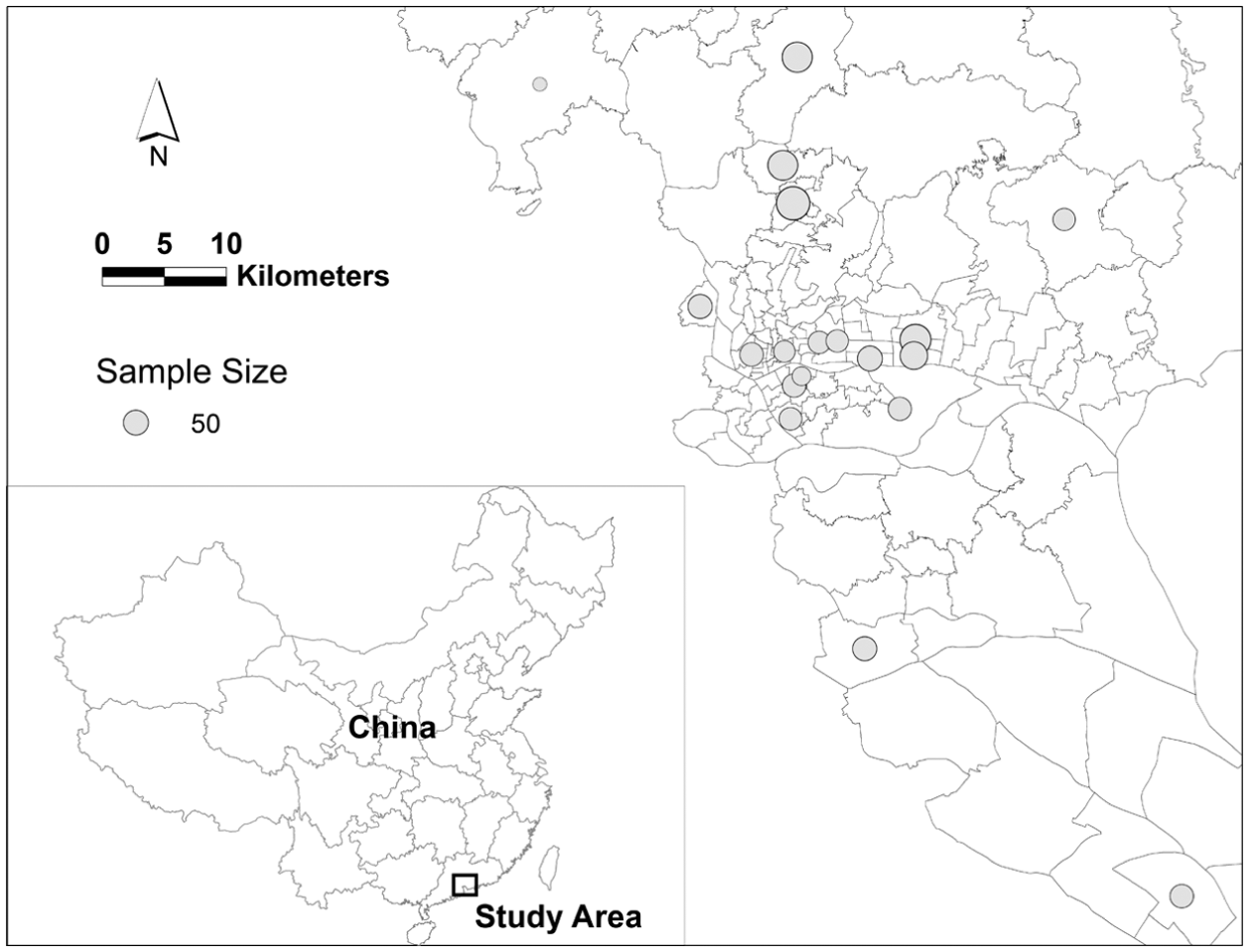
Survey map of Guangzhou, China.
For each of the 19 residents/villagers committees, 4% of the households were randomly selected from the full household lists obtained from the residents/villagers committee offices. With the assistance of the local street offices and residents committees, we gained access to these communities (many of which were gated) and achieved a decent first response rate of 68%. When our first interview request at a household was unsuccessful, we made at least one additional attempt to interview the same household before selecting a replacement among households nearby. We interviewed 976 households in total, and 924 of the questionnaires were usable after the initial consistency check and data cleaning. The survey has a good representation of the migrant population, including students and short-term migrants living in urban villages. However, as housing-tenure choice is usually considered a long-term family decision, we excluded respondents such as students who were generally not in a position to make housing-tenure decisions and migrants who explicitly stated that they did not have long-term plans to live in Guangzhou. The final sample used in this study comprised 826 respondents.
The interview questions covered a broad range of topics including a respondent’s socioeconomic background and housing conditions. All variables are either household-level indicators or describing the conditions of the household heads (therefore not comparable with demographic variables reported by the population census). Household was defined as a family living in the same housing unit and sharing income and expenses. Survey variables used in this study can be classified into three categories: (1) Household demographic characteristics include household size, marital status, age and number of children. It was not uncommon for a respondent to be sharing a unit with other people, and by our definition, when the respondent was not related to his/her roommates or they were related but not sharing incomes and expenses, the roommates were not considered part of the respondent’s household. (2) Economic and market-related characteristics comprise a respondent’s education level, household income, occupation and job ranks. The education variable was coded into nine levels: 0 = no schooling; 1 = elementary school; 2 = junior secondary; 3 = senior secondary; 4 = professional school; 5 = two-year college; 6 = three-year college; 7 = four-year college; 8 = master’s degree; and 9 = doctoral degree. The income variable measures the monthly income of a household. The occupation variable includes eight categories: retirees (i.e. those who were enrolled in and therefore supported by the official retirement programme), governmental employees, educational workers (e.g. school teachers, university faculties and staff), professional service workers (e.g. those in the banking, financial, insurance, healthcare and real estate sectors), low-skilled service workers (e.g. waiters, housemaids and taxi drivers), labourers, other workers and those who were not working (either not participating in the work force or could not find a job). The job rank variable has four levels, including senior management, middle management, regular non-management staff and other ranks. (3) Finally, institutional variables include the Hukou and political status of the respondents as well as the state-affiliation of their employers.
Housing was an important component of the survey and we collected information regarding a respondent’s tenure type, housing source and housing conditions. Homeownership was defined based on the land use and housing property certificates: only housing units endorsed or on track to be endorsed (e.g. legal partial ownership) by both certificates at the time of the survey were regarded as privately owned by dwellers. In other words, this study does not recognise any type of informal or de facto property ownership. The reason for adopting this relatively stringent definition is the fact that the focus of this study is on housing-tenure choice rather than housing outcomes. It is necessary to distinguish the officially recognised homeownership from other types of tenure arrangement, because only the former can be legally traded on the housing market. Finally, housing conditions were measured by the following variables. The total floor space indicates the size of the housing unit. For shared units, the floor space was divided in proportion to the sizes of the sharing families. The housing quality variable is based on the survey team’s rating on the general physical condition of the building using a scale of 1 to 5, with 1 indicating the lowest quality. The survey also collected information regarding housing amenities, including whether a unit had a kitchen, a bathroom, tap water and air conditioning.
Analyses design
The analyses in this study are threefold. First, descriptive statistics were used to explore the overall socioeconomic characteristics and housing outcomes of the sample households. Particularly, the survey statistics were compared with the results of the population census to validate the survey data. Second, housing-tenure choice models based on the specification defined in (1) was built and interpreted. They provide overall baseline models under the assumption of a single housing-tenure process, which should be comparable with most existing understandings on housing-tenure choice in urban China. Finally, a finite mixture model based on (4) was built based on recommended mixture modelling procedures (McLachlan and Peel, 2000). The iterative parameter estimation algorithm was repeated multiple times with different starting values to avoid local optima. Diagnostic indicators such as the Akaike information criterion (AIC) and the Bayesian information criterion (BIC) and entropy were used to assess and select the model. All analyses were conducted with the assistance of statistical packages R and MPlus.
Results
Results of the descriptive analyses
According to the population census, the homeownership rate in Guangzhou has declined considerably in the first decade of the 21st century, from more than 70% in 2000 to less than 57% in 2010 (Guangzhou City Burea of Statistics, 2012). A similar downward trend can be observed for the Guangdong province in general, where the homeownership rate dropped from 76% in 2000 to 53% in 2010 (Guangdong Provincial Burea of Statistics, 2012). There are several possible reasons behind the observed decreases in homeownership rates. With the official termination of the public housing allocation in the late 1990s, it has become more expensive to attain homeownership because most people who wished to do so are obliged to purchase commodity housing units on the open market. The affordability problem was exacerbated by the surging property prices, especially in large cities such as Guangzhou. Meanwhile, large cities are also main destinations of China’s massive rural–urban migration. The percentage of migrants in Guangzhou’s population grew from 33% in 2000 to 37% in 2010. Homeownership rate among rural migrants is generally low (Wu, 2004), and consequently, the increase of the migrant population could have lowered the overall homeownership rate in Guangzhou.
The descriptive statistics of the survey data are reported in Table 1. A total of 402 respondents, or 48.67% of the sample households, are owners of their dwellings. This is lower than the homeownership rate calculated based on the 2010 population census. However, it is notable that the number from the population census was the percentage of households living in purchased and self-provided housing, while in this study only properties with both land use and housing property certificates were considered as privately owned. It turned out that many dwellers of the self-provided units did not possess official certificates at the time of survey. As mentioned earlier in the paper, it is understandable that some units without official certificates can be considered as in a state of ‘de facto dwellers ownership’ because they may offer legitimate tenure security and/or housing conditions comparable with private housing. But these units cannot be legally traded on the market as legitimate private housing, and since the focus of analyses was on housing-tenure choice rather than housing outcomes, we stuck with the official definition of homeownership. On the other hand, self-provided housing accounted for a large percentage (22%) of all housing units reported in the population census. It is more than likely that many of them did not carry official certificates, and therefore, the real homeownership rate in the population census should be smaller.
Descriptive statistics of the sampled households.
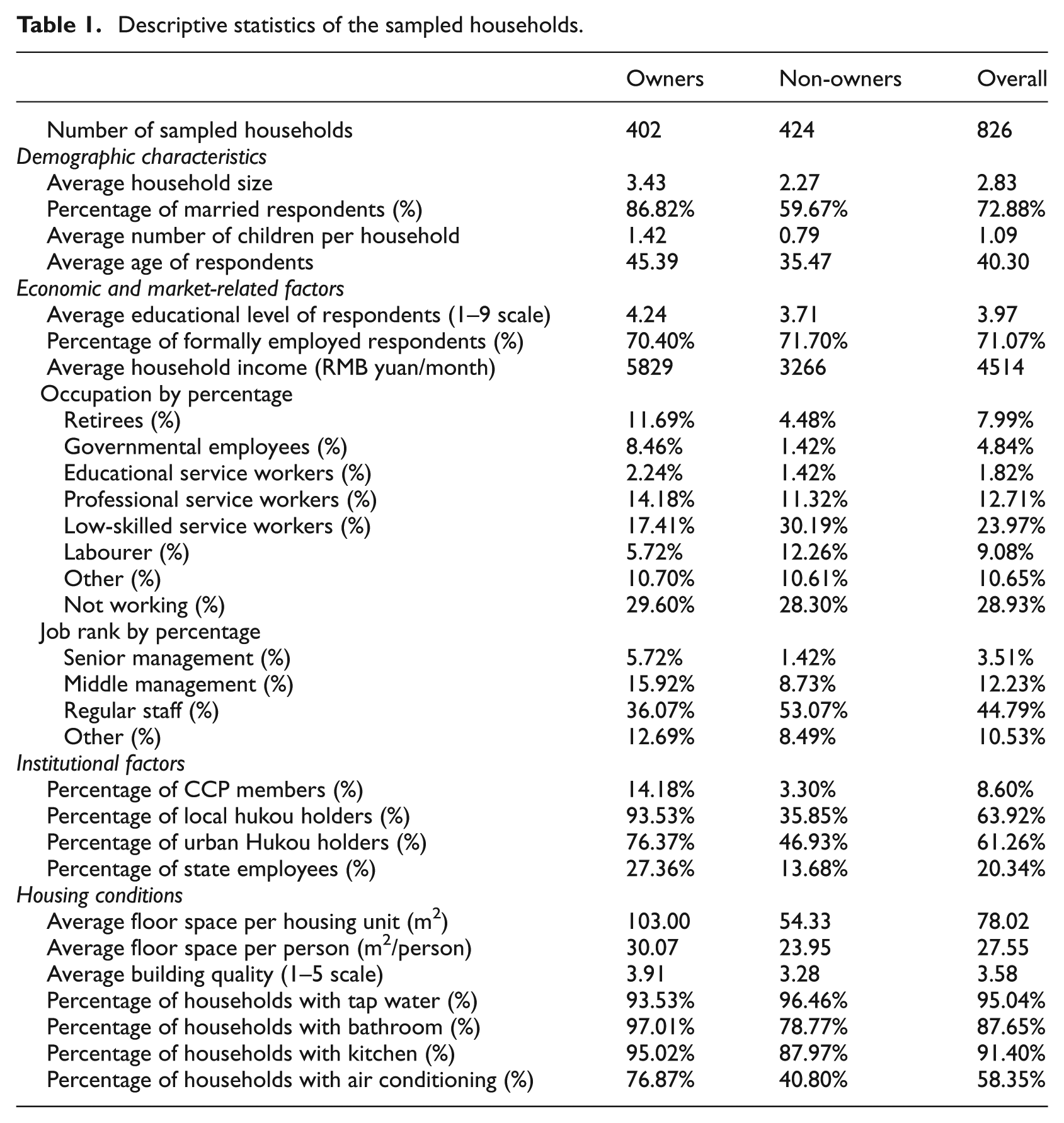
The rest of the descriptive statistics agree well with the 2010 population census. There are 298 non-local Hukou holders among the total of 826 sample households, and the percentage of non-local Hukou holders in our sample (36.08%) is very close to the number reported by the population census (37%). The average household size for the sample households (2.83) is only marginally higher than the 2.73 reported by the population census. The average living space in the survey sample is 27.55 m2/person, whereas the population census reported 26.84 m2/person. Consistent with the population census, an overwhelming majority of the surveyed households have a kitchen, a bathroom and tap water in their dwelling units. Note that the possession of air conditioning is a variable not reported by the population census, but included in our survey as a reliable indicator of living standards given the subtropical climate of Guangzhou.
There are visible differences between owners and non-owners on most of the socioeconomic and housing indicators. Compared with the non-owners, the homeowners enjoy bigger (in terms of floor space) and better (in terms of quality) housing units equipped with better facilities. In terms of household characteristics, the owners group has more married couples, more children per family and larger household sizes on average. Members of the owners group also tend to be older than members of the non-owners group, while attaining higher educational levels and earning more income. In terms of occupational structure, the owners group has higher percentages of respondents who reported to be retirees, governmental employees or professionals in educational and other skilled service sectors. In contrast, the percentages of respondents working in low-skilled service sectors or as labourers are much higher in the non-owners group. The percentages of respondents with mid-level or senior management job ranks are also much higher among the owners. For institutional factors, the percentages of Party members, local Hukou holders, urban Hukou holders and employees of state-affiliated work units are all significantly higher among the owners group than among the non-owners group. In summary, the descriptive statistics indicate the existence of a tenure-based differentiation among the sample households in terms of both housing conditions and socioeconomic status.
Results of the overall models
The results of the overall housing-tenure choice models are reported in Table 2. Model 1 specified only household demographic and economic variables as regressors whereas Model 2 also included institutional factors. Both models included the residents’ committee IDs as a categorical independent variable to control for the effects introduced by the stratified survey design, although the coefficients of this variable were not included in the table because they offer little useful information for interpretation. It was found that the occupation variable, which contains multiple categories, caused multicollinearity problems, as suggested by their variance inflation factor (VIF) values. Consequently, it was converted into a binary variable with 1 indicating that a respondent was employed or supported by the retirement programme at the time of survey. In other words, this new variable is an indicator of economic support rather than a conventional count of ‘employment rate’. Similarly, the job rank variable had high VIF values, and therefore it was dropped from the final models. Both Model 1 and Model 2 have reasonable explanatory power, as suggested by the pseudo-R2 measure (McFadden, 1974). Moreover, the VIF values for the selected regressors are relatively low, suggesting that the models are unlikely to suffer from problems caused by multicollinearity. Model 2 has a lower AIC value and a larger pseudo-R2 value, which means that incorporating institutional factors improved the quality of the model.
Overall model of homeownership attainment.
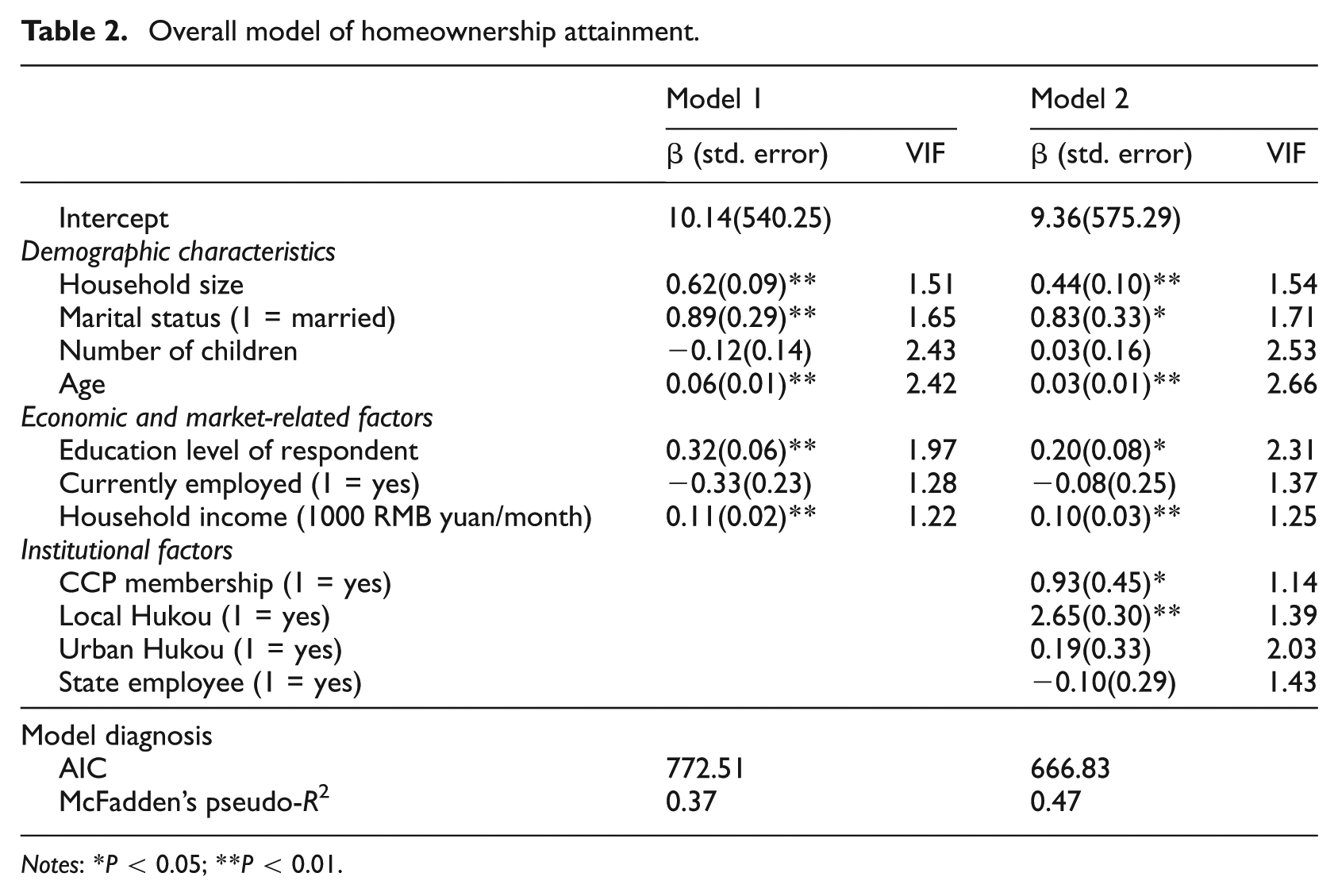
Notes: *P < 0.05; **P < 0.01.
In general, the results of the overall models agree with most existing understandings of homeownership attainment in urban China. Both marital status and household size are significant predictors of homeownership, which reflects the roles of family dwelling preference in housing-tenure choice. The positive effects of age, educational level and household income confirmed previous findings that homeownership attainment is more likely to be achieved among residents with older age, higher educational attainment and more income. An interesting observation is that employment is insignificant in both models. This is largely because a large number of migrants were employed renters. On the other hand, many native residents were homeowners even they did not have a job. As for the institutional factors, the Party membership and local Hukou status have significant positive effects on homeownership. However, urban Hukou status and state employment do not show any significant effects.
Results of the mixture model
After comparing the BIC measures of different models, we concluded with a three-cluster specification for the finite mixture regression. The model converged with an entropy value of 0.77, indicating a reasonably acceptable quality of clustering for three-cluster cases. Table 3 reports the sizes of these three groups based on estimated posterior probabilities (i.e. by calculating the sum of membership posterior probabilities for a given cluster) and the most likely cluster membership (i.e. by counting the number of respondents that are mostly likely to be a member of a given cluster). As shown in the table, the identified three clusters were labelled as ‘urban elites’, ‘native plebeians’ and ‘lower masses’. The lower masses group is mainly comprised of rural migrants and younger local residents mostly working in the low-skilled service sectors or as labourers. By contrast, all members of the native plebeians group and the majority of the urban elites group are local Hukou holders. Moreover, almost all members of the urban elites group (96.12%) hold the urban Hukou status.
Characteristics of the latent clusters generated by the finite mixture model.
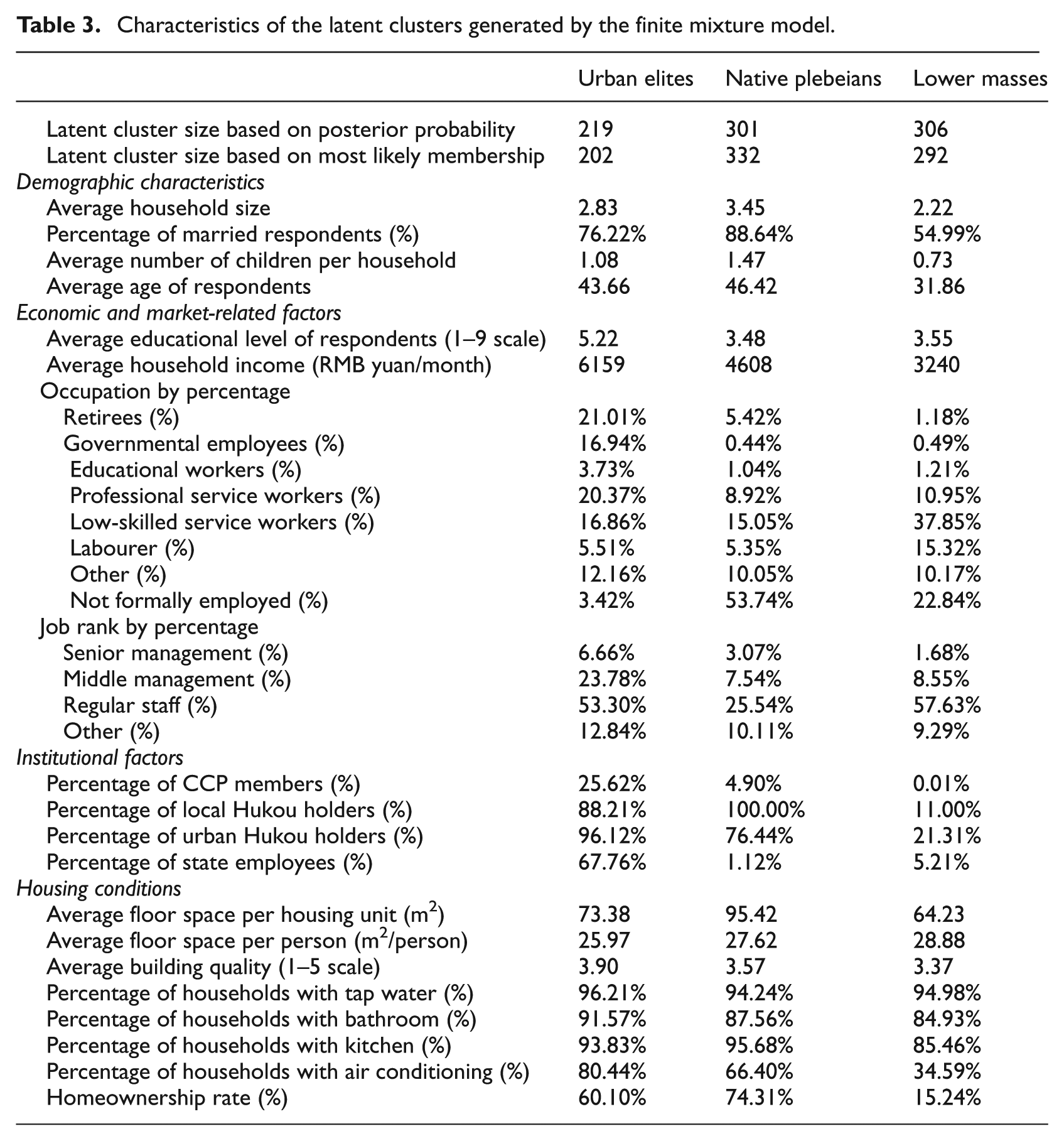
The identification of the lower masses group confirms that the local Hukou status is still a strong discriminant of housing-tenure choice. In other words, rural migrants and a small number of local residents (roughly 11% of the lower masses group) exhibit a distinct housing-tenure choice subprocess, potentially because of the vast socioeconomic and institutional disadvantages they suffer. Demographically, the lower masses group is characterised by younger age, lower percentage of married couples, smaller household size and fewer children per household. Compared with the other two groups, members of the lower masses group also earn the least average household income, while having the highest percentages of low-skilled service workers and labourers. In terms of housing, the homeownership rate among the lower masses group is extremely low and their housing conditions are the worst. The only exception is the per capita living space, for which the lower masses group has the highest average value. This seemingly counter-intuitive result is partly because this study only considered migrant households who had a substantial plan to stay in Guangzhou in the long run. As a result, most students and young workers living in factory dormitories – the group of people with least living spaces – were effectively excluded. It is notable that the lower masses group actually has the smallest housing units on average. But their household size is also significantly smaller than the other two groups, which inflated the average of the per capita floor space.
The more interesting segmentation revealed by the mixture model is the division between the urban elites group and the native plebeians group. Although the majority of the urban elites group are local Hukou holders, urban migrants, i.e. those with a non-local urban Hukou, make up a small but non-trivial proportion of the group. This is consistent with the previous finding that migrants from other cities (rather than from rural areas) enjoy advantages in terms of socioeconomic and housing opportunities (Fan, 2002; Logan et al., 2009). The mean household size of the urban elites group is smaller than that of the native plebeians group, which is largely because members of the urban elites group tend to have fewer children per family. Moreover, households in the urban elites group are socioeconomically much better off than those in the native plebeians group. The urban elites group also includes the majority of the Party members and state employees in the sample households. In terms of housing, most indicators of housing conditions record higher values for the urban elites, but the native plebeians have a higher homeownership rate and larger units on average. This is mainly because the rural Hukou holders in the native plebeians group are usually owners of self-constructed housing units that are often larger than standard urban housing units even though lower in quality. Moreover, it has also been found that an elite family may live in cheap rentals offered by the government or employer despite owning one or more properties (Huang and Yi, 2011). These cases were not considered owner occupancy in this study.
The results of the group-specific logistic regressions are reported in Table 4. For the urban elites, marital status and age are two significant predictors of homeownership, but neither of them is significant for the other two groups. By contrast, household size has significant positive effects on homeownership for both the native plebeians group and the lower masses group, but not for the urban elites. In terms of the economic and market-related factors, educational level is a highly significant predictor among the urban elites, whereas for the native plebeians, it is income that matters. None of the economic and market-related factors, however, seem to affect homeownership attainment among the lower masses group. It is notable that Table 4 reports the coefficients of several institutional factors as ‘N/A’, including the CCP membership among both the native plebeians and the lower masses mass as well as the local Hukou among the native plebeians. This is because the relevant groups contain zero or extremely small number of data points for one of the categorical values of these variables (for instance, there is no non-local Hukou holders in the native plebeians group), and thus there are no meaningful coefficients for these variables, which can be considered as dropped from the respective models. For the rest of the institutional variables, none are significant for the native plebeians, while all except urban Hukou show positive effects for both the urban elites and the lower masses.
Group-specific effects of household characteristics and market-related factors on homeownership attainment.
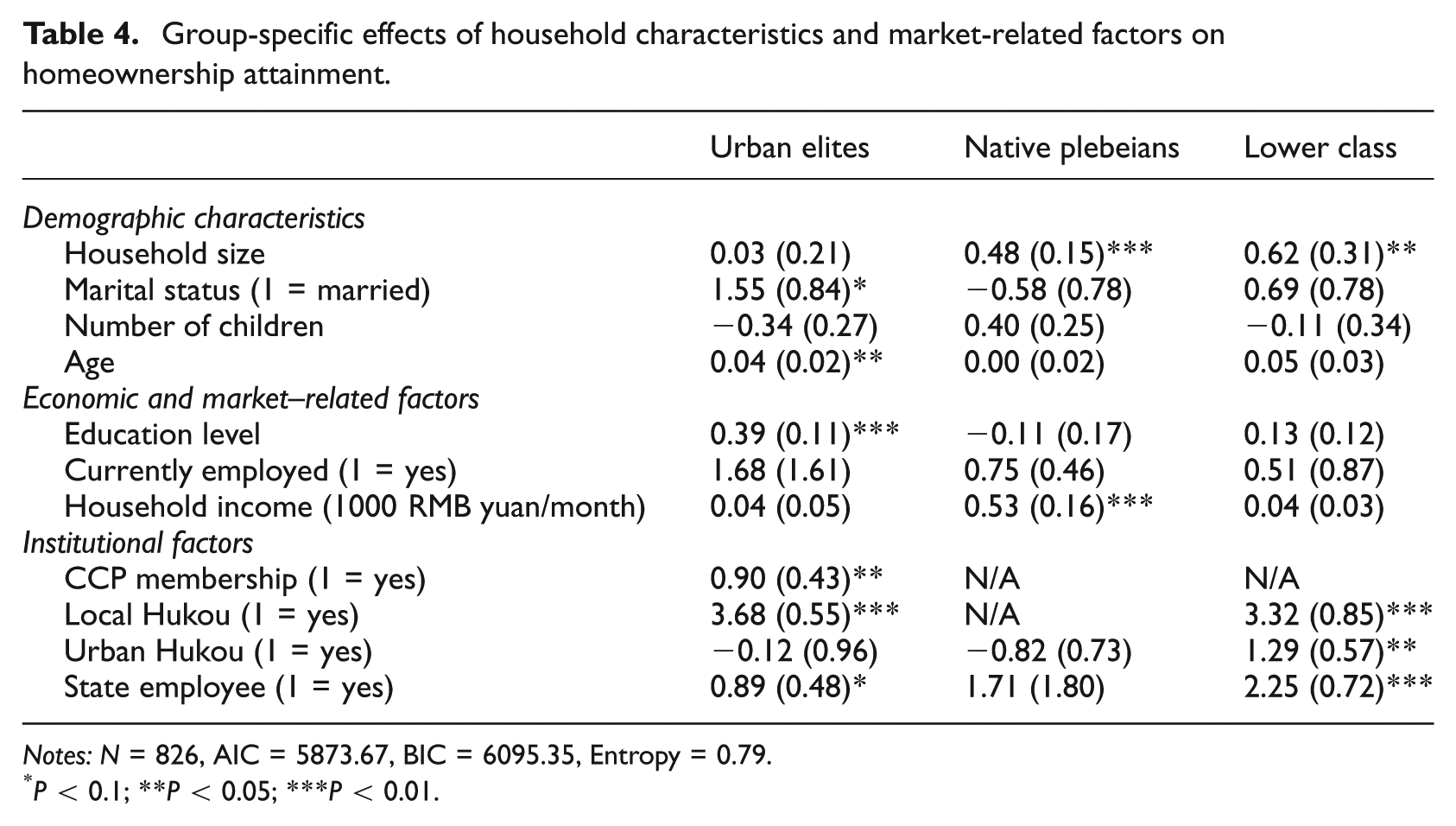
Notes: N = 826, AIC = 5873.67, BIC = 6095.35, Entropy = 0.79.
P < 0.1; **P < 0.05; ***P < 0.01.
Discussion
Despite the visible socioeconomic differentiation between the three identified groups, it is important to understand that these groups were delineated based on the heterogeneity of housing-tenure choice (sub)processes rather than the difference in socioeconomic variables. Note that the finite mixture regression model itself does not necessitate a clear-cut classification: it merely attempts to find out whether the housing-tenure choice process among the sample households can be decomposed into distinct and clustered subprocesses. The alternative hypothesis is that there are no distinct subprocesses (i.e. the housing-tenure choice can only be described by the overall models) or the distribution of the identified subprocesses does not cluster into obvious groups (e.g. imagine the case where most sample households have near-equal membership probabilities for all groups). The fact that three distinct subprocesses of housing-tenure choice exist and distribute among well-separated groups, as well as the observation that these groups also differ socioeconomically, is an interesting empirical finding that offers a new perspective on housing and socioeconomic differentiation. It allows us to look beyond the outcome-oriented distributive inequality and examine the difference in the housing-tenure subprocesses (as indicated by the slopes of the group-specific regressions), which helps expose deep-lying forces of housing differentiation in urban China. It is possible to explore these forces from two perspectives: the perspective of housing access and the perspective of housing demand.
The inequality in housing access reflects the difference in housing opportunities. On the one hand, despite the advancement of housing marketisation, non-market housing opportunities are still commonplace for privileged groups in Chinese urban society. Some of these opportunities, e.g. the so-called ‘collectively funded’ housing offered by powerful work units (Chen, 2012a), can be regarded as the legacy of the public housing era, which partly explains the effect of age – a proxy of seniority in work units – on homeownership. Other housing opportunities are the results of rent seeking and usually linked to corruption (Hanming et al., 2014). There are also legitimate opportunities for a selected few. For example, in order to attract top talents, many employers subsidise private housing purchases for employees with highly demanded skills and/or qualified levels of education (e.g. post-graduate degrees from prestigious universities). Although the lack of regulation and transparency in implementation increases the risk of corruption, these policies do reward high-skilled people and may account for the effect of education on homeownership among the urban elites group. Owing to the plethora of non-market housing opportunities, regular market factors such as income become less important in shaping the housing prospects for the privileged. On the other side of the story are those at the bottom of the housing distribution hierarchy – including most rural migrants – who are deprived of legitimate housing opportunities (e.g. housing subsidies, home loans and housing welfare) because of institutional barriers (e.g. those related to Hukou). This increases the difficulty of homeownership attainment because the only way to obtain homeownership is to buy from the private market. Considering the hefty property prices, even those earning relatively higher incomes in the lower masses group would find a private home unaffordable, because the income range for this group is generally low. Consequently, the income elasticity diminished among both the urban elites and the lower masses, although for very different reasons. Household income was found to be a significant predictor of homeownership only among the native plebeians, who do not enjoy as many non-market opportunities as the elites but are entitled to most of the government-sponsored housing programmes and benefits.
From the perspective of demand, the heterogeneity of housing-tenure choice is a consequence of stratified housing interests and priorities. According to our interview, most respondents regard living in the city as a top priority in their long-term life arrangement, because it is the foundation for pursuing a desired life and career in Guangzhou. However, this ‘universal appeal’ of homeownership substantiated into divergent interests and priorities. For those with limited resources, homeownership is often the only assurance for a secure and stable dwelling place in Guangzhou’s increasingly contested urban space. The pressure of inhabiting in the city is particularly high for larger families, which explains the positive effects of household size on homeownership among both the native plebeians and the lower masses. By contrast, the urban elites face much less pressure in terms of tenure security because they have abundant resources to ensure a decent life in the city. Residents in this group seldom purchase homes simply for the sake of staying in Guangzhou, and they tend to be more concerned with the derivatives of homeownership, e.g. location, residential environment and school districts. One interesting factor on the demand side is marriage, as more and more urban Chinese regard a privately owned property as a material foundation for married life. It is notable that the less well-off families tend to have a more flexible attitude towards the so-called ‘naked marriages’– a recent slang in urban China referring to marriages between partners with few material assets (Xinhua, 2011) – because those families normally do not expect their children to afford expensive items such as private housing. But the lack of assets appears to be a more serious concern among well-off families, which usually have higher expectation on the material capacity of the person their child is going to marry. This partly explains why marital status significantly affects homeownership attainment among the urban elites but not among the other two groups.
Conclusion
In summary, this study confirms the hypothesis that housing-tenure choice among residents in Guangzhou are heterogeneous. Three groups characterised by distinct subprocesses of housing-tenure choice are identified using the methods of finite mixture regression. The urban elites group includes affluent native urban residents, migrants from other cities and privileged citizens such as state employees and CCP members. Homeownership among the urban elites positively correlates with marital status, age and education. The native plebeians group is comprised of less affluent local families, including a large number of unemployed residents and people with local but rural Hukou. They have the highest homeownership rate among the three groups and their housing-tenure choice is a function of household size and income. The majority of the lower masses group are rural migrants. They are mostly renters, although larger households are more likely to be homeowners.
It has long been recognised that social stratification in post-reform urban China can be characterised by three groups: privileged elites, common native citizens and ‘outsiders’ deprived of many rights and benefits (Fan, 2002). This study shows that such a tripartite view can also be used to describe the heterogeneity of housing-tenure choice. The main contribution of this study is a novel perspective on housing differentiation that shifts the focus of empirical lens beyond distributive outcomes to distributive processes. Specifically, the analyses presented in this study make it possible to examine the distinct subprocesses of housing-tenure choice and compare the socioeconomic profiles of the groups delineated by these subprocesses. These findings highlight the importance of understanding the complex forces behind housing behaviour, and provide a direction for further investigating fine-grained mechanisms of housing distribution among specific subpopulations.
It is evident that the heterogeneity of housing-tenure choice exposed by this study is deeply rooted in more fundamental issues in China’s political-economic system, including the persistence of political power, the inefficiency of the highly subsidised and monopolised housing market, and the continued practice of institutional discrimination. Although resolving these problems is a long-term project that requires efforts beyond the urban housing sector, the results of this study offer short-term implications that can help prioritise the current housing policy. Specifically, it is advisable to adopt a triadic strategy of ‘regulating, enabling and enfranchising’ to cope with the housing situations of the three groups identified in this study. For the urban elites, it is necessary to regulate the non-market housing distribution controlled by the privileged class. This includes curbing illegitimate housing allocation to state/governmental employees and formalising legitimate housing benefits (e.g. those offered to high-skilled workers) to reduce the chance of corruption and rent seeking. For the native plebeians, the main focus of the housing policy should be enabling a secure and affordable housing strategy, as tenure security and affordability are the main concern and constraint of family housing choice. Finally, a sensible housing policy must help enfranchise the lower masses group. The reform of the household registration system is an important step towards this goal. More and more cities, including Guangzhou, have started to abolish the long-standing rural–urban dichotomy in a new and eventually integrated ‘residential Hukou’ system (The Municipal Government of Guangzhou, 2009). Although still distinguishing between local and non-local Hukou holders, the new system grants (at least in principle) most benefits enjoyed by native residents, including access to the affordable housing programme, to migrant families who can show proofs of long-term local residency (e.g. an income tax certificate indicating fulltime employment in Guangzhou in the past year). The non-local Hukou holders, however, are still not qualified for the low-cost public rentals (including ‘Lian-Zu-Fang’ and ‘Gong-Zu-Fang’) offered by the municipal government. Another housing barrier for migrants is the property-purchase restriction installed since 2010 (The Municipal Government of Guangzhou, 2013). Under the latest version of this policy, non-local Hukou holders who are already homeowners and local Hukou holders owning two or more properties are not allowed to buy housing in Guangzhou, which is enforced through both administrative order (i.e. by denying the issuance of ownership certificate) and financial means (i.e. by denying mortgage application). Since many migrants own housing at their places of origin (Huang and Yi, 2011), the purchase restriction, which was intended to restore affordability by curbing the property market speculation, becomes a new source of housing difficulty for migrants. This is an ongoing example that the heterogeneous housing market requires more flexible and group-customised housing policy, which, in this case, should distinguish the rural migrant workers in need of secure dwellings from speculators.
Footnotes
Acknowledgements
The collection of field survey data for this research was funded by an IRGP-New Faculty Grant from Michigan State University, with crucial support from a group of students and faculty from MSU and Sun Yat-Sen University. The author also would like to thank the editor and the three anonymous reviewers for their careful reading and constructive comments on this paper.