







Abstract
Over the last decade the English planning system has placed greater emphasis on the financial viability of development. ‘Calculative’ practices have been used to quantify and capture land value uplifts. Development viability appraisal (DVA) has become a key part of the evidence base used in planning decision-making and informs both ‘site-specific’ negotiations about the level of land value capture for individual schemes and ‘area-wide’ planning policy formation. This paper investigates how implementation of DVA is governed in planning policy formation. It is argued that the increased use of DVA raises important questions about how planning decisions are made and operationalised, not least because DVA is often poorly understood by some key stakeholders. The paper uses the concept of governance to thematically analyse semi-structured interviews conducted with the producers of DVAs and considers key procedural issues including (in)consistencies in appraisal practices, levels of stakeholder consultation and the potential for client and producer bias. Whilst stakeholder consultation is shown to be integral to the appraisal process in order to improve the quality of the appraisals and to legitimise the outputs, participation is restricted to industry experts and excludes some interest groups, including local communities. It is concluded that, largely because of its recent adoption and knowledge asymmetries between local planning authorities and appraisers, DVA is a weakly governed process characterised by emerging and contested guidance and is therefore ‘up for grabs’.
Introduction
In most market-oriented economies, local and central states use a range of instruments to capture land value in order to mitigate negative externalities and to deliver public goods and services (see Ingram and Hong, 2012, for a review of approaches). Often in a context of broader regulatory reforms and fiscal uncertainty, governments are looking to development to fund infrastructure and low-cost housing. Uplifts in land value can be generated by a blend of public and private investment, demographic and economic change and regulatory policies, and identifying equitable models for the capture of these uplifts remains both challenging and controversial. The sums involved in land value capture can be substantial. Research in England estimated that planning gain worth £3.7 billion was agreed during 2011–2012 (DCLG, 2014). In England, there has been notable growth in the use of financial appraisals to assess whether, at given levels of value capture, development provides sufficient financial returns to landowners and developers. Focusing on a number of governance-related issues, this paper evaluates the operationalisation of this relatively new practice in order to draw out issues that have wider relevance for international discussions about best practice in land value capture.
The policy background to development viability appraisal (DVA) and the technical shortcomings of modelling approaches have been documented (see Coleman et al., 2012; Crosby et al., 2013). However, although DVAs are now being used in England to determine ‘who gets what’ from the land value uplift that can result from a grant of development rights, little is known about the governance of the DVA process in terms of power relations, accountability, stakeholders, control, decision-making, authority, interests, risk management, equity and transparency.
The focus of this paper is on the ways in which DVAs are produced and, in particular, their production in support of planning policy formation. DVA is applied in two main ways. The first is to provide an evidence base for the deliverability of planning policies. This typically consists of an ‘area-wide’ financial viability test to determine whether a local authority’s policy targets regarding the availability of development land, planning obligations and infrastructure levies could jeopardise either the adequate supply of land for development or development activity itself. The second application is at a ‘site-specific’ level; local planning authorities and developers negotiate levels of low-income housing and other planning obligations for a particular development proposal. It is the first of these applications that is the subject of this paper. Table 1 provides a summary of the stages of the DVA process as it is typically used in area-wide planning policy formation, along with the actors involved.
The area-wide DVA process.
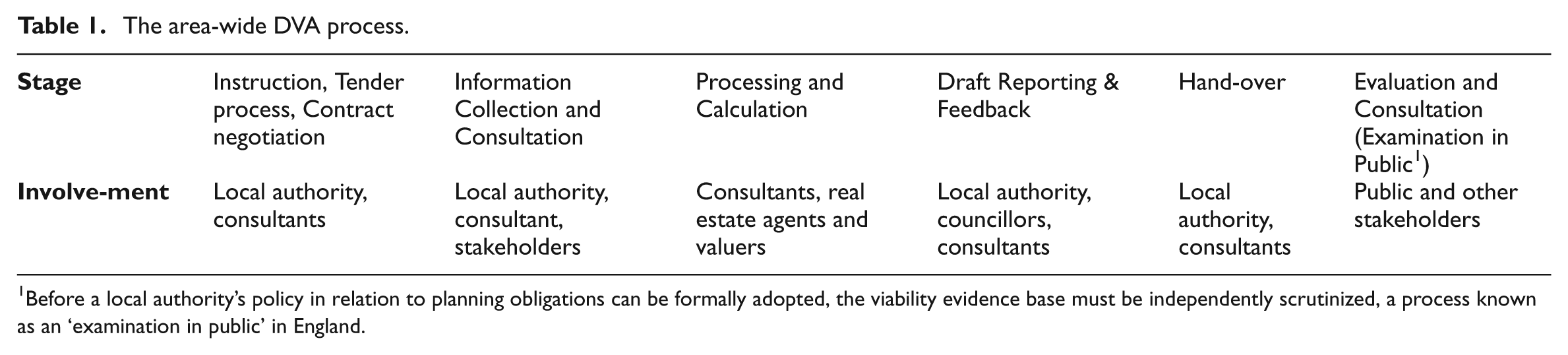
Before a local authority’s policy in relation to planning obligations can be formally adopted, the viability evidence base must be independently scrutinized, a process known as an ‘examination in public’ in England.
After discussing the role that DVA plays in the English planning system, the paper contextualises DVA as a technical planning procedure requiring governance, as a ‘black box’ exercise, a professional service and as a calculative practice. We then present the results of an interview survey with consultant development viability appraisers.
DVA: Planning context and conceptual framework
Background and context
Christophers (2014) traces the use of financial viability tests in the English planning system to the late 1990s. Through a series of circulars, policy statements and guidance notes, viability tests have become embedded in English planning. In 2012, the National Planning Policy Framework emphasised that local planning authorities should pay careful attention to viability, stating that: [T]o ensure viability, the costs of any requirements … such as requirements for affordable housing, standards, infrastructure provision and other requirements should … provide competitive returns to a willing landowner and a willing developer to enable development to be deliverable. (Department for Communities and Local Government (DCLG), 2012: 41)
Moreover, in 2013, the Growth and Infrastructure Act permitted developers to obtain reductions in agreed levels of low-income housing ‘based on prevailing viability …’ which ‘should be supported by relevant viability evidence’ (DCLG, 2013: 4). These reforms have been accompanied by the introduction of regulatory mechanisms that quantify and benchmark existing regulatory systems (such as land-use planning) according to the principles of economic performance and competition (Klenk and Lieberherr, 2014). As Klenk and Lieberherr (2014) identify, the layering of what they call ‘market-based accountability mechanisms’ upon existing regulatory systems can create problems, particularly where the provision of social services and goods is concerned. The integration of the development viability principle into English land-use planning is one example of the type of regulatory ‘layering’ discussed by Klenk and Liberherr (2014). Many of these issues are governance-related and include uncertainties around the mechanisms of (and for) accountability in such hybridised systems (Klenk and Liberherr, 2014). These concerns are not new; attempts to find ‘scientific solutions’ to ‘wicked’ (social) policy problems have long been subject to critique (see, for example, Rittel and Webber, 1973).
Development viability is assessed using a project appraisal model. A development project is considered viable if the projected revenues from a development scheme are sufficient to justify incurring the costs of development, which typically include:
Sufficient return to landowners to incentivise the release of their sites for development.
Costs associated with development implementation (site preparation, construction, professional fees, stamp duty, marketing and leasing, etc.).
An appropriate risk-adjusted return to developers to incentivise them to undertake development.
Planning obligations including infrastructure levies, low-income housing provision and other types of planning gain.
Area-wide DVA is typically based on a set of hypothetical, archetype developments and, consequently, the application of policy targets supported by area-wide DVAs to specific development proposals is often challenged, either opaquely through negotiation between the developer and local planning authority or via more formal appeal and judicial review mechanisms.
DVAs require appraisers to quantify three types of model inputs. The first includes relatively objective inputs (e.g. site size, location, taxes). The second includes construction costs, sale prices, development timescale, professional fees and abnormal costs. These tend to be uncontroversial in terms of definition and scope but are subject to intrinsic estimation uncertainty and are therefore contestable. Finally, the estimation of sufficient returns to developers and landowners tends to be the most controversial and contested inputs.
Governing the DVA process
Reflecting a broader shift whereby planning is increasingly compartmentalised into a series of discrete, technical tasks such as traffic and environmental impact studies and community consultation, external consultants are often appointed to provide specialist advice because many local planning authorities lack the expertise to undertake DVAs in-house (Raco et al., 2015). Private-sector consultants feed reports and guidance back to local planning authorities, which retain decision-making powers (see Campbell and Marshall, 2006; Gunn and Vigar, 2012). The increasing use of specialist consultants in planning-related tasks represents a wider shift in the practice of public service delivery – an activity increasingly characterised by numerous public–private interactions (Pierre and Peters, 2000). Some have argued that this is symptomatic of the rise of regulatory capitalism wherein government runs fewer services directly but instead commissions and oversees the activities of private sector and other non-state providers (see Braithwaite, 2008).
The involvement of external consultants in the production of DVAs raises important questions linked to governance, a broad term that ‘can convey a slightly different meaning depending on who uses it’ (Aubut, 2004: 8). Our focus on governance reflects DVA’s recent integration into broader planning and development processes characterised by a range of different, sometimes oppositional, interests and complex actor networks (see Adams and Tiesdell, 2012; Henneberry and Parris, 2013). Within an overarching framework of accountability, McCall and Dunn (2012) conceptualise governance in terms of equity, competence, transparency, participation, effectiveness in delivery, efficiency, conflict management inter alia.
Informal guidance from government agencies on the production of DVAs has begun to recognise and, to a degree, reflect upon this wider context, stressing the desirability of consulting stakeholders and increasing levels of transparency. For instance: There is a need for transparency on how to approach these issues. Our objective is to build and disseminate a transparent set of assumptions (with consensus within the sector where possible) on these issues and ranges of input variable in different circumstances. We are exploring the basis of engagement with housebuilders, mixed use developers, RSLs, valuers, cost consultants and planners through their representative bodies. (Homes and Communities Agency, 2010: 2)
Consultation with interested parties in the production of DVAs is held to be an important principle for two main reasons. First, it can improve model accuracy by standardising ‘assumptions’ and maximising stakeholder ‘buy-in’ to the results (see Jakeman et al., 2006). Second, reflecting many themes from the collaborative planning literature (see Healey, 1996, for example), consultation with different parties can help protect broader planning goals such as transparency and consensus building.
However, while consultation has become a guiding objective in many planning systems, instances of selective, ineffective and partial consultation can be observed. Often weaknesses relate to the way in which knowledge is perceived or accessed. For example, in consultations regarding road planning in Sweden, Blicharska et al. (2011) found that practitioners distinguished between expert and lay knowledge, treating the former as more relevant. In the context of transport planning in Munich, Hajer and Kesselring (1999) saw, in the restricted participation of different actors, something that pays lip-service to the new democracy but was very similar to corporatist practices providing industry with prioritised access to government. Selective participation that favours expert input can also be framed in terms of the creation of policy venues or deliberative arenas where, ‘invisible’ to the general public, expert knowledge is extracted and policies are originated or legitimised (Timmermans and Scholten, 2006). In the context of Housing Market Assessments, 1 Ferrari et al. (2011) found that many local authorities had some form of partnership or steering group, although typically these comprised local authority officers and representatives of various public agencies, rather than drawing from a wider constituency. Similar observations were made by Murdoch and Abram (1998: 49) in their work on Housing Market Assessments, which argued that the involvement of citizens and communities was usually on acutely constrained terms so that they were ‘rarely invited into the central arenas of policy formulation and they are not heard in many of the technical discourses which comprise the more specialised areas of planning’.
Despite viability’s emerging centrality to planning, and growing recognition that consultation in order to aid transparency is a ‘good thing’, the DVA process itself is subject to little formal regulation outside of advice notes and ‘best practice guidance’ issued by professional and non-statutory bodies such as the Royal Institution of Chartered Surveyors (RICS). The lack of governmental oversight of the practices surrounding DVA is perhaps surprising given the contestable nature of aspects of modelling and the political sensitivities that can surround its use. Central government has been reluctant to provide a methodology for viability assessment (see DCLG, 2015), despite calls for definitive and agreed guidance, the most recent example of which argues that the current diversity of guidance is leading to a great deal of uncertainty and complexity. 2
Furthermore, these complexities and uncertainties can be subject to a process of ‘black boxing’, a technique used to obscure the inner-workings of (policy) procedures deemed ‘too complex’ for non-experts to engage with (see, Rydin, 2013). As Jacobs et al. (2007) suggest, one consequence of ‘black boxing’ is that a ‘technical exercise’ such as DVA can: … acquire a kind of anonymity that allows a set of additional transformations to occur. First, its status can grow and it can be understood as a ‘hard fact’ and the work it does taken for granted. Secondly, it can mesh with wider technological or social systems and grow ‘big’. Finally, it can become ‘mobile’, for once stabilised a diverse range of end-users readily accept and deploy it unquestioningly. (Jacobs et al., 2007: 614)
Such observations are suggestive of the transformative or ‘performative’ power of the appraisal outcome. The way in which DVA is used to measure and define a viable level of development profit, a process which then re-defines profitability ‘benchmarks’ within policy, is an example of this. Ensuring there is opportunity to open the ‘black box’ is therefore critical if the use of DVA is to be understood and challenged when appropriate. The issues raised in this section of the paper are discussed in the research results section below, in which we ask a series of questions of the DVA process including; who has oversight of the process and how does it operate, who is (not) consulted in the production of appraisals, what does consultation consist of and how does it inform model outputs?
DVA as a calculative practice
At the core of the development viability ‘problem’ is the distribution of financial gain between the community, developers and landowners that results from the grant of planning permission. The application of financial modelling techniques can be interpreted as an attempt to solve the problem using what (at least appears to be) a rational, technocratic and quantitative method. These kinds of ‘calculative practices’ can be linked to a wider politics of quantification, whereby socio-economic issues are framed, understood and addressed in predominantly arithmetical terms (see Fligstein, 1998). Indeed, we observe that part of the rationale for the increased use of quantitative procedures such as DVA within planning is that they act as mechanisms ‘through which programs of government are made governable and operable’ (Miller, 2001: 379). Thus, while the methods and conclusions of these exercises are always contestable, the process of quantification is considered to offer several advantages in the creation of an evidence base to inform policy decisions. For example, Porter (1996) argues that numbers offer a common language for negotiation that may not otherwise exist, ensuring that differences of opinion are open to evaluation by similar standards, and increasing the likelihood that mutual trust develops between actors.
Arguably Porter’s analysis underplays the extent to which technical instruments such as DVA are embedded in wider social, political and economic arrangements that dictate how and under what conditions quantification occurs. In tracing how DVA models have been incorporated into local planning policies, Christophers (2014: 95) explores their performative nature, arguing that the development of affordable housing (for example) ‘cannot be understood except through the prism of the models that shape it’. Callon (1998: 24) also highlights the performative nature of such ‘accounting tools’, arguing that they ‘constitute spaces of calculability and define the way the calculation is made up, but also, through the reactions they provoke, new calculative strategies emerge which lead to the changing of goals’.
Whilst mechanisms of quantification such as DVA may provide the impression of precision and objective decision-making, model inputs and outputs are socially constructed. However, this contingency can be obscured by the use of models that attempt to make complex things governable, and which have the potential to create a closed process by which ‘strategists armed with numbers can exert power’ (Denis et al., 2006: 350). For example, quantification, rather than creating a common language, might serve to exclude those without the quantitative skills necessary to evaluate modelling procedures, including the very actors (local authority clients) that commission experts to conduct exercises on their behalf. These multi-actor settings may lack clear lines of command and control, creating monitoring-style governance problems that need to be managed in a way that ensures outsourced activities are being conducted appropriately. This includes ensuring that opportunities for the introduction of bias and/or excess influence by certain parties are not exploited; issues to which we now turn.
DVA as a professional service: Client knowledge and expertise
DVAs involve a particular application of longstanding appraisal techniques used within the real estate sector to solve planning ‘problems’. In most mature real estate markets, appraisals are regulated by a blend of governmental legislation and professional institutions. There is a body of real estate literature on issues and problems in the production of real estate appraisals (see Crosby et al., 2010, for a review). Without explicitly adopting the language of governance, much of this work is linked to micro-politics and the exercise of power strategies that takes place between individuals and organisations involved in the appraisal process.
Crosby et al. (2010) argue that, in a real estate context, investors often have the means, motives and opportunities to influence appraisals. Their motives centre on financial gain; higher appraisals can mean better remuneration. The typically high level of consultation with property owners during the appraisal process provides the opportunity. The means are provided by the inherent uncertainty in appraisal models, together with the expertise of some investors in this area. The uncertainty in many of the inputs provides scope for them to be systematically biased and investors who have expert knowledge will have the ability to rationalise such bias. A stylised fact that emerges from this research is that property owners sometimes attempt to influence appraisal outcomes and appraisers are likely to respond to client pressure because of their financial dependence upon them (e.g. for future commissions).
This work is relevant to our research because policy-makers (in their capacity as clients commissioning the production of viability evidence) may have the motivation and capability to influence DVAs. In the context of DVAs to inform plan-making, the identity of the client is less clear-cut. The formal power to make planning policy rests with the local politicians on the planning committee. Their attitudes towards proposed policies may be influenced by their various roles as local representatives, political party members or individuals with specific policy agendas (Bruff and Wood, 2000). Elected politicians are then advised by professionals, e.g. housing officers, transport engineers and planning officers, who can wield substantial influence on policy formation. In practice, power within local planning processes may be exercised by a fairly small group of politicians and officials (see Kitchen, 1997). It is this group that is likely to be the effective client in the DVA process. Their motivation to influence the process will depend on the strength of their attachment to specific policy aspirations. Their understanding of the DVA process and its governance will, in turn, determine their ability to influence it. An additional complexity is that there will almost certainly be different policy aspirations and knowledge levels among the politicians and officials. These themes are explored below.
Research method and data
The empirical data presented in this section are drawn from an in-depth interview survey of producers of DVAs. At the time the interviews were conducted, DVA was an emerging practice and there was a widely perceived dearth of knowledge amongst local authorities. As a result, many were (and indeed still are) commissioning DVAs from external consultants. Consequently, the main empirical focus was on these producers of DVAs and the process by which they were commissioned, undertaken and delivered. An industry analysis of the main producers of DVAs identified six groups: real estate consultants (11 organisations); planning consultants (12); multidisciplinary engineering consultants (4); specialist providers (8); the Government’s valuation agency (known as District Valuer Services in England); and an academic institution. The interview sample was selected from across these groups, although it is important to note that it is not straightforward to categorise these organisations. Some large firms informally subcontract parts of the DVA process to specialist consultants and, given that this is a relatively young industry, there have been several mergers and takeovers of service providers. Eleven semi-structured interviews were conducted between September and November 2012. For in-depth interviews, the literature suggests that saturation is commonly achieved after approximately 6–12 interviews (see Gubrium and Holstein, 2001; Guest et al., 2006).
In order to group themes emerging from the interviews, as well as to ensure responses remained anonymous, a coding framework allocated sections of text as follows:
Information about the interviewee, including experience and professional background in general terms and in relation to DVA work specifically.
DVA process from contract tendering, through to instruction and delivery. As well as gaining an understanding of procedures, an objective was to understand the client’s knowledge and experience and how this might affect the process.
Modelling approach, range of inputs and sources of information for inputs. The objective was to elicit information on how the client or other stakeholders may influence the selection and/or quantification of inputs.
DVA outputs: what they were, how they were tested (i.e. what benchmarks were employed, how uncertainty was handled) and the process of delivering outputs (draft report stage, knowledge transfer process, role of caveats and review procedures).
After coding, the transcripts were filtered; allowing similarly coded texts to be grouped together for analysis.
Respondents were private consultants consisting of chartered surveyors, town planners and economists, with a range of backgrounds covering valuation, commercial and residential development, consultancy, housing, planning and research/academia. All respondents bar one were senior practitioners (over 20 years of relevant experience) within their company or field and all were experienced in the production of DVAs for local authority clients. Three respondents were involved in the production of early DVA models, particularly during the period 2001–2004, and several other respondents have actively contributed to professional and government committees that are involved with the provision of guidance in this area. The majority of respondents testified to a large influx of development viability work for local planning authorities during the period 2008–2010. Geographically, whilst the majority of respondents were based in the southeast of England, between them they had produced the majority of the DVAs for planning policy formation across all regions of England.
Survey results
Themes identified in the preceding section concerning the issues of client knowledge, expertise and bias, and stakeholder consultation are used here to draw out a range of empirical observations about the operation of the DVA process.
Client knowledge and expertise in the DVA production process
In a context whereby planning tasks are increasingly divided into a range of tasks requiring specialist input, consultants are appointed for their expertise in and experience of DVA. When asked whether the client was well informed on DVA matters, it was generally felt that local planning authorities were not particularly knowledgeable. This was notable at the instruction/tendering stage of DVA (see Table 1), when contracts between local authority clients and appraisal consultants are negotiated. Interviewees described a process whereby they assess a client’s ‘needs’, establish why they have decided to commission a DVA and what they might want an appraisal to communicate. A typical comment was: Some [clients] clearly understand what they’re looking for, others don’t … They’re not necessarily experts in viability and don’t necessarily know what they need to ask. So very often it is a question of guiding them, as well in terms of what they actually need. (Respondent 10)
For some interviewees this lack of knowledge was worrying and, for one respondent, meant that clients could be ‘led by consultants far too much’ (Respondent 01). A more disparaging, but not isolated, view was that: ‘… local authorities are utterly clueless’ (Respondent 02).
When quizzed as to why local authorities tended to be inexperienced in DVA, several interviewees highlighted the relatively recent focus on viability matters in planning, as well as the tendency for planners to be less confident when dealing with the type of calculations embedded within DVA models. As one interviewee explained: Planners were being asked to do something that was actually very new to them therefore I can’t really blame them going to people … On the whole they have great awareness of issues but they are not particularly numerate and they will be the first to admit that. (Respondent 01)
On the more general question of client awareness of DVA issues, interviewees reported variable levels. In some cases authorities were: … quite savvy on what is required …They come at you with a specific requirement and they know exactly what they want. (Respondent 03)
While in other instances: … they are doing it because they have to do it but they don’t really know why they are doing it or what the output is going to be. (Respondent 03)
In this situation, the interviewee felt that it was about ‘educating the client’ as to what the process entailed. A geographical distinction was made; central London local authorities were perceived to be very well informed while elsewhere knowledge of DVA was not felt to be as strong.
In summary, local planning authorities’ ability to monitor and oversee DVA and to ensure quality and accountability is best described as patchy and is closely linked to their levels of understanding of, and confidence in dealing with, the process and outcomes. Several interviewees acknowledged that there were individuals within local authorities with expertise in particular aspects of the process. The feeling was that, while gaps in knowledge remain an issue, over time local authorities have generally become better informed about viability matters. As one interviewee stated: They are becoming more of an informed client whereas five years ago they didn’t really know what they were asking for. (Respondent 10)
This is important since, in a context of pro-development planning policy, viability is likely to become a more prominent feature of the English planning process. As Respondent 10 commented, ‘they [local authorities] are becoming more familiar because they’re being bombarded with it all the time’. The increasing use of DVA may also throw into sharper focus questions of (possible) bias in what is often held up as an ‘independent’ or ‘objective’ procedure. These are issues to which we now turn.
Client influence and bias
Reflecting on the Instruction stage, interviewees suggested that it was almost universal practice for local authorities to put DVAs out to competitive tender. As noted above, this outsourcing is usually a result of a lack of resources and expertise in DVA and suggests that local authority clients would be unlikely to have the knowledge or information needed to bias DVA outputs. Interviewees observed that, after commissioning, clients continued to be consulted throughout the DVA process. It seems that this activity was centred on consultants updating clients on progress, but also involved obtaining input from the client about which policy targets should be analysed. In the early part of the process, one respondent felt that, as a provider, they were not being commissioned because it was anticipated by the client that they would not provide the ‘desired’ output: There have been one or two authorities where we have pitched for the job and I think they have seen the work we have carried out where clearly that was not the output that they wanted and we haven’t been successful in those commissions, because they kind of know what answer they are going to get. (Respondent 03)
This was the only respondent to note this point, and a far more widely held view was that contract price was the key determinant of appointment. This suggests that the commissioning process is functioning as might be expected in a competitive open market, albeit with a large degree of client discretion over final appointment. After agreeing terms of engagement, interviewees described a range of experiences in terms of the level of feedback from the client. Whilst some required regular updates and consultation, others tended to be less engaged: We have the inception meeting, we then go away for a few weeks … we would probably then go back to the local authority, have a meeting, sit down with them and say ‘look, at the early stages it’s looking as if … Now, what do you want us to do?’… So there is a bit of feedback at that point. (Respondent 06)
While the format of feedback varied, providing the client with a draft of the final report for comment was standard practice. This was an opportunity for the client to influence the appraisal outcome. However, there was also an opportunity here to incorporate client feedback before a draft was produced. Whilst not all appraisers had such discussions, this would typically involve a presentation to, and discussion with, planning officers and members of the planning committee: Yes, that’s standard process. I prefer to make sure that we can have an opportunity to discuss the key results before we start drafting.
Interviewer: Because? Because what you need to do is to have a dialogue about what the implications are of these results and also because if there’s an issue that you’ve thrown up you want to discuss with them, you may need to go back and adjust your modelling, add modelling in, do something different, look at some different aspects. (Respondent 04) Yeah, it will go to them and then we’ll go and meet them to talk about it. We will often have several meetings with officers, senior officers, to talk them through and then often we go and see the members as well to explain to them what the results are and what they mean. (Respondent 10)
Whilst not made explicit here, it seems likely that appraisers are testing the acceptability of their findings before submitting a final report. A similar motive is possible for submitting a draft report, albeit there is also an additional quality assurance function, reflecting the findings of McAllister et al. (2013): We report to the client initially and we will produce a draft report and then before we issue that as a final report we will circulate that to stakeholders, typically have a further workshop and say ‘These are the findings, here is the report, you have a period of time in which to raise any comments’. (Respondent 03)
Interviewees described how reports were usually amended at the draft stage in response to feedback; however any changes tended to be minor. Consistent with previous research on other types of appraisals, respondents suggested that clients helped to improve the quality of the appraisal by providing clarification, assisting in the identification of errors and supplying additional information: They often have a panel of people and they go through it with a fine toothcomb and then we discuss the changes with them … I write to the person who is doing it ‘I agree with this point, I don’t agree with this, you have misunderstood what this point means’. So there is a discussion. (Respondent 01)
In terms of client influence, and more specifically whether clients put pressure on appraisers to reach certain conclusions (in effect biasing outcomes), previous studies have found that while interviewees defend the independence of their own work, there was a perception that other appraisers might be susceptible to client pressure (see Smolen and Hambleton, 1997). As one respondent stated in interview: I’m working for myself. I don’t mind saying ‘I don’t want the money and walking away’. If you are running a big company like [deleted], … you have mouths to feed. You have your staff to keep going. It is a more difficult ethical decision to walk away from a piece of work. Now I can do it because I’m solo … I know [deleted] certainly didn’t mind changing reports because the client fancied a better-looking result. (Respondent 07)
Overall though, the interviews suggested that there was little attempt by clients to unduly influence the appraisal outputs and conclusions at the draft report stage. This reinforces the sense that appraisers are acting relatively autonomously in an environment that is characterised by limited external oversight of process and procedure. While appraisers were aware that their findings sometimes did not support the local authority’s policy aspirations, there was a consistent response that appraisers would resist pressure from clients to alter their findings: We are fiercely independent. We say ‘we will tell you what the answer is, what the results of the analysis are and just because you don’t like the answer doesn’t mean we will change them. You can choose to ignore them in your policy making. That’s your area not ours but we are not going to give you the answers that you want because those would suit you’. (Respondent 03)
Appraisers are acting in line with RICS guidance that stresses the importance of consultants maintaining an objective and unbiased approach (RICS, 2012a). This is also likely to be part of a wider process of self-regulation whereby consultants seek to protect their reputational capital as ‘impartial experts’, an important factor in securing future work of this type.
Stakeholder consultation
One way in which appraisers sought to balance positive and negative effects of client influence, and demonstrate that they were acting in impartially, was by integrating various levels and modes of stakeholder input. Respondent 03 describes a fairly common approach to consultation at the Information Collection and Consultation stage (see Table 1): And the other key part of it once we get appointed is the consultation element of it, the stakeholder consultation element … We major on that as a key part of what we do.
Moreover, and perhaps more fundamentally, different stakeholders have varying levels of engagement in any consultation processes related to DVA. These issues were noted by interviewees, who described a relatively informal and uneven process of consultation that involved engaging in a number of ways with different interest groups including clients (local authorities), landowners, housing associations and developers.
Area-wide DVA involves the estimation of financial inflows and outflows for a range of archetypal development schemes. It is not surprising, therefore, that local developers were almost universally consulted. Echoing the comments of Jakeman et al. (2006), developers’ input into the modelling process was seen as beneficial since their ‘close-to-market’ expertise could improve the information inputs into the DVA: Whilst we will have our own ideas about what we think are appropriate site sizes or property values or whatever, the important part of it is to engage all the stakeholders in agreeing those assumptions because they are a key part of the exercise. (Respondent 03)
Other stakeholders consulted frequently included landowners and/or their representatives, housing associations and infrastructure providers: House builders, housing associations, agents, consultants, major landowners … and the authority themselves … You will find then that asset management and property teams will come. (Respondent 03)
It is also important to note those who were not consulted. Perhaps most critically, given the central role that DVAs can play in determining developer contributions in relation to public and social goods such as affordable housing, none of the interviewees consulted members of the local community. Formal consultation with residents has long been embedded within the planning system yet, to date, it has not been extended to the DVA process. This is despite recent media coverage suggesting that the appraisal process should be open to public scrutiny (see Guardian, 2015). This supports our characterisation of DVA as a ‘technical’ procedure operating as a black box in which lay-person knowledge is not inputted and the outputs of which are subject to public scrutiny only at the last stage of the process. As Jacobs et al. (2007) suggest, restricting opportunities for the detail of the appraisal process to be questioned by non-experts allows the validity of its results to ‘grow’ and closes down avenues to question and challenge.
The method of consultation described by interviewees was overseen and orchestrated by consultants, reinforcing their relatively autonomous role in the DVA process. Most interviewees explained that they preferred to meet stakeholders collectively and, in some cases, a single meeting with all stakeholders took place. Some appraisers preferred to meet different groups separately. Reflecting how contested discussions between parties can become, Respondent 07 felt that separate meetings enhanced the likelihood of reaching a consensus: We interview individually because we have found that planners, housing people and developers in the same room just start to argue … the best way to get the best out of them was to separate them. We had half days with developers, half days with planning lawyers, half days with environmentalists, half days with consumers. But we knew if you put them together, there would be no consensus in any shape or form.
Overall there was little consistency between local authorities regarding methods of engagement employed and who was consulted at which stage. Approaches seem to vary according to the client’s knowledge and experience of commissioning appraisals: It varies. Also it depends on what the local authority already has as its network … it might have some standing forum that it uses. You go along and talk to them or you write to them and get feedback or you have to work with the authority to identify the right people … They vary enormously in size as well as to whether you get a big turnout, small turnout but face to face contact through a workshop is very useful. (Respondent 04)
The consultation process can be interpreted as part of a defensive strategy deployed by appraisers to manage expectations and maximise acceptability of results. Interviewees also spoke of creating a scenario in which to defuse opposition and generate support for appraisal outputs by involving interested parties in their formulation: So just trying to hedge off some of those adverse responses that might come in. At least we can say ‘you all told us that your build costs were £110, your profit levels are this, your finance levels are that’. (Respondent 06)
A commonly used phrase was that of ‘buy-in’ or as one interviewee put it: It’s the key part because what you are doing is getting buy-in from everybody so when you actually then produce the results you can say ‘well it’s based on the assumptions which we all agreed, isn’t it?’ So, if the methodology is agreed and the inputs are agreed, you can’t really argue with the output. (Respondent 03)
Another interviewee concurred, suggesting consultation was the: … sensible thing to do because essentially you’re getting buy-in from the development community and from the landowners, to a lesser extent I guess, in the variables that you’re going to be using to test viability. So, to be able to say to an inspector at an EiP [Examination in Public] ‘These developers came to a meeting where we discussed the variables, the inputs to the appraisal. They agreed them or they disagreed and we sought to use them for whatever reason it might be’… you can use that exercise to neutralise opposition. (Respondent 10)
The point made here about the EiP refers to a widely held view that consultation was important in demonstrating ‘due process’ had been followed. This is pertinent since DVA has only been a formal focus of the English planning system for around ten years and, as described earlier in the paper, is subject to little or no external regulation of procedure. Yet, while the lack of externally imposed regulation may create opportunities for clients to influence appraisals and introduce bias, our results show little evidence of this taking place. This is mainly a result of relatively low levels of client knowledge; in effect, a local planning authority generally does not have sufficient expertise (or the ‘means’, using Crosby et al.’s (2013) terms) to influence appraisal outcomes to a significant degree.
Our results also show that, in the appraisal formation stages, stakeholder consultation does occur and while there is variation in the methods of engagement preferred by different appraisers, there is also some consistency in the form that this takes. Consultation tended to be selective with only certain user groups invited to contribute, a process that is then closely managed by consultants themselves. Further research is needed to evaluate the experiences of consultees themselves but our results indicate that the main reason for consulting stakeholders was to improve the quality of information inputted into models, thereby increasing the accuracy of results and the likelihood of achieving stakeholder ‘buy-in’. In the final section of the paper we reflect upon the wider implications of the growth in the use of DVA and set out an agenda for further research in this area.
Conclusion
This paper sheds a critical light on what is an increasingly central function of the English planning system. DVAs are now pivotal to the distribution of the financial gains from permission to develop between the community and landowners. Typical of calculative practices, DVAs can appear to transform the varied and multifaceted processes associated with planning decisions into objective, quantitative and quasi-scientific procedures. However, this apparent objectivity is largely illusory; the choices behind many of the assumptions used in modelling are not neutral and impartial. Rather, they are subject to interpretation and potential bias, and ultimately can significantly affect distributional outcomes. English governments have, since the 1990s, enthusiastically pursued governance reforms wherein market-based mechanisms have been introduced to existing regulatory systems. This paper has shown that this process of ‘layering’ is not always straightforward and raises several governance-related issues.
A focus of this paper has been the extent to which local planning authorities and other stakeholders, can, because of weak governance, bias the outputs of DVA models. At present, the ‘rules’ of what ‘due process’ in DVA consists of have not been formally codified beyond guidance offered by organisations that represent the interests of particular stakeholders such as the RICS (see RICS, 2012b, for example). They are, in essence, ‘up for grabs’. Our analysis suggests that, in the absence of formalised procedures, interest groups are attempting to define what good practice consists of. A relatively small pool of consultant appraisers has been doing most to establish the rules of the game; the DVA process is effectively a ‘closed-shop’. Although beyond the scope of this research, it is notable that several major producers of viability studies are members of professional bodies and their relevant working groups act with Government departments to shape guidance.
While there is currently little external oversight and/or regulation of the process, our research reveals a broadly positive picture of the role of client influence in the formation of DVAs. That is to say, where it occurs, the majority of this influence is perceived to be beneficial. The need for producers of DVAs to be seen as independent and impartial is an important controlling factor. However, since local authorities seldom possess the technical knowledge to contest approaches to, and assumptions of, DVA processes, it is likely that this independence is rarely challenged, raising questions about the mechanisms of and for accountability in terms of the construction and application of viability evidence, particularly where it is used in decision-making on public interest issues, such as low-cost housing.
The research indicated that the participation of, and consultation with, local market intermediaries such as real estate agents, developers, and other interested parties such as low-income housing providers, was seen as an important element of the DVA process. Two key reasons for this emerged. First, these stakeholders were perceived to contribute useful local knowledge to the information intensive process of viability modelling. This was felt to improve the robustness of the modelling process. Second, the inclusion of a range of stakeholders, often with conflicting interests, highlighted the intrinsic uncertainties associated with the assumptions of the modelling process. This served a legitimisation function, neutralising opposition and increasing stakeholder buy-in to the process. However, the consultation process was essentially limited to experts and lay participation was absent.
To date, research has focused on the use of DVAs in the formation of area-wide policy regarding land value capture through planning obligations. Whilst resultant policies will create policy benchmarks or ‘anchors’ for specific development projects, the use of DVA at the scale of individual development sites can be much more controversial. In these instances, expected costs and revenues are more clearly defined; ‘gains’ and ‘losses’ to the developer and/or landowner can correspond to losses and gains for the local community (for example, in the amount of affordable housing secured). There is anecdotal evidence to suggest this context induces a more controversial approach to DVA than we describe in this paper. Project-specific DVAs are usually confidential, commercially sensitive, politically contentious and, consequently, more likely to be challenged. Further research should help determine whether, at the project scale, independence and consultation in the production of DVAs tends to be compromised. Post-financial crisis, it seems probable that similar systems for capturing the uplift in land value upon grant of development rights as seen in England will be adopted in other countries. It is important that research continues to critically evaluate shifts towards this form of calculative practice in planning.
Footnotes
Funding
Funding was received from the Economic and Social Research Council RES-00-22-4146.