







Abstract
Over the course of the past two decades, bicycling has become increasingly popular in the USA. Although the rate of bike trips made in the USA has more than tripled since 1977, it is relatively low compared with many European cities (Pucher et al., 2011a). In urban areas throughout the USA, bicycling is increasingly being touted as an environmentally friendly way to enhance transit choice as public transportation budgets are slashed and automobile infrastructures remain congested. Discourse around the proliferation of bicycling infrastructure development in American cities often obscures complex aspects of community-level choice regarding transit, including the placement and implementation of bike lanes.
This paper seeks to explore the dynamic ways that community members and city planners make sense of bike infrastructure development in Chicago, Illinois. Qualitative interviews and participant observation were employed to clarify the community context of bike lane development in a gentrifying area of the city. We find that community engagement is a critical component of promoting the acceptance and use of bike infrastructure and discuss the role of a community bike shop in facilitating community engagement around bicycling in the neighbourhood of Humboldt Park, home to the second largest Puerto Rican community in the USA.
Keywords
Introduction
In the context of stagnant wages, growing traffic congestion and shrinking government budgets, bicycling has become an increasingly popular and affordable form of urban transportation in the USA (Beehner, 2013). In addition to the economic factors that continue to steer urbanites towards bicycling, personal values associated with sustainability have often come to be reflected in transit choices in the USA (Hoffman, 2015; Pucher et al., 2010). Increasing bike ridership, coupled with the state sponsorship of transit-oriented sustainable development projects, have encouraged many American cities to develop plans for bike infrastructures. These plans are typically touted as urgent and beneficial for all residents (Parkin et al., 2012). An ‘if you build it, they will come’ mentality, which presumes that more bike infrastructure will invariably produce more cyclists, has often led to the ‘fast tracking’ of bike projects (Dill and Carr, 2003; Lugo, 2013). In certain communities this fast tracking may be met with suspicion and resistance, particularly if rapid infrastructure development is not preceded by a robust community engagement process (Checker, 2013; Lubitow and Miller, 2013).
Such was the case in 2003 when the Chicago Department of Transportation (CDOT) proposed development of bike lanes along a stretch of Division Street in the Humboldt Park neighbourhood. Known as Paseo Boricua (‘Puerto Rican Promenade’), the area is the business district and cultural centre of the USA’s second largest Puerto Rican community (Wilson and Grammenos, 2005). 1 Adorned with a pair of 60-foot high Puerto Rican flags and large murals depicting Puerto Rican heritage, Paseo Boricua is embraced as a symbol for community self-determination and a home base for resistance against gentrification. The proposal to install the bike lane was met with community resistance and a veto from then-Alderman Billy Ocasio, the preeminent political figure of Chicago’s 26th Ward (which contains Humboldt Park). 2
Given this complex neighbourhood context, this paper considers how community engagement with bicycling as a form of economic development can mediate perceptions and experiences of gentrification in the Humboldt Park neighbourhood. Drawing from interviews with community bicycle advocates, city officials and transportation planners in Chicago, we explore the tensions surrounding gentrification, neighbourhood identity, and cycling facilities. We suggest that, although community engagement around urban infrastructure decisions may have limited utility in stemming rapid gentrification, community-led economic development projects can dramatically alter the experiences of local residents. This paper fills an important conceptual gap in the literature on urban cycling and gentrification by considering how residents in one city understand the complicated role that bicycles play in neighbourhood development and broader economic changes.
Urban context: Bicycling trends in the USA and Chicago
As widely appealing as bicycling may appear, its most outspoken advocates are not representative of the diverse social landscape of US cities. Rather, they tend to be white urbanites that resemble the faces of displacement in gentrifying neighbourhoods; bicycling rate increases in recent years are largely attributable to ‘a few regions in the gentrifying central neighborhoods of a few metropolitan areas’ (Pucher et al., 2011a: S313). However, publicity of these areas as beacons for white, affluent bike riders may lead to inaccurate perceptions of who stands to benefit from bike infrastructure development; 2009 National Household Travel Survey (NHTS) data suggest that the lowest US income quartile actually used bikes for a larger share of their trips (1.3%) than did the second (0.8%), third (1%) or fourth (1.1%) (Pucher et al., 2011b).
Although ridership in the USA appears to be distributed relatively evenly across income groups, it is predominantly a white practice. In 2010, non-Hispanic whites (66% of the US population) made 77% of all bike trips. However, other racial and ethnic groups’ share of bike trips increased almost 50% (from 16% to 23%) between 2001 and 2009 (US Department of Transportation (US DOT), 2010). Slowly but surely bicycling in the USA appears to be increasing in popularity amongst communities of colour, many of which are disproportionately likely to be stretched thin by the rising cost of owning and maintaining automobiles. The city of Chicago, the site of the current study, provides a glimpse into these trends and the politics and practices surrounding them.
Chicago, Illinois is the USA’s third-largest city and one of the nation’s most diverse (US Census Bureau, 2015). 3 In recent years Chicago has made significant investments in bike infrastructure and has seen corresponding increases in usage. Between 2000 and 2010 its bicycle commuter rate more than doubled, increasing from 0.5% to 1.3%. The 2010 rate was significantly higher than its big-city counterparts New York, New York (0.8%) and Los Angeles, California (0.9%), but significantly lower than cities such as San Francisco, California (3.5%) and Portland, Oregon (6.0%). In 2012 Bicycling Magazine ranked it as the 5th most bicycle-friendly city in the USA (Chicago DOT, 2012: 10). In keeping with these trends, in 2012 the city announced a plan to increase its network of on-street bikeways to 645 miles by 2020, nearly tripling its current network size. Mayor Rahm Emanuel introduced the plan with the claim that his vision ‘is to make Chicago the most bike-friendly city in the United States’ (Chicago DOT, 2012: 7). 4 Emanuel has articulated that the cycling plan is motivated, in part, by the desire to attract technology companies and ‘entrepreneurs and start-up businesses’ to Chicago (Davies, 2012). 5
This framing of cycling infrastructure as an economic development tool to attract young, affluent residents to the city may shed some light on why some residents of the Humboldt Park neighbourhood drew a connection between bike facility development and neighbourhood displacement. The perception of bike lanes as ‘white lanes of gentrification’ speaks to broader concerns about how changes to the built environment may be a catalyst for undesirable neighbourhood changes and residential displacement. 6 In what follows we explore these dynamics and community efforts to respond to, and engage with, cycling infrastructure expansion.
Counterpublics: Alternatives to dominant urban planning dynamics?
The dynamics of urban economic development in the post-industrial city have been well theorised. Critiques of the role of economic and political elites in guiding urban development have underscored the fact that, urban infrastructure changes being framed as broader public goods, the direct economic benefits of large-scale development projects tend to go to a select set of privileged interests in American cities (Cox and Mair, 1989; Harvey, 2008; Larson, 2013; Logan and Molotch, 1987; Molotch, 1976). Urban infrastructure projects in the USA routinely take on an air of neutrality; roads, bridges, apartment complexes and bikes lanes promote an agenda related to economic growth that obscures the very real power differentials inherent in these decisions. This ‘post-political’ city is one where those in power minimise or simplify complex political demands emerging from cultural and social discourse (Swyngedouw, 2009; Zizek, 2002). Carr (2012) has voiced concern that public input processes intended to democratise city planning have instead been manipulated in ways that marginalise community voices while privileging elite interests. This body of scholarship suggests that urban infrastructure development is largely the domain of elites and public engagement is at best illusory and, at worst, a problematic distraction. However, other scholarship emphasises mechanisms by which the public can potentially overcome opaque planning processes.
Fraser’s (1990) reflection on the work of Habermas and the nature of the public sphere suggests that ‘counterpublics’, made up of a multitude of ideological and cultural perspectives, can and do emerge to contest the exclusionary liberal or bourgeois norms regarding public engagement. These ‘parallel discursive arenas’ are places where marginalised groups collectively withdraw from the injustices of the broader public sphere while developing alternative political strategies or forms of resistance (Fraser, 1990: 67). Gregory suggests that this area is vital to understanding how ‘specific power arrangements shape and reshape the discursive spaces within which social groups interpret their needs, invent their identities, and collectively formulate their political commitments’ (1994: 153). The current study builds upon these works to suggest that innovative economic development in relation to bicycles constitutes a counterpublic discourse in a way that mediates the exclusionary nature of an elite-dominated urban public sphere.
Neighbourhood context: Humboldt Park, Chicago
The Humboldt Park neighbourhood in Chicago (see map in Figure 1) has long been home to one of the largest Puerto Rican populations in the USA despite a long history of displacement, reclamation and, most recently, gentrification. Displacement has pervaded the Puerto Rican experience since US colonisation in 1898, not only from the island of Puerto Rico but within the USA as well (Flores-Gonzalez, 2001; Rinaldo, 2002). Low-wage work brought waves of Puerto Ricans to Chicago in the 1940s, where they settled downtown. The construction of a number of universities, hospitals (and the related influx of white workers) in the inner city forced the community consistently westward (Flores-Gonzalez, 2001). By the 1970s, West Town (which borders Humboldt Park to the east) became home to a large percentage of Chicago’s Puerto Rican population, and organised resistance against further displacement coalesced (Betancur, 2002; Rinaldo, 2002).
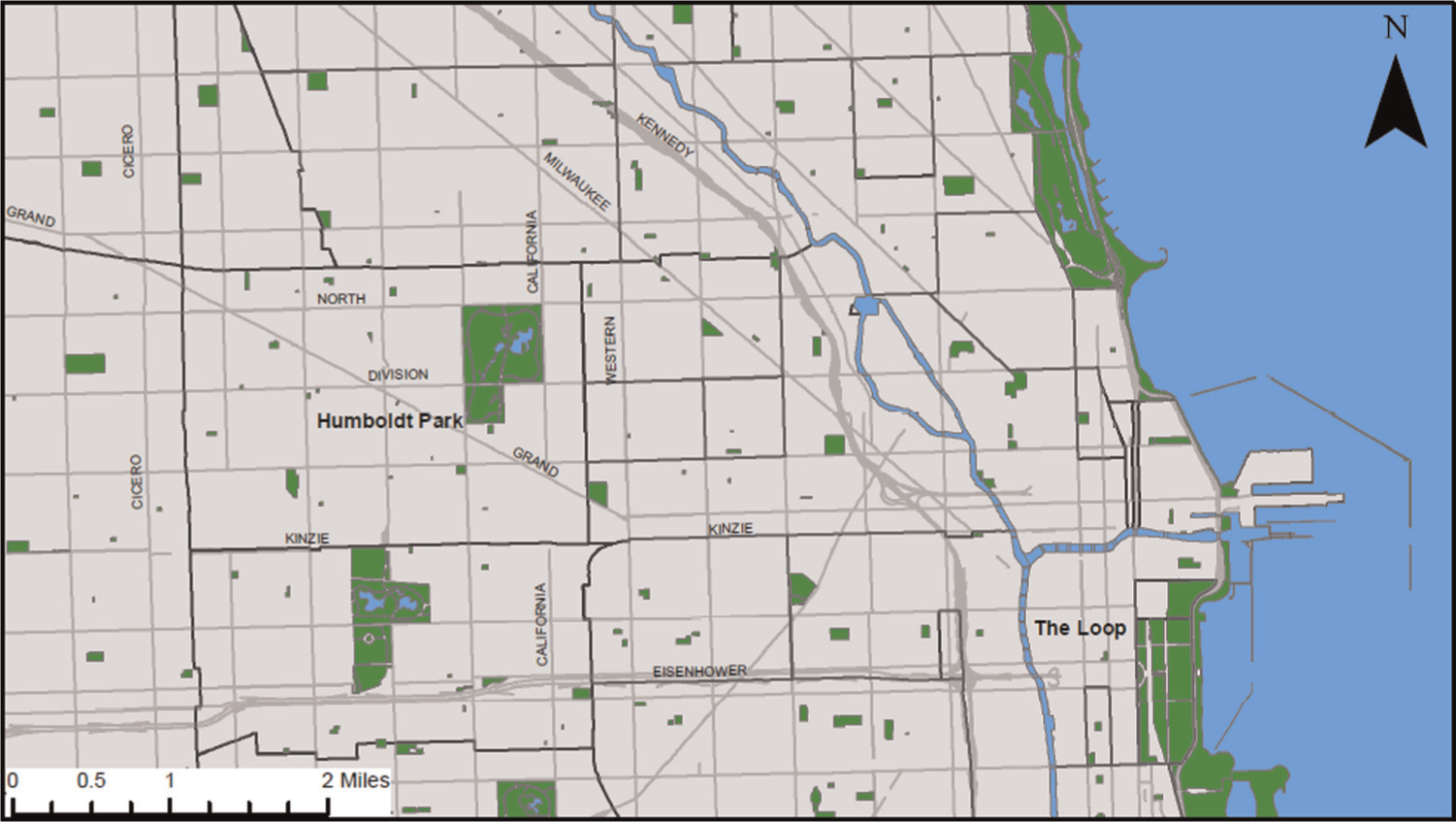
The Humboldt Park neighbourhood in Chicago, IL. Humboldt Park is located about four miles northwest of ‘The Loop’, Chicago’s central business district. Division Street/Paseo Borica runs through the centre of Humboldt Park.
In the late 1960s and 1970s, public and private sponsors of urban redevelopment threatened the close-knit Puerto Rican community and generated organised resistance. As more Puerto Ricans in Chicago joined the struggle for self-determination, community organisations led a variety of actions to express discontent. As Betancur details, ‘These included confrontations with city hall and police over services and police brutality …’ and ‘development of a large network of local organizations and service agencies controlled by Latinos …’, among others (2002: 797). Despite these and other efforts, West Town gentrified rapidly; between 1970 and 1980, the percentage of Chicago’s Puerto Rican population that resided in West Town fell from 42% to 25% (Betancur, 2002). Puerto Ricans, largely displaced from West Town, began to concentrate and establish roots in Humboldt Park.
Humboldt Park and Paseo Boricua: Establishing cultural space
Although a considerable amount of the Puerto Rican population (25%) remained in West Town beyond the 1970s, the Humboldt Park neighbourhood quickly became the primary home of Puerto Ricans in Chicago. In particular, a stretch of Division Street in Humboldt Park known as La Division has grown to embody the community’s organised efforts to establish deep roots in inner-city Chicago. Since the 1980s, La Division has emerged as the home of Puerto Rican businesses and offices for advocacy organisations and politicians. Efforts by this community to permanently stake a claim to this space are a continuation of those made in West Town, but are now inspired by a greater understanding of the forces that pushed Puerto Ricans westward. While family, community and cultural offerings attract Puerto Ricans to live near La Division, organisations such as the Puerto Rican Cultural Center (PRCC) and the Division Street Business Development Association (DSBDA) work to make it affordable and viable to stay for the long term (Wilson and Grammenos, 2005).
The progress of La Division only accelerated in the 1990s as it became the increasingly clear centre of the Puerto Rican community. In fact, it has become more commonly known as Paseo Boricua distinguishing it in name from adjacent stretches of Division Street that expand into other Chicago neighbourhoods. This renaming was considered another step in the mission to make this area of Humboldt Park ‘a recognizable economic, political, and cultural space for Puerto Ricans’ (Flores-Gonzalez, 2001: 9). The same can be said for the two mammoth Puerto Rican flags over Paseo Boricua, which serve simultaneously as the gateways and boundaries for the neighbourhood. Puerto Rican community-building discourse in Humboldt Park remains intimately related to resistance against gentrification that has advanced westward from the city centre for decades, disproportionately displacing Puerto Ricans and other minority populations in its wake (Betancur, 2002).
Current study
Given this historical context, the current study explores how community members and city officials understand and respond to calls for enhanced bike infrastructure in Humboldt Park. To clarify these dynamics, interviews were conducted with community members, city officials, bicycling advocates and city staff at the CDOT.
Methodology
Seventeen interviews were conducted over the course of two weeks during the summer of 2013 (see descriptive information in Table 1). Interviews were further supported by attendance at a two-hour meeting of the Mayor’s Bicycle Advisory Council Meeting (overseen by CDOT staff and attended by more than a dozen Chicago-area organisational representatives appointed to the council). Additional observations were collected through four days of active participation at Humboldt Park’s community bike shop and education centre, West Town Bikes/Ciclo Urbano (WTB/CU). Field notes were taken immediately following these events to help inform the analysis of interview data.
Descriptive information for interviewees (N = 17).
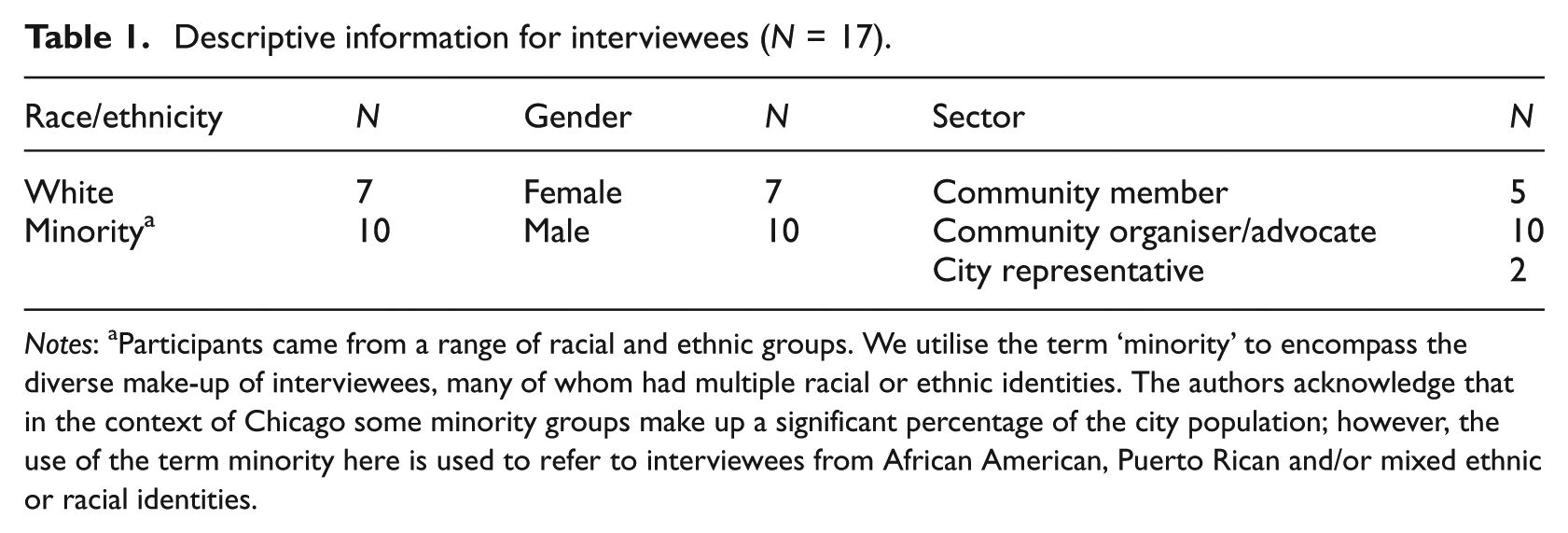
Notes: aParticipants came from a range of racial and ethnic groups. We utilise the term ‘minority’ to encompass the diverse make-up of interviewees, many of whom had multiple racial or ethnic identities. The authors acknowledge that in the context of Chicago some minority groups make up a significant percentage of the city population; however, the use of the term minority here is used to refer to interviewees from African American, Puerto Rican and/or mixed ethnic or racial identities.
Procedure and participants
Interviews took place both in person and over the phone and were loosely structured; they followed an open-ended guide of general topic areas including thoughts about neighbourhood change, responses to bike lanes and other infrastructure, thoughts about future development, and motivations or critiques of the city’s expansion of bike infrastructure. Most interviews lasted between 30 and 45 minutes and interview data was transcribed and coded.
Interview participants reflect a diverse range of ages, racial and ethnic groups, and a relative balance between genders. Participants were recruited either because they played a prominently public role in the neighbourhood (e.g. local Alderman), were a visible public figure related to bicycling in Chicago (e.g. professional, paid, bicycling advocate or a city planner), or were active participants at WTB/CU. All interviewees reflect perspectives of persons who are knowledgeable or engaged with bicycling or decision-making in the city of Chicago.
Table 1 characterises the participants in this study. The ‘community organiser/advocate’ category includes community organisers, bike advocates, and independent journalists; to varying degrees, all of their work pertains to bike issues in Chicago.
Data analysis
All interviews were inductively coded and analysed for recurrent themes and concepts (Bogdan and Biklen, 2007). A multi-step process of constant comparison was used (Glaser et al., 1967; Strauss and Corbin, 1998). The coding process entailed four steps in which the authors: (1) examined the transcript data for common concepts or themes; (2) sorted the interview data into the emergent thematic categories; (3) reread the transcripts and identified and compared our observations regarding patterns in the data to confirm or disconfirm patterns that were emerging; (4) reviewed each interview a final time to confirm conceptual categories. This process resulted in a range of common themes or categories that inform the discussion here.
The ‘white lanes of Gentrification’? Race, class, and bike lanes in Chicago
In 2012, a series of blog posts on Grid Chicago featured content about whether or not new bike lanes proposed for Division Street in Humboldt Park could be considered the ‘white lanes of gentrification’ (Greenfield, 2012a). The blog posts started an online debate in which community members and officials weighed in on the meaning and purpose of bike infrastructure in the neighbourhood. For some, because bicycling in Chicago has been dominated by white, middle-class residents and lower-income white ‘hipsters’, there was a perception that expanding bike lanes into minority communities symbolically paved the way for gentrification.
One interviewee described the distinctions that many interviewees made regarding the complex relationships between white cyclists and neighbourhood change: People who are involved in bicycle advocacy [often] identify as a ‘cyclist’, and quite often that comes from a sport and recreational background, and … not always, but too often, very competitive and very elitist … When you have [residents] viewing cyclists that way … there’s little interest in providing a facility in your neighborhood for those people … It’s always been white guys who’ve come and like, invaded them and said, ‘We’re here to save you, we’re here to help you.’ And yes, Puerto Ricans in Humboldt Park have made a stance [against gentrification] … And certainly bicycle facilities, bikes for a very long time, have been seen as a recreational activity of privileged white people …
A Puerto Rican politician representing the neighbourhood reflected upon these dynamics at length; extended portions of this interview are included to demonstrate his perceptions of the type of people moving into the neighbourhood, coupled with his concerns about bike lanes utilising public space in unsettling ways: A lot of these bikers that have come in to this neighborhood, look you know, they’re not affluent … They’re hipsters by and large … [and] the other group that follows them … are the more affluent yuppies that you find. And so I have resisted a lot of what they would wish to have. I created a transportation committee … I did a study to calm down the traffic on Humboldt Boulevard … and when we were doing this the city department [said] ‘Why don’t you consider also a bike lane?’ I said I don’t want that because … the bikers that will take the bike lane between Division and North Avenue, they will continue … So I said ‘No I’m not gonna do that, for safety [reasons].’ I always use the safety reason. Because then they will take over. They want to take over. You know, now it’s this lane, then it’s this other lane, they remove the cars from the streets, [then it’s] ‘let’s give up the whole street to walking’, you know. I know that’s the way I see it. And I think there is a lot of resent [sic] for it. I hear a lot from residents complaining about these people, they think that they own the streets, you know, they don’t respect [us].
The excerpts above are illustrative of an ongoing perception of bike lanes as a significant mechanism of gentrification and a means by which public space is appropriated in service of neighbourhood ‘outsiders’. In the latter quote there is also evidence of city-level requests for bike lane development and, implicitly, this respondent notes that ‘safety’ is leveraged as a rhetorical strategy to resist city-imposed infrastructure; the complex politics of gentrification are not brought into the official city-level conversations or contestations of the bike lanes. Rather, safety concerns are judged to be a more effective mechanism to challenge bike facility development.
However, this perception of bike lanes as a driver of gentrification is quite nuanced. According to Jose Lopez of the PRCC, it is not so much the bike lanes themselves, but the process by which the lanes are implemented and built that is deemed problematic: It was not that we and Alderman Ocasio opposed the lanes … but at the time it was viewed as a process that mostly involved white people … Our attitude was that we would support the lanes as long as there was community engagement in terms of how the lanes would connect with the community’s own projects and ideas about cycling. We never really got a response from the city and that was the problem. (Greenfield, 2012b)
Interviewees who were residents of the Humboldt Park area underscored the perception that meetings regarding infrastructure decisions often failed to actively engage local Puerto Rican residents: On big projects community input [can be] mandated as part of the plan. And how is that executed? The Department of Transportation sends out a notice to residents of that ward and set up their own meeting, and who shows up to it? … outsiders who are bicycle advocates … who want to ride through those neighborhoods. They aren’t necessarily residents of those neighborhoods, and I don’t think are the best voice of those neighborhoods … I find that often planners and engineers make plans for pavement and not necessarily plans for people.
In part, the abbreviated decision-making processes preceding the development of the Division Street bike lanes can be connected to the nature of bicycling initiatives in Chicago. Mayor Rahm Emanuel’s attempts to implement an ambitious expansion of bicycle lanes in the city have been spurred on not only by the availability of federal funding for such projects but also by the seemingly widespread acceptance of bike projects. As such, the city has undertaken some of the most rapid infrastructure development in the USA.
7
One white bicycling advocate summarised the generalised acceptance of bicycling: So … you typically get a response when you say like, ‘Well I’m not quite sure bike lanes are the way to go …’. It’s like, ‘What? What’s wrong? These are the best things we’ve had in years, and, why are you against us?’
This advocate recognised the taken-for-granted nature of bicycling infrastructure in Chicago and acknowledged the sense of apprehension amongst certain groups when community members voiced resistance to planned infrastructure changes.
As a result of the formalised promotion of bicycling infrastructure and an informal perception of such developments as universally accepted, bike facilities in Chicago have often been installed quite quickly. While efforts may be made to conduct community outreach, this may not adequately capture community desires. One minority community organiser summarised this dynamic: In Chicago … there’s no process for communities for public meetings … there’s no mechanism by which community members … especially in underserved communities, where people can be asking for what they need in a proactive way. What often happens is either the Department of Transportation or the city department, they may have an opportunity to apply for … the federal money that’s available … and they’re pushing for a network of better streets for everybody, but … on the community level there may not be a mechanism that’s proactively telling them where each of these resources should go and how they should be used.
This quote highlights the constraints that city bureaucracies face in attempting to utilise hard-won public funds for infrastructure development while also conducting appropriate and meaningful outreach to communities. Such engagement takes time and energy and can curtail the trajectory of public spending on these projects, particularly if the proposed project is not widely accepted (Lubitow and Miller, 2013).
A failure to conduct adequate outreach when attempting to fast track a bicycling infrastructure project can have negative implications. Six interviewees cited the same story centred on the rapid implementation of a bike lane in an area close to Humboldt Park. In this situation, the city painted bike lanes that directly interfered with a space utilised for church parking on Sundays. Interviewees described how community members were angry about the intrusion into this space and suggested that a lack of input from clergy and local residents led to conflict over the newly striped roadway. One Puerto Rican participant summed up this dynamic: [CDOT] didn’t do enough research about where they were putting these things … they took a space that was a community space … and without talking to them, they plopped something down. And that was really bad for everybody.
This story highlighted how the city’s failure to adequately engage the community ultimately wasted resources that might have been used in other areas where the lanes would have been more appropriate. As the participant above noted, this created a situation in which bicyclists lost out; three participants reported that churchgoers now park illegally in the bike lanes on Sundays. It also created a dynamic in which some community members became resentful of bike lane development, both because of the lack of outreach and because of the rapid, hierarchical implementation of infrastructure.
Rapid infrastructure implementation and a lack of formalised participatory structures is further complicated by Chicago’s unique political environment. The city’s 50 legislative districts (‘wards’) are each represented by an elected Alderman with control over a range of localised decisions (on issues such as safety, public health and even taxes). In 2003, Alderman Billy Ocasio originally vetoed the Division Street bike lane in Humboldt Park. On the one hand, Chicago’s system allows community residents some capacity to influence neighbourhood-level changes by contacting their Alderman directly. On the other hand, the nature of Aldermanic privilege allows infrastructure decisions to be made with little or no input from residents.
8
A quote from one community organiser highlights the challenges of this decision-making structure: We don’t have a formal process for community input … Decisions about projects are … kind of decentralized, they’re made by the local elected officials essentially … so one Alderman in one community might say, ‘Hey, this project is happening,’ or ‘We’re interested in this project, let’s have a public meeting.’ Another one might say, ‘You know what, go ahead, don’t worry about it, I don’t want a public meeting.’ So that obviously is a problem, and so what may happen is then you have community groups or residents who don’t know about a project and didn’t provide any input …
This quote illustrates the variable nature of the power of Alderman to determine what happens in neighbourhoods and demonstrates how community residents can be both central to certain decisions and entirely excluded from others.
In Humboldt Park, the establishment of bike facilities reveals the complex nature of public space; community concerns regarding economic development and ongoing gentrification are mediated by a broader lack of transparent mechanisms to determine how to use and augment the street. Although Puerto Ricans in the area have a dynamic history of bike ridership, broader economic trends and a complex political environment have contributed to a perception that bicycle facilities are, symbolically and perhaps literally, a means of elite outsiders colonising the public space that Puerto Rican residents have consistently fought to maintain. 9
Mediating gentrification? Community engagement models, economic development
The previous section explored the complexities of the symbolic meaning of bike lane expansion, along with the relative lack of public input regarding infrastructure decisions. This section explores how grassroots community organisation and economic development around bicycles can encourage a diverse array of residents to engage in bicycling initiatives. We suggest that West Town Bikes/Ciclo Urbano (WTB/CU) constitutes an example of Fraser’s counterpublic and represents an innovative way for residents to navigate the complexities of gentrification.
WTB/CU, a community-led bicycle training centre and repair shop, evolved out of the non-profit Bickerdike Redevelopment Corporation’s ‘BickerBikes’ programme that began in 2004. Although the programme has served Humboldt Park and adjacent neighbourhoods since its inception (and its parent organisation has served the area since 1967), it didn’t open a storefront on the Paseo Boricua until 2009. With an understanding of the community resistance that culminated in Alderman Ocasio’s 2003 veto of bike lane installation, WTB/CU’s organisers secured the blessing of community leaders in Humboldt Park before opening the shop (Greenfield, 2012a).
As a community organisation, WTB/CU prioritises education and outreach to community members. Classes and training not only help to teach youth how to repair bicycles and work with others in a business setting, but WTB/CU also teaches adults how to feel safe riding. Many interviewees suggested that the Puerto Rican community sometimes felt that biking was for white outsiders; thus, WTB/CU engaged in significant outreach to both minority adults and youth.
Two community bicycling advocates who worked at WTB/CU noted that travel by bike was a cheap and liberating form of transportation for youth: [Compared with public transit], it is almost always faster to take a bike … And so teaching people that a bicycle doesn’t have to be a last resort but a very legitimate form of transportation around the city of Chicago … that idea of giving access to something that otherwise seems inaccessible is a huge part of what we talk about to the kids [who attend our programs]. A lot of the kids who come through our programs have never been to downtown Chicago, have never been to the lake … We take them on rides to the lake, to the zoo, to places, to universities and community colleges, so they see that not having $2.25 in their pockets does not preclude them from getting to where they need to go and is not an excuse.
10
A third community organiser with ties to WTB/CU noted the significance of teaching community members how to engage with bikes: The city puts too much emphasis on infrastructure and not enough on education …, ‘if you build it they will come’ will only go so far. I mean … in addition to having infrastructure, it’s equally important to have education programs and outreach.
While education and outreach were a clear mechanism for enhancing community engagement and interest in bicycling and city infrastructure, for most research participants, overcoming a top-down, exclusionary planning process could be achieved by appealing to the economic development capacities of bicycles.
When asked how to start to transform the centralised planning structures in Chicago, interviewees consistently called for a grassroots, community-led rather than city-imposed approach. They maintained that leveraging the connections, expertise and trust of established individuals and organisations in a neighbourhood can generate more appropriate and open planning processes. As one white organiser put it: I think the role of outreach and being part of the community and finding ways to do that in a sustainable way really helps the work a lot. It helps us find those champions, it helps us find the strategies that work.
This interviewee suggests that community members are in touch with the ‘strategies that work’ in their neighbourhood and are more sustainable in the long term.
In addition to the general belief that grassroots advocates are more in touch with how to encourage the mass appeal of bikes to a diverse group of residents, interviewees routinely highlighted the economic opportunities provided by bicycles. A white male organiser/advocate commented: … my intuition is that the notion of sustainability for communities of color, where it’s going to be most appealing is where we can connect it to economics and jobs. Because that is something that is much more relevant and much more current, really.
Considering the socioeconomic constraints that many of Chicago’s predominantly non-white communities face, development that provides economic opportunity will be well-received by at least some community members. In their experience, multiple organiser/advocates found success by framing language related to bikes in this manner. One interviewee, a white male from Humboldt Park, described the economic frame as a means to connect bikes to much larger issues in his community: I realized that bikes could be a great tool … bikes fit into community building far better than just pursuing bicycle advocacy and activism. That for me anyhow, and the work that I was doing with youth programs, that there are much bigger issues that the community was dealing with, such as housing and education, healthcare, jobs, that bikes could be a part of, and that there was much larger, much greater interest from the community in addressing those issues …
Similarly, a CDOT staff member who oversees bicycle initiatives in Chicago noted the city’s broader interest in developing job training programmes such as WTB/CU’s: The ultimate goal of the mayor was to create this bike apprentice program … we wanted youth in these at risk communities to actually have the skills and opportunities and recognize that [both horticulture] and bike related fields are actually open to them as a potential career.
However, a white male organiser/advocate spoke to the idea that bikes are understandably not always the main priority of residents of these neighbourhoods: … there are larger concerns in these communities that don’t have bicycle facilities, and so how can they even be concerned about like whether or not they have facilities … I am really concerned about the health and wellness of my community in a much different way. Not whether or not it’s safe to jog with my dog, but whether or not it’s safe for my children to walk to school without being ran down by out of control traffic or being shot at.
Interviewees suggested that so long as its value is not overstated and the magnitude of more basic local safety concerns is acknowledged, bike infrastructure may be embraced as a viable community improvement. In particular, advocates in Humboldt Park focused their discussions on economic opportunity and safer streets, while still emphasising the importance of respecting the neighbourhood’s cultural identity and connecting bikes to this identity. One leader at WTB/CU described how the organisation has developed into a multifaceted resource for residents of Humboldt Park: As far as employment goes West Town has been able to offer lots and lots of opportunities. It’s not just wrenching at a bike shop. There’s all kinds of advocacy and outreach that can be done, you know going out and promoting bicycling as part of a healthy and active lifestyle. Instruction, training our kids to go and teach the youth programs, and we do that more and more … it’s not just about bikes but teaching all these soft skills of like what it means to have a job, show up on time every time, keep a schedule, be able to take direction, be able to complete tasks and take initiative to move on to the next one …
As a storefront on Humboldt Park’s Paseo Boricua and a member of the DSBDA, WTB/CU has been careful to respect the cultural identity of the neighbourhood and consider it in all of its work. One of its employees, a white male, describes how the organisation’s very name is a practice in celebrating the cultural heritage of the neighbourhood: It was a huge victory when not only were we allowed to move onto Division Street, but we were invited and we work very, very closely with the Puerto Rican Cultural Center and also the [DSBDA]. DSBDA is a special service … we help promote business along Paseo Boricua … that supports the mission and vision that Paseo Boricua is supposed to be. And so West Town Bikes moving onto Division Street needed to be in line with that. And this is the reason that we named our sales shop Ciclo Urbano, because we really wanted to reflect the neighborhood that we’re in, where we’re at and who we serve.
Resulting in part from the close relationship that WTB/CU has maintained with trusted organisations in Humboldt Park, many of the neighbourhood’s residents have embraced bikes and bike infrastructure. The early resistance to bike lane construction through the Paseo, which began in 2003, was due to it being perceived as yet another imposition by a largely white-led city government. Furthermore, this imposition was considered strongly supported by public and private developers seeking to expand the city centre westward without regard for the history of Puerto Ricans in Chicago. In a drastic shift from this original stance, many interviewees described the burgeoning bike culture in Humboldt Park with a sense of ownership. One Puerto Rican community member, also an employee of WTB/CU, suggested that her organisation has played a significant role in this development: So I feel like West Town Bikes is a big part of why everybody now rides bikes. Like I never used to see, like [my co-worker] said that it used to mainly be predominantly be white people riding bikes, and now it’s mixed and there’s all types of bikes …
One WTB/CU organiser who had grown up in Humboldt Park reflected on the way that the bike shop and its programmes had generated alternatives: Ciclo Urbano/West Town Bikes … being on Division Street and kind of creating this business that’s gonna help un-gentrify … [and not] a boutique or some type of high end clothing, or just a random juice bar … or something like a oxygen shop (laughing). So this brought another world into this community … Bringing bikes … and explaining and teaching how to use a bicycle … and how much a bike can change your life, how much a bike can mold your future, and how you can use it as a tool to make your life better.
One Puerto Rican worker at WTB/CU who had completed the youth programmes and was now a leader in the organisation described how the economic development model had transformative potential: I like to educate my younger generation on how much it’s a choice to change their lives, and how much it’s a individual responsibility. And it does involve a social responsibility, but at the same to change the bigger you gotta change yourself. There’s a word, derived from gentrification, and I like to use it, it’s (gente)rification … (gente)rifying comes from gente, which means people, and (gente)rification is when people from their own community open up businesses, change their community for their own people.
These examples are suggestive of a public space being reformulated in service of economic needs and community interests. WTB/CU represents an innovative attempt to build community power, politically and economically, through education and employment opportunities. We suggest, below, that this space is also illustrative of a vibrant counterpublic that has the capacity to alter the urban landscape.
Discussion
Much of the popular discourse surrounding the rapid integration of bicycles into Chicago’s pre-existing infrastructure has characterised it as a universal public good. Bike lanes in Chicago, as well as the recent Divvy bike-share programme, have been overseen by a series of official planners with a universalised vision of what public space means. The dominance of technical knowledge necessitates that political demands for cultural recognition and community voice must be minimised to allow for the unencumbered implementation of a limited set of choices for street designs (Swyngedouw, 2009; Zizek, 2002).
These top-down mechanisms do little to offset anxieties and tensions about both the literal and symbolic means by which gentrification occurs. This study reveals that, whether or not bikes are catalysts for gentrification, for many people bikes do symbolise a type of gentrification in a meaningful and important way.
High-end economic and real estate development in and around Humboldt Park has generated situations in which minority residents reported feeling marginalised. The emergence of WTB/CU in this space represents an important mechanism through which a critical counterpublic has taken shape. The bike centre’s appeals to local cultural identity, when merged with economic development strategies designed to build and directly serve the neighbourhood, have generated a new public space in which youth and residents are politically and socially engaged with the politics on their street. These dynamics have been present on Division Street for decades through the continual struggle to stave off encroaching development, yet WTB/CU presents a unique example of a counterpublic because it creates a space to directly engage with hegemonic planning processes and to offset some of the negative economic impacts of development.
Fraser (1990) describes counterpublics as having a dual character of being spaces of ‘regroupment’ and also as training grounds for ‘agitational activities directed toward wider publics’ (1990: 68). Through job training and education, WTB/CU has created a space that is largely directed by and for minority youth from the Humboldt Park neighbourhood. In this space, youth are empowered to learn new skills, to teach others, and to become reliable co-workers and leaders. The space established by WTB/CU allows for minority youth to generate their own environmental, political and social ethos. In turn, this regroupment has created the capacity for many WTB/CU participants to engage with broader efforts to challenge hegemonic decision-making processes in Chicago. WTB/CU employees and advocates have been actively engaged in larger events and discussions about transit, the environment, and health and safety, and have also been tasked with serving on advisory panels and city-wide programmes. For example, the Executive Director of WTB/CU serves on the Mayor’s Bicycle Advisory Committee that makes decisions about bike infrastructure and planning. Additionally, youth from WTB/CU have begun to participate in broader city-wide training and educational programmes. 11
While these may be small-scale activities, they reflect a ‘recast[ing] of needs and identities, thereby reducing, although not eliminating the extent of … disadvantage in official public spheres’ (Fraser, 1990: 67). A space created and maintained by minority youth harnesses the economic benefits of encroaching gentrification for direct community benefit, while contributing to the establishment of community-level power and voice as Humboldt Park residents’ perspectives and opinions are increasingly solicited and integrated into city plans for cycling. Although WTB/CU may not be dramatically transforming the landscape of urban planning in Chicago, the organisation represents a vital space for community identity and political voice to grow.
The emergence of a critical counterpublic in Humboldt Park has roots in the broader community effort to maintain Division Street and the surrounding area as a Puerto Rican stronghold. However, WTB/CU’s unique effort to merge economic development and educational programmes have been exceptionally successful in engaging youth and creating safe spaces for the emergence of political and social power. Yet questions remain about the capacity for a counterpublic to truly resist and alter the broader elite project of urban growth; the power that WTB/CU has been able to acquire is dispersed and not necessarily capable of fundamentally altering the dynamics of urban development and gentrification.
We conclude here by suggesting that the top-down approach to decision-making present in Chicago is unlikely to adequately reflect the interests of all residents. If bicycling is to be the environmentally friendly, healthy and sustainable transit solution that is has the potential to be, decision-making processes at the city level must also consider how to enhance community engagement. Although WTB/CU represents a powerful effort to build engagement and voice, urban planners must take seriously community concerns by generating opportunities for a more participatory public sphere.
We suggest that planners remain mindful that changes to street design, particularly the implementation of bike facilities, are often intimately tied to community concerns about ongoing neighbourhood changes. Bicycles have great potential to revolutionise how people use and interact with public space, but a truly just and socially sustainable bike infrastructure must incorporate community concerns and avoid strictly technological, universalised assumptions about the use and value of bicycles.
Footnotes
Funding
This research was supported by faculty funding through Portland State University, and otherwise received no specific grant from any funding agency in the public, commercial, or not-for-profit sectors.