







Abstract
Squatters and migrants use the city space in a peculiar and anomalous manner. Their contributions to the social and political production of urban space are not usually considered crucial. Furthermore, their mutual relationship is under-researched. In this paper I investigate the participation of migrants in the squatting of abandoned buildings. This may entail autonomous forms of occupation but also various kinds of interactions with native squatters. By looking historically at the city of Madrid I distinguish four major forms of interactions. I collect evidence in order to show that deprivation-based squatting is not necessarily the prevailing type. The forms of ‘empowerment’ and ‘engagement’ were increasingly developed while ‘autonomy’ and ‘solidarity’ were continuously present. These variations occurred because of specific drivers within the cycles of movements’ protests and other social and political contexts which facilitated the cooperation between squatters and migrants, although language barriers, discrimination in the housing market and police harassment constrained them too. Therefore, I argue first that two key social organisations triggered the interactions in different protest cycles. Second, I show how, in spite of the over-representation of Latin American migrants, the political squatting movement in Madrid has consistently incorporated groups of migrants and their struggles in accordance with anti-fascist, anti-racist and anti-xenophobic claims and practices. The analysis also provides a nuanced understanding about the ‘political’ implications of squatting when migrants are involved.
Introduction
The refugees’ crisis experienced in Europe since 2015 entails political and urban implications that might be better understood by looking at significant precedents. This article contributes to that goal by examining how migrants were involved in squatting. From 2012 onwards, global mass media covered the occupations by asylum seekers of a Berlin square (Oranienplatz) and a school nearby. While the protest camp in Oranienplatz hosted around 200 refugees and existed from October 2012 until April 2014, the renamed Irving Zola school is still squatted (July 2015). Both spaces served the same purpose – the defence of human rights for asylum seekers in terms of free movement, right to work and education, access to emergency medical care, decent accommodation (instead of the isolated and inhumane conditions of the refugee camps) and opposition to deportations (see http://oplatz.net; Azozomox, 2014: 206). The remaining 40 squatters in the school announced in June 2014 they would jump from the roof in the case of eviction. Over the last years, thousands of German activists supported the refugees’ movement and their squatting action as part of a well-established tradition of autonomist politics in which anti-racism, anti-fascism and squatting have been strongly embraced (Katsiaficas, 2006). However, squatting in Berlin is rarely practiced nowadays (new squats tend to last no more than a few hours or days) since the legalisations and regulations of the early 1980s and early 1990s (Holm and Kuhn, 2011; Martinez et al., 2014). On the other hand, ‘immigrants and people of colour have always been a minority portion of the squatter community’ (Azozomox, 2014: 206). 1
Similar observations can be made about migrants and squatters in other European countries. Solidarity is the prevailing form of interaction as has happened often in Amsterdam, for instance. In 2006, an office building located on a bridge over a highway on the periphery of Amsterdam was squatted by native activists (mostly Dutch-born people) and eventually handed over to the local Moroccan community, which had for years demanded a place to pray. Although the Kraakmoskee (squat-mosque) was evicted in 2010, ‘squatting had provided them [migrants] with a place and with visibility. The Kraakmoskee project also gave the squatters the opportunity to step out of their own neighbourhoods and explore the outer ring area of the city’ (Moore, 2015: 206). As it is well documented elsewhere, immigrants in the Netherlands may also squat alone (Kadir, 2014: 21, 32) and join squats where other natives live (Aoussar, 2010). However, the narrative of social inclusion and diversity within the squatting scene has been overshadowed by the dominant stereotype of ‘Dutch squatters – young, white, politically articulate, militant and skilled activists who heroically battle the police to defend their squats’ (Kadir 2014: 22). Mass media, academic accounts and native squatters themselves tend to reproduce that myth and neglect the contributions of migrants to the production of urban space. In addition, a rising xenophobic discourse has been widespread over Dutch society as well as neighbouring countries in the last decades. This entails discrimination against foreigners, including those from Southern and Eastern European countries such as Spain and Poland, respectively, who are portrayed not only as abusers of the welfare state but also as those ‘who exploit a Dutch protest tactic and who lack the political ideals of squatters “during the movement’s height in the 1980s”’ (Kadir, 2014: 49).
When migrant people squat they tend to do it out of necessity. Their squats are considered more ‘social’ than ‘political’ in a very quick and superficial approach – that is to say, more reformist than radical in political terms. This fits what has been designated as ‘deprivation-based squatting’ with the following features: This configuration involves poor, working-class people who are suffering severe housing deprivation. […] It is tightly organised. […] [There is] an organisational pattern that makes a clear distinction between activists and squatters. The activists open up buildings for the squatters and support them. […] [It] is susceptible to co-optation, i.e. transformation into a form that is useful to state officials. (Pruijt, 2013: 22–24)
Thus, deprivation-based squatting is more frequently an illegal tool to enter into legal modes of accommodation (Aguilera, 2013: 217) rather than a counter-cultural lifestyle. DAL (Droit Au Logement) in France and different groups in Italy represent perfectly this trend of helping the homeless, who are mostly migrants, by adopting a sharp organisational division of work and keeping a favourable attitude towards negotiation with the authorities for a formal housing solution (Aguilera, 2013: 220–222; Mudu, 2014: 147–156). In spite of this evidence, not much attention has been paid to other forms of involvement in squatting by migrants.
In this article I investigate the different modes of interaction between migrants and squatters in the city of Madrid, which has not been examined up to now. My first aim is to disclose the contexts and various types of those interactions which are relevant in order to know their continuity and change beyond the prevailing stereotypes. Furthermore, I argue that migrants are under-represented in the political squatting scenes as much as in the academic writing about squatting. This neglects the contributions of both migrants and squatters to the social and political production of the city space by appropriating unused buildings and houses. Therefore, I intend to fill this gap through an in-depth analysis of the evidence collected about their mutual connections. In so doing, I distinguish four main categories to make sense of the interactions between migrants and squatters beyond the pattern of deprivation-based squatting. Afterwards I explain their evolution by relating them to the political cycles driven by two main social movements – global justice and the 15M – May 15 (2011) or Indignados Movement (the occupation of Puerta del Sol square was one of the key initial events that popularised the movement). In sum, I will show that squatters and migrants in Madrid have incrementally cooperated with each other because of: (1) the interplay of political squatters’ ideology and the migrants’ housing and legal needs; (2) the urban, social and political contexts in which some exemplary practices (ODS (Oficina de Derechos Sociales, Office of Social Rights) and PAH (Plataforma de Afectados por las Hipotecas, (Anti-Eviction) Platform of People Affected by Mortgages) triggered the most intense interactions.
Data and method
The focus of this research is the city of Madrid where I was regularly active in several squatted social centres and a participant observer for six years (2007–2013), although my involvement in squats in different Spanish cities dates back to the late 1980s. I will also mention two cases from Barcelona because they had a wide impact in public debates about squatting and its linkage with the images and policies about migrations. On top of my own participant observations, I have collected 79 specific stories from mass media news, activist documents and blogs over the last two decades (1995–2015). With the help of three assistants, 11 semi-structured interviews in 2012, 2014 and 2015 were conducted. The first interview consisted of a group discussion with various members (men and women) of the Oficina de Okupación (Squatting Office) in the squat Casablanca. The second one was held with a (male) activist of an ODS group involved in the occupation of a building where most of the residents were undocumented African migrants. According to their gender, the rest of interviewees were three women and six men. In terms of their nationality, there were five Spanish interviewees and four foreigners (from Argentina, Chile, Morocco and Italy). Two are involved in the squatted social centre La Enredadera (Tetuán neighbourhood) and three are regular participants in another squatted social centre, La Quimera (Lavapiés neighbourhood), although most also had experiences in the occupation of houses and participated in other social centres. One of them is also an activist in a ‘pan-africanist’ collective. Four of the interviewees are Spanish-born activists engaged in different 15M struggles, such as the PAH and the campaign against the CIEs (Centros de Internamiento de Inmigrantes, Detention Centres for (Undocumented) Immigrants), and two of them had also long experiences as squatters of both houses and social centres.
The facts observed and the discourses produced through this methodological approach were mainly analysed in order to identify the various forms of involvement of migrants in squatting and the significant circumstances that shaped them. The consistency and accuracy of the information gathered was, when possible, contrasted with my own observations. In general there are not noticeable contradictions between the informants although when it comes to the media outlets most of the journalists usually narrate the cases without much background about squatting which is supplemented with other external insights and my own interpretations.
The anomalous social and political configuration of urban space
The references to migrants in the literature about squatting are scattered, very recent and seldom examine the interactions of migrants and squatters in a systematic manner (Aguilera, 2013; Chattopadhyay, 2015; Coutant, 2000; Mudu, 2014). Up to now, the most ambitious attempt in this regard (Manjikian, 2013) has framed both groups as subjects to an increasing rhetoric of securitisation at the state level all over Europe (see also Dadusc and Dee, 2015). However, the ‘politics of emergency and exceptionality’ made up of higher legal and police pressures does not imply necessarily similar or joint reactions by migrants and squatters. Less is even known about their mutual cooperation on different grounds – meeting their needs, political campaigns, daily life socialisation, etc. As for the research made on the various forms of squatting (Cattaneo and Martinez 2014; Pruijt, 2013; van der Steen et al., 2014) migrants are not usually regarded as autonomous subjects that can resemble the radical politics and alternative cultures put forward by most squatters. In order to fill those gaps I propose to take into account the ‘political’ implications of ‘deprivation-based’ squatting and the significant contexts of their living conditions and ideological affinities.
Although squatting for housing purposes is overwhelmingly portrayed as a non-political practice, I assume that many squatters and migrants are aware of their broader political and spatial role in challenging some taken-for-granted assumptions in capitalist societies. That is to say, the rigid or absolute right to private property and the arbitrariness of setting and managing the state boundaries are continuously questioned by both squatters and migrants. Moreover, the unequal distribution of property and the unequal access to national citizenship are in direct conflict with the right to decent and affordable housing, on the one hand, and the right to be granted a decent migrant or asylum status, on the other. Whenever this underlying conflict comes to the surface in public urban life, squatting and migration become key components of current politics. No matter how secretly the actions of squatting and migration are performed, their actors all participate in a situated political struggle about agenda, policies, representation, governance, etc. Whether to remain silent, hidden, clandestine or the opposite corresponds either to tactical decisions or to their social belonging to explicitly political scenes. Just as a convention then, ‘social’ squatting labels the cases where political ideology is loose or not at the foreground because the urgent economic needs are emphasised above all (Aguilera, 2013; Mudu, 2014), while ‘political’ squatting refers to the dense networks of activists where a political discourse contributes to their identity and cohesion (Cattaneo and Martinez, 2014; van der Steen et al., 2014). I use this convention throughout the article by assuming the above-nuanced framework unless it is explicitly stated otherwise.
The practice of squatting helps to shape the city in a contentious manner by opening up anomalous (non-commercial and non-regulated) residential and counter-cultural spaces. The participation of squatters and migrants in city life is usually performed through challenges to dominant inequalities. However, it would be misleading to equate their structural living conditions. In particular, many squatters and most of the migrants (especially the undocumented ones) have experienced similar situations of badly paid jobs (precariousness), social exclusion, police brutality, fascist attacks, spatial displacement, marginalisation and stigmatisation, although not many squatters are so frequently harassed by the police because of their ethnic appearance or arrested because of the lack of expiration of a residence permit. Native squatters, compared with most migrants, enjoy wider, safer, wealthier and denser social networks made of friends, relatives, job acquaintances, political comrades, etc. Among migrants there are internal and striking differences too. Some may be rich or may hold passports from countries dominant worldwide so that the squatting scene is not an appealing one for them. Migrants who do not hold legal documents to stay in a particular country may face additional risks when they attend squats under the threat of eviction or police surveillance. Moreover, on some occasions migrants approach squatting not only as a way to satisfy their needs of housing and social life, but also as a political tool to claim their citizenship rights, especially if they enjoy the support of political squatters and other native activists. This social context of overlapping and different living conditions constrains any given interaction between native squatters and migrants.
When the squatting scene is politicised and nurtured by leftist, autonomist and anarchist perspectives, solidarity with those in need and oppressed, which includes many migrants, is a founding principle. The most outspoken political squatters in Europe from the 1960s onwards (Cattaneo and Martinez, 2014; Martínez, 2013a; SqEK, 2013; van der Steen et al., 2014) had to face the historical circumstances of the aftermath of the Second World War and also the crisis of welfare policies in the following decades. This led, first of all, to defensive struggles against fascism in all its dimensions – not only neo-fascist groups and political parties but also their ideological roots. Anti-fascism, then, became one of the main pillars of identity for those squatters whose politics pointed beyond the walls of the occupied spaces. Accordingly, the opposition to racism and xenophobia was considered a logical consequence of that stance since fascist politics is based on ethnic supremacy, conservative nationalism, hate towards those seen as inferior (not only ethnic minorities and foreigners, but often homosexuals, disabled and homeless people, punks and hippies, communists, even women) and a pervasive violence. The threat of fascism and racism surrounding the squats provoked squatting activists to de-legitimate these imaginaries and to take defensive actions to halt their proponents. As an output of this attitude, a rich anti-fascist and anti-racist iconography, information flows and specific activities (workshops, sit-ins, border camps, etc.) have been produced by squatters and, sometimes, migrants involved in squats too (Moore and Smart, 2015; Wilhelmi, 2002). These affinities ease the practice of solidarity between native squatters and migrants but their interactions may be also subject to limitations, disruptions and non-linear evolutions as we will see.
Autonomous agency: When migrants squat
Squatting in Madrid began as a public action in the years of the transition to liberal democracy, after Franco’s death in 1975 (Seminario, 2014: chapter 1) although the first squat sounding similar to other autonomous spaces in Europe is dated 1985 (Seminario, 2014: chapter 2). In 1992, there was a notorious incident which set the symbolic starting point of the association between squatting (in abandoned buildings, not in slums) and migration. A black Dominican woman, Lucrecia Pérez, was murdered while having dinner collectively in a squatted and almost ruined building – a former fancy discotheque. She was 33 years old and had a daughter. She had neither residence nor work permits. Another Dominican man was shot in the same raid. According to the judicial sentence, the protagonists were four men, three minors and one policeman aged 25. They all were known in Madrid for associating with fascist gangs and far-right football hooligans, and they also had a record of previous violent assaults. The court sentence stressed hate, xenophobia and racism as motivations for the shootings (Calvo, 1993). The building was located in an upper-class neighbourhood of the metropolitan area of Madrid (Aravaca). There was neither electricity nor water supplies in the occupied premises, which contributed an image of marginality and decay associated with squatted places. In 1993, as an attempt to question those stereotypes, a group of autonomist students occupied a building within the campus of the University Complutense of Madrid and named it ‘Lucrecia Pérez’ (Caravantes et al., 1995: 32).
International incoming flows of migration rose in Spain from the mid-1990s onwards at higher rates than ever before (Martín-Pérez and Moreno-Fuentes, 2012). At the peak in 2005, undocumented and non-authorised migrants amounted to 1.2 million (Clandestino Project, 2009), while the total number of foreign-born people settled in Spain reached 6.7 million at the end of 2010. In relative terms, the number of foreigners in Spain shifted from less than 2% of the population in the 1990s to 12% at the end of the 2000s. Notwithstanding this, in some neighbourhoods (such as those in the city centre of Madrid, where squatting was very popular) the concentration of migrants meant rates above 20–27% in the Central District and 22% in Tetuán, for example, in 2011 (Schmidt, 2012: 2). In 2011, the four main countries of origin for immigrants in Spain were Morocco, Romania, Ecuador and Colombia.
The above indicates a regular increase of migrants in Spanish cities until the late 2000s – when the global financial crisis interrupted the flow of incoming migrants. 2 Thus, it could be expected that migrants participated in squats at a similar rate. Given the absence of accurate calculations I suggest that the presence of migrants in political squats slightly augmented over the years although their percentage was in general lower than the local average. For example, according to my observations of political squats in Madrid since 2007, migrants rarely represented more than approximately 10% of the members or visitors. In the 1980s and early 1990s there were even fewer migrants attending squatted social centres. Besides, not all the foreign nationalities were equally represented. Latin American immigrants were the first to arrive in Spain and faced an easier adaptation process, given their mastery of the Spanish language. However, the racist or xenophobic attitudes of many home owners determined their exclusion from the rental market once their Latin American accent was noticed. On the other hand, the interest for revolutions and political struggles in Latin America meant that many squats organised events and invited people from that region. Therefore, Latin American migrants were the first to be seen in political squats. Anyhow, when migrants squatted buildings on their own, autonomously, they tended to do it away from the political squatting scene as, for example, the Dominicans did in Aravaca. This pattern is also evident in other cases widely covered by the mass media.
For example, between 2002 and 2004, around 1000 people (most of them undocumented migrants from Africa and Eastern Europe) occupied the abandoned military barracks known as Cuarteles de San Andreu, in a working-class neighbourhood of Barcelona. Their living conditions were very harsh, without water, electricity, toilets and waste management. After the police evicted the occupiers, around 100 residents were rehoused by municipal agencies and the Red Cross. The occupation showed the autonomous initiative of homeless poor people to get shelter but they were not able to implement any collective self-organisation of the place. Different non-governmental organisations (NGOs), local associations, neighbours and political squatters from the area helped them occasionally and rallied to stop the clearance of the barracks (Blanchar, 2004; Canal Solidario, 2003). In 2008 the ‘Palacete okupado’ in the working-class district of Carabanchel (Madrid) popped up in the local news. One day after it was reported, the police arrested 12 undocumented migrants out of the 20 who lived in the building, although there was no official eviction. Most of them came from Senegal and arrived in the Canary Islands in a fragile boat. After their detention in the squatted building, they were subject to a deportation order. The multi-storey house had been squatted for more than one and a half years. One of the squatters was a Spanish citizen who claimed to have signed a rental contract, which he found out later to be a scam. In contrast with the previous case, this household was collectively run and the neighbours got along well with the migrant squatters (Herráiz, 2008). A formal association, COIN (Coordinadora de Inmigrantes, Immigrants’ Coordination) supported them with legal advice and opportunities for professional qualifications.
In another area, Majadahonda, an upper-class municipality in the metropolitan region of Madrid, a luxury development that did not meet planning regulations remained empty from 2000 onwards although the ground floors were occasionally used by homeless people, drug addicts and youngsters. Later on, an estimated 100 Latin American migrants in families (mainly from Ecuador, Bolivia and Dominican Republic) occupied all the apartments of the building. The replacement of the previous transitory occupants granted the new ones some support by neighbours. The squat was mentioned in the news in 2010 and still remained occupied in 2014, given the absence of any judicial lawsuit against the squatters (Medrano, 2010; Rivera, 2014). Journalists used the term ‘okupas’ (squatters) to name these migrants, although no direct connection with political squatters was known. In addition, the prior media-created image of filth, scuffles, male dominance, lack of self-organisation and rejection by the neighbours shifted to a more positive one in which diverse residents, grouped in families and cohesively organised, enjoyed respect in their neighbourhood in spite of their anomalous form of housing tenure.
Beyond solidarity: Squatters and migrants along the global justice movement
Contacts between migrants and native political squatters have increased since the 2000s. The latter approached the former by launching solidarity actions, fundraising, demonstrations, etc. The first landmark of this interaction was a campaign in 2001 when hundreds of undocumented migrants strived for their legal right to remain in Spain by resorting to lock-ins or self-confinement in different buildings (encierros) in 14 Spanish cities (Nodo50, 2001). In the case of Barcelona, around 800 migrants (mainly of African, Asian and East European nationalities) occupied 48 churches. Although squatters were not the only activists who joined the campaign, the demonstrations and solidarity actions created a strong precedent for further cooperation. The campaign coincided with the demonstrations of the global justice movement against wars, neoliberal policies and global capitalism, but also with a slight decline in the squatters’ movement after the enforcement of the 1995 Penal Code by which squatting became a crime (Martínez, 2013b). In Madrid, squatters from El Laboratorio 2 and from CSOA Seco (Centro Social Okupado y Autogestionado, Occupied and Self-Managed Social Centre) were involved in one of the encierros, although the dominant role in the negotiations with the state authorities was played by labour unions and a formal non-governmental organisation (SOS Racismo).
This wave of solidarity and closer ties is illustrated by a case from September 2002. One building occupied by migrants in Madrid’s Murcia Street was set on fire. Ten residents were evicted after the police arrived. Protesters who gathered in solidarity with the migrant squatters (COIN and political squatters from La Biblio and CSOA El Laboratorio 3) assumed the fire was intentionally caused by racist or fascist groups. La Biblio was a long-lasting grass-roots library project that operated in different squatted buildings where they also taught Spanish language to migrants as a way ‘to fight against the laws on migration and the social exclusion of migrants’ (La Biblio, 2002). After the frustrating experience of several evictions, the collective decided to rent a place in Lavapiés where they have continued with their usual activities up to the present.
The alter-globalisation trend gave birth to the ODS (Office of Social Rights) in the mid-2000s (Arribas, 2012; Toret et al., 2008). At least ten organisations became initial members of this network of activists in different Spanish cities and four of them were rooted in Madrid. The aims of ODS went beyond solidarity with migrants because they had the intention to investigate, devise shared strategies and act out around the circumstances of ‘precarious living’ in the productive, reproductive, social and political spheres – all of them affecting both migrants and increasing portions of the native working and middle-class population. This entailed alternatives to the welfarist policies based on assistance, subsidies, hierarchy of rights and state discipline. In a similar vein, these activists opposed neoliberal policies because they drag individuals into a flexible and unsafe job market, manage state borders at convenience of capitalists’ interests and criminalise political dissent. ODS, then, called for the defence of social rights for all and the self-organisation of those disempowered by the context of precarious living. However, it has been admitted that their daily practice focused more on the concrete needs of migrants who approached their offices regarding the legal documents that allow them to work and reside, the provision of attorneys and solicitors to deal with their arrest and threats of deportation, their economic subsistence even when based on informal selling of goods in the streets and knowledge of the Spanish language (Arribas, 2012; López et al., 2008). Some ODS groups are also criticised for reproducing, unintentionally or without sufficient resources to prevent it, a hierarchical and professional mode of assistance to migrants by white, European, middle-class, highly educated activists. They could have also failed to engage all kinds of precarious natives and migrants because of their focus on the most urgent problems faced by some of the foreigners (Arribas, 2012: 222–224).
One of the achievements of the ODS is to build bridges between the squatting scene and other autonomous but not necessarily squatted social centres where some ODS groups were located (La Piluka, Properidad and Carabanchel). These ties challenged the dominant squatting identity where migration and precarity did not represent a central aspect of squatters’ political discourse. The ODS network called to ‘exit the ghetto’, to question the squatters’ radical imagery of resistance without any compromise or negotiation with the local authorities, their purely theoretical anti-fascism and anti-racism as symbolic without a consistent practice, and the acceptance of nomadism as a given fate. In Madrid, two of the squatted social centres where the work with migrants was a key area of activism, Seco and Eskalera Karakola (in the latter case, as a feminist group they were engaged with migrant women earning their living as domestic workers and prostitutes: Precarias, 2004), succeeded in their claims for legalisation. Therefore, migrants and their specific living conditions became more visible and well recognised among the squatting scene of Madrid, mainly due to the trigger of the ODS. Two examples of this influence in the next generation of squats were the ‘Bangla Thursdays’ in the CSOA Casablanca (where a group of Bangladesh migrants made a small income by preparing and selling dinner, in addition to showcasing films and music from their cultural background) and the multiple activities in the CSOA La Enredadera de Tetuán such as hairdressing, ‘Womens’ Saturdays’, Spanish language classes, computing workshops, the ‘free shop’, etc. in which Latin American and African migrants took part frequently.
At the declining years of the alter-globalisation cycle of struggles the expressions of solidarity continued. For instance, political squatters launched the Mundialito Antirracista (Anti-racist Little World Cup) in 2006 and the Campaña contra el Racismo (Campaign Against Racism) in 2007. The former was a yearly event in which activists from all over the metropolitan region of Madrid shared a day of ‘non-competitive sports competitions’ (basketball, football, running, etc.). The Mundialito was organised by CSOA La Eskuela Taller (based in Alcorcón, a working-class municipality next to the city of Madrid). Their aim was to stop the racism growing around sports since they observed that fascist groups tried to book out public sport facilities in order to prevent migrants from using them. They also expressed their intention to unite ‘natives and foreigners, anarchists, communists, autonomists, postmodernists and separatists’ (Mundialito, 2011). The Mundialito was celebrated for nine years in spite of the obstacles erected by the local authorities. In a similar vein, the Campaign Against Racism gave priority to cultural activities and collective meals over more militant and overt political actions (Rivero, 2007).
In this period I also noted a more frequent presence of Latin American migrants engaged in political squats – not only in social centres but also, a few years later, in residential communes such as La Barraka or Cambalache. Just to mention two pieces of evidence of how this engagement occurred: (1) the tradition of international solidarity which connected autonomist movements with, for instance, the Zapatista uprising, was manifested in the organisation of groups such as the RAZ (Red de Apoyo Zapatista de Madrid) whose members usually lived in collective squats (La Juli) and participated in squatted social centres in order to raise funds and spread information about politics in Mexico (at PSOA Malaya, CSOA La Mácula, CSOA La Enredadera, etc.), at the same time they served to incorporate migrants from Latin American in the autonomist life of Madrid; (2) some Spanish squatters decided to marry undocumented migrants they knew well after years of mutual cooperation (within the ODS at the CSOA Patio Maravillas, for example) in order to halt the threats of deportation that the latter experienced.
In 2009, squatters and other activists formed the Brigadas Vecinales de Observación de Derechos Humanos– BVODH (Brigadas Vecinales de Observación de Derechos Humanos, Local Citizens Watching (Migrants’) Human Rights, similar to the US group Cop Watch) and made their public presentation in the CSOA La Mácula. By wearing reflective vests and walking around in groups of more than ten, they surveyed, documented and denounced the police as they implemented identity controls in the streets, at subway exits, at the front door of associations and at queues for administrative appointments. These controls mainly addressed poor, non-regular and non-white foreigners. Although the police inspections are considered illegal if uniquely based on ethnic criteria, the police raids were systematically orchestrated. In this new form of solidarity, activists collected data about the stop-controls, informed migrants about their rights and, if possible, prevented their arrest. In parallel to the claims made by other formal NGOs such as Amnesty International and SOS Racismo, the BVODH were able to gain media coverage on the violation of migrants’ human rights by the police. They also released three reports at one-year intervals with the results of their activity and analysis (BVODH, 2014).
Migrants’ empowerment through the 15M movement
After the turning point of the huge mobilisation that took place on 15 May 2011, the political context changed for both migrants and squatters. On the one hand, in 2012 the conservative central government excluded thousands of migrants (and also natives away from Spain for more than 90 days) from the free services of the public health system. This had a strong impact for all the estimated half million undocumented migrants at that time (BVODH, 2014: 16) and provoked numerous actions of solidarity and civil disobedience (YoSí, 2015). On the other hand, since 2013 the Campaign Demanding the Closure of the Detention Centres for Migrants (Campaña Estatal para el Cierre de los CIEs) intensified the criticisms of abuses, deaths, privatisation, absence of public scrutiny and the illegitimacy of the detention-and-deportation centres. Many organisations were involved in this long-lasting campaign, but after 2011 the number of participant groups, demonstrations, follow-up of individual cases and investigative reports made and spread by different grass-roots collectives, increased significantly. Squats in Madrid such as Patio Maravillas (and, in particular, the special committee of Ferrocarril Clandestino) actively took part in the campaign. Even the traditional New Year’s Eve anarchist march to jail every year, was replaced by a march to the CIE located in the area of Aluche and was supported by various political squats (CSOA La Gatonera 2013 and https://cerremosloscies.wordpress.com/).
A third key circumstance that occurred after 2011 was the soaring number of both foreclosures of homes with owners unable to pay their mortgages and evictions of tenants unable to pay the rents, combined with the absence of any emergency solution provided by the disappearing public housing system. Migrants were among the ones most affected by those events because of their entry into the housing market at the peak times of the speculative construction bubble. The protests organised by the PAH since 2009 were ongoing but, above all, they gained wider support and influence after May 2011. In Madrid, an association of migrants from Ecuador was the first to join the PAH. Members of neighbourhood associations and lawyers, economists and psychologists, also became regular participants in the PAH. With a similar methodology of civil disobedience at the time of the evictions and the will to negotiate feasible solutions in each case with the banks or local authorities, other ‘housing groups’ born out of the 15M Popular Assemblies extended this wave of protest. Some of these groups also joined the PAH and some of their members were former or present political squatters (in PAH-Centro, at least, according to my observations and interviews). In 2011, the PAH launched the campaign Obra Social, which consisted of the occupation of abandoned buildings, especially those owned by banks and real estate developers. Instead of referring to them as ‘squats’ they preferred to use the adjectives ‘recuperated’ and ‘liberated’ buildings. Therefore, they tried to get rid of the stereotypes associated to the squatting movement such as a strong emphasis on a radical ‘left-libertarian’ political ideology and the manifold goals of the squatted social centres. The PAH occupations focused on the housing needs of evicted families at the same time they demanded ‘affordable rents’ from the owners of the buildings and ‘emergency alternatives’ from the state authorities. Pre-15M squatters also attended eviction resistance callouts and supported the new ‘liberations’ of buildings (Abellán, 2015; De Andrés et al., 2015; Martínez and García, 2015).
This political context became a tipping point which shook the whole squatting movement as we knew it. Negotiations and mass media coverage became more accepted by even the most militant activists. Squatting for housing became more visible, politicised and collectively supported. Poor families with children, homeless people and immigrants became more engaged in the organisation of protest actions and the self-management of the occupied buildings. This empowered them to overcome their difficulties by resorting to squatting. The old imagery of squatting did not vanish at all (not even in some of the new occupations) and many old-school squats remained quite active, but most of them supported this emergent housing movement and, above all, their squatting initiatives. In many of the occupations branded as part of the Obra Social or while taking a similar political perspective (Sebastián Elcano, La Cava Encendida, La Manuela, Las Leonas, Corrala La Charca, Calle Cadete 7, Calle Argente, Calle Callejo, La Dignidad de Móstoles, etc.) there were many Latin American migrants involved although without any explicit distinction pointing to that identity (see, just as an indication, the American accent of activists in the videos of the PAH Vallekas, 2014, and Cadete 7, 2014). One of the squatted blocks (Sierra de Llerena, in the district of Vallecas) in which many of the residents have an African origin, remained apart from the public eye for two years. Afterwards, they went public and associated to the Obra Social of the PAH (Vargas, 2014). This move was motivated by the eviction statement issued by the owners of the building.
The 15M movement also stimulated other forms of activism in the field of migrations and these were narrowly connected to the squatted social centres in use or promoted by the 15M Popular Assemblies in the different neighbourhoods (Martínez and García, 2015). In particular, in Lavapiés a ‘group on migration’ called Migrapiés was created early on. Their work focused on criticising police raids, on the provision of legal assistance to migrants and on their support when they needed to attend the public health system. They also started up a cooperative for providing meals that operated in squatted social centres such as Casablanca and La Quimera before renting their own self-managed social centre (Mbolo Moy Dole) and extending their projects to organic agriculture, cleaning and moving services, painting, catering and alternative tourism (Diso Press, 2014). Migrants, mainly with an African (sub-Saharan) origin, worked in an egalitarian and consensual manner with Spanish indigenous activists, and empowerment through mutual aid and support among them was the main approach instead of just providing help to low skilled and resource-less migrants (Méndez, 2012).
Conclusions
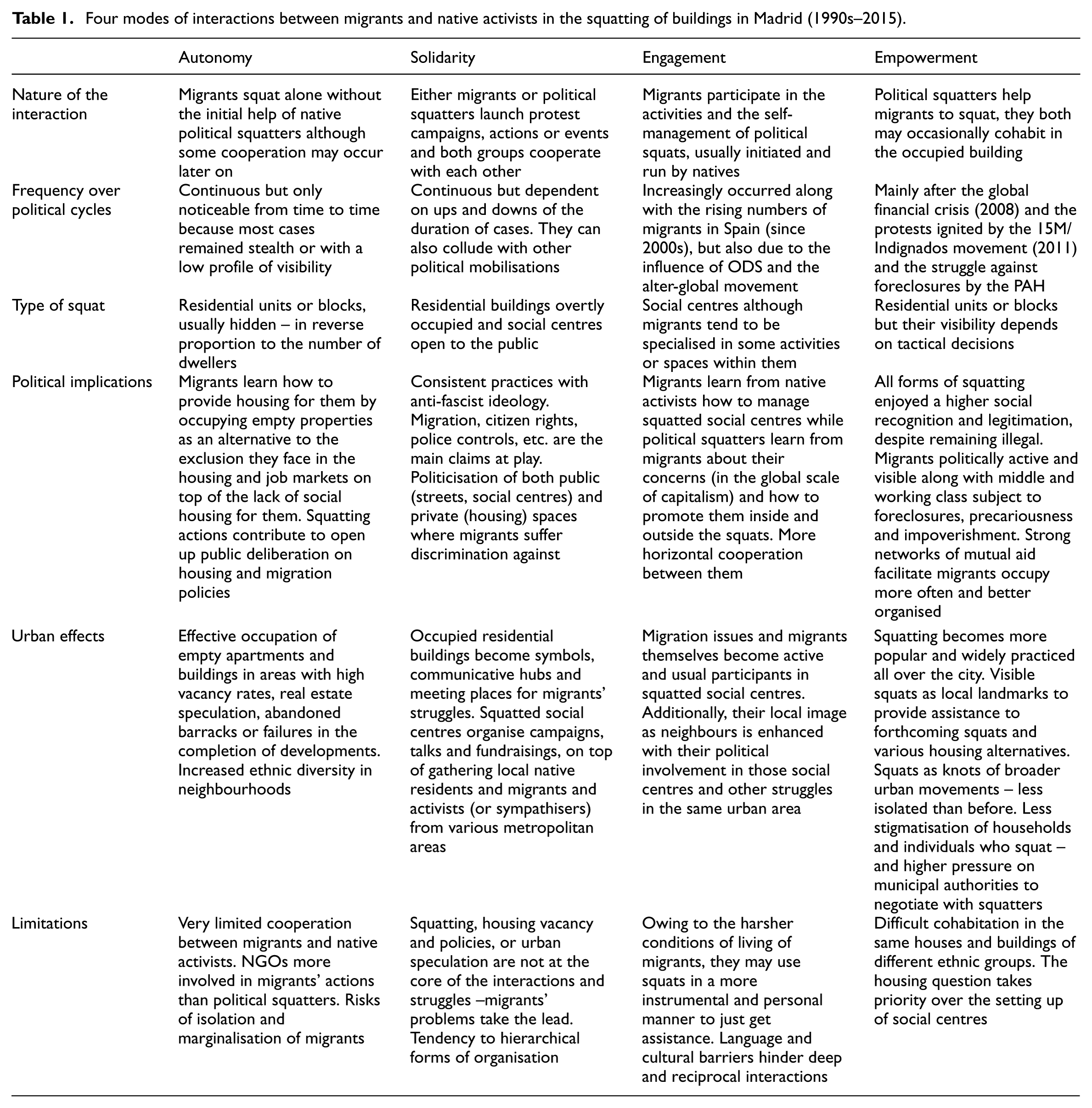
This research aims at understanding the relationship between migrants and native political activists in the practices of urban squatting. As I have shown in the prior analysis, their mutual interactions in the city of Madrid took different forms in different periods of time and political contexts. These interactions have been distinguished as four specific dynamics (Table 1): (1) autonomy – when immigrants squat alone without the initial help of native political squatters although some cooperation may occur later on; (2) solidarity – either migrants or political squatters launch protest campaigns, actions or events in which the issues of migration, citizen rights, police controls, etc. are the main claims at play, both groups cooperate with each other and the squatted spaces are used to develop these ties; (3) engagement – migrants participate in the activities and the self-management of political squats, usually initiated and run by natives, with different degrees of involvement and in different numbers in each case; (4) empowerment – when political squatters help migrants to squat and they both may occasionally cohabit in the occupied building. Obviously, these forms of interaction may overlap. The striking observation is that, beyond the expressions of ideological solidarity or the tendency towards hidden deprivation-based forms of squatting, different forms of interaction have prevailed in different historical periods. In particular, ‘engagement’ has increasingly occurred along with the rising numbers of migrants in Spain, but also given the crucial influence of some initiatives such as the ODS. The ‘empowerment’ forms were more fully developed due to the boost of the 15M movement. ‘Autonomy’ and ‘solidarity’ modes remained as constant features but their knowledge, public visibility and political support have grown up in parallel with the increased social recognition and legitimation of squatting.
Four modes of interactions between migrants and native activists in the squatting of buildings in Madrid (1990s–2015).
An additional consequence is that the political squatting networks have remained relatively consistent with their left-libertarian discourse of ‘solidarity’ in order to add the migrants’ struggles in the range of their concerns. However, it is worth noting that the process of mutual cooperation was slow over the first decade and a half (1985–2000) and some structural limitations are still at play – such as the hierarchical relations that occur when migrants just ask for help to native political activists and no autonomous organisation emerges out of their interaction (a complaint which is usually expressed by PAH members as much as it was by ODS activists before), the language barriers that necessitate exhausting exercises of translation and tend to disengage migrants from struggles where natives are dominant (this is why, as an exception, Latin American immigrants are more prone to participate in squats), the gender roles and relations within some ethnic and immigrant minorities which are incompatible with the egalitarian views of the political squatters (at least in theory: Azozomox, 2014; Kadir, 2014), the troubles derived from informal economic activities (drug trafficking, for example) in which either migrants or squatters may be implicated, etc.
The analysis outlined in sections above has suggested that the various types of interactions between migrants and squatters and their change are due to some specific contextual circumstances – in particular, the rise of the global justice movement and the triggering experience of the ODS, on the one hand, and the 15M movement and the new housing movement which were born after the global financial crisis, on the other. The relevance of these social and political contexts is nuanced with some other political dimensions. The rise of Madrid metropolis as a global city during the late 1990s, the mobilisations called by the global justice movement and the new waves of internationalism such as the Zapatismo in Mexico, gave birth to new modes of questioning the dominant borders policies for people (while not for capital) and the devastation created in poor countries by capitalist modes of production, consumption, debt, exploitation of natural resources, etc. Besides, the restrictions set by the European governments in the last decades halted the asylum refugees’ requests, reinforced the military control of borders, legalised detention camps where numerous illegal practices and violations of human rights are reported, and implemented deportation flights of undocumented migrants. These policies engendered more risky forms of migrants’ mobility and deadly tragedies over the last decades. Paradoxically, they were combined with discourses of ‘integration’ and ‘multiculturality’ as well as privatisations and cuts in public services (Ávila and Malo, 2010), including those services that specifically address the migrant population.
Therefore, the incorporation of debates around these issues during the early 2000s in the political squatting scenes paved the ways for more intense and practical forms of interaction with migrants. Accordingly, starting from an initially poor interaction and given the prevailing image of marginality over the autonomous migrants’ squats, the political squatting scene in Madrid has evolved into deeper concerns on the migration issues, its involvement in the migrants’ struggles and a tighter cooperation in the practice of squatting. After the global financial crisis in 2008 and the 15M movement in 2011, the occupation of houses by migrants, political squatters and other activists boosted and challenged the criminalisation processes which were generally applied to squatting. This, at least in Madrid and other Spanish cities, obtained more favourable media coverage and produced a shift in the tactics of negotiation. As a consequence, the politicisation of the blocks recently occupied for housing purposes resulted in an increased engagement and empowerment of the migrants involved in squatting. A different story might be told in other European countries where the economic crisis has been less severe or the political cycles of protest differ, so further research should expand on these particulars.
Footnotes
Funding
Funding was received from City University of Hong Kong (7200435(POL)) and the Spanish Ministry of Science and Innovation (CSO2011-23079).