






Abstract
The new urbanism promotes preferred design and land use patterns as a means to enhance quality of life through socioeconomic diversity, but many criticise these assertions of causality. Deriving community indicators for social sustainability – including housing affordability and socioeconomic diversity – and from studies assessing new urbanism as an infill development tool, we examine the impact of new urbanism infill development in Parramore, an economically distressed inner city neighbourhood, and Baldwin Park, a brownfield inner-ring suburb, with comparative control neighbourhoods in Orlando, Florida. In Parramore, active new urbanism implementation, including HOPE VI and the Partnership for Sustainable Communities, reflect revitalisation efforts through increased socioeconomic diversity. Meanwhile, the Baldwin Park plan incorporates many new urbanist best practices. The findings from these two distinct cases of infill development indicate that the new urbanism does not necessarily ensure social sustainability, though these principles are often integrated into publicly funded revitalisation initiatives dedicated to doing so through mixed use and mixed income development.
Introduction
Since the early 1980s, the new urbanism has promoted and applied urban design strategies to create more walkable, mixed use, mixed income communities (Calthorpe, 1993, 2013; Duany et al., 2010; Grant, 2006; Sohmer and Lang, 2000; Talen, 2013). Initially implemented in greenfield developments, the establishment in 1993 of the Congress for the New Urbanism (CNU) and the organisation’s partnership with the US Department of Housing and Urban Development (HUD) the following year introduced a focus on affordability and infill strategies. The 1996 Charter of the New Urbanism reinforced this commitment: ‘Infill development within existing urban areas conserves environmental resources, economic investment, and social fabric, while reclaiming marginal and abandoned areas’ (Talen, 2013: 47). These principles and actions place the new urbanism within a framework of community development and public policy initiatives that extend beyond physical design into more intangible sustainability goals.
Many studies have examined transportation and environmental aspects of sustainability as part of the broad definition that integrates social, environmental and economic issues in the built and natural environments (Berke and Conroy, 2000; Campbell, 1996). For purposes of our examination of new urbanism implementation in Orlando, we focus on social sustainability, which has received less attention in the academic literature. As defined by Hassan and Lee (2015: 1270), social sustainability consists of ‘social equity and sustainability of community’ (Dempsey et al., 2011; Trudeau, 2013). Social equity reflects equity of resources and opportunity to access goods, services, jobs and housing while community sustainability entails social interaction within a community and ‘community stability, which promotes pride, safety, security, and a sense of place’ (Hassan and Lee, 2015: 1270; see also Bramley and Power, 2009; Dempsey et al., 2011; Trudeau, 2013). Among the criteria indicative of these two aspects of social sustainability are housing affordability and social equity, two frequently cited expected outcomes of new urbanism projects. Exclusive land use policies and lack of affordable housing in sprawling suburban communities of US cities have increased residential segregation and limited low income and minority opportunity to access good schools, jobs, housing and services, consequently reducing social equity (Briggs, 2005; Lee, 2011; Trudeau, 2013). Ensuring a sufficient supply of affordable housing in desirable neighbourhoods could enhance equity of access to resources for lower income and minority households (Briggs, 2005), and increasing socioeconomic diversity in a neighbourhood could provide disadvantaged households with enhanced social networks and support systems (Briggs, 1998; Talen, 2006). 1 Therefore, this study evaluates Orlando’s implementation of new urbanism principles as a means to realise these social sustainability goals using housing affordability and socio-economic diversity measures to assess this impact.
Given recent initiatives to broaden the new urbanism’s impact and to integrate it into federally funded programs, this analysis provides important insights into the potentials and limitations for this planning approach to contribute to social sustainability. We begin by reviewing recent studies assessing the new urbanism, particularly in relation to housing affordability and social equity, and extrapolate relevant variables or indicators. Given its adherence to the new urbanism since the early 1990s in its plan objectives and land development code and to sustainability since its designation by the State of Florida in 1997 as a Sustainable Communities Demonstration Project (Larsen, 2005), Orlando, Florida offers a means to examine these strategies. Targeting an economically distressed inner city revitalisation initiative and an inner-ring suburb brownfield redevelopment of a former military base also provides insight on, respectively, a predominantly public sector intervention and a predominantly market driven approach.
Evaluation of the new urbanism
As it repositioned itself as a planning strategy, the new urbanism gained traction with the public sector, specifically in the 1993 federal Housing Opportunities for People Everywhere (HOPE) VI program, and more implicitly in the 2009 HUD, US Department of Transportation (DOT) and US Environmental Protection Agency (EPA)’s Partnership for Sustainable Communities (PSC). The federal PSC program offers an opportunity to explore sustainability within the context of the new urbanism. It focuses on six livability principles: transportation choice; equitable, affordable housing; economic competitiveness; community revitalisation; leveraging federal support and interagency coordination; and celebrating healthy, safe and walkable communities.
Many designers, developers and public officials consider new urbanism as ‘a tool for achieving sustainable growth’ measured via housing affordability, ethnic diversity, alternative modes of transportation, mixed use, increased density, environmental quality and an enhanced public realm (Garde, 2004: 167). While new urbanism and sustainability are often touted by supporters in practice as reinforcing desirable development patterns (Calthorpe, 2013; Duany et al., 2010), many critics argue that new urbanism integrates very little sustainability (Berke, 2002; Grant, 2006). For instance, Berke’s (2002: 28) analysis of the CNU Charter finds that very few of the principles focus on environment, equity or even explicitly on economy: ‘In contrast to the five pages of text on ecology and to the one-half page devoted to affordable housing, sixty-five principles that cover forty-five pages of text focus on urban livability and physical design characteristics of transit oriented developments’.
One of the most enduring criticisms of the new urbanism is that a variety of housing types does not guarantee social equity, especially accommodation of lower income groups (Day, 2003; Grant, 2006; Grant and Perrott, 2009). ‘The main problem is that affordable housing in desirable locations (like New Urbanist developments) goes against the basic principles of land economics in the United States’ (Talen, 2010: 493). A number of studies employing hedonic pricing models conclude that households will pay a premium for various new urbanism features, whether associated with an individual home (Tu and Eppli, 1999) or with urban form, including street networks and land use mix (Song and Knaap, 2004). Yet, few developers successfully address this challenge by leveraging government programs and engaging non-profits to integrate affordable housing into their projects (Steffel Johnson and Talen, 2008).
Similarly, as a revitalisation tool, new urbanism’s outcomes are mixed, often resulting in increased housing values rather than serving lower income markets. In their study of Chicago, Ryan and Weber (2007) demonstrate economic benefits in high poverty areas, though scattered site infill results in higher land values than larger scale revitalisation projects they define as enclave or as traditional neighbourhood (new urbanist) design. Deitrick and Ellis (2004) assess the integration of affordable housing into four Pittsburgh neighbourhoods as part of large-scale, small-scale and scattered site projects, documenting the new urbanism as a successful community development strategy.
Despite the new urbanists’ arguments to the contrary (Duany et al., 2010; Talen, 2006), many studies find that land use and design interventions simply cannot remedy significant socioeconomic challenges in our most distressed communities. Place diversity does not simply result in social diversity (Day, 2003; Fainstein, 2005; Grant and Perrott, 2009). Day (2003) assesses new urbanism applications in a California revitalisation project and finds not only that displacement is an issue but also that the planning process itself, which emphasises community solidarity rather than a multiplicity of backgrounds and perspectives, might create problems. Despite its mix of urban form, densities, uses and housing types, the new urbanist community of Markham near Toronto, Canada fails to realise social diversity (Grant and Perrott, 2009). The authors argue that broader socioeconomic forces make these planning interventions particularly challenging.
Given the assertions of the new urbanists concerning housing affordability (Duany et al., 2010; Talen 2013), the criticisms concerning the ultimate lack of affordability and social diversity in many of these communities (Day, 2003; Grant, 2006; Grant and Perrott, 2009) and the applicability some studies have found with new urbanism as an affordable infill strategy (Deitrick and Ellis, 2004; Ryan and Weber, 2007), this study assesses the implementation of new urbanism principles as infill strategies that contribute to social sustainability. Orlando’s enthusiastic embrace of the new urbanism and some significant infill projects over the past two decades offer an opportunity to focus on the rapidly growing Sunbelt region where despite its relatively common application, the new urbanism has not been assessed so readily as an urban infill strategy.
Orlando as a case study: Parramore and Baldwin Park
This comparative study of new urbanist redevelopment with conventional development assesses implementation within two different contexts in the City of Orlando: the Parramore and Baldwin Park neighbourhoods. Orlando, the largest city in Orange County located in Central Florida, has made a significant commitment for over 20 years to new urbanism and sustainability through targeted neighbourhood plans and design guidelines; grants; and transportation improvements.
In the last 40 years, the city more than doubled its population and quadrupled its land area as it accommodated suburban development. 2 As city leaders began to shift their focus to safeguarding downtown neighbourhoods, they adopted historic overlay districts and neighbourhood protection policies in the 1980s, and then the Traditional City Overlay District in 1991 to ensure compatible infill development, particularly architectural elements, urban design and land use (Sohmer and Lang, 2000). Among the most economically distressed and historically segregated neighbourhoods was the Parramore area directly west of Orlando’s downtown. The historic African-American residential and business district suffered from significant population decline during desegregation and demolition and deterioration due to the routing of two major urban freeways and the indiscriminate development of major public projects in the community.
The centerpiece of a strategy to revitalise Parramore in the 1990s involved drafting a ‘master plan’ consisting of urban design guidelines, including street and block relocations to reinforce the grid pattern while introducing pocket parks and squares as well as accommodating a mixture of uses to serve the neighbourhood and encourage walkability. Local officials hired consultants Victor Dover and Joseph Kohl, both former students of Andres Duany, to undertake the project. Completed in 1994, the master plan represented the first direct application of the new urbanism in the city. 3
In Parramore, a significant series of public sector planning and development interventions continue to shape the neighbourhood, in part reflecting the city’s stated commitment to sustainability and the new urbanism while also introducing large-scale projects such as the FAMU Law School (public), the Parramore Heritage (stormwater) Park (public), the new Amway Center arena (public-private) and the newest proposal to establish a downtown campus for the University of Central Florida (public). 4 The redevelopment of a public housing project using HOPE VI, the mixed income and mixed use Low Income Housing Tax Credit (LIHTC) City View project and smaller scale scattered site affordable housing spearheaded through the city’s housing division, the community redevelopment agency or nonprofit developers have characterised efforts to improve housing conditions while maintaining affordability in the community. At the same time, demolitions have continued and proposals such as the Creative Village on the north side of the community are intended to attract economic growth and higher incomes to the area by establishing a hub of ‘the creative industries and innovat[ive] education institutions that, together, will advance the economic, education and job opportunities of the future’ (City of Orlando, 2011: 4).
Directly to the east of the Creative Village is a SunRail station, co-located with the LYNX Central Bus Station. 5 While not physically in the Parramore community, this SunRail Station and the one directly to the south near the Amway Center will certainly impact the neighbourhood, as development associated with these transit hubs – the only two in the line designated as ‘Downtown’ stations – will spill over into Parramore. In 2012, the East Central Florida Regional Planning Council (ECFRPC) and 25 other organisations, including the City of Orlando, signed a memorandum of understanding as the East Central Florida Sustainable Communities Consortium (ECFSCC) agreeing to coordinate on the SunRail commuter rail system. The primary focus of the agreement is to outline the Work Plan for implementing the Sustainable Communities Initiative Grant consistent with specific principles including meeting affordable housing needs, ‘revitalizing low income and/or minority neighborhoods’, ‘improving access to jobs’ and serving as a model for ‘sustainable and inclusive development practices’ (ECFRPC, 2012: 2). More recently in January 2015, the City Council approved the Parramore Comprehensive Plan, integrating the livability principles of the PSC program (City of Orlando, 2015). Thus, Parramore has been the focus of significant planning activities, many of them touting characteristics associated with the new urbanism and sustainability.
Running parallel with the efforts for Parramore revitalisation is the redevelopment of the Orlando Naval Training Center (NTC) into the Baldwin Park neighbourhood, which has been underway since the mid-1990s. Located just over 3 km northeast of the downtown, but outside the Traditional City (see Figure 1), the approximately 1100-acre site was declared surplus by the federal government in July 1993. Following an intensive process of brownfield remediation that engaged federal, state and local agencies and stakeholders (Bagaeen, 2006), 6 the planning department, functioning as the local redevelopment authority, issued a conceptual land use plan and policies just four years later. This conceptual plan accommodated a modified gridiron street pattern with parks surrounding Lakes Baldwin and Susannah, and a higher density mixed use Village Center adjacent to distinct neighbourhoods each within a 10-minute walk of the centre. Through a competitive process, the city council then hired Orlando NTC Partners, LLP, comprising the architectural firm of Skidmore, Owings and Merrill and local planning consultants Miller-Sellen Associates, Inc., to draft specific regulations that implemented the conceptual plan. The resulting Regulatory Plan and Ordinance, adopted in July 1998, 7 contains a series of design and land use guidelines consistent with the new urbanism, including housing with front porches, garages accessible from alleys, a grocery store, cafes, neighbourhood serving shops and parks connected by bikeways and sidewalks to residences. In fact, Baldwin Park is featured on the CNU project website. Though secured with significant public investment in demolition, remediation and infrastructure improvements and guided through the master planning process, the Baldwin Park site developed primarily through phased, large private sector projects (see Table 1).

Case study area: Parramore, Baldwin Park and control neighbourhoods in Orange County, Florida.
Planning initiatives in Orlando, Parramore and Baldwin Park consistent with the New Urbanism and/or sustainability.

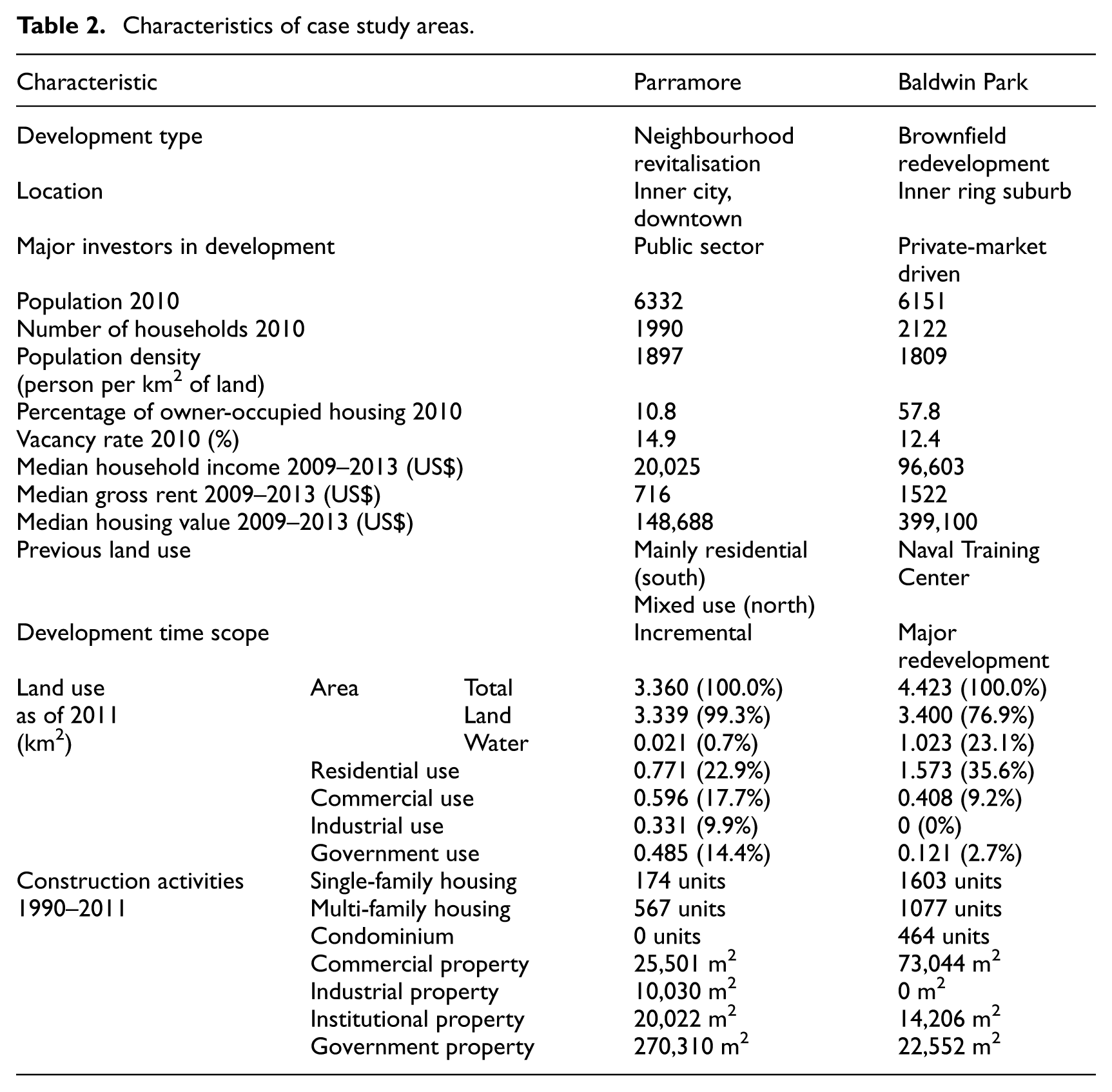
While Parramore and Baldwin Park have a similar land area and population size, they have substantially distinctive socio-economic characteristics (see Table 2). Both areas have mixed land use patterns, but Baldwin Park has a much larger share of residential uses, and Parramore includes a larger percentage of land devoted to public uses. In Parramore from 1990 to 2011, 741 dwelling units (27% of total housing stock in 2010) and about 0.3 km2 of commercial and government facilities were newly built. Because housing programs such as HOPE VI and LIHTC supported the majority of this residential development, government assisted multi-family housing comprises a significant amount. In contrast, all housing units in Baldwin Park were privately constructed since 2002. The housing types are diverse: single-family housing, multi-family housing and condominiums account for 51%, 34% and 15% respectively of total housing stock.
Characteristics of case study areas.
Parramore’s community indicators measured in the 1990 and 2000 censuses and the 2009–2013 American Community Survey (ACS) are compared with those of control neighbourhoods and Orange County. 8 Located outside the Traditional City, these four low income, predominantly African-American inner-ring suburbs proximate the median household income and racial composition of Parramore in 1990. Since Baldwin Park was newly developed during the 2000s, only the community indicators in the 2009–2013 ACS are considered and compared to those for Orange County and four newly developed control neighbourhoods selected based on median household income from the 2009–2013 ACS. Two are newly developed conventional suburban communities and others are new urbanist communities in the outer suburbs of Orange County. The characteristics of case study and control neighbourhoods are summarised in Tables 3 and 4.
Characteristics of case areas and control neighbourhoods of Parramore (base year: 1990).

Note: Median household income, gross rent and housing value are in 2013 inflation adjusted dollars.
Characteristics of case areas and control neighbourhoods of Baldwin Park (base year: ACS 2009–2013).

Sources: Census 2010, ACS 2009–2013, median household income, gross rent and housing value are in 2013 inflation adjusted dollars.
A critical goal of the PSC – housing affordability – is assessed using three indictors: the share of low income affordable housing, HUD’s location affordability index and the availability of assisted rental housing. The share of low income affordable housing refers to the percentage of renter occupied housing with rent below the Orange County fair market rent (FMR). 9 The location affordability index 10 refers to the estimated percentage of household income needed to cover housing and transportation costs for median income families in a community. The availability of assisted rental housing is analysed using the Florida Housing Data Clearinghouse. Finally, the authors measure socioeconomic diversity in terms of income, 11 age and race using the entropy index; the change in this index over time is compared to the control neighbourhoods and Orange County to assess the extent of socioeconomic diversity in new urbanist developments. The variables used in this study and their sources are summarised in Table 5.
Measures of outcomes and sources of data.

Note: The five income categories are as follows: 50% AMI or less (very low income); 50.1–80% AMI (low income); 80.1–120% AMI (moderate income); 120.1–150% AMI (middle income); more than 150% AMI (high income).
Findings based on analysis of community indicators
For over 20 years, residential development in Parramore has been guided by the new urbanism, first as reflected in the Traditional City design guidelines, then in the Dover-Kohl Master Design Plan and HOPE VI redevelopment criteria. At the same time, decades of large-scale public projects, including two major highways, have disrupted the historic fabric of this community. The recent Creative Village proposal and opportunities associated with the two SunRail stations offer a means to introduce new urbanist design interventions that can re-weave sections of the neighbourhood together.
The Baldwin Park master plan was also developed based on new urbanism principles but with private market driven implementation. While the private sector developers, architects and planners who formed the consortium stated that the project will ‘[p]rovide housing for a broad spectrum of ages, incomes, and backgrounds’ (Orlando Naval Training Center Partners, LLP, 1998: 21), a specific commitment to housing that is affordable to lower income groups was not included. Therefore, the outcomes associated with the new urbanism in these two communities may diverge due to their different development contexts.
Parramore
From 1990 to 2011 in Parramore, the number of government assisted rental housing units, including public housing, serving low income families and the elderly increased from 594 to 927 units. These projects include 120 HOPE VI units in Carver Park, 266 LIHTC units in City View and 125 Section 202 HUD Rental Assistance units. Parramore still accommodates many low income households, and 84% of the renter occupied housing has a lower gross rent than the Orange County FMR. The introduction of market rate rental housing as a mixed income strategy in Parramore resulted in a slight change in this housing submarket. While one of the control neighbourhoods, census tract 146.01, where 1016 assisted housing units were newly provided during the study period, experienced drastic increases in the share of low income housing from 50% to 70%, the share of low income housing in Parramore overall fell from 93% to 84% during the 2000s.
According to the location affordability index, Parramore has the lowest housing and transportation costs for median income families among comparable neighbourhoods. The estimated housing and transportation costs in Parramore are 41.6% of the income of median income families, 6.8% lower than that of Orange County. Higher locational affordability in Parramore reflects relatively more frequent transit use and shorter auto trips. Given its downtown location, Parramore is one of the most transit accessible neighbourhoods in Orlando with its existing multimodal central bus station, planned Bus Rapid Transit (BRT) system and the SunRail project.
Recently, Parramore experienced in-migration of Hispanic and non-Hispanic white populations, resulting in increased racial/ethnic diversity compared to the control neighbourhoods. Unlike other control neighbourhoods, the white population increased and the share of minority population fell in Parramore during the 2000s. The age diversity in Parramore was slightly lower than the control neighbourhoods and declined during the 2000s, though this measure was consistent with Orange County overall (see Table 6 and Figure 2). Income diversity in Parramore fell slightly during the 1990s but increased during the 2000s, implying that recent infill projects through the HOPE VI and LIHTC programs may positively affect income diversity. In fact, the share of high income households increased from 4.0% to 7.1% during the 2000s. Although the share of very low income and low income households is still high, these changes indicate the potential of residential revitalisation in Parramore. Infill efforts through the Creative Village and other projects may contribute to making Parramore a more economically diverse community.
Housing affordability and socioeconomic diversity of Parramore and Baldwin Park.

Note: ‘Non-Hispanic other’ includes two or more races, American Indian, Alaska Native and other races.
Sources: Census 1990, 2000, 2010 (Summary File 1), ACS 2009–2013, HUD Location Affordability Portal.

Comparison of Parramore with control groups.
As shown in several indicators, the outcomes in Parramore during the 1990s are distinguished from those of the 2000s. The Traditional City design guidelines were initiated in 1991, but Parramore experienced continuing decline during the 1990s with a loss of population, decline in median household income and a growth in the share of the minority population. In contrast, the median household income and race/ethnic and income diversity in Parramore increased during the 2000s. Furthermore, these changes in Parramore during the 2000s are unique outcomes considering the ongoing decline in the control neighbourhoods. We speculate that a more active public intervention in Parramore consistent with new urbanist principles during the 2000s contributed to these socioeconomic changes.
Baldwin Park
Because the City of Orlando prepared new urbanism design guidelines for Baldwin Park to direct its redevelopment, an opportunity existed to ensure affordable housing and social diversity in the project. However, the conceptual plan contained no explicit criteria or incentives for the provision of affordable housing. Approximately 5% of renter occupied housing in Baldwin Park rents for less than the Orange County FMR, and no assisted rental housing was constructed. The share of low income housing is even lower than in the outer suburban control neighbourhoods. The median gross rent of Baldwin Park is approximately 150% of the median gross rent for Orange County based on the 2009–2013 ACS. Further, almost all owner occupied housing in Baldwin Park exceeds the Orange County median housing value, indicating that no affordable housing is available for low income households in Baldwin Park. Thus, despite the assertion of the new urbanists, the introduction of diverse housing types in Baldwin Park does not guarantee the supply of affordable housing for low income households. Indeed, residents of Winter Park, which is one of the most affluent communities near Baldwin Park, expressed concerns about the introduction of affordable housing in the Baldwin Park project, and the City of Orlando did not actively advocate inclusion of affordable housing.
However, Baldwin Park has relatively better location affordability compared to the control neighbourhoods due to its lower transportation cost. Median income families spend approximately 50% of their income on housing and transportation in Baldwin Park. Baldwin Park has the lowest estimated transportation costs among comparable neighbourhoods due to its proximity to downtown and its mixed land uses. Specifically, median income families in Baldwin Park are expected to spend 20.8% of their income for transportation costs, but median income households residing in new urbanist or conventional suburban communities in the outer suburbs are estimated to spend about 26% of their income for transportation costs. However, as Baldwin Park provides little low income housing, it is difficult for low income households to realise the benefits of lower transportation costs here.
Baldwin Park is economically and racially less diverse than Orange County (see Table 6 and Figure 3). Despite its central location, socio-economic diversity is lower than control neighbourhoods located in the outer suburbs. The share of non-Hispanic white and high income households in Baldwin Park are 78% and 62%, respectively, and these shares are 1.5 to two times higher than those of Orange County. Due to the higher share of young and middle aged populations, age diversity is also relatively lower in Baldwin Park. Because Baldwin Park was developed as a high income community with a limited supply of affordable housing, lower socioeconomic diversity is a natural consequence.

Comparison of Baldwin Park with control neighbourhoods.
Discussion and policy implications
This study assesses community indicators to examine whether infill development based on new urbanism principles achieves social sustainability goals by conducting a comparative case study of the Parramore and Baldwin Park neighbourhoods with respective control neighbourhoods in Orlando. Due to the limited data available, the findings fail to prove causality between the community indicators and the conditions in the case study neighbourhoods. However, the findings provide insight on social sustainability and new urbanist infill development.
New urbanism policies and guidelines can indeed support infill interventions that reinforce social sustainability in more economically distressed communities if they are made part of coordinated and comprehensive public-private sector initiatives as in Parramore. During the 2000s, this active public intervention consistent with new urbanism principles led to signs of revitalisation in this longstanding distressed neighbourhood. Residential infill projects, funded through HOPE VI and LIHTC, are consistent with the Traditional City design guidelines and attract more upper and middle income households. With new mixed income housing options supported by the public sector, socioeconomic diversity is growing. Further, the newly opened commuter rail station funded by the 2009 PSC grant may reinforce potential revitalisation along with the proposed mixed use development of Creative Village. While all these funding sources are tied to programs that integrate new urbanism guidelines, the funding itself coupled with major non-residential projects fuelled revitalisation in Parramore. Key elements, such as mixed income and mixed use, that are consistent with new urbanist tenets but that also operate outside new urbanist guidelines, shaped and strengthened social sustainability in Parramore.
However, this social sustainability is tenuous. With ongoing major non-residential projects and the potential for housing and land price increases, the City of Orlando should pay close attention to housing affordability in Parramore now, to avoid displacement in the near future. One strategy is to introduce policies that require the inclusion of a certain percentage of affordable units in new projects.
In addition, a predominantly market driven new urbanist development may not achieve social sustainability even though the project has higher locational efficiency on an infill site as in Baldwin Park. Trudeau and Kaplan (2016) show that new urbanism projects provide houses for various income groups and have relatively higher income diversity compared to conventionally developed neighbourhoods. The community indicators of Avalon Park, one of the comparable new urbanist communities in suburban Orlando, support their arguments, but these conditions did not hold in Baldwin Park. Proximity not only to downtown Orlando but also to the affluent neighbourhoods of Winter Park enhances Baldwin Park’s market potential. Consistent with new urbanism principles, Baldwin Park has higher location affordability with a lower transportation cost compared to other newly developed suburban communities. Many opportunities for walking, bicycling and social interactions among residents exist through mixed use and pedestrian oriented design, but the lack of affordable housing led to less socioeconomic diversity. Thus, Baldwin Park reflects many best practices from a new urbanism architectural, urban design and land use perspective, but it does not fully realise key social sustainability goals.
Ensuring a variety of housing prices, including affordable housing, should be a precondition of socioeconomic diversity in new urbanism projects as stated in the Charter of the New Urbanism: ‘Within neighborhoods, a broad range of housing types and price levels can bring people of diverse ages, races, and incomes into daily interaction, strengthening the personal and civic bonds essential to an authentic community’ (Talen, 2013: 125). However, Baldwin Park only provides a broad range of housing types without affordability for lower incomes. Consistent with Deitrick and Ellis (2004), Ryan and Weber (2007) and Talen (2010), without public sector intervention and support, market based new urbanism development is not successful in accommodating affordable housing. Social sustainability is not ensured as part of new urbanist projects, despite the movement’s stated dedication to this principle and studies that document the commitment of designers, developers and public officials to applying new urbanism to achieve this and other sustainability goals (Garde, 2004). As evident in Parramore, new urbanism guidelines are often integrated as part of local, state and federal initiatives and programs, but as Baldwin Park demonstrates, new urbanism alone does not ensure social sustainability. Instead, implementation of sustained mixed use and mixed income goals through publicly funded affordable housing and community development programs provides greater assurance of social sustainability in revitalisation projects. Proactive planning informed by monitoring infill strategies combined with ongoing commitment to housing affordability through mixed income and mixed use projects can contribute more effectively to social sustainability in revitalisation and redevelopment endeavours.
Footnotes
Funding
This research received no specific grant from any funding agency in the public, commercial, or not-for-profit sectors.