







Abstract
With ongoing urban revolution, Chinese cities are experiencing an influx of migrants, whose integration into urban society becomes an unprecedented challenge. Using a recent survey in Shanghai and adopting a multilevel multinomial logistic model, this paper studies perceptions of social integration, comparing local residents with migrants. While migrants and local residents have very different perceptions of social integration, both individual-level factors and community-level factors such as residential segregation shape perceptions of social integration, and they shape migrants and local residents differently. In particular, residential segregation, especially migrant population size, tends to reinforce perceptions of social exclusion, which imposes challenges on social integration.
Introduction
Social integration is a process of interpenetration and fusion between different individuals, groups and cultures (Park and Burgess, 1969 [1921]). In terms of social integration between groups, there are minority and majority groups, such as blacks and whites, immigrants and natives. Inequality in life opportunities between them may result in many social problems – poverty, crime, education, even political conflict (Castles and Miller, 2003; Galster et al., 1999; Solivetti, 2010). Immigrant integration has been studied extensively in Europe and the USA (e.g. Alba and Nee, 1997; Gordon, 1964; McLaren, 2003; Portes et al., 1980; Quillian, 1995; van der Laan Bouma-Doff, 2007), which provides theories and empirical analysis examples for internal migration in China.
China is in the midst of an urban revolution, with the largest human migration in history. According to China’s 2010 Census, there were over 261 million migrants living in places different from their household registration and had been away from their household registration places for more than 6 months (NBSC, 2010). Compared with 2000, the number of migrants increased more than 81%, from 117 million. As the largest city and the financial centre of China, Shanghai is a major magnet for migrants. According to the Shanghai Statistical Report 2013, the migrant population in Shanghai reached 9.9 million, accounting for 41% of its total population. Compared with other developing countries, internal migration in China is unique, as it is affected by not only individual decision-making, but also by socialist institutions, such as the household registration (hukou) system (Chan and Zhang, 1999; Fan, 2008). Without the approval to register officially at the destination, migrants are denied many social and economic benefits, including access to subsidised housing and urban public schools (Huang, 2004; Huang and Tao, 2015; Logan et al., 1999). Because of their disadvantaged positions in cities as defined by the hukou system, migrants’ integration into mainstream urban society is more complicated and probably more difficult than domestic migrants in Western cities.
Social integration can be divided into subjective perspective and objective/actual integration. While objective social integration has been widely studied (e.g. Massey and Mullan, 1984; Portes and Rumbaut, 2006; Semyonov and Glikman, 2009; Zhou and Lin, 2004), the subjective perspective of social integration has been poorly understood. Yet, the subjective perspective of social integration is important to objective integration and assimilation. In Milton Gordon’s framework of assimilation, attitude reception assimilation is a part of structural assimilation, a higher stage of assimilation (Gordon, 1964). The majority and minority groups tend to have different perceptions of intergroup relations. For example, natives often express negative and prejudiced attitudes toward immigrants (Berg, 2009; McLaren, 2003; Quillian, 1995), while immigrant groups hold a strong tendency to favour integration (Berry, 1997; Van Oudenhoven et al., 1998). Perception matters, as how people perceive the influx of migrants and their integration in the society potentially can affect their behaviours, which can directly affect the actual integration of the two groups. If intergroup relations are confrontational, conflicts might emerge. Thus, better understanding of perceptions of social integration can have significant policy implications. This paper focuses on the subjective aspect of social integration in China, and studies migrants’ and local residents’ perceptions of social integration between them.
There is a small emerging body of literature on migrants’ actual integration, mostly concerning the labour market and housing attainment in China. Ren and Wu (2006) reviewed existing studies and argued that individual characteristics, the segmented labour market and the discriminative hukou system significantly affect migrants’ social integration. In general, migrants live in poor housing in marginalised neighbourhoods, and they have to rent informal housing at the urban–rural fringe because of housing prices (Knight et al., 1999; Lei et al., 2007; Wu, 2002; Wu and Wang, 2002). There are only a few studies on subjective integration in China, mainly concerning migrants’ identification and residence intention (Cui, 2012; Lei, 2011; Ren and Dai, 2003).
Residential segregation is also a measure of actual integration in classic spatial assimilation theory. The type of neighbourhoods in which migrants live can have a significant impact on their interactions with, and thus integration into, the mainstream society (Semyonov and Glikman, 2009). Yet, we know little about this contextual effect. In this paper, we focus on perception of social integration, and study how it is affected by the actual degree of social integration (or the lack of it as residential segregation).
After reviewing the literature, we will set up a conceptual framework of understanding perceptions of social integration in Chinese cities, and develop related hypotheses. Then we will use Shanghai as a case study to empirically examine both individual and community-level factors shaping residents’ perception of social integration, followed by conclusions and discussion.
Literature review
Social integration (or assimilation) is a key concept in urban sociology that can be traced back to the Chicago School’s writings on immigrants in the USA (Park and Burgess, 1969 [1921]). There are multiple dimensions of integration including economic, social, cultural, political, institutional and psychological integration, and there are multiple stages of assimilation, from adaptation to the new environment to eventual identification assimilation (Ga and Huang, 2009; Goldlust and Richmond, 1974; Gordon, 1964). Spatially, immigrants often initially reside in immigrant enclaves with cheap housing in poor sections of the city. As they improve their economic conditions over time, they tend to move out of immigrant enclaves and move into better housing and neighbourhoods that are more similar to those of the host population, thus achieving spatial assimilation (Alba and Nee, 1997; Massey, 1985). Without residential integration, immigrants may not be able to achieve structural assimilation or other assimilation outcomes (Massey and Mullan, 1984). Although not every immigrant group wants to be assimilated, especially in today’s multiculturalist and globalised world (Portes et al., 1980), social integration is usually cast in a positive light as immigrants overcome their disadvantaged positions in the destination society and become more on a par with the host population.
Existing studies tend to focus on how individual/household factors, such as human capital, social networks and social capital, affect social integration (Portes, 1998; Zhou and Lin, 2004). This emphasis on individual characteristics assumes perfect labour and housing markets, while ignoring contextual and institutional factors that can affect immigrants’ integration. For example, the type of neighbourhoods in which immigrants live and the racial compositions of the local areas can significantly affect immigrants’ economic and housing outcomes and thus their integration. Existing literature on neighbourhood effects tends to focus on the effect of concentrated poverty, while only a few studies look at the consequences of living in ethnic enclaves (Galster, 2007). In the Netherlands, it has been found that there is a strong negative effect of ethnic concentration on the likelihood of maintaining contacts with native Dutch people (van der Laan Bouma-Doff, 2007). Exposure to more members of one’s own ethnic group in the neighbourhood is statistically associated with more poverty (Galster et al., 1999) and a higher risk of being unemployed (Clark and Drinkwater, 2002). It has been argued that residential segregation may hamper an ethnic minority’s integration, as neighbourhoods with a concentration of ethnic minority may restrict their opportunities (Friedrichs et al., 2003; Harrison et al., 2005; Kearns and Parkinson, 2001).
There are two main theories on intergroup relations in classic social psychology that emphasise the role of threat and contact in shaping intergroup attitudes (Levine and Campbell, 1972; Tajfel and Turner, 1979). Based on group threat theories, native-born individuals who live in regions with large immigrant populations are likely to hold negative attitudes toward immigrants in European countries and the USA, especially if the region is struggling economically (Alba et al., 2005; McLaren, 2003; Quillian, 1995). Contact theory (Dixon, 2006; Pettigrew, 1998), however, suggests that, even in less than ideal social situations, interactions between different ethnoracial groups may result in positive intergroup feelings. Semyonov and Glikman (2009) find that ethnic residential segregation (residence in homogeneous all-European neighbourhoods) restricts opportunities for establishment and development of interethnic social contacts; positive interethnic contacts are likely to reduce anti-minority attitudes.
Internal migrants in China share many similarities with immigrants in the West, despite the lack of stark physical differences between migrants and urban residents in China. The hukou system, often called an ‘internal passport system’ (hukou) (Chan, 1996), divides the Chinese population into those with agricultural registration and those with non-agricultural registration, and everyone is registered at only one place. Most migrants in Chinese cities have their hukou (agricultural or non-agricultural) registered in their hometowns, thus they are not entitled to many welfare benefits and economic opportunities. In other words, Chinese migrants face similar obstacles in social integration as immigrants in the West because of their ‘illegal’ or second-class status in the city as defined by the hukou system.
There is a small but growing body of literature on migrants’ integration in China, mostly in Chinese. Most migrants work in the secondary labour market, where the minimum wage, social safety, health insurance, unemployment protection and basic welfare benefits are not relevant (Li, 2000; Ren and Wu, 2006). Migrants change jobs often; yet few can achieve upward mobility (Li, 1999). Being excluded from the primary labour market, it is difficult for migrants to achieve integration. Similar to immigrants in the USA, both human and social capital can affect a migrant’s integration in Chinese cities. Even though the economic return to education is not very high among migrants owing to the segmented labour market (Zeng, 2004), vocational training is very important to migrants’ occupational attainment and economic condition and, thus, integration (Zhao and Wang, 2002). In addition, social networks can provide economic and emotional support to new migrants especially to adjust to the urban environment; yet the homogeneity of these social networks actually prevents migrants from integrating into urban society (Zhu, 2002). Migrants have to develop new social networks through interactions with urban residents to facilitate their integration; yet with the institutional and labour market conditions in Chinese cities, it is very difficult for migrants to establish new social networks in cities (Cao, 2003). In fact, the ‘social distance’ between migrants and urban residents is increasing (Guo and Chu, 2004).
In addition to the lack of entitlements mentioned above, migrants tend to consider their origins as their permanent residence because of the hukou system, which prevents their integration in cities (Li, 2000). Personal interactions between migrants and local urban residents have a significant impact on migrants’ self-identity as local residents versus migrants, which in turn affects their behaviours (Cui, 2012) and thus integration. Most migrants feel they are discriminated against by urban residents, which is more detrimental to their confidence and personality than are their poor economic conditions (Li, 1995). The hukou system made urban residents the privileged first-class citizens, and migrants the second-class citizens, with few interactions between them. A survey in Shanghai shows that most migrants do not feel positive about living in the destination city. Ren and Dai (2003) argue that this is not their true intention; rather it is their ‘rational decision’ given the institutional constraints and their unstable work. Lei (2011) finds that urban new migrants who hold a Shanghai household or registration card show a higher degree of social identification.
There is a growing body of literature on migrants’ housing and neighbourhood choices. In general, migrants live in poor housing and they often concentrated in certain marginalised neighbourhoods such as urban villages in suburbs, old housing neighbourhoods in inner cities, shantytowns, factory dorms, and informal/illegal housing such as basement dorms (Knight et al., 1999; Lei et al., 2007; Wang et al., 2010; Wu, 2002; Wu and Wang, 2002) because of the lack of affordable housing and institutionalised discrimination in the housing system. As a result, residential segregation between migrants and local urban residents is emerging in Chinese cities that were dominated by relatively homogeneous work-unit compounds in the socialist era (Huang, 2005). Huang and Yi (2009) find significant residential segregation between social groups defined by hukou status and mobility in Wuhan even in 2000. With the latest 2010 census, Li et al. (2014) find that migrants in Guangzhou aggregate around the inner suburb of the city, and the segregation index reached 0.48. Significant residential segregation between migrants and locals are also found in Shanghai, Shijiazhuang, Shenyang, Dongguan and Wuxi, with migrants concentrating in urban villages, shanty towns and dormitories at construction sites, far away from urban residents (Lei et al., 2007; Wang and Zhang, 2006). Residential segregation aggravates the psychological segregation between migrants and local residents (Luo and Wang, 2008).
While we start to understand the actual integration between migrants and local residents (or the lack of it) in Chinese cities, we know very little about how people perceive social integration. This paper aims to understand people’s perception of social integration in Chinese cities. In particular, we focus on contextual factors and how the actual degree of social integration affects people’s perceptions of social integration. Social integration is often treated as a one-way process that migrants need to integrate into the urban environment on their own initiatives (Tong and Ma, 2008; Zhou, 2012), while others believe that it is a two-way process that both migrants and local residents achieve integration through interactions (Ren and Wu, 2006). This paper adopts the perspective of social integration as a two-way interactive process, and examines perceptions of both migrants and local residents.
Conceptual framework and hypotheses
Perceptions of social integration between migrants and local urban residents is shaped by both individual and community-level factors (see Figure 1). The above literature review shows that demographic and socio-economic factors, such as age, gender, education and income can affect perceptions of social integration. In the context of Chinese cities, we emphasise the important role of hukou registration place – local residents versus migrants in shaping people’s perception of social integration. It not only directly affects perceptions of social integration, but also mediates other individual outcomes such as income and housing consumption, which in turn affect perceptions of social integration. Therefore, migrants’ perceptions of social integration are likely to be different from those of local residents. Existing studies focused on migrants and their perceptions only. In this paper, we will compare local residents and migrants. We hypothesise that migrants and local residents have different perceptions of social integration (Hypothesis 1).
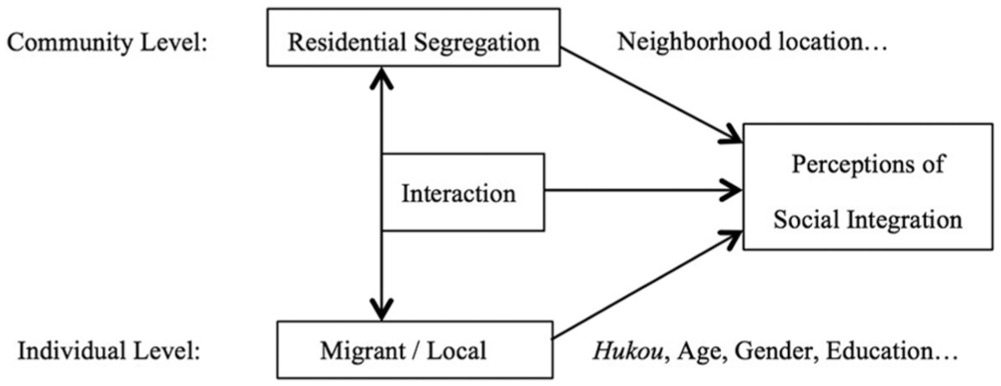
A conceptual framework on perceptions of social integration.
Second, community-level factors, such as neighbourhood location, can shape people’s perceptions of social integration. In particular, we highlight the importance of residential segregation in the neighbourhood to people’s perceptions of social integration. Compared with many other dimensions of integration, such as economic and cultural integration, residential segregation is more physical and visible to residents, thus it can have a significant impact on perceptions. In addition, residential segregation also embodies the lack of economic and cultural integration, which in turn affects people’s perceptions. Thus we hypothesise that residential segregation between migrants and local residents has a significant impact on their perceptions of social integration. In this paper, residential segregation between migrants and local residents is measured by both the relative and absolute concentration of migrants in a community – proportion of migrants and migrant population size in each community. While a large concentration of migrants potentially can lead to more intergroup contact, residential segregation is more likely given the institutional exclusion of migrants especially in the housing sector in Chinese cities. Thus we hypothesise that the higher proportion of migrants and the larger the size of migrant population a community has, the less likely its residents would perceive social integration in their community (Hypothesis 2).
Third, as discussed earlier, migrants are constrained in housing access, thus their housing and neighbourhood choices are limited. In addition to poor housing conditions, they are more likely to live in certain marginalised neighbourhoods such as urban villages and old housing in inner city neighbourhoods. Compared with migrants living in neighbourhoods with less concentrated migrants, those in urban villages may have different perceptions of social integration. Similarly, local residents who live in neighbourhoods with concentrated migrants may have very different perceptions from those in neighbourhoods with few migrants. In particular, existing residential segregation of a community (or the lack of it) can affect the perceptions of migrants and local residents differently. We hypothesise that residential segregation has different effects on migrants and local residents in shaping perceptions of social integration (Hypothesis 3). Furthermore, we also pay attention to the cross-level interaction between hukou status at individual level and migrant population size at community level to test the different perceptions between urban locals and rural locals, or urban migrants and rural migrants living in communities with different sizes of migrant population.
Empirical analysis
Data and variables
The data we use in this study are from the survey of Social Development and Construction in Urban and Rural China (2012) conducted in Shanghai. First, subdistricts and towns are considered as the primary sampling unit, and we use the ‘probabilities proportional to size’ method (referred to as PPS) to select 20 subdistricts and towns. Second, two neighbourhood or village committees as the secondary sampling unit were chosen from each selected subdistrict or town with the PPS method. Neighbourhood Committees are the lowest government organisations and smallest spatial units in the administrative hierarchy in urban areas, and their counterparts in rural areas are Village Committees. One neighbourhood committee may have a population size from 918 to 10,260 residents. Third, residential addresses from selected committees are randomly selected, and then selected household samples from these addresses based on random number tables. Fourth, appropriate respondents from selected households were chosen with the ‘Kish Grid’ method. Finally, 1015 respondents who are above 17 years old and working or have retired and living in urban and rural areas in 40 neighbourhoods were randomly chosen for interview.
The dependent variable is perception of social integration. Based on the group contact and threat theories, we derive the dependent variable from two questions in the questionnaire. The first one is ‘do you agree with the statement “local residents always exclude migrants”?’ (‘exclusion’ in tables). This is a direct measure for perception of actual exclusion, thus social integration, because the two are opposite concepts. If respondents agree with the statement that ‘migrants are not excluded’, it shows at least they believe there is a high degree of intergroup contact and social integration between migrants and local residents. The second is ‘do you agree with the statement that “migrants generally bring problems to local safety”?’ (‘safety’ in tables). A similar question is often used in intergroup threat research (Schneider, 2008; Semyonov and Glikman, 2009; Semyonov et al., 2008). As migrants are often blamed for crimes and local safety issues, this belief is very important to intergroup relations and thus affects integration. If a person believes that migrants bring problems to local safety, he/she is less likely to have inclusive behaviours towards migrants, thus it is a good indicator for social integration. It is always a challenge to measure perceptions and attitudes, especially on sensitive topics such as migrant–local relations, as respondents may provide the appropriate or expected answers (e.g. politically correct answers) instead of their true beliefs. For example, local residents, especially educated ones, may think that migrants threaten neighbourhood safety but they know it is not appropriate to say so, thus they may give the opposite answer. This can be misleading. Nonetheless, these two questions measure two important aspects of intergroup relations and thus perceptions of social integration. Each question is given five options ranging from ‘completely agree’ to ‘completely disagree’ for respondents to choose. We combine the ‘completely agree’ and ‘relatively agree’ into ‘agree’, ‘completely disagree’ and ‘relatively disagree’ into ‘disagree’ because of small frequencies. Thus, both variables have three categories: agree (migrants excluded/weaken), uncertain (exclusion/weakening uncertain), and disagree (migrants not excluded/weaken).
The main individual-level independent variable is hukou registration place, which divides the sample into migrants and local residents. ‘Migrants’ refer to people whose hukou is registered anywhere other than Shanghai but who have relatively stable jobs and live in Shanghai, while local residents are those who are registered in Shanghai. About 70% of respondents are local residents and 30% are migrants. Hukou type (agricultural versus non-agricultural) is another key independent variable. Rural-to-urban migrants are concentrated in low education level, low-skilled jobs, low income, and poor life conditions (Fan, 2008; Knight and Song, 2005; Li, 2006).
Generally speaking, prejudice and discriminatory attitudes towards minorities tend to be more pronounced among those individuals with low socio-economic status (e.g. low education and income), males, and older persons (Espenshade and Hempstead, 1996; Esses et al., 2001; Firebaugh and Davis, 1988; Hughes and Tuch, 2003; Semyonov et al., 2004). Similarly, these factors may affect minorities’ attitudes towards the host society. In addition, most migrants in Shanghai cannot afford to buy homes, and choose to rent housing (Wu, 2002). Migrant children in China are restricted from urban education and the healthcare system (Fan, 2004; Guo, 2007; Qiu et al., 2011; Qu and Wang, 2008). Therefore, homeownership and presence of children are meaningful to migrants’ sense of belonging, and thus may have an impact on their perception of social integration.
The key community-level variable is residential segregation between migrants and local residents, which is measured by proportion of migrants (Allport, 1954; Schlueter and Wagner, 2008; Wagner et al., 2003, 2006) and migrant population size in each neighbourhood or village committee from the community questionnaire. These two variables (migrant proportion and size) are complementary to each other, and measure different dimensions of migrant presence in a neighbourhood. The permanent resident population is the total population living in the neighbourhood, and the proportion of migrant (‘%migrant’ in the tables) is calculated from the number of migrant population divided by permanent resident population. The migrant population size is the number of migrant population divided by 100 to avoid too small coefficients in the models. Two communities have missing information on migrant population. Therefore, there are 992 respondents in 38 communities included in this analysis, ranging from 5 to 44 respondents in each community, and the mean is 26 respondents. The permanent resident population size in 38 communities ranges from 918 to 10,260, and the mean is 4093 residents. In addition, neighbourhood location is included as a community-level control variable, because it is related to the housing price. Non-urban neighbourhood location includes those in rural areas, towns and the rural–urban fringe areas, in contrast to urban neighbourhood locations.
Descriptive analysis
According to Table 1, regarding the statement ‘local residents always exclude migrants’, about 40% of people ‘agree’, 45% ‘disagree’, and 15% are ‘uncertain’. However, more than half of migrants (55.33%) agree, compared with only one-third of local residents (33.96%). In contrast, for the statement ‘migrants bring problems to local safety’, about 52% of respondents ‘agree’, 20% are ‘uncertain’ and 28% ‘disagree’. Yet, more than 60% of local residents agree, compared with only about 31% of migrants. This shows significant differences in perceptions of exclusion and safety between migrants and local residents. While migrants are more likely to think they are excluded by local residents, local residents are more likely to think that migrants are the cause of poor safety in their neighbourhoods. The chi-squared tests for exclusion and safety are significant, indicating significant association between hukou registration place and perceptions of social integration.
Perceptions of social integration by hukou registration place and residential segregation.
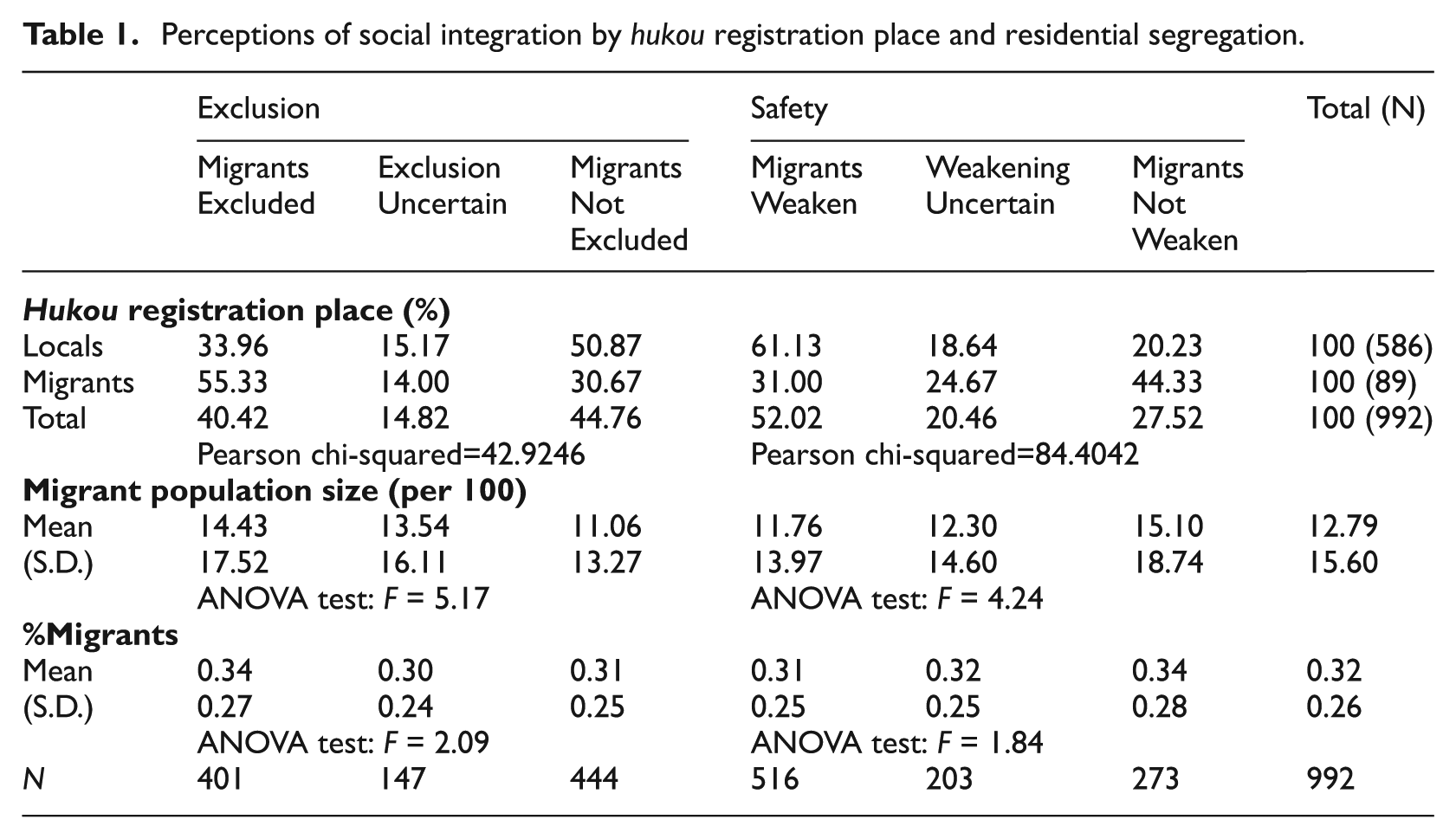
For the statement on exclusion, mean migrant population size of ‘migrants excluded’ is the largest, ‘exclusion uncertain’ is smaller, and ‘migrants not excluded’ is the smallest. This indicates that people living in larger migrant population neighbourhoods are more likely to agree with the statement ‘local residents always exclude migrants’. For the statement on safety, the means of migrant population size are smaller for ‘weakening uncertain’ and ‘migrants weaken’. In other words, residents who live in communities with a larger migrant population are more likely to disagree with ‘migrants generally bring problems to local safety’. Significant ANOVA tests indicate significant differences in migrant population size between groups with different perceptions. In contrast, the mean values of the proportion of migrants do not differ much between people with different perceptions.
Descriptive statistics of all independent variables are listed in Table 2. The average migrant population size and migrant percentage of migrants’ communities are higher than local residents, which indicate the differences of neighbourhood between migrants and local residents. In addition, migrants are more likely to live in the non-urban area, and this finding is consistent with Wu (2002).
Descriptions of independent variables by migrants and locals.

Statistical models and findings
To test our hypotheses, we adopt multilevel multinomial logistic models to estimate the effects of individual characteristics and community-level variables on the respondents’ perceptions of social integration. These models can not only estimate the effect of variables at different levels and interactions between them, but also decompose the variance and covariance of each level (Raudenbush and Bryk, 2002). There are four sets of model, and each includes two dependent variables to represent perceptions of social integration –‘exclusion’ and ‘safety’.
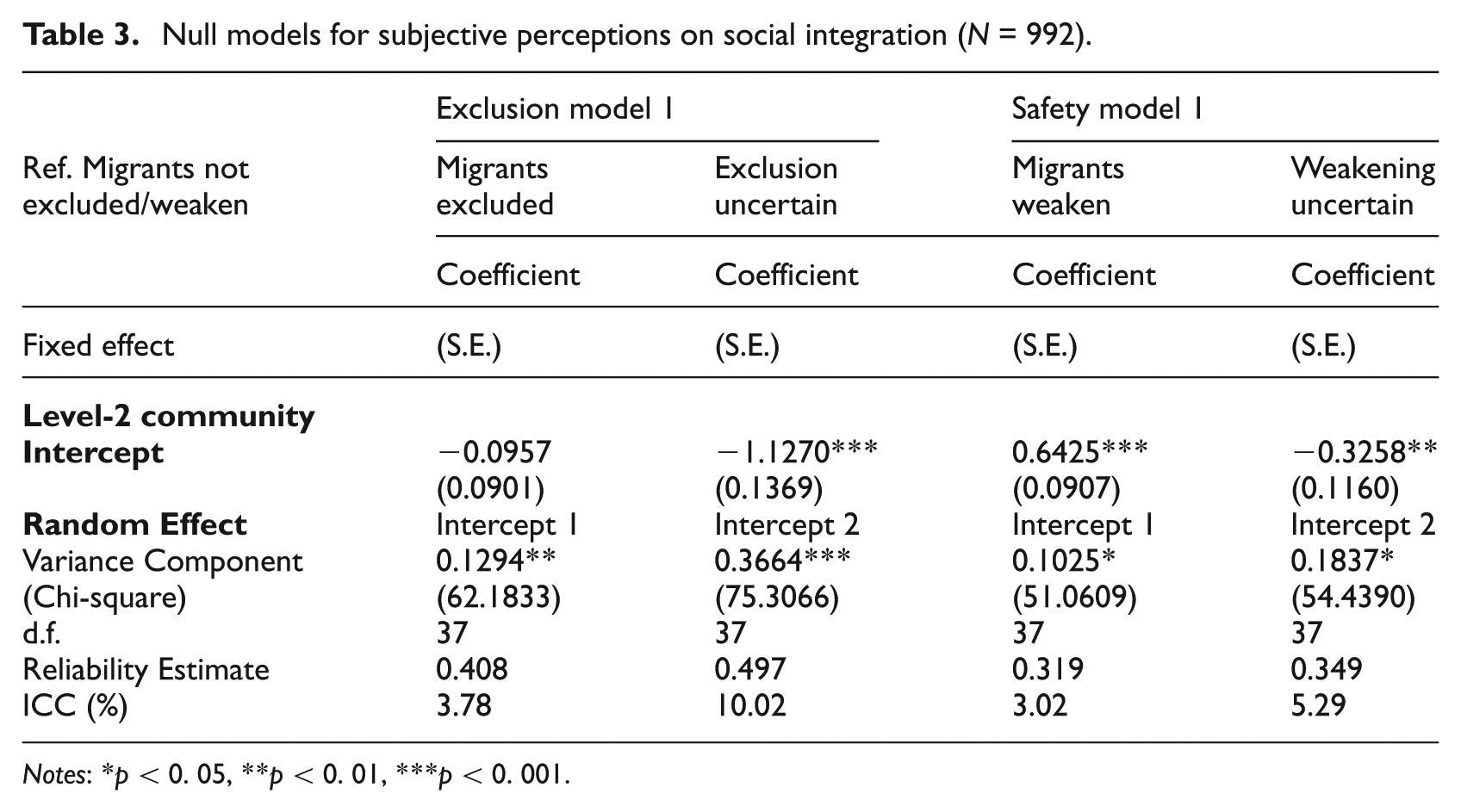
Table 3 shows the first set, and lists results from the null models. The null model is a random intercept model that predicts the individual-level intercept of the perception of social integration as a random effect of the community level, with no other predictors. The intraclass correlation coefficient (ICC) provides an assessment of how much variability in responses lies at the community level. When data are dichotomous, within group variability is defined by the sampling distribution of the data, typically the Bernoulli distribution. When the logistic model is applied, the level-one residuals are assumed to follow the standard logistic distribution, which has a mean of 0 and a variance of π2/3 = 3.29 (Snijders and Bosker, 1999). Based on this, the ICC is calculated using the following:

Null models for subjective perceptions on social integration (N = 992).
Notes: *p < 0. 05, **p < 0. 01, ***p < 0. 001.
The p-value of each model shows the variance at the community level is statistically significant at the 0.1%, 1% or 5% level. Thus, despite a relatively small proportion of variability at the community level (range from 3.02% to 10.02%), these results indicate that multilevel models are essential for this analysis.
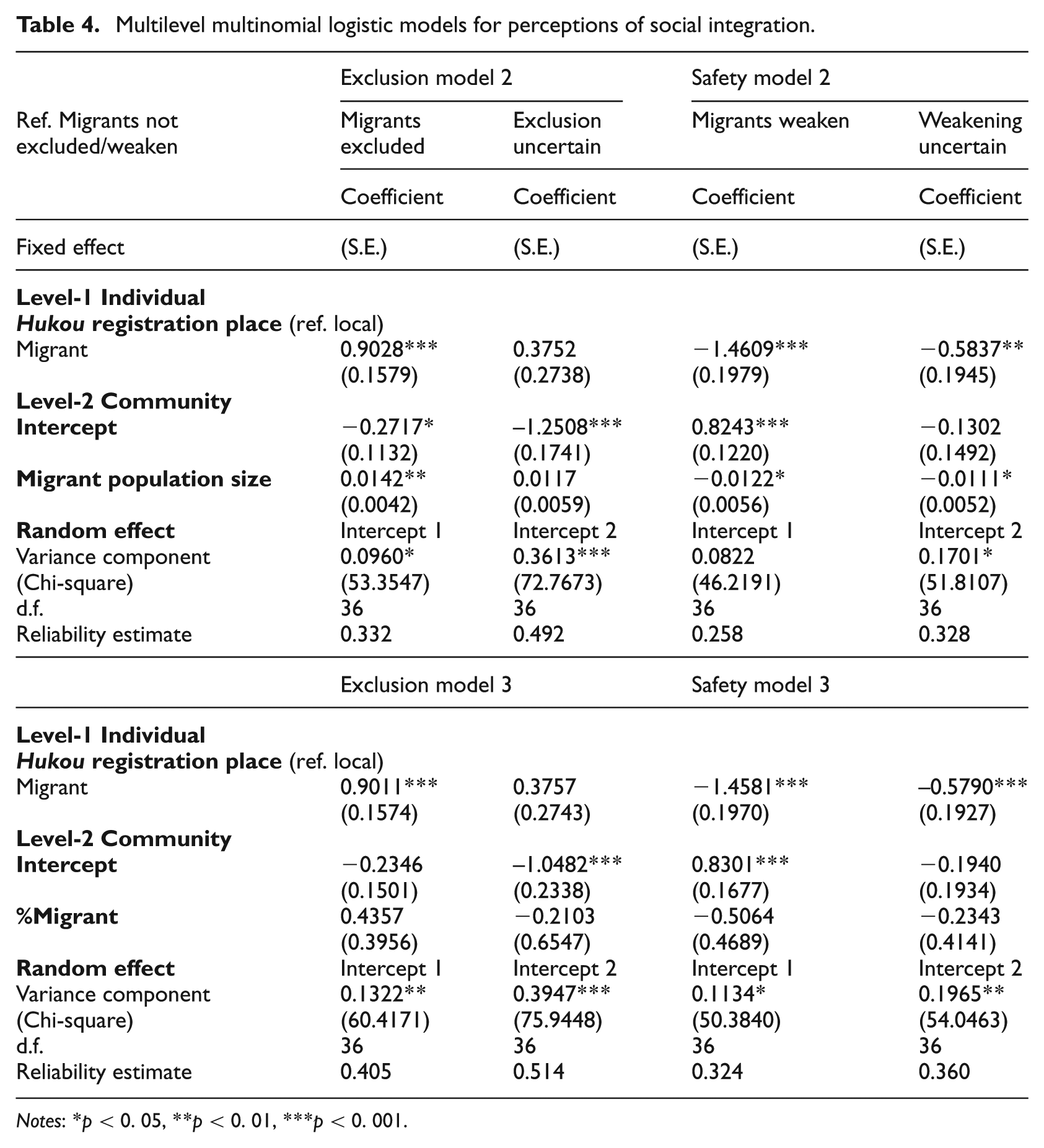
In Table 4, key individual-level and community-level variables are included in the models. Considering the two variables for residential segregation are associated by definition, we will build models with the proportion of migrants and migrant population size separately. For easier interpretation, all independent variables at the individual level are group centred to the mean value of communities. The baseline of each model is the category of ‘migrants not excluded or weaken’. The hukou registration place is significant in both models, which means the differences between local residents and migrants are significant. From exclusion model 2, compared with local residents, migrants are 2.47 [=exp(0.9028)] times more likely to agree with the statement ‘locals always exclude migrants’. In safety model 2, compared with local residents, migrants are less likely to agree with the statement that ‘migrants always have a negative effect on local safety’ (coefficient = −1.4609), and migrants are also less likely to be uncertain (coefficient = −0.5837). Therefore, there are significant differences in perceptions of social integration between local residents and migrants, supporting Hypothesis 1. The results in exclusion model 3 and safety model 3 are similar.
Multilevel multinomial logistic models for perceptions of social integration.
Notes: *p < 0. 05, **p < 0. 01, ***p < 0. 001.
At the community level, migrant population size is significant. For exclusion model 2, migrant population size has a significant positive effect. For each additional 100 migrants in the community, the likelihood of agreeing with the statement on exclusion increases by 1.43% [exp(0.0142) = 1.0143]. In safety model 2, migrant population size has a significant negative effect, indicating that as migrant population size increases, people are less likely to agree with (coefficient = −0.0122) and be uncertain about (coefficient = −0.0111) the statement that migrants bring problems to neighbourhood safety. These results support Hypothesis 2. However, the proportion of migrants is not significant in both models. In other words, migrant population size is more important for residents’ perceptions of social integration than the proportion of migrants in Shanghai.
Because of the significant effect of hukou registration place, we run separate models for migrants and local residents. Table 5 lists results from null models for local residents and migrants separately, and the ICC for each null model is shown. The p-value of the ‘exclusion uncertain’ category in local residents’ exclusion model 4 shows the variance at the community level is statistically significant.
Null models for perceptions of social integration by locals and migrants.

Notes: *p < 0. 05, **p < 0. 01, ***p < 0. 001.
ICC ranges from 2.15% to 16.82%, and the proportions of variability at the community level indicate that multilevel models are essential for the exclusion models of both locals and migrants. In contrast, the ICC of safety model 4 is as low as 0.03%, and the highest ICC is only 6.64%. These results indicate that multilevel models are not essential for safety models of local residents and migrants separately. Because this paper focuses on the community-level predictor, safety models for local residents and migrants are not included in the following analysis.
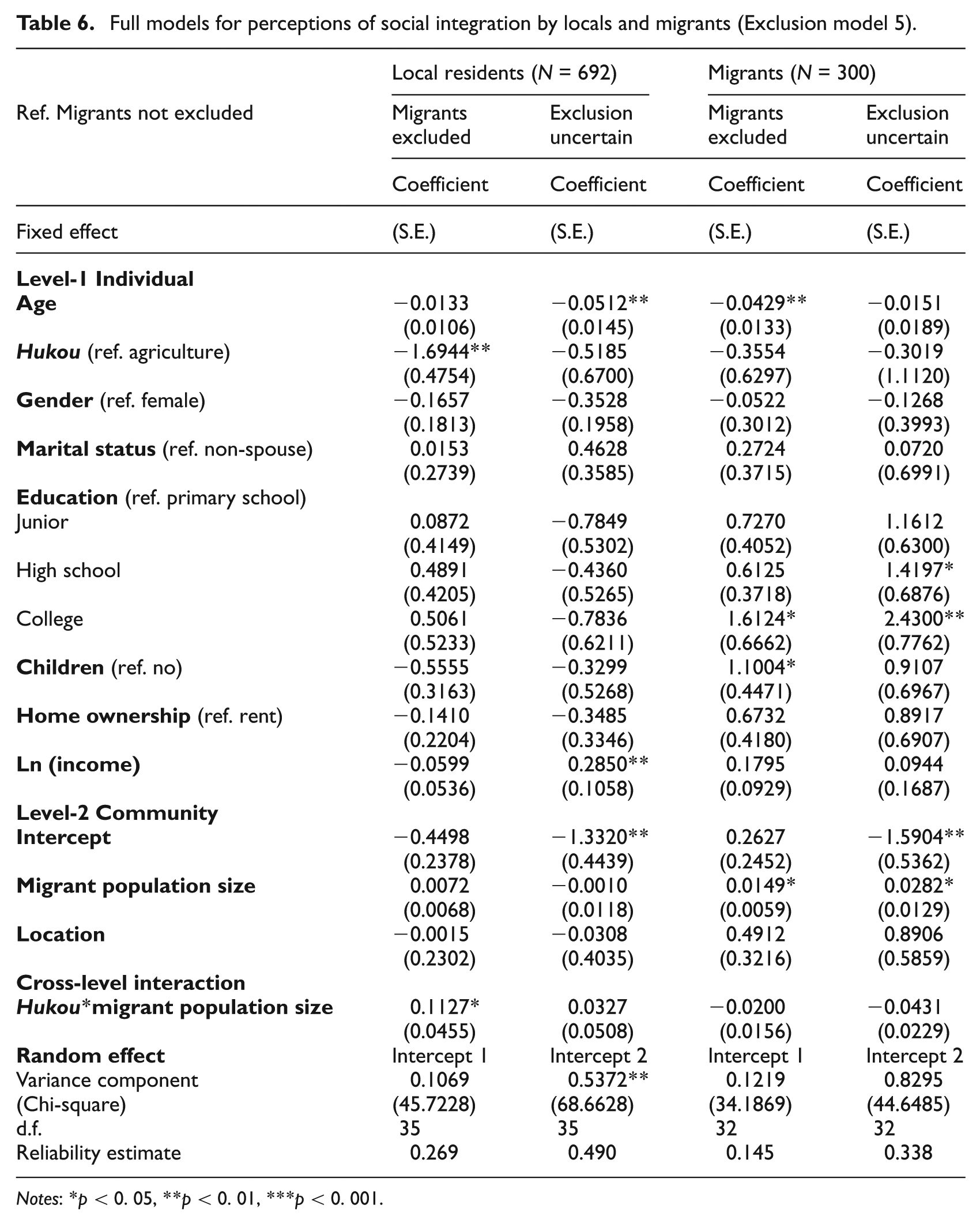
Table 6 is the exclusion model for local residents and migrants, predictors at individual level and community level are included in exclusion model 5. The models for local residents and migrants are very different, indicating different dynamics at both individual and community level in shaping perception of exclusion.
Full models for perceptions of social integration by locals and migrants (Exclusion model 5).
Notes: *p < 0. 05, **p < 0. 01, ***p < 0. 001.
In exclusion model 5, first of all, hukou status is significant for local residents but not for migrants. Compared with agriculture hukou, local residents with non-agriculture hukou (local urban residents) (coefficient = −1.6944) are much less likely to agree with the statement on exclusion. In other words, whether having agricultural or non-agricultural hukou affects local residents’ perception of exclusion, but does not matter to migrants’ perception of exclusion. In contrast, education has significant positive effects on migrants, while it is not significant at all to local residents. In general, migrants with higher education, especially those with college+ education, are more likely to ‘agree’ (coefficient = 1.6124) and be ‘uncertain’ (coefficient = 2.4300) about the statement on exclusion. This shows educated migrants are more critical to existing lack of social integration between local residents and migrants. In addition, migrants with children present are more likely to agree (coefficient = 1.1004); and local residents with higher logarithm of annual income are more likely to be ‘uncertain’ (coefficient = 0.2850) on the statement on exclusion. In other words, migrants with children are more sensitive to their exclusion while local counterparts with higher income are uncertain about their role in the exclusion of migrants.
At the community level, migrant population size has a significant impact on migrants’ perceptions of social integration, but not for local residents. Migrant population size has positive effects, indicating migrants living in communities with larger volume of migrants are more likely to ‘agree’ (coefficient = 0.0149) and be ‘uncertain’ (coefficient = 0.0282) than ‘disagree’ on the statement on exclusion. In sum, both individual and community-level variables shape perceptions of social integration, but differently between migrants and local residents. This generally supports Hypothesis 3. In addition, proportion of migrants also has been tried separately for locals and migrants; however, this community-level factor is not significant in both models, which are not shown here. This result is similar to Table 4, and the proportion of migrants has no impact on migrants’ and local residents’ perceptions.
The interaction term between hukou type at individual level and migrant population size at community level has positive effect on local residents (coefficient = 0.1127). Together with the main effect of hukou status, migrant population size has positive effects on both local urban residents and local rural residents, but the effect is stronger on the former. Living in communities with a larger volume of migrants weakens urban local residents’ perception of their inclusion with migrants.
Conclusions and discussion
As China further urbanises, millions of migrants will settle down in Chinese cities. In particular, the so-called ‘second generation migrants’ who may have grown up in cities and have no experience of farming will not return to their origins. Yet they continue to be called ‘migrants’ instead of urban citizens, and are denied rights and entitlements in cities only because their hukou is not officially registered in cities. With this persistent institutional barrier, migrants’ social integration into Chinese cities becomes problematic and important, which deserves scrutiny and better understanding. While existing studies focus on migrants’ individual characteristics and how they affect the actual integration, this paper focuses on perceptions of social integration in Chinese cities, and examines the roles of both the individual and the community-level factors, in shaping perceptions of social integration. In particular, this paper focuses on how institutional barriers such as the hukou registration place and existing residential segregation (or the lack of social integration) affect people’s perceptions of social integration. In addition, while existing studies focus on migrants and how they integrate into the host society, this study includes both migrants and local residents, and compares their perceptions of social integration to reveal differentiated dynamics in shaping their perceptions.
Using a recent survey in Shanghai, we conducted a series of multilevel multinomial logistic regressions to test the effect of both individual and community-level variables on perceptions of social integration. First of all, people with different hukou registration place have very different perceptions of social integration. Compared with local residents, migrants are much more likely to agree with the statement that they are excluded by local residents, and they are much less likely to agree with the statement that migrants bring problems to neighbourhood safety. In other words, migrants believe they are excluded by local residents, and they are not the reason for poor safety; yet local residents tend to have the opposite views. Furthermore, among local residents, urban local residents are less likely to agree with their exclusion of migrants than rural local residents, while there is no significant difference between urban and rural migrants. It is important to note that while migrants feel the sense of exclusion by local residents in Shanghai, the latter are not aware of this problem, and do not think they are excluding migrants. At the same time, local residents perceive migrants as a threat to their neighbourhood safety, while migrants do not believe so. Therefore, the institutional barrier defined by the hukou system has created seemingly unbridgeable differences in perceptions of social integration, which certainly does not encourage actual integration. In addition, other individual characteristics such as education have different effects on migrants and local residents, demonstrating different dynamics of conventional factors such as human capital on migrants and local residents.
Second, at the community level, the key predictor is residential segregation, measured by migrant population size and the proportion of migrants. While the proportion of migrants is not significant, migrant population size affects perceptions of social integration significantly; however, the effect is different between migrants and local residents. Migrants living in communities with a larger size of migrant population are more likely to agree with exclusion, while migrant population size interestingly has no effect on local residents’ perceptions of social integration. Moreover, the cross-level interactions between hukou at individual level and migrant population size at community level also show the differences between urban and rural locals living in communities with larger or smaller size of migrant population. The coefficient of cross-level interaction has a different sign with hukou at individual level indicates that living in communities with larger size of migrant population relieves the perception differences between urban and rural locals.
The empirical analyses show that perception of social integration in Chinese cities is affected by both individual-level and community-level factors as well as their interactions. In addition to confirming previous studies on the importance of hukou status, this study contributes to the literature by revealing the important role of neighbourhoods, especially residential segregation in shaping perceptions of social integration. Residential segregation further reinforces urban local residents’ perceptions of social exclusion. This shows potentially there is a vicious cycle between residential segregation and perception of social exclusion. Migrants’ integration in Chinese cities will be a challenging process to not only migrants and local residents, but also the government and policy makers. In order to foster social integration between migrants and local residents, the government has to profoundly reform the hukou system, and de-link welfare benefits and economic opportunities from hukou status. Only then would migrants have similar economic status and housing access to local residents, and thus reduce residential segregation between them, which will then foster perception of social integration and lead to real social integration.
This study has several limitations. Owing to the constraints of the data, this paper focuses on perceptions of social integration, which is measured by two questions on exclusion and safety. Social integration and perception of social integration are multidimensional concepts, thus future study should address multiple dimensions of social integration. However, intergroup relation is a sensitive topic that respondents may give misleading answers. A better question design is needed to avoid biases. In addition, we test the importance of community-level variables, such as residential segregation. But additional community-level variables should also be considered, such as housing price, accessibility and amenities. At the individual level, social network and social capital should also be tested in the analysis. The sample we use is relatively small, especially the number of communities for multilevel analysis. It also includes only one city. It would be a good idea to have a larger data set with more communities and more cities. In other words, better data and more research are needed to better understand social integration in Chinese cities.
Footnotes
Acknowledgements
We are grateful to the Institute of Social Science Survey, Shanghai University for providing the data. We also thank Professor John Logan, reviewers and editors for constructive comments and suggestions which have helped to improve the paper significantly.
Funding
This research is supported by the Major Program of the National Social Science Foundation of China (Grant No. 11&ZD035)