







Abstract
Over the last decade, a large part of the Chinese countryside has experienced a ‘hollowing out’ process in economy and state administration, as rapid urbanisation and development have concentrated in urban areas. To deal with this challenge, the Chinese government has launched rural programmes, resulting in significant transformation in the countryside. Applying the state rescaling theory as an analytical lens, this paper argues that these state-led rural programmes have strengthened the state role in governing the countryside significantly based on the case study of Jiangning. These programmes are not fixed yet developed and expanded through the interaction of multi-level governments. While local governments follow the discourse of the higher-level governments in this process, they also restructure the state apparatus for programme implementation. Local governments have some autonomy by echoing and responding to the initiative of the higher-level governments actively. Thus the programme evolution is not simply a top-down process as it encompasses interesting dynamics of state rescaling. Generally speaking, the state plays an important role in moving toward ‘good governance’ in rural China at the initial stage. The state-led rural programmes enable the state to regain its leading role in the countryside and restore the rural public administation to some extent. There is still a long way to go for the civil society to achieve self-governance in the countryside.
Introduction
In the literature on rural China, many scholars pointed out the new governance crisis, especially in government administration, after the abolishment of agriculture tax. At the township level, the abolishment of agriculture tax resulted in a decline of local revenue which significantly reduced the autonomy of the township government in local service provision (Kennedy, 2007; Yep, 2004). The town-level governments were squeezed from above – by the policy imperatives of county government, as well as from below – by village resistance against policy compliance. Scholars claimed that a ‘hollowing out’ process of the state was occurring in the countryside (Li, 2007; Smith, 2010), and the original tight engagement between cadres and villagers in the tax period was alienated (Chen, 2014). Worse still, peasant participation in public affairs has also declined to the bottom and the rural society is fragmented. An atomised, dispersed and disorganised rural society is emerging. This is of great concern to the central government as the stability of the countryside is on its top agenda.
The state remains heavily present in many spheres of governance (Pierre and Peters, 2000). In the literature on rural China, the relation between the state and society has always been a core issue. Many studies have focused on the roles of elites and informal organisations in rural governance, such as rural gentries (Fei, 1946), lineage or religious organisations, even the symbols and norms embedded in the rural network (Duara, 1988). Based on the empirical study of grain procurement by the state in socialist China, Oi (1985, 1989) proposed the clientelist model. She argued that clientelism was just the elite-mass linkage through which the state-party exercised control at the local level. A similar relationship was also observed in industrial firms. Walder (1988) termed it as ‘neo-traditionalism’, indicating its inheritance from the traditional society of China. In the studies of post-reform rural China, the theory of ‘local state corporatism’ explained the rapid growth of rural industry very well. Many scholars unravelled the dual roles of the village cadres: the director in public admistration, as well as the chief executive officer in village enterprises (Lin, 1995; Oi, 1992; Unger and Chan, 1995). Some scholars investigated the rural governance changes in the period after the abolishment of the agriculture tax, from the perspective of village cadre’s performance (Kung et al., 2009; Sun et al., 2013). However, with the decline of lineage society, as well as the weakened fiscal capacity at the village and township levels, there is a disconnection between the state and rural society in the post-tax epoch.
The state is regaining its leading role in rural governance by introducing many state-led programmes. These programmes have emerged against the background of ‘the modernisation of state governance’ and the fiscal reform between central and local authorities in China. They have deeply permeated into the socioeconomic operations of rural China (Qu, 2012). Some scholars keenly termed this new paradigm as ‘governing through programs’ (Zhou, 2012: 34–36). Despite some seminal works, few empirical studies have examined how the state-led programmes shape the countryside, and to what extent the new pattern for governing the countryside can contribute to the rural governance theory.
The programme evolution is not purely a top-down process from centre to grassroots as there are intense interactions among governments at different levels in the programme campaign. The current dynamics in rural China need good explanation from the perspective of governmental changes (Radin et al., 1996), as the Chinese governments have a hierarchical structure (Ma, 2005) and paternalism legacy on rural issues. In this respect, this paper introduces the state rescaling theory into the rural governance analysis. Scale is understood as the organisational principle according to which geographical differentiation takes place at, across and transcends different spatial ‘levels’ (Cartier, 2005). Scaling refers to ‘the establishment of geographical differences according to a metric of scales – etches a certain order of empowerment and containment into the geographical landscape’ (Smith, 2000). By contrast to the notion that the nation-state boundary and ‘level’ of territory is neutral, rescaling theory recognises the shifting in power and control over scales, such as from the national scale to the urban scale or to the global scale. In China studies, specifically, a state rescaling perspective focuses on how actual processes work through the territorial administrative hierarchies – from the centre to provinces, cities, counties and towns, and, in turn, how such political territories are constructed, mutable and dynamic (Cartier, 2005; Chung, 2007; Shen, 2007).
The contribution of the paper is less in terms of theoretical development than in theoretically based interpretation of the case materials. Based on the first-hand data collected through fieldwork in Jiangning, this paper attempts to answer the following questions. How is the role of the state in governing the countryside strengthened through the state-led rural programmes? How do local governments interact with the higher-level (central/provincial) governments and the town-level governments in the process of programme implementation? This paper will unravel the intergovernmental politics on rural issues and evaluate the new governing pattern. The research will refine the theoretical interpretation of state rescaling in the rural context. The findings will also be useful for policy-makers to decide what should be done to revitalise the hollowing-out countryside.
The paper is organised as follows. The study area and research method are introduced in the next section. Regarding the main body of the paper, we adopt a three-parted argument. First, funding gap – this section introduces the formulation of rural programmes by the centre and explains why it happens. Second, implementation gap – programme evolution process and intergovernmental mobilisations are presented. Third, local appropriation – the rationales embedded in the local rhetorical legitimisation as well as path dependent implementation are illustrated with substantial evidence. A discussion of the pros and cons of the new state-led pattern follows and some conclusions are reached in the final section.
Study area and research method
Nanjing is the capital city of Jiangsu Province of coastal China (Figure 1). It lies about 300 km from Shanghai along the Yangtze River, with a population of 8.16 million in 2012 and a territory of 6587 km2 (Nanjing Municipal Bureau of Statistics, 2013). As a sub-provincial level city, Nanjing has more direct connections with the central government than nearby prefecture-level cities in South Jiangsu. The urban–rural relationship in Nanjing demonstrates a typical characteristic of ‘big city with vast countryside’. In 2012, the number of rural residents in Nanjing was 2.03 million and accounted for 24.9% of the de jure population. Although the ratio is the lowest in South Jiangsu, the imbalance between urban and rural development is the most significant (Zhou and Liu, 2015: 81–85).
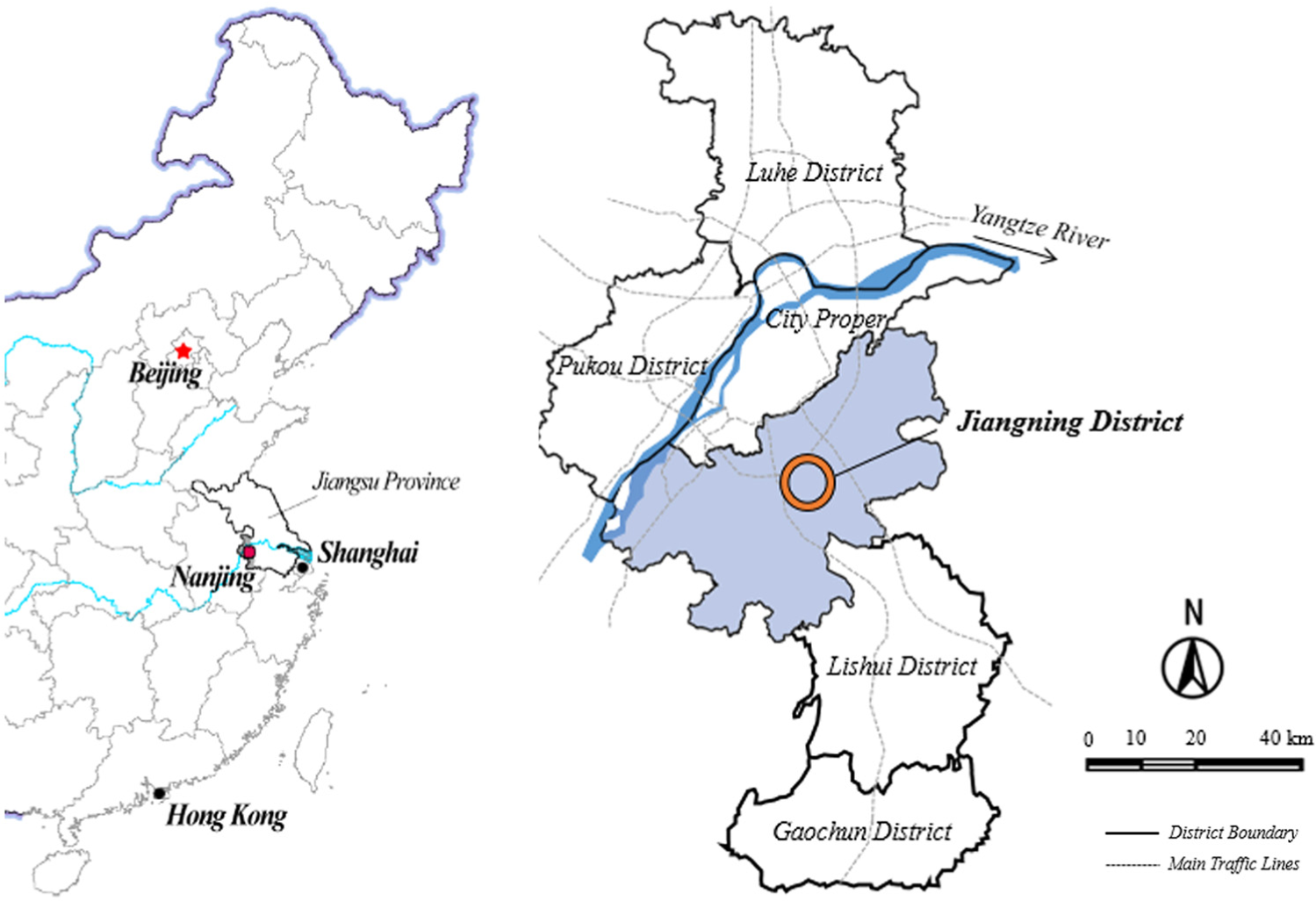
Location of Nanjing and Jiangning.
We choose Jiangning, a district adjacent to the city proper yet under the jurisdiction of Nanjing, as our focused field site. Jiangning was originally a suburban county. After the administrative annexation of ‘county-for-district’ in 2000, Jiangning becomes a district of Nanjing but retains most of its former administrative power of a county. Different from usual districts in the city proper, Nanjing municipal government cannot implement full administration in Jiangning (Zhang and Wu, 2006). Jiangning district resembles a county or county-level city with high autonomy.
Several actors are identified in this study. It is true that governments of Nanjing and Jiangning are different players with different administrative power. For simplicity, they are grouped together as local governments (municipal and/or district) in this paper. From the perspective of the municipality or the district, policies from both the province and the centre would indeed appear as equivalent to policies from the top. Therefore, for simplicity, the State Council, Jiangsu Provincial Government, and the Central Committee of Communist Party of China (CPC), are grouped as higher-level governments (central and/or provincial). Although the CPC committees are not part of conventional governments, they have profound influence on the governmental policy-making. In addition to the two levels, the sub-district/town governments in Jiangning are categorised as town-level governments. As the agencies of the district government to administrate sub-divided units, the town-level governments in Jiangning, such as Hengxi and Tangshan, are primarily in charge of programme implementation with little autonomy in the process of rural programmes. But this does not rule out that such town-level governments have much autonomy in other local affairs such as road construction and power supply. Lastly, the non-governmental actors in our analysis include the local enterprises and peasant organisations such as cooperatives.
Our fieldwork was conducted in the summer of 2014, including five visits to government departments and six visits to the experimental villages. Using the localised qualitative case studies to elucidate the complex internal workings of governmental behaviour in China, the research is exploratory in nature. The villages under investigation are pilot sites for the Village Environment Renovation (VER) and Beautiful Countryside programmes of Jiangning. To get familiar with the local context and informants, participant observation was the initial step in the field. We were actively engaged in the meetings, public affairs, daily life and farming with villagers. Farmers and village cadres developed friendly relationships with us and also introduced new informants. The method helped us formulate sensible and appropriate questions to understand the rural conditions on the ground.
Apart from official documents and statistics, the main data of this paper are derived from the semi-structured interviews. We interviewed five officials at different levels of Jiangsu, Nanjing and Jiangning governments, asking questions about their opinion on the programmes and the programmes’ impacts on rural administration. The officials were from Housing and Urban-Rural Development Department of Jiangsu, Rural Working Commission of CPC Jiangning, Planning Bureau of Jiangning, Planning Bureau of Nanjing, Rural Working Commission of CPC Nanjing. All the bureaus and commissions were relevant authorities on rural issues and the gathered information could be used to mutually substantiate with other data sources. Besides, three village cadres, two planners, two entrepreneurs, and four peasants were also interviewed.
Coping with funding gap: Central initiative of rural programmes
Rural issues matter
China is an ancient agrarian country with a huge rural base in terms of both population and territory. Rural issues have always been at the top of the agenda of central leaders. For 12 consecutive years from 2004 to 2015, the theme of the annual No.1 document of CPC has pertained to ‘three rural issues’ (sannong wenti, i.e. issues of agriculture, peasants and countryside). It is not hard to understand the central government’s concern about the countryside. The ultimate directive of the rural policies is to maintain grain self-sufficiency for the nation (Cloke and Goodwin, 1992; Shen, 2004), as well as sustain the stability of rural society.
Since the planned economy era, the dual system dividing urban and rural sectors (e.g. the hukou system, land tenure system, medical insurance system) has been a long-standing obstacle that hinders rural development. The countryside has been sacrificed to support the development of industries and cities. After decades of rampant growth of cities, the urban–rural imbalance has deteriorated greatly in China (Long et al., 2011). The central government gradually recognised the challenge. In 2003, the epoch-making programme entitled ‘Coordinating Urban–Rural Development’ (chengxiang tongchou fazhan, CURD) was launched by the 16th Central Committee of CPC. The policy was based on the judgement of ‘two trends’ (Han, 2005), i.e. industry should nurture agriculture, and cities should support the countryside (yigong cunong, yicheng daixiang). From protracted ‘taking’ to intensive ‘giving’, this subsidising programme kicked off a new era of state paternalism in the countryside.
Booming state-led programmes in the countryside
The tax-sharing reform in 1994 established sufficient conditions for the formation of rural programmes of China (Lin and Wong, 2012). In the new scheme, taxes in China were divided into three categories: central, local and shared taxes (Wang, 1997). In contrast to the previous situation, a bottom-up extraction mechanism was introduced and the financial capacity of central government was strengthened unprecedentedly. Accordingly, a top-down redistribution system from central to local government was set up. The central government arranged transfer payment to local governments to narrow regional disparities efficiently. In terms of scale, the reform compelled a rescaling up of fiscal responsibility. Huang (2008) viewed it as ‘Chinese style’, in which the centre maintained control of political decision-making, while cities controlled locally specific economic decisions. The funding from the centre that triggered local programme fever is a manifestation of such political directives.
The early 2000s fiscal reform in the countryside necessitated rural programmes. The aforementioned 1994 tax-sharing reform had more or less transferred the fiscal burden to the peasants as town-level governments turned to peasants for revenues (Qu, 2012). Owing to heavy taxes and fees collected for various reasons, the social confrontation between the state and peasants climbed to a peak at the turn of the century. The State Council led by Wen Jiabao made a quick response and gradually implemented the fiscal reform in the countryside. Tax-for-fee (collecting tax instead of fees) reform was first initiated, then fees and levies were abolished gradually. Agricultural tax was finally phased out nationwide in 2006. However, the abolishment of agriculture tax resulted in declining revenue at the town level, which caused a new governance crisis of hollowing state (Chen, 2014; Kennedy, 2007; Smith, 2010; Yep, 2004). The government suddenly found that there was no measure (zhuashou) to govern the countryside effectively, and the public services lacked long-term financial support (Zhao, 2016). Rural programmes were then introduced to cope with such a situation. Comparing the bulging wallet of higher level government with the shrinking pocket of the town-level governments, it is not surprising that the countryside was targeted as an ‘impounding reservoir’ for state investment. Table 1 shows representative rural programmes at the higher level. According to a budget report published by the Ministry of Finance of China (2013), about 1379.9 billion yuan would go to rural areas in 2013. Most of the investment would be carried out in the form of programmes. Under the soaring central funding, at least 100 national rural programmes have been introduced by the central government so far (Zuo, 2014). Those rural programmes in China are totally different from those in the US or UK context. The programmes from the relevant departments of UK or US governments are initiated with an emphasis on community participation. The non-governmental organisations such as local enterprises or community organisations can apply for and use such grants (Swindal and McAreavey, 2012; Ward and McNicholas, 1998). In contrast, nearly all of the programmes in China are initiated and implemented by the government sector, via either vertical system of a department or bureau from central to local government, or horizontal local government which administrates one territory.
Representative rural programmes at the central and provincial level.
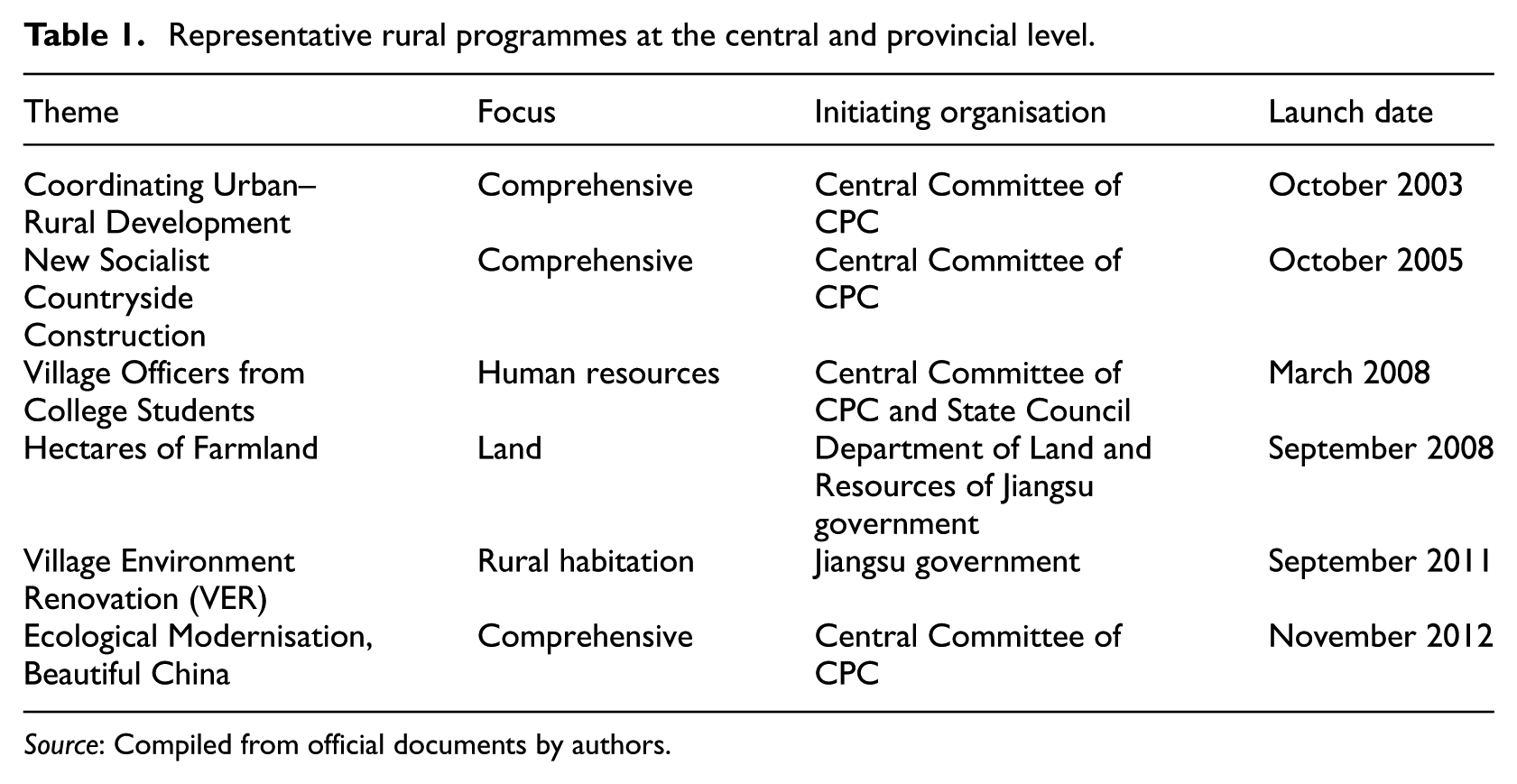
Source: Compiled from official documents by authors.
A rural programme consists of various specific projects. Those projects involve activities or engineering on the rural ground, and refer to concrete or specific operations of a programme. The ‘Village Officers from College Students’ programme is a good example. With funding support, specific projects in this talent programme formulated detailed incentives and schedules to improve the talent structure among village cadres (Table 1). However, it is hard to identify concrete projects in some programmes which are comprehensive in nature. With broad guidelines for local practices, those programmes can be interpreted as strategic stimulus from the central government. One example is the programme of ‘New Socialist Countryside Construction’ (NSCC). Ahlers and Schubert (2009: 57) commented that it is ‘an intentionally vague but holistic policy framework initiated by the central government to be adapted to local conditions’. Even in a comprehensive programme, the strategy of the state can only be projected upon the rural ground through the implementation and consolidation of specific projects.
Programmes and foundations in history
The crisis produced by China’s fiscal restructuring in the 1990s and 2000s motivated the establishment of the programme to funding rural development and governmental intervention in rural areas. The ‘new approach’ is not actually new, but a re-interpretation of the legacies hailed from early years of the People’s Republic. Today’s programmes in the countryside can find their forerunners in the Maoist era, which were called campaigns (yundong) then. A set of campaigns were initiated after 1949. As in the ‘Great Leap Forward’ of the 1950s or ‘Learning from Dazhai in Agriculture’ of the 1960s–1970s, the campaign mode was used nationwide for economic construction. Villages then should develop collective economies in the form of ‘people’s communes’. In addition to the mass campaign, some grand development projects in the planned economy also exhibited a key feature of China’s political regime. The entire bureaucracy was often mobilised to achieve visible progress within a short time. In these ways, scale worked as the state’s scaffolding of persuasion – controlling the movement of fiscal resources or the human capital ‘up’ and ‘down’ the administrative hierarchy.
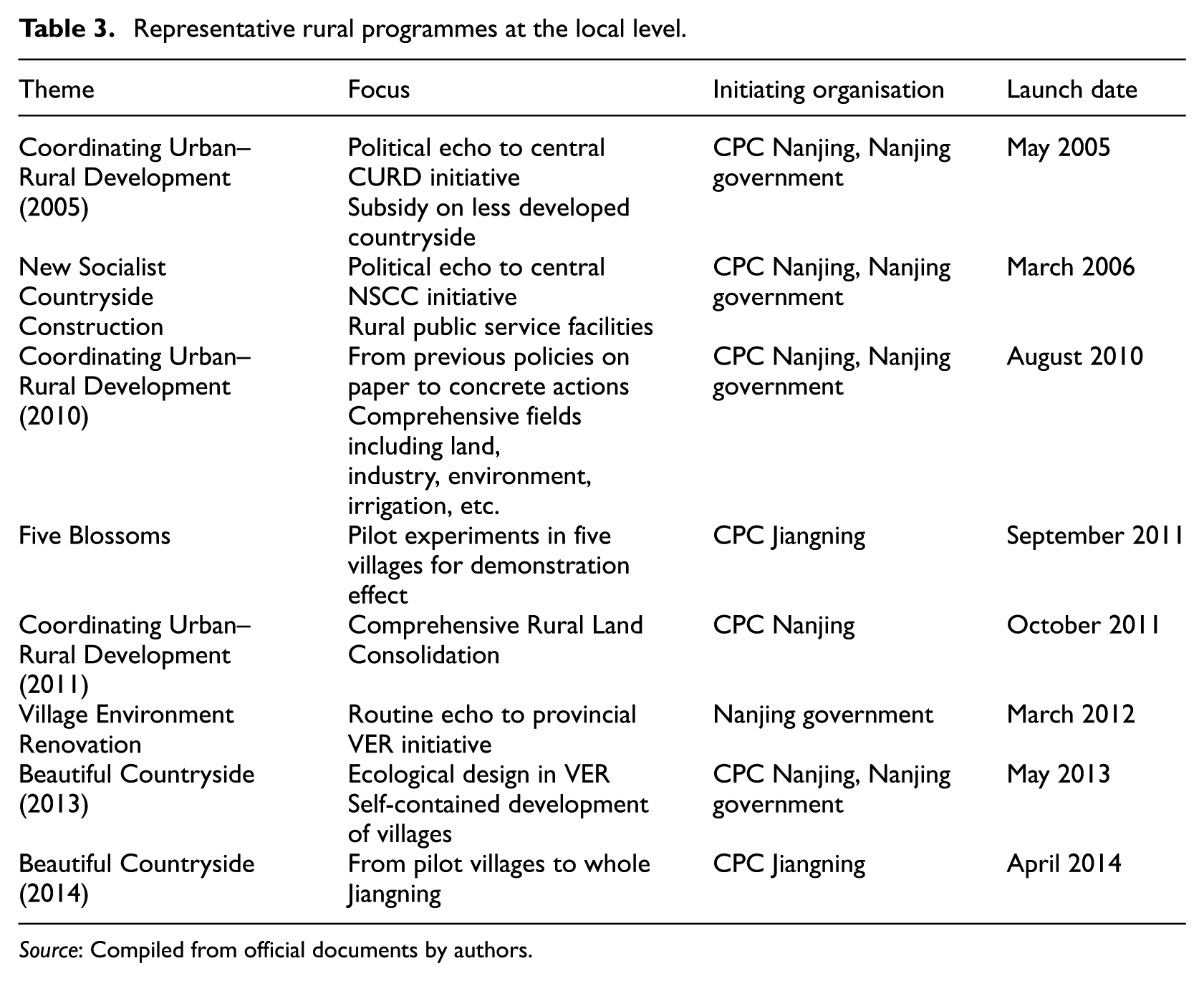
In the post-reform period, the tactics of ‘jumping scales’ were often employed by the authority to realise polarised growth in some regions. Programme-based initiatives such as the designation of special economic zones and coastal open cities were of major importance in stimulating urban and regional growth. In the investigation of rural programmes, scholars also highlighted this historical connection (Looney, 2015). Perry (2011) argued that the NSCC programme should be understood as a ‘managed campaign’ because the programme powerfully combined technocratic pragmatism with Mao-era campaign tactics, including thousands of propaganda teams and lecturing teams. Carefully avoiding the wording of ‘campaign’, contemporary programmes deploy less political terms such as actions (xingdong, table 3) to highlight the pragmatic aspects of the programmes.
Implementing rural programmes: Local response to policy directives
Implementation of the rural programmes encompasses ‘politics of scale’ and ‘production of scale’. The ‘politics of scale’ involve distinct state actors and institutions, influencing goals, policies and ideologies in scale contexts. In contrast, ‘production of scale’ prioritises thinking about scale through spatial processes that transcend and rework scale, rather than via a skeletal framework of ascending levels of state territory (Cartier, 2005). As Swyngedouw (1997: 169) explains, ‘the theoretical and political priority, therefore, never resides in a particular geographical scale, but rather in the process through which particular scales become (re)constituted’.
Conventionally, the division of labour between governments at different levels follows a top-down manner: higher-level governments initiate new programmes, and the local governments allocate fund to town-level governments for implementation. However, this tangible process cannot explain the whole picture. The more fundamental mechanism can be revealed by a review of the programme rationale which explains why the programmes expand at the local and why more stakeholders are involved in the programme campaign (Figure 2). The first rationale involves bottom-up action from the local government which seeks legitimacy from the higher level government for their programmes. The legitimacy then helps to justify the mobilisation process, in which town-level governments and non-government stakeholders, mainly enterprises, peasants and social organisations, are also mobilised to participate in programmes.

Process and rationales of local response.
Intergovernmental and social mobilisation
The intergovernmental relations in the programmes illustrate the ‘politics of scale’ where the operating strategies of existing state apparatus exist. For successful programme implementation, resource mobilisation is of vital importance in the programme campaign similar to many other social movements (McCarthy and Zald, 1977). This mobilisation process is premised on the legitimacy of programmes. To maximise the programme effect, more manpower, material resources, and funds need to be mobilised to implement the programme. Apart from the governments, peasants, private enterprises and social organisations are also mobilised to contribute to the programmes.
Through co-financing (Lin and Wong, 2012), the programmes are embedded with a mechanism of intergovernmental mobilisation. There is an aspect of neo-liberalisation here (Harvey, 2007). Analogous to the tried and true strategy that is consistently used by US federal government (Jin et al., 2005), the province and the centre in China have provided incentive financing schemes, which encourage local governments to provide ‘matching funds’ for rural development. In the provincial VER programme, Jiangsu government required local governments to provide a certain amount of ‘matching funds’ as an essential condition to apply for start-up fund. In the 2010 actual budget of this programme, the higher-level governments spent 158 million yuan on the countryside of South Jiangsu while the local governments invested 273 million yuan, nearly twice that of the former (Table 2). In this case, the fund from the higher-level governments acts as the ‘bait’ to lure investment from low-level governments.
The funding sources from multi-level governments in the VER programme.
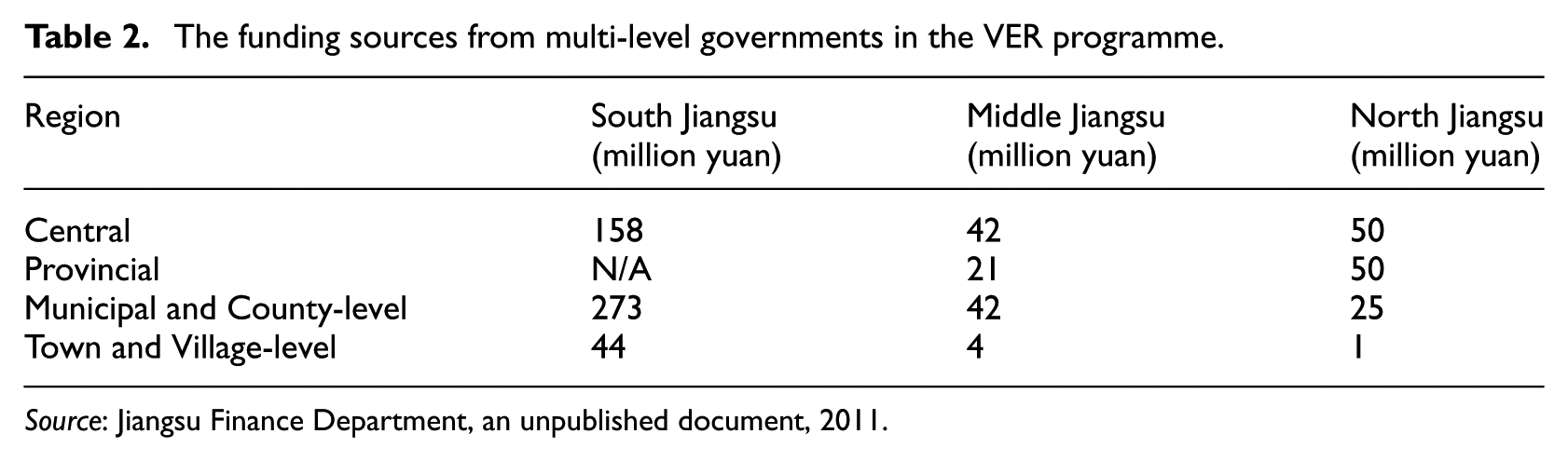
Source: Jiangsu Finance Department, an unpublished document, 2011.
The programmes can realise ‘self-expansion’ and penetrate into the rural society through social mobilisation (Chen, 2013). Private and voluntary sectors are invited to participate in these programmes while there are no significant voluntary actions by the villagers. As one village cadre told us, the initial programme from Nanjing government was an important ‘wind indicator’ for local capital. The ‘attention of higher level government’ ensured an advantage in business promotion and good cooperation attitude of the peasants. The peasants tended to value the short-term performance of a programme. Thus, the initial success was very important to mobilise the peasants to participate in these programmes. Also, the development vision stated in the rural planning was a significant tool to stimulate peasants’ enthusiasm in programme participation (interview with a village cadre in Jiangning, May 2014). This view is also shared by peasants to some extent. When asked the same question in the villager interviews, peasants often claimed that they welcomed changes in the villages (interviews with villagers in Jiangning, July 2014). Many villagers were hired by the agencies of the state-led programmes. However, as peasants were not well organised, grassroots initiatives seldom occurred especially among the youngsters. Seeking quick success and instant benefits, the state-led programmes still exclude the villagers to some extent, even though villager participation is repeatedly claimed in propaganda.
Reconstructing the state apparatus
The reorganisation of the state agency then exemplifies ‘production of scale’ in the programme evolution. To mould a programme-tailored regime, temporary agencies have been established to liaise with different governments and CPC departments. They coordinate the programmes initiated by different bureaus and commissions (Figure 3), and the statecraft gains greatly in governing the rural issues.
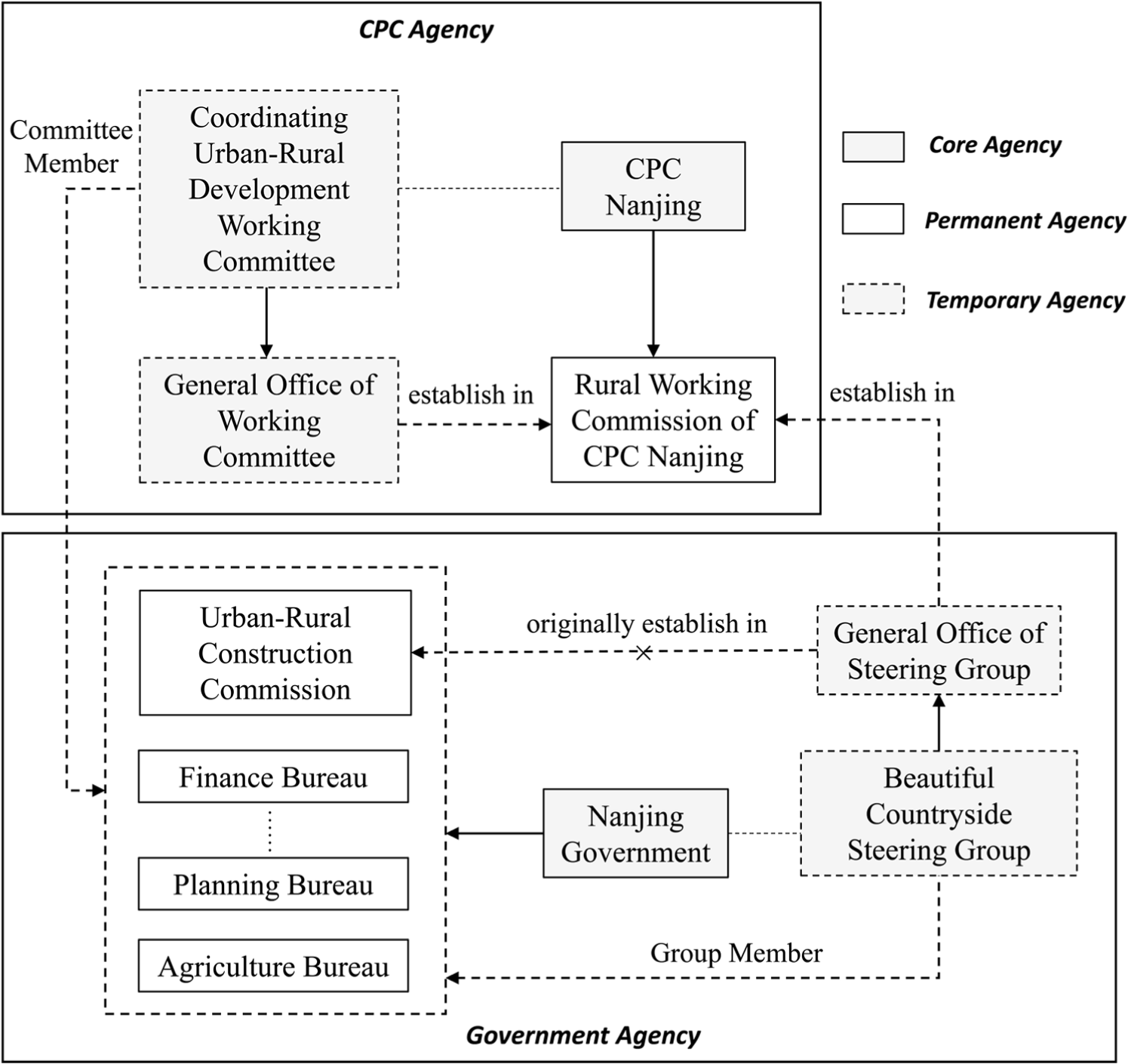
Integrating temporary agencies into permanent agencies.
As Figure 3 shows, the permanent agencies of Nanjing have two systems – CPC and government system. Given that the administration in China follows the state-party system, CPC and government agencies overlap in some domains with different emphases. The CPC agencies are more focused on policy-making and affair-coordination. They often have a broad administrative domain, corresponding to more than one department in the government system. Owing to the significance of the rural issues for the party, CPC Nanjing has a specific working commission, named ‘Rural Working Commission of CPC Nanjing’, to coordinate ‘three rural issues’. Its mission is mainly to optimise production relations in the countryside. In contrast, the government agencies focus on executive works under the guidance of the party. For example, the agriculture bureau in the government system is committed to promoting rural productivity. Other government agencies concerning rural issues include commissions/bureaus of urban–rural construction, finance, planning, land resources, etc.
To coordinate rural programmes, two temporary agencies, namely ‘Coordinating Urban–Rural Development Working Committee’ (hereafter Working Committee) and ‘Beautiful Countryside Steering Group’ (hereafter Steering Group), were established in the CPC and government system, respectively (Figure 3). From the wording of ‘working committee (gongzuo weiyuanhui)’ and ‘steering group (lingdao xiaozu)’, we can differentiate their positions from the very beginning.
The Working Committee was set up according to the document of CURD action outline in 2010. As the top authority for directing and coordinating rural works, the configuration of the Working Committee ensures its leading position. It is co-chaired by the party secretary and mayor of Nanjing. Directors of relevant departments of CPC and city government are committee members. Its general office was set up in the Rural Working Commission of CPC Nanjing. The general office functions as the standing body of the committee in charge of routine business. Its major tasks include the coordination of programmes from multiple channels (e.g. summarising the applications from various departments, allocating funds to operators, and avoiding double funding), investigation and data collection, implementation evaluation, document drafting, etc. (interview with an official in Rural Working Commission of CPC Nanjing, July 2014). The Working Committee mobilises the state capacity that is dispersed at different levels and departments within the governmental sector for maximum effect.
The relocation of the general office of Steering Group offers us an interesting case on the reconstruction of state apparatus. In this process, the capacity as well as the flexibility of the state apparatus is expanded. It was in March 2012, before the 18th CPC Congress, when the discourse of ‘Beautiful Countryside’ first appeared in the official document of Nanjing (Table 3). The document was a routine response to the provincial VER programme, but using a discourse of ‘Beautiful Countryside’ by Nanjing. Because VER was mainly initiated by the provincial department of housing and urban–rural development, the general office of Steering Group was set up and attached to the corresponding commission of Nanjing government, i.e. Nanjing Municipal Commission of Housing and Urban–Rural Construction.
Representative rural programmes at the local level.
Source: Compiled from official documents by authors.
However, after the launch of the programme campaign under the theme of ‘Beautiful Countryside’ of 18th CPC Congress, there were many coordinating affairs that could not be handled by the Nanjing Municipal Commission of Housing and Urban–Rural Construction. The general office of Steering Group was then relocated to the rural working commission of CPC Nanjing. This relocation means that Steering Group becomes a unit of the powerful party system, like the Working Committee. Thus, the general office of Steering Group becomes more powerful to coordinate various departments backed by the party system and party leaders.
State rescaling through programmes: Local appropriation of resources
National-based modes of production have been disarticulating into multi-scalar arenas and toward complex reconstitution of state activity at various scales (MacLeod and Goodwin, 1999). Thus the state, while clearly national, is not specific to one scale. Compared with the Western literature, post-reform China studies on rescaling largely concentrated on the dynamics at and below the state level, among which the theory has been examined with the cases of regional planning and coordination (Chen et al., 2014; Li et al., 2014; Smart and Lin, 2007), administrative reconstruction (Li and Wu, 2014; Luo et al., 2014), and city marketing strategy (Luo et al., 2013). The process of local appropriation in programme evolution reveals such kind of state rescaling. This local appropriation emerges in at least three ways, the first is rhetorical legitimisation. Local governments use the new programme as a slogan to re-brand or expand activities they are already undertaking.
Rhetorical legitimisation
The process of rhetorical legitimisation plays a catalytic role in the programme evolution. To expand the influence of their pioneering works, Nanjing and Jiangning purposely followed the central discourse to seize the priority for their programmes. From the stance of local governments, the higher level discourse provides a rhetoric channel to rescale their rural programme practice, namely scaling-up process.
According to respective launching dates, a time series analysis of the programmes can be made by combining Tables 1 and 3 to observe the discourse process. Generally speaking, the programmes from Nanjing and Jiangning pay more attention to specific projects than those from the higher-level, but the programme density along the time axis is not regular. Before 2010, the documents issued by Nanjing were routine echoes to the central initiatives of CURD and NSCC. However, since August 2010 when the document entitled ‘Action outline on speeding up coordinated development and building new Nanjing of urban–rural integrated development’ was released, the rural programmes in Nanjing have entered a booming phase. Kicked off by this milestone document, rural programmes have transformed from previous policies on paper to concrete actions with an explicit roadmap.
Another important milestone was the 18th CPC Congress in November 2012. In this power handover conference, the Central Committee released the ideological slogan of ‘Ecological Modernization’ and ‘Beautiful China’. The keynote report articulated that the overall layout of socialism with Chinese characteristics should be a pattern of ‘Five in One’, including the construction of economy, politics, culture, society and the newly added ecology. As a local response, the countryside is well placed to practice the central ideology, especially for those coastal provinces with intense man-land relation. Seizing the buzzword ‘beautiful,’ seemingly conferred by the central and irresistible to the mass, Nanjing and Jiangning tactfully advertised their pioneer work with the discourse of ‘Beautiful Countryside’. The proactive echo definitely scaled up local practices, and was helpful in seeking legitimacy and facilitating propaganda.
Legitimisation can be deemed as the aim of rhetorical rescaling. Local governments have become more and more entrepreneurial by initiating various development programmes in post-reform China (Oi, 1992; Shen, 2007). But the local state entrepreneurship needs the blessing of the higher level governments. Legitimacy here can be understood as the acceptance and recognition by the higher level government of a programme initiated by a low-level government. In some cases of the central and western regions of China, it is contended that a programmatic campaign launched by the central may result in chaotic local practices (Li, 2007). Nevertheless, the circumstance in Nanjing is just on the contrary. Nanjing has many bottom-up programmes that need to be endorsed by the central government. The central possesses the ultimate power (Shue, 2004). The local government can gain the legitimacy by positively echoing the strategic slogans or programmes of the central. Only when the local government gets the ‘blessing’, can it realise its ambitious plan and programmes to develop the countryside.
We can examine the legitimation process in detail from the story told by an official. During an inspecting visit to rural Jiangning on 20 November 2012, just one week after the closing of 18th CPC Congress, the mayor of Nanjing came up with the idea ‘to build Jiangning into a demonstration area of beautiful China, beautiful countryside’. He wrote it down on a piece of paper right away and handed over to his Jiangning subordinates (interview with an official in Planning Bureau of Nanjing, July 2014). In this story, the local leader keenly grasped the ideological signal released in the party congress. ‘Beautiful China’, which has become a buzzword nowadays, emphasises ecological aspect in local development. With this vogue word, the pioneer practices in Jiangning got sufficient legitimacy to mobilise the grassroots.
Path-dependent implementation
Implementation of rural programmes is path dependent. Areas that have received programme resources in the past are likely to receive resources in the future. Local governments seek to establish demonstration or model villages that they can show to higher level officials as proof of their success, thereby improving their chances of promotion. With the blessing of legitimacy, Jiangning and Nanjing employ the measure of programme packaging to amplify its impact. This process shows that the local government is not just a deliverer, receiving and passing on the fiscal packages of central programmes; but more like a packer, embedding ongoing rural works into programmes to realise its own ambition (She and Chen, 2011). Thus the programme investment in the countryside is not confined to a single programme, but a chain of programmes (Xun and Bao, 2007).
A scale perspective does not assume that processes necessarily move up and down a territorial hierarchy, but recognises that social processes may move unevenly across a space and sometimes jump scales. The model villages exemplify ‘jumping scale’ through uneven programme implementation.
Since 2011 when Shitang village in Jiangning was first selected as the experimental site of rural eco-tourism, its title has evolved from ‘Five Blossoms’ to ‘Featured Model Village of Beautiful Countryside’. As soon as Jiangning was asked to join a specific programme, the district government always gave the priority to Shitang village to join the new programme. With the additional input of non-governmental capital, the simulacra making of ‘Shitang Home’ attracted investment of more than 100 million yuan in the past three years (interview with an official in Planning Bureau of Jiangning, July 2014). The infrastructure in the village was improved significantly. Farmhouse inns and restaurants were opened up, a new sewerage system was built, cottage façades were painted with a uniform local style, and the deserted ponds around the dwellings were cleaned and dredged. Those programmes were organised by different departments but concentrated in the same village. Benefiting from these programmes, Shitang village gains self-sufficiency in the rural economy led by eco-tourism.
Legitimising land expropriation
Local governments use the programmes to capture resources. Over the past ten years, central and provincial governments have sought to constrain local governments from expropriating rural land with rigorous farmland protection policy. Since the central government only controls the accumulative total of the urban and rural built-up areas, the local governments resort to the countryside within their municipal territories to exploit more land quota for urban growth. Indeed the programmes can be used to evade such restrictions. With the intention to achieve fund balance, local governments use the programmes to legitimise land expropriation in rural areas. The financial return from such land-related programmes supports the local government to initiate additional programmes. But it may have a negative effect on villagers’ right in land properties.
With the progress of the CURD programme in Nanjing, the rural works of Nanjing in 2012 focused on a sub-programme called ‘Comprehensive Rural Land Consolidation’. This programme was originally designated to release construction land and promote large-scale cultivation in the countryside (Huang et al., 2014). Packaged as a CURD programme, the legitimacy of land expropriation from the villages was justified. It was implemented more easily, saving a lot of social costs for Jiangning government. Owing to the introduction of the ‘increasing versus decreasing balance’ policy, the land quota saved from the programme could be transferred to Nanjing city and sold in the land market (Long et al., 2012; Tian et al., 2017). According to an internal agreement signed by the government heads of Jiangning and Nanjing, 1 the latter would allocate 100 million yuan to each pilot sub-district in Jiangning for the land consolidation programme. However, there was a condition that Jiangning government should sell the saved land quota to Nanjing government at the price of 500 thousand yuan per mu. 2 With the net revenue generated by the land price gap, Nanjing government promised to subsidise the rural programmes of remaining sub-districts in a rolling way.
The evaluation of the new state-led pattern: A new mode of rural governance?
Using the programme development as the narrative thread, the previous sections urravelled the intergovernmental interactions from programme initiation to implementation. Beyond the framework within the governmental sector, it is useful to put the state intervention in a broad governance system and consider the implication of the new state-led pattern for rural governance.
In the original definition, the concept of governance is different from government. It is often assumed that state intervention should be reduced to the minimum to ensure enough room for citizen involvement in governance (Rhodes, 1996; Swyngedouw, 2005). In the classic governance theory, the law of waxing and waning applies between the governmental and non-governmental sectors. Thus, it is not surprising to see very few governance studies on the traditional structures among governments themselves (Pemberton and Goodwin, 2010).
Nevertheless, the hypothesis of the classic theory is based on a relatively advanced society, where modern governance structure and strong governance capacity exist. As shown by increasing cross-national evidences, even the proponents of reduced state intervention recognised that effective state capacity was needed for successful implementation of good governance (Fox, 1995). In this way, this paper attempts to interpret the governance term as an evolving process, rather than a static standard stipulating the power proportions of different groups. Based on the evidence in Jiangning, we highlight the state role in the initial stage of moving toward ‘good governance’ of the countryside.
The mighty government in China shows paternalism on the rural issues, but it does not mean that all the problems can be solved by the state. With a dominant position in governing the countryside, the state expands and often spares no effort in the cost-insensitive investments. Such a short-term programme campaign does not ensure a sustainable development of the countryside. Thus to a certain extent, the state-led programmes have not cured the inherent weakness of the rural governance in China. Once the state-led programmes without cost consideration are terminated, the sustainable public goods provision is in question.
Considering the rural governance driven by programmes, it should be admitted that the self-organisation power of the peasants vis-à-vis that of the state is still limited. Some features of Chinese policy process and political system would undermine the ultimate success of the programme model. For grand development programmes, the pressure to deliver results drives local officials to exert maximum control over the policy process. In the context of campaigns, participation may be allowed or even encouraged, but is almost always controlled (Looney, 2015). Confronted with a strong state, many villagers agree to change and look to programme agents for help negotiating the best deal possible. In the case of Jiangning, we can observe the induced but limited participation of villagers. As the programme campaign intensifies, however, the space for negotiation becomes smaller. The dynamics are reinforced by the weak position of many rural organisations, which often serve as instruments of the state rather than as representatives of villagers. Perhaps if the government had involved more self-governed rural organisations and social activists, the outcomes of the programmes would have turned out differently.
Peasant-driven change is certainly possible in China. However, this study suggests that it is not so optimistic for a greater role of peasants in large-scale development campaigns driven by state-led programmes. Good governance in the countryside calls for a reposition of the relationship between peasants and government in programmes. Taiwan’s achievements in the realm of grassroots collectives have attracted the greatest admiration from observers (Perry, 2011: 48–49). The farmer associations (nonghui), first established under Japanese colonialism but systematised in the 1970s, are praised as a model to bridge farmers and the government. The associations are lauded for providing a channel for the articulation of peasant interests as well as for promoting official policies, agriculture techniques, and the like (Wu and Yuan, 2006). In some pioneer regions of mainland China, the ongoing shareholding cooperative reform reifies rural land property rights to the benefits of individual members in a collective (Po, 2011; Zhu and Guo, 2015). State leadership is but one form of rural governance among many. Recent work on the ‘New Rural Reconstruction’ movement in Anhui and Hubei shows a more positive role of the non-governmental and self-organised associations in micro-level community building (Hale, 2013; Thøgersen, 2009). To empower the grassroots engagement, institutional reforms (e.g. land tenure system reform) in the governmental sector, as well as the reconstruction of the traditional rural society, are needed.
Conclusions
The state administration of rural China experienced a hollowing-out process after the tax reform. The governments were trapped in a status with no effective tools to steer the rural development. The state-led rural programmes have changed the embarrassing situation successfully in some regions. Based on the empirical study of Jiangning, this paper shows how the state role in governing the countryside has been strengthened significantly through the rural programmes and how local city/district governments interact with the higher-level governments in programme implementation. While the close intergovernmental interaction is the particular focus of the study, this paper also sheds light on the contribution of the state-led programme to the rural governance theory. The following are some preliminary findings.
First, a new pattern of state governing is in the making in the countryside. In the state-centred society of China, the state-led programmes are contributing to rebuild the rural governance in a unique way. Facing the rural governance crisis and the consensus on ‘rural issues matter’, rural programmes are initiated by governments to support the countryside with earmarked funds. Through those rural programmes, the state apparatus reconstructs and expands; central government successfully penetrates into the countryside and regains the leading role in rural development and governance. Furthermore, as an exogenous drive that aims to vitalise the hollowing countryside, the self-organisation power of the peasants vis-à-vis that of the state is still limited. Generally speaking, rural programmes have brought significant transformation in the countryside and also triggered new governance question.
Second, rural development driven by programmes encompasses interesting dynamics of state rescaling. As revealed in the literature on policy implementation in China (Lieberthal and Oksenberg, 1988), local governments adapt the programmes of the province and the centre to achieve their own objectives. Compared with the higher-level governments who emphasise politics and stability of the countryside, local governments show more utilitarianism and to some degree change the policy directives of the province and the centre. They pay more attention to the demonstrating effects of some pilot villages and the growth of local economies. In this study, it relates back to the problem of higher-level incentives, and drives the nature of appropriation in localities. To be specific, higher-level governments initiate and lead rural programmes. Prioritising the rural issues, they invest a large amount of resources in programme campaign and funding, and have the final say on the legitimacy of programmes. However, higher-level governments only provide broad guidelines and limited seed funds for concrete programmes. The local governments possess discretionary power in the programme campaign. They successfully harness the discourse and restructure the state apparatus for programme implementation.
Third, there is also an aspect of neoliberalisation in the intergovernmental interactions through co-financing programmes – the higher level governments provide incentive financing schemes, which encourage local governments to provide matching funds for rural development. In the case study, we observe that the central and provincial layers of government seek to use their recentralised fiscal power to mobilise lower level action on rural development and the lower levels of government seek to use the new development programmes to recapture control over centrally controlled or regulated resources.
But this paper also has some limitations. The study only investigates the countryside in coastal China where local financial resource is strong, and focuses on the model villages where programme islands have emerged. The new governing pattern may be beneficial to peasants and rural development in the cases of this study, but not all cases. To obtain a full picture of the programme-driven pattern and its impact on rural governance, the geographical variation should be taken into consideration. More case studies should be conducted to accumulate our understanding of rural governance changes caused by rural programmes.
Footnotes
Acknowledgements
The research is supported by the Research Centre for Urban and Regional Development, Hong Kong Institute of Asia-Pacific Studies, The Chinese University of Hong Kong, and the Research Centre for Regional Planning, Nanjing University. The authors thank Professor John Logan, Professor Yuan Ren, Professor Jingxiang Zhang, Dr Ye Liu, Dr Xiaofan Luan, and three anonymous referees for their valuable comments on earlier versions of this paper. A draft version of this paper was presented at the 2015 Conference of Urban China Research Network (UCRN) in Brown University, and was rewarded ‘Best Paper Prize’ by the Steering Committee of the UCRN.
Funding
The research is supported by National Natural Science Foundation of China (41329001 & 51578276) and the Fundamental Research Funds for the Central Universities (090214380013).