







Abstract
Cities have begun to develop a more ‘place-based approach’ to food policy that emphasises translocal alliances. To understand how such alliances develop distinct capacities to act, in this paper we integrate key theoretical contributions from governance networks, social movements and translocal assemblages. Our analysis focuses on the activities and tools used by the UK’s Sustainable Food Cities Network to assemble local experiences, create common imaginaries and perform collective action. Through these processes, we argue, the network creates cross-scalar, collective and distributive agencies that are modifying incumbent governance dynamics. As we conclude, this raises the need to further explore how translocal configurations can develop forms of power that contest, break or reassemble the relations in the food system that are actively preventing the emergence of more sustainable foodscapes.
Introduction
In recent years, cities have become the beacons of food policy innovation. As scholars have documented, the ongoing food crisis has prompted pioneering city governments to distance themselves from the atrophy of a food governance 1 context narrowly focused on market-based solutions and the intensification of production (Morgan, 2015). To address the context-dependent nature of food insecurity, cities are developing a more ‘place-based approach’ to food policy that is expanding the productive and consumptive foodscape beyond their administrative boundaries (Sonnino, 2016).
Researchers have focused on the early implementation stages of urban food policies (Mendes, 2008; Moragues-Faus and Morgan, 2015), paying special attention to the novelty of the governance mechanisms (especially multi-actor partnerships such as food policy councils) that have been deployed (Blay-Palmer, 2009). Emerging evidence also shows that ‘the re-ordering of food rights, governance and assets in one city is leading to important cross-overs of learning and reflexivity in other cities’ (Sonnino et al., 2016: 9), as demonstrated by the creation of translocal food networks (such as the Milan Urban Food Policy Pact) that aim to engender sustainable transformations in the global food system. 2 As Blay-Palmer et al. (2016: 38) argue, ‘by convening around good practices, communities can reinforce a global System of Sustainable Food Systems that: enhances a sustainable flow of food, knowledge and people; develops the capacity to activate sustainable local food systems in a more collective manner; and, potentially, resists the disaggregating impacts of neoliberalism’.
As yet, however, no empirical attention has been devoted to this translocal dimension of urban food governance. How do localised contestations expand from place to place? Do translocal initiatives have the capacity to reconfigure the food governance context? If so, how, and with what potential wider implications for the urban foodscape?
Research design
To begin to answer these questions and enhance understanding of the transformative potential of translocalism in the food system, we focus on the Sustainable Food Cities Network (SFCN) in the UK, one of the earl-iest initiatives emerged to connect cities that are developing food strategies and associated partnerships to govern them. In the light of the paucity of empirical data on translocal urban food networks, our case study should be considered as exploratory in nature – that is, as aiming to build the foundations for future research (Yin, 2009).
Our conceptual framework, which, as we will explain, integrates contributions from governance networks, social movements and assemblage theories, helped us to utilise agency as a means to understand how the SFCN as a specific socio-spatial formation has evolved, how its composites of place-based social movements build alliances and interact, and whether this is having broader implications for the relationships between actors and activities within the food system – i.e. for its governance. How does a translocal initiative create and maintain collective, distributed and cross-scalar agencies? What are the key gathering, coherence and dispersion dynamics at play? How do the different capacities to act amongst the components of a translocal network affect its multiple agencies?
Our methodology was based on a two-step process. First, we collected and analysed secondary data produced at the network level – including the SFCN website, their newsletter, webinars and internal documents. These data were instrumental to understand the nature of the network, 3 refine the research questions and design semi-structured interviews with the three organisations that initiated and coordinate the SFCN. These interviews focused on the origins and evolution of the network, its functioning (activities, organisational features, resource mobilisation and discourses) and resilience, and its relevance in the national and international context. Second, we collected and analysed secondary data (including internal documents, websites and evaluation reports) from five cities (Cardiff, Bournemouth and Poole, Newcastle, Liverpool and Stockport) that have appointed SFCN officers. The analysis of these data informed the design of semi-structured interviews with the food partnership coordinators of those five cities, which focused on the origins and evolution of each partnership, the challenges and opportunities they are facing and their relationships with the network. Data collected through these interviews were complemented with notes taken during regular interactions with network members, including participation in the meetings of the Cardiff partnership and in seven SFCN events that took place between January 2015 and May 2016 in different UK locations. Informal interviews conducted during these events uncovered the politics at play within the network – that is, tensions and emerging conflicts or alliances between different actors.
Using an inductive approach, we built on the conceptual framework that we developed after the literature review (as described below) to open-code our data around the themes of knowledge and resource sharing, collective identity and action, and the tools and strategies utilised by cities to establish linkages across sectors and scales. This coding process helped us to characterise the different types of agencies deployed by the SFCN.
Governance networks, social movements and translocal assemblages
Food scholars have been actively investigating the development of networks, focusing in particular on the emergence of ‘alternative’ initiatives that aim to redefine the relationships between producers and consumers around trust, the redistribution of value and the establishment of new forms of political association (see Goodman et al., 2012, for a review). Most of this literature has confined its focus to individual place-based case studies; few efforts have been made to progress theoretically informed and comparative analyses (Tregear, 2011) that uncover the processes through which composites of actors and places come together and engage with specific cross-scale problems.
To advance research in this area, we draw on three main bodies of work: governance networks, social movements and translocal assemblages. Through their shared focus on the diversity of actors’ interactions and the role of different multi-scalar governance configurations in addressing social-ecological challenges, these literatures can provide the basis for a new conceptual and analytical framework that captures the potential of different types of articulations (governance networks), the politics of networking at play (social movements) and the temporality and spatiality of socio-material practices (assemblages) that shape governance dynamics.
Emerging from public administration debates, organisation theory and political theory, the study of governance networks gained prominence in the 1990s, when scholars began to investigate non-hierarchical forms of governance based on the interaction between a multitude of public and private actors (Klijn and Koppenjan, 2000; Rhodes, 1997). The novelty in the field was represented by emerging trends of uptake and implementation by public institutions of pluricentric modes of coordination, which were seen as an effective and legitimate mechanism of governance (see, for example, Coen and Thatcher, 2008). The limitation of the literature produced at the time was a fairly narrow focus on relatively stable horizontal articulations of interdependent but operationally autonomous actors who interact through negotiations and contribute to the creation of a sense of public purpose (Sørensen and Torfing, 2007). As Blanco (2015: 124) explains, a key question in the network governance literature is ‘to what extent the shift from (hierarchical) government to (collaborative) governance entails a more pluralistic and democratic style of government or, on the contrary, provokes an increasing concentration of power and weakens democracy’.
The first perspective, encapsulated in the Differentiated Polity Model (Bevir and Rhodes, 2003), recognises the potential for democratic renewal offered by governance networks that are properly managed or meta-governed – that is, networks in which the state plays a steering role by setting rules, shaping narratives and distributing resources (Jessop, 2003). As a manager, the state is responsible for the democratic anchorage of networks (Blanco, 2015) – even though, as we discuss below, these can also be meta-governed by non-state actors. The steering role of meta-governors entails: (1) setting the rules of the game; (2) shaping discourses/narratives/identities; and/or (3) distributing resources (Jessop, 2003). This literature identifies numerous strategies for successful network management, such as generating trust, shaping interactions and changing the institutional rules of established networks (Sørensen and Torfing, 2007).
A positive approach to multi-stakeholder partnerships permeates much of the food governance literature (Moragues-Faus et al., 2017). For example, Clayton et al. (2015)’s analysis of 12 US food policy councils shows that credited partnerships between businesses, civil society organisations and government representatives are crucial to increase the visibility and credibility of policy goals, connect them to key policy inputs (e.g. local food communities’ knowledge and priorities) and obtain stakeholders’ buy-in for policy initiatives.
Some critics have expressed concerns about the possibility that urban networks ‘degenerate into conventional governance spaces, characterised by elites excluding needs and interpretations of those not readily accessible to these spaces’ (Moragues-Faus and Morgan, 2015: 1569). Such critical perspectives point to the persistence of power asymmetries within networks and to the co-optation of civil society organisations into neoliberal rationalities that weaken citizen empowerment and democracy (Davies, 2012; Swyngedouw, 2005).
Compared with governance networks debates, the social movements literature – and associated work on contentious politics and spaces of resistance – takes a more pluralistic point of departure. According to Leitner et al. (2008: 157), ‘social movement’ refers to ‘concerted, counter-hegemonic social and political action, in which differently positioned participants come together to challenge dominant systems of authority, in order to promote and enact alternative imaginaries’. This concerted action facilitates the establishment of political alliances that can re-shape governance dynamics, as illustrated by Barthel et al. (2015), who document how community gardening in Stockholm has modified urban food governance by fostering new values among neighbours that ultimately led them to challenge existing land regulations.
Central to the study of social movements is the investigation of multi-scalar and scale-jumping strategies that such movements adopt to expand their power while reaffirming their local particularities (see, for example, Escobar, 2001). Here, scale becomes critical: state institutions (local, regional, national, international) are indeed characterised by scalar spatiality, and social movements tend to develop multi-scalar strategies and scale frames to decide what problems should be tackled and at which scale (Leitner et al., 2008).
While our study is not specifically about social movements, this literature is relevant to uncover the politics of networking, which is key to understanding the mobilisation of a range of actors. For example, Cities for Climate Protection, a study of transnational environmental governance, shows how network practices are intimately connected with the process of re-scaling the state – that is, how political authority is constructed, contested and enacted through particular territories of governance (Bulkeley, 2005). In this context, networks constitute vehicles for knowledge and resource sharing; they build common identities and they construct alternative imaginaries (Castells, 2013; Leitner et al., 2008). In the food domain, alternative networks are reported to be increasingly connected (Goodman et al., 2012), constituting a new social movement (a ‘network of networks’) that emerges in response to ecological degradation and the socio-economic impacts of the industrial food system (Holt-Gimenez and Shattuck, 2011). Through a study of the food movement in Canada, for instance, Levkoe (2015) stresses the role of networking organisations in movement building. As he explains, provincial organisations act as network weavers; they develop strategic linkages between diverse place-based initiatives while supporting decentralisation and encouraging difference.
A growing body of work theorises ‘translocality’ as a tool to address socio-spatial dynamics in an increasingly mobile world of networked places (Greiner and Sakdapolrak, 2013). Several researchers have highlighted the emancipatory potential of translocality, showing how the exchange of knowledge, practices and resources across places enables social movements to reshape development pathways (Banerjee, 2011; McFarlane, 2009). Recent work on geographies of resistance, in particular, highlights the role of translocal networks in spreading localised contestations. For example, Routledge (2003: 334) illustrates how an international network of grassroots initiatives that emerged in opposition to neoliberal globalisation has forged associational politics that ‘constitute a diverse, contested coalition of place-specific social movements’. He uses the concept of ‘convergence space’ to capture the heterogeneous worlds that come together through these coalitions to articulate collective visions. Convergence spaces facilitate uneven processes of interaction and multi-scalar political action; however, they are also comprised of contested social relations, given existing power imbalances within spaces as well as the co-existence of distinct place-specific struggles and worldviews.
In studying relations among different actors and places, the concept of assemblage is gaining traction. Originally used within natural sciences, ‘assemblage’ has more recently emerged also within social sciences (see Marcus and Saka, 2006; for a critique, see Brenner et al., 2011), particularly in contemporary socio-spatial theory, where the term refers to the composition of diverse elements – human and non-human, organic and inorganic, technical and natural – into provisional socio-spatial formations (Anderson and McFarlane, 2011). Central to assemblage theory is an effort to overcome dualisms such as social–material, near–far, fixed–temporary and structure–agency, as well as the limitations associated with the politics of scale (Anderson and McFarlane, 2011; DeLanda, 2006).
The concept of assemblage emphasises three inter-related sets of processes and properties (Li, 2007; McFarlane, 2009):
Gathering, coherence and dispersion dynamics, which draw attention to the assembling and re-assembling of socio-material practices and their spatiality and temporality.
Power as multiple co-existences between groups, collectives and distributive agencies and as plurality in transformation. As Anderson et al. (2012: 180) explain, ‘[a]ssemblage thinking entails a focus not just on how agency produces resultant forms, but also on how the agency of both the assemblage and its parts can transform both the parts and the whole’, creating, at the same time, distributive and collective agencies.
Championing emergence, rather than resultant formation, to embrace the ‘heterogeneous, contingent, unstable, partial and situated’ characteristics of assemblages (Collier and Ong, 2005: 12) and blur scalar distinctions between global and local.
Along these lines, McFarlane (2009: 563) proposes ‘translocal assemblage’ as an analytical tool to study ‘composites of place-based social movements which exchange ideas, knowledge, practices, materials and resources across sites’. Translocal assemblages are not spatial categories or resultant formations but ‘signify[ing] doing, performance and events’.
To contribute to emerging debates about the nature, functioning and governance potential of translocal initiatives, in this paper we propose an analytical framework that focuses on the creation and re-creation of distinct translocal agencies by integrating some of the core features of the literatures discussed thus far (see Table 1).
Summary of the translocal governance framework.
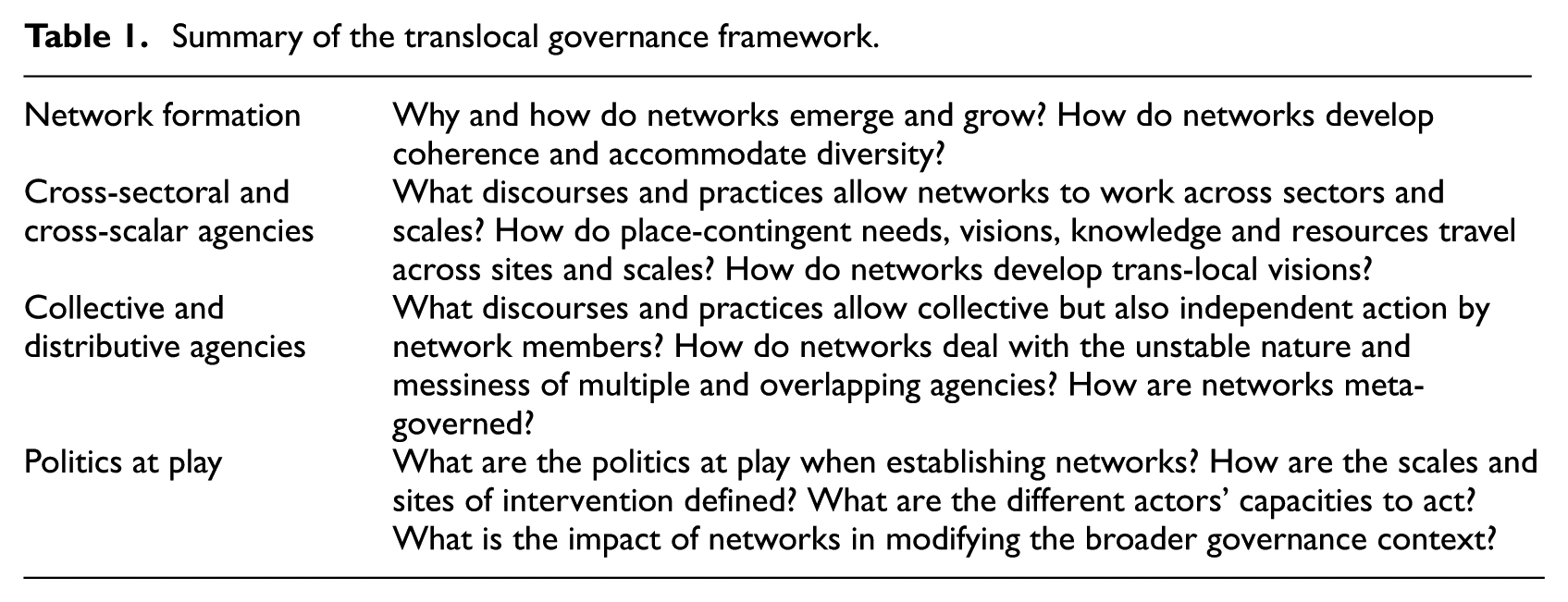
Specifically, we found the social movements literature helpful to understand network formation and its associated dynamics, given its emphasis on knowledge and resource sharing as well as on the process of developing common imaginaries. The governance network literature, on its part, provided a key prism to unpack the creation of cross-sectoral and cross-scalar agencies as a means to address complex and multilevel challenges. At this point of the analysis, we also relied on the concept of translocal assemblage 4 (and specifically its place-contingent and unstable character) to examine how collective and distributive agencies are (re-)created. Finally, the social movements’ scholarship was instrumental to recognise the politics at play in establishing networks, defining scales of intervention and giving analytical prominence to actors’ differential capacities to act. As our analysis will show, this integrated framework is very useful to uncover the processes through which cross-sectoral, cross-scalar, collective and distributive agencies are (re-)created and, more broadly, to enhance understanding of the governance potential of translocal initiatives. Following the structure of our analytical framework, in the next section we discuss how the SFCN was formed, to then analyse the different types of agencies and politics at play within this translocal initiative.
The Sustainable Food Cities Network: A composite of place-based social movements
UK cities have been pioneers in the development of urban food strategies – or ‘the process consisting of how a city envisions change in its food system, and how it strives towards this change’ (Moragues-Faus et al., 2013: 6). For example, the Brighton and Hove Food Partnership was established as early as 2003; in 2006, London launched a Food Strategy to deliver healthy and sustainable food; in 2009, Bristol’s civil society organisations developed a food strategy that became the embryo of the first UK Food Policy Council (Moragues-Faus and Morgan, 2015).
Within this context, the idea to develop a Sustainable Food Cities Network was launched in 2011 by the Soil Association, a UK-based charity campaigning for healthy, humane and sustainable food, which immediately involved two other prominent organisations in the development of the network: SUSTAIN (a national Alliance for Better Food and Farming that was already an active member of the London Food Board) and Food Matters (a not-for-profit national food advocacy organisation that founded the Brighton and Hove Food Partnership).
The motivation for creating the SFCN partly came from the recognition that, with 80% of the UK population living in cities, ‘if you could get the city to change its food culture then that would be a primary driver of fundamentally changing the food system’ (SFCN initiator). This re-scaling of food policy action was also prompted by a perceived lack of national leadership in addressing the vulnerabilities of the food system. As a representative from one of the founder organisations stated:
there was also a sort of dawning recognition that, in the absence, or the likely absence, of significant national government action, particularly in England there was a certain locus of power within cities which was essentially untapped. (SFCN initiator1)
In recalling the origins of the movement, equally important was the perceived need to overcome the thematic divides (agriculture versus health, environment versus industry, trade versus development) that usually prevent the formation of an integrated and multi-actor food governance context:
if we really wanted to see major change at a city level or an urban level you had to get institutional partners, such as local authorities, public health and others building something common and collaborating with local communities and NGOs. Without that, most of what those NGOs and community groups might be trying to achieve would probably fall over once funding was removed. (SFCN initiator1)
Using the language of governance network literature, the SFCN aimed to create cross-sectoral partnerships and multi-level networks meta-governed by three national civil society organisations. Indeed, one of the main features of the network, as our interviews highlight, is an emphasis on the need to establish, consolidate and scale up synergies among pre-existing sustainable food activities. In the early days, this triggered three interlinked processes: gathering sustainable food cities; creating coherence within the network; and accommodating diversity among the narratives and practices of its components.
Gathering sustainable food cities
The SFCN was launched at a conference held in Bristol in November 2011. At the time, the network included five multi-stakeholder food partnerships from Bristol, Plymouth, Brighton, London and Manchester. At this initial stage, some urban food partnerships (such as Brighton) were acting as ‘knowledge hubs’, receiving queries and expressions of interest from other places. According to a member of one of the founding organisations, this
meant there was something to respond to there. The goal then was to get those cities to share, exchange and learn from each other and build that sense of the network. (SFCN initiator2)
Funding for the SFCN was secured two years later, when the Esmee Fairbairn Foundation decided to support its development for three years (2013–2016) under the leadership of the Soil Association, Food Matters and SUSTAIN. During the period between the launch of the network and the allocation of funding, 15 new cities 5 joined the network.
Creating coherence and accommodating diversity within the network
The growth in numbers was due to the organic evolution of cities doing ‘sustainable food cities work’ without formal support – a fluidity that contributed to populating the notion of ‘sustainable food city’ as a heterogeneous, open and place-contingent entity that builds on the diversity, messiness and situatedness of local experiences. It is during this interim period that cities such as Cardiff and Edinburgh have created their own multi-stakeholder alliances and holistic plans, while also interacting informally with other cities through pre-existing relationships between participants.
At the second SFCN conference, held in June 2013, the network codified the ‘sustainable food city’ approach by defining two criteria for new members to join. First, applicants were required to develop an action plan that could lead to significant and measurable improvements and was underpinned by a joint vision for a healthy and sustainable food city. Second, potential members were expected to demonstrate that they had a city-wide cross-sector partnership of public agencies (health, environment, economy), businesses, NGOs and community organisations in place. These requirements aimed to create coherence within the SFCN by focusing efforts around three identified drivers of change: a holistic vision of the food system; an emphasis on multi-stakeholder participation; and a recognition of the place-based contingency of food partnerships and plans.
At a first glance, these city-wide food partnerships could be considered governance networks – that is, relatively stable horizontal articulations of public and private actors. However, in reality, many of these partnerships are constantly re-shaping in response to changing support from local agencies, the need to engage with conflicting interests of their multiple affiliates and the challenges raised by efforts to reconcile their public–private status. For example, to date, one-third of the food partnerships are led by local authority employees, while others are coordinated by a range of stakeholders – including volunteers, academics and community organisations (SFCN, 2015). As a food partnership coordinator stated, in the long-term this diversity could threaten the existence of the network:
Despite doing great work that is recognised by the city council and public health, when it comes to funding the partnership commitment is low, which might result in our disappearance. (Food Partnership Coordinator FPC1)
Exercising agency through translocal initiatives
By amalgamating a range of ‘heterogeneous, contingent, unstable, partial and situated’ (Collier and Ong, 2005: 12) place-based movements fighting for a more sustainable urban foodscape, the SFCN began to emerge as a translocal assemblage that exercises different forms of agency. At present, the SFCN convenes 47 local food partnerships operating across the UK, creating opportunities for cities to co-produce knowledge, share resources and construct collective visions. To understand how different agencies are created in the SFCN, we focus, first, on the governance of the knowledge and resources that have been activated, and, second, on the mechanisms deployed to develop a translocal vision and exercise cross-scalar agency. In the final part of our analysis, we will discuss how the SFCN seeks to distribute its capacity to act.
Creating flows of knowledge and resources
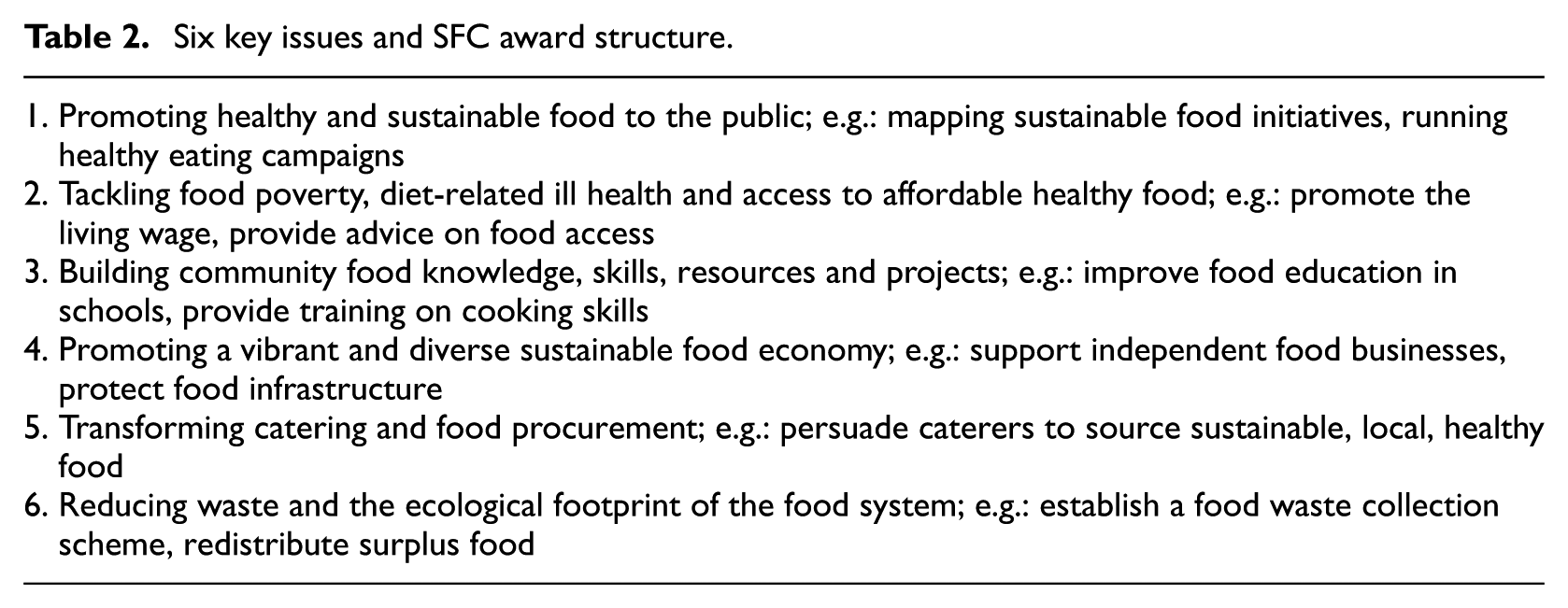
To facilitate knowledge-sharing across different cities the SFCN creates both virtual and material convergence spaces that convene the geographical dispersion and rich diversity of this translocal initiative. For example, the network’s website and its monthly newsletter are important platforms for cities that do not own the resources to showcase their work. In addition to functioning as a knowledge hub, the website conveys the idea of what a ‘sustainable food city’ is by sharing the applications by cities that have received a SFCN award, as we will describe later, and by structuring cities’ initiatives around six key issues tackled by the network (see Table 2). The process of codifying this place-based knowledge is steered by local food partnerships and the network facilitators. For example, London’s good practice guide to control hot food takeaways has been promoted by the SFCN as an example of successful strategy to address food poverty.
Six key issues and SFC award structure.
The tools utilised by the network contribute to the emergence of a collective identity by forging place-based (but not place-restricted) alignments (McFarlane, 2009) that aim to strengthen local partnerships and their reputation. As one interviewee explained:
So the chair of the Food and Drink Industry Board read the newsletter, read the bit about some food poverty statistics in it and just wrote back to me and said ‘I’ve just read your newsletter, it’s really inspirational what you’re doing. The Board has got to address this issue.’ So this stuff, it does come back. (FPC1)
Connections and relationships are also facilitated through face-to-face networking events that provide opportunities for members to share knowledge and discuss common challenges. For example, the yearly national SFCN conferences typically offer hands-on advice through workshops designed to share experiences and implement solutions to everyday challenges such as supporting sustainable business, forming partnerships or running local campaigns. More informally, the conferences are key moments to facilitate the establishment of personal relationships among actors and create flows of ‘tacit’ knowledge – that is, knowledge obtained from direct experience held in non-verbal forms. As one of the coordinators of the SFCN explained:
Fifty-six cities came to the conference, and we had similar numbers last year; and every time we get this amazing feedback like ‘is great I feel like I’m part of something bigger’, ‘this is a really significant movement for change which I’m one small part but I can keep going because I feel like I’m a part of something bigger’. (SFCN initiator3)
The three coordinating organisations rely on communication platforms, events and resources to co-produce and codify practical knowledge, which is then transferred to different places. For example, the SFCN has a mentoring system in place to support cities that express an interest in the network, as described by a representative from one of its founding organisations: ‘We usually go and meet with them and do a presentation. That has helped them to put together an action plan/charter and partnership in place’. This is the case of Cambridge Sustainable Food, which, in the early days, enlisted help from a SFCN facilitator to create a city-wide group that would approach sustainable food holistically. As a representative from Cambridge Sustainable Food described: ‘we would never have done it if it wasn’t for the Sustainable Food Cities Network. He advised about the type of event and about what worked in other places’.
Facilitated by virtual and material spaces of convergence created by the SFCN, mentoring also occurs through exchanges that
sometimes are very specific and sometimes I’ll just phone someone just for a chat because I’m struggling generally with something and need another opinion. (FPC2)
In general, mentorship has been particularly important for the cities that were allocated funding to appoint Sustainable Food City Officers in 2014: Belfast, Bournemouth, Cardiff, Liverpool, Newcastle and Stockport. To secure funding, cities had to develop ‘an inspirational vision of positive change, a clear action plan on how to achieve it and a committed and inclusive cross-sector partnership’ (SFCN, 2013: 1). Through these co-funded posts, the SFCN aimed to create six exemplar models of what a city can do to transform its food culture. However, by allocating an important part of the scarce SFCN resources to those cities, this approach limited the support available to many other cities that had joined the network. On this basis, in 2016 the SFCN modified its funding strategy and developed a system of small grants dedicated to supporting partnerships’ coordinators and campaigns across the UK. 6 A two-year evaluation of progress in the six cities revealed the importance of the quality and breadth of food partnerships, but it also identified other variables that constitute key challenges for many sustainable food cities: the time needed to develop an effective partnership; the economic context; political will; staff experience and their fund-raising skills (SFCN, 2015). These context-dependent variables highlight how cities progress their sustainable food agenda at different paces, given the limited capacity of the SFCN to redistribute resources between places. Indeed, despite the involvement of local governments, the meta-governance of the network relies on (privately funded) civil society organisations that so far have been unsuccessful in fully engaging with the national government and tapping into its powers.
Developing a translocal vision and exercising multi-scalar agency
The SFCN deploys a range of tools to exchange knowledge and assemble disparate experiences, needs, discourses and materialities that cohabit under the ‘sustainable food cities’ umbrella. This umbrella relies on sustainability as a consensus frame, that is, as a concept that finds broad acceptance and therefore facilitates the integration of different priorities and agendas, including those of city councils governed by different political parties. The SFCN has also setup two network-wide processes that aim to further develop a collective vision that can be communicated at different scales. First, there is the Sustainable Food Cities Award, which celebrates the success of places that have adopted a joined-up, holistic approach to food and that are making progress on a range of sustainability issues. There are three tiers to the award (bronze, silver and gold), each requiring an increased level of progress in terms of action and outcomes. The award illustrates how the agency of the SFCN and its member-cities can transform both the parts and the whole. On the one hand, through a participative process, the SFCN has developed guidance to applying for the bronze and silver awards around the six key issues tackled by the network. 7 The gold award, launched in 2017, allows for a certain amount of flexibility to enable cities to define how a gold standard would look in their specific contexts. This place-based awareness of what constitutes success and progress aims to build the capacity to act for different agents within the network. At the same time, it reflects the complexity of a highly uneven urban foodscape, where cities greatly differ in terms of average household income, levels of education and civil society involvement in food and sustainability initiatives. 8
The award structure (see Table 2) increasingly serves also as a framework to communicate the SFCN’s work to wider audiences and shape the development of local plans and actions. According to one of the network’s coordinators,
we really want to integrate working towards the award in all of the support that we provide to the cities (…) I think that cities really appreciate being given parameters of saying (…) if you do these things you will be taking a giant leap forward. (…) People will vary in terms of what the most important thing to do or they may even disagree but then at least it gives them something to disagree against, so it’s very effective. (SFCN initiator2)
These disagreements became evident during a SFCN workshop in London, when, in the light of the limited resources available, a food partnership expressed its preference for prioritising pressing local issues, such as food poverty, over the implementation of a holistic food system approach. As a result, the city excluded itself from the award competition – a fact that highlights the gap that sometimes exists between the ‘sustainable’ vision of the network (i.e. the award criteria identified) and the locally grounded realities of urban food insecurity. When discussing the award system, a food partnership coordinator expressed concerns about the process of comparing places and progress:
I felt like ‘oh my God’ how can I go to these meetings without feeling like a failure because of my area and the inherent limitations (…). We (the food partnership) look at something that they’re doing in Brighton or London and say ‘well that’s all very good for them’. (FPC4)
The second network-wide process implies tapping into the politics at play in the national food policy arena through the launching of national campaigns that have a different thematic focus every year. In 2015 and 2016, the SFCN partnered with cities to tackle food poverty in the UK, reverse the demand for emergency food assistance, provide a publicly funded safety net for vulnerable citizens and ensure that low-income households can access good food. This Beyond the Food Bank campaign called on national and local governments to take action to reduce food poverty and took place at two levels. First, it aimed to guide local action by building on existing initiatives and the collective knowledge of SFCN members. For example, the campaign encouraged cities to adopt living wage policies to ensure that employment is a pathway out of poverty and to nurture local innovations through community initiatives that increase access to healthy, affordable and culturally appropriate food. Building on Brighton and Hove’s example, the campaign also called for members of the SFCN to establish a multi-sector partnership that could tackle the complexity of urban food poverty through a strategic approach. For the SFCN, ideally cities are critical spaces of participation and deliberation:
the laboratories of democracy, it’s where you can test ideas (…), and I think there are lots of really innovative approaches to food security that are being tested at the local level. I hope the network can give visibility and prominence to those innovations and that they can then be replicated in other places. (SFCN facilitator2)
By facilitating the sharing of good practice between cities, the SFCN also aims to scale up local solutions. For example, the network has developed a food poverty declaration 9 (signed by 30 cities) that urges local and national governments to act on different fronts, such as reducing benefit delays, reviewing how benefit sanctions and welfare reforms are implemented and making sure that wages are high enough to meet basic needs. In this respect, the SFCN is part of a growing list of organisations, including Church Action on Poverty, Oxfam, Trussell Trust, the Feeding Britain Inquiry, and the Fabian Commission on Food and Poverty, which are mounting a national campaign to end food poverty in the UK. Through this alliance, the SFCN aims to have a stronger ‘pathway to get those voices from communities to government (…) [in order] to channel that anger and frustration that people feel to put pressure on government to make changes’ (SFCN initiator3). To date, however, the impact of this campaign on national public policies has been, at best, limited.
The process of scaling-up food-related responsibilities and actions from local to national spheres works in multiple directions. As a SFCN officer explained:
It’s how we can raise the profile of the city, which really appeals to people locally and it does give us some credibility … that we are not just off on a whim creating a food partnership but there’s a wider significance to this nationally and based on good examples of what’s worked in other cities before. So I kind of use it as a sort of confidence tool and try to drive a greater engagement locally through a sense of significance nationally. (FPC3)
This emphasis on the national scale is not complemented by an equally significant effort to contribute to global food policy debates. An example of this is the recent Sugar Smart campaign, which is failing to connect its goals of changing consumer behaviour and editing food choices with a critical interrogation of the role of the globalised food and drink industry in reducing sugar intake. 10 Clearly, the scale of intervention of the SFCN is currently restricted to national and local spaces, neglecting multi-level stakeholders (from the food industry to retailers) and global policy dynamics that reproduce food insecurity and unsustainable outcomes.
Distributing the capacity to act
Agents within the SFCN possess different resources and capacities to act. So far, facilitating organisations have played a prominent role in assembling knowledges, resources, cities and stakeholders – that is, place-based urban food movements. For example, they manage funding, shape virtual and material convergence spaces and codify place-based knowledge to enable it to travel across scales and sites. However, the process of setting rules (e.g. membership criteria), shaping narratives (e.g. awards) and developing activities (e.g. food plans or national campaigns) is characterised by multiple interactions among actors operating at different scales (e.g. local food partnerships and national organisations). These cross-scale activities are critical to build the network’s distributed and collective capacity to act, challenging classical meta-governance network conceptualisations. For example, Cardiff’s successful School Holiday Hunger 11 programme is inspiring other cities and supporting the national food poverty campaign; these processes, in turn, are strengthening the programme’s reputation, both locally and nationally. Cities also display different levels of involvement in specific SFCN activities, often as a result of the necessity to navigate complex local and national politics. For instance, a food partnership coordinator from a conservative-led Council stated: ‘in the national SFCN campaign we didn’t go in the press release because, despite the local level work supporting initiatives beyond the food banks, the SFCN campaign was quite critical towards Tory (conservative) national positions’.
SFCN’s coordinators acknowledge that, in order to increase the resilience of the network, ‘we need to see greater and greater control of the individual cities themselves, getting to the point of a sensible and critical mass with a high level of informal communication’. A recent evaluation of the network’s activities shows that nearly all cities are having contacts with other cities. According to one of the coordinators, communication aims to strengthen relations between cities and build their collective identity by ‘formally construct(ing) opportunities’ such as events or campaigns. However, as a SFCN facilitator maintained, a key aspect of the network evolution is ‘creating the conditions where that (spontaneous interaction) happens independently of me’.
Given the limited external funding available, weaving a different assemblage that emphasises collective action and city-to-city exchanges and weakens the relations with the facilitating organisations is critical for the survival of the network. As another SFCN coordinator explained:
I think the whole theory behind the network was that we’ve got these amazing pioneer cities, we’ve got some sense of how support places to do it, (…) so we move towards a network of cities that are taking a broadly similar approach to help hit ‘a critical mass’. The purpose of hitting a critical mass is that, in theory, we feel that at some point soon (…) there will be sufficient models of this approach; so, if we then stepped away the process would continue to evolve and grow under its own steam. The purpose of the network is to facilitate that but also it’s about facilitating learning and exchange and inspiration between those cities so that more and more of those network members take greater and greater ownership of what that network is about. (SFCN initiator3)
Conclusions
In this paper, we have developed a conceptual framework based on the integration of key insights from governance networks, social movements and assemblage theories. Our application of this framework to the analysis of the origins and evolution of the SFCN highlights the centrality of agency and the contingency of place as key factors that influence the development and effectiveness of translocal governance. Moving away from a national and compartmentalised approach to food policy, the SFCN is actively working to forge an integrated, cross-sectoral and participative governance model. Cross-scalar, collective and distributive agencies are vital in this process, as they enable the network to co-produce and connect discourses, practices and knowledges that are grounded in specific urban foodscapes. As we have shown, the SFCN has developed a set of activities and tools to assemble local experiences by fostering knowledge sharing and co-production (e.g. events, case studies’ websites), creating common imaginaries (e.g. criteria to join the network, awards) and performing collective action (e.g. national campaigns). These tools are multi-scalar boundary objects that facilitate distributed agency in spatial and temporal terms and, therefore, support changes in the local and national food governance contexts.
The integration of the three strands of literature has also helped us to progress the dialogue between urban and food studies in three ways. First, the rather mechanistic approach of the governance networks scholarship has grounded the analysis of the SFCN by uncovering specific (meta-)governance tools and configurations. The characterisation of these governance mechanisms and their impact on the network’s capabilities is particularly valuable for urban food practitioners, since it identifies the limitations of networks that are meta-governed by civil society organisations in shaping national policies. Second, the concept of assemblage has provided a non-prescriptive framework that helped to identify diverse, fluid and overlapping agencies. By embracing the provisional character and messiness of socio-spatial formations, this ‘open’ approach has highlighted network features that are different from those championed by political economy approaches widely used in food studies. For example, building flexibility within the SFCN enables cities to tailor their participation to their needs and political context; having rather undefined decision-making mechanisms facilitates experimentation and nurtures new political possibilities. Finally, the emphasis of social movements’ literature on the politics of knowledge creation and the development of collective visions has raised awareness about multi-scalar power dynamics. In our case, this has been useful to uncover the politics at play within the network – particularly the radical unevenness in the distribution and functioning of the SFCN’s agencies, which are at times severely constrained by the contingent and relational character of place. As described, the positionality of different cities within the network is in a constant state of flux, with new members continually joining in and with a fairly uneven participation – as exemplified by the geographical concentration of award winners in the South of England and by the special status of selected city officers.
The SFCN faces two main challenges to deliver its ultimate goal of building a more sustainable food system. First, the evolution of the SFCN towards increased control and ownership by cities would entail a re-distribution of resources and power that, in practice, relies on increasing the capacities of local food partnerships through support that extends beyond the SFCN remit – e.g. training of public-sector staff, increasing funding and nurturing an engaged civil society. Second, to gain wider support this translocal movement needs to provide evidence about the capacity of local food partnerships to deliver long-lasting positive changes.
A key insight emerging from this research concerns the importance of the wider context in which networks operate – particularly the role of broader power dynamics (i.e. capital accumulation and large-scale configurations of uneven spatial development) in constraining the transformative potential of translocal governance initiatives. Examples range from the austerity policies, which are directly challenging the involvement of the public sector in these initiatives, to relevant global issues such as the expansion of precarious labour markets and climate change, which are weakly wired into the SFCN’s narrative and actions. Clearly, there is a need to include more effectively in governance network and assemblage thinking (as well as in the SFCN work) the socio-spatial ‘context of contexts’ (Brenner et al., 2011) in which urban food-scapes are situated. This implies, among other things, progressing research on the potential of translocal initiatives to develop forms of power that contest, break or reassemble the socio-cultural, ecological and economic relations that are actively preventing the emergence of more enabling food governance contexts. A first step could be an exploration of the linkages between the multiple translocal agencies identified in this paper and the changing material (food) conditions in urban spaces. At a time of increasing food insecurities and rapid urbanisation, both food and urban studies would benefit from giving more prominence to ‘agency’ and ‘materiality’ as key analytical prisms to enhance theoretical and practical understandings of the multi-scalar interconnections between food system and city-based transformations.
Footnotes
Declaration of conflicting interests
The author(s) declared no potential conflicts of interest with respect to the research, authorship, and/or publication of this article.
Funding
The author(s) disclosed receipt of the following financial support for the research, authorship, and/or publication of this article: Part of the research leading to these results has received funding from the European Union’s 7th Framework Programme, theme KBBE.2013.2.5-01 under the project TRANSMANGO: Assessment of the impact and global drivers of change on Europe’s food and nutritional security (Grant agreement no. 613532). The main author also acknowledges the funding of the European Commission and the Welsh Government that currently supports her Ser Cymru fellowship. These results reflect only the author’s view; the funders are not liable for any use that may be made of the information contained therein.
