







Abstract
Since 1986, the Socialist Republic of Vietnam has undergone tremendous upheavals in urban growth, city planning and market integration. Yet the complex transformations underway in small cities and towns, especially those in uplands regions, and their impacts on residents’ livelihoods, have been relatively ignored to date in the academic literature. Drawing on small cities and everyday politics concepts, we examine the contested relationships between a socialist state bent on completing a major urban make-over for an upland small city, and the reactions and strategies of local residents. From its historical roots as a small border trading post and colonial garrison town in the late 1800s, Lào Cai has now grown to be a key node on the Greater Mekong Sub Regions’ Eastern Corridor. Urban planning has taken a distinctively ‘modern’ turn since the early 1990s, and the contemporary city reflects a curious blend of socialist urban planning ideals, state visions of modernity and the everyday realities of the local population. Great efforts are being made by city officials and developers to copy the urban forms of Vietnam’s large low-land cities, while concurrently ignoring many of the basic needs of the local population, revealing sharp inequalities. Nonetheless, residents are subtly pushing back against the state’s plans via a range of strategies that also highlight the nuances of inhabiting a small upland city.
Introduction
Mega-cities, world cities and global cities dominate a number of contemporary urban studies debates (Goh and Bunnell, 2013; Krishnamurthy et al., 2016; Roy, 2009). Yet, 52 percent of the world’s urban population live in urban centres with fewer than 500,000 residents (UNFPA, 2007). 1 While small urban centres (small cities or towns) are expected to account for about half the urban population growth in the coming decades and will be the dominant urban form in the Global South, they are still poorly understood, especially in terms of their functions, design and planning, and residents’ experiences and imaginations (Bell and Jayne, 2009). Recent calls have thus been made to highlight the multiplicity of geographical contexts and sizes of cities (Roy, 2009), and to examine cities that are ‘off the map’ or ‘not city yet’ (Robinson, 2002, 2006, 2011). Such calls resonate strongly in the Global South (Parnell and Robinson, 2012), yet given the complex processes that underlie the creation, growth and functioning of small cities in the Global South, generalisations from the Global North should be avoided. This becomes especially clear when considering the diverse political, economic and cultural processes at play (Hinderink and Titus, 2002). In Southeast Asia, where small cities have been largely ignored in academic case studies to date (with the exception of a few studies in Java, Indonesia), calls are being made to develop more nuanced conceptual models to challenge the dominance of Euro-American-centric approaches in urban studies (Bunnell et al., 2012; Goh and Bunnell, 2013; Von Bloh, 2008).
With these calls in mind, this article focuses on the complex state and private processes that create small city urban form in the Socialist Republic of Vietnam, and the responses and reactions of the inhabitants involved. Vietnam’s market liberalisation from the mid-1980s onwards has meant that particular discursive ideals of urban development are supported by the centralised state. Discourses of modernity, progress and orderliness have been repeatedly drawn upon to underpin the state’s goals for urban growth and specific urban forms (Nguyen-Marshall et al., 2012). In the country’s two largest cities, Hanoi and Ho Chi Minh City, there has been a rapid proliferation of quasi-public spaces, such as sprawling shopping complexes, as well as tightly controlled gated communities. The socialist state continues surveillance over most urban spaces, and undesirable ‘backwards elements’, such as street vendors or beggars, increasingly find themselves excluded (Drummond, 2000; Thomas, 2002). Our question here is what happens when the Vietnam state and its corporate allies take this discursive framework and apply it to a small ‘ordinary city’ on the country’s periphery?
The aim of this article is to examine the contested relationships between a socialist state bent on rapidly modernising a small frontier city and the reactions and strategies of local residents, many of whom find themselves increasingly marginalised by the state’s urban vision. We focus on the provincial city of Lào Cai, situated at the northern edge of Lào Cai Province and lying directly on the Sino-Vietnamese border in north-west Vietnam, for three key reasons related to a dramatic increase in upland investment, the province’s rising strategic location and urbanisation policies (Figure 1a). First, the Greater Mekong Sub-Region (GMS), a state-endorsed regional development programme supported financially by the Asian Development Bank and other institutions, is bringing important infrastructure, telecommunications, resource extraction and urban expansion to these uplands as a whole (Fau et al., 2013; Turner, 2013). Second, being strategically located directly on the GMS North-South Economic Corridor stretching from Vietnam’s port city of Haiphong to Kunming in Yunnan Province, China, a new highway inaugurated in 2014 has halved the travel time from Hanoi to Lào Cai City to four hours. A Lào Cai provincial airport is also being planned (a rather politically sensitive topic given the city’s proximity with China). Lào Cai City is also located a mere 35 kilometres from the mountain resort town of Sa Pa, a rapidly expanding tourist destination for lowland Vietnamese (Michaud and Turner, 2017). Third, responding to accelerating urbanisation since the mid-1980s, the Vietnamese state has worked to distribute urban development and economic growth more evenly throughout the country. As part of this response, the ‘1998 Urban System and Development Strategy to 2020’ promotes the economic development of small and medium sized urban centres in an effort to slow the growth of Vietnam’s largest cities (World Bank, 2011). Lào Cai City is thus growing rapidly in national and regional importance, yet no study has investigated the impacts of this major urban make-over on the city’s urban form and resident well-being.
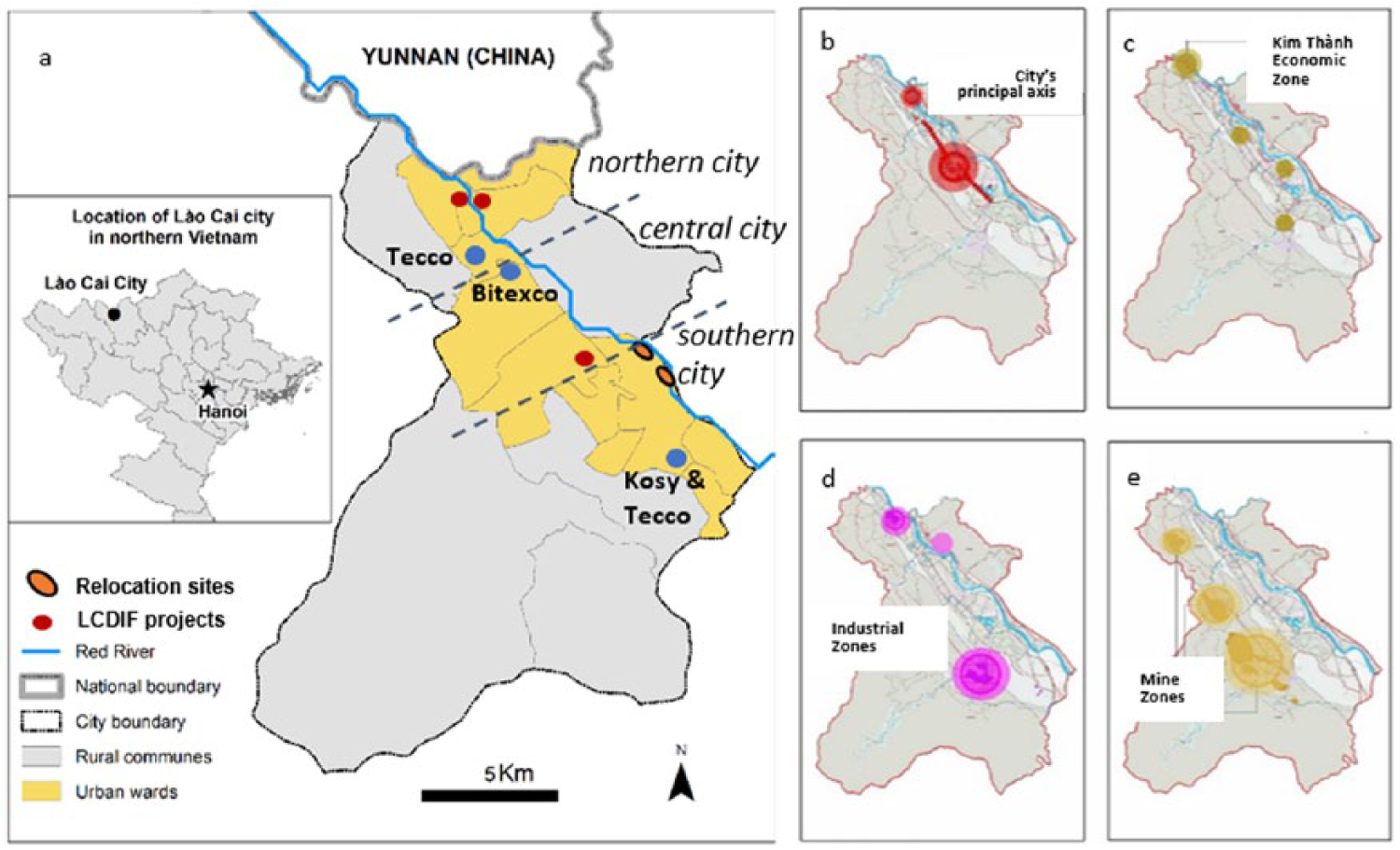
Lào Cai City, showing: a) the city’s official communes and wards, the informal north, central, and south sectors of the city, key housing projects, and relocation housing sites; b) the city’s principal axis; c) the Kim Thanh economic zone on the border with China; d) new industrial zones; and e) mining zones. Dotted lines: informal city’s sector.
We provide the conceptual underpinnings for this study next, drawing on small and ordinary cities, and everyday politics literatures. We then outline the context for Lào Cai City’s current make-over, before answering two specific research questions: first, to what degree and in what ways has Vietnam’s socialist planning system influenced the current growth, design and urban form of Lào Cai City? And second, how have local residents experienced and responded to recent urban changes to their city? Our findings reveal a city rooted in a turbulent history, coping with specific state visions and planning policies that are creating a spatially divided city with increasingly unequal access to the affordable housing stock. We also find an important segment of the city’s population struggling to make a livelihood and undertaking a range of everyday politics to get by and access specific urban resources and spaces.
This article builds on six months’ in-depth ethnographic fieldwork completed by the three authors at different times between 2015 and 2018. 2 This included 102 interviews with city residents, just over half of whom were engaged in informal work (street vending, construction, informal motor-bike taxi drivers), with eight being ethnic minorities. Thirty three of these informal worker interviewees were relocated former peri-urban farmers. The other half of our resident interviewees were shop-keepers, contractors and trade intermediaries, of whom three were ethnic minorities. Our informants ranged in age from 18 to 69, and 48 were women. Nine interviews with planners and city officials were also completed (of whom two were women), as well as ongoing observations of the cityscape since 1999.
Conceptualising small cities, and everyday politics in Vietnam
Of the limited studies focusing on small cities in the Global South, research has tended to concentrate spatially on African regional towns (e.g. Evans, 1989; Owusu, 2004), dispersed cases in South America (Czerny et al., 1997), South Asian small towns (Ali and Varshney, 2012) and regional and tourist towns in China (e.g. Neo and Pow, 2015; Qian et al., 2012). Themes have included the impacts of domestic migration on small towns (Hassan, 2010; Li and An, 2010), the rapid urbanisation of small and medium towns (Fahmi et al., 2013) and the institutional connectivity of small cities within regional networks (Leibovitz, 2006), including their role as regional services hubs (Hinderink and Titus, 1988, 2002; Satterthwaite and Tacoli, 2003). As Bell and Jayne (2009) have noted, while these studies are important in diversifying our understandings of urban geography, ‘smallness’ is not always central to their aims (but see Neo and Pow, 2015). As such, defining and focusing on the urbanity and ‘smallness’ of such cities needs concerted efforts by urban scholars (and practitioners).
As argued by Parnell and Robinson (2012), urban theories developed in the Global North may not be suitable for the Global South, notably when focusing on gentrification or urban renewal processes. They suggest that informality and ‘traditionalism’ may be as useful, if not more so, to understanding urban transformations in the Global South (see also Bunnell et al., 2012). Since the 1990s, scholars and policy makers have also voiced mixed opinions about the roles of Global North small urban centres in regional development (Baker, 1990; Hinderink and Titus, 2002). For optimists, small urban centres stimulate economic development, contributing to a region’s poverty alleviation through access to services, facilities, off-farm opportunities and incentives for the commercialisation of agriculture (Rondinelli, 1983, 1991; Satterthwaite and Tacoli, 2003). Others argue that small urban centres are overly dependent on their rural hinterlands, and lose services and population to higher-order cities due to factors including a lack of qualified human resources, and weaknesses in production and services (Czerny et al., 1997; Hinderink and Titus, 1988, 2002). In sum, while local and regional contexts – natural resource endowments, demographics, physical accessibility and political climate – shape their structures and roles (Bell and Jayne, 2009; Hardoy and Satterthwaite, 1986; Qian et al., 2012), the growth and functioning of small cities frequently depend on policies and processes originating at the national level, far away from their specific locale. How should small cities in the Global South therefore be imagined, conceived, measured and experienced? Parnell and Robinson (2012) argue that (re)theorising cities in the Global South should be built on a wide range of empirical studies, from those focused on official government programmes to investigations of daily livelihoods, ordinary life practices and ‘lifeworlds’. To date, there has been a scarcity of such studies (Bell and Jayne, 2009). To help fill this gap, our article focuses on both the visions of city officials and the daily lived experiences of ‘ordinary’ residents.
Inspired by recent theoretical debates on small and ordinary cities, we also draw from literature on everyday politics to underpin our study. As defined by political scientist Ben Kerkvliet (2009: 232), everyday politics ‘involves people embracing, complying with, adjusting, and contesting norms and rules regarding authority over, production of, allocation of resources and doing so in quite, mundane, and subtle expressions and acts that are rarely organised or direct’. People react to official politics – such as state promoted urban redesign – by supporting, complying with, modifying or resisting norms and rules in order to have access to different resources (Kerkvliet, 2009). Similarly, de Certeau (1984) has demonstrated that individuals in structurally weak positions often draw on quotidian acts to manipulate mechanisms of state discipline in order to ‘conform to them only in order to evade them’ (De Certeau, 1984: xiv; see also Scott, 1990). Authors working with ethnic minority populations in the nearby uplands (Turner et al., 2015), and with street vendors in Hanoi (Eidse et al., 2016), have drawn on an everyday politics framework to highlight subtle, non-formalised resistance to Vietnam’s state-led markets modernisation plans, noting how individuals work to quietly defend and maintain their livelihoods. Our work takes these ideas to the small city context, where we argue that understanding people’s everyday politics can help uncover how state-led modernity is being put into practice in a manner that largely ignores local residents’ needs, while also allowing us to better understand local residents’ array of reactions and coping mechanisms.
Context: Lào Cai’s emergence as a small frontier city
To understand current day planning imperatives and tensions in Lào Cai City, one needs to understand the turbulent past of this upland frontier. During the colonial era, today’s Lào Cai City was the headquarters of the Fourth Military Territory, part of France’s administration of the borderlands. From the late 1890s, the construction of a railway from the port of Hải Phòng, through Hanoi and Lào Cai City, to Kunming, China, a distance of 848 kilometres, brought a boom to Lào Cai City. The railway then sped up the arrival of more lowland Vietnamese and French to the northern uplands upon its completion in 1910 (Turner, 2010). Since Ho Chi Minh declared independence from France in 1945, Lào Cai’s urban growth and form have become closely linked to centralised state policies, as well as reflecting the impacts of a short but intense border war. A series of New Economic Zones designated in the 1950s by the Democratic Republic of Vietnam (1945–1976) started a significant wave of in-migration by the lowland majority Kinh (Hardy, 2003). These zones were designed to relocate lowland populations facing chronic food shortages and limited industrial opportunities in the Red River Delta to sparsely inhabited upland provinces considered ‘empty’, marginal or frontier territories (despite the uplands being home to a diversity of ethnic minority groups). Approximately one million people were resettled in these zones in the 1960s and 1970s (Desbarats, 1987).
A singular event then dramatically changed the urban morphology of Lào Cai City: the 1979 Sino-Vietnamese war. 3 In February 1979, Chinese troops crossed into Vietnam and Lào Cai City was completely destroyed, along with a number of other upland settlements. Although the main military action only lasted one month, it was not until 1991 that both countries officially re-opened their borders, enabling official trade to resume (Wah Chan, 2013; Womack, 2000). As far as we know from observations and from talking with local residents, no colonial building in Lào Cai City survived the 1979 war (interviews 2015–2018). As such, the city’s contemporary built environment is overwhelmingly shaped by post-war construction and urban planning approaches. Moreover, from the mid-1980s, following market liberalisation and the dismantling of co-operatives, the state started relaxing its control over internal mobility. Spontaneous internal migration towards these uplands thus began to grow, with people being enticed by cheaper living costs, reuniting with family and possible trade opportunities with China (interviews; Kim Anh et al., 2012).
By 2016, Lào Cai City’s population was 112,773 (Lào Cai Bureau of Statistics, 2016), with an average annual growth rate of 2.4 percent (National Institute of Architecture, Urban and Rural Planning, 2012). Currently, the city consists of 17 administrative units, with 12 urban wards and five rural communes 4 (see Figure 1a). Seventy-eight percent of the city’s population are Kinh, while ethnic minority groups include Tày, Thái, Hmong, Yao (Dao), Hoa (Chinese), Dáy and Muong (Ministry of Planning and Investment, 2011). These minority individuals tend to live in the city’s more rural areas, with Kinh concentrated in more densely populated urban wards.
Official visions and practices: Big state plans to design a Class 1 city
Contemporary Lào Cai City is a curious blend of socialist urban planning ideals, ambitious public-private plans for modernity and the everyday realities of a diverse population. Socialist urban planning is a centralised, institutionally embedded approach that sees the state actively involved in the day-to-day spatial arrangements of urban locales (Xie and Costa, 1993). Master Plans for provincial cities such as Lào Cai are created by the National Institute of Architecture, Urban and Rural Planning, Hanoi (NIAURP). Lào Cai City’s first Master Plan was issued in 2002, with an adjusted version in 2012, and a second Master Plan was approved in April 2018 ‘for 2040 and visions for 2050’. Urban planning directives are top-down, with centrally designed plans confirmed at the provincial level. There is no public consultation in this process, with local populations informed about a plan after it is officially approved. However, as explained by Lào Cai-based urban planners during interviews, provincial government officials can ‘mildly modify’ the implementation of such plans, although this is often based on ‘who one knows on brown envelopes’ (interviews, 2017; see also Harms, 2016). It is also common knowledge in Vietnam that if one is aware of upcoming urban plans, one can make sizable profits from land deals, as occurred before the 2008 expansion of Hanoi (Labbé and Musil, 2011; PADDI, 2012).
The architecture of contemporary Lào Cai City reflects a range of socialist ideals. The model socialist city is represented by large streets and squares to accommodate official parades, combined with iconic grand buildings and statues exuding socialist solidarity (Kaiser, 2013; Xie and Costa, 1993). Kurfürst (2012: 39) notes that in Vietnam, ‘squares and monuments were built, functioning not as public, but rather official spaces, which can be considered a manifestation of the new political ideology in concrete’. In Hanoi, such landmarks are obvious when one visits Ba Đình Square, flanked by Ho Chi Minh Mausoleum and the National Assembly building. The same planning approach is clear in Lào Cai City where a large square on a wide boulevard is bordered by the Province’s People Committee building, 5 the Ho Chi Minh Museum and a war memorial. Lào Cai residents are also reminded daily of the socialist political regime via propaganda posters along the main streets, and an impressive tiled mural depicting the hardships the region has overcome to reach ‘socialist modernity’ (Figure 2a).
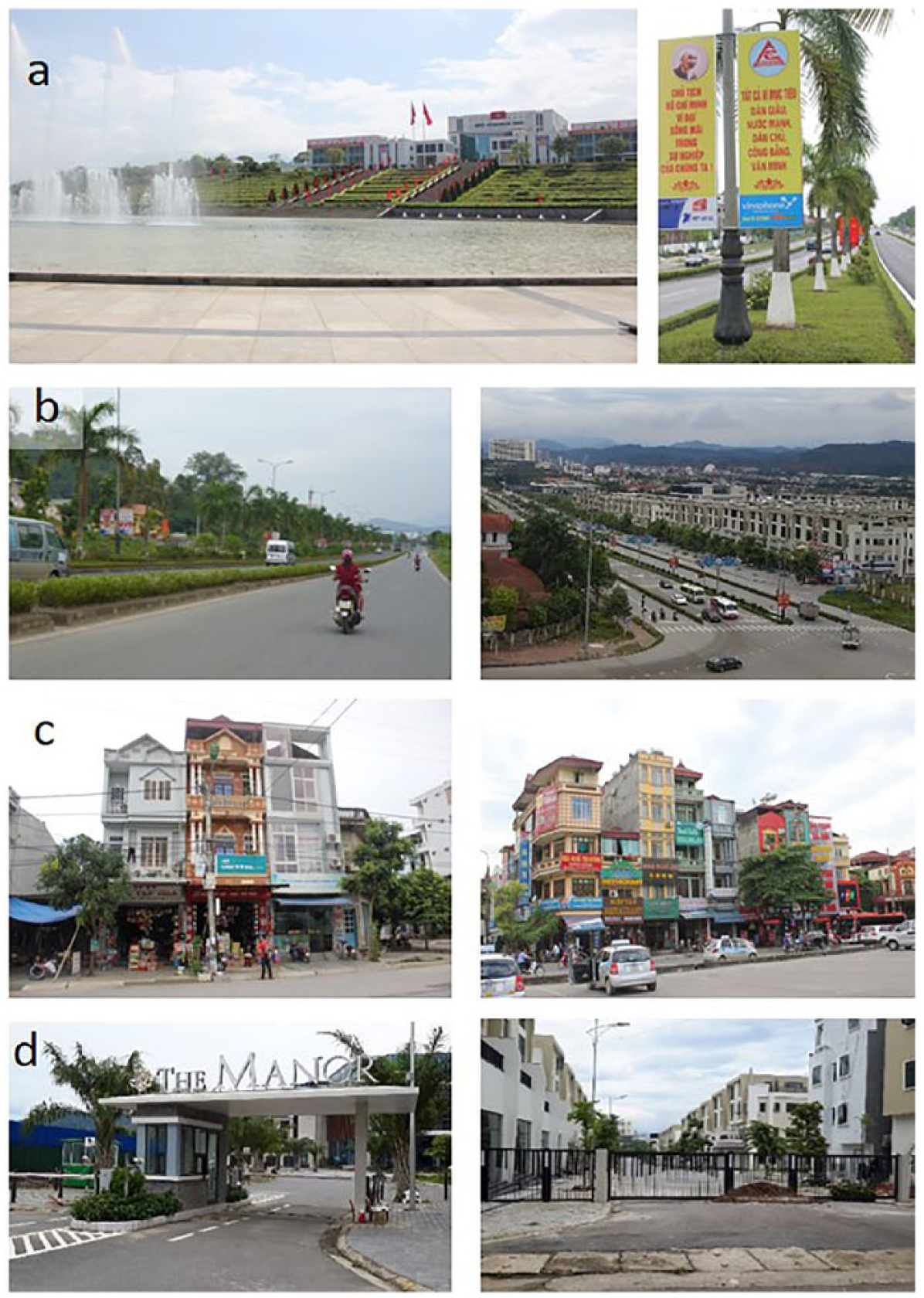
Photos showing: a) socialist-style large state buildings and squares, and propaganda posters; b) the disconnect between the older northern and newer southern sections of the city; c) mixed-function areas in the northern older part of the city; and d) the “Manor Eco+” gated community.
Despite these daily socialist reminders, urban planning for Lào Cai City – closely following the lead of Hanoi and Ho Chi Minh City in what could be considered state-endorsed intercity discursive referencing (Neo and Pow, 2015) – has taken a distinctive ‘modern’ turn since the early 1990s. This is reflected in ambitious plans to raise the city’s position on the urban classification ladder. Vietnam’s specific brand of socialist urban planning (based on former Soviet approaches) has resulted in all urban areas being divided into classes since 1990 (Classes 1 to 5 and ‘Special Cities’) based on population size, population density, the proportion of non-agricultural activities and other factors (Socialist Republic of Vietnam, 1990). Lào Cai City was only formed legislatively in 2004 by combining two district towns (Lào Cai in the north and Cam Đường in the south) and was then ranked a Class 3 city. Since then, the city has undergone a drastic expansion, including the construction of a wide 10 kilometre-long boulevard to connect the two former towns (Figure 2b). Annual urbanisation rates since 2000 have been between 15 percent and 18 percent (NIAURP, 2012; Trinsci et al., 2014), and in 2014 the city was upgraded to a Class 2 city. Lào Cai City officials we interviewed were enthusiastic for the city to be expanded more and upgraded to a Class 1 city by 2030, to sit alongside Hai Phong, Da Nang and Hue (NIAURP, 2012). With this in mind, the City’s Master Plan calls for an expansion of the city surface by 35 percent by 2030 (NIAURP, 2012), and the 2018 Master Plan foresees another 24 percent expansion by 2050 (Lào Cai Provincial People’s Committee, 2018).
Lào Cai City’s 2012 Master Plan has impressive goals, focusing on four principal strategies. 6 The first is the building of additional commercial and cultural centres in the city’s central zone along with pedestrian routes linking the old northern core to this political centre (Figure 1b). The second is the establishment of an economic frontier zone in the north, expanding the current Kim Thanh commercial centre and building new hotels (Figure 1c). The third strategy concentrates on developing the city’s peri-urban zones replete with new eco-villages, parks and entertainment facilities. The fourth strategy focuses on developing the city’s fringes through the expansion of industrial parks and mining operations (the city contains the largest source of apatite in Vietnam) (Figures 1d and 1e). The Master Plan also states that ethnic minority villages will be housed in this urban fringe, as well as facilities for organic agriculture (NIAURP, 2012). Notably, however, ethnic minorities are not mentioned further in the Master Plan, except in a sketch of ‘ethnic minority village’ styles, albeit for luxury compounds.
Such urban planning goals repeat the approach found in other small cities across Vietnam, all striving to obtain a higher level of urban classification, and in turn to gain greater financial support and recognition from the central government (Kienviet, 2014; National University of Economics, 2010). Indeed, our interviews with Hanoi and Lào Cai-based urban planners revealed that state provincial officials want to be able to show off their achievements during their mandates, securing their positions for another term, and gaining more grants from the central government. As also explained in the media, governing a high-class city provides more status than governing a lower-class one (Saigon Times, 2010).
Despite the fact that officials in any small city in the Vietnam uplands want to advance their city’s urban growth so as to gain more resources (and personal benefits), Lào Cai City sits in a unique position with regards to these endeavours. Thanks to the city’s location directly on a Greater Mekong Subregion economic corridor, and being a major border-crossing locale, the city has received substantial central government investment, supported by Asian Development Bank funds. As such, conceptual arguments that small urban centres are often overly dependent on their rural hinterlands (Hinderink and Titus, 2002) do not apply here. However, it is clear that natural resource endowments (mining) and physical accessibility (located in the Red River valley and a core cross-border locale) have played important roles in shaping the city’s specific structure and roles (Bell and Jayne, 2009; Qian et al., 2012).
Urban practices: Contemporary urban form – a divided city
What have been the consequences of Lào Cai City’s planning objectives? First, long-established communes in the north of the city, located close to or directly abutting the Sino-Vietnamese border, have become increasingly densely populated in recent years (Figure 2c). There is a mix of functions in these communes (residential, retail, services, recreational), as well as continuity within the urban fabric. These urban communes are characterised by narrow streets and numerous intersections which facilitate transportation and shorten travel distances to different retail outlets and services.
Second, an expansion of the city’s limits (in accordance with the ‘Master Plans’ goals’) has occurred, rather than adding further to the city’s densification. The central and southern parts of the city are now witnessing intensive suburbanisation with largely fragmented urban functions. These scattered new urban developments or new urban areas (khu đô thị mới) (Labbé and Musil, 2013) include rows of town houses and wide roads, as well as numerous construction sites and vacant land. As explained by one academic architect interviewee: ‘The city adopts plans that foresee future development, which means building huge roads with no real traffic on them and extending land for construction purposes while no construction takes place on it’ (interview, 2015). Due to the low density resulting from urban sprawl, we observed a strong reliance on motorised transportation – predominantly low-cc motorbikes – to overcome long distances within the now fragmented urban fabric. The public transportation system is also inefficient, with a low frequency of services and limited bus stops. A public official explained: ‘If I take the public bus, I have to walk about 500 meters, and the bus isn’t suitable for my working time. I have to spend lots of time waiting’ (interview, 2017). Moreover, walkability anywhere in the city is hampered by poorly maintained sidewalks used for motorbike parking and as extensions of retail stores. As Thảo, 7 a young woman resident, noted with a laugh: ‘Try to walk anywhere in this city on the pavement and you’ll soon break a leg’ (interview, 2017). Long walking distances due to fragmented urban functions make walkability even harder.
Within the southern part of the city, a very noticeable consequence of the drive for urban growth has been a housing construction boom since about 2010. A number of corporate actors, as well as smaller private businesses and developers, are now participating in shaping the city’s growth on a pro-profit basis, strongly encouraged by financial incentives from the government. A Hanoi-based urban planner explained: ‘In Lào Cai, people who accumulate wealth in other economic sectors think that investing in real estate is very feasible; then the speculation starts’ (interview, 2017). In Lào Cai City’s residential sector, three important real-estate investors are currently active, namely Bitexco, Kosy and Tecco Group. While these investors focus on luxury and high-class housing projects, including the Manor Eco+ gated community, the Kosy Neighbourhood and Tecco Towers, many smaller, local companies are also investing in lower-end and relocation projects discussed further below. Moreover, provincial government agencies (e.g. Lào Cai Development and Investment Fund, LCDIF) are participating in housing projects ranging from luxury townhouses and middle-class condominiums (Figure 1a: Red circles) to lower socio-economic housing projects for relocated residents (Figure 1a: Core locales shown as orange dots). The municipal government is also renovating and building public markets, often in collaboration with private investors from Hanoi (observations; Endres, 2017).
While space restricts a nuanced analysis of each housing development project underway in the city, it is interesting to note the following features of four large-scale projects (see Figure 1a for locations). First, Bitexco has recently completed The Manor Eco+, a sprawling 19.8 hectare project with 941 housing units which was partly inhabited as of May 2018 (observations; Manor Eco+, n.d.). This high-end modern European styled project has abundant facilities and services, 24/7 closed circuit television security (CCTV), and numerous guards (Figure 2d). While such features are fairly standard for gated communities elsewhere in Vietnam, including Hanoi and Ho Chi Minh City, what is unique here is a series of green terraces landscaped to represent the local mountainous region. The price-point of these units means it is highly unlikely that ethnic minority inhabitants of the surrounding area could afford to live here, yet their cultural landscape is appropriated for wealthy (overwhelmingly Kinh) urban dwellers.
Second, the Kosy Neighbourhood is currently under construction on 38 hectares of land and will boast 600 housing units. Also located in the south of the city, this is near a planned reservoir for which a village in Binh Minh ward will be relocated. While not a gated community per se, it will also have 24-hour security guards. The advertising for this development emphasises ‘a paradise between beautiful mountains and forests’ where ‘residents get the perfect life in the majestic natural landscape’. The natural environment is drawn upon heavily as a sales feature, distinguishing this development, and indeed the city as a whole, from lowland cities, as well as noting the convenient location close to the Lào Cai-Hanoi highway (Kosy Group, n.d.). Third, Tecco Group is building Tecco Towers within the Kosy site (limited details available to date), as well as constructing a 25-story tower with 365 high-end condominiums in the northern Duyên Hai ward (Tecco Group, n.d.). While these projects mirror those underway or completed in Hanoi’s new urban areas to a large degree, with modern, safe living being heavily promoted, they also highlight differences due to being located in a small upland city, namely marketing campaigns that focus on nature and local cultural landscapes, a lack of pollution and ease of access to a major highway.
Residents’ everyday politics
These high-end residential projects and carefully planned suburbs are being established on what was previously deemed agricultural land. Some local officials we interviewed insisted that these projects are non-controversial, with agricultural land ‘a secondary use, ripe for development’, and land-holders compensated and relocated (interview, 2015). As another local urban planner argued: ‘Losing agricultural land is not serious because developed areas help improve people’s income in comparison to farming’ (interview, 2015). However, an official directly in charge of moving such households added: ‘I understand why folks [bà con] don’t want to move. I also understand they will have a lot of difficulties for their livelihoods. I really sympathise with them. But I had to convince them, that’s my task’ (interview, 2017). The government applies a set ‘Land Pricing Framework’ when acquiring such agricultural land, always below market value. While some of the most important relocations are occurring for urban infrastructure upgrades (roads, water reservoir, sewage management), in other cases the land is reallocated to private developers for new housing projects (Labbé and Musil, 2013; Lào Cao Provincial People’s Committee, 2011; World Bank, 2011; see also Labbé and Musil, 2013). Such land appropriation has become a hotly contested feature of urban change in Vietnam in recent years, with vocal and sometimes violent protests taking place (see Harms, 2016) – such protests are a surprising feature in this socialist country.
Lào Cai City residents were well aware of the large property speculators in the city, accusing them of causing land price inflation. While overt protests have not yet occurred in the city, residents complained bitterly to us about the approach that local officials and developers were taking, arguing that relocated residents had not been fairly compensated (interviews, 2015, 2017). While the Lào Cai Development and Investment Fund is building low-cost housing for low-income residents, these units do not seem to be affordable for the majority of relocated people. Hence, most of the 33 relocated individuals we talked to have had to purchase property and build their own houses, with far less land than their previous homes. As Bằng, a relocated middle-aged former farmer, protested: ‘Sure, I got tens of millions [Vietnamese đồng] as compensation for my old house, but it’s not enough. Until now, I still owe money to my cousins and my friends to pay for my new house!’. Huy, a relocated farmer in his twenties added: After my parents’ relocation, I moved out with my wife and two sons. I received a smaller amount of money because I hadn’t been the main land owner. This wasn’t enough to buy a new piece of land and build a house, so I sold my buffalo, but I still owe VND180 million [US$7700] to the bank.
Cúc, an elderly woman, expressed similar concerns: ‘We cannot count much on compensation. Even if we think we’re getting richer with this money, this feeling will be temporary, and we will always be worried about our future and our life after relocation’ (interviews, 2015, 2017). Many relocated former farmers with whom we spoke are deeply concerned about their future, since agriculture is the only livelihood and skill-set they know, and yet they have been relocated to urban areas without any land for gardening (interviews 2015, 2017).
By drawing on Kerkvliet’s (2009) notion of everyday politics, we were able to analyse how these individuals supported, complied with, modified or resisted norms and rules to gain access to the resources that they need. We found that most of these former farmers are complying with the imposed new situation – moving from their farmland – yet are modifying urban space to suit their livelihood needs in ways that state officials have not foreseen or appreciated. For instance, some former farmers are directly modifying the city’s urban form to fit their requirements by transforming urban public spaces into agricultural plots, be it on vacant land or on disused or poorly maintained pavements. Định, a former farmer now in Nam Cuong commune, explained: ‘The city doesn’t care for the pavements here; they just care about big investments, so I use this space [growing vegetables] for my needs’ (interview, 2018). These residents often depend on social capital to access such resources, with another relocated farmer in Nam Cuong commune, Tuấn, adding: ‘My neighbour lent me his vacant land to plant until it gets built on’ (interview, 2017). Some such residents now sell their surplus urban vegetables and herbs from streets around crowded marketplaces. By doing so, they are not only modifying different urban spaces, they are resisting expected marketplace behaviour by not renting a fixed stall.
Everyday politics are also reflected in new livelihoods. As well as former farmers participating in urban agriculture, some are now selling farm produce on behalf of others (able to keep their land), and hence becoming intermediaries. Trang, a former farmer, explained: I used to grow tens of tons of vegetables when I had my own land, but when the state constructed the new main road I had to shift into doing business by collecting vegetable from farmers and selling at the market. (Interview, 2015)
Other interviewees had shifted from agriculture services towards urban services, contributing to the emergence of informal urban activities in Lào Cai City such as selling drinks from small stalls, home commerce, motorbike taxi driving and street vending. The everyday politics associated with these livelihoods included modifying urban spaces to fit their needs (e.g. installing chairs and tables directly on sidewalks, occupying the road sides with motorbikes) and resisting norms regulating public space occupation. Street vending is not yet banned in Lào Cai City as it is in central areas of Hanoi and Ho Chi Minh City. However, with growing numbers of displaced farmers attempting to find new informal livelihoods in Lào Cai City, it would be reasonable to assume that this might occur in the near future. As Phương, a Lào Cai street vendor selling toys, lamented: more people are vending now because they lost land; I’ve vended for years, but I think the government will stop us soon; there are too many of us now. It’s only a small city, so the government won’t allow many vendors. (Interview, 2018)
Similarly, Yến, an elderly lady selling hot drinks, explained: ‘local officials want to highlight the beautiful scenery, they want to expel us. If they evict me [from vending] I’ll have to leave quickly, but I’ll return later; I have no choice but to work here’ (interview, 2015). It is noteworthy that vendors highlighted being in a small, ‘beautiful’ city to stress why they were likely to be further marginalised, similar to the ‘rule by aesthetics’ mode of governing space that Ghertner (2015) outlines in his study of Delhi as a world-class city. The ‘green, clean and beautiful’ (Xanh, Sạch, Đẹp) and ‘civilised city’ (Văn Minh Đô Thị) propaganda campaigns of Vietnam’s large lowland cities (see Coe, 2015), have not been lost on officials in Lào Cai City as they drive towards Class 1 city status.
A brief case study (narrative map, Figure 3) further highlights the impacts that relocation has had on residents’ lives and livelihoods, as well as how residents appropriate urban space and modify it to their own requirements. Diệu is a 35 year old former peri-urban farmer who lost her agricultural land in Nam Cường commune due to the southern expansion of the city. Now she struggles to maintain a livelihood while working as a vegetable market vendor near the northern city centre. Diệu wakes up at 3.30 am daily and prepares her motorbike on the pavement outside her house. This is officially frowned upon, as pavements are meant to be unencumbered and kept clean, although other residents also claim these pavements for a number of purposes such as urban agriculture and motorbike storage. She then heads to a nearby marketplace, outside of which she meets with wholesale farmers to purchase the produce she hopes to sell that day: ‘I am loading my motorbike with 170 kg of goods; I know it’s dangerous, but less than that that won’t be worth it’. Farmers, intermediaries and porters, all arriving on motorbikes, are adopting the area in front of this marketplace as their meeting point where they can sell, purchase and load goods quickly. Again, this is disliked by state officials who want the market to be conceived of as clean, orderly and bound inside its walls. By 5.30 am, Diệu heads towards a crowded market in the north of the city where she remains to trade until 6 or 7 pm daily. When asked if she is planning to rent a kiosk in a newly built market, she responded: ‘I’m trying to adapt to any new conditions. If I can’t get a stall in the new market, I’ll be roaming the streets with a bicycle to sell goods’ (interview, 2015). Diệu thus draws upon a range of everyday politics to subtly contest the state’s vision of clean orderly pavements and streets so as to maintain a livelihood after relocation.
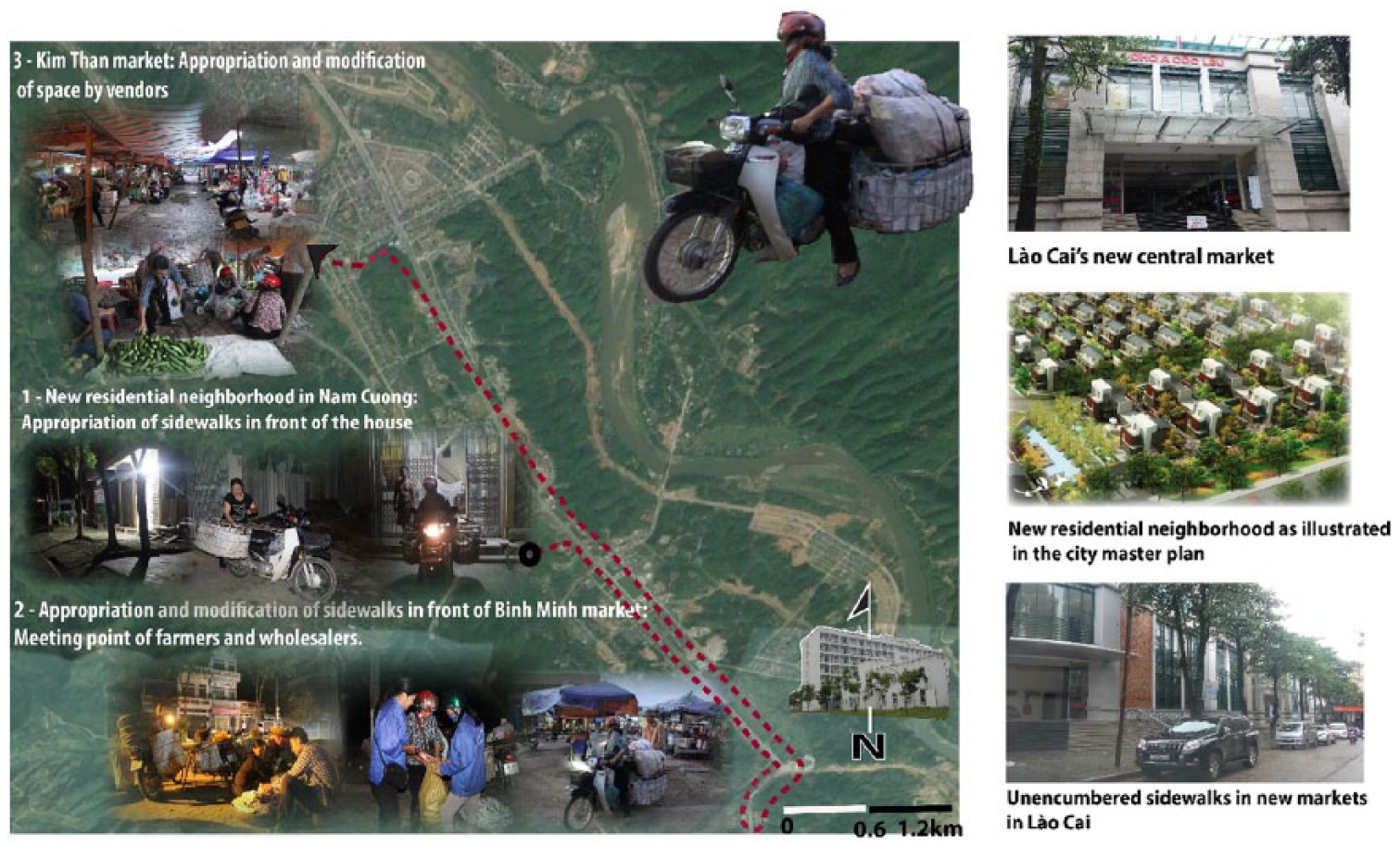
A narrative map of a vegetable vendor’s daily routine showing the different use of space (left) versus the state envision of these spaces (right). Sources: 2015 SPOT images and photos taken by authors (in 2015).
Directly linked to Lào Cai’s position as a small city in the uplands, interviewees raised concerns regarding officials’ disinterest in recognising the city’s ethnic diversity and cultural norms. For example, one ethnic minority Yao resident, Ta May, noted: I used to be a farmer but the government took my land for a project and made me move here [Duyên Hải ward]. I feel stressed here; it’s very busy and lots of people. I miss the space around me and my neighbours. They were Yao and Tày.
When asked specifically about ethnic diversity in the city, Anong, a relocated Thái woman now selling fried snacks beside a marketplace, laughed: ‘the officials don’t care about that; they want us all to be like Kinh, but we are many minorities up here and officials should remember that; it makes this place beautiful and different’ (interview, 2018). By voicing their displeasure at local state discourse, these minority individuals could be argued to engage in a form of ideological resistance (Scott, 1990), while hoping for legitimate community membership.
Other everyday politics of Lào Cai City residents initially appeared less specific to a small city, with inhabitants informally transforming official landscapes into mixed-use recreational zones, in a manner that mirrors activities in Hanoi and Ho Chi Minh City. For instance, in the south of Lào Cai City, recent urban plans have neglected to incorporate areas that would be pleasant for residents to walk, perform daily exercises (ranging from Tai Chi to ballroom dancing to in-line skating) and socialise – important activities for many urban residents in Vietnam (Thomas, 2002). As such, mainly middle-class residents from new housing areas have appropriated space around a large fountain in front of the Provincial People’s Committee that was originally built with the purpose of adding an air of authority and grandeur to the building (Figure 2a). Residents have modified this space to their needs, installing chairs, tables and even temporary sandboxes for children. Faced with what many noted as inefficient planning, local residents slowly push back against official land use expectations, self-organising to gain the space they need for social activities. Yet, unlike in larger cities, there appears to be more flexibility to do this at some sites. For example, Hằng, a woman with her two children, interviewed at Lào Cai train station, explained: ‘for me the train station is a leisure space, I usually bring my children here as it’s an active open space with lots of passengers’ (interview, 2015). This would not be easy to do in Hanoi’s train station due to the sheer numbers of people passing through and officials sometimes telling non-ticket holders to leave (observations). Likewise, while formal sites in Hanoi such as Ba Dinh Square are used for public relaxation, skating and sandboxes are forbidden, and the site is far more closely monitored than Lào Cai City’s formal squares.
Concluding thoughts: A small city experiencing growing pains
While contemporary urban scholarship has tended to ignore small cities, especially those in the Global South, this case study has highlighted that for Lào Cai City, as Bell and Jayne (2009: 690) propose, ‘smallness is bound up with particular ways of acting, self-images, structures of feeling, senses of place, aspirations’. Located on the North-South-West Economic Corridor of the Greater Mekong Sub-Region (GMS), Lào Cai City is the Vietnam state’s ‘poster child’ for how urban development ‘should be done’ in these uplands. Being able to draw on sizable funding from the Asian Development Bank due to being a GMS node, the city is now touted as maximising the advantages and effectiveness of this geographical axis. The national government thus has a strong stake in Lào Cai City’s future and city officials are acutely aware of this, for the most part diligently following the Master Plans laid out for them by their lowland colleagues. In their quest to produce a Class 1 city, great efforts are being made by Lào Cai City officials and developers to reference the material transformations of Vietnam’s large low-land cities, introducing large boulevards, expansive housing projects for middle-class residents and new shopping malls. Yet, we have noted that officials and developers also selectively draw on the particularities and aesthetics of the city’s locale, ethnic imaginaries and small size to reach their goals. The location of Lào Cai in Vietnam’s northern uplands means marketing strategies for potential newcomers can draw heavily on differentiating Lào Cai from large lowland city environments, highlighting Lào Cai’s surrounding nature, climate, safety and infrastructure. Developers and the municipal government itself play on the concerns of lowland middle-class residents with regards to rising pollution, undesirable neighbours, food safety and lack of access to affordable services, to tout the promises of a clean, upland locale, a small city with a friendly environment, safe upland produce and local amenities that can be easily accessed. The city is thus selectively positioned within ‘certain social-spatial and political-economic realities’ (Neo and Pow, 2015: 556).
While designing and marketing this ideal upland city, the resulting large-scale housing projects and urban sprawl have benefitted state and property developers while ignoring many of the basic needs of the local population, such as adequate public transportation, walkable pavements, amenities near current residential areas and the ability to maintain viable urban livelihoods. The housing sector alone reveals sharply rising inequalities, with a number of projects being built for wealthy households while lower socio-economic households, including relocated farmers, are struggling to build new homes. Moreover, ethnic minority residents are now being cajoled to live in densely packed neighbourhoods, away from their former farming land and, as with other relocated residents, have little say regarding their possible livelihood needs.
Nonetheless, Lào Cai City’s residents are not passive recipients of these fairly technoscientific, hierarchical planning approaches. They attempt to mitigate the impacts of the state’s vision for their urban livelihoods and daily routines via a range of everyday politics. While their attempts might be seen as ‘uncivilised’ by government officials, local residents reinterpret state plans with respect to their quotidian needs. Their everyday politics reflect a subtle pushback against a state blinkered by modernity and aesthetic revitalisation, as important numbers of inhabitants silently modify urban land uses and innovatively claim their right to the city. This is evident in the degree to which urban agriculture takes place on unused sidewalks and unclaimed land, how daily marketplace trade spills over into neighbouring streets and crossroads and in the appropriation of public spaces for a range of recreational pursuits, among other responses. In this small city, we find clear evidence of the seizure of the state’s vision of planned modernity through local residents’ everyday reactions and negotiations, with resultant hybrid local urban forms (Robinson, 2006).
In sum, teasing out these forms of hybridity, the distinctive mix of socialist-style planning objectives and speculative entrepreneurship and the unique spatial, political and cultural aspects of this locale demands a careful refocusing of our gaze towards small cities in the Global South that, until recently, have been considered a footnote in global urbanisation (Neo and Pow, 2015). More than ever, ‘urban scholars need to resist the temptation of reifying the experiences of a small subset of cities as the standard accounts of the world economy’ (Qian et al., 2012: 153). Lào Cai might be a small, ‘ordinary city’, but it reveals a diverse, multi-layered and complex set of actors, engaging in a number of contestations over how their future city should look and function.
Footnotes
Acknowledgements
The three authors, who contributed equally to this article, would like to thank all our respondents for their time and insights, and Lê Thành Nam, Ngô Đức Anh, Đinh Thị Diệu and Phạm Thị The for their assistance during fieldwork.
Declaration of conflicting interests
The author(s) declared no potential conflicts of interest with respect to the research, authorship, and/or publication of this article.
Funding
The author(s) disclosed receipt of the following financial support for the research, authorship, and/or publication of this article: This study was supported financially by the Social Sciences and Humanities Research Council of Canada and the Fonds de recherche du Québec – Société et culture.
