







Abstract
The city of Hyderabad plays a significant role in urban transition processes at play in India. Cyberabad, a section of the city of Hyderabad, developed through the rapid urbanisation of rural villages and land, becoming a high-tech, state of the art, globally connected enclave. On weekday mornings in the neighbourhood of Madhapur, smartly dressed HITEC City workers, with ID tags, emerge from hostel accommodation and walk alongside large, black buffalo being herded into rundown dairies. This paradoxical use of space is replicated in the urban fabric of Cyberabad and surrounding Madhapur. Cheek-by-jowl urbanisation has created two very different types of urban locale: Cyberabad – air-conditioned, gardened, watered – a space of hydration and flourishing; and Madhapur – hot, dusty and desiccated – a space of dryness and water struggles. This paper explores whether aspects of urban flourishing and resilience are possible in the newly formed Telangana state and its capital, Hyderabad, through an examination of the past, present and future of the city’s water.
Introduction
The central Indian city of Hyderabad has been in severe water crisis for some time. Water scarcity is a historical feature of the city and the erstwhile state of Andhra Pradesh. However, in the past there was more effective management and a degree of fairer distribution throughout the city and the state (Shahidl, 2014). Water is required for human survival and flourishing. In the city of Hyderabad residents have a long history of water resilience, utilising a range of techniques and structures to capture and store water. Given that the city is currently in crisis, we ask a series of questions: Can Hyderabad redevelop its water resilience? In what ways can urban governance focus on water to create the potential for human flourishing in a desiccated city? What infrastructural changes are being created by the newly formed Telangana State? Can Hyderabad be hydrated? We argue that a combination of neglectful water management, rapid urbanisation, neoliberal shifts in the Indian economy, especially in the urban centres, and the privileging of Cyberabad, has rendered other parts of the city less resilient, resulting in a deterioration in living conditions. 1
Our research took place in Hyderabad between 2011 and 2016. During this time there were marches and riots related to the political campaign for the establishment of Telangana as a new state. Strikes, shutdowns and demonstrations were common everyday political strategies, to push for federal recognition of demands for separation from Andhra Pradesh. Inauguration of the State of Telangana took place on 2 June 2014 and the Telangana Rashtra Samithi party came to power with 63 of the 119 available seats. Hence, our Hyderabad-centred research was worked around diverse everyday politics and localised demands for political justice in terms of self-defined statehood (Srikanth, 2013). Our central foci were neighbourhood liveability, water policies and provision, and residents’ resilience and possible flourishing within and between two very different neighbourhoods: Cyberabad and Madhapur. We used a range of methods to collect original data through repeated field visits: 35 one-to-one interviews with residents who were born and bred in Madhapur, rural migrants and newly arrived digerati (professionals in IT and software development) from all over India; 15 in-depth interviews with political, municipal and NGO actors; focus group discussions with Hyderabadi citizens and academics on everyday water issues and effectiveness of government water policies; and observations and visual methods to capture the everyday water situation and local people’s negotiations.
This paper comprises four sections. The first section introduces key urban and spatial players in the water struggle: the city of Hyderabad, the high-tech enclave of Cyberabad and its rapidly urbanised counterpart, Madhapur. 2 We use the lens of water to examine the complex urban processes that impact upon governance, resilience and flourishing. This first section presents three key scaled spatialities of examination and blends critical analysis of urban development in relation to differential governance practices (or lack of) around investment, infrastructure and water. Our interpretation of governance and politics is to recognise the ways in which political leaders or authorities use their democratically elected power to steer their nation or state. India is a federal parliamentary democratic republic, which consists of a central authority (located in Delhi) with states governed by elected regional or state parties. Governance is strongly related to politics but is more associated with the public sector, power structures, civil society, equity and the ideals of public administration, hence it directly relates to water provision. 3 In the following two sections we focus more specifically on histories of water and related contemporary resilience (Beilin and Wilkinson, 2015; Beilin et al., 2015; Sultana and Loftus, 2012). The second section presents the water history of Hyderabad, enabling a temporal and spatial analysis of water catchment, distribution and usage. Woven through this water-based analysis is the complex story of water provision, urban processes (which have largely been unplanned, unregulated and rapid) and political governance transformation. In the third section we draw more specifically upon our research data to examine how water scarcity plays out in everyday lives and perpetuates particular social, infrastructural and resource inequalities. The penultimate section looks back in time in order to look forward, and critically speculates as to what might happen to Hyderabad and the surrounding areas of Telangana state. The first and current Chief Minister of Telangana, Kalvakuntla Chandrashekhar Rao (known as KCR), has set up two major water-based initiatives. The projects are ambitious and appear to be committed to more equitable and/or universal provision of water than was delivered previously. The final section concludes the paper.
Hyderabad, Cyberabad, Madhapur: Industrial, high-tech urbanisation and water inequalities
Hyderabad
With a population of nearly 8 million, Hyderabad is the fifth largest metropolitan centre in India. The metropolitan region covers nearly 8000 km2 and is ranked 38th in the world by size and population and continues to grow. Situated at the centre of India, on the Deccan Plateau, Hyderabad historically acted as a connecting node between northern and southern India in terms of geography, culture and religion.
From 1947 onwards, Hyderabad experienced different governance and political practices focused around economic development. The governance practice was initially of a state-centric authority steering and placing emphasis on the wellbeing of India’s citizens and supporting new nation building after decades of British colonialism. However, over time, governance and political structures and strategies have shifted; states have gained some degree of autonomy around economic and social development. Following independence, Hyderabad was accorded priority in relation to heavy industrialisation as part of the Nehruvian model of development. Alongside other cities in southern India, Hyderabad became a major player in the establishment of public-sector industries (PSUs) such as heavy machinery and chemical industries. Later, in the 1970s, other major PSUs located in the city, including defence-related industries, manufacturing and steel production. Economic development was strong, jobs were created and Hyderabad developed better urban infrastructure. This, in turn, drew engineering, research and development centres and institutes to locate in Hyderabad. Until the 1980s these developments made Hyderabad an attractive place, offering opportunities and jobs combined with a relatively good quality of living. Skilled individuals and middle-class families from across India migrated to the city. Large numbers of rural-to-urban migrants have been significant actors in India’s contemporary urbanisation (Ramachandraiah and Bawa, 2000), usually poorly absorbed into the economy and forced to reside in sprawling slums in and around Hyderabad. These substantial migrations increased the pressure of urbanisation; Hyderabad’s basic amenities and infrastructure could not keep pace. The Hyderabad Urban Development Authority (HUDA) was established in 1975 as part of an urban vision for future planning. While HUDA achieved the short-term goal of land regulation, zoning and planned infrastructure development in pockets of the city, a long-term vision of mitigating urban challenges, particularly the problems with water, was not adequately developed.
The early 1990s witnessed major changes in India’s political economy from the era of guided industrialisation to a commitment to liberalise the economy, encouraged by the World Bank and International Monetary Fund (IMF) through Structural Adjustment Programmes (SAPs). As India opened up its markets, global information technology (IT) industries recognised an opportunity to access cheaper skilled labour and began to establish their R&D centres in Indian cities. With cities now being seen as nodes of neoliberal growth, major Indian cities relied on the burgeoning services sector, with the provision of premium high-tech enclaves (Graham, 2002). Federal agencies facilitated this foreign investment and subnational governments took the lead in equipping sectors of their cities to be IT- and investment-ready through premium info-structures, subsidised land, availability of uninterrupted water and power, gated residential complexes and entrepreneurial policies (Jensen-Butler, 1999). With state rescaling and restructuring processes from the 1990s onwards, subnational governments became significant players in economic decisions and accumulation strategies (Das, 2015; Kennedy and Sood, 2016). Major cities in India became service economy centres, connected globally through international airports, optic fibre networks and satellite connections, and sub-nation states began to shift their focus to urban centres as engines of growth (see Douglass, 2002; Harvey, 1989). Subsequently there was increasing pressure on governments and city authorities to turn governance away from management and regulation to entrepreneurialism (Orleans Reed et al., 2013). Running alongside these shifts in state-based governance has been the impact of private investment, which led to the relative neglect of basic and public infrastructure in favour of high-end business infrastructure and services (Desai, 2018).
After 1991, when the World Bank and IMF prescribed SAPs to the federal government of India, the nation’s coalition politics combined with the strategies of these two agencies resulting in a deepening of neoliberalism through a subnational focus (Kirk, 2005). The World Bank selected Andhra Pradesh (AP), Karnataka, Uttar Pradesh (UP) and West Bengal (WB) for financial assistance through SAPs (World Bank, 1997).
In 1994, Chandrababu Naidu became the chief minister of AP; his governance style was more about prestige than provision for ordinary citizens. Naidu saw the possibility of Hyderabad becoming a competitor to Bangalore as an IT destination, and travelled abroad in search of investment and inspiration, including South-east Asia specifically, to learn about Singapore’s Science Park and One North, and Malaysia’s Multimedia Super Corridor. Impressed with the premium info-structures he witnessed, Naidu wanted to emulate the Singapore and Malaysian experience (Bunnell and Das, 2010). Naidu invited McKinsey Consultants to prepare an envisioning document, ‘AP Vision 2020’, to develop Hyderabad as the next cyber destination. Hyderabad became the template for those aspiring to make the entrepreneurial state city-centric. The World Bank recognised Naidu as an entrepreneurial minister and provided financial assistance for fulfilling his aspirations for the state and the city (World Bank, 1999).
Cyberabad
Lacking sufficient state funding, Naidu utilised SAP funding from the World Bank and pursued his neoliberal plans to create a technological utopia while neglecting dystopic urban problems such as water access and provision (Ramachandraiah and Bawa, 2000). With an investment of US$350 million, the high-tech enclave of HITEC City was developed in Hyderabad’s western periphery and subsequently expanded to a 52 km2 knowledge corridor, Cyberabad. In 2008, HUDA became the Hyderabad Metropolitan Development Authority (HMDA) and Cyberabad was expanded to 7228 km2. However, it is important to recognise the intense governance, provision and justice disconnects between the peri-urban development spaces of Cyberabad, now a knowledge corridor, and the former village, now an urban neighbourhood, of Madhapur. 4
Applying neoliberal accumulation by dispossession strategies (Harvey, 2003), the AP state government acquired land from 17 villages surrounding HITEC City to develop Cyberabad, and one of those was Madhapur. Villagers were forcefully evicted and farmland was accumulated, with measly compensation, to make way for privileged Cyberabad – a utopian space for high technology dotted with digeratis (Das, 2015). The knowledge corridor became ‘the material and symbolic centrepiece of AP Vision 2020’ (Bunnell and Das, 2010: 278) with glitzy publicity, media shows, visits of prominent business people, and national and international political figures. Doreen Massey (2008: 28) described Cyberabad as ‘not simply an economic model – rather a socio-economic and political (military) project’. Cyberabad was literally born out of the desiccated agricultural landscape at considerable cost for mostly illiterate impoverished farmers. Cyberabad is a technological city enclave that demanded particular forms of (techno)urbanisation and flourishing at the expense of rural farmers, dislocated families and the existing residents of Madhapur. The rise of Cyberabad has created a successful economic urban centre for Hyderabad and the young Telangana State, but generated severe urban environmental and social sustainability problems (Das, 2015; Ramachandraiah and Bawa, 2000). A key problem for the residential areas around this urban IT centre is the lack of water.
Madhapur
Madhapur, one of the 17 villages mapped within the orbit of the new high-tech industrial space development, has witnessed contradictory consequences from the urbanisation processes of Cyberabad. During the 1990s, Madhapur was an agricultural backwater, with cattle rearing and farming as villagers’ primary livelihoods. Despite relative proximity to the urban core of the city, Madhapur was not impacted by infrastructural development (see Das and Safini, 2018). While the majority of the villagers were displaced from their farmland, some managed to urbanise their land and significantly increase their wealth. The larger development of HITEC City began from a corner of Madhapur, with further concretisation and laying of optic-fibre out to the southern corridor of Cyberabad. Owing to Cyberabad’s rising popularity as an engine of growth, parts of the rural ‘surburb/neighbourhood’ of Madhapur quickly became loci of speculative and rampant real-estate deals and development with premium infrastructure that included internet connectivity, uninterrupted water and power supply, and 24-hour security provision (Ramachandraiah and Prasad, 2008). In direct contrast, in other parts of Madhapur, the water table dropped precipitously, electricity cuts occur daily and female domestic workers have to leave their workplaces and head home to the slum areas before it gets too dark, to be safe.
Initial developments in Madhapur primarily constituted infrastructural support to IT companies. Subsequent improvements catered for the consumption demands of the emerging digerati population as part of the larger urban spatial restructuring. This digerati class, highly skilled and sought after, draws better incomes and demands premium goods and services. Consequently, one of the main drivers behind Madhapur’s restructuring is the emerging mobile middle class and affluent populations who are the most conspicuous representations and validations of a globalising urban space. The urban processes around Madhapur’s built form have been spatially engineered to meet the consumption needs of these middle-class populations, with luxury high-rise living; glossy, air-conditioned, securitised shopping malls; exotic restaurants; and designer retailers, dramatically changing the neighbourhood’s socio-economic geographies. Socio-spatial inequalities are writ large in the shiny, huge, glass windows of top-end retailers (water-washed regularly), designed to entice or exclude.
Continued growth of the knowledge enclave has resulted in complex changes in the demography of Madhapur. The shift towards a knowledge-based economy has generated greater social stratification. Alongside this class- and skills-based migration there has been a constant flow of migrants to Madhapur from surrounding rural regions in search of better economic opportunities, producing informal, unplanned housing and establishing small businesses along the roads and paths of Madhapur, extending into nearby high-tech corridors. These differently urbanised groups, comprising long-term Madhapuri residents (with varying socio-economic status), the digerati class and rural migrants, are located in close proximity within the overcrowded neighbourhood, walking the same streets, residing in locally owned and managed hostels, and using the same local shops for necessities. One thing that the majority of residents who live outside gated communities in Madhapur have in common is that they all experience water shortages as a daily part of life. However, employed IT software workers, just a short distance from their place of residence in Madhapur, are transported to a space of water provision, watered lawns and flourishing gardens in Cyberabad, where they can access taps and showers provisioned with water from the Manjira Reservoir.
The history and contemporary context of Hyderabad’s geographies of water: Practices and losses of resilience?
In the context of contemporary debates about resilience, connections have been made with ecological systems theory that recognises ecosystems as adaptive and dynamic (Meerow and Newell, 2016). Studies of social-ecological systems (SESs) acknowledge the role of humans as actors or managers in complex adaptive systems; an essential element of resilience (Orleans et al., 2013). The concept of resilience shifts forecasts, practices and policies from a ‘predict-and-act perspective to one of managing complex systems flexibly, under conditions of uncertainty’ (Orleans et al., 2013: 395). These authors report on the transitioning of resilience concepts to urban systems, as cities are effectively complex adaptive SESs. This encourages the possibility of urban planners, ecologists, municipal/governance institutions, policy makers and environmentalists working together towards more sustainable urban development and planning. However, for this style of ‘resilience planning’ to be effective, the capacities of a range of actors must be enhanced, approaches have to be flexible, diverse and inclusive, and the importance of transparency alongside the divergent interests of different stakeholders has to be recognised (Tyler and Moench, 2012). While we might be witnessing a form of resilience planning in relation to water provision on the part of contemporary Hyderabad, it is not at all clear how effective, open and egalitarian this will be for the different constituencies in Hyderabad in general, and Cyberabad and Madhapur in particular. What is certain, in the context of resilience uncertainty, is that with weak or ineffective governance around provision and planning, the more disadvantaged in society will have less power to extract what they require from any particular system, whether it is rural or urban water systems (see Iyer, 2010, for a detailed report on the governance of water and issues of rights). There have been practices of water resilience in the past, but losses of sustainable practices more recently.
Hyderabad, has a history of using groundwater wells and kuntas (human-made water tanks or lakes) where monsoon rain was stored, replenishing groundwater and providing for agricultural and household purposes. Planned construction of water tanks began as early as the 16th century and continued with the growing demand for water. Hussain Sagar Lake, situated in the centre of contemporary Hyderabad, was constructed in 1575. During the early part of the 20th century, Mir Osman Ali Khan, the ruling Nizam, commissioned the development of 534 tanks to store water and provide adequate flood management. By 1927, two large lakes, Osman Sagar and Himayat Sagar in the western periphery, were constructed by sourcing water from the Musi and Esi rivers, tributaries of the major South Indian Krishna River. Additionally, several important small to medium sized lakes were built, including Durgam Cheruvu in Madhapur covering nearly 150 acres, and Banjara, Uppal, Kukatpally and Afzal Sagar lakes (Ramachandraiah and Prasad, 2008). From the 1960s onwards, increasing urbanisation created higher demands for water in Hyderabad. To cater to industrial and household demand, the state government laid a network of pipelines connecting to the Manjira and Singanoor reservoirs (commissioned in 1965 and 1991, respectively) along the Manjira River (Celio et al., 2010).
Water from the Manjira River has traditionally been used for agricultural purposes through a network of irrigation canals for the western districts of Telangana. However, with water increasingly captured for urban uses, irrigation capacity decreased, resulting in rising rural groundwater use. When Naidu came back from his world visits after 1997 and wanted Hyderabad to become a global IT destination, he had to ensure reliable provision of water and power. Government orders were issued to secure more water for Cyberabad’s development from the Krishna River and, later, the Godavari River. However, in an already desiccated landscape, drawing excessive amounts of water from rivers for urban thirst is neither sustainable nor resilient; substantive negative ecological damage has and will occur over time (see Molle and Berkoff, 2009).
Millions of dollars were spent on developing a network of piped infrastructure. As advised by the World Bank, the state department for water came under a public–private partnership (PPP) to manage and distribute water (Post et al., 2003). Despite initial ideological and political resistance to the PPP model in India, neoliberal governments at national and state scales were able to push through the reforms. Champions of water privatisation claim it provides better distribution, reduced mortality and better social welfare (Vedachalam et al., 2015; Wu and Malaluan, 2008). However, privatisation comes with higher tariffs and charges. Instead of equitable supply, water provision was bundled into price categories. Middle-class neighbourhoods use larger quantities of water and pay more; notably poorer areas that come in the lower categories pay a relatively lower tariff. However, this results in water provision agencies reducing provision, maintenance and improvements for lower tariff-category neighbourhoods. Once privatised, agencies began to cherry pick the lucrative neighbourhoods and industrial zones in higher tariff categories and neglect provision in poorer areas (see Desai, 2018, for a detailed examination of urban planning and water provision issues in Ahmedabad).
The Hyderabad Metropolitan Water Supply & Sewerage Board (HMWSSB) is the sole agency for water provision and management in the city. HMWSSB was restructured during Telugu Desam Party’s (TDP) regime in line with the World Bank’s recommendation to make it commercially viable and profit-driven. During 2011 HMWSSB increased the water tariff and other charges to meet the deficit from the increasing cost of infrastructure maintenance, production and expansion of the network (GoAP, 2011). The agency restructured and revised the tariff categories for all residential use. The result was that affluent neighbourhoods and residents actually pay relatively lower charges than do the other people of Hyderabad.
Furthermore, as Ruet et al. (2002) observe, an uninterrupted and clean supply of water in Indian cities is still a pipe dream for residents (no pun intended). On average, residents of Indian cities have water for only 4.3 hours per day (Asian Development Bank, 2007). Our data show that the water supply provided within Madhapur is only for 45 minutes on alternate days between 05:00 in the morning and 16:00 in the afternoon. Residents in the neighbourhood have no option but to rely on other means, such as purchasing water through private tankers, as well as tanker services from HMWSSB water points and other informal sources (Figure 1). In the next section, we delve further into the grounded realties of water by engaging with Madhapur residents and other city stakeholders to examine and understand the politics of water scarcity and human resilience.
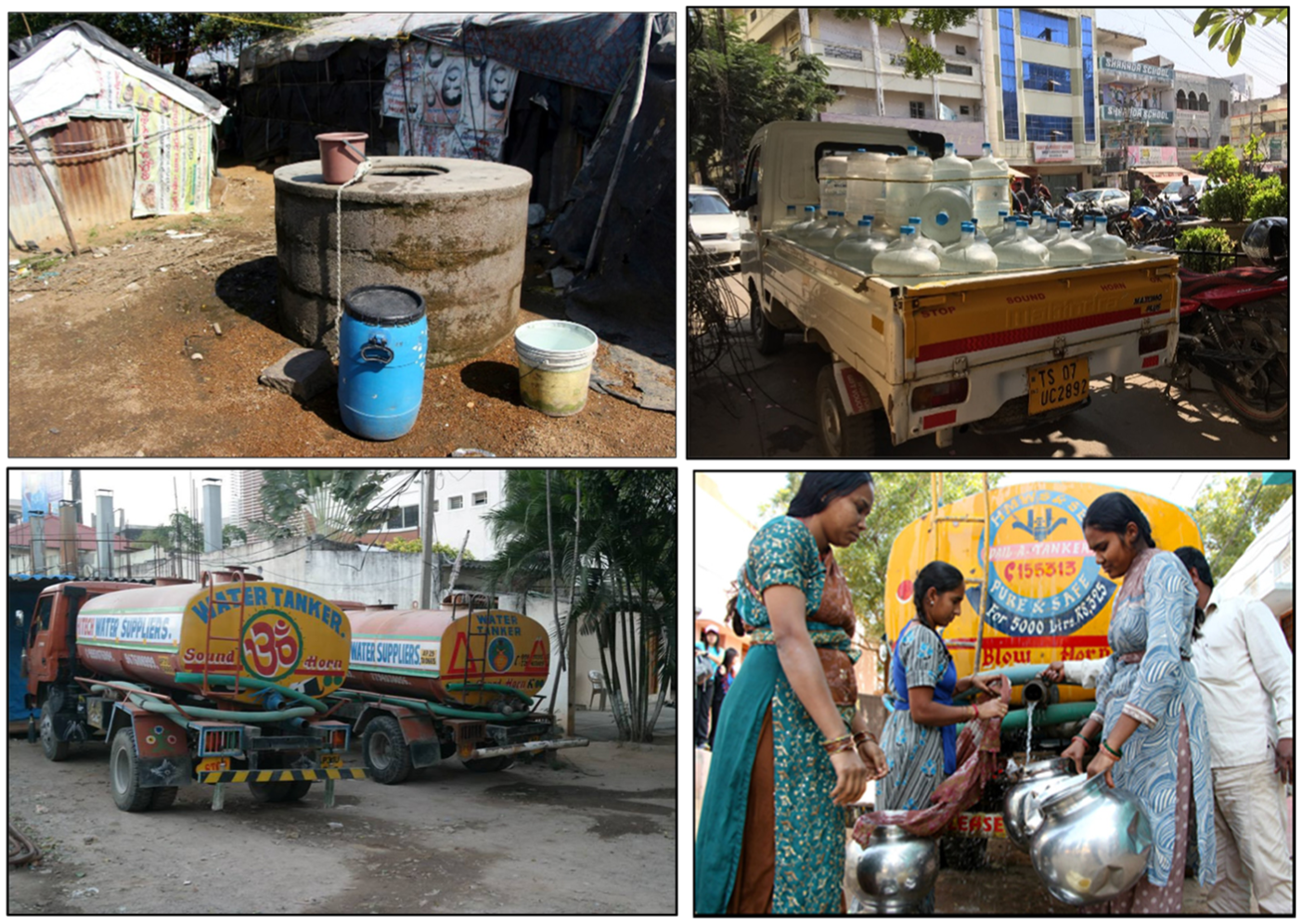
Poor marginal Madhapuris show resilience by accessing and storing water using dug wells, purchasing water containers and sourcing water direct from tankers to their ghadas (traditional pitchers).
Living with desiccation: Possibilities of flourishing?
The neoliberal force of Madhapur’s hyper-urbanisation resulted in the spatial segregation of public resources – especially water. Emerging neoliberal logics resulted in the collapse of public infrastructure agencies, state withdrawal of essential subsidies to the marginalised section of society and increasing privatisation of the water sector (Das, 2015; Desai, 2018). Historically, Hyderabad’s landscape was dotted with thousands of small and medium-sized natural lakes that stored water during the monsoon season and replenished the groundwater level. Near Madhapur, there were several lakes that allowed the farming communities to access water. However, with the development of Cyberabad, destructive real-estate speculation and construction led to shrinking water bodies, infilling and eventual drying up of the lakes (Maringanti, 2011; Prakash et al., 2011). Water networks could not keep pace with increasing demand. Around the same time as the major urban and industrial development of Cyberabad, the state government, under the World Bank’s SAP prescriptions, reduced subsidies for water, increased the tariff for water supply and widened the gap between the haves and the have-nots. Unregulated water trucks indiscriminately take water from surrounding agricultural areas to hydrate the thirsty city.
Scholars have been observing this increasing trend of water privatisation, especially in the cities of the Global South (Bakker, 2003, 2010; Gopakumar, 2010, 2014; Sultana and Loftus, 2012). With elites enjoying better opportunities and ‘capturing’ special privileges over the urban poor, the dispossessed and the excluded, the city has become increasingly splintered (Das, 2015; Graham and Marvin, 2001; Pakalapati, 2010). The Central Groundwater Board (CGB) estimates the Ranga Reddy district surrounding Hyderabad utilises nearly 70% of its groundwater to meet urban demand (Prakash et al., 2011). Over-exploitation of groundwater has resulted in changing agricultural practices and productivity (Mukherji, 2004; Saldias et al., 2015; Shah, 1993). The city appears to be drinking itself dry, with minimal governance structures committed to resilience in place to plan and prevent what will be a disastrous situation, as the water is running out (Niti Aayog, 2018; Verma, 2016).
Within the governance structure of Madhapur there are different scales of democratically elected political offices. However, when officers belong to different political parties it is difficult to achieve a cohesive and consistent plan for sustainable living for ordinary residents in Madhapur and Hyderabad (Tyler and Moench, 2012). Before the creation of Telangana state we interviewed two key elected political figures responsible for planning and policy implementation in the Serilingampally municipality in the Ranga Reddy district, which includes Madhapur and Cyberabad. The Member of the Legislative Assembly (MLA) at that time was part of the national ruling party, the Congress Party. He defined his responsibilities as ‘welfare and development of the public of this constituency, especially on education and health and secondly [finding a] solution for drinking water shortage. I concentrate on roads, drainage and basic needs of the public as it is my duty.’ This MLA became involved in politics when aged 19 through the rural village political structure, growing up alongside Cyberabad’s urbanisation process yet lacking any formal experience or training in urban planning. The growth of Cyberabad therefore created a new form of political constituency lacking experience of urbanisation and industrialisation processes. We posed the question: ‘What are the needs of the residents of the areas surrounding HITEC City
5
in order to live a comfortable life?’ His response surprised us, given what we observed and were told by residents of Madhapur: Here all are living comfortably. We need to provide fundamentals such as drainage system, roads, parking etc., we have already done as much as possible, and still we need to do [more]. We spent 200 crores to build underground drainage system at Serilingampally. [1 crore = US$200,000]
Although the whole municipality is named, in reality the underground drainage system was built as part of Cyberabad’s infrastructure and yet, even within this area, we observed and smelt raw sewage flowing out of large drainage pipes emerging from a hill slope, running into an open shallow ravine. One such example was in the Google compound. However, the MLA did articulate an awareness of the key problems associated with the rapid urbanisation created by the Cyberabad ‘vision’. He noted rapid increases in housing rents and prices; the increase in population through migration (skilled and unskilled workers); the lack of adequate facilities and infrastructure; poor quality roads; and the need for better education and drinking water provision. The MLA did not appear to have a plan or policy to rectify these problems; he appeared aloof from the daily stresses of living in such a place as Madhapur.
The second key political office bearer interviewed was the elected Corporator and member of the TDP. Asked to explain the context of his role as Corporator, his response provided a key insight into this particular aspect of the governance structure and the connection with ordinary people: I work for Serilingampally – 112 division, it is a big division with 85,000 voters and it is expanding … When elected as Corporator, we have to listen to the problems, needs of the people. The reason for not meeting their need is politics and consequences. If the MLA of the constituency happened to be of ruling party and the representative is from opposition party, then it will become bad for the people. In spite of their [MLA] … opposition, we are going forward with the strong will to develop our division. In the council of Greater Hyderabad Municipal Corporation (GHMC), I bring the issues of this area, like roads, water, especially drinking, and electricity supply etc., to their notice and to distribute sufficiently. Why? Because the population is increasing here day by day … the above are to be supplied by the central and state governments.
When asked about his responsibilities towards his division he answered emphatically, Every citizen of our division has to inform their problems to the Corporator. The problems are such, arrange drainages, if water is stagnated, or non-availability of current, water, whatever it may be. So, I am involved 100% in solving their problems.
It was clear that the Corporator had a much deeper understanding of the water situation than the MLA and was very aware of how it affected people on a daily basis. His constituency meeting room was very basic, and on the evening of our interview, a stream of people came to report their problems. A neighbourhood that is really struggling with poor water supply can petition the Corporator directly; he reports this through to the GHMC and water tankers are dispatched. Nevertheless, this is merely a response to an immediate need; those tankers will be directed elsewhere once another neighbourhood petitions for help. Hence, it is the antithesis of the emerging resilience approaches outlined at the start of section ‘The history and contemporary context of Hyderabad’s geographies of water: Practices and losses of resilience? It is a react-and-act rather than an integrated, complex and multi-stakeholder approach.
Madhapur is a big neighbourhood. We observed affluent residential areas with piped water supply and pockets of slums, hostel blocks and low-income households with no supply at all. Walking through Madhapur and talking to residents, we understood that access to water is one of their primary everyday struggles that demands strategies of resilience. Richer residents have piped water connections but no guarantee that water will be supplied for a sustained number of hours and/or every day. Poorer residents used to depend on groundwater sources ranging from water wells to deep-water bore-wells; however, with increasing population and demand for water the groundwater table has been depleted significantly. A resident of Madhapur and employee in Cyberabad said: Here we are facing the problem of (lack) of water – with less rainfall and depleting groundwater. We are facing water scarcity due to more big buildings in the surrounding areas, there is no water, and we have to go deeper than 800 feet to get groundwater.
He reported that in Cyberabad, software companies, five-star hotels and residential condominiums have piped water supply. However, in response to the unreliability of supply, residential neighbourhoods and office buildings have their own deep bore-well systems to access groundwater, similar to the ubiquitous back-up electricity generators in those same areas. Such extraction has inevitably affected Cyberbad’s and Madhapur’s water table, creating increased water inequalities; water self-sufficiency of the past has dwindled alongside financial resources as people pay more and more for less and less water.
More than half of the resident interviewees commented negatively on water provision, rainfall decline and a lowering water table. Residents’ commentaries about water as an everyday struggle were linked to knock-on effects of rising costs, social inequalities and perceived climate change. A Madhapur resident and primary school teacher lamented that the cold weather used to bring rain but now the area was getting hotter, drier, and the rains less and less. She commented, ‘the city has a lot of job opportunities, only water scarcity is a problem. Without water, food prices increase, everything is more expensive … local people cannot cope, only the richer migrants.’
One 70-year-old resident articulated long-term practices of capturing and storing water in previous decades. He was in despair about the current water situation. Despite his experience, knowledge and water-management skills he could no longer fulfil his family’s water needs. We asked about neighbourhood problems: Still not much infrastructure development. See the road is not good, no good drainage, no drinking water facility, while the water pipes are there, it gives water only few days in a week, and also water theft is a big issue … Now ground water is a problem, as population in this neighbourhood is increasing, ground water is depleting. People need to buy water as the piped water is not available and very insufficient. We are not able to water our plants, even big-plants [trees] need water, we are not in a position to care for them. Also the Municipality is not in a position to give water to people. I get drinking water every alternate day from the piped municipality water facility, only for 15–20 minutes. So we have to use our drinking water very carefully … Earlier ground water was available, some 10–15 years back, but now depleting. Earlier we used to get water at 350 feet depth but now even if you go to the depth of 1000 feet, you will not get water here. This is the negative thing of growth in this area … this is affecting [us badly].
Many residents in Madhapur acknowledge that water provision and conservation used to be better but was deteriorating rapidly. People’s resilience matters little when something as essential as water is so scarce.
Going back to the future? Possibilities of hydrating Hyderabad
To understand the present situation of Hyderabad’s hydro landscape and the plans for re-hydrating the region, we first examine the colonial era’s governance practices, which mark the beginning of the end of historical practices of water resilience.
In order to maximise agrarian economic opportunities, British colonial governors created massive canal systems across India, largely ignoring earlier water practices (D’Souza, 2006). Colonial rulers invested heavily in irrigation works as they directly benefited India’s agricultural export economy. In 1854, Lord Dalhousie successfully encouraged private investment in irrigation technologies in India, especially Southern India, as it promised good rates of return (Reddy, 1990). Colonial rulers insisted that canal irrigation was a ‘positive contribution’ to India, yet Whitcombe (1972) demonstrated that new colonial technologies brought adverse ecological consequences along with destruction of irrigation culture and traditional wells (cited by D’Souza, 2006: 622). Rao (1985) noted that development of the Krishna River irrigation project led to rising water taxes for ordinary farmers and increasing salinity of the land, resulting in decreased agricultural output. Agrawal and Narain (1997) argue that the colonial pursuit of profiteering through irrigated agriculture led to a systematic destruction of traditional water-harvesting systems across India. The colonial technologies were not only unable to deliver perennial irrigation but ‘aimed at eliminating the traditional systems’ (D’Souza, 2006: 624).
After independence, water resources in India were governed at federal and state levels (see Angel and Loftus, 2019, for concerns about reliance on state-centric water justice). At the federal level, complex policies were implemented that continued to benefit water bureaucracies and large irrigation projects, including the Krishna River projects of Andhra Pradesh (Mollinga, 2005). At state level, a protective approach has been taken in relation to water policies, often to secure political gains (Venot et al., 2011: 164). Telangana and Andhra states have been negotiating with each other since 2014 for precious water resources. Securing water has become Telangana’s foremost priority because Hyderabad is a high-tech global hub and hence water provision is essential for ongoing economic sustainability.
In 2014, one month after the formation of Telangana state, the new state irrigation department carried out a survey of water tanks across the state. Unlike earlier state governments, the new government, led by the party of Telangana Rashtra Samiti, is critical of subverting water from major state rivers to lubricate the urban and industrial needs of Hyderabad. They are concerned about the lack of proper water and irrigation planning by earlier regimes, which has led to frequent droughts in rural Telangana, subsequent farmer suicide, and an exodus of the rural poor to Hyderabad and the surrounding peri-urban region. Aware of acute water shortages in both rural and urban Telangana, the state government recently launched two mega projects to solve the water crisis.
Telangana state has about 46,600 abandoned and neglected water storage tanks/sources. These tanks previously ensured a higher degree of water self-sufficiency in the region. Scientists and scholars have advocated the need to save these tanks and to ensure better state irrigation facilities (Reddy, 2015). The current state government, therefore, launched ‘Mission Kakatiya’ in 2015 to restore these tanks by 2020 at the cost of nearly US$3.5 billion. The state government will bear half of the cost; the rest will be drawn from loans and grants from federal agencies and financial institutions (Seetharaman, 2016). The Mission has a tagline: Mana Ooru Mana Cheruvu, meaning ‘Our Village Our Pond’, to publicise the retrieval of minor irrigation systems and tank restoration and encourage community participation to work towards sustainable water security. Beilin and Wilkinson (2015) stress the importance of recognising local knowledge and the role of community involvement in securing social justice and resilience (also see Douglass and Miller, 2018). For Telangana, restoration involves de-silting tank beds for increasing water storage capacity, repairing water infrastructure, improving irrigation channels and adopting community-based irrigation management. This will result in better groundwater retention in the surrounding region, increase the storage of water during the monsoon, expand irrigation capacity, and maintain water security. The project is broadly appreciated but scientists have advised the state government that it is essential to adopt a proper scientific approach to the mission; Kumar et al. (2016) caution that the water tank rejuvenation through Mission Kakatiya should be approached through the lens of civil engineering combined with local hydrology and ecology factors. Civil society champions stakeholder governance to encourage people’s participation and recognise the importance of learning from similar exercises already carried out in the states of Tamil Nadu, Karnataka and Pondicherry (Reddy, 2015: 484).
In 2016 the second Telangana water project, ‘Mission Bhagiratha’, was launched. This more ambitious project is a drinking water project involving the laying of 126,000 km of networked pipeline with smart grid and optical fibre cables. The project envisions provision of water to nearly 25,000 rural villages and 67 urban centres across the state by 2019 and is expected to supply 100 litres of water per person in rural areas and 150 litres in urban centres. At a cost of nearly US$8 billion, the project will create a water grid by connecting water resources from two major perennial rivers flowing through the state – the Krishna and Godavari – with nearly 40,000 million cubic feet in total. KCR has prior experience of a successful water project. In 1996, as the MLA of Siddipet, he planned and oversaw a water distribution project that cost US$10 million, utilising the natural gradient of the landscape to supply water to nearly 180 villages in his constituency. Following similar physical geographical advantages, the new project also uses the natural gradient of Telangana state where water flows from north-west to south-east.
While the state government needs an investment of nearly US$11.5 billion for both projects, the chief minister is confident that through state and other federal agency investments, the programme should be completed on time. Mission Bhagirathi and its smart water grid network implementation has attracted interest and visits from several other subnational states. KCR has stated ‘Mission Bhagirathi is going to be a role model in the country’– a policy mobility rhetoric echoed decades earlier by Naidu in relation to his vision for making Hyderabad a global cyber enclave and role model for other states in India, but with very different outcomes for rural and urban residents in the young state. Whether this actually happens is open to conjecture; it is too early to measure the impacts and benefits of these projects (Kumar et al., 2016).
Conclusion
Historically, Hyderabad and its environs recognised that water was an essential and yet scarce resource that had to be technically managed and safeguarded if the region was to be resilient and work towards sustainable development, especially in agriculture. Located on the main trade route between southern and northern India, Hyderabad expanded, so water bodies were enhanced to ensure provision. However, changes under British colonial rule created new and lucrative irrigation schemes, designed to generate wealth for the British nation, but subsequently resulted in non-sustainable agricultural schemes and broke the centuries-long practices of water capture and conservation. Independent India forged a path of urban, industrial and economic growth; the state of Andhra Pradesh benefited from this expansion and success. However, as the fundamental element of water was neglected, the region became more and more desiccated. Cyberabad’s birth in the 1990s impacted upon the surrounding rural areas in profound ways with land grabbing, real-estate speculation and destruction of rural livelihoods, which combined to reduce rural people’s resilience, carefully constructed over generations of living with environmental risk. Their enforced migration to, or enclaving of, villages around Cyberabad accelerated unplanned and non-sustainable urbanisation. Since then, Hyderabad has been a city of desiccation with pockets of watered areas flourishing. However, change is afoot; political commitment to sustainability and resilience has been enacted, policies drawn up and different scales of engineering put into practice. Hyderabad is in the process of re-hydration but key questions remain and will require deep, critical, ongoing engagement with the projects, implementations and outcomes. The ongoing water projects necessitate continued vigilance and a focus on key research questions: Can urban and rural residents continue to demonstrate resilience until the water projects begin to function? Will the water flow really be more equitable? Will resident neighbours of Cyberabad begin to experience flourishing in ways that will enhance their lives and bolster their urban resilience? Can water for the future be garnered through resilience practices of the past?
Footnotes
Acknowledgements
We both thank members of the Social and Cultural Geography Research Group of the Department of Geography, NUS, for their insightful comments and discussion of an earlier draft of this article. Finally, we are thankful to ARI, and very grateful to the editors of the special volume and the reviewers for their useful, constructive comments and suggestions.
Declaration of conflicting interests
The author(s) declared no potential conflicts of interest with respect to the research, authorship, and/or publication of this article.
Funding
The author(s) disclosed receipt of the following financial support for the research, authorship, and/or publication of this article: This article was in part supported by funding from the Global Asia Institute of the National University of Singapore: Grant Number R 109-000-111-133 and National Institute of Education (NIE) AcRF Tier 1 Grant (RI 7/14 DKD).
