






Abstract
Instances of ‘hostile design’ appear across urban space, aimed at pushing particular behaviour – and, ultimately, particular people – out of public areas. But notions of hostile design and related concepts require theoretical clarification. Empirical study is also urgently needed on how such designs influence attitudes, behaviours and health, with implications for cities’ approaches to everything from homelessness to heatwave relief. This critical commentary reviews the main examples of hostile design, considers what, at minimum, must be addressed by theoretical accounts of this phenomenon, and identifies empirical research projects that are just waiting to be performed.
Introduction
The idea that design and architecture can be ‘hostile’ has become increasingly influential in popular discussion on the politics of public space (e.g. Maxwell, 2014; Morton, 2016; Quinn, 2014). This notion is used in critiques of the practice of designing public-space objects in a way that discourages certain uses, and that has the effect of deterring the presence of particular people. While urban environments have always been crafted with an eye toward influencing behaviour, design strategies for discriminating against particular groups are continually evolving and their implementation may be on the rise.
Academics are now beginning to join the discussion, with a scattering of individual contributions pulling together ideas from a disparate collection of disciplinary perspectives, including law, radical geography, urban studies, surveillance studies, planning, design, sociology, activist art, criminology, philosophy and more (e.g. Chellew, 2016; de Fine Licht, 2017; Léopold, 2013; Petty, 2016; Rosenberger, 2017a; Savičić and Savić, 2013; Schindler, 2015; Smith and Walters, 2018). 1 This budding contemporary work builds on a rich history of research on systems of power, surveillance, privatisation and discrimination across urban spaces (e.g. Davis, 1990; Dovey, 1999; Flusty, 1994; Foucault, 1977; Low, 2003; Minton, 2012; Mitchell, 2014; Newman, 1972; Smith, 1996).
We can abstract from this popular and academic discussion a preliminary definition of hostile design: this refers to objects within public spaces that have the effect of targeting vulnerable groups, and which have garnered criticism (or should be criticised) for this hostility. Thus, the designation of something as ‘hostile’ is not an objective or innocent description; it is an allegation. As such, it raises questions about what should constitute public space, who should count as a vulnerable group and whether particular allegations of hostility are justified.
But there remains a need for theoretical work that helps to identify, conceptualise, categorise and understand these phenomena. Also, the topic of hostile design continues to be a missed opportunity for scientific study. Naomi Smith and Peter Walters lay out the stakes, explaining that ‘A lack of academic critique or investigation’, may result in a situation in which hostile designs are, ‘advocated as “best practice” without the attendant debate that examines the type of social spaces they produce’ (2018: 2991). The failure to study these issues not only leaves an important topic under-researched; it leaves us without the data and conceptual tools to recognise and criticise a potentially harmful and advancing urban trend.
In this critical commentary, I argue that the issue of hostile design needs both empirical study and theoretical refinement. After a review of the main examples of hostile design, I consider what factors any theoretical account of these issues must address. This commentary concludes with a brainstorm of empirical research projects ready to be undertaken.
Representative cases
When looking at the discussion in popular media and academic papers, a few main examples of hostile design emerge.
The first is the addition of spikes to a ledge or other surface to deter people from resting there (e.g. Figure 1), a practice which often targets the homeless, or ‘unhoused’, as some prefer. As we will see, the unhoused are the primary, though certainly not the only, population targeted by hostile design strategies.
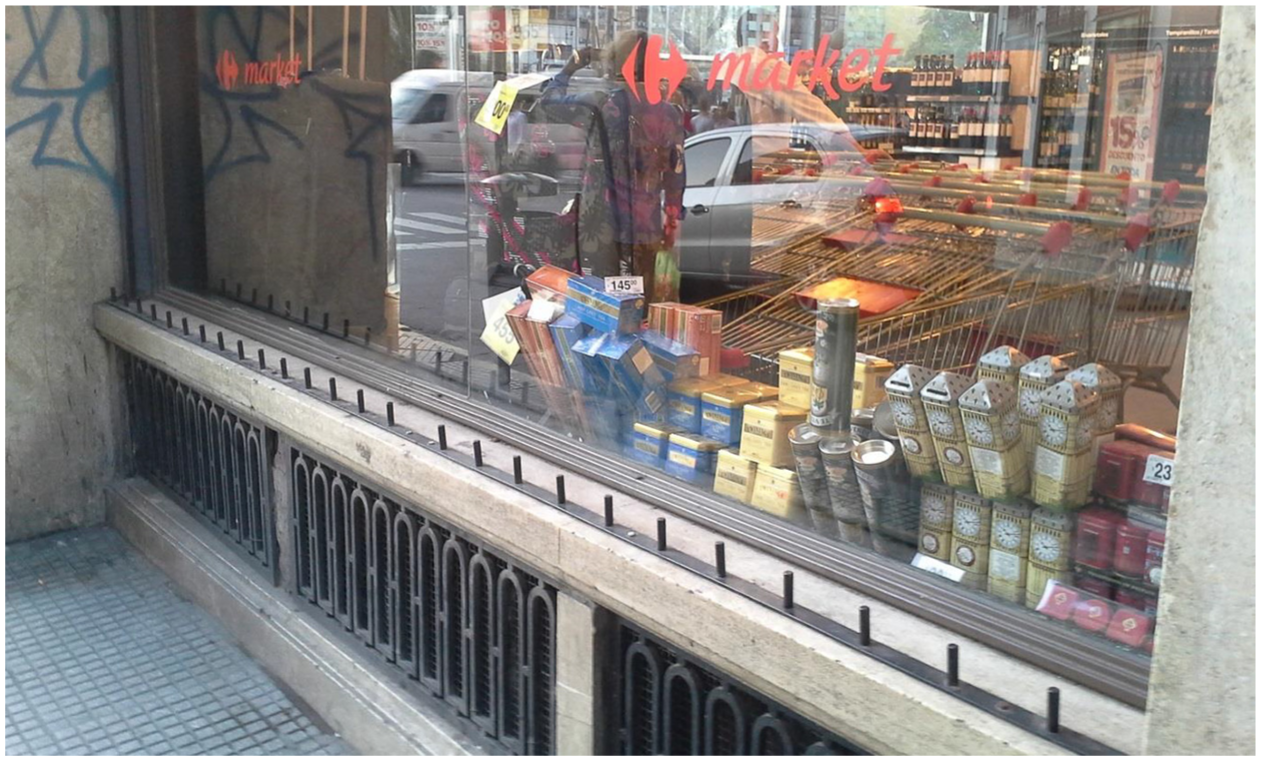
Store window ledge spikes, Buenos Aires, Argentina.
Back in 2015, the phenomenon of anti-homeless spikes in particular, and hostile design in general, was briefly brought to international attention by the backlash over a set of chrome spikes built into the ground in an alcove by the entrance of a London apartment building, inciting protests and a petition, and their eventual removal (Quinn, 2014; Rosenberger, 2014). In one important sense, anti-homeless spikes are unlike many other examples of hostile design because they are noticeable and their purpose is clear. This has prompted criminology researcher James Petty to suggest that the outrage over the London spikes ultimately reflected less the public’s support for the unhoused and more their aversion to being forced to think about the problem of homelessness altogether (Petty, 2016).
A second example of hostile design is what could be called an ‘anti-sleep bench’, that is, a bench fitted with seat dividers or armrests that discourage its use as a space to lie down, a design modification that again targets the unhoused (e.g. Figure 2).
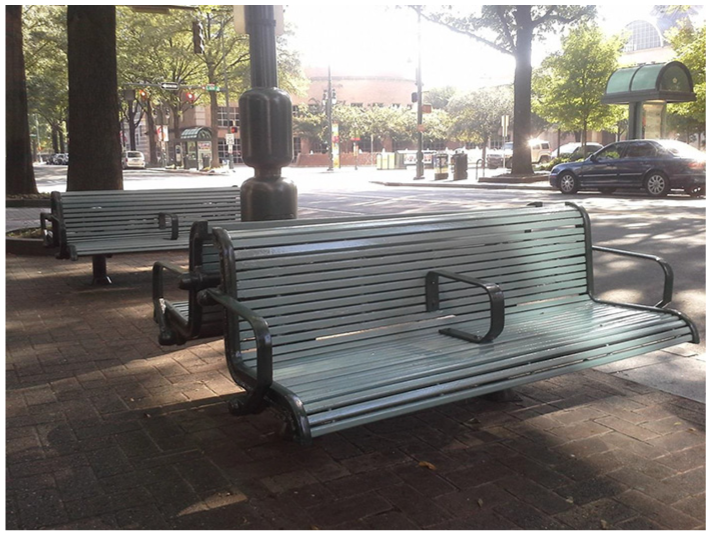
Sidewalk benches with armrests, Charlotte, North Carolina, USA.
‘Skatestoppers’ are the third example (e.g. Figure 3). Sometimes also called ‘pig ears’, these are small metal nubs affixed to ledges and handrails to deter skaters from doing tricks that involve sliding their skateboards across them.
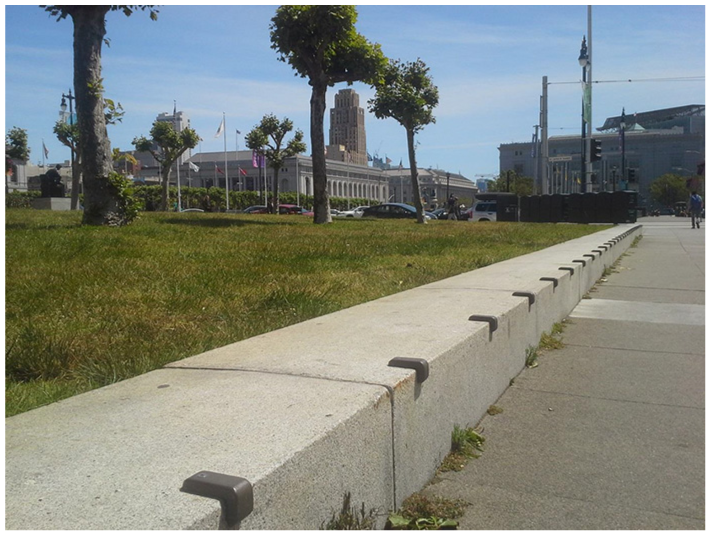
Skatestoppers mounted along a ledge, San Francisco, California, USA.
The fourth example frequently included in coverage of the topic of hostile design is security cameras. Appealing to work in the field of surveillance studies, it becomes clear that cameras can influence the behaviour of those being watched (e.g. Ball et al., 2012; Foucault, 1977; Goold, 2004; Koskela, 2003; Levin et al., 2002; Lyon, 2001; Marx, 2015; Monahan, 2010; Norris and Armstrong, 1999). But they are, of course, an odd entry as a form of hostile design because they do not physically obstruct the use of particular spaces in particular ways, as do the other examples above. There are at least two different ways that cameras are, at times, put toward agendas of controlling how, and by whom, spaces may be used (Rosenberger, forthcoming). One way in which cameras can constitute a form of hostile design is in their capacity to extend the perceptual reach of human actors (say, security guards) who may be working to restrict who may spend time in the area. But another way in which cameras can be ‘hostile’ is by their very presence, especially if it is a conspicuous presence, perhaps even marked by highly visible signage (e.g. Figure 4).
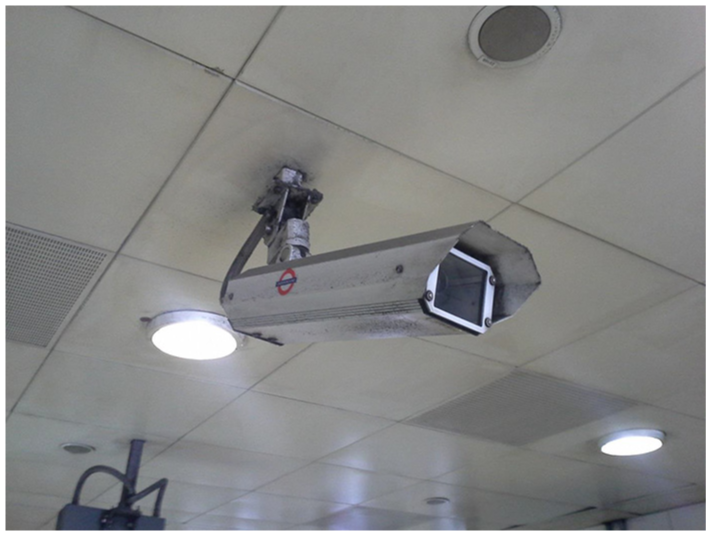
Ceiling-mounted security camera in the London Underground, UK.
The mere presence of the camera, perhaps dangling visibly from the ceiling or mounted on a tall pole, serves as a reminder to people that they may be under surveillance at any time, and it thus pressures them to follow the rules. The conspicuous security camera incites you to police yourself.
Many other things are sometimes mentioned as examples of hostile design. For example, automatic nightly sprinkler systems are at times used for warding off unhoused sleepers. Fences restrict access to alleyways or underpasses – areas at times used by the unhoused for shelter. Bollards and large planters are sometimes placed along the street in front of businesses to keep merchants from setting up temporary stalls. There are a variety of hostile alterations to the soundscape, such as noise machines to deter loitering (including some that work at frequencies only perceptible to the young). Sometimes special lighting is used that is less convenient for certain forms of drug use.
To these already-noted examples, I would add rubbish and recycling bins designed to deter picking. These can take the form of ‘rain hoods’ and other lid shapes that make it difficult to reach down inside, often combined with built-in locking mechanisms or exterior padlocks (e.g. Figure 5). Such anti-picking features could deter the presence of those who look to the bins as potential sources of discarded food, or those searching for recyclable materials that can be traded in for money (Rosenberger, 2017a, ch. 3).
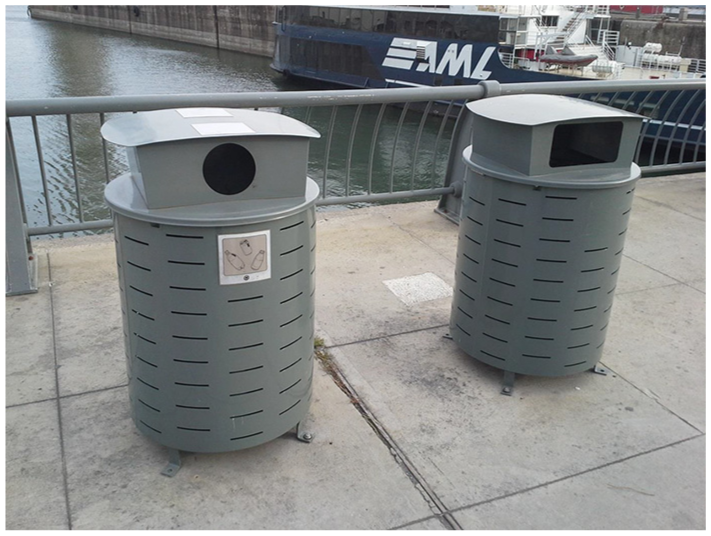
Garbage and recycling cans with built-in lids and locks, Montreal, Canada.
I would also add the example of fire hydrant locks (Rosenberger, 2017b). People in poorer neighbourhoods at times turn to fire hydrants for relief in hot summertime weather and locking mechanisms can impede this usage. This kind of lock often functions by covering over the operating nut (that initiates water flow), or it takes the form of a modified outlet cap which restricts access to where the water emerges, each of which can only be engaged by a special and exclusively available wrench or key. For example, the operating nut of the hydrant in Figure 6 is concealed by a ‘Custodian’ lock, a device which contains special magnets inside, and which allows access to the water only when a corresponding magnetic wrench is used.
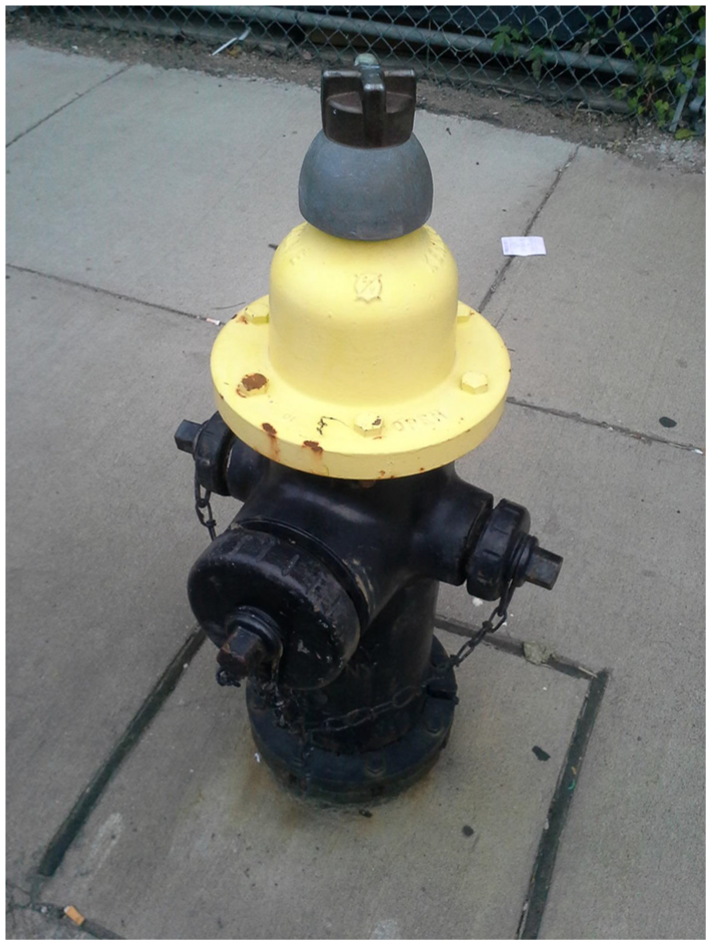
Fire hydrant with top-mounted lock, Boston, Massachusetts, USA.
It may at times even be appropriate to consider the absence of an expected public-space amenity to be itself an example of hostile design, such as the calculated unavailability of public restrooms across large swathes of a city, or drinking fountains, or seating, or shade. The absence of these things may work together to ward off the unhoused. Spikes on a ledge may do the job of deterring sitting, but so does a very short ledge, or a steeply rounded one, or the design decision to simply forgo a ledge altogether. Indeed, the work of analysing hostile designs such as the anti-homeless spikes or the anti-sleep benches may be most important not for what it reveals about any individual instance of such devices, but for what it reveals about the shape of urban space in general.
While this should not be understood as an exhaustive list of things that are at least open to criticism as instances of hostile design, I hope some general picture of this notion is emerging across these entries.
Refining the idea
I suggest that any theoretical account of hostile design must at least minimally contend with a number of things.
First, the designation of something as ‘hostile’ is of course a value judgement. An object is labelled as hostile as part of a critique. This value dimension is reflected in the fact that even the most basic vocabulary for discussing these things remains unsettled. What I have been referring to here as ‘hostile design’ is also denoted by others with terms such as ‘hostile architecture’, ‘unpleasant design’, ‘architectural exclusion’ and ‘disciplinary architecture’, among other terms, all with similarly critical value connotations (e.g. Chellew, 2016; Howell, 2001; Petty, 2016; Quinn, 2014; Rosenberger, 2017a; Savičić and Savić, 2013; Schindler, 2015; Smith and Walters, 2018). Much of this work builds on a history of research in multiple fields that has critiqued notions of ‘defensive urban design’, associated with theories of crime prevention and ‘broken windows’ policing, and connected with the increasing privatisation of urban space (e.g. Davis, 1990; Flusty, 1994; Foucault, 1977; Low, 2003; Minton, 2012; Mitchell, 2014; Smith, 1996). 2
Second, any individual instance of hostile design cannot be understood exclusively in isolation. It must also be considered in terms of any larger collection of social and political agendas within which it may play a part, and any pattern of design across the city for which it is a particular instance. Law scholar Sarah Schindler goes so far as to argue that hostile design should itself be recognised as a kind of regulation. She writes, ‘Exclusion through architecture should be subject to scrutiny that is equal to that afforded to other methods of exclusion by law’ (Schindler, 2015: 1953).
For example, the analysis of any particular instance of anti-homeless design, such as a particular anti-sleep bench or anti-pick rubbish bin, should not only be considered with regard to its local impact, but also its role within a city’s larger approach toward the problem of homelessness. To understand that individual instance, we would need to additionally investigate the larger pattern of anti-homeless devices that populate a city’s public spaces. We could consider the city’s laws that target behaviours of the unhoused (laws that critics claim have the effect of criminalising homelessness itself), such as the outlawing of sleeping ‘rough’ or camping in public places, panhandling, loitering and sitting or lying down too long in public (what are sometimes called ‘sit/lie’ laws). As political geographer Don Mitchell puts it, ‘Homeless people are in a double bind. For them, socially legitimated private space does not exist, and so they are denied access to public space and public activity by the laws of a capitalist society that is anchored in private property and privacy’ (2014: 135). In addition to anti-homeless laws and regulations, anti-homeless design must also be understood in relation to things such as the availability of affordable housing, services for addiction and mental illness, domestic abuse services, patterns of racism, a city administration’s vision for its downtown, a city’s constellations of public and private space, and more. These all contribute to a city’s approach to the problem of homelessness, an approach for which the anti-sleep bench plays a small part.
Third, theoretical accounts of hostile design must address issues of visibility. The dynamics of hostile design are shot through with expectations of who should and who should not take notice. As mentioned, many examples of hostile design are constructed specifically to remain inconspicuous to the non-targeted, allowing the non-targeted population to use the space uninterruptedly. Those not targeted by, say, skatestoppers or anti-sleep benches may often not register these devices as ‘hostile’, or even really see them at all. Targeted populations, on the other hand, may find those same devices hard to ignore. And yet not all examples of hostile design are marked by inconspicuousness to the non-targeted. Examples such as the anti-homeless spikes are noticeable as an effect of their functioning. Some, such as the conspicuous security camera, are highly visible by their very design. Remember also that an effect of hostile design (combined with the laws and other converging elements of a larger hostile agenda) can be to push particular groups out of shared spaces, thus rendering that population itself less visible. For example, in the view of critics, anti-homeless design and law not only represent a failure to solve the problem of homelessness, but they also compound the problem further by making it less obvious. Anti-homeless design and law function to hide the problem.
Fourth, any theory of hostile design must be able to account for the possibility of resistance. Among other things, a theory of hostile design is an account of power enacted through the reconfiguration of objects and space. Such an account should also offer a conception of how these acts of power taking place through design always remain open to potential challenge and counteraction. Examples of resistance efforts come in many forms. Many instances involve the straightforward vandalism of the hostile design at issue. Skateboarders have popped off skatestoppers with power tools and crowbars. Anti-surveillance activist groups have engaged in coordinated efforts to deactivate security cameras. People have found ways to hack into hydrant locks, even the sophisticated magnet-laden ones.
Another form of resistance can be seen in projects that raise consciousness of hostile designs – and the social and political agendas advanced by them – to the larger public. Activist artists and designers find creative ways to put a spotlight on the pervasive network of anti-homeless design, and they create prototypes of alternative welcoming objects and spaces. The topic of surveillance has been a special target of activist artwork, with many installations over the years finding ways to raise awareness of the pervasive system of cameras all around us. And Smith and Walters (2018) have recently articulated the ways that the straightforward act of participating in the alternative usage of space creates traces that constitute their own indications of group resistance.
Last, any theory must acknowledge the great variability within the class of things that can be called hostile designs. As such, we must recognise that our evaluations of particular types of hostile design may differ. An accusation that something is an example of hostile design should prompt considerations about exactly what constitutes public space, as well as exactly who is targeted and who benefits. They should prompt considerations about whether such an accusation is justified, and what values undergird our justifications or our dismissals.
As one aspect of this variability, we may look at all the various designs that restrict behaviours and decide which of them should be branded as hostile. Take fences, for example. Someone may criticise a fence that closes off an underpass as an example of hostile design since it deters the use of that space as a form of shelter. But maybe that same person is less critical of, say, a white picket fence surrounding an individual private residence. And that same person again might actively support the use of fences along bridges that function as suicide barriers, a form of self-harm deterrence.
So, too, might someone distinguish in their evaluation between different forms of hostile design. For example, we can imagine someone who is critical of anti-homeless design, and yet who is at the same time less critical of, say, anti-skateboarding measures. So too, again, might someone make distinctions between their evaluations of particular instances of hostile design. We can imagine someone who is critical of anti-homeless design as a trend, but who simultaneously defends a particular instance of an anti-sleep bench or anti-pick rubbish bin for the way it has an effect of assisting some vulnerable population.
In this way, we can see that any claim that something should be considered hostile (as well as any counterclaim that something should not) is never a merely innocent description. It is a context- and value-laden evaluation of the politics of urban materiality.
Empirical research prospects
The phenomenon of hostile design presents us with new opportunities for research, ones that stand wide open, and many with potential relevance to urgent policy concerns. There is a need for greater conceptual clarity here, a need for thinking about how instances of hostile design should be identified and tabulated, and a need for the development of empirical research methodologies. Several potential lines of study are immediately evident.
One necessary area of research is the straightforward investigation of the empirical reality of hostile design. What data can be gathered about contemporary trends in public-space design that have been – or could be – criticised as hostile? For example, organisations such as the National Law Center for Poverty and Homelessness (NLCHP) monitor the passage of legislation in the USA that targets the unhoused, and their work confirms that such laws are being enacted at an increasing rate (NLCHP, 2014). Advocates for the unhoused often correspondingly claim that anti-homeless devices are also being installed more and more. But the evidence for this is only anecdotal. There is a need for the development of empirical methodologies for charting a city’s hostile design in general, and anti-homeless technologies in particular, and keeping tabs on their rate of installation. Such methods could include field study, or even the use of imaging data such as Google maps. And they could include the study of policies regarding the implementation of hostile designs, analysing sources such as best-practice guidelines for the design of bus stops and subway platforms published by various cities’ transit authorities.
Another area of research waiting to be performed is the study of people’s awareness of hostile design, and their attitudes toward these devices. There is an open question about the degree to which hostile design is recognised by different populations of a city. As noted, it is possible that those not targeted by, say, anti-sleep benches or skatestoppers may not even notice these things as they walk by. This effect, insofar as it is operant, would be related to the fact that many instances of hostile design are built in a way that does not announce their ‘hostile’ function to the non-targeted, such as the bench armrests that may not openly appear to additionally perform an anti-sleep function. Meanwhile, those targeted by hostile design may remain very aware of it. Initial anecdotal findings in the work of Cara Chellew, an environmental studies researcher in Toronto, appear to support the latter possibility, for example quoting a nurse who reports that unhoused patients have fretted about the callousness of the city’s anti-sleep benches (2016). It may be a different question altogether as to how much different groups take notice of more conspicuous examples of hostile design such as anti-homeless spikes or deliberately eye-catching security cameras. Even still, if an environment is ‘normal’ to someone and its various features are passed by in the background on an everyday basis, these otherwise conspicuous instances of hostile design may grow unnoticed over time.
Insofar as people take note of hostile design, their various attitudes about these devices could be studied. Survey work could be done to identify peoples’ attitudes about particular populations, say, youths, skateboarders or the unhoused. Then these data could be compared with additional survey data on peoples’ attitudes toward the hostile designs that target these populations to see if the former serve to predict the latter. Survey work could also be done to investigate how members of targeted populations feel about these objects. Are they bothersome, or are they met with a shrug? Survey data could also potentially help determine the effects that the presence of hostile design has on people’s attitudes. It could be investigated whether hostile designs contribute to an impression of a space’s ‘proper’ or ‘intended’ usage. It could be asked whether the presence of hostile design informs people’s understandings of a city’s approach toward targeted groups. And members of target populations in particular could be asked whether and how hostile designs make them think about themselves. Whether the presence of hostile design in public spaces has an effect on people’s impressions of a city, or on specific populations of that city, is an open empirical question.
Hostile design also introduces potential public health inquiries. We can investigate whether different forms of hostile design have measurable impacts on the wellbeing of targeted groups. Take the example of hydrant locks (Rosenberger, 2017b). Empirical questions can be raised regarding whether open hydrants (if flowing safely) provide measurable relief during heatwaves, especially in poor neighbourhoods where other forms of escape from the heat may be unavailable. We could also examine whether hydrant locks diminish this relief. We could study the health effects of a programme such as the one in New York City where the local fire department can be asked to put a ‘spray cap’ on a hydrant to transform it into a community sprinkler.
On the topic of anti-homeless design, there is a debate about whether things such as anti-sleep benches or anti-homeless spikes are ultimately harmful or helpful to unhoused people themselves. Defenders of anti-homeless design sometimes claim that it is a form of ‘tough love’, discouraging the unhoused from sleeping rough, and nudging them to seek help. Critics, such as myself, instead claim that anti-homeless design works in conjunction with anti-homeless law to push the unhoused out of public spaces and into more secluded and more dangerous margins of the city (Rosenberger, 2017a). This is an issue in need of empirical data, and one with clear implications for homelessness policy.
All forms of hostile design are not the same, nor are the groups targeted by them. Different cities adopt these devices to different degrees and in different ways. Figuring out how best to understand and study this phenomenon, especially where it intersects with pressing policy issues, remains an unmet scientific challenge.
Footnotes
Declaration of conflicting interests
The author(s) declared no potential conflicts of interest with respect to the research, authorship, and/or publication of this article.
Funding
The author(s) received no financial support for the research, authorship, and/or publication of this article.
