







Abstract
Various institutional and cultural settings have shaped spatial planning systems with comparable features; however, such systems have been adapted to specific cultural, normative and spatial conditions. In line with the growing demand for international knowledge exchange in urban and regional planning, planning cultures have recently come into sharper focus. Moreover, it has become widely acknowledged that many cities in Europe and the USA have to deal with challenges posed by long-term demographic and economic changes. This also holds true for Japan. The objective of the research presented here is to comparatively investigate changes in planning cultures in view of shrinking cities in the USA, Germany and Japan. The findings will allow us to detect interdependencies between changes in planning cultures and societal changes in the wake of shrinkage, and finally to derive hypotheses for both the future-oriented development of shrinking cities, and the development of planning cultures based on the comparison of cultural settings. In this respect the paper concludes with the hypothesis that there might be planning cultures that are not framed by geographic entities (nations, regions, cities), but rather by topics along shrinking cities. This could offer insight into a new research sphere of ‘topical planning cultures’. While lasting effects and successes of policies and strategies applied in shrinking cities remain to be seen, their influence on a broader knowledge exchange, contextualisation and innovation in the sphere of planning cultures is evident.
Introduction
Various institutional and cultural settings have shaped spatial planning systems with comparable features; however, such systems have been adapted to specific cultural, normative and spatial conditions. In line with the growing demand for international knowledge exchange in urban and regional planning, planning cultures have recently come into sharper focus (see the volumes and special issues edited by Knieling and Othengrafen, 2009; Levin-Keitel and Othengrafen, 2017; Sanyal, 2005).
It has now become widely acknowledged that many cities in Europe and the USA have to deal with the challenges posed by long-term demographic and economic changes (Wiechmann and Wolff, 2013). This also holds true for Japan (Uemura, 2014). However, the complexity of this problem cannot simply be put down to ‘shrinkage’, or population loss, in urban centres (Pallagst and Wiechmann, 2005). Instead, multiple causes have to be considered. Although the connection between population loss and economic decline is not self-evident, since both processes can be the result of different causal chains, these factors remain linked as cause and effect with each other (Turok and Mykhnenko, 2007).
For a long time, shrinking cities was a stigmatised topic in planning. However, much has since been written on the topic in Europe – especially in Germany (e.g. Bontje, 2004; Gestring et al., 2005; Siedentop and Wiechmann, 2007). In the USA, the academic discussion is evolving, with more and more scholars investigating urban shrinkage (Beauregard, 2003; Hollander et al., 2009; Mallach and Brachman, 2013). The shrinkage debate in Japan has only been partially developed with regard to the situation of widespread population loss and a dramatically ageing society (Fujii, 2008; Matanle and Rausch, 2011; Yahagi, 2014).
As regards instruments and policies, Pallagst and Wiechmann (2005) hypothesise that planning for shrinking cities does not work under the preconditions of urban growth but requires a slightly different paradigm shift. For international comparative research, it remains to be seen whether this change in planning culture will be a general trend or a notion driven by local and national specifics.
The purpose of this paper is to investigate planning cultures and shrinking cities, the interconnectedness of which has not yet received a substantial amount of attention. The paper features the results of a research project tracing changes, modifications of policies and strategies in shrinking cities and − as a result − unravelling hypotheses for planning cultures. 1
Research design and methodology
This research project was fuelled by the basic hypothesis that shrinkage generates the necessity to enforce changes (Pallagst, 2010), reforms and even innovations in planning cultures. The social, economic and spatial transformations triggered by shrinking processes present specific challenges for urban development and spatial sciences (Hollander, 2018; Hollander et al., 2009; Oswalt, 2004; Pallagst and Wiechmann, 2005). As the causes and effects of shrinkage have comparable trajectories in different countries (Pallagst, 2009; Pallagst and Wiechmann, 2005) − while national discourses and suggested solutions will most likely differ − it may be argued that international comparative research offers a purposeful engagement with planning cultures and expands empirical research on the subject.
Consideration should also be given to the fact that planning areas in the USA, Germany and Japan offer very specific, yet different, cultural settings. These countries have been selected according to the ‘most different systems’ approach, based on comparative studies in political sciences (Otner, 2010). While US planning culture has been labelled ‘market oriented’ (Pallagst, 2007), that in Germany offers a more elaborate multi-level planning system, often criticised as being inflexible (Heemeyer, 2006). Japanese planning culture is traditionally based on a highly bureaucratic and centralised top-down model. Within this model, the central government of Japan is considered to be ‘all-knowing’ (Feldhoff, 2008: 37).
The objective of the research presented here is to comparatively investigate temporal changes in planning cultures in view of shrinking cities in the USA, Germany and Japan. The aim is also to comparatively analyse the planning strategies and instruments connected to urban shrinkage and its causes. The findings will allow us to detect interdependencies between changes in planning cultures and societal changes in the wake of shrinkage processes, and finally to derive hypotheses for both the future-oriented development of shrinking cities and the development of planning cultures based on the comparison of cultural settings.
To accomplish these goals, the case studies are characterised by the respective economic, demographic and urban development. The three cities (Cleveland, Bochum and Nagasaki) are categorised based on already-existing shrinkage typologies (Wiechmann and Wolff, 2013), the acceptance of shrinkage (Farke, 2005) and development paths of policies and urban planning (Danielzyk et al., 2002). This categorisation tests a form of classification previously developed by Pallagst et al. (2017). Existing terms, definitions, typologies and theoretical approaches towards shrinkage and planning cultures are also considered, to provide a comprehensive overview of both research topics.
The cities in the case study (Cleveland, Bochum and Nagasaki) were selected based on the ‘most similar systems’ approach (according to Pierre, 2005). This choice was also motivated by the results of the EU COST Action Cities Regrowing Smaller (CIRES), which showed that, of all the European cities with more than 10,000 inhabitants, those with a population between 300,000 and 500,000 are most often affected by shrinkage (Wiechmann and Wolff, 2013). All three cities have similar population levels, shrinkage patterns and industries. Additionally, all three cities have applied major strategies to find innovative solutions to shrinkage-related problems.
The case study research applied a contextualised comparative approach to find variations, and common features and differences were put at the centre of the investigation (Booth, 2011). The selection of case study cities was also based on the following hypotheses:
Severe shrinkage problems are present in all three cities, leading to a change in traditional planning strategies and the adaptation of established planning instruments or the use of new instruments.
Planning strategies are embedded in the local cultural context and cannot or can hardly be transferred to other cities regardless of similar conditions.
Despite this limited transferability, there are signs of convergence in the development of planning cultures initiated by shrinkage.
To unravel best- or worst-practice examples, as well as advantages and disadvantages of strategies and measures utilised in shrinking cities, the method of embedded case study research (Yin, 2003) was applied. With this approach, in-depth analysis of actors, their motivation, actions, chances and limits, can be assessed.
The core of the investigations relied on primary data from 40 distinctive, semi-structured, in-depth interviews in the years 2017 and 2018 with government agencies (city planning departments, regional entities and ministries), political decision-makers, NGOs, developers and academics. The interviewees were chosen as key stakeholders of planning and development agencies as well as key persons in specific projects. The language barrier in terms of Japanese, which was initially identified as a risk for the success of the project, was managed by involving one of the co-authors as an interpreter in all interview settings in Japan and to identify relevant data and documents. These interviews were prepared and evaluated on the basis of statistical data, archive material and a sound review of literature on shrinking cities in the USA, Germany and Japan. If permission was granted, the interviews in Japan were recorded and transcribed. Interviews with German- and English-speaking experts were documented as interview notes by a second interviewer not directly involved in the discussion. The notes and transcriptions were analysed regarding the content and answers to the questions from the interview (Mayring, 2007).
The interview questions for all cities partly focused on the current situation regarding population development and housing, and possible critical points in the history of urban development (e.g. major shutdown of plants, the introduction of policies, etc.). Furthermore, the perception of shrinkage as a problem (both by city officials and the public), and specific policies applied in neighbourhoods with high vacancy rates to stabilise prices and improve the quality of life, were captured. In addition, specific aspects regarding the cities were considered, such as suburban development in Cleveland, the metropolitan/regional setting of Bochum and national programmes in Japan.
The results were verified at a workshop (2017 in Kaiserslautern) with a select number of stakeholders from the case study cities in order to generalise the findings. Preliminary results of the case study analysis were presented and specific questions were asked of the experts to verify the results. Additionally, an open discussion questioned specific answers and statements given by the experts. This workshop offered practitioners and academics the opportunity to discuss and anticipate the possible impacts of changes in planning for shrinking cities, outline ambiguities and gaps in knowledge regarding planning for shrinking cities and identify the possible impacts for research on planning cultures.
Conceptual framework
Contextualising planning cultures and shrinking cities
In order to investigate how planning is changing in view of shrinking cities, the authors turned to the research sphere of planning cultures. Research work (Othengrafen, 2010) has specified the criteria needed to define planning cultures:
General context displays the basis of a planning culture comprising a more general understanding.
Planning context displays the values and beliefs of professional planners.
Planning toolset refers to the policies and strategies applied in a specific setting.
For this study, the third criterion (the ‘planning toolset’) was considered and modified by the authors, as the research was designed to be empirical. The planning tools were grouped into two categories:
Guidelines and policies, such as urban regeneration guidelines, economic policies, guidelines for urban structure.
Strategies such as masterplans, substitute industries, land banks, greening/green infrastructure, neighbourhood programmes and plans.
In previous research, Pallagst et al. (2017) developed an analytical framework for planning cultures, which engaged both the perception of shrinkage and the many strategies applied when dealing with such a phenomenon, for example, ignoring the development or taking the shrinking cities problem more seriously (in various degrees) (Danielzyk et al., 2002). By ignoring the problem of shrinkage and continuing traditional growth strategies, the planning culture faces only minor changes with little evolvement over time. The rationale behind this is that the perception and acceptance of shrinkage largely influences the choice of planning approaches in shrinking cities (Pallagst et al., 2017). A modified version of this framework was applied here to typify the case study cities according to their respective development patterns related to their perception of shrinkage (see Figure 1). Figure 1 illustrates the analysis of cases from the conceptual framework of perception and strategies. In a comparative mode, the chart displays the main strategies and approaches undertaken by the three cities to deal with shrinkage. The dynamics of planning with shrinkage can also be traced over time.
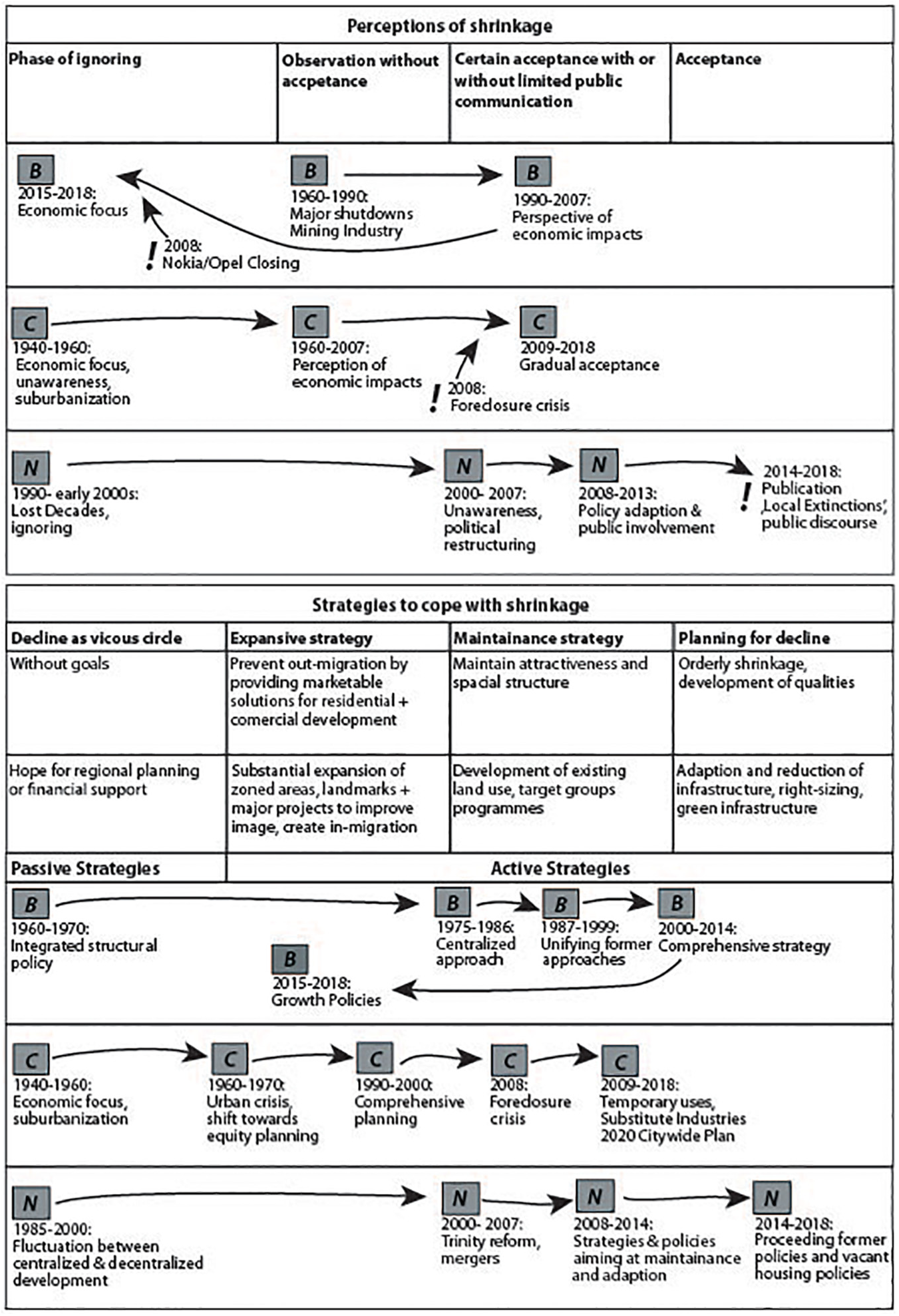
Perceptions and strategies of shrinking cities.
The value of the perception-strategies chart (Figure 1) lies in the fact that it can be applied to a range of cities confronted with shrinkage, offering an explanatory framework for cities and planning cultures.
A certain amount of momentum may be necessary to initiate strategies for change. In an investigation of path dependencies of planning approaches, Sorensen (2016) refers to these as ‘critical junctures’. For this purpose, critical junctures were identified for the case study cities, which represent turning points to start implementing policies tailored specifically towards shrinkage. These critical junctures are indicated in the chart with an exclamation point (!).
Planning cultures: Where do we stand?
While the topic of planning cultures may have experienced a recent rise to prominence in planning debates, 2 there is an undeniable level of fuzziness when it comes to defining the topic (Fürst, 2009). In particular, the growing demand for knowledge exchange and comparative research projects as part of EU initiatives makes it clear that planning culture is a component that is deeply embedded in a nation’s planning system and thus needs to be considered (Fürst, 2009). We find that at the beginning of this discourse the narrative was based on planning cultures coinciding strongly with planning systems, thus relating to national levels. However, this discourse has recently opened up towards the local level (Reimer, 2012). Additionally, Reimer also relates planning practice (as part of planning culture) to the planning context, for example, problems and challenges (Reimer, 2012). Furthermore, scholars have also suggested viewing planning cultures on the level of urban areas (Reimer et al., 2014).
While more and more academics have shaped the notion of planning cultures, it appears the definition is becoming even fuzzier. Subsequently dismantling planning cultures shows a multi-layered subject facing constant change, in part induced by factors such as Europeanisation (Reimer et al., 2014), globalisation (Sanyal, 2005), growing competition between cities and regions (Newman and Thornley, 2005) and the demands for comparative research (Pallagst et al., 2018). Moreover, it is not a static concept; it needs to adapt.
The research presented here arises from the question of how discourses around specific topics or problems in planning might affect planning cultures. Previous research by the authors had traced several similarities and differences for the joint research of planning cultures and shrinking cities:
Emerging discourses: Both topics – planning cultures and shrinking cities – can be labelled ‘emerging topics in spatial planning’, as international discourses in both areas have only started to emerge over the last 15 years. Just like planning cultures, shrinking cities were initially widely underrepresented in international comparative urban and regional research.
Planning levels: Just like planning cultures, the shrinking cities phenomenon is a multi-dimensional process, comprising cities, urban districts and metropolitan areas (Pallagst, 2008). However, especially economic transformations as a trigger for shrinkage show very different characteristics depending on national, regional and local contexts (Cunningham-Sabot and Fol, 2007).
Academia versus practice: Planning cultures largely perform as an academic concept that is lacking empirical research, whereas shrinking cities present a planning challenge that is vividly engaging practitioners and academics in search of urban or regional solutions.
Despite the fact that the context of planning culture is not the main focus of this research, 3 selected aspects should be highlighted in order to understand the complex settings affecting shrinking cities in all three countries.
US planning culture has traditionally been market-oriented, developer-driven and the breeding ground for NIMBYism (Pallagst, 2007). Individual decisions are driven by market forces and embedded in economic competitiveness. In this regard, planners’ ideas regarding quality of life for the community often stand in direct contrast to the property-driven interest of individuals (Hoch, 1994). The strong affinity towards growth found in US planning culture makes it difficult for shrinking cities to liberate themselves from this context. Even today, after the discourse on shrinking cities took off later than in Europe (Wiechmann and Pallagst, 2012), the topic is still considered to be a merely regional problem in the USA (Mallach et al., 2017: 103).
German planning culture offers quite an elaborate multi-level planning system, where policies, plans and strategies are released at every level: nation, state, region and municipality. The German government has introduced a normative framework for the development of the entire country. Utilising the so-called ‘counter-current principle’ (Gegenstromprinzip), planning levels are intertwined in a complex and inflexible system of consultations and negotiations. While economic changes have occurred in many old industrial areas in Germany since the 1970s, the debate regarding shrinking cities and policymaking started when the eastern part of the country started to suffer from the dramatic effects of post-socialist economic transitions. Combined with sustained processes of out-migration, this led to a lively debate on the issues of shrinking cities after the year 2000 (Wiechmann and Pallagst, 2012).
When looking at Japanese planning culture, we find the central government plays a prominent role. However, in the coming years it is expected that an activation of the local level will take place (Mallach et al., 2017; Uemura, 2017). Sorensen (2011) points out that a shift of power towards more decentralised policymaking has already taken place but the direct influence of local governments on policies and planning remains limited. A distinctive factor of the Japanese discourse on shrinkage is that the entire country is affected by demographic change and an ageing population. As such, the phenomenon of shrinkage is not limited to specific areas.
All three planning cultures are confronted with shrinkage. The question is: How do shrinking cities in these very different systems react? It is here that this project’s empirical research starts.
Perceptions and paths of decline in Cleveland, Bochum and Nagasaki
The following section presents findings regarding the specificities of the downwards spiral processes of the cities Cleveland, Bochum and Nagasaki in line with the perceptions-strategies chart (see Figure 1).
Several aspects of Cleveland appear to be characteristic of shrinking cities in the USA, particularly those in the ‘Rust Belt’ of the USA. Cleveland’s growth was fuelled by its strategic location by Lake Erie and important waterways during the industrialisation period. The city reached its peak population of around 915,000 inhabitants during the 1950s (Pallagst et al., 2018). However, by the end of the 1960s, Cleveland’s economy had to deal with several problems such as the structural change experienced by other old industrial cities. A general de-industrialisation trend during the 1970s led to further loss of jobs and population (Coppola, 2014). While the number of households in Cleveland fell between 1950 and 2010 by around 23%, the number of households in Cuyahoga County increased by around 118% in the same period (Piiparinen et al., 2016) because of suburbanisation and urban sprawl. Interviews with a number of stakeholders in the city surprisingly revealed that the perception and awareness of shrinkage as a problem had started quite late, with the post-2008 economic crises. Thus, this point marks a critical juncture for the city, and the point from which policies started to become more focused on shrinkage.
Bochum is a classic German example of an old industrialised city that began losing population following the decline of the mining and steel industries. The focus on only mining and steel-producing industries can be identified as the main reason for the difficult economic development in Bochum and the Ruhr Area as a whole. Thus, the incipient downturn of these industries in 1958 led to Bochum’s general decline. However, this process cannot easily be detected when observing population figures. Interestingly, Bochum’s population peaked in 1975, years after the crisis had set in (Pallagst et al., 2018). The reason is that Bochum significantly increased its urban area by incorporating neighbouring cities and towns (Mittag, 2005). The incorporation of Wattenscheid in 1975 was the last incorporation so far and marks the temporary end of population growth for the city; 40 years of decline in population has followed, with a fall from 434,900 inhabitants in 1975 to 369,300 in 2015 (Pallagst et al., 2018). While there were policies and strategies tackling shrinkage to some extent, Bochum experienced its disruptive event, much like Cleveland, in the year 2008 (interviews with city planning staff and NGOs), when the plants of Nokia and Opel closed in the city.
Nagasaki became a centre for industrialisation, new technologies and commerce at the end of the 19th century (Hein, 2016: 466). In the following years, Nagasaki also became a centre for shipbuilding and fishery, and these are still important industries for the city today. In this time, the demand for housing increased and the city developed the surrounding hills and mountain sites (Pallagst et al., 2018). These hillside development areas host small homes and have limited accessibility, making them rather unattractive today (City of Nagasaki, 2017: 18). The early 1990s saw the beginning of a trend of industrial decline which has continued until today and has enhanced population shrinkage (Yahagi, 2014). From the peak of 506,000 people in 1975, the population had dropped to 429,000 by 2015. The number of inhabitants was increased by incorporating six neighbouring municipalities (Nagasaki Web City, 2016) in 2004 and 2005. However, the problems caused by an ageing society remain. The city of Nagasaki remained unaware regarding the shrinkage for quite some time. Nagasaki’s critical juncture appears to be the 2014 publication of ‘The extinction of rural areas’ by Hiroya Masuda in 2014 (Masuda, 2014), after which the shrinkage discourse became more public in Japan. 4
Resetting policies and strategies to cope with shrinkage
Looking at the three cities’ trajectories of decline, we find somewhat comparable characteristics. This should not come as a surprise, as the downward spiral was caused by economic/post-industrial transformations (all three cases) and demographic changes (in Germany and Japan). Moreover, all three cities have brought forward planning policies and strategies to deal with shrinkage. However, this has – at least in part – happened over different time frames and with different focuses (see Figure 1). During the research, a broad range of strategies was detected in the cities. 5 The analysis reveals that planning strategies appear – in the authors’ opinion – on the one hand representative for each specific case’s approach towards shrinkage; on the other hand, they showcase innovations in planning. Based on key strategies and policies and the general approach the cities are following, three trajectories were derived from the cases, which help to characterise the cities’ planning cultures:
Cleveland: focused growth
Bochum: unifying approach and growth
Nagasaki: top-down implementation and reaction.
Cleveland: Focused growth
After the downturn in the 1960s and 1970s, the city followed a new approach, turning from industrial production to focusing on research facilities and the health sector. This led to the emergence of a new image and identity in Cleveland. Nevertheless, targeted policies were only implemented much later, following the 2008 economic crisis. As the interviews and investigations on site revealed, development in Cleveland is targeting specific neighbourhoods, which appear to be of interest to private investors. Underpinning the focused growth planning culture, the research could identify the following three neighbourhoods that are promoted as main development hubs by the city of Cleveland.
First, downtown development: most recently, tourism in the city was fuelled by the Republican National Convention for the presidential election in 2016 and the success of Cleveland’s basketball team (interviews with representatives of different local NGOs). Thus, many of the vacant former banks and office buildings located in the urban centre have recently been converted into prestigious hotels and apartments. This adds to the city’s previous attempts to develop its tourism sector with flagship projects such as the Rock and Roll Hall of Fame and the Cleveland Museum of Arts.
Second, the Greater University Circle Initiative (GUCI), which aims to increase the positive impact of the University Circle area on the surrounding neighbourhoods, some of which are most affected by shrinkage (interview with representative of local NGO). The aim of the initiative is to ‘promote dialogue about the future of surrounding neighbourhoods and to catalyse and help fund projects to transform both the built environment and the lives of residents’ (Cleveland Foundation, 2014: 24).
Third, lakefront development: further capitalising on its assets, the city has started to develop a lakefront district, which is located not too far from its urban centre. In doing so, the city has joined the general global trend of waterfront development. By developing highly sophisticated apartment buildings and restaurants, the city is targeting the millennials as the new much-acclaimed citizenry to ‘refill the doughnut’ (interview with representative of local NGO).
In addition to the focused growth approach, Cleveland is also applying a range of strategies in line with US shrinkage paths, such as the Cuyahoga County Land Bank. 6 Awareness of shrinkage has been positively increased through initiatives involving temporary uses, as represented by the Pop Up City Cleveland movement. Initiated by the Cleveland Urban Design Collaborative with the support of Kent State University, this project aims to organise short-term interventions on vacant sites or in vacant buildings to help revitalise these areas (interview with representative of NPO). Moreover, according to interviewees, the city of Cleveland aims to become a healthier city (interview with city planning staff). To achieve this, the city is mapping out a greener and more sustainable footprint. 7
The city of Cleveland has generally accepted shrinkage since 2009. However, after analysing the findings of the case study research, the authors remain sceptical about the coherence and comprehensiveness of these developments. The focus on a few neighbourhoods in prime locations is highly dependent on and driven by private investment interests. While this can be regarded as a positive factor, this approach also bears some risks. The investment priorities might easily change again towards suburban development, as in previous years, increasing the existing segregation, as improvements on a neighbourhood level often lead to gentrification and the displacement of existing residents. Furthermore, it is questionable whether investments in infrastructure for tourism are a sustainable way to push the city’s development. A coordinated public funding programme (as we find in Germany and Japan) could lead to more balanced development throughout the city. However, this seems improbable given the experiences with public-funded urban development projects and the general antipathy towards government programmes in the USA.
Bochum: Unifying approach and growth
Bochum’s approach to shrinkage can be described as ‘unifying’, meaning a strong affinity in regional planning and the attempt to amalgamate existing initiatives. As post-industrial changes caused shrinkage in both Bochum and the entire Ruhr Area, regional efforts to solve these problems started as early as the 1960s (MetropoleRuhr, 2016b). Four phases can be identified in regional development policy. In the first phase (1966–1974), integrated policy was the key element that led to the foundation of the Ruhr-University-Bochum. Earlier, the state of North Rhine-Westphalia had aimed to develop a new form of industrialisation with modern sectors; this led to the establishment of plants by car manufacturer Opel and electronics manufacturer Graetz (later bought by Nokia). While this initiative was conceived to diversify the economy, the local population remained strongly dependent on only a few major employers. During the second phase (1975–1986), development was guided by a more centralised approach. The State supported cities in managing structural change. For this purpose, vacant industrial sites were redeveloped with public funding (MetropoleRuhr, 2016a). The state of North Rhine-Westphalia was steering this development in terms of guidelines and financial incentives.
The third phase (1987–1999) was marked by attempts to unify former approaches and to complement the top-down approach of the previous decades with bottom-up initiatives. The responsibility for planning was transferred to the regional government. During this phase, reclaiming vacant properties was one of the main instruments to drive development. Another highly prominent and internationally acclaimed example for regional strategy is the international building exhibition, ‘IBA Emscher Park’. In the fourth phase (since 2000), fragmented projects have been replaced with a comprehensive strategy. Additionally, the federal government became actively involved in urban development after it became apparent that municipalities and state governments alone could not handle the financial challenges linked with urban shrinkage. 8
Besides regional efforts, the city has also initiated a range of policies and strategies (Pallagst et al., 2018). The recently updated masterplan presents a comprehensive strategy for improving Bochum through a range of projects (Stadt Bochum, 2014b). This plan, and its predecessor from 2009, represents the first comprehensive development strategy for decades and has an optimistic outlook on the future development (interview with member of the city council, Bochum).
In recent years, the city has commenced initiatives and redevelopment projects to foster economic growth. One major project is the redevelopment of the former car manufacturer Opel’s factory site, vacant since 2014. The aim is to redevelop the area with office spaces, small-scale industries and commerce (Bochum Perspektive 2022 pop). With the expertise of former Nokia employees and existing business structures in the field of IT and electronics, an IT-security cluster has formed in the past decade and is growing both in importance and visibility for Bochum’s economy. The city has also established a network between the university and the city to improve the visibility of the university (interview with representative of the city of Bochum). Another flagship project is the new ‘Gesundheitscampus’ (Health Campus) near the university.
Bochum’s masterplan includes all these new focal points and developments and presents a strategy for the improvement of Bochum through this new cluster approach and other projects (Stadt Bochum, 2014b). However, the plan can be criticised for being too focused on connecting the inner city, the university campus and the former Opel area, and neglecting the other neighbourhoods (similar to the development in Cleveland). Yet, the number of local neighbourhood development plans (ISEK) has increased over the past years. It remains to be seen if the new impetus these plans, and the cluster strategies that come along with them, can establish a positive trend for the future development of Bochum. What is missing in Bochum is a stronger engagement of bottom-up initiatives and private investors. Public funding is still a major driver for the development in Bochum.
Nagasaki: Top-down implementation and reaction
Nagasaki’s planning culture is influenced by the fact that planning is directed by the central government in a top-down system. Consequently, the city has been in a position to react. During the 1980s and early 1990s, the Japanese central government had, like other countries, neglected the problem of shrinking cities. During that time, the economy was highly fuelled by the ‘bubble economy’. 9 With rising awareness of the problem of shrinkage, in the late 1990s and early 2000s several laws regarding planning and the tax system were reformed to give the municipalities more options and better tools to deal with shrinkage (referred to as Trinity Reforms). One of these laws recognises non-profit organisations (NPOs) as actors in planning processes. These NPOs fulfil an important role within Japanese society by providing support and help for marginalised groups and the elderly 10 (Funck, 2012: 111). However, the effect of these NPOs and of the participatory approaches to planning is still small (interview with a researcher at Nagasaki Institute of Applied Science).
The city of Nagasaki has recently published a number of plans and concepts for its future development, all of which address the problem of shrinkage and its consequences. The new masterplan for Nagasaki aims to plan for a compact city by concentrating future developments within the areas accessible via public transport. While compact city approaches are not unique to planning in Nagasaki the goals are adapted to the specific shrinkage and ageing-related problems the city faces. This includes, for example, focus on the existing public transport network, restrictive development outside the access area for public transport, reducing the number of people living in areas vulnerable to natural hazards, and increasing accessibility for old people. Additionally, the plan suggests zones for development with a focus around the centre and sub-centres. For the slopes and hillsides of Nagasaki, this plan only allows very limited development (City of Nagasaki, 2016: 3). Furthermore, the city published its ‘Housing and Living Plan’ in 2012, making special reference to the housing and living conditions in Nagasaki. Besides a detailed analysis of the housing stock, this concept recommends several actions for improvements, especially regarding access to public housing (City of Nagasaki, 2012: 53–55).
In addition, the recent property tax reform may help to deal with the effects of a declining population. In 2014, high taxes on vacant land were reduced to make it easier to convince property owners to demolish vacant houses. Moreover, municipalities are now able to order demolition or renovation of deteriorated houses for security reasons (City of Nagasaki, 2017: 29).
Recent planning activities in Nagasaki started with the interventions made by the central government, during which it put a stronger focus on shrinkage. This reactive initiative from the city is somewhat surprising given the intensity of the shrinkage problem. It remains difficult to judge whether city officials have accepted shrinkage and are finally dealing with its consequences, or whether the strategies applied remain in a passive-reactive mode, as in past decades. 11 While the economic development strategy focusing on shipbuilding, fishery and tourism as traditional branches lacks innovative spirit, it follows the recommendations of the economic development concept drafted by the Ministry of Economy, Trade and Industry (METI). Similarly, the existing universities have only recently been seen as a potential source of innovation and in-migration of young people. However, combating shrinkage is a work in progress, as an updated concept is soon to be published by METI focusing on more innovative branches such as renewable energy. Compared with Bochum, where the state’s government once also had a more dominant role, this role has not (yet) evolved in Japan and therefore leaves only little room for the city government to shape the concepts for future development (one could assume that this is also not desired by the city government). Likewise, the role of private investors and bottom-up initiatives is very limited in Nagasaki. Taking care of these deficiencies could improve the effectiveness in urban development.
Conclusions
It may be concluded that shrinkage is indeed challenging existing planning cultures in a way that means planning paradigms are shifting from growth-centred planning towards more realistic and sustainable development paths, given the future demographic development. The changed circumstances in a shrinking environment lead to an adaptation of traditional, long-established ways of dealing with planning problems and therefore to a change in local planning culture. This could mean a stronger focus on redevelopment of existing urban structures or densification and compact developments. This paper has demonstrated the trajectories and strategies applied by shrinking cities, yet there are still loose ends and methodological challenges. Furthermore, this paper has demonstrated that there are different approaches to planning in a shrinking city, depending on the specific planning system and planning culture as well as the specific local circumstances. Given the empirical results of the research, future research could focus on the implications of shrinking cities for planning cultures and the areas of research that need to be dealt with further, for example, distinguishing between general trends in planning and specific reactions towards shrinkage. This might be difficult since the transfer of knowledge in a global planning community is bound to have an effect also on shrinking cities.
For a long time, urban and regional research has associated planning cultures with specific national settings or countries (Sanyal, 2005) much like the term ‘planning systems’ (Pallagst et al., 2018). In these discourses, planning cultures (e.g. of the USA, Germany and Japan) would be considered as more or less homogeneous entities. Further research (Reimer, 2012) has broadened this perspective, placing planning cultures in the context of planning levels and distinguishing between national, regional and urban spheres.
In view of the developments caused by shrinkage and the changes in planning revealed in the empirical part of the research, one might ask whether the notion of planning culture is bound to change as much as planning. Thus, we may formulate the hypothesis that there might be planning cultures that are not framed by geographic entities (nations, regions, cities) but rather by topics around shrinking cities. If so, how can planning culture be characterised or operationalised? This could, in turn, offer insight into a new research sphere of ‘topical planning cultures’. In line with this thought, the authors propose first ideas for an operative definition of planning culture. Accordingly, planning cultures are defined as follows: Planning culture encompasses the societal aspirations towards planning – its processes and its outcomes. It refers to the values and shared beliefs of stakeholders involved in planning, and the methods and tools they are applying and producing. Planning cultures are not static but constantly evolving in line with societal changes or planning related challenges. Planning culture as we see it can be attached to specific territorial entities, be they nations, sub-nations, regions, or cities − most likely but not necessarily within administrative boundaries. In addition, it can be attributed to cities or regions having to face specific planning problems.
This research has also demonstrated that in all case study cities, specific events have raised awareness of shrinkage and led to the introduction of targeted policies and programmes. There is also a long list of subsequent programmes. The question is: How far can these events be identified in path dependencies, and how far can conclusions be derived for specific policy-making patterns?
At the beginning of the research, the hypothesis was expressed that planning strategies can only be partially transferred from one planning context to another. Nevertheless, similar tendencies might be traced. The research presented here demonstrates similar or comparable patterns of strategies in the case study cities. Some strategies can be derived from the genuine context of shrinkage, such as temporary uses (Pop up City in Cleveland, Cleveland Urban Design Collaborative, 2017), or the acquisition of substitute industries (Health Campus in Bochum, University Circle in Cleveland, tourism in Nagasaki). Other strategies, policies and guiding principles for planning correspond to general trends in planning. Interestingly, the compact city principle can be found in both Bochum and Nagasaki, and – at least in part – in the focused growth approach of Cleveland. It is still not clear how these strategies interact with one another, how decision-making processes determine the selection of a particular strategy, and whether there might be other types of strategies. Further research should take these aspects into consideration.
While the lasting effects and successes of the policies and strategies applied in shrinking cities remain to be seen, their influence on a broader knowledge exchange, contextualisation and innovation in the sphere of planning cultures is evident. Case-study-based empirical research sheds light on the complex interdependence of planning, its instruments, challenges and, ultimately, planning cultures.
Footnotes
Acknowledgements
The authors would like to thank Terry Schwarz, Director of the Cleveland Urban Design Collaborative, for her support and her valuable insights regarding planning and urban development in Cleveland.
Declaration of conflicting interests
The author(s) declared no potential conflicts of interest with respect to the research, authorship, and/or publication of this article.
Funding
The author(s) disclosed receipt of the following financial support for the research, authorship, and/or publication of this article: This work was supported by the German Research Foundation [project number 314345471].
