







Abstract
This article explores a conjunctural approach to comparison as a means to capture the complexity of the processes shaping metropolitan land transformations in a city of the global South, comparing the co-implicated actions of developers and local residents across central and peri-urban Jabodetabek. A conjunctural approach shares with some other forms of comparison the ambition to build new theories and challenge existing knowledge. Rather than controlling for the characteristics of units of analysis as in conventional comparison, a conjunctural approach attends to the broader spatio-temporal conjuncture. It involves highlighting unexpected or overlooked starting points for comparison, attending to inter-place, inter-scalar and inter-temporal relationalities in order to identify shared general tendencies as well as particularities and to chart their mutual constitution. Grounding this comparison iteratively puts local knowledge and observations in conversation with already existing theories. Deploying these principles in a socio-spatial intra-metropolitan comparison, we show that economic speculation on land and property is complexly entangled with actors’ socio-cultural speculations, as they seek also to realise aspirations for distinct peri/urban futures. Economic speculation deepens already existing inequalities in wealth and power differentials between and among developers and kampung residents. The erasure of informal settlements and displacement of their residents is supplemented by the ability of other kampungs and select residents to take advantage of spillover opportunities from the formal developments built on former kampung land. Distinct central city and peri-urban landscapes are emerging, shaped by differences in the social ecology of land and local governance and planning regimes.
Introduction
Across Asia, major metropolitan areas are experiencing a great land transformation as large-scale residential, commercial and industrial real estate developments displace thousands of residents from informal settlements, supplemented by unabated immigration from smaller cities and rural areas. Their impact on the landscape is inescapable; mushrooming clusters of modernist buildings and associated infrastructure enclose land previously occupied by informal settlements and open agricultural land, displacing local residents and erasing their settlements.
Recent critical scholarship on property markets and land speculation has focused on how corporate speculative real estate investments and land grabs displace and dispossess residents across the globe (e.g. Gidwani and Upadhya, 2022; Levien, 2018; Nam, 2017; Ortega, 2020; Upadhya, 2020). Goldman (2011) coined the term speculative urbanism to conceptualise these processes and their relationship with global finance. In this article, we expand studies of speculation and speculative urbanism to embrace a broader range of actors, extending the conceptualisation of speculation to incorporate socio-cultural aspects and attending to the role of the physical and built environment in shaping speculative land transformations. Using greater Jakarta (Jabodetabek) as a case study, we examine how developers and kampung residents 1 both engage in economic and socio-cultural speculation, and how this is transforming the landscape across central and peri-urban sites.
We utilise a twofold comparative methodology. First, we adopt a conjunctural approach to comparative urbanism. A conjuncture describes the particular condensation of political, economic and cultural forces that come together in a historical moment (Hall, 1979), but also in space (Leitner and Sheppard, 2020). The conjuncture gives meaning to and shapes the norms and motivations governing actors’ imaginaries and practices, and their contestations. A conjunctural comparison extends the inter-urban relational approach proposed by Ward (2010) and others to examine how processes and places are shaped by the spatio-temporal conjuncture. It involves highlighting unexpected or overlooked starting points for comparison, attending to inter-place, inter-scalar and inter-temporal relationalities in order to identify shared general tendencies as well as particularities and to chart their mutual constitution (Leitner and Sheppard, 2020). Second, we deploy this to develop a comparison that has both a social and spatial register, comparing the actions and aspirations of developers and local residents across central and peri-urban Jakarta. As an intra-metropolitan comparison, with other scholars (McFarlane et al., 2017) we experiment with downscaling the imaginary of comparative urbanism to the intra-urban scale.
One advantage of a conjunctural approach to comparison is that it provides insights into the complexity of relations by identifying shared general tendencies, particularities and their entanglement. Shared general tendencies are wider processes and trends that are revealed through a theoretically informed comparison that places theory and observation into conversation with one another. Particularities are site specific in terms of their temporality and spatiality. Grounding this comparison in what we have learned from the field enables us, when appropriate, to challenge theoretical arguments and empirical findings that have emerged from studying other cities.
In what follows, we first lay out the guiding principles for a conjunctural comparison, in conversation with the existing literature on comparative urbanism and the emergent scholarship on intra-urban comparison. Second, we summarise Jakarta’s spatio-temporal conjuncture and that of our central and peri-urban research sites. Third, we engage in a comparative analysis identifying general tendencies and particularities that characterise the behaviour of developers and kampung residents as they speculate on land and property and on peri/urban futures. General tendencies include the complex entanglement of economic and socio-cultural speculation, and that economic speculation deepens already existing intersecting inequalities in wealth and power within and between developers and kampung residents. Yet developers and kampung residents envision very different peri/urban futures. Fourth, the intra-metropolitan comparison reveals dynamically complex inter-relations between formal developments and kampungs: Even as large real estate developments erase informal settlements and displace residents, they also create conditions of possibility that other kampung residents can take advantage of, shaping the nature of urban land transformations. However, place-specific particularities in regulatory regimes and the social ecology of land 2 at the two sites shape the speculative options available to developers and kampung residents and the emergent landscape. Concluding, we draw out the insights that a conjunctural approach makes possible for intra-metropolitan comparison.
A conjunctural approach to intra-metropolitan comparison
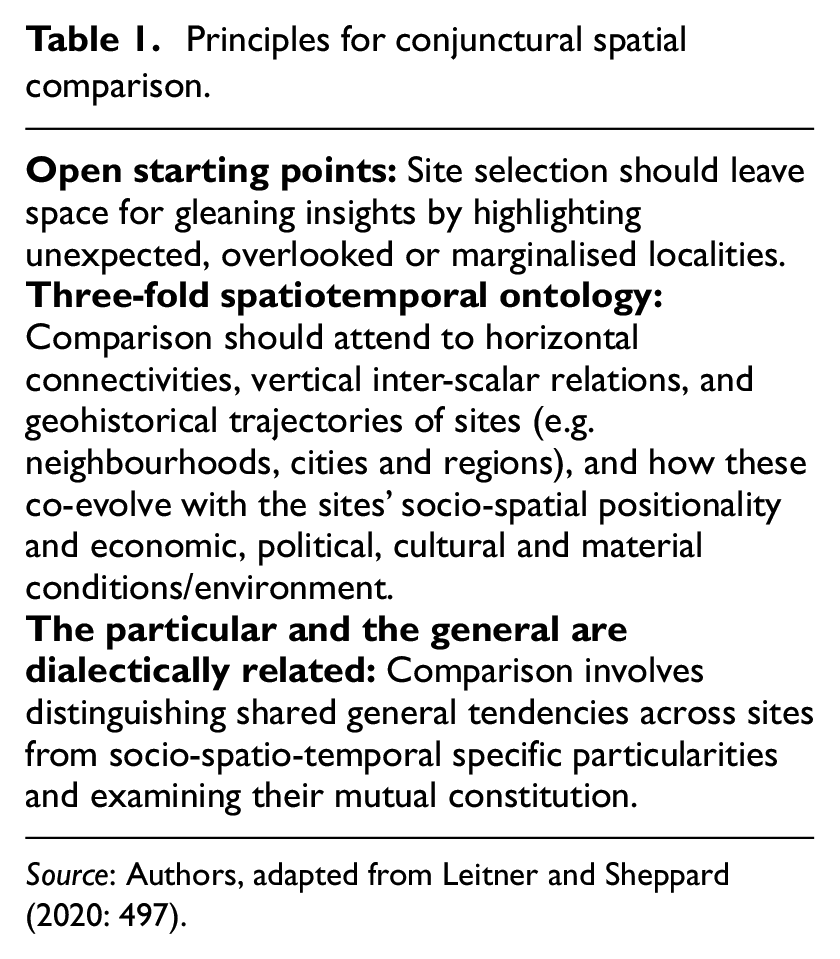
Methodologies for undertaking inter-urban comparison have become an active area of debate in recent years. The long-standing tradition in comparative urbanism (Nijman, 2007; Walton, 1990) has been to adopt approaches that treat each city as an independent unit of analysis. This utilises methods of difference and similarity in the tradition of John Stuart Mill (Ragin, 1987), or the more complex comparative strategies developed by Tilly (1984; cf. Robinson, 2011; Sheppard et al., 2020). Against this tradition, a number of scholars have come to advocate a relational approach to comparative urbanism that examines ‘how different cities are implicated in each other’s past, present and future’ (Ward, 2010: 480; Peck and Theodore, 2012; Robinson, 2011). Relational comparison recognises the reality that the openness of cities means that they cannot be treated as isolated units of analysis. It also contributes to decentring the norms of urban comparison by thinking cities through elsewhere. Robinson (2016: 22) identifies three aspects of this: Bespoke comparisons, tracing empirical connections between cities, and launching distinctive analyses from specific urban contexts. Building, like Robinson, on the work of Hart (2018), Leitner and Sheppard (2020) have proposed a relational comparative strategy that goes beyond highlighting connections between places, dubbed conjunctural comparison. 3 This entails three guiding principles for a fully spatio-temporal comparative methodology (Table 1).
Principles for conjunctural spatial comparison.
Source: Authors, adapted from Leitner and Sheppard (2020: 497).
The first guiding principle of being open to undertaking comparison from unexpected starting points is consistent with Robinson’s bespoke comparisons. Second, the spatio-temporal ontology extends relational comparison’s emphasis on the interdependencies between sites to incorporate inter-scalar relationalities and the historical trajectories and legacies at the centre of conjunctural but also post-colonial urban theory and methods. The significance of the different aspects of this ontology, and how they intersect and shape one another in complex ways, is an empirical question. Third, a mutually constitutive relationship between shared general tendencies across sites and spatio-temporally specific particularities implies that analysts should be open to the possibility that particularities can shape general tendencies, not just vice versa. Paying attention to spatiality also means acknowledging that what is general about tendencies depends on the geographical scale at which comparison is undertaken. In the case discussed here, general tendencies hold across central and peri-urban sites of Jabodetabek, but with the potential to extend to larger geographic scales. For example, if we identify that speculation deepens inequalities in wealth and power between residents in both central and peri-urban sites, this general tendency may also extend to the supra-metropolitan scale. All three guiding principles reinforce the importance of taking local knowledge and field observations seriously as potentially disruptive of theoretical convention, while resisting the fiction (Brewer and Lambert, 2001; Popper, 1959) that observations can be theory free.
Elsewhere we also make the case for extending the theoretical remit of social science comparison to the more-than-human world by conceptualising societal, material and biophysical processes as dialectically interrelated (Leitner and Sheppard, 2020: 506, fn). We attempt such an extension here, grounded in the finding that material particularities of the two sites – their physical and built environment – shape specu-lative actions and consequent land transformations.
The vast bulk of scholarship on comparative urbanism presumes that comparison is between cities. Challenging this presumption, McFarlane et al. (2017) advocate for intra-urban comparison. Comparing the access to and politics of infrastructure across two informal settlements in both Mumbai and Delhi, and three in Cape Town, they argue that intra-urban comparison provides insights into the diversity of seemingly similar settlements within cities. While conceptually committed to a relational comparison, their discussion of the empirical cases prioritises the distinct and intersecting internal economic, social, cultural and material configurations and processes of the selected sites, including residents’ practices and political governance. Similarly, Ruszczyk (2019) compares a centrally located and a peri-urban ward in Bharatpur, Nepal, examining the role of local women’s groups in fostering social, environmental and economic resilience across two districts that differ in terms of their presence and activity. Smiley (2020) compares two neighbouring wards in Dar es Salaam, Tanzania, seeking to account for stark differences in water services in settlements that are similar except for their urban form.
While highlighting unexpected starting points, these studies focus on revealing economic, political, social and cultural differences between intra-urban sites. Similarities and differences function as binary categories, into which observable features of sites are divided for purposes of comparison. They form the basis for the two classical comparative methods of difference and similarity. Dissolving such binaries, a conjunctural approach to intra-urban comparison focuses on general tendencies and particularities. Shared general tendencies are processes and trends, revealed by placing theory and observation into conversation with one another. Particularities are site specific in terms of both their temporality and spatiality. Shared general tendencies and particularities are inter-related: each potentially shapes the other, with the possibility that particularities can become general tendencies and vice versa. In order to derive general tendencies and particularities, a conjunctural intra-urban comparison places sites within their spatio-temporal conjunctures and pays attention to inter-site and inter-scalar relationalities shaping the places being compared.
Applying these guiding principles to the Jakarta case study, our comparative strategy is twofold – comparing across two geographic sites (central city and peri-urban) and two groups of participants in land transformations (developers and kampung residents) within their spatio-temporal conjunctures in order to identify shared tendencies and particularities. We treat the central city and peri-urban sites, and developers and kampung residents, as co-equal interrelated starting points – challenging any inclination to prioritise the central city or developers as the norm. Beginning with the conjunctures of the two sites, we deploy the conjunctural spatio-temporal ontology to compare across sites and groups and identify shared tendencies and particularities.
Field research design
The research reported on here is part of an international, inter-urban and intra-urban comparison of speculative urbanism and land transformations in Jakarta and Bengaluru (India). The field research was undertaken at central and peri-urban sites where informal settlements have been rapidly transforming as space is made for large residential, industrial and mixed-use real estate projects. From a large number of potential sites, two were identified through pilot research (Figure 1). The central city site is Epicentrum / Menteng Atas in South Jakarta, composed of Epicentrum – a mixed high-rise residential, office and retail development – surrounded by Kampung Menteng Atas that it has been gradually colonising. The peri-urban site is in Cikarang on Jakarta’s eastern peri-urban frontier, an area of large formal industrial and residential developments scattered among kampungs and arable land. Five rounds of fieldwork were completed between 2013 and 2017 in Epicentrum/Menteng Atas, and four rounds between 2016 and 2019 in Cikarang.
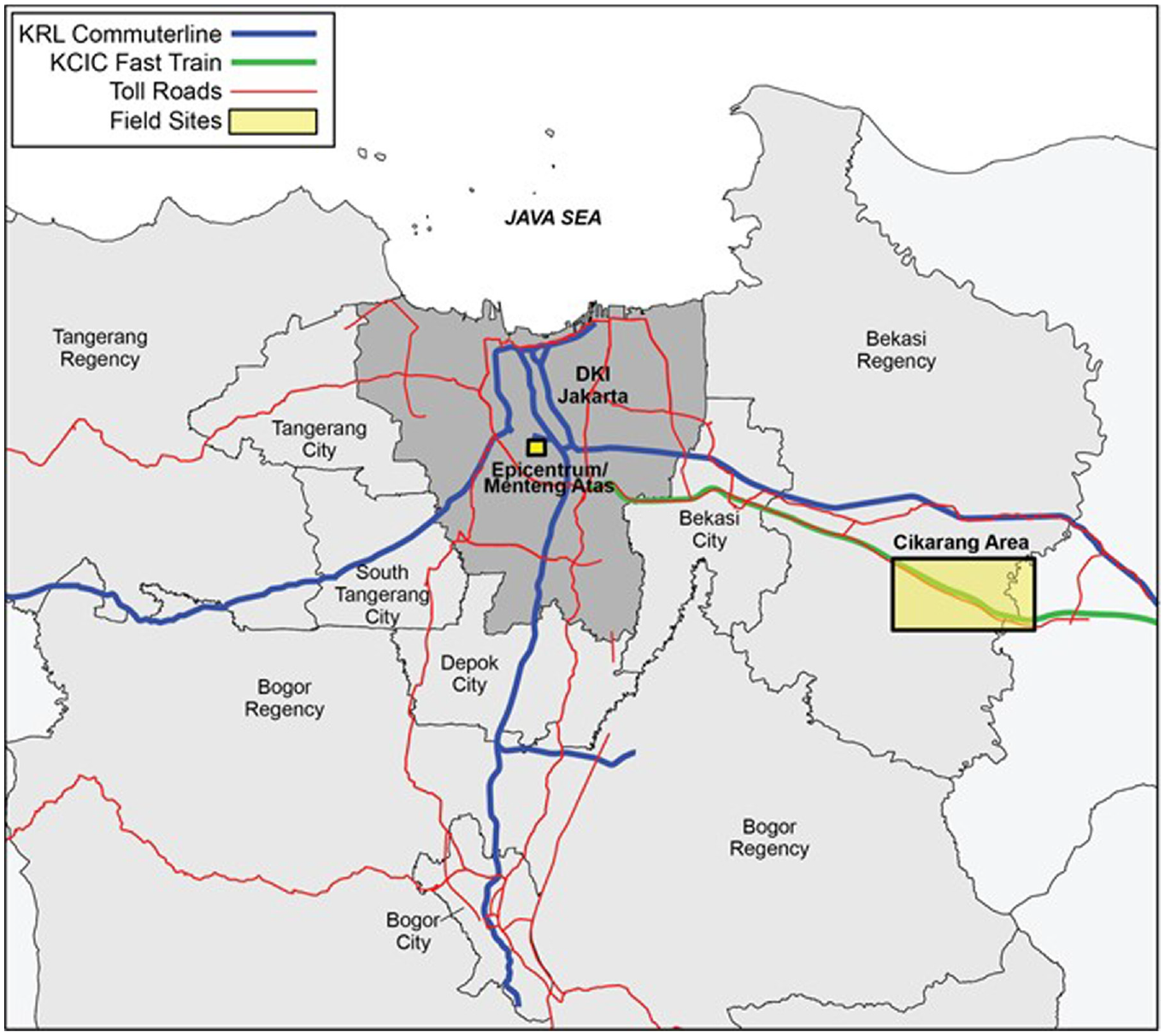
Jakarta metropolitan area – central city and peri-urban field sites.
The authors and their local collaborators conducted 30 semi-structured in-person interviews at both sites with developers and local officials (in English and Bahasa Indonesia) involved in the development projects, and 135 semi-structured in-person interviews with kampung residents (in Bahasa Indonesia), using a purposive sampling design. Sixty-seven per cent of kampung interviewees and 10% of developers and local officials were women. The interviews with kampung residents included soliciting information on socio-demographic characteristics, economic activities and livelihood practices, household composition and migration/settlement history, the size and quality of housing and amenities and land and property transactions in the kampung, including their experiences negotiating displacement, their assessment of kampung living and their aspirations for the future. We asked residents who already had relocated to reflect on changes in their housing conditions, household composition and economic activities, and their overall assessment of the move. Multiple return visits and re-interviews with kampung residents allowed us to document the rapidly transforming socio-material landscape, also enabling us to interrogate interpretations from previous rounds of fieldwork.
Interviews with developers, real estate consultants and financial institutions focused on the respective development projects, the land assembly process, financing and the regulatory environment. While we could ascertain names of brokers assembling land in both areas, they proved too elusive to interview. Information from interviews was complemented by observations at the different sites and archival records (including newspaper articles and government documents). Interview transcripts and field and debriefing notes were translated, transcribed and analysed through iterative coding based on repeated close readings of the transcripts supplemented by NVivo software. Names are changed to ensure confidentiality.
The spatio-temporal conjunctures of Epicentrum and Cikarang
Epicentrum / Menteng Atas and Cikarang are distinct geographical sites within greater Jakarta, which is known colloquially as Jabodetabek. In this section, we place the two sites to be compared within their spatio-temporal conjunctures. We begin with the positionality of Jabodetabek and Indonesia within the long geohistory of globalising capital and summarise recent conjunctural shifts.
Jabodetabek occupies a relatively peripheral socio-spatial positionality within globalising capitalism (Indraprahasta and Derudder, 2019). With 32 million inhabitants, it is one of the world’s largest megalopolises but far less influential or visible than much smaller ‘global cities’ like Paris, London or Singapore. This reflects Indonesia’s status as a nation whose conditions of possibility remain shaped by its colonial history. Its economy still depends heavily on exporting raw materials to the global economy, with 20% of its domestic manufacturing (and many of its larger establishments) foreign owned (Lipsey et al., 2013). Like the bulk of former colonies characterised by ‘surplus populations’ (Sanyal, 2014), informal livelihood practices are pervasive. Under President Suharto’s autocratic rule, neoliberalisation was introduced in the 1980s, centred on the Jakarta metropolitan area where large peri-urban New Towns were built by well-connected Indonesian developers aided and abetted by Suharto (Herlambang et al., 2019). The 1997 Asian financial crisis turned urban boom into bust; the massive debts accrued by these developers forced both them and the Indonesian banks financing their projects into bankruptcy, exacerbating the national economic crisis (Winarso and Firman, 2002). The economic crisis and the demise of the Suharto regime triggered a shift in the national conjuncture from authoritarian rule to democratisation (dubbed reformasi), which saw the emergence of more independent political parties and the devolution of regulatory power from the national to regency and municipal scales. Neoliberalisation became less centralised while retaining distinctly Indonesian characteristics. An interventionist national state and elite informality mean that the economy remains dominated by well-connected Indonesian oligarchs and state-owned enterprises (Hadiz, 2005; Herlambang et al., 2019), with an increasing Japanese and Chinese presence shifting Indonesia’s geopolitical focus away from the US (Anguelov, 2021). Indonesia remained largely unaffected by the 2008 global financial crisis.
DKI Jakarta, the centre of Jabodetabek, is Indonesia’s primate city, political and economic capital and principal gateway to the global economy. 4 Metropolitan Jakarta began to expand beyond the DKI in the early 1980s, accelerating in all directions but particularly to the West and East, guided by the development of toll-roads (Figure 1). Large swaths of Jabodetabek’s agricultural land have been converted to urban land uses, increasing from 9,400 to 224,000 ha as agricultural land decreased by 179,000 ha between 1972 and 2012 (Pribadi and Pauleit, 2015).
By 2005, finally having recovered from the 1997 crisis, Indonesia’s developers initiated a new round of land transformations (Herlambang et al., 2019), building super-blocks in DKI Jakarta and ever more spectacular peri-urban integrated developments for a newly wealthy middle class looking to invest in property. Taking advantage of and exacerbating sharp increases in property values (averaging 250% between 2007 and 2012 across the metropolitan region, Elmanisa et al., 2017), these new developments are largely built on land occupied by informal settlements (kampungs) and agriculture. Thousands of residents were displaced, creating complex and uneven patchworks of formal developments and kampungs in both central and peri-urban Jabodetabek.
Two-thirds of Jakartans live in kampungs (Kusno, 2020), reflecting the pervasiveness of informal housing and employment in the global South. Kampungs are auto-constructed, mostly unplanned settlements with narrow winding paths and streets and low-rise buildings housing residents, small businesses, mosques, schools and health facilities. 5 While kampungs are informal, residents are not devoid of land rights that they can sell: There is a spectrum of formal land rights granted by the state (freehold, use, occupancy and right-to-build certificates), alongside residual indigenous rights (hak girik) upheld by local officials (Leaf, 1993; Leitner and Sheppard, 2018). Residents’ socio-economic positions range from the very poor, to the poor, to the middle and upper middle classes, with household monthly incomes ranging between 1.5 and 30 million IDR (US$100–2000). The poor and very poor work as vendors of various goods, take menial jobs in nearby formal developments, do occasional piecework or domestic work or are agricultural labourers in peri-urban kampungs. The middle class often work in the formal sector and government offices; some run successful kampung businesses and increasingly operate as landlords building rental housing (kontrakan). 6 These inequalities are also reflected in the widely varying size and quality of kampung housing: from a rented room, to houses of various sizes and amenities, to well-constructed villas with as many bathrooms as bedrooms.
The first site, Epicentrum / Menteng Atas in South Jakarta, exemplifies central city land transformations driven by the construction of high-rise, mixed-use superblocks. These enclaves promise middle-class residents respite and security from the larger city, capitalising on the negative representations, perceptions and fears held by elite and middle-class populations about Jakarta’s kampungs and their residents. Selected kampungs have been targeted for removal, where land-brokers and developers persuade residents to sell their land rights; residents of other kampungs seek to make the most of spillover benefits from nearby formal developments.
Kampung Menteng Atas had existed already for two generations when the Bakri Corporation began to acquire land for Epicentrum in 1992. Larger blocks of land were initially purchased from private and public sector owners, but further expansion entailed acquiring kampung land (some 70,000 ha by 2007; Simatupang et al., 2015). In 2005, construction began on a corporate skyscraper, supplemented by a series of condominium towers (Rasuna Epicentrum), shopping centres, hotels and sports facilities for office workers and condominium residents. Bakri built schools and infrastructure to conform with city planning regulations, also paying for a new mosque for Menteng Atas residents. With the help of brokers, kampung land is painstakingly acquired from residents subdistrict by subdistrict and banked until the next development phase, with some sold off to other developers to raise money. Our fieldwork was undertaken in one such subdistrict (RW 2), where most homes were sold and razed between 2013 and 2019.
The second site, Cikarang on the eastern periphery in Bekasi Regency, had been zoned for manufacturing in the 1980s. The highway connecting this region with DKI Jakarta was designated a toll road in 1988, with industrial and integrated estates built around the toll road exits (Herlambang et al., 2019). The area is now dominated by a patchwork of industrial and integrated estates, interspersed with kampung settlements and agricultural plots. Integrated estates, such as Jababeka, Kota Delta Mas and Lippo Cikarang, now include separate zones for industrial, commercial and residential functions. They are also outfitted with a large range of amenities and services – recreational facilities such as sports stadia, parks and golf courses, private schools and universities, places of worship and health facilities. Industrial estates such as MM2100 and Karawang International Industrial City are dominated by foreign-owned branch plants and export-oriented Indonesian firms (Hudalah and Firman, 2012). The residential developments attract middle- and high-income residents ready to live outside Jakarta, also housing the managers of peri-urban industrial and commercial establishments. These developments by and large have run rough-shod over attempts at land use planning by new, recently empowered but less experienced local state planning apparatus: Lippo’s recent and ambitious Meikarta development resulted in corruption investigations into the links between its local managers and local public officials.
Speculating on land, property and peri/urban futures
In this section, we identify general tendencies and particularities based on comparing the actions and experiences of the two groups involved in land transformations – developers and kampung residents – within the larger spatio-temporal conjuncture. We find that both developers and kampung residents speculate, not only economically on land and property, but also undertaking socio-cultural speculation on imagined peri/urban futures (challenging the focus of speculative urbanism scholarship on the economic calculations of large corporate actors).
Other scholars paying close attention to how speculation works have recently expanded conceptualisations of speculation beyond its conventional economic meaning (Bear, 2020; Humphrey, 2020; Leitner et al., 2022; Simone, 2013). Bear (2020: 2) opens up speculation beyond developers and economic rationalities, conceiving it as a ‘future oriented social action’ that utilises ‘affective, physical and intellectual labour [that] aims to accumulate capital for various ends’. By broadening the understanding of speculation beyond a purely economic calculation of returns on investment, she offers a non-economistic approach to explaining such behaviour. Relatedly, Humphrey (2020) documents how developers and purchasers of real estate both engage in speculation but with different goals, rationalities and visions of the future, highlighting the importance of affect (the thrill, uncertainty, anxiety), non-economic considerations (social contacts, family responsibilities) and imaginaries/dreams in shaping speculative economic behaviour. As we show in this section, our research in central and peri-urban Jakarta supports some of these findings.
Speculating on land and property
Developers
The real estate development arms of large Indonesian conglomerates are the major players in land transformations, alongside the Ciputra Development Group (Leaf, 2015). Facilitated by finance capital, and a host of intermediaries including public officials, they speculate on rising land values, which they also have the power to shape. This positions them to reduce the risks of speculation. They speculate on land assembly, banking and assetisation as the basis for initiating speculative property developments. Under Suharto, developers with close political connections to the President faced little uncertainty and risk, but land assembly in the post-Suharto era has become fraught with uncertainty. Much to developers’ chagrin, it requires lengthy and complex negotiations with kampung households holding various title or occupancy rights. These negotiations create anxieties among residents that they will lose out if they do not sell now, augmented by pressure to sell from relatives and local officials, and under-the-radar intimidation. Residents are offered irresistible sums of money – the prices offered for a 100 m2 Menteng Atas property in 2016 equated to 40 years of income for very poor residents we interviewed (Leitner and Sheppard, 2018). Having assembled land, developers may sit on land banks for decades, awaiting the right moment to realise returns on the property they build.
As we repeatedly learnt in interviews, developers expect a 15–30% return on their property investments (larger developers having higher expectations), including both the rent gap (the return on land as an asset) and the profits from selling property (the commodity built on this asset). Such property developments are necessarily speculative – planning, constructing and marketing the project requires significant up-front finance in the expectation that units will be sold and returns on investment realised. Jabodetabek’s developers risk significant amounts of their own money, supplemented by pre-sales to households making up 30–70% of project finance. Pre-sales cannot be spent until the project is underway; it must be held in escrow 7 as collateral for bank loans. When the real estate market peaked in 2014, pre-sales posed no uncertainty: ‘The 2,400 apartments of one of our residential buildings, offered to the public in April 2014, sold out in one day! … Every time we launch one it sells out in one day’. 8
Perceptions of a seemingly limitless demand from Indonesian middle- and upper middle-class end-users and investors further fuelled the speculative construction of large residential estates. Developers invest much effort in marketing, presenting their next project as bigger and more spectacular and offering more ancillary services than anything yet built. If a project does not generate the requisite sales the developer will abandon it, being required to return pre-sales to households or re-frame it as part of a new and better project.
Inequalities exist between developers in their capacity to speculate to their own advantage. Large developers shape land values and development trajectories, with smaller developers following in their wake by piggybacking onto the opportunities thereby created and entering joint ventures. Small developers struggle to acquire land and financing; they often require more equity, necessitating loans from state and private banks. Large developers’ returns on land and property speculation are generally higher. 9
Kampung residents
Kampung residents speculate in two ways; they speculate on when to sell existing property rights to maximise exchange value on auto-constructed property, and on how to invest these windfall gains in land and property by taking advantage of rent gradients and increasing land values. Kampung residents in possession of title or other property rights use these to negotiate for as much exchange value as possible from selling their property in order to purchase better quality replacement kampung housing. Their bargaining power is rather limited, however; the price is set by developers, other companies and brokers, sometimes vying for the same properties. Kampung residents, particularly in peri-urban kampungs, take advantage of their dense social networks to compile detailed knowledge of land price differentials within their activity space. But they have little knowledge about the land prices that developers and brokers charge one another. Kampung residents have different monetary/financial expectations from developers, however. Their first priority is sufficient money to rehouse members of the extended family in improved housing, usually further out from their current central city or peri-urban location.
10
As one interviewee whose family negotiated a sale in Menteng Atas relates: We initially waited until the land price increased from 10 to 12 million [IDR/sqm]. Then my brother negotiated with Pak Oki [local broker] 15 million. We felt lucky about the price. The money we got was less than 500 million and was equally divided between the seven brothers and sisters. Everyone got around 70 million … My brother and I bought a [55 m2] house in Depok for 130 million, while the other siblings moved and became renters in Bekasi.
11
Middle-class kampung residents speculate also by becoming rentiers – adding floors to their current homes that they rent out or investing some of their windfall gains in the construction of rental properties. The latter is particularly popular in Cikarang. One middle-class family relocating to a newly created peri-urban kampung in Cikarang used the cash left over after building a new family compound to build an eight-unit kontrakan rental property. After one year, they had made enough rental income to be planning construction of a second multi-unit kontrakan. 12
Power asymmetries exist not only between developers and kampung residents, but also between kampung residents in terms of their capacity to engage in and benefit from speculation in land and property. 13 Middle-class kampung residents can wait for bid prices on their property to increase, holding out for a larger gap between the selling price in their current kampung and the cost of land in potential destination kampungs.
In 2017, I bought 2000 sqm of land still cultivated with paddy near the Cibeet River [border between Cikarang and Karawang] for 150,000 [IDR/sqm]. Over a period of three months after buying the land, I was approached by Meikarta’s broker offering 250, 300, 500, to 700,000 Rupiah. I refused to sell because I had just bought it and wanted to get 1 million.
14
By contrast, poor residents may be induced or forced to sell immediately (e.g. to pay outstanding debts). After displacement, residents’ capacity to speculatively invest in and gain returns from kampung rentiership is also unequal. Those able to access land and financial resources can construct rental properties (with considerable sweat equity) on land purchased at the peri-urban frontier. This is not an option for the low-income peri-urban kampung displacees we interviewed, but they were able to recreate a home, usually larger in size and with desired amenities (Figure 2).
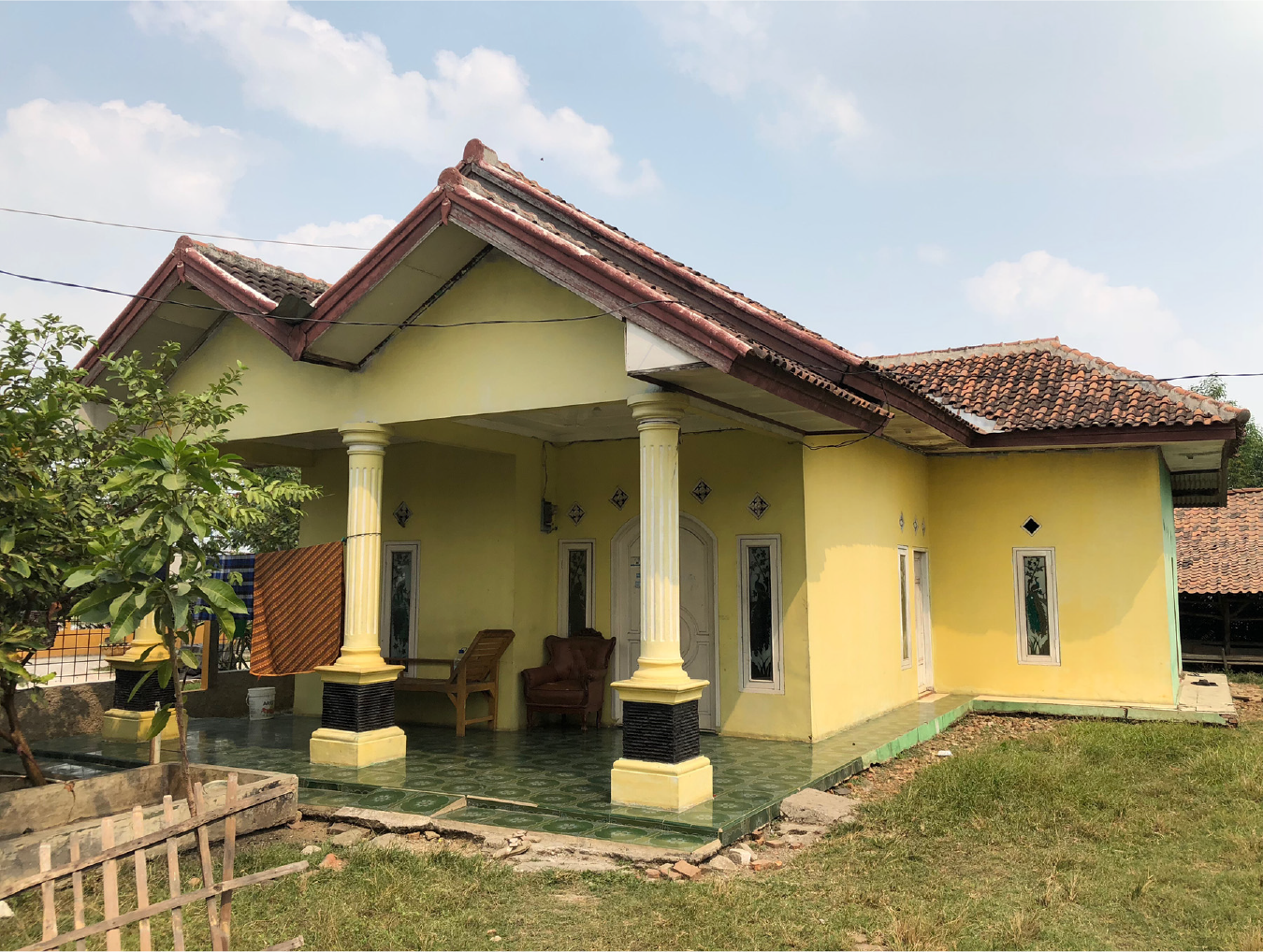
Displacees’ new home, Rawa Banteng Baru, July 2018.
Speculating on peri/urban futures
Beyond speculating on land and property, kampung residents and developers also speculate on peri/urban futures – their visions of how to live well and realise a good life in central city and peri-urban locations. These visions, imaginaries and aspirations differ dramatically, however, between the two groups.
The urban future aspired to and promoted by developers, architects, planners and politicians is that of a global modernity – apartment towers, subdivisions (rumahans), gated communities and villas, shopping malls, western-style infrastructure and services and well-remunerated formal-sector employment. Residents living and working in these new formal developments can realise their individuality to become modern, global neoliberal citizens. These are world-class city aspirations (Ghertner, 2015; McCann et al., 2013). Inter-referencing to western and selected Asian locations (Bunnell, 2015; Ong and Roy, 2011) is integral to constructing such futures. For example, peri-urban Jakarta’s gated communities are replete with references to Southern California locations such as Orange County (Dick and Rimmer, 1998; Leitner and Sheppard, 2018). In 2018, the LIPPO Group, the development arm of one of Indonesia’s largest Chinese-Indonesian conglomerates, announced a megaproject in eastern peri-urban Jakarta: ‘Meikarta, the future is here today’. Advertised as the ‘Most beautiful metropolitan city in Southeast Asia’, Meikarta is presented as a high-tech research, business and commercial hub offering its residents innovative infrastructure/transportation, green sustainable living, state-of-the art medical facilities and arts, culture and educational institutions. Future residents can choose architecture from around the world – European, American, Asian or Modern style (Figure 3) – and a Central Park to stroll in. Such glowing descriptions work to confer value, conveying to potential buyers that residing in Meikarta will realise their world-class urban aspirations.
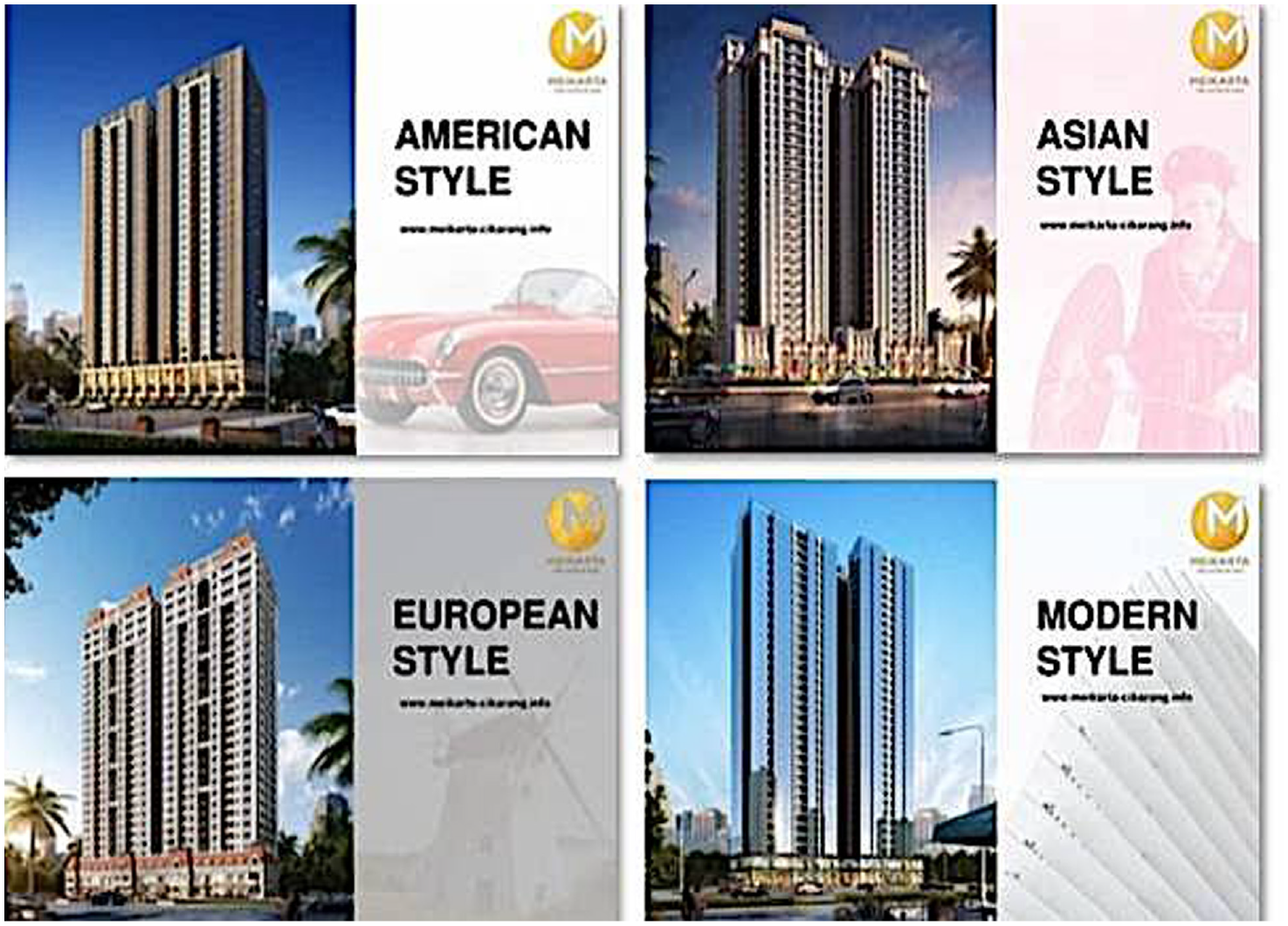
Meikarta: Four architectural styles.
Yet the kampung residents in our study do not embrace these imaginaries, refusing developers’ offers of replacement housing in the high-rise apartment buildings that will displace them. 15 Both central and peri-urban kampung residents value the flexibility of kampung spaces as well as the sociality and mutual aid that kampung life provides – an urban commons that they aspire to maintain after relocation. They also strongly prefer living at ground level.
Women, in particular, expressed their desire to retain what they consider as major benefits of kampung life: Unlike in a housing complex where people would live individually, the relationship between neighbours in the kampung is stronger. I have more freedom as well here.
16
I love the community in the kampung. For me the housing complex is too individualistic – you, me, me. I would never want to live in an apartment.
17
I like living here because I am close to my family; it is close to my daughter’s school and my workplace; and I have close friendships here. I want to have a bigger house with more space and a front yard, but in a kampung where people know and help each other. People don’t know each other in an apartment complex, and I do not like this.
18
Women play a central role in facilitating and practising commoning in kampung environments – leading prayer groups, organising arisans (community savings groups) 19 and coordinating other commoning activities such as providing care and financial support to fellow kampung residents in need. In one case, women organised a migrant arisan after displacement from their kampung, to maintain community among households that were now scattered around southern Jakarta.
Here we see a dramatic clash of imaginaries and aspirations for peri/urban futures. Developers’ and politicians’ world-class aspirations are accompanied by denigrating representations of kampung life as outmoded, unsanitary and inconsistent with modern urban living – arrested Development (Hart, 2002). Similarly, ‘the state’s gendered rationalization of kampung life’, rooted in legacies of dominant state gender ideologies, does not consider kampungs as ‘suitable urban environments for the proper ibu [mother]’ (Tilley et al., 2019: 5).
Speculation on land and property and that on peri/urban futures co-evolve with one another in complex ways, as do the relations between the developers and kampung residents. Developers’ bets on a world-class future align with their financial speculation on land and property. Kampung residents speculate on land price differentials in order to realise their aspirations for a larger and better home, community and sociality. Notwithstanding tremendous pressures to conform to world-class urbanism, kampung residents’ speculation on peri/urban futures involves a politics of refusal and resistance to such dominant imaginaries, aspiring to more collective peri/urban futures that they enact after displacement.
Summarising, one general tendency is that developers and kampung residents engage in both economic speculation on land and property and socio-cultural speculation in urban futures. Unlike developers, however, kampung residents with property rights and wealth prioritise the use value of property – building homes for themselves and their families. Relatedly, kampung residents aspire to a different kind of peri/urban future to that promoted by developers. Second, the ability to take advantage of speculating on land and property is unevenly distributed, reflecting intersecting differences in class, wealth, gender and access to land among and between developers and kampung residents, with inequalising consequences. In other words, speculation on land and property is shaped by and deepens pre-existing structural inequalities. These actions of developers and kampung residents have to be seen within the larger context of globalising capital and neoliberal development norms shaping the Indonesian and Jakartan political economy. These norms include competitive commodity production, a universal path to economic development and the expectation that individuals are responsible for their own success and failure. Recently, the increasing influence of financialisation has normalised speculation as a path to individual prosperity.
Spaces of speculative land transformations
Our field research identified a clear general tendency in speculative land transformations across the central city and peri-urban sites. Even as formal, planned developments erase informal kampung settlements, displacing their residents, they create spillover opportunities that other kampungs and residents work to take advantage of.
In the central city, residents of still-existing kampungs build rooms to rent and small stores, catering to workers and residents from nearby formal developments. Some central city displacees are able to purchase a rental unit, turning to rentiership to replace income lost after relocation (Leitner et al., forthcoming). In peri-urban Cikarang, wealthier residents build one- or two-story rental kontrakans with up to 22 units of 15–20 m2, which they rent to migrants and their families drawn from across Java to jobs in nearby factories (Figure 4). For some, this also forms the basis for starting other capitalist enterprises and becoming locally influential. The proliferation of kontrakans is becoming a defining element of peri-urban kampungs (Leitner et al., 2022).
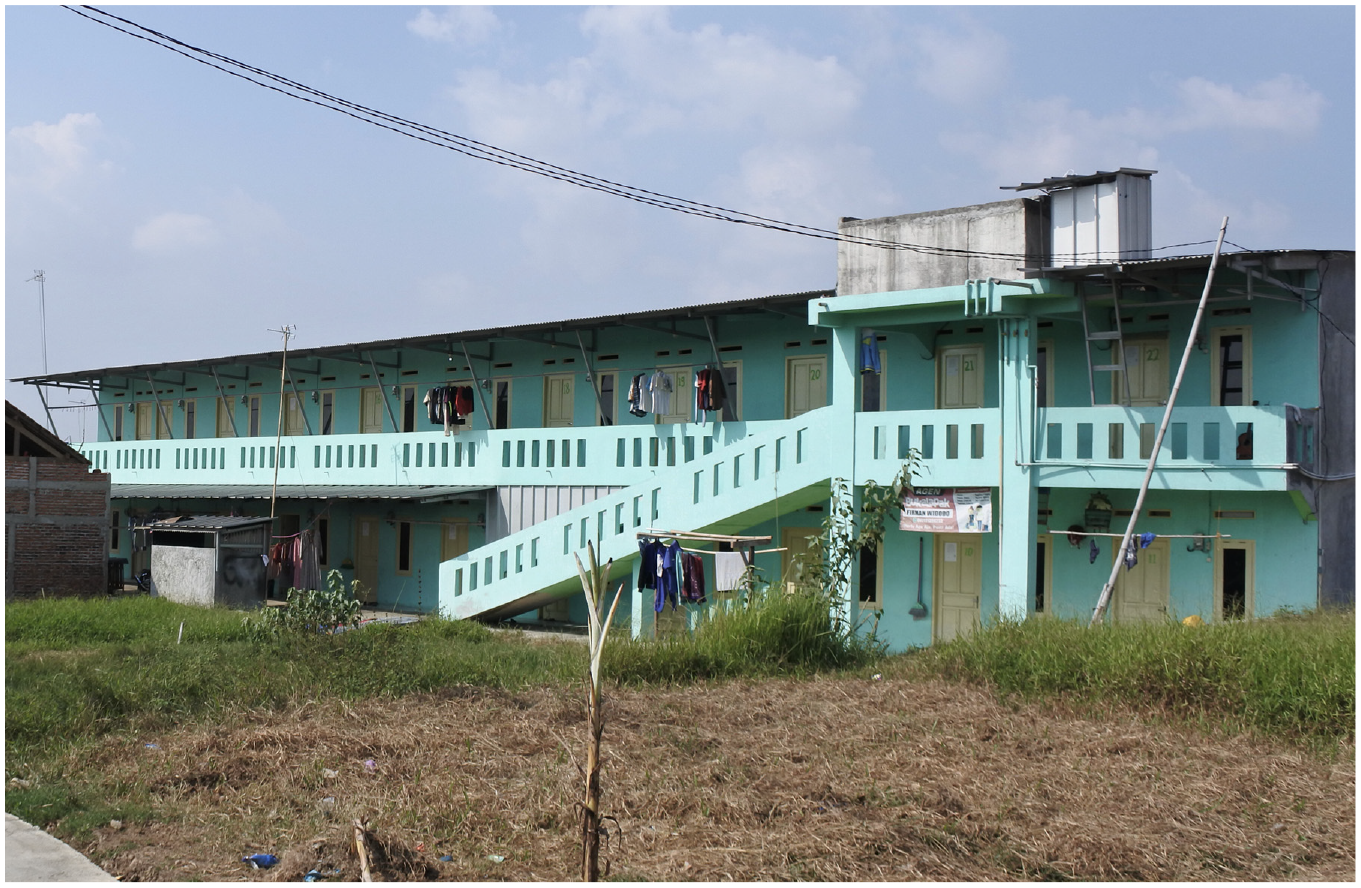
Peri-urban Kontrakan, Kampung Tegal Danas Impres, August 2019.
This creates a complex landscape of land transformations across both sites. Some kampungs or sections of kampungs disappear altogether, whereas the proximity of other kampungs to formal developments enables them to flourish. Yet even flourishing kampungs are continually subject to broader processes (e.g. the availability of capital, the profitability of land and real estate, the state-regulatory environment) that put them at risk of being targeted for the next formal development. Thus general tendencies in kampung transformations are influenced by larger-scale political, economic and social structures and processes.
A closer examination of micro-dynamics at the two sites we studied also reveals particularities. Place-specific governance and planning regimes and social ecologies of land at the two sites create different speculative options for developers and kampung residents, producing distinct landscapes. As Indonesia’s economic, political and cultural hub with a powerful Governorship, new property developments in DKI Jakarta are tightly regulated by a well-resourced, micro-managing zoning and planning bureaucracy (BAPPEDA). By contrast, peri-urban Jakarta has a more laissez-faire local state planning apparatus, giving developers and displaced kampung residents largely free rein to buy and build. The central city’s social ecology of land is that of an extremely high-density built environment that has lost much of its open green space during the past four decades. Notwithstanding Indonesia’s Law 26 of 2007 ‘Concerning Spatial Management’ stipulating that cities devote 30% of their land to green space, Setiowati et al. (2018) estimate that DKI Jakarta has just 4.65% – mostly in its southeastern and northwestern periphery. To assemble land, therefore, developers have no option but to persuade kampung residents to sell their land rights, often through brokers. Developers expressed frustration with the slowness of land assembly in central Jakarta – the CEO of CCM Holding described how it has taken 13 years to acquire a scattershot of plots amounting to a third of the 3 ha kampung behind their iconic World Trade Centre. Land values have stagnated since 2014, when DKI Jakarta was one of the world’s hottest real estate markets, but elevated prices combined with land assembly difficulties are inducing developers to shift their speculative land and property investments to peri-urban Jakarta and smaller provincial capitals.
Peri-urban kampungs in Cikarang are characterised by a very different social ecology of land – a patchwork of land uses dominated by industrial, residential and integrated estates and accompanying infrastructure encroaching on rice paddy fields, rural kampungs and residual forests. Paddy fields lose access to water and are built over, and the rolling landscape is flattened for the new developments. There is simply much more unbuilt green space with more room for developers to manoeuvre than in the central city. Some developers also hold onto large peri-urban land banks, which further facilitate land and property speculation. While there is the same laborious process associated with purchasing individual plots of kampung land, available green space and looser planning regulations make land acquisition less complicated. Developers face different challenges, however. Rural land must be flattened to make it usable for factories and high-rises, and infrastructure (roads, utility nodes and networks, Internet, etc.) must be developed. They also must generate the excitement that will induce middle-class Jakartans to leave the central city, crafting elaborate and aggressive advertising campaigns that promise world-class urban living.
Central city kampung displacees face limited relocation options. Relocation to a cheaper kampung forces them much further out. Our interviewees moved between 13 and 26 km to other kampung neighbourhoods, albeit not as far as peri-urban Jakarta. Having to move into an already existing kampung made it difficult for households to reconstruct the dense social networks of mutual aid enjoyed in their previous kampung. Further, Jakarta’s horrendous traffic congestion (reflecting its dense built environment) forced the bulk of our interviewees to abandon pre-existing jobs and reconstruct their livelihoods. In contrast, peri-urban displacees can take advantage of unbuilt land nearby. 20 They move much shorter distances (0.5–5 km for our interviewees) often as chain migration to the same new kampung as their neighbours, easing the reconstruction of pre-existing social networks and identities. To symbolise the reconstruction of community, displacees from old Kampung Rawa Banteng named the new kampung they created on a greenfield site Rawa Banteng Baru. 21 Steep land price gradients and greenfield space enable them to build larger compounds that the extended family can continue to cohabit after relocation; some use remaining funds to become rentiers, building kontrakans. By contrast, central city kampung displacees in our study, faced with limited space at relocation sites and adult children aspiring to separate from their parents, would split proceeds from the sale between extended family members who rent or buy property elsewhere.
These shared general tendencies and particularities produce distinct speculative landscapes – compact, high-rise developments being shoe-horned into densely built kampungs in central Jakarta, and a rapidly shifting patchwork of lower-density formal developments, dynamic and mobile kampungs and rural land uses and practices in Cikarang. These sites are not isolated from one another but inter-related. First, they are connected through their shared embeddedness in larger-scale conjunctural configurations. Second, speculative land transformations in central Jakarta co-evolve with those in peri-urban Cikarang, for example, as high land prices and land assembly barriers in central Jakarta contribute to the peri-urbanisation of formal real estate development projects.
Conclusion
In this article, we explore the insights that a conjunctural approach brings to comparative urbanism through a case study of speculative land transformations across central and peri-urban Jabodetabek from the perspective of developers and kampung residents. A conjunctural approach shares with some other forms of comparison the ambition to build new theories and challenge existing knowledge. Grounding such a comparison means iteratively putting local knowledge and observations in conversation with already existing theories. A conjunctural approach differs from other comparative methods by explicitly attending to the spatio-temporal conjuncture, rather than simply controlling for the characteristics of sites as in conventional comparison. This means interrogating how socio-spatial and socio-temporal positionality of sites and their complex relations and intersections shape outcomes. A word of caution, however: this complex multiplicity of relations means that comparative analysis at times feels like a juggling act.
A conjunctural approach shares with other relational comparisons an openness to creating space for taking seriously unexpected starting points – in our case, kampung residents (in addition to developers) and a peri-urban site (as well as the central city). From these starting points, our grounded approach takes what we learn from the field as not only being interpreted through already-existing conceptual frameworks but also contributing to (re)conceptualisation. In order to realise its ambition for theory building and testing, a conjunctural approach seeks to distinguish shared general tendencies from particularities and to explore their mutual constitution. General tendencies not only shape the particular, as when the ideology of neoliberalism shapes variegated local processes of neoliberalisation, but emergent particularities also can influence the form taken by neoliberalism as a general tendency.
Comparing across social groups, both developers and kampung residents engage in economic speculation in land and property and socio-cultural speculation in aspirational peri/urban futures. Taking advantage of shifting spatio-temporal rent gradients, they make financial bets about where and when to invest in a radically uncertain and rapidly changing landscape. These bets are entangled with the peri/urban futures they seek to realise. This general tendency is bound up with social group specific particularities. First, developers focus on the exchange value of property, whereas kampung residents attempt to use accrued exchange value to realise the use value of their property by building a new home. Furthermore, while developers aspire to creating a world-class neoliberal metropolis, displaced kampung residents seek to recreate kampung form and sociality centred around commoning and mutual aid. Second, inequalities between developers and kampung residents in access to resources and information create unequal conditions of possibility to benefit from speculation. Developers are price makers in these land markets, whereas many kampung residents are price takers, positioning developers to reap the lion’s share of returns on investment. Within these groups, large developers have come to see speculation as a sure thing, expecting 15–30% rates of return on their projects, whereas smaller developers follow along – seeking to benefit from proximity to large-scale developments. Wealthier kampung residents are positioned to prosper through rentiership, gaining political capital that further positions them to shape kampung life.
Comparing across sites, in both central and peri-urban Jakarta, kampungs and their residents are displaced as developers induce residents to sell land rights, even as other residents and kampungs find ways to benefit from their proximity to the formal developments built on erased kampungs. Speculative land transformations in central Jakarta also co-evolve with those in peri-urban areas, as when high land prices and land assembly barriers in central Jakarta incentivise developers to switch their projects to peri-urban sites (and beyond).
But we also noted significant site-specific particularities – distinct social ecologies of land and governance and spatial planning regimes – which produce distinct speculative options and landscapes. At the peri-urban site, ready access to unbuilt land eases the displacement process, creating a patchwork of formal residential and industrial developments, agricultural plots and kampung settlements. Kampungs disappear as others flourish on elevated land with burgeoning kontrakans built by well-resourced residents. With no space to replace evacuated kampungs in central Jakarta, displaced residents must find space in other kampungs, often significantly further out. This creates livelihood challenges that displacees attempt to mitigate through small-scale rentiership. Existing kampungs proximal to formal developments prosper through a process of densification – adding new rental space and marketing cheap food and services to nearby workers and residents, and accommodating displacees. This is reinforced by particularities in the local state planning apparatus – land transformations in central Jakarta are governed by a surveillant zoning and planning bureaucracy whereas the peri-urban local state planning apparatus is more malleable through elite informality. The former tightly circumscribes central city land transformation, whereas the latter accords developers but also displaced kampung residents more latitude to realise their speculative agendas and imaginaries.
Our main motivation for developing a conjunctural approach to comparison is our ambition and goal to better capture the complexity of the processes and actors shaping land transformations. The spatio-temporal conjuncture, a particular condensation of cultural, economic and political forces in space and time, gives meaning to and shapes the norms and motivations governing actors’ imaginaries and practices. This approach enabled us to tease out the associated general tendencies, particularities and their inter-relations – both those reproducing conjunctural norms (e.g. pervasive economic and socio-cultural speculation, kampung displacement) and those contesting them (e.g. kampung commoning). It is our hope that we can collectively come closer to realising this goal, as other scholars further experiment with this methodology through both empirical investigation and theoretical reflection.
Footnotes
Acknowledgements
The field research reported on here would not have been possible without our collaborators. In particular, we thank Wahyu Astuti, Melinda Martinus, Liong Ju Tjung and Herlambang Suryono (Tarumanagara University, Jakarta), Dian Tri Irawaty and Sam Nowak UCLA), Emma Colven (University of Oklahoma) and Dimitar Anguelov (University of British Columbia) for their help with the fieldwork. We are extremely thankful to our Jabodetabek informants for their hospitality and generosity, and especially thank Jennifer Robinson for her advice on previous drafts, and Tony O’Sullivan.
Declaration of conflicting interests
The authors declared no potential conflicts of interest with respect to the research, authorship, and/or publication of this article.
Funding
The authors disclosed receipt of the following financial support for the research, authorship, and/or publication of this article: We acknowledge support from the US National Science Foundation (Grant BCS-1636437).
