






Abstract
The potential of infrastructure ‘as a solution’ is currently at the forefront of American political consciousness. Historic levels of investment in infrastructure proffer seismic material, economic, and symbolic transformations at a near-continental scale. However, the present policy context for infrastructure planning in the US is confounded by a mosaic of decision-making authorities that hamper the development of cohesive approaches to sustainable and equitable development. This situation underscores the need to identify how infrastructural futures are assembled and scaled as simultaneously continuous and emergent, old and new, and marked by the diverse capacities of various stakeholders. This paper makes a case for ‘seeing like a region’ when examining transformative approaches to infrastructural change, as infrastructure systems regularly transcend the boundaries of urban space and hence become enmeshed in the goals of broader constituencies and interests. Through a case study of the Southwestern Pennsylvania Commission, we question how infrastructural futures are understood and materialised by the region’s central planning stakeholders. Our analysis pays particular attention to the challenges faced by regional planning organisations when navigating the spatial–temporal frames of incremental and radical change. As the Southwestern Pennsylvania Commission operates with limited staff capacity, high regulatory burdens, and short time horizons for budgeting processes, incremental changes to infrastructure often are the best hope for solving regional challenges of structural inequality and uneven access to resources. This demonstrates how the solutions proffered by infrastructural development are confounded by the dynamics that come into focus when evaluated from the regional scale. Yet we also identify possibilities for regional approaches that foster equitable urban futures within the spatial envelopes created by infrastructural systems and imaginaries that transition from reactive ‘infrastructural solutions’ to a proactive materialisation of ‘infrastructures as solutions’.
Introduction
In an age of infrastructure-led development, infrastructural imaginaries are ambitiously visioned and scaled (Schindler and Kanai, 2024; Shatkin, 2022; Wiig and Silver, 2019). Alongside China’s Belt and Road Initiative (BRI), the Initiative for the Integration of Regional Infrastructure of South America (IIRSA), and the India–EU Connectivity Partnership, the Biden Administration’s flagship ‘Infrastructure Investment and Jobs Act’ (H.R. 3684) – commonly known as the ‘Bipartisan Infrastructure Law’– marked yet another flagship programme of material and symbolic nation-building. Signed into law by President Biden on 15 November 2021, the Law included up to $1.2 trillion of funding ($550 billion being newly authorised) for broadband access, safe drinking water programmes, renewable energy infrastructure, updates to the electric grid, and historic levels of spending for transportation: $110 billion to repair highways, bridges, and roads; $66 billion for passenger and freight rail; and $39 billion to expand public transit provision, modernise bus and rail fleets, improve safety, and advance equitable public transportation planning and operations (Federal Transit Administration, 2023). The economic and geographic scope of the 2021 Bipartisan Infrastructure Law brought the potential of infrastructure as a solution to the forefront of political and public debate. A generational opportunity to rebuild the US’s declining infrastructure, reshape its economy, and enhance the quality of life of its citizens evoked tantalising visions of material and symbolic transformation on a scale beyond even that of Roosevelt’s Tennessee Valley Authority (founded in 1933), Eisenhower’s Interstate Highway System (begun using the Federal-Aid Highway Act of 1956), or Kennedy’s Appalachian Regional Commission (founded in 1963). At the Law’s signing ceremony on the White House South Lawn, Biden declared, ‘my message to the American people is this: America is moving again, and your life is going to change for the better’ (cf. Naylor and Walsh, 2021).
It was with no little irony then, that on a snowy Pittsburgh morning on 28 January 2022, with President Biden in town to promote his cornerstone infrastructure policy, an 80-year-old bridge in the city’s Frick Park neighbourhood collapsed. Fortunately, the failure occurred before the morning rush hour with just one nearly empty Port Authority bus and seven cars on the bridge when it gave way. There were no fatalities and only 10 people sustained minor injuries. The failure of the Fern Hollow Bridge, though, was disconcerting for several reasons. It was located on a key urban artery that linked Pittsburgh’s majority white urban core to its metropolitan hinterland via the majority black municipality of Wilkinsburg. Carrying an average of 16,000 people per day, the bridge had last been inspected in November 2021 – just two months prior – and was rated as in poor yet passable condition. This served as an ominous reminder that 255 other bridges in the Pittsburgh metropolitan area were rated in poor condition by the Pennsylvania Department of Transportation (PennDOT). As with other infrastructural breakdowns, the bridge’s failure disclosed the confluence of different perspectives on infrastructure (Graham, 2010) including the material vulnerabilities inherent in physical structures; the spaces conceived by planners and those lived by residents (and the space between them); the social inequalities existing across the networked metropolis; the precarious reliance on infrastructural systems shared by adjacent municipalities; and the (struggle to meet) financial costs associated with construction and maintenance. Yet even in its moment of ruination, the Fern Hollow Bridge also evoked what Anand et al. (2018) term the ‘promise of infrastructure’– and a modernist faith in the ability of planners and engineers to rapidly remake the city at a grand scale. Speaking in Pittsburgh on the day of bridge collapse, President Biden promised to not only ‘fix all of [Pittsburgh’s ailing bridges]’ (cf. CBS Pittsburgh, 2022) but argued of the Bipartisan Infrastructure Law: All of these investments—in making it in America, in research and development, in infrastructure—are really about one thing: empowering more cities and more towns to do what you’re doing right here in Pittsburgh, transforming yourself from being told you’re a city without a future to becoming a city of the future. (Biden, 2022, emphasis added)
Open questions remain regarding the capacity of such infrastructural fixes to reshape the trajectories of cities, regions, and nations, and what the parameters of their futures might be (Gansauer et al., 2024). As Coutard (2024) argues, infrastructures ‘materialise’ social futures, inscribing them in space and time through forms of ‘infrastructure-based futuring’ that inevitably promote some types of future at the expense of others. We therefore need to ask, if infrastructure is framed as a solution, what is the nature of the infrastructural remedy? What is it a solution to, and for whom?
The space between the Fern Hollow Bridge’s material collapse and the wide-lens reimagining of Pittsburgh’s – and America’s – future raises further questions regarding who can imagine, and materialise, a necessary infrastructural fix and the extent to which their modalities of infrastructure-based futuring shift planning decisions towards substantively transformative agendas rather than simply replicating existing ‘business-as-usual’ approaches. Unlocking the potential of infrastructure to foster both incremental (or short-range) transitions and more structural transformations (reflected in long-range planning documents) requires envisioning (ideally) more sustainable and equitable urban futures and pragmatically acknowledging the diverse capacities of actors and institutions to realise that change (Hodson and Marvin, 2010; Wolfram, 2016). It also requires uncovering the persistent socio-political and technological obduracies that lead to the reproduction of unsustainable and inequitable places (Hommels, 2005; Wright, 2010), including how current strategies and governance regimes erect barriers to addressing systemic drivers of social vulnerability (Kotsila et al., 2022; Shi et al., 2016). These are multi-faceted challenges for urban and infrastructure scholars and for practitioners charged with planning and implementing infrastructure on the ground.
Focussing on Metropolitan Planning Organizations (MPOs) as key imagineers of infrastructures ‘as urban solutions’ in the United States, this paper argues that infrastructure planning encounters a key set of challenges because it is caught between the temporal horns of futurist visionary promises and quotidian presentist pragmatism. This tension problematises any form of transformation, whether via large-scale Federal investment or in response to a local infrastructure disruption. Discourses of sustainable development and technological innovation provide a sense of a liberatory future, but such ideals are frequently curtailed by the desynchronised multi-scaled governance processes that regulate urban infrastructures (including the rhythms of often misaligned budget cycles, planning frameworks, and public engagement processes) and the pragmatic conservatism of frontline planners and engineers. A resulting overemphasis on enhancing infrastructural resilience to help communities ‘bounce back’ to a state of normalcy following shocks in the present frequently inhibits opportunities to catalyse deep transformative restructuring into the future (Rachunok and Nateghi, 2021).
The potential of infrastructure to shape urban futures materially and symbolically is further conditioned through a variety of spatial and scalar frames. As the Fern Hollow Bridge collapse reveals, ostensibly urban infrastructures frequently transcend local and state administrative boundaries and bring diverse regional interests to the fore. The capacity of local, state, and Federal governmental agencies to respond to the collapse disclosed linkages connecting specific infrastructural assets, institutions, and actors through a regionalised politics that determines the shape of infrastructure investment and repair. To wit: PennDOT monitors road and bridge conditions and administers an $8.6 billion budget that is estimated to be half the level necessary to maintain and improve the state’s transportation infrastructure. With limited funds to allocate across Pennsylvania, projects are approved via a set of regional intermediaries including the state’s 19 Metropolitan Planning Organizations and four Rural Planning Organizations, alongside PennDOT and the State Transportation Commission. Urban infrastructural decision-making in southwest Pennsylvania (as across the US more generally) is therefore politically fraught, subject to both a mosaic of governing authorities and the geographic and social characteristics of the different urban, suburban, and rural constituencies distributed across the Commonwealth.
In response to these temporal and spatial dynamics, we make a case for ‘seeing like a region’ when examining efforts to enact infrastructural change. Using a case study method anchored around the Fern Hollow Bridge collapse, this paper examines how infrastructural change and urban futures are understood, constructed, and mobilised as a regional concern (Addie et al., 2020). We continue our argument by detailing our regional approach to seeing infrastructures ‘as urban solutions’. Residing between the near-continental vision of the Bipartisan Infrastructure Law and the intimate geographies through which infrastructures are encountered, we emphasise a regional perspective for two central reasons. First, as a territorial envelope, ‘the region’ is the relevant scale for transportation planning coordination in the US context and therefore where regulatory spaces and constellations of actors converge to determine whether, and how, infrastructure can produce transformative urban solutions. As such, in our empirical case, ‘the region’ is primarily defined as the geographic envelope of southwest Pennsylvania’s MPO, the Southwestern Pennsylvania Commission (SPC), a 10-county metropolitan region centred on the City of Pittsburgh. Second, as an analytic framing, ‘infrastructural regionalism’ attends to how infrastructural systems are governed across multiple jurisdictions, the intersecting epistemic communities making claims on infrastructural space, and how communities differentially perceive and live regional spaces through infrastructure (Addie et al., 2020).
The following sections unpack how the SPC constructs socio-technical knowledge and infrastructural imaginaries to support (sometimes aligning, sometimes conflicting) radical and incremental articulations of urban transformation. Our analysis is informed by three 60-minute interviews with SPC board members and planning staff conducted and recorded via Zoom during 2022 and 2023, along with informal conversations held with additional SPC managers and staff between 2021 and 2023. Semi-structured interviewing explored the spatial imaginaries and temporal horizons adopted by key stakeholders involved responsible for shaping infrastructural space in southwest Pennsylvania, their capacities to enact planning interventions, and their perspectives on the efficacy of public participation processes and technologies in informing infrastructural decision-making. During the interviews, we used the failure of the Fern Hollow Bridge as an inflexion point to probe: (1) the points of negotiation and contestation inherent in extant arrangements for providing and maintaining infrastructure systems; and (2) the capacity of actors in the region to pivot between (or connect) pragmatic and transformative agendas. After coding the interviews for these elements, we assessed the transcripts against content and discourse analysis of SPC documents including project listings, financial reports, public comments, story maps, and environmental justice reports for the 2021–2024 Transportation Improvement Programme (TIP) and scenario reports, regional visioning, and strategic planning documents that informed the SPC’s 2019 long-range plan, SmartMoves for a Changing Region, and its 2023 updates. By focussing on incremental and long-range planning, we assess infrastructure as material and political objects of analysis that often delineate the socio-spatial parameters of collective infrastructural imaginaries.
Our findings demonstrate that the infrastructure-based futuring of Metropolitan Planning Organization staff is complicated by the varied temporalities and scales of planning and budgeting that govern infrastructural systems in the US, and by the uneven way that public engagement strategies are factored into long-range planning processes. Our core claim is that important differences between incremental and radical infrastructural fixes (theorised respectively as infrastructural solutions and infrastructures-as-solutions) are refracted via the epistemological vantage points of top-down regional planning and lived experiences of the region (theorised respectively as seeing regionally and seeing like a region). These distinctions matter because the temporality and spatiality of infrastructural fixes condition how both the repair and maintenance of existing assets and the provision of new assets are justified as solutions to metropolitan problems. We conclude the paper by outlining the possibility of broadening regionalised public participation in infrastructure planning to realise equitable city-regional futures.
Ways of seeing infrastructure
Infrastructure offers a powerful lens to view how actors are addressing wicked urban challenges (Rutherford, 2020). In the US, critical infrastructures including transportation systems are becoming a pressing concern at a moment when the urban process is undergoing a series of converging transitions. The impacts of infrastructural obsolescence, technological disruption, climate change, rising social inequality, racial capitalism, and public apathy mean that multiple overlapping epistemologies are shaping debates about the construction of urban and regional futures. Such debates are complicated by the co-presence of divergent moral and epistemic claims (Legacy et al., 2024), the differing timeframes over which infrastructures are planned, and the increasingly extended temporal horizons over which futures are envisioned (Addie et al., 2024; Elsner et al., 2019). Faced with the tendency to evaluate infrastructure through large-scale (spatial and temporal) projects that provide some sense of a break from previous practices, Rutherford (2020) reminds us to look for infrastructural changes that are more often incremental than radical. In response, this paper is interested in thinking through the metaphorical and conceptual processes of ‘seeing’ infrastructure in general and through a distinct regional lens.
The way that infrastructural researchers and practitioners see infrastructure matters because it delineates the parameters of the infrastructural problem at hand and how potential solutions may be realised. This is illustrated in on-going debates across a multi-disciplinary literature, with several modalities of ‘seeing’ capable of revealing dimensions of urban infrastructuring while also reproducing challenging blind fields and omissions. In Scott’s (1998) classic formulation, seeing infrastructural challenges ‘like a state’ means they appear as programmatic problems that can be rendered legible and therefore fixed through governmental apparatus, and are ‘best tackled from a vaulting vantage point floating above the fray of the living city’ (Amin and Thrift, 2017: 29). While compelling, Scott’s research shows how the state often fails in its goal of increasing the legibility of governed spaces. This is because the linear relationship that such a state-based perspective creates is often undercut by the complexities of the (urban) world. Multiplex communities and distributed agency effectively challenge the capacity of the state to exert wilful control over any vision for a city or region (Glass, 2018a; Glass, 2018b). To ‘see like a city’ offers alternative modalities of ‘seeing’ that not only expose the partial and incomplete nature of the state’s gaze (Valverde, 2011) but, in recognising the resiliency of a multiplicity of political authorities, suggest that the state’s ‘own wish to fix things in a certain way is part of the problem’ (Magnusson, 2011: 137). Amin and Thrift (2017) extend the art of seeing like a city directly into the realm of urban infrastructure, advocating for engagement with a plurality of knowledges to reconstruct the city (and its possible futures) from the ground up ‘making visible its hidden-in-plain-sight infrastructures and disclosing their force and performativity’ (Amin and Thrift, 2017: 5). Schafran et al. (2020) further suggest ‘seeing’ infrastructure from a systems perspective to strip them of ideological presumptions and idealised political arrangements and position any potential transformative interventions in relation to their historical, technical, and social context. In what follows, we critically extend such thinking by proposing a regional analytic for seeing urban infrastructure’s material and social dimensions.
Seeing urban infrastructures ‘Like a Region’
As indicated in our reading of the Fern Hollow Bridge collapse, we frame our conceptual argument and empirical discussion through the lens of ‘infrastructural regionalism’ to capture the current state-territorial policy context of our case (transportation infrastructure planning in the US) and acknowledge the multiple dimensions of infrastructural change as they are perceived through variegated regional lives (Addie et al., 2020). In doing so, we do not reify ‘the region’ as an idealised territorial frame or arena to improve collective provision but rather engage it as an analytical frame that provides a rejoinder to instrumental top-down perspectives that present cities as monolithic, homogenous receptacles or actors whose ‘wealth of stakeholders are somehow outside of defining and addressing the processes in question’ (Rutherford, 2020: 6).
In this light, approaching urban infrastructural futures through a regional perspective is constructive in three main respects. (1) Cities and regions offer distinct, if related, vantage points to think about infrastructure. ‘City’ and ‘region’ are relationally constituted scalar frames, but to see ‘like a region’ is not simply a question of upscaling an urban political frame. As both spatial abstractions and territorially defined planning arenas, regions divulge different questions, challenges, actors, and fields of action than those of cities or municipalities, especially as they are oriented around notions of networked authority (Purkarthofer et al., 2021), as in the case of MPOs and their structure of governance and representation. (2) The governance of large technical systems involves complex arrangements that transcend place-based and state-centric urban politics. Utilising a regional perspective foregrounds issues of distributed agency, collective action, and uneven development that are generated through the creation of infrastructural systems. The presence of multiple jurisdictions and cross-boundary governance realities requires balancing competitive and collaborative stakeholder interests through complex institutional architectures and over varying timeframes. There is a ‘productive spatial and strategic ambiguity’ created by infrastructures when viewed at a regional scale (Wachsmuth and Kilfoil, 2021) that surmounts their potential coherence as technical solutions when fragments are observed at smaller scales. (3) The contested social construction of regional space belies the existence of a singular, immutable, a priori territory. Infrastructures and infrastructural imaginaries interpolate new (and dissolve extant) regional spaces and publics. The regional envelope of the SPC is significant, guiding development of infrastructural systems based on the MPO’s authority over that territory. However, the fragmented, co-present, and overlapping nature of other regional planning spaces and the general public’s lack of interest or information about these formal planning regions gives rise to a multiplicity of variegated epistemic regionalisms through which the perceived, conceived, and lived dimensions of infrastructural space – and thus urban solutions proffered through infrastructure – are enacted.
The tangled geographies of regional infrastructure defy a simple transfer of the ontological politics proscribed by seeing ‘like a state’ or ‘like a city’, or the instrumental interrogation of seeing through infrastructure systems in isolation (i.e. interrogating housing systems as separate from transportation or energy systems). While infrastructures might be constructed through formalised regional spaces, individual infrastructural systems are co-located with multiple other dynamic sectoral, administrative, and lived socio-technical constellations. We therefore distinguish between ‘seeing regionally’, which engenders singular, homogenous visions of regional space produced, for example, through top-down planning, and ‘seeing like a region’, which acknowledges the complexity, partiality, and contestation of internally differentiated and diversely understood regional space. To see infrastructure ‘like a region’, then, is to both recognise what Davoudi and Brooks (2021: 54) see as a ‘struggle over normalising and institutionalising certain scalar imaginaries’ and acknowledge that regional spaces and infrastructures always exist in a state of becoming. The vexed issue of regional governance means that the issue of who speaks for what region must be subjected to considerable evaluation before claims are pushed forward. As Paasi and Metzger (2017) have argued, we need to pay attention to when ‘people “out there” (e.g. activists or policy practitioners) are ascribing regionality, analysing why “they” treat/define something as a region in practice, and looking at what difference does this make’ (p. 27). The performative dimension of spatialised socio-technical imaginaries is significant here as it highlights both the on-going production and negotiation of power relations and the resultant strategic struggles surrounding coalition building and the mobilisation and legitimisation of given ideological goals (Davoudi and Brooks, 2021).
Collectively, these propositions motivate us to ask who can ‘see regionally’? How do socio-technical systems cohere to construct new spatial imaginaries and regional subjects? And how can ‘seeing like a region’ inform the political construction of more sustainable and equitable regional futures? These questions draw attention to the problems of power and distributed agency in the planning of urban and regional futures (see Harrison et al., 2021). To explore them in a concrete context, we turn to examine the imaginaries and instruments through which the SPC constructs futures for the southwest Pennsylvania region. As a privileged imagineer of infrastructural change, the SPC undertakes incremental and radical actions that position infrastructures as regional solutions, guided by (irregular) input from members of the public and elected officials. However, our analysis suggests that their institutional mandate, strained capacities, and the spatial and temporal parameters of change that are inherent in standard MPO processes mean that they often do so in ways that exacerbate the public’s suspicion of planning and, by extension, the SPC’s goals of increasing regional connectivity, equity, and resilience.
Seeing urban infrastructures and regional futures in southwest Pennsylvania
Infrastructural systems develop through incremental and radical spatio-temporal punctuations shaped by material failures, new technologies, and demographic shifts. In the US, the work of shaping cities, metropolitan areas, and regions with infrastructure falls to a limited set of technical experts and appointed representatives with authority to imagine infrastructural solutions, yet who are constrained by the collective social imaginary about what infrastructures are intended to do, and what these spaces are ‘meant’ to look like. As such, the capacity of these infrastructural imagineers is structured at the confluence of two – significantly regionalised – governance modalities: (1) the governance of infrastructure, which is determined by specific institutional, legal, and regulatory context; and (2) governance by infrastructure, in the sense that the geographic scope and unevenness of socio-technical networks constructs distinct regional spaces (Enright and Ward, 2021: 1026). The regionalised nature of American infrastructure planning incorporates many forms of special government responsible for coordinating functions above the local scale (Miller and Cox, 2014; Miller and Nelles, 2019). The result is a complex web of decision-making outcomes and development trajectories that tend to confound the generation of coherent or cohesive metropolitan responses to wicked challenges articulated within variegated regional envelopes (Glass, 2015).
Within this milieu, Metropolitan Planning Organizations function as federally mandated entities responsible for transportation infrastructure planning for each urbanised area exceeding a population of 50,000 (Miller and Cox, 2014). MPOs became highly significant following the passage of the Intermodal Surface Transportation Efficiency Act (ISTEA) in 1991, as each MPO is empowered to decide which transportation infrastructure projects are allocated funding (Conant and Myers, 2002). However, this arrangement presumes that MPOs can adequately represent and reflect local needs, and that MPO staff adjudicate local infrastructure needs and stakeholder perceptions across multiple scales, something that runs up against several constraints in practice. Whereas some critiques of the MPO framework focus on the risk that decision-making is shaped by the composition of MPO boards (Sanchez, 2006), Miller and Cox (2014: 181–183) argue that a more significant influence is the relative decision-making power of state Departments of Transportation in relation to MPOs. Moreover, the sheer diversity of populations and priorities overseen by MPOs creates problems for institutions and tools that aim to build consensus for large-scale infrastructural projects in and across regional space (Glass, 2015; Wachsmuth, 2017a).
As the designated MPO for the southwest Pennsylvania region, the SPC administers infrastructure planning for 2.5 million inhabitants distributed across urban, suburban, and rural communities. The region includes significant transportation corridors consisting of several interstate highways, inland waterways, railroad corridors, and an emerging network of recreational bikeways. Southwest Pennsylvania is not a capacity-adding region – it faces structural challenges including vacant land, low population growth, and ageing infrastructure – but it is nonetheless notable for recent economic transformation following the legacy of deindustrialisation (Dietrich-Ward, 2015; Neumann, 2016). Formed in 1962, the SPC has transformed over time from ‘purely parochial protection of individual governments’ self-interests to a more enlightened discussion about the needs of the region’ (Miller and Cox, 2014: 187). This transformation includes a stronger defence of its role as the metropolitan area’s sole mandated authority responsible for reflecting the needs and priorities of its citizens during short- and long-term planning processes. The MPO currently allocates the use of $35 billion in state and Federal transportation and economic development funds through 2045. As we illustrate, the SPC’s approach to short-term planning and longer-term strategic visioning offers an instructive case study to examine what epistemic and temporal vantage points are valued in constructing infrastructural futures, and the interplay of incrementalism and radicalism that infrastructural intermediaries can bring to bear through processes of infrastructure-based futuring.
Infrastructural imaginaries, imagineers, and the tensions between radical and incremental change
The SPC’s role is established both by the political and economic realities of their constituent communities and the short-term and long-term planning horizons that their staff produce through a variety of frameworks (1–5-year budget models, strategic planning prospectuses and so on). This is, in effect, an intermediary role performed between Federal infrastructure funding and state/local jurisdictions – a logical compromise intended to ensure that project approval is aligned with the geographically specific needs of the communities of a given metropolitan area and the temporal constraints of variegated planning times, budgetary cycles, and the changing priorities of successive political administrations. Following federal protocol, the SPC and its partners are required to develop a Transportation Improvement Programme (TIP) that covers a period of at least four years, and that is planned in conjunction with the state and public transportation providers. The TIP includes capital and non-capital projects related to transportation infrastructure and must include significant public engagement through mandated comment periods. Since each MPO is responsible for developing their TIP plans, priorities for individual TIPs will differ based on region-specific needs. Rural regions might not prioritise public transportation projects and will instead favour maintenance or development of highway infrastructure (Gansauer et al., 2024). In contrast, a heavily urbanised region might require significant funding for transit options to coordinate labour market commuting patterns. 1 Transportation is widely defined under the ISTEA framework so biking, rideshare, and pedestrian infrastructure are included alongside rail, road, bridge, and tunnel projects.
The SPC uses State Department of Transportation districts to convene stakeholder partners to aid in construction of its TIP: transit agencies, Transportation Management Associations, and SPC member jurisdictions are all engaged in developing the TIP, which cover four-year periods. The SPC’s 2021–2024 TIP became effective on 1 October 2020, and work immediately began to update the TIP for the next funding cycle. 2 SPC TIP funds are split between transit and highway projects according to prescribed state funding formulae, and the projects are differentiated across 12 categories for action across the SPC footprint. 3 During this process, the State Transportation Commission collected public comments that are considered by the TIP working groups in their deliberations. The TIP working group meetings consisted of deliberation and screening of candidate projects and settled on a total of 282 prospective projects that included a mix of point-specific (hub) and corridor projects (see Figure 1). Stakeholder workshops provided a forum for external consultation, but the prompts used to shape what is largely a one-directional conversation direct discussions of the region’s future towards a relatively narrow set of possibilities, for instance about what make a ‘good’ hub or corridor (see SPC, 2019: 85).
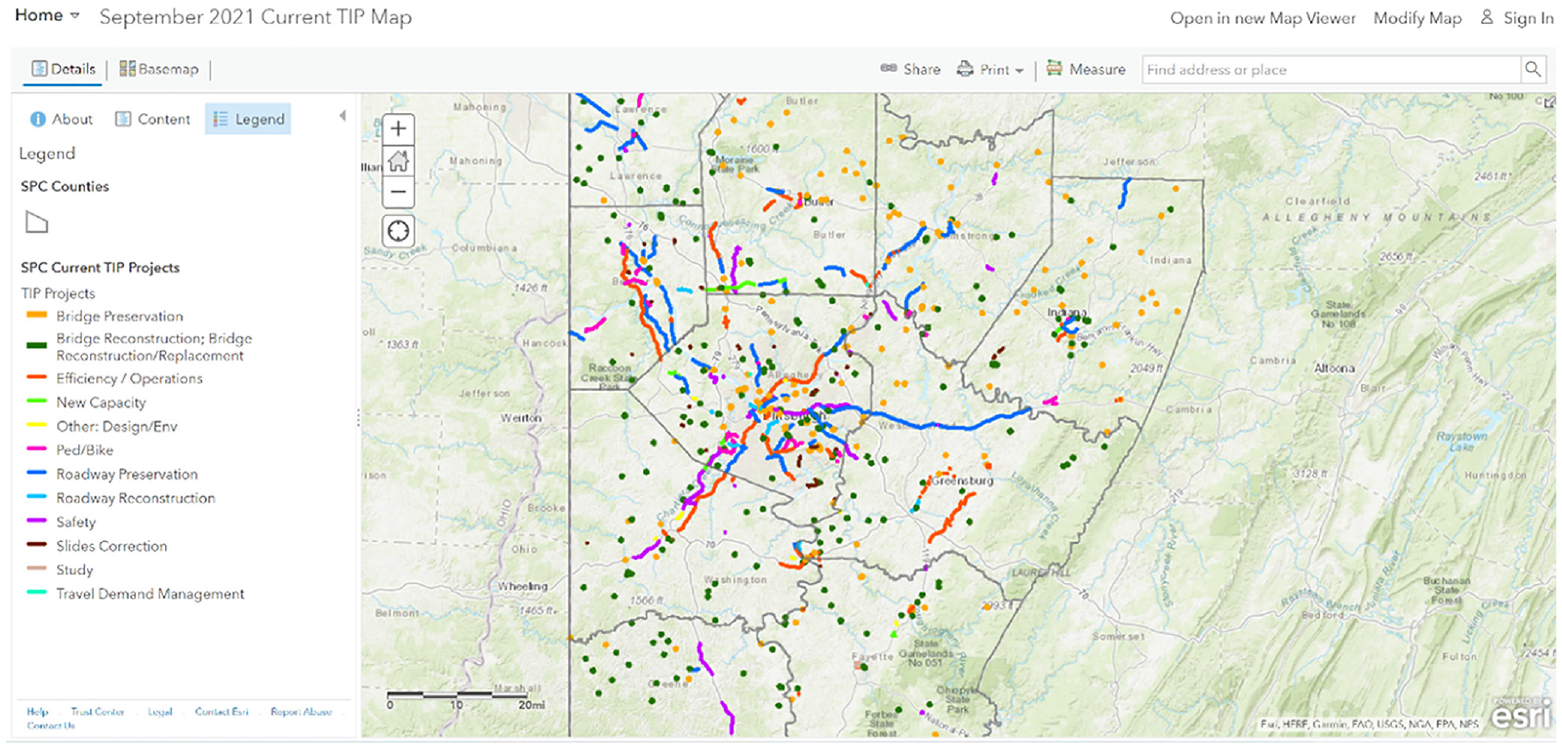
September 2021 Transportation Improvement Programme map (Southwestern Pennsylvania Commission).
The mandated TIP process relies on comparatively short time horizons to muster a tranche of projects that can be considered for funding in each budget cycle. The day-to-day requirements of transportation planning therefore mean that the TIP directs MPOs towards incrementalism. Radical transformation warrants an outside stimulus, creating a tension between a pragmatic presentism shaped by developmental and associated social lock-ins on one hand, and the prospects of wider systemic change on the other, as noted by one SPC Board member: There’s 200+ [TIP] projects in the region and some of them are just ‘reconstruct this highway interchange’, which costs something like $50 million over four years of construction. That’s not doing anything bold. It’s fixing geometries. It’s rebuilding something that’s dilapidated … Does that mean we shouldn’t do them? I don’t think so. We have to think about what that means for a suburban or rural community that we have designed over decades to be car dependent. (SPC Board member interview, 3 November 2022)
The SPC is guided in managing tensions between visionary and quotidian planning by their Long-Range Plan (LRP), a set of strategic planning documents collated as SmartMoves for a Changing Region. The LRP sets an infrastructural planning agenda around a set of strategic goals (SPC, 2019). SmartMoves documents outline three core goals for the region:
1. Connected mobility that intends to create ‘a world class, safe and well maintained, integrated transportation system that provides mobility for all’ (SPC, 2019: 10). Key thematic priorities here include: (a) equitable transport access; (b) high-tech mobility (connected and autonomous vehicles); and (c) streamlining financing, governance coordination, and holistic planning.
2. Building resilient communities that will attract development via ‘intensive investments in connectivity, walkable neighbourhoods, and green infrastructure’ (SPC, 2019: 15).
3. Creating a globally competitive economy via strategic infrastructure investments to support innovation and advanced technology industries. A central argument here captures the ‘old’ and ‘new’ infrastructural imaginaries conditioning future visions; ‘keeping our ageing infrastructure in a state of good repair is necessary to support growth in the region, but it is just as important that we build the infrastructure of the future’ (SPC, 2019: 20).
Across these goals, and the SmartMoves plan more broadly, infrastructure is clearly imagined as a catalysing force to stimulate economic and community growth across regional space. As an SPC Board member put it: ‘infrastructure has been used to tear apart communities, but it can be used to bring them back together … it can provide jobs and build more dense, walkable communities [even if] that’s going to take decades’ (SPC Board member interview, 3 November 2022). The institutional process of envisioning infrastructures as regional solution serves to subjectify varied populations into a coherent economic public despite the partiality of the use and perception of different transportation infrastructures. Anchored by standard concepts including sustainability, accessibility, and connectivity, the regional vision represents a 25–30-year process that acknowledges the structural changes underway (albeit unevenly) across the deindustrialised region. Yet the relationships between what are generally broad and ubiquitous top-down regional discourses and the specific material interventions included in the TIP are largely contingent rather than necessary, shaped by already-existing transportation modalities, population centres, and an approach that distributes infrastructure spending across rural, suburban, and urban areas of the region. As a result, the SPC’s post-industrial framework for future growth is, in practice, directed and constructed through the compartmentalised infrastructure interventions prioritised by the TIP, with their more bounded and immediate temporal horizon. To summarise, the planning documents that avow to present infrastructure as a solution represent significant tensions between short- and long-term priorities, and between local and regional needs. We turn next to examining how MPO analysts and managers navigate those temporal and spatial tensions in their work.
Managing infrastructure-based futuring
Such a pragmatic, incremental process of infrastructural change reflects the conditions and resources confronting SPC staff charged with envisioning the region’s future. Within the SPC, the work of constructing regional infrastructural solutions to perceived local transportation needs is conducted by a small team of professional planners, analysts, and managers whose priority is to ensure that projects, budgets, and planning processes adhere to the raft of regulatory requirements established by the US Department of Transportation (USDOT). For example, the Obama administration implemented an updated Environmental Justice order that attempts to avoid disproportionately high or adverse effects to minority or low-income populations arising from transportation planning decisions. Federal transportation funding is highly competitive, meaning that MPO staff shape their applications to attend to the government’s evaluation criteria. In practical terms, this means that the quotidian focus of staff is focussed on regulatory compliance rather than progressive visioning. An SPC manager explained that ‘we have 3–4 people working on the draft document, and another staff person focussed on air quality conformity … so our documentation is shaped by the requirements we receive’ (SPC Staff interview, 8 November 2022). Operating with limited staff capacity, high regulatory burdens, and short time horizons for budgeting processes, incremental changes to infrastructure via small projects and experiments are often the best hope for responding to regional challenges of structural inequality and uneven access to resources. Furthermore, whereas MPOs include a governance structure of commission members that vote on the final funding decisions in any budget round, board members have limited capacity to influence or evaluate the infrastructural solutions made by MPO staff. In the SPC case, an appointed SPC Board member explained that staff provide a list of projects for a final vote, requiring the Board to trust in the internal decision-making process of MPO staff: We tend not to be presented with alternatives (aside from long range planning where [MPO staff] have been doing more scenarios, for example around low, medium, or high growth for the region) … [MPO staff] will identify a funding opportunity or an idea [and say] ‘here’s the funds or the project that we’d like to go after’. So, a direction has already been taken and conversation [at the Board-level] is then structured around the nuances of that decision. (SPC Board member interview, 3 November 2022)
The role of Board members then becomes one of asking questions: A lot of these things are set up to be breezed through and approved … [so] it’s really important to ask questions and get staff to engage with us on what a project is and how it benefits the region: why are we spending money on [this project]? Why aren’t we doing this [alternative]? (SPC Board member interview, 3 November 2022)
Mechanisms for arriving at infrastructural solutions through the TIP and LRP process are thus predicated on the competence and vision of a limited number of professional staff planners and managers; the distinctly situated epistemic perspectives, interests, and questioning from SPC Board members; and the use of data that are far more limited than might be presumed.
Technologies of participation and the limits of engagement
Individual planners, managers, and board members commented that they found themselves constructing regional futures and infrastructural interventions primarily through a narrow set of technocratic processes and knowledges. Compounding the limited capacity of SPC staff to collect and analyse data, this has the further impact of curtailing the ‘transformative capacities’ of the region as it tends to exclude those without the requisite knowledge to participate in technical dialogues and disempowers alternative communities of practice (see Wolfram, 2016). Interviewees therefore suggested stronger data processes are necessary to support effective infrastructural investment under current conditions. Part of creating a robust TIP and realising the potential of regional infrastructural imaginaries involves public consultation aimed at providing the data (broadly considered) needed for informed decision-making. Considering how to operationalise regional participation raises several profound technical and conceptual questions, both for the SPC and for broader critical urban and regional scholarship (see Häkli et al., 2020; Pickering and Minnery, 2012). This challenge foregrounds the problematic of who can see regionally, as framed in the following terms during our interviews: How do you engage people in a way where things don’t get lost in the detail? I don’t know how you can do that. There are hundreds of projects [in the TIP]. How do you engage someone in Westmoreland County on projects of a local nature in Bedford County? They’re not going to know why a particular project is needed there … I looked through the TIP and still don’t know 90% of the projects. A lot of trust building is needed. (SPC Board member interview, 3 November 2022)
A key issue in this regard is the absence of on-going outreach beyond a brief window of public engagement. This infringes on the formation of ‘infrastructural publics’ (Harvey and Knox, 2016), either in relation to the regular rhythms of transportation planning or in instances of crisis such as the Fern Hollow Bridge collapse. Current forms of public engagement in the SPC’s TIP development process include two rounds of 10 public meetings (20 meetings total), a speaker’s bureau, ArcGIS Story Maps, online and newspaper advertising (including some targeted Spanish-language media ads), social media outreach, and a 30-day public comment period. The SPC also draws on the State Transportation Commission’s survey that generates approximately 600 comments from the southwest Pennsylvania region. The Southwestern Pennsylvania Commission and other MPOs recognise the importance of digital tools for public outreach (the SPC joined Twitter in 2017), as well as the role of visualisations and renderings in conveying what projects in the Transportation Improvement Plan and Long-Range Plan will look like and do. Story mapping, for instance, was viewed as ‘a valuable tool’ because it presents data in a format that is largely accessible to the public (in terms of content and mode of consumption) (SPC Staff interview, 8 November 2022). As a technology of translation through which technical knowledge is rendered legible, digital platforms like ArcGIS Story Maps offer potential as a reference point to the public about how infrastructure stitches regional space together.
As reflected in Figure 1, this is a rudimentary visualisation of the infrastructural region, conceived of as the sum of localised projects and localised experiences. While more work clearly needs to be done, it does function as a step towards impelling a more transformative agenda via ‘seeing like a region’ insofar as: (1) it exposes the needs and demands of other places across the region; (2) it contextualises them, and their spill-over effects, around coherent narratives that place localised concern within a broader regional envelope (as in the case of environmental justice, see Figure 2); and (3) it constructs a spatial imaginary and scale of action around which political efforts may gravitate. Of course, there are no guarantees that the public will respond in progressive terms nor that the information provided will be objective or intelligible be a lay public (Legacy et al., 2024). Acknowledging such critiques, we do see potential here to inform equitable and sustainable decision-making because such tools and visualisations illuminate both investment needs for transformative planning practice and the need to address research questions including: what metrics can effectively evaluate justice and equity outcomes across scales? Where can trade-offs help build broader coalitions to support desired regional development? Where might attempts to promote sustainable futures in one part of the region create displacement or maladaptation in others? And indeed, what are the limits and alternatives to current modes of planning? (following Shi et al., 2016: 135).
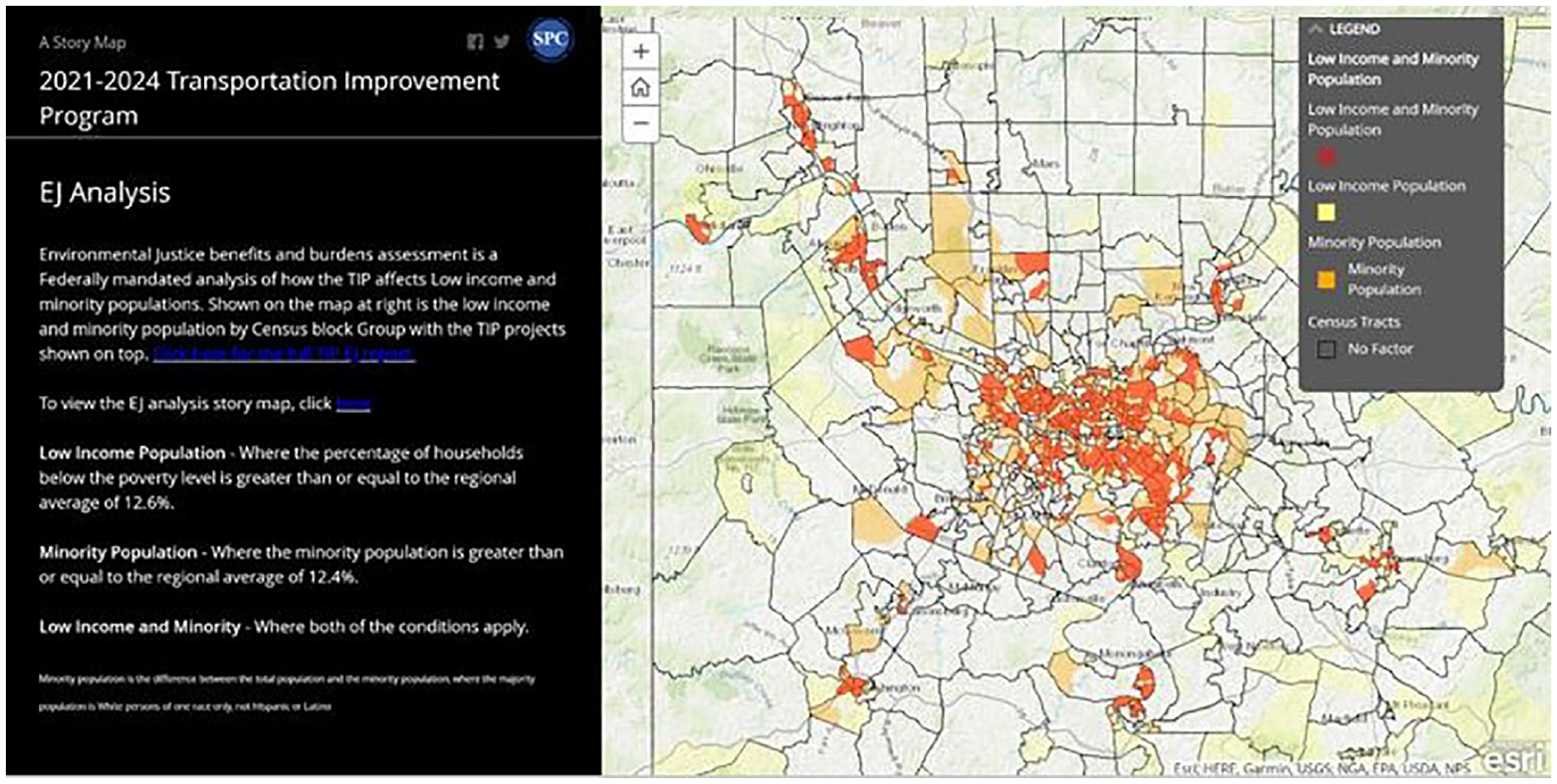
2021–2024 Transportation Improvement Programme environmental justice analysis (Southwestern Pennsylvania Commission).
The need to enhance public participation and feed this into the SPC’s infrastructural imaginaries has become particularly apparent to staff planners during the last months of the development of the 2021–2024 TIP. The COVID-19 pandemic forced the SPC as well as other MPOs across Pennsylvania to shift all in-person engagement to purely virtual platforms, consisting of live and recorded virtual public meetings, the use of Wiki Map style commenting, multimedia advertising and newspaper articles. SPC managers noted that this sudden change challenged their capacity to capture significant community input into the plans for transportation infrastructure. COVID-19 presented an acute challenge to community participation in the southwest Pennsylvania region, yet we argue the growing reliance of planning organisations on digital participation presents an engagement transition that infrastructure planning organisations across the US will need to address in the post-pandemic era.
Towards equitable regional futures: Between infrastructural promise and pragmatism
Residents of Greater Pittsburgh soon adjusted to the immediate disruption caused by the Fern Hollow Bridge collapse. Regional lives were enacted via new everyday mobilities. Bus passengers on affected routes experienced at least 30 minutes of extra travel time on their journey to Oakland, a significant Innovation District anchored by two major research universities, the University of Pittsburgh and Carnegie Mellon University. Residents on streets where buses detoured benefitted from the unexpected surplus of service, while motorists were redirected onto new routes to get into Oakland or Pittsburgh’s downtown. Meanwhile, expedited action on the part of the Federal and State governments provided $23 million for the reconstruction of the Fern Hollow Bridge. The speed at which the bridge was re-visioned and financed is certainly impressive, but this came at the cost of substantive public deliberation that could open the possibility of envisioning – and realising – an infrastructural fix leading somewhere else. The original off-the-shelf renderings for the replacement bridge showed a nondescript four-lane design that privileged Modernist visions of automobility that forced cyclists and pedestrians to share a narrow strip of pavement (see Figure 3). Cycling advocates from the nonprofit Bike Pittsburgh pointedly critiqued this design and overcame initial bureaucratic resistance to ensure that cycling and pedestrian infrastructure could be integrated more prominently into the eventual design of the replacement bridge. A key challenge towards this end was that interest in prioritising transformative infrastructural alternatives struggled to diffuse between levels of government. Local input from impacted neighbourhoods, surrounding municipalities, and the City of Pittsburgh was largely sidelined by the expedited planning process mobilised by PennDOT and the federal government – a move that bypassed the territorial envelope of the SPC (and the capacity of the region as a political space to bring diverse epistemic perspectives to bear). Moreover, while the SPC continues to advocate for a pivot from automobile-centred transportation options in SmartMoves and projects including regional bicycle highways (SPC, 2019: 106), such long-range plans failed to significantly influence the response to the financial and logistical problems disclosed by a short-term disruption to the auto-centric metropolis. Consequently, incumbent planning frameworks broadly supported infrastructural presentism, both in prioritising a response that would enable the immediate system to quickly ‘bounce back’ and by reproducing an environment predicated on established auto-centric technologies and lifestyles (see Coutard, 2024). Yet the new bridge, reopened in December 2022, ultimately included a protected shared-use path for walking and bike transit, reflecting the possibility for groups like Bike Pittsburgh to influence the parameters of infrastructural change when the process is sufficiently opened to public input. This is a temporal and political issue. Although such ‘pushing of the needle’ did not radically alter the bridge’s design or primary function, it demonstrated that adjustments to immediate urban infrastructural fixes can integrate elements – material and discursive – that could turn the region towards a more radical reimagining.
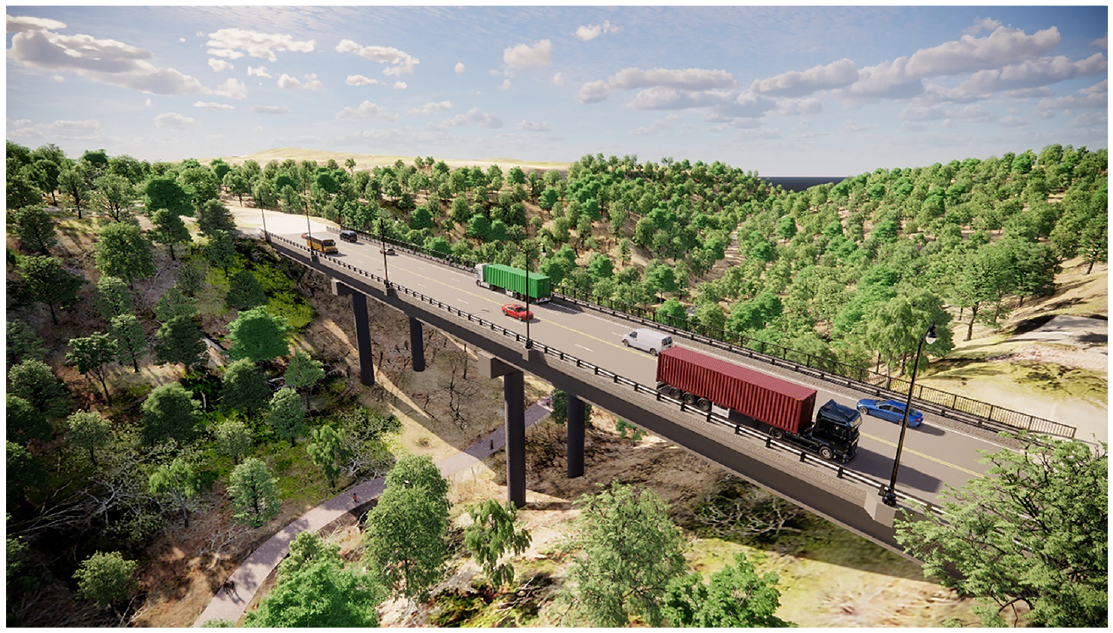
Fern Hollow bridge replacement, initial design (PennDOT).
The partial reimagining of the Fern Hollow Bridge highlights how infrastructural futures are constructed and scaled as both continuous and emergent through the diverse capacities of varied infrastructural imagineers. In particular, we see that the radicalism and incrementalism currently characterising the infrastructural visions of MPOs are conditioned by the varied temporalities of strategic visioning, infrastructure planning, and quotidian interventions. The cadence of daily planning activities, regular and spectacular budget cycles, and the limitations of public engagement mandates create challenges for infrastructures to materialise immediate solutions in the present, let alone to help catalyse more equitable futures. Whereas MPOs like the SPC are federally mandated to guide transportation infrastructure investment in metropolitan areas, we find that in southwest Pennsylvania public engagement strategies within these regional envelopes are insufficient for developing coherent solutions to transportation infrastructure problems that are inherently regional in their scope and articulation. The localism inherent in existing public engagement methods exacerbates the tensions between a politics of infrastructure that foregrounds ‘small interventions with large effects’ (Amin and Thrift, 2017: 6) and Rutherford’s (2020: 2) reflection that any number ‘of small urban projects and experiments claiming to offer responses to big fundamental issues, [too often] seem to be only token initiatives with limited potential for leading on to something more meaningful’. To be clear, enhanced participatory planning in southwest Pennsylvania would not have prevented the Fern Hollow Bridge collapse, nor should public engagement be seen as a substitute for the mundane, essential work of maintenance, repair, and monitoring (Denis and Pontille, 2015; Graham and Thrift, 2007). Indeed, public perceptions cannot be expected to neatly arrive at consensus across regional space, nor when they encounter the realities of budget accounting sheets or engineering blueprints. Nevertheless, had the regional public’s ideas about Pittsburgh’s urban infrastructure been sought on a continual basis, the early designs for replacing the fallen bridge might not have been met with criticism about the lack of public involvement in the design, and they may ultimately have opened space to reimagine both transportation flows around Frick Park and the future of the wider region.
The Fern Hollow Bridge case thus reveals a disjuncture between the potential of infrastructural imagineers to construct what we term infrastructures-as-solutions (strategies for broader transformation) and the realities of infrastructural solutions (as incremental tactics of response and suture rolled out on the ground in the present). The latter still require substantive investment, but substantively reproduce blind fields created by current imaginaries and the tools available to inform decision-making. Here, seeing infrastructure ‘like a state’ can only take us so far, particularly if it leads to the implementation of bounded ‘infrastructural solutions’ conditioned by a narrowly framed technocratic imaginary and mediated by short-range budgets and off-the-shelf plans. ‘Infrastructures-as-solutions’ materialised through visionary and transformative long-range plans are appealing, yet do not tend to directly connect to the quotidian lives of residents. In contrast, it is vital to recognise that governing the complexities of essentially regionalised infrastructural systems as they are punctuated by the diverse capacities of a multiplicity of stakeholders (local, regional, and state planners, multiple funding agencies, residents, business interests etc.) is ultimately unwieldy – even as ‘seeing like a city’ may open us to the messy and incremental actually existing systems that are repaired, maintained, and reproduced through everyday social practice. What we are left with is the added tension between seeing regionally via the top-down and planned visions of the region as a conceived space of economic development and presumed infrastructural coherence on the one hand (as per SmartMoves) and seeing like a region as an analytical frame to capture how this spatial envelope is constructed, inhabited, and experienced in multiple, fragmented ways by multiple publics, who are either brought into the visioning of infrastructural futures by planners in occasional processes or respond to infrastructural disruptions by grudgingly shifting their mobility practices. Our conceptual juxtaposition of these infrastructural fixes and regional epistemic perspectives is represented in Figure 4.
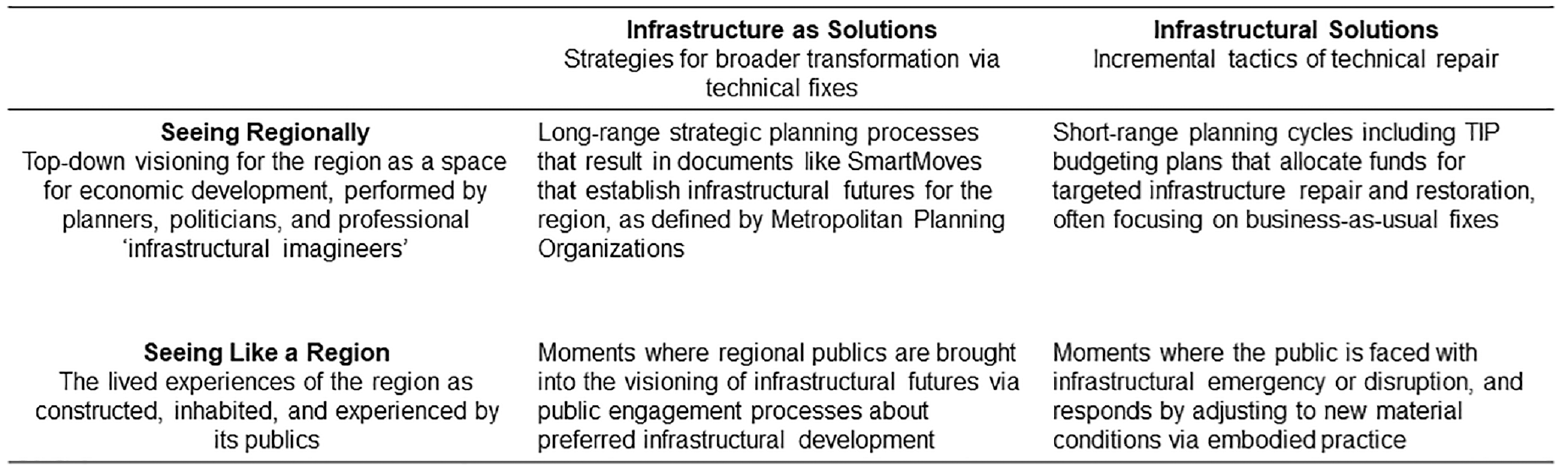
Bridging ‘infrastructural solutions’ and ‘infrastructures as solutions’– regional epistemic perspectives.
The tensions between ‘seeing regionally’ and ‘seeing like a region’ reveal the potential and the pitfalls of infrastructure-based solutions thinking. Infrastructure is encountered experientially and understood in prosaic terms by most constituencies, while becoming part of a more strategic understanding of regional opportunity by the privileged actors who guide transportation planning for organisations such as the SPC, who are the most likely to see regionally – both by mandate and professional perspective. Their strategic overviews (as embedded in the SmartMoves document) represent a vision of the region as transformative: pushing agendas that will only be attained through years of sustained effort. At the same time, the SPC is a tactical body that assembles the priorities of local communities (albeit it in a piecemeal way) to determine the maintenance of existing infrastructure and development of new projects that are determined by funding cycles and expressed community needs. Even as a tactical body, the planners, managers, and board members of regional planning agencies like the Southwestern Pennsylvania Commission are aware that short-term budget cycles and infrastructural disruptions create an opportunity to shift the needle towards structural change in how a region sees and uses infrastructure. By overlooking the incrementalism involved in infrastructural development, we risk missing the planning debates and public practices that can indicate how change occurs within city-regions, and the pragmatic and transformative potential this locks in (Rutherford, 2020: 2). This confluence of incrementalism and radicalism, of vision and mundane management, and of regionalism and localism, emblematises the way that social imaginaries – and the performative function of ‘infrastructures-as-solutions’– are constructed in and across different time horizons, spatial relationships, and through modes of constrained and multi-scalar agency. Addressing these challenges is especially pressing in regions like southwest Pennsylvania where legacy infrastructure systems actively inhibit transitions to more spatially just or sustainable futures. Such ‘left behind places’ (Gansauer et al., 2024; Rodríguez-Pose, 2018) must deal with both an abundance of antiquated infrastructures – detritus from previous regimes of accumulations that continue to perpetuate racialized environmental and economic injustice (Inwood, 2023; Silver, 2021) – and face widening infrastructural gaps that need to be bridged if they are to become places of the future and with a future.
Conclusion
At the outset of the paper, we highlighted the need to account for the questions of what infrastructure is a solution to, and for whom, as well as attending to which actors had the capacity to imagine and materialise infrastructural change over what spatial and temporal horizons. In our case, we tied the localised disruptions presented by the 2022 Fern Hollow Bridge collapse in Pittsburgh to both the contemporary US policy context (which champions infrastructural investments as the solution to profound regional economic development challenges) and the regional constellations of actors charged with imagining and constraining future development. We argued that perceiving solutions through the urban scale – both conceptually and in the sense of local administrative units – is a necessary yet insufficient framework to understand whether more equitable futures may be created via infrastructure. A regional perspective helps bring such progressive futures into view. This, however, must transcend a narrow scalar upscaling as the traps of ‘seeing regionally’ only serve to reproduce the limitations of ‘seeing like a state’– the erasures of rendering space legible and removal from quotidian lived complexity – across a wider territorial frame. Moreover, in the US context, a reliance on top-down regional imaginaries often overlooks the practical complexities of actually existing multi-scalar and pluro-temporal governance regimes, and the limited capacity of those charged with future visioning to see beyond the incremental, pragmatic necessities of the present. Regions are not simply larger versions of cities, nor are they pre-given territorial or administrative containers for the exercise of state power and the realisation of an ‘institutional fix’ (Addie and Keil, 2015). The provocation to ‘see like a region’ attunes us to how the abstract nature of regional identity is accepted and evaluated to foster decision-making processes that may better account for and negotiate the diverse perspectives, communities, knowledges, and desired futures found within a regional planning envelope.
Considering infrastructural transformations ‘like a region’ foregrounds: (1) notions of collective agency and (attempts to form) what Wachsmuth (2017b) terms ‘infrastructural alliances’ to direct regionalised growth politics towards coherent economic spaces; (2) the production of a palimpsest of concurrent regional forms across economic, material, lived, and environmental regions, which continually evolve, even in ostensibly static territorial formations; and (3) the significance of building a realist political ontology that broaches the contradictory impulses of neoliberal governments towards instigating decentralised agency with the concurrent compulsion to ensure actors conform to the disciplinary mechanisms (formal and informal) of territorial spaces and imaginaries, as seen in the UK with the uneven rollout and outcomes of the ‘levelling up’ strategy (Lee, 2017; MacKinnon et al., 2022). The challenge for infrastructural research of ‘seeing like a region’ is to reconcile the common occurrence of distributed agency and partial perspectives on infrastructural form with a fundamental commitment to asking how infrastructures function as subjectifying forces for different populations – something we see in the case of the Southwestern Pennsylvania Commission through radical reimagining and incremental fixes that we describe as ‘infrastructures-as-solutions’ and ‘infrastructural solutions’. Further research could use this conceptual distinction to identify how to encourage a convergence of local rationalities in regional planning envelopes. This might occur via new methods or approaches to encourage citizen participation in planning processes, although that is not to suggest that participation is a simple normative social ‘good’ that will result in emancipatory consequences (see Haughton and McManus, 2019). Rather, infrastructure planning has the potential to contribute to more equitable futures through enhancing procedural and distributive justice (Shi et al., 2016). We argue that motivating broader ‘infrastructural alliances’ could move debates over urban and regional futures towards transformative, equitable outcomes.
Footnotes
Acknowledgements
An earlier version of this paper was presented at the ‘Infrastructures as Urban Solutions?’ international roundtable workshop, held in Limburg, Netherlands from 9 to12 May 2022. Participation was courtesy of a Hewlett Travel Grant from the University of Pittsburgh’s Center for International Studies. Our thanks go to the organisers (who also edited this special issue), and to Theresa Enright and Shaun Smith for their provocations during the workshop. We would also like to thank Andy Pike and Danny MacKinnon for their helpful comments, the SPC for their collaboration, and the three anonymous reviewers for their insightful feedback.
Declaration of conflicting interests
The author(s) declared no potential conflicts of interest with respect to the research, authorship, and/or publication of this article.
Funding
The author(s) received no financial support for the research, authorship, and/or publication of this article.
