







Abstract
This article presents a mixed-methods, multi-authored artistic research project that explores the work of plants in more-than-human communities of extreme toxicity at a former brown coal mine turned wastewater pit in Bitterfeld-Wolfen. Considering the political history of the site through a century of intense industrialization, the project asks: what roles do plants assume in the time-marking and place-making processes of ecological labour engaged in toxic remediation? And how can this specific kind of labour be mediated? We use a mixture of qualitative and artistic research methods to draw an analogy between the work of plants and the work of humans who, in different ways, became embroiled in the site’s material history of extraction and industrial expropriation. We use archival photographs montaged with our own photographic field documentation of plant succession and pigments derived from plants collected on site to explore the social, economic and aesthetic dimensions of pollution through the medium of silkscreen – a tightly woven nylon mesh, not unlike the synthetic nylon products historically manufactured on site. We show how shifting meanings of place, labour and multiple urban temporalities coalesce on site – from the deep time of plant ancestors transformed into coal, to the boom and shrink chronology of a manufacturing town in the former German Democratic Republic, to speculations about energy futures, and the ecological possibility of botanical ‘alterlife’.
The sky. What kind of a feeling was it when I let it settle upon me, absorbing the toxic yellow-grey mist into my consciousness, counting the high-walled openings from which it flowed and then hung like a roof over the city? – Monika Maron (2021 [1981]: 33, translation ours) Clean windows everywhere among this god-awful dirt. And they all wear white shirts, and the children white socks … you have to think about how many of them have bronchitis. You wonder about every tree that hasn’t withered away. – Monika Maron (2021 [1981]: 17, translation ours)
Introduction
The layer of dirt in Monica Maron’s GDR-era novel Flugasche (Fly Ash), a critical account of pollution in Bitterfeld, has largely been overwritten. Today, the post-industrial city can be read as a palimpsest of entangled agencies – where technocratic remediation interweaves with the unruly growth of ruderal urban nature, each inscribing its own temporalities onto the landscape. We begin by situating the East German town of Bitterfeld-Wolfen through the case study of Silbersee (Silver Lake), tracing its shifting human–vegetal relations. We then outline our methodology and highlight key arguments. Using silk screening as an artistic research method of layering empirical observations with theoretical impulses on labour and value from the fields of urban studies, cultural geography, feminist STS and environmental humanities, we will sketch out three ways of thinking about plants as agents of change within Bitterfeld-Wolfen’s deep-time histories, cyclical presents and speculative futures. First, we discuss plants as time markers. Focussing on plant time allows us to bring multiple temporalities of Bitterfeld-Wolfen’s urban nature to the fore. These temporalities span the deep time of lignite and its extraction – which turned the region into a hinterland of industrialization – the boom and shrink chronology of this former manufacturing town, recent remediation projects and speculations about energy futures in the region. Second, we discuss plants as place makers. In the case of Bitterfeld-Wolfen, the various place-making capacities of plants encompass their roles as cultural signifiers of economic fluctuations, as material agents stabilizing urban-industrial landscapes and as connectors of places. The place-connecting capacity of plants spans ever more distant places and scales if we include plant derivatives like coal, cellulose or smog enmeshed in processes of planetary urbanization. Finally, we discuss plants as mediators of ecological labour, making the point that plants function both as literal agents of ecological repair and as metaphorical media for conveying time, space and labour. We then bring these three ways of thinking about plants as time markers, place makers and mediators together in the discussion, and reflect on the potentials and limits of silk screening as an artistic method in the context of Bitterfeld-Wolfen and in urban studies research more generally.
Introducing a palimpsest: Reading Silbersee as entangled layers of time, place and labour
Cultural geographer Sam Merrill describes a palimpsest as a document made up of layered texts that undergo ‘processes of erasure, revision, and reuse’, as it has been applied metaphorically in fields such as ‘archaeology, architecture, and geography, […] often in relation to the temporal configuration of urban space and the memory traces embodied within it’ (Merrill, 2013: 245). 1 Geologist Bjornerud (2018) similarly describes landscapes as palimpsests, imagining layers of earth materials akin to an ancient tablet on which text has been perpetually inscribed and overwritten. 2 Urban-industrial centres are both an interruption to the geological palimpsest, in which ancient geogenic materials are extracted and displaced, and at the same time an anthropogenic addition to that palimpsest, in which the processing and transformation of those extractions introduce a new layer on the deep-time planetary tablet, the era now commonly known as the Anthropocene. Zooming in on the sedimented histories of a former open-cast coal mine turned wastewater pit in Bitterfeld-Wolfen, our research questions are both site-specific and speculative: What roles do plants assume in the time-marking and place-making processes of this urban-industrial palimpsest? How can these vegetal activities be seen as a kind of ecological labour engaged, for example, in the remediation of toxicity? And how can artistic methods be used to activate material and metaphorical thinking about temporal urban natures and their mediation in an urban studies context?
Located in the German state of Saxony-Anhalt, Bitterfeld-Wolfen is a twin city shaped by the enduring bonds between the energy and chemical sectors. These bonds were forged across more than a century, from Prussian expansion and fascist wartime mobilization to socialist intensification of manufacturing, all of which advanced the region’s trajectory of industrial modernization and its associated toxicities. By the late 1980s, the district began to attract international attention due to extensive levels of pollution (Ault, 2021; Chaney, 2017), as lamented in Monika Maron’s Flugasche, cited at the start of this article. Since the fall of the Berlin Wall in 1989, significant federal investment and strategic public relations campaigns have improved the district’s reputation for toxicity, indicative of a transformation that has been read not only as ‘post-mining’ but also as ‘post-socialist’ (Maertens, 2024). Despite ongoing clean-up efforts, industrial residues from the last two centuries persist. The plumes of penetrating smog that once ‘hung like a roof over the city’ (Maron, 2021 [1981]: 33) may have faded from view but have not disappeared. They have settled into the ground, gradually absorbed into sediment archives and cellular tissues.
A fenced-off lake on the outskirts of Wolfen serves as case study of how industrial, ideological and ecological regimes etch themselves onto a landscape. Within an area of about 20 hectares, ruderal vegetation along the lake’s perimeter reveals feral temporalities of ecological succession characteristic of ‘industrial nature’ (Storm, 2014). 3 The story of the lake begins with a clay pit excavated for brick production, supporting the outward expansion of cities like Berlin at the dawn of industrial modernity. The excavation of clay also unearthed brown coal seams that initiated decades of lignite extraction, attracting energy-intensive industries like AGFA 4 to relocate from Berlin. When the coal was depleted and the drainage pumps stopped, groundwater returned to fill up the crater, forming lake-like conditions and prompting a name change from Johannes Grube (Johannes Mine) to Silbersee (Silver Lake) – in reference to the silver halide used in film production at the nearby factory. Burning lignite yielded coal tar that powered an expanding chain of chemical products – from azo dyes to cellulose-based film, synthetic fibres and beyond. Under imperial, fascist and socialist regimes, the site absorbed the material outputs and by-products of these industries. As wastewater from AGFA and later ORWO 5 accumulated in the pit, Silbersee gradually became a catchment for the region’s industrial metabolisms.
Today, the lake is in the process of being backfilled as part of the larger remediation project ÖGP-Bitterfeld-Wolfen. 6 To prevent further groundwater contamination, engineers opted to fixate the polluted sediments with inorganic slag derived from incinerated municipal waste. The plan to fill the 2.3 million m3 crater is expected to take approximately two decades and will require up to 200,000 tons of ashen layers. Once backfilled, the site is slated to host a solar energy field, effectively burying the past under a new energy regime and infrastructural imaginary. It is here, in the entangled sediments of industrial modernity and future potentiality, that our inquiry begins to tease out reflections on Silbersee as a complex layering of time, place and labour – a palimpsest.
Methodological approach
Using research creation 7 as a methodological approach to address questions of temporal urban nature(s), we draw on a mix of qualitative methods of observation and site analysis, archival research and silk screen printing as an embodied way to materially and conceptually sort out and further develop arguments of plant labour on contaminated urban sites of historical contention. Over the course of two years, co-authors Caroline Ektander and Alexandra Toland dug through historical photo archives and followed the seasonal cycles of ruderal plants growing around Silbersee. We collected leaves, berries, bark and fruits of plants on site to derive pigments with the expertise of master pigment maker David Kremer. Reflecting on the act of pouring wastewater through the soil over many years, we poured plant-derived ink through the screen, discussing ideas about viscosity through the lens of labour – in the print studio, in the field and in our conversations and written exchanges with co-author Sandra Jasper – to invite a kind of visual-haptic attention to the geological and political timescales and timescapes of the site known as Silbersee.
Artistic serigraphy, from the Latin word seri for silk and the Greek word graphein to write, more commonly known as silk screening, is a printing technique in which ink is pushed through a fine mesh onto a substrate such as paper or cloth, except in areas made impermeable to the ink. ‘Ink’ in silk screening can be anything from commercially available art products to chocolate powder, chalk, pulverized clay or, in our case, finely ground plant biomass. As an artistic research method that allows the practitioner to multiply, mask, piece together and overlap images in serial production by way of a porous mesh, silk screening is particularly well suited to drawing out the palimpsestic metaphor of layering time, place and labour in Bitterfeld-Wolfen. Before actually entering the print studio, however, the act of layering begins with critical aesthetic decision making: which images, of which sites, historical moments and representational figures? Our visual research led us to different archives and exhibitions focussed on mediating memory, including: the Wolfen Film Museum Archive, the Deutsche Fotothek at the Saxony State and University Library in Dresden, the Kreismuseum Bitterfeld, the FOTOTHEK archive of private photography curated by media artist Anke Heelemann in Weimar, the exhibition ‘Progress as Promise: Industrial Photography in Divided Germany’ at the German Historical Museum in Berlin, the permanent exhibition of historic dyes and pigments at the TU Dresden and the 2022 edition of the OSTEN festival in Bitterfeld-Wolfen, in which the authors also participated. From our engagements with these various collections, our final selection for the purpose of this article consisted of three staged portraits shot by the late photographer Wolfgang Schröter, 8 collaged with our own photos of plant succession on site using pigments derived from those very plants pictured. The criteria for selection that led to this choice were open yet specific – we were looking for iconic examples of place-based labour involving the presence of plants or plant derivatives that could serve as the basis for a visual palimpsest consisting of historical images overlayed with contemporary ones. Our intention was to visually juxtapose the more-than-human work of (phyto)remediation as a form of maintenance with a particular memory of human labour and technical maintenance in the longer industrial history of Bitterfeld-Wolfen. Through the creation of a silkscreen triptych, we use the layering of images to discuss three main arguments below. Firstly, we begin by considering plants as time markers in a 50-million-year-old story that connects plant ancestry (lignite) with their ‘alterlives’ (Murphy, 2017). Secondly, we figure plants as place makers, integral to the urban palimpsest of Bitterfeld-Wolfen and its entanglements with wider cultural and economic urban geographies. Thirdly, we argue that both time marking and place making constitute not only forms of ‘ecological labour’ (Ernwein, 2021b) but mediations of such labour. In this way, we aim to show how an artistic research methodology can contribute to theory development in urban geography studies.
Plant time: Silbersee and the confluence of plant relations
The images of our silk screen triptych depict workers during three chronological stages in the commercial process of film production in the GDR: the intense physical labour of managing wood for the production of cellulose (Figure 1(a)); the subsequent washing and separation of woody fibres (Figure 1(b)); and the inspection of final reems of processed cellulose (Figure 1(c)), before being cut and packaged for distribution. The images were then collaged with snapshots from our fieldwork taken on the now-overgrown grounds of the former ORWO factory and overlaid with headings from newspaper clippings found in Anke Heelemann’s FOTOTHEK in Weimar and the Film Museum’s photographic archive in Wolfen.
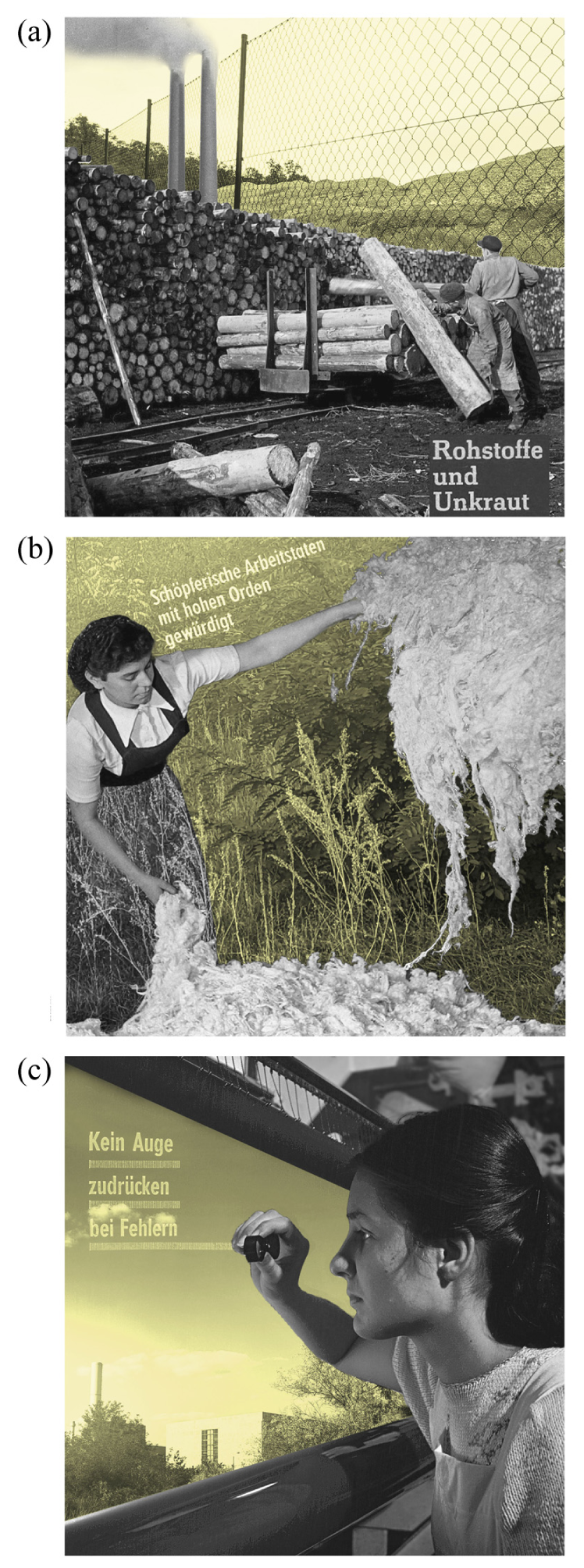
Digital template for screen print of photo montage, consisting of historical photographs by Wolfgang Schröter (record numbers: df_wgs_0001962, df_wgs_0001968, and df_wgs_0001958, ©Deutsche Fotothek/Wolfgang Schröter) and recent photographs by A Toland (2022), nettle-based plant pigments and newspaper clippings. From top to bottom: (a) ‘Rohstoffe und Unkraut’ (translation: resource and weed); (b) ‘Schöpferische Arbeitstaten mit hohen Orden gewürdigt’ (translation: ‘Creative work is honoured with high awards’); (c) ‘Kein Auge zudrücken bei Fehlern’ (translation: ‘No turning a blind eye to mistakes’).
In the first image (Figure 1(a)), printed with nettle ink, charcoal and pulverized amber from the Kreis Museum, 9 we see two workers stacking tree trunks from nearby forests to be processed into cellulose for the film industry. In the background, chimneys billow smoke burned from coal made of ancient trees that once thrived on site. Superimposed onto the negative space is an image of the current fence surrounding Silbersee lined by wild locust, birch and willow trees, from which the charcoal pigments were made. In this image, plant residues and representations from different geological eras are brought together as a multi-layered expression of vegetal time. Phenomenologist Michael Marder suggests that ‘the meaning of vegetal being is time’ (Marder, 2013: 95), challenging the reductionistic idea that the lifetime of a plant can be ‘exhausted in the process of actualization’ (Marder, 2013: 94), from germination to growth, flowering, seeding and then decay and death. Plant-time, in Marder’s terms, is not only non-linear but offers an ontological model that, we argue, is helpful for thinking about, mediating and actively countering Anthropocene dystopias. A phyto-ontological worldview furthermore incorporates ‘the vegetal hetero-temporality of seasonal changes; the infinite temporality of growth … and the cyclical temporality of iteration, repetition, and reproduction’ (Marder, 2013: 95). The plant ancestry of fossil fuels pushes this onto-scenario to its limits. Brown coal began to form and deposit underground in what is now the German state of Saxony-Anhalt around 400 million years ago from compressed plant remains, evolving from swamp land to peat land, to deposits of rich lignite flecked with amber just below the surface. Because lignite is less efficient as an energy source than black coal, oil and gas, it is often readily consumed by on-site industries that pop up close to the source. Thus, plant-derived coal and chemicals became co-constitutive of the region’s pollution, saturating the Silbersee and confounding the geopolitical palimpsest.
Regarding plant time, we are furthermore interested in the human shifts in value as plant agencies are determined by their material states – from living beings rooted in soil to timber products, fossilized fuel, petrified sap or combusted emissions. As a case in point, fly ash from power plants nowadays is filtered and sold as a cheap and easy-to-obtain soil amendment to improve the physical, chemical and biological properties of degraded soils due to its high concentrations of plant-available nutrients and its promise of greater agricultural yield (Kishor et al., 2009). Where fly ash today creates agricultural capital in the form of commodified waste products, the Flugasche (fly ash) described in Monika Maron’s novel was rendered valueless, lifeless and even life-threatening. The ecological labour involved in its containment today is subsequently undervalued. Stinging nettles, dandelions, plantains, locusts and box maples are not typically favoured (or purposely planted) in urban green spaces but proliferate here in spite of the toxicity. The unfiltered fly ash that spewed into the skies, along with the complex chemical residues left over from the synthetic fibre industry, now actually feeds successive generations of plant communities about whose ‘value’ for these now soil-borne, plant-available nutrients we can only speculate.
Extending this phyto-ontological reading of plant succession, we may also invoke Michele Murphy’s figure of the alterlife as ‘life already altered, which is also life open to alteration … figuration of chemical exposures that attempts to be as much about figuring life and responsibilities beyond the individualized body as it is about acknowledging extensive chemical relations’ (Murphy, 2017: 497) The concept of alterlife provides a generative lens for understanding the metabolic flows that have accumulated in the Silbersee as well as the destined arrival of whole communities of plant species that settled the land when industrial interests shifted. On the one hand, plant-based lignite shaped the chemistry that plant-based labour is now expected to process, for example via the production of oxygen, accumulation of heavy metals and sequestration of carbon. On the other hand, the timeline of fly ash is intimately entangled with the timeline of ecological succession of those plants whose collective presence continuously transforms the landscape. Succession on contaminated wetlands may thus be understood as a palimpsest of maintenance – an ongoing labour that incrementally reduces toxicity to allow new (alter)life to thrive.
What processes of biomass accumulation and dispersal will be evident on the site of the Silbersee in another 10,000 years, and which plant communities could take over the succession of willows, poplars, locusts and alders in only 100 years? In the documentary film Sehnsucht nach Bitterfeld (Yearning for Bitterfeld) by Ralf Hopfner and Thomas Freundner (1993), there is a scene in which archaeologist Wolfgang Hartung descends in the claws of a bucket wheel excavator used for lignite mining, explaining that he has found the remains of a prehistoric forest elephant here and is sure he will also find traces of Neanderthals. ‘At about 20 metres below the surface this is where it gets interesting; we have travelled back in time to a forest 150,000 years old!’, he exclaims. Between Maron’s despair and Hartung’s euphoria there are trees on the horizon that appear as the latest time markers in a 50-million-year-old narrative. From the remains of ancient trees that led to lignite formation millions of years ago to the millions of cords of wood that enabled the production of cellulose for a burgeoning film industry, to the ring of spontaneous woody vegetation now stabilizing the perimeter of a soon to be forgotten lake, Silbersee appears as a case study in shifting human–vegetal relations that juxtapose plant-time with human value creation.
Plant space: Ecological place makers, cultural signifiers, distributed agents
Sitting in the studio of the print workshop at Kunstquartier-Bethanien in Berlin’s district of Kreuzberg, we are waiting for a screen to dry. The print studio is perhaps one of the best places to reflect on the passing of time because clocks there run according to material needs and clear-cut production processes that only come to fruition through a cyclical repetition of trial and error. The walls of the workshop itself are a palimpsest of decades of artistic creativity and political and social engagement. The former Gründerzeit hospital, with its yellow brick facade reminiscent of Greppin Klinker (Greppin Brick), once quarried and manufactured in the region of Bitterfeld-Wolfen, borders the Luisenstadt Canal, designed by Peter Joseph Lenné in the 1840s and backfilled with rubble after the Second World War. During the Cold War, it overlooked the formidable death strip, which once wound through the city as an important strip of urban nature until being developed for real estate in recent years. What is more, this place is part of a larger network of places that are connected through plant-time that weaves its way through disparate sites to connect the dots – from places of production in the print studio (Berlin) to places of storage in photographic archives (Dresden) to places of remediation (Bitterfeld-Wolfen). Plants are elemental in the cultural construction of these places, from covering up visible layers of toxic industrial history to serving aesthetic tastes connected to urban, agricultural or recreational use (Del Tredici, 2014). Through their derivatives as coal, cellulose, smog or pigment, they connect places far beyond the actual spatial boundaries of root zones and microclimates. Plant space becomes enmeshed in processes of planetary urbanization when we consider these metabolized derivatives in their myriad and largely uneven socio-ecological relations (Swyngedouw, 1996, 2022). Plant space, like plant time, is distributed.
Today only a fraction of the former ORWO industrial complex remains, as evident in the expansive landscape shown in Figure 1(c). The footprints of demolished factories now filled by swaths of spontaneous vegetation are cultural placeholders for economic speculation, generally tolerated by landowners while they await new development. The transition from industrial production under socialist rule to industrial production under capitalism marked a decisive thinning and modernization of the district following the fall of the GDR. In the early 1990s, large parts of the area were repurposed into the Chemical Park Bitterfeld-Wolfen, a privatized industrial cluster that attracted new business interests. The Wolfen Industry and Film Museum is one of the few preserved historical buildings amidst a contemporary ensemble of chemistry, logistics and advanced manufacturing firms. Homogeneous windowless buildings and sprawling carparks mark the spatial character of the district in equal measure to the leafy green succession that defines the former wastewater pit – both part of a longer-term strategy of ecological remediation and economic stabilization.
From the fenced-in blocks of reinforced concrete and sheet metal structures to informal green space populated by willows, locusts, poplars, box maples and brambles, we single out the genus Salix (willow) as place maker to develop the figure of the fence as aesthetically and conceptually elemental to the plant-space of Bitterfeld-Wolfen. Characteristic of Silbersee and other wet places like it – regardless of origin as a kettle hole formed by receding glacial ice or as residual hole formed by lignite mining – willows have long been cultural spatial signifiers, marking borders as hedges between farmers’ fields, buttressing entry roads into villages or framing serpentine windbreaks along irrigation ditches. Known for their incredible flexibility and ability to vegetatively reproduce, willows can plant themselves along opportune waterways or be planted by human hands as natural fences or riverbank stabilizers. Along the outer banks of the Silbersee, a mix of different species of willow hugs the length of the fence, its occurrence as planted or wild-growing unknown to us. In the habitus of hedgerows and other barriers, wherever a fence is needed, willows will naturally assume their place in the landscape, creating spatial worlds with an agency that separates but also connects. Whilst they are no longer intensively cultivated as space-defining natural resources, willows continue to hold landscapes together. As geographers Marion Ernwein, Franklin Ginn and James Palmer, citing Emanuele Coccia (2018), suggest: ‘plants are in fact the most fundamental makers of the world; they transform everything they touch into life, they make out of matter, air, and sunlight, for the rest of the living, will be a space of habitation, a world’ (Ernwein et al., 2021: 17). In the pollarded worlds once made by willows, these plants were used for making baskets, brooms, temporary architecture, furniture and fences. They were and still are furthermore prized by herbalists from different cultures around the world for their ability to alleviate arthritis and other aches and pains. Though their place in the world today as producer of household goods and medicinal remedies has been largely replaced by synthetic substitutes made of materials such as those once manufactured in Wolfen, the willows on site today weave their way through the sludge to form a new basket-like presence around the wastewater pit, containing and buffering on symbolic and spatial but also molecular levels. On sites like Silbersee, willows have also been shown to alleviate contaminated soils, for example in the phytoremediation of cadmium and other heavy metals (Klang-Westin and Eriksson, 2003; Kuzovkina and Quigley, 2005). Its extraordinary vitality, its ability to bind and hold things together, to alleviate and heal both humans and soils and to signify places of cultural importance, makes the willow not only a place maker but a world maker in Ernwein et al’s terms. Back in the print studio in Berlin, we metaphorically and materially invite these world makers into the palimpsest with a willow pigment that appears as pale and light on paper as the faint sound of its leaves in the wind.
Plant labour: Mediation of more-than-human work
Val Plumwood once cautioned, ‘ecological thought has to be much more than a literary rhapsody about nice places, or about nice times (epiphanies) in nice places’ (Plumwood, 2008: 139). In Anthropocene studies 10 there is a tendency towards literary rhapsody that is aesthetically fixated on toxic places, mediated as ruin porn, schadenfreude, the toxic sublime, post-war voyeurism and the like. This is not our intention. ‘Niceness’ in Plumwood’s terms, in Bitterfeld-Wolfen, is contestable. Green infrastructure and new recreational and touristic developments, for example along the shores of the nearby Goitsche Lake, stand in contrast with the ubiquitous presence of groundwater pumping pipes visible throughout the city. Signs of commercial production and residential renovation appear alongside levelled street blocks overgrown with spontaneous vegetation. In the district of Bitterfeld-Wolfen, growth and shrinkage, leisure and toxicity stand side by side. Silbersee, as a concentration of this paradoxical development, is a place that activates ecological thought through changing imaginaries – by businesses attracted to the region, by journalists and filmmakers shocked by the scale of humanly induced landscape change, by local authorities who have tried to manage the area’s development, reclamation and reputation and by socio-economic and political trends that have cast the site as a poster child for ecological disaster, economic development and then as a clean-up success. What about the imaginaries on site? How can mediation of this place reflect the city’s history of extraction without surrendering to dystopian visions?
In this section, we draw on the concept of ‘ecological labour’ as a force to mediate place and time. ‘Ecological labour’, as described by Ernwein, includes ‘forms of labour whose raison d’être is keeping non-human life alive and setting the right conditions for it to contribute its agencies to urban life’ (Ernwein, 2021b: 106). From the exploitation of fossil plants as fuel to the employment of plants in environmental clean-up, Ernwein, Ginn and Palmer point out that ‘plants are obligate participants in planetary capitalism and conduct various forms of work crucial to its maintenance and growth’ (Ernwein et al., 2021: 22). This enrolment of plants’ capacities in urbanization projects also has social implications, involving the politics of human labour (Ernwein, 2021a), including, as we will show, its gendered dimensions. In our silk-screening exercise, we attempt to bring several aspects of these observations to light. In the first image of our Silbersee triptych (Figure 1(a)), the newspaper clipping ‘Rohstoffe und Unkraut’ (‘Resource and weed’) highlights the binary categories through which plants have been understood as either raw materials or useless brush. There is, however, a close link between ‘resource and weed’ that is not merely a question of value.
From a geobotanical perspective, plants serve as indicators for directing humans towards sites of coal or minerals, a practice of prospecting that dates back centuries. 11 From a critical reading of ecosystem services, plants that settle disturbed soils without being planted can also act as ‘sign-posters’ to help humans read the landscape and make sense of place (Toland et al., 2021: 131). Plants are also used in clean-up efforts to ‘phyto-remediate’ post-industrial landscapes after coal or minerals have been extracted. Metallophytes, or plants that can tolerate high levels of heavy metals, have been subsequently put to work as a cost-effective strategy due to their metabolic capacities, even with the aim of preparing ground for future agricultural cultivation (Van der Ent et al., 2018). Spontaneous vegetation also has a history of serving not only as an indicator for economic prosperity or depression (Del Tredici, 2014) but as a particular kind of urban aesthetic (see e.g. Gandy, 2013; Hauser, 2003; Jasper, 2018; Kühn, 2006). Ecological thought, following Plumwood, can thus be a recognition of the signposting, hyperaccumulating, restorative and aesthetic labour that plants do in places like Bitterfeld-Wolfen.
In recent decades, architecture, planning and urban design have deployed ecological rhetoric with enumerative terms to describe and measure the value of these kinds of labour – biotope value, nature-based solutions, ecosystem services, compensation landscapes – through which nature becomes enrolled in the technocratic ‘adaptation’ of modernity (Danneels, 2025; Gandy, 2021; Jasper, 2021; Lachmund, 2013). This tired terminology and the strategies behind it render invisible the different modes of human and non-human labour that are part of the creation, maintenance and cleaning up of contaminated landscapes. Namely, these terms often lack insight from urban botany and cultural interpretations of urban nature that have emphasized how ‘plants have their own agency irrespective of human intentions’ (Gandy and Jasper, 2020: 11). Geographers and political theorists have begun to respond to such technocratic rhetoric of environmental remediation to ask what re-valuing such botanical prospecting, cleaning and world-making work would imply politically.
The notion of ecosystem services as a category of useful labour, that does not result in tangible products but rather in immaterial goods, resonates with Salleh (1997) and other ecofeminist comparisons between the exploitation of women’s work and the exploitation of nature’s work. Plant labour, much like domestic labour, and other forms of gendered care work, has been historically undervalued. In a somewhat similar trajectory of an urban lake contaminated by a former chemical textiles plant in the Prenestino neighbourhood of Rome, Italy, Tola (2019: 201) describes labour along gender lines: ‘The chemical department employed a mainly male workforce while women, many of them as young as thirteen to sixteen years old and paid much less than the men, were the majority in the textile plant’. This condition, combined with the proliferation of plants in the restoration of contaminated soils, is addressed in the second image of our Silbersee triptych. The gendered labour of washing and separating cellulose at the film factory is overlaid with an image of weeds at work, with the caption ‘Schöpferische Arbeitstaten mit hohen Orden gewürdigt’ (‘Creative work is honoured with high awards’; Figure 1(b)). While the Italian case reflects the patriarchal labour divisions under fascist regimes, the GDR actively promoted gender equality in the workforce through policies such as universal childcare and equal pay initiatives. Nevertheless, traditional gender roles often persisted in practice, complicating the narrative of emancipation in the former East (Sieg, 1995).
Thinking with Ernwein, Ginn and Palmer, we are also wary of the potential political implications of anthropomorphizing the labour of plants against a background of labour marked by intergenerational violence, especially towards women ‘in a world economy characterized by the systematic exploitation and abjection of labour’ (Ernwein et al., 2021: 23). While a direct analogy between plant labour and human labour remains problematic, alliances between species can highlight the relational importance of working together in multispecies societies. Political theorist Alyssa Battistoni (2017) uses the concepts of ‘hybrid labour’ and ‘Oikos-work’ to think through a mode of political subjectivity that accounts for the economic dimensions of more-than-human relationships. Battistoni (2017: 6): extends the insights of feminist theorists regarding undervalued forms of production … [to] articulate the idea of a kind of hybrid labour that understands the ‘work of nature’ as a collective, distributed undertaking of humans and nonhumans acting to reproduce, regenerate, and renew a common world.
Ecological restoration is moreover ‘an opportunity for a partnership’ (Kimmerer, 2013: 396), in which the alliance of efforts and of intelligences comes together as multispecies labour. In her description of industrial damage to Onondaga Lake in upstate New York, Robin Wall Kimmerer (2013: 331) mentions the plants that arrive in succession on disturbed soils to do healing work on the land: ‘Here on the waste beds there are expanses without a living thing, but there are also teachers of healing and their names are Birch and Alder, Aster and Plantain, Cattail, Moss, and Switchgrass’. Many of these plants are also found at Silbersee.
While considering their work as a form of care work (risking anthropomorphization), we also recognize that as these plants change the land, the land also inevitably changes the plants. An outgoing phyto-ontological premise that recognizes the work of willow, birch and alder over time must also include the potential for morphological and genetic alterations to these plants under pressures of persistent toxicity. Recognizing the care work of plants speaks to recent efforts in combining political economic and biochemical conceptions of metabolism (Barua, 2025). Care work as a form of maintenance or healing, Maria Puig de la Bellacasa (2015: 2) has similarly argued, carries ethical and affective implications, reminding us that ‘any notion that care is a warm pleasant affection or a moralistic feel-good attitude is complicated by feminist research and theories of care’. Mediating plant labour along the banks of the Silbersee is thus inevitably also a mediation of alterlife and its metabolisms, not nice, pleasant or warm, but worthy of acknowledgement as more-than-human care.
Discussion: Mediating urban temporalities, places and plant labour
In the studio, we use a loupe to examine a printed image on a sheet of transparent film before it gets ‘burned’ on the silk screen. The image (Figure 1(c)) shows a young woman factory worker inspecting a ream of cellulose through a loupe. In the background we have added an image of bushy growth in the place where production buildings once stood. The caption reads, ‘Kein Auge zudrücken bei Fehlern’ (‘No turning a blind eye to mistakes’). Compared to the precision desired in industrial processes of both manufacturing and the science of environmental remediation, our own work reflects the inevitability of error: visual data too pixelated to burn; pigments that fade over time; an ink mixture too sticky to print; and paper improperly aligned to the screen. Failure, though rarely acknowledged, is a constant reality in both the remediation of physical landscapes and the (re)mediation of visual materials.
Through studio workshop trials and errors, site-based encounters, archival discoveries and many dead ends, we propose new phyto-imaginaries that approach environmental remediation as a palimpsest of complex and often contested histories. In doing so, we attempt to peel back the dominant story of human-made failure, and particularly East German-made environmental disaster in Bitterfeld-Wolfen and the various schemes devised to remediate its mistakes. Alenda Y Chang muses that ‘environmental remediation reminds us that environments are also media, able to transmit, conceal, and come between other entities in significant ways’ (Chang, 2015: 3). Through artistic engagement with different visual materials, we reflected on the role of plants not only as environmental media able to transmit, conceal and come between but also as metaphorical mediators of time, space and labour. In their collection Critical Concepts for the Creative Humanities, Iris van der Tuin and Nanna Verhoef (2022: 125) refer to the critical theory-building strength of metaphors, which ‘produce intuitive and direct associations between two [or more] separate domains’. Meanwhile, Tim Cresswell (1997: 330) has argued that ‘metaphors can be understood as ways of thinking and acting with geographical and political implications’. In our layered analysis, the use of metaphor is put to work, for example through the figure of the palimpsest, the labour of plants and the medium of the silk screen.
At the time of this writing, the ecological labour at Silbersee is moving along gradually, with about two-thirds of the lake already immersed in rubble and with a thick band of spontaneous vegetation rewilding the perimeter. Limited access through fencing and warning signs around the lake has deterred human activity, recreational and otherwise, allowing plant pioneers to settle and engage with lake-like conditions before the pit itself disappears beneath a new layer of matter and new infrastructure for energy production. Ruderal plants harness the sun and replenish the soils with decomposed leaf litter, stabilize the banks with their roots, nourish communities of soil microorganisms, which in turn absorb and demobilize toxins, and in so doing emerge as time markers and place makers in a longer history of multispecies labour that distinguishes itself culturally and politically from other wetlands and other forms of labour. In a new chapter of Silbersee, a solar park is planned for the site, adding another layer to the palimpsest where meanings and mediations of place and temporalities of urban nature coalesce. It may even prompt a new name, just as Johannes Mine (Johannes Grube) once became Silver Lake (Silbersee), or else fade quietly into oblivion.
Conclusion
Using an artistic research methodology, we have explored the role of plants as time markers and place makers involved in the ecological labour of environmental remediation. Drawing analogies between vegetal and human labour, we traced overlapping histories of extraction, industrial decline and energy futures, revealing how layered urban temporalities and botanical ‘alterlife’ coalesce on site. We were able to engage with plants directly by collecting them and transforming them into a still-toxic yet photochemically unstable ink that will vanish over time with exposure to light. We were also able to use the screen as an apparatus to think through toxicity, acknowledging that the medium of the ‘silk’ itself was made of synthetic materials chemically similar to the synthetic textiles once produced (and dumped) in the Silbersee.
While spraying down used silk screens in a print studio in Berlin, so-called ‘ghost images’ would occasionally appear where stains on the mesh were particularly resistant to cleaning, not unlike stains in the landscape that persist after the source of point pollution has moved on. The silk screen thus became a metaphorical tool for thinking about processes of industrial production, contamination and remediation on site – from nylon fabric as both source of toxicity and instrument of creativity; to plants as both mediators of historical imagery and as phytoremediators in a biochemical sense; to the concept of a porous membrane as a medium for re-imagining history and the soil itself as a medium for filtering wastewater; and finally, to different notions of archives as collections of photographic records as well as chemical traces in the land.
The silk-screening method furthermore allowed us to physically integrate and write (as in graphein) with and about materials collected from the field (plants rendered as pigments) as well as materials from historical sources and site visits (photographs of then and now) alongside conversations and site observations. In this way, the project presents an example of research creation in an urban studies context, characterized by the integration of artistic methods, in which the act of art making is central to the investigation and presentation of theory (Loveless, 2020). With this, we recognize the need for further critical research in urban studies and related fields that can highlight the agency and political-ecological dynamics of urban plants as well as the aesthetic and creative dimensions of plant labour.
Footnotes
Acknowledgements
This work was a co-authored sub-project developed within the framework of Caroline Ektander’s PhD research project, Toxic Commons: Transmediating Permanent Pollution. Material support came in part from the Bauhaus-Universität’s Kreativfonds. We would like to thank the anonymous reviewers for their thoughtful feedback as well as Sven Sachenbacher (IFM, Wolfen), Anke Heeleman (Fotothek, Weimar), SLUB Dresden, Jörg Stuckrad (Bauhaus-Uni Print Workshop) and Magda Korsinsky (Druckwerkstatt BBK Berlin).

Ethical considerations
To the best of our knowledge, no one was harmed during the realization of this research. Moreover no Artificial Intelligence was used in the writing of this article.
Informed consent
All fieldwork and archival investigations were conducted in accordance with institutional and professional ethical standards.
Funding
The authors disclosed receipt of the following financial support for the research, authorship, and/or publication of this article: The artistic research leading to these results has received Funding from the project Toxic Commons – Bitterfeld-Wolfen/Fushun under the grant programme Kreativfonds at Bauhaus University Weimar.
Declaration of conflicting interests
The authors declared no potential conflicts of interest with respect to the research, authorship, and/or publication of this article.
Data availability statement
Research journal notes, field photographs and (anonymized) correspondence may be made available to any concerned parties upon request.