







Abstract
Cities worldwide face immense challenges in transitioning to a sustainable future. While being structurally and politically bound to continuous growth, the striving for a constant increase in production and consumption puts enormous pressure on our planet and its ecosystems. Degrowth has been proposed as a pathway to solving this dilemma. Although scholarly attention to urban degrowth has expanded, a central aspect of cities remains partly unexplored: mobility. Urban mobility, being motorized and dependent on fossil fuels, has a substantial environmental and social impact, making it a central issue for sustainability. Within mobility research, urban sustainability has primarily been addressed by problematizing automobility and discussing how to replace the car as the dominant mode of transport. However, the relationship between mobility and growth extends beyond cars and needs to be addressed more generally. This article develops and expands the conversation between the degrowth and sustainable mobility literatures through a theoretical exploration of the concept of “limits.” It proposes a relational conceptualization of limits, providing an analysis of this concept in relation to key vectors of urban mobility: space, speed, and the body. Our study suggests not only that limits should be conceptualized along these vectors but also that these specific limits could be used to tease out what sustainable urban mobility might mean in practice.
Introduction
We live in a rapidly growing world where production and consumption continue to reach all-time highs every year (IMF, 2024). Despite promises of green growth, this is accompanied by a steady increase in emissions (IEA, 2024). As the global average concentration of CO2 in the atmosphere is well above 420 ppm and still rising (NASA, 2024), extreme weather events are becoming more common (WMO, 2024), painfully demonstrating the consequences of combining infinite growth with a finite planet. Transport 1 is a critical sector in terms of emissions and its importance for the organization of cities. Currently, the sector accounts for approximately one-fourth of global energy-related CO2 emissions (Jaramillo et al., 2022: 1056), with slightly higher percentages in Europe and the United States (EEA, 2022: 25; EPA, 2024: 29). As industrialized societies are structurally tied to high levels of mobility (Bertolini, 2020), the rising global demand for mobility creates a gulf between the forecasted future and the commitments to combat climate change, for example as articulated in the Paris Agreement (UN, 2015). This contradiction has led researchers, environmental civil servants, and activists to call for a transition to sustainable mobility.
Sustainable mobility is more than a sector-specific version of sustainable development; rather, it is a diverse and multidisciplinary paradigm that has come to strongly influence public discourse in many parts of the world (Curtis, 2020; Goodwin and Curtis, 2020). Sustainable mobility challenges the dominant ideas within the car-based paradigm (Owens, 1995; Whitelegg, 2020), advocating healthier and cleaner modes of transport, such as walking, cycling, and public transport (Stanley and Lucas, 2014), and technological improvements in terms of vehicle efficiency and less-polluting fuels (Bishop, 2012; Tran, 2014). Additionally, sustainable mobility researchers have emphasized the reduction of mobility demand as a complement to conventional policy solutions, such as technological innovation, electrification, and biofuel (Banister, 2011). However, growth-critical perspectives are often empirically and theoretically limited in sustainable mobility research, as they tend to focus on mobility growth with less attention to the connection between mobility and other forms of growth, such as economic and population growth (Bertolini, 2020; Isaksson, 2023).
In the social sciences, critical perspectives on growth have proliferated over the last decade. Challenging the widely held proposition that growth is necessary, researchers and activists have proposed a wide range of alternative notions, including degrowth, post-growth, steady-state economics, doughnut economics, well-being economy, and Buen Vivir. Although these ideas have yet to have a significant impact on politics, they have gained increased recognition in academia and civil society. In this article, we primarily focus on one of these, degrowth and the degrowth literature. Many definitions of degrowth have emerged, but Hickel et al. (2022: 401) have offered an explanatory yet straightforward description: “Degrowth is a purposeful strategy to stabilize economies and achieve social and ecological goals, unlike recession, which is chaotic and socially destabilizing and occurs when growth-dependent economies fail to grow.” This means that degrowth is neither an economic concept nor an ideology (see Demaria et al., 2013). It points towards a strategy of lowering social metabolism and extractivism while ensuring justice and collective decision making. Therefore, we draw inspiration from the degrowth literature, but we primarily focus on one of its key conceptualizations: limits. Indeed, limits, their nature, and their implications have received new attention thanks to the debates within the degrowth literature. 2
Both the sustainable mobility and degrowth literatures have made significant contributions to their respective fields; however, they have not been sufficiently put into dialogue with each other. Therefore, we see an increasing need to develop the conversation between these fields, combining the heterogeneous field of sustainable mobility with the equally diverse perspectives of degrowth by zooming in on how they address growth and limits, respectively. Subsequently, we build on the few studies that have explored this connection (e.g. Cattaneo et al., 2022; Szabo et al., 2022) and aim to explore how urban mobility could be re-conceptualized using a relational concept of limits. We argue that while limits have been central for analyzing economy and ecology on a global scale, the concept has not been adequately developed for studies of mobility, especially in an urban setting. Many of the conflicts and dilemmas at the intersection of growth and mobility are, therefore, urban in character, making cities a good point of departure for exploring limits to mobility. Despite significant contextual variance between urban settings (e.g. between small Scandinavian rural towns and Asian megacities), many cities continue to be ideologically committed to pursuing increasing levels of mobility as well as sustained high growth rates in terms of economy, urban population, and land use. Implicitly, these commitments are also often present in policies that align with the sustainable mobility discourse (Isaksson, 2023). Thus, imagining a future where limits to mobility are recognized remains a pressing task for research, politics, and civil society.
The article is structured into two major parts. After this introduction, we briefly present our conceptualization of relational limits, followed by two sections presenting the sustainable mobility and the degrowth literature, with a focus on how they address growth and limits. The second part of the article is devoted to developing a relational understanding of the limits of urban mobility. Specifically, this is done through discussing spatial, speed, and bodily limits. Finally, in the concluding discussion, we bring these parts together and highlight avenues for future research.
Conceptualizing limits
Limits occupy a central concept in environmental thinking. Since the publication of Limits to Growth (Meadows et al, 1972) in the early 1970s, the idea of limits has been linked to the growth of industrial society, population growth, pollution, and resource depletion. Over the past 15 years, the concept of limits has occasionally been reframed in terms of “boundaries” or “thresholds.” Notably, “the planetary boundaries” framework (Rockström et al., 2009) has received significant attention and has also influenced the widely recognized “doughnut model” proposed by Raworth (2017). In our view, many of these are related concepts, and subsequently aim to capture roughly the same idea. And since the literature on “the planetary boundaries” and “the doughnut model” both begin with the observation that Earth’s resources are finite, it aligns firmly with the concept of limits (e.g. Brand et al., 2021). What sets limits apart from boundaries is that limits encompass both external limitations and self-limitations, that is, they involve physical constraints as well as self-imposed limitations. 3 So, rather than purely objective limits set by the availability of natural resources or ecological boundaries, limits are also subjective, something we impose on ourselves as a society. 4
Brand et al. (2021) argue that limits are ultimately social constructs and must be decided upon in some form of political assembly. After all, limits have no agency in themselves, for they are devices developed and used by us to relate to each other and to nature and its ecosystems. Relatedly, Gómez-Baggethun (2022: 135) argues that “[l]imits cannot tell us what we should do, but they do tell us what we cannot do as they define the material frames within which human agency operates and autonomy can be realized.” Said differently, limits offer affordances on which social relations and relations with nature are negotiated and potentially settled, at least temporarily.
We argue, building on this, that limits should be viewed as relational. They emerge in the interaction between us and the world, between society and nature, and refer to the extent to which social and natural limits, or material and immaterial boundaries, are negotiable. Thus, exploring mobility from the perspective of relational limits allows us to identify how taken-for-granted phenomena are, in fact, historically specific constructions that combine natural and social dimensions.
One way to approach limits to mobility from a relational perspective is by using scales. We propose that limits to mobility can be understood to operate at different scales, and we utilize this framework to delineate our analysis. Firstly, on the macro scale, “limits” entail the idea that structural aspects (whether economic, environmental, or social) limit the possibility or desirability of growth (Meadows et al., 1972). For example, globally, mobility growth is affected by the depletion of natural resources, climate change, and geopolitical conflicts (Moriarty and Honnery, 2008, 2013). Degrowth largely emerged from observations at this macro scale of how national growth rates corresponded to climate change at the global level. Secondly, they operate at the meso scale, which includes urban areas and their transport systems, which often face severe challenges related to poor air quality, congestion, and accidents, as well as raise questions about the quality of life (e.g. Neves, 2013). While specific modes of transport can be substituted for better ones, and while cities can expand to accommodate growth, limits to this growth are set by the availability of land, increasing economic costs, and the public tolerance for the environmental and social impact of more traffic. In the degrowth literature, there have emerged sector-specific debates, for example around housing and food systems, which are akin to what we here mean by a meso level. Finally, on the micro level, our bodies and the technologies we use to propel them forward involve limits. For instance, a car requires approximately 12 m2 of space both when parked and even more when driven (due to necessary safety distances), whereas riding a bike in urban areas will seldom allow you to exceed 30 kPh. Moreover, all cars, bikes, and buses are restricted by the road network, while the tracks limit trains and trams. While the macro scale, emphasizing planetary boundaries, has been thoroughly discussed and developed in the degrowth literature, sustainable mobility scholars have addressed the micro and meso scales to a significant extent. We argue that the meso scale remains partly under-theorized. By analyzing the meso level from the perspective of relational limits to mobility, it may be possible to develop a more nuanced understanding of mobility and growth, and to provide insights into how these are politically negotiated in an urban setting.
Given that limits is a central concept in critical research on urban issues, how does the literature on sustainable mobility address the issues of limits and growth? And how does the degrowth literature, which has shown a particular interest in mobility, conceptualize limits? While we will return to the discussion of limits later, we want to explore whether—and if so, how—limits and growth have already been conceptualized in these bodies of literature.
Reducing cars or reducing mobility: Degrowth in the sustainable mobility literature
Research on sustainable mobility constitutes a broad literature, ranging from scholars concerned with incremental advancements of so-called sustainable modes of transport to those advocating radical transformations of the transport system and society in general (Holden et al., 2019). We strategically engage with central contributions from those who pioneered the field in the 1980s and 1990s, as well as some notable works in the more contemporary literature. Specifically, we investigate how these contributions address growth. Many of these happen to originate from the UK, so rather than it being an intentional delimitation, this reflects how the research developed.
Early works on sustainable mobility focused on the automobility dependence of modern societies (Newman and Kenworthy, 1989). In particular, the character of the traditional, car-centered transport planning paradigm has been critically investigated (e.g. Goodwin et al., 2012 [1991]; Owens, 1995). In these works, the prevailing paradigm’s so-called “predict and provide” character was the focal point, “in which demands are projected, equated with need and met by infrastructure provision at least in as far as the public purse will allow” (Owens, 1995: 44). Thus, the central point of criticism was the naturalization of increasing traffic and the political imperative to accommodate this growth.
For instance, in the early 1980s, Adams thoroughly analyzed how economic and political practices in transport planning worked to promote the idea of the inevitability of transport growth. In his seminal book Transport Planning: Vision and Practice (Adams, 1981), he explains that: Traffic growth is viewed as an autonomous process that will continue into the indefinite future. Within constraints set by the ability of the public to provide the funds, the road provision and expenditure targets of the long-term national transport program are strongly influenced by the forecasts of the rate of traffic growth. The traffic forecasts have become an established part of the climate of opinion within which transport problems are evaluated. (Adams, 1981: 134)
The primary reason for this willingness to invest a substantial amount of public money in expanding transport capacity is the assumed relationship between increased transport and economic growth (Givoni and Banister, 2013: 7).
Analyzing the drivers of transport growth has been essential in the literature, with works highlighting how political priorities of economic growth and population growth affect the actual and perceived necessity of accommodating mobility demand (Givoni, 2013: 20; McKenzie, 2003). Goulden et al. (2014: 143) argue that the “predict and provide” character of traditional transport planning does not cause traffic growth but should be considered a “transport-specific manifestation” of an overarching growth paradigm. Although several studies have problematized the causal link between increasing traffic and economic growth (Ansar et al., 2016; Banister and Berechman, 2001), policymakers generally assume that more transport is good for the economy (Givoni and Banister, 2013: 8). This also tends to be the case for the sustainable mobility discourse, which has been given increasing critical attention (e.g. Boussauw and Vanoutrive, 2017; Isaksson, 2023; Rehnlund, 2019).
While sustainable mobility encompasses a wide range of aspects, the literature is generally divided between those aligning with policymakers’ vision of it as a means to bridge the conflict between growth and sustainability, and those using it to critique the fundamental organization of the transport system and the prevailing norms of mobility.
An example of the latter is the concept of hypermobility, introduced by Adams (2001) to describe a society where mobility levels have risen to a point where they produce fewer benefits and more adverse consequences. Building on this, others have investigated the “darker side” of hypermobility and its physiological, psychological, and emotional costs (Cohen and Gössling, 2015). Similarly, Moriarty and Honnery (2008, 2013) discuss several constraints to ever-increasing mobility, such as limits to technology and the economy, as well as increasing geopolitical conflicts, proposing a shift towards a low-mobility society. Likewise, several authors have highlighted the internal contradictions of sustainable mobility, particularly in its emphasis on continued growth in mobility (Bertolini, 2020; Essebo and Baeten, 2012; Ferreira et al., 2017). These works relate to the more developed critique of growth in the degrowth literature, and there is an increasing effort to study mobility from a growth-critical perspective that goes beyond only mobility growth (e.g. Bertolini, 2020; Bertolini and Nikolaeva, 2022; Ferreira and Von Schönfeld, 2022; Isaksson, 2023).
Despite this growth-critical stance on mobility, the concept of limits remains largely left out of these debates. For instance, Goulden et al. (2014: 143) claim that “‘sustainable development’ provides the salve that would mitigate any pain from acknowledging limits: growth would continue untroubled.” Although this is an example of where “limits” is, indeed, mentioned, the conceptualizations of limits found in the degrowth literature have not yet been sufficiently influential or applied in the sustainable mobility literature. Given the centrality of mobility in modern societies and the complex intersections of social and physical limits in the urban transport system, there is a need, we argue, to further conceptualize limits to urban mobility.
From bikes to boundaries: Mobility in the degrowth literature
Degrowth scholarship highlights the social and ecological costs of economic growth and argues for a socio-ecological transformation grounded in the principles of ecological sustainability and social justice. Urban planning and mobility are relatively marginal areas of research in degrowth, but they are expanding (see e.g. Alexander and Gleeson, 2019; Demaria et al., 2013; Lehtinen, 2018; Wächter, 2013; Xue, 2014).
While the widely cited book Degrowth: A Vocabulary for a New Era (D’Alisa et al., 2015) hardly contains any references to mobility or transport, one of the forefathers of degrowth, Ivan Illich, discussed the impact of movement and energy to a considerable extent. For example, he discussed the beneficial implications of walking and biking compared to the massive negative impact of the car. Speaking about the relationship between energy and speed, Illich also suggests that: Man on a bicycle can go three or four times faster than the pedestrian, but uses five times less energy in the process. He carries one gram of his weight over a kilometer of flat road at an expense of only 0.15 calories. The bicycle is the perfect transducer to match man’s metabolic energy to the impedance of locomotion. Equipped with this tool, man outstrips the efficiency of not only all machines but all other animals as well. (Illich, 1973: 60)
Bicycles not only boast thermodynamic efficiency but also offer affordability, Illich argues. In addition, the public infrastructure and utilities to accommodate bicycle traffic, compared to those for high-speed vehicles, are even more disproportionate than the price difference between the two modes of transport, as illustrated by the fact that bicycles occupy minimal road and parking space (see also Gössling and Choi, 2015). Another forefather of the degrowth movement, André Gorz, suggested that when the car transitioned from being a luxury object to being mass-produced and consumed by a large share of households, it led to its devaluation. Indeed, the more people who use a car, the less value it has as streets and parking spaces become crowded, since traveling takes longer and requires more energy (Gorz, 1980 [1973]).
In the degrowth camp, many have picked up these critical reflections on mobility (Cattaneo et al., 2022). While numerous recent studies have echoed the arguments presented by Illich and Gorz (e.g. Cox, 2023), others have attempted to integrate concepts from degrowth and climate justice into the realm of mobility (Chertkovskaya and Paulsson, 2022) or critical transport studies (Kębłowski, 2023). What these have in common is their critique of how deeply public transport is embedded in urban, growth-driven logics. Yet, they both also demonstrate that degrowth offers alternatives by emphasizing socio-spatial justice, for instance through old, robust technologies (such as trolleybuses; Chertkovskaya and Paulsson, 2022) and easy access through pricing (fare-free public transport systems; Kębłowski, 2023). Although walking, biking, and public transportation are often favored or promoted in recent literature on degrowth and mobility, these modes are also central to broader contemporary approaches to sustainability. As the previous section discussed, a shift towards these modes is now a core aspect of what has become known as the “sustainable mobility paradigm” (Banister, 2008). The IPCC and numerous cities also endorse these supposedly sustainable modes of travel in their attempts to realize sustainable mobility, although they often end up competing with cars and call for increased road capacity (see Kębłowski et al., 2022). So, while widely supported in sustainability policy, these modes often face criticism from car-borne urban residents and conservative politicians in practice, as they are associated with reduced space in car-dominated urban environments (Wild et al., 2018).
Another degrowth discussion that has made its way into mobility literature is the one on planetary boundaries. For instance, in their attempt to study how accessibility could be provided within planetary boundaries, Willberg et al. (2024: 143) develop measures for a “safe and just space framework and transport.” After discussing the difficulties with such action-oriented research, they conclude that “[a] key challenge for accessibility research is to develop new ways to measure accessibility within social and environmental limits that span both dimensions theoretically rigorously” (Willberg et al., 2024: 157). They, therefore, suggest utilizing novel computational methods and new types of mobility data in combination with classical theories about justice and equity.
Unfortunately, none of these important studies have discussed limits to any greater extent. Although a few of them mention the concept in passing, they do not engage with it, neither theoretically nor methodologically. So, while limits is a key concept in degrowth, it is theoretically underdeveloped in relation to mobility (Cattaneo et al., 2022; Chertkovskaya and Paulsson, 2022; Cox, 2023; Kębłowski, 2023). In the broader degrowth literature, though, limits are widely discussed as being social, biological, planetary, or biophysical (e.g. Brand et al., 2021). 5 These considerations have led us to believe that the limits to mobility have not been conceptualized in any greater detail thus far. Yet, limits relate not only to movement as such but also to how movement is taking place, under what conditions, how it is represented, and how it impacts its surroundings (e.g. Cresswell, 2011).
Exploring the limits to mobility: Space, speed, and bodies
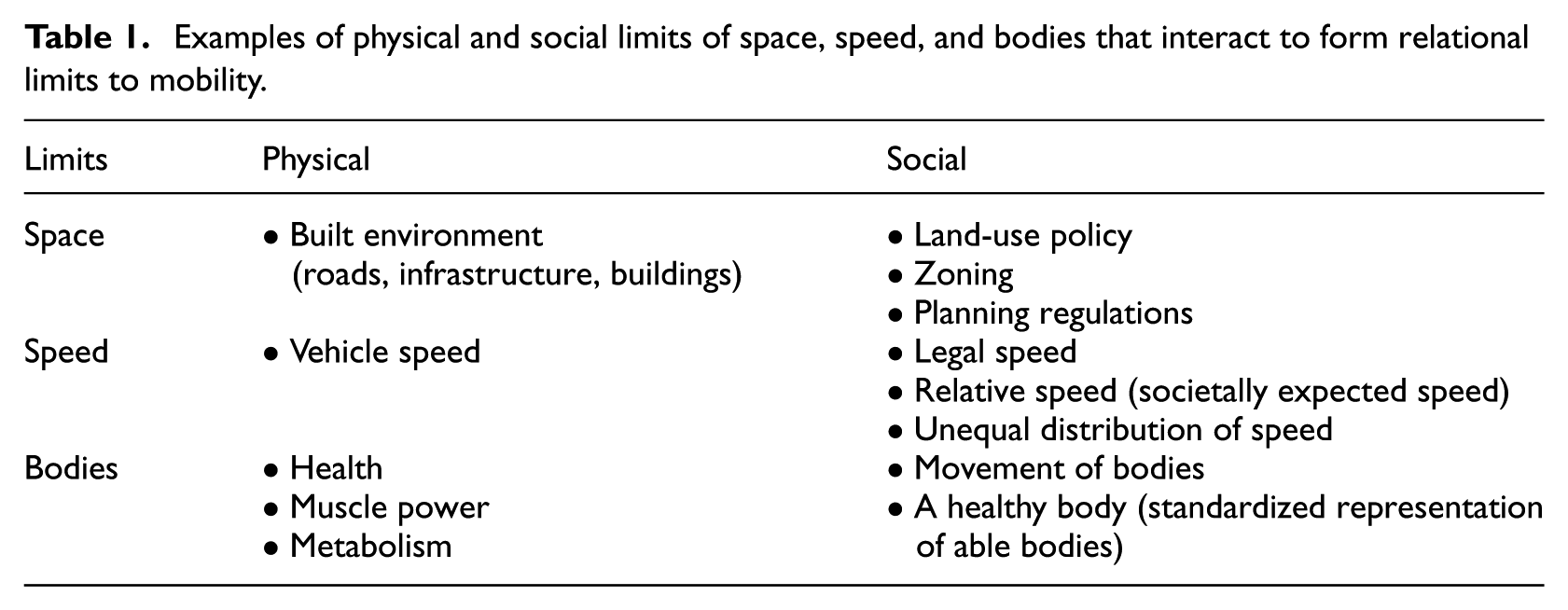
Above, we have discussed the sustainable mobility literature and its focus on car dependence, as well as the degrowth literature’s take on mobility. Both these pieces of literature have much in common, and there are indeed overlaps. By developing a relational approach to limits, we critically discuss urban mobility and provide theoretical and methodological cues for where research could move forward. We have identified three types of relational limits that are especially relevant to explore in depth: (1) space, (2) speed, and (3) bodies. These concepts are established in social theory, yet they provoke new debates and prompt us to revisit old ones as well. For instance, Merriman (2012) suggests that some of these concepts operate as “geographical primitives,” meaning they are abstractions that invite us to approach and engage with mobility in various ways. Indeed, while space is socially, politically, and economically produced in dynamic and/or dialectical processes (e.g. Jensen, 2011), speed is both a measure, that is, the time it takes to move through space, and a bodily sensation that is experienced through motion (Bergmann, 2008; Bissell, 2010; Cresswell, 1999). As such, these concepts invite us to explore them in empirical contexts and to juxtapose them with prior research. Many have also elaborated on these concepts and used them as sensitizing and organizing devices for empirical studies. However, this is not the place to unpack what these “primitives” mean or to offer elaborate definitions. Instead, we use them as heuristic devices, as “primitive” abstractions that allow us to discuss urban mobility on a more conceptual level and how they could be understood in relation to what we refer to as limits. After all, these are not only central concepts in mobility research but they also offer conceptual foundations for understanding limits in the context of urban mobility. While these primitive abstractions (Merriman, 2012) may be over-theorized, we have nonetheless decided to use them, as they allow us to explore the dynamics of the relations of limits in urban mobility. We discuss the meaning of these in more detail below as we juxtapose them in relation to our conceptualization of limits to mobility (see Table 1).
Examples of physical and social limits of space, speed, and bodies that interact to form relational limits to mobility.
Spatial limits
Space and limits are inextricably linked when discussing urban mobility. After all, the city’s streets and squares come with physical limits in the sense that they cannot easily be expanded due to surrounding buildings or infrastructure. Due to this spatial limitation, different types of vehicles and pedestrians must share urban space, a classic trope in urban planning (Wächter, 2013). As the car has been a prioritized mode of transport over the past century, space for other vehicles and forms of transport has been given limited room.
However, this has changed in part over the past decade. As planners and architects attempt to create conditions for sustainable mobility, streets are narrowed to provide more dedicated space for cycling and walking. Even squares where there used to be car parking regain their role as squares. Often, these changes in space are met with protests from car users and store owners (see e.g. Gössling, 2020). A focus on economic growth and securing job opportunities might be linked to cities seeing themselves as “growth machines” (Molotch, 1976). While this usually refers to inter-city competition on a national or global level, it also has implications for the micropolitics of urban mobility. After all, despite efforts to make cities more walkable and bikeable, many cities still consider themselves “engines of growth” and, therefore, are hesitant to limit space for urban mobility, at least excessively (see Schindler, 2016).
In recent years, several attempts have been made to launch a research agenda for spatial politics and degrowth (see Xue, 2022; Xue and Kębłowski, 2022). Space is political as it involves the distribution of rights, access to places, and inclusion in decision-making processes. Bringing degrowth and spatial politics together has also been called for by several scholars. For instance, Kaika et al. (2023: 1205) argue that “building a spatial degrowth agenda is urgent, as the current focus of degrowth scholarship on either small-scale localized practices or macro-economic proposals will not do.” Indeed, this urgent call for a spatial degrowth agenda underscores the need for interdisciplinary collaboration and innovative approaches to address the complex spatial politics of urban growth and sustainable mobility. As cities continue to grapple with the challenges of population growth, resource depletion, and climate change, there is a growing recognition among researchers and activists of the interconnectedness between spatial planning, the slowing down of socio-ecological metabolism, and degrowth. Alexander and Gleeson (2019) have taken this approach to some extent by demonstrating how degrowth can be achieved in suburbs through increased opportunities for self-sufficiency and access to basic services (see also Schindler et al., 2023).
Urban space is a key site of contentious politics; however, in attempts to connect spatial politics and degrowth (see Xue, 2022; Xue and Kębłowski, 2022), limits on urban space are largely overlooked. While limitations on the use of natural resources are often found in the degrowth literature, limitations on urban space are uncommon. It is also notable that Cattaneo et al. (2022), who explore a degrowth approach to urban mobility options, do not even mention road space and the spatial limitations of streets. Taking limits seriously, urban space and mobility could undergo transformative changes, we suggest. Subsequently, urban roads for car use could degrow, for instance by removing car parking, narrowing street space, or even removing road space entirely. Such proposals would spatialize degrowth at the level of the street and its limitations. Although some of these proposals have been previously voiced under the sustainable mobility paradigm (see Gössling, 2020), which we also demonstrated earlier, we argue that these proposals could be discussed under the rubric of limits. This would allow these singular proposals to be understood as part of a broader ambition to promote social and environmental objectives. Moreover, it would not only signal that mobility is adjusting to degrowth conceptualizations but also justify the concept of limits in other mobility domains. Finally, highlighting the relational character of spatial limits sheds light on how space is unevenly distributed and accessed in cities, offering possibilities for the dual task of simultaneously reducing spatial demands and redistributing access to urban space.
Speed limits
Urban mobility is often viewed through the lens of speed, and in transport planning, even seconds saved are expected to yield substantial societal benefits (Khisty and Zeitler, 2001: 597). Different modes of transport are commonly identified by their respective speeds, with slower alternatives being categorized as ineffective, time consuming, and costly. At the same time, there are limits to enhancing transportation speed through the construction of new and improved infrastructure. With improved speed (resulting from increased capacity), latent demand is released, creating induced traffic (Bucsky and Juhász, 2022; Goodwin, 1996; Goodwin and Nolan, 2003).
In the urban transport system, speed is highly interconnected with time. The purpose of increasing speed is to “save” time. As the above literature review demonstrated, the traditional transport planning paradigm is commonly criticized for its blind focus on time savings (Banister, 2008; Whitelegg, 1993). However, speed and time are also central to sustainable transport planning, as time savings in public transport are assumed to result in a modal shift, thereby reducing car traffic and carbon emissions (Isaksson, 2023). However, the optimistic view on the possibilities of public transport investment to boost a transition from car use is problematic. Empirical studies indicate that the picture is more complex, and the solution has a double-edged nature (Holmberg, 2013). Generally, only a minority of the increased public transport trips originate from previous car users. Thus, transport planning constantly faces limits when aiming to increase speed, in terms of both induced traffic and the limited effects of modal shift.
Although speed is considered fundamental in transport planning, there are social limits to speed in terms of how speed is distributed among societal groups. In infrastructure analysis (so-called cost–benefit analysis), the social dimension of new mobility infrastructure investments is seldom prominent (Næss, 2016). While enhanced mobility is often perceived as inherently good, its costs and benefits are unevenly distributed (Beyazit, 2013). As Cresswell (2010: 21) points out, “[m]obility is a resource that is differentially accessed. One person’s speed is another person’s slowness […] Speeds, slownesses, and immobilities are all related in ways that are thoroughly infused with power and its distribution.” For example, in Sweden, the average number of cars in the lowest two income deciles is only around 0.3, while it is almost 1.5 for the two highest income deciles (Research Service of the Swedish Parliament, 2015), with other contexts demonstrating similar patterns (Banister, 2013). Thus, improved car infrastructure would not improve mobility for those without access to a car. On the contrary, the increased presence of cars and car infrastructure is likely to reduce mobility for several societal groups. In particular, this is evident for children whose independent mobility is increasingly restricted by the norms and practices of automobility (Whitzman, 2013). Therefore, the central question is for whom speed is increased and for whom it is decreased.
While public transport solves some of these problems, others persist. For example, for buses to be attractive, they need to be comparably fast (Almeida et al., 2022; Birr et al., 2014). However, high speeds and the priority given to heavy vehicles, such as buses, impose restrictions on cyclists and pedestrians, creating barriers and increasing the risk of accidents. Of course, cars are responsible for most barrier effects, but all forms of high-speed mobility require more resources and space, often at the cost of slower modes and other societal priorities. This remains true even when high-speed modes move slowly (Whitelegg, 1993). Thus, planning and building to transgress the physical limits of speed in the urban context will typically have negative social and environmental consequences that disproportionately affect disadvantaged groups.
A degrowth perspective with a relational understanding of limits would highlight that many of the adverse effects of transport, such as air and noise pollution, barrier effects, unequal access to mobility, accidents, and sedentary lifestyles, are directly proportional to higher speeds. Consequently, by acknowledging that lower speeds are often socially and environmentally more beneficial for society, the priorities of the current transport system need to be flipped on their head. Urban design notions, such as shared spaces (Hamilton-Baillie, 2008), can serve as inspiration for constructing policies that prioritize slower modes of travel. Consequently, efforts to reclaim central parts of cities from cars would be a first step towards acknowledging the limits of speed in creating viable urban areas.
Bodily limits
The growing focus on mobility in terms of bodies, health, and active lifestyles is deeply connected to broader discussions of limits to growth and sustainability. Indeed, bodies occupy a key position in these debates, as promoting walking, cycling, and other forms of active transportation represents a shift away from car-dependent systems, aligning with efforts to reduce fossil fuel use, greenhouse gas emissions, and environmental degradation. While this form of mobility has a much lower ecological footprint, requiring fewer resources for infrastructure and helping to mitigate urban sprawl, these are also core concerns in the debate on degrowth.
Given this, is it meaningful to discuss bodily limits, and which type of limits would be called for if the body were subjected to degrowth ideas? There is no straightforward answer to this question. Nevertheless, it is reasonable to suggest that “active mobility” would play a key role when discussing such limits. After all, framing mobility through bodies and health highlights the interdependence between environmental quality and physical well-being. As more “active” forms of mobility contribute to reduced rates of chronic disease and mental stress, this not only improves individual lives but also reduces the pressure on healthcare systems, which might be beneficial for broader societal sustainability (Mizdrak et al., 2019; Mueller et al., 2015).
Active mobility is a curious concept, however. Walking and biking were earlier categorized as non-motorized modes of transport. It is only relatively recently that they have been given a more positive connotation with the concept of “active mobility” (see Held et al., 2015). So, rather than downgrading walking and biking to the level of the car, they are positioned as beneficial both for public health and for urban environments. In this view, the car is a “passive” form of mobility, causing both CO2 emissions and urban congestion.
The body is also self-limiting. This is an insight that any form of embodied mobility takes as its departure. Illich discussed this when arguing that muscle power demonstrates how the human body imposes a form of self-limitation on the bicycle’s technological capacity to extend human muscle power (see also Cox, 2023). As the human body is self-limiting, it cannot grow indefinitely without breaking down. This analogy is often used in degrowth circles to exhibit the inherent limitations to growth in ecosystems and biological systems. Relatedly, it is no coincidence that the slow-moving snail was chosen as a symbol of degrowth early on (Latouche, 2009). This shift also represents a broader rethinking of what limits mean. Instead of focusing on economic expansion and the role of speed for connecting people and things around the world, linking mobility to bodily health encourages us, we suggest, to move towards limits that value well-being, social justice, and ecological reproduction.
It is essential to note, however, that discourses promoting walking, cycling, and “active” lifestyles often rely on able-bodied norms, indirectly framing mobility as something achieved through physical movement in conventional ways. Bodies are diverse and beyond the discursive reframing of slower and more sustainable forms of mobility as “active”; health concerns often revolve around a particular conception of the body (Freund and Martin, 2007). However, differences in physical ability, age, and other factors limit not only bodily mobility but also the ability to participate in society. For instance, urban designs that prioritize cycling or pedestrian infrastructure may unintentionally marginalize people who use wheelchairs or scooters or require frequent rest.
Based on this, it might be worthwhile to rethink what constitutes “active” or “healthy” bodies. Someone using a powered wheelchair or navigating the city with mobility aids is still actively engaging with their environment. Yet, these forms of movement are often overlooked in “active mobility” narratives. While the concept of limits to growth often focuses on planetary boundaries, we believe that human bodies also have limits, which are diverse and complex, involving different needs.
In much of the sustainable mobility literature, the goal is to avoid travel altogether, thereby limiting the movement of all types of bodies. While a degrowth approach to mobility would undoubtedly endorse this goal and possibly conceptualize such no-travel as a form of limit, it is challenging to discuss bodily limits in a meaningful way. Still, the movement of bodies relates to all the other forms of limits we have discussed above. What space should be given to different forms of mobility and different forms of bodies? Which spatial and temporal limits are articulated when bodily limits are discussed? This is ultimately about the space for different types of human bodies to move about in the cityscape. At what speed should bodies move? Although we have no clear answers to these questions, they can serve as a point of departure for discussing bodily limits and how they can be conceptualized.
Concluding discussion: Towards a relational understanding of the limits to urban mobility
Inspired by discussions about limits in degrowth, we set out to explore how limits have been understood and conceptualized in the context of mobility, with a primary focus on the sustainable mobility paradigm and the degrowth literature dealing with mobility. While the sustainable mobility paradigm does not conceptualize limits, let alone hardly mention them, the degrowth literature does. The degrowth literature, however, has only recently started to take a serious interest in urban mobility-related matters. Much of this research calls for more critical examination of urban planning and mobility issues from a degrowth perspective. However, in doing so, it echoes many of the assumptions found in the sustainable mobility paradigm. To move beyond this, we focused on conceptualizing limits in the context of mobility.
Building on prior research in degrowth (Brand et al., 2021), we developed a relational approach to limits (e.g. Gómez-Baggethun, 2022). By this, we refer to the way that social and natural limits, as well as material and immaterial boundaries, are negotiated and settled temporarily. This raises questions of how, where, and for what purpose limits should be conceptualized in the field of urban mobility. Recognizing that limits are relational does not make them less tangible or significant. Arguably, limits that are reproduced both by physical constraints (such as availability of resources, physical space) and social systems (norms, institutions, and cultures of space) tend to be more difficult to reshape than those maintained by only one of them.
Our key contribution to the debates about degrowth spatial politics (e.g. Alexander and Gleeson, 2019; Demaria et al., 2013; Lehtinen, 2018; Wächter, 2013; Xue, 2014) lies in conceptualizing limits not only as relational but as relational in terms of space, speed, and bodies. These terms are widely debated in urban mobility research, as well as in urban studies more generally. We have therefore used them with great caution, yet maintain that they are key for conceptualizing limits on what we have termed a meso level. After all, urban mobility does not directly connect to issues discussed under the rubric of urban “growth machines” (which tends to deal with inter-city competition on a more macro level; Molotch, 1976; see Schindler, 2016), nor does it connect primarily to individual or household decisions, at the micro level (Cattaneo et al., 2022). Besides relating the limits to mobility to scaling, we would also like to propose that our relational framework should be applied to real-world cases and further developed within the literature on the spatial politics of degrowth, particularly for understanding how the limits to urban mobility are played out in different contexts.
Furthermore, building on prior research on degrowth and urban mobility (Cattaneo et al., 2022; Chertkovskaya and Paulsson, 2022; Cox, 2023; Kębłowski, 2023), we have argued that our framework (constructed around space, speed, and bodies) shows how limits could work as a productive concept for discussing how urban mobility could become sustainable. Unlike the earlier studies, however, we have discussed in depth what limits mean, and what they could do to urban mobility. For example, as spatial limits are not defined merely by the built environment but also by norms such as land-use policies, zoning, and governance frameworks, they together co-produce what is physically possible. Moreover, speed limits illustrate how physical capabilities of movement are mediated through societal norms, regulations, and inequalities in access to speed. Urban planners and city officials could recognize this. Finally, bodies, too, represent a tangible site of limitation as they are subjected to physical constraints yet also embedded in social norms and value hierarchies that define who can move freely and how. Our contribution lies in gathering these types of limits into a coherent framework and showing how they could be “self-imposed” on urban mobility (D’Alisa, 2019).
While we have treated these three types of limits separately for analytical purposes, they are deeply intertwined in practice. For example, the speed of transport is determined by the physical space where the transport takes place, as well as our norms and perception of that space. Increasing the speed of motorized modes of transport will proportionally restrict unprotected travelers when they share the same physical space. Thus, realizing higher speed necessitates that a larger proportion of resources (e.g. time and space) are relocated from one mode of transport to another. In this sense, urban transport is often a zero-sum game (Illich, 1973; Latouche, 2009), where aiming to transgress either the social or physical limits to mobility is increasingly complex and has adverse consequences not only for the environment but also often for people.
Our framework on limits also offers sustainable mobility scholars (e.g. those inspired by Banister, 2008) a way to move beyond technically oriented solutions and emission-based metrics by emphasizing the spatial, temporal, and embodied dimensions of mobility. By focusing on the meso scale, our framework not only bridges the gap between macro-level policy and micro-level behavior but also highlights how the three types of limits are not obstacles to urban mobility but productive concepts that could be developed further into design principles, to be used by urban planners and city officials. For instance, urban planners and city officials could “self-impose” our framework to diagnose unsustainable mobility patterns, design transport systems that respect limits, and justify policies that slow down and shorten movement. Our framework also helps them communicate that limits are not obstacles but key foundations for creating sustainable cities. This “self-imposed” take on limits (Kallis, 2019) invites deeper engagement with degrowth thinking and challenges growth-oriented assumptions. Subsequently, future studies within the sustainable mobility literature could explore how different social groups or urban morphologies experience the three types of limits to urban mobility that we have conceptualized.
In summary, we have highlighted three limits to urban mobility and their significance, which have been only marginally explored in prior research. However, given that we have focused on these three types of limits, we acknowledge that there is room for future research to explore additional dimensions. What is the role of wealth and taxes in limiting mobility? How are political and economic logics and institutions limiting mobility? Still, we hope that our discussion of relational limits to mobility, as embedded in space, speed, and bodies, will inspire further discussions on how to integrate degrowth and sustainable mobility.
Footnotes
Acknowledgements
We would like to extend our sincere gratitude to Claus Hedegaard Sørensen for his invaluable insights and constructive feedback on this work. We are also deeply thankful to the participants of the Swedish Political Science Association—SWEPSA conference held in Umeå in 2024 for their thoughtful discussions and contributions, which provided important perspectives and inspiration for this study. Last but not least, the two anonymous reviewers have also been instrumental in helping us improve the manuscript.

Funding
The authors disclosed receipt of the following financial support for the research, authorship, and/or publication of this article: This research has been partly funded by Swedish Research Council for Sustainable Development, Grant number 2025-00813 Formas.
Declaration of conflicting interests
The authors declared no potential conflicts of interest with respect to the research, authorship, and/or publication of this article.