







Abstract
Street soils and vegetation are increasingly central to urban agendas for healthier, more sustainable cities. In Berlin, small roadside plots are informally cared for by residents as gardens: spaces of sociality, creativity, and multispecies conviviality. Yet, despite their multiple benefits, these practices remain excluded from formal planning frameworks. This paper highlights the ecological, spatial, and material value of such everyday care acts, framing them as part of an emerging typology of urban gardens within Berlin’s evolving landscape. Drawing on both conventional methods and experimental tools, like a citizen science soil counter-mapping project, the research develops the notion of care-time to describe how everyday proximity and sustained attention shape street gardens as liminal spatio-temporal domains. It reflects on their capacity to sustain intertwined human and non-human temporalities, render urban soil care visible, and support street ecosystems, reimagining the street as a site of participation, cohabitation, and alternative governance.
Using care-time to examine civic practices of street greenery in Berlin
The care of street greenery by local residents is a long-standing and visible practice in Berlin. Despite its prevalence and potential to address public concerns around urban greenery, civic responsibility, and governance (Lachmund, 2022), this public involvement continues to operate as a grassroots effort, existing independently from the formal legal frameworks and green space management systems and protocols. Informed by Puig de la Bellacasa’s (2015) reflections on temporalities of care, this study uses the concept of care-time to emphasise the value of citizen-led initiatives, arguing they offer alternative pathways for street design and gardening cultures. By focusing on voluntary engagement, it shows how sustained time investment supports ecological enrichment at street level, shaping the often-overlooked dimension of street soils. Through an experimental soil counter-mapping methodology developed within the Open Soil Atlas citizen science project, this analysis examines care-time as a relational process linking human labour with the temporalities of street ecologies.
This inquiry focuses on a specific form of urban garden: the street garden. Amid socio-spatial change, this typology has emerged as a flexible, situated form of greening. As densification (SenStadtWohn, 2023), privatisation, and market-driven development reshape Berlin (Bernt et al., 2013; Schüschke, 2020), traditional gardens face pressure and reduced support (Ferrari et al., 2023; Kumnig et al., 2017). In contrast, street gardens, whether in tree pits, verges, or front gardens, offer accessible, small-scale greenery. Their ecological value is especially relevant as street vegetation and permeable soils are increasingly recognised for their role in climate mitigation, biodiversity, and ecosystem services (Böse and Schürmeyer, 1984; Säumel et al., 2016; SenStadtWohn, 2022), with their vitality often relying on the ongoing care provided by local residents (Ise, 2006; Marshall et al., 2019).
As street gardening enters ecological street redesign, it reveals tensions in neoliberal governance, where civic participation is often instrumentalised (Brand, 2007; Pudup, 2008). In Berlin, street gardening is broadly encouraged: in many districts residents can care for tree pits and roadside plots without formal permits, guided only by minimal municipal recommendations (SenStadtUm, 2025). Yet as street trees suffer from heat and soil degradation (Bartoli, 2021; SenStadtWohn, 2022), citizen labour increasingly compensates for gaps in public management. Initiatives like Stadtbäume für Berlin, which relies on private tree sponsorship (SenStadtUm, 2024b), and Gieß den Kiez, a platform encouraging residents to water trees (CityLAB Berlin, 2024), recast unpaid volunteer work as civic engagement. Though framed as participation, these practices lack regulatory support and risk shifting public responsibilities onto volunteers (Gruber, 2020). This delegation and deregulation obscure the temporal depth, affective investment, and everyday commitment residents dedicate to these spaces. As Rosol (2010, 2012) notes, such engagement can mask exploitative dynamics in which volunteer labour is simultaneously relied upon and devalued.
While voluntarism in Berlin might often be valued primarily for its economic utility, it fundamentally depends on residents’ time, a dimension this paper approaches not merely as a resource, but as a relational condition of care. Care here refers to the practice of looking after someone or something, grounded in responsibility, concern, and sustained commitment (Krzywoszynska, 2023; Nassauer, 2011). In gardening, time is not incidental but central to how care is enacted and maintained in relation to space and nature (Clément, 1991). Tending to soil and more-than-human life along streets is physically and emotionally demanding and unfolds over time. Yet, as Kotsila et al. (2020: 2) note, while time and care are recognised in grassroots gardening, they remain largely unsupported in planning logics focused on efficiency and measurability.
This paper introduces the notion of care-time as a critical lens to foreground how street gardening challenges dominant governance logics, while also illuminating the diverse social and ecological values produced through voluntary engagement. It frames care and time as interdependent, generating tensions between the human temporalities of unpaid labour and the non-linear temporalities of the garden—temporalities which, as landscape architect Clément (1991) notes, are cyclical, unpredictable, and self-organising, much like nature itself. These contrasting temporalities open up a space of negotiation through which care is materially and relationally enacted. In this context, citizen work in street gardens becomes a situated socio-material practice that, as in other forms of urban gardens, fosters multispecies interdependencies (Certomà, 2011; Jhagroe, 2023). Among these, soil plays a central role, not only as the substrate of garden life, but as a matter in which time and care intertwine.
Urban soils have long been marginalised in ecological and planning discourses (Meulemans, 2020b), often seen as polluted, inert, or disposable. Yet they warrant renewed attention in urban projects (Secchi, 1986), not only for sustaining urban life, but also as living records of the city’s temporalities. As urban palimpsests, they are terrains where human and environmental timescales intersect (Vialle and Giampieri, 2020). Focusing on street garden soils, this analysis foregrounds their role as infrastructures sustaining multispecies life and as temporal sediments of human care. In particular the topsoil, the most biologically active and vulnerable stratum, susceptible to degradation under climate stress and urban intensification, remains uniquely responsive to everyday human interventions (FAO, 2015). Here I propose evaluating how routine acts of care gradually shape and sustain topsoil, aiming to reveal agents and temporalities often overlooked by dominant governance logics.
This work is inspired by Puig de la Bellacasa’s (2015) concept of ‘making time for soil’, a form of caring time that foregrounds the interdependent temporalities of more-than-human life. Soil is approached here not as inert matter, but as living bioinfrastructure (Puig de la Bellacasa, 2014): a socio-ecological medium shaped through ongoing human and non-human interrelations. In this view, I propose to analyse the garden’s soil as a material archive of care, where the temporality of voluntary action intersects with nonlinear non-human rhythms (Bastian, 2009). Through the lens of the care–time nexus, street gardening is proposed as a practice in which temporal and spatial dimensions are deeply entangled. The ways in which volunteers make time for gardening are inseparable from the garden’s physical site, which emerges not simply as a location or span of time, but as a dynamic terrain of relation and ongoing negotiation.
To situate this approach, the next section outlines a theoretical framework rooted in feminist scholarship, which has given ethical and political weight to care-time as a way to reclaim practices often made invisible in dominant urban discourses (Caffentzis and Federici, 2014; Meyer-Renschhausen, 2016; Mies and Shiva, 1993). Building on this, the paper explores the concept of care-time empirically through a qualitative account of citizen-led street gardening in Berlin, drawing on photographs, interviews, and institutional documents. Central to the inquiry is an experimental counter-mapping of street spaces in Neukölln, co-developed with the citizen science project Open Soil Atlas (initiated under EU funding Horizon 2020 and coordinated by Action and King’s College London), which I co-created. The mapping aims to surface overlooked data, showing how the embodied temporality of care is inscribed in the soil, supports plant life, and reshapes the street’s ecological and spatial dynamics.
Theoretical framework: Street gardens, care, time, and soil
In academic discussions on street gardening, care practices are described through various terms, such as ‘guerrilla gardening’ (Reynolds, 2008), ‘stewardship practices’ (Lachmund, 2022), or civic responsibility initiatives that portray participants as ‘green godfathers’ (Gruber, 2020). While these concepts highlight forms of engagement that challenge neoliberal logics and promote non-utilitarian actions of care, they often overlook the relational and temporal dimensions inherent in street gardens. Feminist scholarship instead foregrounds the garden as a relational space shaped by care, time, and more-than-human ties.
The garden, as an extension of the domestic sphere, is tied to care, a feminist concept linked to social and emotional labour historically done by women within systems of capitalist reproduction (Federici, 2012). Within this view, the garden functions as a site of reproductive labour, both social and environmental, operating despite and beyond capitalist logics, which often marginalise or erase such work (Valle, 2015). Care requires flexibility and time, conflicting with the rigid, productivity-focused structures of capitalism. As a space of non-commodified care, the garden shifts time and energy towards sustaining life rather than profit (Caffentzis and Federici, 2014; Federici, 2019; Mies, 1986). Cultivating land becomes an act of caring for life, soil, and relationships (Mies and Shiva, 1993; Shiva, 1988), blurring the divide between public (paid, male-dominated) and private (care, family) spheres (Meyer-Renschhausen, 2016; Meyer-Renschhausen et al., 2002).
This vision of land care, as cultivating life through diverse, non-utilitarian relations (Mies and Shiva, 1993), aligns with Tronto’s (1993, 2013)view of care as a political and ethical practice rooted in attentiveness, responsibility, and responsiveness. Fisher and Tronto (1990: 40) define care as ‘a species activity’ sustaining bodies, selves, and environments in an interconnected web. In this light, street gardening moves beyond notions of activism or citizenship often tied to guerrilla gardening or stewardship, highlighting instead embodied and affective labour. It frames the garden as a site of ongoing, often invisible, socio-ecological negotiation.
Indeed, street gardening literature suggests that pavement interventions are driven not only by ecological concerns, but also by affective and cultural attachments to place and urban nature. Positioned between private and public realms, these practices prefigure more-than-human forms of urban coexistence (Moxon, 2024; Pellegrini and Baudry, 2014). This ties into Puig de la Bellacasa’s (2017) aforementioned expansion of care to include more-than-human interrelations. These interdependencies begin with the soil, which is both central to garden life and pivotal in Puig de la Bellacasa’s reflections on care and temporality. In response to the global degradation of soils, one of today’s most pressing environmental matters (FAO, 2015), she calls for a rethinking of human-soil relations through the lens of soil as living (Puig de la Bellacasa, 2014, 2015, 2017). Soil, she argues, is not merely a substrate or medium, but a living assemblage of organisms: ‘Organisms are soil’ (Puig de la Bellacasa, 2015: 701). Caring for soil, therefore, means acknowledging it as a living, relational entity (Krzywoszynska, 2023).
Focusing on soil care within agricultural production, Puig de la Bellacasa (2015) critiques dominant technoscientific and productivist approaches to soil care, which prioritise linearity and efficiency while sidelining relational and ecological dimensions. From a feminist care ethics perspective, this produces a controlled and extractive form of care, shaped by a human-centred, one-directional temporality (Puig de la Bellacasa, 2020). Such frameworks often obscure slower, situated practices like permaculture, which attend to the complex material and ethical rhythms of soil. Puig de la Bellacasa (2015) argues that the time of care is not a fixed resource, but something generated through ongoing engagement: ‘Time is not a given […] but that we make it through practices’ (p. 694 original emphasis). From this perspective the paper explores how making time in and through street gardening supports the vitality of soils and street landscapes and articulates human and more-than-human temporalities that sustain ecological pace.
Underlying Puig de la Bellacasa’s work is the idea that soil remains largely overlooked in both knowledge production and everyday life. Her research seeks to make soil visible, arguing that how we understand soil directly shapes how we care for it (Puig de la Bellacasa, 2015, 2017). This study thus examines human–soil relationships, critiquing the limited attention given to street-level soils and the gardening actions that shape them. The methods introduced in the following section, such a counter-mapping photography and interviews, serve as tools for rendering this situated knowledge legible.
Methodology
The study of this paper, conducted between 2018 and 2022, adopts a mixed-methods approach, combining conventional and experimental tools. It builds on recent efforts to rethink how research is conducted in landscape and urban studies (Bathla, 2024), embracing creative practices, such as photography, walking, and cartography, as valid modes of inquiry. Applying intersectional approaches to theory and empirical work, the study examines street gardening within the socio-ecological challenges of contemporary public space design.
The methodology unfolded in two phases. Phase one combined visual inquiry and interviews to (i) explore how making time for street gardens engages more-than-human life and shapes their spatial and temporal evolution. Phase two used counter-mapping to examine (ii) soil as a record of care and time, influencing the ecological rhythms of street gardens and its spatial configuration. It traces how volunteers’ time, transforms the soil, sustains plant vitality through watering, and contributes to the upkeep the space.
Visual investigations and interviews
The first phase involved mobile phone photography during walks in Berlin’s Neukölln, Schöneberg, and Kreuzberg districts. The images capture diverse street gardens and care practices, offering alternative narratives of the urban landscape by highlighting often-overlooked actions and spaces (Datta, 2011). A curated selection of eight images (Figure 1), captures the material traces of care and the informal spatial boundaries that define these liminal interventions, foregrounding their socio-spatial dimensions.
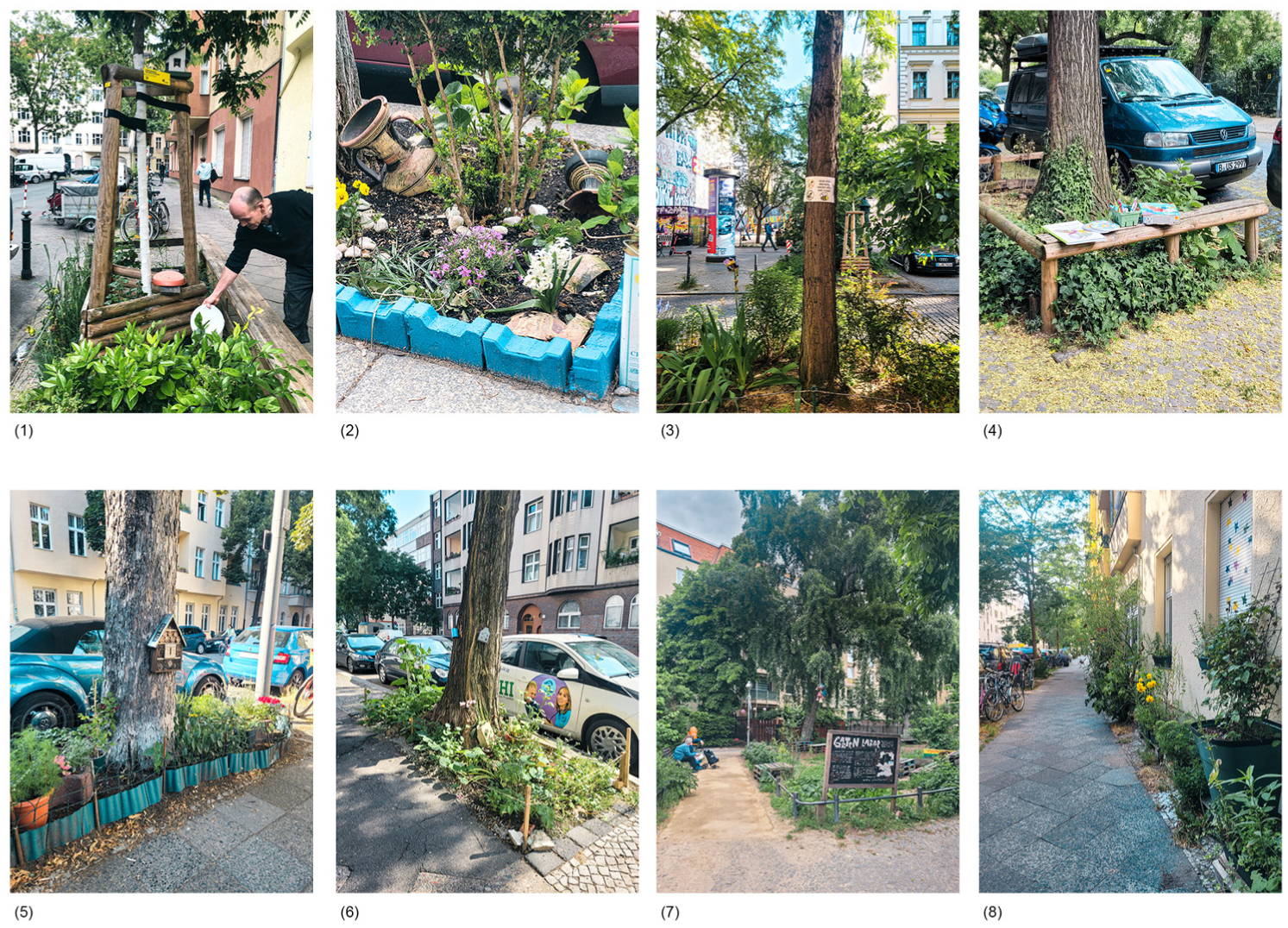
Visual investigation (1) Citizen waters a tree-pit in front of his shop. He is the donor who contributed to the planting of the street tree through the Stadtbäume für Berlin campaign, whose plaque hangs on the tree. The street garden features vegetation, wooden fences, and a bird house (Neukölln, 2018); (2) Low fences contain the new soil added by citizens in a street garden (Schöneberg, 2019); (3) Sign installed on a tree forbidding the area to be trampled on and used by dogs, but indicating the presence of bees in the garden (Kreuzberg, 2020); (4) Second-hand material placed on a bench enclosing a tree-pits (Neukölln, 2021); (5) Low fences contain the new soil added by citizens in a street garden. The street garden features vegetation, plants in pots and insect hotel (Kreuzberg, 2021); (6) Donaustraße street garden. The street garden features vegetation, rope fences, and a bird house (Neukölln, 2020); (7) GartenLabor community garden (Neukölln, 2020); (8) Ossastraße (Neukölln, 2020).
In parallel, I conducted ‘go-along’ interviews (Scott, 2019) with 12 street gardeners in these districts, discussing motivations, time commitments, and challenges. Additional interviews with Neukölln authorities (two from the Roads and Parks Commission and two from the Quartiersmanagement) provided institutional perspectives on recognition, soil design, and benefits of gardening. Finally, I carried out repeat semi-structured interviews with three activists leading street gardening initiatives in Neukölln.
Counter-mapping
Counter-mapping challenges dominant understandings of urban space and knowledge (Dalton and Mason-Deese, 2015; Orangotango, 2019). In this study, it foregrounded aspects of street gardening often excluded from standard data, particularly street-level soil conditions. By centring soil, the mapping showed how care-time regenerates urban ground in relation to non-human rhythms, while tracing practices such as watering and fencing as interventions shaping the garden’s spatial and temporal qualities. These methods draw on citizen science counter-mapping practices developed through the Open Soil Atlas (OSA), a grassroots project I co-created within a permaculture-inspired community that promotes soil care and literacy through the independent production of soil knowledge (Ferrari, 2023).
The counter-mapping exercise is closely tied to the goal of making urban soils and their significance visible. Central to the OSA is the recognition that citizens often lack access to reliable soil information. Although the Berlin Senate provides open soil data (SenStadtUm, 2024a), it is often outdated or lacks sufficient resolution for specific urban areas. This is particularly true for street soils, typically absent from official records. Counter-mapping thus generates place-based knowledge, documenting soil and its care, and offering tangible engagement with street ecologies.
The counter-mapping was conducted in 2021 along the street Donaustraße, in northern Neukölln. This urban area was chosen for its diverse tree pits and front garden strips, which vary in size, design, and maintenance, making it a valuable case to examine the consistency of time investment. Situated in a dense urban environment with limited green spaces and low environmental justice scores (SenStadtUm, 2022), citizen-managed spaces here played a key role in fostering an informal urbanity, offering sites for sociability, education, and ecological awareness (Säumel et al., 2021).
North Neukölln (11.7 km2; 164,636 inhabitants) (Amt für Statistik Berlin-Brandenburg, 2023) has undergone rapid gentrification over the past decade, transitioning from a marginalised neighbourhood (Soederberg, 2016) to a popular area for Western expats (Holm, 2013). Despite this, persistent challenges—drug use (Germes and Klaus, 2021) and illegal dumping (Süddeutsche Zeitung, 2024)—affect street space perception and complicate volunteering. The Donaustraße counter-mapping thus considered various aspects of care, not only soil characteristics but also watering and cleanliness, within this socially and environmentally complex context.
The survey merged three elements: soil indicators from Open Soil Atlas (OSA, 2021b), six street space types, and watering data from Gieß den Kiez (CityLAB Berlin, 2024). Soil was assessed by erosion, profile, and anthropogenic impact (litter). Spaces were classified as maintained/unmanaged tree pits, newly designed tree pits, or front gardens, noting fences and barriers. These data were cross-referenced with watering records from Gieß den Kiez, offering a triangulated view of the time humans invest in gardening, its effects on non-human agents’ lives, and how time is materially inscribed into the spatial configuration of street gardens along Donaustraße.
Results and discussion
Street gardeners’ time invested in care
Citizen engagement in Berlin’s streetscapes is both widespread and diverse. These spaces illustrate how human temporal investment in care shapes each garden’s spatial form and ecological character, producing evolving aesthetics, maintenance routines, and material boundaries (Figure 1). All interviewees tended to small areas near their homes or workplaces. Across both street conversations and activist accounts from North Neukölln, the connection between time, care, and the challenges of voluntary work consistently emerged as a central theme. The excerpts below, while drawn from individual accounts, capture patterns that recur across the broader set of interviews.
Max, an activist and founder of the GartenLabor community street garden and several tree-pit initiatives in North-Neukölln (Figure 1(7)), emphasised the emotional dimension of everyday practices and the sustained effort required to follow the growth of plants and the transformation of space. Since the beginning of his engagement, he described developing a deep attachment to the street environment.
I saw many places in Berlin where there were beautiful tree-pits. This is the way people take care of their environment, in this small nature, just a few square meters in a completely paved area. In the streetscape there are only these idyllic islands […] These spaces are generally not protected, so people are used to destroying everything. Every day at GartenLabor, I had to repair something and water the plants again, but at the end of the work I used to think this is the most beautiful place in the world! (Max, 2020, emphasis added)
While Max frames street gardening with ecological and affective sensitivity, using expressions like ‘small nature’ and ‘idyllic islands,’ he also underscores the challenges of daily maintenance and care. Like Max, many interviewees stressed the need for consistent commitment. Most respondents reported dedicating time weekly or even daily for over three years. They shared enthusiasm for their projects but expressed frustration with the difficulty of having these spaces respected, a term often mentioned. This issue is acute in Neukölln, a dense area with scarce green space and persistent litter. As Max put it: In Neukölln tree-pits are often used for rubbish and cars or bikes park on these areas. The soil in the tree-pits is compact and lifeless. Working in these spaces also means to show children how to take care of our environment. How can a child experience nature in Neukölln and learn something from these spaces? That’s why I started with GartenLabor by building fences, benches and planting plants. (Max, 2020, emphasis added)
Max frames tree pits as key urban sites for enacting environmental education, emphasising how small urban spaces are often overlooked or misused and affect the health of street ecosystems such as soil. The call for respect and the educational motivation voiced by citizens are also expressed through recurring socio-spatial features, which show how time invested in gardening translates into the spatial evolution of these spaces.
Low fences are commonly built around tree pits. They reflect volunteers’ efforts to protect soil and plant life from damage or vandalism, while also serving passers-by, sometimes as seating, other times as spots for sharing second-hand goods (Figure 1(4)). Often overlooked in street gardening discourse, these fences are meaningful urban elements through which personal motivations, such as protecting urban nature and engaging in non-utilitarian sharing, become visible in public space. As such, they embody solidarity with both non-human life and the wider urban community.
Handmade signs on or near trees often ask passersby to avoid trampling soil, littering, or letting dogs enter. Some signs educate about plants or guide respectful use (Figure 1(3)). These messages are paired with material supports for urban wildlife like bird feeders, insect hotels, and water bowls. Together, these signs, boundaries, and gestures show how human care-time in street gardens builds kinship between humans and non-humans. Human time shapes the garden as a space where human rhythms sustain the ecological cycles of soil, plants, and animals, making care a shared, time-based practice.
Ownership and spatio-temporal liminality
The boundaries placed around citizen-maintained street areas also express a sense of belonging and a form of ownership enacted within public space. The term ownership was first brought up by Max, who referred to it when reflecting on what motivates people to engage in street gardening: Doing this work, one fosters a feeling of self-efficiency, meaning to be capable of changing the environment by working with and for other people. […] Here ownership is a key tool, it’s a form of care. I take care of my environment: If it is not also mine, why should I feel to take care of it? Public space belongs to everyone, but it can also belong to no one. (Max, 2020, emphasis added)
In this sense, ownership becomes a way to reframe care and the time invested in public space: an attachment to place that is at once personal and collective, shaped by the desire to maintain and improve the shared (public) environment. Max, who often builds fences around tree pits in neighbourhood projects, says these fences make people’s presence and efforts visible. However, he notes that Neukölln’s unstable population, due to gentrification and rising rents, threatens continuity, as cared-for spaces are often abandoned when residents move away.
Such shifts in who lives nearby affect the stability of these initiatives. Anna (pseudonym), another local gardener involved in greening Ossastraße in Neukölln (Figure 1(8)), shares her experience of how these practices can be disrupted: We live on the ground floor and have no balcony or garden, so we put a bench in front of our house and bought cheap plants at the supermarket. […] A neighbour initiated the greening by taking perennials from her backyard and planting them in pots and tree pits on the street. Other neighbours with us saw this example and started to do the same. For a certain period, the street was beautiful, the children played outside, everyone respected the street … Then one day someone complained and called the Ordnungsamt [a local government unit]. We had to clear everything out. It was a horror! (Anna, 2022)
The resident shows how collective practices that enhance street life remain fragile without legal recognition, making the non-human timeframes linked to gardening unstable too. Her account reveals a condition of spatio-temporal liminality, blurring boundaries between private and public, and between states before and after ecological human care. By placing plants and benches on the sidewalk, domestic care spills into public space. Sidewalk gardening lets residents reshape urban space and non-human life, claiming everyday ownership near their homes. However, the vulnerability of these unregulated projects underscores how the garden can become a temporary realm, sustained only as long as human care continues.
Civic care and time within a weakening institutional framework
The initial engagement with local authorities explored how street greenery care fits into urban planning and how voluntary time is valued. Officials from Quartiersmanagement and Neukölln Roads and Parks Commission described street gardening as a widespread but largely informal practice, accommodated through minimal and mostly technical regulations that vary by district. In Neukölln, for example, guidelines for tree pits focus primarily on visibility, safety, and drainage, specifying maximum plant and fence heights and requiring soil to remain below pavement level (Bezirksamt Neukölln, 2023). Within these constraints, residents enjoy considerable autonomy in implementing street gardening projects, many of which also prioritise soil care. Officials from the Neukölln Roads and Parks Commission acknowledged that practices such as planting, composting, or building DIY barriers to retain soil (Figure 1(2;5)) (sometimes exceeding formal guidelines) help mitigate soil degradation and sustain the ecological functions of street greenery, provided they do not interfere with infrastructure.
Street soils are an increasing concern for local administrations due to their role in rainwater absorption and tree health, a concern reflected in strategies promoting de-sealing and the reduction of traffic space to expand street green areas across several districts (Bezirksamt Friedrichshain-Kreuzberg, 2020; Bezirksamt Mitte, 2023). Discussions on street soil planning revealed substantial variation in soil quality, particularly in tree pit substrates, linked to the absence of standardised guidelines and to budget-dependent sourcing. Under these uneven conditions, residents’ ongoing care effectively operates as an informal urban infrastructure, supporting soil ecologies and complementing formal planning.
Yet, both in new street greening strategies and in current practice, citizens’ contributions remain outside formal planning frameworks. While officials acknowledge the ecological benefits of street gardens and the management work they provide, this reliance reflects a governance arrangement in which some responsibilities for street greenery are informally delegated to residents. Residents’ time and labour are rarely formally recognised or embedded in planning strategies, yet they implicitly support municipal maintenance efforts through unpaid civic engagement.
The experiment of counter-mapping
Building on these findings, the counter-mapping experiment in Donaustraße gathered data not normally collected from the ground up. First, I assessed citizens’ contributions by classifying levels of maintenance, monitoring litter, and tracking watering activity in roadside areas. Second, I examined street soil through surface observations and shallow digs to identify human impact on topsoil. Fenced areas were included to see if spatial boundaries affect soil and space quality. The mapping of soil considered both vertical stratification and horizontal variability, reflecting the heterogeneity of street soils noted by Neukölln officials.
The survey results indicate that, despite the diversity of soil types, topsoil quality is primarily shaped by human intervention (Figure 2), closely linked to the consistency of civic engagement over time. Maintained tree-pits exhibit the best soil conditions, particularly in terms of erosion and topsoil thickness. Fences around certain street areas emerged as key indicators of better-managed soils, as they help deter misuse such as littering. In the case of tree-pits, fences often signal active community projects—but they also reveal the temporary nature of these efforts when areas fall into neglect (e.g. TP12, TP18).
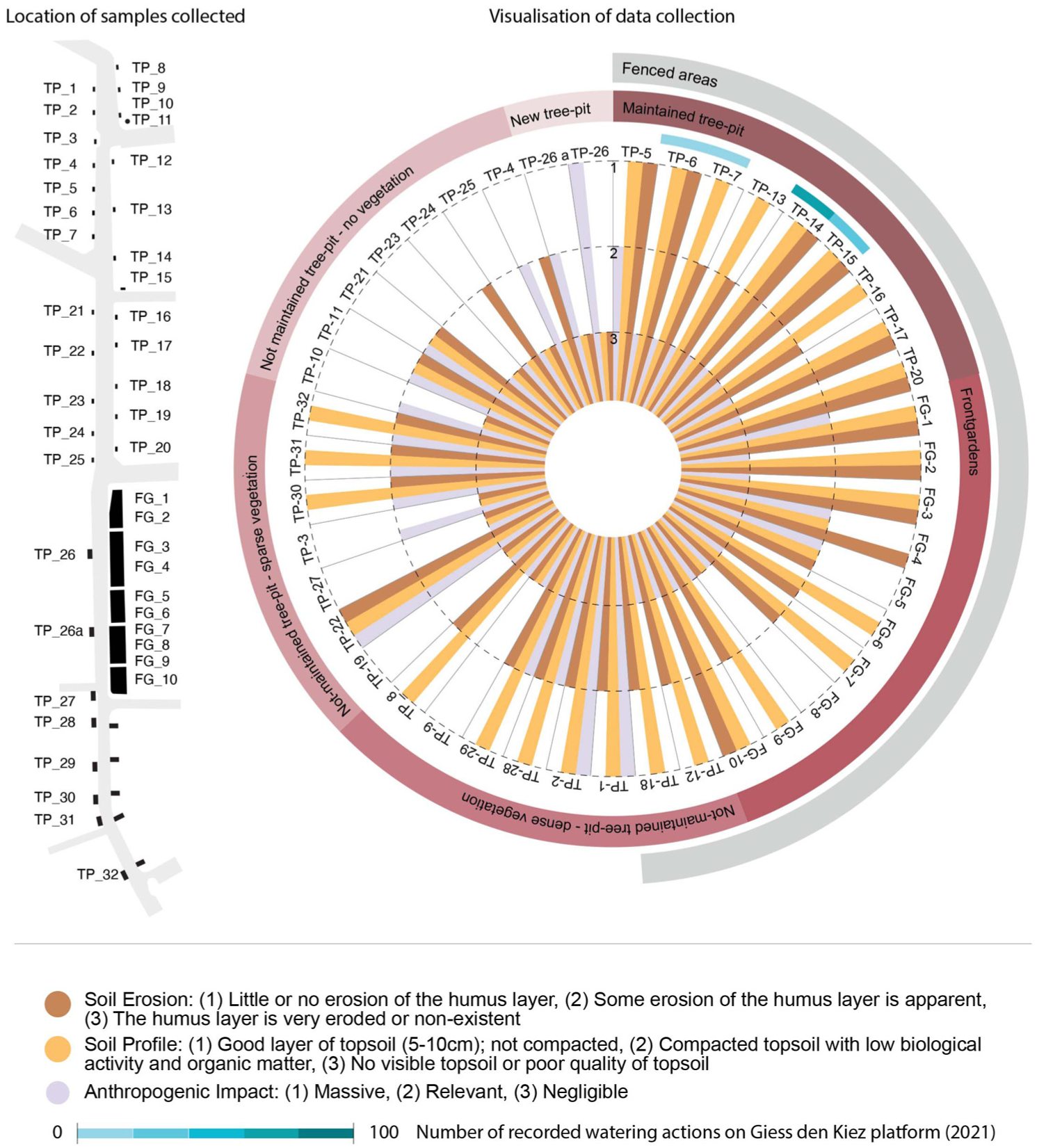
Visualisation of the data collected in the Donaustraße survey.
For front gardens, boundaries, whether resident-built or formed by existing hedges, enclose soils with minimal erosion and well-preserved topsoil. An exception is sample FG8, located along an informal pedestrian path, where trampling has degraded the soil. By contrast, newly designed tree-pits (TP26, TP26a), covered in mineral gravel intended to improve rainwater absorption (per district guidelines), showed no topsoil layer. These gravel surfaces appear to discourage public engagement, with higher levels of litter suggesting neglect. Additional data from the Gieß den Kiez platform confirm that fenced and maintained spaces are also those most frequently watered by residents.
Digging into the ground revealed layered relationships between citizens and soil. A notable discovery was the informal use of some tree pits for composting. One woman, tending a pit near her husband’s shop, described how she regularly brought kitchen waste from home, scattering it over time to nourish the plants. Though she did not consider herself an expert, her consistent, repeated gestures reflect a temporality of care that unfolds gradually through routine. Though unrecorded in the dataset, this everyday practice, blending domestic habits with public space, highlights how small, embodied gestures contribute to soil care and the making of urban gardens.
Berlin’s street gardens as a spatio-temporal liminal domains
Care and time take form in street gardens through actions like adding soil, composting, posting signs, planting, and feeding urban animals. These gestures, whether planned or improvised, shape the garden as a network of socio-material relations, unfolding across different agents and temporalities (Jhagroe, 2023). Among them, fencing stands out as especially significant. As a recurring feature of many street gardens, the fence, the very archetype of the garden, highlights the spatial and temporal liminality of street gardens and makes visible the time invested in their upkeep.
In street gardens, I observe that fences act as boundaries of care, protecting firstly soil and non-human life. In the Donaustraße counter-mapping, fenced areas were linked to higher topsoil quality, cleaner conditions, and more frequent watering. Fences not only express an affective attachment to place but also serve a practical function: they help shield gardens from misuse by passers-by and reduce the time and effort required for ongoing maintenance. As markers of continuity, they embody ongoing care and align human time with the rhythms of street nature, potentially enabling more sustained and reciprocal forms of urban cohabitation.
Boundaries prefigure a form of ownership that can be understood as care. As Myers (2019: 125) observes, garden enclosures reveal how people imagine and shape human–non-human relations. The counter-mapping of Donaustraße shows how such enclosures reconcile ownership-as-care with soil temporalities: the street garden becomes a site where human attention meets processes of soil regeneration. This resonates with Meulemans’ (2020a: 168)account of guerrilla gardening in Paris, where boundaries serve as a metaphor for anthropogenic pedogenesis: a co-creative process among soil, plants, and humans. The Donaustraße case thus illustrates how boundary-making materialises encounters between social and ecological times.
Building on this, I suggest that street gardening, through acts like fencing and engaging with urban nature, contributes, perhaps unintentionally, to what Puig de la Bellacasa (2015) describes as ‘making time for soil time’: embracing the multiple, interwoven rhythms of soil as part of an ethics of care towards more-than-human life. This involves rebalancing human involvement with the diverse temporalities that shape ecological processes, challenging dominant notions of linear control. Informal micro-practices of garden-making reflect a pace of ecological care attuned to the needs of urban soils and plants often more effectively than top-down interventions driven by efficiency rather than ongoing engagement.
This care arises from a liminal spaces, close to home or work, placing street gardens between public and private realms. In these in-between spaces, proximity to the domestic sphere enables forms of dwelling in hybrid landscapes, sustained through relationships with non-human others that deepen socio-ecological attentiveness (Krzywoszynska et al., 2020). Here, the gardens’ closeness to everyday life transforms pavements into porous thresholds. Drawing on Benjamin and Lacis’s (1978) notion of porosity, in which boundaries between living places and outside remain permeable, street gardens operate through modulated openness rather than exclusion. Their fences protect non-human life while also providing amenities for passers-by, such as seating or small structures for exchanging second-hand materials, as noted earlier. By softening the boundary between public services and domestic practices, these gardens make everyday care visible and extend it outward, inviting pause and engagement.
This spatial in-betweenness often mirrors precarious temporalities. Interviews show that displacement and housing instability can lead to the neglect or loss of street gardens, as unstable dwellings undermine everyday practices of care. In this sense, the street landscape becomes porous, continually made and unmade through shifting routines and interruptions, echoing Benjamin and Lacis’s (1978) view of the city as an always-in-process space, where built environments, social life, and temporality intersect and remain in constant negotiation. If care is understood as an interdependent relation between human and more-than-human life, it becomes vulnerable not only to time constraints but also to fragile conditions. Street gardens reveal how ecological rhythms are tied to urban precarity, showing that care depends both on individual commitment and wider structural factors that determine who can make time for it.
This spatial and temporal liminality also shapes governance in street gardens. By asserting forms of ownership over public land, these practices expose their in-between status and challenge conventional public/private property regimes (Barchetta, 2017; Chiodelli and Moroni, 2014). As Blomley (2005: 292) notes, street gardening blurs this divide through ‘boundary crossing’ producing hybrid spaces where ownership emerges through engagement with urban nature. The growing recognition of street gardens by local administrations reflects their integration into volunteer-based governance, often compensating for austerity in urban green maintenance. In this context, fencing becomes a pragmatic response to limited public investment, signalling how citizen-led projects assert respect for these landscapes and the surrounding urban space. Like other urban gardening initiatives (Apostolopoulou, 2021), these interventions do not simply appropriate public land but propose alternative ways of producing everyday urban space, fostering the urban commons rather than undermining it.
Street gardens are embedded in Berlin’s public space design culture as hybrid spatio-temporal domains evolving with urban change. Long described by local gardening associations as Gärten von nebenan [gardens next door], they emphasise proximity to domestic life and offer alternative ways of engaging with nature where access to community or allotment gardens is limited (Grüne Liga Berlin e.V., 2014). In a city where densification increasingly threatens green space and gardens often remain marginal to rapid urban development (Kotsila et al., 2020), street gardens persist. Their informal, open-ended character resists project-based temporalities, cultivating slower, care-driven rhythms of human–non-human relations. As open space shrinks, street gardens offer a spatial, temporal, and governance counter-narrative, contributing to the city’s socio-spatial reconfiguration and pointing towards new ways of dwelling in and governing the street.
Conclusion
This paper has explored informal street gardening and its material and affective dimensions as they intersect with multiple temporalities of urban transformation. Focusing on the concept of care-time, it showed how making time for street gardens generated liminal, more-than-human entanglements that shaped their spatial and temporal trajectories. It further demonstrated how residents’ sustained engagement supported soil ecologies and street greenery in ways that are rarely examined or formally recognised within urban planning. Metho-dologically, the study employed counter-mapping as a critical approach to analyse these practices. Although bottom-up mapping did not match the precision of laboratory-based soil analyses, the Donaustraße case succeeded in revealing how street soils were informally managed, an aspect that is rarely documented. Developed through the grassroots Open Soil Atlas initiative, this approach also highlighted the importance of citizen science in urban research.
The findings indicate that street gardens function as liminal spatio-temporal domains that both reflect and respond to contemporary urban conditions. In increasingly dense cities, they are shown to support renewed human–nature relations by enabling practices of learning, maintenance, and co-creation unfolding according to non-linear rhythms. In doing so, street gardens contribute to the ecological functioning of street-level ecosystems and to the socio-spatial reconfiguration of the city, pointing towards an emergent typology of urban gardens and alternative ways of dwelling in and governing the street. While care and time remain marginal within formal planning frameworks, this study lays the groundwork for exploring their potential relevance for future urban plans and policies as well as for further research into the possible unintended effects of these dynamics.
Footnotes
Acknowledgements
I thank the Open Soil Atlas team, with whom I first recognised the importance of urban soil. I am especially grateful to Anna Verones and Arne Thiemann for their collaboration on the Donaustraße survey, and to Christian Kopač for his assistance with coding the counter-mapping results. I also thank Laura Kemmer for her insights into the temporalities of care, which contributed to this research.

Funding
The author received no financial support for the research, authorship, and/or publication of this article.
Declaration of conflicting interests
The author declared no potential conflicts of interest with respect to the research, authorship, and/or publication of this article.