







Abstract
The scale of the 21st-century urban housing challenge has prompted state actors in both the Global North and South to adopt increasingly interventionist approaches to ‘affordable’ housing production. This article draws on research in six cities (Shanghai, Nairobi, Paris, Casablanca, Salford and Rome) to discuss the changing relationship between housing, finance and the state through a global comparative perspective. It adopts an urban statecraft lens to examine affordable housing production as a site through which state actors engage with financialisation processes to different extents, leading to the reconfiguration of the state in the process. From this exploratory comparison, the paper identifies three dimensions of statecraft across which state-led affordable housing production can be analysed: state motivations to intervene; the forms of financial and institutional innovation adopted by policymakers; and strategies to redistribute and mitigate the risks associated with financialisation processes. In proposing these dimensions, the central contribution of the article is to establish an analytical framework for further empirical research on the uneven geographies of the global state-housing-finance nexus.
Introduction
International policy since the 1980s has advocated a limited role for the state in housing production, with governments expected to create an enabling environment for market provision and community self-help (Gruffydd Jones, 2012; Soederberg, 2017; Van Waeyenberge, 2018). However, the extent of the 21st-century urban housing challenge demonstrates the sustained failure of this policy approach to deliver decent, affordable shelter at scale (Croese et al., 2016; Marcuse and Madden, 2016; Potts, 2020). Despite the Sustainable Development Goal target of providing adequate, safe and affordable housing for all by 2030, the United Nations (2025: 30) estimates that up to 3 billion people worldwide currently ‘struggle to afford a place to live’. This challenge has been framed by influential policy actors in terms of quantitative ‘deficits’ of units, with the mass construction of new housing privileged as the solution (Buckley et al., 2016; Santoro, 2019). In a high-profile report (Woetzel et al., 2014: 2), the McKinsey Global Institute projected the emergence of a global ‘affordable housing gap’ of 440 m units by 2025. They argued that this ‘gap’ represents a $16 tn business opportunity for the real estate industry and financial sector to engage in the mass production of affordable housing units. In addition, mass housing production has been identified as a potential catalyst for economic development. For example, the African Development Bank (2022) identify large ‘housing backlogs’ in urban Africa as a ‘market opportunity’ and argue that investment in affordable housing can drive growth and industrialisation on the continent through the development of construction supply chains.
In response to the persistent failure of enabling and participatory approaches to address shelter ‘deficits’, ‘gaps’ and ‘backlogs’, state actors are adopting increasingly interventionist approaches to affordable housing production in both the Global North and South. In the context of austerity urbanism in the Global North, fiscally constrained local state actors have created innovative new vehicles, such as arms-length companies, for the delivery of subsidised housing. Adopting financialised logics, these ventures typically fund affordable housing production by capturing land rents from speculative real estate development (Beswick and Penny, 2018; Christophers, 2019; Purcell and Ward, 2023). National governments across the Global South have established programmes to mass produce new units for low- and middle-income citizens. These initiatives typically take the form of public-private partnerships and provide subsidised access to finance to extend homeownership to new social groups (Buckley et al., 2016; Croese et al., 2016; Santoro, 2019). Following the dominant policy framing of McKinsey and others, the industrial production of new ‘units’, often on greenfield sites, is increasingly prioritised over improving and making better use of existing housing stock. This represents a significant departure from participatory approaches to low-income housing provision in the Global South, such as in-situ upgrading, that became popular in academic and policy circles towards the end of the 20th century (Bhan 2017; Croese et al., 2016). This top-down approach has generated concern that state programmes will create housing that is either unaffordable or inappropriate for low-income groups, reproducing socio-spatial inequalities in the process (Buckley et al., 2016; Coelho et al., 2022; Rolnik, 2019; Santoro, 2019).
This paper draws on research in six cities to discuss the changing relationship between housing, finance and the state through a global comparative perspective. While housing research has traditionally been segmented between Global North and South, there have been recent calls for comparative research on the political economy of housing that disrupts established geographical binaries (Aalbers, 2022; Fernandez and Aalbers, 2020; Goldman, 2023; Potts, 2020). This article contributes to this agenda by establishing a comparative dialogue between research on state-led affordable housing production in Shanghai, Nairobi, Paris, Casablanca, Salford and Rome. These research projects were conducted by the authors separately, before being brought into conversation during a session on ‘“Affordable” housing production, finance and the state in the Global North and South’ at the 2023 Royal Geographical Society-Institute for British Geographers (RGS-IBG) Annual International Conference in London. Methodologies for these studies varied, but all focused on qualitative work and most had at their core the combination of in-depth interviews with key stakeholders (including state actors at various scales) and analysis of policy documents (see Online Methodological Appendix for further details). The one methodological ‘outlier’ was the study of Rome, which used activist-ethnographic fieldwork encompassing first-hand participation in an urban squatters’ movement, but this too was combined with semi-structured interviews and archival research. As such, we collectively have a deep understanding of the contexts of each of our cities. We cannot do justice to the richness of this empirical material here, but instead use it as a basis for conceptual innovation through what Robinson (2022: 14) terms ‘generative’ comparative practice.
Robinson’s (2022: 115) global approach to comparative urbanism is grounded in a postcolonial critique of the limitations of comparison as a ‘quasi-scientific formal method’ that seeks to control for difference through case selection. In practice, this has often limited comparison to contexts with similar political systems and levels of development, leading to a narrow focus on US and European cities. In response, Robinson (2022: 9) argues that urban scholars should ‘abandon the hopeless effort to apply a quasi-scientific rigour to case selection’ and embrace contextual variation as the basis of conceptual generation. This critique does not imply that any and every city can be compared without a clear methodological rationale. Rather, Robinson (2022) advocates a generative approach to case selection in which the identification of shared features across diverse contexts provides the grounds for comparison. Research from our six cities was brought into dialogue at the RGS-IBG conference session when both shared features (increased state intervention in affordable housing production) and contextual diversity (uneven engagement with financialisation processes) became apparent, indicating the potential for conceptual generation. In response to calls to disrupt conventional geographical binaries in housing research (Aalbers, 2022; Fernandez and Aalbers, 2020; Goldman, 2023; Potts, 2020), we purposively selected three cities each from the Global North (Paris, Rome, Salford) and South (Casablanca, Nairobi, Shanghai) for comparative analysis. Comparing across these diverse contexts enabled conceptual generation through the development of a three-part framework for analysing state agency in affordable housing production.
In examining contemporary shifts in housing policy, this paper builds on the recent interest in ‘statecraft’ as a concept to understand the urban state as both agent and object of change (Cirolia and Harber, 2022; Cirolia and Robbins, 2021; Pike, 2023; Pike et al., 2019; Ward et al., 2024; Wu et al., 2024, 2025). It does so by examining affordable housing production as a site through which state actors engage with financialisation processes to different extents, leading to the reconfiguration of the state in the process. Adopting this lens, the article proposes three dimensions of statecraft across which state-led affordable housing production can be compared. First, it discusses the political-economic motivations of state actors to intervene in urban housing markets. Second, it examines the forms of financial and institutional innovation pursued to address housing needs in each context. Third, it explores the strategies adopted to redistribute and mitigate the risks associated with financialisation processes and manage the contradictory status of housing as both financial asset and infrastructure of social reproduction. A comprehensive empirical comparison of the cities is beyond the scope of this article. Rather, in proposing these three dimensions, the central contribution of this exploratory comparison is to establish an analytical framework for further studies of affordable housing production as urban statecraft. The article begins by reviewing debates on the relationship between financialisation, housing and the state. Next, it provides a brief introductory overview of each of the six city contexts before comparing these examples across the three dimensions of statecraft identified above. The article concludes by calling for further empirical research that utilises this three-part framework to advance our understanding of the uneven geographies of the global state-finance-housing nexus.
Financialisation, housing and the state
Following the 2008 financial crisis, ‘financialisation’ emerged as a key concept for understanding the political economy of housing. Financialisation has been characterised as ‘the increasing dominance of financial actors, markets, practices, measurements and narratives’ within societies and economies (Aalbers, 2019: 3), and by ‘the penetration of rent-extraction mechanisms into new spheres of social reproduction and everyday life’ (Purcell et al., 2020: 446). Understood as such, financialisation is necessarily underpinned by processes of ‘assetisation’, defined as ‘the transformation of an ever-growing range of things into assets from which to extract value’ (Birch and Ward, 2024: 20). Building on these conceptualisations, the financialisation of housing is defined by housing’s growing integration with, and subordination to, financial markets, and its associated transformation into a financial asset whose value is determined by its potential to yield future rents. Aalbers (2017) argues that the growing imbrication of housing and financial markets is evident from various indicators: growing national mortgage debt to GDP ratios; a shift from public welfare provision to individualised asset-based welfare; the expanding global trade in mortgage-backed securities; the emergence of financial institutions as residential landlords; and the increasing dependence of housing developers on financial markets for funding. This subsumption of the housing sector to financial logics is dependent on, and contributes to, the ‘transformation of residential real estate into a financial asset, opening channels for extraction by rentiers’ (Fernandez and Aalbers, 2020: 681).
Financialisation research to date has often focused on Northern economies such as the UK and US. In contrast to these contexts, Southern economies tend to be characterised by low levels of mortgage debt and limited secondary markets for mortgage-backed securities (Pereira, 2017; Socoloff, 2020). However, there is now a growing literature on housing financialisation in the Global South. This research has drawn attention to the role of multilateral organisations such as the World Bank in promoting mortgage market expansion (Aalbers et al., 2020; Gruffydd Jones, 2012; Rolnik, 2019; Van Waeyenberge, 2018), and the ‘subordinate’ character of financialisation in Southern countries due to their peripheral position within the global monetary hierarchy (Fernandez and Aalbers, 2020; Socoloff, 2020). Over the past decade, state-led affordable housing production has emerged as a key focus of financialisation research in both the Global North and South. In the North, researchers have documented how local authorities have responded to national austerity policies by acting as agents of financialisation and funding affordable housing through capturing land rents from speculative real estate development (Beswick and Penny, 2018; Christophers, 2019; Purcell and Ward, 2023). In the South, national state programmes to expand homeownership to low- and middle-income groups have been identified as an important vector of housing financialisation (Aalbers et al., 2020; Pereira, 2017; Rolnik, 2019). In response to calls to explore ‘common trajectories’ between the political economy of housing in the Global North and South (Aalbers, 2022: 1057), this paper brings these two areas of study into dialogue to understand the uneven geographies of the global state-housing-finance nexus.
Capitalist urban development is characterised by a fundamental contradiction between housing’s use value as shelter and its exchange value as a commodity, with the state playing a key role in mediating between these dual functions (Marcuse and Madden, 2016). This contradiction has intensified under contemporary conditions of financialisation, and the tension between housing’s exchange value as a financial asset and its use value as an infrastructure of social reproduction generates risks that can be redistributed and mitigated but not eliminated (Goulding, 2024). For example, researchers have examined how the risks associated with financialisation processes are often offloaded from private capital onto the public (Beswick and Penny, 2018; Goldman, 2023; Goulding 2024). Gabor (2021) argues that the role of the state in global development is increasingly focused on ‘de-risking’ activities through which global finance capital can be enticed to invest in essential infrastructure projects. This ‘development as de-risking’ fundamentally involves shifting risks from private to public balance sheets (Gabor, 2021: 431). However, scholars of 21st-century ‘state capitalism’ have suggested that it is reductive to understand state action as narrowly dictated by the interests of finance capital, particularly following the rise of China and the ‘re-legitimisation’ of state-led development (Alami et al., 2021: 1296). At the urban scale, this ‘new’ state capitalism entails both ‘muscular’ state intervention and a reliance on private finance to achieve policy goals such as housing and infrastructure delivery (Wijburg and Waldron, 2025). As such, it is necessary to recognise both the contemporary reassertion of state agency and the increasingly financialised character of global development (Schindler et al., 2023).
In responding to these debates, this article draws on recent urban studies research that employs the concept of ‘statecraft’ to analyse how state actors engage with financialisation processes, and how the state itself is transformed in the process. Policy responses to housing affordability challenges have typically been analysed through an urban governance lens, with attention paid to relationships between the wide range of state, market and civil society actors involved in the management of urban processes. For example, Wijburg (2021) has compared the challenges faced by European ‘interventionist’ and US ‘entrepreneurial’ governance regimes in addressing housing unaffordability under generalised conditions of financialisation. An urban statecraft lens seeks to complement this broader governance analysis with a specific focus on the state as both instrument and object of change (Cirolia and Harber, 2022, Cirolia and Robbins, 2021; see also Williams, 2022). Regarding the state as instrument of change, a statecraft analysis responds to the contemporary shift towards ‘muscular’ statism (Wijburg and Waldron 2025) by recentring state agency in analyses of urban development. In contrast to narratives that portray state agency as subordinated to the interests of global finance, for example, an emerging body of statecraft research examines how state actors seek to harness financial logics to address their urban policy goals (Pike 2023; Pike et al. 2019; Ward et al., 2024). Regarding the state as object of change, a statecraft approach seeks to understand how state institutions are reconfigured through governing urban space. For example, the statecraft literature has paid particular attention to urban development as an arena for state rescaling, changing central-local relationships and power struggles between different state actors (Cirolia and Robbins, 2021; Cirolia and Harber, 2022; Wu et al., 2024, 2025).
This article examines affordable housing production as a site of urban statecraft. Rather than focusing on a specific state scale, we follow Cirolia and Harber’s (2022) expansive conceptualisation of urban statecraft that encompasses the range of multi-scalar state institutions that exercise power over urban space (see also Robinson et al., 2025 on the ‘transcalarity’ of urban development politics). In its comparison of prior research undertaken in six cities, the paper undertakes an iterative approach in which key themes from the statecraft literature are brought into conversation with this empirical material. Three dimensions for the analysis of affordable housing production as urban statecraft appear through this comparison. The first, the political-economic incentives that motivate state intervention in housing production, emerged inductively from the city contexts themselves. The second two dimensions, how state actors pursue financial and institutional innovation whilst also managing the attendant risks, reflect central concerns of urban statecraft research (Pike, 2023; Pike et al., 2019; Ward et al., 2024; Wu et al., 2024). By identifying these dimensions of comparison, our analysis extends and develops urban statecraft analysis through the domain of affordable housing. Before doing so, however, we introduce the contexts of our cities, noting the different policy mechanisms through which the state aims to deliver affordable housing in each.
State-led affordable housing production: Introducing the city contexts
Shanghai
Shanghai demonstrates how strong Chinese national policy since 2008 has set ambitious targets for affordable housing delivery at the city-scale, explicitly recognising the state’s role in managing a ‘healthy’ housing market (Shanghai Municipal Government, 2008). This is defined as supporting real estate-based growth to give as many households as possible a chance to accumulate housing wealth, while providing support for those unable to take on the costs and risks of mortgage-based ownership independently. In practice, this delivers ‘segmented housing (de)financialisation’ – a series of differentiated measures through which affordable housing opportunities target specific social groups (Shen et al., 2022: 273). Shantytown renewal projects ‘unlock the value’ of centrally located land, allowing the city government to drive wider urban development, with displaced residents gaining Relocation and Resettlement Housing in compensation. Shared Ownership Housing allows residents to purchase housing (gaining a stake in its future appreciation) in partnership with the city government, with rules over share purchase and resale carefully set to discourage speculation. Finally, subsidised rental housing supports groups excluded from other schemes: Public Rental Housing to attract specific pools of workers needed by cities, and Cheap Rental Housing to support those otherwise unable to afford decent shelter.
Each of these modes of delivery is made possible through state-ownership, both of urban land and the corporations that produce new housing (Wu et al., 2025). These conditions enable Chinese cities to undertake a particular form of statecraft, balancing local urban development objectives against central state directives to mitigate the risks to social stability posed by overheating property prices. Shanghai’s own form of muddling through these conflicting demands produced 616,300 affordable housing units from 2008 to 2015 (Shanghai Municipal Government, 2017). Of this total, around 70% was Relocation and Resettlement Housing, with the redevelopment of prime sites also financing the remaining tenures - 14% Shared Ownership Housing, but only 5% Cheap Rental Housing (Shen et al., 2022). Affordability here is also segmented: those seeking assistance to buy property through Shared Ownership Housing are borrowing at near-commercial rates, whereas rental schemes may provide housing at around half the open-market price. In sum, the segmentation of Shanghai’s housing sector to maintain social stability demonstrates how Chinese urban statecraft is characterised by ‘state entrepreneurialism’ in which capital accumulation is subordinated to state strategic goals (Wu et al., 2024).
Nairobi
In Kenya’s capital, the national government has sought to deliver affordable housing at scale through engaging in joint ventures with real estate developers. Former President Uhuru Kenyatta launched the Affordable Housing Programme (AHP) in 2017. Part of a wider drive to transform Kenya into a middle-income industrialising country, this initiative promised to address an estimated national deficit of 2 million homes by delivering 500,000 new units by 2022 (Mwau and Sverdlik, 2020). In 2022, incoming President William Ruto continued and scaled up the AHP, setting a goal of constructing 250,000 new units a year (President of the Republic of Kenya, 2022). The AHP envisages the housing value chain as a key catalyst of economic development, for example by employing artisans to produce doors and windows for new residential projects. For each project, the National Housing Corporation engages a developer to construct high-rise apartment blocks with a view to selling 30% of the units at market rates and 70% at fixed ‘affordable’ prices. The first AHP project launched in 2020 with completion of 1370 apartments in Ngara, east Nairobi, built on public land by the China State Construction Engineering Corporation (Kieti et al., 2020).
The AHP is a form of urban statecraft that aims to entice private investment in affordable housing production by de-risking both supply and demand. On the supply-side, it seeks to incentivise construction at scale by providing an offtake guarantee for any unsold units and subsidies in the form of public land, bulk infrastructure and tax breaks. On the demand-side, it promises to provide an avenue to homeownership for low- and middle-income Kenyans through broadening access to housing finance. It offers a tenant purchase scheme for lower income groups, with those on slightly higher incomes given relatively affordable mortgages (7% interest rates) through the Kenya Mortgage Refinancing Company, established with World Bank support. At the AHP’s centre is a National Housing Development Fund (NHDF) which acts as an intermediary between supply and demand, financing both the offtake guarantee and the tenant purchase scheme. To capitalise this fund, the government has introduced a controversial payroll levy in which all formal workers must contribute 1.5% of their monthly salary, regardless of whether they will directly benefit from the programme or not. In a national context of inequality, wage stagnation and indebtedness, as well as a long history of government corruption, this additional tax has provoked vocal public opposition to this instance of urban statecraft (Manji and Ghai, 2023; Opalo, 2019; Wanakuta, 2025).
Paris
The Grand Paris Express project is an example of urban statecraft that seeks to boost affordable housing delivery via land value capture. Launched in 2010, the project provides new rail links for the outer municipalities of Paris while also seeking to address the capital’s housing affordability problem. A new state agency, the Société des Grands Projets (SGP), was established to collaborate with property developers to deliver 8000 dwellings on the land acquired for this transport project. In addition, €30 m was allocated to revitalise the land around the metro stations, accessible by the municipalities concerned if their proposed redevelopment included a stipulated proportion of social housing. The intention was for central state coordination to deliver social gain by de-risking private investment and incentivising cooperation from municipal authorities (Gallez, 2014). In some respects, the SGP reflects broader trends in French statecraft under conditions of austerity in which interventions have transitioned away from direct public housing provision toward mechanisms that rely on fiscal incentives for private sector investment (Epstein 2013; Gimat et al. 2022). In contrast to the nationwide growth of the private rental sector and shift towards asset-based welfare (Benites-Gambirazio and Bonneval, 2024), however, this initiative seeks to use transport infrastructure and land value capture to scale up social housing delivery in the capital.
In practice, however, this vision has been pulled apart by the conflicting interests of the different state agencies concerned. The metro project is running massively over budget, and France’s national audit body (the Cour des Comptes) is insisting that the SGP rectifies this by maximising the financial return on the land under its control. This pushes the SGP towards the production of housing for the open market, while the municipal authorities do not have sufficient funding to purchase land of their own to build social housing elsewhere in vicinity of the new stations. At the same time, municipalities in the wealthier western outskirts of the capital continue to resist the social housing agenda outright: they would rather face fines for under-delivery of affordable housing by permitting the development of commercial property that will generate business tax revenue into the future (Maaoui, 2023). As such, this is an instance of urban statecraft in which the central government is struggling to coordinate the interests and agendas of various state actors sufficiently to redirect land value gains towards regional rebalancing and affordable housing delivery (Gosnet, 2025).
Casablanca
Morocco’s national Villes Sans Bidonville programme (VSB, Cities Without Slums) aims to eradicate the country’s shantytowns by reclaiming public land for the construction of ‘affordable’ and ‘adequate’ housing. Eligible low-income households are resettled from shantytowns towards the urban margins and required to purchase a subsidised apartment or plot for auto-construction (Harroud, 2019; Le Tellier, 2009; Navez-Bouchanine, 2012). In common with equivalent programmes elsewhere in the Global South, VSB faced an affordability gap between the incomes of intended beneficiaries and the cost of construction. As a result, many units were occupied by non-eligible households with higher incomes – a phenomenon widely known as glissement (dropout; Beier, 2024; Le Tellier and Guérin, 2009). In response, the authorities permitted an informal arrangement whereby two shantytown households receive a single plot at the resettlement site and independently arrange for a third party (tiers associé) to finance the construction of a four-storey apartment building. The third party becomes the owner of the two lower apartments, and each resettled household owns one of the two upper apartments (Toutain, 2013; Zaki, 2013). The scheme allows private small-scale investors to act as third parties: they do not need the capital to acquire land at market prices, and can resell their own property in order to refinance the construction and make a small profit. Implemented in several resettlement projects in Casablanca, this arrangement widened access to lower-income shantytown residents and reduced glissement (Beier, 2021), leading the international development sector to promote it as ‘African Best Practice’ (Toutain, 2014).
The VSB programme is a form of urban statecraft that attempts to bridge a housing affordability gap by mobilising development finance from third-party (micro)entrepreneurs. This emphasis on incremental financing has, however, created challenges. Small-scale developers are highly sensitive to market fluctuations, and any drop in the prices of finished units risked them abandoning construction before completion, or making (sometimes dangerous) compromises over building quality. The informality of the partnership between resettled dwellers and third parties – who independently brokered agreements for the development – resulted in numerous conflicts, as each vied for a stronger consideration of their own interests (Beier, 2021). As such, this plot-by-plot approach to financing has made access to housing more affordable, but has not eliminated risk for either resettled dwellers or developers. The irony here is that as individual plots are tied up in legal battles, or stalled part-way through construction, the desirability of whole resettlement sites is diminished, threatening the land value appreciation on which the scheme’s viability depends.
Salford
As with Paris, Salford illustrates attempts to use land value capture as a mechanism for affordable housing delivery. In this case, however, it is the municipal state seeking to innovate within the constraints of a neoliberalised national planning framework. In the UK, the right to develop land was nationalised in 1947, with developers required to surrender a portion of land value uplift to the state in return for planning permission. Initially allowing a significant redistribution of wealth, this form of taxation has been systematically attenuated since 1990. First, it was translated into ‘planning obligations’ (affordable housing, infrastructure or monetary contributions) negotiated between developers and local authorities. Then, from 2012, a form of ‘viability appraisal’ has protected competitive returns to developers, enabling them to renegotiate their affordable housing contributions downwards (McAllister et al., 2016). Over the same period, national policy has stimulated the property market through privatising public housing (the ‘right to buy’ for council tenants), state-led gentrification (‘housing market renewal’), and planning reforms that remove obstacles to development (‘presumption in favour of sustainable development’). The net result is a system that facilitates land value uplift in response to the demands of real estate investors. This heightens regional inequalities while making local authorities dependent on, but less able to extract, a share of the resulting profit to deliver affordable housing (Ferm and Raco, 2020).
Salford municipality’s response was initially to embrace ‘property-led regeneration’, as exemplified in the redevelopment of its deindustrialised docklands between the 1980s and 2000s. This state-led gentrification generated criticism which intensified over the 2010s as an influx of investment into Salford and neighbouring Manchester created a development boom that did not translate into significant land value capture for affordable housing delivery (Goulding et al., 2023). In response, from 2016 Salford City Council has engaged in an innovative form of statecraft that seeks to redirect planning gain contributions into a new council-owned housing company. Named Dérive after the magazine of the French Situationists, this company invested £2 m in the delivery of new social housing stock when it launched in 2018. Motivated by a ‘new municipalist’ critique of neoliberalism, Dérive represents an attempt to socialise and ‘de-financialise’ (see Wijburg, 2020) affordable housing: as an arms-length company its housing stock is exempt from the ‘right to buy’, and its assets are let at below-market ‘Salford rents’ thereby precluding them from financialisation as investment grade properties. However, through its dependence on developer contributions for funding, Dérive’s capacity remains tied to rising property values (Purcell and Ward, 2023). As such, this instance of urban statecraft embodies a deep ambivalence towards financialisation processes.
Rome
Our final example is Rome, which has both a long-standing housing shortage and vibrant housing rights organisations with an extended history of direct action (Di Feliciantonio, 2017; Quirico, 2021). As the squatting of vacant properties increased in the aftermath of the 2008 financial crisis, those leading the struggles renamed the movimenti di lotta per la casa (housing rights movements) to movimenti per il diritto all'abitare (movements for the right to inhabitation, MRHa). This change reflects the broadening of the struggle beyond the provision of housing as an end in itself, recognising that squats also provide a range of physical and social infrastructure (Cacciotti, 2024; Grazioli, 2024). The post-crisis spike in residential squatting was initially met with legislative crackdowns and brutal evictions (Caciagli, 2022; Mudu, 2014). The public outcry against this aggressive response provoked a change in strategy from the Prefecture, City Council and Region, who decided instead to negotiate with movement organisations over their claims to urban space.
This shift in approach by the state is epitomised by the City Council’s decision to transfer people from squats into permanent public housing units instead of endorsing evictions. A series of such moves between 2020 and 2023 provided squatters with affordable housing, but led to the dissolution of autonomous communities and solidarity-based support systems. In response, MRHa are now working with the City Council to recognise two squats, Porto Fluviale (a former barracks) and Metropoliz_Città Meticcia (a former salami factory) as public housing granted the status of ‘urban commons’ (Grazioli, 2021). The fact that the City Council has recognised both as places viable for public housing, and within this to retain the squats’ multifunctional infrastructures (arts and crafts workshops in Porto Fluviale, and recognition of Metropoliz_Città Meticcia as a ‘living museum’), extends the scope of Rome’s housing rights struggles. In these cases, the local state has used its power of eminent domain to legally recognise movement-based conversions of non-residential vacant buildings into spaces for (collective) inhabitation. This demonstrates how political pressure from below can motivate innovative forms of statecraft to address housing needs that go beyond a narrow focus on mass construction.
Affordable housing production as urban statecraft
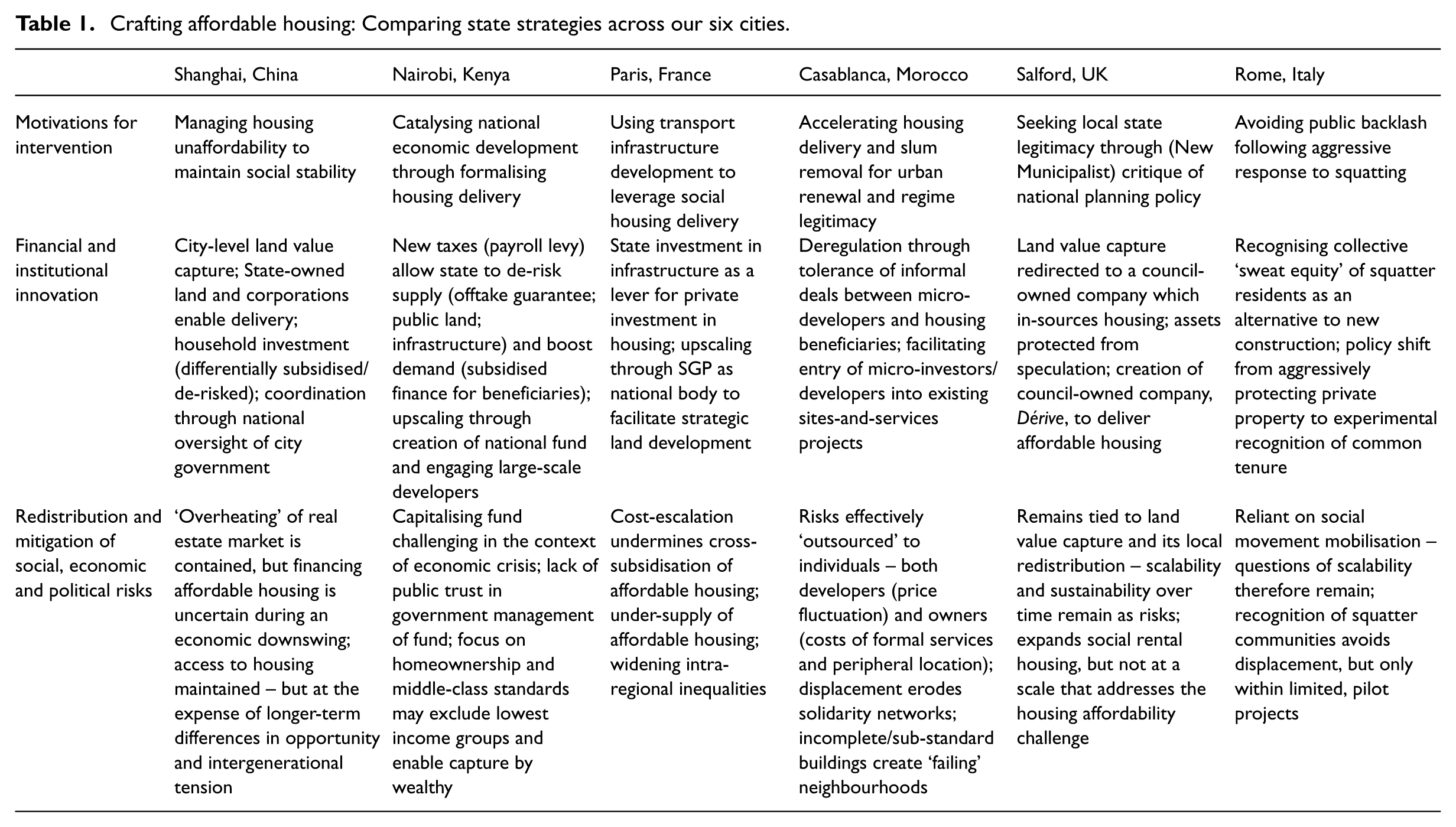
The remainder of this article draws comparisons between the contexts introduced above. In the process, it identifies three dimensions through which affordable housing production can be analysed as a site of urban statecraft. First, we reflect on the diverse political-economic motivations for state actors to intervene in housing production. Next, we examine the various forms of financial and institutional innovation through which this intervention is enacted. Finally, we explore the uneven ways in which social, economic and political risk is redistributed and mitigated in order to manage the contradictory function of housing as both financial asset and infrastructure of social reproduction. Through our analysis, risk management emerges as a particularly fertile domain for comparison, and this is reflected in the greater detail afforded to the discussion of this third dimension. The key features of statecraft identified in each city context are summarised in Table 1. The article concludes by arguing that these three dimensions constitute an analytical framework for further empirical research on the uneven geographies of the global state-finance-housing nexus.
Crafting affordable housing: Comparing state strategies across our six cities.
State motivations
The state’s role in articulating real estate-driven economic growth with housing affordability is common to all of our cities, with the legitimacy of state actors being vulnerable to challenge if they fail to get this balance right. As housing affordability crises have deepened across our contexts, the state’s motivation to intervene in housing production has, in general, increased, but not evenly. In both Shanghai and Nairobi, state intervention is a response to challenges created by the commodification of housing. Growing housing unaffordability in China has generated public discontent, motivating policymakers to seek a balance between economic development (fazhan) and social stability (wending; Shen et al., 2022). The marketisation of Kenya’s housing sector in the context of rapid urbanisation and planning informality has led to the mushrooming of poor-quality, overcrowded and unaffordable private rental accommodation (Mwau and Sverdlik, 2020). Addressing the shortage of decent, affordable housing in urban areas been identified as an opportunity to catalyse national economic transformation by successive Kenyan presidents (President of the Republic of Kenya, 2022). In both contexts, shifts in national policy seek ‘win-win’ outcomes that combine real estate-based growth with greater housing affordability. However, Paris illustrates how national attempts to balance these priorities can be undone through local political pressures, with its wealthier municipalities resisting social housing targets in favour of more profitable development (Maaoui, 2023).
The motivation for intervention was highest across our contexts where housing unaffordability posed a direct political threat or opportunity. While Morocco’s VSB was an already-existing upgrading programme in line with international policy agendas, experimentation with its new mechanism for delivery came in the aftermath of the 2011 Arab Spring (Zaki, 2013). This regional uprising placed increased pressure on municipal governments to contain social discontent by accelerating housing delivery (Beier, 2018). For Salford, experimentation with state insourcing of affordable housing fed directly into a wider UK trend of left-leaning municipal governments publicly demonstrating their autonomy from, and opposition to, national austerity and privatisation policies (Purcell and Ward, 2023). Rome perhaps indicates how far political pressure can motivate policy change: an over-zealous crackdown on squatters caused public disquiet, and well-organised housing movements were able to use that moment to push for official recognition of squatters’ claims that could set important precedents for future experiments in collective living (Grazioli, 2021). The wider lesson here is that political drivers are important in understanding affordable housing production as urban statecraft, and that these shape the interface between state actors and global capitalism in complex and context-specific ways.
Financial and institutional innovation
The degree of financial and institutional innovation pursued by state actors differs significantly across our six examples. In Nairobi, we see a policy approach that looks very close to the McKinsey ‘blueprint’ for mass housing delivery: adopting industrialised construction methods, unlocking public land for development, de-risking supply through offtake guarantees and supporting demand through subsidised finance (Woetzel et al., 2014). Innovation within the Parisian context is similarly limited: the state here is acting to encourage property-led regeneration with the aspiration that some of the benefits be redirected into affordable housing provision. Both cities demonstrate how scalar adjustments become core aspects of statecraft through the deliberate ‘reconstitution of the urban state at a different, often novel scale’ (Cirolia and Harber, 2022: 2444). This involved the establishment of new, higher-level bodies: the SGP to coordinate infrastructure delivery across the Paris region; and the NHDF to mitigate risks for developers and beneficiaries across Kenya nationally. Importantly, within these exercises of ‘scalecraft’ (Fraser, 2010) the intention to mobilise finance through incentivising investment from large-scale commercial players remained unchanged, demonstrating that institutional innovation can occur without a fundamental change in the state’s role. Indeed, statecraft here meant innovation in governance arrangements in order to maintain this underlying purpose.
We identify a greater degree of innovation in our remaining examples. The context of Shanghai is perhaps unique as the state owns all urban land and can deliver housing at scale through large state-owned enterprises (Wu et al., 2025). These contingencies enable the Chinese state to undertake an ambitious restructuring and segmentation of the entire housing market, coordinating the economic incentives for individual households and the political incentives of urban managers (Shen et al., 2022). Elsewhere, innovation responds to the local state’s more limited scope for action. The adjustment of the VSB programme in Casablanca to allow the co-development of housing units between plot owners and third parties attracted investment from local small-scale developers. In this case, the state is looking beyond established actors in the formal real estate sector to tap into new sources of speculative finance for affordable housing (Beier, 2021). Salford seeks to redirect value from Greater Manchester’s real estate boom into public housing delivery, making it dependent on financialised logics to achieve its policy goals. However, Derive’s legal status as an arms-length company places the new homes built by the Council beyond the scope of processes of privatisation, speculation and assetisation (Purcell and Ward, 2023). Finally, Rome’s decision to grant the status of ‘urban commons’ to the squats in Porto Fluviale and Metropoliz_Città Meticcia demonstrates an innovative response to the housing crisis that circumnavigates financialised logics. The City Council has recognised the sweat equity of squatters in converting vacant buildings into genuinely affordable spaces for communal living (Grazioli, 2021). This challenges the commonplace dependency on private finance to address housing need, and opens the space for alternative policy framings that look beyond simply increasing the supply of new ‘units’.
Redistributing and mitigating risk
The diverse forms of statecraft identified in our six cities represent localised attempts to wrestle with the contradiction between housing’s exchange value as financial asset and use value as infrastructure of social reproduction. Most state actors rely to some degree on speculative activities to finance affordable housing production. Such affordable housing policy ‘solutions’ often merely redistribute the social, economic and political risks associated with financialisation, rather than eliminating them. In Nairobi, the emphasis on promoting homeownership risks the exclusion of low-income groups who cannot afford to participate in the tenant purchase scheme. Previous upgrading initiatives in the city demonstrate that planning standards attuned to middle class expectations (such as self-contained two-bedroom apartments) often lead to wealthier groups displacing intended beneficiaries (Huchzermeyer, 2008). Such units may be acquired by well-connected elites as a rental asset, and some AHP properties have already appeared on Airbnb. In addition, the programme has generated significant political risk for the national government, who have struggled to build popular support for their decision to capitalise the NHDF with a compulsory payroll levy (Manji and Ghai, 2023; Opalo, 2019; Wanakuta, 2025).
In Paris, tying affordable housing provision to an infrastructure megaproject has magnified and concentrated these risks rather than spreading them more equitably. Clearly, there are severe problems of coordination across different government bodies, with the Cour de Comptes and local authorities pursuing their own cost recovery and revenue maximisation agendas that undermine attempts by the SGP to cross-subsidise social housing delivery through land value capture. As a result of this ‘intra-state conflict’ at the metropolitan scale, socio-spatial inequalities and housing unaffordability problems have persisted under the Grand Paris Express initiative (Gosnet, 2025: 428). Risks associated with affordability for low-income groups are also evident in Casablanca’s VSB scheme. While access has been broadened by the involvement of third-party micro-investors, relocation often increases costs for transport, utilities, taxes and maintenance. In addition, informalising the redevelopment process risks that apartments will be poor quality or unfinished, leading project sites to become stigmatised neighbourhoods (Beier, 2021). While these problems compromise affordable housing delivery, however, the VSB programme may represent effective statecraft by focusing beneficiaries’ resentments on the behaviour of third-party speculators. In contrast to the Government of Kenya’s highly centralised approach, therefore, the Moroccan state’s decision to distance itself from the final point of housing delivery may prove an effective strategy to offset political risk.
While risk is a perennial feature of state-led affordable housing production, some state actors have adopted a more pro-active approach to protecting the socially reproductive function of housing. In Shanghai, the central Chinese state has successfully guided city-level strategy to balance the twin priorities of economic development and social stability. Pressure has been placed on city governments to use land to address social and environmental goals, and alignment with national development priorities is essential to the career progression of local officials (Wu et al., 2024). Consequently, multi-scalar state approaches to affordable housing provision in Shanghai are significantly more coherent than those in Paris. Shanghai’s segmented (de-)financialisation is not entirely risk-free, however. Households buying into Shared Ownership Housing often take on mortgages with strict restrictions on resale designed to contain speculation, requiring families to commit to their investment across generations (Shen et al., 2022). While this approach has mitigated the risk of property market volatility in the short-term, young people’s frustration at being tied to the housing choices of their parents may evolve into future challenges for social harmony. In addition, while the central state has averted the spectre of a US-style subprime lending crisis, the post-2020 downturn in China’s real estate market has threatened the viability of land-based financing mechanisms (Wu et al., 2025). China’s multi-scalar statecraft has therefore achieved a degree of social inclusion in the here and now, but has not eliminated the systemic risks threatening affordable housing production and access in the future.
Policy experiments in both Salford and Rome seek to insulate inhabitants from risk by promoting non-commodified forms of tenure and creating institutional barriers between the housing sector and financial markets. In Salford, Derive’s status as a council-owned company protects its housing stock from assetisation by placing it beyond the scope of the national ‘right to buy’ privatisation mechanism and ensuring below-market rents. In Rome, declaring squatted buildings as ‘urban commons’ places them beyond the reach of speculative activities. This represents an official recognition that these spaces provide multiple use values that cannot be reduced to the provision of housing ‘units’ as individually owned assets. However, in both cases questions remain about the scalability of these innovative approaches. Porto Fluviale and Metropoliz_Città Meticcia are both the outcome of long-term movement mobilisation, and may yet face legal challenges (Grazioli, 2021). As such, they provide interesting test-cases of urban commoning in practice, rather than an instantly reproducible solution to Rome’s wider housing crisis. Similarly, with only £2 m in start-up capital Derive represents a relatively small-scale intervention in Salford’s housing landscape. Ironically, this ‘new municipalist’ vehicle is funded by capturing some land value uplift from speculative urban development processes, making its future growth dependent on a buoyant local real estate market (Purcell and Ward, 2023). This illustrates the constrained agency of local state actors to challenge rentier logics within a national context of austerity urbanism (Christophers, 2019).
Conclusion
This article documents a global housing policy conjuncture in which states are no longer relegated to the role of ‘enablers’ of markets and self-help. Responding to the scale of the global housing challenge, multi-scalar state actors are adopting increasingly interventionist approaches to produce ‘affordable’ housing. Rather than a return to a mid-20th-century paradigm of publicly funded housing construction, however, these contemporary interventions are characterised by varying degrees of subsumption to the logics of private finance. As such, this article has adopted an urban statecraft lens to explore how state actors engage with financialisation processes to address housing needs, and how the state itself is remade in the process. It is beyond the scope of this article to undertake a comprehensive empirical analysis of state-led affordable housing production in specific urban contexts. Rather, it has prioritised geographical breadth and brought research in six cities into dialogue to identify some key points of commonality and variation across space. This exploratory comparison has enabled us to propose three dimensions of state agency that can be analysed to understand the uneven geographies of the global state-housing-finance nexus: the political-economic incentives that motivate state intervention in housing production; the financial and institutional innovations adopted by policymakers in pursuit of this end; and the approaches to distributing and mitigating risk fashioned by statecrafters as they navigate the terrain of financial uncertainty. Further research should deepen our understanding of these aspects of urban statecraft through detailed case study analysis. In the meantime, however, we conclude with some brief reflections on each of these dimensions.
Regarding motivations, the forms of statecraft discussed in this paper all represent attempts to manage the fundamental contradiction between housing’s dual social and economic functions as both infrastructure of social reproduction and financial asset. While this tension is a general feature of capitalist urban development, this paper indicates that the response of state actors is shaped by geographical contingencies that are inherently political as well as economic. The state has a strong motivation to intervene in a housing affordability crisis because its legitimacy is closely linked to its ability to ensure wider social reproduction. However, this pressure manifests in geographically specific ways, from the local political opportunities that ‘new municipalism’ presents in Salford (Purcell and Ward, 2023) to national government directives to prioritise social stability over capital accumulation through ‘state entrepreneurialism’ in Shanghai (Wu et al., 2024). Motivations for intervention can therefore only be understood through the ‘identification and explication of actors, relations, rationalities, processes and geographies’ (Pike et al. 2019: 24) that disaggregate and ground financialisation in place.
Concerning institutional and financial innovation, questions of scale are intimately bound up in the exercise of statecraft across our six cities. Shanghai, Nairobi and Paris all indicate instances where innovation has been linked to scaling up: the national state is central to engaging large scale developers in Nairobi (in the activities and funding of the NHDF), and in creating a vehicle for infrastructure megaproject delivery (and a hoped for ‘trickledown’ of housing benefits) in Paris. However, it was only in Shanghai that these national goals were effectively coordinated with the actions of the state at the city level. Our remaining examples have, in different ways, all been experiments of localisation: producing and protecting social housing as a council-owned asset (Salford), negotiating with housing activists over particular sites (Rome), or deflecting risk downwards by permitting ‘informal’ arrangements between micro-investors and housing beneficiaries (Casablanca). Regardless of their particular form, this range of responses illustrates that scalar shifts will often be an important part of navigating the contradiction between housing’s use and exchange value.
Finally turning to risk management, our city contexts by no means present a uniform picture of statecraft as the offloading of risks from finance capital onto urban inhabitants. While some of the contexts discussed above demonstrate a high degree of entanglement with financialisation processes, others represent a deliberate attempt to limit, or even avoid altogether, dependence on financial logics to address housing needs. The implication of this geographical unevenness is that financialisation cannot be understood as a linear process in which the use value of housing as shelter is inevitably subordinated to its exchange value as a financial asset. Rather, housing financialisation is uncertain (Goulding, 2024) and contingent on state action to mediate the tension between use and exchange value (Marcuse and Madden, 2016). As Pike (2023) argues, therefore, the growing dominance of financial logics within urban statecraft is an empirical question rather than a foregone conclusion. Our comparison indicates that there is considerable scope for state actors to mitigate the risks associated with financialisation processes and protect the function of housing as a vital infrastructure of social reproduction.
Supplemental Material
sj-docx-1-usj-10.1177_00420980261436336 – Supplemental material for Affordable housing, finance and the state: Towards a global urban comparison
Supplemental material, sj-docx-1-usj-10.1177_00420980261436336 for Affordable housing, finance and the state: Towards a global urban comparison by Tom Gillespie, Glyn Williams, Raffael Beier, Antoine Gosnet, Margherita Grazioli, Thomas F. Purcell, Jie Shen and Callum Ward in Urban Studies
Footnotes
Acknowledgements
The authors are grateful for constructive feedback from the anonymous Urban Studies reviewers and editorial guidance from Karen Coelho. The article took inspiration from the contributions of participants in a 2023 RGS-IBG conference session on ‘“Affordable” housing production, finance and the state in the Global North and South’. Tom Gillespie also received helpful feedback at a seminar in Cornell University’s Department of City and Regional Planning in March 2025.
ORCID iDs

Ethical considerations
Each of the research projects discussed in this article complied with the ethical approval requirements (including requirements for participant consent) of the authors’ respective institutions.
Funding
The authors disclosed receipt of the following financial support for the research, authorship, and/or publication of this article: Tom Gillespie acknowledges funding from the University of Manchester’s School of Environment, Education and Development. Jie Shen acknowledges funding from the National Natural Science Foundation of China (42171222).
Declaration of conflicting interests
The authors declared no potential conflicts of interest with respect to the research, authorship, and/or publication of this article.
Data availability statement
The datasets generated and analysed during the studies discussed in this article are not publicly available.
Supplemental material
Supplemental material for this article is available online.
References
Supplementary Material
Please find the following supplemental material available below.
For Open Access articles published under a Creative Commons License, all supplemental material carries the same license as the article it is associated with.
For non-Open Access articles published, all supplemental material carries a non-exclusive license, and permission requests for re-use of supplemental material or any part of supplemental material shall be sent directly to the copyright owner as specified in the copyright notice associated with the article.
