







Abstract
This article examines the discursive practices through which actors produce and negotiate representations of Rotterdam, the Netherlands, as a tech city. We approach the tech city as a discursive construct and argue that its ongoing remaking can be obscured when scholarship centers on dominant governmental and corporate institutions as coherent, top-down discourse producers. Instead, we show how tech city institutions function as enacted assemblages shaped by individuals’ interstitial practices. We examine such practices through text-elicited, in-depth interviews with actors involved in those institutions. Our findings identify four clusters of practices through which individuals professionally engaged in the tech city (i) critically addressed rhetorical gaps and positioned themselves as bridges, (ii) expressed skepticism and dissent, (iii) reproduced narratives tactically, and (iv) resignified dominant representations.
Introduction
Typing almost any city’s name into a search engine alongside “innovative,” “smart,” or “digital” yields countless organizations promoting that city in such terms. Rotterdam, the Netherlands, our case study, is no exception. Long known for its harbor roots, the city has been increasingly associated with urban digitization and technological innovation (Engelbert and Fried, 2025). Over the past two decades, municipal agencies, EU-funded projects, public–private partnerships, and innovation hubs have promoted Rotterdam as tech-driven through websites, reports, social media, and events.
The pairing of urban problems with promises of technological innovation has drawn growing scholarly attention. Across urban geography, sociology, and communication studies, research has examined how powerful governmental and corporate actors discursively construct cities as technologically innovative, often treating these narratives as top-down forces and locating contestation outside dominant structures. Two influential labels recur: the smart city, tracing how corporate agendas travel via funding bodies and local governments (Hollands, 2015; Söderström et al., 2020), and a “planetary Silicon Valley” imaginary that celebrates entrepreneurial innovation as the universal solution to socio-urban challenges (Wahome and Graham, 2020; Zukin, 2021). Together, this scholarship identified a widely propagated discourse that casts cities as facing globally shared problems and positions technological and data-driven innovation as the desirable answer for urban efficiency, sustainability, and quality of life. These two representations converge within specific contexts. The networking hub Venture Café Rotterdam (2021), for example, has described Rotterdam as “an international ecosystem for innovation and entrepreneurship” and hosted events like the 2023 “Smart Cities: Global Challenges. Local Solutions.”
Yet this body of work has tended either to treat governmental and corporate institutions as coherent discourse producers or to locate agency in actors positioned outside those institutions (e.g. residents, activists, grassroots initiatives). What remains less examined is the discursive work of actors inside the very institutions that circulate tech city narratives—people whose jobs require them to reproduce promotional storylines but who may also bend, quietly refuse, or rework them in practice. This article addresses that gap by asking: how do actors working with tech city institutions negotiate and (re)produce tech city discourse through their everyday practices, and what forms of agency become visible through these negotiations? By foregrounding these micro-politics from within, we contribute to debates on governance, city branding, and the practical production of urban futures.
As Sadowski and Bendor (2019: 556) caution, the dominant discourse should not be considered exclusive. Even if one version has become hegemonic, “this isn’t to say there are no alternatives, only that they are still struggling to compete with the corporate imaginary.” They call for attention to “places where divergence, breakdown, and resistance happen” (Sadowski and Bendor, 2019: 557) and for revealing the cracks in the smart city’s foundations. Addressing their calls requires a non-deterministic view on discourse, one that acknowledges people’s capacity to reinterpret and negotiate dominant narratives (Engelbert, 2019). Such a view has proved productive in underscoring the role of urban inhabitants and activists in co-producing alternative urban visions (Georgiou, 2024; Hollands, 2015). However, the assumption that agency can only be found outside dominant institutions remains: among the “places where divergence” can happen, little attention has been paid to actors embedded within these institutions, the ones who promote the tech city narrative but may simultaneously re-shape it.
Those tasked with promoting the tech city—and thus interviewed in this study—are not limited to communication specialists and marketers. The discursive production of the tech city is embedded in the everyday practices of a diverse array of actors, including people with technical roles within municipalities, startups, and innovation hubs. They regularly participate in events, produce promotional content, and articulate the value of innovation as part of their job. Their work is also discursive work: their daily practices are central to sustaining the tech city imaginary. They occupy a critical but often overlooked position not just in the technical but also the symbolic production of urban innovation.
To examine these within-institution negotiations of tech city discourse while remaining attentive to agency as relational, institutionally embedded, and often incremental (Coe and Jordhus-Lier, 2011), we draw on feminist and post-structuralist approaches and practice theory (Bacchi and Rönnblom, 2014; Ortner, 2006) and extend Burns and Welker’s (2022) work by conceptualizing interstitiality as a set of situated practices. Instead of treating institutions as homogeneous entities, or the work within them as pre-determined, we treat tech city institutions as enacted assemblages: reproduced through everyday work, yet also potentially unsettled from within (Bacchi and Rönnblom, 2014). From this perspective, actors performing discursive work for Rotterdam’s tech city engage in interstitial practices within and across institutional settings. Their views on texts published by municipal departments and innovation-support organizations allowed us to identify how reproductions of hegemonic techno-utopian discourse coexist alongside varied, creative, and critical readings of them—a tension that becomes visible through four clusters of practices developed in our analysis.
Theoretical framework
The tech city discourse
We build on scholarship that highlights the salience of discourse in tech-driven urban imaginaries, and we go a step further by specifying the everyday practices through which such discourse is produced and negotiated in institutional settings. Critical smart city scholarship has explained the symbolic production of urban futures by institutions such as academia, supra-national bodies, municipalities, and technology companies in terms of institutional interests and power positions. Foundational studies have found that communications by such organizations tend to represent the city as a system of systems, facing challenges best solved with privately provided assemblages of data and sensors (Hollands, 2015; Söderström et al., 2020). Recent work further underscored how these narratives are operationalized through managerial vocabularies, templates, and policy scripts that travel across cities and organizations, and are reworked as they encounter local institutional logics (Engelbert and Fried, 2025; Guenduez et al., 2024; Tandon et al., 2025). Emphasizing the promises of technological innovation, “these narratives pose smart cities as common sense: technology driven growth that ‘works for everybody’” (Tandon et al., 2025). In texts where organizations refer to the city’s innovativeness, research has found portrayals of cities as pools of tech-savvy entrepreneurial talent needed to rapidly solve urban, societal, and environmental problems through digital applications and startups (McNeill, 2021; Wahome and Graham, 2020; Zukin, 2020). Given how consistently corporate-oriented techno-utopian rhetoric appears across settings, scholars often describe a “dominant” smart city discourse (Grossi and Pianezzi, 2017; Söderström et al., 2020; Vanolo, 2016), noting that “all cities share this vision” of a Silicon Valley urbanization (Zukin, 2020: 3). Wahome and Graham (2020) show that this Silicon Valley-inspired vision for socio-urban development is reproduced in scientific, policy, and business discourse across contexts.
The authorship of tech city imaginaries has often been attributed to coherent actors, typically sets of institutions working in concert toward similar goals. For example, Kitchin et al. (2017) identified a network of interrelated communities (urban technocrats, an epistemic community, and advocacy coalitions) that promote smart city rhetoric and shared values, beliefs, and practices. Similar assumptions underpin notions of a unified tech “community” or “ecosystem,” as in Zukin’s (2020) account of actors from public, private, and academic sectors coalescing into a tech community that lobbies for their common interests, and Miranda et al.’s (2022) description of a “discursive ecosystem” composed of media, government, and corporations who frame innovation in mutually reinforcing ways. However, recent studies complicate the idea that the top speaks with one voice, showing how tech agendas pass through institutional work, cross-professional frictions, and horizontal tensions across organizations (Enlund and Harrison, 2024; Guenduez et al., 2024). This article builds on that shift by examining not only organizational frictions as such but also the concrete discursive practices through which individuals make, bend, and sometimes quietly refuse dominant tech city narratives from within the institutions tasked with circulating them.
As suggested by Bates (2017), treating institutions as internally homogeneous is analytically limiting. While groups engaged in producing and using urban data often exhibit shared values and assumptions, tensions and conflicting beliefs emerge among participants. Ideologies may smooth over contradictions, yet their persistence highlights the need to attend to how actors negotiate discourses from within (Potter and Wetherell, 1990, in Bacchi, 2005). Narratives producing the tech city must be understood not only as vehicles of power but also as sites of negotiation (Engelbert, 2019).
Agency in the tech city
The literature has mostly looked for practices of negotiation and alternative meanings outside tech city institutions. Studies focusing on urban residents’ experiences have challenged understandings of the tech city as a purely top-down construct. Notable here is Datta’s (2018) feminist urban geography, showing how city dwellers’ engagements with digital tools generate meanings of the city that coexist with hegemonic visions. Halegoua (2019) and Georgiou (2024) extend this approach. They acknowledge state and corporate actors’ definitions of the “digital city,” yet foreground inhabitants’ active reimagination of it. Introducing the concept of “re-placeing,” Halegoua (2019) describes how people use digital media to construct their own sense of place, often in ways that diverge from official visions. Georgiou (2024) emphasizes how urban dwellers creatively engage with digital infrastructures, shaping counter-narratives that prioritize lived experience over strategic or technocratic imperatives.
Scholarship has also highlighted the role of organized collectives, coalitions, and activist groups by exploring their abilities to put forward alternative urban visions, focusing on issues of data ownership through data commons and other (infra)structures for technological sovereignty (Cardullo and Kitchin, 2019; De Lange, 2019; Lynch, 2020; Tandon et al., 2025). Underscoring their in-between position, amid institutional structures and loosely connected individuals, Burns and Welker (2022: 6) noted that nonprofits, civil organizations, and community associations “operate in the ‘interstices’ of the smart city,” finding ways to influence urban tech programs. They connect inhabitants with institutional bodies, represent residents at council hearings and in planning processes, hold collaboration sessions, and mobilize data for citizens. Crucially, Burns and Welker (2022) conceptualize these groups’ “interstitiality” as a fluid mode of engagement: interstitial actors can navigate across, and simultaneously belong to, multiple social fields. An individual may simultaneously be a nonprofit administrator, a community association member, and a municipality employee.
We take up Burns and Welker’s (2022) call to complexify top-down versus bottom-up dichotomies and theorize how interstitial actors perform diverse roles to shape urban geographies. At the same time, we extend their concept: rather than treating interstitiality primarily as an organizational in-between position, we conceptualize it as a set of situated discursive practices through which actors navigate, mediate, and rework dominant narratives while remaining institutionally embedded. This shift from interstitiality-as-positionality to interstitiality-as-practice allows us to examine agency from within. We recognize actors’ capacity to make a difference in how tech city narratives are articulated while recognizing that such capacity is always uneven and constrained. Following Coe and Jordhus-Lier (2011), we approach agency not as an abstract attribute but as a relational, grounded process that must be assessed in relation to the institutional formations in which actors are embedded. The actors we study are also workers: their discursive labor unfolds within organizational hierarchies, funding regimes, professional norms, and reputational pressures that shape what can be said. We therefore treat agency as constrained and variegated; much of what we observe aligns with incremental reworking of dominant narratives rather than overt resistance.
Interstitiality as practice
While scholarship has often overlooked the agency of individuals working with dominant tech city institutions, attention to the everyday practices within them has sharpened in recent years. We build on these studies, but extend them by specifying the discursive practices through which actors themselves manage rhetorical gaps and negotiate what tech discourse can mean.
Recent work has begun to examine within-institution dynamics from different angles. Guenduez et al. (2024) described the “institutional work” municipal smart city managers perform to align bureaucratic logics with smart city frameworks through persuasion and tactical negotiation. We extend their insights, attending to how this tactical work can be not only about accommodating dominant models but also about bending and reinterpreting them. Enlund and Harrison (2024) traced “horizontal tensions” across municipal employees, consultants, and technology providers, showing how competing agendas and temporalities can produce ambivalence and distancing from the “smart city” label. We further show that these tensions are shaped not only by occupational categories but also by actors’ own understandings, beyond and within institutional boundaries. From an intersectional feminist lens, Listerborn and Neergaard (2021) showed that dissent appears not only in visible exit or protest acts but also in subtle workplace practices and informal conversations. We build on these insights, by shifting the analytic focus from institutional frictions and ambivalence to the concrete discursive practices through which actors reinterpret, tactically reproduce, and sometimes contest dominant narratives.
Together, these studies suggest that the production of the tech city is not a seamless, top-down process. Rather, it is mediated by individuals who, despite being embedded in dominant institutions, enact reflexive and potentially transformative practices. We therefore read these mediations as interstitial practices: situated forms of discursive labor through which actors reproduce and rework the tech city imaginary under conditions of constraint. This conceptualization provides the grounding for our empirical contribution: we identify four clusters of practices that show how agency is negotiated by the actors most associated with producing tech city discourse.
Methods
Understanding how the tech city is discursively produced not just from institutional structures but also from individuals’ everyday practices of reading and negotiating discourse requires a research design that renders such practices visible. Key in this direction is paying close attention to context. Our analysis is grounded in Rotterdam, the Netherlands, a city that for two decades has been rebranded by public and public–private city marketing initiatives seeking to shift its blue-collar, crime-associated image and turn it into a modern, globally attractive hub (Custers and Willems, 2024; Van den Berg, 2011). Tech innovation has played a central role in this agenda. Our localized perspective, following scholarly attention to ordinary cities (Burns et al., 2021), offers insights into how places outside elite global circuits reinterpret smart city models to gain international recognition. It also allows us to identify in detail the varied actors engaged in producing the tech city. Between 2021 and 2024, we interviewed 44 individuals working with a range of Rotterdam-based organizations that we conceptualized as tech city institutions: a municipal–intermediary–startup assemblage that produces and circulates public representations of Rotterdam as a smart, digital, innovative city through programs, partnerships, events, websites, and promotional media. The dataset comprises municipality-connected actors (n = 20), innovation-support/intermediary organizations (n = 13; including incubators, accelerators, university entrepreneurship infrastructures, and coworking/networking spaces), and entrepreneurs and innovators publicly showcased through these organizations (n = 11).
The first author conducted the fieldwork and interviews as a PhD researcher based in Rotterdam but not originally from the city. Access and trust were facilitated by institutional affiliation (a Rotterdam-based university that participants widely recognized) and by the event-intensive nature of Rotterdam’s tech field, where public networking events enabled repeated in-person encounters prior to interviewing.
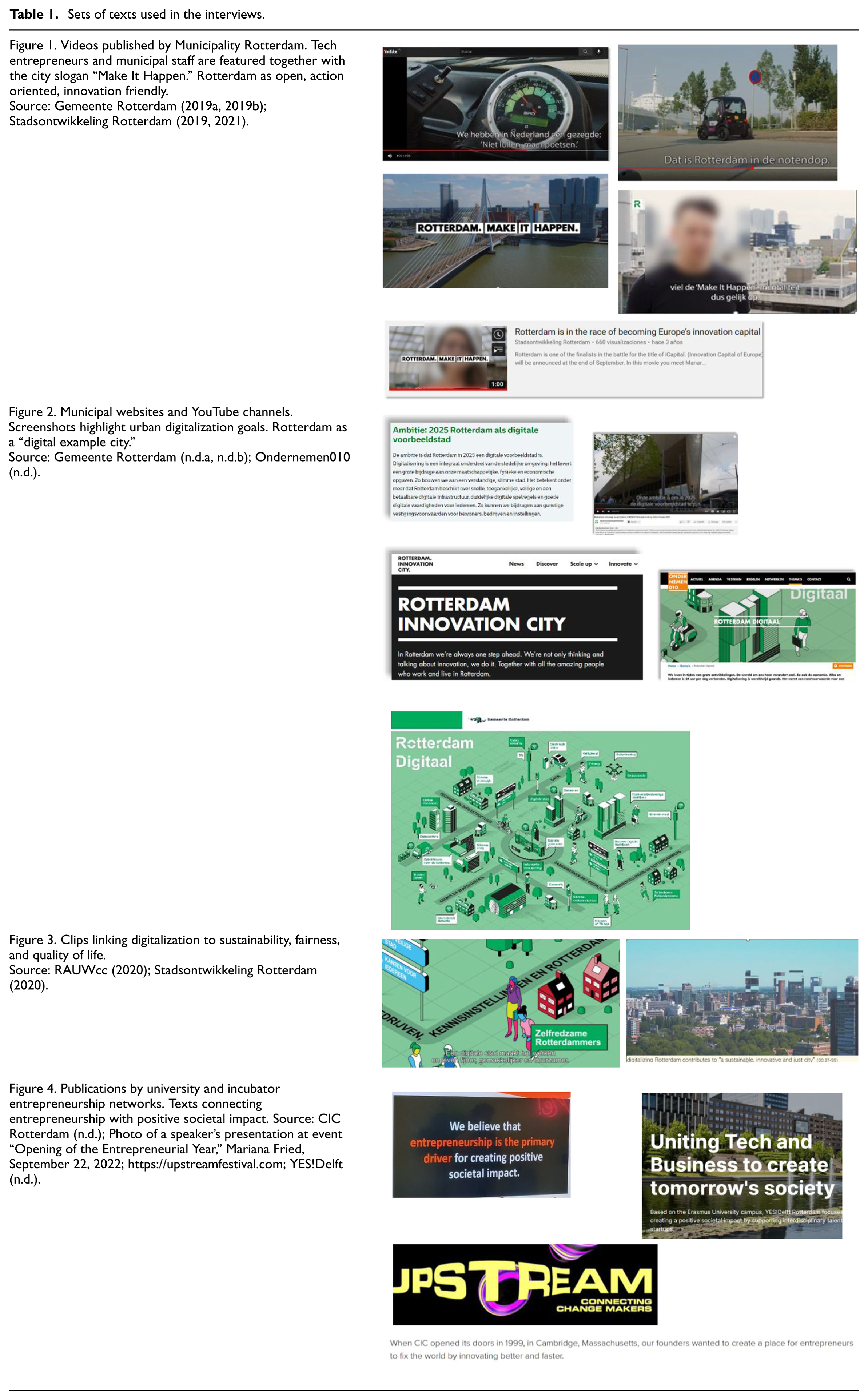
An ethnographic approach to discourse places it in the contexts where it circulates, and in relation to human action (Blommaert, 1999). This framework emphasizes the actual people behind the language, “their interests, their alliances, their practices, and where they come from, in relation to the discourses they produce” (Blommaert, 1999: 7). To implement it, we asked interviewees to reflect on their experiences with specific texts circulating at the time. Specifically, we compiled a corpus of over 50 publicly available texts published by Rotterdam-based organizations about innovation, smartness, and digitalization. From them, we selected a core set of prompts based on their cross-organizational salience and their ability to represent recurring narrative patterns in Rotterdam’s communications (e.g. action-oriented mindset, digital city over smart city, entrepreneurship-as-impact). We clustered examples into sets of prompts which included fragments from websites, newsletters, and videos published by the municipality and innovation-promotion organizations; posters, flyers, and signs displayed in offices and events; and speeches delivered at public events we attended as observers. Table 1 presents the core prompts shown to all participants and which help interpret interview excerpts cited in our findings; additional prompts were tailored to participants’ organizational contexts (e.g. texts produced by their own organization).
Sets of texts used in the interviews.
The text corpus also helped us to sample participants. We searched for interviewees who were connected to the organizations and projects represented in them, and expanded the sample through snowball referrals. Acknowledging that readings of the hegemonic tech city are shaped by social position and lived experience (Engelbert, 2019), we sought a diverse sample of interviewees. Participants occupied diverse roles, including municipal project managers, advisors, team leaders, and innovation officers; intermediary actors such as startup facilitators and coworking representatives; and entrepreneurs and innovators including founders, designers, and student entrepreneurs. Gender was recorded for all participants (17 women; 27 men). Ages ranged from 18 to 60, and 18 participants mentioned living in Rotterdam while 17 lived elsewhere but worked in the city (nine were unspecified). Participants came from varied professional fields, including engineering, management, law, and urban development, with seven trained in communication, culture, or media. Most were mainly responsible for developing innovation-related projects and digital infrastructure and fostering the growth of technology-based startups. Nevertheless, all participants had engaged, to varying degrees, in communicative tasks that projected representations of Rotterdam as a smart, digital, or innovative city. These included representing the city at international events (“I promote our city in Barcelona, Baltimore, New York,” explained Sander, a Municipality Smart City project manager), contributing to press releases and social media, and co-authoring reports framing Rotterdam as a “future-oriented city.” Even participants in highly technical roles acknowledged being active in promoting the city internationally, while entrepreneurs joined municipal delegations or appeared in marketing materials highlighting the city’s innovation ambitions. Because participants occupied heterogeneous roles, we treat the four practice clusters as analytic patterns that can co-occur within individuals rather than fixed types of people or organizations. We identify participants by pseudonym and role at first mention.
Interviews lasted between 45 minutes and two hours. Based on interviewees’ preferences, they were in English or in Dutch; 25 interviews were in person and 15 online. These comprised 38 one-to-one interviews and two small-group interviews (with two and four participants respectively), yielding 44 participants overall. While the sample is strongest for actors who are publicly visible in Rotterdam’s innovation field (e.g. municipal programs, innovation hubs, and founders showcased through them); less visible strata (e.g. back-office staff or roles less present in public-facing events) are likely under-represented. Prompted by slides with the materials listed on Table 1, participants discussed how they interpreted narratives published by themselves, their organizations, or others in the field. These materials served as entry points into the social processes behind their production, foregrounding the moments of hesitation and negotiation experienced by the individuals reading and crafting them. The semi-structured interview guide also covered participants’ backgrounds, roles, and connections to the city. To mitigate the potential for prompt-based elicitation to encourage strategic accounts, interviews began with open questions about participants’ work, their relationship to Rotterdam, and whether and how they used labels such as “smart,” “digital,” or “innovative” before any prompts were introduced. Visuals were then used to anchor discussion in concrete texts and to invite both agreement and critique.
Interviews were analyzed using Atlas.ti. Coding focused both on participants’ open (unprompted) characterizations of the city and of their work, and on their subsequent reading of the shown texts. We compared across interviews to identify recurring configurations of interpretive moves and their functions in institutional work (e.g. bridging, dissent, tactical reproduction, resignification). We wrote reflexive memos and discussed emergent patterns in regular co-author meetings, using visual (Miro board) mapping to visualize connections and boundaries between codes. We refined the four practice clusters through iterative re-reading, attention to deviances, and consolidation of definitions to ensure each captured a distinct mode of negotiating tech city discourse while allowing for overlap within individual interviews.
Findings
Participants’ reflections on their communicative tasks revealed four types of interstitial practices they performed vis-a-vis the tech city discourse: bridge building, skepticism and dissent, accommodation, and resignification. These clusters are analytic patterns rather than actor types: the same individual could enact more than one practice across different settings and audiences. Together, these practices show how individuals navigate dominant narratives, revealing that the production of Rotterdam’s tech city is heterogeneous and negotiated. While practices cut across organizational positions, two tendencies were visible. Bridge building and inequality-oriented critique were articulated most often by municipality-connected and intermediary actors with public-facing responsibilities, whereas accommodation was most explicitly discussed by entrepreneurs (and intermediary actors) whose work depended on securing institutional recognition and resources.
Bridge building
The first practice we observed—bridge building—was two-fold. Participants, especially municipality-connected and intermediary actors in public-facing roles, articulated a critical understanding of Rotterdam’s digital and innovative portrayal as a narrative strategically designed to attract attention, investment, and legitimacy in fields they often described as a professional “bubble.” Vis-a-vis this narrative, they positioned themselves as much-needed bridges between the dominant discourse and city inhabitants.
Asked about Figure 1, Paula (municipal innovation program; junior communications staff) said the materials aimed to show that Rotterdam “is this innovative ecosystem and that things are fast moving … to be able to compete with the other ecosystems.” She referred to this messaging as produced by others: “They try to be very concise: … ‘This is an innovative ecosystem. This is very entrepreneurial’.” Across interviews, participants similarly externalized authorship to a vague “they,” also when Daniel (incubator; innovation lead) described “smart city” and “digital city” as flexible labels attached to changing trends: “It’s all a connotation thing … it means whatever they connect to it.” Over time, he noted, such terms get “stained with all kinds of meanings,” necessitating new labels.
Besides the externalizing “they,” participants attributed the crafting of this discourse to abstract entities with power, framed as “the city” or as an overarching “innovation culture.” For Julia (incubator, lead), this attribution included a gender dimension. Reflecting on Figures 3 and 4, she remarked, “This culture is dominated by men. They produce the pictures you’re showing me. They produce the hot air because for them it’s a competition.” Across these accounts, the tech city was framed not as a self-evident reality but as a malleable construct.
While participants often located discourse in an externalized “bubble” or “ecosystem,” they described themselves as navigating its boundaries, moving in and out, translating rather than originating discourse. Based on a critical understanding of Rotterdam’s tech portrayals as strategically designed in powerful fields, participants framed their work as bridges connecting the professional “bubble” and the city’s diverse publics: entrepreneurs (from startup founders to small shop owners), participants’ families and friends, and, more generally, everyday Rotterdammers. This positionality legitimized presenting their work as mediators between institutional rhetoric and lived urban realities.
Maarten (municipality; entrepreneurship program manager) was one of those who thought mediation was needed between policy visions and entrepreneurs’ day-to-day needs. He promoted municipal programs for tech entrepreneurs which celebrated a “digital, carbon-neutral, circular and inclusive” economy, and relied on startup language (“scaling” and “attracting capital”). In his view, the programs reflected municipal long-term visions, which contrasted with entrepreneurs’ concerns: “There’s a difference between … where does the city need to go compared to: ‘I’m a founder and I need to survive the next three months’. So you make a translation.” For Maarten, translation required “educating” entrepreneurs, for example by bringing together speakers on sustainability and on capital attraction. Laura (municipality; economic development program), in turn, translated global discursive trends to small shop owners. She avoided mentioning “duurzaam” (sustainable), which shop owners negatively related to “duur” (expensive). Her daily work involved adapting language to either government officials or local entrepreneurs, insisting, “those are two different stories.”
Especially for interviewees who were from Rotterdam or long-term residents, calling the city “smart” or “digital” was often confined to professional circles. They contrasted their work with daily life among their family and friends. Tessa (municipality; innovation advisor) said the term “smart city” did not feature in personal conversations: “In my work of course it does … But as a Rotterdammer myself, I don’t really notice much of it.” Several participants described bridging work aimed at city inhabitants more broadly. As Johannes (municipality; advisor) put it, municipal staff were “very much used to speaking in a way … that people don’t understand,” noting that for residents, “smart city doesn’t even exist.” Similarly, Sebastiaan (municipality; digital services coordinator) said he used “digital” and “smart” 1 only with external actors like the Chief Digital Office, since the terms held little meaning for the Rotterdammers he worked for.
Crucially, participants critically considered the consequences of this discursive gap and its potential to deepen inequalities. Daniëlle (coworking space manager) worried that materials portraying Rotterdam as innovative (Figure 1) would not resonate broadly: “In our bubble that lands and that’s known. I’m doubting if that’s outside for the whole group of citizens. I don’t know if it lands there … that’s something that we should be really mindful of.”
Reflecting on organizations’ celebrating innovation’s impact (Figures 3 and 4), Leyla (municipality; team lead) remarked: “A lot of people cannot relate [themselves] to this communication. I can, but a lot of citizens in Rotterdam can’t.” For her, such portrayals targeted “well-educated people familiar with innovations” while overlooking services “that impact citizens more directly.” Johannes emphasized how innovation rhetoric widens divides: “Because of that, the differences between people also keep being emphasized … if you don’t understand [tech innovation], or it’s not explained, the gap gets wider … [we] have to keep an eye on [that].” This concern justified Johannes’ translation workarounds: That’s why an important part of my work is communicating with people we cannot reach. …also in other languages than Dutch, which actually we’re not allowed to do if you work for the municipality. So we’re a bit naughty in that.
His using other languages despite restrictions revealed both institutional constraints on communication and staff’s resistance. Bridge building thus entailed not just adapting one’s language. As Lina (innovation-support organization; director) argued, “You can’t explain an innovation ecosystem to a person using all these difficult words. Right? So you have to adjust.” It also entailed acknowledging a gap and reflecting on its consequences. Sebastiaan exemplified this when, during a work meeting, he raised concerns about the disconnect between municipal communications, like the infographic of a hyper-connected city (Figure 2), and citizens: “[We] raise warnings, like: ‘Listen, you want this’ …but a large portion of our job seekers don’t understand that. ‘Are you aware of that?’” Understood as translation and as critique, bridging complicated notions of a homogeneous “tech community” or “discursive ecosystem,” pointing to a permeable and contested field. By treating institutional rhetoric as simultaneously necessary for legitimacy and insufficient for public resonance, participants repositioned themselves as mediators who manage the boundary between ecosystem language and lived urban realities. Bridge building therefore stabilizes dominant discourse by rendering it communicable, and it destabilizes it by foregrounding who is excluded by its vocabularies, explicitly linking tech city branding to inequality, voice, and recognition.
Skepticism and dissent
A second set of practices revealed participants more openly questioning the narratives promoted by their organizations. In the interviews and their everyday professional settings, they critiqued tech city narratives for being techno-solutionist, detached from urban realities, overly vague, or for masking the human work behind technology. They also described moments of pushing back against these terms in workplace discussions, and sometimes withheld participation from practices that reproduced dominant tech city narratives.
The techno-solutionism most participants read in texts like “startup solutions are coupled with societal challenges,” and the ubiquitous mentioning of “impact” (Figure 4) triggered skepticism and fatigue. Vera (innovation-support organization; director), whose organization claimed online to support “impact-driven entrepreneurship,” admitted: “We’re considering stopping using the word [impact] because for me it’s been degraded … it’s a buzzword that everybody is using.” Some participants described embodied reactions resulting from their discomfort with such narratives. Looking at Figure 4, Sebastiaan (municipality; digital services coordinator) described an embodied “tension” and “clash between worlds,” arguing that this communication resonates with only a limited segment of the city who “believe[s] they’re contributing to making Rotterdam better and smarter,” but does not reflect the lives of the people he worked for.
Like Sebastiaan, others critiqued gaps between narrative and reality. Entrepreneurship advisors pointed to disconnects between strong marketing and weak investment, while four participants used terms like “innovation theater” and “innovation (green-)washing” to denounce the performativity of tech city discourse. Marcel (municipality; Chief Digital Office) argued that often “the innovation becomes an event, that’s the innovation theater … innovation circus, it’s just like you’re creating events, you wanna be seen as innovative, there’s no process, there’s no plan.”
The clips from municipal platforms that linked digitalization to sustainability, efficiency, fairness, and wellbeing (Figure 3) were read as ambiguous feel-good messaging lacking substance. Stefan found them “hollow,” and Cristina questioned the link between digitalization and justice. This critique of vague, feel-good messaging extended to widely recognized labels such as “smart city,” which participants also challenged for being imprecise and loosely defined. Although he had represented Rotterdam at the Smart City Expo, Marco (startup entrepreneur) avoided the term in his startup’s communications: “Maybe we are not good at selling ourselves? But I try not to say this bullshit. I mean, what is a smart city, honestly?” Two municipal employees working on digitalization said they “hardly ever” used the term and found it “disturbing” given its technical orientation. Johan (municipality; program manager) explained: Smart city thinking is also developed by IBM, it’s really coming from the tech industry … They would make all cities become technical and they would supply everything … They will tell us what to do … This is not how it works.
The smart city label was particularly criticized for masking human effort. Paul and Bart, who worked on municipal infrastructure projects, questioned the “smart” qualification for downplaying the human effort shaping technology. Paul (municipality; department manager) argued: [the expression] smart city already feels off to me, but “smart software”? That I find deadly. Software is not smart. It might have been smartly developed, made smart by the people behind it, but the software itself is only as smart as the people who created it.
Bart (municipality; advisor), sharing similar views, pushed back on the term with colleagues. He recalled voicing his disagreement to the municipality’s Communications teams about using “smart” to qualify systems: In my vocabulary that doesn’t come up so often. But in the vocabulary of the Communications people, very much so, that is: we have to show that we are “smart” … [Those] terms come up there … I’ve had discussions about that … the discussion is often: what is smart?
Bart’s questioning of Communications specialists was one of several examples of interstitial practices within the organization. Like him, other participants recalled workplace interactions where dominant narratives were renegotiated. Johannes described his “struggle” to make colleagues recognize that techno-utopian narratives overlook residents’ concerns. Marinus (entrepreneurship-support organization; advisor) reported “a big discussion” at an incubator about the placement of symbols replicated from U.S. tech culture, such as foosball tables and neon signs. Zahra (entrepreneurship-support organization; director) tempered tech-solutionism by insistingly pressing for purpose in meetings, using iterative “why” and “what for” questions to reframe discussions away from tech “hype.” As she explained, when speaking to “tech enthusiasts,” she often asked them “Why? What’s the purpose [of that technology]?” to find that “Nine out of ten times, it’s not even about technology.”
Dissent sometimes went beyond questioning. Participants sometimes decided to step back and withhold participation from institutional practices. Zahra described being “very selective as to what events I do attend … [If] it’s a company that has a lot of questionable partners, then I don’t go.” Paul explained that although the City Council had advised using the term “smart software” in his project’s communications, he deliberately omitted it. He felt the label reinforced the idea that technology (rather than people) is smart. Likewise, Maarten declined to contribute to a campaign by questioning the techno-centrism in smart city messaging: They were doing a national campaign on tech. They said “Can you give a quote on the importance of tech for the Netherlands?” I thought for like two hours on it. And the reason I couldn’t give an answer is because I don’t think tech is the most important part of our future … the terminology of “smart city” feels like we all have to be digital and connected. And it’s not … I said, “I’m not going to send a quote.”
These examples show how, even within organizational routines, individuals engaged in everyday, low-visibility interventions that reshaped dominant narratives. Analytically, skepticism and dissent expose the cracks in techno-utopian discourse from within the institutions most associated with it. These practices re-politicize the tech city by disputing its vagueness, its corporate provenance, and its tendency to obscure human labor and uneven urban impacts. This cluster foregrounds constrained agency: participants pushed back through low-visibility interventions (questions, revisions, selective participation, refusal), revealing how legitimacy is negotiated rather than assumed.
Accommodation
Critique did not necessarily imply outright dissent. Even participants who voiced skepticism found themselves engaging with the narratives they questioned, to navigate institutional agendas and gain support. Despite his outspoken criticism of “smart city” language, Paul admitted: “if you were communicating something to city hall, you’d say, ‘In our Smart City program … blah blah blah’.” This tactical compliance or accommodation was part of the interstitial practices participants performed to communicate effectively and gain legitimacy, even when being critical.
Among entrepreneurs, particularly, there was agreement on the convenience of aligning with institutional rhetoric to gain traction. Daan (startup entrepreneur), for example, had co-authored a report stating that Rotterdam wants “to invest in the city of the future.” He explained that aligning with “impact” and municipal vocabularies was “convenient”: in pitches, he adapted storylines to the language he knew municipal stakeholders were keen on (e.g. “livability”), even when he personally judged these terms as vague.
Accommodation to dominant rhetoric sometimes costed participants’ emotional discomfort. Zahra critiqued “innovation” and “impact” as buzzwords but admitted to tactically using them at certain events. With the visuals in Figure 4, she watched a video where someone declared “Innovation is key if you want to have a better world.” Zahra commented: “Innovation” is such a hyped-up word. What do you mean with “innovation”? … the same goes with impact. What do you mean with impact? Define it … You can use [the term] to your advantage and your benefit. But personally, I don’t feel comfortable with that.
Even though she found them hollow and overused, Zahra reported using these terms on occasions, acknowledging that tactical use of hegemonic language is needed to gain legitimacy in spaces where decisions are made, for example at an event where she needed to negotiate for her team’s project. When talking about reproducing terms like “innovation” and “impact” without having time to detail specifically what they mean to her, Zahra acknowledged the emotional cost of tactical uptake— “Then I feel dirty. I go home, take a shower [laughs]” —while also framing accommodation as a strategic means of accessing decision-making spaces: “you have to play the game to be in the game … and try to change the rules while you’re playing … we use these words as a way to frame things so we can actually get what we want.” Zahra’s view echoed the experiences of others who used language pragmatically to access resources. After admitting that if everybody talks about impact, “it becomes nothing,” entrepreneur Tim reflected: “The only way to succeed as a tech company is to sell something … So we will keep posting crappy marketing posts that I don’t like … [including in social media] the ‘impact’ and ‘sustainable’ and ‘tech’.”
Accommodation practices show how dominant discourse reproduces itself through pragmatic, resource-oriented compliance rather than wholehearted belief. They show that agency inside institutions often takes the form of tactical navigation, and that actors may adopt dominant framings to stay in the game while attempting incremental shifts from within. Yet, as these examples underscore, this was also experienced as burdensome, suggesting cracks in the dominant discourse. The fact that participants continued reproducing these narratives, even while questioning them, points to the power of dominant discourse to mask these fractures, making them invisible. Precisely because of this invisibility, it becomes crucial to examine these cracks closely. The following section explores the less visible negotiations at work, revealing how participants actively reinterpreted concepts and constructed alternative narratives.
Resignification
The fourth type of practices involved reappropriating symbols and the meanings attached to them. Participants re-claimed dominant expressions by infusing them with meanings that better reflected their values, introduced alternative vocabularies to better describe their work, and reworked symbolic representations of innovation to challenge exclusionary framings.
When participants sought to re-signify a term, instead of accommodating to it, they charged the term with alternative meanings to reflect their own values. Johannes acknowledged that the term smart city need not be technically confined: “You can also, of course, find more meanings than just the technical part.” Participants often re-framed the term to emphasize inclusion, sustainability, and wellbeing. Sanne (municipality; innovation manager) offered a personal interpretation of smartness as removing barriers so everyone can participate in society. Her idea of the smart city implied enabling access: “We need diversity to get better. That’s where innovation starts.” Against what he saw as an economically narrow official definition, Stefan also reframed “smart,” envisioning a “smart green,” “smart inclusive,” and “smart participating” city. Lina, in turn, defined the “innovation” that she hopes to contribute to, focused on personal development: “If people were in one way or another touched by the programs we do … Innovation is also believing that something better is possible.”
Others introduced alternative vocabularies to better reflect their perception of their work. Charlotte (entrepreneurship-support organization; staff), for instance, replaced the label “social tech” institutionally used to promote the program she worked for and used “health tech” instead. Because the program worked with profit-driven startups, she considered “social tech” misleading and shaped by strategic alignment with governmental agendas, not by the actual goals. She explained: “ ‘Social entrepreneurship’ for me, means that your business doesn’t just make profit but also has social impact.” Despite acknowledging the organizational mandate, Charlotte shifted terminology mid-interview, proposing an alternative to her organization’s framing: “[It’s] important to find definitions or to ask each specific person for a definition because I think everything is mixed up … also in this interview I started calling it ‘health tech’ because I think it’s more health tech.” Similarly, Sebastiaan described a project that entailed “developing a testbed” and paused to clarify: “It’s an experiment, but we are not allowed to use the word ‘experiment’. So we call it a testbed. But yes, it’s an experiment.” As he continued describing the project, he called it an “experiment” throughout the interview, asserting a term that, to him, better reflected the project’s nature.
Also, outside the interview, in more public settings, participants challenged existing symbolic representations of the tech field, proposing alternatives to its exclusionary frameworks. Zahra, for example, was initially put off by her organization’s website, which portrayed innovation through images of suited white men. During the interview, she recalled: “[I] said no when they offered me the job, based on the website … I told [a friend], ‘I don’t like the way that they only have white men on their website.’ She’s like, ‘but you can change that’.” At the time of writing, the website had shifted its imagery toward showing diverse groups of people in brainstorming sessions. With a similar goal as Zahra, Lina sought to reconfigure representations of Rotterdam’s innovation field through the events she organized. While she avoided publicly critiquing racial and gender inequalities to circumvent potential backlash, she strategically gave stage visibility to entrepreneurs from marginalized groups, shifting representation from within. Across these examples, participants’ resignification practices reshaped the meanings of dominant labels, concepts, and representations. Resignification practices show how dominant symbols are not only accepted or rejected but actively reworked: participants infused “smart,” “innovation,” or institutional branding with alternative values and intervened in representational politics. Resignification foregrounds meaning making as a mode of institutional change, often incremental but consequential in redefining what the tech city can legitimately stand for.
Conclusion
Scholarship has highlighted institutions’ role in shaping technocentric urban futures, often overlooking the human agency embedded in these institutions and their narratives, thereby concealing possibilities for change in tech city discourse. We shed light on how such agency is exercised under constraint by identifying the interstitial practices of individuals involved in producing representations of Rotterdam as a tech city. Rather than treating interstitiality as an in-between organizational position, we extended Burns and Welker (2022) by conceptualizing interstitiality as practice, seen in the everyday discursive work through which actors reproduce, bend, reinterpret, and sometimes refuse dominant narratives while remaining embedded in the organizations that circulate them.
Approaching discourse ethnographically allowed us to treat institutional texts as entry points into the situated work through which Rotterdam’s tech city narrative is maintained and contested. Across interviews, we identified four interstitial practices—bridge building, skepticism and dissent, accommodation, and resignification—that show how actors manage rhetorical gaps, contest legitimacy, tactically reproduce framings, and rework meanings. Taken together, these practices show that the tech city is not produced as a coherent institutional line but negotiated in everyday work, making visible moments of exclusion and contestation that a text-only analysis would overlook.
What we observed in Rotterdam, then, is that even those engaged in promoting urban tech agendas are self-reflexive and critically engaged in efforts to negotiate and redirect how dominant discourse is articulated. Our findings complexify top-down versus bottom-up models, showing that dominant institutions are neither isolated nor ideologically uniform. A feminist post-structuralist approach to practice (Bacchi and Rönnblom, 2014) allowed us to expose local institutions as unfixed and shaped by creative human activity, that is, as spaces from where agency can also be identified. We approached agency as relational, institutionally embedded, and often incremental, visible in constrained, sometimes oppositional practices within organizational routines (Coe and Jordhus-Lier, 2011).
This study thus contributes to an understanding of the tech city as a discursive construct held together, and at times destabilized, by everyday discursive work. In line with Burns and Welker’s (2022) call to consider how urban smartness is contested from its interstices, our findings show how cracks, frictions, and discursive shifts can emerge from within. They showed that interstitiality is not necessarily tied to organizations but enacted through practices, something people do in moments of discursive negotiation. In doing so, we extend recent accounts of institutional work and horizontal tensions by specifying a practice-based typology of how within-institution actors contest legitimacy, tactically reproduce dominant terms, and resignify symbols. These micro-negotiations may—over time and under particular organizational conditions—accumulate into more consequential shifts in institutional agendas and urban imaginaries.
While Rotterdam’s rebranding trajectory and event-intensive innovation field shape how these practices become visible, the practices themselves are not unique to this case. Many cities assemble similar municipal–intermediary–startup so-called ecosystems and rely on comparable repertoires of techno-utopian branding. Our contribution therefore offers a way to study how dominant urban tech discourse can be sustained and contested from within across ordinary cities. A practice-centric view suggests that if discursive shifts already occur inside institutions, governance interventions should not only produce new narratives but also create organizational routines and feedback mechanisms that surface and amplify existing internal critique. Treating communication not as a glossy output but as a site of governance, while making space for internal translators and critics, could reduce discursive exclusion and strengthen legitimacy.
By centering individuals as discursive workers, we showed that the tech city narratives are not authored by a monolithic institutional voice. They emerge from the actions of a diverse set of actors occupying a variety of roles, some with institutional authority, others in more precarious positions. Their varied motivations, experiences, and reflections underscore the heterogeneity often flattened by notions of urban tech as a unified ecosystem. Understanding the production of the tech city requires tracing these everyday discursive practices. It is in them that we locate agency and the potential for change. Research would benefit from further exploring the lived experiences, positionalities, and tensions faced by these actors, to better understand how social justice may be pursued from within the very institutions presumed to uphold existing structures.
Footnotes
Acknowledgements
The authors are deeply grateful to all those who contributed to this research by offering their time for interviews and conversations, welcoming us into their workplaces and events, and reviewing parts of the article. Special thanks to Prof. Dr Susanne Janssen for her guidance throughout the development of this project, and to the academic community of the School of Communication at Northwestern University for their valuable feedback during the early stages of the article.

Ethical considerations
This study received ethical approval from the Ethics Review Board of the Erasmus School of History, Culture and Communication (ESHCC), Erasmus University Rotterdam (application no. ETH2223-0168, approved on December 15, 2022).
Consent to participate
All participants provided written informed consent prior to their involvement in the research.
Funding
The authors disclosed receipt of the following financial support for the research, authorship, and/or publication of this article: This research was supported by the PhDs in the Humanities 2021 grant from the Nederlandse Organisatie voor Wetenschappelijk Onderzoek (NWO), file number PGW.21.022.
Declaration of conflicting interests
The authors declared no potential conflicts of interest with respect to the research, authorship, and/or publication of this article.
Data availability statement
The materials used as prompts during the interviews are publicly accessible. The qualitative data derived from the interviews are not publicly available, to protect participants’ confidentiality. Researchers interested in specific excerpts may request access to those portions for which participants have explicitly provided consent, subject to ethical approval and data-sharing agreements.