






Abstract
Pathology informs and structures urban spaces. This article explores the relationship between the urban and the pathological by trailing the Aedes mosquito, the dengue vector, to trace the intersection of the civic, social, ecological, and political in the everyday life of Delhi. To control the possibility of a dengue epidemic, the gaze of public health authorities primarily focuses on areas considered inherently “dirty”—localities of East Delhi at the margins of the city, situated at Yamuna riverfront, populated by working-class migrants living in unauthorized colonies. The residents of such areas, however, have to deal with the absence of basic urban infrastructure on one hand, while also being under the stringent administrative glare for pest control. Interestingly, both the inhabitants of these areas and their administrators express the ungovernable stubbornness of such regions using the colloquial expression “Khula area.” Based on a multi-sited ethnography, this work follows many usages of the term Khula by several actors across the city, including scientists, city administrators, and frontline workers. Then, it argues that the word Khula is an empty signifier, which, through many of its meanings, enables us to see urban spaces through the prism of the pathological and all things that fall within its shadow.
Introduction
“Metropolis must be a mosquito-free zone,” an entomologist with the Delhi National Center for Disease Control declared while I was interviewing him. He then told me many technical and biological facts about mosquitoes, ranging from their habit and habitat to their anatomy and behavior. He emphasized that “knowing” mosquitoes well is the first step to controlling mosquito-borne diseases. After about an hour-long monologue about mosquitoes’ biology, he asked about my work till then, the institutions I have worked with, and the places I have visited. Once he learned that I was working with the Municipal Corporation of Delhi (MCD) with a focus on East Delhi, he said that East Delhi is a “problem” indeed, and elaborated: East Delhi me pachas hazar bhi DBC kar diye jay to dengue khatam nahi hoga vo Khula area hai. [Even 50,000 domestic breeding check (DBC)
1
workers won’t be able to control dengue in East Delhi, as it is the Khula area]. There will always be one or two houses there which won’t give you access to the household. These houses will have enough breeding to infect the whole neighborhood. I have taught you many things about mosquitoes, but sirf theory par entomology nahi chalti practical bhi dekhna hota hai [entomology doesn’t work only with theory, we must look at the practice as well].
The entomologist thus stated his expectation of a sanitory city, detailed the method to fulfill his expectation, and eventually conceded that it was not achievable. The reason for this was that East Delhi was the Khula area. As I mentioned, I had already started my fieldwork 2 in East Delhi with a focus on an informal settlement named Sonia Vihar, which was under the jurisdiction of the East Delhi Municipal Corporation (EDMC). 3 The word Khula, by now, was an oft-repeated word in my field in the context of dengue. At first, I assumed it referred to the porosity of the area as the word Khula means open in Hindi. It appeared to signify the openness of these areas to the flow of materials, bodies, and, consequently, infections across interstate borders. For this, the area is conveniently located at the margins of the city and at the bank of the river Yamuna, to give a gateway to the migrants, floods, water logging, mosquitoes, and unchecked infected bodies, all of which can disrupt the link people draw between the urban and orderliness. Though, as we will see as the article unfolds, Khula kept shifting its signification as well as the location with its several usages. While urban dwellers narrated their vulnerability through this expression, administrators and frontline workers used it in exasperation, highlighting their frustration with the area and its inhabitants. Similarly, whenever I thought I had located it, it shifted its location as people always tried to dissociate themselves and their neighborhoods from it.
This tendency can be understood through the lens of the pathological. With implications far beyond it, the concept of (the normal and) the pathological is rooted primarily in medicine. A physician and philosopher of medicine, Canguilhem (1994), while defining it placed himself in opposition to 19th-century vitalists, who viewed the pathological as simply a statistical variation of the normal. Canguilhem widened the definition of the normal by referring to it as a wide range of conditions within which an organism adapts to its changing milieu. As long as it adapts, it must be considered normal. The pathological, hence, is not merely a quantitative deviation from a statistical norm but a qualitative, subjective state characterized by a reduced capacity to establish new norms of life (normativity). Foucault (1990), a student of Canguilhem, extended this idea to show the shift in modern medicine that enables mapping of the patients’ bodies in an attempt to understand what is ailing them. He further shows, through his analysis of prisons, clinics, asylums, and hospitals, how location becomes a ground for control and even segregation. In his other works as well, Foucault (1995 [1975]) described the “plague towns” in the Middle Ages and the way administrators dealt with them in terms of quarantining as “strict spatial partitioning” and an early form of panopticon. As he writes, “It is a segmented, immobile, frozen space. Each individual is fixed in his place. And, if he moves, he does so at the risk of his life, contagion or punishment” (Foucault, 1995 [1975]: 195). Here he very explicitly draws a connection between space and contagion and points out how administrative strategy, in order to restrict the movement of infection, attempts to separate, isolate, and immobilize the body itself. 4 In this line, the work of Sennett (1996) can be seen as understanding cities as bodies writ large. Sennett studies several cities of western civilisation historically to understand urban spaces through bodily experiences. By describing ancient Athens, Rome, and Paris, his work shows how political and religious beliefs about the body shaped these cities and their public spaces (Sennett, 1996). To comment on modern cities such as London and New York, he argues that a physician named William Harvey’s discovery of the blood circulatory system provided a way to imagine cities as systems of veins (Sennett, 1996). Hence, communal spaces and freely floating bodies were seen as too chaotic and a nuisance to be controlled, which made the city mirror the circulatory system. Read together, these three works lay the basis for looking at the city through biomedical and administrative attempts to locate and segregate the pathological. This work also attempts to locate the pathological in the city. However, the pathological remains semiotically unstable and spatially elusive.
Through the narratives of several actors across the city, including scientists, city administrators, frontline workers, and urban dwellers, I first depict the various uses of Khula to highlight the instability of its signification. To understand this instability, this article puts the existing ideas of urban studies, such as urban informality, abjection, and urban peripheries, in conversation with the anthropological understanding of an empty signifier. While ideas such as informality help characterize the instability, contradictions, contestation, and negotiation that urban dwellers face, the notion of an empty signifier, as the article will show through the notion of Khula, enables us to conceptualize these contradictions. Through these concepts and the empirical inputs, the article will show how the Khula area is an empty signifier, a word that absorbs meaning rather than emitting one. Its many meanings allow us to delve into the city’s spatial, civic, and socio-political textures.
A note on dengue and the field site
Dengue is an epidemic-prone mosquito-borne viral disease, previously considered an infection in tropical countries, which now has a global presence (World Health Organization, 2025). It is spread by the female Aedes mosquito, which breeds in clean, contained, small, and often anthropogenic water bodies. It also feeds exclusively on human blood. These characteristics make it primarily an urban pest. India recorded a dengue outbreak as early as 1780 (Gupta et al., 2012). However, a nationwide outbreak in 1996 garnered this infectious disease media and political attention. In this outbreak, Delhi alone recorded around 500 deaths and over 10,000 infections, pushing the city administration to formulate policies and strategies to control it (Addlakha, 2001). These strategies primarily focus on controlling Aedes mosquito breeding, as there is no vaccine or specific cure for dengue. Hence, Delhi witnesses a city-wide effort to curb dengue, which involves looking for mosquitoes’ preferred habitats, spraying insecticides in stagnant water, and fogging public spaces, especially around monsoon time, as this is considered the most suitable time for mosquito breeding. Dengue control thus provides an opportunity to explore the relationship of urban spaces with disease, dirt, pests, and all things pathological. The upcoming sections follow the everyday mosquito control work by the municipal corporation and the everyday negotiation between the city administrators and the urban dwellers. The health department of the MCD, responsible for the groundwork on mosquito control, given the lack of funding, human resources, and infrastructure, focuses primarily on the low-income neighborhoods of East Delhi. Hence, this region eventually became my focus, too. In East Delhi, the Sonia Vihar locality became the focus of dengue control efforts due to its proximity to both the Yamuna River and the interstate border and due to the socio-economic profile of its residents. The locality also recorded the highest number of dengue-chikungunya 5 cases in Delhi’s 2015–2016 outbreak (Indian Express, 2017). Hence, in East Delhi, an unauthorized 6 colony named Sonia Vihar became my focus. The upcoming sections elaborate on how a colloquial expression, the Khula area, is used to describe various aspects of East Delhi, and then the article, through the semiotic analysis of the Khula area, argues that Khula is an empty signifier that encompasses the spatial as well as the moral aspects of the city.
Of porous borders and a mixed population: Governing the Khula area
“You don’t know what a PBP [permanent breeding point] is! They have not shown it to you yet? Pehle hi din dikha dena chahiye tha” (they should have shown it to you on the very first day). Dr Rai,
7
the Chief Medical Officer (CMO) of the EDMC, was astonished as well as irritated that I did not know what PBP was. He muttered under his breath while shuffling through the files on his desk, looking for something. He then took out a blank piece of paper and started scribbling. He drew something that looked like a vantage point from which two waves were emerging, and said: The North-East zone of the EDMC is the Khula area. The water of the two places meets at this point. Hence, water gets logged here. Consequently, a PBP is formed—a permanent breeding point. Breeding is inevitable here. Whenever our team goes there for inspection, they ask the DBC worker in advance if there is a PBP here. So that if breeding is found there, it won’t be considered a DBC worker’s fault.
Here again, the Khula area reappeared in the testimony of a city administrator. This time, though, we are getting some material explanation of its vulnerability to epidemics. As per Dr Rai, this area somehow facilitates waterlogging permanently, which facilitates breeding. The latter here is so unavoidable that even the frontline workers of the area are not held accountable for it. However, based on a drawing, it was difficult to grasp the idea of a vantage point where water logs and mosquito breeds. “Think of it as a backyard to your home, to which you have no access. Hence, you cannot clean it,” he tried to explain further with another analogy. So, the area was a blind spot to the vision of state machinery. “Tch,” he was visibly disappointed at my incomprehension. He then called the Sonia Vihar malaria office and reproached its office in charge, “Madam ko ab tak PBP nahi dikhaya? Vahi to poori booklet hai!” (You have not shown her PBP yet. That is the key to understanding the area). Dr Rai then turned to me and said: Do you understand now? The problem with this place? Have you seen South [Delhi] workers? They have tabs. These people have not shown you PBP yet! To get any work done here is a miracle. This is the Khula area, you know, so our workers unionize.
8
[Khula area hai na to thoda workers ki unionbaji ka chakkar hai].
So the municipal officer claimed that, unlike the tech-savvy workers of South Delhi, the frontline workers with EDMC were inefficient. Khula reappeared; this time, it enabled an EDMC official to express what he thinks of his subordinates, who, as per his testimony, would rather unionize than work.
After Dr Rai’s call to the Sonia Vihar office, MCD workers arranged to show me the PBP on my next visit to the field. The next day, I arrived there to find all the DBC workers busy in a process they called gadde banana (preparing a mattress). They had a sack (bori) of about three feet long which they were filling with pieces of cotton. After doing this, they stitched the mouth of the sack and started calling it gadda. Then they poured a mosquito larvicidal chemical over it that they referred to as dawa. Once the gadda was saturated with dawa, we all set off for a process called gadde lagana.
We stopped at a narrow road, underneath which a drain was flowing. This drain was merging with a large open drain of stagnant water with garbage floating on its surface. The unfinished portion of the road towards the open drain had some of the iron rebar protruding out of it at several places. Once there, the frontline workers tied the gadda with rope at one of its corners. As onlookers observed us with great interest, the frontline workers gradually dipped the gadda in the drain so that most of it was immersed in the water. Now, we could only see the recently stitched mouth of the gadda. Deepakji, 9 the officer in charge of Sonia Vihar’s malaria office, walked up to me and said, “All the mosquitoes are going to die now.” He pointed towards the water and added, “Now dawa will create a film over the water, and the mosquitoes will continue to die. We return every 15 days or so to pour dawa on the gadda again so that it remained saturated with dawa at all times” (Figure 1).
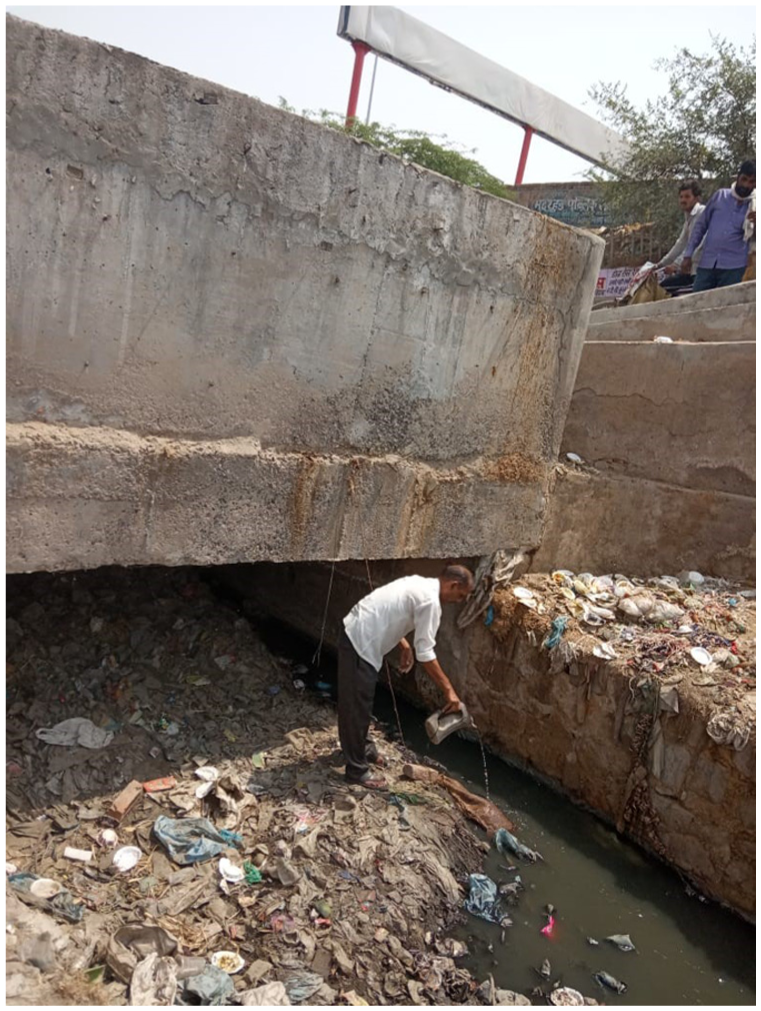
A frontline worker pouring insecticide over a gadda (mattress). April 2019. All pictures used were taken by the author, unless specified otherwise.
Once this was done, I asked Deepakji, “Weren’t we supposed to see the PBP today?” He replied, pointing towards the open drain where we had just put the gadda: “This is the PBP, our ward’s largest.” But, I wondered out loud, after this huge effort, how can it remain a PBP? He pointed to the back of the gadda and said:
All this dirty water is coming from UP [Uttar Pradesh; Ye saara ka saara UP ka ganda paani aa raha hai peeche se]. Sometimes, it comes with such a force that our gadda floats away. How can we control it? We can only tie these gaddas on “our side.” There is no surveillance system on the UP side of the border.
Now that I have seen the PBP mosquito control effort, Dr Rai’s drawing that looked like a vantage point was beginning to make sense. The area was indeed a blind spot in the vision of state machinery. In a manner of speaking, it was the backyard of Delhi, a meeting point of the material of two places (Delhi and UP) over which the MCD has partial and often insufficient control. In addition to its material and spatial quality, Deepakji pointed to another characteristic of the area. He pointed towards the other side of the road and said: See that narrow lane? The right side is UP, and the left is Delhi. People here have two IDs. Ye log breeding pakde jaane par UP vale ho jaate hai aur ilaaj karane ke liye dilli wale ho jate hai [residents here claim to be from UP when we find breeding in their houses and become Delhi residents to claim health facilities]. How is surveillance possible here? Ye Khula area hai na [This is Khula area, you know].
Now, in addition to pointing at the confluence of material, he was also pointing to the entanglement at the level of the population. Allegedly, the residents here can claim the residential status of either adjoining state based on their convenience, making disease surveillance impossible. Deepakji said “Khula area” as if it was the explanation for it all. So, I asked him what the Khula area meant. He pointed indistinctively at the field before us, interspersed with some houses, and said: “It means it is completely open; what else?” (Matlab open hai sara ka sara aur kya?). I knew Khula meant open in Hindi. I needed more than a literal translation to understand what Khula meant in the present context. I did not have to wait long. He started explaining: Khula area hai madam. Kachchi zameen, kachchi colony.
10
Ghar-ghar me neta hai. Ghusne nahi dete. Tunkey cooler check nahi karne dete. Idhar Yamuna ka pani bhar jata hai. Udhar border hai. [This is Khula area, madam: unpaved roads, unauthorized colonies. Everyone acts like a VIP. They won’t let us enter their homes to check their water tanks and water coolers. Yamuna River on this side and state border on the other].
He enumerated all the problems that, according to him, made Sonia Vihar challenging to manage. In his testimony, the spatial qualities such as kachchi zameen (unpaved roads), frequent flooding, the proximity to the Yamuna and the interstate border, the legal status such as unauthorized colonies, and the moral qualities of the residents (who avoid the eye of the state) appear together as if one implies the other.
Here, as we can see, the collection of the meanings of Khula is continuously expanding. For scientists, it means an area where impeccable theoretical knowledge of entomology does not work. For a city administrator, it is an area filled with “unionbaz” workers who are not as efficient and as well equipped as their counterparts in South Delhi. Furthermore, for the frontline workers who are more intensively involved with the day-to-day work of mosquito control, Khula is expanded to denote the spatial, administrative, and moral features of the area and its residents. Khula represents some inexplicable quality of the area due to which even the expert knowledge of insect behavior, disease-related data, and the meticulous process of gadde lagana fail to curb its epidemic proneness. I also want to draw attention to an important slippage in the meaning of the Khula area here; it is not just referring to a location but also continuously alluding to the social and moral qualities of those inhabiting it. So, the residents who lie about their identity or resist the state’s entry into their homes, or the workers who would rather unionize than work, are subsumed within the adjective Khula in addition to its location and spatial attributes. Thus, in addition to some inexplicable qualities that make governance difficult, the testimonies of people ranging from a scientist to a CMO to frontline workers indicate the moral attributes of those who inhabit it. Khula, hence, is a locational adjective but is also immediately moral. Understanding the conflation of different kinds of pathologies in the term Khula requires an understanding of the pathological.
As explained earlier, the understanding of the pathological in the body has given way to an understanding of the pathological in the urban. This leads to the identification and segregation of the pathological within urban spaces. Many scholarly works show how such attempts have shaped urban spaces and neighborhoods. For instance, Ghosh (2020) shows how urban spaces in colonial Calcutta were first shaped by racial ideas of purity and then by Hindu ideas of purity and pollution. Similarly, Sharan (2014), while making a case for tracing the distinctive history of contemporary South Asian cities, has shown how certain elements, such as meat and slaughterhouses have been considered “in the city” yet “out of place” (Sharan, 2014). Noting another attempt to regulate such areas, Legg (2014) traces the spatial segregation and then separation of red-light areas in colonial times, and shows how Delhi worked to evict prostitutes from the walled city and how this process led to the construction of the urban in colonial India. In a comparatively recent work, Ghertner (2015), among many other urban scholars, describes how Delhi, in the first decade of the millennium, in its quest to become a “world-class city,” bypassed maps and statistics, which in any case were considered unreliable, and declared slums illegal because they “looked” illegal and did not fit into the aesthetic expectation of a millennial city.
Thus, attempts have always been made to locate and regulate or even banish the pathological from the city, and East Delhi has historically been the area where people banished from the other parts of Delhi have resettled. Starting from the 1960s, when the original master plan for Delhi’s development was created (Baviskar, 2020), East Delhi has seen several peaks in the influx of migrants that reflect India’s history of urbanization. For instance, during the emergency 11 in 1975–1977, slums from central parts of Delhi were demolished, and people were relocated to the trans-Yamuna swamps of the eastern margins of the city (Baviskar, 2020; Tarlo, 2003). In the 1980s and 1990s, during financial liberalization, Delhi development authorities competed with private builders to provide modern housing to the increasing population of the city (Baviskar, 2020). The early 2000s again witnessed a series of demolitions as India aspired to become a millennial city (Ghertner, 2015). In preparation for hosting the Commonwealth Games in 2010, the slum demolitions were intensified to make Delhi look like a world-class city (Dupont, 2011). Each time, East Delhi was the destination for the displaced slum dwellers. The tension between their displacement and “emplacement” (Read, 2012) is well recorded, as is the legal and financial ambivalence of these neighborhoods to becoming a site of industrial production as well as residence (Benjamin, 1996).
In light of this history, calling Sonia Vihar Khula can be seen as another way of zone marking an area that authorities see as problematic and worth controlling. Hence, despite having several meanings, “the Khula area” is not an empty signifier, as Khula seems to be a colloquial expression meaning “dirty” or ungovernable. It can be argued that certain pockets of the city have always been branded as dirty by the authorities, and attempts have been made to segregate and control them. However, Khula, as I will show in the next section, through the experiences of the residents of the area, is not only used by the people trying to govern it but also by the people who are inhabiting it, and their usage of the term has the most disruptive influence on the stability of its meaning. This shows that, along with an attempt to locate the pathological, there exists a continuous deterritorialization of the pathological that makes it impossible to locate it in the city.
Of abjection and abandonment: Inhabiting the Khula area
“Aaplog aaye hai isliye din me bhi light jal rahi hai na? nahi to raat me bhi na jale” (it’s because you all are here that the streetlights are on even during the day; otherwise, they don’t work even at night), Asha, a resident of Sonia Vihar, said to us tauntingly. It was a day in the field in Sonia Vihar when frontline workers were preparing for a dengue awareness rally. I was with them in a municipal dispensary while they checked if everything was in order, waiting for the senior officials to arrive. Asha was standing with a few other women and some Sonia Vihar Resident Welfare Association members. I had seen the preparation for the rally over the past few days. I knew that the dengue control efforts were intensive around such rallies, as senior officials were coming for inspection in each ward. To show better numbers and good work, around this time, frontline workers issued more notices, fines, and challans (fines) than usual to residents for allegedly harboring “mosquitogenic conditions” on their premises. This often created friction between the frontline workers and the residents. Women were particularly annoyed by their presence, as the DBC workers would enter their homes, scrutinize household objects, list them, and tell them their stored water could be a potential mosquito-breeding site. Hence, Asha’s tone was not unexpected. However, their gathering to meet the officials was something I did not expect. Shouldn’t they avoid the state’s glare if they were seen as harboring mosquitoes and contagion? Soon, their purpose was clear. When the MCD officials and some elected MCD representatives arrived, the residents gathered and started shouting at them, demanding better garbage removal services. “Sirf machchar check karne aate hai aapke log, challan kaat deta hai kuda uthwane koi nahi aata” (Your people only come to check mosquito breeding and levy fines on us. No one comes to pick up the garbage). DBC workers tried to explain to them that a different department was concerned with garbage disposal; they would even give its address to the residents. Residents, however, kept asserting that they had never seen any work of garbage disposal in their area. I witnessed this kind of altercation between the residents and the MCD officials every time they visited the area. The residents would often assert, “aap hi aate ho yaha, aap hi se kahenge” (We see you only, so we will address our complaints to you only). 12 The residents were highlighting the fact that, though they expected the state’s involvement with services like garbage disposal, the only time they saw a representative of the state was at the time when the dengue season was at its peak. This was the time when authorities were concerned with the possibility of a dengue outbreak and conducted intense mosquito control drives in the area.
The concept of abjection can help us understand the plight of the residents of Sonia Vihar. Anand (2012) has used the idea of abjection to explain the shortage of water supply for the Muslim citizens of the city of Mumbai. He argues that abjection is not simply the lack or absence of social and political entitlements but a deliberate denial of them in marginal neighborhoods. Thus, he makes a case for seeing abjection not as a subconscious impulse as the philosopher Kristeva (1982) sees it, but as a conscious political response of the state towards marginal neighborhoods where certain citizens are rendered abject based on their identity. Just as for the Muslim residents in Anand’s ethnography, for the residents of Sonia Vihar, I argue that abjection is both the reason for this area’s abandonment as well as the product of it. This means the state is both overworked and under-present at the same time because of how areas like Sonia Vihar are perceived. Hence, the DBC workers here are overworked and under immense pressure to control the mosquitoes. On the other hand, services such as regular water supply, garbage disposal, and municipal wastewater disposal are absent for the same reason—the area’s perception as “dirty.”
Later that day, Asha took me to her house. Like many others around it, her house was about two feet lower than the road, where you could enter only by lowering your head and stepping on a wooden stool. From inside, however, it was nothing I expected to find in the area branded as “dirty” or “problematic” by the authorities. It was a two-storeyed concrete house covered with tiles, water and electricity connection, decent furniture, and electronic appliances. With its children preparing for higher education, it had all the signs of an upwardly mobile middle-class household, except for one characteristic—its location. Being located in an unauthorized colony of East Delhi, Asha’s home, like most other houses in this locality, beneath their apparent modernity and upward mobility, bears the signs of the state’s neglect of the area and the uncertainties the residents face in their day-to-day lives. For instance, the exterior surface of Asha’s brick-and-mortar house was covered with tiles, but the walls inside seemed perpetually damp, and the paint was chipping off in places. Asha explained that the water often enters their home during the rainy season and leaves its mark in the form of seelan (dampness) till long after. In a similar vein, she owned expensive household objects such as furniture, vehicles, and electronic appliances. However, they needed to be protected from the various threats the area poses to the safety of these objects—furniture such as sofas and beds and electric appliances such as the fridge were kept on bricks to protect them from being soaked in the water that enters these houses in times of flooding, which is frequent given this region’s proximity to the river Yamuna. Likewise, the objects that have to be kept outside the house, such as a water cooler and a motorcycle, were tied to the house’s window using a metal chain and a heavy lock. This was done, Asha claimed, to prevent drug addicts, who are aplenty in the area, from stealing it and selling it for parts to buy drugs. Her overhead water tank and the vent of the air conditioners were also covered with a wire mesh, which is lockable in order to protect them from theft and monkeys. Although the house had a municipal water connection, concealed pipe fittings all over the building, and an overhead water tank for water storage, containers of various sizes were lined up in the kitchen and bathroom for storing water, signifying the irregularity of the municipal water supply in the area.
Her home exhibits the characteristics of an area located at the peripheries. As theorized by Caldeira (2017), neighborhoods such as these grow organically and engage with the authorities tangentially. Peripheral urbanization thus does not refer to only location but to many other characteristics of the instability and informality 13 of these areas. This instability and the contradictions have made urban ethnographers refrain from using words such as slum. 14 However, it has also been noted that these areas, as a zone of abandonment, have given way to the rise of various mechanisms for navigating legality/illegality 15 as well as for finding a way to negotiate with the state instead of being a passive receiver of its control measures. Since Asha’s home and neighborhood exhibited all these characteristics, it seemed that I had finally located the Khula area. However, complicating the matter, Asha said to me one day: “Pehle yaha bohot machchar the, ye bhi Khula area tha ab to sadak ban gayi hai” (This area too had a lot of mosquitoes once, as it was the Khula area. Now roads have been constructed here).
Her statement was confusing. The entomologist pointed me to East Delhi as the Khula area, while EDMC officials pointed me to the North East zone of the EDMC. Further, the frontline workers were calling Sonia Vihar the Khula area. Thus, everyone was marking the Khula area, an area that was the most “sensitive” in the context of dengue, as per their knowledge. Asha’s home then qualifies to be in the Khula area, as it was in the Sonia Vihar neighborhood of the North East zone of East Delhi. Asha, however, referred to her place of residence as the Khula area in the past tense; she insisted that her home used to be located in the Khula area but was not anymore. I asked her what she meant by the Khula area and why her colony no longer qualifies as one. Her answer was even more puzzling: “Didn’t you see that my house is lower than the road? At first, it too was seven feet above the road. Ab itni baar sadak ban gayi ki ghar neecha ho gaya” (Now, as the road has been repaired many times, the house surface has been lowered). So, if not in her locality, where can one find the Khula area now?
Asha showed me: it was a location further into the interior of Sonia Vihar, not far from her home, with houses not very different from hers. However, the houses were no longer at a lower surface than the road like Asha’s. Instead, they were built over a platform five to seven feet higher than the road. I now had to climb a few stairs to enter them instead of lowering my head and stepping on a stool as I had to do at Asha’s. She explained: “Jaha sadak baad me aati hai aur plot pehle khareed liye jaate hai, vaha log aise hi ghar banate hai” (The place where plots are bought first and roads reach later, this is how the houses are built). What Asha meant, and I have also observed in this area, is that people construct their houses on a higher plinth (see Figure 2), anticipating road construction in the area in the future. Hence, the houses are eventually, due to road works and repeated road repair, below the ground. Thus, oddly, the houses below the road, though they have the problem of flooding, are seen to be in a more developed part of the neighborhood. On the other hand, houses on a higher plinth signified that urban infrastructure was still to catch up.
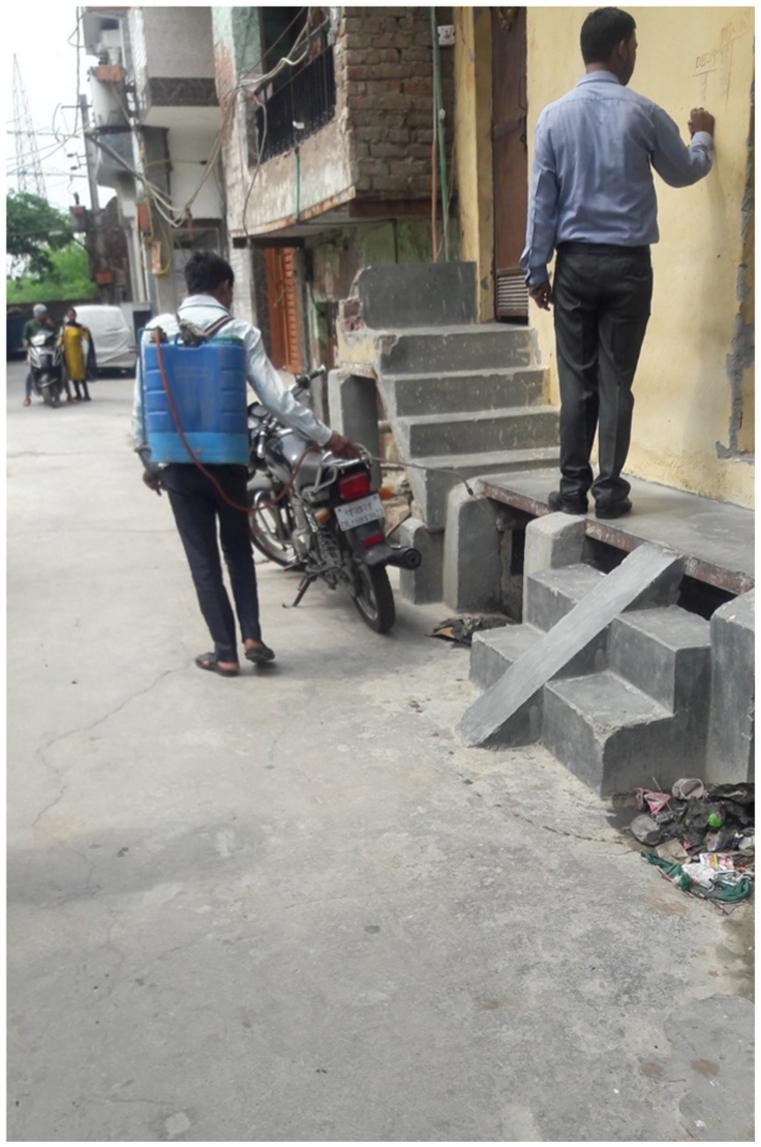
A DBC worker inscribing the date of his visit on the wall of a house, while another is spraying insecticide. Observe the raised platform on which the houses are constructed. There is a haudi (sump) beneath for the wastewater. Garbage taken out of the haudi can be seen. July 2019.
Because of this elevation of the houses, I can see a water tank-like structure made of brick and mortar, locally referred to as “haudi,” right outside each house. I could hear an electric motor buzzing inside the haudi and a water pipe coming out, which must be carrying water, but I was unsure where to. Each haudi, as a resident explained to me, is two to three feet deep and acts as a reservoir for the wastewater coming out of the house. Every few days, house residents dispose of wastewater in the nearby vacant plot through an elaborate system of pipes and electric motors. The latter is abundant in the area as it is still being inhabited, and many people living as tenants in other parts of the city or in the process of shifting to Delhi from UP have bought a piece of land here as an investment and have left it vacant. This arrangement compensates for the absence of a state-provided and municipality-maintained water drainage system in the area. As one resident, while explaining this system to me, remarked: “Yaha sarkar ne kuch nahi kiya to logo ne apni vyavastha khud hi bana li” (The government did not do anything here, so the residents made their own arrangements). Infrastructural lag in the cities, despite its promise of development, has been theorized (Anand et al., 2018), so much so that sometimes infrastructure in the city makes its presence felt only through its absence (Graham, 2010). So, finally, was this neighborhood within Sonia Vihar the Khula area? Where abandoned by the state, people found alternative ways to develop and access basic infrastructure. To complicate the matter further, a resident remarked:
Go towards the fourth pushta 16 [i.e. river embankment; the one in the colony next to hers]; we at least have pipes [for drainage of wastewater]. Women in that colony had to throw out wastewater manually with a bucket. Khula area hai vo [that one is the Khula area].
Apparently, I was yet to locate the Khula area, the “key” to understanding North East Delhi, let alone its meaning. The resident was now pointing to some other area as Khula, as it had even poorer water disposal arrangements than them. As I kept talking to the residents throughout fieldwork, a pattern of continuous deterritorialization of the Khula area began to emerge. I will explain this through the map of Sonia Vihar handdrawn by frontline workers (Figure 3).
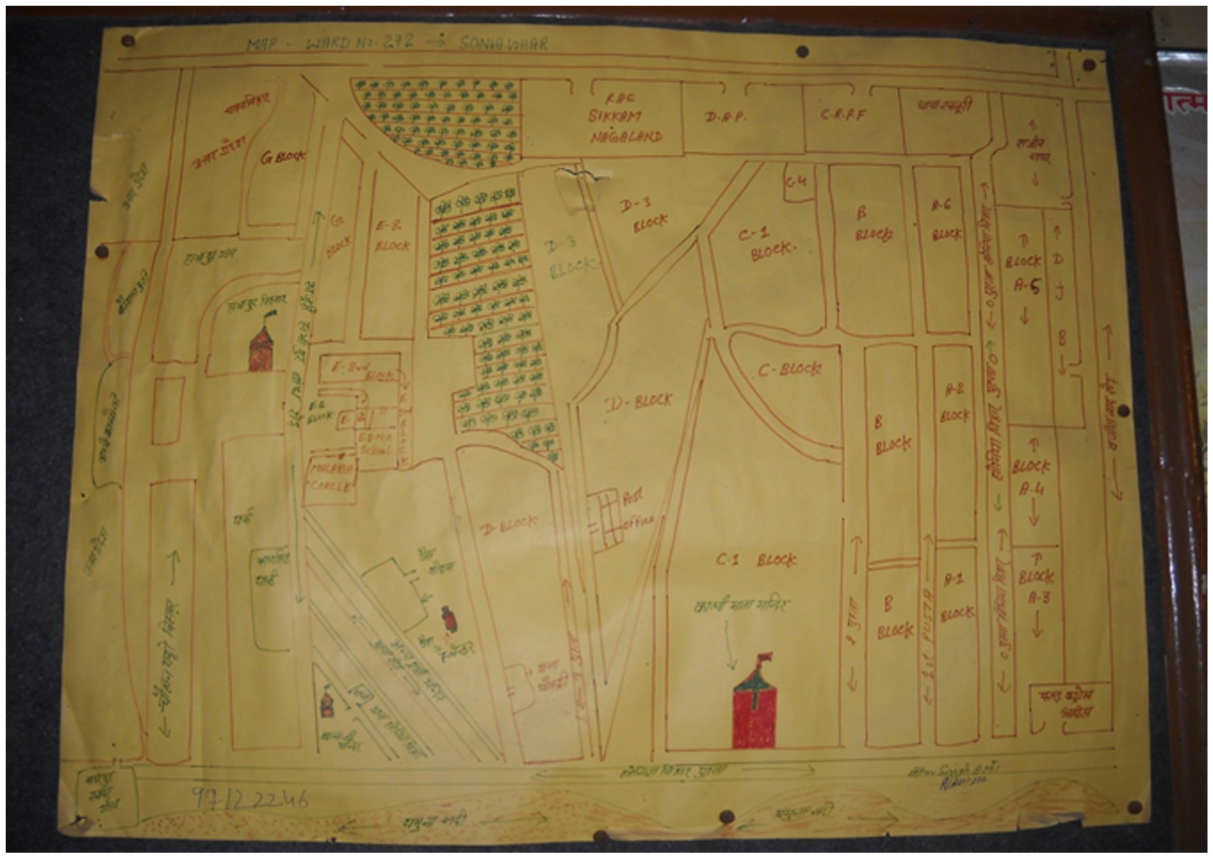
A map of Sonia Vihar hanging up at the ward office. Hand-drawn by EDMC workers. May 2019.
At the bottom of this map is a green wavy line with red dots inside; it represents the Yamuna river that separates the trans-Yamuna region from the rest of Delhi. Right above it, two parallel green lines are the sign of Pushta Road. Pushta is colloquial for the river embankment, which, according to the locals here, was initially made of mud to shield the area from the river flow and later concretized. Pushta also indicates a colony or settlement in East Delhi colloquial language, for example, “First pushta,” “last pushta,” “my pushta,” and so on. The Pushta Road joins East Delhi to the rest of the city. Further upwards, the map has lines perpendicular to pushta road. They represent the informal colonies of the area, called Pushta Colonies. These are numbered from 0 to 4, as in zero pushta, first pushta, and so on, arranged in the order of increasing distance from the city. So, a resident of Sonia Vihar I spoke to never pointed to their pushta as the Khula area. For instance, Asha, who lived at first pushta, took me to dhai (2.5) pushta to show me the Khula area. Once there, a resident pointed towards the fourth pushta as the Khula area, as the people of the fourth pushta do not have electric motors for wastewater disposal. To summarise, the Khula area is where someone else lives, but everyone knows where it is. And as an ethnographer, when I put all of the testimonies together, it was impossible to pinpoint the location of the Khula area. Here, I would like to clarify that the location of the Khula area is clear to each utterer. This means that while Asha points to one neighborhood, her neighbor points elsewhere; they both are clear about its location, like many other informants I have quoted. However, through the ethnographic access of various testimonies, I could see that every time I seemed to have located the Khula area, it shifted its location. Hence, a framework is required to understand this instability and its significance.
Many meanings of Khula: An empty signifier
Here, I would recollect all the slippages in the meaning of the Khula area that I pointed out earlier. Across testimonies, it has been a spatial adjective as well as a moral one. For instance, for the scientist, it was not just its location in East Delhi but also its residents, who would not give entry to the municipal authorities. For the city administration, it was not just the location of North East Delhi but also the subordinates who were rather incompetent. While the administration’s usage of the word Khula is in line with what the entomologist has said—ungovernable location and residents—they use the lack of fixed meaning of Khula to critique the frontline workers. For the frontline workers, it was not just the Sonia Vihar and the territorial challenges its marginal location posed to them, but also the residents who harbored mosquitogenic conditions and did not provide them access to their households. Hence, by saying that she does not live in the Khula area anymore, a resident like Asha dissociates herself not only from the location but also from the moral implications that come with inhabiting such an area. People told me different things, which range from the more obvious—its peripheral location, its porosity to allow bodies and material into its borders—to the less palpable—mixed populations, unruly citizens, inefficient workers, and the state’s abjection. And then, as an ethnographer, when I put all these meanings together, it was clear that the word Khula absorbs meanings rather than emitting them. It exhibits the characteristics of an empty signifier, which has been theorized in various ways in anthropology to understand the polysemic ability of a word. The first such conceptualizion comes from Levi-Strauss (1987), when he develops the concept of empty signifiers through “mana”
17
in the introduction to Mauss’s work. He says: … these notions have a fluid, spontaneous character, whereas elsewhere they serve as the ground of considered, official interpretative systems; a role, that is to say, which we ourselves reserve for science. But always and everywhere, those types of notions, somewhat like algebraic symbols, occur to represent an indeterminate value of signification, in itself devoid of meaning and thus susceptible of receiving any meaning at all. (Levi-Strauss, 1987: 55)
Here, Levi-Strauss explains that empty signifiers are characterized by uninhibition and fuzziness in signification. Very similar to algebraic symbols, they are structurally empty and represent something unspecified. All these qualities make them receptive to many meanings. Simply put, an empty signifier is a signifier without a fixed meaning. Though having an origin in semiotics, an empty signifier has been used to theorize various socio-political phenomena. For instance, Laclau (1996) has argued how empty signifiers can be used to foreground political instability. Similarly, concepts like sustainability (Brown, 2016) and governance (Offe, 2009) have also been called empty signifiers. Borrowing from the field of semiotics and social theories, Laclau (1996) has used the idea of an empty signifier as a nodal point that makes sense only when it is contrasted or related to something else. Here as well we see that Dr Rai contrasts East Delhi with South Delhi—a more affluent part of the city, supposedly more governable. Similarly, Asha took me to me other neighborhoods within East Delhi which lacked good roads or a municipally maintained waste disposal system. In both cases, Khula is a void, empty of any positive content, and hence is only defined negatively (not as good as South Delhi). This emptiness enables Khula to attract many meanings that all point to the ungovernability of East Delhi, which can mean different things to different actors. For instance, it takes up meanings ranging from obvious ones like a porous border (since the word Khula means open) to moral ones like non-cooperative residents and subordinates and the absence of state-provided urban infrastructure. It helps people who govern the area to justify their focus on East Delhi while conflating various kinds of pathologies ranging from biological to moral, under the garb of the notion of Khula. Authorities branding certain areas dirty and hence rationalizing the state’s glare and control, as pointed out earlier, is not a new phenomenon. Hence, it is no surprise that localities of East Delhi became the focus of the state’s attempt to regulate dengue. What the notion of the Khula as used by the residents interestingly adds to this debate of urban peripheries and their pathologizing is that branding certain parts of the city as “dirty” or Khula is not a unidirectional administrative act of declaring such areas ungovernable but a complex practice through which residents too express their plight and attempt to negotiate better living conditions in their part of the city. This is shown through Asha’s experiences with the city when she uses Khula to hold the municipal workers accountable for maintaining sanitary conditions in her neighborhood in order to keep it mosquito-free. Or when she describes adjacent neighborhoods as Khula to describe her own as better or more city-like. Ambiguity in the meaning of Khula thus allows the residents to negotiate better living conditions and dissociate themselves from the moral implications of inhabiting the Khula area. It is the participation of the residents themselves in its usage that makes Khula an empty signifier. Khula is a marker of derision, filth, and ungovernable excess, but it also marks the ground for making claims on state officials, for creating neighborly boundaries, and for differentiating both the area and the people who inhabit it. The Khula voices state’s exasperation as well as residents’ abandonment. Looking at it as an empty signifier allows us to understand its potential to harbor multiple and, at times, contradistinctive meanings. Through these meanings, we can see what a city is expected to be and, instead, what it actually is. For instance, authorities expect obedient subordinates and cooperative residents, while they get the opposite.
Similarly, residents expect state-provided services, and what they get is the state’s presence, only to be accused of harboring mosquitoes. Thus, while following the city’s disease control efforts, I found an empty signifier that kept shifting in signification and location. Hence, the dengue epidemic, as suggested in the beginning, even in its absence, enables us to delve into the social, political, and moral world around it. In the case of this work, the dengue epidemic and the way its possibility captured the collective affective rhythms of Delhi, the anxieties and panic of its citizens, administrators, and scientists, has helped to probe into several facets of everyday life of the city.
Conclusion
This article has shown how pathology informs and structures urban spaces through ethnographic inputs and their analysis. While cities actively work to mark, control, contain, and even segregate the contagions, pests, diseases, diseased bodies, and all things considered pathological, several kinds of pathologies always complicate the sanitized image of the city through their unwavering presence. This work explored this structural tension between the urban and the pathological by tracking the dengue control efforts in the city of Delhi. To control the possibility of a dengue epidemic, the gaze of public health authorities primarily focused on the areas considered inherently “dirty”—localities of East Delhi at the margin of the city, situated at the Yamuna riverfront, populated by working-class migrants living in the unauthorized colonies. The residents of such areas, however, dealt with the absence of basic urban infrastructure on the one hand while also being under the stringent administrative glare for pest control. In such a situation, both the people governing such localities and the people inhabiting them, in the case of this article a neighborhood called Sonia Vihar in East Delhi, use the phrase Khula area. Through this notion, they all express their aspirations and frustrations: a notion through which the signification, as well as the location of the pathological, kept shifting across various testimonies. This article, putting together various meanings of the Khula area, has argued that it is an empty signifier—a signifier without meaning and hence the recipient of many meanings. The empirical ground for this work has been an unauthorized colony, a type of settlement that has long drawn the attention of urban studies and has been studied through various notions such as informality, legality, and abjection. The notion of an empty signifier may help urban scholars to bring together all of these notions not just to characterize the city but also to see how these instabilities, contestations, and contradictions shape urban spaces.
Footnotes
Acknowledgements
This article was developed with a Writing Urban India (WUI) grant from the Centre for Policy Research. I thank my WUI mentor, Prof. Rohit Negi, for his valuable suggestions and input. The article is based on doctoral fieldwork, and I thank my doctoral supervisors, Prof. Janaki Abraham and Prof. Yasmeen Arif, for their continuous guidance and support. I would also like to thank Prof. Kaushik Sunder Rajan and my friend Anirudh Raghvan for their crucial feedback on the initial drafts of the article. An earlier version of the paper was presented at Yale University's Modern South Asia Workshop, 2024. The work has immensely benefited from the discussions and inputs provided during the workshop. The suggestions from anonymous peer reviewers have helped me sharpen the arguments and engage with the available literature intensively; I am grateful for their insightful comments.

Ethical considerations
The author confirms that all the research meets the ethical guidelines, including adherence to the legal requirements of the study country.
Consent to participate
The author confirms that verbal consent was obtained from all the participants.
Funding
The author disclosed receipt of the following financial support for the research, authorship, and/or publication of this article: For writing this article, the author received a Writing Urban India grant, a fellowship from the Urban Studies Foundation hosted by the Center for Policy Research.
Declaration of conflicting interests
The author declared no potential conflicts of interest with respect to the research, authorship, and/or publication of this article.