






Abstract
This article examines how spatial justice is institutionally configured across urban regimes in Cairo through a controlled comparison of premodern Islamic Khiṭaṭ – subdivisions structured by socio-religious and juridical principles – and contemporary gated communities. The study adopts a comparative analytical stance rather than seeking normative reconciliation. Drawing on GIS-based spatial analysis, archival reconstruction of waqf endowments and 42 semi-structured interviews, the article explicitly foregrounds its mixed-methods design to ensure empirical grounding. The findings show measurable disparities in service density and access (3.2 vs 0.8 facilities per hectare; 1.8 vs 0.6 health facilities per 1000 inhabitants) and identifies patterned redistributive infrastructures linked to waqf endowments. The transition from moral oversight under the Muḥtasib – responsible for hisba – to contractual governance in contemporary enclaves is examined through concrete institutional mechanisms of exclusion rather than abstract normative contrast. Rawlsian principles are used heuristically as analytical reference points without presuming hierarchy or equivalence between Islamic and liberal frameworks. The City of the Dead is analysed as a fully integrated empirical case supported by administrative records and spatial mapping, illustrating a hybrid configuration in which distinct regulatory rationalities intersect to produce measurable redistributive outcomes including 22% improvement in potable water access and 18% increase in primary school enrolment. Rather than proposing synthesis, the article situates Islamic and Rawlsian traditions as historically grounded rationalities whose institutional effects can be analytically compared. Conceptualizing spatial justice as an institutional configuration grounded in documented spatial effects, the study contributes to comparative urban theory and governance debates in fragmented metropolitan contexts.
Introduction
Urban fragmentation has intensified across cities in the Global South, including Cairo, over the past three decades, driven by land financialization, rising insecurity and increasingly individualized lifestyles (Marcuse and Van Kempen, 2000; Sims, 2010). Gated communities (Lees et al., 2008) – defined by secure boundaries and internalized service provision – now shape much of the peri-urban landscape of Greater Cairo (Vignal, 2011). These enclaves exemplify what Lees et al. (2015) describe as ‘actually existing neoliberalism’, in which urban space is structured through accumulation and selective access. In this configuration, the ‘right to the city’ risks becoming a market-mediated privilege rather than a claim to inclusive citizenship (Low, 2003). As Robinson et al. (2022) observe, large-scale urban projects generate differentiated regimes co-constructed by the state, developers and affluent groups, often with uneven distributive consequences. Yet spatial differentiation in Cairo is not solely a contemporary phenomenon. In a distinct theological and political context, premodern Islamic cities – particularly under Mamluk rule – also exhibited differentiated spatial arrangements. The Khiṭaṭ – premodern urban subdivisions documented by al-Maqrīzī and organized through socio-religious and juridical principles – describe an urban fabric structured around community cohesion, functional mix and regulated access (Othman, 2015; Raymond, 1985). Although grounded in different normative foundations, both Khiṭaṭ and contemporary enclaves organize inclusion and exclusion through institutionalized regulatory logics. Rather than opposing an ‘Islamic city’ to a ‘neoliberal city’, this article examines how distinct moral and regulatory rationalities configure access and redistribution without presupposing normative hierarchy. Specifically, the study analyses how spatial justice is articulated across two historically situated governance regimes – contemporary gated communities and Mamluk Khiṭaṭ – and explores the conditions under which their rationalities intersect. The comparison is extended through a hybrid contemporary case in Cairo, allowing these configurations to be examined in interaction rather than in isolation. Theoretically, the study engages Rawls’ (1971) Theory of Justice alongside Islamic conceptions of justice (ʿadl, qisṭ). It adopts a comparative analytical stance that identifies convergences and tensions without seeking normative reconciliation or theoretical synthesis. Rawlsian principles are mobilized heuristically as analytical reference points, while Islamic institutions such as waqf and ḥudūd are examined as historically situated regulatory devices. The analysis is structured around six comparative indicators: epistemic foundations, moral values, redistributive mechanisms, spatial logics and access regimes, regulatory frameworks and subjects of justice. The findings indicate that while both regimes regulate access and structure differentiation, their ethical foundations and redistributive logics diverge in demonstrable and spatially measurable ways. The article advances three contributions. First, it interprets waqf and ḥudūd as historically embedded mechanisms of redistribution and boundary regulation. Second, it develops context-sensitive indicators of spatial justice applicable to fragmented urban environments. Third, it conceptualizes Islamic urban institutions as counter-zoning systems operating through distinct regulatory and redistributive devices. Taken together, these contributions aim to pluralize debates on spatial justice by situating them within historically grounded institutional traditions rather than framing them as civilizational contrasts. The remainder of the article is organized as follows: the next section develops the theoretical framework; the following section outlines the comparative methodology; subsequent sections present the empirical analysis and discussion; and the article concludes with a final synthesis.
Frameworks of justice and planning traditions: A comparative perspective on Rawlsian and Islamic conceptions
This section outlines the theoretical foundations of spatial justice within two historically situated traditions – Rawlsian liberalism and Islamic governance – in order to establish a comparative framework for analysing their urban translations in both neoliberal and premodern contexts. Spatial justice is approached here not as a universal distributive formula but as a historically situated configuration shaped by institutional arrangements, territorial regulation and uneven access to urban resources (Soja, 2010). A schematic representation of the analytical framework is developed in the following sections, illustrating points of convergence and tension between critiques of gated enclaves and the normative tradition of the Khiṭaṭ, as well as the study’s conceptual positioning. Rather than positioning these traditions as civilizational opposites, the section adopts a comparative analytical stance that examines how distinct moral and regulatory rationalities structure spatial inclusion and exclusion. Drawing on debates on hybrid modernity and ‘contemporary medievalism’ (Al-Sayyad and Roy, 2006), as well as on the entrepreneurial role of religion in urban economies (Lanz and Oosterbaan, 2016), the analysis identifies zones of interaction without implying historical continuity or normative equivalence (Chakrabarty, 2000).
Neoliberal urbanism and logics of enclavement
Since the 2000s, the proliferation of gated communities across Global South metropolises has been closely associated with processes of neoliberal restructuring and land financialization (Brenner and Theodore, 2002; Caldeira, 2003). In Cairo, these enclaves are linked to partial state withdrawal from service provision and the expanding role of private developers (Denis, 2006; Sims, 2010). Access to goods such as water, roads and green spaces is reorganized through securitized perimeters and contractual governance arrangements. Glasze et al. (2006) characterize this configuration as ‘contractual urbanism’, in which regulatory authority is partially delegated to market-based mechanisms. While spatial differentiation in such enclaves is often framed as a contemporary neoliberal rupture, regulated forms of territorial ordering have deeper historical precedents. In Mamluk and Ottoman cities, institutions such as the waqf (charitable endowment) and the office of the Muḥtasib (market and moral overseer) structured service provision and oversight according to religiously grounded norms (Abu-Lughod, 1987; Raymond, 1993). The Khiṭaṭ – urban subdivisions anchored in neighbourly solidarities and juridical principles including shufʿa 1 (pre-emption rights) – established differentiated yet normatively regulated regimes of access. The comparison does not imply ideological continuity but highlights that both regimes organize access through institutionalized logics – contractual in one case, moral-juridical in the other. This perspective aligns with efforts to recentre urban theory by incorporating non-Western rationalities without presuming normative superiority (Robinson, 2006; Robinson and Roy, 2016; Roy, 2009a, 2009b; Watson, 2014).
Islamic Khiṭaṭ and ethical regulation
Long interpreted primarily as morphological forms (Bianca, 2000; Elsheshtawy, 2008; Hakim, 1989; Raymond, 1985), the Khiṭaṭ are increasingly understood as juridical and governance mechanisms embedded in Islamic jurisprudence (Akbar, 1989; Rabbat, 2023a, 2023b). Two institutions were central: ḥudūd (normative boundaries regulating conduct and access) and waqf (inalienable charitable endowments financing collective goods; Hoexter, 1998; Kuran, 2005). These mechanisms operated within a broader conception of collective responsibility orientated towards maṣlaḥa – the common good as articulated in Islamic legal thought (Al-Māwardī, 1996). In classical jurisprudence, maṣlaḥa refers to the preservation of essential social goods – religion, life, intellect, lineage and property – through context-sensitive interpretation. Unlike liberal notions of public interest grounded in procedural neutrality, maṣlaḥa is embedded in moral theology and communal obligation. Its relevance for urban governance lies in linking redistribution and regulation to an explicitly normative conception of collective welfare. The Khiṭaṭ therefore represent historically situated arrangements in which equity emerged from institutionalized moral obligations rather than abstract procedural rules. At the same time, these arrangements were not uniformly inclusive. Access to certain waqf-based benefits could be restricted to members of the Muslim community, and socio-professional hierarchies shaped differentiated regimes of entitlement. Acknowledging these internal exclusions prevents romanticization and situates Islamic institutions within historically specific power relations.
Rawls and Islamic justice in comparative perspective
Rawls’ (1971) Theory of Justice remains influential in debates on urban justice, particularly through the ‘difference principle’ and the emphasis on primary goods (Fainstein, 2010). However, rather than treating Rawlsian theory as universally applicable or normatively superior, this study approaches it as one historically grounded framework among others. Scholars such as Yiftachel (2009) and Watson (2014) have argued that liberal models may insufficiently capture locally embedded solidarities and faith-based moralities that shape governance in many Southern contexts. In Islamic traditions, redistributive mechanisms such as waqf and regulatory devices such as ḥudūd are anchored in communal responsibility (umma) and accountability before God. Justice (ʿadl) denotes moral balance and social order, while qisṭ refers more specifically to distributive equity. The comparison between Rawlsian and Islamic conceptions is analytical rather than reconciliatory: it highlights how distinct epistemologies – procedural impartiality in one case, communally embedded obligation in the other – generate internally coherent but differently grounded approaches to spatial regulation. This framework does not seek synthesis. Instead, it identifies convergences and tensions that become analytically visible when applied to urban contexts such as Cairo.
Hybrid arrangements and situated urban justice
Contemporary Cairo exhibits hybrid governance arrangements combining contractual, religious and informal regulatory logics. Gated enclaves coexist with neighbourhoods sustained by local solidarities, while institutions derived from waqf traditions and civic associations often compensate for state limitations (Denis, 2006). Religious and neoliberal dynamics may intersect: some Islamic institutions adopt managerial practices, while certain private developments mobilize moral narratives to legitimize exclusion. These hybrid configurations provide the empirical terrain against which the theoretical correspondences outlined above will be assessed. Rather than presenting Islamic institutions as normative alternatives to neoliberalism, this study treats them as analytically distinct regulatory formations whose interaction produces context-specific outcomes. In this sense, the notion of ‘counter-zoning’ functions as a heuristic descriptor of alternative regulatory logics rather than as a prescriptive model. The empirical sections that follow evaluate how these frameworks operate in practice and where their redistributive capacities converge or diverge.
Methodology
Sources and data
This research adopts a multi-scalar comparative design grounded in mixed methods (Creswell and Plano Clark, 2011), combining historical textual analysis, GIS-based spatial reconstruction and contemporary qualitative inquiry. Textual, cartographic and discursive sources are systematically cross-referenced to ensure empirical traceability between evidence and claims. Rawlsian principles are mobilized within this design as analytical criteria rather than prescriptive or normative standards. The historical corpus consists primarily of Khiṭaṭ al-Maqrīzīya (14th–15th centuries), alongside the accounts of Ibn al-Duqmaq (14th century) and al-Qalqashandī (14th–15th centuries; al-Qalqashandī, 2009). These sources were cross-checked with waqfiyyāt fragments, digitized Ottoman maps and archaeological studies (Hanna, 2011), enabling reconstruction of juridical and territorial logics associated with the Khiṭaṭ. The contemporary spatial distribution of gated communities analysed in this study is presented in Figure 1.
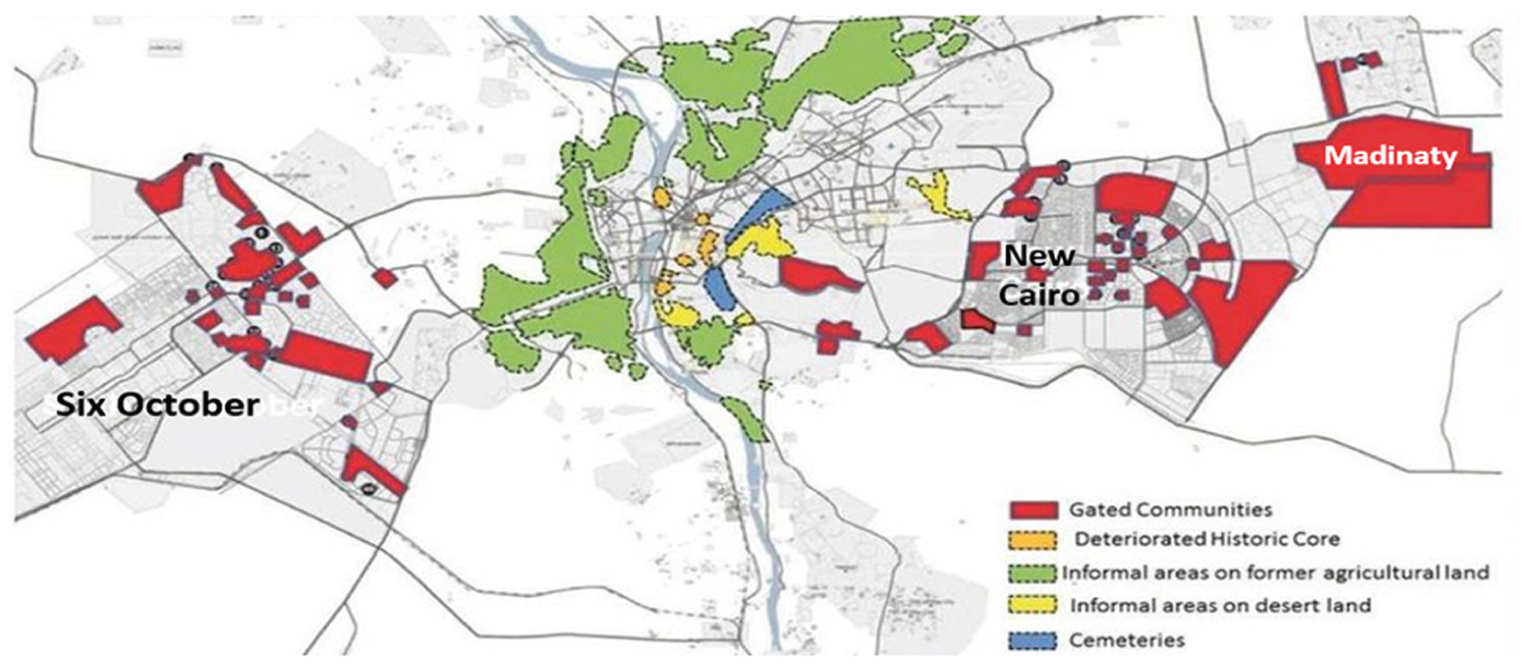
Map showing the spatial distribution of state-planned gated communities in Greater Cairo.
The contemporary corpus comprises three gated enclaves – 6th of October, New Cairo and Madinaty – together with a hybrid redevelopment context, the City of the Dead. The inclusion of this third configuration ensures that the analysis does not remain a binary comparison but evaluates interactional dynamics across regimes. Case selection followed three criteria: (1) representativeness of the neoliberal enclave model; (2) feasibility of field access; and (3) the presence of institutional actors involved in governance and planning. Fieldwork conducted between 2022 and 2024 comprised 42 semi-structured interviews with planners, municipal officials, waqf representatives, developers and residents. Interviews were conducted in Arabic and anonymized. Fieldwork was complemented by site surveys, GIS layers (land boundaries, circulation networks, built forms) and structured observation of access-control devices and everyday spatial practices. Annotated excerpts are incorporated into the findings to substantiate claims regarding perceptions of security, community and exclusion.
Analytical framework and indicators
The analytical framework brings together Rawlsian principles of justice (Rawls, 1971, 1993) and normative instruments identified within Islamic jurisprudence (waqf, hisba, ḥudūd). These traditions are not treated as commensurable normative systems but as analytically distinct frameworks whose spatial implications can be compared through operational indicators. Drawing on epistemic decentring approaches (Parnell and Robinson, 2012; Robinson and Parnell, 2011), conceptual principles are translated into observable spatial and institutional dimensions. The selection of the comparative indicators followed an iterative process combining theoretical synthesis and empirical validation. First, key dimensions of justice were identified through a review of Rawlsian theory and classical Islamic jurisprudence, focusing on how each tradition conceptualizes redistribution, regulation and access. Second, these dimensions were cross-checked against the empirical material – including historical archives, GIS-based spatial analysis and interview data – to ensure their analytical relevance and observability in the Cairo context. This process led to the identification of six indicators that capture both the normative foundations and the spatial manifestations of justice across regimes. These indicators were retained because they provide consistent points of comparison across both historical and contemporary cases while remaining empirically observable within the available data.
Three primary analytical domains structure the comparison:
(1) Urban form and access regulation;
(2) Governance ethics and collective obligation;
(3) Resource distribution and urban rights.
These domains are operationalized within a comparative matrix (Table 1), further refined through six criteria: epistemic foundation, moral values, redistributive mechanisms, spatial logic, legal regime and subject of justice. Table 1 synthesizes these dimensions by organizing them into a structured framework that enables systematic comparison between historical and contemporary configurations.
Comparative dimensions of urban justice across historical and contemporary regimes.
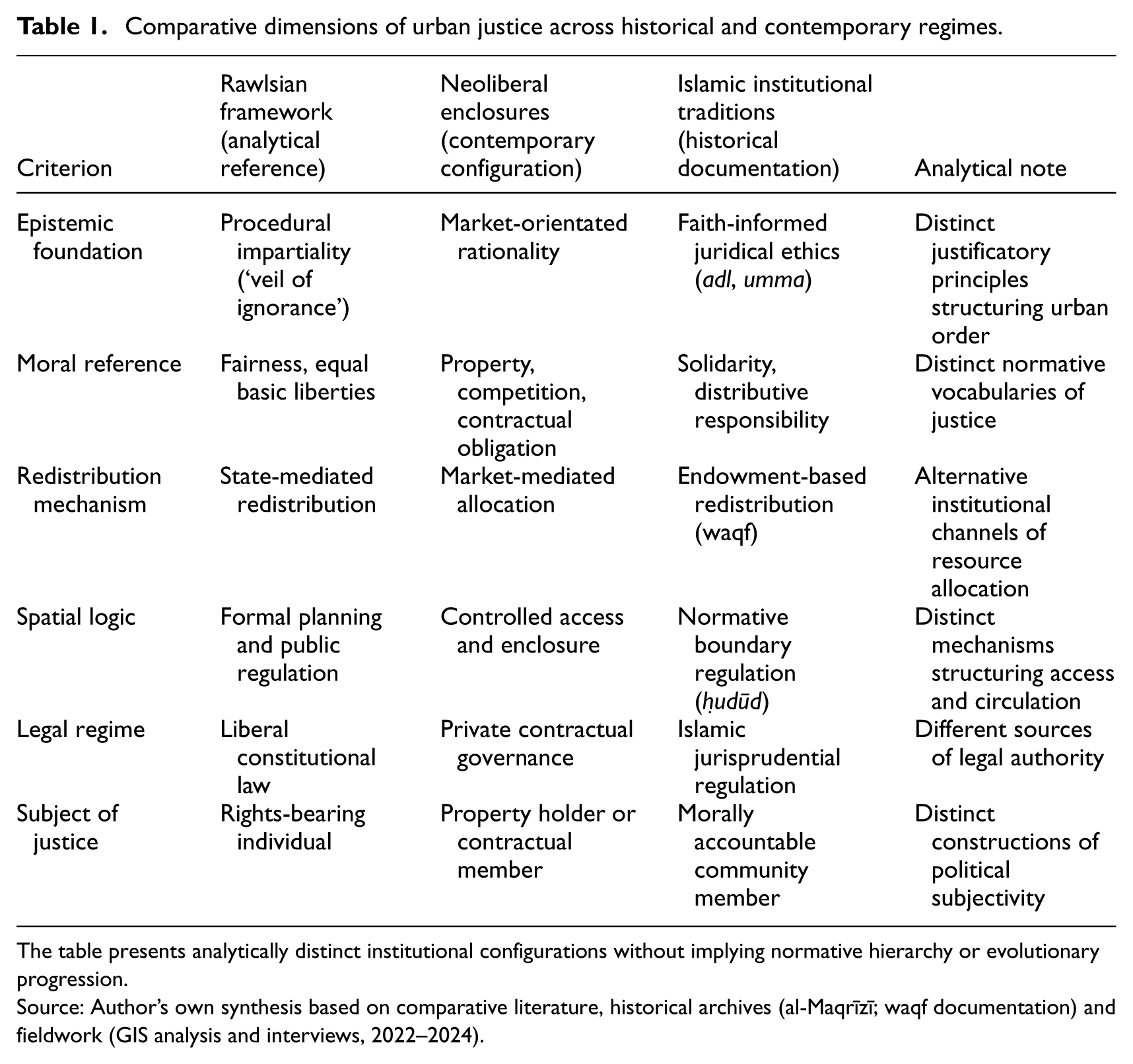
The table presents analytically distinct institutional configurations without implying normative hierarchy or evolutionary progression.
Source: Author’s own synthesis based on comparative literature, historical archives (al-Maqrīzī; waqf documentation) and fieldwork (GIS analysis and interviews, 2022–2024).
Empirically, the study combines a critical reading of al-Maqrīzī’s al-Khiṭaṭ, GIS-based spatial analysis and 42 semi-structured interviews conducted in three gated communities – 6th of October, New Cairo and Madinaty. This mixed-methods design provides the empirical basis for assessing how redistributive and regulatory mechanisms are materially configured across historical and contemporary contexts. By linking normative frameworks to observable spatial patterns, the study enables a structured comparison of distributive dynamics. To ensure empirical tractability, these criteria are translated into operational indicators capturing observable dimensions of spatial governance across historical and contemporary contexts, as presented in Table 2.
Operational indicators of spatial justice in Cairo.
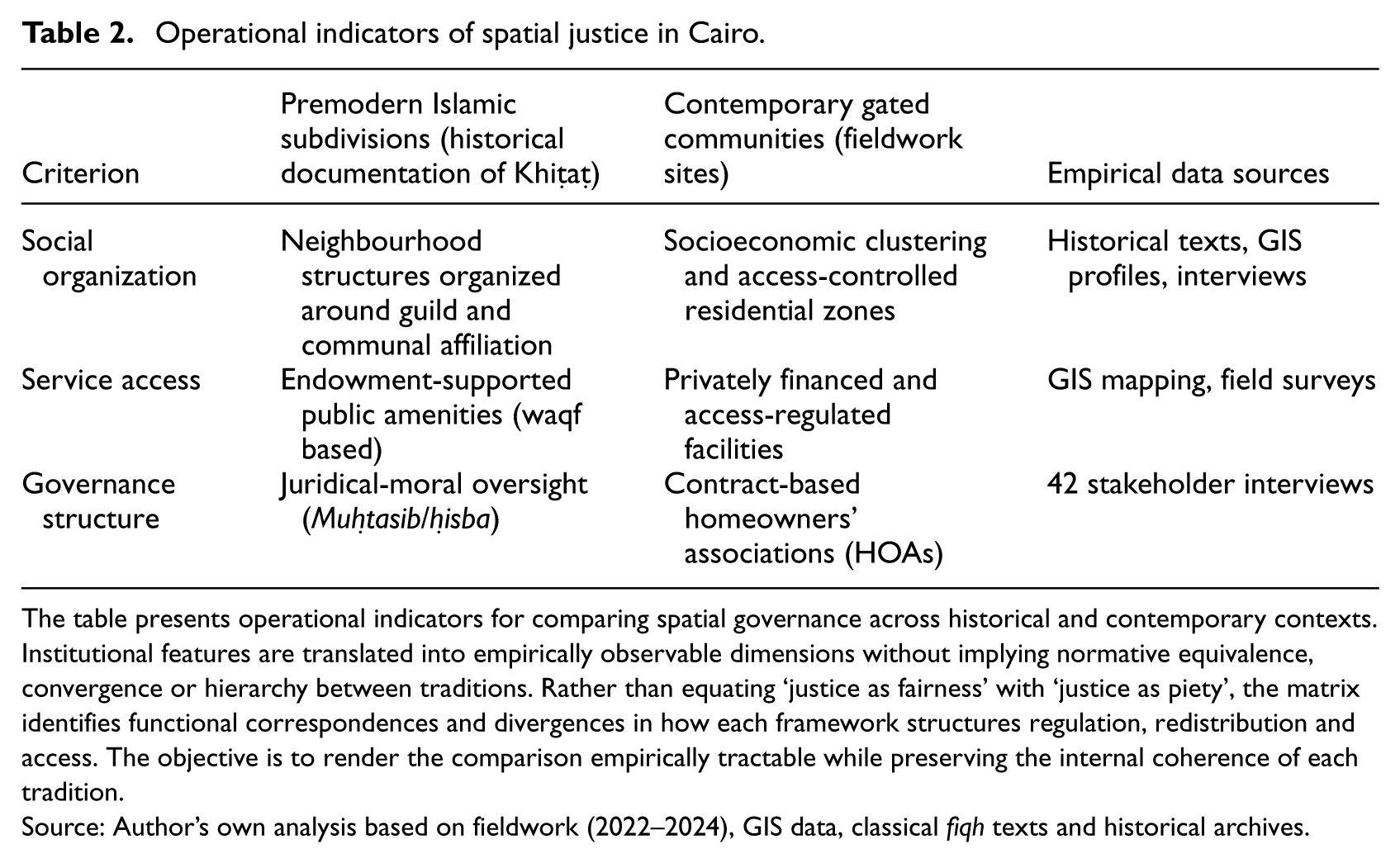
The table presents operational indicators for comparing spatial governance across historical and contemporary contexts. Institutional features are translated into empirically observable dimensions without implying normative equivalence, convergence or hierarchy between traditions. Rather than equating ‘justice as fairness’ with ‘justice as piety’, the matrix identifies functional correspondences and divergences in how each framework structures regulation, redistribution and access. The objective is to render the comparison empirically tractable while preserving the internal coherence of each tradition.
Source: Author’s own analysis based on fieldwork (2022–2024), GIS data, classical fiqh texts and historical archives.
Analytical methods
The three analytical levels – textual, spatial and triangulated interpretation – are interlinked, ensuring traceability between sources and findings. To clarify how these levels are articulated within the research design, a schematic representation was developed as a conceptual synthesis of the methodological approach.
Figure 2 was constructed through an iterative process combining theoretical structuring and empirical workflow mapping. It integrates the three analytical components – textual analysis, spatial (GIS) analysis and interview-based qualitative inquiry – into a unified analytical sequence. The figure was developed by first identifying the main sources of evidence (historical texts, spatial data and field interviews) and then mapping their interconnections in terms of data processing, interpretation and validation. Particular attention was given to ensuring that the figure reflects the sequential and recursive nature of the research design, including feedback loops between empirical observation and conceptual interpretation. Rawlsian principles are positioned within this schema as analytical reference points guiding evaluation, rather than as prescriptive or normative endpoints.
Mixed-methods analytical sequence. Schematic representation of the research design integrating textual analysis, GIS-based spatial analysis and interview-based qualitative inquiry. The figure illustrates the sequential and iterative relationships between data sources, analytical procedures and interpretative stages, including feedback loops between empirical observation and conceptual evaluation.
Textual and cartographic analysis: The historical corpus was thematically coded (NVivo) according to categories of justice, regulation and spatial organization. Identified entities (mosques, sūq, schools, awqāf) were georeferenced to visualize redistributive and regulatory networks. This allowed assessment of how juridical devices structured territorial organization.
Contemporary spatial (GIS) analysis: The gated enclaves were mapped using satellite imagery, cadastral data and field surveys. GIS layers were employed to measure morphology, facility density, functional segregation and access-control arrangements. Spatial outputs were systematically compared against the analytical grid to substantiate claims regarding differentiation and access.
Critical triangulation: Convergences and divergences across textual, spatial and interview data are synthesized in Table 1 and visualized in Figure 2. This triangulation strengthens evidentiary robustness and reduces reliance on any single data source.
Limitations and ethical considerations
The study is constrained by the fragmentation of waqf archives, restricted access to certain private enclaves (notably Madinaty) and a gender imbalance within the interview sample. 2 These limitations were addressed through methodological triangulation and reflexive attention to researcher positionality. An ethical protocol was followed throughout, including informed consent procedures, anonymization and secure data storage. Methodologically, the comparative design avoids imposing a singular normative lens by allowing each framework to be analysed within its historical and institutional context. By combining archival research, textual interpretation, geospatial mapping and interviews, the methodology enables a structured and empirically grounded comparison of regulatory and redistributive logics in Cairo. Empirical findings derived from this design are presented in the following two sections.
Rethinking premodern urbanism: Spatial justice and governance in the Islamic city
The empirical analysis is organized in two complementary parts. The first examines the historical configuration of the Khiṭaṭ and analyses their internal regulatory logic, spatial organization and redistributive mechanisms based on archival and spatial reconstruction. The second extends the analysis to contemporary and hybrid configurations, presenting empirical findings from fieldwork and GIS analysis, and discussing interactional dynamics across governance regimes. This structure enables a progressive comparison between historically grounded systems and their contemporary transformations.
Khiṭaṭ as territorial configurations of governance
The Khiṭaṭ system of Mamluk Cairo (14th–15th centuries) constituted a territorial mode of governance articulating social differentiation, redistribution and moral regulation. Rather than treating the Khiṭaṭ as a coherent or idealized model of justice, this section examines them as historically situated configurations whose regulatory logics can be analytically reconstructed through archival and spatial evidence. Georeferenced analysis of al-Darb al-Aḥmar (Figure 3) indicates a polycentric organization in which housing, marketplaces and mosques were connected through socially recognized thresholds (ḥudūd), rather than enclosed by rigid property demarcations.
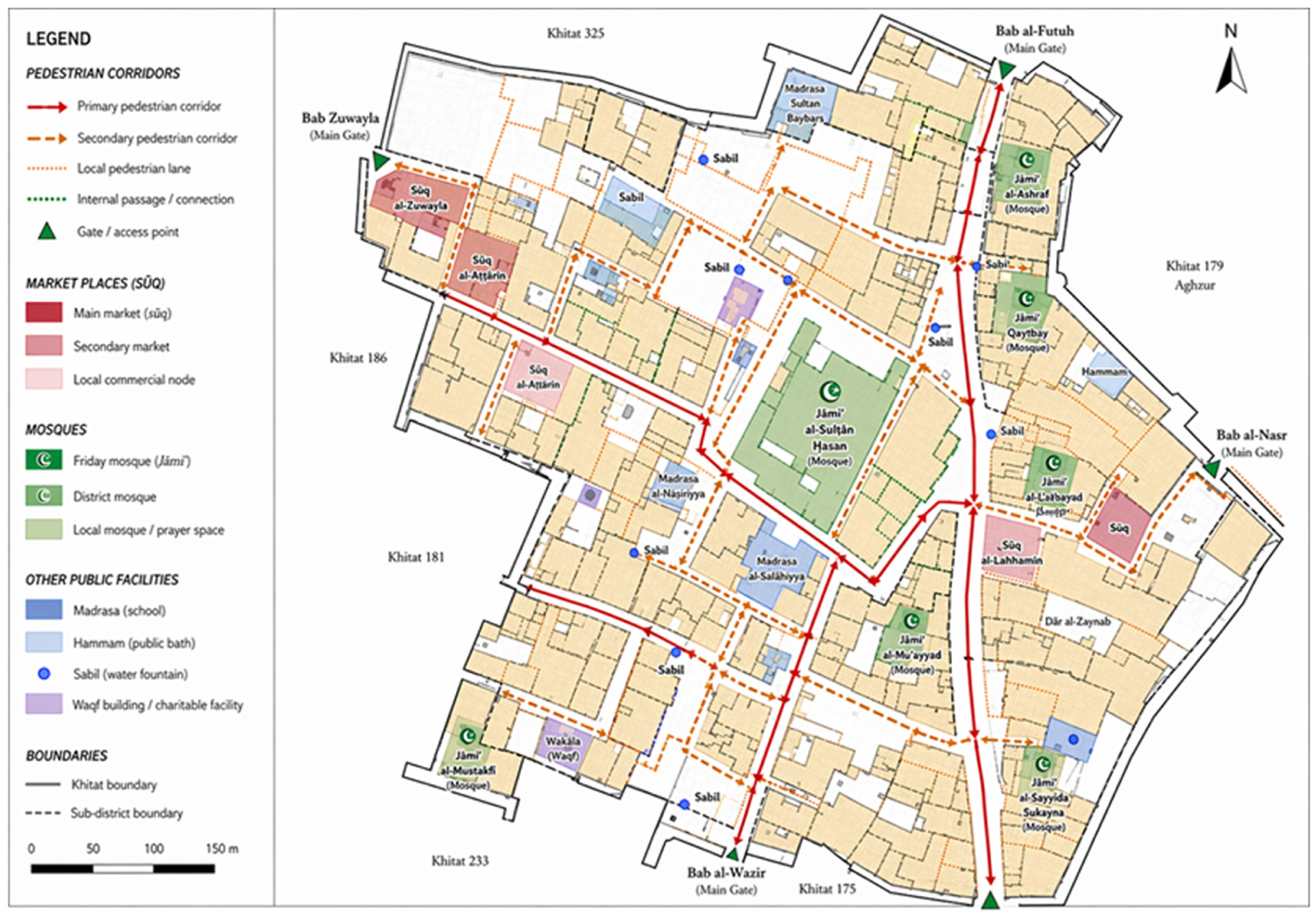
The Khiṭaṭ as territorial configurations of governance: pedestrian corridors, marketplaces and mosques. Georeferenced historical plan of al-Darb al-Aḥmar (1952), used as a base layer to reconstruct plot boundaries and the spatial organization of the Khiṭaṭ. The figure identifies primary and secondary pedestrian corridors, marketplaces (sūq) and mosque locations, highlighting their role in structuring circulation, access and redistributive spatial networks.
GIS overlays of waqf endowments and circulation routes show concentrations of redistributive infrastructure along major pedestrian corridors. Urban space was structured through nested units (ḥāra, ḥūma, maḥalla), whose boundaries regulated conduct and communal obligations more than exclusive ownership. Three regulatory principles can be identified: (1) ḥudūd as normative boundary markers; (2) functional mixity across residential and commercial uses; and (3) redistributive infrastructures financed through awqāf. As one imam from Bayn al-Qaṣrayn noted during fieldwork discussions on historical waqf memory, ‘the waqf sustained the street; it gave proximity its meaning by sharing its blessings’. This testimony is used illustratively and cross-checked against archival waqf deeds rather than treated as primary historical evidence. The Muḥtasib, responsible for supervising markets and public conduct, operated alongside the waqf system within a broader moral–juridical regulatory order.
Interpretative framework: Cross-reading, translation and limits
Certain Islamic mechanisms – particularly waqf-based redistribution and moral supervision – can be examined through selective Rawlsian categories such as primary goods and the difference principle. This cross-reading does not imply conceptual equivalence or normative reconciliation but serves as an analytical device for identifying functional correspondences and divergences. Waqf endowments provided relatively stable access to specific collective goods (water, education, worship spaces), while the Muḥtasib structured procedural oversight embedded in communal accountability. However, Islamic justice rested on collective obligation (farḍkifāya) rather than individual rights abstracted from religious affiliation. Bringing Rawlsian theory into dialogue with Islamic institutions requires conceptual translation rather than reconciliation. While certain redistributive effects may appear functionally comparable, their justificatory foundations differ substantially. The analysis therefore prioritizes observable spatial outcomes – including facility distribution, density patterns and governance practices – rather than claims of normative superiority. In line with the methodological framework, these concepts are translated into measurable indicators and integrated into GIS analysis. Spatial mapping of waqf clusters demonstrates uneven but patterned redistribution rather than universal coverage, indicating that the Khiṭaṭ functioned as territorial devices structuring access and regulation, though not without hierarchy. The Khiṭaṭ system did not constitute an egalitarian order. Access to certain waqf benefits could privilege members of the Muslim community, and socio-professional hierarchies shaped differential access to influence and resources. Archival evidence indicates variation across neighbourhoods rather than a uniform redistributive regime. These observations highlight both correspondences between moral norms and spatial organization and embedded hierarchies within that organization.
Comparative implications and transition
This analysis contributes to the pluralization of urban theory by examining how non-liberal moral economies structured territorial regulation. It posits the Khiṭaṭ not as a normative template for contemporary planning but as a historically specific configuration that complicates linear narratives of urban modernity. Findings based on waqf documentation, GIS mapping and interview material indicate that redistributive mechanisms were institutionally embedded, though uneven and bounded by religious affiliation. To synthesize these governance logics across historical and contemporary contexts, Table 3 presents a structured comparison of institutional configurations, highlighting how social organization, resource distribution and governance arrangements are operationalized within each regime.
Urban governance configurations in historical and contemporary Cairo.
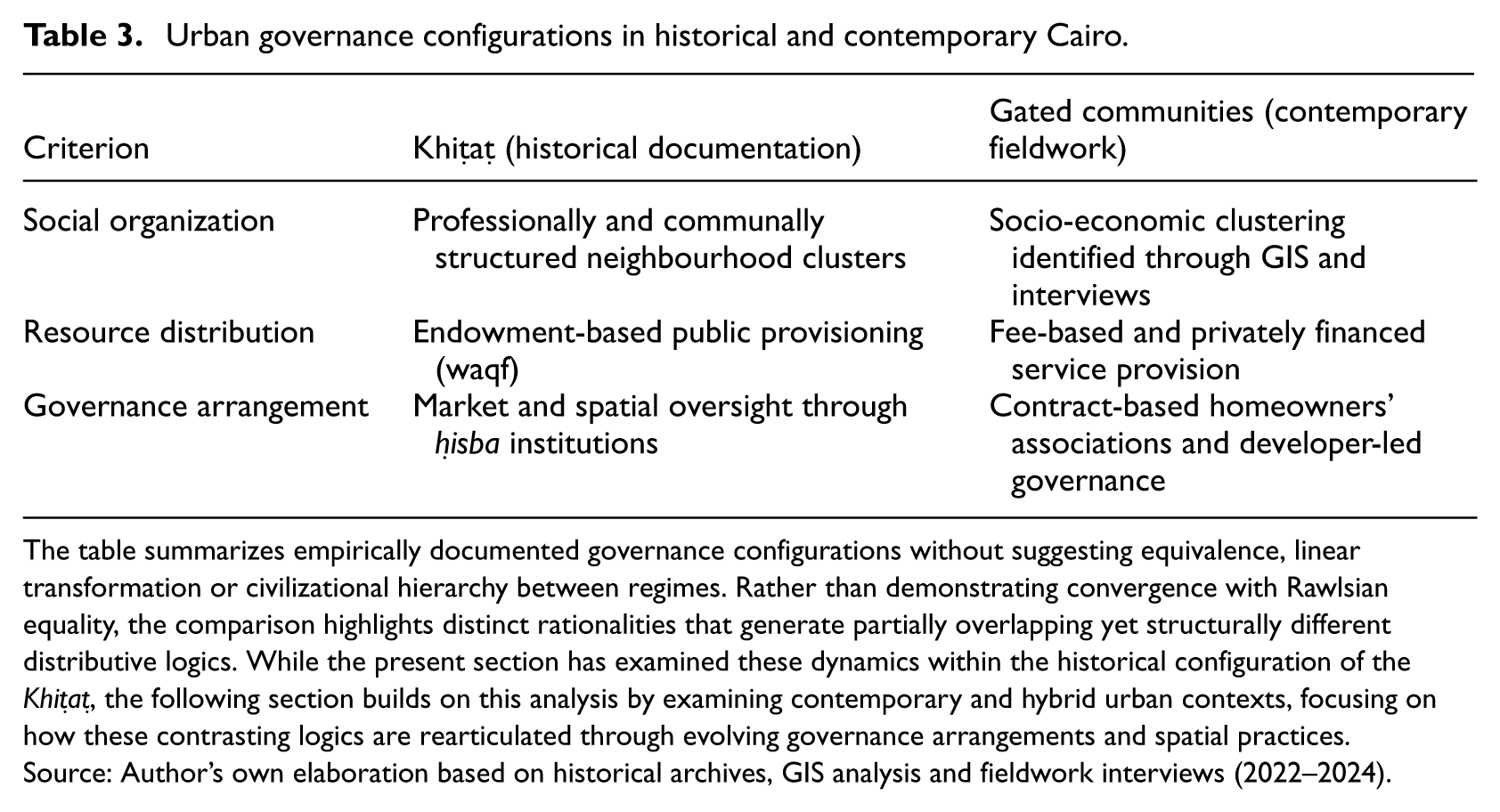
The table summarizes empirically documented governance configurations without suggesting equivalence, linear transformation or civilizational hierarchy between regimes. Rather than demonstrating convergence with Rawlsian equality, the comparison highlights distinct rationalities that generate partially overlapping yet structurally different distributive logics. While the present section has examined these dynamics within the historical configuration of the Khiṭaṭ, the following section builds on this analysis by examining contemporary and hybrid urban contexts, focusing on how these contrasting logics are rearticulated through evolving governance arrangements and spatial practices.
Source: Author’s own elaboration based on historical archives, GIS analysis and fieldwork interviews (2022–2024).
Findings and discussion: Contrasting logics of spatial justice in Cairo
This section examines how Rawlsian procedural justice and Islamic moral–juridical justice are spatially translated across three urban regimes in Cairo. Building on the preceding analysis, it compares Mamluk urbanism – structured around al-Khiṭaṭ, waqf and hisba – with the neoliberal zoning practices of gated communities, focusing on access to services, governance arrangements and thresholds of inclusion. Rather than positioning one framework as normatively superior, the analysis treats these regimes as historically situated configurations that organize redistribution and regulation through distinct justificatory principles. It foregrounds concrete spatial mechanisms and case-based evidence to demonstrate how justice is materially produced and contested across institutional settings.
Spatial inequalities and access to services
GIS analysis reveals marked disparities in service provision. Gated enclaves contain on average 1.8 health facilities per 1000 inhabitants, compared with 0.6 in adjacent informal districts. Green space provision follows a comparable pattern, with enclave districts containing nearly three times more landscaped area per capita than neighbouring low-income areas. These differences indicate differentiated spatial allocation regimes structured through market-mediated access. Fieldwork in a gated compound in New Cairo illustrates this mechanism. A medical facility officially registered as serving the surrounding district was, in practice, accessible only to residents holding private membership cards. Informal settlement residents located less than 800 metres away reported being redirected to overcrowded public clinics. As one non-resident remarked, ‘it’s close, but it’s not for us’. Access required passing a guarded checkpoint where entry was conditional upon presentation of a membership card or prior digital registration; security screening, contractual verification and differential pricing combined to regulate eligibility. By contrast, in Mamluk Cairo, waqf endowments financed mosques, schools and sabils under the principle of farḍkifāya, embedding service provision within collective obligation. For example, the waqf of Sultan Qaytbay funded a mosque complex including a sabil–kuttab strategically located along major circulation routes, facilitating access to water and education irrespective of income. Revenues derived from endowed lands were earmarked for maintenance and salaries under the supervision of appointed administrators (nāẓir al-waqf). These findings indicate a transformation in the institutional basis of redistribution: from obligation-based allocation embedded in moral–juridical norms to conditional access structured through contractual and economic criteria. Functionally, both regimes perform zoning-like operations – allocating services and regulating access – yet through contrasting logics.
Governance and regulatory logics
Gated communities are administered by homeowners’ associations operating through contractual governance arrangements and lacking formal public counterweights. Regulatory authority is exercised through maintenance fees, architectural rules and security protocols, while broader social impacts remain institutionally unaddressed. By contrast, in medieval Cairo, the Muḥtasib exercised moral and spatial oversight over markets, public space and infrastructure. This contrast reflects a shift in the institutional grounding of regulation – from religious obligation to property-based governance. Interviews indicate that 72% of surveyed urban planners perceive that ‘ethical regulation has disappeared from planning’, signalling a perceived disconnection between governance structures and distributive concerns. This perception is treated as a contemporary diagnostic discourse rather than objective confirmation of normative decline. Governance authority in gated communities is territorially bounded and inward facing, whereas ḥisba extended across the urban fabric, linking spatial regulation to collective welfare. In zoning terms, governance functions as a spatial device defining the perimeter of responsibility and the scope of recognized claims.
Inclusion, boundaries and perceptions of justice
Premodern ḥudūd operated as normative markers structuring circulation without constituting rigid exclusionary barriers. They delineated neighbourhood identity while maintaining permeability across spaces. Contemporary enclaves, by contrast, institutionalize enclosure through walls, gates, checkpoints and surveillance systems that materialize a conception of justice grounded in controlled separation. Interviews indicate that residents frequently perceive these devices as protective, associating justice with security and predictability. One interviewee explicitly defined justice as ‘controlled access’, illustrating how exclusion becomes normalized as a legitimate condition of safety. Spatially, this marks a transformation in the function of proximity. In the Khiṭaṭ, adjacency did not preclude circulation; in enclaves, proximity no longer guarantees interaction or shared access. These thresholds operate as de facto zoning instruments, filtering movement and redefining belonging. At the same time, despite documented spatial disparities, 25 of the 42 enclave residents describe their environment as ‘just’, invoking cleanliness, tranquillity and service quality. Justice is thus articulated through lived experience rather than distributive criteria. From an analytical perspective, this introduces a tension between mapped inequality and perceived fairness. GIS mapping indicates significantly higher green space provision in enclaves without compensatory redistribution mechanisms. Rather than signalling moral decline, these findings suggest that justice is reframed through experiential and securitized criteria. Justice becomes an affective and sensory judgement that can coexist with distributive inequality.
Hybrid urbanism and institutional intersections
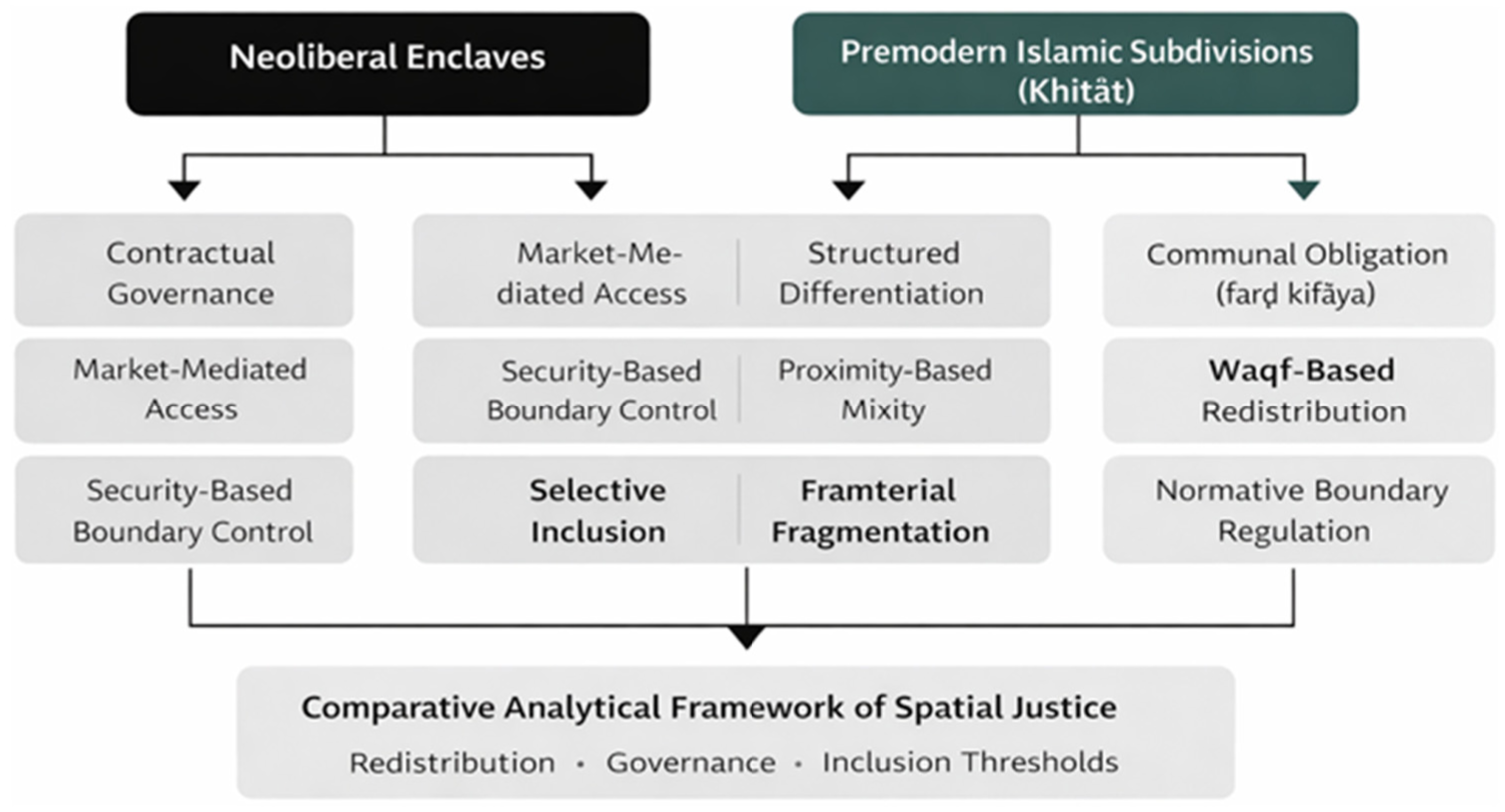
The redevelopment of the City of the Dead exemplifies a hybrid urban configuration combining waqf-based redistribution, formal planning instruments and participatory governance mechanisms, as illustrated in Figure 4.
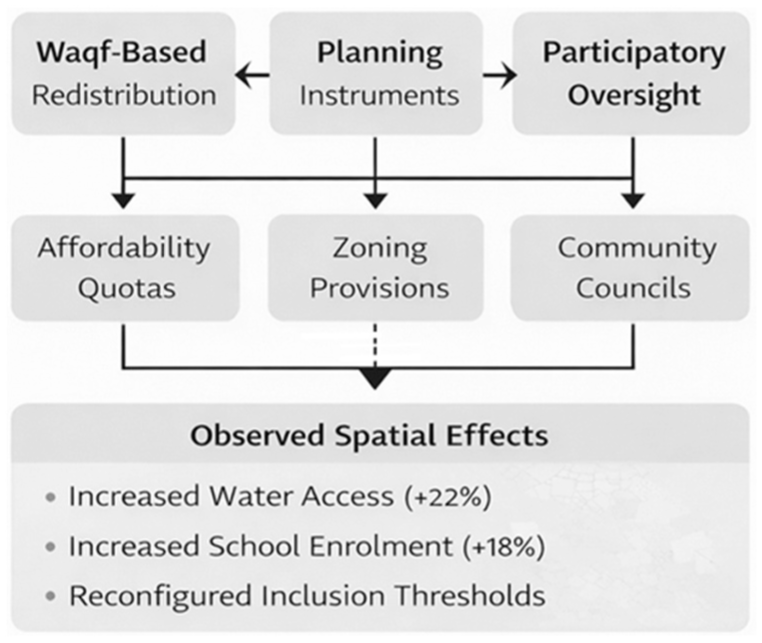
Hybrid governance configuration in the City of the Dead. Analytical representation of the hybrid governance configuration observed in the City of the Dead, illustrating interactions between waqf-based redistribution, formal planning instruments and participatory governance mechanisms. The figure maps institutional intersections and associated empirical outcomes without implying systemic consolidation or normative synthesis.
This configuration operates through three interrelated mechanisms:
(1) Earmarked waqf revenues financing service provision;
(2) Zoning instruments introducing affordability requirements;
(3) Participatory councils mediating redevelopment processes.
Field data indicate measurable redistributive effects, including a 22% improvement in access to potable water and an 18% increase in primary school enrolment. These outcomes are corroborated by spatial data and administrative records. Rather than constituting a synthesis of Rawlsian and Islamic traditions, this case illustrates how distinct regulatory rationalities intersect pragmatically within specific institutional contexts. Convergence occurs at the level of institutional practice rather than normative theory.
Synthesis
The findings demonstrate that urban justice in Cairo unfolds through multiple rationalities: moral (waqf, ḥisba), procedural (zoning) and hybrid configurations. Rather than representing successive stages, these regimes coexist and interact through overlapping practices of regulation, redistribution and boundary making. Taken together, the findings indicate that Islamic urban institutions operate not as residual traditions but as operational ‘counter-zoning’ systems that reorganize access and regulation beyond statutory planning frameworks. This formulation is analytical: ‘counter-zoning’ designates regulatory devices that structure access and redistribution outside formal land-use planning, without implying normative superiority. Justice thus emerges as a context-specific and negotiated outcome shaped by the interaction of communal ethics, procedural regulation and institutional pragmatism.
Conclusion: Plural configurations of urban justice in fragmented cities
This study examined three urban regimes in Cairo – the medieval Khiṭaṭ, contemporary gated communities and the City of the Dead – in order to analyse how spatial governance embodies distinct yet intersecting conceptions of justice. GIS data, waqf cartographies and interview material demonstrate a strong correlation between institutional arrangements and the distribution of collective services. In the Khiṭaṭ, the density of publicly funded waqf facilities reaches up to 3.2 units per hectare, compared with 0.8 in modern peripheral districts. These empirical contrasts show that spatial justice is not an abstract normative ideal but is materially embedded in regulatory devices, territorial boundaries and redistributive infrastructures. Rather than framing one regime as normatively superior, the analysis has treated these configurations as historically situated responses to questions of redistribution, regulation and urban order. While Khiṭaṭ and gated enclaves differ in their justificatory principles – communal obligation versus contractual entitlement – both organize differentiated access to services and structure inclusion through institutional mechanisms. Justice thus emerges as a spatialized and relational practice shaped by the moral and legal matrices within which governance operates. The article contributes to debates on spatial justice by placing Rawlsian procedural reasoning and Islamic moral governance in analytical dialogue without presuming reconciliation or equivalence. Rawlsian concepts are mobilized heuristically to interpret distributive configurations rather than as universal normative standards, while Islamic institutions such as waqf and ḥisba are examined as historically embedded regulatory frameworks rather than as culturally bounded alternatives. This positioning supports a plural understanding of justice attentive to diverse epistemologies, while recognizing their internal tensions, exclusions and institutional limits. Empirically, the study develops a comparative typology of spatial justice regimes, operationalized through indicators of service distribution, governance structures and inclusion thresholds. Interviews in Madinaty and Darb al-Aḥmar illustrate how justice is perceived differently across contexts – as security and order in one case, and as solidarity and obligation in another. Quantitative contrasts in service density, green space allocation and infrastructural access substantiate these differences, while also revealing that moral and neoliberal rationalities often coexist within fragmented urban landscapes rather than operating in isolation. Methodologically, the integration of textual analysis, GIS mapping and interview narratives enables the translation of normative concepts into observable spatial patterns. By rendering historically distinct regimes analytically comparable while preserving their contextual specificity, this mixed-methods design strengthens the empirical grounding of debates that often remain abstract. At the same time, the findings suggest that urban justice in Cairo cannot be reduced to a binary opposition between communitarian ethics and neoliberal governance. Instead, it emerges as a negotiated and context-dependent configuration shaped by institutional memory, economic restructuring and evolving moral vocabularies. Islamic institutions are therefore analysed not as idealized alternatives but as historically situated infrastructures of regulation whose redistributive capacities operated within defined communal boundaries. The case of the City of the Dead further illustrates how distinct regulatory rationalities intersect within specific institutional contexts. The reactivation of waqf revenues, the introduction of affordability requirements and participatory oversight mechanisms demonstrate that redistribution and contractual planning can coexist pragmatically at the level of institutional practice. Measured improvements in access to potable water (22%) and primary school enrolment (18%) indicate that such hybrid configurations produce tangible spatial effects. These findings suggest that urban justice is shaped less by doctrinal coherence than by the capacity of institutions to align redistribution, regulation and territorial management in response to concrete urban challenges. Looking forward, further research may extend this comparative framework to other cities with Islamic institutional legacies in order to test the transferability of spatial justice indicators. Additional work could examine how colonial and postcolonial planning frameworks interact with local moral infrastructures, and how contemporary waqf institutions are reconfigured within market-orientated environments. Rather than proposing a unified model of justice, this study advances an analytical vocabulary for examining how plural moral and procedural frameworks organize access, redistribution and belonging in fragmented cities. Urban justice thus appears not as a universal template but as a situated and evolving field of institutional practice.
Footnotes

Funding
The author received no financial support for the research, authorship, and/or publication of this article.
Declaration of conflicting interests
The author declared no potential conflicts of interest with respect to the research, authorship, and/or publication of this article.