






Abstract
Conventional urban planning and development praxis in Aotearoa New Zealand has fallen short of consistently providing Indigenous Māori communities the opportunity to grow and develop their culture within urban environments. In the paper, we report on reflections from our research participants about the barriers that they deduce are continuing to hinder Indigenous visibility within urban environments. We establish a conceptual framework centred on three key Indigenous concepts relevant to this kaupapa (purpose): mana motuhake (self-determination), tuakiritanga (cultural identity), and kotahitanga (collective orientation). The investigation is primarily based on kōwetewete (a conversational method) with research collaborators comprising the urban professionals and mana whenua (local tribal group) most directly involved in Indigenous urban transformation in the city of Ōtepoti Dunedin. Our research demonstrates that participants perceive that significant barriers from historical and ongoing inattentiveness, combined with strong colonial dominance of planning practices, underpin the extensive cultural marginalisation of Māori in the built environment.
Introduction
The powerful ongoing effect of colonisation is strikingly evident in the uneven visibility of Indigenous identities and knowledges in urban landscapes despite the persistent and growing presence of Indigenous peoples in cities – both those who are Indigenous to the local area and those from further afield. Conventional western urban planning and development mechanisms in Aotearoa New Zealand have long failed to meaningfully facilitate space for the development of Māori culture and the establishment of urban Māori identity able to co-exist with the prominent colonial structures and culture in city environments. Many authors argue that Indigenous communities living in the urban environment have been rendered as ‘no longer here’ by colonial priorities (Gosnell-Myers, 2022: 83). The colonial repression and deformation of our Indigenous cultures go hand-in-hand with these broader spatial injustices endured by Māori (Moewaka Barnes and McCreanor, 2019).
Despite this, generations of Māori have built new relationships with whenua (land) in towns and cities, developed artful and ingenious responses to changing environments, and fashioned new ways of identifying with and living in urban spaces. Alternative approaches to urban planning ‘persist and operate independently from, and sometimes in conflict with, state planning authorities’ (Thompson-Fawcett, 2025: 107). Planning is not confined to sanctioned experts and regimes.
Nevertheless, the legitimated planning systems commonly work against Indigenous aspirations in the city. The aim of this research article is to explore, with those most closely engaged in Indigenous urban efforts, some of the realities of endeavours to Indigenise the urban environment in Ōtepoti Dunedin, a small city of just over 130,000 residents on the southeast coast of Aotearoa New Zealand’s South Island. The research reported here is part of a broader programme investigating decolonising and Indigenising urban environments. The barriers explored here are those raised by our research participants as ongoing concerns that need to be addressed for future success. In the paper, they are framed by three Indigenous concepts – mana motuhake, tuakiritanga, and kotahitanga – which were identified, through the preparatory literature review and discussions with our research collaborators, as particularly important to the Ōtepoti Dunedin context. These have acted as the principal pou (pillars) for the conceptual framework (Figure 1).
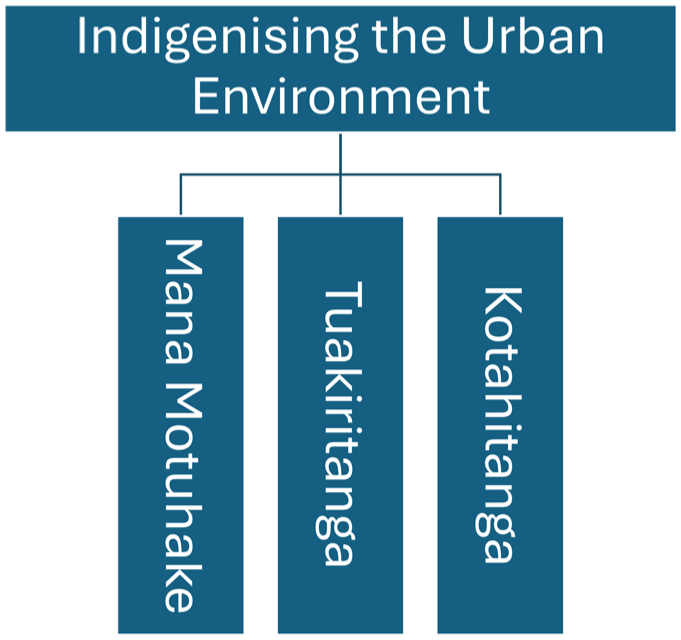
Conceptual framework.
Conceptual framework
There is much work being undertaken by various Indigenous communities as they seek decolonisation and Indigenisation of urban planning. Some Māori communities have been among the most successful internationally in reigniting Indigenous planning influence and outcomes despite prevalent western systems (Kitson et al., 2022; Puketapu-Dentice et al., 2017; Thompson-Fawcett, 2022). However, such success is patchy around Aotearoa New Zealand and hard-won. For this paper, we have selected as our focus three prominent pou that stand behind such planning undertakings. They are some of the most frequently articulated concepts in previous studies by Māori researchers in the urban sphere. These three pou have been among those commonly deployed by Māori communities as a foundation for achieving traction in city development processes, and in particular, they hold specific relevance in our case study location. Our research uses them as yardsticks via which to reflect upon the barriers to Indigenous ambitions for transformation in Ōtepoti Dunedin. While each pou is discussed separately in the subsections below, as will become obvious through the paper, there is a logic to their connectivity. We begin now with a succinct account of each pou as pertinent to the research presented in the paper.
Mana Motuhake | Self determination
The concept of mana motuhake encompasses the idea of Indigenous self-determination and has various applications ranging from addressing the impact of colonialism, to reclamation of historical lands and resources, and safeguarding traditional practices and knowledge (Barker and Mihesuah, 2005). Historically, such applications have been largely excluded from the public awareness within urban landscapes, with the most extensive concentration of traditional tikanga (customary practices) remaining within rural areas (Walker and Barcham, 2010). Nevertheless, Māori communities have not relinquished their right to practice mana motuhake in urban settings and have not succumbed to the structures rooted in modern urban planning practice. Communities have forged their own pathways through the colonial urban planning and development space in order to engage with local authorities (Puketapu-Dentice et al., 2017). The colonial hegemony embedded in the latter organisations means the official decision makers have the potential to either impede and oppose, or uphold and assist the ambitions, values, and goals of Indigenous people (Puketapu-Dentice et al., 2017). Nevertheless, a diversity of daily planning practices has been crafted through which colonial planning systems are being disrupted by Indigenous communities. Through educative, political, adaptive persistence, these communities model self-determination. They ‘are constantly developing ways to resignify, reclaim, and reimagine the futurities of their Land’ (Lopez-Huertas, 2026: 521). Certainly, the historic and continuing trend towards erosion of the connexion between Indigenous people and their land has ignited a growing demand by urban Indigenous communities to recover their rights and reassert their presence back in the environments they call home (Hibbard, 2022; Raerino et al., 2021).
Tuakiritanga | Cultural identity
The concept of tuakiritanga encompasses the security of cultural identity that comes with understanding and recognition of such factors as your whakapapa (shared ancestry), whānau (family) connectedness, hapū (kinship) relationships, te ao Māori holistic worldviews, whenua (ancestral lands) and environment, and sense of belonging in terms of cultural embeddedness in practices and places (Durie, 1995; Fox et al., 2022; Rangihau, 1975). Tuakiritanga includes the notion of place identity, acknowledging the intricate relationships between people and the environments they inhabit (Proshansky et al., 1983). Cheshmehzangi and Heat (2012), Stedman (2002), Ujang and Zakariya (2015), Violich (1985) all speak to the idea that identity is shaped and even manipulated through the visual representations in the spaces that surround people. While much has been written about the identities of individuals, communities, and places, Borell (2005) argues that there is a need to consider the significance of collective identity and its importance for designing contemporary urban landscapes. Deluze et al. (2023: 5) remind us that for many Indigenous communities, ‘urban areas were originally and continue to be a source of sacred relationships among humans, land, water, sky, and ancestors’. Such understandings have substantial implications for western urban development practices in settler-colonial contexts.
In settler-colonial cities, the cultural identity of people and the places they occupy has been significantly shaped by the specifics of local urbanisation processes. For Māori, while culturally heterogeneous, identity in place has universally suffered sizeable harm due to execution of colonial planning practices and structures (Keiha and Moon, 2008). Amongst others, Puketapu-Dentice et al. (2017) discuss the need for, and attempts at, adaptations that encourage the flourishing of Māori identity in cities, embracing revamped thinking in urban planning and development practices (Walker et al., 2019). There is a loud call from Indigenous communities to ensure that within urban environments there are ‘spaces that support Indigenous peoples to be Indigenous by connecting them to land, to culture, to history and to kin’ (Kitson et al., 2022: 422).
Kotahitanga | Collective orientation
The final concept of kotahitanga embodies a sense of togetherness, unity, collective action, and co-operative co-existence. It acknowledges diversity and the value in working inclusively towards goals and shared outcomes. While the concept commonly refers to collective action by Māori communities, it is also activated as a model for co-operation between Indigenous and non-Indigenous groups. In an urban planning context, it distinguishes between notions of community participation and collaborative decision-making, with the later prioritising meaningful partnership, rather than merely engaging to tick a bureaucratic box (Innes and Booher, 2004; Te Pā Tū, 2023). Cook (2023) indicates that collaborative decision making enables the process to arrive at the optimal outcomes for the community, however, cautions that a collaborative workspace can lead to conflict when parties’ motivations and desires are divergent from one another. Te Tiriti o Waitangi is the key founding document of Aotearoa New Zealand, and its implications for urban planning include recognising the ongoing associations Māori have with urban locations and ensuring early, meaningful and culturally appropriate involvement of Māori communities in decision making processes. Historically, tokenistic engagement methods have been implemented within Aotearoa New Zealand that fail to align with Te Tiriti, including a lack of inclusivity, diversity, influence and self-determination in the decision-making space, leading to adverse outcomes for Māori and other cultural minorities within the country (Belgrave, 2014; Dionisio and Macfarlane, 2021; O’Brien et al., 2018). Nevertheless, practical recognition of kotahitanga and the potential of collaborative decision-making to juggle the aspirations of multiple parties offers hope for the future of planning (Wang et al., 2021).
In sum, urban Indigenous communities have been driven to adjust to colonial planning practices that have eroded their connexion to land and culture. However, there is a deep-seated demand from those communities to reclaim their rights and reassert their presence in built environments. To achieve this, the recognition and application of mana motuhake, tuakiritanga, and kotahitanga in urban planning and development practices has been important as guidance for many communities.
Methods
Being Indigenous ourselves, the research we present in the paper necessarily uses Indigenous methodology and a kaupapa Māori approach. Indigenous methodology acknowledges the relational, interconnected foundation of knowledge, and the associated obligation to decolonise research and ensure reciprocity through collaborative endeavour with community. Hence, the research reported in this paper was co-conceived and co-produced by Indigenous researchers and various Indigenous communities as a team. When we refer to research collaborators in the Results section, that is recognition that participants were co-creators of the study and partners in discerning the meaning of the results. Such an approach has been founded on the conviction that knowledge is shared, not owned, belonging to the collective (Wilson, 2002). Kaupapa Māori research also emphasises research practices that are culturally appropriate in the Māori context, centre Māori perspectives, and safeguard research conceived and implemented by Māori, with Māori, and for the benefit of Māori (Smith, 1999). Undertaking research in this way also enables the questioning of contemporary western interpretations and understandings, whilst adding an additional layer of protection for Indigenous people from further misrepresentation and simplification of their culture, knowledge, and experiences (Fixico, 2013; Louis, 2007; Walker et al., 2006; Wilson, 2002). Given the particular priority we wanted to place on rich detail that values the perspectives of our local research collaborators and their authentic life encounters with planning practices, the research is qualitative in nature (Caelli et al., 2003; Clarke and Jack, 1998).
A mix of qualitative methods was used, combining primary and secondary information. The secondary research involved a thorough analysis of city plans, specific development plans, design guidelines, other planning documentation, and media articles. This analysis highlighted areas of both good and poor practices within the urban planning and development processes. Although not a focus in this article, those analyses have played a role in understanding the processes involved and have influenced elements recorded in the Results and Discussion sections of this article.
The primary research on which we concentrate in this paper involved conducting a series of kōwetewete. The ‘kōwetewete’ method was developed by Te Awhe-Downey (2021). The word itself can be translated as converse or talk, but as a research method it involves customised set-up, flexibility, generosity, accountability, and reciprocity. It is a distinct, tikanga-led storytelling method that enables the participants to determine what is learned through the interaction in a fluid manner. The communication is teller-focussed, not interview-focussed; it encourages a two-way sharing of stories in the progression of the conversation. In this way, there is an interchanging of the roles of tuākana (mentor) and tēina (mentee) throughout. We employed kōwetewete as a culturally tailored, relaxed conversational method that is connected to the wider practices of a kaupapa Māori approach. Our kōwetewete included engaging with research collaborators one-by-one in a manner in which they were comfortable to control the sharing of their experiences and stories of working in and around the Indigenous urban planning space. In this paper we focus on the insights of eight of our research collaborators who were intimately involved in recent urban planning projects with a strong Indigenous mission in Ōtepoti Dunedin, including mana whenua, mana whenua employees, as well as urban designers, architects, and planning professionals working within and beyond the City Council – some of the latter were also Māori. The small number of research collaborators is a result of the small number of people working in this particular space in this particular city at present. Kōwetewete were open and accommodating, allowing for each collaborator to delve into specific areas in which they had particular interest (Crabtree and DiCicco-Bloom, 2006).
This paper reports on one moment in a multi-decade series of engagements by us with most of the research collaborators and the local Indigenous communities. Consequently, it is part of an ongoing research relationship that fosters continuing dialogue and reflection, and new directions for future undertakings. In this particular project, the main focus of the conversations and analysis of the dialogue from kōwetewete was based on the pou from the conceptual framework, grouping the findings into related clusters accordingly, as reported below (Mihas, 2023).
Results
In this section, we present results via the pou of the conceptual framework. Our kōwetewete involved dedicated time with each participant discussing stories around their perceptions and experiences of commitment to each pou in development taking place in Ōtepoti Dunedin. First, the concept of mana motuhake is explored through discussions we had with research collaborators in regard to the state of Indigenous self-determination in City practices. Second, tuakiritanga is considered from our conversations with collaborators regarding place and cultural identity in current urban development activities. Finally, the commitment to kotahitanga in urban place making is contemplated from the exchanges we had about existing collaborative decision-making efforts within Ōtepoti Dunedin.
Mana motuhake
The experience of most of our research collaborators was that there was limited recognition or understanding of Indigenous sovereignty or self-determination in the planning and development of the city. They spoke of on-going difficulties in attempting to implement mana motuhake, commenting that: ‘[i]t’s still a challenge’ (Research Collaborator 2, Senior Council Staff Member), ‘[i]t hasn’t been [included]’ (Research Collaborator 3, Māori Partnerships Expert), ‘it has not been common’ (Research Collaborator 5, Mana Whenua Member), ‘it’s something that … hasn’t had a lot of airtime’ (Research Collaborator 6, Heritage Advisor). One of the mana whenua collaborators mentioned that in recent times mana whenua have actually needed to own or maintain significant interests in the land under development in order to practice mana motuhake in Ōtepoti Dunedin’s urban environment. This was a situation deemed good by participants when Māori did have ownership of the land but was disappointing elsewhere because it lacked recognition of mana whenua traditional territory obligations (despite the western ownership model) and their status as Treaty Partner as opposed to mere stakeholder.
Multiple restrictions in the planning and development process were identified as hindering mana whenua ability to exercise Indigenous sovereignty, including colonially biased provisions embedded in the Dunedin City Council’s District Plan – this plan controls what people can do on their land and how it can be developed. For example, Research Collaborator 6 stated ‘[i]t’s about the rules around the District Plan, that are about controlling outcomes on a city or district wide level rather than particular groups of people per se’. Complexities at the decision-making level were also noted by Research Collaborator 3: ‘You know, there’s a lot of divisive attitudes [in the Council] and I think that shows that people are scared that Māori are making progress’. Mana whenua were also referred to as ‘just another stakeholder’ by one participant (Research Collaborator 1, Architect) in regard to their standing in urban planning and development processes – a clear breach of mana whenua status as both partner and sovereign entity under Te Tiriti o Waitangi. Some non-Māori professionals working on Ōtepoti Dunedin’s Indigenising projects were not clear on the difference between a stakeholder and a Treaty Partner. Others agreed that this had been the case, but that they saw a recent shift taking place in both attitudes and likely policy direction towards better recognition of partnership (Research Collaborator 2). The gravity of this issue is reinforced by the findings of other research in Ōtepoti Dunedin (Acheson and Bond, 2024).
Some collaborators saw future potential. For example, one research collaborator spoke of the possibilities of being able to reverse what has historically marginalised mana whenua in the city. Success related to papakāinga (kinship village development) was one example that offered lessons for urban planning and development, as described by Research Collaborator 6: Look at say, papakāinga you know, how Indigenous cultures – Māori culture – is allowed to actually use their land in the way that they choose to rather than being restrained by any overall zoning on the land, per se.
However, overall, in our analysis of Council planning documents and relevant project specific documents we could not find explicit recognition of concepts such as Indigenous self-determination or sovereignty. Nevertheless, in several major projects in the city, it was clear that the initial design process had been modified to facilitate better incorporation of mana whenua values as the development progressed. Relationships and partnership between mana whenua and Council are a work in progress. Overall though, it is evident that substantial barriers must still be overcome before Indigenous communities in Ōtepoti Dunedin can actively exercise self-determination or sovereignty in everyday practice.
Tuakiritanga
Participants in the research recognised a distinct Ōtepoti Dunedin identity. For example, Research Collaborator 5 described the city as ‘strong, vibrant, alive, and future forward’. Nevertheless, the emergence and visibility of Indigenous cultural identity has been slow compared to many other centres in the country: Māori cultural identity in Dunedin’s urban environment at the moment it’s almost non-existent. I’d say smatterings of it slowly creeping in … So, slowly changing but at the moment you wouldn’t know that there’s anything Māori in the city to be honest. (Research Collaborator 8, Mana Whenua Member)
It was acknowledged by most research collaborators that in recent years, Māori identity in Ōtepoti Dunedin is becoming more evident, highlighting that planning and development processes are gradually recognising tangata whenua and providing opportunities for more Māori design to be incorporated in urban spaces. Research Collaborator 7 (Mana Whenua Planner) emphasised current Indigenous-led endeavours aiming to ensure Mana Whenua are being seen within the landscape, ensuring the concept of whakamana (uplifting endorsement) is visible in the way the urban area and its spaces are cherished. Research Collaborator 2 referred to it as a ‘journey’. But it is constrained: ‘[a]t the moment, the focus is definitely on publicly owned buildings, and Kāi Tahu [mana whenua] owned buildings that they’re developing. In time, that might change’ (Research Collaborator 2).
At the same time, multiple barriers were identified with respect to enhancing Ōtepoti Dunedin’s cultural identity. These were highlighted by Research Collaborators 2 and 4 who, in particular, described the District Plan as failing to maintain pace with changing times due to a slow turnaround of its review and update process, and the lack of meaningful recognition of mana whenua as a partner rather than an ‘inconvenience in the planning process’ (Research Collaborator 4, Former Council Planning Practitioner). In regard to the latest changes to the plan, Research Collaborator 2 indicted that ‘the current District Plan has taken a step in the right direction, whether it’s the perfect vehicle yet, I don’t think it is’. Similarly, Research Collaborator 4 indicated that the current District Plan was inadequate at challenging the status quo as reinforced by professionals: ‘I think practitioners need to get schooled up because, let’s be honest, I think most of our [planning] practices are run by middle aged white guys who possibly don’t see the value in making space for Māori’.
The District Plan was further critiqued by Research Collaborator 2 who indicated that the rules within the Plan give significant recognition to the historic colonial façades of the urban area in Ōtepoti Dunedin somewhat at the expense of even earlier histories and alternative designs. Research Collaborator 2 made the following statement, referring to a conversation they had with a colleague: ‘There are rules very much like “it needs to look like this very colonial [style]” … My colleague … said, “you need to go back to them and tell them the building needs to look more European”’. Historically, there has been a distinct leaning towards protecting colonial heritage and culture in Ōtepoti Dunedin. For example, within the Dunedin City Council’s recent Central City Plan (Dunedin City Council, 2021: 12) there is recognition of this shortcoming: ‘Dunedin’s Ngāi Tahu cultural heritage is a distinctive element and needs to be better acknowledged. Currently more emphasis is given to the city’s Scottish and Chinese history than it is to its Ngāi Tahu heritage’. Reinforcing this point, Research Collaborator 6 contended that the Dunedin District Plan is embedded with biased rules that fail to take account of diversity in the city and how different communities are differentially impacted by ‘one-size fits all’ planning provisions. This is corroborated by other recent research on planning in Ōtepoti Dunedin (Acheson and Bond, 2024; Moudgil, 2022).
The kōwetewete findings indicate that the connexion between Māori and the urban space in Ōtepoti Dunedin is an evolving process and one that needs to be improved given the Treaty context. But the lack of willingness on the part of some professionals, some decision makers, some elected officials, and some members of the public is simply ‘very racist’ (Research Collaborator 3) and many are not yet able to conceive of multiple cultures being able to ‘co-exist’ in the built form of the urban landscape (Research Collaborator 4).
Kotahitanga
Collaborative decision-making – in this case where there is a prioritising of partnerships between Indigenous communities and local authorities (and the relevant urban development professionals) – was found to be wanting in Ōtepoti Dunedin. In particular, there has been a long history of a lack of actively pursuing the development of cooperative relationships on the part of non-Indigenous agencies in preference for more tokenistic consultation processes. For example, some of these issues were quite simple things like engagement timeframes prioritising a colonial belief system – failing to take into account the time it takes for Indigenous communities to meet, discuss, then participate in planning processes. This issue is also discussed in the Ōtepoti Dunedin context in other planning related research, for example, Diprose et al. (2024). Research Collaborators 1 and 2 highlighted that their respective organisations’ existing relationships with mana whenua were not as strong as they thought they ought to be. For example, Research Collaborator 1 stated ‘I don’t feel as though we have particularly good relations [with mana whenua]’ and Research Collaborator 2: indicated that upon moving back to Ōtepoti Dunedin they were ‘surprised at how backwards – not quite the right word – but how we weren’t pushing the envelope down here in terms of trying to get into more of a partnership space’. Not infrequently, that situation (of not actively pursuing relationship-building early on in planning activity) results in non-Indigenous organisations heading down an unhelpful path that needs rectifying later, affecting the development schedule and using additional mana whenua resource and time: So, in terms of the mana whenua, if we go back to the beginning of this project I mentioned, that started off a bit on the wrong foot. We ended up having a bit of a hui [gathering] down at the Ōtākou marae [meeting grounds] to try and reset things and point us all in the right direction. (Research Collaborator 1)
The implications of this were reinforced by Research Collaborator 4: If mana whenua is not engaged … then you’re going to miss the bus here, all of those opportunities here are going to fall over. So, … it was more difficult than it needed to be. Speaking to the engagement process and the people, the actors, involved in that, engagement processes need transparency and some strategic sort of alignment or else they’re going to miss some opportunities and capacity and capability.
However, a promising theme in conversations was that in the last three to five years, relationships were improving, and collaborations were emerging, with mana whenua attaining more recognition from practitioners and local authorities. For example, Research Collaborators 4 and 5 acknowledged the shift in this way: Emerging! It’s probably changed over the last couple of years. I know that they’ve got some sort of Māori positions in Council, but when I was there, they didn’t have those. (Research Collaborator 4) Improved! Improving all the time…Because we have a memorandum of understanding (MOU) we’ve got a great process [with Council]. (Research Collaborator 5)
Finally, Research Collaborators provided insight into what they perceived the future could potentially look like in terms of collaborative efforts between mana whenua and the Council. For example, from the perspective of the Council, Research Collaborator 2 described significant forthcoming change at the policy development stage: ‘Starting right at the top, you can see that that policy making is now going to be imbued with an entirely different flavour of how we should engage with mana whenua’. While Research Collaborator 8 provided a perspective from mana whenua: I’m trying to empower Pākehā [non-Indigenous New Zealanders] to be good Pākehā for us, be our allies. That’s when we’ll get the change. That’s where the change will happen. There’s no point in whacking them over the head with a big taiaha [long wooden weapon], because they’ll just retreat … They’ve got a lot of work to do. Not us!
Findings indicate that historically mana whenua representation at the decision-making table has been limited and restricted through poor collaboration processes. Nevertheless, our collaborators suggest that the processes involved, and the partnerships, are evolving positively.
Discussion
The results highlight various barriers (and opportunities) identified by collaborators that currently exist within the urban planning and development processes that continue to marginalise Māori culture in Ōtepoti Dunedin. From our analysis, we would argue that at least three prominent themes have surfaced in the kōwetewete with our research collaborators, demonstrating the profound obstructions to decolonising and indigenising the city. First, the relentless colonial dominance of the planning and design of urban space and the manipulation of planning processes, reinforcing a narrative that obscures celebration of Māori identity. Second, there has been a persistent lack of recognition of historical and cultural foundations of Ōtepoti Dunedin relevant to mana whenua and their values and aspirations in the urban environment. Finally, there is some evidence emerging that the practices that have played a significant role in the marginalisation of Māori culture in Ōtepoti Dunedin are very slowly shifting in a direction that is better able to offer equitable and inclusive outcomes through Treaty commitment – albeit a transformation that is still a burden born principally by Indigenous communities. We address each of these themes in the following subsections.
Colonial dominance
Indigenous communities must contend with residing in urban environments powerfully influenced by tenacious settler-colonial mindsets and priorities. There is a significant deficiency in current practice whereby the guiding principles, processes, policies, provisions and practices in urban planning and development are disproportionately influenced by colonial legacy, and are sluggish in embracing bicultural constitutional arrangements and multicultural contemporary urban contexts. This is reinforced by historic dispossession and loss of land and related rights. Dispossession has created a significant barrier to Māori in effecting mana motuhake and creating a keen sense of identity within the urban environment. As noted by Gosnell-Myers (2022) and Porter and Barry (2016), a key factor contributing to the loss of a right to a visible urban presence in cities such as Ōtepoti Dunedin is the pervasive belief that Māori communities are non-urban and essentially absent from the city, which has allowed colonial development to thrive unchecked. Recognising and protecting the rights of Indigenous communities, especially in their takiwā (territory) – which includes urban areas - is not only essential for addressing the historical injustices faced by Māori but also serves as a crucial step in empowering Indigenous communities per se to foster urban identities and Indigenise urban spaces.
The outcomes our research collaborators spoke of in Ōtepoti Dunedin affirm the ideas of Puketapu-Dentice et al. (2017) who claim that the heavy settler-colonial dominance evident in planning decision-making ordinarily leads to the derailment of the goals and aspirations of Indigenous communities. The persistence of colonial ascendancy is reinforced by the divisive attitudes held by both decision-makers, practitioners, and much of the general public. These mindsets contribute to the marginalisation of Indigenous culture, presenting a significant barrier for mana whenua and other Māori in their efforts to shape urban spaces in ways that reflect their identity.
Lack of recognition of historic and cultural foundations
While obviously intimately associated with settler-colonial domination, yet a distinct domain where different perspectives and material and metaphysical elements might have been valued, is the lack of appreciation of the historic and cultural underpinnings of the city that would demonstrate the unique Indigenous foundation of Ōtepoti. Since colonisation, there has been little to no visual retention or representation of Māori pasts, design, tikanga (practices), and kōrero (narratives) in the city. This aligns with the work of Walker and Barcham (2010) who found that te ao Māori (the Māori world) has been excluded from the public consciousness in urban centres (Randell-Moon, 2020). The veiling of Māori traditional practices and stories not only demonstrates equity and Treaty betrayals but further disconnects Indigenous people from their whenua (land), as illustrated by Raerino et al. (2021) in their discussion of the erosion of the holistic connexion between Indigenous people and the land. The ability to see oneself reflected in the environment one occupies is a key factor in shaping a community’s identity, as highlighted by Cheshmehzangi and Heat (2012), Stedman (2002), Ujang and Zakariya (2015), and Violich (1985). However, the lack of visual representation in many urban spaces has hindered Māori sense of belonging. Research collaborators emphasised this concern, noting that Māori culture in Ōtepoti Dunedin is virtually invisible, and to the unknowing observer, there is little indication of Māori presence or influence, past or present.
A chance for change
While the above highlights the harsh reality of the historic marginalisation of Māori communities within Ōtepoti Dunedin – through the lack of visible acknowledgement of mana whenua histories and presents and the enduring colonial dominance in the planning system – a shift towards change is beginning to take shape. Most of our research collaborators noted the importance of small improvements in professional and decision-maker capability in this sphere, and the resultant outcomes through several specific planning projects. Evolving progress also includes refocussing planning documents, improving planning processes, and prioritising partnership between mana whenua, other Māori communities, local authorities and professional practitioners.
Nevertheless, of critical importance, as Karim (n.d) concluded, is the reality that Indigenous peoples have not surrendered to settler-colonial structures or breaches of Te Tiriti o Waitangi. And, associated with sovereignty matters there remains the inevitable burden of fostering change and educating for transformation that still, unfortunately, sits disproportionately with Indigenous communities, as was clear in the case of Ōtepoti Dunedin. There is no doubt that countering dominant colonial legacies originates from the work of Indigenous communities. However, agents and agencies in the planning system need to have a proactive commitment to dismantling current praxis and this necessitates taking on a responsibility to learn, upskill, and seek to decolonise planning (Porter and Barry, 2016).
Conclusion
The mission of this research was to understand the recent experiences of the obstacles to decolonising urban spaces through the reflections of those people most eagerly engaged in Indigenous urban planning in Ōtepoti Dunedin, Aotearoa New Zealand. To achieve this, we used an Indigenous methodology and a kaupapa Māori approach that prioritised cultural appropriateness and collaboration and enabled us to centre on our research collaborator voices and interpretations.
The research delivers some very helpful insights. First, it is clear that Indigenous sovereignty, or mana motuhake, is often sidelined within urban planning, with planning processes restricting Māori self-determination. The influence of colonial biases, such as those embedded in tools like the District Plan, continues to limit Māori participation, reflecting an ongoing struggle for recognition and empowerment in city development. Similarly, Māori cultural identity, or tuakiritanga, remains underrepresented in Ōtepoti Dunedin’s urban spaces. Although there has been some gradual progress in incorporating Māori perspectives, barriers persist. These include inapt planning documents, weak implementation of provisions, and a lack of recognition of Māori cultural values, which hinders the creation of a more visible and meaningful presence of Māori identity in the city. Hence, it is not unexpected that consistent and genuine collaboration, or kotahitanga, between Māori communities and non-Indigenous urban professionals is still wanting in Ōtepoti Dunedin.
Despite some improvements, many Indigenous participants feel that their involvement is tokenistic rather than meaningful, with past neglect and a lack of proactive engagement from local authorities, organisations and urban professionals continuing to undermine genuine partnership efforts. As a result, the legacy of colonialism remains deeply embedded in urban planning practices, reinforcing settler-colonial values and leaving relatively little space for Māori cultural expression. This colonial dominance continues to obscure Māori culture, making it difficult to decolonise let alone Indigenise urban spaces. And, while there is an evolving shift towards more inclusive planning practices, much of the responsibility for this change still falls on Indigenous shoulders. To achieve authentic transformation, urban planning systems must be restructured to remove colonial biases, embrace Māori perspectives, and promote collaboration and equity through intentional policy changes and practice.
Coming full circle back to our three pou as depicted in Figure 1, there is a decipherable relationship in the model that points a way forward. Kotahitanga encourages the early creation of co-operative and collective associations that deliberately nurture inclusive processes from the outset of conceiving policy, provisions and projects. That foundation lays down the potential for Tuakiritanga, based on devising unique tangible outcomes that cultivate a sense of self-recognition and belonging from all communities in the city. In achieving these two elements, Mana Motuhake emerges as communities reassert their presence in the city.
Footnotes
Acknowledgements
The authors would like to thank all of the research collaborators that participated in the kōwetewete involved with this research and we are also grateful to the reviewers for their very insightful suggestions.

Funding
The authors disclosed receipt of the following financial support for the research, authorship, and/or publication of this article: The authors would like to thank the funders of the research, Ngā Pae o te Māramatanga Centre of Research Excellence.
Declaration of conflicting interests
The authors declared no potential conflicts of interest with respect to the research, authorship, and/or publication of this article.
Glossary
Kaupapa Māori – Māori approach
Kotahitanga – Solidarity, Collective action, Collective Orientation
Kōwetewete – Conversations
Mana motuhake – Indigenous Sovereignty, Autonomy, Self-determination
Mana whenua – People with ancestral authority over land or territory
Māori – Indigenous peoples of New Zealand
Ōtepoti – Dunedin
Pākehā – New Zealanders of foreign descent
Pou – Pillar
Taiaha – Two-handed striking weapon
Takiwā – Territory, Area
Te Tiriti o Waitangi – The Māori language version of the Treaty of Waitangi
Tikanga – Māori customary practices
Tuakiritanga – Cultural Identity
Whakamana – Uplifting endorsement
Whenua – Land, Territory