






Abstract
This article examines the coalitions underpinning opposition to housing development across the Paris metropolitan area. Drawing on a database of 141 housing-related development conflicts (2017–2022), compiled through local press analysis and socio-spatial mapping, it analyzes how local mobilizations are distributed across the metropolitan territory and which actors participate in them. The findings reveal a highly fragmented landscape of contention. Most conflicts are driven by ultra-local coalitions linking neighborhood groups and local political actors, predominantly concentrated in socially mixed middle-class areas. Broader environmental coalitions do emerge, but they remain socially and spatially selective, concentrated in upper- and upper-middle-class neighborhoods endowed with greater symbolic and cultural resources. By articulating coalition-building processes with the socio-spatial characteristics of neighborhoods, the article demonstrates that the capacity of local mobilizations to connect with wider actors is unevenly distributed and shaped by metropolitan inequalities. It shows that territorially bounded struggles must be situated within metropolitan-scale patterns of mobilization. These findings also point to the need for greater analytical attention to the articulation between relational and territorial forms of structuring in contemporary land-use conflicts.
Introduction
In recent years, in the Paris metropolitan area, environmental organizations involved in contesting large-scale development projects have taken an interest in more routine, small-scale mobilizations opposing urban residential construction. Some activists consider these localized struggles as part of a broader ecological front, as illustrated by the following interviewee: There have been a lot of broad, urban, and youth-driven mobilizations around climate issues – youth strikes, climate marches, and the like. But we sensed that the intensity of these actions might wane over time. Land-use conflicts have existed for a very long time, but they’ve often gone unnoticed. What we set out to do was bring them back into focus, make them visible again, and create a network of mutual support. (Employee, environmental organization, June 2022)
The integration of smaller neighborhood groups is thus seen as an opportunity to consolidate broader coalitions (Vacher, 2021). This calls for extending the focus beyond large-scale and emblematic conflicts, which often remain the core focus of research attention (Audikana et al., 2025; Orueta and Fainstein, 2008; Swyngedouw et al., 2002), and for paying closer attention to more fragmented mobilizations surrounding smaller-scale development projects. This article therefore moves beyond a focus on flagship projects to explore the wider landscape of land-use conflicts by examining the actors mobilized within them in a European metropolitan context.
In this respect, it contributes to renewed research on local conflicts over housing development. For several decades, the scholarly literature has examined these mobilizations, treating them as ordinary and recurrent phenomena and often interpreting them through the lens of parochialism or localist attitudes. More recently, academic debate has focused on the not-in-my-backyard (NIMBY) label. One strand of the literature adopts a planner-led, operational perspective, seeking to identify the determinants of local resistance in order to overcome NIMBY opposition. Within this view, local protests are commonly associated with private interests and portrayed as conservative reactions that hinder development and contribute to housing shortages (Dear, 1992; Dougherty, 2020; Inhaber, 2018). By contrast, another strand of the literature challenges this framing, arguing that, due to its pejorative connotations, it reproduces processes of delegitimation that marginalize certain forms of local collective action. From this perspective, scholars agree that even small-scale land-use disputes are inherently political, and that mobilized actors must be considered analytically as citizens rather than merely as local residents (Burningham, 2000; Eranti, 2024; Kempton et al., 2005; Neveu, 2002).
The ambivalent status of these mobilizations in the literature is also shaped by a longer-standing debate on the scope of such local struggles and their differentiation from what are considered “proper” urban social movements. As early as the 1970s, Manuel Castells defined urban social movements as forms of collective mobilization structured around three dimensions: collective consumption, community culture, and engagement with local politics (Castells, 1977a). From this perspective, such activism is understood as enabling actors to move beyond what Mark Purcell (2006) has termed the “local trap” in which a wide range of ephemeral, place-based mobilizations are seen as remaining confined. This distinction has subsequently been taken up by other authors, who similarly contrast territorially bounded protest with more structurally transformative forms of urban activism (del Romero Renau and Valera Lozano, 2016).
To move beyond this dichotomy, our analytical framework is structured around two dimensions. First, we adopt a metropolitan-scale perspective to capture the overall landscape of contestation surrounding housing production, encompassing conflicts of varying scale and location. This approach allows us both to identify broader metropolitan patterns of mobilization and to develop a spatially grounded analysis of contestation, embedded within the socio-economic territories of the metropolis. Second, at the theoretical level, we advance a coalition-based approach to land-use conflicts. Drawing on the literature on coalition formation in social movements (Brooker et al., 2018; Gawerc, 2020), we examine opposition to housing development through the capacity of mobilized groups to build broader coalitions by engaging with political actors and other civil society organizations within and beyond their municipalities. This relational perspective allows for a systematic characterization of forms of opposition in terms of the scope and diversity of actors involved.
Paris constitutes a compelling case study for examining contemporary land-use and housing conflicts, due to its long history of urban mobilizations and enduring housing challenges (Halbert et al., 2021). Since the 1970s, the Paris metropolitan area 1 has been a key site for studying urban social movements. Castells notably questioned how such urban struggles might catalyze broader processes of social change (Castells, 1977a). Further research documented activism shifting from class-based labor struggles in the banlieues rouges to new forms focused on immigrant rights, environmental justice, urban precarity, and development issues (Bellanger, 2014; Fourcaut et al., 2007). Localized movements often emerged in response to large-scale renewal and infrastructure projects, and were often framed in terms of the right to the city and access to affordable housing (Castells, 1983; Kipfer, 2016). Today, the Paris metropolis still represents a critical terrain for analyzing land-use contestation, where local dynamics intersect with broader national and European policy frameworks aimed at limiting land artificialization. The European “No Net Land Take” objective, for instance, has fueled debate in France, where the government’s Zero Net Artificialization policy is gradually being enshrined in law. What once appeared as localized land-use disputes are now embedded in wider institutional and political tensions, prompting the emergence of new coalitions and repertoires of action (Aguilera, 2021). This article thus considers these mobilizations in order to explore the possible emergence of a new wave of social movements in the Paris metropolitan area.
Against this backdrop, the article examines the socio-spatial distribution of land-use conflicts over housing development and the extent to which local mobilizations are embedded in broader coalitional configurations involving environmental actors. To address this question, we develop two expectations derived from both preliminary observations and the existing literature.
The first expectation relates to the spatial dispersion of mobilizations across the metropolitan territory. Rather than being concentrated in a limited number of hotspots, conflicts are likely to take the form of multiple, scattered struggles embedded in diverse local contexts. Several factors support this expectation, including patterns of diffuse urbanization, the growing prominence of opposition to densification, and the spatial dispersion of middle-class populations within the metropolitan area.
The second expectation relates to the environmentalization of mobilization, namely the involvement of environmental actors in these coalitions. A substantial body of work documents the centrality of environmental concerns in local land-use conflicts. More recently, scholars have begun to question whether these localized struggles are also becoming sites of engagement for a broader array of environmental actors, reflecting their increasing interest in local development disputes.
To examine land-use conflicts over housing development in the Paris metropolis, the article is structured as follows. The following section reviews the literature on neighborhood mobilizations and the historical waves of protest in the Paris metropolitan area. The subsequent section outlines the methodology, which combines local press analysis, socio-spatial typologies, and cartographic tools. The empirical analysis yields two main sets of findings. First, most mobilizations are small-scale and locally bounded: they are spatially dispersed yet concentrated in socially mixed middle-class neighborhoods. In these contexts, land-use conflicts are structured by highly localized coalitions linking neighborhood groups and local political actors (fourth section). Second, broader coalitions involving environmental actors remain a minority and are unevenly distributed across the metropolitan territory. They tend to be anchored in upper- and upper-middle-class neighborhoods, where residents can mobilize greater symbolic and cultural resources, highlighting the socially differentiated capacity to scale up local struggles (final section).
Literature review: Land-use conflicts between local mobilizations and metropolitan dynamics
Analyzing neighborhood mobilizations beyond NIMBY
Debates on land-use conflicts over housing developments are often framed through the NIMBY label and its many variants (Yes In My Backyard [YIMBY], Locally Unwanted Land Use [LULU], Build Absolutely Nothing Anywhere Near Anyone [BANANA]). While early uses of this label portrayed opponents as parochial and self-interested, a substantial body of scholarship has since criticized the normative bias of such analyses and their tendency to delegitimize local collective action (Dechézelles and Olive, 2016, 2019; Lake, 1993). Rather than dismissing them, recent research interprets these mobilizations as broader struggles over land, urban futures, and the meaning of the general interest. This shift has been driven by a range of analytical perspectives, notably those focusing on the narratives and alternative constructions of the common good through which opponents frame their causes (Jobert, 1998; Lolive, 1997; Trom, 1999), the clashing valuation systems at stake in land-use disputes (Eranti, 2017), the repertoires of action they mobilize and the processual dynamics of conflict escalation (Davison et al., 2016; Fienitz and Siebert, 2023).
A key issue in this literature is how the actors involved in these conflicts are conceptualized. Broadly speaking, it remains segmented between, on the one hand, approaches that focus on individual-level characteristics and attitudes, and, on the other, perspectives that grasp these disputes through collective actors’ mobilizations.
Much research examines land-use conflicts at the level of individual actors and preferences. Some contributions adopt a broad perspective by framing these actors as citizens whose claims raise fundamental questions about the nature of contentious participation in democratic planning processes (Herdt and Jonkman, 2023; Makridou et al., 2024). Einstein et al. (2020) conceptualize opposition as a form of unequal participatory power, showing how a small, socio-economically advantaged group of “neighborhood defenders” uses planning institutions and land-use regulations to delay and restrict housing development. Other studies seek to capture how such disputes are shaped by residents’ attitudes toward densification, urban development, or representations of density. These orientations are socially and spatially situated, and linked to socio-professional status, generation, residential context, and housing tenure (Einstein, 2021; Manville and Monkkonen, 2024). Whittemore and BenDor (2019) use quantitative analysis to demonstrate how ideological, demographic, geographic, and political factors influence attitudes toward residential development. In a similar vein, Wicki and Kaufmann (2022) show that individual responses to housing projects are shaped by residential contexts, with opposition more likely in suburban and rural areas. Drawing on the socio-economic characteristics of mobilized residents, some studies have also analyzed the greater reluctance of socially advantaged groups toward affordable housing projects (Scally and Tighe, 2015). Conversely, other scholars have pointed to the tendency for facilities to be sited in areas inhabited by less mobilized populations with fewer organizational and material resources, thereby reinforcing existing socio-spatial inequalities (Wolsink, 1994). Finally, some authors have refined this individual-level focus by specifying distinct citizen profiles beyond pro- and anti-development positions. Ruming et al. (2025), for example, identify five ideal-typical resident positions in relation to suburban densification: supporters, resisters, opponents, expansionists, and beneficiaries.
A second strand examines land-use conflicts through the collective actors that organize and intervene in these struggles. These conflicts are indeed structured by organized groups, and sometimes coalitions, that mobilize resources, construct shared frames, and sustain contention over time. Often based on qualitative case studies of large-scale development projects, some research highlights that such land-use conflicts are constituted by heterogeneous constellations of organized stakeholders whose composition and internal relations evolve throughout the conflict trajectory. In their analysis of the Old Oak development in London, Robinson and Attuyer (2020) show that residents’ associations act as collaborative and future-oriented collective actors, articulating concerns to encompass questions of social inclusion, environmental sustainability, and democratic governance. Collective action is not confined to neighborhood groups alone. Anne-Mette Hjalager’s (2020) large-scale analysis of 213 land-use conflicts in Danish coastal tourism identifies a plurality of organized stakeholders, ranging from property owners and rights-holders to interest-holders and knowledge-holders, such as environmental organizations, heritage advocates, and professional associations. Some of these studies focus more explicitly on the processes of coalition-building among mobilized collective actors. They show how neighborhood associations actively seek alliances with other civil society organizations, expert groups, and policy actors operating at higher levels of government (Briata et al., 2020; Brooker et al., 2018; Nicholls and Jain, 2023; Staggenborg, 2016). The question of coalition composition has also been foregrounded by the rise of YIMBY groups, which have significantly redrawn the landscape of actors both supporting and opposing housing development. Emerging from the San Francisco Bay Area in the 2010s, this ideologically heterogeneous movement advocates for expanding housing supply through zoning reform and the removal of restrictive land-use regulations, bringing together market-oriented currents focused on deregulation and left-leaning strands coupling supply-side reforms with demands for social housing (Brouwer and Trounstine, 2024; Owens, 2022; Tapp, 2021). In doing so, it has prompted, particularly in the US context, a realignment of political coalitions in land-use conflicts. Most notably, it has exposed the extent to which opposition to new construction is sustained not only by conservative homeowners but also by progressive residents mobilizing environmental, social equity, or neighborhood preservation arguments, a configuration some have labeled “left” or “environmental” NIMBYism (Owens, 2022; Tretter et al., 2022). This further underscores the importance of examining the composition of coalitions and the neighborhood contexts in which they emerge.
Our contribution bridges these two strands by conceptualizing coalition-building as embedded in the socio-economic features of neighborhoods. This perspective identifies the conditions that enable local mobilizations to scale up.
Waves of metropolitan mobilizations in the Paris metropolis
Focusing on coalition-building through a relational approach to urban mobilizations might not be as novel as it seems. In his pioneering work on urban movements, Manuel Castells (Castells, 1977b) already interrogated the capacity of local collectives mobilized around housing issues to build coalitions and find allies at other scales. In his study of renewal in inner-Paris neighborhoods, he was particularly interested in how local mobilizations connected to a broader political process, by securing support from national tenant associations or, in the aftermath of May 68, linking up with radical left students (Castells, 1983). Much like contemporary literature, Castells focused on large-scale conflicts involving the transformation of entire neighborhoods and the central state’s decisive role. In the Parisian context, he identified two waves of urban social movements: the first rooted in opposition to the extensive Haussmannian renewal project, and the second emerging in response to the Gaullist urban redevelopment program of the 1960s. In his study of urban movements emerging around the construction of grands ensembles in the Paris metropolis, Castells thus identified “a new type of social movement, formed by homeowners, technicians, and professionals, orientated towards the defense of the environment, the improvement of neighborhood life, and the enrichment of local democracy” (Castells, 1983: 92). Yet he was cautious about classifying them as full urban social movements (Castells, 1977b: 377). These mobilizations often achieved their goals, but success tended to lead to demobilization rather than radicalization.
From the 2000s onward, Paris’s suburbs experienced a new wave of urban renewal policies (Epstein, 2013; Lelévrier, 2010). However, it did not trigger the kind of grassroots mobilizations and coalition building seen in the previous two waves of renewal (Deboulet, 2006). Thus, in Paris, weak urban mobilization in the context of large housing (re)development projects appears to be slowly consolidating into a recurring pattern, despite the large-scale transformations Paris has undergone over the past decade – particularly with the construction of the Grand Paris Express transportation infrastructure (Clerval and Wojcik, 2024). Similarly, in spite of attempts by some environmental organizations at mobilizing around the socio-environmental impacts of the 2024 Olympics, collective mobilizations have been limited.
Whether this pattern of limited mobilization reflects a structural feature of Parisian politics or a transitional phase remains an open question, particularly as urban governance has been significantly rescaled toward the metropolitan level in recent years. Halbert et al. (2021) suggest that the recent formation of metropolitan regions may give rise to a new wave of “metropolitan social movements.” These mobilizations may reflect the institutional fragmentation of the metropolis and tend to adopt more reticular, loosely structured forms of action, less tied to traditional political organizations or centralized urban policies. Their emergence remains socially selective, as moving beyond the “local trap” (Purcell, 2006) often requires access to cultural and professional capital, a pattern already noted in environmental activism (Ollitrault, 2001).
Taken together, these strands of literature highlight both the analytical importance of mobilized actors and the enduring difficulty of accounting for how local struggles connect (or fail to) to broader metropolitan dynamics. While research has examined either individual attitudes or organized collective action, and while historical analyses have traced successive waves of urban mobilization in Paris, less attention has been paid to the socio-spatial conditions under which localized conflicts crystallize into specific coalitional configurations. This calls for an empirical strategy that systematically maps mobilized actors across the metropolitan territory and analyzes the socio-spatial conditions shaping coalition-building.
A methodological approach based on media content and cartographic analysis
To study coalitions opposing housing projects in the Paris unité urbaine, we constructed a database using local press sources. The use of press data to analyze (land-use) mobilizations is widely discussed in the literature (Earl et al., 2004; Rucht and Neidhart, 1999). We are fully aware of the limitations of this source, including selection bias, framing processes, and fluctuations in media attention (Fillieule, 2007; McCarthy et al., 1996). News coverage necessarily introduces a discrepancy between the totality of conflicts and those reported. Nevertheless, we consider the local press an essential empirical source, particularly in urban contexts, as it provides regular coverage that renders visible a wide range of mobilizations. Empirically, we have observed that this source allows us to approach mobilizations even around ordinary or small housing projects, which a priori receive less media coverage.
Our database offers a comprehensive and unprecedented census of media-covered housing mobilizations in this metropolitan area. It maps the geographical distribution of these mobilizations, quantifies them by the number of contested housing units, and identifies the actors involved, which we categorized by both collective names and types (e.g. neighborhood groups, environmental organizations, and other supralocal entities). Additionally, the database records the developers of the contested projects, and the political actors involved.
We conducted a systematic search on Europresse using Le Parisien as the media source, covering the period from 1 January 2017 to 31 December 2022. This daily (owned by the LVMH group) is the only media outlet in the Paris metropolitan area that has the capacity to monitor local mobilizations throughout the metropolis, as reported in its local pages. We employed the following search string: TEXT = construction* & (logement* | habitation* | immobilier*) & (conflit* | mobilis* | opposition* | riverain* | association*). This query returned 3514 articles, from which we identified 141 distinct conflict cases. Alongside press sources, we consulted association websites, social networks (e.g. Facebook pages of neighborhood groups), developers’ websites, and local gazettes to document each conflict case. A conflict was included in our corpus if it met the following criteria: it concerned housing production operations (whether standalone or associated with other development programs); it involved a collective of citizens, whether formalized or informal; and it was based on one or more identifiable forms of engagement by the parties involved. Accordingly, articles merely reporting local residents’ reluctance without evidence of organized action were not retained.
This database is integrated with cartographic processing, which combines press data with external municipal and sub-municipal datasets, such as dominant land use patterns and neighborhood socio-economic characteristics. This integration enables us to create a detailed map of mobilizations, characterizing these spaces both morphologically and socio-economically. Spatially, these mobilizations are remarkably evenly distributed across the metropolitan area (Figure 1).
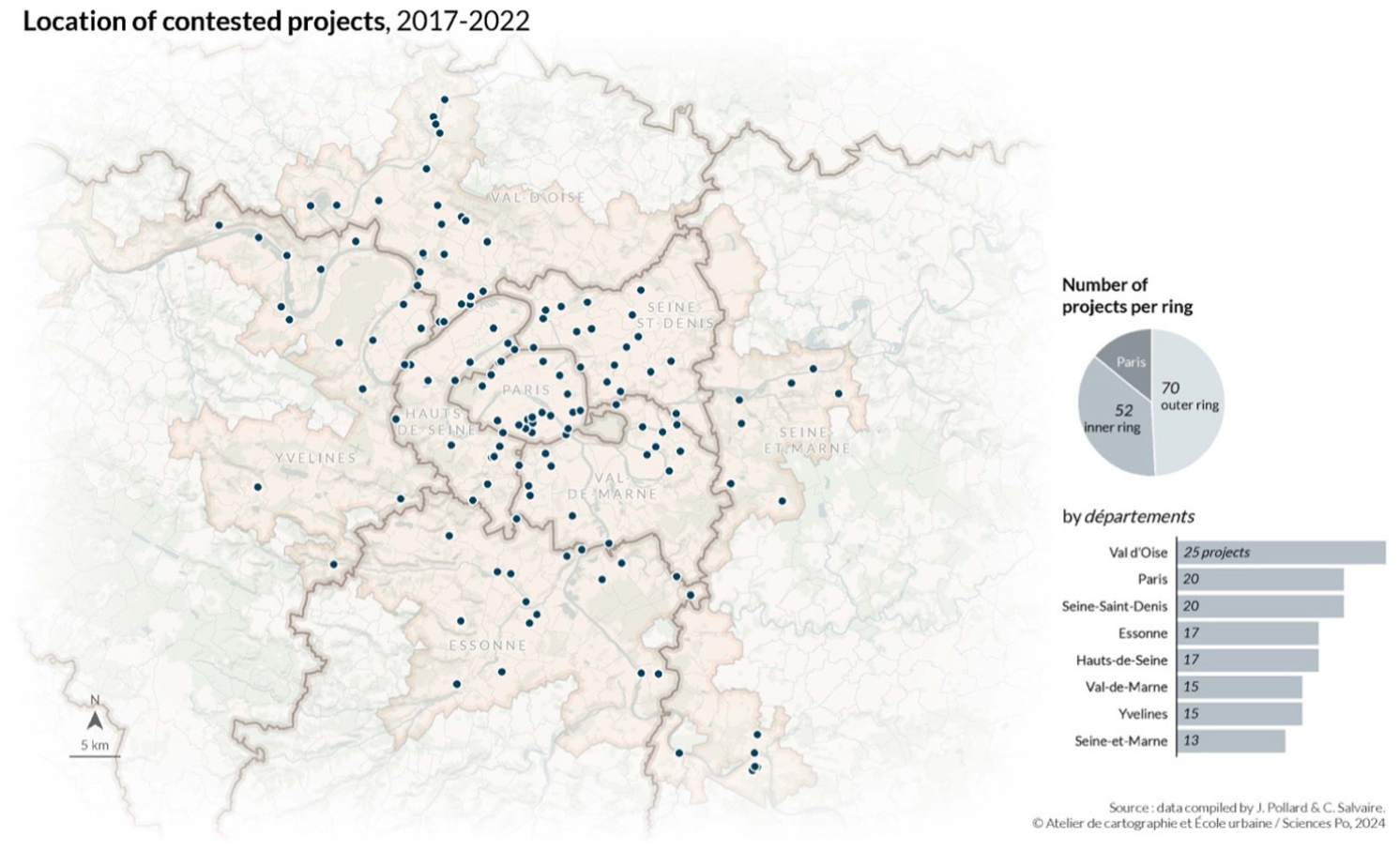
Location of contested housing development projects, 2017–2022.
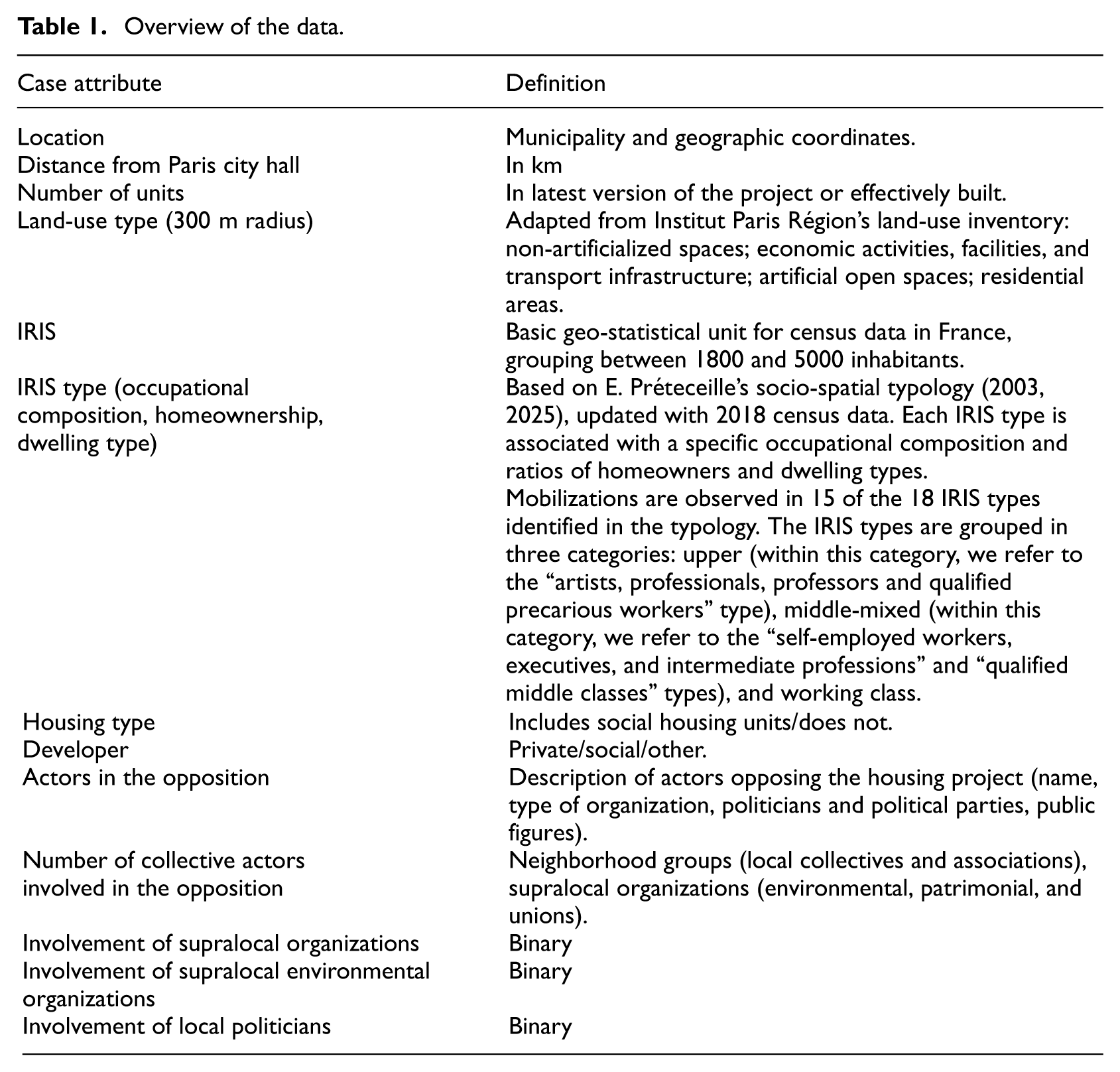
We further analyzed our dataset by cross-referencing it with Edmond Préteceille’s typology of the socio-occupational composition of the Paris metropolis, which is based on IRIS spatial units grouping between 1800 and 5000 inhabitants. 2 Using correspondence analysis, Préteceille classifies these units according to occupational composition, unemployment, and job precarity, consolidating them into 18 types organized into three broad groups: upper, middle-mixed, and working-class (Préteceille, 2003; Préteceille and Cardoso, 2020; Préteceille and Savina, 2025). Originally designed to study segregation dynamics, this typological approach not only reveals the overrepresentation of certain occupational groups in conflict-prone areas but also highlights unique configurations of social mixing and inter-group relations, factors that appear to be key drivers of mobilizations against housing construction. Moreover, each spatial unit type is associated with additional characteristics, such as the ratio of homeowners, the prevalence of single-family homes, and specific spatial distributions, which serve as secondary factors in explaining the distribution of mobilizations and the nature of coalition types (Table 1).
Overview of the data.
Scattered opposition: A mosaic of localized protests against housing projects
Fragmented mobilizations in the wake of incremental urbanization
One of the key findings of our study is the scattered and fragmented nature of housing conflicts, which tend to revolve around small-scale development projects. Half (n = 70) of mobilizations target projects comprising less than 100 units. Some mobilizations focus on large-scale, highly visible urban development projects, such as high-rise constructions (e.g. the Bruneseau Seine project in Paris’s 13th arrondissement), interventions involving heritage sites (such as the project affecting the Butte Rouge Garden City in Châtenay-Malabry), or the creation of eco-districts on previously undeveloped land (such as the Woodi eco-neighborhood in Melun). But most conflicts are rooted in highly localized disputes and often concern routine housing operations that, far from being invisible, become the subject of media coverage and sometimes intense political debate at the local level.
This territorialized pattern of conflict mirrors the institutional and political configuration of housing construction regulation in the Paris metropolitan area. Although planning competences have been partially transferred to intermunicipal bodies, the power to deliver building permits remains predominantly municipal. The Paris unité urbaine is composed of 406 municipalities, which therefore constitute key decision-making arenas for development control (Pollard, 2018). This dispersion, which characterizes the local governance of housing construction, constitutes a major institutional driver of the scale of land-use conflicts and of the municipal anchoring of collective mobilizations. Long-term research by Dominique Lorrain (2018) in Villiers-sur-Marne (a municipality in the inner suburban ring) highlights the limited capacity of local government to regulate (or even fully recognize) the dynamics of incremental urban development on its territory. He shows that such a governance gap fuels local dissatisfaction and opposition to housing construction.
This localized conflictuality is also closely tied to the forms of urbanization characterizing the Paris metropolitan area. Housing conflicts can be understood not only as reactions to specific planning decisions, but also as responses to a broader form of urbanization that proceeds in fragmented, incremental ways. Joël Idt has shown that the production of the Paris metropolis is largely driven by these dispersed and small-scale operations, often initiated below the radar of public debate but cumulatively significant (Idt, 2023). His analysis highlights how this mode of urbanization, through numerous minor interventions, has become the dominant vector of metropolitan growth. It is precisely this proliferation of discreet projects, managed through localized arrangements and rarely accompanied by coherent strategic planning, that increasingly provokes contestation. The forms of opposition thus mirror the forms of urbanization: scattered, sometimes opaque, and embedded in the everyday politics of place-making.
The prevalence of ultra-local coalitions between neighborhood groups and politicians
Our data (n = 141) shows that the vast majority of mobilizations (83%) only entail local collectives that operate at municipal or infra-municipal levels. While most of those are driven by a single collective (n = 89), some bring together several local associations (n = 28). This finding appears particularly robust as it runs counter to the expected biases of our methodology, which we assumed to overrepresent conflicts involving supralocal actors with preexisting ties to the media.
We observe the overwhelming dominance of mobilizations with a very narrow territorial anchorage: a neighborhood, or at most a small municipality. While they are characterized by their lack of engagement with supralocal, environmental organizations, they routinely involve local politicians, particularly those representing opposition parties. Political actors are involved in the majority of mobilizations surrounding residential development and densification projects in our database (61%).
Housing is a focal point of local political confrontation, as it raises sensitive issues that often serve as catalysts for partisan opposition to manifest and solidify. Opposition parties and elected officials play a pivotal role in mobilizations against urbanization, actively supporting local associations and publicly expressing their disagreement with municipal executives. Across all conflict cases documented in our database, we systematically recorded the political affiliation of the municipalities concerned, and no significant pattern emerged: conflicts over housing development occur in both left-wing and right-wing governed municipalities alike. A further finding from our data is that associative actors sometimes transition into local politics following their involvement in mobilizations, either by joining an established political party or, in rare instances, founding a new one. This underscores the sometimes blurred boundaries between associative activism and formal politics at the local level. A notable example is the mobilization against the Woodi eco-neighborhood on farmland in Melun, in Paris’s outer suburbs, which led to the creation of a new local political party. Indeed, during the 2020 municipal elections in France, conflicts over housing development received particular media attention.
Analyzing these mobilizations thus reveals locally rooted and horizontal contentious coalitions involving a limited number of actors, located within the geographical boundaries of a municipality or even a single neighborhood. These actors engage in collective action against the implementation of policies managed by local governments, supported by actors from the political opposition. In spite of efforts by some actors at reterritorializing the struggle against housing development at a metropolitan scale, the extreme fragmentation of planning authority across the 406 municipalities of the urban unit continues to structure a landscape of small-scale mobilizations with limited reach and where processes of politicization operate at the scale of local governments (Figure 2).
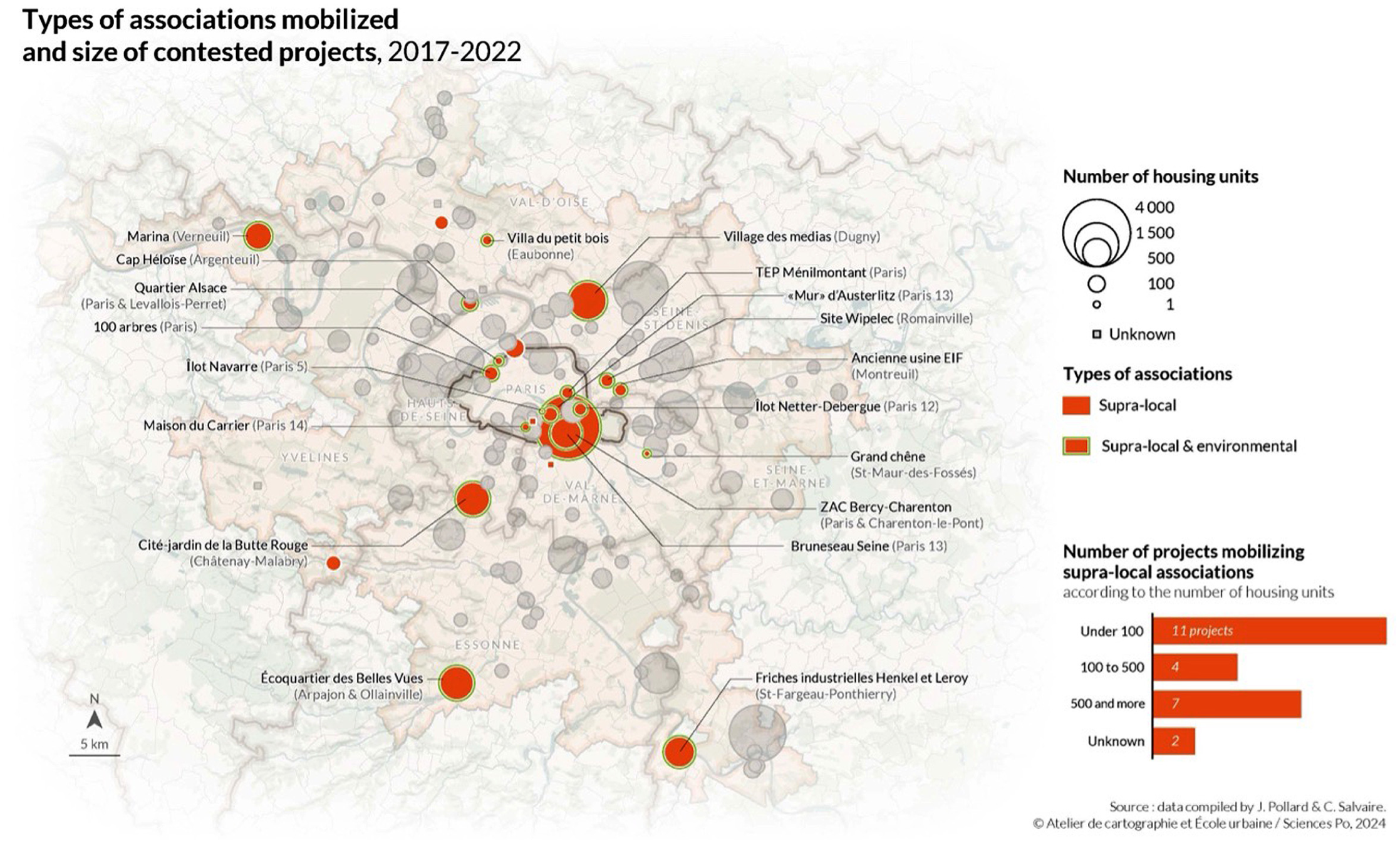
Number and type of associations involved in opposing new housing projects (2017–2022).
Ultra-local coalitions rooted in socially mixed middle-class areas
Though we have underlined the scattered and fragmented character of mobilizations against housing construction – thus mirroring the forms of urbanization and the scale of its regulation in the Greater Paris –, their distribution is uneven. Mobilizations against housing construction are primarily rooted within what Préteceille’s socio-spatial typology defines as middle-mixed areas, where they are overrepresented by 14% points. These types of areas are dominated by the middle classes yet characterized by their high degree of social mixing. Different groups, ranging from the upper-middle to working classes, coexist and likely bear conflicting expectations regarding housing developments. 3
Within middle-mixed areas, the distribution of ultra-local coalitions typically formed by scattered mobilizations is itself heterogenous. Namely, opposition politicians are more likely to engage alongside collectives in areas where homeowners form the strongest electoral base. For opponents to housing construction, it is easier to find political allies in these spaces, and home ownership appears decisive in explaining their engagement alongside local collectives. This notably applies to the spaces of “qualified middle classes” and of “self-employed workers, executives, and intermediate professions,” which are predominantly located in the outer ring of the metropolis, and where mobilizations against housing construction show local politician involvement rates of 60% and 72%, respectively.
Overall, it is the combination of a diverse environment from a socio-professional standpoint and the presence of a sizable group of homeowners that can explain the emergence of ultra-local coalitions. This strongly contrasts with the “residential clubs” described by Eric Charmes (2009) in French peri-urban municipalities – that is, municipalities located in the peri-urban rings surrounding the unité urbaine, whereas our survey concentrates on the latter. In that peri-urban context, clubbization is associated with a more socially homogeneous population and with a broadly shared consensus around preserving low-density environments with single-family dwellings. There, the power of residents over planning is well entrenched through municipal planning instruments, and politicians are less likely to engage with local mobilizations. In contrast, in middle-mixed spaces where homeowners coexist with other groups, and control over planning instruments is more contentious, residents appear more likely to seek political allies and articulate their struggles with political cleavages at the municipal level.
The emergence of environmental coalitions with a narrow socio-spatial base
The scarcity of multilevel coalitions involving environmental organizations
Coalitions involving supralocal, mainly environmental, organizations 4 only account for a small minority of all cases recorded in the database (24 cases out of 141). But they still represent a sizable, and perhaps emerging, minority. Environmental coalitions, as observed in the database, are empirically defined as follows: they bring together one or more environmental organizations, systematically allied with one or more neighborhood groups, and very often with local and sometimes national political actors (18 cases out of 24). They are thus characterized by the association of actors with different levels of intervention, from local to national, which leads us to define them as multilevel contentious coalitions.
As previously noted, ecological activist groups have taken a strong interest in land use conflicts, and recent organizations operate alongside an older generation of associations which are typically recognized by local state authorities (“agréées”) as interlocutors on environmental matters. The latter, part of a movement that has been structured around issues of biodiversity protection since the 1970s (Ollitrault and Villalba, 2014), notably get involved in conflicts that relate directly to farm and/or wetland preservation. For example, in Verneuil, alongside the Seine, in the western suburbs of Paris, in a biodiversity-rich wetland, the Association de défense de l’environnement des Yvelines successfully opposed the construction of a housing and leisure complex by one of the country’s largest developers.
On the other hand, younger organizations focused on climate (rather than solely biodiversity) issues are less integrated with public institutions and more focused on direct action (Ollitrault and Villalba, 2014). In spite of efforts to link up with smaller-scale mobilizations, they are primarily involved in high-profile redevelopment projects at the core of the metropolis, which they contest on the basis of their fight against “concretization” [bétonisation] and its implications for climate change mitigation and adaptation. For example, in 2020, several climate activist organizations joined forces with local collectives to contest the development, as part of the 2024 Paris Olympics, of a media cluster eventually turned into 1300 housing units that encroached onto an open greenspace of Seine-Saint-Denis.
For environmental organizations, opposition to development projects related to housing remains a marginal issue, compared with the fight against large-scale or hazardous infrastructure projects — such as landfills (Sebastien, 2017). The latter notably include large infrastructure and commercial developments, with larger environmental footprints and extensive ecological implications. When it comes to opposing housing construction, environmental arguments intersect with social issues, and the line of defense is tighter, in a context where housing needs and inadequate housing are high on the political agenda. Their patterns of mobilization thus highlight the tension between global environmental imperatives and local planning dynamics.
Socio-spatial selectivity in the territorial anchorage of environmental coalitions
From an urban morphological standpoint, supralocal actors are getting involved in local coalitions in varied configurations ranging from farmland (e.g. Verneuil’s marina project) to high-density, central urban areas (e.g. Dugny’s media cluster). Furthermore, supralocal organizations join coalitions opposing projects of various sizes, including small-scale projects within central Paris. A notable example is the TEP Ménilmontant, in central Paris, where opposition to a project of 83 social housing units led to the formation of a large coalition which, alongside prominent national politicians, involved environmental and heritage organizations.
This picture of even distribution shifts dramatically once social characteristics are superimposed onto spatial ones, unveiling a landscape of coalition-building highly skewed by the characteristics of residents. In spaces dominated by the upper and upper-middle classes, coalitions tend to be broader, involving political actors and organizations operating at larger scales (mainly environmental ones). Such large-scale organizations are involved in approximately one quarter of the mobilizations against housing construction in these upper socio-spatial types. Furthermore, the interventions of these organizations are closely tied to the presence of specific occupational groups. They tend to become active in areas where professionals in information, arts, and entertainment, as well as academics, are highly overrepresented. 5 Local mobilizations manage to form larger coalitions involving supralocal actors whenever they include a high density of professionals of symbolic production. The latter possess high levels of cultural capital (enabling them to produce, mobilize, and communicate legitimate discourses on environmental and urban change) and are embedded in activist, academic, and political networks, highlighting their capacity to build coalitions even around projects with relatively limited urban impact.
The occupational characteristics of spaces prone to coalition-building match the composition of environmental organizations. Indeed, the latter have long been known to be dominated by university-educated upper to upper-middle class individuals equipped with scientific and media skills (Ollitrault, 2001). When engaging in mobilizations against residential development in their places of residence, such occupational groups are able to capitalize on these skills and resources in order to build expansive coalitions to oppose housing production. In this light, the tendency of mobilizations rooted in upper socio-spatial types to integrate larger coalitions could be understood as the result of the multipositionality of some of their leaders (Mathieu, 2007), who mobilize simultaneously at the hyper-local level and within larger arenas.
Beyond upper socio-spatial types, the role of these occupational groups in building broader coalitions is also visible in middle-mixed spaces. Middle-mixed neighborhoods are characterized by the lowest implication of supralocal organizations within coalitions fighting housing construction. However, the only types of this category where the involvement of supralocal organizations reaches 25% are those where information, arts, and entertainment professions are over-represented. While professionals of symbolic production are endowed with skills and resources that enable them to forge larger coalitions, they are also constrained to do so by their institutional environment. Indeed, unlike their class counterparts residing in small municipalities of the western part of the metropolis, these occupational groups are concentrated within Paris and in the large municipalities of the first ring, where upper and upper-middle class groups do not wield the same degree of control over planning instruments (compared with small-scale, socially homogenous municipalities). In order to shape residential development, they are dependent on alliances and political interventions in local governments.
In turn, given the relative concentration of these occupational groups in the core of the metropolitan area, interventions of supralocal organization within mobilizations are skewed toward the center: whereas the median mobilization is located 13.6 km from the center of Paris, the median mobilization involving a supralocal organizations is only 6.75 km away from the City Hall.
These findings invite a dialog with the broader debate on the social and political composition of coalitions opposing urban development, one that has been significantly shaped, in the US context, by the rise of YIMBY activism. The coalitions documented here do not conform to the archetypal image of conservative homeowners defending property values. Rather, they tend to be anchored in upper and upper-middle class areas with high levels of cultural capital, and to mobilize around environmental and heritage issues in opposing residential development. This resonates with coalition dynamics documented in the US context, where pro-housing activism has exposed the extent to which opposition to new construction can be sustained by progressive, well-resourced actors whose resistance is articulated through environmental or urban quality discourses (Brouwer and Trounstine, 2024; Tretter et al., 2022). Our findings add sociological grounding to this debate by showing that such configurations are not uniformly distributed across urban space, but are structured by the socio-spatial concentration of professionals of symbolic production and their differential capacity to build expansive coalitions.
Conclusion
This article has examined the coalitions of actors mobilized in opposition to housing development in a major metropolitan area, bringing to light several key findings. First, moving beyond the limits of the NIMBY framework requires shifting attention from neighborhood groups treated as autonomous, reactive actors to the broader relational configurations in which they are embedded. Our findings call for a reconsideration of small-scale mobilizations. Rather than viewing them as parochial responses, we suggest situating them within the coalitional networks and territorial contexts that shape their development. By articulating infra-metropolitan territorial characteristics with coalition types, this study highlights the analytical value of examining territorial contexts and collective configurations together.
Second, our analysis identifies two main types of coalitions opposing housing development. The predominant configuration consists of highly localized alliances linking neighborhood groups and local political actors. These coalitions tend to emerge in socially mixed middle-class neighborhoods with high rates of homeownership. A less frequent but significant configuration involves broader environmental coalitions in which supra-local environmental organizations collaborate with neighborhood groups and political actors. Their presence is socially selective: upper and upper-middle occupational groups, endowed with symbolic and cultural capital, are particularly well positioned to sustain such alliances.
These findings lead us to advance three complementary explanations for the fragmented landscape of conflict and coalition-building across the metropolis. Neighborhood socio-economic composition conditions both the existence of mobilization and the scale of coalition-building. However, other factors also help explain this landscape of conflicts. The political and institutional landscape, marked by enduring institutional fragmentation, shapes opportunities for mobilization. The incremental and uneven patterns of urbanization likewise structure where conflicts emerge.
The question of whether these dynamics amount to a new “wave” of urban mobilization remains open. Regardless of the label, however, the landscape of contention identified here warrants sustained scholarly attention. The conflicts we document reflect both resistance to urban sprawl and reluctance toward densification. More broadly, they echo evolving political debates about land use at the metropolitan scale and increasingly pressing concerns regarding the limitation of land consumption. Localized struggles are embedded in wider political dynamics and may participate in the reconfiguration of metropolitan governance. For this reason, the distinction often drawn between proximity-based mobilizations and “proper” urban social movements appears analytically limiting. These developments can be interpreted as marking an emerging phase of mobilization characterized by fragmentation yet also by selective linkages, uneven spatial distribution, and a growing involvement of environmental actors, often supported by political actors.
Finally, this research opens two avenues for further inquiry. First, a coalition-based approach would benefit from qualitative and longitudinal analysis in order to better understand how alliances form, evolve, and dissolve over time, how environmental arguments circulate across different types of mobilizations, and how political actors negotiate their position within these configurations. Second, future research should further examine the potentially transformative dimension of these mobilizations for urban politics. Neighborhood-based movements potentially constitute important sites of political engagement. They articulate contested relationships to land and to the city, foster localized politicization, and may also contribute to the ongoing reshaping of urban policymaking.
Footnotes
Acknowledgements
We warmly thank Edmond Préteceille for his support and stimulating exchanges, and Patrick Le Galès, Stijn Oosterlynck and Tommaso Vitale for their enriching discussions. Special thanks go to Benoît Martin and Antoine Rio from the Sciences Po cartography workshop for their discussions on data visualizations and for producing the maps. We are also grateful to the three anonymous reviewers for their constructive comments, which greatly helped us improve this article. We extend our thanks to the organizers and participants of the panel discussions at the AESOP Congress (2024), the AFS Congress (2025), and the CRESC (2025) and ESPI2R (2025) seminars for their valuable feedback on earlier versions of this work.
Funding
The authors disclosed receipt of the following financial support for the research, authorship, and/or publication of this article: This research has been supported by the Agence Nationale de la Recherche under an Open Research Area scheme (ANR-18-ORAR-0004) and by the Sciences Po Urban School.
Declaration of conflicting interests
The authors declared no potential conflicts of interest with respect to the research, authorship, and/or publication of this article.
