







Abstract
Drawing on Jacques Rancière’s theory of aesthetic politics of the distribution of the sensible, this paper proposes the concept of the agency of memory and a framework of the economisation of memory politics through a tracking study of the whole urban redevelopment process of Shibati in Chongqing. They are not only a socio-cultural construct, but also an aesthetic-political pathway embedded in material interests and institutional arrangements. Memory and counter-memory can be either co-opted as a form of policing or serve as a pathway to politics. They have porous and fluid boundaries, the shifting of which is deeply constrained by the ‘transitional identity’ of political subjectivity. Hence, in Shibati’s urban redevelopment, the politicisation of memory that questioned the established order is converted into an economisation of memory for positional optimisation, and socially and culturally constructed memory evolves into a redistribution at the economic-cultural interface. Once endowed with economic value, memory and counter-memory are transformed into a form of capital that is calculable, tradable, and manipulable, which poses a significant challenge to memory justice. This study elucidates that the gradual mechanism of inclusion–co-optation, guided by the thread of memory and counter-memory, holds significant potential and promise for urban spatial governance in China.
Introduction
Shibati is an urban neighbourhood with a long history and vibrant local culture in Chongqing, China, and its redevelopment demonstrates a depoliticised process of dynamic adjustment in memory governance. Due to the fact that the majority of Shibati’s residents belong to the grassroots, they assert their political subjectivity as ‘masters’ through the emotional ties they have with Shibati throughout the entire redevelopment process, which ultimately hinders the progress of urban redevelopment through the participation of the agency of memory. In their process of cooperation, resistance, and negotiation with the government and developers, the role of memory and counter-memory is particularly important. Throughout the entire redevelopment process of Shibati, multiple actors—including the grassroots, developers, and the government—interact via memory and counter-memory as communicative mediums. This dynamic reenacts a process in which the grassroots progressively partake in urban governance, thereby engendering memory politics.
Based on a nearly 15-year tracking study of Shibati, this paper elucidates the aesthetic-political process manifested through the shifting forms of ‘affirmative sabotage’ (Tello, 2022) and radical preservation engaged in by the government, original residents, mobile vendors, and cultural preservationists, all centred around memory and counter-memory. In accordance with Rancière’s perspective, the ‘police’ in this paper refers to the hierarchical order established within the specific communities involved in the Shibati’s urban redevelopment, which operates by assigning positions or tasks through its diverse forms (Rancière, 2009b). In contrast, the ‘politics’ is an act of distributing the sensible that pursues equality and reconfigures the established order of inclusion and exclusion (Rancière, 1999). By its very nature, policing inevitably omits and excludes the interests of certain groups, as it emphasises a stable hierarchical order and fixed patterns (Davidson and Iveson, 2015). Politics occurs only when the ‘part’ that has been omitted and excluded reconfigures the distribution of the sensible (Rancière, 2004). Viewed through this lens, the ‘part’ that has been omitted and excluded constitutes the very condition of possibility for Rancière’s aesthetic politics to function.
Theoretically, drawing on Rancière’s conceptual framework of police and politics, this paper explores the agency of memory and the economisation of memory politics. It further elucidates that a gradual inclusion–co-optation mechanism, guided by the thread of memory and counter-memory, holds significant potential and promise for urban spatial governance in China. From the policing perspective of the government and developers, a vision of a future city and a spectacular spatial imagination have been projected onto Shibati because of its location in the urban centre. However, given that most of the Shibati’s residents are from the grassroots, the realisation of this futuristic urban vision entails their exclusion. More importantly, the fact that most residents in Shibati are a floating population renders them ineligible to receive compensation from the redevelopment. This contradiction triggers the emergence of politics mediated by memory and counter-memory. Through defending and sustaining the omitted and excluded memories, the grassroots resist the policed form of memory, thereby reconfiguring the distribution of the sensible.
This study resonates with the extensive literature on urban redevelopment by uncovering its deprivation effects (Jin and Shin, 2025; Kurt-özman and Tasan-Kok, 2025; Mizrokhi, 2021); it departs from that literature, however, by considering how a seemingly post-political governance rationality mutates within the Chinese urban context. While a substantial body of research on urban redevelopment has noted the omitted and excluded ‘part’ (Muñoz and Fleischer, 2022; Robinson et al., 2025), it has largely overlooked the manner of its omission and exclusion. This paper reveals how memory and counter-memory function as a governance technique that builds consensus through the manner of omission and exclusion, thereby shedding new light on discussions of post-political governance in Chinese cities.
Drawing on Rancière’s core notions of police and politics, as well as the distribution of the sensible, this paper examines the disintegration and remaking of Shibati—a neighbourhood that constituted a distinctive local society in Chongqing’s urban history. It unpacks the contestation process between forms of resistance and modes of policing, all operating through the means of memory and counter-memory. Furthermore, this study examines both the detrimental effects and the creative destruction brought about by neighbourhood transformation, a process guided by the logic of interactive evolution of memory and counter-memory. This constitutes a critical reflection on the current logic of commodification underlying urban redevelopment in China, which uses memory as a pretext (Chen et al., 2020; Feng et al., 2024; Li et al., 2024; Yang, 2024).
This study makes several key contributions to the literature. Firstly, it illuminates how memory and counter-memory drive the mutual construction and transformation of police and politics. The grassroots and cultural preservationists construct political subjectivity through memory and counter-memory and serve as a ‘transitional identity’, thereby advancing the understanding of memory justice in urban redevelopment. Secondly, it elucidates the agency, porosity, and limitations of memory and counter-memory within the operation of Rancière’s aesthetic politics, thereby providing a consensus-seeking ‘economic-cultural’ interface and the distribution of the sensible agentive mechanism of the economisation of memory politics. Finally, it posits that urban redevelopment serves as a key catalyst for the activation of urban memory. The government co-opts memory discourse, developers design memory narratives, and residents capitalise on memory premiums. This critique of the economic game that uses memory as a strategy and tool poses challenges to actions aimed at preserving the simultaneity of memory, making memory justice even more difficult to achieve.
Theoretical framework
Police, politics and the distribution of the sensible
Rancière (2010) draws a distinction between police and politics. Policing signifies domination, management, and order. It ensures that every individual remains in their assigned place, thereby guaranteeing the orderly functioning of the society. Within this order, it determines who has a ‘part’ and thus becomes visible and audible. Therefore, the distribution of the sensible is defined. Thus, within the established order, there necessarily exists the part of those that have no part (Derickson, 2017: 44)—those who are not counted by the prevailing system (Rancière, 2009a). Politics, by contrast, entails the dissolution, resistance, and reconfiguration of the prevailing regimes of domination, management, and order. When the part of those that have no part breaks from their assigned invisible position and demands visibility and audibility, the conflict that ensues constitutes politics. Politics comes into being through the part of those that have no part—that is, the part that, having been excluded by the system of the distribution of the sensible, rises to demand equal recognition (Dikeç, 2005). Politics is the process whereby the part of those that have no part becomes visible within the community and brings about a redistribution of the sensible (Rancière et al., 2001).
Rancière’s theory of aesthetic politics advances the understanding of depoliticisation, post-politics, and post-democracy (Dikeç, 2017; Saleh and Landau-Donnelly, 2024; Swyngedouw, 2017; Uitermark and Nicholls, 2014), offering a valuable lens through which to understand government-led consensual narrative strategies. However, its application in the field of urban studies has also provoked considerable debate (Beveridge and Koch, 2017b), particularly regarding the understanding of its political disruptiveness, where significant divergences exist. Beveridge and Koch (2017a) contest post-political theory, arguing that, in particular, it narrows the scope of politics, overlooks the power of everyday resistance and institutional action. It is undeniable that Rancière’s aesthetic politics visibly reveals the excludability of the established order (Swyngedouw, 2011). Although Rancière posits an antagonistic, ruptural, and oppositional relationship between police and politics, some scholars have revealed that police and politics take on mutually fluid and interactive forms in urban renewal (Ling and Wang, 2025: 1003). Ekaterina Mizrokhi (2021) argues that the spatio-temporally dislocated space itself becomes a technique of policing, while the state-led aesthetic discourse construction in urban redevelopment constitutes a key post-political practice. Furthermore, the state-capital nexus behind digital platforms becomes a more invisible form of the redistribution of the sensible (Wan and He, 2026). However, the existing literature still lacks insights into the entire process of urban redevelopment, particularly the forms of interaction between police and politics and the co-optation mechanism in the process of seeking consensus. It is precisely this literature gap that this paper seeks to fill by employing the theory of aesthetic politics.
Memory, counter-memory and memory politics
Scholars in the field of geography and urban studies have demonstrated that memory is a selective socio-cultural construction—it is not a mirror of the past, nor is it inherited naturally; rather, it is shaped by power, collective emotion, and decisions (Anderson and Daya, 2022; Jones, 2011; Rose-Redwood et al., 2008). Crang and Travlou (2001) point out that memory is not preserved by space, but is continually generated, disrupted, and reconstructed through spatial practices. Therefore, memory is multifaceted, entailing how we negotiate the relationships between the past, present, and future (Farrar, 2011; Sabbagh-Khoury, 2023). Different social groups differ and even conflict in their understanding of the relationships between the past, present, and future (Antweiler, 2024; Muñoz and Fleischer, 2022; Wang et al., 2026). In contrast to memory interpretations that emphasise commemoration, history, and events (Bellaigue, 1999; Sumartojo, 2021), this paper conceptualises memory as the diverse emotional engagements and identifications of different groups with the same place, involving the dynamic game of power relations and the reproduction of social order.
Relevant scholarly work indicates that urban redevelopment involves diverse memories (Hamlin and Oberle, 2023; Ranger and Ranger, 2023); the government, developers, local residents, and the public hold divergent, and even conflicting, memories of the same neighbourhood, with substantial spatial practices of counter-memory present in reality (Binoy, 2022). Counter-memory is conceived as a force that resists amnesia (Barthes, 1981). It consistently challenges the hegemony of singular, grand memory narratives (Foucault, 1998[1971]), thereby actively re-configuring the configuration of existing power structures. It emphasises juxtaposition and coexistence in response to the multiple temporality and subjectivity that coexist in the contemporary global context (Tello, 2022). The resistant politics of urban redevelopment, operating through counter-memory, propels the awakening of spatial justice. Thus, memory and counter-memory serve not only to critically reflect on the outcomes of urban redevelopment and spatial transformation but also to invigorate the politics itself, thereby constituting a critical theoretical lens for examining social justice (Land, 2023).
Both memory and counter-memory are narrated by distinct subjects whose accounts are inseparable from their present predicaments and the spaces they inhabit (Mah, 2010). It is precisely this heterogeneity that entails divergences both between and within memory and counter-memory for different narrative subjects, thus acquiring a function in urban governance from a socio-cultural perspective (Hartog and González Martínez, 2022; Loughran et al., 2018). Therefore, by integrating the difference of political subjectivity within aesthetic politics, an analysis can be developed—through the frameworks of police/politics and memory/counter-memory—that interrogates both the depoliticised forms of consensus-seeking and the processes of politicisation in urban redevelopment. Current literature has yet to answer a fundamental question: Can the construction of political subjectivity through memory and counter-memory, by fulfilling the egalitarian claim of the part of those that have no part, reconfigure the distribution of the sensible, thereby making the invisible visible and the inaudible audible? Within the field of urban studies, existing scholarship on memory and counter-memory has predominantly focussed on issues of place identity (Ding, 2023; Oakes, 2019; Schönig, 2007), while paying scant attention to its role as a technique of governance. To this end, this paper seeks to reveal the theory and practice of memory as a strategy and tool.
Study area and research data
Study area
Shibati is the most representative old street in the central urban area of Chongqing, it is only 500 metres away from Jiefangbei business district. Shibati has a total population of 11,810 residents, with the proportion of floating population exceeding 50%. 1 The majority are from low-income groups, including manual workers, employees in commercial and service-oriented industries, and individual business owners. Open-air tea-houses, noodle shops, outdoor barbering and cupping therapy are their primary means of livelihood, with an average monthly income ranging from 500 to 2000 yuan. Residents commuting between the upper and lower parts of the city, mobile vendors, and migrant workers constitute the main social groups in addition to the original residents. The geographical location and historical accumulation of Shibati in Chongqing are unparallelled by any other plot of land, possessing uniqueness.
In the historical period, the sloping lands on both sides of the Shibati stairway and the surrounding areas collectively formed the mountainous alleyways between the upper and lower parts of the city. This centuries-old bluestone staircase connects the prosperity of the upper part of city with the decline of the lower part of city, 2 it is the representative of Chongqing city tikan (Mountain City Terraced Corridors; Figure 1). The spatial morphology of the streets and alleys of the mountain city shown by Shibati, characterised by its ‘ascending slopes and descending steps, winding through serpentine paths, adapting organically to the terrain’, attracts the ‘gaze’ of various groups, including tourists, cultural and art lovers (Urry and Larsen, 2011: 1, 30). It was not only the cultural, economic, and political centre of Chongqing, but also a hub of grassroots culture (Zhou, 2025b). At the same time, it is also a ‘living channel’ that a mountain city forms with the help of topographic drop and an urban neighbourhood that has undergone many functional transformations. After the redevelopment of Shibati, it has now become an urban tourism destination integrating culture, commerce and tourism (Chinanews, 2021).
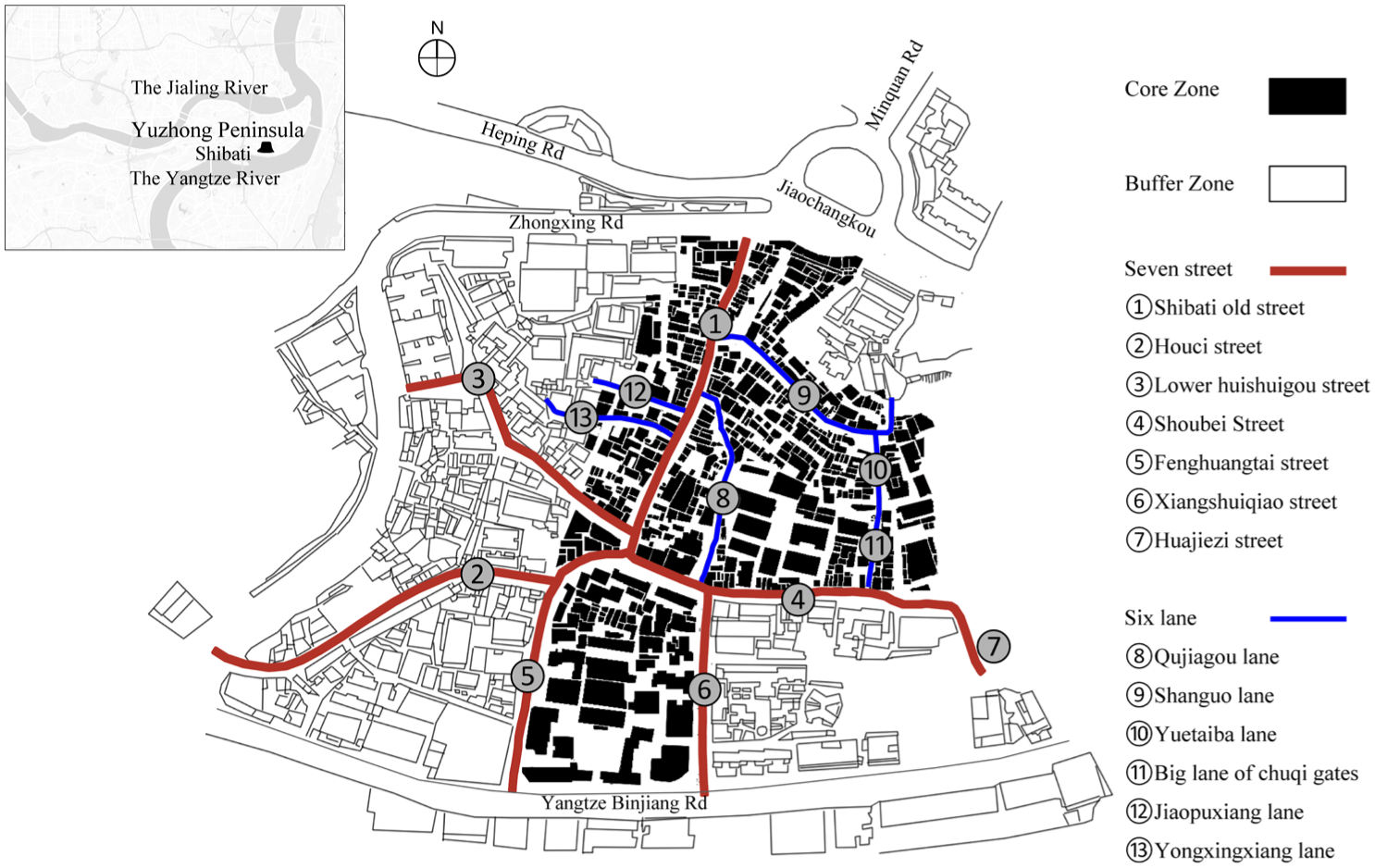
The location of Shibati in Chongqing.
Data collection
The fieldwork for this study was conducted in three phases: before redevelopment, during redevelopment, and after redevelopment. Phase I was prior to the large-scale demolition. We conducted six field surveys in Shibati from April 2008 to July 2010 and held in-depth interviews with cultural scholars who advocated for the protection of Shibati. We interviewed a total of 25 original residents and tenants using semi-structured interviews, and in-depth interviews were conducted with five cultural scholars. Phase II was the stage of large-scale demolition and construction, during which semi-structured interviews were conducted with 35 individuals, and in-depth interviews were carried out with 19 individuals from October 2010 to December 2019. Phase III, from December 2022 to October 2023, the newly-constructed Shibati had been completed and emerged as a new ‘wanghong attraction’ in Chongqing (Hualong Net, 2023). In this phase, textual analysis was conducted on a series of activities organised by Internet media, tourists, the Xintiandi Group, the district government, and the sub-district office, which aimed to revisit Shibati. The interviewees included original residents, shopkeepers, vendors, tourists, news reporters and editors, investment developers, personnel of the Redevelopment Command Centre (RCC) and so on (Table 1). Each semi-structured interview lasted approximately 30–40 minutes, while in-depth interviews ranged from 50 to 90 minutes. A total of approximately 108,000 words of transcribed notes were compiled.
The interviewees and key issues in different phases.
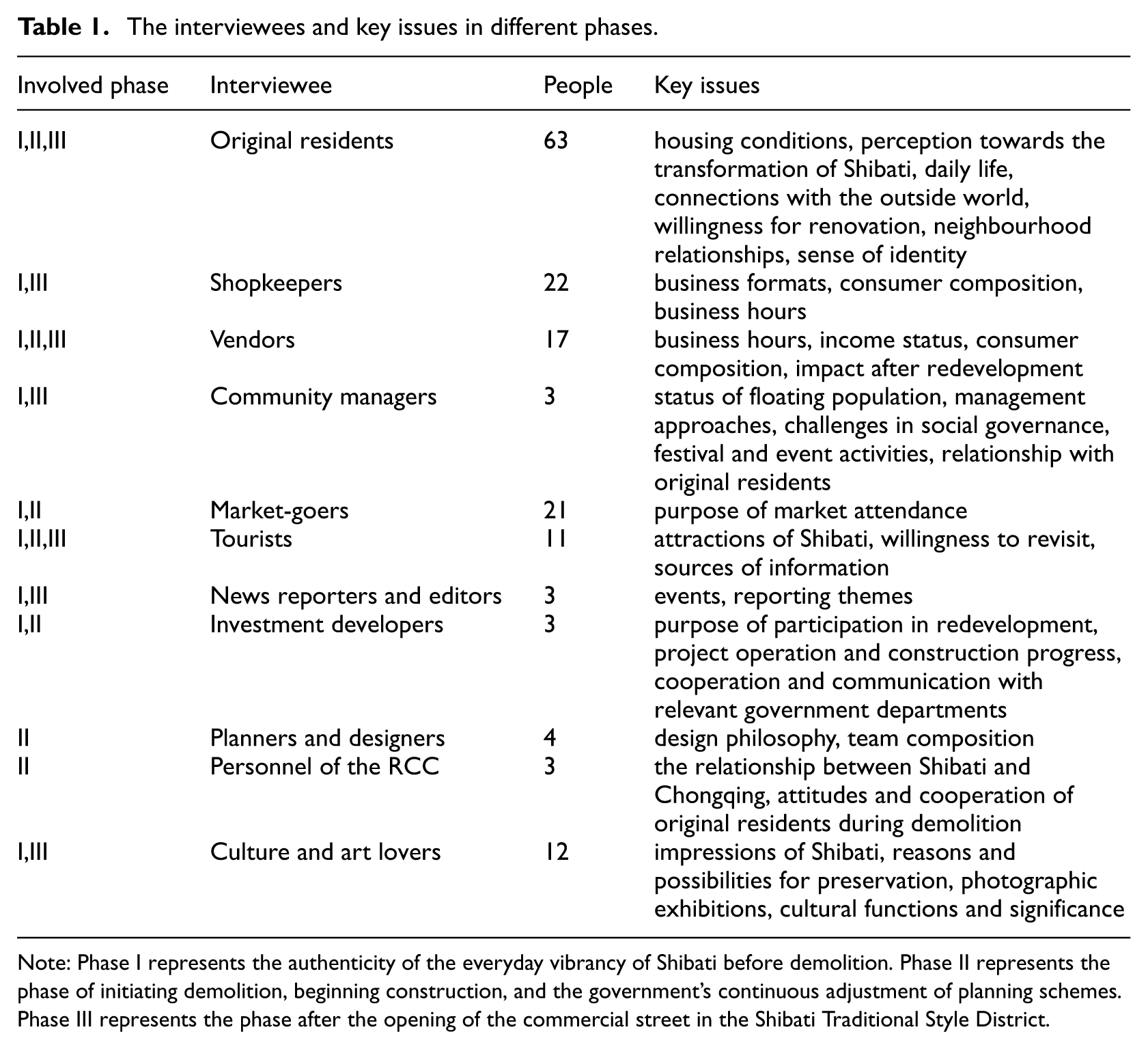
Note: Phase I represents the authenticity of the everyday vibrancy of Shibati before demolition. Phase II represents the phase of initiating demolition, beginning construction, and the government’s continuous adjustment of planning schemes. Phase III represents the phase after the opening of the commercial street in the Shibati Traditional Style District.
Memory intervenes in the urban redevelopment of Shibati
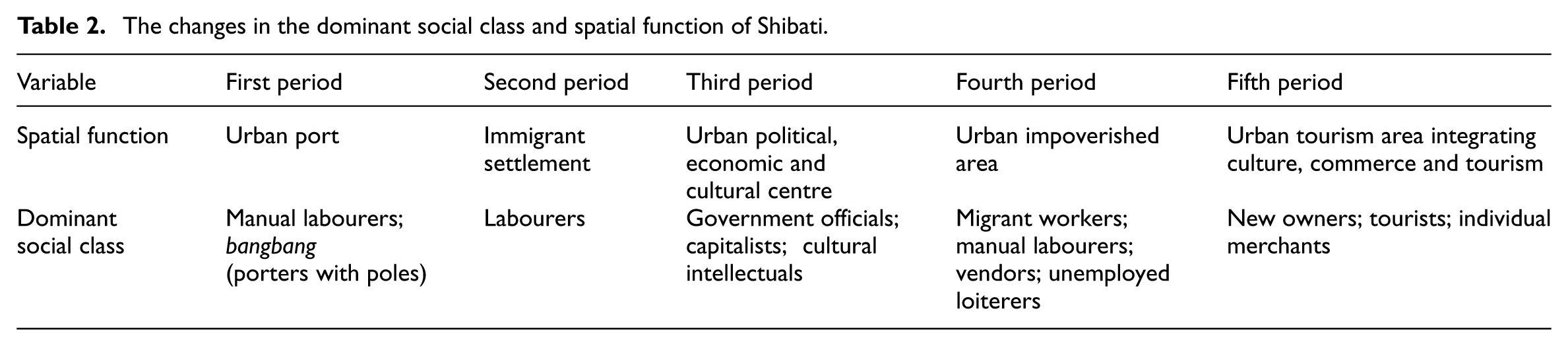
Shibati has a close historical connection with the urban development of Chongqing, having 1700 years of development history. At its peak, it was the political, economic and cultural centre of Chongqing. Its decline and transformation reflect the urban spatial expansion path of Chongqing, which was born by the water, built along the river, and developed upwards along the mountains (He and Zhang, 2021). From the perspective of urban development, the urban functions and spatial attributes of Shibati have undergone significant changes across five periods: from an early urban port area to an immigrant settlement, followed by an urban political, economic and cultural centre to an urban impoverished area, then transformed into urban tourism area integrating culture, commerce and tourism, with changes in the dominant social classes (Table 2). Since the proposal to redevelop Shibati through demolition was introduced, the voices calling for its preservation persisted until the completion of the new Shibati. It has become an urban redevelopment project with high domestic and international attention. To this day, there is still no way to end the social debate over the redevelopment of Shibati. From the whole process of urban redevelopment, the urban redevelopment of Shibati is a process full of conflicts, constant resolution and dynamic compromise between police and politics. In this process, the interactions between police and politics centred around memory and counter-memory are particularly noteworthy, and their specific modes of operation will be elaborated in the following section.
The changes in the dominant social class and spatial function of Shibati.
Police: Stigmatisation and the exclusion of memory
Throughout the three phases of the redevelopment of Shibati—before, during, and after, top—down government decision-making and bottom-up opposition have interacted in an intertwined manner. In order to ensure the smooth progress of the demolition work in the early phase of redevelopment, the government designated capable state-owned enterprises to participate in the demolition and established the RCC. On the basis of conducting field visits with the original residents, the RCC planned a special report titled Eighteen Dreams of Shibati’s People, which allowed the poor living conditions of Shibati and the hidden problems of vice (prostitution, gambling, and drug abuse) to be publicly disseminated throughout society. A large number of impressions of Shibati as ‘decaying’, ‘filthy’, and ‘despairing’ have been widely reported in the media. As mentioned by the RCC and community workers: Shibati is a place where one gets drenched in rainy days, scorched in hot days, gnawed at by rats at night, and constantly at risk of theft. (Worker of the RCC, May 2015) In this community, it is quite common to have police dispatched four or five times a day, with the highest number reaching thirty to forty times in a single day. The reasons for calling the police are diverse, including reports of theft, sightings of drug use, complaints about prostitution, and conflicts with neighbors. (Community worker, July 2010) You may have your own vision of humanity, but the residents of Shibati are under no obligation to pay the price for it. (Government official, May 2015)
This feature report magnifies the social problems of Shibati as an impoverished community while ‘excluding’ its profound local memories. By fully exposing its harsh living conditions and hidden social problems, it achieves policing through the stigmatisation of local memories. Furthermore, after the special report, under the supervision of relevant government agencies, the RCC organised a referendum of more than 7000 households involved in demolition in the name of polling on the renovation of old and dilapidated buildings. Residents were given the opportunity to decide for themselves whether to proceed with the demolition. The entire process was open to the public. The voting results showed that 96.1% of the households were in favour of the demolition. 3 The desires of Shibati residents for a ‘modern’, ‘clean’ and ‘warm’ residential community frequently appeared in official reports, and these became the rationale for the government’s demolition police. On the basis of the public opinion poll, the government soon launched a redevelopment project covering a total area of 188,800 m2, involving the demolition of 7083 households, and the renovation of a total building area of 385,000 m2.
The contingent memory politics
Defending memory
Under a series of policing measures, including a special report, referendum, and unified coordination by the RCC, the redevelopment of Shibati still faced strong opposition from some residents. One month after the referendum, the original residents of Shibati received the details of the housing demolition compensation. Subsequently, dissatisfaction arose due to the low compensation amounts and the distant location of the resettlement housing. Moreover, the unclear ownership and property rights of Shibati’s houses made the allocation of demolition compensation contentious. Consequently, some original residents strongly opposed their house’s demolition. They refused to relocate, citing their attachment to their old neighbourhood and the memories of growing up there. Some residents wrote slogans with strong resistance tendencies such as ‘Opposing forced demolition’, ‘Unfair compensation’, and ‘Vowing to live and die with the house’ on the construction hoardings. They also hung large-scale portrait photographs of some original residents on the hoardings and walls to declare the vitality of their daily life and their harmonious neighbourhood relations.
Subsequently, the voices of opposition to demolition and renovation quickly expanded to the category of outsiders called the part of those that have no part (Derickson, 2017: 44). Due to the lack of compensation plans for the livelihoods of small traders, vendors and tenants by the government and developers, the grassroots quickly joined the opposition camp and formed an opposition alliance. In their opinion, Shibati is a place to make a living, demolition means losing the means of livelihood and facing uncertainty. As mentioned by some tenants: It is very convenient to live in Shibati. We all work at Jiefangbei as waiters. It takes us 5 minutes to get to work. The rent is very cheap, and we can buy cheap daily necessities when we go to the market in Shibati. If we move out from here, we can’t find a place so close to Jiefangbei and so cheap. (Tenant, October 2012) I don’t mind the crappy houses here, I just sleep here at night and spend most of my time working at the mall. When I have saved enough money, I’ll go to a better residential area. (Tenant, November 2012)
In addition, some vendors held up placards on their stalls, which read ‘I want to survive’ to protest the demolition (Figure 2). Despite having made a living in Shibati for a long time, they remain the part of those that have no part in the government’s compensation scheme. The expansion of the part of those that have no part in defending memory poses a significant challenge to government-led police order. They strive to sustain their livelihoods by preserving the memory of everyday vibrancy, a point that will be elaborated in detail below.
Street vendors conducting business and the slogan ‘Protesting Demolition’.
Maintaining memory
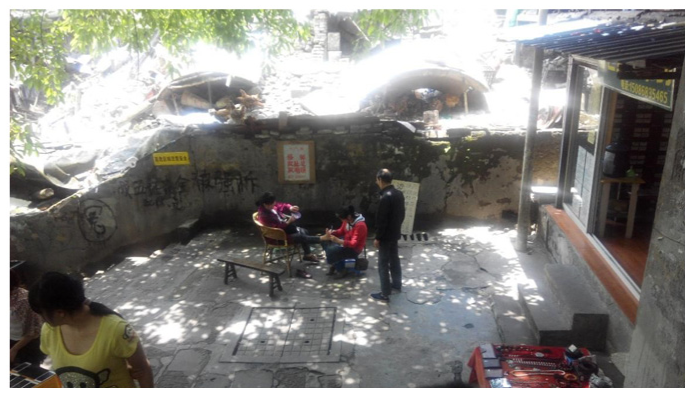
Due to the large concentration of migrant workers in Shibati, a folk custom of attending the market on Saturdays and Sundays gradually emerged. A total of 2 km of streets and alleys along the route from Huajiezi, Shoubei Street, Xiahuishuigou, Houci Street to Shibati (Figure 1), contained more than 800 business vendors when market activities were held. Since 2010, the roar of demolition machinery in Shibati has failed to suppress these vibrant market activities. Conversely, neither the number of vendors nor the market-goers has significantly decreased. On the ruins left by the demolition of Shibati and in the deserted alleys, the market activities continue to take place along the original streets. A scene of market activities on the ruins reflects the livelihood needs and the demand for living space of maintaining authentic local memories among the grassroot population (Figure 3). On the one hand, it delayed the overall demolition schedule of Shibati, preventing the developers from completing the demolition work within the originally planned construction period. On the other hand, it brought about serious safety hazards, while simultaneously posing a silent challenge to the police of the demolition site. This way of maintaining the original local memory was entirely spontaneous. The living habits of small traders, vendors, tenants, and market-goers constitute a political action that manufactures dissensus to make the invisible visible and the inaudible audible (Rancière, 2010). Behind it lies the logic of life that sustains the livelihood through the inherent scene.
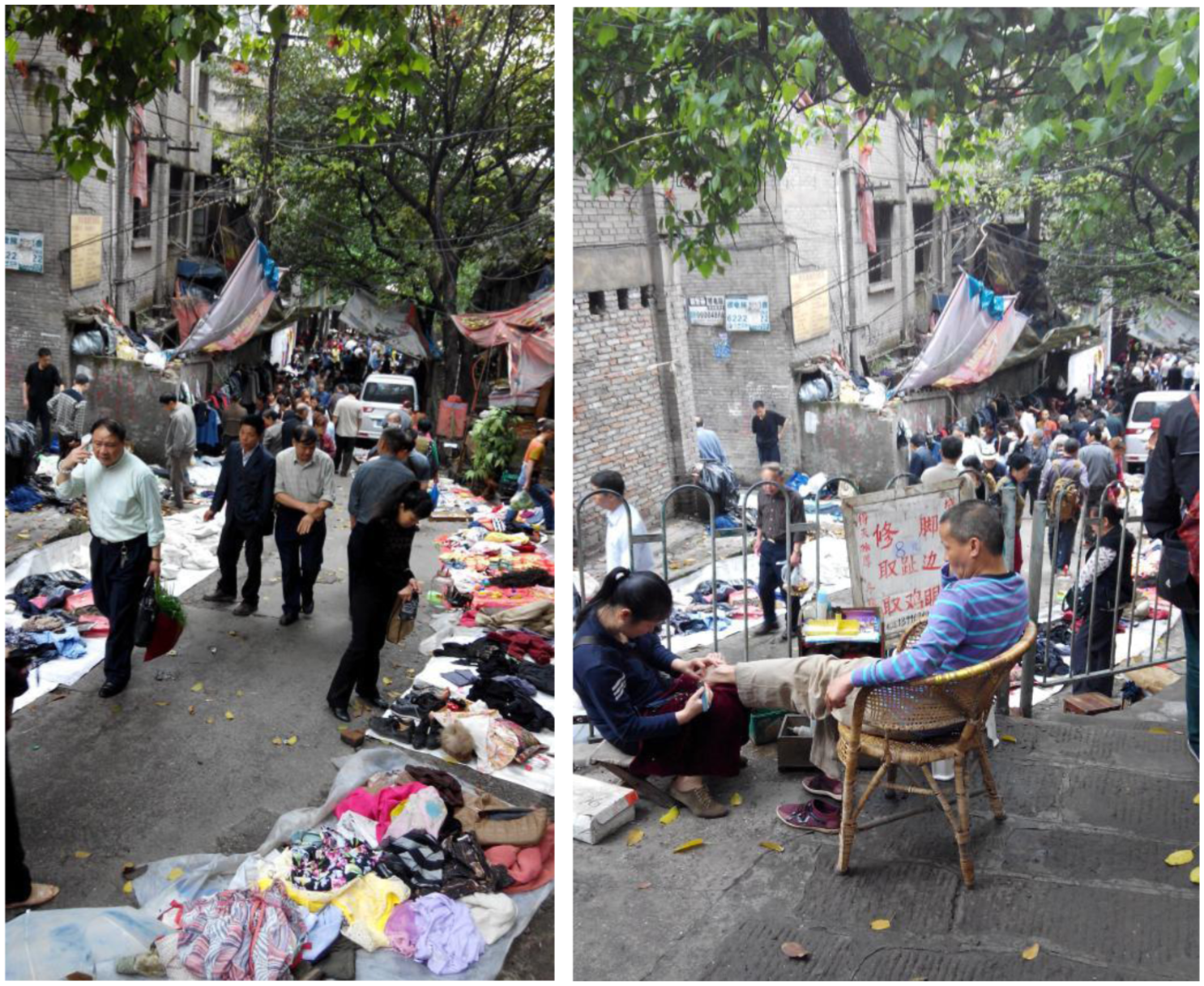
Market activities on the ruins.
Towards counter-memory
Counter-memory that resists the police order becomes a path through which politics occurs, and it is closely bound up with the omitted parts of the memory of the police order. In addition to some property owners, stallholders, vendors, and tenants, a number of artists, photography enthusiasts,
4
and cultural preservationists also joined the camp of the part of those that have no part in opposition. They strongly opposed the stigmatising dissemination of local memory by the government and developers that serves urban redevelopment. Through various forms, such as documentaries and photographic works, they presented the depth of the historical neighbourhood of Shibati, the gradually vanishing vibrancy of everyday life during the demolition, and the difficulties of residents’ life. As mentioned by a photography enthusiast: Shibati is a world of truly three-dimensional living. It is the quintessential representative of the mountain city. Upon my first visit, I was captivated by the shaded alleyways lined with lush trees, the haphazardly crisscrossed electrical wires, the enticing aroma of cooking wafting through the air, the cries of street vendors, the sounds of Hong Kong films emanating from video halls, and the occasional bursts of laughter. Driven solely by a passion to capture the everyday life here, I have made more than ten trips between Beijing and Chongqing, without any form of remuneration. It is simply a matter of personal affection. (Photography enthusiast, October 2018)
These photographic works and short videos have caused a sensation on the Internet, drawing unprecedented attention and in-depth exploration to the cultural values and local memories of Shibati that had been excluded. Here are some examples:
Liu Bocheng once operated a pharmacy in Shibati and used it as a base for passing messages among revolutionaries; Yu Youren once lived in a small alley in Houci Street, and the name of Houci Street was actually coined by Yu Youren himself; the patriotic general Feng Yuxiang once engaged in discussions with cultural intellectuals at the ‘Tianfeng Guqin Society’ in Shibati; the industrialist Liu Hongsheng established a match factory at Fenghuangtai there, supporting the War of Resistance against Japanese Aggression through industrial development; artists such as Xu Beihong and Xu Yuanbai once engaged in artistic creation in Shibati.
A large amount of information regarding the cultural value of Shibati has been successively unveiled. However, in the relevant planning schemes published by the government, there were no measures to preserve these cultural values. Voices opposing the redevelopment of Shibati from all sectors of society have been rampant, causing the demolition work to proceed very slowly, with several periods of stagnation (Figure 4). Thus, the political subjects emerging from memory disputes in Shibati demonstrate spontaneity. Their modes of politics manifest through fragmented forms and multi-narrative subjects, initiating struggle around excluded memories that have been policed—a trajectory evolving from defending and sustaining memory towards ultimately articulating counter-memory. In this process, the part of those that have no part continues to expand, propelling the emergence of the politics (Rancière et al., 2001).
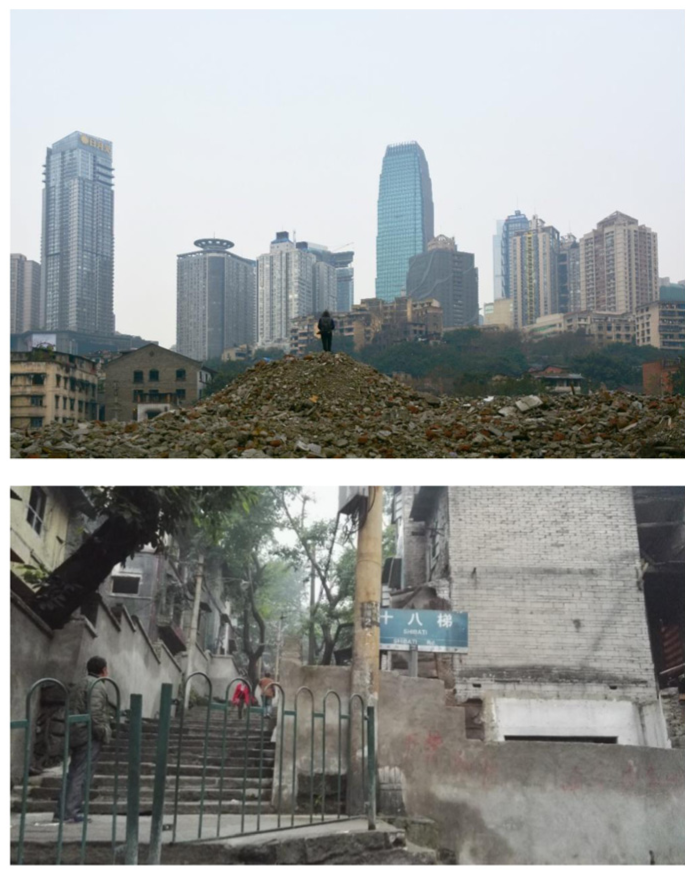
The stalled demolition site.
Memory and counter-memory as a tool
The selection of memory
With the demolition progress being slow or even interrupted, the government realised that it was hard-pressed to advance the redevelopment of Shibati solely from the perspective of social governance in dilapidated housing renovation. To address this issue, the government established the Historical and Cultural Block Construction and Management Committee. It also organised relevant departments to compile the Protection Plan for the Historical and Cultural Landscape of Chongqing’s Main Urban Area, designating Shibati as a historical and cultural landscape district, and explicitly committing to preserving the memory of the mountain city (Chongqing Municipal Planning and Natural Resources Bureau, 2025). In addition, the RCC similarly used construction hoardings to display large-scale photos of the residents who have relocated to the new community. These photos featured family portraits of the residents, as well as their bright, spacious, and fully-equipped new homes. Each photo was labelled with the homeowner’s name, the address of their new community, and the original address at Shibati. The measures taken by the government and RCC have, in essence, already exceeded the form of policing. Soon, real estate developers made new arrangements in line with the government’s planning. They picked out the iconic material memories to weaken the logic of capital appreciation in urban redevelopment. This is fully demonstrated in the subsequent cultural restoration and reuse of the Matchstick Mill.
The decision makers of the GuocoLand Residential Project chose to build the project’s marketing experience centre at the dilapidated Matchstick Mill, 5 the project involved the high-standard and intensive conservation-based reconstruction of a brick-and-timber structure with a construction area of only 5770 m2, which spanned 1031 days. The project has pioneered the marketing experience in terms of material selection, landscape design, functional matching, and art exhibitions. The historical building was revitalised as the display centre for the residential project. The Matchstick Mill, a symbol of China’s modern national industry, was restored to its original appearance to highlight the transnational capital and value orientation of the GuocoLand Residential Project in inheriting Chongqing’s humanistic history. More importantly, the work has been awarded the Architecture Master Prize, setting a precedent for the restoration and innovation of historical buildings worldwide. Furthermore, the newly constructed Shibati Traditional Style District has selected and preserved typical material memories such as ficus virens, bluestone slabs, air-raid shelters, tikan, and the former site of the French Consulate. Undoubtedly, such memories are selected, essentially through the developers’ selective material memory to achieve the purpose of policing. Memory has become a tool for developers to achieve their goals. Through the means of memory, developers demonstrate compromise, yet they obscure the authentic memories of Shibati and the local society originally inhabited by the grassroots.
The supplement of counter-memory
Confronted with the ongoing market activities, the developers directly exerted pressure on the RCC, demanding the suspension of these activities to ensure personal safety during the demolition and construction process, as well as to maintain the construction schedule. In response to the ongoing market activities and over 100 households that resolutely refused to relocate, the government adopted two distinctly different approaches for guidance. In response to the former, the government issued an official document to prohibit the market activities and erected hoardings in some alleys to restrict access. In response to the latter, a more flexible approach was adopted, festive events and photographic exhibitions themed around ‘recollection’ were organised. The RCC and relevant departments organised several reunion activities for the former residents of Shibati. These events brought together residents who had previously moved out of Shibati and were now scattered across different areas. They returned to Shibati to reconnect, reminisce about friendship and envision the future. The activity had a profound impact on the residents who insisted on not relocating. In their conversations, the most frequently mentioned topics were their new houses and new life. In addition, due to the long-term persuasion by community-influential residents and the numerous inconvenience in their daily life, including sleep difficulties caused by construction noise, more than 100 households eventually moved out of Shibati one after another. By the end of 2016, the demolition was completed. The Shibati project, from the initiation of resident relocation to the commencement of construction in 2017, spanned over six years.
Furthermore, in October 2021, Shibati officially opened to the public, marking its entry into the commercial operation phase. The pictures of Shibati after opening to the public were rapidly disseminated on social media. Due to its inauthentic replica of ancient architecture and clumsy material memory landscape, it was met with even more intense social critiques. As mentioned by a tourist and a cultural preservationist: This is a Ming Dynasty well, huh? A shallow concrete cesspool, outrageously fake!!!! I will never come again. (Tourist, December 2021) The current Shibati and the Mountain City Memory Museum are far from the real Shibati and far from meeting the public’s expectations. (Cultural preservationist, February 2022)
To maintain its normal operations and mitigate the negative impact of intense social critiques, the government, in collaboration with operators and social media, announced the launch of regular intangible cultural heritage (ICH) display activities in the new Shibati. They also publicised that during the 2025 Spring Festival holiday, the new Shibati received a staggering 9.5 million visitors within just five days (Upstream News, 2024). This achievement was further highlighted by Shibati’s appearance on the 2025 CCTV Spring Festival Gala, propelling it to become one of the top five tourist destinations nationwide (Zhou, 2025a). These measures effectively obfuscated the social critiques directed at the archaised commercial street. Once again, they operationalised the policed form of counter-memory to resolve the political form of counter-memory articulated by cultural preservationists. It is evident that the government’s policing actions extend beyond merely planning adjustments, facility improvements, and environmental beautification. Rather, it involves a cultural governance strategy that employs the selection of memory and the supplement of counter-memory as its governance tools. Fundamentally, the memory anchoring of Shibati has propelled and yet constrained the process of its urban redevelopment. The forms and boundaries of top-down policing and bottom-up political action have been mutually altered due to memory and counter-memory, bringing about the distribution of the sensible.
The agency of memory and the economisation of memory politics
Memory is used as an important tool to reconfigure social and spatial order in the government’s approach of policing. Simultaneously, as politics unfolds through the form of counter-memory, policing adapts by strategically responding to the content and form of counter-memory, likewise supplementing local memory in the guise of counter-memory. The conscious and unconscious counter-memory resistance of different classes, including original residents, tenants, mobile vendors, and cultural preservationists, did not change the outcome of spatial transformation and local social fragmentation in Shibati, nor did it truly achieve the goal of the part of those that have no part. The economic demands originating from the grassroots lead to the vulnerability of its political subjectivity. Two fundamental reasons underlie this. Firstly, it is the contradiction between the ‘transitional identity’ of original residents’ political subjectivity and the expectation of institutionalisation. Following shifts in the government’s form of policing, the original residents became profoundly fragmented, resulting in acute political vulnerability. Secondly, the counter-memory of cultural preservationists is fragmented. They are inherently unable to forge genuine solidarity with original residents and mobile vendors fighting for higher compensation. Instead, they showcase the neighbourhood amnesia of rapid urban development in a nostalgic manner, aiming to elicit sympathy. In other words, the part of those that have no part has adopted the path of memory and counter-memory, rather than pursuing the restoration of a complete local memory.
It can therefore be concluded that the political subjectivity of memory is inextricably linked to that of the part of those that have no part. The question of who is the subject of memory extends into the issue of memory’s inherent agency. Counter-memory can serve as both a form of politics and a channel for police. The existing order and the standpoint from which memory is defined directly determine the construction of political subjectivity in counter-memory. The political subjectivity of the part of those that have no part in Shibati is fragile, this stems from the difficulty for the part of those have no part to form an institutionalised mechanism for deliberation. Nevertheless, it is this group that has rendered segments of the obscured order audible and visible. Both the counter-memory of policing and that of politics have jointly propelled the accumulation and supplement of memory justice in Shibati. Memory and counter-memory, police and politics, are not binary opposites. They possess porous, fluid boundaries (Figure 5).
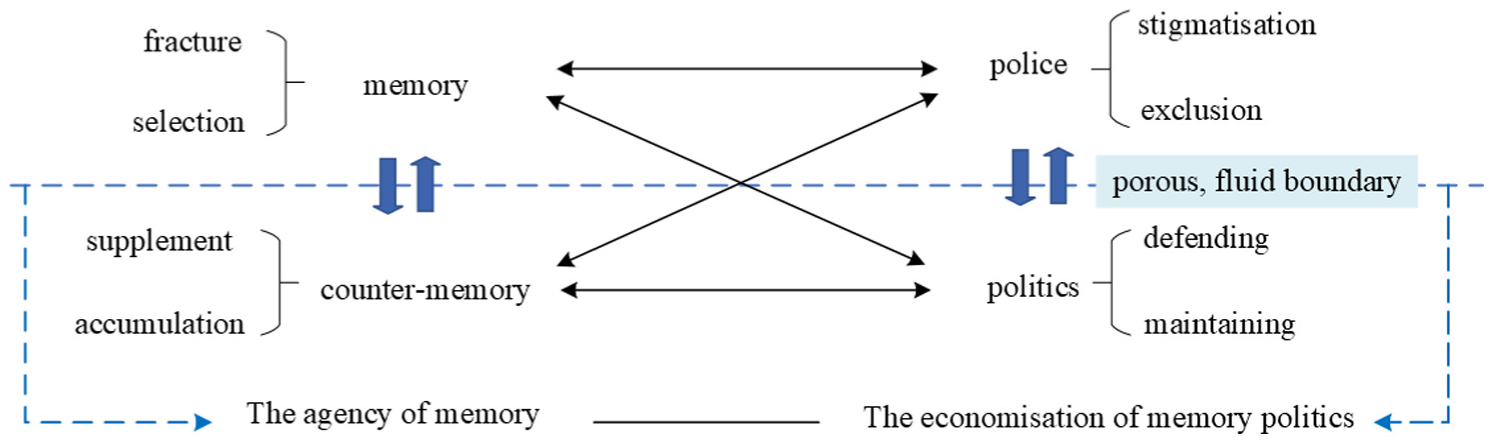
The mutual construction and flow of memory and counter-memory, police and politics.
However, changes in these porous and fluid boundaries are heavily constrained by the ‘transitional identity’ of political subjectivity, rather than playing their institutionalised role. Throughout the entire process of the urban redevelopment of Shibati, the political actors, though spontaneous, remained fragmented. In particular, the driving forces behind the original residents’ resistance have been predominantly rooted in demands for higher economic compensation and livelihood needs, rather than a fight for local memory itself. Therefore, in the context of urban redevelopment, memory politics is not defined by how the past is articulated, but by what can be claimed for the future—transforming intangible ‘memory loss’ into tangible ‘economic compensation’. The politicisation of memory that questioned the established order is converted into an economisation of memory for positional optimisation. Socially and culturally constructed memory evolves into a redistribution at the economic-cultural interface. Once endowed with economic value, memory and counter-memory are transformed into a form of capital that is calculable, tradable, and manipulable. Nevertheless, this study must point out that this porous and fluid boundary functions like a filter. Filtering memory into price is a strategy of necessity; otherwise, it would be even more difficult to gain recognition.
Conclusion
The redevelopment of Shibati has achieved a fundamental transformation from an urban impoverished area to a cultural space integrating culture, commerce, and tourism. Throughout this transformation, the pre-existing community culture and lifestyles have gradually faded away, making way for emerging commercial practices and urban spectacularisation (Flock, 2024). In this spatial transformation, the boundaries between police and politics have shifted and mutually constructed. Memory and counter-memory have become the medium and pathway for the shifting and mutual construction of the boundaries between police and politics. Therefore, memory and counter-memory have acquired a political attribute in urban spatial governance. They are not a mirror image of the entire past, but rather a present-grounded game at the economic-cultural interface. Memory and counter-memory constitute the as-yet-undistributed part of the sensible. Due to the multifaceted nature of their subjects, memory and counter-memory have become practical techniques for the emergence of the politics in urban redevelopment. The exclusion and selection of memory becomes a special form of policing tool, counter-memory is not a denial of memory, but rather a powerful retort to the exclusion and selection of memory.
The results of this study indicate that the grassroots represented by original residents, mobile vendors, and cultural preservationists have changed capital’s attitude of focussing on economic interests and indifference to social welfare to some extent (Sun et al., 2024; Wang and Wu, 2025), making the local memory a visible factor that capital and power have to take into consideration, which is difficult to see in previous studies of urban redevelopment. Therefore, at the theoretical level, this paper reveals the boundary interactions between police and politics in Rancière’s aesthetic politics, as well as the multi-layered negotiations of local memory. This is different from the singular opposition, confrontation, or even zero-sum relationship between police and politics. Secondly, as performative expressions of power relations in dynamic game, both memory and counter-memory are anchored in the present rather than in the past. The memory politics here concerns what memory does rather than what it is, thus becoming a medium for urban spatial governance.
The contribution of this paper is to reveal the economic-cultural interface where the boundaries between memory and counter-memory, police and politics, become fluid, thereby advancing the understanding of the transformation from the politisisation of memory to the economisation of memory in the context of urban redevelopment. The gradual mechanism of inclusion–co-optation, guided by the thread of memory and counter-memory, holds significant potential and promise for urban spatial governance in China. At the same time, what requires critical reflection is this: in the context of urban redevelopment, who is entitled to assume the role of institutionalised guardian of memory and custodian of urban culture. Drawing on Rancière’s theory, we find that memory serves as a mediator of aesthetic politics, and that the justice of memory is crucially linked to the political subjects capable of redistributing the visibility of memory. Therefore, memory justice refers not only to the visibility of different political subjects’ memories, but also to the simultaneous manifestation, coexistence, and juxtaposition of memories from different eras within the same physical space. When the simultaneity of memory becomes an institutionalised mechanism of visibility through a logic of accumulation rather than replacement, memory will not be subsumed under the logic of policing. The simultaneity of memory is a necessary condition for memory justice. Another contribution of this paper is that it adds critical reflection to the social feedback following the completion of urban redevelopment project and on its relationship with the earlier phases, whereas previous research has tended to focus primarily on the pre-redevelopment phase and construction process of urban redevelopment.
Footnotes
Acknowledgements
The authors are indebted to Dr Junxi Qian, who provided valuable comments on early drafts. We thank the editors and reviewers for their insightful and constructive comments on this paper. Thanks to all interviewees who were willing to share their experiences and insights.

Funding
The authors disclosed receipt of the following financial support for the research, authorship, and/or publication of this article: This research is supported by the National Natural Science Foundation of China (Project No. 42371237).
Declaration of conflicting interests
The authors declared no potential conflicts of interest with respect to the research, authorship, and/or publication of this article.