






Abstract
Recent scholarship on left-behind places shows how uneven spatial development produces affective consequences. Yet discontent and resentment are often treated as near-automatic responses to economic marginalization, obscuring the diversity of left-behind places and their varied emotional and political outcomes. This article argues that left-behindness is temporally constituted: to understand how it is experienced, interpreted, and politicized, we must analyze how places are left behind in time. To do so, the article develops a multi-layered timescape framework linking a macro timescape of global capitalist restructuring, a meso timescape of local change agency, and a micro biographical timescape of lived experience. Interactions across these layers—through timing, sequence, duration, and tempo—shape how left-behindness becomes narratable, meaningful, and contested. Empirically, the article analyzes Northeast China as a case of left-behindness, identifying a distinctive pattern of belated cultural representation and quasi-politicization crystallizing in the city of Shenyang.
Introduction
Across many countries, widening spatial inequalities have produced a growing set of places described as “left behind.” While large metropolitan areas concentrate talent, capital, and innovation (Bertinelli and Strobl, 2007; Florida, 2017), other places instead experience cumulative decline and discursive marginalization, often pejoratively labeled “rust belts” or “flyover country” (Rodríguez-Pose, 2018; Rodrik, 2018). These places—whether former industrial heartlands or long-peripheral areas—face economic stagnation, out-migration, institutional erosion, and a pervasive sense of diminishing prospects, and increasingly come to be recognized, both externally and internally, as places that no longer matter. This uneven development has generated what scholars describe as a broader “geography of discontent,” with significant political and social consequences (De Ruyter et al., 2021; Dijkstra et al., 2020; Ford and Goodwin, 2014; Rodríguez-Pose et al., 2024). In response, recent research has turned to the concept of “left-behind places” to analyze how such regions become marginalized within national growth trajectories (MacKinnon et al., 2024; Pike et al., 2024; Rodríguez-Pose et al., 2023; Trejo-Nieto, 2025; Tups et al., 2024).
While the link between left-behind places and political discontent is central to understanding the affective dimensions of uneven development, focusing only on visible or politicized cases is analytically limiting. Privileging such sites obscures the heterogeneity of left-behind places—both in the pathways through which marginalization unfolds and in how it is locally interpreted, whether as inequality, unfairness, or something else (Rodríguez-Pose, 2018; Rodrik, 2018). The concept is often applied across multiple scales, from neighborhoods and towns to cities and regions, grouping together rural areas and former industrial regions with markedly different histories and institutional legacies (Bolton et al., 2019; Jennings and Stoker, 2019; Kemeny and Storper, 2020). Equating left-behindness with discontent therefore risks homogenizing distinct trajectories and overlooking how marginalization is constructed, experienced, and responded to in place. Former industrial regions, for example, differ markedly from rural areas in their institutional legacies and social orders, producing more complex responses to decline (Cramer, 2016; Scheiring and King, 2023; Walley, 2013). Empirical variation underscores this point: even among structurally similar U.S. post-industrial cities, political trajectories diverged during the 2020 election, with some remaining Democratic strongholds while others shifted Republican despite comparable economic pressures (Ternullo, 2024). More rigorous analytical frameworks are therefore needed.
This article responds to recent calls to reconceptualize “left-behindness” as relational and temporal, produced through multiple dimensions that unfold unevenly across places and over time (Benner et al., 2024; Furlong, 2019; Pike et al., 2024). Empirically, it examines the old industrial region of Northeast China, widely regarded as left behind during the country’s rapid growth and frequently labeled China’s “rust belt.” The economic foundations of its marginalization date to the onset of market reforms in 1978, yet this gradual decline did not translate into overt affective or political mobilization. Only after 2015 did left-behindness become widely narrated and emotionally resonant, taking shape through a distinctive form of quasi-politicization centered on cultural reclamation and representations of loss, most visibly in the “New Northeast Literature” associated with young writers in Shenyang—a relatively locationally advantaged and economically resilient city (Xie, 2025). This pattern raises two puzzles: why did left-behindness rooted in late-1970s reforms become culturally mobilized only decades later, and why did this contestation emerge most visibly through writers based in relatively resilient Shenyang rather than from the region’s most economically marginalized localities?
Addressing these questions requires a processual perspective on how places become left behind and how marginalization becomes narratable, meaningful, and politically charged. The article therefore develops a timescape approach that treats socio-spatial change as temporally constituted. It distinguishes three intersecting layers: a macro capitalist timescape shaped by global restructuring and shifting accumulation regimes; a local change-agency timescape shaped by institutional actors; and a biographical timescape capturing residents’ lived experiences. Intersections among these layers—through timing, tempo, duration, and sequencing—shape trajectories of decline, lived experiences of left-behindness, and how such conditions are understood and acted upon.
The remainder of the article proceeds as follows. The second section elaborates the timescape framework and key temporal mechanisms. The third section outlines the research site and methodology. The fourth section presents empirical findings from Northeast China, with a focus on Shenyang. The conclusion reflects on the broader implications of a timescape approach for understanding left-behind places in an era of global transformation.
Conceptualizing left-behind places as a temporal phenomenon
A key contribution of the literature on “left-behind” places is its effort to link the structural conditions of uneven spatial development with their affective consequences (MacKinnon et al., 2022). Structural conditions refer to measurable dimensions such as income disparities, employment loss, and material deprivation (Davenport and Zaranko, 2020), while affective dimensions capture subjective experiences, including emotional responses, senses of belonging, and attachments to place among residents of marginalized areas (Díaz-Lanchas et al., 2021; Gordon, 2018). By foregrounding this dual character—material marginalization alongside place-based affect—the literature provides a valuable framework for understanding how uneven development is both structurally produced and socially lived.
What remains insufficiently theorized, however, is the mediating process through which left-behindness is interpreted, framed as a problem, and gradually politicized—or not—within specific local contexts. This link is analytically crucial because it shapes whether marginalization becomes a source of grievance, how it is expressed, who articulates it, and what emotions and political meanings it acquires. A place is not simply left behind in objective terms; it becomes left behind through processes of imagination, perception, and discourse (Benner et al., 2024; Görmar, 2024; MacKinnon et al., 2024; Tups et al., 2024). These interpretive and experiential processes are inherently temporal, connecting readings of past trajectories to evaluations of present conditions and expectations of the future. Competing definitions of left-behindness thus evolve through ongoing negotiation among actors with different stakes and temporal horizons, shaping local identities and attachments over time (Benner et al., 2024; Biddau et al., 2023; MacKinnon et al., 2022).
To account for how left-behindness is both structurally produced and subjectively experienced over time, this article proceeds in two steps. First, it develops a multi-layered timescape framework to map the coexistence of multiscalar processes—macro restructuring, local institutional change, and biographical life courses—that together shape a place’s trajectory into left-behindness. This framework specifies the structural-temporal architecture within which marginalization unfolds. Second, drawing on temporal studies, the article identifies the concrete intersection mechanisms between these timescapes through which left-behindness is lived, interpreted, and acted upon.
A timescape approach to left-behind places
Analyzing left-behind places requires understanding how place is constituted, experienced, and transformed over time. Place is “concrete, subjective, and empirically affective,” in contrast to abstract and ostensibly objective notions of space (Chu and Hassink, 2023: 397). It is therefore not a static container but a dynamic social construct, continuously reshaped through cultural practices, power relations, biographical trajectories, and institutional processes (Cresswell, 2014; Pred, 1984). Humanistic geography has long emphasized place as lived and relational, formed through experience, memory, emotion, and meaning (Tuan, 1977). Residents are embedded in local contexts, and their knowledge, agency, and expectations are shaped by places (Pike et al., 2024).
Understanding the evolution of social and economic landscapes requires attention to the layered and interacting temporalities through which generative processes, structural shifts, and historical events unfold (Henning, 2019; Martin and Sunley, 2022). Drawing on Adam’s (1998, 2008) concept of the timescape, which understands space and society as co-constituted through time, this article conceptualizes place as produced through the interaction of three interrelated temporal layers: a macro capitalist timescape, a meso-level local change-agency timescape, and a micro-level biographical timescape.
The macro capitalist timescape refers to broader constellations of accumulation regimes, production and consumption cycles, technological change, uneven development, and crisis. Capitalist temporality is composite, encompassing slow structural shifts, rhythmic cycles, and abrupt disruptions such as trade wars, regime transitions, or pandemics (Sewell, 2008). These dynamics are mediated by the state, which acts as crisis manager, institutional innovator, resource allocator, and narrative builder (Skocpol, 1984). The state can dismantle entrenched path dependencies, legitimize new development paths, steer transition through institutional innovation, and correct social inequalities and spatial injustice (Berger et al., 2022; Hassink et al., 2018; MacKinnon et al., 2019). Through policy timing, sequencing, and prioritization, the state shapes the tempo and direction of spatial change.
The local change-agency timescape centers on how municipal governments, planners, firms, and community organizations interpret and rework these broader agendas within specific territorial contexts (Bækkelund, 2021; Grillitsch and Sotarauta, 2020; Stihl, 2024). Rather than passively implementing top-down directives, local actors actively negotiate development pathways, materially and discursively making—or unmaking—places as left behind (Ey and Sherval, 2016). This agency has both a “bright” side, including innovation and institutional entrepreneurship, and a “dark” side, as decisions may inadvertently entrench marginalization or reproduce decline (Benner et al., 2024; Kurikka et al., 2023).
The biographical timescape captures lived temporal experience. It traces how residents interpret structural change, respond to institutional shifts, and participate in the ongoing remaking of place over the life course. Under relatively stable conditions, everyday rhythms sustain social reproduction and anchor identities and expectations (Ho, 2021; Lefebvre, 2004). During periods of disruption, however, these rhythms fragment: biographies are unsettled, plans recalibrated, and futures rendered uncertain (Swidler, 1986). Emotional responses—nostalgia, resentment, resignation, or aspirations to leave—become temporal strategies for navigating disrupted life trajectories (Agbiboa, 2019).
Taken together, these three timescapes suggest that left-behindness emerges from the uneven intersection of structural transformations, local institutional responses, and lived biographies rather than from any single factor. Although these processes often unfold gradually, they become most analytically visible at historical conjunctures when accumulation regimes are reorganized and the relationship between place, institutions, and livelihoods is redefined. Such moments—often conceptualized as critical junctures (Capoccia and Kelemen, 2007; Fischer et al., 2024; Sørensen, 2023)—are intrinsic to the macro capitalist timescape. Periods of deindustrialization, large-scale restructuring, financial crisis, or pandemic recalibrate the spatial value of assets, skills, and institutions, turning former centers of production into peripheral or disadvantaged regions. This perspective is particularly salient for old industrial areas. Because their infrastructures, labor markets, and social institutions are built around specific industrial regimes, they are highly path dependent and especially exposed to macro restructuring. When national or global strategies shift, inherited strengths can quickly become liabilities. Attending to these conjunctural reconfigurations thus provides a concrete entry point for tracing how left-behindness is materially produced, institutionalized, and later interpreted in everyday life.
Temporal mechanisms shaping the meaning of left-behindness
The three timescapes do not operate in isolation; their intersections shape how left-behindness is experienced and interpreted. Differences in sequence, tempo, duration, and timing condition how actors encounter change, mobilize resources, and respond to moments of reform or disruption.
Sequence refers to the ordering of events and how this ordering structures expectations, interpretations, and outcomes (Pierson, 2000). Institutions and dominant narratives embed implicit scripts about what should happen first and what futures are plausible. When these anticipated sequences break down, shared assumptions about progress and fairness are unsettled. Hochschild’s (2016) study of Trump voters illustrates this dynamic: adherence to a “deep story” of upward mobility makes stalled advancement or perceived line cutting feel unjust, translating temporal disappointment into emotional and political grievance. “Long-term” left-behind regions differ from “recently” left-behind ones in the ordering of growth and decline, influencing how residents attribute causes and assess future prospects (Connor et al., 2024).
Tempo concerns the speed and intensity of change across timescapes (Adam, 2008; May and Thrift, 2001). Change is uneven rather than uniform, combining slow structural drift with abrupt transformation (Pierson, 2003). Tempo shapes not only outcomes but also the capacity to respond. Because institutional adaptation is typically slow—constrained by routines and accumulated capacities (Hu and Yang, 2019)—rapid restructuring can overwhelm governance systems, undermine learning, and generate disorientation and chronic stress (Chien and Woodworth, 2018; Datta, 2017; Rosa, 2013). Conversely, slow violence unfolds incrementally, embedding diffuse and enduring forms of trauma (Pain, 2019).
Duration highlights the persistence of long-standing institutions, practices, and moral economies. Such durability can stabilize social life while also constraining adaptation (Pierson, 2003). At the meso level, enduring arrangements generate path dependencies that lock regions into particular trajectories (Martin and Sunley, 2006). At the micro level, they shape expectations, dispositions, and habitus, influencing how people interpret change and imagine the future. Prolonged stagnation may normalize decline, erode trust, and foster intergenerational resentment (Rodríguez-Pose et al., 2024).
Timing directs attention to when individuals encounter change across the life course, producing generational and cohort effects (Mannheim, 1952). Exposure to industrial decline or policy reform at different stages of life shapes how loss and opportunity are perceived (Elder, 1974; Troost et al., 2023). Older workers who recall stable employment often interpret decline as betrayal or injustice (Essletzbichler et al., 2018; Gordon, 2018; Norris and Inglehart, 2019; Walley, 2013), whereas younger cohorts may experience stagnation less as rupture than as an enduring condition of constrained horizons (Silva, 2013).
Together, these mechanisms operationalize the timescape framework, enabling analysis of how left-behindness is produced, interpreted, and contested over time. Rather than treating left-behind places as static categories or assuming discontent as automatic, this approach foregrounds left-behindness as a dynamic and historically contingent process emerging from the uneven intersections of temporal layers (Figure 1).
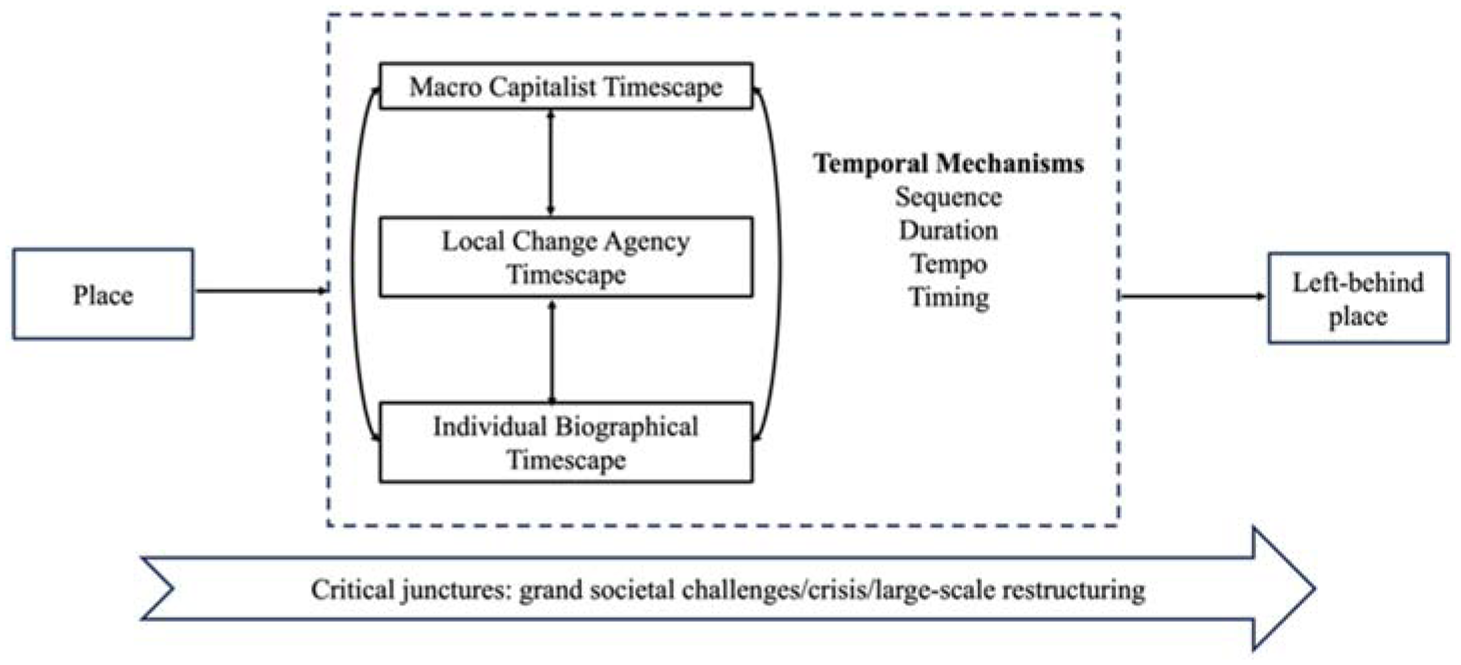
Integrative theoretical framework.
Research place and methodology
This study focuses on Northeast China—comprising Liaoning, Jilin, and Heilongjiang—once celebrated as the “Eldest Son of the Republic,” later labeled China’s “rust belt” (Hu, 2014; Lee, 2007), and widely regarded as left behind during the country’s rapid growth. 1 More specifically, it asks why Shenyang, Liaoning’s provincial capital and one of the region’s more resilient cities, 2 has nonetheless emerged as a prominent site where the “Northeast Problem” is publicly articulated and culturally contested, and why this articulation appeared only after 2015 despite decades of gradual economic marginalization since the onset of market reform.
This apparent paradox allows the study to move beyond equating left-behindness with either deprivation or resilience and instead to analyze it as a historically and temporally mediated process. In this sense, Shenyang functions as a “theoretically resolutive case,” useful for clarifying conceptual tensions and generating broader theoretical insights (Pacewicz, 2024). The analysis traces how left-behindness is produced through the interaction of policy timing, industrial restructuring and urban regeneration, and biographical experience, asking how it is lived, defined, and voiced—by whom, when, and why.
Empirically, the study combines long-term fieldwork in Shenyang, historical documentation of Northeast China, and comparative observations beyond the region. Multiple sources are integrated to examine macro-, meso-, and micro-level timescapes of change. At the macro level, policy documents, archival materials, and secondary literature reconstruct decades of political-economic restructuring, institutional reform, and regional development strategies. At the meso level, the analysis focuses on local change agents—municipal governments, enterprise leaders, and planners—examining how they interpreted and implemented reforms, managed unemployment crises, and pursued urban renewal. Sources include local newspapers, gazetteers, enterprise archives, and interviews with officials.
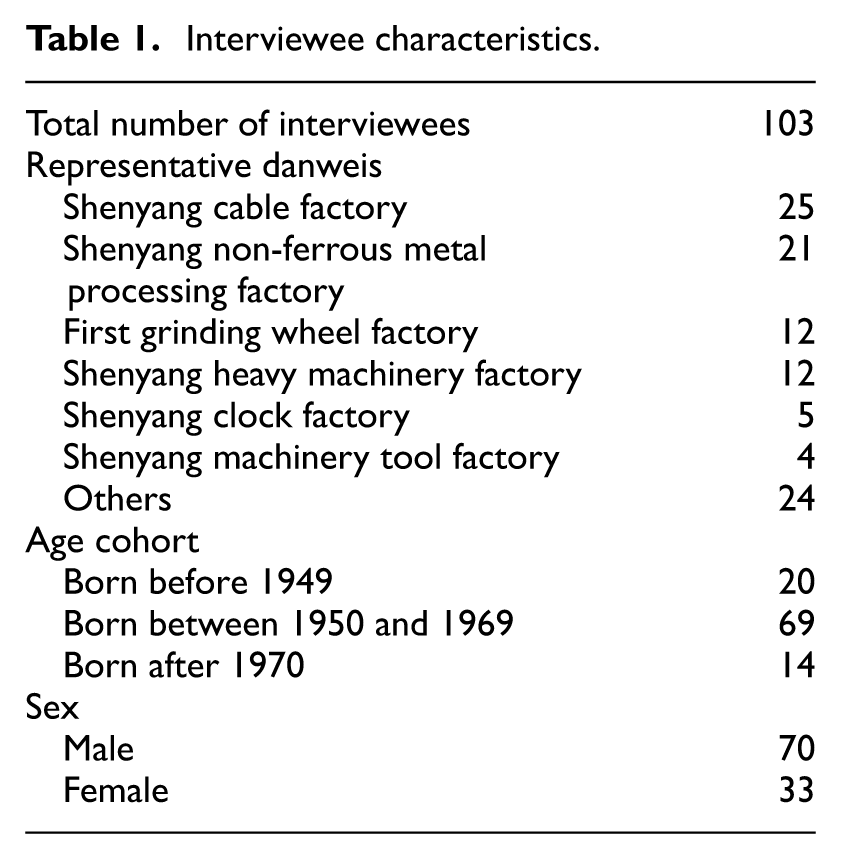
At the micro level, 103 in-depth, semi-structured biographical interviews with former danwei employees and long-term residents capture how these transformations were experienced and narrated across the life course. Interviews explored work histories, factory restructuring or closure, family trajectories, perceptions of urban change, and expectations for the future. Rather than eliciting fixed opinions, the interviews encouraged narrative reflection linking personal biographies to broader institutional and policy shifts. Given the historically central role of danwei institutions in Northeast China’s urbanization (Tian, 2007), sampling was danwei-based, covering 21 representative work units across heavy and light industries and including diverse positions and age cohorts (see Table 1). To ensure analytical rigor, interview narratives were cross-checked across respondents and triangulated with policy documents, danwei gazetteers, archival records, and newspaper accounts.
Interviewee characteristics.
Finally, to clarify Shenyang’s specificity and make the temporal mechanisms more visible, I conducted short field visits to other Northeastern industrial cities—Daqing, Fuxin, Benxi, and Anshan—as well as to industrial cities outside the region, including Wuhan, Pingxiang, and Shanghai. These contrastive observations provide temporal benchmarks, highlighting how different configurations of restructuring—whether abrupt, protracted, or diffused—shape divergent developmental and affective outcomes, including but not limited to left-behindness.
Findings
The findings are organized around how key temporal mechanisms, operating across intersecting timescapes, combine to produce Northeast China’s distinctive configuration of left-behindness.
From structural to affective left-behindness
Historically known as Manchuria, Northeast China was an early center of industrialization under Japanese occupation and later became the cornerstone of socialist industrialization after 1949. Confronted with postwar isolation and geopolitical insecurity, the Chinese Communist Party concentrated resources in inherited industrial bases—especially the Northeast—building on colonial-era infrastructure. The First Five-Year Plan placed completion of the region’s industrial system at the center of national development. To secure production and working-class loyalty, the state institutionalized lifelong employment and “cradle-to-grave” welfare through the danwei (work unit) system (Lee, 2007). Danweis provided not only wages but also housing, schooling, healthcare, and daily services, forming self-contained industrial communities. At the same time, rural areas were mobilized to support rapid industrialization (Lu and Perry, 1997), while coastal regions, viewed as strategically vulnerable, received fewer early investments. The Northeast thus emerged as both the industrial heartland and a privileged core of the socialist political economy.
Market reform gradually destabilized this position. The onset of reform in the late 1970s reshaped regional hierarchies and partially reversed the urban–rural order of the planned economy. Economic liberalization proceeded unevenly: coastal and agrarian regions—once peripheral—were designated as experimental zones (Coase and Wang, 2012; Shirk, 1993), and their rise became closely associated with China’s global ascent (Autor et al., 2016). By contrast, the Northeast, long central to national production and fiscal extraction, was largely excluded from early experimentation.
As a result, the region’s relative position steadily declined, with its share of national GDP falling from 14% in 1977 to just 4.7% by 2024 (Figure 2). This long-term marginalization, however, did not unfold smoothly. Rather, it was punctuated by periodic crises and state-led revitalization campaigns. The most decisive rupture—a critical juncture—occurred between 1997 and 2002, when state-owned enterprise (SOE) restructuring under the policy of “grasping the big and letting go of the small” (zhuada fangxiao) triggered mass layoffs, community disintegration, and widespread insecurity (Lee, 2007). In response, the Hu–Wen administration launched the “Revitalization of the Northeast” in 2003 alongside the “Develop the West” and “Rise of the Central Region” regional developmental programs (Chung et al., 2009). Yet while central and western regions gained momentum through these initiatives, the Northeast continued to lag (see Figure 2). Liaoning’s reported negative growth in 2017 further intensified national scrutiny (National Bureau of Statistics of China [NBSC], 2016, NBSC, 2017).
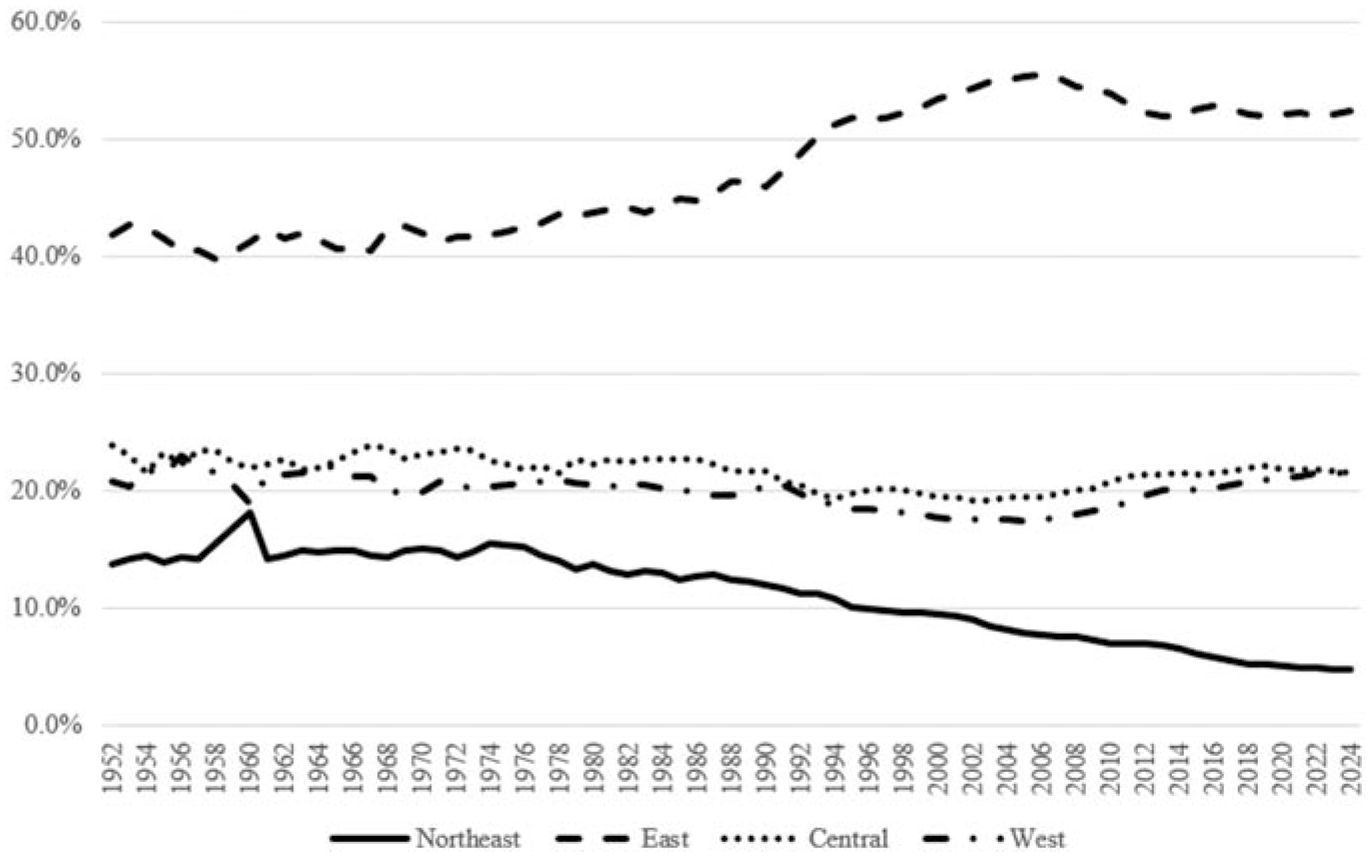
Regional proportion of national GDP (1952–2024).
Together, these shifts produced a recognizable structural form of left-behindness at the regional scale. Yet for many years this condition was articulated primarily from the outside. It appeared either as a technocratic problem to be corrected through policy intervention (Chung et al., 2009) or as evidence of a lingering planned-economy mentality and a lack of “market genes” (Economist, 2014; Zhang, 2004). In both framings, the Northeast figured less as a site of lived experience than as an object of diagnosis and stigma.
Only with the emergence of “New Northeast Literature” did these histories begin to be narrated from within (Xie, 2025). Through everyday stories of displacement, memory, and fractured identity, writers transformed diffuse losses into shared emotional and moral claims, challenging external stigmatization and reframing the “Northeast Problem” as lived reality rather than abstract diagnosis. Left-behindness thus shifted from a structural condition to an affectively experienced and collectively articulated one—a transformation that raises two further questions: why did this articulation emerge only after 2015, and why did it crystallize in Shenyang?
To address these puzzles, I step back from cultural expression to the longer temporal dynamics that shaped the region’s trajectory. A timescape perspective requires reconstructing how macro- and meso-level reforms unfolded in sequence, tempo, and duration, gradually laying the conditions for later affective mobilization.
Critical junctures, duration, and tempo: Macro–meso temporal dynamics
In the early decades of reform, change proceeded cautiously. Reluctant to destabilize its industrial backbone, the state limited restructuring to incremental adjustments within SOEs, which continued to enjoy privileged access to markets, inputs, and credit. Policies allowing firms to retain surpluses financed technological upgrades and sustained their status as secure and desirable employers. The dominance of medium- and large-sized SOEs constrained the development of grassroots markets (Xie, 2019), and the danwei system remained the central institutional anchor of the local economy and society. As Figure 3 shows, danwei employment continued to grow for more than a decade after 1978, peaking only in the early 1990s.
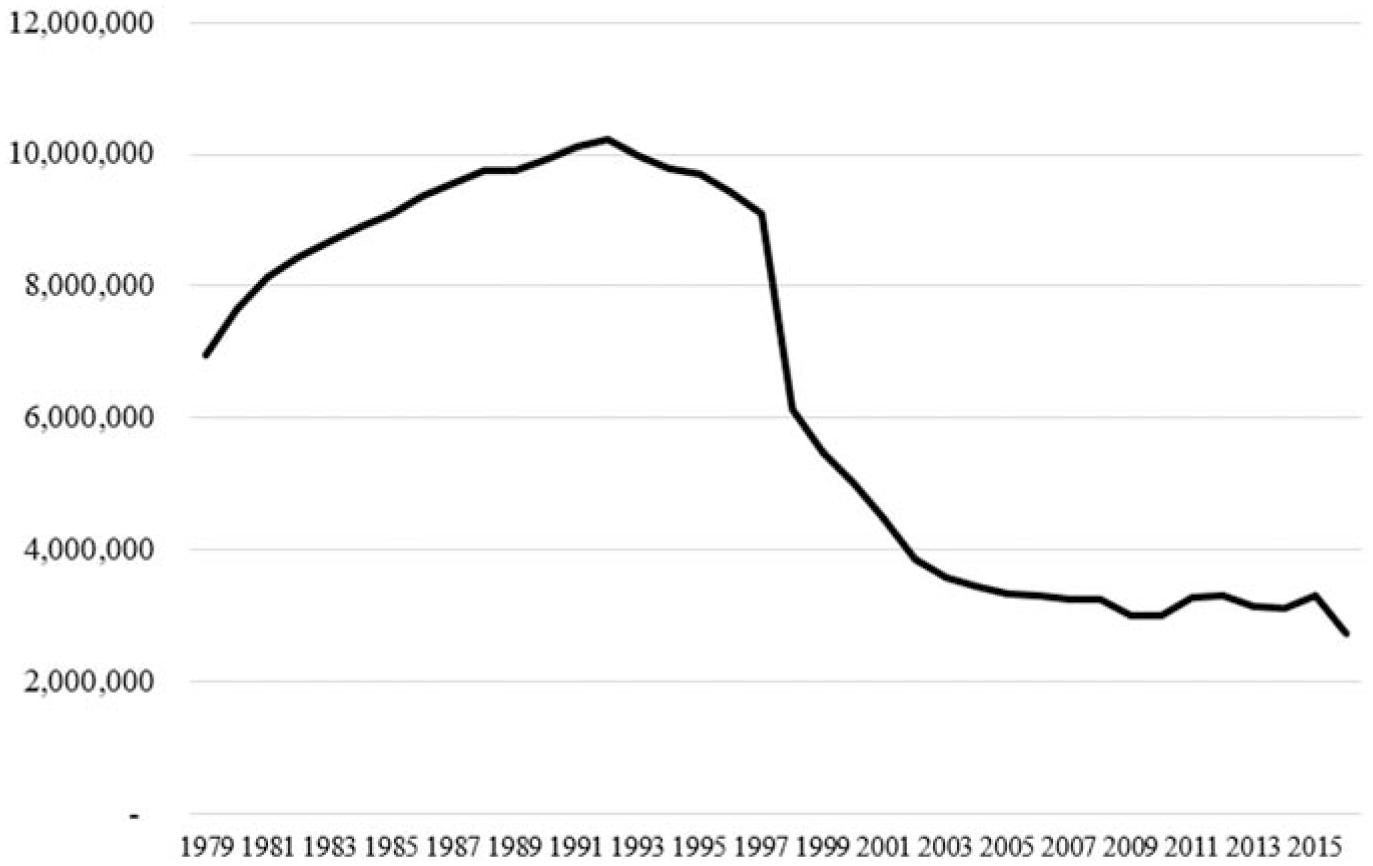
Employment in the danwei system in Liaoning Province (1979–2016).
This persistence reflected not merely policy preference but also structural inertia. Even as inefficiencies mounted, personnel reform remained tightly circumscribed. Until 1992, only managers could dismiss workers with “iron rice bowls,” and then only for disciplinary reasons (Naughton, 1995). In practice, few dared to do so for fear of unrest and political risk: “We didn’t dare to cut labor because we were afraid of rebellion … workers were reassigned within the factory rather than pushed into society” (INT21-170605). 3 Reform thus unfolded as prolonged stasis—a drawn-out duration that deferred rather than resolved underlying contradictions.
The impasse broke in the late 1990s. China’s impending WTO accession prompted a decisive restructuring of the SOE sector: the state preserved strategic “lifeline” industries while downsizing or privatizing the rest (Eaton, 2016). The policy of “grasping the big and letting go of the small” (zhuada fangxiao) marked a clear market turn and constituted a critical juncture for industrial regions. Nowhere were the consequences more concentrated than in the Northeast. In Liaoning alone, 2.94 million jobs were lost in 1997; between 1997 and 2002, 5.23 million disappeared—a rapid rupture following decades of relative stability (Figure 3).
The years that followed were characterized by mass layoffs and institutional upheaval that fundamentally reconfigured relations among the central state, local governments, and enterprises. 4 Historically, governance in industrial cities had been enterprise centered, leaving local governments comparatively weak (Tian, 2007). The restructuring crisis reversed this balance. As firms collapsed or withdrew, municipalities assumed responsibility for managing unemployment, social unrest, and redevelopment, thereby expanding their fiscal and administrative authority. In line with the directive to “let go of the small,” local governments accelerated the sale of smaller public and collective enterprises, offering tax concessions, land-use exemptions, and streamlined procedures to attract investors (Shenyang Daily, 1997).
The social costs were especially visible in old industrial districts such as Tiexi District in Shenyang, where roughly 130,000 of 300,000 workers were laid off by the late 1990s, many losing pensions, healthcare, and unemployment protection (CPC Shenyang Municipal Committee Party History Research Office and CPC Shenyang Tiexi District Committee, 2013). Facing collapsing industrial assets, wage arrears, and mounting unrest, municipal authorities had to finance restructuring while containing social fallout (Lee, 2007). Land and real estate consequently became new engines of accumulation. The creation of the Tiexi New District in 2002 and the “East Move, West Build” (dongban xijian) initiative relocated surviving firms to peripheral industrial zones while converting former factory sites into marketable property. By transforming land into capital, the municipality generated revenue to repay debts, resettle workers, and fund redevelopment (Su, 2004). Land-driven growth soon became central to Shenyang’s recovery (Fan and Dai, 2017).
Through this shift, the local state moved from managing production to managing land, and from dependence on enterprises to entrepreneurial urban governance—mirroring the broader rise of land-based municipal finance across Chinese cities (Hsing, 2010). This transformation was not only institutional but visibly spatial: as Figure 4 shows, a comparison of North 2nd Road in 1990 and 2006 reveals that, although the “East Move, West Build” program began only in 2002, Tiexi District’s industrial landscape had been fundamentally remade within roughly five years. The district even won the 2008 UN Global Best Livable Area Award, with UN-Habitat officials lauding its transformation from industrial hinterland to livable urban space (Liu, 2008). This redevelopment was subsequently memorialized in the China Industrial Museum, whose exhibits narrate the district’s “rebirth” and celebrate the speed of transformation: “Ten years of hard work…Tiexi completed what Germany’s Ruhr and France’s Lorraine did in 30 years.” Such narratives recast painful dislocation as developmental achievement, translating rupture into a story of progress and crafting an “official memoryscape” (Mah, 2012).
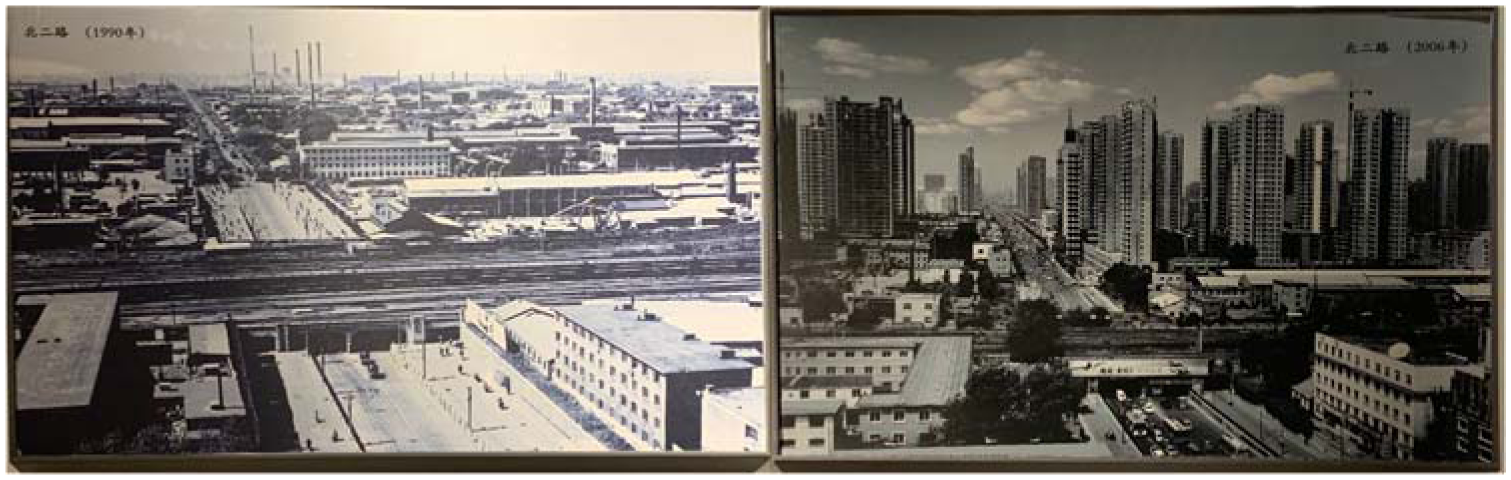
North 2nd Road in 1990 and 2006.
Biographical timing: Lives within structural change
The macro–meso dynamics traced above show that left-behindness in Northeast China cannot be reduced to industrial decline alone. State and local interventions—through policy sequencing, institutional protection, abrupt restructuring, and land-led redevelopment—actively structured the places’ trajectories within the region. These interventions produced a layered timescape of prolonged stability, sudden rupture, and rapid urban transformation. It is within this uneven temporal landscape that individual lives unfolded.
Decades of SOE and danwei dominance— its long duration—cultivated stable life expectations organized around lifelong employment and enterprise-based welfare. Entering socialist factories with the promise of cradle-to-grave security, workers built identities around work and developed strong moral attachments to their danwei. As one respondent recalled: We were so proud of being an employee of the Grinding Wheel Factory. At that time, we were allocated living units and good welfare. Every holiday, we were allocated something from the factory. If you mentioned you are a state-owned-unit employee from our factory, you could easily find a wife or husband because you are guogong. (INT9-171019)
This extended life stability and predictability were then abruptly shattered. Between 1997 and 2002, waves of factory closures and mass layoffs compressed profound economic and social dislocation into a short span of time. Many workers were dismissed in their forties and fifties, precisely when family responsibilities peaked. Outcompeted by younger migrant laborers and new graduates, they were pushed into informal and precarious work—street vending, domestic service, security guarding—or into prolonged unemployment. Life trajectories that had once seemed linear became uncertain and morally ambiguous (Xie, 2024a). Disrupted careers eroded their sense of efficacy and control over the future. As one interviewee, who had tried various types of work opportunities but still could not regain a sense of former pride, put it: “Whatever, that was just my fate [ming]. I have to accept my fate [renming]” (INT45-170927).
For many, retirement—once a marker of aging—became a refuge. Pension income often exceeded what they could earn in the informal market (INT17-170519), transforming retirement into a form of institutional shelter. A former worker explained: In the past, retirement meant you were old. Now we are forced by life difficulties. Only when we retire can we have a stable income. We workers were like wanderers for these many years. Before retiring, we were swimming in the sea of bitterness. After retirement, we went ashore. (INT9-171019)
At the same time, urban redevelopment deepened these disruptions spatially. Under the “East Move, West Build” initiative, former factory sites were converted into modern residential and commercial districts that attracted a new middle class, while many displaced workers remained in aging danwei housing with limited prospects for mobility. Regeneration thus redistributed opportunities unevenly, producing a sharp divide between the beneficiaries of growth and those who bore its costs. As one respondent remarked bitterly, “Thanks to the Communist Party. Now we’ve become the real proletariat!” (INT37-170715). 5
The succession of long stability, abrupt collapse, and rapid redevelopment generated a distinctive temporal experience, especially for the “Transition Generation” born in the 1950s and 1960s (Xie, 2024a). Their grievances were expressed largely through quiet, everyday talk rather than overt political mobilization. During the reforms, the speed and opacity of change made unfolding processes difficult to grasp, limiting resistance to fragmented petitions (Xie, 2024b). By the time the consequences became clear, many had aged out of the labor market, while modest pensions and housing provisions offered just enough security to dampen collective action. Caught between competing explanations—market forces, state policy, or personal fate—residents often struggled to identify a clear object of blame. Left-behindness thus emerged less as open protest than as muted resignation, embedded in biography rather than articulated as organized politics.
Belated cultural contestation
The social trauma produced by the rapid restructuring of the late 1990s did not disappear with subsequent economic recovery and urban regeneration. Instead, it lingered as a latent presence in everyday life, embedded in family memories and carried quietly across generations. For years, these experiences remained largely privatized, expressed through resignation rather than collective claims. Only later did they acquire a more explicit cultural form.
This shift became visible with the emergence of the “New Northeast Writer Group,” represented by Shuang Xuetao, Ban Yu, and Zheng Zhi. Belonging to the children of the Transition Generation, these writers grew up in households marked by layoffs, downward mobility, and prolonged insecurity. They witnessed both the material consequences of restructuring and the silence surrounding their parents’ losses. Writing thus became a means of belated articulation (Xie, 2025). As Shuang Xuetao noted, his aim was to “leave behind fictional records for those who have been insulted and injured, and for those precious moments of our shared humanity” (Shuang, 2016).
Unlike their parents—who often internalized dislocation as personal failure within the dominant narrative of national growth—this younger generation transformed diffuse suffering into narratable experience. Through stories of factory closures, fractured families, fading industrial communities, and moral bewilderment, they reclaimed the region’s past from both official triumphalism and external stigmatization (Xie, 2025). In doing so, they shifted the “Northeast Problem” from a technocratic diagnosis to a lived and emotionally resonant condition.
This cultural rearticulation soon extended beyond the region itself. As national growth slowed and precarity spread, the Northeast’s trajectory increasingly resonated with broader publics who felt similarly stalled or displaced. What had once appeared as a regional anomaly came to be recognized as a more general condition of post-reform China. Through literature and cultural production, Northeast China thus became not only an object of policy concern but also a symbolic site through which wider experiences of loss and left-behindness could be expressed.
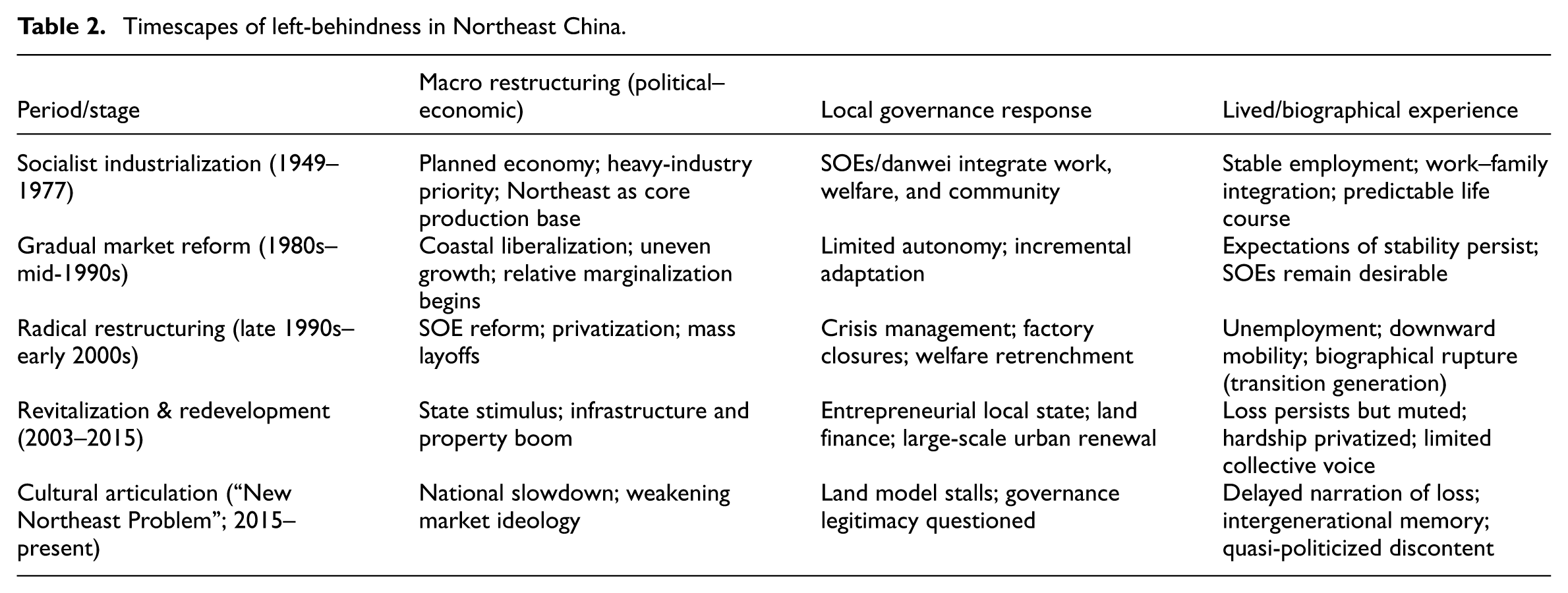
Seen through a timescape lens, this belated contestation is not incidental but temporally structured. The rapid tempo of late-1990s restructuring produced immediate shock and dislocation that muted collective voice rather than generating protest, while the long duration of danwei stability had deepened dependence on institutional guarantees. For the Transition Generation, biographical timing—midlife responsibilities, labor-market exclusion, and reliance on modest pensions—encouraged resignation and privatized suffering. Articulation became possible only later, when a younger cohort encountered these accumulated losses from a different life-course position and within a new national context of slowing growth. In this altered temporal sequence, experiences that had once been unspeakable could be narrated, shared, and publicly recognized. Left-behindness thus emerges not directly from marginalization itself but from the historically specific alignment of tempo, duration, sequence, and generational timing that makes suffering culturally legible (Table 2).
Timescapes of left-behindness in Northeast China.
Discussion and conclusion
This study argues that left-behindness should not be understood as a fixed structural attribute of places, nor should affective responses such as discontent or resentment be treated as automatic consequences of economic marginalization. Rather, left-behindness is relational, discursive, and temporally constituted: a socially mediated process through which places come to be defined, interpreted, and experienced as left behind. To capture this dynamic, the article advances a timescape approach that conceptualizes left-behind places as continuously made and remade through the interaction of three temporal layers: the macro capitalist timescape, the local change-agency timescape, and the biographical timescape.
Empirically, the remaking of left-behindness in Northeast China emerges at the intersection of these temporalities. Although economic marginalization accumulated gradually after market reform, its public and affective manifestation was uneven and belated. The late-1990s state-sector restructuring functioned as a critical juncture: a compressed sequence of collapse followed by rapid redevelopment that overwhelmed the Transition Generation. At the same time, the long duration of subsequent stagnation, combined with life-course timing—aging out of work while securing minimal welfare—muted collective action and deferred overt politicization. Only when the children of the Transition Generation encountered these accumulated losses at a different biographical moment, and amid a broader national slowdown, did the same structural marginalization become narratable and culturally mobilized. This temporal alignment helps explain both the delayed emergence of left-behindness as a public issue and its distinctive cultural articulation.
Shenyang’s experience further highlights the decisive role of the local change-agency timescape. Here, rapid factory closures, concentrated layoffs, and land-driven redevelopment—actively orchestrated by municipal governments rather than unfolding solely through abstract market forces—produced both material dislocation and a triumphalist regeneration narrative that marginalized alternative accounts of suffering while leaving powerful reservoirs of memory and loss. Only later did a younger cohort transform these muted experiences into publicly legible claims through “New Northeast Literature,” allowing the region’s trajectory to resonate nationally rather than appear exceptional.
Beyond Shenyang, however, temporal mechanisms operated differently because the pace, duration, and sequencing of change varied across localities. Coal-dependent places such as Fuxin experienced slow, protracted decline driven by resource depletion (Hu and Yang, 2019); oil cities such as Daqing underwent delayed and gradual reform; and Changchun’s automotive base enabled steadier adjustment. In these contexts, slower and more continuous change diffused shock, reducing the likelihood that left-behindness would crystallize into concentrated or culturally politicized expressions.
This temporal and relational perspective carries important implications for debates on uneven urban and regional development, particularly policy agendas aimed at “levelling up” left-behind places (McCann, 2024; Martin et al., 2021). Approaches focused narrowly on economic indicators or infrastructure investment risk overlooking how residents interpret change and remain attached to place. More effective strategies must therefore engage with lived histories, moral expectations, and locally embedded capacities, fostering genuinely endogenous development (MacKinnon et al., 2022). More broadly, the analysis suggests that left-behindness is not simply a matter of spatial disadvantage but of temporal experience: it emerges through when disruptions occur, how long their effects endure, and when they become collectively narratable. Understanding these temporal dynamics is essential for explaining why some places become politically and culturally salient as “left behind,” while others, facing comparable structural pressures, do not.
Footnotes
Acknowledgements
Earlier versions of this article were presented at the Politics of Industrial Closure DePOT Annual Conference in Canada, the History and Theory of Capitalism Workshop at the University of Chicago, and the PKU–HKU Sociology Exchange Conference in Beijing. The author is grateful to the participants at these events for their thoughtful comments and constructive feedback on earlier drafts. The author also thanks Yirui Chen and Shanquan Xu for their valuable research assistance.

Funding
The author received no financial support for the research, authorship, and/or publication of this article.
Declaration of conflicting interests
The author declared no potential conflicts of interest with respect to the research, authorship, and/or publication of this article.