






Abstract
Urban design and planning increasingly engage biodiversity, habitat restoration, and green infrastructure, yet they still pay limited attention to how human–wildlife relations are felt, contested, and governed in everyday urban life. This paper develops Wildlife-Affective Urban Design (WAUD) as a conceptual framework for examining how urban form shapes multispecies encounter not only through ecological performance, but also through fear, curiosity, attachment, irritation, avoidance, and unequal exposure to harm. Bringing wildlife-inclusive design, affective urbanism, emotional urbanism, multispecies ethics, and spatial justice into dialog, the paper argues that coexistence should not be understood as a linear progression from contact to empathy. Instead, encounters with wildlife may generate care, discomfort, nuisance, anxiety, or demands for control at the same time. In this way, the paper contributes to emotional urbanism by extending it beyond predominantly human-centered accounts of urban feeling toward the unequal politics through which multispecies emotions become institutionally legible and governable. Across landscape, neighborhood, and building/interface scales, WAUD shows how design can organize differentiated proximities, thresholds, and responsibilities rather than simply encourage closeness. Methodologically, it calls for combining quantitative indicators, situated accounts of encounter, and ecological proxies without presuming transparent access to nonhuman subjectivity. The paper concludes by redefining emotional equity not as the equal distribution of positive feeling, but as the reduction of systematic harms, exclusions, and unrecognized burdens in multispecies urban life.
Introduction: Emotion, ecology, and the urban condition
Why feeling matters in urban ecology
Cities are not only systems of circulation, exchange, and settlement; they are also environments that are felt. Urban life is organized through atmospheres of comfort, stress, familiarity, fear, curiosity, and indifference that emerge through the interaction of bodies, infrastructures, climates, and routines (Anderson, 2009; Thrift, 2008). Heat islands, traffic corridors, street trees, vacant lots, drainage canals, and bird calls do not simply occupy space. They shape attention, tolerance, and patterns of movement. Feeling is therefore not an aftereffect of urban form; it is one of the ways urban form becomes socially and politically consequential.
Even so, mainstream planning and urban design have usually treated emotion as secondary to measurable performance. The dominant languages of resilience, sustainability, and environmental management continue to privilege carbon, hydrology, mobility, land value, and infrastructure capacity. These metrics matter, but they do not exhaust how urban environments are inhabited or contested. The climate crisis has made that limitation harder to ignore. Climate anxiety, ecological grief, heat stress, and the search for sensory refuge all show that urban sustainability is never only technical; it is also experiential, moral, and affective (Cunsolo and Ellis, 2018). A more adequate account of resilience must therefore ask not only whether cities function, but how they are differently sensed, endured, and negotiated across human and nonhuman lives.
This problem becomes especially sharp in urban settings where wildlife becomes newly legible, ecologically supported, or politically contested through restoration, conservation planning, and everyday encounter. Wildlife is increasingly visible in cities through habitat restoration, conservation-oriented planning, and the expansion of urban ecological infrastructures. Yet urban biodiversity is never received uniformly. Encounters with birds, foxes, bats, pollinators, deer, pigeons, rats, or monkeys may evoke delight, care, curiosity, irritation, fear, disgust, or calls for removal. These reactions are not incidental. They shape complaint, tolerance, stewardship, investment, and exclusion. In that sense, the politics of urban ecology are also affective politics (Barua and Sinha, 2023; Seddon et al., 2021; Soulsbury and White, 2016).
Why affect matters: From urban atmosphere to political consequence
Over the past two decades, scholarship on affective urbanism has shown that cities are not only built environments to be measured, regulated, or navigated, but also atmospheres to be felt. Urban experience is shaped through rhythm, sound, lighting, density, weather, memory, and bodily attunement, such that comfort, tension, anticipation, and unease become part of how space is inhabited and interpreted (Anderson, 2009; Paiva, 2024; Thrift, 2008). This insight matters for the present article because multispecies urban life is never experienced only as ecological function. Wildlife is also encountered through moods and embodied responses: curiosity at birdsong, anxiety around bats, irritation at droppings, fascination with foxes, or fear of species associated with danger, disorder, or contamination. In this sense, urban ecological relations are always also affective relations.
Yet the relevance of affect for this article is not simply descriptive. The point is not only that cities generate feelings, but that feelings help determine whether ecological interventions are tolerated, opposed, celebrated, or governed as problems. A restored wetland may be framed as environmental repair by some residents and as mosquito risk or insecurity by others; a nesting habitat may be celebrated as biodiversity infrastructure in one context and condemned as nuisance in another. Affective responses therefore shape the political life of urban nature by influencing legitimacy, complaint, stewardship, and support for intervention. This is where emotional urbanism becomes important for the argument developed here: it names the moment at which urban feelings cease to be merely experiential and become institutionally consequential. In that sense, the question is not only how cities are felt, but how feeling enters the politics of coexistence under unequal conditions of exposure, visibility, and voice (Barclay and Riddle, 2021; Bosworth, 2023).
WAUD: Argument, scope, and analytical boundaries
This paper develops Wildlife-Affective Urban Design (WAUD) as a framework for understanding how multispecies urban relations are shaped not only through ecological structure, but also through fear, curiosity, attachment, irritation, avoidance, and unequal exposure to harm. Its central claim is that urban coexistence should not be understood as a linear progression from contact to empathy. Encounters with wildlife may generate care, but they may also intensify discomfort, habituation, antagonism, public-health concern, or demands for removal. WAUD therefore treats affect not as a decorative supplement to biodiversity planning, but as part of the conditions through which coexistence is spatially organized and politically governed.
The framework is deliberately bounded. It focuses on urban wildlife because free-living species are most directly shaped by planning decisions about habitat continuity, interface design, movement corridors, lighting, waste systems, and public space (Apfelbeck et al., 2020; Garrard et al., 2018; Seddon et al., 2021). This does not imply that companion, research, or farmed animals are ethically less important. Rather, they are governed through distinct institutional regimes of ownership, enclosure, care, labor, and regulation that would require a different analytical starting point. Including them fully would shift the paper away from the design and governance of urban encounter toward broader questions of domestication, captivity, husbandry, and systematic exploitation. Even within wildlife itself, the category is unstable: charismatic, common, synanthropic, feral, and stigmatized species are not perceived or governed equally. WAUD begins from that unevenness. Its aim is not to model harmonious coexistence, but to clarify how contested co-presence is differentiated, managed, and justified across urban space.
Contribution and article structure
The article makes three linked contributions. First, it argues that urban coexistence should not be understood as a linear progression from contact to empathy. Second, it develops WAUD as a multi-scalar framework for organizing differentiated proximity, encounter regulation, and the reduction of systematic harm and exclusion in multispecies urban life. Third, it advances an expanded evidentiary approach in which quantitative measures, ecological and behavioral proxies, and situated affective accounts are interpreted together without presuming transparent access to nonhuman subjectivity.
This argument is written from a particular intellectual and geographical position. It draws primarily on Global North urban theory, environmental humanities, and planning literatures, even as it seeks to develop a framework that can be put into dialog with wider multispecies debates. As such, WAUD is proposed not as a universal model, but as a situated conceptual intervention whose terms require further development across decolonial, postcolonial, and culturally differentiated urban contexts.
The argument proceeds in four steps. The following section situates WAUD within the conceptual lineages of wildlife-inclusive design, affective and emotional urbanism, multispecies ethics, and spatial justice. The paper then translates this framing into a multi-scalar account of landscape, neighborhood, and building/interface design. The fourth section addresses methodological implications, arguing for mixed evidence and interpretive restraint. The final section then shows why coexistence must be negotiated through conflict, legitimacy, and unequal recognition rather than assumed as a harmonious outcome.
Genealogies and conceptual framing of WAUD
From biophilic design to wildlife-inclusive design
One important lineage informing WAUD begins with biophilic design, which brought sustained attention to the restorative and health-related value of everyday contact with nature in built environments (Kellert, 2008; Kellert and Wilson, 1993; Ryan et al., 2014). By foregrounding vegetation, water, daylight, and natural materials as supports for wellbeing, biophilic design helped reintroduce feeling into environmental design discourse. Even so, its dominant logic remained anthropocentric. Nature was typically framed as beneficial because it improved human mood, recovery, or performance, not because nonhuman life had independent claims on urban space.
A later turn toward biodiversity-sensitive and wildlife-inclusive design expanded this frame by treating cities not only as greener environments for people, but also as habitat mosaics for birds, insects, mammals, amphibians, and other species (Apfelbeck et al., 2020; Beatley, 2016; Garrard et al., 2018; McDonald and Beatley, 2020). This shift translated ecological science into design strategies such as habitat connectivity, dark-sky lighting, bird-safe glazing, nesting infrastructure, and vegetated corridors (Garrard et al., 2018; Jägerbrand and Spoelstra, 2023; Van der Ree et al., 2015). Yet much of this literature still justified coexistence through ecosystem services, amenity value, or conservation performance (Beatley, 2016; McDonald and Beatley, 2020). It was often more attentive to where species could persist than to how coexistence is experienced, contested, or governed in everyday urban life (Hinchliffe and Whatmore, 2006; Lorimer, 2015; Tănăsescu, 2022).
WAUD builds on these traditions but departs from their assumptions. It retains biophilic design’s concern with embodied urban experience and wildlife-inclusive design’s attention to habitat and species-sensitive form, while rejecting the notion that more contact is inherently desirable or that coexistence is simply a positive design goal. In WAUD, coexistence is negotiated rather than assumed, and design must address nuisance, fear, habituation, and unequal legitimacy alongside care and ecological accommodation.
Affective urbanism, emotional urbanism, and the limits of atmospheric explanation
A second genealogy shaping WAUD comes from affective urbanism, which approached the city through atmosphere, embodiment, sensory intensity, and everyday attunement rather than through formal representation alone (Anderson, 2009; Paiva, 2024; Thrift, 2008). This body of work is crucial because it demonstrates that urban life is not exhausted by land use, infrastructure, or governance categories. Space is also lived as pressure, immersion, interruption, familiarity, or unease. For WAUD, that contribution is foundational: multispecies relations are mediated not only by habitat provision or ecological performance, but also by fear, curiosity, attraction, irritation, and avoidance. Affective urbanism therefore helps explain why wildlife encounter can never be reduced to a neutral environmental event.
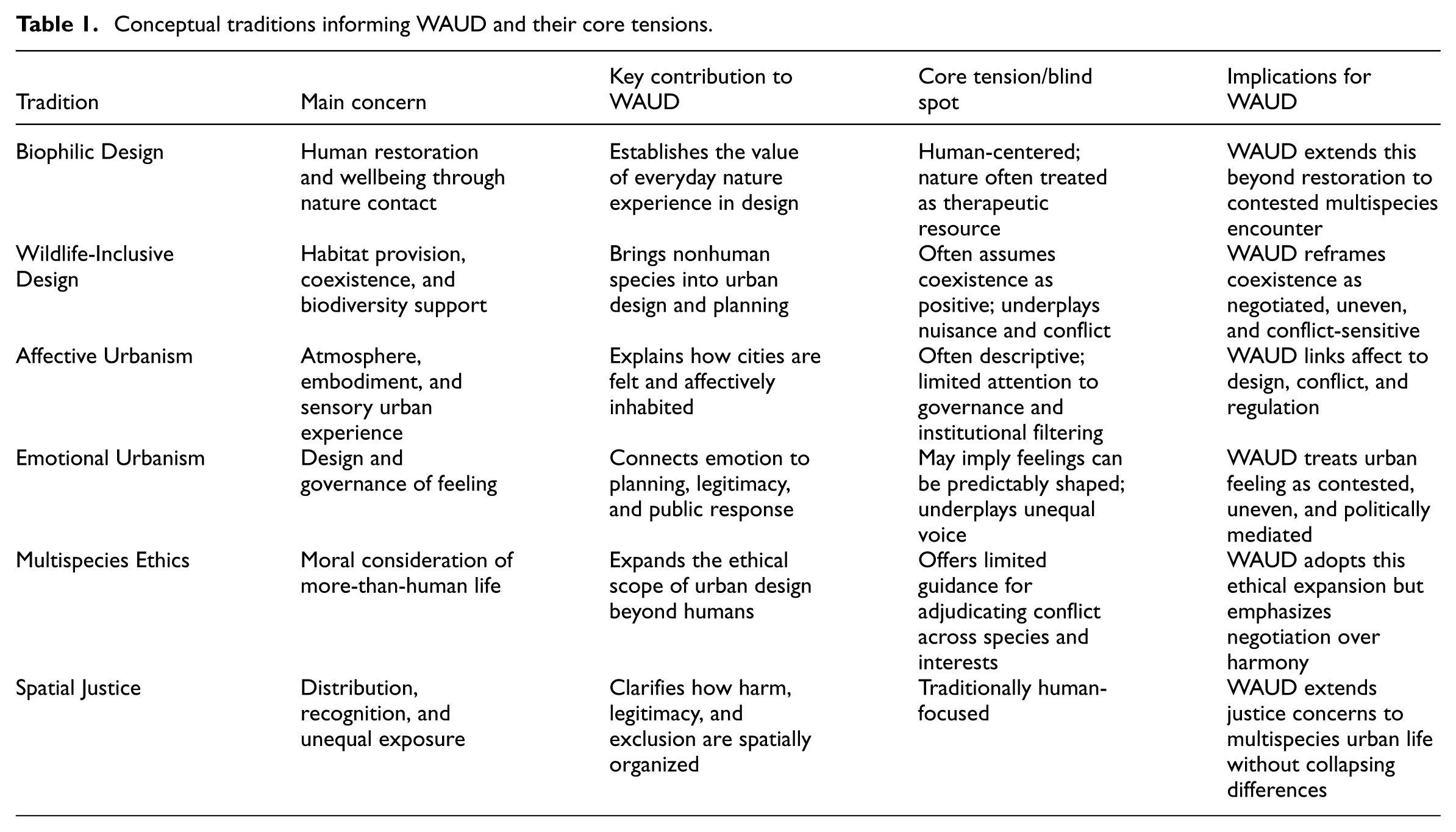
At the same time, affective urbanism remains limited as a planning framework if it stops at atmospheric description. It is highly effective at showing how urban environments are felt, but less precise in explaining how those feelings are selected, translated, and acted upon within institutions. This is where the distinction between affective urbanism and emotional urbanism becomes analytically useful. In this paper, emotional urbanism refers not simply to the presence of feeling in the city, but to the design and governance of conditions under which feelings become legible, actionable, and politically unequal. Fear does not automatically become policy; care does not automatically become recognition; irritation does not automatically become exclusion. All are filtered through property relations, public health discourses, neighborhood status, media narratives, and administrative categories. WAUD draws on affective urbanism to understand the embodied and atmospheric dimensions of encounter, but it draws on emotional urbanism to explain how those encounters become matters of legitimacy, conflict, and regulation. This distinction is important because it prevents the framework from romanticizing atmosphere while also preventing it from collapsing emotion into a simple policy variable (Barclay and Riddle, 2021; Bosworth, 2023; Buser, 2014). Table 1 identifies the main traditions on which WAUD draws and the unresolved tensions each brings into the framework.
Conceptual traditions informing WAUD and their core tensions.
WAUD as a mediating framework: Ethics, justice, and unresolved tensions
WAUD should therefore be understood not as a synthesis that resolves prior traditions, but as a mediating framework that places them into productive tension. From biophilic and wildlife-inclusive design it retains attention to embodied encounter and habitat support; from affective and emotional urbanism it takes seriously the role of atmosphere, feeling, and political consequence; from multispecies ethics and spatial justice it draws a wider normative field in which nonhuman life, unequal exposure, and selective recognition become central analytical concerns (Anguelovski et al., 2019; Celermajer et al., 2021; Haraway, 2008; Schlosberg, 2007). The value of WAUD lies precisely in refusing to collapse these traditions into a seamless model of care.
Its conceptual contribution is to make unresolved tensions analytically central rather than secondary: care and control, proximity and boundary, inclusion and exclusion, empathy and nuisance, coexistence and regulation. Cities do not welcome all species equally, and neither planning institutions nor urban publics respond symmetrically to different forms of animal presence. Some species are rendered compatible with urban nature, while others are coded through danger, disorder, contamination, or expendability (Lorimer, 2007, 2015; Van Patter, 2023). WAUD uses these asymmetries to shift the question from whether coexistence is desirable in principle to how legitimacy, exposure, and design intervention are differentially organized in practice. In that sense, WAUD is less a theory of harmonious living-together than a framework for interpreting and governing contested multispecies urban life (Figure 1).
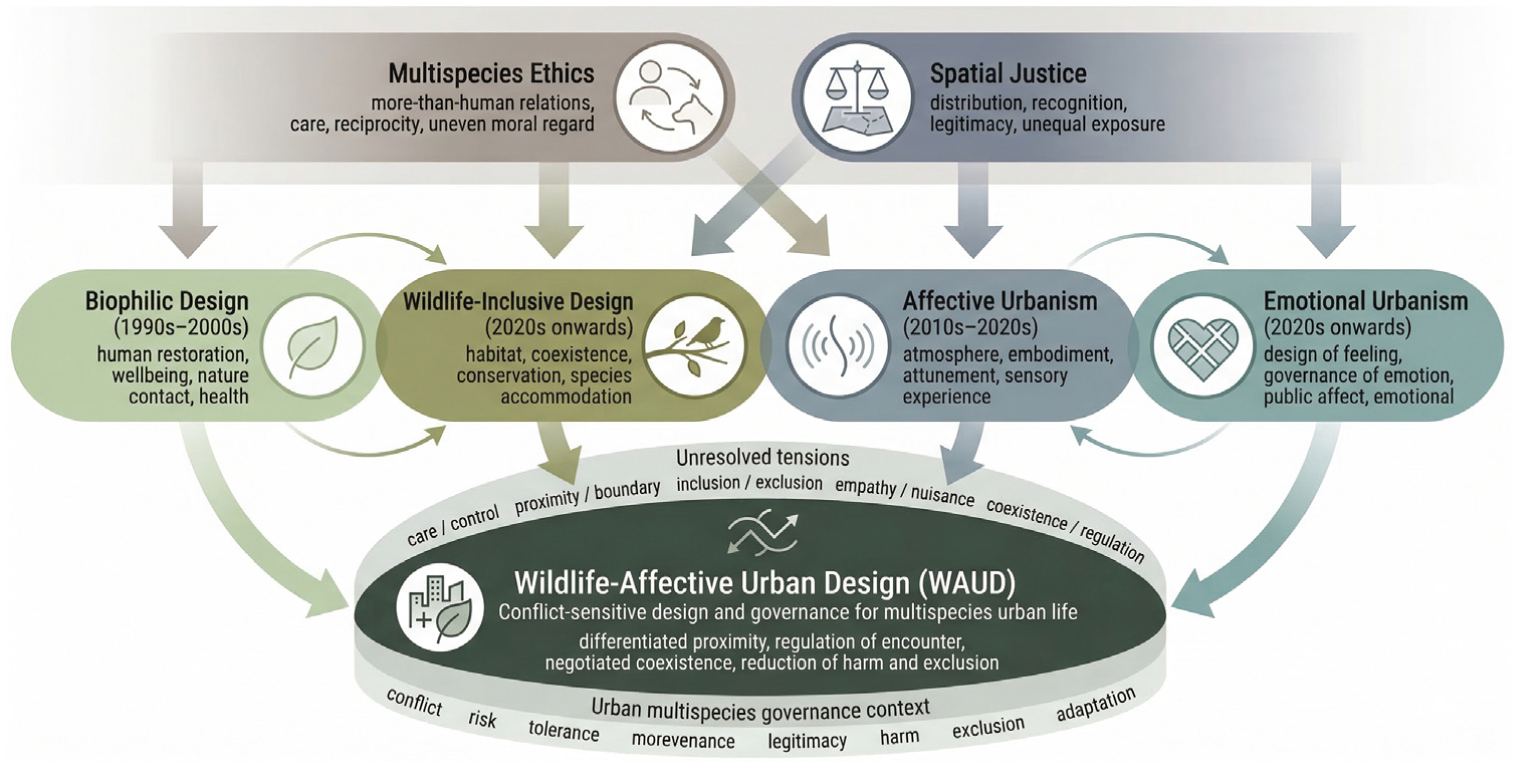
Conceptual positioning of WAUD. WAUD emerges through the layered convergence of biophilic design, wildlife-inclusive design, affective urbanism, and emotional urbanism, and is critically reoriented by multispecies ethics and spatial justice. Rather than implying a linear progression, the figure highlights mediated connections and unresolved tensions.
A key implication of this framework is that multispecies coexistence should not be understood through a single emotional trajectory. Wildlife encounters are affectively variable, and their meanings shift across species, settings, and forms of urban exposure. Figure 2 illustrates this affective differentiation across urban scales.
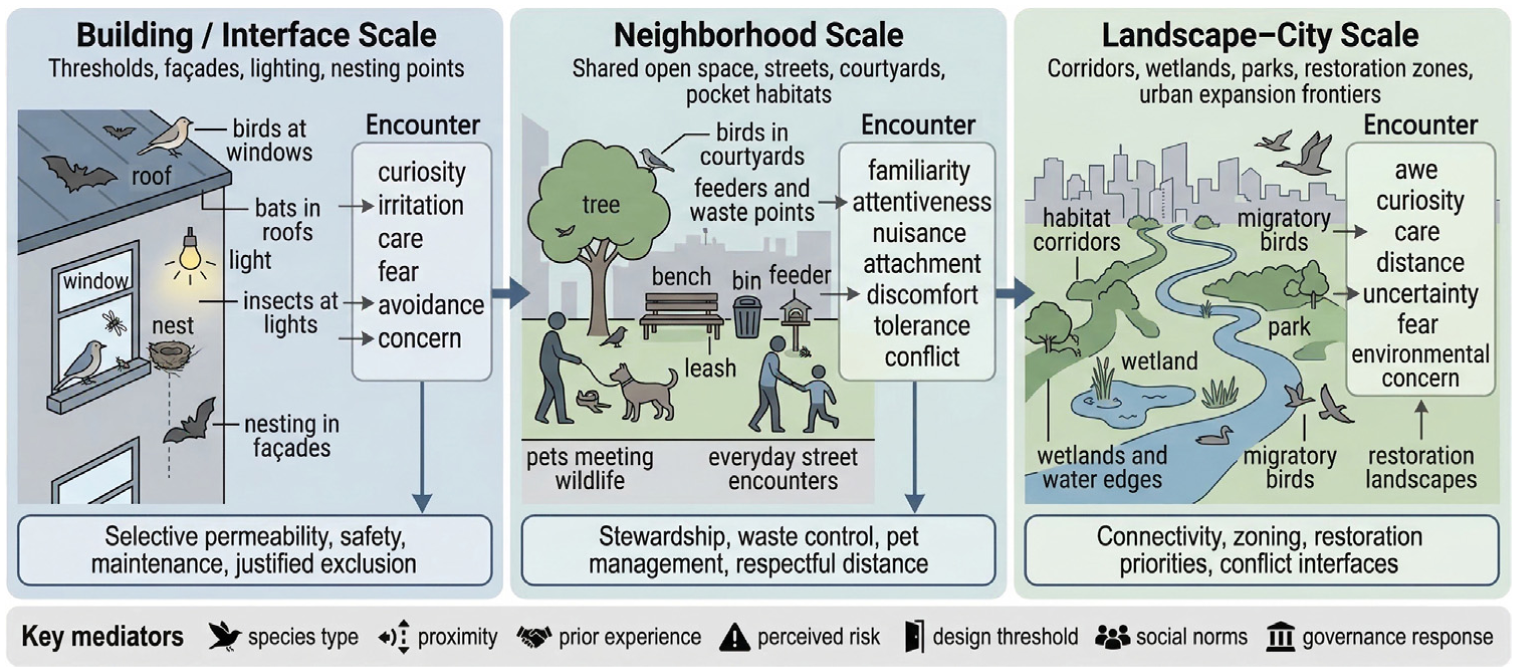
Contested affective geographies of wildlife encounter across urban scales. Wildlife encounters at the building/interface, neighborhood, and landscape-city scales generate diverse and sometimes conflicting affects, including curiosity, care, irritation, fear, and avoidance. Rather than implying a linear progression toward empathy, the figure highlights affective variability and the mediating role of design and governance.
A multi-scalar framework for contested coexistence
WAUD requires a multi-scalar framework because wildlife encounter is organized through very different spatial conditions across the city. Landscape structure, neighborhood routine, and building detail do not generate a single emotional trajectory; they shape different forms of visibility, exposure, disturbance, refuge, and responsibility. The point is therefore not to maximize closeness. It is to calibrate proximity, clarify limits, and design for situations in which coexistence remains contested rather than assumed (Hinchliffe and Whatmore, 2006; Whatmore, 2002; Wolch, 1998).
Designing across scales: From closeness to differentiated proximity
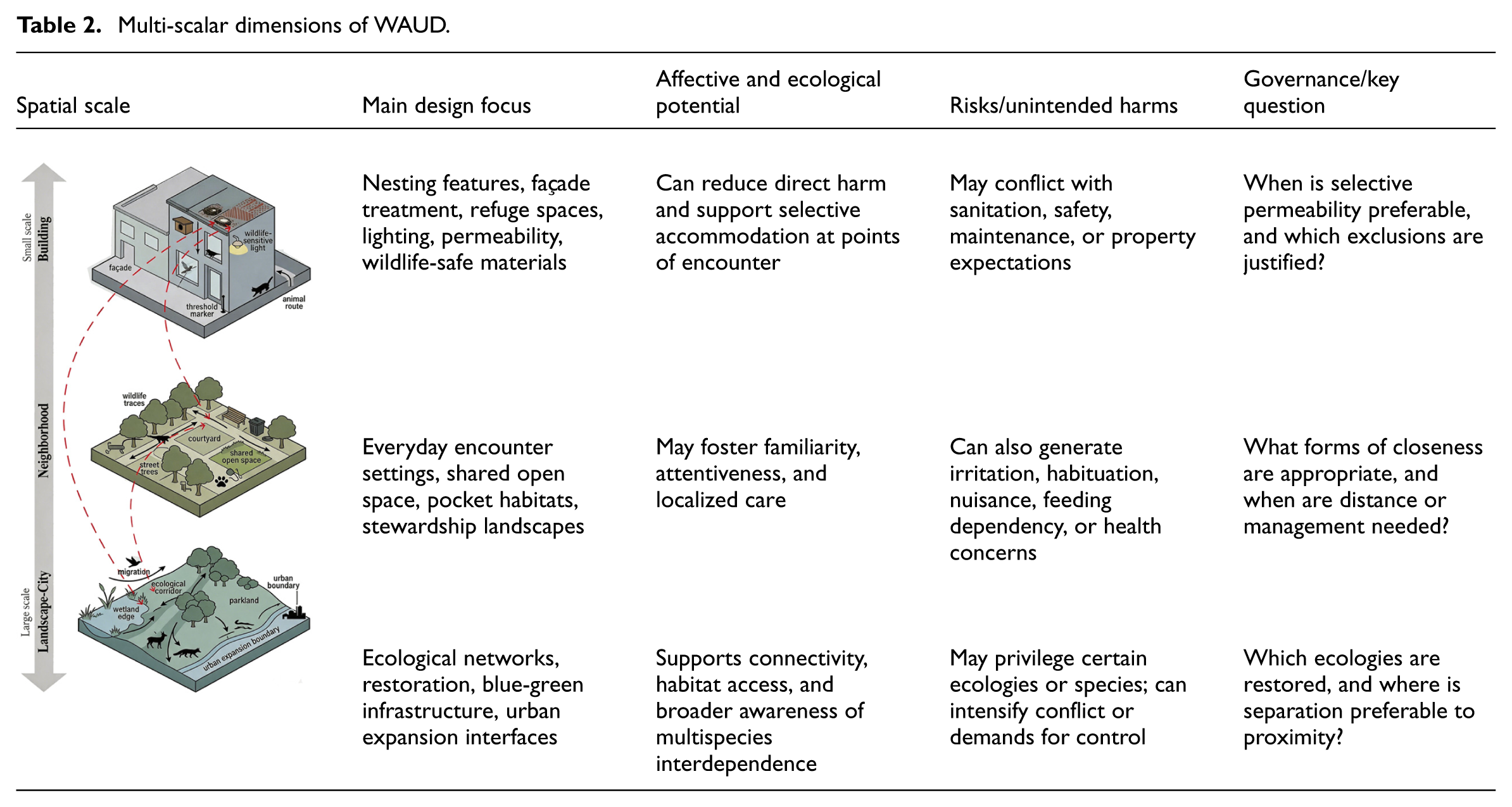
Earlier wildlife-inclusive approaches often implied that more encounter was inherently desirable. WAUD adopts a more careful position: proximity may support attentiveness and care, but it may also intensify habituation, resentment, exclusion, or lethal control, depending on species, setting, and institutional response (Haraway, 2008; Van Dooren, 2014; Wolch and Emel, 1998). The key design question is therefore not how to move urban subjects along a predictable gradient from distance to empathy, but how to organize relations across scales: at the landscape–city scale, design shapes habitat continuity and conflict frontiers; at the neighborhood scale, it structures repeated encounter and everyday tolerance; and at the building/interface scale, it regulates thresholds of collision, refuge, entry, and exclusion. These scales are interdependent. A corridor may support movement at the metropolitan level while generating edge conflicts in backyards; bird-friendly planting may support pollinators while creating maintenance concerns; exterior lighting that improves human wayfinding may fragment nocturnal behavior (Van der Ree et al., 2015).
Table 2 summarizes the framework: each scale offers ecological and affective possibilities, but each also introduces risks, trade-offs, and governance questions that prevent coexistence from being treated as a simple design good.
Multi-scalar dimensions of WAUD.
Landscape–city scale: Connectivity, ecological selection, and frontiers of tolerance
At the landscape–city scale, WAUD concerns habitat continuity, ecological repair, and distributed environmental perception. Corridors, river edges, wetlands, remnant woodlands, vacant lots, and transportation verges influence how wildlife moves through metropolitan space and where people are likely to register that movement. Yet restoration is never a neutral technical exercise. To reconnect habitat is also to decide which ecologies count, which species are welcome, and where urban residents are expected to accept the consequences of return (Houston et al., 2018; Lorimer, 2007).
For that reason, a WAUD approach at this scale should combine connectivity with selective buffering. Dark corridors and riparian continuity may benefit bats, birds, amphibians, or small mammals, but they may also produce new edge conditions in which fear or conflict becomes concentrated. Urban restoration can intensify disputes over coyotes, deer, boars, monkeys, geese, or other species whose presence is interpreted very differently across neighborhoods and cities. The task is therefore not simply to make urban nature more ecologically inclusive or experientially accessible, but to make the politics of ecological selection explicit and to ask where contact is desirable, where refuge should remain relatively undisturbed, and where temporal or spatial separation may be more just than forced intimacy. The scalar organization of multispecies encounter in WAUD is outlined in Figure 3.
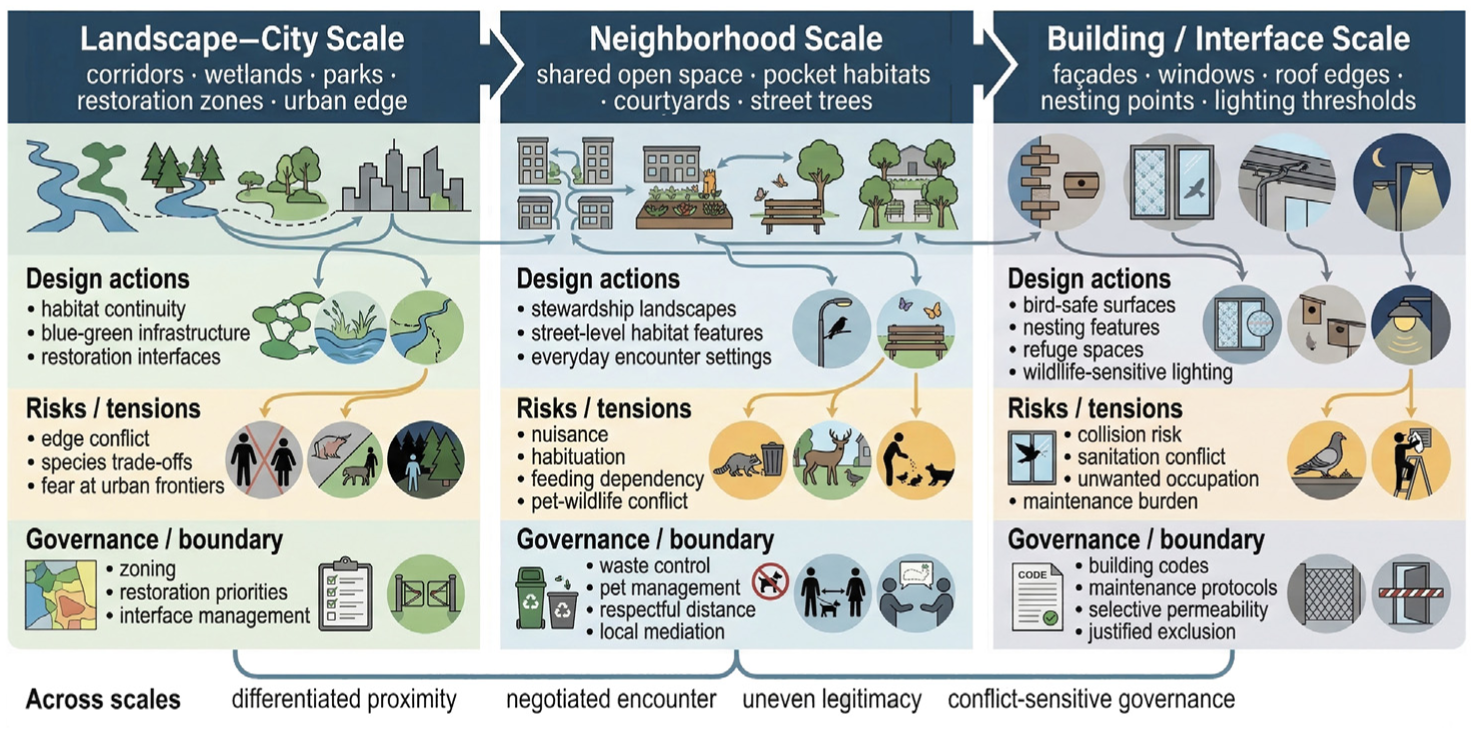
Organizing multispecies encounter across urban scales in WAUD. Across the landscape–city, neighborhood, and building/interface scales, design shapes how encounter is enabled, filtered, or limited. Opportunities for coexistence remain inseparable from risks, boundaries, and governance conditions.
Neighborhood scale: Everyday encounter, familiarity, and the limits of intimacy
The neighborhood is often imagined as the privileged scale of affect because it is where encounter becomes repetitive: birds at feeders, foxes in alleys, raccoons in bins, bats under eaves, possums on fences, or pollinators in planted verges. Repetition can support familiarity, but familiarity should not be romanticized. Repeated contact may stabilize tolerance, yet it may equally produce annoyance, fear, feeding dependency, sanitation complaints, conflict with pets, or demands for removal. The neighborhood is therefore less a laboratory of empathy than a field of negotiated co-presence (Hinchliffe and Whatmore, 2006; Seddon et al., 2021).
A WAUD framework should privilege respectful distance as much as visual or sensory access. Not all practices of care are benign. Feeding wildlife, encouraging repeated close contact, or designing for intimate visibility may express curiosity or attachment, but they can also produce feeding dependency, disease transmission, habituation, conflict with pets, or escalation of nuisance claims. Neighborhood design must therefore do more than encourage positive feeling; it must clarify how co-presence is expected to work, where food waste is contained, where pets are separated from vulnerable wildlife, how planting is maintained, whether residents are discouraged from feeding certain species, and how schools, housing associations, or municipal agencies communicate species-specific guidance.
Building and interface scale: Thresholds, selective permeability, and justified exclusion
The building/interface scale is where multispecies urbanism becomes materially precise. Glass can kill birds. Vents and cavities can provide refuge or unwanted entry. Roofs can function as habitat, heat infrastructure, or maintenance burden. Lighting can orient people while disorienting insects and nocturnal species. Fencing can protect vulnerable gardens but also fragment movement. At this scale, WAUD must move beyond the binary of host versus barrier and instead analyze thresholds: who passes, who collides, who shelters, who is excluded, and under what justification (Van der Ree et al., 2015).
Design strategies at this interface should therefore pursue selective permeability. Bird-safe glass, timed lighting reductions, green roofs with restricted access, integrated nest boxes, screened drainage elements, and façade retrofits can all reduce harm while avoiding the fantasy of unrestricted cohabitation. In WAUD terms, the building is not a miniature sanctuary. It is an instrument for organizing partial openings and partial closures in ways that make urban coexistence more legible and less violent.
Integrating scales through governance: From encounter to mediation
A multi-scalar WAUD framework should treat governance as the mechanism that links ecological design to accountability. At the landscape–city scale, this may involve species-specific planning guidance, corridor protections, and conflict-sensitive zoning. At the neighborhood scale, it may require reporting systems, educational protocols, or mediation between residents, property managers, and environmental agencies. At the building scale, it may involve standards for bird-safe materials, lighting curfews, maintenance responsibilities, or retrofit incentives. What matters is not the creation of consensus, but the creation of procedures through which recurring tensions can be interpreted before they become grounds for indiscriminate removal or neglect.
This reformulation also changes the role of emotion in policy. Instead of treating curiosity or care as straightforward indicators of success, WAUD asks which patterns of fear, frustration, attachment, or avoidance reveal a spatial mismatch that design could address. Governance does not complete the multi-scalar framework by harmonizing it; it completes it by making conflict visible across scales and by clarifying who is responsible for responding (Figure 4).
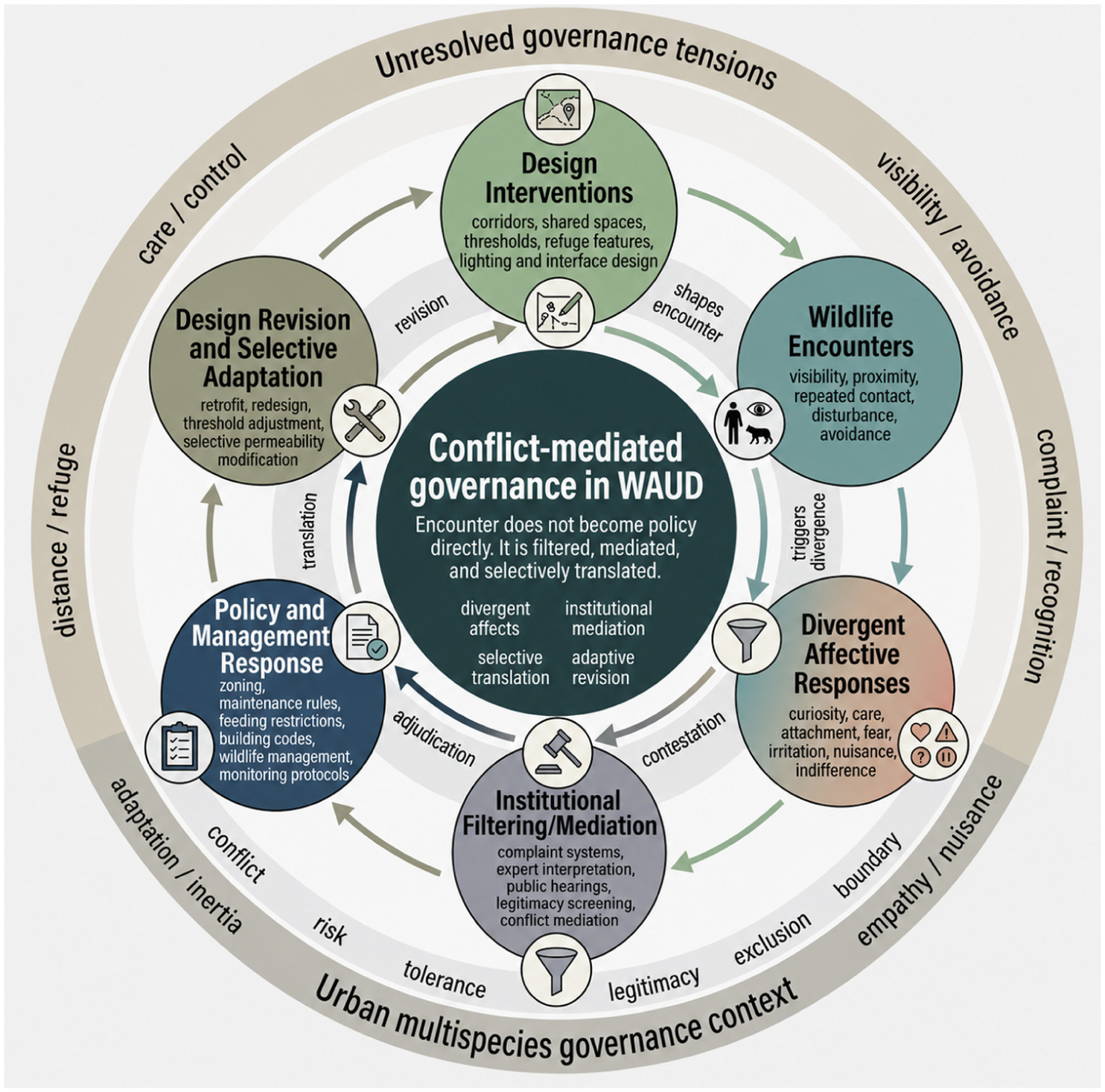
Conflict-mediated governance loop in WAUD. Design shapes wildlife encounter, but encounter does not translate directly into policy. Affective responses are divergent and selectively filtered through institutional mediation, producing uneven management responses and subsequent design revision.
These principles are not purely speculative. Existing practices already approximate parts of the framework, even if they are rarely described in affective terms: bird-safe glazing and façade retrofits reduce collision risk; timed lighting reductions and dark-sky measures lower disturbance for nocturnal species; and neighborhood rules around feeding, waste storage, and pet management can reduce habituation, conflict escalation, and uneven burdens of care (Apfelbeck et al., 2020; Jägerbrand and Spoelstra, 2023; Van der Ree et al., 2015). At the landscape scale, corridor planning and selective buffering likewise show how connectivity can be combined with managed distance rather than unrestricted access (Garrard et al., 2018; Seddon et al., 2021). Such measures are most plausible where repeated encounters with birds, bats, pollinators, or meso-mammals can be moderated through thresholds, maintenance, and species-specific guidance, even if they are less likely to resolve conflicts involving animals widely perceived as high-risk or intolerable. What WAUD adds is not a wholly new toolbox, but a way of interpreting these practices through conflict, legitimacy, and differentiated proximity.
Methodological and evidentiary implications of WAUD
WAUD does not reject quantitative rigor; it questions whether metric evidence alone can adequately capture how multispecies urban environments are inhabited, contested, and governed. The methodological issue is therefore not whether planning should abandon measurement, but how different forms of evidence can be assembled without assuming that any one of them provides a complete view. In multispecies settings, measured performance, lived interpretation, and nonhuman response often diverge. A place may score well on comfort or biodiversity metrics while still producing fear, nuisance, collision risk, displacement, or institutionally ignored conflict. WAUD responds by treating method as a site of interpretation rather than simple verification, and by insisting that evidence must remain partial, mediated, and accountable.
Rational legacies and the limits of metric thinking
Urban planning and environmental assessment have long been organized through the authority of measurement. Thermal indices, canopy-cover ratios, habitat counts, exposure models, and mobility data make urban conditions comparable and governable, and they remain indispensable for accountability and policy design (Batty, 2013; Oke et al., 2017). Yet the dominance of rational-metric reasoning also narrows what can count as evidence. As earlier critiques of modernist planning suggested, cities are not only abstract systems but lived and sensed environments whose meanings exceed what formal indicators can stabilize (Jacobs, 1961).
For WAUD, the problem is not measurement itself but the assumption that technical legibility is equivalent to adequate knowledge. A cooling intervention that reduces surface temperature may still intensify glare, disturb nesting birds, or produce a public sense of sterility. A biodiversity gain measured in species richness may coincide with noise complaints, droppings, predation concerns, or perceived danger. Metric success and lived success do not necessarily align, especially when encounter, nuisance, or risk are central to the politics of coexistence.
These limitations are especially important in multispecies contexts. Metric systems often flatten atmosphere and ambiguity into performance scores, compress long temporal processes into short monitoring windows, and assume broadly comparable responses to greening, visibility, or access. They may also exclude forms of situated observation through which conflict first becomes legible: recurring collisions, repeated avoidance of specific thresholds, changes in dawn chorus, or altered use of microhabitats. WAUD therefore retains quantitative evidence, but treats divergence between measured success, lived interpretation, and observed animal response as a substantive finding rather than a methodological inconvenience (Anderson, 2009; Pink, 2015).
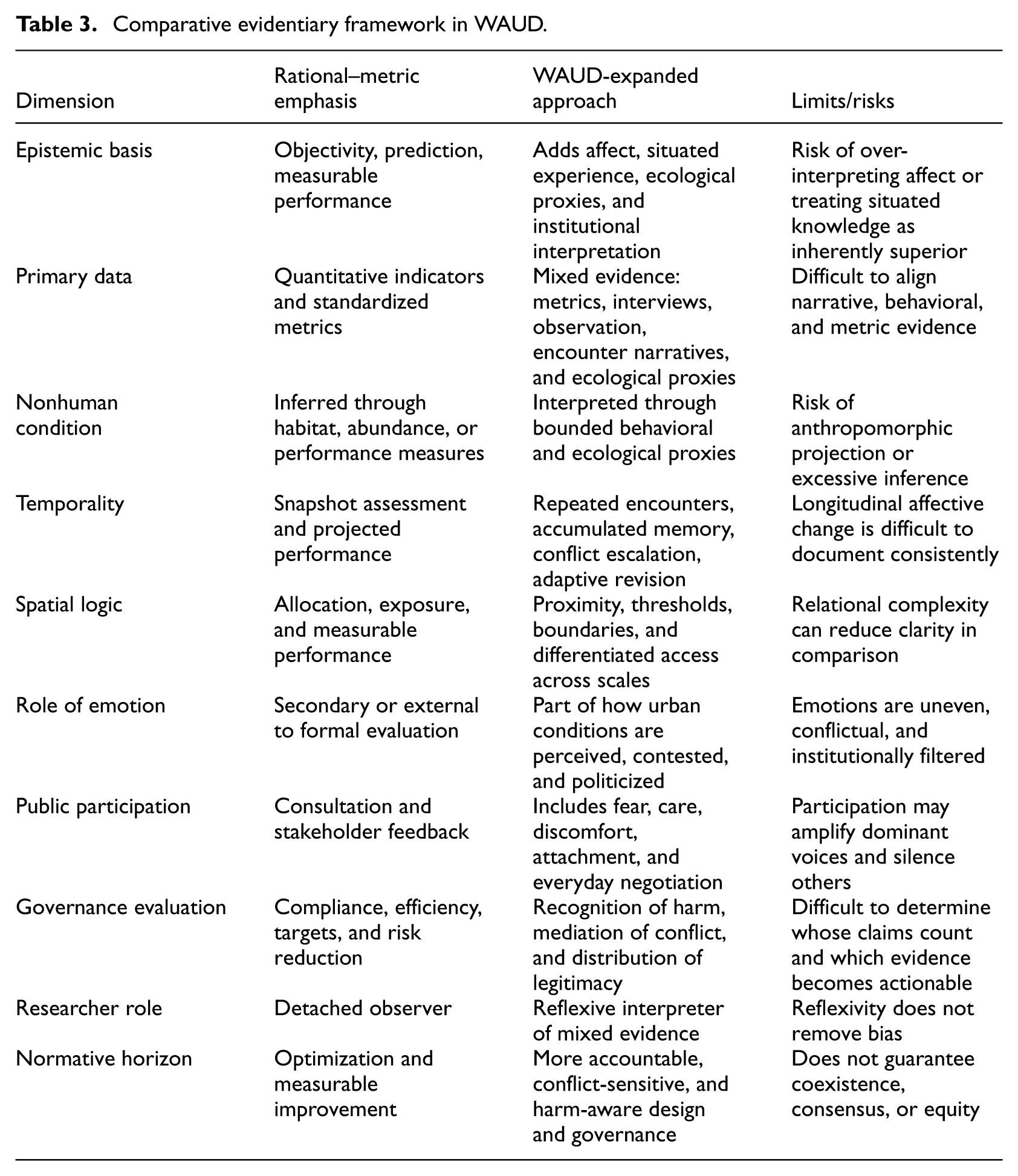
Table 3 summarizes WAUD as an expanded evidentiary framework rather than a paradigmatic replacement for quantitative urban research. The key move is not to abandon measurement, but to hold metrics, proxies, and situated accounts in productive relation while remaining explicit about the limits of each.
Comparative evidentiary framework in WAUD.
Mixed evidence and bounded complementarity
Different forms of evidence illuminate different dimensions of multispecies urban life. Quantitative indicators reveal distributional structure, situated accounts show how conditions are interpreted and politically weighted, and ecological and behavioral proxies offer a more cautious approach to nonhuman condition through movement patterns, habitat use, avoidance, mortality, acoustic activity, reproductive success, or observed stress responses (Lorimer, 2015; van Dooren et al., 2016).
For human participants, this may include interviews, diaries, sensory mapping, walking methods, and field observation that document how encounters are interpreted and negotiated in everyday life (Evans and Jones, 2011; Pink, 2015). For nonhuman life, WAUD remains methodologically cautious, relying on bounded ecological and behavioral proxies rather than claiming transparent access to animal subjectivity. The framework therefore neither reduces wildlife to inert ecological data nor romanticizes it as a fully readable emotional subject.
WAUD treats mixed evidence as a practice of bounded complementarity. Quantitative indicators, ecological proxies, and situated affective accounts are not seamless equivalents, nor should they be merged into a single emotional narrative. Their divergence is often analytically important. A site with strong biodiversity indicators but persistent resident hostility may reveal failures of threshold design, maintenance, or governance. A site celebrated for public attachment may conceal collision risk, displacement, or other harms legible only through ecological monitoring. What matters is not methodological harmony but the capacity to interpret tensions across evidence types (Figure 5).
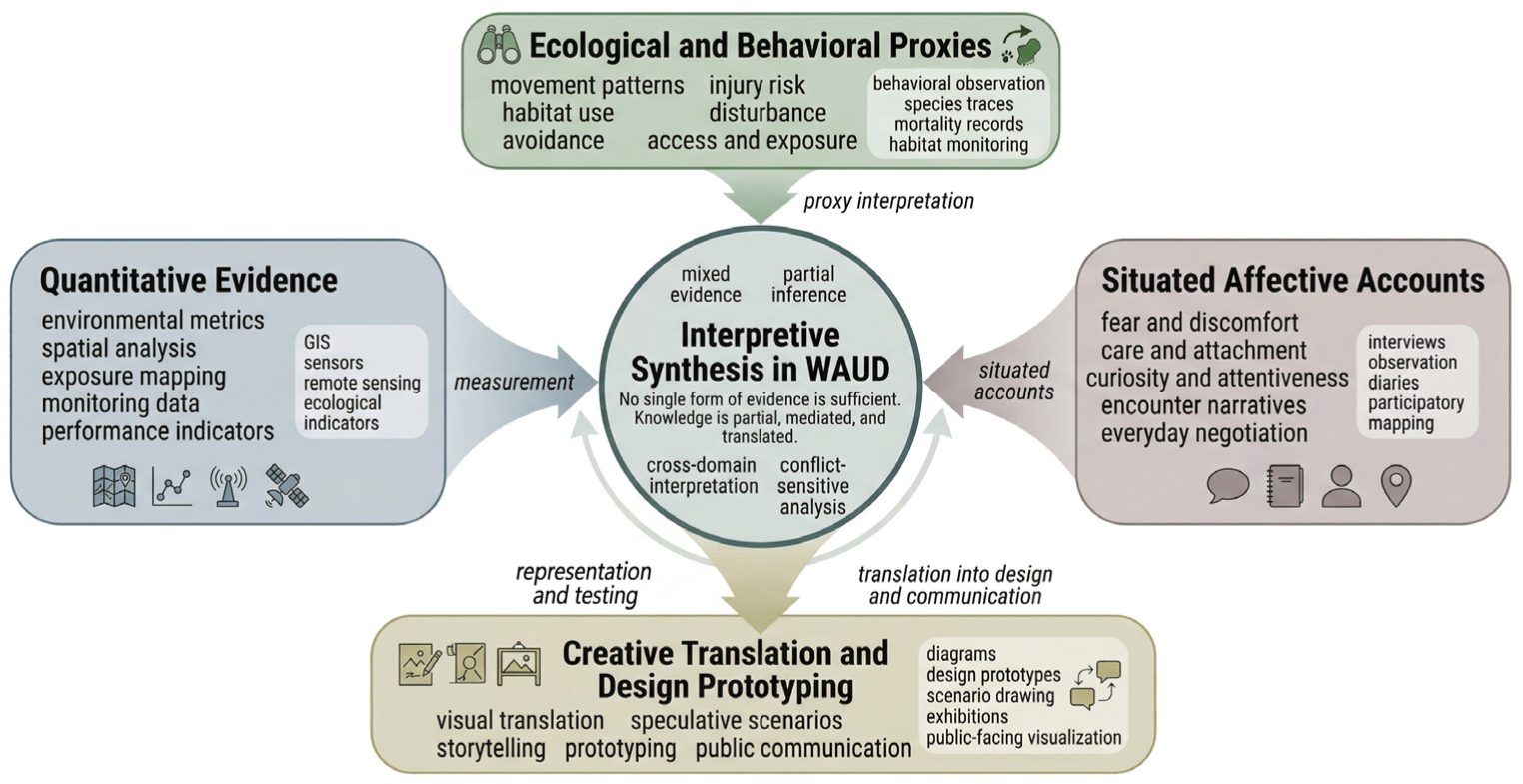
Mixed evidence and interpretive pathways in WAUD. WAUD combines quantitative evidence, ecological and behavioral proxies, and situated affective accounts through interpretive synthesis rather than direct transparency. Creative translation through mapping, visualization, and prototyping helps connect evidence to design and public understanding, while mediation, uncertainty, and epistemic limits remain central.
Methods, translation, and emerging forms of inquiry
A WAUD methodology is best understood as a portfolio rather than a singular technique. Participatory sensing can pair environmental readings with situated accounts of comfort, stress, or uncertainty, while ecological monitoring records bird strikes, bat passes, pollinator abundance, or edge use. Walking interviews and sensory ethnography remain useful because many multispecies relations are spatially specific and episodic, occurring at thresholds such as alleys, underpasses, canal edges, balconies, or drainage corridors (Evans and Jones, 2011).
Narrative ethnography is equally valuable, but it should not be restricted to stories of care or stewardship. WAUD also requires accounts of annoyance, disgust, boredom, conflict fatigue, and uncertainty. A method that records only successful attachment would reproduce an optimistic bias and misrecognize contested coexistence as a problem already solved. In this sense, negative and ambivalent affect is not noise in the data, but necessary evidence of how coexistence is lived.
Arts-based and design-led inquiry can also contribute when they translate sensory and ecological conditions into forms that publics and decision-makers can discuss. Sound maps, annotated transects, scenario drawings, and public-facing visualizations can make otherwise neglected conditions visible. But these methods should be treated as interpretive and translational devices rather than substitutes for ecological evidence. Their value lies in making uncertainty discussable, testing alternative arrangements, and communicating contested conditions more clearly.
Methodological implications for urban studies
For Urban Studies, the contribution of WAUD lies less in inventing a new method than in changing how evidence is assembled and evaluated. Quantitative material should not automatically count as authoritative while qualitative or sensory material is treated as merely contextual; each mode should be able to test, complicate, or challenge the others. Participation, likewise, should be understood less as co-feeling than as structured disagreement over whose discomfort is recognized, whose care is dismissed, and how property, tenure, race, class, and expertise shape those judgments (Anguelovski et al., 2019; Schlosberg, 2007).
Evaluation should also move away from the fantasy of a single coexistence index. Composite measures may be useful for policy communication, but they cannot erase tensions between human perception, ecological function, and nonhuman vulnerability. WAUD therefore favors a differentiated dashboard of indicators: reported fear, attachment, and nuisance; observed collision, displacement, or habitat use; and governance variables such as complaint patterns, maintenance regimes, and design responses. The purpose of evaluation is not to certify harmony, but to identify recurring asymmetries, unresolved burdens, and sites where mediation is required.
Conflict, legitimacy, and negotiated coexistence
Emotional justice as unequal exposure and affective conflict
Emotional justice in multispecies urbanism should not be understood as the equal circulation of positive feeling. In cities, encounters with wildlife do not distribute comfort, delight, fear, irritation, or vulnerability evenly, and they do not affect all species or all residents in the same way. Some urban inhabitants experience birdsong, pollinators, or visible habitat as signs of ecological recovery and everyday enrichment, while others encounter the same spaces through droppings, noise, bites, predation, uncertainty, or perceived danger. Likewise, some species are more easily narrativized as welcome urban companions, while others are coded as nuisance, contamination, or threat (Lorimer, 2007, 2015; Van Patter, 2023). Emotional justice therefore concerns unequal exposure, unequal recognition, and unequal burdens rather than shared atmospheres or generalized empathy.
From this perspective, affective conflict is not a temporary obstacle on the way to harmonious coexistence; it is constitutive of urban multispecies life. Coexistence is always lived through differentiated tolerances, asymmetrical risks, and uneven capacities to avoid or absorb disturbance. This is especially important in multispecies settings because contact does not have a single emotional direction. The same encounter may generate curiosity for one resident, fear for another, and vulnerability for the animal involved. Rather than asking how urban design can produce uniformly positive feeling, WAUD asks how design and governance organize the uneven conditions under which conflict, tolerance, and accommodation become possible.
Legitimacy, power, and selective governance
Because affective conflict is unevenly distributed and not all emotional claims are recognized on equal terms, legitimacy becomes central to any account of coexistence. Planning and governance do not simply respond to feeling; they selectively recognize some emotional claims as reasonable, urgent, or actionable while rendering others excessive, sentimental, or politically negligible. Fear may be institutionalized quickly when it aligns with dominant narratives of safety, property, or public health, while care, attachment, or more ambivalent forms of cohabitation may remain weakly recognized unless they are already supported by conservation discourse, esthetic value, or elite environmental norms (Anguelovski et al., 2019; Bosworth, 2023; Schlosberg, 2007). At the same time, not all human claims enter institutions equally. Residents with greater visibility, property security, or political influence may more easily translate nuisance into management response, whereas marginalized communities are often expected to endure environmental burdens with less recognition or recourse (Anguelovski et al., 2019; Schlosberg, 2007).
In this sense, coexistence is never governed through emotion in the abstract. It is governed through selective processes of institutional translation in which complaint, attachment, discomfort, and ecological concern are filtered through power, legality, legitimacy, visibility, and unequal voice. The result is not a smooth feedback loop between encounter and policy, but a contested field in which design, feeling, and governance remain unevenly aligned. Urban emotional politics therefore matter not because feelings are inherently authoritative, but because institutions decide which feelings count, whose discomfort becomes actionable, and which forms of multispecies life are treated as legitimate components of the city. Figure 6 illustrates how affective responses, institutional filtering, and unequal legitimacy shape negotiated coexistence.
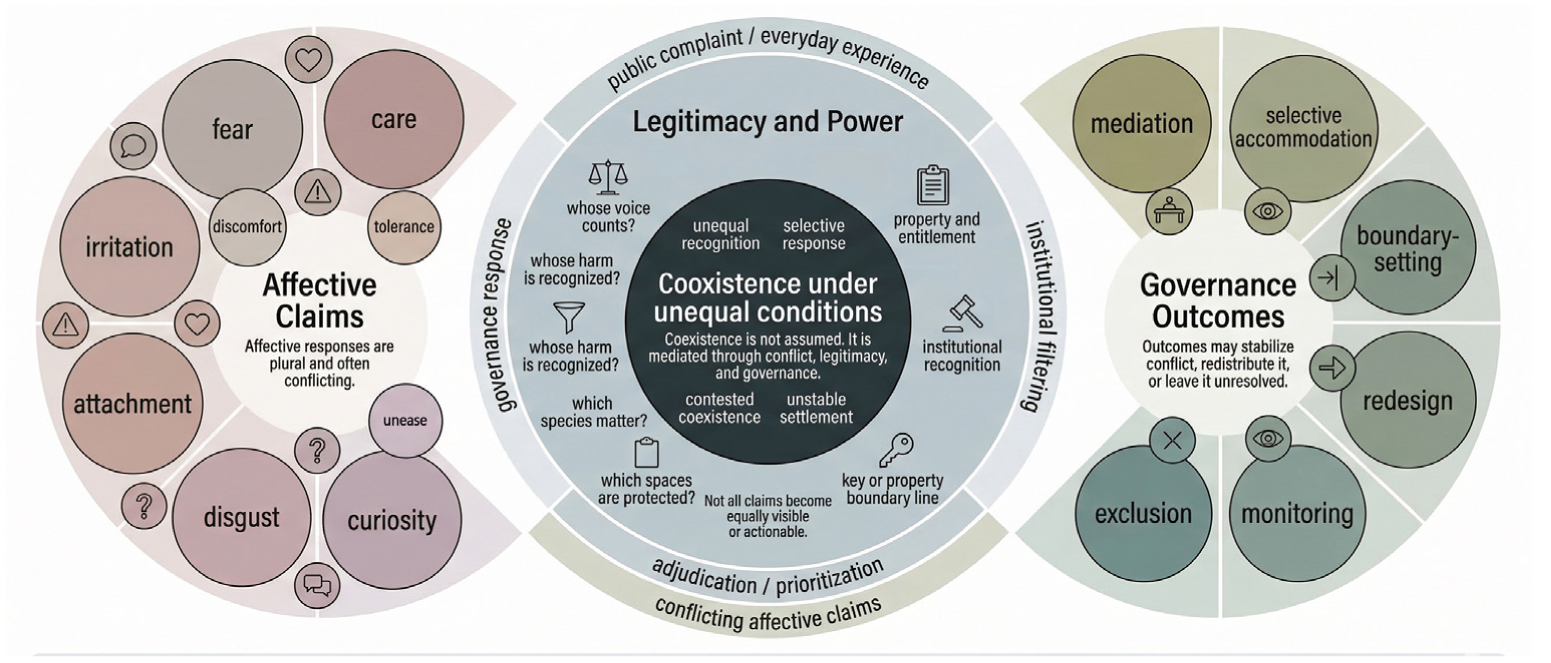
Affective conflict, legitimacy, and negotiated coexistence in WAUD. Rather than presenting conflict as a pathway to emotional equity, the figure shows how divergent affective claims are mediated through legitimacy, power, and institutional recognition. Coexistence is framed as negotiated and uneven, with governance outcomes ranging from accommodation and redesign to boundary-setting and exclusion.
Species difference, institutional risk, and the limited horizon of emotional equity
A further implication is that emotional equity must remain a narrow and conflict-sensitive concept. Not all species can or should be accommodated everywhere, and not all emotional responses translate into planning objectives. Positive affect is not exempt from this problem: care may also generate dependency, overexposure, or harm when proximity is treated as an unquestioned good. Some animals are more readily tolerated because they fit prevailing esthetics of urban nature, while others are governed through stigma, securitization, or removal (Celermajer et al., 2021; Haraway, 2008; Tănăsescu, 2022). Likewise, the institutionalization of emotion carries risks. If emotional life is rendered too quickly into policy metrics, dashboards, or design checklists, coexistence may be reduced to behavioral management, moralized tolerance, or symbolic branding rather than substantive negotiation over harm and responsibility.
For that reason, emotional equity should be defined more modestly and more defensibly: not as shared affection, and not as the universal inclusion of all species, but as the reduction of systematic harms, exclusions, and unrecognized burdens across multispecies urban life. This narrower horizon does not promise harmony. Instead, it supports a more accountable form of coexistence in which thresholds, refuges, separations, and selective accommodations can be justified, revised, and contested in transparent ways. Under such conditions, negotiated coexistence becomes not a utopian resolution of conflict, but a practical and revisable framework for living with difference in the city.
Conclusion: Toward situated and non-utopian multispecies urbanism
Theoretical contribution
This paper has argued that wildlife-inclusive urban design cannot be understood through ecological performance alone. Multispecies urban life is shaped through encounter, and encounter is affectively variable, politically filtered, and unevenly distributed. WAUD contributes a framework for understanding multispecies urban life as affectively variable, politically filtered, and unevenly governed by placing wildlife-inclusive design, affective urbanism, emotional urbanism, multispecies ethics, and spatial justice into sustained conversation. Its central move is to shift from a harmonious model of coexistence to one organized around differentiated proximity, selective permeability, contested legitimacy, and negotiated responsibility.
In doing so, the paper also contributes to emotional urbanism itself. Much work on emotional urbanism has shown how cities are lived through feeling, but it has been less explicit about how emotional life is reorganized when the urban question is no longer exclusively human. By introducing wildlife as a constitutive part of affective urban encounter, this paper extends emotional urbanism beyond human-centered atmospheres, attachments, and anxieties, and toward the uneven politics through which multispecies feelings become institutionally legible or governable. It therefore reframes emotional urbanism not simply as a field concerned with how cities are felt, but as one concerned with how emotional claims are selectively recognized, spatially distributed, and translated into planning and governance under unequal conditions.
Rather than treating contact with wildlife as a predictable route to empathy, WAUD shows that urban encounters can generate curiosity, care, discomfort, irritation, fear, avoidance, and demands for control at the same time. This matters because those responses shape whether species are tolerated, protected, excluded, or rendered incompatible with urban life. In that sense, the paper reframes urban coexistence not as a stable moral ideal, but as a spatial and political condition that must be interpreted through conflict, asymmetry, and unequal exposure.
Planning and governance implications
This reformulation has practical implications across scales. At the landscape scale, it means making ecological selection explicit and combining connectivity with buffering. At the neighborhood scale, it means treating everyday encounter as a site of repeated negotiation rather than assumed familiarity. At the building/interface scale, it means designing thresholds, selective openings, and justified exclusions rather than simply maximizing access. Across all three, governance matters because recurring tensions do not resolve themselves; they require procedures through which harms, conflicts, and responsibilities can be made visible and revised.
Methodologically, WAUD also calls for a more careful evidentiary practice. Quantitative indicators remain necessary, but they should be read alongside situated accounts of encounter and bounded ecological proxies. The point is not to abandon measurement, but to resist the assumption that measurable performance is equivalent to adequate knowledge. Affective responses, ecological conditions, and institutional judgments do not align automatically, and their divergence is often precisely where the politics of coexistence becomes visible. Figure 7 illustrates this concluding scenario.
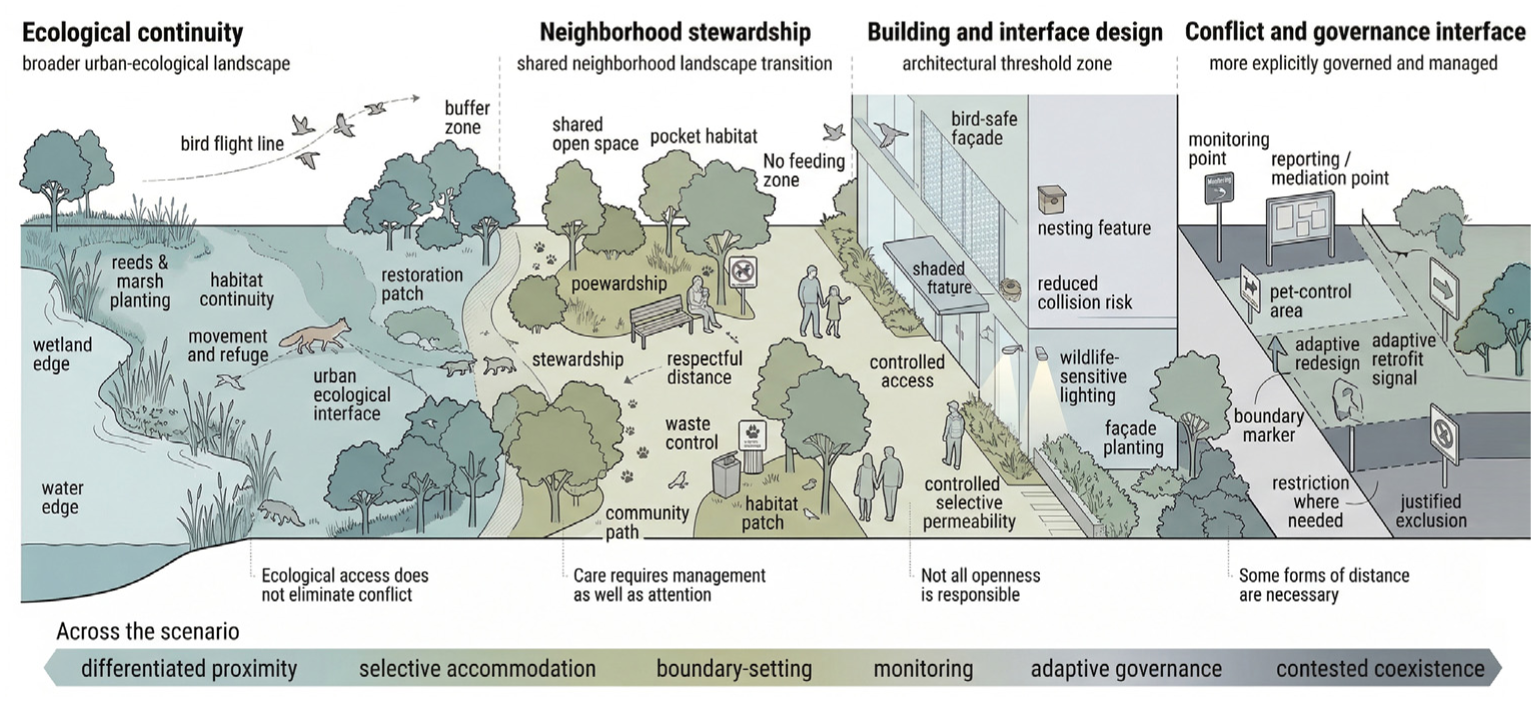
A negotiated scenario for multispecies urban coexistence in WAUD. Rather than depicting a harmonious urban end-state, the figure presents coexistence as a conditional arrangement shaped by selective accommodation, differentiated proximity, boundary-setting, monitoring, and adaptive governance across urban space.
Toward a narrower and more defensible horizon of emotional equity
The normative implication of WAUD is deliberately modest. WAUD does not define emotional justice as the equal circulation of positive feeling, nor does it assume that all species should be welcomed in all places. Such formulations risk romanticizing coexistence while obscuring its uneven burdens.
For that reason, emotional equity should be defined more narrowly: not as shared affection, but as the reduction of systematic harms, exclusions, and unrecognized burdens in multispecies urban life. This is a limited horizon, but also a more useful one. It allows urban design and planning to move beyond both technocratic indifference and moralized empathy toward a form of coexistence that remains conflict-sensitive, revisable, and accountable to unequal conditions. Positive affect is not exempt from this problem: care may also generate dependency, overexposure, or harm when proximity is treated as an unquestioned good.
A final qualification is necessary. Although WAUD is proposed as a general framework, the urban conditions and literatures informing it are not universal. Multispecies coexistence is shaped by culturally specific histories of settlement, religion, colonialism, and everyday human–animal relations, so the meanings of tolerance, nuisance, care, and legitimacy cannot be assumed to travel unchanged across contexts. The framework therefore requires further development across decolonial, postcolonial, and culturally differentiated accounts of urban life, rather than being treated as universally transferable.
Footnotes

Funding
The authors disclosed receipt of the following financial support for the research, authorship, and/or publication of this article: The authors gratefully acknowledge the support provided by the Research Center for Cultural Landscape Protection and Ecological Restoration, China-Portugal Belt and Road Joint Laboratory on Cultural Heritage Conservation Science, School of Architecture, Soochow University, China.
Declaration of conflicting interests
The authors declared no potential conflicts of interest with respect to the research, authorship, and/or publication of this article.