






Abstract
Increasingly critical focus is being placed on how urban adaptation policies approach issues of justice. Adaptation has been shown to exacerbate existing inequities or create new ones. Framings of justice issues in adaptation policies affect what representations are ultimately translated into practice. This study contributes to the field of adaptation justice by offering a critical look into the way proposed frontrunner cities approach justice issues by employing a frame analysis on 14 urban adaptation policies for the concepts they use and centre the issues around, what issues they focus on and how, and the way justice issues are presented. The results show three frames used in the policy documents: (i) justice through protection, which focuses on protecting the citizens and their ability to adapt; (ii) justice through equity and participation, which stresses equitability in distribution and increased fairness in participation; and (iii) justice through transformation, which suggests that justice issues are more deeply rooted in social structures and systems. We argue that while not all adaptation actions have far-reaching justice consequences, adaptation policies and policymakers should make a cognisant effort to recognise and acknowledge how and what inequities affect the adaptation initiatives and processes, to achieve more just and equitable adaptation outcomes.
Introduction
Urban areas are socio-ecological systems where the social, environmental, and economic spheres intersect (Byrne, 2021) and where issues of climate change adaptation land at the intersection of power, politics, and representation. The diversity of urban populations, livelihoods, and people’s differential needs and values creates questions and conflicts about the fairness and justice of climate change adaptation. Adaptation policies in cities may affect the lives of billions worldwide (United Nations, Department of Economic and Social Affairs, Population Division, 2019). There is concern that urban adaptation may create new inequities and vulnerabilities, or exacerbate existing ones, if adaptation policies are not carefully considered and designed with justice questions in mind (Eriksen et al., 2021).
Two issues need to be considered regarding justice and urban adaptation. First, the impacts of climate change are not divided equally among the population in the urban space, rather, they vary based on, for example, the existing spatial distribution of people and socio-economic status (Mohtat and Khirfan, 2021), and disproportionately affect the demographics already more vulnerable to climate impacts because of, for example, their age, gender, ethnicity or social status (Juhola et al., 2022b; Yang et al., 2021). These vulnerabilities and their uneven distribution are not born out of thin air but are often the results of historical, socio-political and institutional processes, where stakeholders have shaped planning and urban management in ways that have become detrimental to groups that held – and often continue to hold – less power in society to affect change (Chu and Cannon, 2021; Paavola et al., 2006; Shi et al., 2016; Yang et al., 2021).
Second, attempts to address these unequally distributed impacts – that is, climate change adaptation – are not a separate societal process happening in a vacuum. Rather, adaptation is largely implemented within existing structures of governance and can, as such, be in danger of repeating and exacerbating the very same patterns that have created current vulnerabilities and issues of inequity (Anguelovski et al., 2016; Bulkeley et al., 2014; Eriksen et al., 2021; Malloy and Ashcraft, 2020).
While it is also stressed that climate change adaptation is not always necessarily connected to issues of justice (e.g. Bulkeley et al., 2014), these issues have still often remained in the periphery of urban adaptation policy considerations (e.g. Juhola et al., 2022a), though some cities have begun to pay increasing attention to them (Cannon et al., 2023). Scholars have argued that if adaptation policies do not take justice into account, the results of adaptation can lead to unfair and inequitable outcomes that do not necessarily improve vulnerable populations’ positions (Reckien et al., 2025), nor share the benefits and harms of adaptation in a way that is equitable, and which may lead to conflict over their acceptability (Malloy and Ashcraft, 2020; Shi et al., 2016).
Much of urban adaptation policy research has focused on policy progress by identifying ‘frontrunners’ or ‘extensive adaptors’ (e.g. Araos et al., 2016; Reckien et al., 2023). Here, the focus has thus far been more on adaptation as a whole, which does not reveal how exactly justice issues are considered in these policies and plans. There are emerging studies on indices for analysing how to include justice matters into the adaptation assessment criteria in urban policies (e.g. Juhola et al., 2022a), as well as studies analysing justice implications of adaptation policies and projects (e.g. Chu et al., 2025; De Gopegui et al., 2025).
However, the literature is still lacking critical research on how policies utilise the notion of justice in adaptation policy and how they frame and contextualise issues of justice (e.g. Mohtat and Khirfan, 2021). Climate change adaptation has real, material impacts on well-being and livelihoods, and the way justice issues are framed in adaptation policy affects how urban adaptation is planned and implemented, and whether that is done in a way that is just and equitable.
This study focuses on a selection of adaptation plans of cities that are recognised as advanced, that is, paying substantial consideration to adaptation or resilience to climate change, as we argue that the frontrunner status implies a more likely integration of justice issues. We ask: How are issues of justice in adaptation framed in advanced urban climate change adaptation policy? We apply frame analysis to study the material, with an emphasis on the importance of problem framing in how justice issues are represented.
Urban adaptation governance and justice
Urban adaptation is a complex, contested multi-level process, and it is widely acknowledged that responses to climate change can also have negative impacts, possibly leading to maladaptation and exacerbation of vulnerability, that is, people’s susceptibility to be adversely affected by climate hazards (e.g. Andrews et al., 2023; Juhola et al., 2016). Maladaptation refers to unwanted, and often unexpected, negative impacts of adaptation actions that – while advancing adaptation from one perspective or group of people – cause harm to another (cf., Juhola et al., 2016). While adaptation actors in urban areas range from individual citizens and private-sector actors to municipal and public-sector actors within city governments, adaptation policy remains dominated by the environmental wings of local governments (Shi et al., 2016). This may partly explain the overemphasis on urban greening as a panacea for urban sustainability issues, including adaptation needs, which tends to overshadow inequity issues (Mengato and Haase, 2026).
It has been argued that much of adaptation planning is biased towards technocratic and managerial approaches, which focus less on the social consequences or equity implications of climate change and adaptation itself (e.g. Eriksen et al., 2021; Juhola et al., 2022b). The technocratic bias in adaptation planning is claimed to overemphasise regulatory, financial and engineered adaptation interventions (Chu and Cannon, 2021), and climate resilience is driven primarily by perceived risks to urban economies (e.g. ‘climate urbanism’; see Long and Rice, 2019). Even successfully implemented adaptation efforts can be inequitable, such as in cases where they end up prioritising the protection of affluent people’s assets at the cost of protecting more vulnerable parts of the population, or when adaptation measures lead to the displacement of people (Anguelovski et al., 2016; Mohtat and Khirfan, 2021).
Previous studies have shown that when questions of justice are considered in urban adaptation planning, they are primarily focused on distributive justice, followed by procedural justice considerations (Coggins et al., 2021; Fiack et al., 2021). Urban adaptation often focuses on the relation between the distribution of resources and services, and differential vulnerability and adaptive capacity of citizens, with less attention being paid to the structural and systemic drivers of vulnerability (Chu and Cannon, 2021; Chu et al., 2025) – such as how poverty can affect access to cooling, or lack of participation can impact local land-uses and thereby increase vulnerability to climate hazards (Kaswan, 2021).
There is growing research interest in equity and justice in cities’ adaptation policies (e.g. Cannon et al., 2023) that, however, does not trickle down to adaptation implementation (Chu and Cannon, 2021). Despite the rich global selection of competing imaginaries of adaptation in academic literature, the transformational and just adaptation imaginaries fail to translate prominently into grey literature and actual governance, which remain at a business-as-usual level (e.g. Harris et al., 2017; Loroño-Leturiondo et al., 2025; Kanarp et al., 2025). The way justice is framed in policy plays a pivotal role in shaping the outcomes. In general, there is a discursive disconnection in adaptation in regard to justice issues, with governing bodies being more focused on risk-management, technical solutions and provision of incentives and information, while others, such as community groups and scholars, call for a focus on the deeper, systemic and structural causes of vulnerability in urban areas (Schlosberg et al., 2017).
To study the framing of justice in urban adaptation policy, we employ a theory guided framework that draws on the existing literature on adaptation justice, which is still a relatively new field but is closely associated with the established theories and concepts of environmental and climate justice, particularly, the division between recognition, distributive and procedural justice (e.g. Paavola et al., 2006) and, more recently, restorative justice (e.g. Juhola et al., 2022a), as well as the capabilities approach (e.g. Schlosberg, 2012), see Table 1.
Dimension of urban adaptation justice.
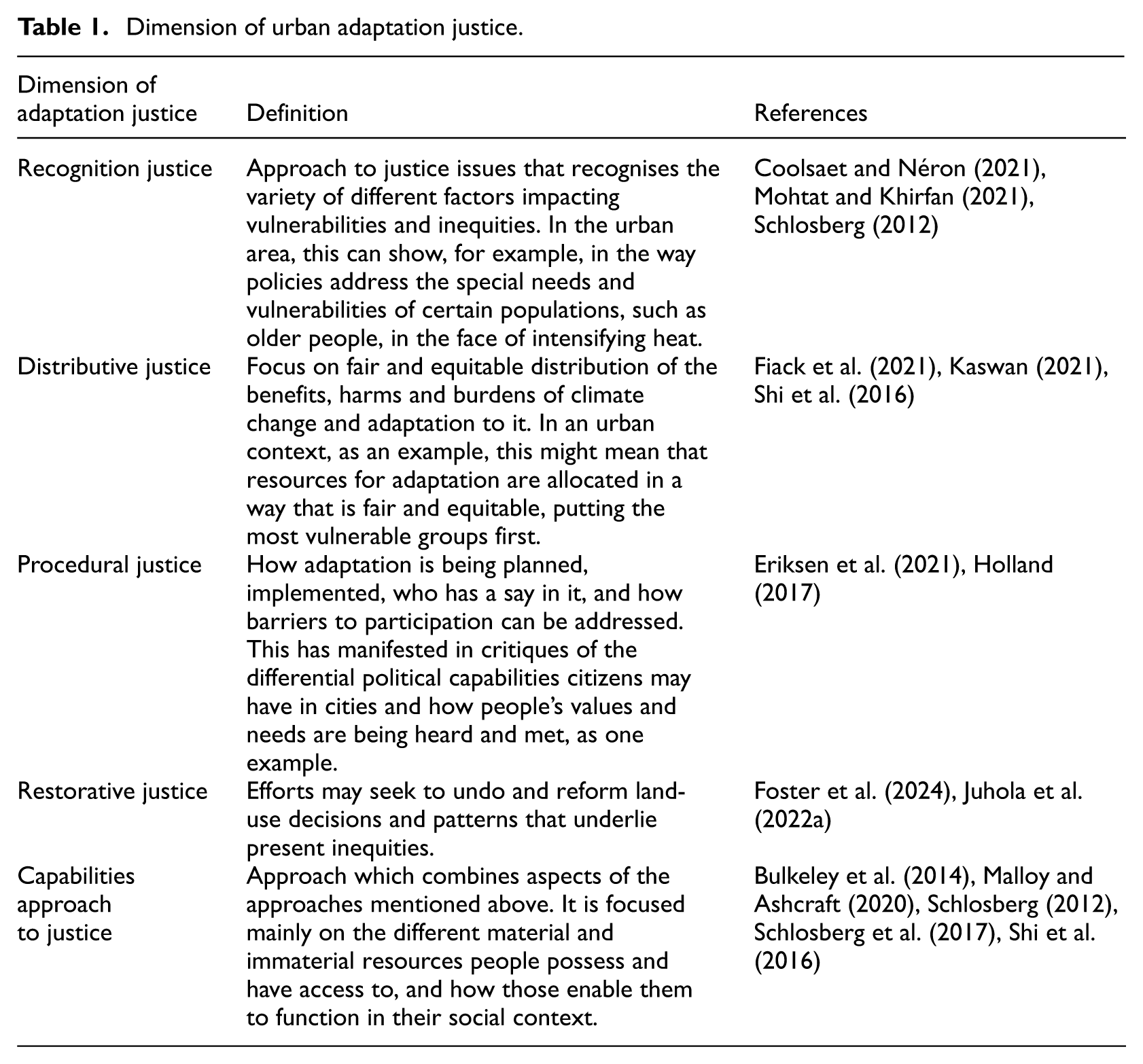
We employ these concepts of justice in the context of urban adaptation together with the literature on adaptation framing that broadly defines the three main frames presenting adaptation as resilience (the ability of a given system to maintain its functioning in changing conditions), equity, or transition/transformation (Malloy and Ashcraft, 2020; Pelling, 2010). By highlighting certain aspects and problem definitions of issues and centring discussions around specific themes, framing consequently impacts policy decisions and actions (Keller, 2013; Van Hulst et al., 2024). Hence, we present the following operationalised questions in the analysis: (1) What concepts are used in the policies, and what topics are the issues centred around? What is pushed to the side or ignored?; (2) What justice topics are present in the policy documents?; and (3) How are dimensions of urban adaptation justice represented when adaptation is framed as resilience, equity or transition and transformation?
Materials and methods
The material for this study consists of a set of adaptation plans from cities considered frontrunners in climate change adaptation (see Table 2). These frontrunners were chosen based on two studies – the set of the highest-ranked cities originally from Araos et al. (2016), adapted by Pietilä (2023), and another top seven cities from Reckien et al. (2023). These cities’ ‘frontrunner’ status is owed to factors such as the assessed fact base, the quality and quantity of their adaptation initiatives (Araos et al., 2016), and qualitative assessments of their goals, implementation, monitoring and evaluation, and participation (Reckien et al., 2023). These qualities are usually identified in affluent Euro- and anglophone-centric countries, resulting in a sample that excludes many regions worldwide.
Dataset.
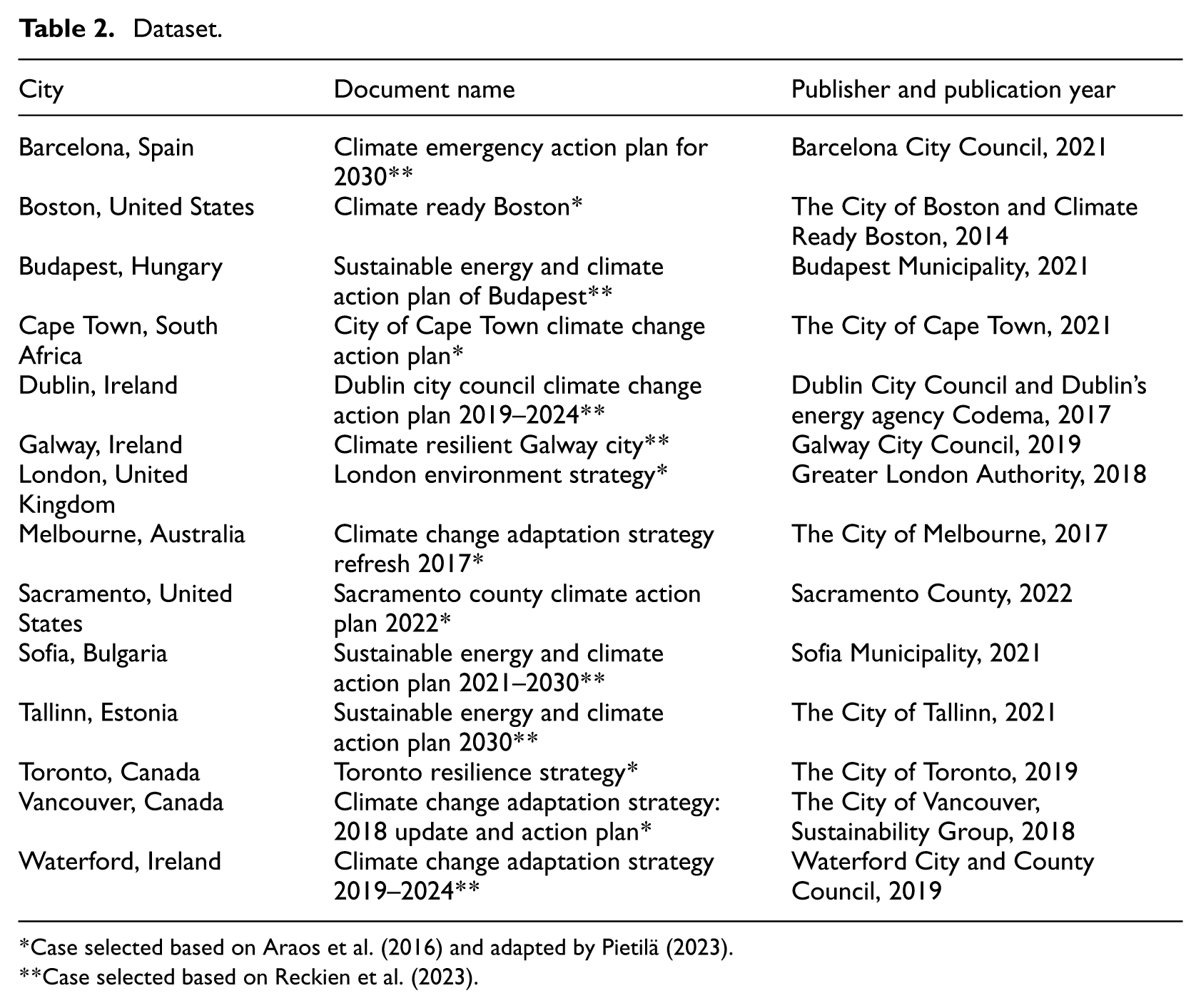
Case selected based on Araos et al. (2016) and adapted by Pietilä (2023).
Case selected based on Reckien et al. (2023).
We use frame analysis (e.g. Khan and MacEachen, 2021; Keller, 2013; Van Hulst et al., 2024) to analyse the plans for the manner in which they represent justice issues. ‘Frames’ are understood here as central meaning patterns of a discourse that highlight and centre specific aspects of an issue while giving less attention to others or omitting them (Keller, 2013; Van Hulst et al., 2024). The analysis follows an abductive logic (Van Hulst and Visser, 2025) that moves iteratively between theory and data. We conducted the thematic coding (Silvasti, 2014) in ATLAS.ti software (version 25.0.1), and it followed the theory-informed framework (Table 1) of adaptation justice dimensions and the operationalised questions. We started coding by identifying the general content and structure of the documents, and the sections that dealt with adaptation; then, sections that addressed either explicitly or implicitly issues of justice in adaptation and the framing of adaptation were coded. Next, we organised the coded excerpts inductively around emerging themes related to justice issues – such as the resilience of systems, functions and citizens, and the recognition of underlying issues – creating additional codes accordingly (Silvasti, 2014), for example, vulnerability from climate risks and place, or affordability. Finally, we carried out an interpretive analysis to synthesise the main frames, that is, central meaning patterns of a discourse with specific thematic focuses and internal structures (Keller, 2013), by reading the coded text fragments, theorising and engaging with the literature, and rereading and recoding the fragments.
To avoid the potential bias involved in an interpretive analysis (e.g. Khan and MacEachen, 2021), we discussed the coding choices and findings between the authors, while the corresponding author carried out the main coding work, acknowledging that by analysing discourse, the analysis also contributes to it – there is no clear line between analysis of discourse and participating in it (Keller, 2013).
Results
Three different ways of framing justice issues in adaptation are used in the policy documents to varying degrees, and they partly overlap, that is, the frames do not fully describe the policy documents’ stances. The frames centred the justice issues around the topics of (i) protecting citizens from climate change, (ii) fairness and equitability and (iii) systemic and structural factors that underlie vulnerabilities and inequities in adaptation. The main dividing lines between the frames lie in (1) the way vulnerability and reasons for it were conceptualised; (2) the way underlying structural and systemic factors of inequities and vulnerability were recognised – or not recognised – and handled; and (3) the way procedural issues were – or were not – approached.
Justice through protection
The justice through protection frame centres justice issues in adaptation to the risks posed by climate change and in protecting the different functions of urban systems, that is, on the traditional idea of resilience to climate change. This includes, among others, protecting infrastructure against flood damage, protecting people against extreme weather events, or protecting services against disruptions – a distinctly limited capability approach to justice. At the centre of this frame is the protection of citizens’ health, well-being and livelihoods from the impacts of climate change.
One of the main concepts in this frame is risk: risks from climate change, risk assessments, and measures to alleviate and respond to the risks. Climate change is framed as the driver of additional risks and changes in vulnerability; therefore, climate risks are the focus of adaptation. Actions to mitigate them range from providing information on how to deal with extreme weather and other impacts, to ensuring that blue-, green- and grey infrastructure are resilient, building new infrastructure, and ensuring that the services provided by the city or local councils function in the face of climate risks. As an example, infrastructure, such as flood protection, is framed as beneficial because it protects citizens from the risks of climate change, as exemplified in the following quote: Many neighborhoods benefit from dam flood protection: Flood protection at the New Charles River Dam could simultaneously protect parts of northern Downtown, southern Downtown, Charlestown, the Charles River neighborhoods, and the South End and Roxbury. – Boston, p. 113
Vulnerability is connected to climate change within the protection frame and is conceptualised primarily in terms of the negative impacts it poses. Increases in vulnerability and actions to mitigate these vulnerabilities are centred on how climate impacts and risks affect citizens’ and communities’ health, well-being and quality of life. The frame recognises that climate change poses differential impacts on citizens owing to their physical attributes (e.g. age or medical conditions), occupation, or their geographical location. These interplay with climate risks in contexts such as predisposition to negative heat impacts due to age or existing illnesses, residents’ proximity to and access to emergency services, or lack of support networks due to isolation.
The cities present themselves as responsible for helping citizens and communities adapt, and their focus on justice is evident through this protective lens. The responsibility for protecting the citizens is conceptualised in two different ways. First, the individual is ultimately responsible for their own adaptation, while the city provides them information and education on risks and how to increase their own preparedness, see for example: The health effects of climate change are linked to an increase in heat waves, an increase in the spread of diseases [by transmitters], a deterioration in air quality, an increase in trauma due to slipperiness and a deterioration in the quality of drinking and bathing water. The city can support coping with these effects mainly through information and awareness-raising and support for groups at risk. – Tallinn, p. 45
Second, the city works to ensure that services and infrastructure that support people – such as, council housing, healthcare, and transport – are resilient to the impacts of climate change, thereby protecting citizens’ health and well-being. The city, as the actor, is there to improve the resilience of that which is deemed important and is responsible for that resilience, see for example: Climate change will impact both the services and assets that Galway City Council manage and the local communities within our functional area. Local Authorities play an influential role in preparing communities for climate change through the services they deliver, such as planning and development, critical infrastructure, environmental facilities and socio-economic programmes. – Galway, p. 15
In this frame, justice and equity are not discursively connected to adaptation, and adaptation is framed as a depoliticised process that centres on assessing risks and responding to them by improving resilience and protecting communities’ health and well-being. Adaptation becomes more akin to development with a climate focus.
Justice through equity and participation
The justice through equity and participation frame is founded on the understanding of climate inequality and how it will increase social inequities. Adaptation is positioned not as a separate issue in society, but as deeply connected to other challenges cities and their citizens face. The focus on equity and fairness comes with the recognition that different people have different needs, values and capabilities when it comes to adaptation, and to identify and address this spectrum, a participatory approach to adaptation planning, monitoring and evaluation is required.
This frame approaches vulnerability through a lens of inequality: citizens possess unequal capabilities and opportunities to adapt to climate change largely due to their circumstances, such as, inequitable distribution of resources, services, opportunities, and shelter in the city, as well as marginalised groups that are often already in more vulnerable social positions. Different equity-affecting social and economic factors are acknowledged to influence vulnerability, and vulnerability is discursively linked to existing societal problems, moving it beyond a framing that mostly centres on risks from climate change. Following this idea, actions are framed to prioritise the most vulnerable groups for fair and equitable adaptation. Climate change impacts citizens differently, and the actions taken must take that into account, as highlighted in Barcelona’s plan: Climate change affects health and quality of life but it does not affect everyone in the same way. Which is why the Climate Emergency Action Plan cannot respond to the effects of climate change on the city and its citizens in a uniform way. – Barcelona, p. 75
More precisely, vulnerability is framed as something to be assessed to better target adaptation actions, for example, via vulnerability and equity assessments. For instance, the City of Toronto uses an ‘Equity Lens’ tool for equity analysis in the development of policies and projects, among other uses, to help: identify and address barriers that may be experienced by equity-seeking communities and Indigenous peoples in accessing City services. – Toronto, p. 14 The Equity Lens online tool also generates an Equity Impact statement which is required in the budget process. – Toronto, p. 111
Vulnerable groups in the frame may include, for example, minorities, women, low-income households and others who may have relatively more limited ability to access resources or opportunities – for example, transportation, housing, energy, food, emergency services or employment – owing to their position in society.
Justice issues in this frame centre around distributive matters, as illustrated in Toronto’s plan: We also know that access to safe and liveable homes and reliable infrastructure is not equitably distributed across the city. For example, apartment towers, where one in three low income families live, are disproportionately vulnerable to extreme heat and power shortages. – Toronto, p. 7
Not only is distributive inequity in society framed as one of the drivers of vulnerability, but the idea that the benefits and harms of adaptation should be shared equitably among residents, and that adaptation should provide benefits not only for the few but also seek co-beneficial actions where possible, is present. These concerns can include, for example, how access to housing affects the ability to cope with climate change, or the goal of increasing people’s participation in the economy through adaptation actions, thus reducing inequities. Another prominent distributive aspect is the availability of green space, trees and shelter – and specifically the lack of them in certain areas. Fairness in adaptation is considered achievable if the distributive inequities are addressed and the most vulnerable are prioritised.
As part of more equitable adaptation, the frame uses the language of fairness and inclusivity to place greater attention on citizens’ participation in the adaptation decision-making process and to acknowledge the contribution local knowledge can make. Thus, procedural matters are closely linked to the distributive concerns and revolve around engagement; the city engages its residents on what to focus on in adaptation, how to adapt, and in co-producing projects, departing from more top-down ways of planning, aiming to empower citizens to action – see for example: Local authorities have significant experience in engaging citizens through their existing functions, including land-use planning, housing, employment, transport and environmental efficiency and awareness. Local authorities are also engaged in existing public participation structures and approaches that are bottom-up, local community centred and are outcome focused. – Dublin, p. 24
However, in engaging citizens, the city is still positioned as the one taking action, and questions about political capabilities and power remain absent. The increased participation of stakeholders appears more as an addition to current decision-making structures and sticks to a more general level, see, for example: Finally, as citizens are crucial for solutions to climate change, DCC [Dublin City Council] will set out to actively inform and engage the public through a range of innovative programmes and partnerships and, where possible, facilitate bottom-up, community-led solutions. – Dublin, p. 9
This frame ties justice issues to adaptation at a fundamental level, treating them as essential to addressing adaptation. Focus shifts away from a general concept of ‘resilience’ toward improving vulnerable groups’ positions in society and achieving equitable outcomes as a priority. The goals for adaptation become more about distributive actions to take citizens’ differing needs and values into account in the planning.
Justice through transformation
The justice through transformation frame is the least common, identifiable mainly in the policies of Toronto, Cape Town and Barcelona. This frame also begins at a point where social inequities are seen as problems inherently intertwined with adaptation, much like in the previous frame. However, the focus on inequity is not so much on the distributive aspects, but on recognising and identifying structural and systemic factors that create and uphold them, offering more transformative views to tackling them, such as outright calling for transformative and systemic change, as illustrated in the following: This SFA [Strategic Focus Area] targets climate response that addresses the elements of spatial integration and access to resources and essential services that together compound inequity. The objective is a just plan for the transformative and systemic change needed to build climate resilience and reduce GHG emissions, with any trade-offs being made in favour of the poorest residents of the city. – Cape Town, p. 55
While the representation of vulnerability is similar to that in the other two frames, the difference lies in how vulnerability is addressed. Structural and systemic factors – such as poverty, inequitable land use or economic systems perceived as unfair and inequitable – are explicitly linked to vulnerability and other justice issues that adaptation addresses. The actions to tackle vulnerabilities, instead of incremental adjustments, call for transformation, as the following excerpt illustrates: Pathway 10: Greater equity, inclusivity and a just transition work towards greater equity, inclusivity and a just transition to a carbon-neutral and climate-resilient future that is centred on strong participation and engagement by all stakeholders. The aims will be to eliminate resource poverty, ensure sustainable and equitable land use, enable poverty reduction, and encourage and ensure well-being and a healthy environment. – Cape Town, p. 29
The justice issues are seen as part of a larger phenomenon that should be assessed with systemic and structural drivers in mind. Addressing them is a larger undertaking, deeply connected to other aspects of society, not just those directly related to climate change. This framing moves the conversation beyond what is commonly conceived as adaptation and into wider societal discussions. It also guides the conversation towards measures that aim for systemic change, which shows in talk of a fairer and more just economy, trying to undo injustices in land-use planning that have led to segregation of people and increased vulnerabilities, or in taking gender into account in analysing how people are able to access affordable and safe housing, as for example: We need to set out the actions from a gender perspective, incorporating diversity and flexibility criteria into public spaces, facilities and dwellings, to adapt to the new realities and families, and the ageing population (with a higher proportion of elderly women). – Barcelona, p. 84
This frame prioritises recognition – recognition of the different positions people hold in society, of how social structures and systems shape people’s daily capabilities and vulnerabilities, and of how those shape their ability to adapt. Here, the idea of recognition ranges from acknowledging how systemic and structural factors, for example, poverty, discrimination and gender, affect the way citizens can access necessities, such as housing and energy, to acknowledgements of the effects past injustices – such as colonialism, or segregationist policies – have on their current situations, which reflects the idea of restoration. This offers a broader view of justice issues that is more cognisant of the variety of different factors at play, including how local knowledge is an important aspect of effectively adapting to climate impacts and alleviating vulnerability, see, for example: Indigenous peoples have essential, far-reaching knowledge and practices that are missing today, grounded in the laws of the land and Natural and higher laws…the nature of the relationship [between the City and Indigenous communities] needs to change in relation to climate work, from one that still reflects colonial domination to one that moves into a process of collaboration. After all, climate and other environmental catastrophes are intimately related to colonialism. – Toronto, p. 55
The procedural justice discourse this frame draws on is influenced by recognition justice and capabilities approaches to justice, recognising that people’s ability to participate in decision-making and planning processes differs, and that not everyone’s voice is heard equally. How people are able to participate in governance and have their voices heard is framed as part of how their vulnerability is shaped, how inequities affect them, and the adaptation process.
This frame recognises barriers to meaningful participation as part of justice in adaptation that need to be recognised and addressed, and the idea of participation goes beyond consultation and engagement. People’s political capabilities and the ways in which inequities and power imbalances impact them are placed at the centre of procedural issues; disenfranchisement and discrimination are seen as challenges to inclusive participation. Empowerment and inclusion of people in the decision-making process are justified by the idea that the government should be accessible to all residents – especially through positive engagement and communication with residents – and that governance should reflect the needs and demographics of the city.
By explicitly connecting adaptation, inequalities, inequities, and injustices to systemic and structural factors, the focus of action shifts from (re)distribution and participation to addressing the underlying issues that cause inequalities and inequities. Adaptation is framed not only as a matter of climate change but also as an economically, socially, and politically transformative one.
Discussion
These empirical findings reveal three ways of framing justice issues in adaptation policies of 14 advanced cities, mostly in the Global North, that reflect adaptation frames previously identified in research (Malloy and Ashcraft, 2020; Pelling, 2010). Each frame provides a representation of what the justice issues are seen to be about and where the limits are to how the policy documents approach them. Our findings contribute to the discussion on advancing just adaptation and on how current adaptation policy supports this by showing alternative ways of understanding adaptation justice and the types of limitations and preconditions these views impose on the adaptation actions that the documents are meant to guide in our sample cities. This leads us to raise three considerations.
First, the three frames illustrate how the differential treatment of vulnerability shapes what is just and whether vulnerability assessments hold a vital position in adaptation planning, for example, in guiding the prioritisation of actions to benefit the most vulnerable. Approaching vulnerability this way can, however, conceal the underlying factors that create it and may allow them to persist under the guise of ‘just’ adaptation (Eriksen et al., 2021; Tschakert et al., 2013). This can be considered as a type of maladaptation where the vulnerability of the target group ‘rebounds’, that is, is increased through adaptation (see Juhola et al., 2022a). This can be seen in our sample, where identification and resilience-building for the most vulnerable groups receive more attention than the underlying structures that contribute to their state. This was evident in the Boston case, studied by Malloy et al. (2022) after the implementation of the adaptation plan, where injustices are reproduced through conventional policy-making procedures and the exclusion of the views of residents who participated in the process, that is, in a tokenistic way.
In some cities, as our sample demonstrates, vulnerability is understood as more than an inherent quality. Rather, as discussed in the literature, it results from complex, dynamic factors ranging from political capabilities and discrimination to individuals’ health and age, which interact with adaptation and the changing climate (e.g. Eriksen et al., 2021; Schlosberg, 2012). Furthermore, some studies (e.g. Eriksen et al., 2021; Holland, 2017; Tschakert et al., 2013) emphasise that power is an inherent factor in adaptation, and in the way vulnerability is framed within adaptation processes. Therefore, the use of static indicators and assessments that are structured in advance may fail to capture dynamic factors central to maladaptive outcomes and the continued existence and reproduction of vulnerabilities. While this may be understood or even stated in urban adaptation policy, it rarely translates into an assessment method that goes beyond current indicator-based methodologies. The ‘Equity Lens’ tool of the City of Toronto is an interesting opening that seems to hold potential for a more dynamic way of assessing the justice issues in adaptation planning and implementation, although research on the use of the tool is limited to infrastructure planning (see LeClair et al., 2023).
Second, the three frames illustrate that when vulnerability is connected to political capabilities and underlying societal structures, the issue of recognition becomes central. Increased attention to participation and political capabilities in the framing of justice issues stands in contrast to imaginaries of adaptation, which frame the process through a top-down, specialist-oriented vision of governance. Multiple studies have highlighted the importance of addressing citizens’ differential political capabilities to avoid maladaptation through the implementation of solutions which reinforce or create new inequities (e.g. Eriksen et al., 2021; Holland, 2017; Shi et al., 2016). This can result from prioritisation of the resilience of urban economies and infrastructure, or greening, as universally beneficial strategies, over the well-being of citizens (see, e.g. Chu and Cannon, 2021; Long and Rice, 2019; Mengato and Haase, 2026).
Whether adaptation is apolitical is where the frames diverge. In the justice through transformation frame, inequity in political capabilities is important. This reflects previous literature (Coolsaet and Néron 2021; Schlosberg 2012), which stresses that recognition justice is not only relevant in procedural issues but also for achieving equitable distribution of harms and benefits, as well as for effectively reducing vulnerability (Eakin et al., 2022) and, eventually, putting restorative justice in effect. The acknowledgement of the injustices related to colonialism may be the first step toward this in a few of our case cities. This, however, is not the case with the justice through protection and justice through equity and participation frames, which approach justice in more apolitical terms. Increasingly, in literature that calls for more transformative adaptation, the focus is on citizens’ political capabilities and on disrupting existing relations of power (Holland, 2017; Malloy and Ashcraft, 2020; Pelling, 2010; Tschakert et al., 2013). Coolsaet and Néron (2021) and Schlosberg (2012), for example, point to the role misrecognition and political disenfranchisement play in the (in)equitable distribution of environmental goods and harms in society. This raises a question about the framing of justice in adaptation; can it lead to equitable adaptation, if the way justice is framed does not engage with the socio-political aspects of the system it is being implemented within, and, further, what are the prevailing social and political conditions that allow a shift in the justice framing?
Third, our three frames reveal the extent to which policy documents in our sample cities acknowledge and are willing to tackle these existing power structures through transformative adaptation, which is most evident in the transformation frame. Key limitations in achieving just outcomes are those set by the governance systems within which adaptation takes place (Siders, 2022). This is the core challenge for the kind of resilience outlook identified in the protection frame that does not engage with socio-political questions. Recognition justice is relevant here as it further draws attention to the fact that adaptation is not in fact a depoliticised process and operates within the same sphere as other development efforts in the urban environment and is subjected to the same impacts, from social structures to systemic effects, from the governing bodies as well as the surrounding culture (Bulkeley, 2021). There are, however, degrees of recognition, too. While the equity and participation framing works towards equitable adaptation and integrates aspects of recognition, its ideas of equitability and fairness are not visibly connected to critiques of socio-political and structural conditions that underlie them. Many adaptation initiatives, even those framed as being about equity, are still implemented within established ways of governance and structures of power, which have often contributed to the very problems they aim to address (Anguelovski et al. 2016). This makes the goal of just adaptation a fundamentally political one, as seen in the transformation frame, which sets the action in terms of fundamental structural change and the improvement of stakeholders’ political capabilities.
This study offers a view of how policies frame justice issues in policy documents, yet it does not study implementation on the ground or whether this implementation is, in fact, more just and results in more just outcomes. It also focuses on which frames are present, but not on quantitative aspects, that is, how much each city’s policies utilise them. Further research, therefore, can focus on gathering more empirical evidence, as the language of equity and fairness is not a guarantee of just adaptation (Anguelovski et al., 2016; See and Wilmsen, 2020), especially when empirical evidence supporting this assumption is largely lacking. Policies and plans might not change anything in practice if the measures laid out in them do not actually translate into implementation, which places the onus on tracking the credibility and implementation of those actions (e.g. Olazabal et al., 2019). Future studies might also explore the way in which framings – and representations – of justice issues in adaptation have evolved temporally, and in which ways different governmentalities of adaptation (Keskitalo et al. 2012) impact how justice issues are (1) framed and represented in the policies and (2) implemented via adaptation actions. Furthermore, in addition to the justice theories applied in this study, there are recently emerging theories that may be pertinent to the discussion of urban adaptation justice, for example, epistemic justice, intergenerational justice, intersectional justice and multispecies justice.
As the selection of frontrunner cities is mostly Euro- and anglophone-centric, from relatively affluent countries, it is worth noting that this provides a look at cities that may skew towards having more justice-inclusive framings of adaptation than those deemed in earlier studies to be lacking in adaptation. The frames are also a reflection of the socio-political contexts of those cities; an example of which can be seen in how talk of colonialism and Indigenous voices was reflected in the policies of Cape Town and Toronto. These aspects add to the limitations of generalising the results of this frame analysis; the results must be treated within their contextual environment as a snapshot of a specific time, place, and type of discourse. While this study did not delve into the temporal aspect of the analysis, it is worth noting that time is also a factor that may affect the results.
Conclusion
At the same time as literature and theories on framing may focus on adaptation as a vehicle for comprehensive structural and systemic change in society, the adaptation solutions need to be workable. Adaptation does not need to be approached as a silver bullet that will fix all of society’s ills. This, however, does not mean that the way justice issues are framed in policies is inconsequential, as policies are central to shaping understandings of adaptation.
Adaptation policies play a central role in shaping adaptation, as the framing and language used in them shape how issues are represented and what actions are taken. While some adaptation actions can be beneficial for all and a resilience goal can be a good one, there is a real possibility that they could recreate and exacerbate existing inequities and vulnerabilities. At the core of this often lies a misrecognition of how adaptation impacts and is impacted by existing social inequities, as well as a misrecognition or ignorance of the values and needs of the residents. We argue that there are multiple ways of defining just adaptation, ranging from framing it as protection from risk to ways that recognise the socio-political and complex nature of adaptation and its justice issues, not limited to ‘resilience’. We stress that the language of fairness and equity is not a guarantee of just adaptation, as it can move attention away from more deeply rooted problems by focusing on surface-level issues.
To address misrecognition and efforts that exacerbate vulnerabilities and inequities, policies should engage more with how societal inequities affect different aspects of adaptation and utilise frames that present adaptation as a complex, contested socio-political process when addressing justice issues. Increased attention should be paid to the differential capabilities citizens have in decision-making, as well as to how society shapes those capabilities and based on what underlying assumptions.
Footnotes

Author contributions
Conceptualization: EK, SJ and JK; Data curation: EK; Formal Analysis EK; Methodology EK, SJ and JK; Supervision: SJ and JK; Validation: EK, SJ and JK; Writing – Original Draft Preparation: EK, SJ and JK; Writing – Review & Editing: EK, SJ and JK.
Funding
The authors received no financial support for the research, authorship, and/or publication of this article.
Declaration of conflicting interests
The authors declared no potential conflicts of interest with respect to the research, authorship, and/or publication of this article.