






Abstract
This article develops a theoretical framework for analyzing urban solidarity by bringing the concept of social capital into dialogue with the feminist notion of intersectional alliance. While social capital has long been used to examine relational resources embedded in networks, it has often been criticized for utilitarian and economic reductionism. Conversely, the concept of intersectional alliance foregrounds political commitment and solidarity across difference, but remains analytically under-specified. The article argues that integrating these two perspectives allows solidaristic cooperation among heterogeneous actors to be analyzed as a relational configuration that combines political orientation with relational mechanisms of cooperation. The paper reconstructs the genealogies and limits of both concepts and compares them across three analytical dimensions—motivations, purpose, and solidarity—before proposing an integrated framework that seeks to contribute to urban studies by offering a conceptual vocabulary for analyzing solidaristic relations in cities. The objective of the integration is twofold: first, to politicize social capital by mitigating its utilitarian tendencies and emphasizing the often-overlooked dimensions of power and conflict; second, to operationalize the concept of intersectional alliance, making it analytically useful for investigating the resources activated within social relationships. In doing so, the framework provides a theoretical lens for examining urban solidarity, where heterogeneous actors stabilize cooperation under conditions of spatial proximity and conflict.
Introduction
This article aims to foster synergies across theoretical and disciplinary approaches to build new analytical frameworks for interpreting urban solidarity practices (Arampatzi, 2017; Bauder, 2022). Cities are places where social interactions are particularly intense and complex, diverse and conflictual (Mela, 2006); where lives are interconnected through their very differences (Pulcini, 2009) and where singularity and plurality coexist (Arendt, 2017). If urban space is understood as the material and shared platform on which social ties are forged and collective practices unfold, then the interplay between cities and social relations concerns our modes of inhabiting the world, of living in community, and of cultivating bonds of solidarity. This raises broader questions about how social relations are formed, sustained, and politically oriented. As Lin (2001: XI) suggests, sociology can be understood as “the study of choices in social relations,” concerned with the motivations and consequences of actions. When the motivations are brought to the forefront, it becomes evident that relationships are characterized by a decision-making dimension that encompasses values, ethics, and politics. Of course, this does not apply to every social relationship. As Weber (1995: 25) states, “the concept of social relationship does not state anything about the existence or otherwise of a solidarity between individuals acting,” nor does it necessarily account for the characteristics underpinning the bond itself. While social interactions can be occasional and contingent, not all concepts used to describe relational structures take this variability into account. The notion of the social network, for instance—now widely adopted to indicate the structure of connections among social actors and the configuration of their relationships—tells us nothing about the intentions behind these links or the contexts in which they are embedded. In contrast, although they emerge from distinct genealogies and disciplinary traditions, the concepts of social capital and the feminist notion of intersectional alliance both address the motivations and objectives underlying social ties, while engaging questions of structural inequality, solidarity, and trust.
Rooted in the early development of sociological thought but only systematized in the 1980s, social capital has followed a downward trajectory: once highly influential, it was widely criticized and partially displaced by network-based approaches. Despite this decline, I argue that the conceptual relevance of social capital deserves renewed attention, because it brings value issues back into the center of social scientific debate (Schuller et al., 2000), and also because it considers how actors are embedded 1 in structural relational networks that shape their actions (Granovetter, 1973). Moreover, social capital remains an analytically valuable and methodologically structured tool for interpreting the network society and its growing inequalities (Andreotti, 2009). Rather than abandoning the concept, this article engages critically with its limitations in order to rethink its analytical potential for contemporary urban solidarities. To pursue this line of inquiry, I argue that a process of re-signification is necessary, and I suggest that an analytical articulation between the notion of social capital and the feminist concept of intersectional alliance is especially fruitful. Such an integration helps reframe social capital in ways that respond to the challenges posed by intersectional thought, thereby offering a renewed analytical lens for interpreting what Graeber (2021) describes as communities of purpose and not of definition: solidaristic alliances grounded in identification rather than identity (Sa’ar, 2005), and oriented toward the pursuit of shared goals. This understanding resonates within feminist scholarship, where the term intersectional alliance has been primarily developed to theorize political solidarity across differences. This concept prompts us to engage with issues such as: how is it possible to converge and mobilize for collective liberation without erasing our differences? What methodologies could enable the recognition of socio-cultural differences while fostering the creation of a common ground for defining a collective political subject? In this regard, the concept of intersectional alliance proves particularly powerful, as it encourages reflections that critically engage with the dynamics of power and solidarity. While these questions have largely been addressed within feminist theory, this article proposes to mobilize the concept of intersectional alliance analytically within urban sociology. In this context, intersectional alliance becomes a useful lens to examine territorialized relations that emerge, for example, in struggles against gentrification and the housing crisis, in movements for the reappropriation and occupation of urban spaces, and in campaigns for common goods and the right to the city. This theoretical article proposes an integration of social capital and intersectional alliance with two objectives: first, to politicize social capital by mitigating its utilitarian tendencies; second, to operationalize the concept of intersectional alliance, making it analytically useful for investigating the resources activated within social relationships. The resulting framework seeks to bridge the respective gaps of the two concepts and to provide an analytical tool for examining solidaristic relations among actors. This effort speaks directly to urban studies, where solidaristic cooperation often takes shape among heterogeneous actors who do not share stable identities or pre-existing forms of community belonging, yet are required to coordinate collective action within conditions of spatial proximity and conflict (Nicholls, 2009).
The article is structured as follows. The first section examines the concept of social capital, reviewing its main interpretations, as well as its critiques and potential. The second section reconstructs the concept of intersectional alliance, outlining its genealogy, core features, and internal tensions. The third section brings the two perspectives into analytical articulation, reformulating key dimensions of social ties—motivations, purpose, and solidarity—and illustrating how these operate within spatially situated collective practices. The last section discusses a possible application of this integrated framework within urban theory, reflecting on its implications for research on collective action.
Social capital: Genealogies, evolutions, and conceptual ambivalences
Many pages have been devoted to social capital, a heterogeneous concept that resists univocal definitions and rigid disciplinary boundaries. As Piselli (1999: 395–396) notes, social capital: is a situational and dynamic concept; a concept, therefore, that does not refer to a specific “object”, cannot be flattened into rigid definitions, but must be interpreted, from time to time, in relation to the actors, the ends they pursue, and the context in which they act.
Its widespread use in academic debate can thus be attributed not only to its analytical utility, but also to its flexibility. Given the wide range of existing interpretations (Field, 2003; Halpern, 2005), the following pages will examine a few of the most influential conceptualizations. In particular, I focus on micro-founded approaches, which define social capital as a set of cooperative social relations that facilitate the achievement of otherwise inaccessible goals (Andreotti, 2009) and pay “analytical attention to the concrete situations in which actors act and to the emerging effects of their interaction” (Bagnasco, 2002: 274). 2 In this section, following a brief overview of the origins of social capital in classical sociology, I distinguish between two groups of perspectives that emphasize different dimensions of the concept. The first includes Pierre Bourdieu, alongside later elaborations by Nan Lin and James Coleman, and conceptualizes social capital primarily as a resource. The second, represented by authors such as Alessandro Pizzorno, Alejandro Portes, and Julia Sensenbrenner, places greater emphasis on reciprocity and the motivations underlying social ties. The section concludes by reflecting on the most compelling aspects of these approaches.
Origins and articulations of a layered concept
Despite its interdisciplinary character—which, for instance, facilitates the reintegration of social dimensions into the study of economic behavior (Andreotti, 2009)—social capital is a distinctly sociological concept, rooted in classical analyses of social integration, cooperation, and group formation (Bagnasco, 2002; Tosini, 2005). These traditions are closely tied to questions that later became central to urban research: how relations are formed among strangers, how trust emerges in conditions of proximity, and how cooperation persists in socially heterogeneous environments. From Tönnies’ (2011) distinction between Gemeinschaft and Gesellschaft to Durkheim’s (2014, 2021) reflections on social cohesion; from Weber’s analysis of reputation and closure (Andreotti, 2009; Trigilia, 1999) to Simmel’s (2018) account of metropolitan interaction, classical sociology laid the groundwork for understanding relational life in contexts characterized by density and difference—conditions that are particularly intensified in cities. Although these contributions provided important conceptual foundations, the theoretical consolidation of social capital is relatively recent, taking shape between the 1980s and the early 2000s.
A major contribution is provided by Bourdieu (1986: 248), who, within his broader theory of different forms of capital, 3 defines social capital as an “aggregate of the actual or potential resources which are linked to possession of a durable network of more or less institutionalized relationships of mutual acquaintance or recognition.” From this perspective, social capital is a resource distributed—often unequally—according to both the size of the network actors can mobilize and to the volume of capital (economic, cultural, or symbolic) held by its members. Similarly to economic capital, social capital represents accumulated labor that enables actors to mobilize social energy and strengthen their positions. Bourdieu’s work highlights how access to networks is highly selective, requiring a certain degree of homogeneity among the actors involved, and often reproducing existing social hierarchies. In cities this dynamic becomes particularly visible, as relational proximity simultaneously facilitates cooperation while reinforcing mechanisms of closure and exclusion (Forrest and Kearns, 2001; Haynes and Hernandez, 2008; Wacquant, 2007). Defining social capital as a resource—both limited and cumulative—thus reveals how power and scarcity operate within relational structures: the accumulation of resources by some actors restricts access for others (Glaeser et al., 2002; Portes, 1998).
In continuity with Bourdieu, Lin (2001) defines social capital as a relational resource generated through investment in social ties expected to yield returns across economic, political, labor, or community settings. Such interpretations emphasize the utilitarian dimension of social capital and portray actors as strategically forming connections to maximize benefit. Similarly, though with a more explicitly economic focus, Woolcock and Narayan (2000: 226) argue that “the basic idea of social capital is that a person’s family, friends, and associates constitute an important asset” that can be leveraged for material gain. In these interpretations, the actor is depicted as a rational subject oriented toward maximizing their interests (Kovalainen, 2004). These perspectives broadly belong to the framework of rational individualism, 4 a theoretical tradition that understands social behavior as the outcome of rational decisions focused on interest maximization (Cocozza, 2005).
While Coleman’s theory also fits this framework, Piselli (1999) highlights its partial departure from classical individualism by emphasizing how social organizations and institutions shape action. Individuals act interdependently, pursuing goals that are not purely self-centered (Coleman, 1990). Intertwining subjective and structural dimensions, Coleman (1988: S98) defines social capital in functional terms as a set of social structures that facilitate action. Among its forms is the social capital of obligations and expectations, which relies on the extent to which the social environment is perceived as trustworthy, meaning that obligations are expected to be fulfilled and that actors hold claims on one another. This approach has strongly influenced urban research on neighborhood effects and everyday institutions: studies on collective efficacy translate its components—trust, obligations, and informal norms—into neighborhood mechanisms shaping crime and cooperation (Sampson et al., 1997; Sampson, 2012), while research on urban organizations shows how local institutions generate relational resources independently of individual intentionality (Small, 2009). Although this perspective retains a utilitarian orientation, its emphasis on trust complicates the idea that social action can be reduced to profit-maximizing strategies (Lin, 2001).
Softening the utilitarian imprint of the previously discussed theories, other interpretations emphasize solidarity and belonging rather than instrumental exchange. Portes and Sensenbrenner’s concept of bounded solidarity exemplifies this approach, describing a form of social capital that “does not arise out of the introjection of established values or from individual reciprocity exchanges, but out of the situational reaction of a class of people faced with common adversities” (Portes and Sensenbrenner, 1993: 1325). Drawing on Marxist analyses of class consciousness formation, this form of social capital is grounded in dynamics of identification with one’s group or community (Portes, 1998) and arises from shared material conditions or common characteristics among actors (Portes and Sensenbrenner, 1993). It is therefore a type of social capital generated through belonging (Trigilia, 1999), characterized by strong and homogeneous networks whose members share a common identity—whether local, ethnic, or cultural—and cultivate relationships of trust and reciprocity. This conceptualization closely aligns with what Pizzorno (1999) terms solidarity social capital, which is based on relationships strengthened within cohesive groups through shared identity, culture, or symbolic traits. Such forms often develop within localized groups—local associations, migrant communities, or neighborhood networks—but may also produce exclusionary effects, from amoral familism (Banfield, 1958) to endogamic forms of solidarity (Pulcini, 2000). These risks are mitigated in the case of reciprocity social capital (Pizzorno, 1999), which is not based on belonging to a cohesive group. This form of social capital refers, for example, to relationships between two or more individuals in which cooperative ties are oriented toward a common goal, or where interactions are guided by universal principles, intended as shared ethical values that transcend utilitarian interests or identity affiliations. Drawing on Trigilia’s (1999) work on local development, reciprocity social capital emerges through experimentation and is thus based on weaker, more occasional relationships that do not rely on prior acquaintance or shared ownership dynamics. 5
Critiques and potentials of social capital
The flexibility of the concept has allowed social capital to encompass a wide range of heterogeneous interpretations. Some of these formulations, however, have been criticized for their economic reductionism. This stems partly from social capital’s interdisciplinary position between economic reasoning and broader sociological approaches (Coleman, 1990), and partly from its frequent definition by analogy with economic capital (Bourdieu, 1986; Lin, 2001). Even where this analogy is less explicit, social relations are often interpreted instrumentally and valued primarily for their expected returns (Portes and Sensenbrenner, 1993). The diffusion of the concept beyond academia has reinforced this tendency. International institutions such as the World Bank have mobilized social capital to interpret economic growth, local development, and social cohesion (Grootaert, 1998). This has generated an extensive policy-oriented literature (Fine, 2001) and raised critical questions about who defines desirable forms of cooperation, which associations should be supported, and through what kinds of interventions (Molyneux, 2002). A further issue concerns what is known as institutional isomorphism. As Lin (2001) observes, organizations tend to conform to dominant models within their institutional field, and their legitimacy often depends on such conformity. Consequently, antagonistic movements—including urban grassroots initiatives, housing struggles, and other contentious actors—may appear as lacking social capital. More broadly, the emphasis on its positive effects risks obscuring its ambivalent nature: under certain conditions, social capital can also produce exclusion and reinforce inequality (Andreotti, 2009).
I argue that, despite these critical features, social capital remains a valuable analytical concept for interpreting the motivations underlying social ties and the power dynamics embedded within them. One of its key strengths lies in its ability to “reinsert value issues into the heart of social science discourse” (Schuller et al., 2000: 36) by foregrounding the motivations underpinning social ties. If approached critically, social capital can shift from obscuring inequalities to helping analyze how they are produced and contested, and become a tool for examining collective action and solidaristic practices in urban settings (Schuller, 2007). However, its dominant formulations struggle to account for forms of solidarity that emerge across heterogeneous social positions and are sustained through political identification rather than shared belonging alone. For this reason, I argue that the concept needs to be reworked through its articulation with intersectional alliance.
Intersectional alliance: Genealogies of a politics across difference
To develop this argument, I turn to the concept of intersectional alliance. Originating in decolonial feminism and subsequently elaborated across feminist and critical scholarship, it encompasses a rich and diverse ecosystem of concepts. Among the various terms available, I have chosen to use alliance because—unlike coalition—it denotes enduring relationships grounded in shared values (Tarrow, 2005), involving a level of commitment that is more sustained, deeper and founded on political connections (Albrecht and Brewer, 1990). Unlike forms of solidarity based primarily on shared belonging—such as bounded solidarity (Portes and Sensenbrenner, 1993) or other group-based accounts of social capital (Trigilia, 1999)—intersectional alliance conceptualizes cooperation among heterogeneous actors as a situated political practice, shaped by context, grounded in processes of identification (Sa’ar, 2005) and oriented toward shared goals. This concept could be relevant for urban analysis, where collective and solidaristic action often involves heterogeneous actors (Domaradzka, 2018). Examples include mobilizations to create and defend common spaces (Bianchi, 2023; Stavrides, 2016), protect urban green areas (Anguelovski, 2015; Checker, 2011), or claim the right to the city (Iveson, 2013; Mayer, 2009; Uitermark et al., 2012). The following sections first outline the conceptual ecosystem through which alliances have been theorized and then examine the tensions and limitations surrounding this notion.
Origins and articulations of a relational concept
Across critical social theory, scholars have observed that many contemporary struggles cannot be adequately understood through a single axis of conflict. Analyses of capitalism increasingly describe it as a multidimensional social order that organizes economic production together with racial, gendered, ecological, and political forms of domination. To describe this extended configuration of capitalism, Jaeggi (2018) employs the concept of form of life, while Fraser (2014) refers to it as an institutionalized social order characterized by structural divisions and institutional separations. These interpretations understand conflicts around care, environment, cities, migration, and everyday reproduction as intertwined and call for new analytical categories to grasp the current crisis. In doing so, these approaches expand class analysis by examining how multiple structures of inequality operate simultaneously in practice. Earlier reflections on racialized structures of domination had already emphasized this entanglement (Hall, 2019 [1980]; Robinson, 1983). Fanon (2001 [1961]), for example, demonstrated how capitalism and colonialism are mutually constitutive: within the colonial order, economic, and ideological domination cannot be separated, while domination is organized along racial lines. These insights were further developed by decolonial and intersectional feminists (Crenshaw, 1989; Davis, 2019[1981]; Hill Collins, 2009; Mohanty, 1984), who highlight the interconnections between class, gender, race, and sexuality as co-constitutive forms of oppression that must be addressed collectively to achieve radical social transformation. As the activists of the Combahee River Collective (1977) famously assert: sexual politics under patriarchy is as pervasive in Black women’s lives as are the politics of class and race. We also often find it difficult to separate race from class from sex oppression because in our lives they are most often experienced simultaneously.
What is at stake, therefore, is how to conceptualize cooperation among actors differently positioned within social hierarchies. Recent feminist debates frame such coordination as requiring forms of solidarity capable of holding difference together while pursuing shared aims. As pointed out by Arruzza et al. (2019: 59), “class solidarity proceeds through the mutual recognition of the significant differences that exist between us. […] In this way, feminism for the 99% seeks to move beyond the well-known and outdated oppositions between identity politics and class politics.” The concept of intersectional alliance thus emerges as an attempt to interpret collective action structured by heterogeneity rather than common identity.
In this context, decolonial scholars challenge both the monolithic portrayals of the so-called “third world woman” (Eschberger, 2021; Mohanty, 1984) and the notion of a universal “women sisterhood” (Morgan, 1984), understood as natural and detached from historical and cultural differences. Instead, they conceptualize alliances as emerging from collective political struggles shaped by diverse forms of domination (Baritono, 2020). According to these perspectives, new kinds of collective political solidarity can only be envisioned by transcending essentialist views of subjectivities and oppression (Mohanty, 2020). The terms and images used to describe these synergies are many, but all share the common purpose of building pathways of convergence that cross differences. hooks (1986), for example, re-signifies the notion of sisterhood
6
by detaching it from its bourgeois interpretation and claiming solidarity bonds founded on the sharing of strengths and resources. In her vision, women do not need to eradicate difference to feel solidarity. We do not need to share common oppression to fight equally to end oppression. […] We can be sisters united by shared interests and beliefs, united in our appreciation for diversity, united in our struggle to end sexist oppression, united in political solidarity. (hooks, 1986: 138)
Differences are thus not opposed to one another (Anzaldúa, 1981) but are mobilized to foster political relationships where diverse subjectivities converge, “shifting and crossing borders at the intersections of culture and community, as well as geographic and racial locations” (Malhotra and Pérez, 2005: 48). This is what Carrillo Rowe (2005, 2008) terms differential belonging: a dynamic movement between different communities in resistance, with which we engage in relational ties. In this context, “the meaning of self is never individual, but a shifting set of relations that we move in and out of, often without reflection. […] It moves a politics of location from the individual to a coalitional notion of the subject” (Carrillo Rowe, 2005: 16). The multiple character of the self that emerges from this fundamental exposure to relationships is not synonymous with fragmentation, since it does not conform to the logic of purity implicit in identity politics (Lugones, 2003). A politics of relation seeks to orient the self toward the other, privileging subjectivity over the idea of the autonomous individual 7 (Carrillo Rowe, 2005), and being-in-common (Pulcini, 2009) over isolation. In this relational perspective, “subjects are multiple, impure, and thus able to dwell in the intersections between worlds of sense, and negotiate resistances to subjugating reductions at those intersections” (Lugones, 2003: 234). It is precisely in these conjunctions that possibilities arise for building shared horizons of struggle as well as widespread belonging: what Reagon (2015) terms coalition politics, Hill Collins (2009) refers to as transversal politics and Haraway (2018) describes as affinity politics—a network of transversal alliances organized around specific themes, offering an alternative both to rigid party structures and to monolithic conceptions of conflict. Within these approaches, alliances “necessitate this identification that comes from seeing ourselves and each other interrelating ‘worlds’ of resistant meaning. To the extent that identification requires sameness, this coalition is impossible” (Lugones, 2003: 109).
Critiques and potentials of intersectional alliance
Despite its political potential, the concept of intersectional alliance should not be romanticized. Scholars have noted the risks associated with the diffusion of intersectional discourse (Musso, 2025), including processes of co-optation and appropriation—what Haraway (2018) describes as forms of ventriloquism through which dominant actors speak in the name of others (Spivak, 1988). In this sense, the figure of the ally has itself been problematized, especially when it operates as a gatekeeping position mediating visibility and legitimacy for marginalized groups, reproducing hierarchies in subtler forms (Ajari, 2024; Césaire, 1956). 8 Bouteldja (2023), for instance, observes that alliances between dominant and subordinated groups are often conditional, premised on the latter’s conformity to the norms and agendas of the former. These dynamics become particularly visible in practices of performative allyship, defined as expressions of solidarity that symbolically support marginalized groups without materially transforming their conditions (Kalina, 2020). In such cases, intersectional alliance functions instrumentally, serving reputational, or political washing strategies rather than collective transformation (McClanahan, 2021). In this respect, alliances are not immune to the same critique often addressed to social capital: relational engagement can become a means for accruing symbolic or moral advantage rather than enabling substantive cooperation. A further limitation concerns the epistemic status of the concept itself. As discussed above, intersectional alliance emerged primarily as a political category and ethical horizon rather than an analytical tool—a concept equipped with criteria for empirical identification, comparison, and explanation across cases. Consequently, it is strongly normative but offers limited analytical operability: it effectively articulates desirable forms of cooperation, yet offers less guidance for assessing their impact or identifying the resources mobilized through them.
Placed alongside the limitations of social capital outlined earlier, these tensions suggest a productive complementarity. If social capital risks depoliticizing relations by reducing them to resources and coordination mechanisms, intersectional alliance risks remaining analytically indeterminate despite its political richness. Bringing the two concepts into dialogue therefore offers a double advantage: it allows social capital to be re-politicized and made more attentive to contemporary forms of intersectional solidarity, while providing alliance with a more precise analytical vocabulary and empirical operability. The following section develops this integrative proposal.
Toward a theoretical integration: A dialogue between social capital and intersectional alliance
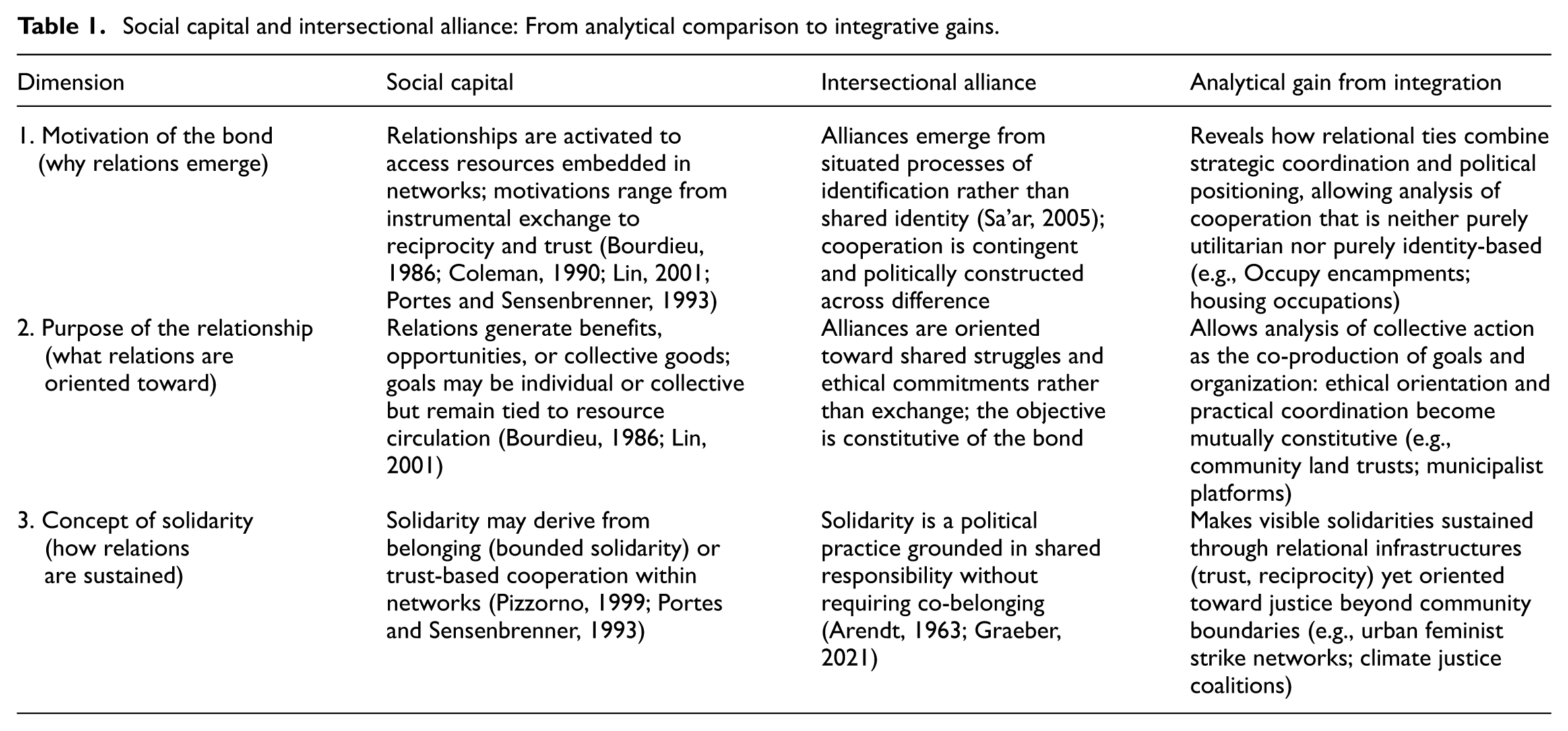
Having examined the origins, developments, and limitations of both social capital and intersectional alliance, this section brings the two concepts into dialogue. The aim is to identify the analytical dimensions along which they interpret social ties differently, clarifying their points of convergence, divergence, and productive integration. Both frameworks address three fundamental dimensions of social ties—motivations of the bond, purpose of the relationship, and concept of solidarity—yet they conceptualize these dimensions differently. Table 1 schematically maps these dimensions, identifying a shared analytical terrain through which the concepts can be compared and theoretically integrated.
Social capital and intersectional alliance: From analytical comparison to integrative gains.
The following sections analyze each dimension in turn, situating them within the urban debates in which these notions have been mobilized. The final subsection then moves from comparison to integration.
Alliances beyond identity
Urban space plays a crucial role in processes through which heterogeneous actors coordinate action across difference. Urban scholarship has long examined such dynamics through different analytical lenses. Research on urban regimes (Bua and Davies, 2023; Mossberger and Stoker, 2001; Stone, 1989) and urban growth coalitions (Logan and Molotch, 1987; Terhorst and Van de Ven, 1995) has analyzed how alliances among public and private actors shape governance and development, while other strands of literature have focused on urban social movements and collective mobilization (Nicholls, 2008; Uitermark et al., 2012). More recently, feminist urban scholarship has portrayed the city as a non-neutral relational environment in which intersectional alliances may emerge. Urban contexts intertwine experiences, biographies, and practices, enabling alliances and political actions to arise while reshaping everyday life. Collectivities, in this sense, are “not simply about what ‘we’ have in common—or what ‘we’ do not have in common. Collectivities are formed through the very work that we need to do in order to get closer to others” (Ahmed, 2000: 179–180). Cities are therefore sites where solidarities are actively constituted. As Butler (2017) argues in her reflections on Tahrir Square and the Occupy movement, acting together in public space constitutes an embodied challenge to dominant political orders: the “we” emerges through “the alliance of bodies—plural, persistent agents—who claim the public sphere from which they were excluded” (Butler, 2017: 95). Beyond serving as a platform for radical encounters (Ahmed, 2000), cities are also privileged arenas for dissent, where actors exercise a right of appearance (Butler, 2017), enact insurgent citizenship (Sandercock, 2004), and build alliances through shared spatial practices (Palermo and Sabatini, 2021).
Such dynamics challenge explanations of solidarity rooted in shared belonging or identity. Intersectionality understands subjects as constituted through multiple and co-present relations of power, whether or not they explicitly recognize them (Puar, 2018). Within this framework, no one belongs to a single category (Saldanha, 2010); identities are instead historically situated articulations within struggles for social justice (Haider, 2018), positioned at the crossroads of heterogeneous forms of domination (McCall, 2005). This perspective implies a shift from relations rooted in co-belonging and shared identity (Pizzorno, 1999; Portes and Sensenbrenner, 1993) to relations grounded in identification (Sa’ar, 2005), understood as a contingent process through which actors align around common concerns without erasing asymmetries or differences (hooks, 1986). Bonds thus depend on the recognition of shared stakes across differently situated experiences. Read through the lens of intersectional alliance, such urban configurations acquire additional significance, as they challenge the contemporary prominence of identity-based politics, which often fragment rather than produce collective political subjects (Lilla, 2018; Serughetti, 2023). Intersectional alliances can therefore be interpreted as forms of transcommunality (Brown-Childs, 2003): collective configurations grounded in shared material needs and struggles for justice that connect heterogeneous actors across social boundaries. Rather than presupposing a community, they actively produce one through cooperation.
Communities of purpose and shared intentionality
Processes through which heterogeneous actors stabilize cooperation and self-organization (Uitermark, 2015) are particularly visible in territorial political experiments organized around shared projects of coexistence and intentionality. Experiences such as the Zapatista communities in Chiapas (Clark, 2023; Fitzwater, 2019; Khasnabish, 2010), the democratic confederalism of Rojava (Dirik et al., 2017; Öcalan, 2016; Strangers in a Tangled Wilderness, 2015), or the Sarvodaya Shramadana Movement in Sri Lanka (Clark, 2023) show forms of collective action structured not by common identity but by a negotiated political horizon articulated in place (Dirlik et al., 2017; Khasnabish, 2010). Everyday practices of self-government, mutual aid, and collective decision-making stabilize commitments over time (Boal et al., 2012; Creagh, 2009), producing what Graeber (2021) terms communities of purpose rather than communities of definition. These experiences raise broader questions concerning how intentionality and objectives operate within solidaristic relations. Intersectional alliances share important affinities with social capital insofar as both describe relationships that enable actors to achieve otherwise unattainable goals (Andreotti, 2009; Coleman, 1990): ties are therefore neither purely voluntary nor entirely disinterested. In this sense, alliances may resemble forms of reciprocity social capital (Pizzorno, 1999), where cooperation is sustained by trust, obligation, and shared objectives rather than immediate exchange. Yet intersectional alliances do not depend on network membership or co-belonging. They often involve heterogeneous actors temporarily coordinating around common concerns, as in affinity group practices that sustain cooperation without requiring prior shared identity (Dupuis-Déri, 2003). This convergence helps avoid romanticizing alliances while resisting simplistic dichotomies between economy and morality (Nguyen et al., 2017). However, the two frameworks diverge in how they conceptualize interest and intentionality. Social capital theories, including reciprocity-based ones, ultimately interpret cooperation through a logic of benefit, even when mediated by trust and obligation: whether in commercial enterprises (Pizzorno, 1999) or ethnic entrepreneurship (Portes and Sensenbrenner, 1993). Although social capital is not confined solely to economic relations, it remains conceptually tied to forms of accumulation, exchange, and advantage, albeit intertwined with dynamics of support and recognition. By contrast, although relationships of solidarity are never entirely altruistic, intersectional alliances represent a type of self-interest that can be fundamentally non-selfish (Volpe, 2023). They help soften the individualistic connotations often linked to purpose-driven action, introducing a notion of interest that exceeds both individual and collective spheres precisely because it is shared (Mason, 2000). 9
Decolonial feminist thought radicalizes this shift by challenging the individualizing model of agency. Lugones (2003) critiques hegemonic understanding of intentional action, which attributes full efficacy to individual decisions and elevates self-determination and individual responsibility as primary expressions of agency. Against this view, she argues that intentionality emerges relationally, between subjects rather than within autonomous individuals. As Carrillo Rowe (2008: 9) observes, “while identity is often conceptualized around the ‘I’ […], alliances are conceptualized around the ‘we’ as we make claims to belonging.” Intentionality is thus reconfigured as something that emerges between subjects, within the relational space they inhabit (Lugones, 2003). Territory plays an important role in this process: shared space materializes responsibilities and coordinates heterogeneous actors, revealing place-based political organization as a potential alternative to global capitalism (Dirlik, 1999).
A guide for action: Reframing solidarity
Scholarship on urban solidarity movements shows how bonds can be sustained through shared political commitments rather than pre-existing community or identity (Arampatzi, 2017; Bauder, 2022). Transnational feminism, for instance, connects locally situated actors beyond the boundaries of the nation-state through political commitments rather than shared identities (Baksh and Harcourt, 2015). Emerging alongside globalization and new communication infrastructures, it challenges binaries such as global/local and center/periphery (Grewal and Kaplan, 1994), while fostering new forms of cross-border solidarity (Basch et al., 1994; Eisenstein, 1996; Ong, 1996). Rooted in specific places yet oriented beyond them, such alliances demonstrate how cooperation can persist without homogeneity, relying instead on negotiated common ground and continuous political work (Mohanty, 2002). Solidarity thus appears as a situated relational process sustained through interaction across difference.
In social capital theory, solidarity often derives either from shared belonging (Pizzorno) or from group-based bounded solidarity (Portes and Sensenbrenner), typically anchored in class or cohesive group membership. Intersectional alliances, by contrast, articulate solidarity as emerging through processes of identification across differently positioned subjects. What sustains cooperation is the recognition of interconnected forms of oppression (Shelby, 2002), experienced differently according to actors’ positions within intersecting social hierarchies (Young, 1994). Solidarity thus functions as a principle that enables cooperation without requiring homogeneity. As Serughetti (2024: 130) notes, it “refers to mutual support in sharing adversities, starting from the recognition of a common cause.” This understanding resonates with Arendt’s (1963) conception of solidarity as the capacity to comprehend plurality beyond class or nation, as well as with Shelby’s (2005) pragmatic account of Black solidarity grounded in a shared commitment to justice (Volpe, 2023). Solidarity is thus far from being a mere emotional response; rather, it arises from the recognition of shared vulnerability and political ideas, such as justice and freedom, assuming the form of “a principle that can inspire and guide action” (Arendt, 1963: 84). hooks (1986: 138) similarly distinguishes solidarity from episodic support, emphasizing the role of “community of interests, shared beliefs and goals around which to unite, to build Sisterhood. Support can be occasional. It can be given and just as easily withdrawn. Solidarity requires sustained, ongoing commitment.” Intersectional alliances can therefore be understood as communities of interest (Arendt, 1963) or as communities of purpose (Graeber, 2021), where differences are not erased but mobilized through common action. Aligning with this perspective, Featherstone (2012) conceptualizes solidarity as a relational achievement forged through encounters and political practices across space rather than as an outcome of prior identity or community membership.
From comparison to integration
The preceding paragraphs explored the affinities and divergences between social capital and intersectional alliance, showing that both address core dimensions of social ties while conceptualizing them differently. The issue, then, is how the two frameworks may mutually enrich one another. To begin with, intersectional alliance introduces into social capital a political and ethical dimension often underdeveloped in relational resource approaches. In doing so, it challenges social capital’s utilitarian leanings and compels the framework to confront power asymmetries and structural inequalities, shifting attention from individual accumulation or group cohesion—which may themselves be exclusionary—toward collective transformation, re-orienting the purpose of social ties toward justice. Concepts such as differential belonging and relational intentionality move the analysis from network structure alone to the quality and direction of solidarities forged across differences. In this sense, intersectional alliance politicizes social capital and extends its scope to heterogeneous actors and contentious collective action. Conversely, social capital provides intersectional alliance theory with analytical traction. Whereas alliance functions primarily as a normative and descriptive category, social capital offers an established vocabulary for examining and measuring how cooperation operates in practice: trust, reciprocity, obligation, solidarity, dense and weak ties, for example. These relational mechanisms make it possible to examine how political solidarities are sustained, stabilized, or disrupted in concrete settings, thereby operationalizing intersectional alliance. The social capital framework thus provides a language for analyzing the practical infrastructures through which solidarity is organized, drawing on a well-established conceptual repertoire widely used in urban research on neighborhood relations, local institutions, and collective action (Andreotti, 2009; Blokland and Savage, 2008).
Read across the three analytical dimensions discussed above, the integration produces three specific analytical gains.
At the level of motivations, cooperation can be examined as combining strategic coordination and political positioning, allowing analysis of bonds that are neither purely utilitarian nor purely identity-based. This perspective is particularly useful for studying urban protests and mobilizations, where heterogeneous actors temporarily converge and processes of political identification are activated.
At the level of purpose, collective action appears as the co-production of goals and organization, in which ethical orientation and practical coordination become mutually constitutive. This lens can inform the analysis of community land trusts, municipalist platforms, neighborhood institutions, occupied buildings, and other community infrastructures, where relations sediment through repeated interaction while remaining oriented toward shared objectives.
At the level of solidarity, relational infrastructures such as trust and reciprocity can be analyzed together with their normative orientation, revealing solidarities that extend beyond bounded communities while remaining practically sustained. This applies especially to networks, platforms, and coalitions, where cooperation must be continuously coordinated, maintained, and translated into collective projects.
The resulting integrated framework makes it possible to interpret solidaristic practices as relational configurations in which ethical orientation and practical organization are mutually constitutive. From this perspective, solidarities are understood neither as purely strategic coordination nor as purely normative commitment. This analytical payoff is particularly relevant for urban studies, where cooperation frequently emerges among heterogeneous actors who do not share stable identities yet must coordinate within spatial contexts. The following section discusses how this perspective can be applied to the analysis of urban contexts.
Discussion and conclusions: Applying the integrated framework
Having outlined the theoretical integration between social capital and intersectional alliance, the remaining task is to clarify its contribution within urban studies. Urban scholarship has long examined how heterogeneous actors coordinate collective action within cities across institutional (Logan and Molotch, 1987; Stone, 1989) and contentious (Arampatzi, 2017; Leontidou, 2010; Nicholls, 2008) configurations. Taken together, these perspectives show how cities constitute arenas where cooperation must be negotiated across social difference. For this reason, research on collective action has long examined how spatial configurations shape practices of mobilization and meaning-making (Miller, 2000; Miller and Martin, 2003; Routledge, 2003; Wolford, 2004), with urban contexts providing key settings in which these dynamics unfold. The integrated framework proposed here contributes to this debate by providing a conceptual vocabulary for examining how solidaristic relations are structured through the interplay between relational mechanisms and political orientations. This effort speaks directly to urban studies, as solidaristic bonds in cities frequently emerge among heterogeneous social worlds under conditions of spatial proximity (Amin, 2002; Watson, 2009). Such conditions produce what Massey (2005) calls throwntogetherness—a juxtaposition of diversity and difference in urban life—that is “generative of a social ethos with potentially strong civic connotations” (Amin, 2008: 10). Multiplicity thus becomes an environmental condition where inequalities are materially exposed and collectively experienced, enabling encounter (Valentine, 2008), identification (Blokland, 2003), belonging (Wise, 2005), and producing tangible common grounds for collective action. Squares, neighborhoods, parks, and informal meeting places operate as material platforms where relations are repeatedly enacted 10 (Latham and Layton, 2019; Neal et al., 2015). But urban space does not merely host solidarities, it participates in their formation: repeated co-presence stabilizes cooperation and transforms episodic interaction into durable relations (Cohendet et al., 2011). Such processes may generate forms of insurgent citizenship (Holston, 2009), confirming that spatiality is key to social identity formation (Carter et al., 1993; Keith and Pile, 1993; Martin, 2005).
Within this context, the framework developed here helps to clarify how different strands of urban research—on institutional coalitions, urban regimes, and urban social movements—can be read through a common analytical lens. More specifically, the framework contributes by enabling a set of analytical questions that cut across these domains: how are solidaristic relations among heterogeneous actors initiated and stabilized? Through which relational mechanisms—such as trust, reciprocity, and network ties—are they sustained over time? Under what conditions do these relations become oriented toward justice rather than coordination alone? And how do processes of identification across difference shape the emergence of collective political subjects? In this perspective, social capital provides a vocabulary for identifying relational mechanisms through which cooperation is organized and sustained (trust, reciprocity, strong, and weak ties), while intersectional alliance specifies the political orientation of such cooperation, clarifying when solidarities are directed toward justice-oriented collective aims rather than simple coordination. Their integration produces a reciprocal improvement. First, social capital is re-signified: its utilitarian and economistic interpretations are displaced by attention to power asymmetries, differential belonging, and justice-oriented coordination. Second, intersectional alliance gains analytical operability: what was primarily a normative and political category becomes empirically investigable through the vocabulary of relational mechanisms—trust, reciprocity, obligation, weak, and dense ties.
The analytical gains of this movement can be summarized along the three transversal dimensions developed in the article. First, at the level of motivation, the framework allows cooperation to be understood as combining strategic coordination and political identification. Second, at the level of purpose, the framework makes it possible to analyze collective action as the co-production of goals and organization, showing how ethical commitment and practical coordination become mutually constitutive. Third, at the level of solidarity, the framework reveals how trust and reciprocity can sustain forms of political cooperation that extend beyond bounded communities while remaining materially and organizationally grounded. By embedding a value dimension within an operational relational vocabulary, the framework seeks to offer a more ethical, political, and situated reading of social ties, connecting debates on urban governance, collective action, and solidaristic practices that have often remained analytically separate. In doing so, it provides an analytical grammar for examining how heterogeneous actors negotiate difference and construct common political horizons within cities, and opens a research agenda for systematically investigating how solidaristic relations are formed, sustained, and transformed across urban settings.
Footnotes

Funding
The author received no financial support for the research, authorship, and/or publication of this article.
Declaration of conflicting interests
The author declared no potential conflicts of interest with respect to the research, authorship, and/or publication of this article.