







Abstract
Do populists pursue distinct kinds of policies, and if so, how successful are those policies? Populist rhetoric often invokes themes of redistribution insofar as leaders claim that power and resources need to be restored to “the people.” As a result, populists tend to offer a very broad view of social policy that emphasizes security, order, rewards, and punishments. Populists’ narratives may be simple, but once in office, they may face complex problems that call for more sophisticated policy solutions. This study examines whether populist policies fit the messages they deliver to their target voters, and aims to contribute to the development of a methodology for determining that relationship in specific empirical cases. I focus on the case of Russia, which enacted a major change in its old-age pension system in 2018 under the leadership of President Vladimir Putin.
In recent years, populism has been identified as a distinct form of politics. 1 Much attention has focused on how populists win elections, but less research has been conducted on how populists perform once they are in office. Do populists pursue distinct kinds of policies, and if so, do those policies work? The track record of populists in power is now under scrutiny, particularly since Donald Trump was elected as U.S. president. Some scholars have observed that, once in power, populists tend to become increasingly authoritarian (Krastev 2018; Müller 2018, 4). Others have noted that populists may win votes by criticizing neoliberal capitalism, but once in power, they tend to pursue policies that benefit the wealthy—such as flat taxes, tax cuts, or reducing regulations (Johnson 2017). This phenomenon may reflect the fact that we often use the term “populism” to apply to movements on the far right, who decry government intervention in the economy and denounce existing public policies (Brunnbauer and Haslinger 2017, 341). But there are still relatively few detailed studies on the kinds of policies that populists pursue, and on the success they have in pursuing their goals. As populists often declare that they will take decisive action on social and economic problems (Hopkin 2017, 476; Polete 2015, 202), it is important for researchers to evaluate whether populists are able to implement programs that live up to their claims.
It is difficult to research populist policies, for a variety of reasons. “Populism” is a politically loaded term. It is a term often used to describe politicians on the left (such as Hugo Chavez), politicians on the extreme right (such as Marine Le Pen), or opposition figures who are difficult to pigeonhole ideologically (such as Russia’s Alexei Naval’ny). The range of leaders described as populist impedes precise operationalization. Hence, given the many differences between populist leaders, it is difficult to state definitively whether a given policy is populist in nature, or whether it is a non-populist policy being pursued by a populist leader. A second reason it is hard to evaluate populist policies is because there are relatively few examples of populist leaders who have been in power long enough to evaluate their track records (Enyedi 2016). In addition, leaders’ policy priorities may shift once they are in office. Some scholars argue that populist leaders, historically, fare poorly when it comes to delivering policy reforms and social improvements (Snyder 2017). Indeed, populist leaders may fail to deliver on their promises, but so might non-populist leaders. If populists fail to achieve policy results, how do we determine whether policy failure is a result of populism, or because of another cause (such as insufficient resources)? Any examination of populist policies should avoid holding populists to a higher standard than non-populist regimes; instead, research should determine whether populists deliver on their promises and achieve sound policy outcomes.
This article aims to advance the discussion on the relationship between populism and policy, and to contribute to the development of a methodology for determining that relationship in specific empirical cases. I draw on the case of Russia, which enacted a major change in its old-age pension system in 2018 under President Vladimir Putin. Russia’s pension reform, which raised the age of eligibility for an old-age pension, provides a suitable case study to interrogate the relationship between populist politics and policy outcomes. In Russia, there were mass protests over the planned reform after it was announced in June 2018. These protests focused as much on the process of reform as on its content. In that regard, the pension age reform resembles the unpopular social benefit monetization reform adopted in 2004, which also led to mass protests and numerous court challenges. Intended to simplify the federal budgetary process, monetization provided a complex, comprehensive overhaul to Russia’s social benefit system. However, the reform inspired a backlash from citizens, who were unprepared for the abrupt termination of in-kind social benefits, and who did not appear convinced that cash benefits would be an adequate replacement. Despite the government’s modification of the monetization policy, citizens launched numerous court challenges to the new law (Chandler, 2008, 2014). Did Putin’s populism influence the outcome and response to this reform? I begin by defining populism, then review the literature on populist social policies to provide the context for my subsequent hypotheses applied to the Russian case.
Populism, Policy, and Performance
Populism is a contested concept, but it generally has been applied to movements that share the following characteristics: a denunciation of existing political parties and institutions; a claim to have special, direct insight into voters’ feelings and interests; and a call to create a more autarkic domestic politics (see, for example, Inglehart and Norris 2017, 443; Mudde and Kaltwasser 2017; Müller 2018). Scholars have argued that populist leaders use narratives and discourses that posit that the status quo puts key groups of people at a disadvantage. They claim to be attentive to groups that have been “left behind” (Brunnbauer and Haslinger 2017, 341). These groups include the blue-collar working class, members of the ethnic majority, dwellers of small towns and rural areas, and older men (Inglehart and Norris 2017; Innes 2017, S37; Hoggett, Wilkinson, and Beedell 2013; Soones et al. 2018). In Hungary, Victor Orban’s FIDESZ party fixed its gaze on the panelplōdi, or dwellers of Communist-era apartment blocks, often found in city outskirts or in towns (Chelcea and Druţa 2010, 526–7). In practice, populists can also attract support from relatively affluent social conservatives, as Montgomery (2015, 238) has argued.
Because populist leaders rely so heavily on redistribution issues, they tend to offer a very broad view of social policy that emphasizes security, order, rewards, and punishments. Social policy themes tend to figure prominently in populist leaders’ election platforms and government programs. Populists often use discourses that argue that existing policies are unfair (they divert resources and benefits away from target groups) and unjust (they do not reward people who ostensibly “deserve” benefits). 2 Leaders may blame social problems on particular groups (such as immigrants), while lauding the presumed virtues of the ethnic majority (Petsinis 2015, 275). Implicitly, then, populists make social policy claims on two levels: first, by calling for a redistribution of resources, and second, by implying that existing policies have adverse effects for society (e.g., by promoting immoral behavior).
Populists have come to power at a time when there has been a global diffusion of social policy models. Linos (2013) discovered a trend for social policy ideas to spread across countries: When leaders consider policy innovations, they may draw on evidence-based lessons for good practice. For leaders who seek policies that balance redistribution with effectiveness, they can gain knowledge from a global dialogue about the effectiveness of various models. Linos (2013) argues that networks of policy experts play significant roles in this exchange of ideas across borders. The notion of global norm diffusion raises an intriguing empirical question, as yet under-explored in the literature: Do populists reject international social policy models as elitist, or do they incorporate them into their reform plans?
One responding hypothesis might be that populists represent, in part, a backlash against the strong role that international institutions played in encouraging reforms. Indeed, Appel and Orenstein (2018) argued that populism in Eastern Europe drew upon the backlash against neoliberalism that followed the 2008 recession, and that populist leaders moved away from free-market policy solutions. The literature on social policy in East European countries provides a context for understanding the earlier period, the 1990s and early 2000s, before populism developed strong roots. From the 1990s onward, East European countries faced pressures for reform, but it was politically expedient for elected leaders to demonstrate autonomy from international institutions such as the International Monetary Fund (IMF) and World Bank (Müller 2003). For example, Beblavy (2014) argues that these countries implemented neoliberal social policies, such as flat taxes and private pension schemes. Inglot, Szikra, and Raţ (2012) add pronatalist policies and means-tested benefits (as opposed to universal benefits) to this list. Vanhuysse (2006) argued that postcommunist East European political leaders often pursued “strategic social policies” that have separated groups from each other, especially separating unionized workers from others; in what might be called populism, they are buying the support of groups such as pensioners by giving benefits and/or early retirement to those groups. While Vanhuyusse’s monograph was published before the most recent wave of populist leadership, he describes a pattern of divisive, instrumentalized politics often associated with populism.
Victor Orban, Prime Minister of Hungary since 2010, could be considered a “typical” populist. Orban has relied heavily on ethnic nationalism and sharp denunciations of foreign influence (Enyedi 2016). Orban brought in a law in 2001 that allowed ethnic Hungarians who were citizens of other east European states, to be eligible for some social benefits when in Hungary. For example, children attending Hungarian-language schools outside of Hungary could be eligible for assistance, a policy that caused friction with neighboring Romania (Deets 2008). Orban has criticized by the IMF and the European Union—of which Hungary is a member (Johnson and Barnes 2015). Orban has sought to discredit his socialist political opponents, and indeed to deride the very idea of redistributive policies in general (Chelcea and Druţa 2010, 522).
The literature, then, suggests that populists may pursue a hybrid blend of policies that combine nationalism and neoliberalism. Shields (2012) argued explicitly that in Poland, populist leaders have criticized capitalism but have tended to maintain neoliberal policies. Are those policy blends harmonious, or do they contain inherent contradictions? Cook and co-authors (2019, 294–5) argued that Putin’s social policy has tried to balance an appearance of responsiveness to the welfare demands of key groups while pursuing neoliberal economic policies and trying to reduce budget expenditures, and this has not met with many concrete results. Indeed, it has triggered protests when cutbacks are perceived. By contrast, Orenstein (2019) argued that populist leaders in Poland and Hungary have gained political popularity from particular kinds of social policies: especially cash-based, family allowance policies that incentivize having more than one child. In South America (especially Brazil), some populists on the left have also pursued redistributive social policies that have emphasized cash payments to the poor (Anderson 2011, 5). These works suggest that, while populists have often prioritized social policies, their strategies and results have been mixed. It is difficult to draw definitive conclusions about populism and social policy outcomes based on this complex variation, but the trends identified here inform the hypotheses of the research in this study.
Research Focus and Methods
As populism relies on redistributive rhetoric to gain electoral support, one can expect social policy to be a priority for leaders once elected. The following propositions are advanced:
The literature discussed earlier suggests that populists on the right may choose social policies that combine elements of neoliberal austerity policies with discrete programs that distribute limited cash-based benefits to key social groups. As a result, policies may appear to reduce commitments to some social benefits while expanding others. Therefore, given the importance that populists attach to “the people,” one can expect populist policy reforms to include an effort to communicate to the public the purposes and nature of the redistribution.
As populists are identified with particular kinds of political discourses (which elevate “the people” over “elites”), they can be expected to draw on those discourses to rationalize their reforms. Populists who criticize “global elites,” “the West,” or international institutions may find it difficult to explain to voters if they are enacting policies that resemble neoliberal models. Thus, a successful policy would be one able to anticipate and justify proposed shifts in resources.
Policies that reduce existing social entitlements may inspire political opposition from groups who are adversely affected. Populists, then, can be expected to adopt policies that do not adversely affect their key voter constituencies.
If populists are attached to a particular campaign narrative that suggests a plan to shift social policy resources to specific groups of voters, one can assume that the public would react adversely to policies that are perceived to contradict that narrative.
Vladimir Putin’s pension reform provides a suitable case study. First, experts often consider Putin to be not only a populist himself, but a role model for other populist leaders (Lassila 2016; Molyneux and Osbourne 2017). As a leader in power for two decades, and who has won four presidential elections, he has been in office long enough to evaluate the consistency of his messages and the effectiveness of his reforms. Pension reform was one of Putin’s first priorities upon first winning the presidency in 2000, and he has made elaborate efforts to win the votes and trust of pensioners. His language often stresses the importance of honoring the contributions made by the older generation, while criticizing the politicians of the 1990s who were in power when the social safety net collapsed (Chandler 2004, 135–9).
Following a discussion of the pension reform itself, this study examines the role of Putin’s political discourse on the pension issue. Understanding Putin’s narratives helps to explain the political response to the reform. Two sources are examined systematically to reveal the evolution of Putin’s positions on the question of pension age: his annual addresses to Parliament (the Federal Assembly), and his regular call-in TV shows, in which he takes questions from members of the Russian public.
The 2018 Russian Pension Reform
Because of Putin’s attentiveness to old-age pensioners, the plan to raise the pension age by five years came as a surprise. The plan was introduced to the public rather suddenly just before the beginning of summer 2018. The May 2018 ukazy (decrees) were issued by Putin upon his inauguration at the start of his new presidential term. They represented the economic and social goals for the government to fulfill by 2024. They included the improvement of assistance and living standards of “citizens of the older generation,” and to raise life expectancy to age 78. 3 The May ukazy provided the basis for raising the pension age, without explicitly addressing pensions; rather, by calling upon the government to fulfill certain targets, raising the pension age was one way to conserve revenues. On June 14, Prime Minister Dmitry Medvedev discussed the pension reform plan in a session of the Russian government. Only five weeks later, it was passed in the first reading by the State Duma (the lower house of the Russian parliament). The main feature of the pension reform was raising Russia’s pension age, in increments beginning in 2019, to be ushered in over a ten-year period. Eventually, according to the initial legislation, the retirement age would be 63 for women and 65 for men. Medvedev noted that raising the pension age would bring Russia closer to the European average, noting that since Soviet times, Russian pension ages had been relatively low. He argued that demographic and economic pressures justified the law: Russians now enjoyed a higher life expectancy than previously, having recovered from a dip in the 1990s, and many Russians continued to be productive and healthy well into their late 50s and 60s. Furthermore, raising the pension age would reduce the pressure on pension finances and increase the overall number of people in the workforce. Medvedev (2018) emphasized that the reform would not affect certain occupations (such as miners and doctors), and that those who had a very long employment record (stazh) would be able to retire earlier.
Statistics reveal a strong demographic imperative for raising the pension age. According to Russian state statistics, the ratio of employed people to pensioners declined from 1.61 in 2011 to 1.59 in 2016. 4 The annexation of Crimea brought 674,000 pensioners into the Russian pension expenditures. 5 Russian state statistics predict that between 2018 and 2036, the percentage of working age people in the population will decline from 56 percent to 54–55 percent, while the percentage of people above the current pension age will increase from 25.4 percent to 30 percent in the same period. 6 Between 2006 and 2018, the number of people older than pension ages of 55/60 has increased by between 300,000 and 600,000 per year. 7 As of 2016, 23 percent of people receiving a pension were working pensioners, and the average number of years people worked before going on pension was 6.4. 8
As leaders have acknowledged, Pension Fund contributions have been insufficient to cover expenditures, although the Fund’s public statistics make it difficult to assess just what the deficit might be. According to the 2017 report, expenditures exceeded revenues by 49.4 billion. Yet the same report said that Pension Fund contributions provided 4.481 trillion rubles, while the cost of pensions paid out was 7.167 trillion; that is, the Pension Fund provided only about 55 percent of revenues, with the federal budget paying the rest. Interest and investment returns amount to only about 1 percent of pension revenues. 9 The same report shows that expenditures have exceeded revenues since 2012. This must be disappointing, as the 2001 pension reform was oriented toward accumulating revenue from pension investments. Thus, a strong case could be made for raising the pension age, given the costliness of the system and the limited alternatives for improving finances in the short term. Raising the pension age would theoretically increase the size of the workforce and stabilize the number of pensioners.
Notwithstanding the rationale for the reform, several aspects of Mededev’s June announcement were striking. First, as was noted in the media, Medvedev’s remarks occurred shortly before the opening of the FIFA World Cup in Russia. As a result, some wondered why the reform was announced at a time when it might escape public notice because of the attention focused on football (Oliphant 2018). Second, Medvedev said quite openly on June 14 that the pension age plan was a direct result of President Putin’s order to the government to ensure steady increases to those individuals already on pension. This raised the question of Putin’s involvement in a plan on which he had hitherto been silent. Third, Medvedev’s plan proposed an imminent change that would alter the life plans and incomes of a significant number of people, especially the 54-year-old women and 59-year-old men who might have to postpone a retirement expected in 2019. Medvedev did not propose significant public consultation. The Public Chamber (a body formed to provide feedback from civil society on policy), received a draft version of the bill only a week before it went to the Duma. The Chamber claimed to have many questions for the government, including the request for a fuller picture of the finances. 10
In the text of the draft law that was presented to the Duma, the word “reform” is something of a misnomer in that the proposed law revolves around a very simple matter of the age of pension eligibility. The proposed legislation does not alter the overall administration of the system, or its revenue collection mechanism. 11 When the bill reached the State Duma on July 19, Russia’s Minister of Labor and Social Protection reiterated that raising the pension age was financially necessary, given the increasingly unfavorable ratio of pensioners to those employed full-time whose contributions paid into the Pension Fund. Like Medvedev, Maksim Topilin claimed the pension age change was essential to ensure that existing pensioners would be able to keep up with inflation and enjoy an improved standard of living. Topilin emphasized that the demographic trends in question were not new—they had been discussed even in Soviet times—and he observed that the question of increasing the pension age had been raised already with the pension reform discussions of the 1990s. 12 This was correct: Soviet demographers had noted that there was pressure on the pension system and had forecast that the population would continue to age as the birthrate fell (Chandler 2013, 25, 74–5). Raising the pension age had been debated in the 1990s, under the Yeltsin administration, a discussion suggested by the World Bank that, along with the IMF, was concerned over the sustainability of the Russian budgetary system (Chandler 2004, 127–43). Topilin did not mention in his remarks to the Duma that raising the pension age had been ruled out once Putin became president in 2000. Russia’s last major pension reform (2001) made no change to the pension age. Furthermore, Putin had just been re-elected president for a six-year term in March 2018. His election platform did not include changes to the pension age, and pensions were increased two months before the election. As Sokhey (2018, 4, 10, 12) argued, this attention to pensioners in advance of key elections has been a key part of Putin’s strategy to win votes.
The plan to raise the pension age received criticism in the Duma. Although the ruling party (United Russia) was squarely behind the reform, members of the other political parties spoke against it. The Duma Committee on Labour, Social, and Veterans’ Affairs (ostensibly the committee sponsoring the bill) accepted it on division, with the committee’s chair arguing that he was personally opposed to it even while presenting the bill as enjoying the support of most of the committee members. He argued that unions had opposed the law, and feared there was insufficient preparation of the impact it would have on the work force. 13 While the Health Committee came out in favor of the draft law, the chair of the Committee on Regional Policy and problems of the North and Far East also reported that his committee was split along party lines. Nikolai Kharitonov specifically questioned the decision to spring the reform on the public before the World Cup. 14 While various members of the Duma supported the government’s rationale for the reform, others raised serious questions: among them the concern that the bill could raise unemployment, that people aged 55+ had few guarantees that they would be able to keep their jobs, and that people might feel unfairly deprived of pensions they had earned. Gennadii Ziuganov, head of the Communist Party (KPRF), predicted that the law would be particularly hard on women. 15 The bill passed in the first reading by 328 votes for, 104 against; proposals to submit the law to public discussion, and to delay parliamentary hearings scheduled for August to September, both failed. 16
Shortly before the proposed pension legislation was discussed in the Duma, the legislature voted to shelf a draft law on equal rights for men and women, passed in the first reading in 2003 and dormant since then. 17 The Duma’s Speaker, Viacheslav Volodin, claimed that the bill was outdated and implied that it focused mainly on political representation while insufficiently addressing women’s needs in the workplace. 18 In fact, that bill, had it been passed, would have provided a measure of protection against discrimination, including discrimination in the workforce. It would have provided avenues for appeal to people who felt discriminated against. To abandon this law just at a time when a raise in the pension age might adversely affect older female workers is puzzling.
In August 2018, the Duma held hearings on raising the pension age. Many of these reiterated previous points made in the Duma by the same people. Noteworthy were those who made new contributions to the debate. The head of the Federation of Independent Trade Unions (FNPR), Mikhail Shmakov, claimed that 90 percent of trade union members were against the law. Valerii Fadeev, head of the Public Chamber, said the proposal was a “perebor” (a sudden attack), which was overly rushed. Alexander Shokhin (the head of the Russian Union of Industrialists and Entrepreneurs, and a former Minister of Labor) criticized the government for inadequate research on the impact the law might have on the labor market. 19
The pension issue provoked further backlash in summer 2018. Opposition leader Aleksei Naval’ny deemed the proposal to raise the pension age as “a completely concrete theft from every person” (“konkretnoe ograblenie kazhdogo cheloveka”) and promptly exhorted citizens to vote against pro-pension reform candidates in upcoming local elections. He called for protests across Russia. 20 Another opposition politician, Gennady Gudkov, suggested that the government improve the sustainability of the pension system by addressing corruption, rather than increasing the pension age. 21 Later in July, a proposal to hold a nationwide referendum asking the population whether they supported changing the pension age was denied by Russia’s Central Electoral Commission (CEC). The CEC head, Elena Pamfilova, claimed that she did not object to a referendum on this question, but that the proposed question presupposed a particular answer. 22 Following widespread media criticism, the CEC met again to consider revised proposals to hold a referendum from Moscow City, Moscow oblast, and Altai krai, and that it had been accepted in principle. 23 The proposed referendum question, reportedly backed by the KPRF, was “Do you agree that the legally established age in RF legislation as of June 1, 2018, giving the right to an old-age social insurance pension (for men—60 years, for women—55 years) should not be raised?” (Shipenkov 2018). Public outcry appeared to be affecting the ruling party’s prospects in upcoming September 9 local and gubernatorial elections. The Director of the Levada Center polling agency claimed that not only were many people upset about the pension age, but they were linking it to other issues, such as discontent with increased spending for the armed forces (Chizova and Coalson 2018). On September 9, protests occurred in Moscow, Saint Petersburg, and other cities across Russia. The Ministry of Internal Affairs said that approximately 100 people had been arrested, although others doubted this figure, believing hundreds more had been arrested. 24
On August 29, President Putin spoke directly to the Russian public in a televised address. Putin referred to the law in neutral language as a set of changes to the pension system. He emphasized that the measures were not budget cutbacks; they were measures oriented to ensure the stability and adequacy of pensions going into the future. He acknowledged that the bill would affect millions of people, and that it was causing worry (“trevozhat”). He repeated the claim that the issue of raising the pension age had first been discussed in Soviet times. He evoked nationalist themes by saying that one of the root causes was the decline in the birthrate of the 1990s, which he compared with that of the Second World War. Putin argued that the government had discussed other measures, but none would be sufficient to sustain the pension system. Putin admitted that he had personally been opposed to raising the pension age throughout the 2000s, and that he had stated in 2005 that the pension age would not increase during his term as President (which ended in 2008). 25 In actual fact, Putin in 2005 in his annual call-in show had stated that the pension age would not increase as long as he was president. 26 While Putin may not have known in 2005 that he would be president in 2018, it is nonetheless on the record that he said that the pension age would not change on his watch.
Putin concluded his address with proposed measures to “soften” (“smiagchit”) the proposed reform: The pension age for women would reach 60, rather than 63; workers up to two years younger than pension age would be able to start their pension six months earlier than the current bill would provide; penalties would be introduced for employers who laid off or refused to hire older workers; job training and other programs for older workers would be developed; current pension ages would be maintained for certain categories of workers; and certain social benefits would be available to women at age 55 and men at 60 even if they were still in the work force. 27 Putin did not mention that the bill on discrimination had just been cast aside by the Duma, and avoided the word “discrimination” in his address. On September 6, Putin forwarded his proposed modifications to the Duma. 28 Not everyone was convinced that Putin had stepped in to alter the reform in response to public opinion; there was media speculation that Putin’s modification effort had been staged in advance (Levinson 2018). In September, United Russia proposed that the Pension Fund be supplemented with revenue confiscated from crimes involving corruption and that members of parliament be allowed to voluntarily give up the pensions they received for their legislative service 29 : This was a sign of wanting to show a concession, but one which lacked a clear commitment. On September 13, the Duma approved in first reading a draft law that would impose criminal penalties on employers who terminated workers nearing pension age. 30 The bill passed its second reading on September 20 and third reading September 25. 31 But as of September 20, the bill simply enabled punishment for employers. It made no provision for compensation or reinstatement to terminated workers. 32
The backlash against raising the pension age was based, in part, on the timing of the reform (its sudden introduction), and also on the fact that the issue was raised suddenly. To understand the backlash, it is valuable to examine the context. What did Putin previously tell the population about the pension age? Did they see this coming? Did he discuss this with the public? A very good source is available to assess these questions: Putin holds a regular, televised call-in show almost annually, where he takes questions from the public. In recent shows, these questions have been sent by Twitter and other social media, and he has invited other members of the government to answer specific questions. Although Putin delivers policy messages in different formats (his annual address to Parliament; his annual lengthy press conference)—it is the call-in show that best represents the message that he wishes to give directly to voters—and indeed the call-in show itself is a performance intended to demonstrate that Putin is responsive to the public.
Figure 1 illustrates that old-age pensions were a regular theme that came up in Putin’s call-in shows, and that he often took the initiative to bring up the question of pensions himself. In fact, not infrequently he brought up old-age pensions in answering a question that had nothing to do with pensions. Furthermore, in almost half of his addresses, he directly raised the question of whether pension ages should be raised or stay the same. So it is fair to say that Putin consciously and consistently chose to mention pensions in his annual discussions with the Russian public, and by using the format of the televised call-in show, to put his messages on pensions on the public record.
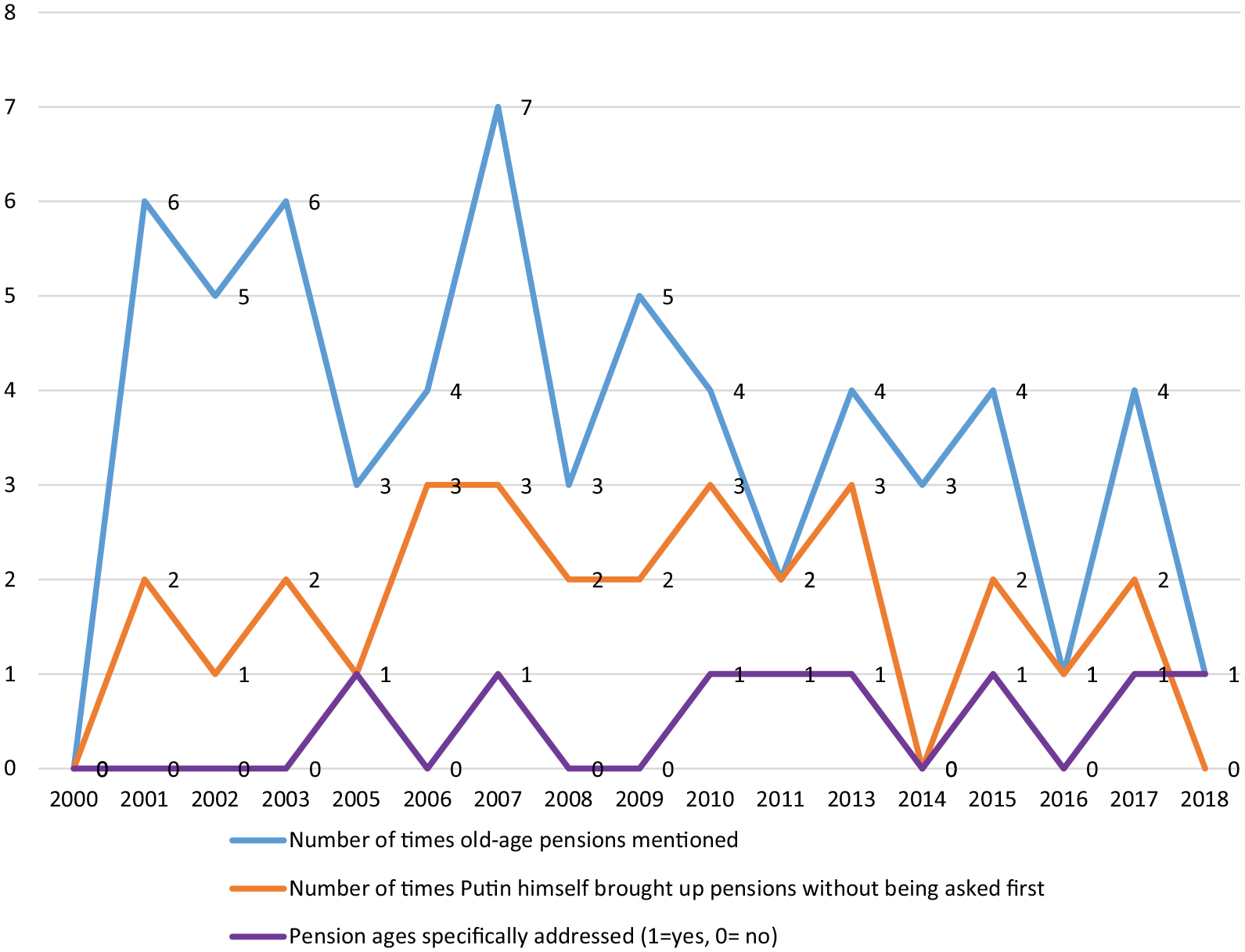
Pensions and Putin’s Call-in Shows.
So when Putin chose to speak about pensions to the public, what did he say? In 12 of the 17 events, he mentioned pensions in his opening remarks at the beginning, before taking any questions. Frequently, in these contexts, he mentioned pension policy as an achievement: He noted pension increases made by the government, particularly when he was able to link those achievements to economic growth (as, for example, in 2002 and 2007). 33 In leaner years such as 2010 and 2011, Putin claimed he was able to raise pensions in real values despite the economic crisis. 34 Putin frequently received questions from pensioners, and it was reported that he received many more questions than he was able to answer in a single show. When asked about pensions, Putin often made simple, categorical, and unequivocal statements, even in response to sophisticated questions: For example, in 2002, Putin was asked about how the investment principle was going to work in the newly reformed finance mechanism of the pension reform: His answer included the simple statement “Pensions will grow” (Pensiia budut rasti). 35
Putin sometimes made personal promises to pensioners. In response to an elderly lady who told Putin she could only dream of having a new dress, Putin invited her and her sister to a New Year’s Eve party in Moscow and promised there would be presents for them under the tree. 36 Asked by a twelve-year old boy what his pension would be like in 2050, Putin praised him (“Vot molodets”) and predicted that its real value would be 250 percent of the equivalent pension in 2010. 37 Such statements are consistent with a populist discourse, where a leader makes a public commitment to deliver a benefit directly to an individual citizen.
When asked about pension age, Putin’s answers were either unequivocal or vague. As discussed above, in 2005, when asked directly about whether the pension age would increase, he answered, I am against raising the pension age. And so long as I am president, there will be no such decision . . . And I repeat again, I am against raising the age of eligibility for pension, both for men and for women.
38
He further acknowledged that the pension age was a matter of individual rights (prava). He said that he was in favor of a voluntary approach, finding policies to encourage people to choose to stay in the workforce longer. In 2007, when asked about the pension age, Putin said, “I think that it is not necessary to raise the pension age in the Russian Federation.” 39 In 2010, he told a miner that there were no plans to raise the pension age and that this question was not even being considered. 40 In 2013, Putin went so far as to claim that the so-called “nonsystem opposition,” if they had their way, would raise the pension age. 41
From 2013 onward, Putin began to equivocate more on pension reform. His call-in shows acknowledged the revenue shortfalls of the Pension Fund and the reality that the increased birthrate had not reversed the demographic situation as much as he hoped. 42 He also acknowledged that the pension expenditures of Russia increased when that country absorbed Crimea in 2014. 43 In 2015, Alexei Kudrin was again invited on Putin’s call-in show, and he noted that there were chronic problems with the Pension Fund’s need to be subsidized by the federal budget. Kudrin explicitly argued that the pension age could be raised to make the pension system more viable. Putin did not follow up until later in the show, when asked about it by a caller. At that point, Putin went into some detail on the demographic and economic challenges to the pension’s budgetary system, but simultaneously affirmed that he did not favor raising the pension age. In a country where life expectancy for men was below 65, a raised pension age would make pensions into a “wooden raincoat” (“dereviannyi mekintosh”). He went on to say there needed to be an “open dialogue with society” (“otktrytoi dialog s obshchestvom”) on the pension question, and that no matter what, those close to pension age should not be affected by any reform. 44 In 2016, Putin told viewers that the pension age was being examined within the government, 45 but in 2018—only three weeks before Medvedev introduced the pension plan publicly—Putin avoided answering a question about a possible raising of the pension age directly. Instead he said he regarded the issue as one which needed to be approached carefully, and that the highest priority was to raise the incomes of those already on pensions. 46
Figure 2 shows the number of mentions of pensions in the president’s speeches to parliament, the Federal Assembly (which consists of the State Duma and the Federation Council). It includes speeches made during Putin’s three terms as president (2000–2004, 2004–2008, and 2012–2018) and during Dmitry Medvedev’s term (2008–2012). Comparing Figure 2 with Figure 1 shows several striking trends. First, Putin paid the most attention to pensions early in his first term (when the government was proposing pension reform to the legislature) and at the end of his second term, when he chose to argue strongly against raising the pension age in 2007. His 2007 speech was given soon before the 2007–2008 election cycle (although Putin himself was ineligible to run for a third consecutive term as president). Second, although Putin consistently discussed pensions with voters on his hotline shows, he did not show the same sustained attention in his speeches to Parliament. During his third term as president (2012–2018), he was relatively silent on the pension age question.
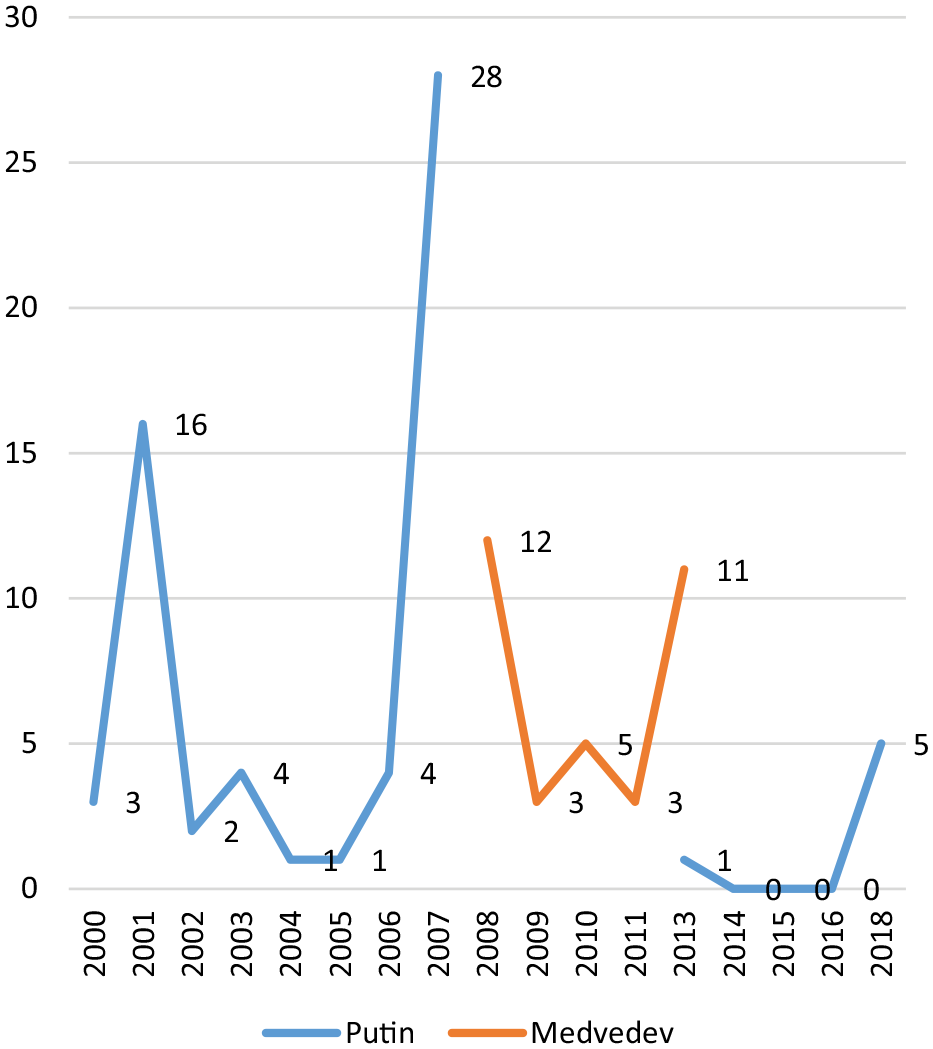
President’s Speeches to Federal Assembly: Number of Mentions of Pensions.
Themes raised in parliamentary speeches echo those raised in the hotline in many ways. The evolution of the speeches over time gives a clear picture of pension finances as being a constant concern since 2000, with an acknowledgment that demographic trends strain the system. In his first and second terms, Putin takes pains to note improvements in the regular payment of pensions, and in the ability to raise them in line with inflation. The speeches reveal that Putin and Medvedev have proposed a number of measures to try to address the problem with pension resources: the single social tax; 47 the pension reform eventually introduced in 2001, which provided for investment of some pension contributions to generate more revenue; 48 the pronatalist reforms, intended to increase the birthrate; 49 and various voluntary schemes to try to encourage private pension savings and later retirements. 50 In his 2007 speech, Putin devoted eleven paragraphs to explaining why he opposed raising the pension age, and proposed better collection of social taxes to help improve the system. He added that reserves could be used to supplement pension finances. 51
In their speeches, both Putin and Medvedev spoke of the pension system being about more than just a social insurance benefit, but an indicator of norms and values. Putin’s 2005 speech claimed that the payment of adequate pensions was essential for a “just” (“spravedlivoi”) state. 52 In 2007, speaking about the need for old-age pensions to be sufficient, Putin said, “Our culture has historically been based on respect for the people who raised us. A society that does not treat its old people with respect has no future.” 53 In his maiden speech as Russia’s president, Medvedev spoke of adequate and secure pensions as being “a right” (pravo) of the elderly. 54 In 2018, Putin used the phrase “Our moral duty is to support the older generation in every possible way.” 55 In evoking themes such as justice, rights, and respect, the two leaders set up a discourse in which withholding pensions could be seen as a violation of rights and an erosion of respect. Furthermore, Putin often used the terms “pensioner,” “pozhilye liudei” (senior citizens), “old people” (stariki), and “the older generation” (starshee pokolenie) interchangeably, further reinforcing the idea that old people are pensioners by definition.
This analysis indicates a pattern: first, that Putin had an opportunity to prepare the public in advance for an abrupt change in the pension age, but did not take advantage of it. Second, the president relied on others, such as Alexei Kudrin, to raise painful financial issues while he himself emphasized his past achievements. Third, even those members of the public who were able to ask Putin a direct question showed that they were concerned about their pensions, whether at present or in the future, and they raised very direct questions to their president. Finally, Putin appeared to be inconsistent on this issue. Prior to his re-election as president in March 2018, Putin gave his annual address to Parliament on March 1, in which he presented his achievements of his previous term and goals for the coming term. In effect, that televised address was his election campaign platform. While acknowledging the country’s economic and demographic constraints, Putin stated that the government would be working out a program to improve the position and quality of life of the “older generation.” He did not mention any plan to reform the pension system or to touch the pension age. 56 That is perhaps to be expected before an election, but Putin left the impression that things would improve, not worsen.
Discussion and Conclusion
Why is this case study relevant to populism? Putin’s willingness to focus on pensioners and to promise them improved conditions has been a key part of his image for a long time, and has been an integral part of his election campaigns. Pensioners are a target group for him. His reluctance to touch the pension age for 18 years suggests a desire to keep this target group happy, even though—by his own admission—a possible change has been on the table for decades. While populists pride themselves on being men of action known for sudden decisive policy changes, this particular case suggests that a strategy to court voters can impel leaders to postpone or delay important decisions. And when populists use televised speeches and call-in shows to get across their message, they leave behind a written record of the promises they have made. Thus, leaders’ efforts to reach the public directly may provide a tool for holding them to account, even if they adopt authoritarian measures. The transcripts of his call-in shows and addresses to Parliament are online and a matter of public record.
Putin’s use of simple language and unequivocal statements on pensions prevailed over the imperative to consult and inform voters—consistent with what the literature suggests about leader-oriented populism. The case study shows the risk of that approach. For a sensitive issue such as raising the pension age, it would have been beneficial to engage in a broad discussion, based on consideration of evidence and attentiveness to citizens’ concerns. Instead, Putin’s leadership was criticized for a top-down approach. Had there been extensive consultation and debate, various actors would share the responsibility if the reform failed. But in this case, the responsibility for the consequences of reform will lie squarely with Putin, Medvedev, and United Russia. Indeed, Putin’s public opinion rating fell between spring and fall 2018, a development widely attributed to the unpopularity of pension reform, and the ruling party United Russia did worse than expected in local elections on September 9—a day when many people protested the pension reform in Russian cities (Arkhipov 2018; Kolesnikov 2018). It was reported that more than 1,000 people were arrested for participating in the protests. 57
In issuing the May 2018 ukazy, Putin had issued general directives, a six-year plan of expectations for the government to fulfill. The plan was essentially a list of ambitious targets for the government to meet, which focused on percentages and numbers. In expecting the government to deliver improvements to the population, and giving them orders to fulfill, Putin was acting like a classic populist—leading the government and calling them to account at the same time. And yet the plan paid little attention to how the government was to achieve these goals, or whether it was realistic to do all these things at once. It was left up to Prime Minister Medvedev to figure this out.
Finally, the Russian leadership took a narrow approach to pension finances, showing a simple calculation that raising the pension age would create a more sustainable pension revenue stream. But they had few concrete plans to announce about various realities: If babushki (grandmothers) would now be obliged to work full-time into their late 50s and early 60s, many working mothers would have to find alternative sources of child care. If more older people will be working, will there mean fewer jobs for younger people? If people lack adequate health care, will they not be able to continue working until the new pension ages? And might pension finances be improved if there was a more robust economy, higher wages, less brain drain, and higher immigration? The pension reform raises bigger questions about the overall direction of Russian governance and about whether there is a need for larger socioeconomic problems to be addressed.
The case study suggests that populist leaders may be vulnerable to social policy mistakes, because of several political propensities: first, an impulse to launch major policy changes suddenly with little consultation; second, a reluctance to undertake measures that might be unpopular with key constituencies, but which might merely postpone action to address a problem; and third, a tendency to raise expectations of citizens through grand (and ultimately unrealistic) promises. Further research is needed to demonstrate whether these conclusions are valid across multiple cases. However, the Russian example does suggest that there is a political cost to postponing reforms, and that leaders would be wise to avoid making stark promises that they may not keep.
Footnotes
Appendix A
Appendix B
Acknowledgements
I would like to thank panel participants and conference attendees for their comments.
Author’s Note
The original version of this article was presented to International Conference on Global Dynamics of Social Policy, held at University of Bremen, Germany, on October 25, 2018.
