







Abstract
The number of female MPs elected by direct vote in Bangladesh's Parliament is abysmally low due to the low level of female candidates in the parliamentary elections. This study addresses the underrepresentation of female candidates in the election following the supply- and demand-side model of Norris and Lovenduski. We focus on the continuing patriarchal social and political culture, dynastic politics, campaign funding, and violence as supply-side factors and political parties and nominations, quotas/reserved seats, and rule compliance as demand-side factors that affect the candidate nomination process in Bangladesh. The article is based on semi-structured interviews with female and male MPs of the Bangladesh Parliament and aspirant female politicians who hold different party positions. The study argues that the patriarchal nature of politics and culture controls the supply and demand-side factors of candidate selection and discriminates against female candidates to vie in the general constituencies.
Women's active engagement in electoral competitions is essential for effective democratic development in any country (Rai 2017, 58). A government that is democratically organized is truly legitimate only when both male and female citizens are given equal opportunity for full participation in all aspects of life, including politics (Thomas and Wilcox 2014, 2-3). The Constitution of Bangladesh provides equal opportunities to its citizens in all aspects of life. It recognizes women's equal rights and amends existing laws from time to time to reflect gender equality. It has, in this vein, introduced the provision of reserved seats along with the adoption of various international treaties and conventions like the Universal Declaration of Human Rights (1948), the UN Convention on the Political Rights of Women (1953), the ratification of the Convention on the Elimination of All Forms of Discrimination against Women (1979), the Vienna World Conference (1993), the Cairo Conference on Population and Development (1994), the World Summit for Social Development (1995), the UN World Conferences for Women (1975, 1980, 1985, 1995), the Millennium Development Goals (MDG), and national strategies to ensure gender parity in politics.
Notwithstanding this, women continue to lag far behind their male counterparts in every sector of politics, including electoral candidacies, in Bangladesh where women constitute 49.2 percent of the total voters (Bangladesh Election Commission 2021). Despite this large number of female voters, constitutional and institutional provisions for equal participation and affirmative action to increase female participation in politics—including reserved seats, major political parties headed by women for decades, leader of the house and parliamentary opposition leader being occupied by women for almost half of the life span of the nation, and a female speaker of the parliament—the representation of women is still marginal and far below the minimum threshold to be a constituent part of the decision-making process in the parliament of Bangladesh. The country ranks 110th in the world with only 20.9 percent of female legislative members in parliament, including 16.66 percent of reserved seat members as of May 1, 2022 (Inter-Parliamentary Union [IPU] 2022). The low level of female parliamentarians is simply due to the shortage of female candidates in elections—which is an ongoing, universal issue. But why is there such a shortage if Bangladesh has recently implemented a variety of electoral and other procedures, including reserved seats for women, to enhance gender equality? In this article, we explore the obstructions that face women's continuing inequality in political representation in Bangladesh that is significantly contributing to the shortage of female candidates. According to Norris and Lovenduski (1995), one of the key areas of contention is the issue of supply and demand which can be applied to explain the barriers faced by women while seeking entry to elective offices.
The nature and extent of the barriers to female candidacy vary from country to country, depending on the context of a particular society. Thus, specific procedures and techniques may not produce the same results for all countries. This is especially true for Bangladesh as a highly patriarchal society. The socio-cultural traditions and practices make many women dependent on men who have strong reservations regarding women's involvement in politics. Property ownership patterns also favor male MPs and resource distribution is highly unequal. Within such an environment, the nature and dynamics of political activities, in general—and electoral politics, in particular—remain barriers for women in Bangladesh. Therefore, despite the Constitutional safeguard for equal political participation and a series of affirmative actions in areas like education, employment, and compliance with international treaties, questions arise concerning why so few women are getting nominations as candidates to the general constituencies. Is it because of a lack of eligible and interested female candidates seeking nominations? Or is it because women are discriminated against and kept away from securing nominations for elections in other ways? We look into why so few women run for general elections in Bangladesh and isolate some of the factors contributing to the low engagement and/or nomination of women as candidates in national elections. Our focus is on the potential/eligible female candidates seeking nomination to participate in the general election.
Significance of the Study
The candidate selection process is important and plays a key role since the efficient functioning of the parliament depends on its elected representatives. There is a growing literature studying the candidate selection process and its consequences for developed democracies. For example, Bjarnegård and Zetterberg (2019), Cheng and Tavits (2011), Evans (2008), Lovenduski (2016), Lovenduski and Norris (1989), Kenny and Verge (2016), Krook (2009), Lawless and Fox (2005), Norris and Lovenduski (1993, 1995), and Medeiros, Forest and Erl (2019) have investigated the factors influencing the low level of female candidature for elections. These scholars identified family, education, employment, finance, culture, personal networks, quotas, and political parties as important determinants common to all societies. However, there is almost no research on the nomination of female candidates for parliamentary elections in Bangladesh. This lacuna needs to be filled as identifying the factors influencing female candidacy can assist in bringing more women as candidates in direct elections for general seats, thus increasing the number of women representatives in the legislative house of Bangladesh. This study aims to help in closing the knowledge gap about the elements influencing female candidates for Bangladeshi parliamentary elections.
Sources of Data
Primary data for this study was collected from three sets of respondents through semi-structured interviews. The first set involved interviews with 23 female MPs of the Bangladesh Parliament. Among them, 15 were from the Bangladesh Awami League (BAL)—the party in power now, six from the Bangladesh Nationalist Party (BNP), and two from the Jatiya Party (JP). However, only six (BAL-three, BNP-two, and JP-one) were directly elected MPs from general constituencies. The rest were indirectly elected via reserved seats. The second set of interviews was conducted with five male members: one from the JP, one from the BNP, and three from the BAL who served on the 9th (2009–2013) and 10th (2014–2018) Bangladesh Parliaments. The third set of interviews was conducted with 25 potential/eligible female political leaders who occupied different party positions from diverse wings of the party such as the student wing, youth wing, labor wing, and the main party leadership line. Members of this group were directly involved in political activities and thus became aspirants for securing party nominations to run in general elections. Secondary sources (books, journal articles, internet sites, reports, and newspapers) were also examined to ascertain why so few women are coming forward as candidates for direct election.
Political System of Bangladesh at a Glance
The Bangladesh state is currently governed by a parliamentary form of government, which is a multiparty democracy. The prime minister leads the government while the president serves as the country's ceremonial head and is chosen by parliament. Bangladesh's parliament is a unicameral chamber with 300 members elected directly from single geographic regions for five-year terms under the “first-past-the-post” system that includes 50 reserved seats for women to be elected indirectly. The BAL, BNP, JP, and Jamat-e-Islami (JI) are the major political parties. Since 1990, the country has been ruled by the BAL or coalitions of the BNP and JI (the Islamic conservative party). For administrative purposes, the country is divided into eight divisions that are further divided into 64 districts, which are then further divided into Upazilas (the second tier of rural local government). Finally, an Upazila has several union parishads (the lowest tier of rural local government), which are made up of several villages. Bangladesh has two types of local government: the three-tiered rural local government (Zila/districts Parishad, Upazila Parishad [sub-districts], and Union Parishad) and the two-tiered urban local government (City Corporations and Pourashava). In the local government, one-third of the seats are reserved for women to be elected by direct ballot.
Current Status of Female Candidates Running for General Constituencies in the Parliamentary Elections of Bangladesh
Women in Bangladesh enjoy rights equal to men when it comes to contesting the 300 general seats, in addition to the 50 seats reserved for them. It is mention-worthy why being elected to a general seat is so important, even though there are reserved seats for women. Theoretically, female MPs elected to reserved seats have the same legal rights, opportunities, and benefits as general MPs elected to general constituencies. However, due to different electoral systems and processes, significant differences remain in terms of status, political involvement, the exercise of authority, and public exposure. A candidate who is directly elected to a general seat has a distinct constituency with a certain number of electorates and geographical demarcations. Reserved seats in parliament, on the other hand, do not have a defined constituency. Political parties choose candidates for reserved seats based on the number of seats they win. Furthermore, legislators occupying reserved seats lack the political power that comes with being elected directly to a seat that represents a defined area and population. Women members in reserved seats do not have such an area or population to represent. As a result, they owe allegiance primarily to the party's leaders. They are also denied the allocation of constituency development funds that their general-seat counterparts receive, thus weakening their influence and portraying them as “second-class” MPs in parliament. The general public views reserved seatholders as “backbenchers” who are ineffective at their jobs (Paasilinna 2016, 15–20).
Women in Bangladesh appear to have fallen significantly behind men when it comes to running for direct elections and getting elected to parliament. Only two women were nominated to run in the direct election in the 1st general election in 1973 and both failed. In the 2nd parliamentary election held in 1979, 13 female candidates ran for general constituencies. Two were elected. Fifteen women ran for direct election in the 3rd parliamentary election in 1986, and five were elected. The JP nominated seven women to contest in the 4th parliamentary election in 1988, and four of them won. In the 5th parliamentary election of 1991—which was considered the restoration of democracy—39 female candidates ran for general seats while only four were elected: three from the BAL and one from the BNP (Firoj 2007, 7–8).
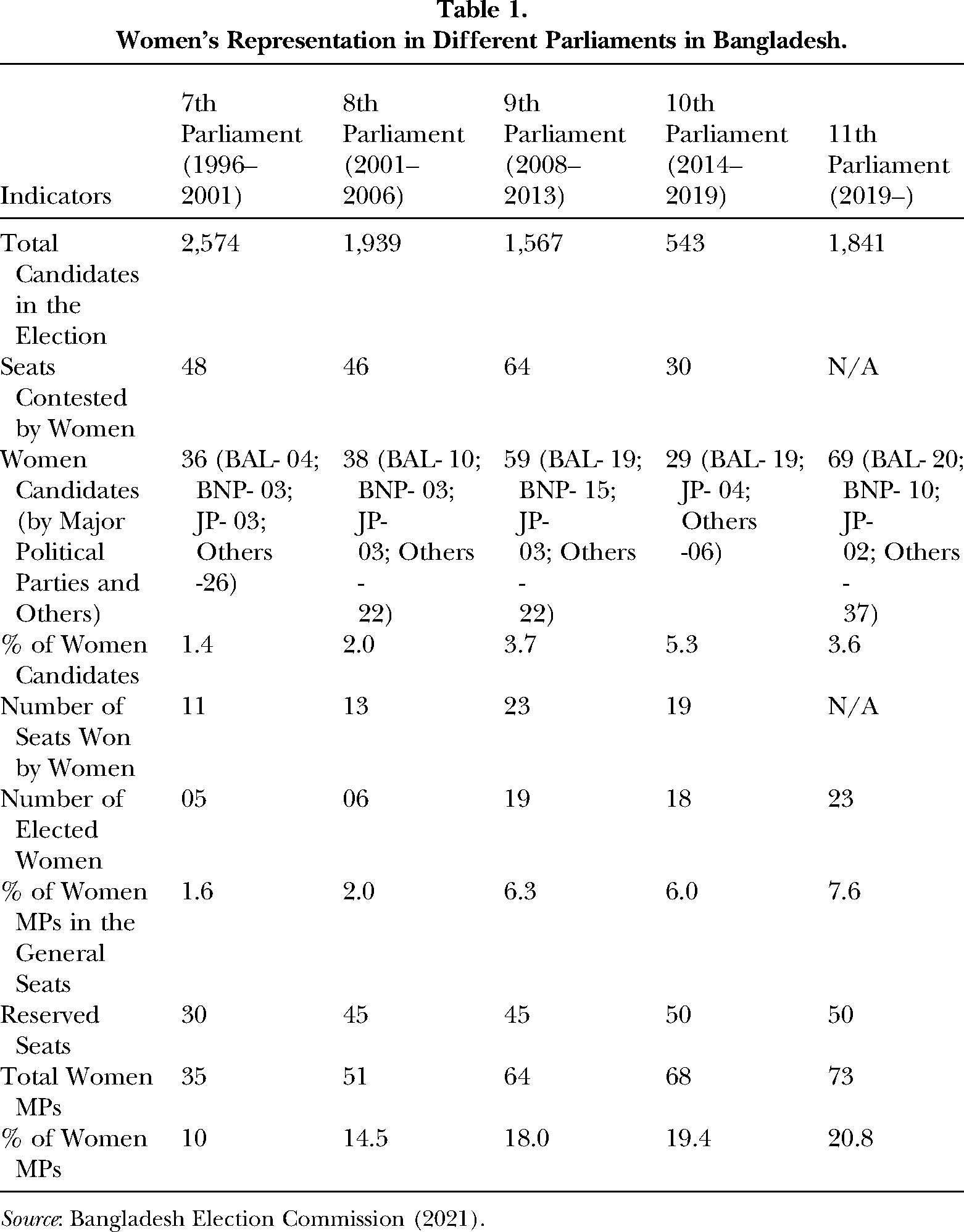
In the 7th parliamentary election in June 1996, 36 women ran for 48 seats; the BNP nominated three female candidates to run for seven seats, the BAL nominated four female candidates to run for six seats, and the JP nominated three women to run for six seats. Only five female candidates were successful, securing 11 seats/constituencies. The 8th parliamentary election in 2001 saw 38 women candidates running for 46 seats. Only six of them were elected, occupying 14 seats. It is worth noting that a candidate can run for a maximum of five seats/constituencies in the parliamentary elections of Bangladesh. However, the Bangladesh Election Commission regulation that was revised in 2008 restricted the maximum number to three constituencies. Now, after being elected, he or she can only hold one position and must resign from the others (Bangladesh Election Commission 2021).
The 9th parliamentary election was conducted in 2008 when 59 women ran for 64 general seats. Nineteen women were elected, securing 23 general constituencies. In the 10th parliamentary election of 2014, 29 women ran for 30 seats and 18 won in 19 constituencies; although a critical question about the credibility of the election was raised regarding this election—as only 153 out of 300 constituencies secured uncontested winners and voter turnover was abysmally low. The BNP, one of the largest political parties that have ruled Bangladesh several times, did not contest the election (Bangladesh Election Commission 2021).
In the 11th parliamentary election of 2018, the BAL fielded 19 female candidates, the BNP finalized 15 female candidates, and the JP nominated two female candidates to run in races with direct votes. In these cases, the BAL won all 19 constituencies, the JP won both theirs, and none of the BNP's female candidates were elected. Two women were later elected in by-elections (Bangladesh Election Commission 2021). It seems that the number of female candidates, as well as the number of elected female legislators in general seats, appears to be increasing slowly as Table 1 indicates. However, the number of female candidates securing nomination by the major political parties is significantly low.
Women's Representation in Different Parliaments in Bangladesh.
Actors and Factors Contributing to the Low Number of Female Competitors in the Electoral Process
The actors and factors involved here are interlinked or interwoven in a tangled and inseparable manner. To help in disentangling them, we follow Norris and Lovenduski (1995, 14–15) who identified two interacting factors, “supply” and “demand,” that produce a low number of women in competitive politics. The supply-side explains the factors contributing to the negative motivation of female political leaders not taking part in nomination races. The demand-side includes the actors—specifically, the selectors, party heads, and institutional compliances—that discriminate against women's nomination. Norris and Inglehart's (2003, 3) study explains the interconnections between these two factors as they act for low female representation in electoral politics because, “in traditional cultures, women may be reluctant to run and, if they seek the office, they may fail to attract sufficient support to win.” Therefore, it is evident that both supply and demand factors and actors are considered responsible for marginalizing women's presence in elective positions. This trend is universal. However, there are many additional factors and actors that vary across countries. For a more in-depth and explicit explanation in the case of Bangladesh, we here divide these factors into the broad categories of supply and demand, then break down the attendant subcategories. The supply category includes patriarchy, dynastic politics, finance, violence, and election campaigns. The demand side comprises political parties, nomination process, quotas or reserved seats, and compliance with institutional rules. It should be borne in mind that the supply- and demand-side factors are interrelated and interdependent.
Supply-Side Factors
Patriarchal Structure in Bangladesh
The structure of the society in Bangladesh is highly patriarchal and hierarchical which positions women in a subordinate status compared to men. This obviously creates obstacles to the entry of women in public and political functions. “Discrimination against women emerged as one of the most visible and articulated social issues in Bangladesh which generates women's subordination. Male domination and women's subordination are the basic tenets of Bangladeshi social structure” (Sultana 2011, 11). It should be noted right at the outset that discrimination against women is a human rights violation and a violation of the Constitution of the People's Republic of Bangladesh—a point we return to toward the end of this article.
Writing in 1997, Lim (cited in Sultana 2011, 10) argued that patriarchy is not a mere social attribute, it is a process through which male domination and female subordination take place in the socioeconomic and political arena. The patriarchal nature of politics keeps women away from politics as “men are considered bearers of the culturally legitimated authority” (Rosaldo 1974, 21)—a view that continues in Bangladesh today. Information gathered from the interviews conducted for this study revealed that patriarchy in Bangladeshi politics is considered the biggest obstacle for women attempting to build a career in politics. In most cases, women's political careers emerged from mainstream political engagement. This is especially true for the prospective young women who started their political careers as students with the ambition to become career political leaders. This state of affairs also jeopardizes the ultimate result of introducing quotas or reserved seats for women. As one potential female candidate from the capital city of Bangladesh related when her party did not consider her nomination: “the biggest hurdle for women is that ‘she is a woman.’ The prime minister wants to bring women to power, but everyone around her is male. Politics in Bangladesh has not come out of the grip of this masculinity” (Khan 2018).
A clear reflection of the patriarchal model and gender-role ideology is seen in politics regarding the distribution of roles among the limited number of women who have managed to become a part of the political elites (Khelghat-Doost and Sibly 2020, 402). “political life is organized according to male norms and values and in some cases even male lifestyles” (Shvedova 2005, 35). During the interview, an honest confession of the male MPs’ views regarding the active involvement of women in politics in general, and the political careers of women in particular emerged. All of their views go against women's engagement in politics. They also confidently expressed that, except for very few exceptions, women MPs cannot perform by themselves and very often engage their friends and relatives in the dispensation of their functions as elected representatives (Prodip 2021). Women are still rarely considered as full political actors and are rather seen as pawns to be used in the political maneuvers of men—a position that Collier (1974, 89) drew attention to long ago.
Furthermore, in a deep-rooted patriarchal state like Bangladesh, “women are not only limited by society in terms of the opportunities they seek but also choose to limit themselves” (Inglehart and Norris 2003, 9). In a society with entrenched patriarchy, women impose self-restrictions on their political involvement which leads them to become reluctant regarding active political roles. Shvedova (2005, 44) rightly states that “traditional cultural values militate against the advancement, progress, and participation of women in any political process.”
Dynastic Politics
Dynastic politics is a notable norm of political culture in Asia, most particularly in South Asia. Almost all the female heads of state or heads of government in this region ultimately came from a family that has been in politics for generations. Examples include Bangladesh, India, Sri Lanka, the Philippines, Pakistan, Indonesia, and Thailand. The trend is so pervasive that these leaders often occupy several key positions at a time which makes them powerful actors. Bangladesh is no exception as the head of the government occupies the position of leader of the legislative house and head of the political party. The situations at the national and local levels reveal a similar trend. Choi (2019, 226) identifies that the issue of women in politics involves elite bias and the impact of such biases contributes to the fact that female political elites in Asia are byproducts of the dynastic political entity. The case of Bangladesh supports his perspective. A large portion of male and female MPs in Bangladesh have an established political family tree—and this pedigree has become a significant element ingrained in political party nomination irrespective of gender identity. A substantial number of interview participants expressed their despondency at lagging behind in the nomination race against a rival candidate who has a very strong political family, despite their claims to be better candidates for the nomination. The situation has a discouraging and demoralizing effect on prospective female political activists. As Richter (1990–1991, 528) observes, in South and Southeast Asia, “the most important political posts open to women have been so because of familial ties to prominent male politicians.”
Careful observation demonstrates that female leaders in elective offices in South Asia are the byproduct of dynastic political culture—they are rarely “ordinary” citizens. This confirms that family heredity most often outweighs gender equality when it comes to securing high political office. Women in important political positions are customarily viewed (and judged) according to their family connection to eminent male politicians; this happens in situations where a male replacement is not available in the event of the demise of a father or husband who previously occupied the position (The European Foundation for South Asian Studies 2020, 4–5). Male members of eminent political families are starkly discernible in higher political positions. Given this context, the elimination of male political dynasties is impossible if not very difficult in South Asia and the situation in Bangladesh is no exception. The interviews conducted for this study showed that, except a very few, almost all the women MPs came from a strong political family. Indeed, many have jumped into political positions from the status of housewives, having never held any political position previously.
Finance
Financial ability plays a significant role in the recruitment of women to legislatures in both established and new democracies. As elsewhere, money determines the social status of an individual in Bangladeshi society and so the social and economic status of women has a direct influence on their participation in political organizations and elected bodies. Yet, while money is needed for political activities, secret, unbridled, and unanticipated campaign funding clearly has the potential to skew the democratic process and post-election governance. Campaign expenditures are on the rise globally and such a trend contributes to various kinds of political corruption that makes fundraising a difficult task (Bryan and Baer 2005, 7). Campaign fundraising is also more challenging for women in Bangladesh as they generally possess fewer financial assets and social and professional networks than men and mostly stay out of regular political activities (Shvedova 2005, 41).
In addition to this socio-economic context, the funding patterns and sources for political parties in Bangladesh remain highly ambiguous today. They often rely on individual, local, and foreign donations from supporters, admirers, and business/industrial financiers in return for an underhand mutually benefitting pact, which has resulted in the emergence of a new trend in Bangladesh since the mid-1980s: money politics. The major political parties regularly collect money by selling nominations to wealthy candidates in exchange for a hefty sum (Chowdhury 2013). As a result, one might argue that candidate selection has become a money-making process in Bangladesh's politics, enabling wealthy businesspeople to take center stage in politics and depriving active seasoned politicians in the process. Money has also provided opportunities for the rich to obtain key positions on party committees, especially within parliament. Relatedly, funds are spent in a variety of ways to buy votes and sway the minds of voters—some candidates even offer bribes to independent candidates (who tend to be serious competitors) to convince them to withdraw their candidature before elections (Ahmed 2019; Chowdhury 2013).
In the 1st parliamentary election of 1973 in independent Bangladesh, 13 percent of the total MPs were businessmen and industrialists. This figure reached 34 percent in the 2nd parliamentary election of 1979 under the martial law government led by General Ziaur Rahman and continued throughout the 2nd martial law government led by General Ershad, as the military authorities attempted to legitimize their illegitimate power by enticing businessmen and other influential people to their folds. Political domination by businessmen persisted even after democracy was restored in 1990. In the 7th parliament of 1990, 48 percent of MPs were businessmen and industrialists; this figure rose to 52.1 percent in the 8th parliament. In the 9th parliament, 63 percent of MPs were businessmen and about 69 percent in the 10th parliament (Ahmed 2019; Chowdhury 2013).
In the current parliament of Bangladesh, the share of businessmen and industrialists is 61 percent (182 of 300 MPs); only a few female MPs are business personalities (Bangladesh Election Commission 2021). Winning an election nomination requires considerable financing in Bangladesh, rendering women in a disadvantageous position as compared to men and underscoring that they tend to be given the lowest priority when it comes to gaining political nominations. The few visible women in Bangladesh's present political mainstream are from a higher socioeconomic stratum (Parvin 2016, 819). In short, politics in Bangladesh is currently dominated by money and muscles where women have little or no access.
All the participants who gave interviews for this study admitted that there is a minimum set price for obtaining a party nomination that most women cannot afford—indicating a likely positive correlation between financial ability and the chance of winning a nomination. One interviewee revealed that a female BNP participant who vied against a powerful BAL male candidate in the general constituency obtained the resources for election-related expenditures by borrowing from her brother living abroad. She failed to win the seat. Three female participants who were successfully elected to the general constituencies received the requisite funding from their renowned industrialist-cum-politician husbands. Another female BAL participant revealed that she received the required funding in the form of donations from big business on the order of the party leadership. Naturally, not all prospective women candidates have the same opportunities.
Violence
Political violence and unrest are on the rise in many parts of the globe. Violent clashes and murders of opponents between the major political parties are common which creates a sense of insecurity. Violence clearly impacts the participation of both men and women. However, it has a severe impact on the attainment of women's economic, social, civil, and political rights and discourages them from participating in politics more than men. Violence has long been a part of Bangladesh's political arena and is widely regarded as a major political and governance issue. While disagreements between parties are typical in democracies globally, they frequently elevate to the use of extreme forms of violence in Bangladesh, resulting in murder, injury, and loss of resources (Thomas 2002, 3–5; True et al. 2012, 2). In 2019, Bangladesh ranked 28th in the world for political violence risk (with five points on a scale of seven points, where 1 = low, 7 = high) according to country rankings (TheGlobalEconomy.com 2021). The country's current situation of highly confrontational politics, rampant corruption, enmity, and increasingly ferocious political attacks combined with a new breed of politicians backed by money and armed support, has developed a vicious cycle, undermining the establishment of a basic democratic system in Bangladesh (BRAC Institute of Governance and Development 2014, 43).
Violence and conflict surrounding political activities significantly hinder women's candidacy—and not merely due to the fear of becoming victims of political attacks and clashes themselves or to the fear of exposing their families to them. Women in Bangladesh generally lack the resources to engage in ‘muscle’ politics in a manner comparable to men. Because the ability to rally ‘muscle’ is often perceived as critical to advance in a political party and gain party backing for candidacy, this lack of access is seen to undermine women's propensity to enter politics, resulting in a loss of skilled and eligible female candidates (Paasilinna, Palmer-Wetherald and Ritchie 2017, 13–14).
A poignant example underlines the plethora of personal, political, and gender issues involved here. While campaigning for the 2018 parliamentary elections, a female candidate of the BNP was assaulted by ruling party BAL workers. The attackers chased her and damaged her car and flanking motorcade—culminating in serious injury to herself, her mother, maternal aunt, brother, and several party workers (Star Online Report, 2018). Such incidents are not uncommon in today's Bangladesh, a state of affairs that acts as a further deterrent to women seeking candidacy. The National Democratic Institute's (2018) gender audit and the delegation's meetings with female politicians revealed that several women candidates and MPs faced online violence in the form of disinformation, defamation, threats, harassment, and false accusations. Women reported experiencing character attacks, rumors, and outright discrimination from the media and members of their party, as well as disinformation in the form of often-sexualized false images, news on Facebook fabricated to discredit them, online newspapers with fake articles, and fake websites (National Democratic Institute 2018, 6).
The interviews on which this study is based clearly identified the violent political culture and weak implementation of attendant laws as deterrents to the participants’ entry into politics. Most expressed serious concerns over security issues. Some did not feel safe to campaign in remote places while others did not go out at night due to a lack of security. After being elected, two interviewees reported verbal and physical harassment by their male colleagues. Many aspirant women do not dare to fight against such experiences—which has exacerbated the shortage of eligible female candidates. As Paasilinna, Wetherald, and Ritchie (2017, 1) claim, “women in Bangladesh are uniquely impacted by pervasive violence in the country's electoral process, as voters, candidates, political party supporters, and activists.” The interview participants were in full agreement with this. Some opined that they are frequently subject to the “unknown” or “invisible” fear of being harassed or intimidated by their male counterparts and feel the need to put every single step with care to minimize the likelihood of different types of defamation. Others cited several examples of male candidates pressuring female candidates to withdraw their political nominations by carrying out conscious campaigns to slander women. Female candidates have also been identified as perpetrators (Prodip 2021), spreading defamatory messages against female opposition.
The interviews confirmed that women political activists face multiple obstacles falling within the broad category of violence. These include intimidation—both direct threats and psychological character defamation—hate speech against women leaders, and restriction in campaign activities. On the surface, the record does not look very alarming since the number of competing women candidates is very few. For example, in the last parliamentary election, only 69 of 1,848 were women: that is, one in 27 candidates were women. The severity of these variants of violence is nevertheless a great concern regarding the low representation of women in candidacy races as well as of even more concern for all the individuals involved.
Election Campaigns
Election campaigns are expensive and require solid financial backing for success. In fact, in Bangladesh, expenses start when a prospective candidate expresses her/his intention to participate in the election. The nomination itself, vote-buying, further campaigns, and donations to local clubs, associations, and religious institutions cost a significant amount. The vast majority of women political leaders and MPs in Bangladesh do not have independent professions or sources of income, remaining dependent on their husbands. Consequentially, the political hope of many women dies rather early. The interviewees reflected the widespread frustrations over the huge informal and unofficial expenditures that nomination and, eventually, successful election incurs.
Other than the dynastic route, and/or sympathy or support from local people after the death of a husband or father, the only way to enter a legislative position is through political parties and their wholehearted support. Parties are considered the main capital for securing a nomination, mounting a competitive election campaign, and financing success. It is generally understood in Bangladesh that people cast their vote for the ‘party symbol’ not for the ‘candidate.’ The party's role is thus extremely important to entering elected office. In response to the question, “are you ready to run the election as an independent candidate if you do not get party nomination?” every respondent's answer in our interviews was an emphatic “no!” The critical point to underline here is that political parties act as a gatekeeper to enter the political arena. They can facilitate women's candidacy—and they can also stop women from political engagement.
As a predominantly Muslim country, religious institutions in Bangladesh—especially mosques, where people gather for prayers—are a good place to engage in election campaigning. People want to see their prospective leader in person and to gauge whether they will be likely to develop religious institutions or offer grants and donations to their place of worship. However, in mosques that place is restricted for women candidates. Door-to-door campaigning strategies and rallies also contribute to electoral success, but in Bangladesh, these strategies are not regulated by a stipulated timeframe and so sometimes take place at night. Informal voter mobilization also takes place mostly at night. For the reasons connected to direct and indirect violence and harassment noted earlier, such circumstances are neither favorable nor comfortable for women candidates in a way that clearly undermines gender equality in campaigning.
In short, the supply-side factors discussed in this section point strongly to many reasons why there is a shortage of women candidates in Bangladesh's elections and even fewer successful female candidates. In interview with the authors of this article, the majority of the aspirant female candidates expressed that they cannot afford the typical election campaign which invariably involves a huge amount of money, organizing against violence and terrorists, and day-to-night campaigns for voter mobilization. Lawless and Fox's (2008) study revealed that the pattern was similar 15 years ago. They found that women, in general, express strong apathy toward campaign activities—especially entreaties and invocations to voters, managing party officials, reaching the doorsteps of voters, and handling the press, while maintaining their family activities/duties and privacy (Lawless and Fox 2008, 7). Then, as now, all these factors act as deterrents to female prospective candidates from running in general elections in Bangladesh.
Demand-Side Factors
Political Parties and Nomination
Working for a political party helps one to improve organizational skills, decision-making strategies, lobbying skills, and learn and perfect political etiquette. Parties also offer power by providing access to electoral offices and in the party organization as well as assistance in developing links between public officials and voters. They are likewise the ultimate gatekeepers as they nominate candidates for elections. Thus, women need to be members of a political party to circumvent discrimination (International Institute for Democracy and Electoral Assistance [International IDEA] and Inter- American Development Bank [IDB] 2011, 15).
One can, of course, run as an ‘independent’ candidate. However, in most countries it is difficult to get elected without the support of a political party in parliamentary elections. Therefore, aspirant women usually join a party. Besides, political parties may differ considerably across nations regarding the strategies encouraging women to get involved in politics as well as the pre-selection of women as party candidates. For example, party laws or regulations might incorporate provisions specifically designed to increase the political participation of women: for instance, a gender equality agenda in the party constitution; gender-balanced party management and policy committees; and a gender-balanced candidate list in the election using quotas. Indeed, party quotas assure that a particular percentage of the party's list are women in the Nordic countries and quotas play a significant role in the higher representation of women among elected representatives (International IDEA 2021; Matland 2005, 95–6).
While there may be procedural variations, party candidates in Bangladesh are chosen by a central selection board comprised of top-brass party members. The board invites applicants for an interview after evaluating their applications, reviews their applications during the interview, and ranks them based on their qualities, previous legislative experience, financial ability, service and loyalty to the party, popularity, and prospect of winning the election. Even though the party constitution designates the parliamentary board as the supreme decision-making body, in practice party chiefs make the final decision after consulting with other board members. However, the nomination process within Bangladesh's parties is neither transparent nor internally democratic. The major political parties normally nominate candidates who can donate large sums of money to the party fund, spend money to win votes, and are well-connected. This underscores the earlier point concerning why so many businessmen and industrialists are nominated and elected to the parliament via the ‘nomination trade.’ The practice evidently creates significant barriers for women to become nominated as candidates. More broadly, it has hampered the emergence of promising new candidates from the grassroots level (Mahiuddin n.d., 2; National Democratic Institute 2018, 5). As we have seen, the male-dominated political parties favor and patronize those female members who come from highly influential political families as proxy candidates to contest in family seats either in place of their husbands, fathers, or other family members (BRAC Institute of Governance and Development 2014, 84) thus depriving many dedicated and eligible female candidates.
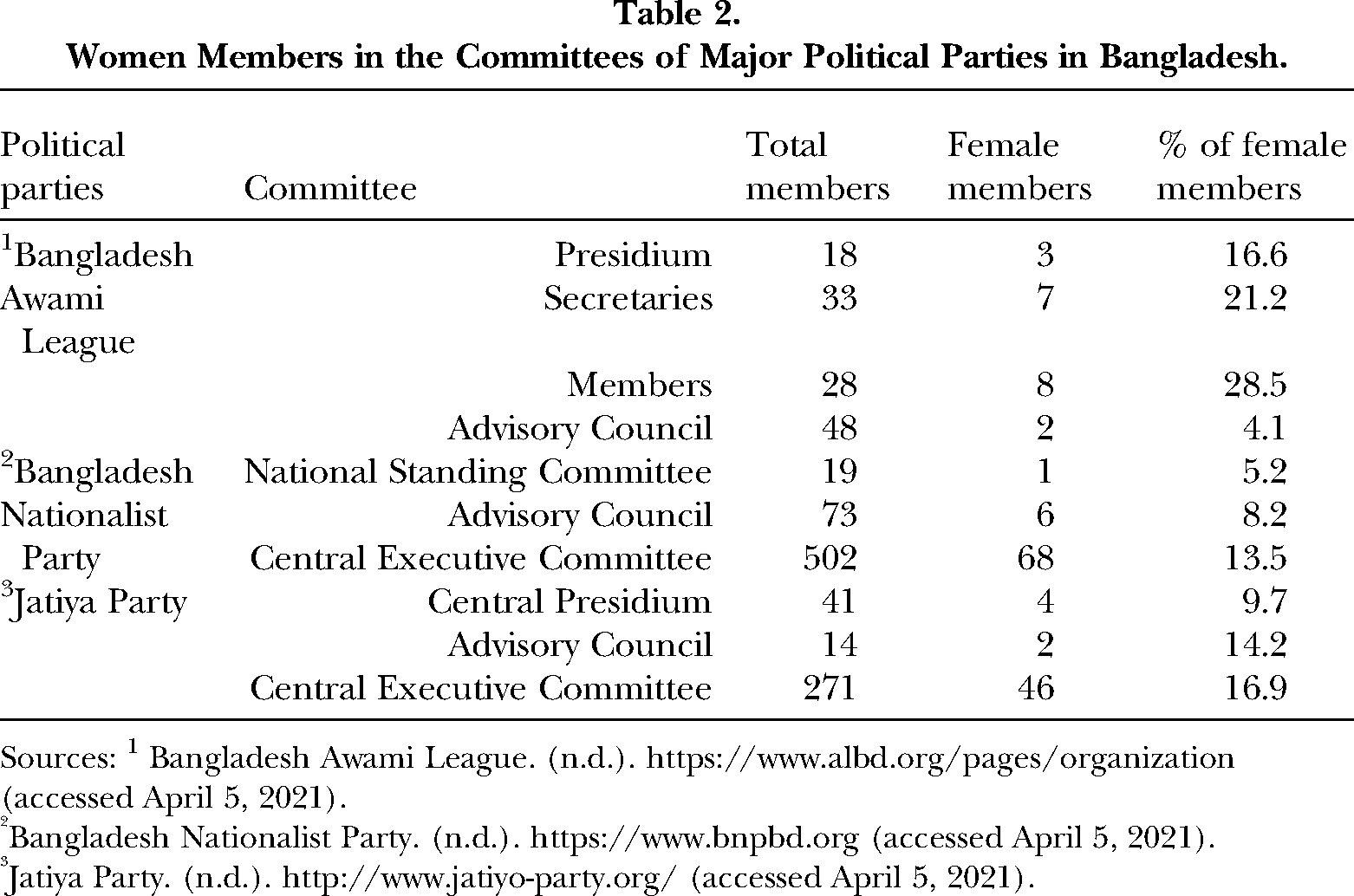
We can see a fair number of women in major political parties in Bangladesh, but, as the proverbial “glass ceiling” persists in a variety of contextual ways, the dynamics of being engaged in politics and winning the election are not the same as for men. Women, in general, lack the qualities and contexts to win elections in Bangladesh which ultimately pushes many of them to abandon seeking the nomination. The political party's role is crucial to setting women candidates on the political road to elected office. But their inclination toward male-dominated institutions is prominent (Dahlerup and Leyenaar 2013, 2). The central advisory committees of the BAL, BNP, and JP are dominated by male politicians (see Table 2). They do involve female workers and supporters in election movements, anti-government marches, strikes, and rallies. Yet women are marginal in the top policy-making bodies of the major political parties which significantly affects women's successful political involvement (Ahmed 2008, 290).
Women Members in the Committees of Major Political Parties in Bangladesh.
Sources: 1 Bangladesh Awami League. (n.d.). https://www.albd.org/pages/organization (accessed April 5, 2021).
Bangladesh Nationalist Party. (n.d.). https://www.bnpbd.org (accessed April 5, 2021).
Jatiya Party. (n.d.). http://www.jatiyo-party.org/ (accessed April 5, 2021).
Table 2 shows that all the major political parties in Bangladesh are predominantly led by men. It has long been argued that such disparity enhances a disproportionate advantage for, and power of, men and leads to favoritism and unjust candidate recruitment and selection (Childs 2013, 93). Recently, a move was instituted to ensure that political parties registered with the Bangladesh Election Commission were legally required to ensure at least 33 percent female representation in all committees, including the party's central committee. However, at the time of this writing the key decision-making committees of the BAL, BNP, and JP have only around 10–15 percent female members, indicating that—as yet—the parties lack clear, effective plans to increment women's representation (Jahan 2014, 45).
The data in Table 1 show that women comprised 3.6 percent, 5.3 percent, and 3.7 percent of the total candidates in the 11th, 10th, and 9th parliamentary elections in Bangladesh, respectively. The political domain is intimately associated with men and masculinity. Political institutions as such are popularly known as male-oriented in that they display the tendency to behave and realize things in favor of men. Kenny (2013, 38) rightly argues that, “while constructions of femininity and masculinity are both present in political institutions, the masculine ideal underpins institutional structures, practices, and norms.” Indeed, a built-in pervasive male-oriented cultural norm of the institutions leads to reproducing male dominance (Lovenduski 1998, 339)—a point that still applies globally. One female MP from a reserved seat in Bangladesh expressed her opinion on this issue to a media spokesman: “our male colleagues talked a lot in the meeting and the parliament in favor of women's leadership but the moment they realize the fact that they have been challenged by any women candidates in their constituencies they take a strong stand against female candidature” (Khan 2018).
This is the stern political reality in Bangladesh. Another sitting MP currently occupies a top leadership position in a left-wing political party and started her political career in a student organization closely engaged with the garment workers’ associations reported that: “we decided that women leadership would be brought to the fore in the party. But when I went to the council, I saw that everyone was saying the exact opposite. They were not saying what they had said the day before. How can a woman run such an organization?” (Khan 2018). She is not the only strong voice in the debate. A female presidium member and former minister of the BAL stated that women are living in a patriarchal environment and fail to get support and assistance from their male counterparts to advance in politics (Khan 2018). Male leaders possess the idea that female leaders are not capable of performing like them and nominate only a few female candidates for the elections. In the 2018 parliamentary election around 100 female aspirants from the BAL collected and submitted their application forms to run for a direct election; only 19 got the tickets. According to a BAL presidium member and MP, it is the party policy to nominate so few female candidates. BNP male leaders possess similar attitudes toward female candidates (Antara and Raju 2018).
All the interviewees noted that parties have been responsible for several demand-side deterrents to female candidacies and political success. They listed as most prominent among these deterrents: the party candidate nomination process; the lack of party support; the prevalent gender biases that have existed within the parties for years; and considering male candidates as a trustworthy source of funding. Several interviewees cited that male politicians have negative opinions regarding women in political leadership positions. To be sure, a majority of male politicians do not always express their negative attitudes toward female leadership in public. However, they are reluctant to allow women to have their own space. In reality, the lack of democracy inside the parties greatly hinders women's access.
Competitive domains, in general, also have a clear gender bias. The competitive nature of running for a political position has a distinctly negative impact on the motivation of potential female candidates to compete as a candidate in the election (Preecea and Stoddard 2015, 307). In this study, female political aspirants were found to be more discouraged from considering themselves as a candidate when they see an acutely uneven competition to get a ticket. It imposes a self-restriction on the political ambition of eligible female political activists and the party members.
Quotas/Reserved Seats
Quotas and reserved seats are a type of affirmative action mechanism used to address the underrepresentation of women and other minorities which has become an integral part of the electoral landscape in many countries. Gender quotas take a wide range of forms across countries. Voluntary/political party quotas, reserved seats, and legal candidate quotas are the three most popular forms of gender quotas (International IDEA 2021) used by many countries in legislatures and political parties. Sweden, Finland, the Netherlands, and Norway are leading the way in getting more women into parliament by implementing voluntary party quotas that guarantee 40–50 percent female representation on party lists during selection and nomination processes. In other developed Western countries such as Australia, Canada, and the United Kingdom, voluntary party quotas are now widely used (Dahlerup and Freidenvall 2005, 38–39; Hoodfar and Tajali 2011, 72).
The legislated candidate quota allows for the preservation of a certain percentage of total candidates on electoral lists for women. This is the most recent form of quota system launched in developing countries during the 1990s, mainly in Latin America, post-conflict Africa, and the Middle East. This type of quota guarantees 25–50 percent of total seats for aspirant female candidates. Alternatively, reserved seats ensure that a certain number of seats in a parliament or local body are reserved for women, as specified in the constitution or by statute (Hoodfar and Tajali 2011, 47–48). Bangladesh has a quota of 50 reserved seats in the parliament as a top-up on 300 directly elected MPs from 300 distinct electoral constituencies. At the outset it was only 15, later it was increased to 50 by several Constitutional amendments. These 50 seats do not have any specific constituencies (Jahan and Amundsen 2012, 17) and are distributed among the political parties against their ratio in the parliament. It is the party that nominates and makes the final list of women MPs under reserved seats. The Election Commission formally announces and publishes the names through Gazette notification (Firoj 2007, 17–18).
The practice of quotas in Bangladesh is nevertheless controversial. Rather than encouraging political freedom, Chowdhury (2002) claimed two decades ago that quotas increase female dependency on politics and perpetuate their marginalization. Political parties prefer to see women represented by reserved seats thus limiting their entry as direct-seat contestants. Earlier, Chowdhury (1994) had argued that the reserved seat provision not only fails to raise the number of women in parliament but also weakens women's representative status. In a male-dominated society, women's non-electability is seen as a sign of political vulnerability, and as a result, they rarely speak up for themselves. The interviews conducted for this study suggest that little significant substantive headway has been made since these observations.
The interviewees mentioned that, while many of the female reserved seat MPs were interested to run for the general constituencies, only a few of them secured nominations. Furthermore, they were usually selected for those seats where it is difficult to win. Even though the interviewees supported the provision of reserved seats, it became clear that rather than facilitating women's entry, they believed the reserved seats obstruct women's advancement in politics. Likewise—and very revealingly—a female MP and ex-minister of the BNP said that women are not given nominations for direct election by the parties but rather kept aside to fill the reserved seats (Antara and Raju 2018). This, again, shows how procedures that were ostensibly designed to promote greater gender equality can actually be used to obstruct it. As we have seen, a female candidate needs a strong network with the parties and sufficient financial means to secure a nomination for either a general or reserved seat. These are resources that the majority of women do not have. In consequence, the male-dominated political parties discriminate against women on the grounds of quotas as they have the excuse that, since men do not have a quota, they are to be given preference when selecting candidates for direct election.
Rules Compliance
Equal gender access to power, decision-making, and leadership at all levels is a necessary precondition for the proper functioning of democracy. Formally speaking, a multi-party democratic system prevails in Bangladesh. Irrespective of caste, religion, ethnicity, and gender all citizens become voters at the age of 18 years. Bangladesh is a signatory of the Convention on the Elimination of All Forms of Discrimination against Women (CEDAW). Article 2 of CEDAW instructs states to adopt appropriate legislative and other measures, including sanctions, for prohibiting all discrimination against women. Article 7 of CEDAW provides the basis for realizing equality between women and men through ensuring women's equal access to, and equal opportunities in, political and public life, including the right to vote and to stand for election, as well as to hold public office at all levels of government (UN Women n.d.). Substantively speaking, Bangladesh patently has reservations about Article 2 and has implemented its provisions at the surface or formal level in a way that has not embodied their deeper egalitarian spirit. More than 80 percent of the interview participants stated they were confident to lead in political positions. Yet less than 20 percent aspire to do so and an even smaller percentage has fought with success against the cultural and institutionalized deterrents discussed in this article in order to secure a nomination.
Conclusion
Prospective women political activists possess the necessary command and attributes for leadership as well as the essential motivation for political engagement. Yet in Bangladesh women remain disenfranchised and an injudicious dissimilarity between males and females is notable within political parties in various forms in Bangladesh. The patriarchal nature of the political culture remains very prominent in practice. Notwithstanding formal, procedural compliance with democratic standards and international conventions, that patriarchal culture continues to view women with a preconceived negative attitude. The supply size of the prospective female candidates for election competition has consequently become worryingly narrow. On the other hand, party leaders are clearly reluctant to see women advance to powerful elected positions which contributes to the low demand for women in nomination panels. This leads to a smaller female presence in election competitions.
This study has argued that in Bangladesh, despite protestations and procedures to the contrary, politics is still seen and practiced as a largely masculine domain. One indication here is that, to be politically successful in competitive elections, women are required to display certain masculine personality traits, characteristics, and other resources. In a patriarchal society and the political culture stemming from it, women severely lack the agency or related contextual advantages necessary to enter and remain in the “democratic” electoral environment. This, of course, not only applies to women with “traditional feminine characteristics” who may be less interested in competitively elected positions as a result of the systemically driven difficulties in prospective success. Any rational actor—regardless of gender or characteristics—would be less inclined to expend energy where the prospects of success are slim or the costs of candidacy are elevated in other ways (particularly when these concern personal security). The interviews conducted for this study also showed that the obstructions present in the current political system in Bangladesh have meant that even educated and politically ambitious women impose a form of self-restriction that is reflected in the low number of female candidacies.
The study also found that incumbent women MPs, whether directly elected or occupying reserved seats, are less interested in re-running for their seats compared to their male counterparts. We were able to confirm no marked outcome as a positive result of the introduction of institutional rules to increase the number of women in elective positions. The various supply- and demand-side factors and actors discussed in this article have combined in diverse ways to contribute to the low number of women candidates in Bangladeshi elections. The conclusion here is that the quotas/reserved seats do not have much spill-over effect encouraging the entry of new women candidates into competitive politics. Major new interventions and transformations as well as better functioning procedures and a more robust commitment to international gender equality norms are therefore still required to propel the existing social, economic, and institutional arrangements in Bangladesh forward on the road to substantive and meaningful gender equality and better quality of democracy.
Footnotes
Acknowledgment
We are grateful to the anonymous reviewers and editor at World Affairs for their valuable comments and support in developing this article.
