







Abstract
This World Affairs 2023 special issue contains six contributions, including this one, exploring some of the key political consequences of traditional beliefs such as magic and superstition in the developing societies of the Global South as well as in certain industrially advanced societies of the Global North. To show why traditional beliefs matter, we provide an explanation in this introduction for why traditional beliefs exist in developing countries, why they survive in developed countries, and why they may become more popular over time. By utilizing a simple game theoretic approach, we explain why rational people can sometimes increase their payoffs by subscribing to a superstition while superstitious people never gain by switching to rationality. In fact, the superstition—which has no causal connection with the natural course of events—may even yield better results, not only for the individual but also for the group. This is the reason why, in the framework of evolutionary stable equilibrium, superstitious people can demographically dominate an entire population over time. In addition to explaining the existence and the persistence (or the popularity) of traditional beliefs, we highlight the key findings presented in the articles included in this special issue. All of them underline a cardinal point: traditional beliefs matter. They shape electoral behavior, they shape attitudes toward democratic governance, and they influence voters’ assessment of political figures and historical events. Precisely because traditional beliefs have such extensive implications for a country's political life, we believe that in the future scholars will have to pay greater attention to such beliefs to have a better understanding of political phenomena and trends.
A visitor at the home of Niels Bohr, famous atom scientist and Nobel Prize winner, was surprised to see a horseshoe hanging over the door. “Do you, a sober man dedicated to science, believe in that superstition?” “Of course not,” replied Bohr, “but I’ve been told that it's supposed to be lucky, whether you believe in it or not.”
The Speaker's Handbook of Humor (Droke 1956, 373)
The history of superstitions and belief in magic is as old as the history of humanity itself. They are widely considered as unscientific, irrational, and unreasonable, 1 but their persistence and popularity in the age of science keep puzzling scholars.
Superstitions still persist in all societies, including modern, developed, and technologically more advanced ones. According to the Gallup and Harris polls of paranormal belief (reported in Vyse 2013), more than half the U.S. population believes in psychic/spiritual healing and extrasensory perception, and more than a third believes in haunted houses, possession by the devil, ghosts, or spirits of the dead, telepathy, and/or visitation by extraterrestrial beings. Similar beliefs are held not only by Britons and Canadians (Paranormal Beliefs Come (Super)Naturally to Some, gallup.com)—as well as by other Western societies—but are also quite commonly held in many Muslim communities around the world (Muslim Beliefs in the Supernatural and Related Practices, Pew Research Center). Such beliefs are, then, quite clearly world affairs.
It was estimated in 2005 that American businesses lost close to a billion U.S. dollars every Friday the 13th (Kramer and Block 2008). Ng, Chong, and Du (2010) report from the world's top elevator manufacturer that around 80 percent of elevators around the world do not have the 13th floor button. Kolb and Rodriguez (1987) found that returns on Friday the 13th of a month are significantly lower than other Fridays in the stock market, although Dyl and Maberly (1988) argue that this finding is coincidental. In South Africa, drivers with more superstitious beliefs drive less carefully and incur more accidents (Peltzer and Renner 2003). Woo and Kwok (1994) not only demonstrate the effect of superstition on Hong Kong license plate auctions but also show that this effect is culturally dependent: “What is considered to be unlucky in Western Societies is dismissed in Hong Kong: and vice versa.” Liu and others (2021) likewise find a considerable increase in life insurance spending in certain zodiac years among Chinese rural households. 2
While previous studies have reported that traditional beliefs, such as superstitions, are culturally dependent, in this issue, we wish to suggest instead that they represent important correlates, and/or determinants, of individual attitudes and values and of what has been regarded, at the aggregate level, as national culture. The pervasiveness of traditional beliefs, as some of the studies included in this special issue reveal, represents an important criterion for capturing the cultural variation cross-nationally. More importantly, if traditional beliefs shape national cultures and if political phenomena are, to greater or a lesser extent, cultural characteristics, then it is reasonable to hypothesize the existence of a nexus between traditional beliefs and political phenomena, outcomes, attitudes, and behavior.
The purpose of this special issue is to explore whether and to what extent the presence and/or pervasiveness of traditional beliefs has a detectable impact on political life. We have sequenced the articles in the special issue as follows. In “Modernization, Superstition and Cultural Change,” Pelizzo, Turganov, and Kuzenbayev (2023) analyze the relationship between socioeconomic development and the pervasiveness of traditional beliefs in Muslim communities. In “Traditional Beliefs and Electoral Behavior in Indonesia,” Harakan, Pelizzo, and Kuzenbayev (2023) and in “Traditional Beliefs and Electoral Behavior: Some Evidence from Togo,” Pelizzo and others (2023) investigate the electoral consequences of traditional beliefs, showing that voters who hold traditional beliefs are more likely to vote for government parties. In “Traditional Practices and Support for the Strongman's Rule,” Pelizzo and Kuzenbayev (2023b) show that voters with a traditional mindset prefer the rule of a strongman to democratic rule, while in Germany, according to “Beyond Religion: Superstition, Traditional Beliefs, and The Extreme Right,” superstitious voters are more anti-Semitic and have more positive views of Hitler and his regime (Pelizzo and Kuzenbayev 2023a).
The evidence presented in this special issue sustains at least three broad claims. First, traditional beliefs are still very common, and the process of socioeconomic development has not managed to eradicate such beliefs even in industrially advanced settings. In this introduction, we argue for why that may be the case. The second claim we advance is that traditional beliefs matter: traditionally minded voters prefer the status quo, vote for ruling/governing parties, and are less supportive of democratic processes than other voters. The evidence presented in this issue requires us (and all scholars, particularly those in the politics and policy sciences) to pay greater attention to traditional beliefs for they are still able to shape—in a way that the literature has so far failed to properly appreciate—the political life of the (post)modern world. Third, while previous studies identified religiosity as one of the important facets of tradition, the studies included in this special issue make it quite clear that religiosity is not the only dimension of a traditional mindset and, more importantly, that religiosity and traditional beliefs can engender opposite political outcomes.
The findings presented by the articles included in this special issue are significant for both analytical and practical purposes. They show the importance of going beyond religion to capture the traditional mindset of a society. They likewise show that there is greater cultural homogeneity across the followers of different religions in a given country than among the followers of a given religion across several countries. They confirm that Islam is not the kind of culturally monolithic entity that Huntington (1993) had depicted. They also indicate that traditional beliefs survive not only in the developing countries of the Global South but also, and possibly surprisingly, in the industrially advanced settings of the Global North. We believe that these findings may be of interest to scholars working in a wide range of disciplines. They should appeal to sociologists of religion, secularization theorists, modernization theorists, electoral behavior scholars, political culture scholars, and comparative politics specialists. Yet, we believe that in addition to having some analytical and empirical significance, the findings presented in this issue have also significant implications for policy makers.
By showing that traditionally minded voters tend to vote to preserve the political status quo (by voting for ruling parties) or that they have a cultural aversion to democratic rule, we are able to identify some of the (cultural) obstacles that need to be removed in the developing countries of the Global South to create the conditions for successful democratic transitions and consolidation. This simple lesson was known to Lipset (1959) and remains valid six decades later.
The analysis of the German data (Pelizzo and Kuzenbayev 2023a) is also consistent with Lipset's (1959) claim that democratic consolidation depends above all on the presence/absence of proper cultural conditions. But it also shows that, as the religious landscape in the industrially advanced countries of the Global North changes and new cults become more common and new/old traditional beliefs gain greater currency, the political landscape may also be transformed in a radical way. Extreme-right voters are more likely to hold superstitious beliefs, superstitious voters are more sensitive to the appeal of the extreme right, and—as the analysis of the German data revealed—they are more likely to have moderately benign views of Hitler and the National-Socialist regime. As new/old cults and traditional beliefs become more popular in Europe, they may enhance the electoral appeal of extreme right and/or populist parties. And the possibility of such a profound transformation of the political landscape is something that policy makers should most certainly pay attention to.
Superstitions as Instruments of Social Rationality
Persistence of these beliefs in various societies and their cultural connections are strong indications that they are useful, personally or socially, despite the appearance of irrationality. In fact, like all other human behavior, superstitious behaviors (beliefs) stem from adaptive behavior in all organisms, including humans (Foster and Kokko 2009). Research in biology and zoology indicates that many animals can develop superstitions and engage in magical thinking. Skinner (1948) contends that even pigeons are found to develop superstitions in controlled experiments.
A rational calculus of expected costs and benefits, according to the theory of rational irrationality (Caplan 2001), can explain why people tend to sustain their irrational beliefs (and actions) when the cost of these beliefs (and actions) are small and the likely benefits (psychological satisfaction, social belonging, etc.) exceed these costs. People tend to keep their superstitions when these are harmless, and instrumentally rewarding.
Alongside this basic framework, economists delve into details and explain why some superstitions are more likely to survive. Surviving superstitions, in fact, are sufficiently complex and rely upon a rational learning process with sufficient patience by the members of the group (Fudenberg and Levine 2006). They construct a game theoretic model with rational learning to demonstrate that some superstitions will not persist, and more importantly, they will change the behavior of people. Hara, Lee, and Iwasa (2015) further prove how a superstition is likely to be maintained when a population consists of three groups: believers, non-believers, and half-believers.
In a nutshell, simple superstitions like “if you commit a crime, you will be struck by lightning” will not survive because it is relatively easy to experiment and verify that “the chances of being struck by lightning are independent of committing crimes.” In contrast, the example used by Fudenberg and Levine (2006) is the second law in the Code of Hammurabi: If any one bring an accusation against a man, and the accused go to the river and leap into the river, if he sink in the river his accuser shall take possession of his house. But if the river prove that the accused is not guilty, and he escape unhurt, then he who had brought the accusation shall be put to death, while he who leaped into the river shall take possession of the house that had belonged to his accuser.
Experimentation, however, is not a sufficient method to amend the beliefs that are irrationally held. Alicorn (horn of the unicorn) trade in late Medieval and Renaissance Europe provides us with an interesting case. Alicorn was believed to offer a strong protection against poison, and it was an expensive item. The inventory of the royal wares of Queen Elizabeth I of England in 1558 included a unicorn horn (the Horn of Windsor) with a recorded value of 10,000 pounds sterling, the holy Roman Emperor Charles V paid off his debt (equivalent to a million U.S. dollars today) with two unicorns, and the King of France's alicorn was valued at 20,000 pounds (Lavers 2017). 3 King James I of England put the alicorn's magical power to the test by summoning a servant to drink poison mixed with unicorn powder. It was an unfortunate experiment for the servant, but the king's unshaken belief in the magical powers of unicorns survived the results of the experiment, because he concluded that he was cheated with a counterfeit (Dudley 2008). 4
Another example is the Gypsy law, according to which “unguarded contact with the lower half of the human body is ritually polluting, ritual defilement is physically contagious, and non-Gypsies are in an extreme state of such defilement” (Leeson 2012b). Leeson explains how this mechanism based on a superstition allows the Gypsy community to enforce desirable conduct, especially when more formal alternatives (government or ostracism) are not immediately available.
A similar approach was taken by Leeson to examine the relationship between ordeals and Medieval people's belief in iudicium Dei (judgments of God)—according to which God condemns the guilty and exonerates the innocent through ‘clergy-conducted’ physical trials of fire and (boiling) water or ducking putative ill-doers in the village pond. The outcomes of these ordeals were reported as miraculous, but only after employing the tools of game theory and mechanism design do we understand that the outcome was a type of separating equilibrium and the entire mechanism is socially productive (Leeson 2012a, 2012c). In fact, a similar approach is actively used by modern governments by utilizing polygraph tests—although “lie detector” tests lack the scientific basis and are incapable of determining whether a person accused of a crime is in fact guilty or innocent. Furthermore, Leeson and Russ (2018) examine how Europe's witch trials reflected non-price competition between the Catholic and Protestant Churches for larger dominion in the European continent. In another study, Leeson and Coyne (2012) compare how “sassywood” (trial by poison ingestion) does a better job of fulfilling the conditions for effective criminal justice in contemporary Liberia, where formal criminal justice institutions fail to satisfy those conditions.
Hence, we can emphasize traditional beliefs serve the society's interest when formal institutions are weak, or nonexistent. The finding that people tend to be more superstitious in bad times (Ng, Chong, and Du 2010) also supports this conclusion. Furthermore, Vyse (2013) discusses how magic starts as product of the “primitive” mind, connects to religion, and becomes a social institution and a response to uncertainty.
The Game of Politics
A typical summary of the game that provides higher payoffs for hunting a stag is portrayed in Table 1. Rousseau (1755) discussed the story of a stag hunt in his Discourse on Inequality: On the Origin and Basis of Inequality Among Men to illuminate his vision of the social contract: a group of hunters who wish to catch a stag face a coordination problem. They will succeed if they all remain sufficiently attentive, but each is tempted to desert his post and catch a hare. Each hunter prefers a share of the stag to a hare. However, they face two options: to remain attentive to the pursuit of stag, or catch a hare. If all hunters pursue the stag, they catch it and share it equally. But if any hunter decides to catch a hare, the stag escapes, and the hare belongs to the defecting hunter alone. Table 1 summarizes a typical matrix that provides higher payoffs for hunting a stag.
Rousseau's Stag Hunt Game.
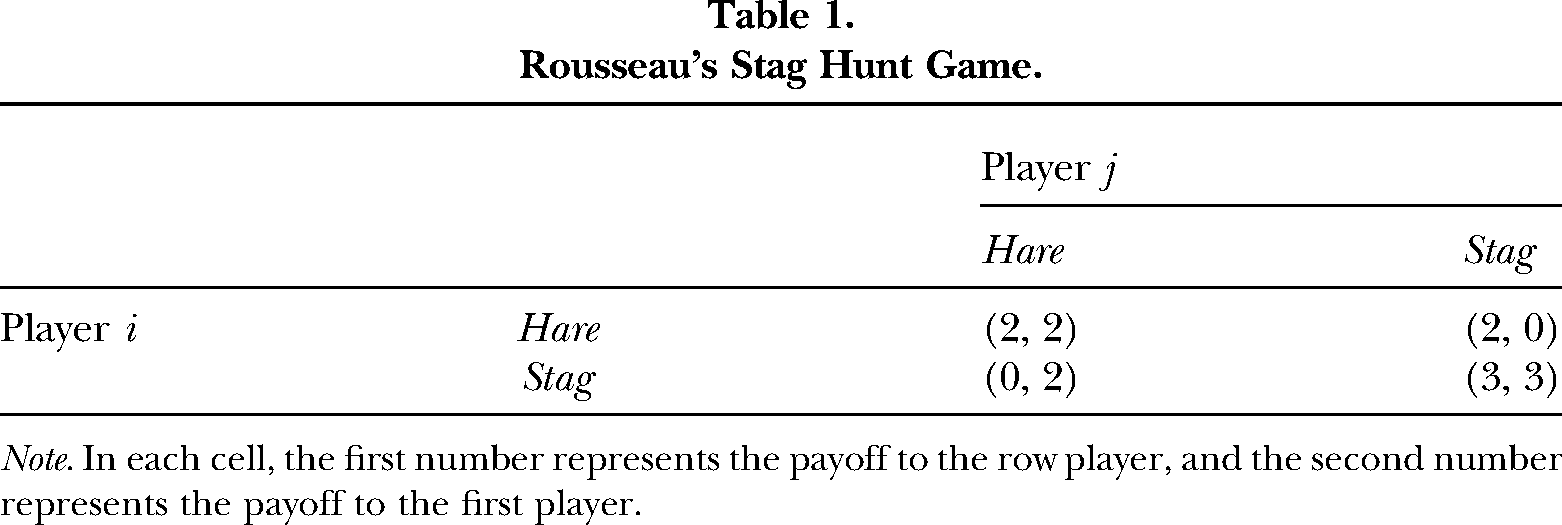
Note. In each cell, the first number represents the payoff to the row player, and the second number represents the payoff to the first player.
The game has multiple equilibria: a socially and individually superior outcome of Stag, Stag at which both players get 3, or an inferior outcome of Hare, Hare where both get 2. 5 The strategic nature of the game forces the players to consider what they believe the other player will do before they make their choice. Hare, Hare is a risk-dominant equilibrium (Skyrms 2004) because a player can secure a payoff of 2 by playing Hare while playing Stag entails a risk of getting 0 if the other player plays selfishly for whatever reason.
The game is simple but astonishingly rich in illustrating the political setting. To quote Skyrms (2004): The whole problem of adopting or modifying the social contract for mutual benefit can be seen as a stag hunt. For a social contract theory to make sense, the state of nature must be an equilibrium. Otherwise, there would not be the problem of transcending it. And the state where the social contract has been adopted must also be an equilibrium. Otherwise, the social contract would not be viable. Suppose that you can either devote energy to instituting the new social contract or not. If everyone takes the first course, the social contract equilibrium is achieved; if everyone takes the second course, the state of nature equilibrium results. But the second course carries no risk, while the first does.
Stronger social institutions, formal or informal, are successful because they provide a mechanism to ensure the superior payoff of 3 to their members by eliminating all uncertainty in the people's minds against the risk of getting nothing. But when the institutions are weak or nonexistent, so that social cooperation and coordination are less certain, the outcome is less rewarding.
The third equilibrium in the stag hunt game involves mixing two strategies following the rationality axioms of Von Neumann and Morgenstern (1944) and the interpretation of Harsanyi (1973) (called the mixed strategy equilibrium). This equilibrium is when each player plays 
More generally, when the probability of rain is α, expected payoff of the superstition is 3 − α:


Tradition and Political Culture
Superstitions and believing in magic are components of a more complex social structure called tradition. Tradition 8 includes certain customs, rituals, informal rules, and conventions. Historically, they evolved in response to the problems faced by the members of different societies. They are more likely to be repeated by the following generations if they solve those problems. The most successful elements of tradition work so perfectly that they prevent the problems even before they arise. Some contribute to solving the coordination and cooperation problems in a community. In addition, they are instrumental in building ties within a community, social benefits, and in many cases private (individual) benefits. Thus, superstitions, like any other component of the tradition, are culture specific (Kramer and Block 2008).
In fact, the more successful in eliminating and preventing individual or social problems before they take place, the more likely the causal link will be forgotten. Cutting nails at night is a popular superstition in many Asian and Middle Eastern countries, believed to bring bad luck. Although there is no scientific evidence to support this superstition, cutting your nails during the night was more dangerous and less hygienic with no electricity or light and limited visibility during the nights in ancient times (Purba, Herlina, and Siahaan 2020). Similarly, rituals decrease anxiety, improve performance, and they are more effective than other forms of distraction or trying to calm down (Brooks et al. 2016). In team sports, almost all participants (90% +) believe in “slapping the hand of the scorer” or the “team cheer” based on a study in Canada (Vyse 2013). It can be linked to a more universal practice of a handshake. A ‘hand shake’ is understood as a gesture and declaration of trust (“I am not carrying a weapon against you”), and it pro-actively prevents likely problems (lack of trust) among strangers although the actual origin of ‘the hand shake’ is older than Homo sapiens and maybe as old as our DNA (Al Shamahi 2021). But once the gesture is accepted, practiced, and transmitted through thousands of generations, it becomes an established custom and hardly anyone today thinks about its rationality before shaking the hand of a stranger.
Tradition also shapes the political culture in societies. Politics, when understood as the process of decision making concerning the distribution of resources and power and status in a society, is essential in setting the objectives and also the means to reach those objectives. Coordination, cooperation, and trust are important in reaching a political decision, whether unanimous or majority, as long as it is deemed legitimate. It is perhaps not so surprising that under weaker political institutions in low-trust societies, superstitions and seemingly irrational belief systems are more influential in shaping the political culture. The political decision-making process is complex. Indeed, the lack of proper institutionalization in less developing economies may actually increase the uncertainty, the complexity, and the ambiguity of the decision-making process (Huntington and International Affairs 1968). When properly developed, institutions provide political actors with the guidance that they require to minimize the uncertainty and reduce the ambiguity associated with decision making. In those settings in which institutions are not properly developed and fail to provide actors with the guidance that they require/need, political actors may seek guidance from informal institutions, which necessarily and historically includes unfounded beliefs, superstitions, and magic. Traditional beliefs shape the electoral behavior of voters, shape their attitudes toward democratic/autocratic governance, and shape their assessment of rulers and regimes.
Yet traditional beliefs, for the reasons we have alluded to earlier, may survive in spite of progress along the developmental path and even persist quite strongly in developed countries. More importantly, the model presented above makes it quite clear why traditional beliefs and superstitions may acquire wider currency over time regardless of the level of socioeconomic development of a given society. As the articles included in this special issue reveal, the popularity of these traditional beliefs has, among other things, visible political implications. They are associated with, and they are possibly responsible for, the way voters cast their ballots, attitudes toward democratic governance, and appreciation/interpretation of political figures and historical events. And they consistently show that a traditionally minded voter is generally more apathetic, less likely to vote, more likely to support the ruling party/parties and contribute to the preservation of the status quo, and more likely to have authoritarian tendencies. The implications of these findings are clear: the traditional mindset is an obstacle for democratic transitions and consolidation in developing countries, but it also poses—or may eventually pose—a threat to democratic governance in developed countries. This is the reason why we believe this special issue represents a timely contribution to the study of the political consequences of a traditional mindset and traditional beliefs and why more research needs to be conducted along the lines of inquiry explored in this issue.
Footnotes
Acknowledgments
This project would not have been completed without the help, the encouragement, and the support of several colleagues and friends. We would like to thank Colin Knox, Neil Collins, Gianfranco Pasquino, and Marco Verweij for reading some (or all) of the manuscripts that now appear in this special issue. We wish to thank the anonymous reviewers at World Affairs for providing constructive feedback and guidance as to how the manuscripts could be improved. Above all, we wish to thank World Affairs Editor-in-Chief, Dr. Emma Norman, for giving us an opportunity to work on this project and for helping us to do a much better job than we would have done otherwise.
