







Abstract
The current article explores the possible selves, or future expectations, of 543 incarcerated juvenile offenders in four Western states in the United States. We argue that juveniles who are able to articulate future expectations and fears and generate concrete strategies for achieving their goals have higher levels of motivational capital (i.e., resources which provide momentum for behavior) and thus greater readiness for transitioning back into society. We found that a majority of juveniles were able to articulate simple expectations about the future; however, less than a quarter recognized the relationship between hopes and fears and connected them to concrete strategies. Findings did not differ significantly according to race or gender. We point to a need for juvenile corrections to work with all youth to construct plausible reentry plans. Furthermore, we suggest that research is needed to compare postincarceration success of youth with varying levels of motivational capital.
Youth incarcerated at a young age are likely to have faced many challenges (e.g., poverty, poor parenting, lack of education, racism, etc.), which contribute to their placement in the juvenile justice system. These are challenges which do not simply disappear, and may actually worsen, upon conclusion of incarceration. A number of longitudinal studies suggest that anywhere from 31% to 71% of juvenile delinquents graduate into adult crime (Blumstein, Cohen, Roth, & Visher, 1986), and although there are no magic bullets with regard to reducing recidivism, effective planning is likely to be the first line of defense (McCamey, 2010; Willis & Grace, 2009). A minimum requirement of the system should be to help youth develop plans to effectively negotiate barriers for successful reentry into the community. Reentry planning and aftercare services designed to help youth transition; however, are still not universal practices among secured juvenile facilities (Spencer & Jones-Walker, 2004). Given the high rates of recidivism and the barriers to success for even well-supported youth, it is regrettable that more emphasis is not placed on assisting incarcerated youth with future-oriented planning.
The current article explores future-oriented expectations, fears, and strategies (possible selves) among a group of juvenile offenders. Specifically, we explore the extent to which youth in five facilities possess motivational capital for life after release. We define motivational capital as a collection of social and cognitive resources which work together to provide momentum for behavior. Motivational capital is a social psychological concept which parallels the related sociological/criminological concept of social capital. Just as social capital research generally focuses on the cumulative impact of social network resources on behavior (Portes, 1998), motivational capital is the cumulative gathering of motivational resources for behavior. In this case, we are exploring cognitive resources (e.g., goals) which are expected to facilitate prosocial behavior and reduce antisocial behavior among juvenile offenders reentering society. We compare our findings with previous research on related constructs and discuss implications for juvenile corrections. Based on the findings of this research, we make suggestions about ways in which juvenile corrections might facilitate the planning process and build motivational capital among delinquent youth.
Literature Review
Possible selves represent a multifaceted conception of an individual’s future-oriented self (Markus & Wurf, 1987)—what one would like to become, could become, and would like to avoid becoming (Markus & Nurius, 1986). They are future-oriented visions which include aspirations, goals, motives, and fears (Markus & Nurius, 1986; Oyserman & Fryberg, 2006). Possible selves may include both positive and negative images—the “intelligent” self who gets A’s in high school, the “athletic” self who is the quarterback, or the “dropout” who skips class and is kicked out of school. These future-oriented expectations and fears may be set in either near or distant future (Oyserman, Brickman, & Rhodes, 2007; Strahan & Wilson, 2006).
Expectations, Fears, and Balance
Possible selves come in the form of both expectations and fears. Identifying positive future goals serves numerous functions in terms of self-enhancement and motivation. Regardless of one’s current situation, planning for a more successful future can serve to enhance self-esteem and positive emotion (Oyserman, Bybee, Terry, & Hart-Johnson, 2004). Furthermore, recognition of future expectations can motivate individuals to reduce the discrepancies between current situations and desired future selves (Markus & Nurius, 1986; Strahan & Wilson, 2006). In other words, being able to picture an improved “future me” can make me feel better in the moment while also incentivizing behavior designed to achieve that “future me.” Although positive expectations about the future self can enhance motivation, the desire to avoid a negative future self can also provide an additional motivational push. As long as the fear of the “future me” does not become paralyzing, it can provide motivation to avoid negative situations (Newberry & Duncan, 2001; Oyserman & Markus, 1990b).
Each of these visions (i.e., expectations and fears) provides motivation; however, when these two components are in the same life domain they provide an increased state of motivational capital (Oyserman & Markus, 1990a, 1990b). Researchers have found that if individuals strike a “balance” between their expected and feared selves, they are more likely to achieve their future-oriented selves (Oyserman & Fryberg, 2006; Oyserman & Saltz, 1993). For example, Next year, I expect to stay away from drugs and fear getting caught up with my drug “chumps.” This is referred to as having a “balance” in the same life domain (i.e., both visions involve drug use; Oyserman & Saltz, 1993). The cognitive recognition of what is expected, even wanted (staying away from drugs), and the fear of not achieving what is expected (a drug-free life) can provide a stronger motivational push than either self in isolation (Oyserman & Markus, 1990b). Although positive expectations are beneficial, they may not always be effective without fears (Oyserman & Fryberg, 2006; Oyserman & Saltz, 1993).
Fears balance expectations by helping a person distinguish and prioritize between other goals (Oyserman & Markus, 1990a). For example, individuals who expect to graduate from high school but lack the fear of failing out may find themselves in a competitive state with other goals such as wanting to be popular (Oyserman & Markus, 1990b). Thus, when friends ask them to skip school or use a fake ID to buy beer, the immediate compelling opportunity to be “popular” may overcome desires for academic success. Having balanced expectations and fears may help youth recognize competing selves and allow them to prioritize goals. Furthermore, striking a balance in the same life domain helps individuals to recognize necessary steps and potential barriers, which may initiate the development of strategies to achieve those goals (Oyserman & Fryberg, 2006; Oyserman & Saltz, 1993).
Strategies as Motivational Capital
The final aspect of motivational capital and the possible self-construct which helps connect expectation, motivation, and behavior is the strategy. Strategies serve several functions in terms of transforming expectation into reality. Selves are the “what” whereas strategies are the “how-to.” Strategies serve as an action plan (e.g., I want to avoid using drugs and I’m going to attend NA meetings once a week to help me reach that goal). They also serve to reduce the psychological distance between present and future (Oyserman & Fryberg, 2006; Oyserman & Markus, 1990b). If future consequences seem distant, individuals are less motivated to change present behaviors (e.g., smoking may cause lung cancer but I have plenty of time to quit). If, however, individuals implement strategies, those goals become more realistic and provide a greater sense of investment toward the future. Finally, the more concrete, achievable, and detailed the strategies are, the more likely they are to lead to actual behavior (Oyserman et al., 2004).
Research on strategies within the possible self-construct has been limited; though in terms of motivational capital, it may be the most significant piece. Oyserman and colleagues (2004, 2006) have conducted at least two studies that indicate the importance of developing strategies. In a study of eighth graders from primarily ethnic minority and high poverty households, the authors found that youth who were able to delineate strategies, significantly improved their grades, increased time spent on homework, and reduced chances of summer school referral (Oyserman et al., 2004). In fact, the average eighth grader exhibited a drop in school participation and homework involvement during the year: a negative shift that students with strategies were able to avoid (Oyserman et al., 2004). In a second study, low-income Detroit middle school youth were randomly assigned to either an intervention or control group (Oyserman, Bybee, & Terry, 2006). A 7-week intervention was implemented during homeroom, which aimed to help youth identify possible selves and forge balances and strategies. The experimental group experienced positive outcomes on behavioral problems, time spent on homework, grade point average, and depression. Strategies and balance completely mediated the impact of the intervention on behavioral problems and time spent on homework (i.e., the program helped youth develop strategies which were related to improvement on outcome measures). Strategies also partially mediated the effects of the intervention on GPA and depression (Oyserman et al., 2006).
Having even one or two possible selves can provide motivation for behavior but as selves become more numerous, more balanced, and more connected to clear, detailed strategies they become a greater source of motivational capital and are more likely to result in behavior. Simply picturing a desired self cannot, by itself, make it a reality; however, knowing how to achieve the future self makes goals more realistic and obtainable. Thus far, the development of strategies among delinquent populations has received minimal attention within the possible selves’ literature. The current study seeks to overcome this gap and provide more insight on the possible selves construct as a whole.
Delinquency and Possible Selves
Thus far, we have suggested that certain constellations of possible selves (e.g., balance, strategies) can serve as motivational capital and facilitate success by engendering positive emotion, reducing the psychological distance between present and future, and providing direction for implementing steps or avoiding potential roadblocks. The focus of this article, however, is on possible selves and motivational capital among incarcerated juvenile offenders. This population deserves study for several reasons. First, previous research has established that there are motivational differences between delinquent and nondelinquent populations. Second, some research suggests that motivational differences are actually predictive of future delinquency. Finally, incarcerated juvenile delinquents are likely to face a number of obstacles between release and the successful transition to adulthood. This is especially true among minority youth, particularly African Americans, who are more likely to experience traumatic events such as witnessing violence and are more likely to be victims of violence (Vaughn, Wallace, Davis, Fernandes, & Howard, 2008). It is important to gain understanding about existing motivational capital among offenders to implement effective programming designed to help youth achieve postrelease goals.
Previous research on delinquent and nondelinquent youth has established motivational differences between the two groups (Oyserman & Markus, 1990a; Oyserman & Saltz, 1993; Trommsdorff & Lamm, 1980). A study conducted by Oyserman and Markus (1990a), compared the possible selves of four groups of adolescents with varying degrees of official delinquency (i.e., public school, community placement, group home, and state training school youth). The most delinquent youth in their sample were least likely to generate conventional school or job-related expected selves and were most likely to report fears of future criminal behavior. Furthermore, the two most delinquent groups (i.e., group home and training school youth) were less likely than nondelinquent groups to report balance between expectations and fears (Oyserman & Markus, 1990a). Similar findings were reported in a later study comparing public school and detention center youth. Specifically, nondelinquent youth reported more balance in expectations and fears and more attempts to attain expected and avoid feared selves. Furthermore, impulsive behavior and possible selves measures were moderately successful (68.5% correct) in discriminating between public school (74.4% correct) and detention center youth (64.6% correct; Oyserman & Saltz, 1993). Finally, although they were not compared with nondelinquent youth, a small sample of incarcerated youth in a qualitative study reported very few strategies to attain expected selves or avoid feared selves (Abrams & Aguilar, 2005).
In addition to comparing delinquent with nondelinquent youth, a few studies have also used possible self-indicators to predict self-reported delinquency and other nonconforming behavior among public school youth. In a survey of 418 high school youth, the number of expected and feared selves accounted for 21% of the variance in overall self-reported delinquency and 18% of the variance in arrestable behaviors (Newberry & Duncan, 2001). When Oyserman and Markus reinterviewed the least delinquent youth (i.e., public school and community placement youth) following their initial study, they found that youth with more balance between expectations and fears in the first interview were less likely to report having participated in delinquent behavior in the 3 months between interviews (Oyserman & Markus, 1990a).
Previous studies have established a link between possible selves and delinquency; however, research in this area still has several shortcomings. Although there have been numerous studies on possible selves in the last 20+ years, few since those pioneering studies (i.e., Oyserman & Markus, 1990a, 1990b; Oyserman & Saltz, 1993) have included delinquent populations (see exceptions; Abrams & Aguilar, 2005; Newberry & Duncan, 2001). Second, research on incarcerated youth has excluded girls and involved relatively small samples (10-133 boys). Incarcerated samples have been confined to Minnesota and Michigan and have varied in the types of offenders and length of incarceration. Finally, possible selves’ investigations with delinquents have focused primarily on expected and feared counts, categories of selves, and balance between expectations and fears; however, little attention has been paid to strategies (Oyserman & Saltz, 1993).
The Current Research
Based on the literature reviewed above, we argue that youth with the most developed motivational capital, are most likely to experience desired behavioral change and thus most equipped for life after incarceration. Although having plans does not guarantee success, the literature reviewed suggests that it makes it more likely. Thus, we describe the extent of motivational capital in the current sample of juvenile offenders. Under the framework of motivational capital, we explore expected and feared selves, balance among expectations and fears, and strategies (both concrete and abstract). We add to the current research by focusing on all aspects of the possible self in addition to making a few methodological improvements: an increased sample size, expanded geographical coverage, and the addition of delinquent girls. We compare our findings with previous research and discuss implications in terms of theory and practice.
Data and Method
Data collection for this study included self-administered surveys with juveniles at treatment facilities in four Western United States. The researchers initially contacted facilities and juvenile corrections departments in 11 Western United States and the following states agreed to participate: Alaska (n = 86), Idaho (n = 125), Nevada (n = 186), and Oregon (n = 146). The facilities targeted in each state were the largest coed facilities which had a minimum stay of 90 days. Facilities ranged in size from approximately 60 to 180 beds. A variety of programming was offered at these facilities including sex offender treatment, substance abuse services, educational and vocational programming, and cognitive training.
Sample
The sample for the current study (N = 543) was comprised of 384 boys (71%) and 159 girls (29%). The most often reported race/ethnicity was White (38.1%); followed by multiracial (19.1%); Latino, Hispanic, or Mexican (16.3%); Native American or Alaskan Native (8.7%); African American or Black (8.3%); other (6.7%); and Asian American or Pacific Islander (2.8%). The respondents ranged in age from 12 to 22 years (M = 16.49, SD = 1.48). The highest education level completed ranged from 4th to 12th (M = 9.48, SD = 1.57). At the point of data collection, the mean time spent in the facility was 7.5 months for men and 4.7 months for women. Males reported being incarcerated as a result of violent crimes (35%), sexual offenses (21%), property offenses (16%), status and drug/alcohol offenses (15%), probation violations (8%), and multiple offenses (5%). Females identified primarily violent offenses (33%), status and drug/alcohol offenses (31%), probation violations (14%), property offenses (10%), multiple offenses (7%), sexual offenses (3%), and prostitution (3%).
Procedure
Youth completed paper-and-pencil, self-administered surveys. Two researchers were present at each of the facilities to provide instructions and answer questions. The questionnaires included several measures of attachment and relationship quality in addition to measures of future orientation. Youth were gathered in central common areas such as classrooms or lunchrooms and given approximately 30 to 45 minutes to complete the questionnaires. All on-site youth were invited to participate in the research. Of the 568 youth available to participate, approximately 96% (N = 543) completed the questionnaire.
Measures
Possible selves
Youth at the five targeted facilities, completed the Possible Selves Questionnaire (PSQ; Oyserman & Markus, 1990a) which asked the respondents to list three expected and feared selves and accompanying strategies. They were asked to complete the following statement: Next year, I expect to be . . . The open-ended nature of this question allowed respondents to answer as candidly as possible. After answering the above question, the respondents were further instructed to answer “Am I doing something to be that way?” and if yes, “What am I doing now to be that way next year?” This question prompted respondents to provide strategies for achieving their expectations. The feared possible selves followed the same pattern: “Next year, I want to avoid . . . ; Am I doing something to avoid this”; and if yes, “What am I doing now to avoid being that way?” These questions identified possible expectations, fears, and strategies that the respondents had for the upcoming year.
Possible selves coding
Because of the open-ended nature of the questions, responses had to be coded before analysis could be conducted. Two researchers coded responses for count, categories, balance, and strategies. The responses were coded according to a modified version of a coding scheme developed by Daphna Oyserman as a part of National Institute of Mental Health and W.T. Grant Foundation-funded activities. Oyserman’s coding scheme served as the foundation, and categories were added and modified to appropriately capture the possible selves of the current population. Two investigators coded all of the possible selves and agreement was calculated (ranging from 78% to 96%). Following the initial agreement calculation, investigators discussed cases where inconsistencies occurred to come to a final agreement on coding.
The respondents were given three lines to report possible selves; however, many respondents identified more than one possible self per line. Investigators first counted the number of selves reported and then coded them into the appropriate categories (see Table 1 for more information). The investigators also examined balance between expected and feared responses for the upcoming year. “Balance refers to the construal of both positive expectations and fears in the same domain” (Oyserman & Fryberg, 2006, p. 20). For example, “I expect to graduate and fear getting kicked out of school.” This would be coded as a balance in the academic domain. Investigators also counted the number of strategies and determined whether the strategies were concrete or abstract in nature. Strategies which were abstract in nature did not have a tangible approach to achieving their possible selves—wanting to be smarter “by educating myself.” However, numerous respondents reported strategies that were more concrete—wanting to be smarter “by taking college classes.”
Possible Selves Content Coding
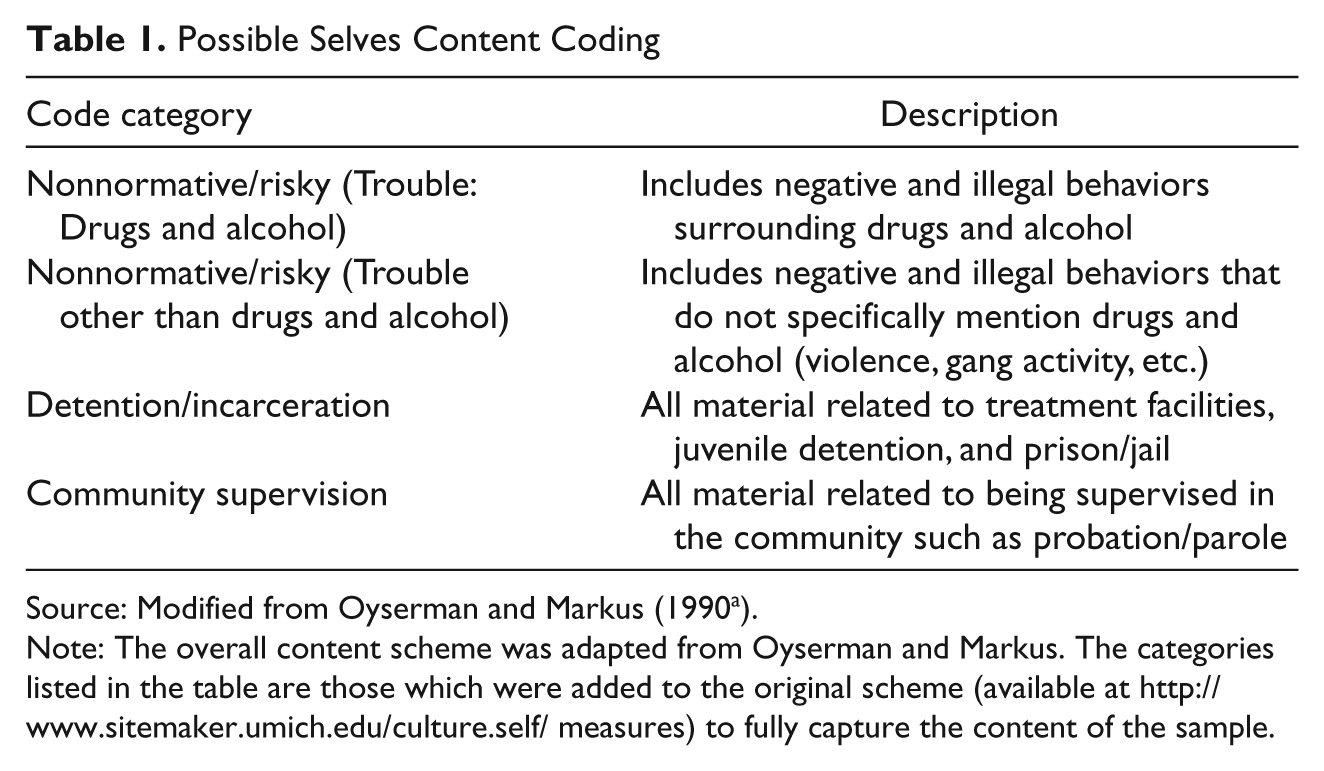
Source: Modified from Oyserman and Markus (1990a).
Note: The overall content scheme was adapted from Oyserman and Markus. The categories listed in the table are those which were added to the original scheme (available at http://www.sitemaker.umich.edu/culture.self/ measures) to fully capture the content of the sample.
Results
The following section is a descriptive outline of motivational capital reported by youth incarcerated in the target facilities. The literature reviewed suggests that each added piece of motivational capital contributes to the likelihood that behavioral change will occur. As such, we treat each component (i.e., selves, balance, strategies) separately and then report on the overall motivational capital as an integration of components.
Selves
Most youth reported between 2 and 3 expected selves (boys: M = 2.86, SD = 1.28; girls: M = 2.96, SD = 1.28) and between 2 and 3 feared selves (boys: M = 2.27, SD = 1.08; girls: M = 2.40, SD = 1.11). The expected and feared selves reported by youth stretched across a number of life domains. The most commonly reported expected selves fell under the areas of lifestyle (59%), school (54%), and job (48%) and there were no significant differences by gender. Approximately 62% of girls reported at least one expectation in the school domain, followed closely by lifestyle (59%) and job expectations (43%). For boys, lifestyle ranked first with at least 59% reporting one or more expectations in that domain followed by school (51%) and job expectations (50%).
The most commonly reported domains in terms of feared selves were risky behavior (56%), drugs and alcohol (52%), and interpersonal (42%). Drugs and alcohol were the most commonly reported fears among girls with 62% reporting at least one fear in the domain. Drugs and alcohol were followed closely by fears about risky behaviors (56%) and interpersonal situations (45%). Risky behavior (56%) was the most commonly reported fear among boys, followed closely by drugs and alcohol (47%), and interpersonal (41%). See Table 2 for information about all reported domains.
Categories of Expected and Feared Selves by Gender
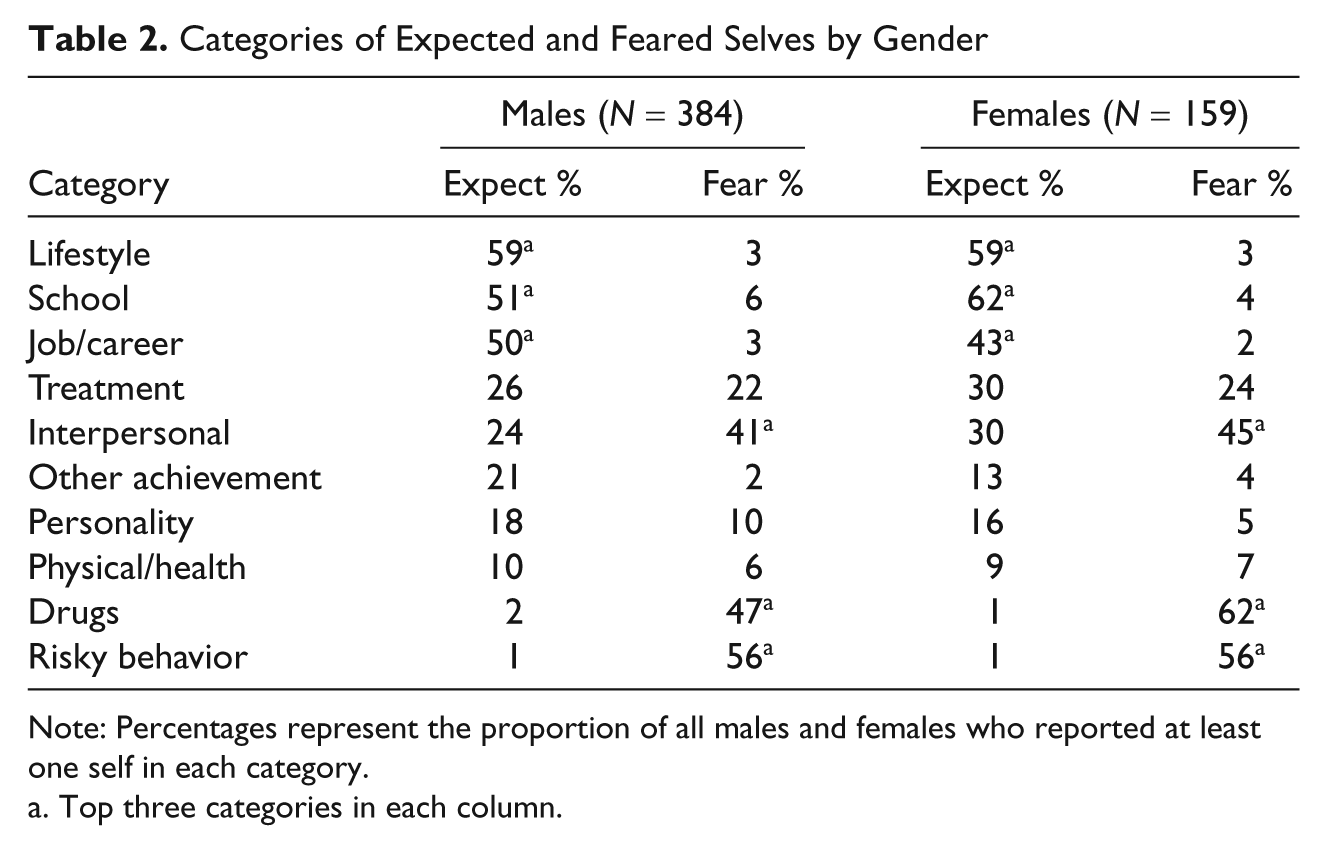
Note: Percentages represent the proportion of all males and females who reported at least one self in each category.
Top three categories in each column.
Balance
The number of balanced selves ranged from 0 to 3 for boys and from 0 to 2 for girls. Balance in the possible self-literature is defined as having an expected and a feared future-oriented self in the same domain. In the current sample, only 36% (n = 193) of youth (boys = 34%; girls = 39%) reported a balance in possible selves. The most often reported balance by youth in the sample was in the domain of incarceration. Approximately 16% of all youth (or 46% of youth reporting at least 1 balance) reported expecting to be released from the facility and fearing coming back. This was not surprising since youths were incarcerated at the time of survey administration. The second most reported balance was in the domain of drugs and alcohol with 9% of the total sample (or 25% of youth with at least 1 balance) reporting in this area. An example of a drug and alcohol balance would be a youth expecting to stay clean but fearing falling back into patterns of drinking or drug use. See Table 3 for balanced selves.
Balance Categories by Gender
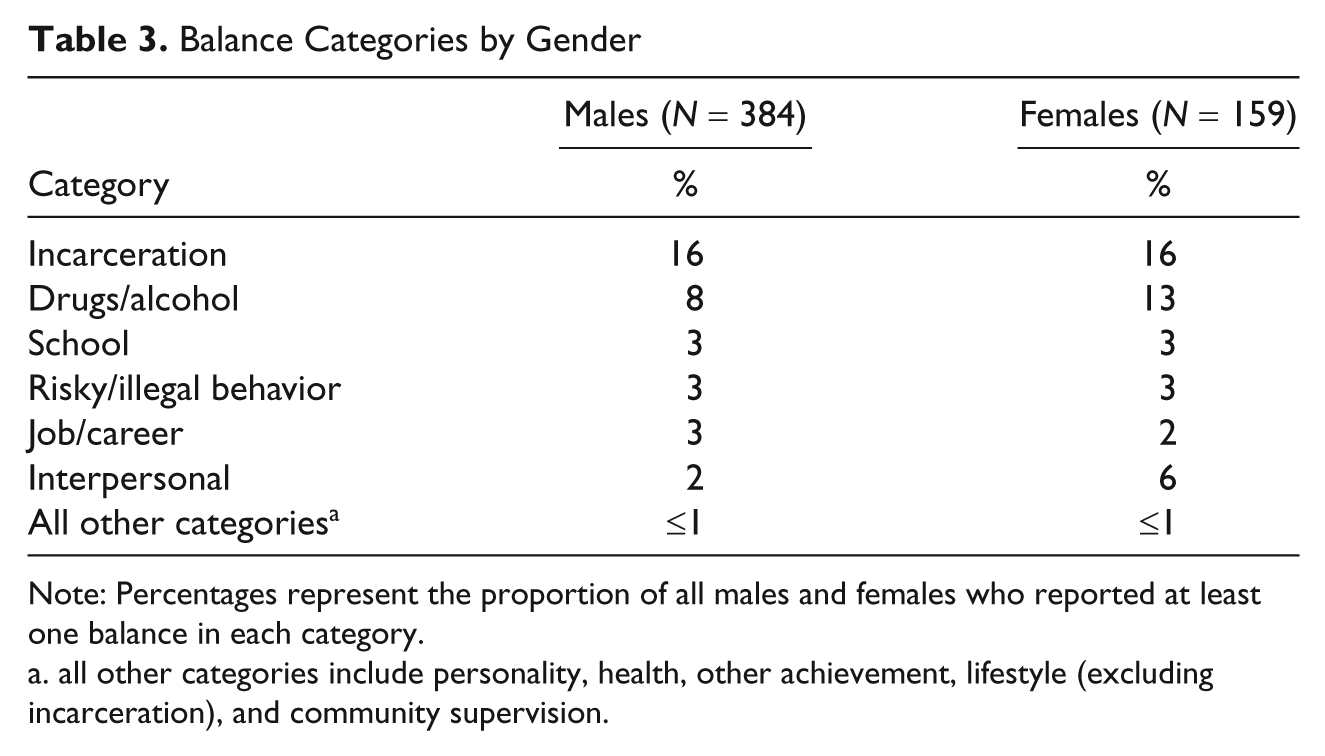
Note: Percentages represent the proportion of all males and females who reported at least one balance in each category.
all other categories include personality, health, other achievement, lifestyle (excluding incarceration), and community supervision.
Strategies
The final component (i.e., strategies) of motivational capital is important to examine because it is the aspect of the possible self construct most closely linked to behavior (Oyserman et al., 2006). Expected strategies ranged from 0 to 9 for boys (M = 2.43, SD = 1.56) and from 0 to 6 for girls (M = 2.41, SD = 1.47), whereas feared strategies ranged from 0 to 5 for boys (M = 1.87, SD = 1.34) and 0 to 6 for girls (M = 1.94, SD = 1.32). Approximately 91% of the youth were able to identify at least one strategy for either expected or feared selves. When strategies were coded for concreteness, however, the number reporting strategies dropped significantly. Concrete strategies were defined as those strategies which could be easily replicated by another person. For example, a youth who reported wanting to get a high school diploma might report one or more of the following strategies: going to class (concrete), completing homework (concrete), doing well (abstract). Approximately 60% of youth were able to identify at least 1 concrete expected strategy and 52% of youth were able to identify a concrete feared strategy.
Demographic Breakdown Across Variables
A series of t tests, chi-squares, and correlation analyses were conducted to explore differences by gender, race (White, non-White), and age. No significant gender or races differences (t tests) were found for the number of selves, strategies, or balances generated. Although the order of expected and feared selves categories changed slightly, the top three categories of expected (lifestyle, job, and school) and feared (risky behavior, drugs and alcohol, and interpersonal) selves remained the same for race and gender. Furthermore, there were no significant differences in the number of balances generated; though White youth were significantly more likely than nonwhite youth to have any balance (vs. no balance), χ2(1) = 3.96, p < .05, V = .09. The difference, however, was small; 32.3% of non-Whites generated at least one balance, whereas 40.8% of Whites generated at least one balance. There were also significant correlations between age and the number of concrete expected, r(539) = .132, p < .01, and feared, r(539) = .120, p < .01, strategies. The number of both expected and feared concrete strategies increased with age.
Putting It All Together
Motivational capital is based on the idea that future-oriented cognitions (e.g., goals, strategies) build on one another and represent resources for behavioral action. As such, we argue that each element of the possible self-construct is an individual resource, but when combined with other elements they are more likely to lead to behavior. Expectations and fears lie at the beginning of the motivational spectrum. Most youth (97%) in our sample were able to identify at least one expectation or fear for the upcoming year. The next cognitive step is identifying a balance between those expectations and fears. Approximately 36% of the youth in the sample were able to identify at least one expectation and one fear in the same domain. The number of youth reporting a balance drops to 25% if incarceration balances are excluded. We suggest that delineating an incarceration balance (i.e., wanting to leave incarceration and never return) requires less cognitive effort than other balances. Approximately 20% of the youth were able to identify at least one nonincarceration balance and one concrete strategy. Finally, at the top of the ladder, we find the most developed sense of motivational capital with approximately 14% of the youth in the sample being able to identify at least one balanced expectation and fear and a concrete strategy for both the expectation and the fear.
Discussion
Comparing Current Findings With Previous Research
The findings regarding feared selves are very similar to the pioneering study reported by Oyserman and Markus (1990a). They reported that the most delinquent youth in their sample described fears related to involvement in crime and drugs, much like the fears described in our sample. In addition, the youth in our sample discussed fears about interpersonal relationships. Even these fears were indirectly related to crime and drugs (i.e., wanting to avoid “bad influences,” “my old gang chumps,” “bad peers,” etc.). Though the Oyserman and Markus’ (O&M) sample did not include delinquent girls, the female reports in this sample closely resembled reported fears of boys.
Youth in this sample did differ from the O&M sample in terms of commonly reported expectations. Delinquent youth in the O&M sample differed from nondelinquent youth in that “their hopes were a diverse set that involved relatively few mentions of school or school-related activities such as sports, or alternative achievement selves such as jobs” (Oyserman & Markus, 1990a, p. 122). Approximately 14% of the most delinquent youth (training school youth) in their sample reported future expectations regarding school; compared with 54% in the current sample. In addition, 48% of the youth in our sample reported expectations about jobs, something not commonly reported in the O&M sample. It is unclear why our sample reported conventional selves more often than in the O&M sample though it is possible that is a function of the different sampling strategies. Our sample (N = 543) was much larger than the training school sample (N = 60) in the O&M study. Furthermore, the current study used a sample that was spread across five different facilities. It is possible that the single institution sample captured contextual norms where a larger sample across several facilities allowed for more variance in selves and context. Furthermore, school was mandatory and year-round at each of the five facilities in this study and a few of the facilities provided vocational programs. It is possible that school and jobs were at the forefront of these kids’ minds because they were reminded of these life domains on a daily basis through facility programming.
With respect to balance, the current sample was nearly identical to the 1990 findings of Oyserman and Markus. In the current sample, 36% of youth reported a balance compared with 37% of delinquent youth in the O&M sample. It is important to note that 81% of nondelinquent youth in the O&M sample reported a balance in expectations. Strategies were not explored in the initial O&M sample although a later study found that delinquent youth were less likely than nondelinquent youth to report both balance and attempts to attain (i.e., strategies) selves (Oyserman & Saltz, 1993). The current study found that 40% of youth were unable to generate a concrete strategy related to expected selves and nearly half of the sample was unable to generate a concrete strategy related to feared selves. Simply put, although many incarcerated youth recognized the importance of succeeding in school or staying off drugs, nearly one out of every two youth were unable to identify even one concrete strategy that would help them to achieve these desired situations.
In general, the results of this study do not support significant differences by race or gender in motivational capital. Although previous research has not explored all aspects of motivational capital among incarcerated samples, research on nondelinquent youth does suggest gender similarity in regard to reporting expected selves (Aloise-Young, Hennigan, & Leong, 2001; Leondari, Syngollitou, & Kiosseoglou, 1998) and balance (Oyserman, Gant, & Ager, 1995). Knox, Funk, Elliott, & Bush (2000) did report some gender differences on the likelihood of attaining selves. They found that women were moderately more concerned than men about feared selves becoming a reality. This could be reflective of research that indicates women tend to have lower self-esteem than men and are less likely believe their future goals are obtainable (Knox et al., 1998). Although we did not ask participants to report on the likelihood of their expectations, we know that female offenders may face differential experiences in attaining their goals on reentry because of family obligations, personal relationships, and other gender-specific barriers to success. The lack of self-esteem coupled with obligations or barriers on reentry can create an overwhelming atmosphere, which may hinder the application of planning and positive self-thinking. Although there were no gender differences in motivational capital in this study, we believe that more research into gender differences is warranted.
Little research has explicitly explored race differences in the numbers of selves and strategies. Oyersman et al. (1995) found little difference in overall balance between Whites and Blacks; however, Black youth were less likely to report balances in the domains of academics and employment. Similarly, we did not find significant differences in the overall number of balances reported though we found that minority youth were slightly less likely than Whites to report any balance. Even though the difference by race was minimal (V = .09), more research is needed in this area. At least one study suggests that the construction of adolescent possible selves may be closely connected to perceived ethnic stereotypes (Kao, 2000). From previous research, we know that minority youth are more likely to suffer a broad range of barriers to successful reentry and that many programs fail to recognize the cultural vulnerabilities related to sense of self, stereotypes and discrimination, and economic disparity (Spencer & Jones-Walker, 2004).
Balance and Strategies
Balance between expectations and fears has been empirically linked to self-reported delinquency (Oyserman & Markus, 1990a; Oyserman & Saltz, 1993); alcohol and tobacco use (Aloise-Young et al., 2001); the generation of strategies, and academic achievement (Oyserman et al., 1995). It may be arguably the biggest contributor of motivational capital explored in the possible self-literature thus far. That being said, just over a third of the current sample was able to identify a balance in future expectations and fears (compared with 81% of nondelinquent youth in the 1990 O&M sample). Furthermore, nearly half of those who were able to generate a balanced self did so in the domain of incarceration. Although wanting to get out and hoping never to come back does constitute a balance by definitional standards, one might question the cognitive effort required for a youth who currently has his or her freedom restricted to come up with such a balance. If, for sake of argument, we were to exclude those youth who generated only freedom/incarceration-related balances, we are left with 25% of the sample who were able to generate a balance. This means that 75% of these incarcerated youth are likely to return to the community with expectations unbalanced by fears and vice versa. They may have hopes of finishing school or securing jobs but no fears about not doing so and thus little stopping them from skipping the occasional class or showing up late for their new job.
Strategies represent the “action plan” piece of the possible selves construct. Once a youth recognizes what he or she wants to achieve or avoid, the next step is to figure out how to get there. None of the pieces of motivational capital discussed in this article guarantee that behavior will follow; however, strategies represent the motivational resource most closely tied to behavior (Oyserman et al., 2004). The majority of youth (i.e., 91%) in the sample were able to identify at least one strategy; however, not all of these strategies were concrete enough to be effectively implemented. Many of the strategies generated by youth were abstract in nature and unlikely to be helpful toward goal achievement. For example, one youth expected to be “living on my own with my daughter and girlfriend” and his strategy was “by changing my life.” Another youth expected to be “in my own home w/ a good stable job/career” and the strategy was “by waiting till my release date of July 6th.” These youth were able to write down a strategy though the strategies selected do not provide much in the way of guidance. Approximately 60% of youth were able to generate at least one concrete strategy associated with future expectations (e.g., expect to “go to college and learn a trade” by “making straight A’s in school and working with staff to get in the program” or expect to be “healthier” by “lifting weights, exercising, playing sports, eating healthy”). Although even the more concrete strategies do not guarantee success, they represent a focused plan that tied to desired outcomes.
Motivational Capital: Putting It All Together
At the top of the motivational capital pyramid we have identified a small 14% of youth who were able to generate each of the building blocks (i.e., future expectations and fears; balance beyond incarceration; and concrete strategies for both expectations and fears). Youth who fall in this category have desires but are also likely to recognize potential roadblocks to achievement. They are most likely to recognize, even if only at a basic level, some of the steps necessary for achieving their goals. These youth have a basic set of cognitive motivational resources that they can take with them when they leave the facility. In thinking about motivational capital as a construct larger than possible selves, however, the cognitive recognition may be a first step only. Motivational capital may also include problem-solving skills and social support from others (i.e., anything that helps move a person in the direction of behavioral change). That said, only 14% of the youth in the current sample were able to identify a simple plan that incorporates the recognition of expectations, fears, and strategies necessary for goal achievement. Previous analysis of the same data does suggest that youth with stronger feelings of belonging and greater perceived support from staff during incarceration report more strategies than youth who perceive less support and belonging (Clinkinbeard & Murray, 2011). However, we have little information regarding the postincarceration social network resources available to even those 14% of youth who do have a plan. Future research should focus on what happens to these youth after leaving the facility but also on the types of social resources that may be available to further enhance motivational capital.
A Focus on Context and Implications for Practice
When analyzing types of selves, it is important to consider the nature of possible selves development such that they are sensitive to changes in context and thus likely to change often over the course of the lifespan (Markus & Nurius, 1986). A person’s environmental context is likely to influence the types of possible selves which are most salient to the individual. In the current study, each youth’s environmental context consisted of the facility in which they were living and the staff and youth by which they were surrounded. The findings regarding the most commonly identified expectations and fears seem to support Markus and Nurius’ (1986) proposal that possible selves are a reflection of one’s immediate surroundings. The most commonly reported fears relate to avoiding those things (i.e., crime, drugs, negative influences) which landed youth in their current position and if not avoided would likely return them to similar surroundings. The most commonly reported expectation related to “getting out of this place” in addition to expectations about school and jobs. It makes sense that in a world where your freedom is restricted that gaining freedom would be salient. Furthermore, although the findings regarding school and jobs diverge from those reported by Oyserman and Markus (1990a) they are consistent with youths’ immediate context. That is, youth are forced to go to school on a daily basis and several of the facilities provide vocational programming.
The issue of contextual salience is extremely important when one considers the development of selves within an institutionalized context. First of all, the other youth and staff within the facility are the most salient transmitters of feedback regarding the appropriateness and feasibility of future-oriented selves. Earlier research with this same sample supported this conclusion with findings that staff feedback accounted for more variance in the generation of selves than did feedback from either mother or father figures (Clinkinbeard, 2007). Implications for practice, then, are that staff may be extremely important in helping youth plan for what lies ahead after release. Efforts to use staff and strengthen the focus on release planning during incarceration could potentially increase the proportion of youth who are able to generate balanced plans and strategies.
At least one possible self-specific intervention (i.e., school-to-jobs) has been developed and evaluated with positive gains in future-oriented planning among nonincarcerated adolescents (Oyserman et al., 2006; Oyserman, Terry, & Bybee, 2002). This intervention even moderated the negative effects of deficient parent involvement (i.e., something many incarcerated youth are likely to experience) on academic outcomes (Oyserman et al., 2007). Juvenile correctional facilities might benefit from considering the adoption of this or another research-based approach to the improvement of planning and goal-achievement. Although we suspect that there is already some informal focus on planning in many facilities, a purposive evidence-based approach may be more beneficial. The lack of gender and race differences in this study suggests that such interventions should target all incarcerated youth. Furthermore, although the development of higher order functioning, including planning and self-regulation, is partly up to the course of natural adolescent development, there is some evidence that there are ways to help youth improve this functioning (e.g., authoritative parenting and improved self-regulation; Purdie, Carroll, & Roche, 2004).
Although the improvement of planning during incarceration is a legitimate goal; we do not recommend that facilities stop at this step. If future-oriented selves are contextually salient, as proposed in theory (Markus & Nurius, 1986), it begs the question of what happens to reentry plans once the context changes. Only two of the five facilities in this sample reported any type of aftercare program. The lack of available aftercare combined with the finding that gains made during incarceration often disappear shortly after release (Deschenes & Greenwood, 1998), suggest that any attempts in helping youth plan for reentry may be futile if there is not some mechanism for translating plans from one environmental context to another (i.e., from institution to community). Reentry or aftercare programming could be used to assist youth in (a) maintaining/continuing future-oriented planning on release, (b) connecting with community resources to facilitate realization of goals, and (c) negotiating new or unanticipated barriers to goal-realization. A framework such as the motivational capital framework outlined here could be used as an initial assessment on entry that is, revisited often throughout incarceration and reentry planning.
Limitations and Future Research
There are several limitations to this study. First, youth facilities in this study were primarily located in the Western geographic region of the United States and were not randomly selected for inclusion; therefore, the findings are not easily generalizable beyond the target facilities. There is a need for future research which uses random selection on a national scale to provide a better approximation of motivational capital of the incarcerated youth population. We do note, however, that the current study includes the largest geographic coverage and sample size, to date, among studies on possible selves and delinquency.
Second, we were not able to conduct follow-up interviews or surveys with the youth in this sample. We hypothesize a positive relationship between possible self-generation during incarceration and behavioral outcomes on release. There is previous evidence of the relationship between possible self-generation and later delinquent behavior among public school samples (Oyserman & Markus, 1990a) though the design of the current study did not allow us to test such a relationship. There is a need for longitudinal research which follows youth from facility to the community to examine changes in possible selves during the transition and to explore the relationship between motivational capital and reentry success indicators (e.g., recidivism, school involvement, vocational involvement). Furthermore, such research would benefit from a strengthened qualitative component (e.g., in-depth interviews) to generate a better understanding of motivational capital and the components necessary for behavioral change. Finally, the current study focused on planning mechanisms of juvenile offenders, though there is still a need for deeper study of social and environmental components of motivational capital.
Conclusion
Juvenile recidivism estimates approximating 50% (Lipsey, 1999; Minor, Wells, & Angel, 2008) suggests that, for many youth, not much changes on the conclusion of incarceration. We argue that the first line of defense against recidivism is planning. We question whether most youth are ready to walk out the doors of a juvenile facility and experience successful outcomes. In this study, we found that although most youth are able to identify at least one future-oriented expectation or fear, many neither recognize the competing nature of their desires, nor are they able to connect their expectations to concrete strategies designed to facilitate accomplishment. Youth in this study were living in very structured environments, yet only a one third of them were able to identify a balanced expectation and fear and only one seventh were able to generate balanced expectations and fears which were linked to concrete strategies. Furthermore, the lack of significant gender and race differences in these findings suggests that motivational capital is an issue that deserves attention across all demographic groups within correctional facilities. We ask, what is likely to happen to these numbers once youth are thrown back into unstructured contexts that are not necessarily conducive to achieving desired goals and avoiding undesired outcomes? We point to a need for juvenile corrections to work with youth on constructing plausible reentry plans and to find mechanisms through which these plans don’t go up in smoke the second the doors close behind these youth.
Footnotes
The author(s) declared no potential conflicts of interest with respect to the authorship and/or publication of this article.
The author(s) received no financial support for the research and/or authorship of this article.