







Abstract
Using Hofstede’s cultural dimension of masculinity/femininity, this quantitative content analysis investigated the coverage of virginity loss (i.e., occurrence, tone, and association with negative consequences) and pregnancy (i.e., occurrence, tone, and negative consequence of sex) in 2,496 feature stories from all issues of three U.S. and three Dutch teen girl magazines from 2006 to 2008. Stories about virginity loss and pregnancy occurred equally often in the U.S. and Dutch magazines. Pregnancy was attached with a negative tone in both the United States and Dutch coverage. Virginity loss, however, was portrayed with a positive tone more often in the Dutch coverage than in the U.S. coverage. In addition, pregnancy was depicted as a negative consequence of sex more often in the U.S. coverage than in the Dutch coverage. Implications are discussed in terms of differences in adolescent sexual socialization in the United States and the Netherlands.
Teen magazines play an important role in adolescent sexual socialization. Not only are teen magazines tailored to cover a variety of topics about sex that are relevant to young people (American Psychological Association [APA], 2007; Durham, 1996, 1998; Garner, Sterk, & Adams, 1998; Walsh-Childers, Gotthoffer, & Lepre, 2002; Ward, 2003) but they also cover sexual issues in ways that address adolescents more directly than other media (Ward, 2003). In fact, many teen readers rely on magazines as a “sounding board” and “close confidant” (Kaiser Family Foundation [KFF], 2004, p. 2). Moreover, teen magazines are easily available at supermarkets, magazine stands, and public libraries (Ward, 2003). Finally, teen magazines are popular among adolescents, with about 6 out of 10 teenagers reading them (Roberts & Foehr, 2004).
Given the importance of teen magazines for adolescents, the coverage of sex-related topics in teen magazines has received considerable research attention (e.g., Bleakley, Hennessy, Fishbein, & Jordan, 2008; Carpenter, 1998, 2001; Durham, 1998; Farvid & Braun, 2006; Firminger, 2006; Stankiewicz & Rosselli, 2008; Taylor, 2005; Willemsen, 1998). Two sex-related topics that teen girl magazines traditionally cover are virginity loss and pregnancy (Carpenter, 2001; Clarke, 2009; Hust, Brown, & L’Engle, 2008). These two topics are central to adolescent sexuality because a teenager’s first coital experience often shapes successive sexual experiences and attitudes (Billy, Landale, Grady, & Zimmerle, 1988; Carpenter, 2001). Moreover, pregnancy is often considered a negative consequence of virginity loss (Carpenter, 2001, 2005). Thus, in countries such as the United States, the importance of maintaining one’s virginity is often stressed to teenagers to prevent the risk of pregnancy (Tolman, 2002).
Despite the important role of virginity loss and pregnancy in adolescent sexuality, our knowledge about how teen magazines cover these two topics is limited. Only one study to date has dealt with the coverage of virginity loss in teen magazines (Carpenter, 2001). The coverage of pregnancy has never been studied in its own right but only in the broader context of the dangers associated with sex (e.g., Clarke, 2009; Garner, Sterk, & Adams, 1998; Stankiewicz & Rosselli, 2008). We also know little about the extent to which the coverage of these two topics may differ between cultures, as existing research shows a strong bias toward the analyses of U.S. magazines. As approaches to (adolescent) sexuality are culturally dependent (Ford & Beach, 1951; Simon & Gagnon, 1984), the coverage of teen magazines is likely to vary between countries. Cross-cultural comparative research may deepen our understanding of the potential limitations of single-country research and shed light on how virginity loss and pregnancy are covered in different cultures. Therefore, it is the goal of this study to (a) explore the largely neglected topic of virginity loss and pregnancy in the coverage of teen magazines; (b) describe potential country differences in the coverage of these two topics; and (c) explain such differences from a cross-cultural comparative perspective.
Country Differences, Virginity Loss, and Pregnancy
Against the backdrop of Hofstede’s (2001) dimensions of national culture, two countries that are useful to compare in terms of teenage virginity loss and pregnancy are the United States and the Netherlands. Based on extensive cross-national empirical research, Hofstede (2001) has identified five specific dimensions of national culture in which countries differ. These five dimensions include power distance, uncertainty avoidance, individualism/collectivism, masculinity/femininity, and long-term/short-term orientation. According to Hofstede’s research (2001), the United States and the Netherlands are similar on four of the five dimensions but differ substantially on the masculinity/femininity dimension, with the United States being a masculine society and the Netherlands being a feminine society. In masculine societies, men are usually defined as “assertive, tough, and focused on material success; women are [. . . ] more modest, tender and concerned with the quality of life” (Hofstede, 1998a, p. 6). By contrast, feminine societies are usually marked by both men and women being modest, tender, and focused on the quality of life (Hofstede, 1998a).
The difference between the United States and the Netherlands in only the masculinity/femininity dimension is desirable for cross-national comparative research for two reasons. First, with regard to the logic of comparative research (Dogan & Pelassey, 1984; Mackie & Marsh, 1995), the dissimilarity of the United States and the Netherlands in only the masculinity/femininity dimension generally facilitates the explanation of potential differences in the coverage of virginity loss and pregnancy in U.S. and Dutch teen magazines. If the coverage differs between the United States and the Netherlands, we can conclude that it is related to the masculinity/femininity dimension (i.e., the one dimension in which these two countries differ). Such insights can also help us make better sense of existing research that has found country differences in the coverage of teen magazines. For example, Carpenter’s (2001) pioneering work on the coverage of virginity loss in one U.S. (Seventeen) and one German teen magazine (Bravo) showed that the coverage in the United States and Germany differed along the predictable lines of liberalism in adolescent sexuality. However, for Hofstede’s (2001) aforementioned general dimensions in which countries differ (and which can explain sexual liberalism), Carpenter’s comparison of the United States and Germany produced inconclusive results. As Hofstede (2001) has shown, the United States and Germany differ in terms of individualism (i.e., the degree to which people look after only themselves and their family) and uncertainty avoidance (i.e., the degree to which people feel threatened by uncertainty). As a result, it remains unclear which of these two dimensions, or both jointly, explain the differences that Carpenter found in the coverage of the U.S. and German teen magazines.
The second advantage of the masculinity/femininity dissimilarity between the United States and the Netherlands is that it helps us derive specific factors which allow us to explicate more precisely why country differences in the coverage of virginity loss and pregnancy may occur. 1 As previous research suggests (Hofstede, 1998b; Schalet, 2000; Joshi, Peter, & Valkenburg, 2011), the masculinity/femininity dimension is linked to three factors that are directly relevant to virginity loss and pregnancy. These three factors are sex education, accessibility to contraceptives, and parental attitudes about teenage sex.
With regard to sex education, many U.S. public high schools teach teenagers to abstain from sex until marriage (e.g., Herzog, 2008; Luker, 2006). This focus on abstinence is typical of masculine societies (Hofstede, 1998b). In contrast, schools in the Netherlands teach students that virginity loss before marriage is permissible. Dutch sex education emphasizes that love, and not necessarily marriage, should be present, and that virginity loss is something normal for teenagers (Schalet, 2000, 2011). The Dutch approach is typical of a feminine society (Hofstede, 1998b).
As abstinence is the primary form of sex education offered to young people in the United States (e.g., Herzog, 2008; Luker, 2006), teenagers are often not consistently informed about contraceptives (Luker, 2006; Tolman, 2002). Moreover, contraceptives are sometimes difficult to obtain in the United States (Luker, 2006). This lack of information about, and accessibility to, contraceptives usually results in low contraceptive use among sexually active U.S. teenagers (Carpenter, 2005; Luker, 2006; Tolman, 2002). In contrast, Dutch teenagers are typically educated about contraceptives in schools. Contraceptives—notably birth control pills—are more affordable and accessible in the Netherlands than in the United States (Schalet, 2000, 2010). As Hofstede (1998b, p. 165) has shown, this difference between the United States and the Netherlands coincides with the differences between feminine and masculine societies.
Regarding parental attitudes toward adolescent sexuality, the conservative and religious right of the United States consider teenage sexuality to be problematic and disruptive (Schalet, 2000, 2010). Many U.S. parents discourage sex before marriage by emphasizing the dangers, risks, and diseases associated with sex (Luker, 2006; Schalet, 2000). The attitudes toward adolescent sex of many U.S. parents reflect the moralistic approach to sexuality that is characteristic of masculine societies (Hofstede, 1998b). In feminine societies, matter-of-fact attitudes toward adolescent sexuality prevail (Hofstede, 1998b, p. 175). For example, Dutch parents usually approach teenage sex as a normal part of life (Schalet, 2000, 2010). Love relationships and the “social responsibility of teenagers [. . . ] make their sexuality a ‘normal’ phenomenon” (Schalet, 2000, p. 76). Moreover, although Dutch teenagers are made aware of the risks associated with sex, parents in the Netherlands hardly use the negative consequences of sex as a reason for teenagers not to have sex (Schalet, 2000).
In conclusion, the masculinity/femininity dimension, and the specific factors derived from it, such as sex education, accessibility to contraceptives, and parental attitudes toward adolescent sexuality, may help explain differences in the U.S. and Dutch approaches to adolescent sexuality. To a certain extent, teen magazines usually mirror the prevailing cultural norms regarding adolescent sexuality (Carpenter, 2001; Schalet, 2010). Therefore, potential differences in the coverage of virginity loss and pregnancy in U.S. and Dutch teen magazines may generally reflect the differences between the two countries in the masculinity/femininity dimension. Specifically, such differences may be predicted on the basis of how the two countries vary in terms of sex education, accessibility to contraceptives, and parental attitudes toward adolescent sexuality.
Virginity loss and teen magazines
Virginity loss is almost universally recognized as a turning point for teenagers as they enter adulthood (Carpenter, 2005). It is therefore not surprising that previous research has revealed that a substantial portion of sex-related material in teen magazines deals with virginity loss (Carpenter, 2001, 2005). However, cross-national comparative content analyses of virginity loss are scarce. The only comparative study to date showed that, in both the U.S. and the German coverage, virginity loss was mentioned predominantly within the context of a loving relationship (Carpenter, 2001). In both countries, losing one’s virginity was depicted as a gradual experience through the addition of new sexual activities over time. Nevertheless, the German coverage approached virginity loss positively and emphasized the pleasures rather than the risks of sex. The U.S. coverage often took a negative stance toward virginity loss. In addition, the U.S. coverage frequently emphasized the risks and dangers of having sex to discourage female readers from losing their virginity, whereas discussions about pleasure occurred rarely.
Carpenter (2001) was the first to address the coverage of virginity loss in teen magazines from a cross-national comparative perspective. Nevertheless, several important questions remain unaddressed. First, and most generally, we do not know how often virginity loss is covered in teen magazines and to what extent the occurrence of virginity loss differs by country. Second, the tone of virginity loss coverage and the potential country differences of tone have not been a main focus of Carpenter’s study but have been investigated within the context of broader questions. Finally, it is unclear how often negative consequences are associated with virginity loss and whether country differences for these negative consequences exist. Investigating the negative consequences of virginity loss is particularly important as they are frequently used in the United States to discourage adolescents from having sex (Schalet, 2000).
Our hypotheses focus on how virginity loss is portrayed in U.S. and Dutch teen girl magazines in terms of occurrence, tone, and the negative consequences associated with virginity loss. We anticipate virginity loss to occur more often in the Dutch teen magazines than in the U.S. teen magazines (Hypothesis 1a). After all, sex seems to be more normalized and openly discussed in the Netherlands than in the United States (Schalet, 2000, 2010). Furthermore, due to its comprehensive sex education curricula and easy accessibility to contraceptives, we expect the Dutch coverage of virginity loss to be more positive than the U.S. coverage (Hypothesis 1b). Finally, because the U.S. approach to virginity loss focuses more strongly on the risks and dangers of adolescent sex than does the Dutch approach, we believe virginity loss will be associated with negative consequences more often in the U.S. magazines than in the Dutch magazines (Hypothesis 1c).
Pregnancy and teen magazines
Although teenage pregnancy constitutes an important topic in adolescent sexuality (Clarke, 2009; Hust et al., 2008), little is still known about the coverage of pregnancy in teen magazines. Interviews with U.S. teenagers on the subject typically reveal a strong fear of pregnancy (Carpenter, 2005; Thompson, 1995; Tolman, 2002). Moreover, in the United States, teen pregnancy is often mentioned as a reason not to have sex (Schalet, 2000). Consistently high teenage pregnancy rates in the United States have also made teen pregnancy a public health concern and a social problem (Amy & Loeber, 2007; Schalet, 2011; UNICEF, 2001). In the Netherlands, teen pregnancy is not as much of a public health concern or a social problem as it is in the United States (van Loon, 2003; Schalet, 2000). As a result, the Dutch do not fear teen pregnancy in the same way as people in the United States (Schalet, 2000, 2010). Dutch teenagers are aware that sexual activity may lead to pregnancy, but it is rarely used as a reason not to have sex because there is a common understanding that proper contraceptive use will protect against any unwanted consequences of sex (Schalet, 2010).
Given the scarcity of previous research on how teen magazines cover pregnancy, we formulate hypotheses on the same three indicators identified as important for the coverage of virginity loss—that is, the occurrence of pregnancy in magazine coverage, the tone attached to it, and the explicit mention of pregnancy as a negative consequence of sex. Contraceptives are more easily available for Dutch adolescents than for U.S. adolescents, and teen pregnancy is not as much of a public health concern in the Netherlands as it is in the United States. Thus, we expect the U.S. teen magazines to cover pregnancy more frequently than the Dutch magazines (Hypothesis 2a). In addition, teen pregnancy is more feared in the United States than in the Netherlands and conveyed to adolescents as a reason not to have sex. Therefore, we expect the U.S. teen magazines to depict teenage pregnancy with a negative tone more often than the Dutch magazines (Hypothesis 2b). Finally, due to difficulties in obtaining contraceptives in the United States (Luker, 2006), U.S. teenagers are more likely to get pregnant than Dutch teenagers. We therefore expect pregnancy to be treated as a negative consequence of sex more often in the U.S. coverage than in the Dutch coverage (Hypothesis 2c).
Method
Sample
We conducted a quantitative content analysis of the U.S. teen girl magazines Seventeen, CosmoGirl! (U.S. edition), and Teen, as well as the Dutch teen girl magazines Fancy, CosmoGirl! (Netherlands edition), and Girlz!. These magazines were chosen because they are the most popular teen girl magazines in the United States and the Netherlands and serve as a point of orientation for other teen girl magazines in both countries (Carpenter, 1998, 2001). Compared with Carpenter’s (2001) study, which investigated only one teen magazine per country, the broad selection of magazines in this study provides a more encompassing overview of how teen magazines cover virginity loss and pregnancy in different countries. We opted for magazines from 2006, 2007, and 2008 because we wanted to obtain a comprehensive picture of the most up-to-date coverage of virginity and pregnancy.
The unit of analysis was a feature story. A feature story is a nonfiction story that intends to inform or amuse the reader through standard articles, interviews, quotes, sidebars, fillers, or question and answer pieces. To qualify as a feature story, a story had to be presented as one semantic unit defined by homogeneous content, colors, a frame around the story, and separate headlines. There were 753 U.S. and 1,743 Dutch feature stories which made up the total sample of 2,496 feature stories.
All feature stories were analyzed for whether they explicitly mentioned virginity (loss) and pregnancy. Of the 2,496 feature stories, 115 (4.6%) stories were virginity related and 131 (5.2%) stories were pregnancy related. Of the 115 stories about virginity, 36 (31.3%) stories were from the U.S. magazines and 79 (68.7%) stories were from the Dutch magazines. Of the 131 pregnancy-related stories, 38 (29%) stories were from the U.S. coverage and 93 (71%) stories were from the Dutch coverage.
Procedure
The codebook for this study was an extension of a codebook used in a previous content analysis of U.S. teen girl magazines (Joshi, Peter, Valkenburg, 2010). Three native American English speakers served as coders for the U.S. teen magazines, and five native Dutch speakers served as coders for the Dutch teen magazines. The coders were trained by the principle investigator and a research assistant. Before coder training started, the coder trainers took an inter trainer reliability test to preclude artifacts in the coding as a result of the trainers’ idiosyncratic understanding of the codebook (Peter & Lauf, 2002). The inter trainer reliability test showed very high agreement between the trainers (average intertrainer reliability was 95.2%, Cohen’s κ = .87).
Coder training took place separately for each country team and occurred over the course of 2 days. Each team was trained for a total of 7 hr and each coder coded five articles at home. Once coder training was completed, an intercoder reliability test was conducted separately for the U.S. and Dutch groups with seven randomly sampled stories from both the U.S. and Dutch magazines. To make sure the coders’ understanding had not changed during the course of coding, we conducted an intracoder reliability test 4 weeks after the intercoder reliability test. The inter- and intracoder reliabilities were generally very good (see below).
Virginity loss
Virginity loss was operationalized with three indicators: occurrence, tone, and negative consequences associated with virginity loss. We operationalized occurrence by assessing whether virginity loss was mentioned in the story. Categories included “yes” and “no.” The average intercoder reliabilities for occurrence were 100% (Cohen’s κ = 1.0) for both the American and Dutch groups. For occurrence, the average intracoder reliability was 100% (Cohen’s κ = 1.0) for the American group and 95.8% (Cohen’s κ = .90) for the Dutch group.
We measured tone by asking, “How is virginity loss mentioned in the story?” Categories included “positively (e.g., virginity loss is a good thing, etc.),” “negatively (e.g., teens are too young for sex),” “both positively and negatively mentioned,” and “neither positively nor negatively (i.e., neutrally) mentioned.” For the purpose of our analysis, we recoded the categories into “positively,” “negatively,” and “both positively and negatively, and neutrally mentioned.” The average intercoder reliabilities for tone were 100% (Cohen’s κ = 1.0) for the American and Dutch groups. For tone, the average intracoder reliability was 100% (Cohen’s κ = 1.0) for the American group, and 95.8% (Cohen’s κ = .90) for the Dutch group.
We assessed the negative consequences associated with virginity loss by asking, “Are the anticipated consequences of virginity loss positive (e.g., you are popular once you lose your virginity) or negative (e.g., you can get pregnant if you lose your virginity)?” Categories to choose from were “positive,” negative,” “neutral,” “any combination of more than one of the above,” and “not mentioned.” As the focus of this study was on the distinct consequences of virginity loss, we excluded the categories “neutral,” “any combination of more than one of the above,” and “not mentioned,” and recoded the remaining categories as “exclusively positive” and “exclusively negative.” The average intercoder reliabilities for negative consequences were 100% (Cohen’s κ = 1.0) for the American and Dutch groups. The average intracoder reliability was 100% (Cohen’s κ = 1.0) for the American group, and 95.8% (Cohen’s κ = .90) for the Dutch group.
Pregnancy
The pregnancy coverage was coded in terms of occurrence, tone, and negative consequence of sex. We investigated occurrence by assessing whether pregnancy was mentioned in the story. Categories included “yes” and “no.” The average intercoder reliability for occurrence was 95.2% (Cohen’s κ = .89) for the American group and 100% (Cohen’s κ = 1.0) for the Dutch group. For occurrence, the average intracoder reliability was also 95.2% (Cohen’s κ = .89) for the American group and 100% (Cohen’s κ = 1.0) for the Dutch group.
We operationalized tone by asking, “How is pregnancy mentioned in the story?” Categories included “positively (e.g., teen pregnancy teaches responsibility),” “negatively (e.g., teens are too young to become parents),” “both positively and negatively mentioned,” and “neither positively nor negatively (i.e., neutrally) mentioned.” For the purpose of our analysis, we recoded the categories into “positively,” “negatively,” and “both positively and negatively, and neutrally mentioned.” The average inter- and intracoder reliabilities for tone were 95.2% (Cohen’s κ = .89) for the American group and 100% (Cohen’s κ = 1.0) for the Dutch group.
We assessed negative consequence of sex by asking, “Is pregnancy treated as a negative consequence of sex?” Categories to choose from included “yes” and “no.” The average inter- and intracoder reliabilities for negative consequence of sex were 95.2% (Cohen’s κ = .89) for the American group and 100% (Cohen’s κ = 1.0) for the Dutch group.
Results
Virginity Loss
Hypothesis 1a: Virginity loss will be mentioned more often in the Dutch magazines than the U.S. magazines.
Table 1 indicates the country differences for each indicator of virginity loss and pregnancy, showing both the absolute figures and pertinent percentages. As our data were of the nominal level, chi-square analyses were conducted to test for country differences in virginity loss and pregnancy between the U.S. and Dutch magazines. Virginity loss occurred in 4.8% of the U.S. stories and 4.5% of the Dutch stories. There was no significant difference, χ2(1, N = 2,496) = 0.07, ϕ = .005, ns. Therefore, Hypothesis 1a was not supported.
Virginity Loss and Pregnancy in U.S. and Dutch Teen Girl Magazines.
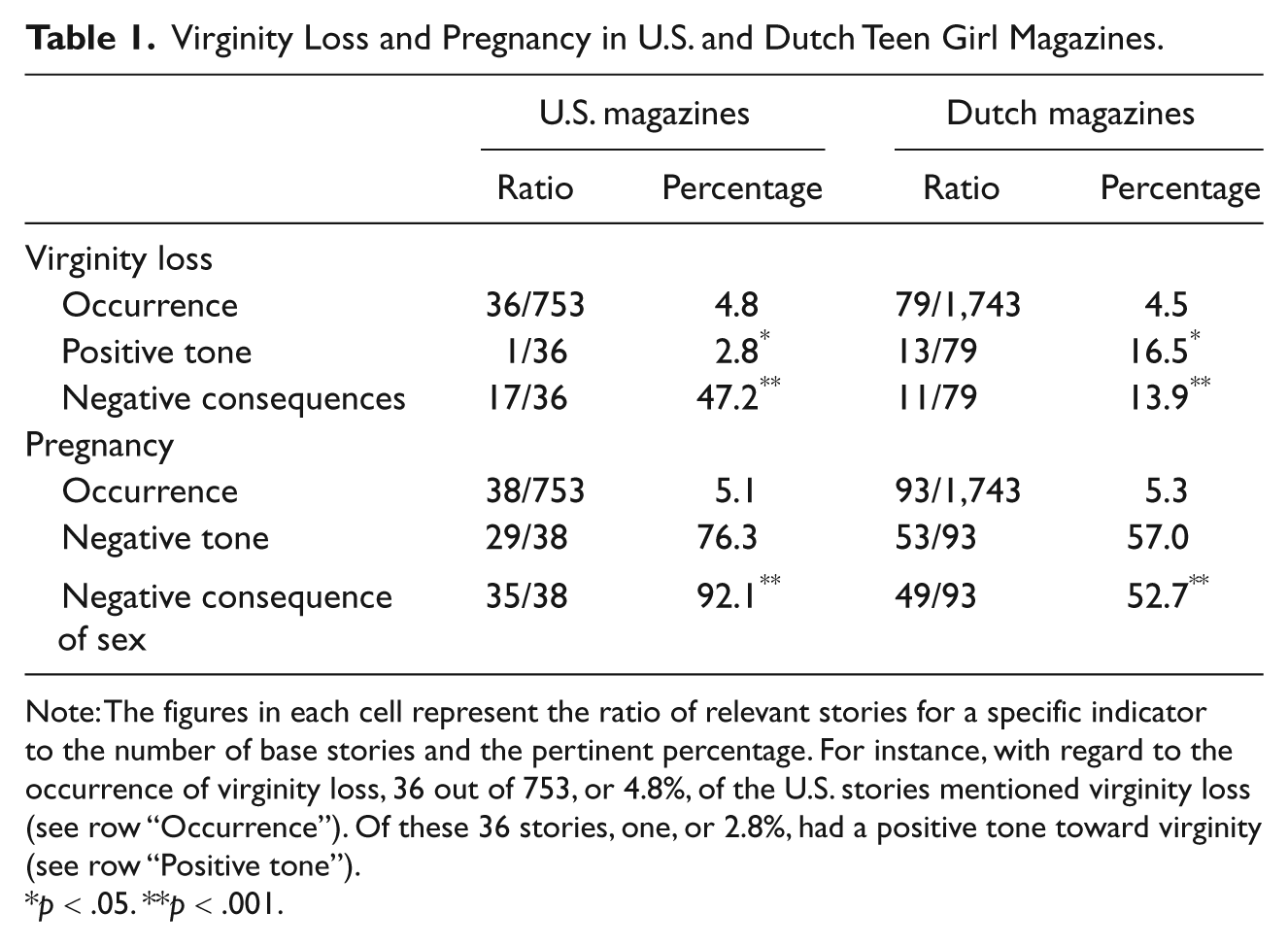
Note: The figures in each cell represent the ratio of relevant stories for a specific indicator to the number of base stories and the pertinent percentage. For instance, with regard to the occurrence of virginity loss, 36 out of 753, or 4.8%, of the U.S. stories mentioned virginity loss (see row “Occurrence”). Of these 36 stories, one, or 2.8%, had a positive tone toward virginity (see row “Positive tone”).
p < .05. **p < .001.
Hypothesis 1b: Virginity loss will be depicted with a positive tone more often in the Dutch teen girl magazines than in the U.S. teen girl magazines.
Of the stories about virginity loss, 2.8% of the U.S. and 16.5% of the Dutch stories mentioned virginity loss with a positive tone. Accordingly, 27.8% of the U.S. and 13.9% of the Dutch stories mentioned virginity loss with a negative tone. This difference was significant, χ2(2, N = 115) = 6.37, Cramer’s V = .236, p < .05. Hypothesis 1b was therefore supported.
Hypothesis 1c: Virginity loss will be associated with negative consequences more often in the U.S. teen girl magazines than in the Dutch teen girl magazines.
Of the stories about virginity loss, 47.2% of the U.S. stories and 13.9% of the Dutch stories linked virginity loss with negative consequences. A significant difference between the Dutch and U.S. stories was found, χ2(1, N = 115) = 14.89, ϕ = .360, p < .001. Thus, Hypothesis 1c was supported.
Pregnancy
Hypothesis 2a: Pregnancy will be mentioned more often in the U.S. teen girl magazines than in the Dutch teen girl magazines.
Pregnancy was mentioned in 5.1% of the U.S. stories and 5.3% of the Dutch stories, which did not differ significantly, χ2(1, N = 2,496) = 0.06, ϕ = .005, ns. Hypothesis 2a was not supported.
Hypothesis 2b: Pregnancy will be depicted with a negative tone more often in the U.S. coverage than the Dutch coverage.
Of the stories about pregnancy, 76.3% of the U.S. stories and 57.0% of the Dutch stories mentioned pregnancy with a negative tone and 2.6% of the U.S. and 8.6% of the Dutch stories mentioned pregnancy with a positive tone. Overall, the difference between the U.S. coverage and the Dutch coverage was not significant, χ2(2, N= 131) = 4.59, Cramer’s V = .187, ns. Therefore, Hypothesis 2b was not supported.
Hypothesis 2c: Pregnancy will be depicted as a negative consequence of sex more often in the U.S. teen girl magazines than in the Dutch teen girl magazines.
Of the stories about pregnancy, 92.1% of the U.S. and 52.7% of the Dutch stories treated pregnancy as a negative consequence of sex. This difference was significant, χ2(1, N = 131) = 17.75, ϕ = .369, p < .001. Hypothesis 2c was supported.
Discussion
Teen magazines typically deal with topics related to adolescent sexuality (e.g., APA, 2007; Durham, 1998; Ward, 2003), so it can be expected that they cover virginity loss and pregnancy. Against the backdrop of Hofstede’s cultural dimension of masculinity/femininity and specific country differences in sex education, accessibility to contraceptives, and parental attitudes toward adolescent sexuality, our study investigated how the coverage of virginity loss and pregnancy differed between U.S. and Dutch teen girl magazines.
Virginity Loss
The U.S. and Dutch teen magazines did not differ in how often they covered virginity loss. Generally, virginity loss was rarely mentioned in the teen magazines of both countries. This surprising finding suggests a modification of the general assumption that the normalization of adolescent sexuality (Schalet, 2000, 2010) causes an increase in the coverage of virginity loss. It may be that in countries such as the Netherlands, where adolescent sexuality is normalized, virginity loss has become such an integral part of adolescent sexual development that it is hardly worth reporting. In countries such as the United States, where adolescent sexuality is not yet fully normalized, virginity loss may be an issue that is harder to report. As a result, teen magazines from these two countries resemble each other in how often they cover virginity loss but perhaps for different reasons.
In line with our expectations, the Dutch magazines mentioned virginity loss with a positive tone more often than the U.S. magazines. The U.S. magazines rarely mentioned any positive aspects of virginity loss. This finding reflects Hofstede’s (2001) distinction between the Netherlands as a feminine society and the United States as a masculine society. Masculine societies such as the United States hold more “moralistic attitudes about sexuality” (e.g., abstinence until marriage), where “premarital sex [is] socially acceptable at a later age, or not at all” and “information on contraception is limited” (p. 175). In contrast, feminine societies such as the Netherlands have “matter-of-fact attitudes about sexuality,” where “premarital sex [is] socially acceptable at an early age” and “contraceptives and information [are] freely available” (Hofstede, 1998b, p. 175).
U.S. teen magazines attached significantly more negative consequences to virginity loss than did Dutch teen magazines. This finding is in line with previous findings about a stronger normalization of teen sex in the Netherlands than in the United States (Schalet, 2000, 2010), but it also merges with Hofstede’s (2001) masculinity/femininity dimension. In masculine societies, sex can easily be associated with exploiting your sexual partner; girls often report negative feelings about their first sexual experience, and sexual harassment is a sensitive issue (Hofstede, 1998b). In contrast, sex is largely seen as a relationship between partners in feminine societies. Moreover, “girls do not report negative feelings about first sex” and “unwanted intimacies are not such a big issue” (Hofstede, 1998b, p. 175). Thus, the material that U.S. and Dutch adolescents consume from these magazines seems to reflect the differences that Hofstede outlines between masculine and feminine societies.
Pregnancy
Contrary to our expectations, pregnancy was mentioned equally often in the teen magazine coverage of the United States and the Netherlands. This finding does not coincide with the greater number of teenage pregnancies in the United States than the Netherlands (UNICEF, 2001). Our results also contradict Hofstede’s (2001) masculinity/femininity dimension, as well as specific country differences, such as the type of sex education programs and accessibility to contraceptives, which all suggested that pregnancy would be less of an issue in the Netherlands. One explanation for this unexpected result may be that teen pregnancy generally presents a serious incident, with well-documented repercussions and adverse long-term effects (Amy & Loeber, 2007; Thompson, 1995). Moreover, magazines in the United States and Netherlands may have the same ultimate goal, which is to create magazines that people will purchase and read. If teen pregnancy is an important topic in both countries, then the coverage of teen pregnancy is likely to occur equally often in the U.S. and Dutch magazines. Thus, the similarity of the U.S. and Dutch coverage reflects not only the general seriousness of teen pregnancy but also the popularity of the topic, regardless of cultural differences.
This explanation may also apply to our second unexpected finding: U.S. and Dutch magazines both covered teen pregnancy with a negative slant. In feminine societies, such as the Netherlands, girls may have more agency in sexual relationships (Hofstede, 1998b) and teenage sex may be more normalized than in masculine societies such as the United States. These cultural differences, however, did not translate into a different evaluation of pregnancy in the coverage of teen magazines. According to the coverage of both the U.S. and Dutch magazines, teenage pregnancy is generally equated with failure. Therefore, future research should focus less on the tone of the coverage and more on the reasons for why teen pregnancy is portrayed negatively in magazine coverage, especially because consumption of this information may affect teens’ impressions of how a society deals with teen pregnancy (Gerbner, 1998). In a masculine society, with its emphasis on morals and norms, becoming pregnant as a teenager may be seen as a sign of lacking morals. Feminine societies, however, emphasize (female) sexual agency, so teenage pregnancy may point to a lack of sexual self-efficacy.
A difference did emerge between the coverage of the United States and the Netherlands in whether pregnancy was depicted as a negative consequence of sex. U.S. magazines portrayed pregnancy as a negative consequence of sex more often than the Dutch magazines. This finding resonates with the higher prevalence of moralistic attitudes in a masculine society, such as the United States, compared with a feminine society, such as the Netherlands (Hofstede, 1998b). This finding is in line with a danger discourse of adolescent sexuality in the United States, which emphasizes pregnancy as a potential negative consequence of sex (Schalet, 2000, 2011). In the Netherlands, adolescent sex is not necessarily linked to the prospect of teenage pregnancy. For example, although Dutch parents are aware of pregnancy as a potential risk of adolescent sexual activity, they do not use the risk of pregnancy as a reason for teens to abstain from sex (Schalet, 2000, 2010). The Dutch magazine coverage reflects this same stance, with about half of the Dutch stories not portraying pregnancy as a negative consequence of sex and half of the stories depicting it as a negative consequence of sex.
Limitations and Future Research
Our study is one of the first to investigate both the coverage of virginity loss and pregnancy in teen girl magazines from a cross-national perspective but has some limitations. First, we focused only on the most popular teen magazines and only investigated the years 2006 through 2008. Although existing research indicates no major changes in the coverage of teen magazines as a whole (Carpenter, 1998, 2001), our results cannot automatically be generalized to other teen magazines and time periods. Second, we cannot preclude that the country differences have resulted, at least partly, from different business models and editorial policies of the teen magazines. Future research should investigate this issue more elaborately. The U.S. and Dutch teen magazines must compete in a media market that is increasingly dominated by the Internet, which may result in similar business models and editorial policies in both countries. Therefore, we believe that cultural factors affect the coverage in teen magazines more strongly than economic considerations. Finally, some industry experts suggest that the Web is one of the biggest threats to teen magazines, whereas others say that vacillating between the print and online arenas is becoming more common for teen magazine readers (KFF, 2004). As a result, many teen magazines have created an online version of their publication to maintain readers’ interests in between issues by offering at least 50% new content online which is not found in their print version (KFF, 2004). Future research should conduct a content analysis of similarities and differences between the print version of teen magazines and their Internet counterparts.
In conclusion, similar to earlier research (Carpenter, 2001), our study has shown that the coverage of virginity loss and pregnancy in teen magazines partly reflects more general cultural differences. Whereas existing studies have only described such cross-national differences in the coverage, we have shown that they may be related to Hofstede’s (2001) cultural dimension of masculinity/femininity and, by extension, to more specific country characteristics such as sex education, access to contraceptives, and the normalization of adolescent sexuality. Generally speaking, the masculinity/femininity dimension provided a good predictor of whether virginity loss was associated with negative consequences, whether pregnancy was a negative consequence of sex, and how positively virginity loss was portrayed. These results could point to a relationship between the masculinity/femininity dimension and a risk discourse of adolescent sexuality (Schehr, 2005; Schalet, 2011). With a pragmatic attitude toward sexuality and greater female empowerment, adolescent sexuality is more pleasure-oriented and less risk-oriented in feminine societies than in masculine societies. We believe that conceptualizing adolescent sexuality in terms of a pleasure or risk discourse, and comparing it along the masculinity/femininity dimension, may be key to understanding how and why cultures differ in their acceptability of adolescent sexual activity.
Footnotes
Acknowledgements
The authors would like to thank Marleen Klaassen for her help during data collection.
Declaration of Conflicting Interests
The author(s) declared no potential conflicts of interest with respect to the research, authorship, and/or publication of this article.
Funding
The author(s) disclosed receipt of the following financial support for the research, authorship, and/or publication of this article: The second author’s work on this article was supported by a grant from the Netherlands Organisation for Scientific Research (NWO). The authors would like to thank Marleen Klaassen for her help during data collection.