







Abstract
This study explored the perceptions of resilience and coping among homeless young adults, a focus that differs from previous research by considering the unconventional resilience and coping of this high-risk population. Semistructured qualitative interviews were conducted with 45 homeless young adults. Individual interviews were audio recorded, transcribed, and analyzed by coders using an iterative process of content analysis. Findings revealed four primary themes that highlight perceptions of resiliency and coping, including individual strengths, positive life perspective, external social supports, and individual coping strategies. Implications for professionals working with this population suggest that developing and strengthening programs tailored to utilize homeless young adults’ resiliency may be beneficial. Recognizing the strengths and resilience that homeless young adults are capable of, and incorporating a strength-based perspective to empower these young adults, may encourage positive choices and increase the likelihood of transitioning out of homelessness.
Homeless young people face multiple structural and social barriers, including a lack of adequate housing, substandard and/or nonexistent health care, and victimization. Living on the streets is often fraught with danger, extremely impoverished conditions, and constant threats to meeting daily needs (Whitbeck & Hoyt, 1999). Homeless young adults often report initially leaving home due to family conflict or abuse in their homes of origin (Whitbeck, 2009). Their trajectory into homelessness results in experiencing high levels of stress that predisposes them to disproportionate rates of depression, anxiety, substance abuse, risky sexual behaviors, and other mental health and behavior challenges (Cauce et al., 2000; Thompson, Bender, Windsor, Cooke, & Williams, 2010).
These young adults are exposed to a wide variety of traumatizing events and many forms of exploitation while on the streets. In comparison to their housed peers, they experience high rates of sexual assault, robbery, physical violence, and assault with a weapon (Whitbeck, 2009), resulting in decreased life expectancy (Gaetz, 2004; Whitbeck & Hoyt, 1999). The longer they remain on the street, the more likely they are to experience trauma and the resulting damaging effects.
Furthermore, law enforcement officials, service providers, family members, and society more generally often negatively label and stigmatize homeless young adults. They are typically characterized in terms of deficiencies, which limits recognition of their internal resiliency and capacities to cope (McCollum & Trepper, 2001). However, the “raw struggle for existence” among homeless young adults who live in dangerous, stressful, and traumatizing environments requires extraordinary resilience (Rowe, 1999). While acknowledging these difficulties, innate capabilities associated with resiliency may enable them to overcome the adverse effects of hardship (Laursen & Birmingham, 2003).
Resiliency has been defined as “the process of, capacity for, or outcome of successful adaptation despite challenging or threatening circumstances” (Masten, Best, & Garmezy, 1990, p. 426). Resilience focuses on the ability of individuals to recover from stressful, even traumatizing, situations (Luthar, Cicchetti, & Becker, 2000). Various risk and protective factors have been associated with resiliency, including social support, social connectedness, religious beliefs, internal locus of control, and positive emotionality (Thompson, Arnkoff, & Glass, 2011). Resiliency and “street smarts” are developed as homeless young people learn where to find resources, establish who they can trust, and adapt to the social structures and culture of the street economy (Lankenau, Clatts, Welle, Goldsamt, & Gwadz, 2005). These skills, gained through observation and experience, may not be “prosocial” behaviors in a traditional sense; however, they enable homeless youth to develop competencies unique to their environment that assist them in enduring their daily existence.
The term “hidden resilience” has been used to suggest that unconventional, even antisocial, behaviors may be used to endure in the midst of adversity (Ungar, 2004). Nontraditional coping behaviors may not be recognized as resilience in traditional settings where it is “hidden” by outward signs of deviance and antisocial behaviors. For example, homeless young people may protect themselves from harm using adaptive strategies, such as carrying weapons and networking with streetwise, criminally involved peers who can protect them (Greenblatt & Robertson, 1993). These behaviors suggest a resilience that is initiated and developed in response to the environment of the street economy, but which would be inappropriate in more traditional societal settings.
Previous research suggests specific skills and capacities upon which these youth rely to resolve challenges and difficulties. Effective coping strategies may decrease the negative effects of trauma and distressing situations (Unger et al., 1998) as young people rely on available resources. For example, having respect for oneself, developing a positive attitude, and building self-efficacy are major sources of resiliency that may increase homeless youths’ ability to cope with street culture and assist them to successfully transition off the streets (Lindsey, Kurtz, Jarvis, Williams, & Nackerud, 2000). Many form surrogate families with other street youth—connections that offer an increased sense of security and belonging. In addition, animal companions also increase these young people’s resiliency by providing safety, unconditional love, and motivation to survive (Rew & Horner, 2003).
Reliance on informal coping strategies, including seeking support from similarly situated peers (Bender, Thompson, McManus, Lantry, & Flynn, 2007) may create feelings of resiliency. The challenges and hardships, often described as inevitable for youth living on the streets, are counteracted by having a community of peers for various types of support. While peer networks may engage in illegal and antisocial behaviors, social connectedness and peer networking allows for shared knowledge of resources key to positive adaptation and resiliency (Rew, Taylor-Seehafer, & Fitzgerald, 2001).
Service providers who recognize young people as resilient often serve youth from a strengths-based perspective (Saleebey, 1992) and emphasize methods to increase coping strategies that empower them to make changes. This increases cooperation from young adult clients (Selekman, 2005) and may more effectively assist them in maximizing resources and developing coping strategies to accomplish desired outcomes.
Most research on homeless young adults highlights the multiplicity and magnitude of their problems (e.g., Cauce et al., 2000; Thompson et al., 2010; Whitbeck & Hoyt, 1999). Homeless young adults are exposed to a wide variety of traumatizing events and many forms of exploitation while on the streets (Thompson, Maccio, Desselle, Zittel-Palamara, 2007). In comparison to their housed peers, they experience high rates of sexual assault, robbery, physical violence, and assault with a weapon (Whitbeck, 2009), resulting in decreased life expectancy (Gaetz, 2004). Only a limited number of studies have investigated resiliency and coping strategies that enable homeless young people to survive life on the streets (e.g., Bender et al., 2007; Rew & Horner, 2003). Building upon the scant information currently available, this study provides a more in-depth investigation of the perceptions of a relatively large sample of homeless young adults concerning their strengths, positive life perspectives, external supports, and coping strategies. Recognizing the resiliency of homeless street youth may improve service providers’ capacity to draw upon the inherent strengths of these young people and may assist homeless young adults in sustaining positive change and possibly transitioning out of homelessness.
Method
Sample and Recruitment
Homeless young adults receiving services from a community drop-in center located in Central Texas were recruited for participation in the study. The drop-in center, typical of others across the country, provides outreach and support services to homeless and runaway youth up to age 24. The center offers
A purposive sampling strategy was employed that recruited participants whose characteristics were representative of others in the homeless young adult population who used drop-in center services (Thompson et al., 2010). To be included in the study, participants had to be 18 to24 years of age, spent at least 2 weeks away from home in the month prior to the interview, and had provided written informed consent. As a standard practice by the drop-in center, youth who entered the facility were subjectively evaluated for intoxication or being under the influence of drugs. Those who entered the drop-in center in this condition were asked to leave until they were sober or no longer “high.” Case managers made this determination prior to individual recruitment. Forty-five youth participated in this qualitative, exploratory study between February 2010 and April 2011.
Once the individual’s eligibility was determined, case managers introduced willing participants to a research assistant who explained the study and consent forms in a private office space. All procedures were approved by the principal investigator’s university institutional review board and complied with mandatory-reporting statutes. Homeless young adults received a US$5 gift card to a local food store for participation in the qualitative interview, which was audio recorded and transcribed with the young person’s permission.
Data Collection
Semistructured interviews were conducted by doctoral-level research assistants using qualitative research methods. All research assistants had at least 2 years of clinical experience working with youth who were homeless or been victims of physical, sexual, and/or emotional trauma; they also received extensive training in qualitative interviewing methods with homeless youth.
Basic demographic information was collected before qualitative questions were asked. A semistructured interview guide included a list of questions that provided a structure for interviewers who were given the freedom to add prompts and explore issues that were identified as important to the individual young person. The complete interview not only examined resiliency, coping, and safety strategies adopted by homeless youth, but also addressed multiple specific topics, such as trauma, substance use, transience, and service use. For this study, the open-ended questions that sought youths’ perspectives on resiliency and coping strategies are analyzed.
Data Analysis
Audio recordings of qualitative interviews were transcribed and transcripts were analyzed using iterative content analytic procedures (Miles & Huberman, 1984). Two coders examined the 45 transcripts to identify major themes. These coders then utilized a high-inference coding process (axial coding) that included reading through each report multiple times to develop a list of major themes centered on issues of resiliency and coping. Four major themes emerged from these data: (a) individual strengths, (b) positive life perspective, (c) external social supports, and (d) individual coping strategies. Specific categories were also developed to further define each of these themes. The two coders then examined each transcript and identified all distinct statements (i.e., any word, phrase, sentence, or response that pertained to a single concept stated by an individual). Three transcribed interviews were then coded by assigning each statement one specific code. Coders compared their agreement on each coded statement to determine how similar they were coding statements (percentage interrater agreement = 0.75). Differences in coding were then resolved through discussion and consensus. Three additional transcripts were coded and agreement between the coders compared again. To determine interrater reliability, Cohen’s κ was calculated using the Cohen and Fleiss’s κ program (see http://www.stattools.net/CohenKappa_Pgm.php) on the two coder’s coding of the three transcripts (Czaja & Blair, 2005). Results were satisfactory (Cohen’s κ Unweighted = 0.85; 95% CI = 0.69, 1.01) as established guidelines suggest interrater reliability above 70% is adequate (Boyatzis, 1998). Given this level of agreement, each coder independently coded the remaining transcripts.
QSR Nudist.6 software was used to organize the coded statements into separate nodes for each theme with its associated categories. Printed reports of each major theme and categories were reviewed to identify specific statements that represented “typical” responses by the young adults. Interpretations of the categorized statements were then summarized and reviewed by multiple team members for their adequate representation of responses. The frequency of responses to the various themes provides an indication of how commonly each topic was discussed by respondents (see Table 1).
Description and Frequency of Reported Themes and Categories From Transcribed Interviews.
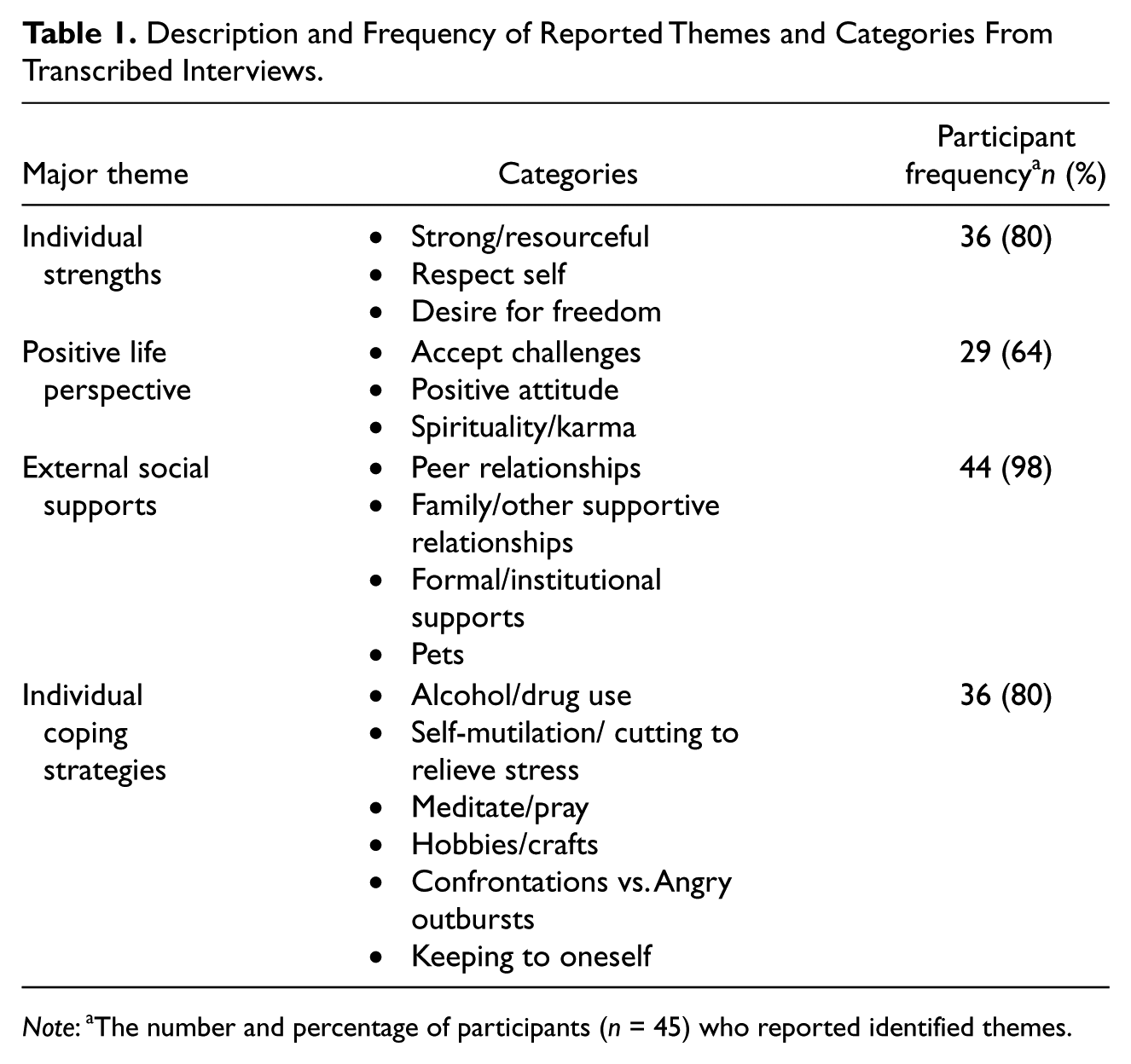
Note: aThe number and percentage of participants (n = 45) who reported identified themes.
Results
Sample Demographics
Homeless young adults (n = 45) averaged 21 years of age (SD = 1.7), included more males (66.7%) than females (33.3%) and were primarily White (80%), Latino (6.7%), Black (2.2%), or other/mixed ethnicity (11.1%). More than one third (35.6%) had dropped out or had been suspended from school; the remainder had graduated (33%), had a GED (17.8%), or were currently enrolled in high school or college (8.9%). Approximately 33% had been in foster care at least once during their lifetime. Most young people identified themselves as homeless or “traveling” and were living on the street or in temporary shelter (73.3%); others reported staying with family or friends (24.4%). These young people had been homeless on an average of 41.3 months (SD = 30.1 months) or approximately 3.5 years.
Homeless youth identified four major themes related to resiliency and coping: (a) individual strengths, (b) positive life perspective, (c) external social supports, and (d) individual coping strategies. Each theme is discussed and illustrated with youths’ more salient comments.
Individual Strengths
Eighty percent (n = 36) of homeless young adults mentioned that individual strengths contributed to their resilience while living on the streets. Although they frequently encountered adversity and high levels of victimization, being resourceful, wanting to continue living independently on the streets, and travel appear to be core measures of resiliency.
Homeless young adults described their ability to find resources when needed, standing up for themselves, and believing in their ability to survive on the streets and care for themselves. These young people generally believed that if they were determined, they could survive anything. For example, one participant stated, “I’ve been on the streets for three and half years now and the whole time I’ve been out here, you know, it’s always been determination that’s gotten me through the biggest, hardest part of being on the street.” Of those participants who were parents, children were cited as a motivator to make good choices. As one young person stated, “my main priority and my main strengths is doing what is right for my child—not for me, but for my child.”
Participants also described respecting themselves because of their capacity to survive. Believing that one could “take care of myself no matter what. . . situation arrives in my life” gave them confidence that they could overcome any adversity. One young person suggested that “you’ve got to believe in yourself, because if you don’t believe in yourself, you’re going to fail on the streets.” The need to respect and believe in themselves was important, as it was unlikely that others would be supportive of their choices. Their internal belief in their abilities and having “a strong mind, being able to deal with the world” were noted as indications of their high level of resiliency. One participant stated: I’m a very outspoken, very blunt person. I’ve been walked over most of my childhood, and I don’t deal with it anymore. If someone gets in my face for even the smallest thing, I’m usually back up in theirs. I’m a lot stronger than most people.
Participants frequently mentioned that a desire for freedom motivated them to overcome the hardships they encountered. They described their desire to experience new places and people without having responsibilities that would inhibit their mobility. One participant stated, “I couldn’t see myself doing anything else right now, you know. I’ve tried. I went crazy. I couldn’t handle it. I had to get back out on the road.” The desire for freedom and autonomy created a strong motivation to survive street life and was viewed as increasing their resiliency.
Positive Life Perspective
A majority of homeless young adults (64%, n = 29) described their positive perspective on life as a general source of resilience. The positivity and optimism voiced by these young people focused on accepting challenges, being content with their situation, and enjoying “an action-packed and happy life.” Accepting the consequences of being homeless helped them develop positive thoughts and energy, which created feelings of contentment and life satisfaction. One youth stated, “Once upon a time I used to be bothered by all that stuff, but nowadays I just try not to pay attention to the stuff. I’m just trying to do the best as possible. I need to be able to be happy with what I’m doing in life.”
These young people found comfort in identifying the positive aspects of their lives and were happy about the freedom and autonomy the homeless lifestyle afforded them. Being positive about their lives was viewed as extremely necessary for survival. For example, “I try to stay positive and not let negative things hurt me or bring me down,” or “I usually either ignore most things or I laugh about it.” They remained remarkably optimistic that their situations would improve while highlighting the benefits of homelessness instead of dwelling on its challenges. As one young person stated, “I don’t have to have a phone to be happy, I don’t have to have a bed to sleep in to be happy. . .I think that attitude will get me, gets me, out of a lot of trouble and a lot of situations.”
Several young people mentioned that a higher power or belief in God was as a source of hope, comfort, and strength. As one individual noted, “ I know riding trains is dangerous. I know that someone could fall off and someone could get hurt. But I also know that it doesn’t matter what happens, I’m going to be alive and the universe will continue to provide for me. I could break an arm, but I know that I’ll live.
External Social Supports
Nearly all (98%, n = 44) young adults interviewed mentioned various sources of support upon which they depended, including individuals in which they confided and sought guidance and support. Although they lived predominately on the streets, many continued to communicate with family members, typically siblings. In addition, they desired guidance from someone who was “wise” or “older and has been around;” often these were other homeless peers who had extensive experience on the streets. Formal supports, such as counselors, social workers, police, and health-care providers, were described as useful, but typically sought in crisis circumstances.
Peer relationships were also described as extremely important to homeless young people, as was reflected in the preponderance of description of peers in relation to their perceptions of resiliency. When youth spoke about peers, it was often as if they are talking about family members. Friends/peers were described as primary sources of emotional support and protection. As one individual suggested, the “greatest strength that helps me cope with street life is my friends.” They listened to each other without judgment, experienced similar situations, provided a sense of physical safety, and met recreational needs through playing music together or just talking. For example, “A lot of the kids out here are really close to each other. It’s like all we’ve got.” More experienced youths offered advice to those new to the street; among young women, trusted friends provided safety and protection.
Family and housed friends/peers were discussed in terms of people on whom they might call for emotional support. For example, one young person said, “I mean, if I ever did need counseling, I’ll probably just call my mom. You know, she’s a very wise woman.” Another said, “If I could call anyone it would be my dad. I wouldn’t call anyone else.” Others suggested they regretted leaving home: “Sometimes I will usually break down into tears, and I just regret leaving my home ‘cause at least I had my parents there [to] help and support me.” Siblings also provided support, especially those who had similar family experiences family. For example, “my sister talks to me. . . because she is the only one who actually cares about me. Her and my mom.”
Homeless young adults described empathic individuals who were “just understanding” or “someone who’s been through the same thing, because they know where you’re coming from” as providing supportive relationships. One youth described the type of individual he might talk to: “I don’t usually talk about my problems. But if I were to look for somebody, it would probably be someone like a woman, like motherly, you know, who can comfort me.” Another noted: “I like talking to older people because they’ve been around. They’ve done this already, they know what’s going to happen and they could just be like a voice of reason when you don’t have anyone.”
Formal or professional supports were described as emerging from a variety of sources, but shelters and drop-in centers were the most commonly utilized formal services. Drop-in centers and temporary shelters acted as a gateway for referral to other services, such as medical care, sexually transmitted infection testing, mental health, or substance abuse services. One young person gave an example of seeking substance use treatment through the drop-in center: I couldn’t stop drinking. I was like not trying to kill myself, but in a way it’s like I am killing myself without intention. So the social worker said, “It looks like you have a problem with drinking and I can help you with that.”
Case management, counseling services, and support groups were viewed positively as they helped young people feel empowered to remain independent. One young person suggested that “in group you learn how to talk about things to get it off your chest and out of our mind so that you can deal with it.”
Homeless young people had varying views on law enforcement, though most were negative. They described “getting the crap beaten out of me by the cops,” “thrown in jail for no reason,” and having to avoid confrontations. Some suggested that carrying weapons, including knives and guns, were necessary to stay safe, but were also “just the easiest way to get arrested.” Experiences with the police were described as a common occurrence that often resulted in being arrested for drug possession or distribution. However, the support police offered, especially concerning safety, was recognized. For example, “if you feel like you are about to be beaten, all you have to do is stop and dial 911 and the cops will be there” and “if my friends can’t handle it, then I call the cops usually.” Even when police were viewed as negative and invading the privacy of the young person, their assistance was valued in crisis situations.
Another important external social support that homeless young people identified was owning a pet. Their pets, typically large dogs, were identified as companions, protectors, sources of comfort, and a reliable source of stability in the lives of homeless young people. As stated by one participant, “dogs are really important on the street. They’re pretty much our best friends or whatever. They’re companions. They take care of you.” Animals were relied upon for protection, no matter the circumstances, for example: I just feel more comfortable when I am with them. Um, they just bring more peace to my life. I have been with them throughout the whole winter, sleeping with them. They gave my body warmth and I just got that close with them; so yeah, they keep me pretty happy
Another suggested, I talk to my dog a lot and it’s just to get it out. You know, you don’t really need someone to respond cause she looks at you, my dog looks you in the eyes when you talk to her. I spend a whole lot of time talking to her about it (traumatic event) because then I also don’t get no feedback, only I just get to vent, which is better.
Individual Coping Strategies
When asked about coping with life on the streets, 80% (n = 36) offered a variety of individual coping strategies, such as being able to ignore their problems or “laugh it off,” prayer/meditation, reading, writing, playing or creating music, escaping difficult situations, or simply “venting to another human that you know is listening.” As one young person noted, Venting, like screaming helps sometimes. . .I would rip a stuffed animal to shreds and I’d feel better and I didn’t hurt no more, and it’s just a way of releasing the anger, the pressure.
Another noted that being “easygoing” and not letting problems or challenges “bother me” was also helpful, as was having a sense of humor. Others noted that they moved locations frequently to escape conflicts with other homeless peers or significant others, while others dealt with conflict by “projecting strength. . .Like I just expect it. . .if I treat people well then they’ll treat me the same in most cases, like I don’t go looking for trouble.”
Homeless young adults also described various coping strategies that would be considered negative behaviors in conventional settings, but were identified as means of coping with their highly stressful living conditions. For example, they used mind-altering substances for recreational purposes, but also as a means of coping with the difficult aspects of living on the street, such as experiencing trauma, being arrested, or losing a pet. Substances were used to relieve stress, to “put me in a calm state,” to numb emotions, to relieve pain, and to decrease anxiety. Homeless young adults were very vocal about the positive benefits of alcohol and drugs as a means of being more resilient to meet challenges. For example, “I mean, it doesn’t like solve anything, but yeah, like you know, it gets your f. . .ing mind off of it.”
It’s like I can sit here and mope all day and hate myself and hate everything around and know I don’t have anyone left or I can chug this bottle of booze and shoot up this f. . .ing dope and feel a little bit better about life. For most people, that’s all they have left anymore.
Self-mutilation through cutting, burning, piercing, and tattoos was also described as methods used to relieve stress and shift negative emotions to a focus on physical pain. As one young person stated: It’s a release of an emotional pain to physical one. Emotional pain always hurts worse, but if you can hurt yourself physically, it’s a transfer.
Understanding this negative coping strategy was well articulated by one young person: Instead of thinking about the pain of not having my mom with me, my mom. . .oh my God, you have a cut on your arm; you need to pay attention to that. Don’t worry about your mom, think about that later. You have a cut, take care of that, think about that.
Discussion
Navigating the transition from adolescence into adulthood is challenging, and it is often complicated by a variety of developmental, psychological, and sociological changes (Park, Kim, Kim, & Sung, 2007). This challenge is exacerbated for homeless young adults by the absence of basic resources, sexual and physical victimization, psychological challenges, and unstable living conditions. In attempting to understand and meet the needs of this population, services typically operate from a deficit or problem-focused perspective and research examining the resilience of homeless young adults is scarce (Cleverley & Kidd, 2011). An effort to contribute to building knowledge of resiliency among this vulnerable group of young adults was the aim of this study.
The majority of young people in the sample credited their own personal strengths when discussing overcoming adversity. Specific themes and categories emerged regarding their capacity for resiliency despite their traumatic experiences and adversity. Their basic belief is in their ability to persevere, remain autonomous, and be self-sufficient. Thus, individual strengths may be important qualities to develop in efforts to foster increased resilience and decrease problem behaviors among these young people.
A positive outlook on life also appears to help overcome traumatic events of street living. Narratives of homeless young adults coalesced around their ability to accept adversity and challenges, their general positive attitude, and belief in things “happening for a reason” in association with a higher power or spiritual outlook. Previous research appears to support these findings as one study found homeless youth with greater levels of resilience displayed fewer risky behaviors (Rew & Horner, 2003); another study indicates homeless youth who believe in a better future are less likely to have suicidal thoughts or attempts (Kidd & Carroll, 2007). The positive outlook of homeless young adults appears to help them survive the streets and may relate to healthier behavior and mental health.
Almost all the homeless young people in this study described how they utilized external sources of support to help them survive and cope with life on the streets. These young adults acclimated to street culture through finding, navigating, and securing external resources. Because many sources, particularly family (Whitbeck & Hoyt, 1999) contributed to their decision to leave home, ascertaining safe external supports was necessary. The young adults in this study confirmed previous research findings indicating that homeless peers provide an important learning environment for staying safe and surviving the streets. Homeless peers can provide positive emotional support that decreases emotional distress and improves coping skills. Peer support also may reduce stress and depressive symptoms, even help peers stop using drugs (Kidd & Davidson, 2006), transition off of the streets, and make positive changes in their own lives (Bender et al., 2007). However, homeless young adults often seek drug-using friends and embed themselves in social networks that reinforce
Individual coping strategies were varied in terms of dealing with adverse situations. The strategies described by participating homeless young adults were not necessarily prosocial methods; they described using substances and self-injurious behaviors as a means of coping with challenges of daily life. Similar to other studies (e.g., Slesnick, Bartle-Haring, Glebova, & Glade, 2006; Thompson, Barczyk, Gomez, Dreyer, & Popham, 2010), homeless young adults cited drug and alcohol use as a means of numbing their emotions or escaping problems experienced on the streets. Unlike prosocial resilient traits, abusing substances may result in negative outcomes. Evidence suggests that homeless youth who use substances are more likely to have poorer mental health status (Van Leeuwen et al., 2004). Thus, using substances may be viewed by these young adults as a means of coping, but their use actually leads to additional challenges.
The need to focus on services that shift the use of poor coping skills (substance use, self-injurious behavior) to positive skills (positive outlook) is indicated. Providers understanding and developing interventions that incorporate existing healthy coping strategies are critical to their effectiveness and usefulness to these young adults (Kidd & Davidson, 2006). In addition, understanding young people’s ability to experience extreme despair while hoping for a better future is a crucial vantage point from which interventions must be built (McCay et al., 2010). Despite the high rates of mental health problems that have been reported among homeless young people, treatment efforts have largely focused on problems and pathology rather than strengthening coping skills and resiliency. Thus, providers delivering services to this population may be more successful if they incorporate the narrative themes identified in this study, especially those that coalesced around individual strengths. As homeless young adults rely extensively on their relationships with peers for support not found in traditional home environments, fostering trust is a critical step in developing positive relationships with these young people (Karabanow & Clement, 2004; Kidd, 2003).
Limitations
When considering the implications of the findings of this study, certain limitations should be noted. Young people participating in this study were recruited from one social service setting in one city, reducing the transferability of our findings to those disconnected from services—a group perhaps far different concerning their perceptions of resiliency. However, this sample of youth were similar in demographics to other studies of this population (e.g., Bender et al., 2007; Kidd, 2003; Tyler, Hoyt, Whitbeck, Cauce, 2001); specifically, the majority were male, Caucasian, and had been living on the street for several years. As with any self-report data, young adults may also have been hesitant to disclose the true extent of their challenges, hardships, or trauma experiences which might result in much higher levels of resiliency than would have been perceived by others. Trained interviewers attempted to overcome social-desirability bias by ensuring privacy and confidentiality during interviews and were encouraged to describe their own opinions without judgment. Finally, the small number of transcriptions that were included to determine interrater reliability may not be representative of all coded transcriptions and thus results must be interpreted with caution.
Conclusion
Services to homeless youth would likely be most effective if providers built upon the resilience and strength of these young people, while incorporating positive peer support, therapeutic rapport, and the development of healthy coping strategies. Initiating encounters early in the young person’s homeless trajectory, before he/she has been on the streets for a long period of time and experienced high levels of psychological distress also seem necessary (Cleverley & Kidd, 2011). Although the transition of homeless young adults off the streets requires substantial change in their identity, relationships, and the ways in which they view the world (Kidd & Davidson, 2006), without intervention, the long-term consequences for these youth are bleak. As they move into adulthood with limited education, poor employment options, and involvement in the criminal justice system, (Zlotnick & Robertson, 1999), effective interventions must build on the positive aspects of their resilience and coping.
Footnotes
Declaration of Conflicting Interests
The author(s) declared no potential conflicts of interest with respect to the research, authorship, and/or publication of this article.
Funding
The author(s) received no financial support for the research, authorship, and/or publication of this article.