






Abstract
The present study investigated differences between students sent to out-of-school facilities (N = 148), also called rebound facilities, and non-referred students (N = 411), in junior vocational high schools. Self-reports on externalizing and antisocial behaviors were used to compare the two samples. Referred students scored significantly higher on externalizing and antisocial behaviors than non-referred students. After controlling for age, gender, and socio-economic status (SES), an interaction effect between ethnicity and referral status was found, in which differences between referred and non-referred students on externalizing behavior were larger for national students than for immigrant students. No interaction effects were found for antisocial behaviors. In short, immigrant youths were more likely to be referred while reporting less externalizing behavior than their national peers. Practical implications in terms of possible intervention models are discussed.
In schools, behavioral problems of students threaten classmates’ well-being and affect school safety. Most schools choose to implement disciplinary systems to preserve school safety and in this way hope to maintain an educational climate conducive to students’ development and learning. Since the introduction of the zero tolerance policy in the early 90s in the United States, school disciplinary actions mandated more punitive and repressive actions. Hirschfield (2008) suggests that there is an increasing similarity between such policies and policies typical of the way incarcerated juveniles are treated. The zero tolerance policy is not conducive to the positive adaptation of all youths concerned (Skiba & Rausch, 2006). While introduced to contribute to a positive and safe school climate, parts of the implementation of this policy have proven to have negative effects on school climate. Higher rates of out-of-school suspensions and expulsions were reported and these are related to a less positive school climate, lower levels of student achievement, and increased prospects of future student misbehavior and school drop-out (Clonan, McDougal, Clark, & Davison, 2007; Skiba & Rausch, 2006).
Secondary schools in the Netherlands also use exclusionary disciplinary measures, paralleling increasing school violence over the past few years. The murder of a secondary school deputy in 2004 fueled the public debate regarding school safety and order. In response to this, the Dutch Ministry of Education introduced the so-called rebound facilities. Before returning the students to their mainstream schools, rebound facilities are supposed to achieve behavioral changes and increase students’ school engagement (School Inspectorate, 2007; Van der Hoeven, 2004).
Rebound facilities are educational centers for secondary school students who are not diagnosed with a psychiatric disorder, but do show maladaptive behavior in such a manner that school safety is at stake. Currently, in the Netherlands, 4,500 students can avail of rebound facilities, and available accommodations increase at an average of about 8% per year (Van der Steenhoven, Messing, & Van Veen, 2012). Seventy-five percent of referred students return to their mainstream school, 13% are referred to special needs classes, and the other 10% are placed in other mainstream schools or apprenticeship programs.
Thirty years of research on office referrals, suspensions, and expulsions in the United States has shown that particular students received a disproportionate share of disciplinary interventions (e.g., Bryan, Day-Vines, Griffin, & Moore-Thomas, 2012; Skiba, Michael, Nardo, & Peterson, 2002).The overrepresentation of male minority students in exclusionary discipline practices has been a consistent finding (e.g., Gregory, Skiba, & Noguera, 2010; Raffaele Mendez & Knoff, 2003; Skiba et al., 2011; Thomas, Bierman, Thompson, Powers, & The Conduct Problems Prevention Research Group, 2008). Studies on disproportionality in school discipline practices have not been conducted in the Netherlands so far.
Disproportionate Discipline and Exclusionary Practices
Disproportionality in disciplinary measures occurs when particular groups of students, relative to their proportion in the population, experience overrepresentation or underrepresentation in disciplinary referrals (Children’s Defense Fund, 1975; Skiba & Peterson, 1999). Most studies on disproportionality issues have computed a composition index by comparing the number of persons affected by a particular measure (e.g., expulsions) to the total number of similar persons not affected by the measure. The label “similar” refers to similarity in a particular category, for example, age, ethnic background, or gender (Hosp & Reschley, 2003). Studies on disproportionality in school discipline practices have shown a race and gender bias (e.g., Bryan et al., 2012; Skiba et al., 2002). In the United States, research since the 1970s has documented that African American students (Raffaele Mendez & Knoff, 2003; Skiba et al., 2002), and more recently, Hispanic and American Indian students (Wallace, Goodkind, Wallace, & Bachman, 2008), experience more than twice as many disciplinary measures as Caucasian students. In a recent study with about 5,000 English course teachers, Bryan et al. (2012) found that students’ race or ethnic background significantly contributed to the prediction of referrals to school counselors for disruptive behavior. Moreover, for both English and Math courses, teachers were likely to refer more boys than girls, these teachers were influenced by previous disciplinary infractions and the accompanying expectations of future infractions. Students’ socio-economic status (SES) is also an important predictor for referrals, but may be contaminated with students’ ethnic background (Skiba et al., 2002). Yet, recent studies (Bryan et al., 2012; Skiba et al., 2011; Wallace et al., 2008) clarify that even after controlling for SES, race and gender remain significant predictors of referrals.
Teachers most often mention physical aggression among students as a reason for suspension. However, the majority of infractions appears to be nonviolent and includes attendance issues (Richard et al., 2003), disobedience (Raffaele Mendez & Knoff, 2003), or classroom disruptions (Raffaele Mendez & Knoff, 2003; Skiba & Rausch, 2006). An observational study of teacher–student interactions in school found school suspensions not to be the outcome of serious disruptions but of communication styles and negative interpretations of communication contents and accompanying behaviors, such as asking attention in an argumentative manner (c.f., Vavrus & Cole, 2002). Townsend (2000) found that particularly teachers of European American origin may interpret the more energetic and expressive communication style that characterizes many African American students, as offensive or combative. Furthermore, acceptance of stereotypes regarding particular minority groups may amplify reactions to relatively minor authority infractions (Townsend, 2000) or lead to student referrals to alternative, semidetached school programs (Casella, 2003b).
Immigrant Youths in the Netherlands
Although in the Netherlands, immigrant youths’ well-being on average is at least as good as that of their non-immigrant counterparts (Van Geel & Vedder, 2010), they also describe experiences of discrimination (Berry, Phinney, Sam, & Vedder, 2006), and experience poorer socio-economic conditions than national youth (Herweijer, 2009). At a political level, there is moderate support for multiculturalism in the Netherlands (Banting & Kymlicka, 2004), but many Dutch nationals voice concerns about the multicultural society (Arends-Tóth & Van de Vijver, 2003), hold negative opinions, especially concerning the Muslim immigrants (Gonzalez, Verkuyten, Weesie, & Poppe, 2008; Pew Research Center, 2005), and prefer not to live in neighborhoods with high concentrations of immigrants (Gijsberts & Dagevos, 2005). It is difficult to judge whether these negative opinions concerning immigrants in general will affect referral rates, but in a previous study in the Netherlands, it was found that Moroccan (mostly Muslim) youths who were incarcerated tended to be incarcerated for relatively lighter felonies than their native Dutch incarcerated peers (Veen, Stevens, Doreleijers, Van der Ende, & Vollebergh, 2010).
The Current Study
By receiving students who are perceived as problematic in school, rebound facilities aim to contribute in helping restore or maintain a positive school climate for the non-referred students and teachers of the referring school. The majority of students referred to rebound facilities are immigrant youths from junior vocational high schools (about 70%), the type of schools in the Netherlands visited by most immigrant adolescents (Statistics Netherlands, 2012). The three largest groups are youths with Moroccan-Dutch, Turkish-Dutch, and Caribbean-Dutch backgrounds. In adolescence, youths from these groups report more externalizing problems than national youths (e.g., Van Oort et al., 2007).
This study investigates differences between students referred and students who are not referred to rebound facilities to find out whether or not referrals are based on relevant characteristics. Students referred to rebound facilities are expected to score higher on externalizing and antisocial behaviors than non-referred students. Aforementioned studies show exclusionary practices to be influenced by processes affecting the objectivity and consistency of discipline referrals (e.g., Irvin, Tobin, Sprague, Sugai, & Vincent, 2004), resulting in an increased chance for male minorities to be referred (e.g., Gregory et al., 2010; Raffaele Mendez & Knoff, 2003; Skiba et al., 2011). Instead of disproportionality index calculations, the present study focuses on differences in reported problem behaviors between referred and non-referred immigrant and national youths. Based on previous studies on disproportionality in exclusionary practices in the United States (Bryan et al., 2012; Skiba et al., 2002; Thomas et al., 2008) and on the overrepresentation of immigrant youths in pre-trial detention in the Netherlands (Veen et al., 2010), we hypothesized in the present study that:
Method
Participants
Rebound students
Initially, there were 170 high school students from three rebound facilities in The Hague. We excluded students attending higher levels of secondary education due to their small number. This resulted in 148 junior vocational high school students as participants in the present study with ages ranging from 12 to 16 years (Mage = 14.35, SD = 1.14). The sample consisted of 104 boys (70.3%) and 44 girls (29.7%), and included 41 European-Dutch students (27.5%), 34 Turkish-Dutch (22.9%), 28 Moroccan-Dutch (18.8%), 18 Caribbean-Dutch (12.7%), and 28 immigrant adolescents with other backgrounds (18.1%) like Iraqi and Polish. Of these immigrant students, 32 (29.9%) were first-generation immigrants and 75 (70.1%) second-generation immigrants.
Non-referred students
This group included 411 students from four junior vocational high schools. The sample consisted of 201 (48.8%) male and 204 (49.5%) female adolescents aged 12 to 16 years (M = 13.57, SD = .99). Six students did not answer the question regarding gender. Most students were European-Dutch (160, 38.8%), 49 were Turkish-Dutch (11.9%), 59 Moroccan-Dutch (14.3%), 62 Caribbean-Dutch (15.1%), and 81 adolescents had another background (19.7%). Most immigrant students (195, 77.7%) were second generation. The others were first generation.
Measures
A survey consisting of several scales was administered to the students. The survey began with general questions about demographics such as age, gender, educational level of respondent and parents, and birthplace of respondent and both parents to decide on a respondent’s status as a first- or second-generation immigrant.
SES was measured with the Family Affluence Scale (FAS; Currie, Elton, Todd, & Platt, 1997). A sample item of this scale is, “How many computers does your family own?” The scale contains four items. As each item has different response categories, Cronbach’s alpha could not be computed. The FAS has been found to have good criterion validity (Boyce, Torsheim, Currie, & Zambon, 2006), and to significantly correlate with reports of parental occupation (Currie et al., 1997) and parental reports of SES (Andersen et al., 2008).
To assess externalizing behavior, we used two subscales of the Dutch version of the self-report screening measure Strengths and Difficulties Questionnaire (SDQ; Van Widenfelt, Goedhart, Treffers, & Goodman, 2005). The scores from both subscales, namely, Hyperactivity/Inattention (e.g., “I am restless, I cannot stay still for long”) and conduct problems (e.g., “I get very angry and often lose my temper”), denote externalizing behavior. Both subscales demonstrated adequate test–retest reliability and adequate concurrent validity with the Youth Self-Report version, for Dutch youth (Muris, Meesters, & Van den Berg, 2003; Van Widenfelt et al., 2003). Furthermore, the scores from both scales showed good convergent and discriminant validity (Goodman, Lamping, & Ploubidis, 2010). The Cronbach’s alpha found in the present study is .76.
For measuring antisocial behaviors and cognitions that support their manifestation, we used the How-I-Think Questionnaire (HIT-Q; Barriga, Gibbs, Potter, & Liau, 2001; Barriga, Hawkins, & Camelia, 2008; Nas, Brugman, & Koops, 2008). The HIT-Q is developed to measure self-serving cognitive distortions and antisocial behavior. In our study, we used the Dutch version of the HIT-Q (Nas et al., 2008), which contains 39 propositions or statements with a 6-point Likert-type response scale, from “disagree strongly” to “agree strongly”. The questionnaire represents self-serving cognitive distortions (e.g., “If someone is careless enough to lose a wallet, they deserve to have it stolen”). Every scale has at least two items which belong to an antisocial behavioral category. The categories can be divided into an overt behavior scale, with the categories opposition-defiance and psychical aggression, and a covert behavior scale such as on lying and stealing. Furthermore, the questionnaire comprises anomalous response items and positive fillers to encourage full use of the questionnaire. HIT-Q demonstrated good psychometric qualities and proved to be a reliable measure for antisocial behavior (Wallinius, Johansson, Lardén, & Dernevik, 2011). Furthermore, the Dutch translation of the HIT-Q has an adequate construct and concurrent validity and reliability (Nas et al., 2008), which is also demonstrated across samples collected in junior vocational high schools in the Netherlands (Van der Velden, Brugman, Boom, & Koops, 2010). The Cronbach’s alphas in the present study for the referred group is .89 for covert behavior and .90 for overt behavior. The Cronbach’s alphas for the non-referred group is .85 for covert behavior and .83 for overt behavior.
Procedure
For the present study, data were collected from referred and non-referred students in the Hague, the Netherlands. Questionnaires were administered in students’ first week in the rebound, before starting any behavioral interventions. Four mainstream junior vocational schools took part in our study. Three of these schools actually referred students to the participating rebound facilities.
To make sure that referred and non-referred students would be as comparable as possible, schools were invited to select classes with the most behaviorally problematic students (potential referrals) for participation. Data on both rebound facilities and mainstream schools were gathered by researchers and research assistants. Letters of informed consent were given by teachers to parents of students on mainstream schools. During intake, rebound teachers were asked to inform and verbally ask respondents’ parents for their consent. Participation was voluntary. Participants were assured anonymity and confidentiality.
Statistical Analyses
Differences in age and SES between the referred and non-referred students were analyzed with one-way analyses of variance (ANOVAs). Chi-square difference testing was applied to test differences in gender and ethnicity proportions between the referred and non-referred students. To investigate differences in externalizing and antisocial behaviors between referred and non-referred students, multivariate analysis of variance (MANOVA) was conducted using a 2 × 2 × 2 design (Ethnicity × Gender × Referral status).
Interaction effects between ethnicity (nationals vs. immigrants) and referral status (referred vs. non-referred) on problem behavior were analyzed with MANOVAs. Age and SES were included in the MANOVA as covariates, referral status, ethnicity, gender as fixed variables, and externalizing, overt, and covert behaviors as dependent variables.
Results
Preliminary Analyses
Age, gender, and ethnicity were compared between the referred and non-referred students. An ANOVA showed that the rebound students (M = 14.35, SD = 1.14) were older than the non-referred students (M = 13.65, SD = .86), F(5, 559) = 62.79, p < .01, Cohen’s d = .73. A chi-square test demonstrated an unequal distribution of boys and girls between the referred and non-referred students, χ2 (1,554) = 19.13, p < .01; boys were overrepresented among rebound students whereas the gender distribution was balanced among non-referred students. Furthermore, a chi-square test demonstrated that there were proportionally more immigrant students in rebound facilities than in mainstream schools: χ2 (1,561) = 5.38, p < .05, odds ratio = .62. An ANOVA with SES as the dependent variable yielded that rebound students reported lower socio-economic circumstances (M = 9.27, SD = 1.77) than their non-referred peers (M = 10.53, SD = 1.86), F(1, 446) = 47.18, p < .001, Cohen’s d = .69. Our preliminary analyses showed both referred and non-referred students to be significantly different with regard to age, gender, ethnicity, and SES. The following analyses were therefore corrected for these background variables.
Between-Group Differences in Externalizing and Antisocial Behaviors
After controlling for age, gender, ethnicity, and SES, results showed significant differences in externalizing and antisocial behaviors between referred and non-referred students. Mean scores and standard deviations for the variables SES, externalizing behaviors, covert behavior, and overt behavior are provided in Table 1 for both the referred and non-referred students. Correlations between the variables included in this study are provided in Table 2. Externalizing behaviors showed the highest effect size, F(1,363) = 59,206, p < .01, with a partial eta square (η2) of .14. Furthermore, referred students scored higher on overt and covert behaviors: overt behavior, F(1,363) = 38,961, p < .01, η2 = .10; covert behavior, F(1,363) = 10.969, p < .01, η2 = .03. Boys were characterized by more covert behavior than girls, F(1,336) = 6.485, p < .05, η2 = .02. Boys and girls did not differ in overt and externalizing behaviors.
Means, Standard Deviations, and ANOVA’s of the Main Study Variables.
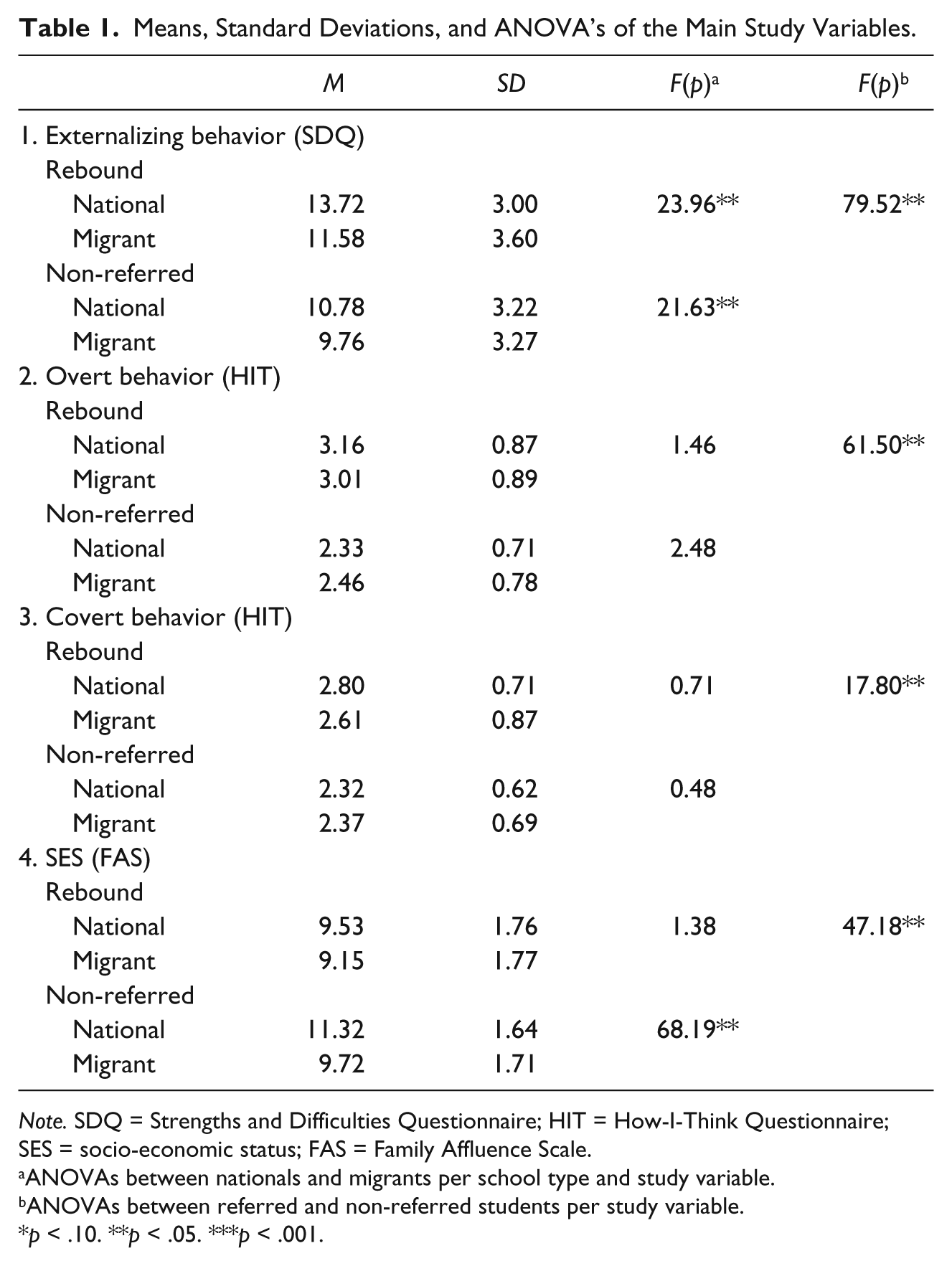
Note. SDQ = Strengths and Difficulties Questionnaire; HIT = How-I-Think Questionnaire; SES = socio-economic status; FAS = Family Affluence Scale.
ANOVAs between nationals and migrants per school type and study variable.
ANOVAs between referred and non-referred students per study variable.
p < .10. **p < .05. ***p < .001.
Correlations of the Main Study Variables.
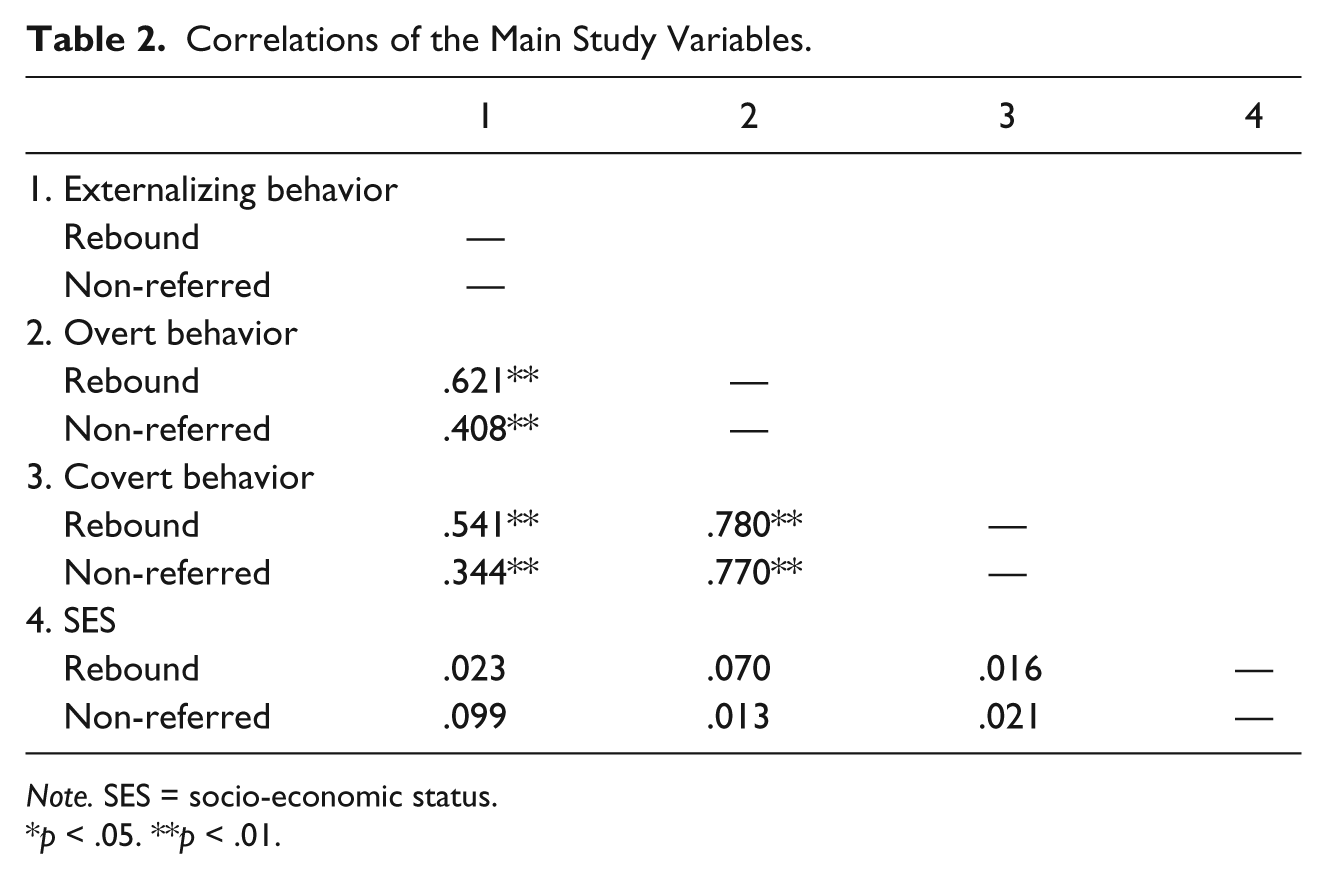
Note. SES = socio-economic status.
p < .05. **p < .01.
Differences Between Referred Immigrant and National Students
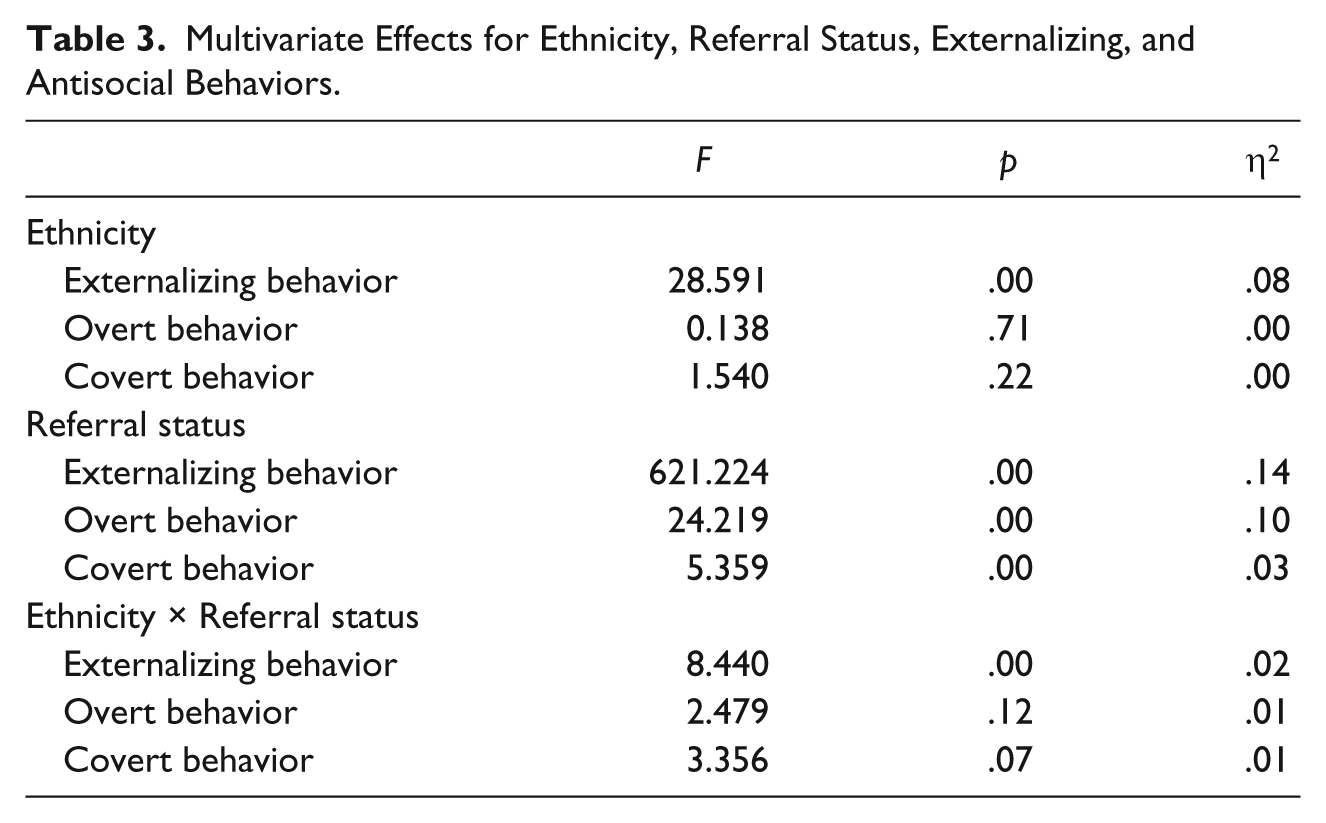
A MANOVA was conducted to test for differences in externalizing, antisocial behaviors between referred and non-referred students. Gender, ethnicity, and referral status were entered as fixed variables, and age and SES as covariates. Results revealed a main effect for ethnicity (see Table 3). National students reported more externalizing behaviors than immigrant students, F(1,363) = 28.591, p < .01, η2 = .08. Overt and covert behaviors did not significantly differ between national and immigrant rebound students. National students in rebound facilities reported more externalizing problems than their immigrant peers. Our hypothesis was thus confirmed for externalizing behavior only.
Multivariate Effects for Ethnicity, Referral Status, Externalizing, and Antisocial Behaviors.
Interaction Effects Between Ethnicity and Referral Status
A MANOVA was conducted to test for interaction effects between ethnicity and referral status. A significant interaction effect was found between ethnicity and referral status for externalizing behavior, F(1,363) = 8.440, p < .01, η2 = .02 (see Table 3). This interaction effect supports our hypothesis that referred national students report more externalizing problems than their referred immigrant peers, and that the difference in externalizing behavior between referred and non-referred immigrant students is smaller than the difference between referred and non-referred national students. This result indicates disproportionality in exclusionary practices, in particular, immigrant students referred to rebound facilities report less externalizing problem behavior than referred national students. A comparable interaction effect was not found for covert behavior, F(1,363) = 3.356, p = .07, η2 = .01, or overt behavior, F(1,363) = 2.479, p = .11, η2 = .01.
Discussion
In the present study, differences in externalizing behavior, and overt and covert antisocial behaviors between students referred to rebound facilities and their non-referred peers were investigated. Overall, we found clear differences in externalizing behavior, and overt and covert behavior between referred and non-referred students, with rebound students scoring higher on externalizing behavior, and overt and covert antisocial behaviors. As expected, we also found an interaction effect between ethnicity and referrals, specifically, differences between referred and non-referred students on externalizing behaviors were larger among national students than among immigrant students.
Socio-economic circumstances in which immigrant children grow up are generally worse compared with their national peers. These socio-economic circumstances are related to more behavioral problems (Herweijer, 2009). However, in line with previous studies (Bryan et al., 2012; Skiba et al., 2011; Stevens & Vollebergh, 2008; Wallace et al., 2008), the present study suggests that referrals are not explained by students’ SES. In addition, immigrant youths were more likely to be referred while reporting less externalizing behavior than their national peers. This concurs with earlier research in the juvenile justice system in the Netherlands. Recent work on incarcerated adolescents in the Netherlands has shown similar trends: Ethnic minorities were more frequently arrested for less serious offences and lower levels of psychiatric symptoms than their Dutch national counterparts (Veen et al., 2010; Vreugdenhil, Doreleijers, Vermeiren, Wouters, & Van den Brink, 2004).
Our findings did not support our hypotheses for covert and overt behaviors, in which we expected these behaviors to show the same interaction pattern as we found for externalizing behaviors. Particularly, mean scores on overt problem behavior, such as physical aggression and oppositional-deviance, were similar between national and immigrant students in the referred group. These results suggest that disproportionality only holds for less severe externalizing behaviors, such as hyperactivity and mild forms of conduct behaviors during classes, whereas antisocial behaviors do not explain disproportionate exclusions. This reflects the mission of rebound facilities to cater for the needs of students with mild problem behavior without psychiatric diagnoses (Van Veen, Van der Steenhoven, & Kuijvenhoven, 2007).
Limitations
To the best of our knowledge, the present study is the first to investigate the quality of referrals to rebound facilities. This is an important step toward future attempts to improve the procedures and adapt the criteria used in referral procedures. However, several limitations must be kept in mind while interpreting the results of this study. One of the limitations is the cross-sectional design which only offered correlational data and precluded examining causal pathways. The study would have benefitted from qualitative observations or content analyses of discipline codes of teachers or discipline referrals, which may have led to a clearer distinction between behaviors that in the present study may have been labeled too easily as problematic. A better knowledge of what behavioral concepts stand for and what behaviors are characteristic of students referred to institutions like rebound facilities is important for preventive, remedial, and other educational measures. A further limitation of the present study is the use of self-reports. Additional teacher reports on externalizing and antisocial behaviors would have served an important function of continuously monitoring the validity of measures and the information they provide. Nevertheless, we used well-validated self-report instruments, investigated repeatedly in Dutch and ethnically diverse youth samples (Achenbach et al., 2008; Nas et al., 2008; Richter, Sagatun, Heyerdahl, Oppedal, & Røysamb, 2011).
Implications
Findings from this study suggest that referrals to rebound facilities parallel the existing international data on disproportionate disciplinary practices for the past 30 years. In particular, externalizing behaviors were identified as contributing to the disproportionate referrals to rebound facilities.
Promising school-wide behavioral programs promoting culturally responsive management practices to reduce the risk of disproportionate referrals have been developed and implemented, albeit small scale (Bohanon et al., 2006; Fallon, O’Keeffe, & Sugai, 2012; ; Sugai & Horner, 2002; Vincent & Tobin, 2011; Vincent, Tobin, Swain-Bradway, & May, 2011). The school-wide positive behavioral support (SWPBS) intervention model, for instance, is designed to prevent maladaptive student behavior and to ensure that all students are part of the best evidence-based academic and behavioral practices. SWPBS is characterized by premises such as, clearly defined appropriate and inappropriate behavior, proactive teaching to monitor these defined behavioral standards, and continuous web-based collecting of discipline referrals and its evaluations (Sugai & Horner, 2002). This program has shown consistent effectiveness in decreasing disciplinary infractions and increasing school safety perceptions (Barrett, Bradshaw, & Lewis-Palmer, 2008; Flannery, Sugai, & Anderson, 2009). However, information on disciplinary patterns disaggregated by students’ ethnic background suggests that disproportionality is still present after implementing SWPBS (Kaufman et al., 2010; Vincent et al., 2011), which suggests that the implementation of only positive behavioral programs or objective database registration and monitoring of referrals is not sufficient (Vincent et al., 2011). Treating every student the same is conceptually not equal to being culturally responsive, which requires adaptation to students’ personal needs. Therefore, recent studies have suggested expansion of key features of the SWPBS program to enhance cultural responsiveness among teachers (Vincent et al., 2011), by training them to appreciate cultural diversity and avoid a colorblind approach (Cartledge & Kourea, 2008; Singleton & Linton, 2006), while emphasizing cultural equity by responding effectively to the differing needs of ethnic minority students (Monroe, 2005). Through this approach, we may perhaps minimize the referral of students due to cultural misunderstandings and only refer the students that really need the help of a rebound facility.
Footnotes
Declaration of Conflicting Interests
The author(s) declared no potential conflicts of interest with respect to the research, authorship, and/or publication of this article.
Funding
The author(s) disclosed receipt of the following financial support for the research, authorship, and/or publication of this article: The authors received funding from the school network “Zuid-Holland West”. The funder did not play any role in designing the study, data collection and analysis, decision to publish, or preparation of the manuscript.