







Abstract
Research on school bullying and violence has always been working with taxonomies of bullying to categorize aggressive acts. Researchers distinguish between direct and indirect or between physical, verbal, and relational bullying. Cyberbullying is categorized either by type of action or by type of medium. In this article, we propose another kind of categorization: the taxonomy of reasons. A questionnaire was developed that asks for the five dimensions “instrumental,” “power,” “sadism,” “ideology,” and “revenge.” It was tested with middle-school children in Germany. While bullies claim that their reasons were mostly revenge, victims mostly insinuate sadism and power. Both groups claim that ideology and instrumental violence play a little role. Confirmatory Factor Analyses (CFA) show that at least four of the theoretically proposed dimensions make sense (except instrumentality). A qualitative analysis of open answers shows that for future questionnaires, the taxonomy should include additional dimensions, such as peer pressure and lack of self-control.
Bullying in Schools
Although bullying in schools (defined as “aggressive behavior normally characterized by repetition and imbalance of power”; Smith & Brain, 2000, p. 1) has probably existed as long as schools themselves, we can look back on a rather short period of research of only a bit more than 30 years. During this time, information was gathered about criteria for definition, personality traits of bullies and victims, forms of bullying, gender differences, coping strategies, and consequences (Smith & Brain, 2000). Studies have shown early that there are some cultural differences in understanding bullying (Smith, Cowie, Olafsson, & Liefooghe, 2002). Compared with Western cultures, the Japanese phenomenon “ijime,” for example, relies more on relational than on direct aggression (Akiba, 2004). However, researchers mostly agree on the conceptual definitions of bullying. Of course, that does not mean there are no differences in, for example, prevalence rates among countries (for a detailed comparison of countries, see Smith et al., 1999).
This article reviews existing taxonomies (categorization systems) for traditional bullying and cyberbullying and proposes to add a new taxonomy by type of reason. Taxonomies are an important area of research for two reasons: First, by defining categories of a phenomenon, they form a rationale for operationalizing the construct. Questionnaire items are developed based on those categories, which makes it important to establish exhaustive taxonomies that cover all aspects of a phenomenon. Second, taxonomies can be used as a foundation for more elaborate research questions. For example, only the distinction between physical, verbal, and relational forms of bullying made it possible to understand gender differences. Especially for new phenomena, like cyberbullying, good taxonomies are crucial for understanding more about their true nature.
Taxonomies for Traditional Bullying
School bullying has as many faces as violence itself and can range from physical attacks such as punching, kicking, or even stabbing with a knife to softer forms like insults or gossiping. Most common forms of bullying are (in order of frequency) harassing, ridiculing, beating, threatening, spreading rumors, and exclusion from common activities (Seals & Young, 2004; Sharp & Smith, 1991).
From the beginning on (Olweus, 1993), researchers have categorized acts of bullying along the taxonomies of aggressive behavior in general: Direct versus indirect bullying on the one hand and physical, verbal, and psychological bullying on the other hand (Smith, 2009) are two dimensions that can be combined in a matrix of 2 × 3 = 6 possible forms of bullying: Physical bullying is usually direct (A hits B) but can also take place in an indirect manner (A tells B to punch C). Verbal bullying can also be direct (A insults B) or happen behind the victims back (A spreads rumors about B). Psychological (sometimes called relational) bullying is used to undermine the victim’s status within a group or to destroy his or her friendships. This can happen with the knowledge of the victim (direct bullying) or in more covert (indirect) forms (Coyne, Archer, & Eslea, 2006).
The taxonomy of reasons (TOR, as presented below) describes a third dimension of bullying incidents: for example, direct verbal bullying out of revenge or indirect relational bullying for the exertion power.
The Situation in Germany
Bullying in schools has been of interest for German researchers since the 1990s (Petermann, 2003). Research focuses mostly on prevalence rates, characteristics of bullies and victims, and attributes of the school. Most studies and intervention programs focus on violence in schools in general and not specifically on bullying (Riebel, 2008). With prevalence rates between 4% and 12% (Lösel & Bliesener, 1999), bullying is definitely a problem in this country.
For a few years, the focus of most German researchers has shifted to cyberbullying, first studies were published since 2008 (Katzer, 2008; Riebel, 2008), focusing on prevalence and overlap with traditional bullying.
Cyberbullying
Since the new millennium, research has started to focus on a new type of violence among children and adolescents that uses the fast evolving new media as a method to bully others. Early studies have focused mostly on the prevalence of cyberbullying and on the differences to traditional bullying. Only of late, researchers try to cover the basics, which have so far been neglected: conceptualization, methodology, and theoretical foundation (Bauman, Cross, & Walker, 2013). A consensus has not been reached on definition (Tokunaga, 2010), measurement (Menesini & Nocentini, 2009), or categorization. In this article, we follow the definition by Smith et al. (2008) “[Cyberbullying is] an aggressive, intentional act carried out by a group or individual, using electronic forms of contact, repeatedly and over time against a victim who cannot easily defend him- or herself” (p. 376). For a critical discussion of the definition, see Smith, Del Barrio, and Tokunaga (2013) and Bauman, Underwood, and Card (2013).
Taxonomies for Cyberbullying
Although there are many ways in which researchers categorize (and therefore assess) acts of cyberbullying, they mostly use a taxonomy of actions (TOA) as proposed by Willard (2007) or a taxonomy of media (TOM) as proposed by Smith et al.(2008). The TOA distinguishes between different behaviors (harassment—sending offensive messages to the victim; denigration—spreading rumors about someone; impersonation—identity theft; outing and trickery—forwarding embarrassing or private pictures, videos, or messages; exclusion—excluding someone from common activities such as chats or online games). TOM asks which kind of medium was used to perform the bullying (by phone, text message, email, picture or video clip, instant messenger, website, chat).
Many current studies use either some kind of TOA (Ang & Goh, 2010; Erdur-Baker, 2010; Katzer, Fetchenhauer, & Belschak, 2009) or some kind of TOM (Beran & Li, 2005; Ortega, Calmaestra, & Mora Merchán, 2008; Slonje & Smith, 2008), although in both cases the authors usually make adaptions. As a result, there is as little consensus in categorization of cyberbullying as there is in its definition.
This general lack of a convention for categorizing cyberbullying is a tremendous problem in terms of comparability of results. Usually, the answers on the several subtypes of bullying are summed up to a score that is used to define victim status. Menesini & Nocentini (2009) have shown that results can vary considerably depending on which question one uses to assess victim status.
After reviewing the existing literature on cyberbullying, Dooley, Pyżalski, and Crosset (2009) come to the following conclusion:
Clearly, the different types of cyberbullying are not equal in terms of the skills needed to engage in the behavior as well as the impact they have on victims. It would be interesting to determine if there is an association between a perpetrator’s motivation (e.g., revenge vs. fun) and the type of media used to cyberbully. (p. 185)
We therefore propose not to limit scientific outcome by using only one taxonomy in a study but to use both TOA as well as TOM and to even complement them with a third taxonomy: a categorization of reasons.
Motives Behind Violence in Schools
In his classic work on the roots of “evil” behavior, Baumeister (2001) lists four different reasons behind violence: predation (or instrumental violence), revenge, ideology, and sadism. Pinker (2011) takes up this taxonomy of reasons (TOR) but adds a fifth category: power—arguing that the need for power is a special kind of instrumental violence that is universal in human beings (McClelland, 1987). In this study, we used the five-factor variant—assuming that if power were not inherently different from instrumental bullying, this would be displayed in the data.
A questionnaire that tries to cover all common motives and order them along theoretically as well as empirically founded dimensions has not yet been developed for the study of bullying motives. However, the issue of motives has been addressed in theoretical as well as in empirical works. In the following overview, the five types of reasons of the TOR are presented and discussed with regard to school bullying and violence.
Instrumental Violence
We call behavior instrumental violence when the perpetrator attacks the victim to reach an aim he or she cannot reach with non-violent means. Olweus (1993) suggests that a common reason for bullying is the fact that the bullies often blackmail their victims to give them money or valuable items. However, little is known if this motive plays a significant role and what other kinds of instrumental violence might be important for bullying.
Power
Violence motivated by a need to exercise power occurs when the perpetrator hopes to secure or to enhance his or her position within a social entity. This issue has been addressed on the outskirts of research on gender differences, which often focuses on the reasons why girls use different kinds of violence than boys (Coyne et al., 2006; Siann, Callaghan, Glissov, Lockhart, & Rawson, 1994). The means they use may be different, but the aims they use them for are the same. Boys as well as girls use violence to maintain or improve their position in the “pecking order” of the class.
Revenge
Children and adolescents as well as adults can react angry and aggressive when being threatened and attacked, especially when they feel the attack was unjustified. Especially in the context of cyberbullying, the question is discussed if this might be a medium for the physically weak to take revenge on their real-life bullies.
Ideology
In-group/out-group phenomena play an important role in human interactions and can eventually lead to violence toward individuals who we perceive to belong to the out-group (Brewer, 1999). When it comes to bullying, the traits that increase the chance of becoming a schoolyard victim seem to be rather psychological ones (e.g., low self-esteem, shyness, introversion) than variables such as ethnicity, social status, outer appearance, sexual orientation, religious affiliation, and other obvious traits that distinguish the individual from the majority (Siann et al., 1994). Thus, we can expect that ideologist reasons play a rather minor role.
Sadism
Sadism sounds like a rather harsh term for interactions between children and adolescents. But sadism does not necessarily include needles and pins but merely describes the feeling of joy that is being drawn from watching another person suffer. In the classroom, this can simply mean that fellow students are harassed out of boredom, which was indeed one of the main reasons girls named for bullying others (Owens, Shute, & Slee, 2000).
The TOR was designed to categorize acts of violent and antisocial behavior in human adults, ranging from gossip to robbery and much more serious forms of violence such as (mass) murder. This study aims to find out if the five categories are also applicable to the living environment of middle-school students in an educational context. Three major questions are in focus here:
What are the most common motives for bullying in schools (including cyberbullying)?
Is the empirical factor structure identical with the theoretical concept as proposed by Baumeister (2001) and Pinker (2011)?
Are there any additional reasons relevant in the everyday life of middle-school students that are not covered by the TOR?
Method
Participants
A questionnaire was presented to 578 middle-school students from five schools from a rural area in the state of Rhineland-Palatinate, Germany, by teachers in training. Rhineland-Palatinate is one of 16 German states, wealth and educational level are consistent with the German average. The schools were ordinary without any noticeable peculiarities (such as a digital divide or an accumulation of violent incidents). The sample has to be considered an ad hoc sample, because the schools were not sampled randomly but chose to participate on their own account. Fifty-four percent of the participants were male, 44% female (2% refused to provide information on their gender). The age ranged from 11 to 18 years with a medium age of 14.71 years (SD = 1.32). As almost all the students were under age, the parents were given an information form about content and purpose of the study. Their consent was required for the students to participate in the study.
Assessments and Measures
The questionnaire contained several scales on traditional and cyberbullying and asked both for bully and victim experiences. The five kinds of reasons from the TOR were operationalized via three items for each motive (e.g., for power/victim perspective: “How often did it happen to you in the course of the last year that you were victimized because the other person wanted to show you who is stronger?”), and participants were asked to answer them on a five-point-scale ranging from “never” to “several times a week.” Two scales were newly developed: one asking students about their own motives when they bullied others and one asking them what motives the bullies might have had when they themselves were victimized (for an English translation of the content of each item, see Table 1). By checking the frequencies of the items on both scales the most common motives of bullies were identified and compared with what victims assume to be the most common motives.
Frequency of Reasons in Descending Order (Bullies’ Perspective).
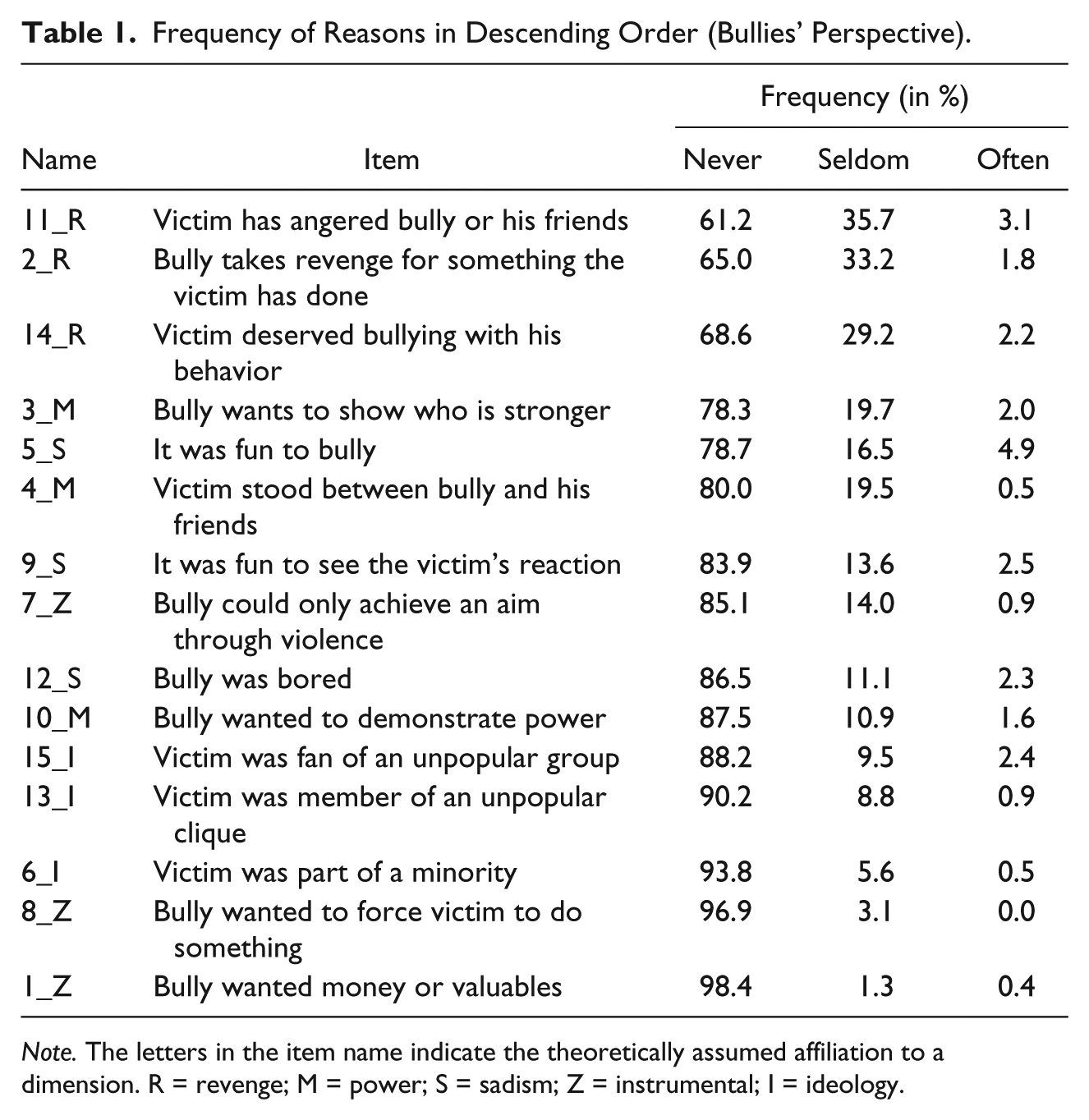
Note. The letters in the item name indicate the theoretically assumed affiliation to a dimension. R = revenge; M = power; S = sadism; Z = instrumental; I = ideology.
Confirmatory Factor Analyses (CFA) were used for both the bully and the victim scale to see if the dimensional structure of the data fit the theoretical assumptions, this was done using MPLUS Version 6.1. Confirmatory instead of exploratory factor analysis was used, because there already existed theoretically funded assumptions on the underlying factor structure (T. A. Brown, 2006).
In addition to the rating scales, the questionnaire contained an open question: “If you ever bullied a fellow student, please name the reason(s) for your behavior.” This was done to see whether the TOR really does include the most common motives for bullying or if there are other prominent reasons that should be included when the taxonomy is adapted for children and adolescents. A qualitative analysis was performed on those open answers: The text was reviewed and checked for reasons. Not all participants filled in the forms and some of them gave more than one reason for violent behavior. The total of N = 186 reasons was analyzed, and a key word was assigned to each reason.
Results
Most Common Motives
Table 1 gives an overview on the motives rated most common by the bullies. The five-point scale is here being transformed into a three-point-scale with the values “never,” “seldom,” and “often.” The rationale behind this is the fact that bullying requires—per definition—that victimization occurs repeatedly and over a longer period of time. When incidents occur more seldom, some authors speak of “soft” or “less severe” bullying (Borg, 1999). In any case, even seldom acts can be described as “violence” because violence does not demand repetition as a criterion. We can use those incidents to get a clear picture on the existence and distribution of motives, but we have to keep in mind that—strictly speaking—this is not bullying.
The rating of the bullies yields a rather clear picture: The items for revenge are on the very top of the list followed by (less frequently) the items on power and sadism. Sadistic behavior was however attributed more often to fun than to boredom. Bullying motivated by ideology seems to play a rather minor role, and instrumental violence seems to occur on only very few occasions.
The perspective of the victims as presented in Table 2 yields a somewhat different picture.
Frequency of Reasons in Descending Order (Victims’ Perspective).
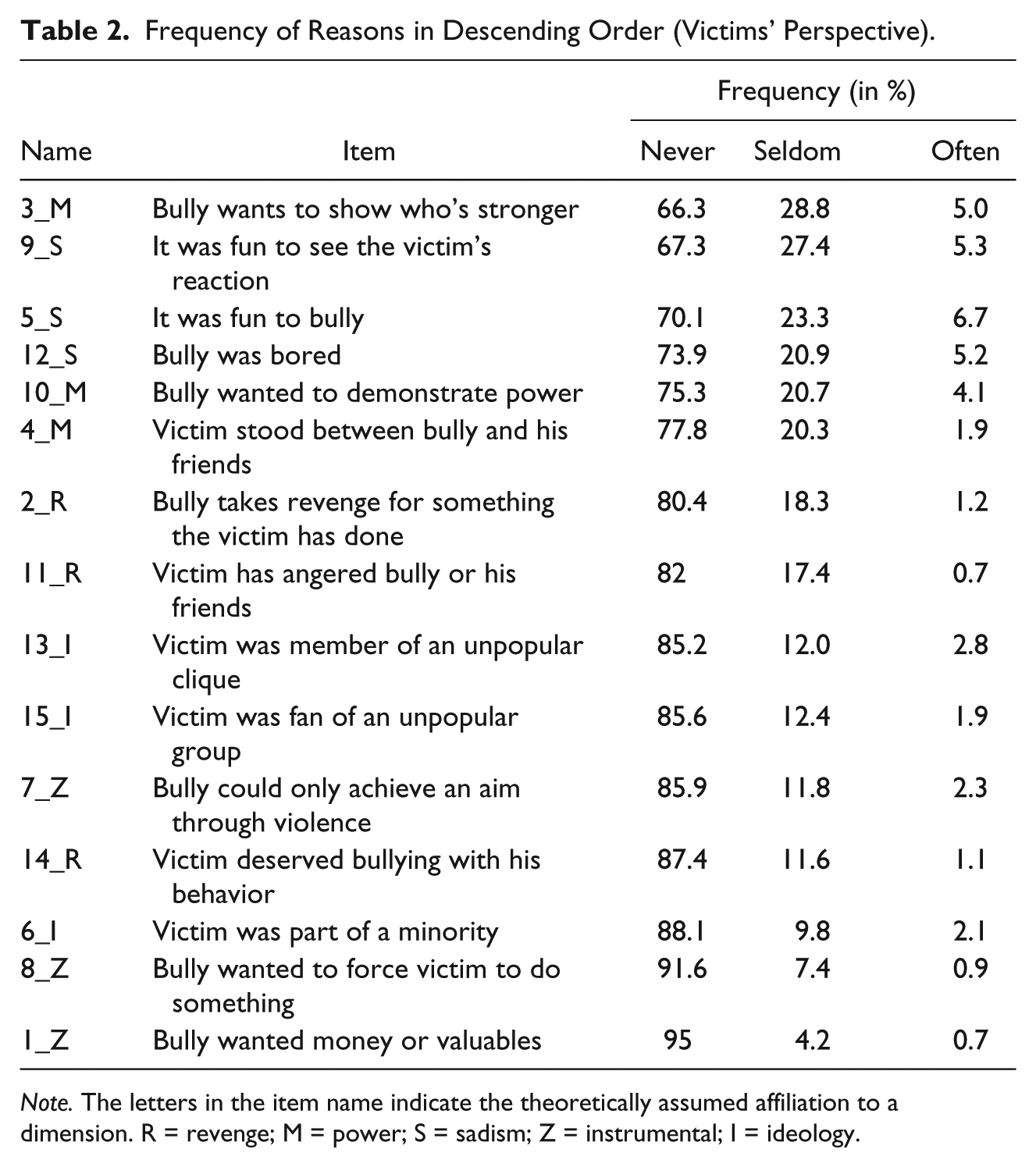
Note. The letters in the item name indicate the theoretically assumed affiliation to a dimension. R = revenge; M = power; S = sadism; Z = instrumental; I = ideology.
The victims attribute the bullies’ behavior mostly to sadism or an urge for power. Revenge and ideology also play a role. When it comes to ideology, it is interesting to observe that the victims agree with the bullies on the fact that belonging to a minority is not a very common reason for being bullied. The same results were found with regard to instrumental bullying.
Confirmatory Factor Analysis
CFA were used to find out if the division of motives into the five aforementioned subcategories can be confirmed empirically. For this purpose, the perspective of the bullies as well as the one of the victims was taken into account. Although we can expect to find differences between both perspectives here, we can look for agreements between both perspectives.
The bullies’ perspective
Probably due to very little variance in the instrumental items (instrumental bullying was hardly ever reported and by the bullies even less than by the victims; see above), the model containing all five factors did not converge. The results of the non-converging solution indicated a misfit of the factor “instrumental bullying,” so in a second step, the factor instrumental bullying was removed from the model (as it has little practical relevance anyway) and a four-factor-version was being calculated. The results of this model are depicted on the left side of Figure 1. Only a single adaption had to be made with the four-factor-solution: Item I_15 (victim was fan of an unpopular group) showed loadings >1 with the ideology factor. Instead of fixing the variance a more conservative approach was used and the item was removed from the model (Chen, Bollen, Paxton, Curran, & Kirby, 2001).
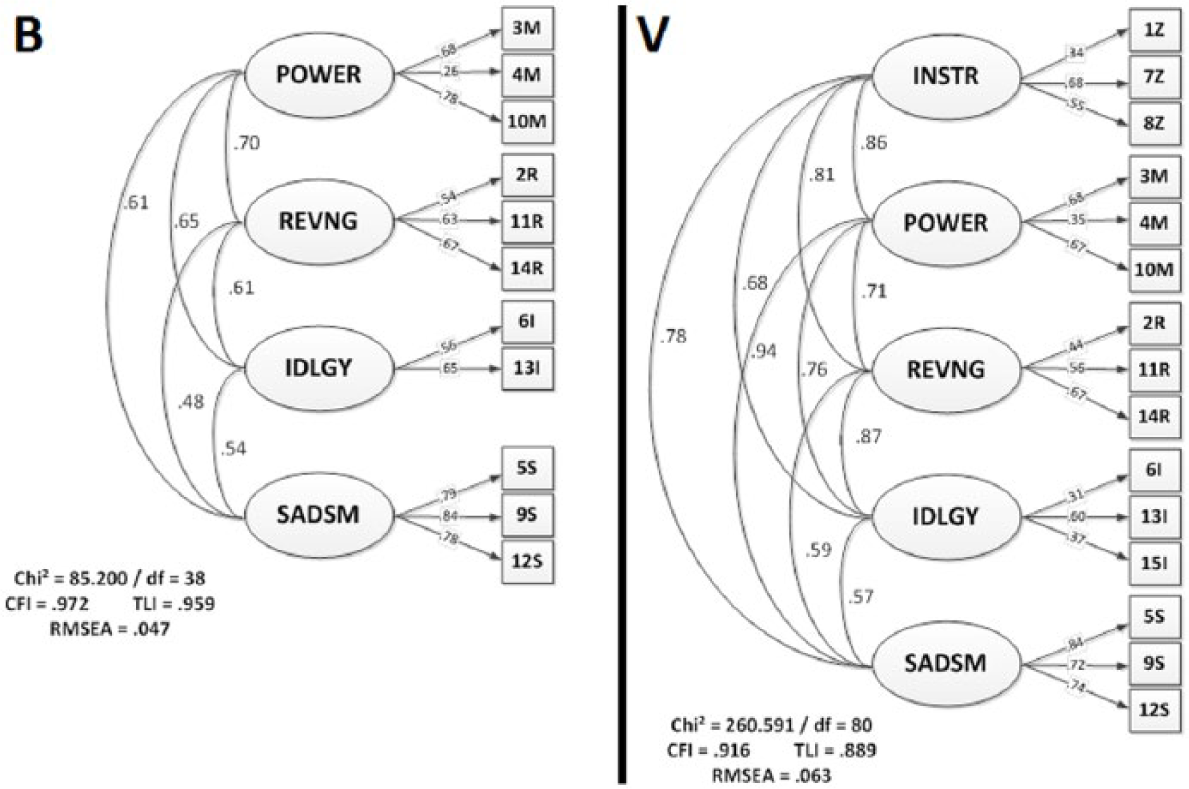
Confirmatory factor analysis of reasons from the bullies’ (left side) and from the victim’s (right side) perspective.
As visible on the left side of Figure 1, all items have factor loadings >.50, except for Item 4_M (victim stood between bully and his friends) with a loading of only λ = .26. This is not surprising as the other two items on the factor (bully wants to show who is stronger; bully wanted to demonstrate power) are both about the relationship between bully and victim and 4_M is about the relationship between the bully and a third party. In spite of the rather low factor loading, the item is left in the model for theoretical reasons. The fit indices Comparative Fit Index (CFI), Tucker–Lewis Index (TLI), and root mean square error of approximation (RMSEA) show that the model fits the data very well. (The fit indices used in this analysis can be interpreted as follows: The CFI indicates acceptable model fit when >.90 and good model fit when >.95; ideally, values should even exceed .97. The TLI has similar criteria and demand values >.95 for acceptable and >.97 for good model fit. The RMSEA shows good model fit when 0 < RMSEA < .05 and acceptable model fit when .05 < RMSEA < .08; T. A. Brown, 2006; Schermelleh-Engel, Moosbrugger, & Müller, 2003).
The victims’ perspective
The CFA over the victims’ answers is portrayed on the right side of Figure 1. For the victims’ perspective, the theoretically assumed factor structure could be verified without any adaptations. All items show satisfactory factor loadings of λ ≥ .30. The intercorrelations between the latent factors are all rather high with .57 ≤ r ≤ .94 and higher than the intercorrelations in the bullies’ perspective. The highest correlation (r = .94) is between “sadism” and “power”; “instrumental bullying” and “power” (r = .86) share 74% of their variance. However, the model fit is not entirely satisfactory: While the RMSEA is in the range of acceptable model fit, CFI and TLI indicate sub-standard model fit.
Qualitative Analysis of Open Questions
The rating of the open answers yielded 11 key words, to each of which several answers (ranging from 6 to 49) were assigned. Five of the key words responded to the dimensions of the TOR; 6 can be considered additional kinds of reasons. Table 3 shows how frequent the different key words were assigned.
Key Words From Qualitative Analysis of Reasons.
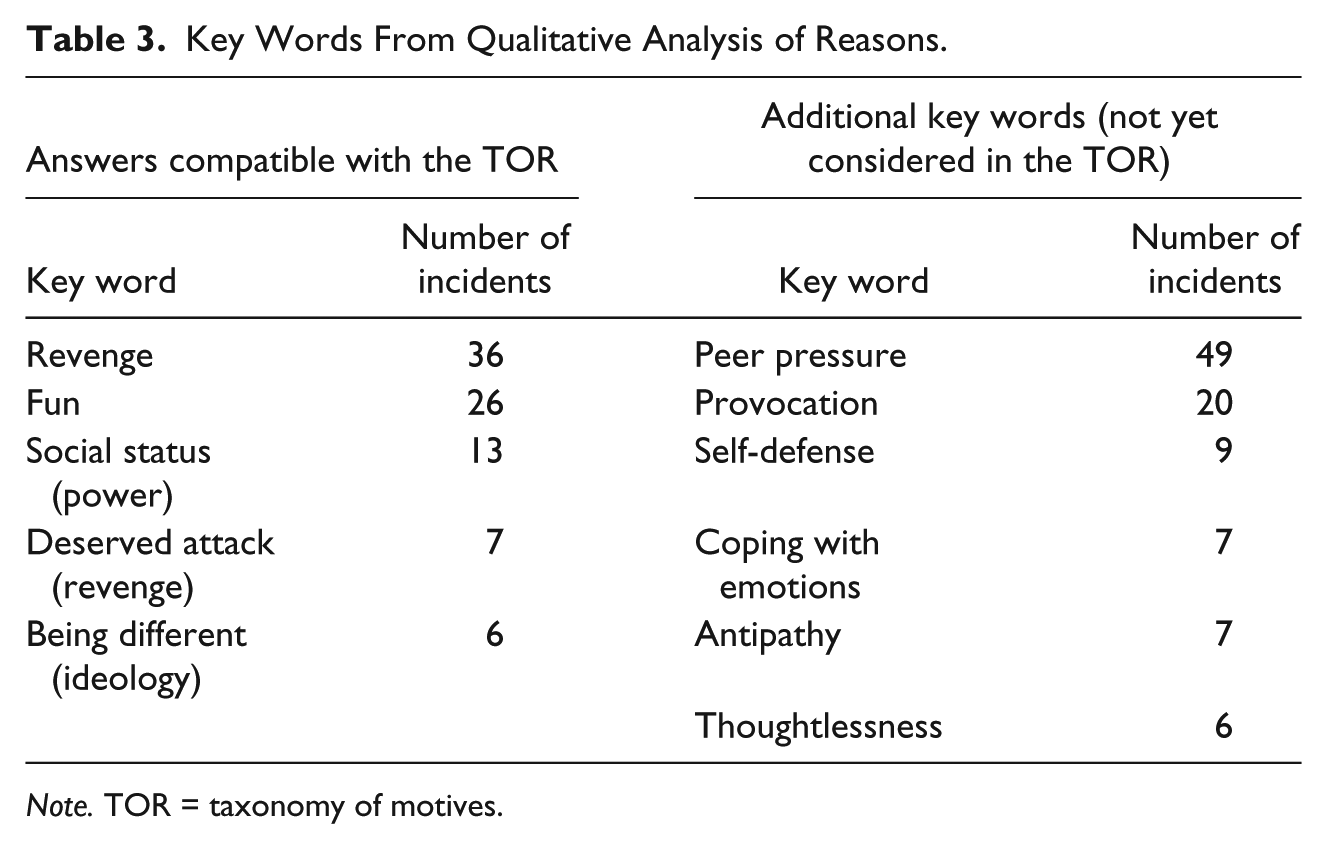
Note. TOR = taxonomy of motives.
First, let us consider the reasons consistent with the TOR taxonomy (see the left-hand side of Table 3). The order of the frequencies seems to validate the findings from the quantitative item analysis. Revenge is named most often, followed by fun (sadistic) and power. Seven participants explicitly mention that the victim simply deserved being bullied without further explaining how or why they deserved this kind of treatment. Bullying out of ideological reasons was mentioned only 6 times (3%) where bullies justified their behavior with the victim being “different” or “weird.” Instrumental bullying in the form of blackmail for money or valuables was not mentioned at all.
The right-hand side of Table 3 shows the key words that were at first sight inconsistent with the TOR. Forty-nine students name “peer pressure” as a reason for bullying someone. With 26% of all mentioned reasons, peer pressure seems to play a huge role as a motivator. Seven of the participants explicitly use this word, which has to the reader a negative connotation of being coerced into something. This feeling is evident from wordings such as “in order not to be bullied as well (boy, 14)” or “[I bullied] maybe a little. Only for the others to see that I am on their side . . . (girl, 13).” However, the group can also foster rather positive feelings: “It makes me feel good being part of a group (boy, 15).”
Provocation is also mentioned very often as a reason for violence, but other motives also seem to play (although probably a minor) a role: self-defense, coping with own negative emotions such as anger or frustration, antipathy toward the victim, or simple thoughtlessness.
Discussion
Most Common Motives
It is no surprise that bullies and victims differ in their assessment of motives. Human beings process information in ways that allow them to keep a positive picture of themselves. Both bullies and victims find themselves in situations where—without justification—their self-worth is threatened. For the bully, hurting others is in contrast to the self-perception of being a nice person, whereas being bullied by others might be contradictory to the picture of oneself as a likable person. For both groups, the result is cognitive dissonance (Festinger, 1957), which can be overcome by reasonable explanations for those situations. It is known from research on aggression in general (Baumeister, 2001) that victims and offenders give very different reasons for an attack: Offenders can usually justify their behavior with solid reasons that make it seem like they did not have any other choice but choosing violent means. Such reasons include being provoked, defense or revenge against earlier attacks by the victim and so on. Victims, however, claim that the perpetrators did not actually have any comprehensible reason at all. Instead, they think the offenders have acted purely out of their evil spirit, without the slightest reason or provocation. Baumeister (2001) calls this phenomenon “the myth of pure evil.” The objective “truth” probably lies somewhere in between both perspectives. Due to the fact that both groups use such self-justifications for the reduction of their own cognitive dissonance, all parties involved actually believe in the accuracy of their perspective (i.e., they do not just lie to others to convince third parties, although the deception of others might play a role as well as self-deception).
The results of the frequency analyses over the most common motives fit perfectly within the theoretical framework of the “myth of pure evil.” Opinions differ quite a lot when it comes to the most common motives. While bullies give revenge as the most common motive and name sadism and power only in second place, it is the other way round with the victims, that is, the victim more often sees the bullying as something that happens either out of no reason at all (but just for the fun of doing it) or motivated by “lower” motives (such as the gain or demonstration of power), whereas the bullies argue with the justification of their behavior by revenge. This finding is consistent with the literature and therefore not very surprising. More interesting are the facts on which both groups agree: As expected, ideology plays a rather small role as a motive for violence and bullying (Siann et al., 1994) and instrumentality plays hardly a role at all. Olweus’ (1993) assumption on bullies’ blackmailing for money or valuables seems to be falsified by the data—occurrences like these are rather the exception than the rule. Still, in schools from poorer environments, those material reasons might play a bigger role. Future studies should focus on the question if social class might be factor that enhances this kind of motivation.
Confirmatory Factor Analysis
The CFA results lead to the conclusion that the theoretically proposed factor structure seems to be rather valid. The fact that the four dimensions, power, sadism, ideology, and revenge, could be replicated in both models (bullies’ as well as victims’ perspective) validates the existence and independency of these factors. However, the in part sub-standard model fit of the victims’ model suggests that we should refrain from using the instrumental items in future versions of the questionnaire. This consequence is also consistent with the findings on most common motives.
On the item level, the questionnaire is being validated by the substantial factor loadings in both models. All items make sense and to each factor three items can be clearly assigned. An exception is being made by Item 4_M (victim stood between bully and his friends). It should be considered if future versions of the questionnaire should differentiate more between two kinds of power bullying: the demonstration of power or strength to daunt the victim and the fight for individual friend or relationships. Both are aspects of power and status within the class, but the phenomena are rather distinct in their nature and probably call for two separate dimensions. Further research needs to find out if the power factor includes two sub-dimensions when the TOR is used on bullying in schools.
The latent correlations between the five factors are all rather high, which suggests that students who bully for one reason tend to bully for other reasons as well.
We can only guess why those correlations are higher from the victims’ perspective than from the bullies’ perspective. We can assume, though, that in spite of all self-preserving contortions of reality, bullies know why they bully. One good reason is probably enough for them to justify their behavior. The victim, however, can only speculate what his bully’s reasons might have been, which can lead to the fact that victims name several reasons more often than the bullies do. Victims are probably unable to determine what the exact reasons behind an incident were. The almost perfect correlation between sadism and power indicates that victims can hardly differentiate between those two reasons.
As for the question of power and instrumental bullying, we have only the victim data to check Pinker’s hypothesis that they are two different dimensions (the factor “instrumental” was not included in the CFA model of the bullies). Although the association is rather high, there remains 25% of non-shared variance, which is why we can quite safely assume that, though related, instrumental and power bullying are two different phenomena.
Qualitative Analysis of Open Questions
The analysis of the qualitative data reveals two major findings. First, the TOR is validated in the respect that the four factors identified in the CFAs are also mentioned in the open answers and interestingly even in the same order of frequency (revenge more often than fun, and power and ideology only in 3% of the cases).
Second, the analysis also shows that when used for research on bullying, the TOR does in its current form not cover all kinds of reasons students have for victimizing others. But not all the key words found justify taking them up separate full dimensions in a future version of the TOR questionnaire. For example, “self-defense” does not actually make any sense in the context of bullying but rather seems to be a kind of (self-)deception of the perpetrator. Bullying cannot—by definition—happen out of self-defense as it requires the victim to be the inferior and helpless part (Menesini et al., 2012).
Also, the key words “antipathy,” “coping” and “thoughtlessness” are counted seldom and could possibly both be attributed to a pattern of disinhibited behavior. In fully socialized grown-ups, antipathy (without provocation) alone should not result in aggressive behavior and if it does, it is associated with psychopathology (Aboujaoude & Koran, 2010). Interestingly, some of the participants mention bullying as result of experiencing negative emotions such as anger and frustration. Usually, research on bullying considers stress and negative emotions only on the outcome side—as consequences of bullying. An exception is the recent work of Patchin and Hinduja (2011) who apply general strain theory (Agnew, 1992) to (cyber)bullying and can show that indeed strain and anger / frustration are associated to aggressive behavior in schools. Maladaptive coping, too, can be considered as a form of disinhibition or more precisely as choosing an alternative out of a catalogue of reactions that is harmful to both bully and victim. Further research needs to find out if the TOR should be extended by a separate category for lack of impulse control.
The key word “provocation” describes a phenomenon consistent with bullying literature and might hence be a useful addition to the TOR. Olweus (1993) makes the distinction between ordinary and provocative victims who challenge their fellow students with strange, dissocial, or inadequate behavior that can result in rejection and even lead to bullying.
“Peer pressure” is the key word mentioned most of all and therefore seems to play an important role as a motive. This finding shows that in its current form, the TOR is not perfectly adequate to the experiences of middle-school students with regard to bullying. The TOR was developed to classify adult’s motives for violence or antisocial behavior. Although adults, too, are influenced by members of their peer group, the phenomenon is especially evident in adolescents whose definition of their own identity is highly dependent on being accepted by one’s peers (B. B. Brown, 2004). Bullying is usually a group phenomenon (Olweus, 2003) where only a few students in a class actually initiate the bullying and the others only tend to foster it or stand by. For the initiators, the TOR in its current form might be exhaustive enough, but for the majority of the class, it needs to be extended by a category for bystanders and followers.
Practical Relevance
Studying motives is not only interesting for researchers who want to understand the causes of human behavior. For teachers, social workers, and school psychologists, it is also important to know and understand the dynamics behind (cyber-)bullying. For them, it could be useful to investigate the situation in their school with a simple questionnaire containing TOR items. The strategies for fighting bullying will depend on the most common motives in this particular school.
The results of this study are also relevant for the assessment of bullying and cyberbullying by questionnaires. Using all three of the currently existing taxonomies takes little space and time, and yields a huge additional benefit in information. As mentioned above, we suggest using all three taxonomies in questionnaire studies. Researchers should also consider including open questions in their studies of new phenomena such as cyberbullying. The reality of adolescents’ lives at school might (as was the case in this study) yield categories that were not thought off before.
Limitations
Bullying in schools is still a rather sensitive topic in German schools. Therefore, the school administrators did not allow questions on parents’ socioeconomic status or ethnicity. To replicate the findings of this study, future research should use representative random samples—large enough to consider these and more variables as covariates such as school or class size, educational achievement, and number of friends. Also, students from other countries and cultural backgrounds should be questioned, as there might be cultural differences concerning the motives behind bullying and cyberbullying. Random samples would also solve the problem of self-selection.
The results of this study were drawn from a middle-school setting. Results cannot simply be transferred to other educational contexts (such as preschool or higher education) without further validation. However, they can be used as a point of origin for generating hypotheses.
Conclusion
The aim of this study was to establish a TOR for motives behind bullying in schools. Based on an existing five-factor theory, most common motives were identified, and the theoretically assumed factors were tested for factor validity. Open questions on motives were used to find additional reasons not covered in the original TOR.
The results show that the taxonomy of reasons can be applied to bullying in schools, but some fine-tuning is needed for the taxonomy to reflect the circumstances under which middle-school students live and learn together—especially when it comes to the influence of the peer group.
Especially for new phenomena such as cyberbullying, good taxonomies are crucial for understanding its true nature. They help us grasp a more accurate concept of cyberbullying by providing insights on what exactly happened, how it was carried out, and what the underlying reasons were. Questionnaires on bullying and on cyberbullying should therefore include items on reasons. Those items should not replace items in established taxonomies but complement them with a further aspect that has been neglected until now.
Future research needs to be done to develop and validate a revised TOR scale that includes items on the motives from the qualitative results. Also, it would be interesting to investigate the relationship between the different categories in TOA, TOM, and TOR: Do bullies choose different media and actions, depending on their motives? The existing taxonomies (TOA and TOM) should also be investigated more thoroughly. So far, they are used without proof of validity.
In the future, researchers and practitioners should also consider distinguishing between the person(s) who initiated a behavior and all those who only bully out of peer pressure. The latter group is distinct from the initiating bullies as well as from the bystanders and deserves more attention.
Footnotes
Declaration of Conflicting Interests
The author(s) declared no potential conflicts of interest with respect to the research, authorship, and/or publication of this article.
Funding
The author(s) received no financial support for the research, authorship, and/or publication of this article.