







Abstract
The present study evaluates adolescent gang involvement using cross-sectional survey data from 1,475 adolescents living in a disadvantaged Comuna in Medellin, Colombia. Specifically, we examine the prevalence of former and current gang membership, affiliation with gang members, and lives untouched by any gang association. Once these groups are established, we identify variation in membership on the basis of demographic and theoretical variables, and determine whether such variation can be described by using the selection, facilitation, and enhancement models developed by Thornberry et al. While our results, consistent with many prior findings using North American samples, support the selection model for most theoretical variables and enhancement for behavioral outcomes, our strongest contribution is our study’s ability to demonstrate the temporal impact of gang involvement.
Introduction
Empirical research on juvenile gangs in America has evolved over time. Ethnographic research was first used to assess the etiology of the gang and gang membership (Thrasher, 1927; Yablonsky, 1959). The 1970s ushered interest in effective techniques for gang prevention, suppression, and control (Klein, 1971; Klein & Maxson, 1989). During the late 1980s and early 1990s, given the dramatic rise in violent crimes attributed to juvenile offenders, scholarly investigations sought to enhance understanding of both gangs and their influence on behavior. Some researchers explored differences between gang and non-gang members (Esbensen & Weerman, 2005; Katz, Maguire, & Choate, 2011), as well as between members and gang affiliates (Alleyne & Wood, 2010; Battin, Hill, Abbott, Catalano, & Hawkins, 1998; Curry, Decker, & Egley, 2002; Donnermeyer, Edwards, Chavez, & Beavais, 1996; Dukes, Martinez, & Stein, 1997; Esbensen, Huizinga, & Weiher, 1993; Gatti, Tremblay, Vitaro, & McDuff, 2005; Johnstone, 1983; Kakar, 2005; Thornberry, Krohn, Lizotte, & Chard-Wierschem, 1993; Yoder, Whitbeck, & Hoyt, 2003; Zhang, Welte, & Wieczorek, 1999). While much recent work demonstrated an association between gang involvement and delinquency, Thornberry and colleagues (1993) sought to establish whether gangs caused an increase in negative behavior, positing that selection could also be a factor, if already deviant youth were those most attracted to gangs (Thornberry et al., 1993). Most subsequent research testing their theory focused exclusively on delinquent and drug use differences, though a number of studies also explored demographic, social, and individual differences (Dukes et al., 1997; Esbensen et al., 1993; Johnstone, 1983; Yoder et al., 2003). The present research investigates several established themes among a sample of disadvantaged youth in Medellin, Colombia.
Given its history, Medellin provides a unique setting for the study of youth gangs. In the 1990s, Medellin recorded approximately 6,500 murders annually, with city police afraid to enter certain areas of the city controlled by street gangs, guerrilla groups, and drug cartels. Unfortunately, little research of the variety discussed above originates from Latin America in a language accessible to North American audience. As a result, most of what is known about gangs describes North America almost exclusively (notable exceptions include Alleyne & Wood, 2010; Bennett & Holloway, 2004; Katz & Fox, 2010; Katz et al., 2011). Using survey data from approximately 1,400 youth living in San Javier (also known as Comuna 13), Medellin, the present research seeks to address the following questions: How prevalent is former and current membership in gangs, affiliation with gang members, and lives untouched by any gang association (i.e., the groups compared in this study)? Does gang involvement vary on the basis of age, social class, and gender? Do theoretical and behavioral measures (see appendix for a list of all variables included in the analysis) vary by level of gang involvement and if so, can such variation be described by using the selection, facilitation, and enhancement models developed by Thornberry et al. (1993)? We begin by contextualizing our research within Latin American urban-gang history.
Contextual Overview
To properly understand youth gangs in Latin America, it is necessary to briefly examine recent history linking urban poverty and violence in the region. Even by U.S. standards, Latin American includes many strikingly violent ecological contexts. Like the United States, the Colombian phenomenon of adolescent violence is strongly correlated with urban disadvantage (Moser & McIlwaine, 2006), and the threat is far greater among Colombian males as their homicide death rate is 6 times that of females (Pan American Health Organization, 2012). One analytical perspective suggests that the current form(s) of urban violence in Latin America is a result of globalization in the period since the 1980s (Briceno-Leon & Zubillaga, 2002; Kruijt, 2011; Strocka, 2006). Although economically beneficial to some (i.e., elites and a growing middle class), the period was also marked by fragile civilian governments and ongoing social inequality, evident in areas such as employment and economic opportunity, quality health and educational resources, and basic infrastructure (Kruijt, 2011; McIlwaine & Moser, 2004; Moser & McIlwaine, 2000, 2006; Nivette, 2016; Rogers, 2003; Strocka, 2006). Evidence of weak government could be seen in the dysfunctionality of public institutions (i.e., corrupt/inefficient bureaucracies such as political and judicial systems, and the police) and the declining level of social services provided to vulnerable “slum dwellers” (Briceno-Leon & Zubillaga, 2002; Gutierrez & Jaramillo, 2004; Melguizo & Cronshaw, 2001; Sanin & Jaramillo, 2004). Results from the Latinobarometer (2011), a survey of approximately 1,200 randomly selected Colombians, reflect such dysfunctionality. For example, while 41% of those surveyed had some or a lot of confidence in the state, only 33% and 31% expressed confidence in the judiciary and local government, respectively. Moreover, while 42% of Colombians polled expressed some (30%) or a lot (12%) of confidence in the police, McIlwaine and Moser (2003) found the police the least-trusted institution in many disadvantaged neighborhoods.
Finally, since the 1990s, the number of citizens living in poverty in Latin America has grown as the minimum wage declined and employment in the formal economy. Colombia, where civil war/conflict since the 1950s has only exacerbated the effects of more recent globalization, has suffered disproportionally. The county has experienced a flood of internal refugees moving from rural to urban areas, with Medellin’s poorer communities, such as Comuna 13, absorbing a disproportionate number. Paradoxically, consumption trends have increased, especially in urban areas, as access to media and the Internet has increased (Briceno-Leon & Zubillaga, 2002). In short, while globalization has brought important benefits to Latin America and Colombia, it has also led to the growth of informal, and sometimes illegal, economies.
In Medellin, youth gangs are referenced as bandas, delincuentes, or parches, and predate the development of drug cartels of the 1980s and 1990s (Berkman, 2007; Rogers, 1999). By 1999—6 years after Colombian Special Forces and the Drug Enforcement Administration (DEA) killed Pablo Escobar—there were no fewer than 120 youth gangs in Medellin largely located in the disadvantaged northern comunas of the city (Rogers, 1999, 2003). In a qualitative study of nine disadvantaged and highly violent urban neighborhoods in Colombia (Moser & McIlwaine, 2000), youth gangs were unanimously identified by teachers as associated with the drug trade. Young males from marginal communities also joined gangs to defend local territory and/or overcome social exclusion (Carpenter, 2016; Kincaid, 2000; Koonings, 2001; Kruijt & Koonings, 1999; Moser & McIlwaine, 2006; Pearce, 1998; Strocka, 2006). Within these neighborhoods, gang membership often involved youth no longer in school, estranged from their families, viewed with hostility by community elders, and acutely aware of their marginal position within the legitimate opportunity structure. While youth gangs help facilitate the drug economy, social identity of members is enhanced by behaving in ways which protest social marginalization and insecurity.
While deviant groups with a very formal structure (i.e., cartels, paramilitary groups) exist in Colombia, so do groups similar to the “youth gang” which has been explored in urban America for the past century. Unfortunately, comparative studies of youth gangs are rare (Alleyne & Wood, 2010; Katz & Fox, 2010). It should not come then as a surprise that the behavior and social background of such groups in Latin America is underexplored, and much of what exists is qualitative and difficult to generalize (Rogers, 1999). This article seeks to combine some of the methodological techniques and theoretical understanding of gangs in North America with observations from Colombia.
Theoretical Framework and Empirical Research
Thornberry et al.’s (1993) unique theoretical explanation uses three models to investigate causality between gang membership and delinquency. First, the selection model attributes no added explanation to gang membership but instead argues that the gang member is a different “type of person.” This approach is consistent with a social/self-control prediction, arguing that the gang member is more delinquent before, during, and after membership when compared with non-gang individuals. The social facilitation model suggests that gang membership alone is the cause for delinquency. According to facilitation, the gang creates the delinquent, with youth observed as more delinquent only during membership, via social learning and status enhancement. The final model, referred to as enhancement, acknowledges that gangs likely attract individuals who lack social bonds yet simultaneously enhance their negative behavior during active membership.
Thornberry et al. (1993) offer a first test to the theory. Using longitudinal data, the authors evaluated variation in the delinquency of males with special attention to changes in gang status over time. Three groups were identified: those never acknowledging gang membership (non-member), those acknowledging gang membership at one of three time periods (transient member), and those acknowledging membership at least twice (stable member). Results support facilitation for transient and stable members as they had higher rates of general delinquency, especially during membership.
Results from subsequent longitudinal studies that investigate these models vary. Observing differences between gang and non-gang youth using the Buffalo Longitudinal Study of Young Men, Zhang, et al. (1999) found partial support for selection, consistent support for facilitation, yet no support for enhancement. They explain that prior delinquency increases the likelihood of gang membership, though an increase in subsequent delinquency and drug use is stronger among juveniles who were not delinquent prior to membership. In other words, they found support for selection for prior offenders and facilitation for members without a delinquent past. Finally, in a longitudinal study of disadvantaged boys in Montreal, Canada (Gatti et al., 2005), findings support facilitation for temporary members and enhancement for stable members. Consistent findings from longitudinal studies suggest facilitation for temporary members, while support for all three models is found for stable members.
Cross-sectional data have also been used to address these causal questions using a “graduated groups” approach (Alleyne & Wood, 2010; Curry et al., 2002; Donnermeyer et al., 1996; Dukes et al., 1997; Johnstone, 1983; Kakar, 2005; Yoder et al., 2003). Such analyses are legitimate tests of the theory because they include a group at an “intermediate stage” of membership and/or a group of former members. In fact, Thornberry et al. (1993) point out that prior research evaluating dichotomous differences between gang and non-gang
fail to examine the delinquent careers of gang members before and after they are members of the gang. However, examining these careers is a crucial step in the process of determining why gang members exhibit such high rates of delinquent behavior. (p. 79)
Such cross-sectional studies illustrate selection when intermediate and former groups are as delinquent as the member but more delinquent than the non-gang group. If observations fit facilitation, current gang members are more delinquent than all other groups. Enhancement is supported if the intermediate and former groups are less delinquent than the member but more delinquent than those in the non-gang group. Using this rubric, presented visually in Table 1, prior cross-sectional evidence is reviewed.
Our Gang Typology in Relation to the Thornberry, Krohn, Lizotte, and Chard-Wierschem (1993) Theory, Prior Research, and Theoretical Variables Included in the Current Model.
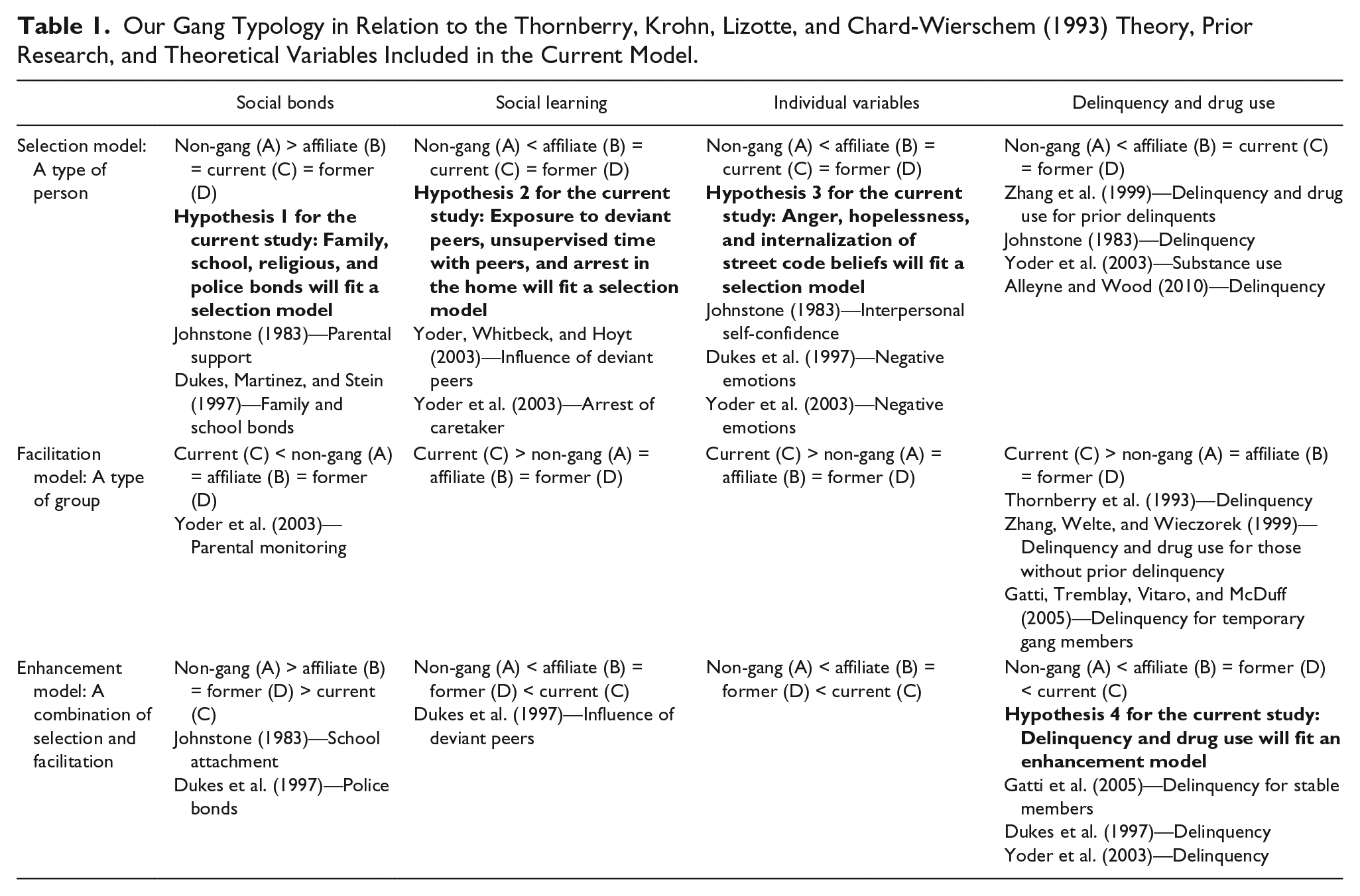
Four cross-sectional studies (Alleyne & Wood, 2010; Dukes et al., 1997; Johnstone, 1983; Yoder et al., 2003) have tested and expanded the Thornberry et al. (1993) theory, evaluating not only the relationship between gang status and delinquency but also other background characteristics. First, Johnstone (1983) observes behavioral and social differences between three groups (uninvolved youth, recruits, and members) among a sample of Black male adolescents from suburban Chicago and find support for selection as the delinquency of the members and recruits was greater than non-members. Next, Dukes et al., 1997 find enhancement for all drug and delinquency measures when observing five groups (non-gang, wannabes, former members, current local-gang members, and current national-gang members) using a school survey of more than 11,000 Colorado youth. Data from homeless and runaway youth led Yoder and colleagues (2003) to conclude support for selection for substance use and enhancement for delinquency as they compared variation across three groups (non-involved, involved, and gang members). Finally, Alleyne and Wood (2010) use responses from five London schools to observe three levels of gang membership (non, peripheral, and full member) finding support for selection. While facilitation finds common support when longitudinal data are used, support for selection and enhancement is most consistent among cross-sectional studies.
To support hypotheses for our social bond, learning, and individual variables (illustrated in Table 1), we further review findings from studies that extend the original theory. To begin, most prior research supports the expectation that non-gang youth exhibit greater pro-social bonds in relation to gang members (see Yoder et al., 2003 for a review). Dukes et al. (1997) observe family, school, religious, and police bonds in a style similar to the present research. The selection model is strongly supported for family and school bonds, while they interpreted results for police bonds as enhancement, and found no variation in religious bonds. Yoder et al. (2003) find that their intermediate and non-gang groups experienced more parental monitoring than gang members (support for facilitation) but Johnstone (1983) finds that parental support was greater for non-gang than either recruits or members (support for selection). Regarding school bonds, Johnstone (1983) finds support for enhancement as their uninvolved group reported higher school adjustment than the intermediate group who showed higher adjustment than gang members. In contrast, Dukes et al. (1997) interpret their results as supporting selection as their wannabe and current member groups scored significantly lower on their educational bonds measure than non-members. Variation in the above summary likely reflects significant differences among the samples of each study, as well as important subgroup variation (males vs. females, for example) within one study.
Next, three studies have measures of peer pressure similar to our own and generally support selection (Esbensen et al., 1993; Yoder et al., 2003) though Dukes et al. (1997) find the enhancement model “the most credible explanation” upon closer examination (p. 152). Although no study has investigated unsupervised time with peers within the Thornberry et al., 1993 theory, Thornberry (1998) has found it to be a risk factor influencing gang membership in the Rochester Youth Development survey. The Yoder et al. (2003) study comes closest to our variable measuring pro-deviant values in the home and found strong support for selection as non-involved youth experienced fewer caretaker arrests than their two gang groups. Two studies (Esbensen & Weerman, 2005; LeBlanc & Lanctot, 1998) support treating deviant beliefs as a risk factor for gang membership, though no prior study has tested such beliefs within the Thornberry et al. (1993) framework. Using a measure as similar to the present as exists, Esbensen et al. (1993) find support for selection for their “normlessness” measure in a sample of Denver adolescents living in “risky neighborhoods” as non-gang youth were significantly less “morally disengaged” when compared with gang members. Although our study is the first to include anger and hopelessness, there is some evidence that negative psychological states will fit the selection model (Dukes et al., 1997; Johnstone, 1983; Yoder et al., 2003). Based on findings from prior research, we hypothesize that social bond (Hypothesis 1), social learning (Hypothesis 2), and individual variables (Hypothesis 3) will fit a selection explanation, and delinquent variables (Hypothesis 4) will fit enhancement.
Method
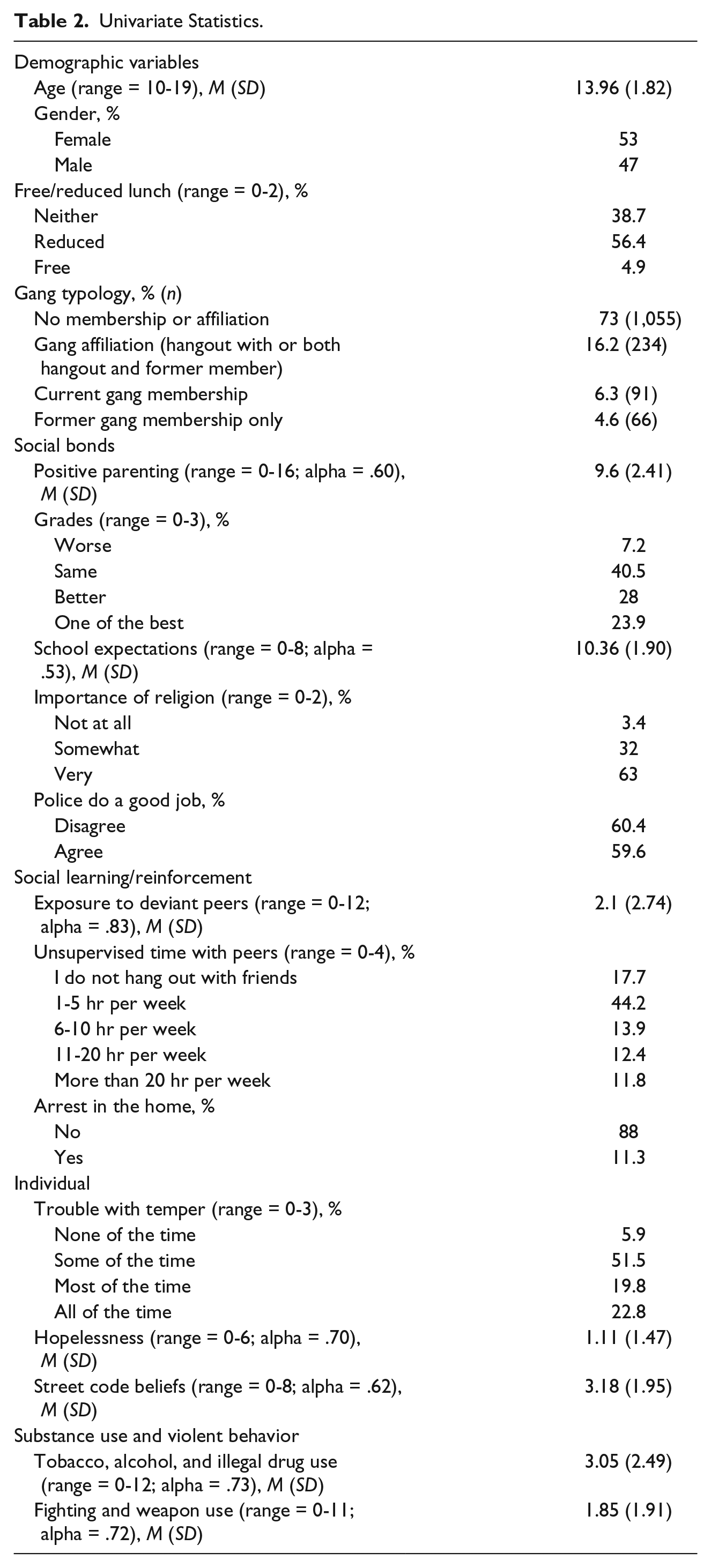
Our study focuses on one of the two most disadvantaged comunas of Medellin, Colombia. In 2008, members of the research team traveled to Medellin to begin to understand Comuna 13, and its place in Medellin and Colombia (see Drummond, Dizgun, & Keeling, 2015 to learn more of our approach). During one visit, we established a partnership with a local non-profit organization in the Comuna whose goal is to provide socialization programs and opportunities for youth and their families. This organization helped identify and approach appropriate public schools and assisted with the administration of the survey in cooperation with our Spanish-speaking author. During the summer of 2009, we surveyed three of six public high schools in the Comuna, asking all students in attendance to participate. After obtaining parental and subject consent, we collected data from 1,475 sixth to 12th graders, approximately 62% of the total number enrolled and approximately 75% of students initially approached. Although it is fairly common to use school-administered surveys to answer questions about juvenile gangs (Alleyne & Wood, 2010; Curry et al., 2002; Dukes et al., 1997; Esbensen & Weerman, 2005), it is important to acknowledge that such a setting is likely underrepresentative of high-risk youth, as those youth often drop out, are habitually truant, or are institutionalized. Next, we discuss the measurement by which our sample is described (Table 2).
Univariate Statistics.
Measures
Three questions were asked to determine gang status: “Have you ever been a member of a gang (0 = no, 1 = yes)?” “Are you currently a member of a gang?” and “Do you hang out with gang members?” Responses to these questions were used to create four groups: the non-gang group (youth responding no to all three questions), affiliates (youth who hang out with gang members but claim no current membership), current gang members (those answering yes to the second question), and former members who have left that lifestyle in the past (those acknowledging former but not current membership or affiliation).
We expand the application of Thornberry et al.’s (1993) original theory by including a number of social and individual variables, and expect that they will be related to differing levels of gang involvement. To evaluate social bonds, we include four of the five types used in the Dukes et al. (1997) study, those associated with parenting, school, religion, and the police. After factor and reliability analysis confirmed the appropriateness of a summative measure (this confirmation process was performed for each scaled measure), a Positive Parenting scale was created from 12 survey questions (survey items used as single or summative measures are listed in the appendix) measuring parental rule setting, monitoring, and discipline (range = 0-16; alpha = .60). Two separate indicators evaluate school bonds the first measuring grades in relation to peers (worse = 0; about the same = 1; better = 2; one of the best = 3). The second school-bond measure added responses to four questions assessing student desire to finish high school and go to college (range = 0-8; alpha = .53). To evaluate religious bonds, survey participants were asked the importance of religion in his or her life (not important = 0, somewhat important = 1, very important = 3). Finally, similar to Dukes et al. (1997), police bonds were examined using student response to one question (disagree = 0, agree = 1).
Three measures evaluate social learning, while three observe variation in individual characteristics. Six survey items were used to assess peer pressure (range = 0-12; alpha = .83). Next, we inquired about the amount of time (measured as 0 = none, 1 = 1-5 hours, 2 = 6-10 hours, 3 = 11-20 hours, 4 ≥ 20 hours) the respondent hangs out unsupervised with friends. The final social learning measure asked if a member of the household (excluding the respondent) was arrested in the last year (0 = no; 1 = yes). We treat this variable as a social learning measure, instead of one evaluating parental/family bonds, since Perea (2001) acknowledged that gang members were more likely to live apart from their families in his observational study from Bogota. Two social-psychological variables are included to measure anger, examined via response to a single question, and hopelessness (range = 0-6 and .70 alpha) measured by a six-item scale. Our final individual variable is an eight-item scale observing Anderson’s (1999) street code beliefs concept (range = 0-8; alpha = .62).
To measure differences in substance use and violent behavior, we created two scales both comprised of seven questions. Our Substance-Use scale adds responses about the frequency and recency of using cigarettes, alcohol, crack/cocaine, and marijuana (range = 0-12; alpha = .73). To measure violence, two questions were asked about the frequency of physical fights, while five questions focused on whether the respondent has carried, brandished, or used a knife or gun (range = 0-11; alpha = .72).
Analysis Plan
The principle purpose of this article is to use cross-sectional survey data from approximately 1,400 youth living in a disadvantaged community (Comuna 13—San Javier) in Medellin, Colombia to build upon earlier research that tests the Thornberry et al. (1993) theory using the “graduated groups” approach (Alleyne & Wood, 2010; Curry, et al., 2002; Donnermeyer et al., 1996; Dukes et al., 1997; Johnstone, 1983; Kakar, 2005; Yoder et al., 2003). To allow for direct comparison, we used analytic techniques common to prior research. For comparative purposes, we first describe the prevalence of current and former gang membership, association with gang members, and lives untouched by any gang association in Comuna. Next, we evaluate cross-group variation in behavioral, social, and individual variables, and seek to confirm whether the patterns observed fit selection, facilitation, or enhancement. Instead of ANOVA (used by Kakar, 2005; Yoder et al., 2003), we ran inferential statistics to confirm variation in gang involvement by age (t-test as age ranged from 10-19), gender (χ2 with male = 1), and whether she or he received free or reduced cost lunch at school (0 = no; 1 = yes reduced; 2 = yes free) as a proxy for social class (χ2). Those results determined which demographic variables were used as controls in our ANCOVA analysis (an approach similar to Alleyne & Wood, 2010; Dukes et al., 1997). Once the ANCOVA determined variation in means for our independent variables of interest across the four gang groups, we include post hoc comparisons for each pair using the Bonferroni method, analysis also common in prior research (Alleyne & Wood, 2010; Dukes et al., 1997; Yoder et al., 2003). While further multivariate logistic regression analysis enhances statistical control, this approach is not found in the related literature as it does not allow for pairwise comparison between the four groups simultaneously but rather comparison of three groups with one reference. Instead, using ANCOVA allows us to interpret our results using Thornberry et al.’s (1993) theory as significant variation or equality between contiguous groups establishes support for a particular model.
Results
Prevalence of Gang Statuses (Table 2)
One quarter of neighborhood youth admit either affiliation with gang members (16.2%) or membership (6.3% current, 4.6% former). Given that our results are based on a school sample, this is likely a conservative estimate of gang influence on youth behavior in Comuna 13, especially since Perea’s (2001) qualitative study of more than 1,000 youth groups in Bogota—38 of them gangs—found that only 50% of youth gang members still attend school in contrast to 90% of the general adolescent population. In relation to prior studies, our status breakdown falls in between that of Dukes et al. (1997), who claim that 86% of their representative school-based sample were neither members nor affiliates, and Yoder et al.’s (2003), who claim that half of their homeless/runaway sample were either members or involved. As perhaps a better comparison, prevalence in Comuna was more similar to that of a cross-sectional study of high-risk urban schools in Trinidad and Tobago (Katz & Fox, 2010), as 7.7% reported gang association and 13% membership (6.8% former, 6.2% current).
Regarding age, similar to a study involving adjudicated males in Montreal (LeBlanc & Lanctot 1998), we found no variation with gang involvement (t test = 1.02) with a minimal mean range from 13.91 (non-gang) to 14.14 (affiliates) years of age. Next, even though the adolescents in our sample attend school in disadvantaged neighborhoods, we felt it important to confirm our suspicion that social class likely had little impact on gang status. Similar to prior studies among homeless/runaway (Yoder et al., 2003) or adjudicated youth (LeBlanc & Lanctot, 1998), no effect for our social class measure was observed (χ2 = 3.85). As is common, we found that girls (χ2 = 64.63***) were significantly more likely to be non-gang or affiliates instead of members. Based on these results, we control for gender alone in the ANCOVA analysis below.
Cross-Group Comparisons
To compare the four groups on variables of theoretical interest, a one-way ANCOVA—including the Bonferroni post hoc test—is used (Table 3). Means for the non-gang group (labeled A in group comparison) are presented in the first numeric column. The second column presents means for our “affiliates” (B) who either claim to “hang out with” gang members or claim former membership in addition to presently “hanging out.” The third column presents means for respondents acknowledging current gang membership (C), while means for youth acknowledging former membership but no current association (D) are located in the fourth column. Presenting the influence of gang association in this gradual manner allows us to observe an increase toward membership, followed by a decline for the group who is no longer a member nor admits to hanging out with members. In the final two columns, inferential tests are used to check for (a) significant variation across groups (the F-test in Column 5), and more precisely (b) significant variation between each pair. Post hoc analysis is performed using the more conservative Bonferroni test, given the dramatic differences (i.e., A = 1,055; B = 234; C = 91, and D = 66) in group size.
Variation Among the Measures of Interest Along the Gang Typology: ANCOVA Results (Controlling for Gender).
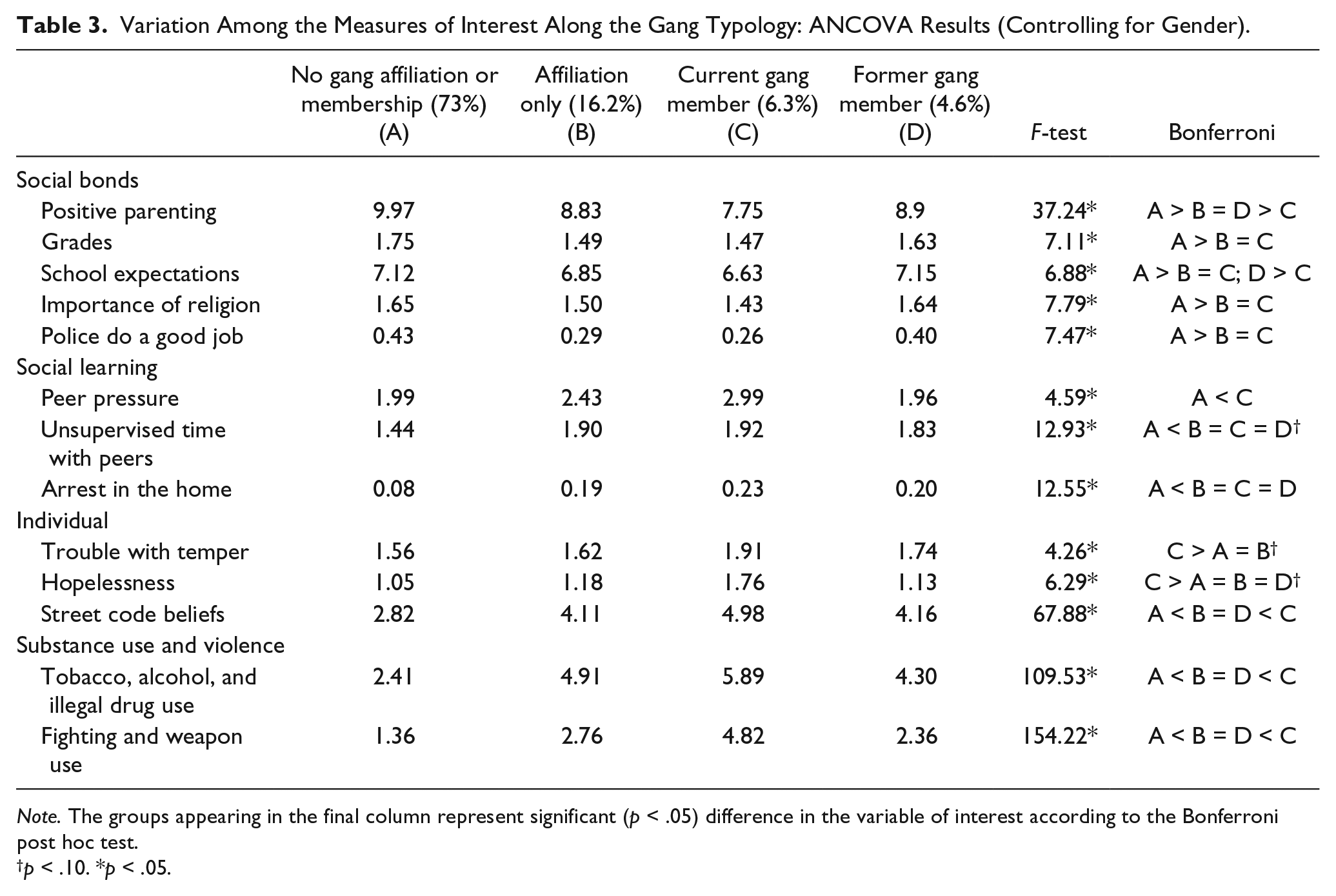
Note. The groups appearing in the final column represent significant (p < .05) difference in the variable of interest according to the Bonferroni post hoc test.
p < .10. *p < .05.
Based on close examination of prior research, we expected family, school, religious, and police bonds to fit the selection model. With the exception of family bonds, our expectations were confirmed. Attachment to school, religion, and a positive perception of police was significantly higher among the non-gang group (A) when compared with both affiliates (Group B) and current members (C). Our positive parenting measure better fits the “mixed” or enhancement model; not only was selection observed (i.e., A differed from B and C), but we also found those currently involved in a gang (Group C) were less bonded to family than affiliates (Group B) and former members (Group D).
As expected, the only model supported in the social learning analysis is selection. Results for spending unsupervised time with peers and having a household member arrested in the last year fully support selection, as the non-gang group (A) was less exposed (M = 1.44 and 0.08, respectively) when compared with both affiliates (M = 1.90 and 0.19) and current (M = 1.92 and 0.23) and former members (M = 1.83 and 0.20). In fact, these latter results were the most robust social learning effects (f = 12.93 and 12.55, respectively) and seem strongly to indicate a “different person/different lifestyle” model.
Results for our individual variables are least supportive of our hypotheses. Regarding anger and hopelessness, we find support for the facilitation model, as current gang members not only express significantly more anger (M = 1.91) and hopelessness (M = 1.76) than the non-gang group (M = 1.56 and 1.05, respectively) but also affiliates (1.62 and 1.18) and former members (1.74 and 1.13). Finally, our street code measure joins positive parenting in strong support for the enhancement model. Not only are non-gang youth less likely to internalize street code beliefs (M = 2.82) in relation to all other groups, the intermediate groups (mean for affiliates = 4.11 and former members = 4.16) internalize fewer negative beliefs than current members (M = 4.98). Patterns illustrating substance use and violence both fit the enhancement model. Specifically, we not only find non-gang youth (A) significantly less involved than all gang groups (B-D) but also affiliates (B) and former members (D) significantly less involved than current members (C).
Discussion
Our study sought to observe the cross-cultural applicability of U.S.-gang theory and research using data from disadvantaged youth from Medellin, Colombia. Before reflecting on the accomplishments of our study, we begin by acknowledging the diversity of measurements in prior research (Esbensen, Winfree, He, & Taylor, 2001). While studies validate that peripheral membership is enough for youth to experience some of the effects of gang membership (Alleyne & Wood, 2010; Dukes et al., 1997; Johnstone, 1983; Yoder et al., 2003), research has also established that the largest attitudinal and behavioral difference is “between the never gang and the ever gang youth” (Esbensen et al., 2001, p. 124). Given the robust nature of the latter finding, most comparative research simply differentiates between gang and non-gang youth. Although dichotomous differentiation has its place, we believe that evaluating gang influence using the “graduated groups” approach allows us not only to observe behavioral difference but also enhance our understanding of the social background and individual traits of multiple gang statuses, especially those of the peripheral member. In fact, Thornberry et al. (1993) conclude by stating that “research should attempt to identify systematically those factors that separate the more transient from the more permanent gang members” (p. 83). We believe that our analysis supports the importance of identifying protective and risk factors, both for former members and for those who claim affiliation but not full membership. Specifically, it is through understanding the uniqueness of these groups that interventions aimed to disrupt the process toward membership or escalate programs of desistance can be established. Before more closely examining our findings, we discuss some limitations of our study.
First, we acknowledge the restrictions of cross-sectional data which limits our ability to more deeply establish the processes examined here and recognize that a stronger test of the Thornberry et al. (1993) theory would examine the process of affiliation, membership, and desistance over time. That said, we are pleased with our ability to examine the process with cross-sectional data, using the “graduated groups” method, and hope to use our network in Medellin to collect multiple waves of data in the future. In addition, though we sought advice and involvement from local Colombians (both academics and residents of the neighborhood), our survey may reflect bias. In fact, it is important to note that several of our scale measures have low alpha scores even though factor analysis was used when developing each scale. In defense of this criticism, we acknowledge that all scales were established measures. Furthermore, they had been used previously in a longitudinal study of disadvantaged adolescents in the American South where they resulted in low alphas during some waves (Bolland, 2007). However, we are encouraged that our measures behaved in a manner consistent with theoretical expectation and pleased by the construct validity established as each scale was theoretically consistent with other variables in the study (i.e., social bonds were protective factors while social learning led to risky outcomes, etc.). While we believe that such results are encouraging, we also look forward to constructing a more organic survey which not only tests processes established as important in North America but further considers unique elements of Comuna when our collaborative work resumes. Finally, as noted above, studying the prevalence of gang involvement by conducting a school-based survey is not optimal as it likely undersamples those most at risk for association. Fortunately, our partners in Medellin have offered to assist in a neighborhood-based survey, and we are making preparations to take advantage of this offer. While it is important to acknowledge these limitations, we are pleased to bring observations from Latin America into the adolescent gang literature, and offer a critical review and interpretation below.
We believe that our results both complement and expand prior conclusions that test the Thornberry et al. (1993) model. Our first expected result is most complementary: We concur with Dukes et al. (1997) and Yoder et al. (2003) that delinquency and substance use conclusively fit enhancement (Table 4). When using cross-sectional data to measure the impact of gang status on adolescent deviance, it appears that gangs are certainly attractive to a “kind of person” as the non-group is significantly less involved than all others. However, once involved, the “kind of group” attribute enhances negative behavior most effectively during membership alone. Moreover, gang-involved youth (affiliates and members) are drawn from those less attached to school, religion, and authority (police) and have more deviant associations. These findings support our selection expectation that youth are formed prior to involvement, and that involvement does not further enhance deviant associations or destabilize most social bonds (Table 4). Regarding social bonds, prior research is most inconsistent; the only prior study to include religious bonds (Dukes et al., 1997) found no effect. Perhaps, the difference in ecological contexts is the most obvious explanation for this inconsistency, as Latin America is a world region with arguably a higher attachment to religion. In fact, 63% of our sample stated that religion is “very important” (Table 2). Dukes et al. (1997) was also the only prior study to include police bonds and found support for enhancement as their wannabe and non-gang groups had significantly higher bonds than former members whose own bonds exceeded current members. Our study endorses selection as our non-gang youth exhibited higher bonds with police than either affiliate or current members. One final methodological difference of note between the two studies is as follows: Their sample appears to be from a “mainstream” Colorado community whereas our sample is significantly disadvantaged. Given the more antagonistic relationship between police and low-income residents, this methodological difference no doubt affects the inconsistency between the two studies (McIlwaine & Moser, 2003). Regarding the remaining social-bond measures, our school-attachment findings are similar to those of Dukes et al. (1997) in support of a selection model though in contrast to Yoder et al. (2003) who found support for facilitation and Johnstone (1983) who found enhancement. The consistency between our study and Dukes et al.’s (1997) concerning school attachment could be attributed to the fact that both samples were surveyed in a school setting versus at home (Johnstone, 1983) or in the streets, shelters, and drop-in centers (Yoder et al., 2003).
ANCOVA and Post Hoc Findings as They Relate to the Thornberry, Krohn, Lizotte, and Chard-Wierschem (1993) Theory and Our Original Hypotheses.
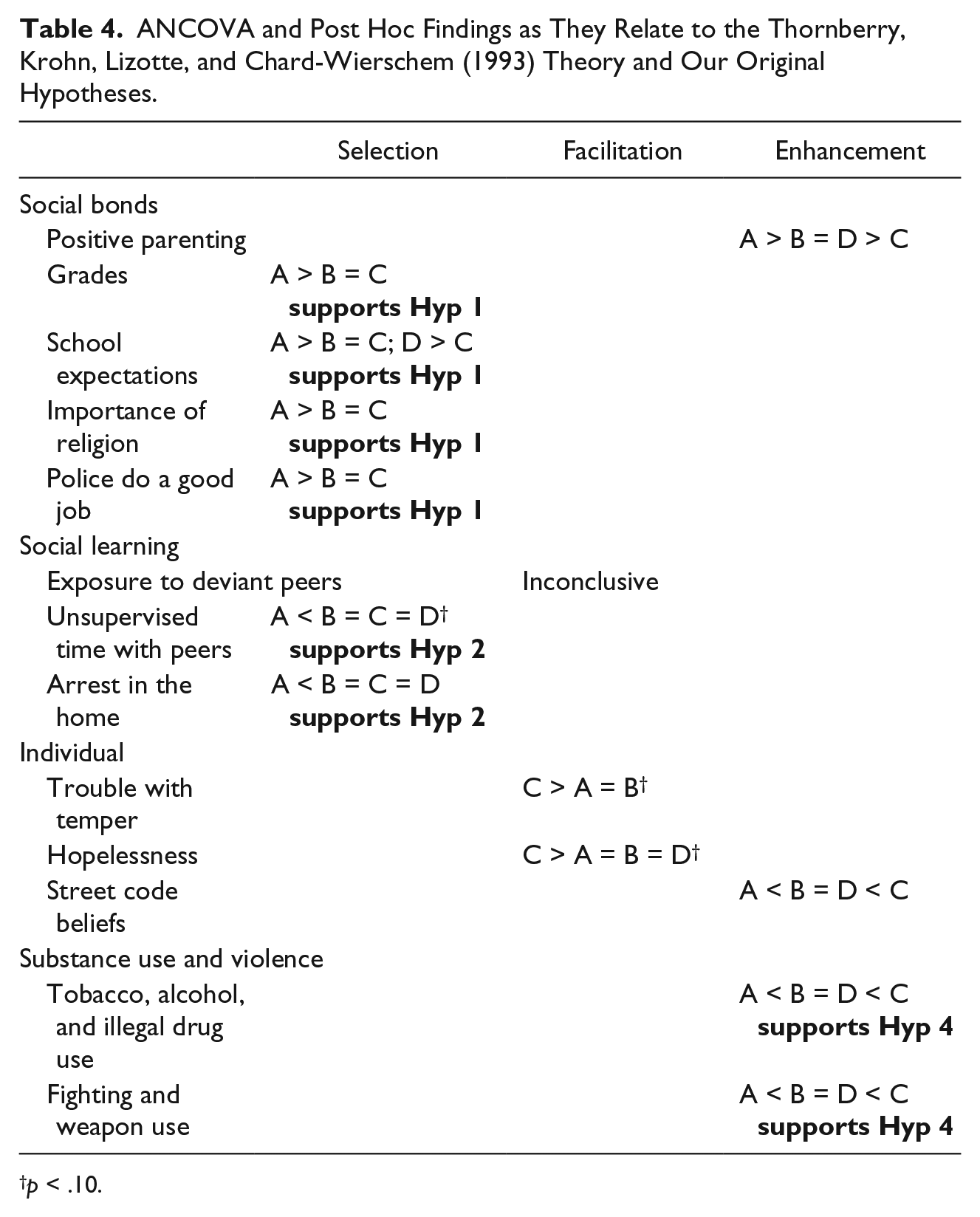
p < .10.
In regard to our opportunity measures (Table 4), our non-gang group was significantly less likely than any gang-involved group to either live with someone who was arrested in the last year, a finding consistent with Yoder et al. (2003), or spend unsupervised time with peers, a finding illustrative of Thornberry’s (1998) expectation. Unfortunately, we are unable to draw a conclusion regarding the effects of peer pressure, as variation was observed only between non-gang and current gang members (prior research support selection Yoder et al., 2003 or enhancement Dukes et al., 1997). Few respondents experienced significant peer pressure (the average was 2.1) from a range of 0 to 12 (see Table 2). Such a low mean varies significantly from results predicting gang involvement among disadvantaged adolescents in Mobile, AL, as their average for the same scale (using the same questions and response categories) was 15.94 on a scale of 6 to 18 (Jaggers et al., 2013). When differences in scaling are accounted for, their mean is 7.84 points higher. Such a difference is likely cultural, as scholars have emphasized that many Latin American adolescents undertake adult-like responsibilities, especially familial responsibilities, and as such the influence of peers is likely far less than in the United States (Umana-Taylor & Bamaca-Gomez, 2003).
Some of our most significant contributions are those which fail to support our initial hypotheses (Table 4). Such consideration also allows us directly to address Thornberry et al.’s (1993) call to identify mechanisms which differentiate transient versus currently committed members. First, we observe that current gang membership facilitates a negative emotional state in which adolescents are pessimistic about their future. This finding, though inconsistent with expectations, is intuitive, as negative emotions are true states of mind and, as such, particularly vulnerable to the current situation. It is also a rather hopeful finding as it speaks to the potential benefit of positive interventions for former gang members and a more reachable mind-set for affiliates as they fail to express that they have nothing to lose. Not only are school expectations of our former members consistent with non-gang members and significantly greater than affiliates or current members, but we find that their religious and police bond scores are as well, even though these latter similarities fail to reach statistical significance using the conservative Bonferroni test. While logical, the tremendous impact of family and deviant beliefs on differentiating group membership is also unexpected (Table 4). That is, while family is consistently important to delinquency theorists, it appears especially so within a world region in which strong family ties are impactful throughout the life-course (Umana-Taylor & Bamaca-Gomez, 2003; Vega, 1995). Current results in support of enhancement suggest that positive parenting prevents Comuna adolescents both from any gang involvement and from becoming or remaining “current” gang members.
In regard to deviant beliefs, our findings suggest enhancement as non-members are least likely to internalize such beliefs, while affiliates and former members are significantly less likely than current members. That non-members score consistently lower than all other groups is consistent with the benefit of the attachment illustrated in our findings for social bonds. However, association with gangs (either as affiliates or as former members) presents violence-affirming beliefs based on the tenuous status of the group itself. Thornberry et al. (1993) spend time theorizing that much delinquency associated with gangs is a product of in-group status maintenance. They suggest that “when the status of the gang leaders is threatened they often resort to out-group aggression” (p. 58) to help restore solidarity. As a result, the beliefs of even transient members, while considerably lower than one presently “in the life,” move more toward amorality when compared with adolescents with no exposure at all. As a guard against the development of deviant beliefs among disadvantaged youth, relationships with mentors offer adolescents the most promising alternative to gang attachment. In conclusion, while our results support the selection model for most theoretical variables and enhancement for behavioral outcomes, our strongest contribution is our study’s ability to demonstrate the temporal impact of gang involvement.
Footnotes
Appendix
Declaration of Conflicting Interests
The author(s) declared no potential conflicts of interest with respect to the research, authorship, and/or publication of this article.
Funding
The author(s) received no financial support for the research, authorship, and/or publication of this article.