







Abstract
While transitions to college can be stressful, links between distinct types of college transitions and changing student well-being remain unclear. For instance, peer ability often shifts from high school to college, though students differ markedly in how much peer ability change they experience. Here, we draw on national longitudinal data (National Longitudinal Study of Adolescent to Adult Health [Add Health]; Waves 1 and 3; N = 1,453) to demonstrate how peer ability transitions from high school to college relate to changes in depressive symptoms and self-esteem, net of student personal background and school-average levels of peer ability. We find that depressive symptoms increase by 27% for students experiencing lowered peer ability across their college transition, relative to no substantial change in peer ability. Meanwhile, heightened peer ability in college links to neither diminished nor enhanced student well-being across the transition. Overall, student well-being relates more closely to collegiate than high-school peer ability.
Transitioning to college is a stressful experience for many youth (e.g., Chung et al., 2014; Conley, Durlak, & Kirsch, 2015; Conley, Kirsch, Dickson, & Bryant, 2014; Wagner, Ludtke, Jonkmann, & Trautwein, 2013). Schulenberg, Sameroff, and Cicchetti (2004) have even suggested that college may “permanently alter” life-course trajectories of well-being (p. 802). However, it remains unclear what makes some college transitions stressful and others relatively smooth. Differing social and academic climates between high school and college, and among colleges and high schools, seem to matter fundamentally to student adjustment, though precise magnitudes and natures of these ecological effects remain debated (e.g., Deutschlander, 2017; Fletcher & Frisvold, 2011; Kurlaender & Grodsky, 2013).
Average student ability and other related school-level measures including teacher support, safety, classmate turnover, and socioeconomic and racial composition have been shown to predict student health and well-being (e.g., Bifulco, Fletcher, & Ross, 2011; Dufner, Reitz, & Zander, 2015; Fletcher & Frisvold, 2011; Marsh, Trautwein, Ludtke, Koller, & Baumert, 2006; Smokowski et al., 2014; Wang & Dishion, 2012), suggesting that ecological processes matter, but it remains unclear how changes in school ecologies—rather than schools taken alone—might factor into student well-being changes across the transition to college. School transitions are important to well-being in their own right, as they involve changes in ecological factors, such as changes in networks of social relationships, institutional or teacher resources, and peer characteristics, and these changes are experienced and interpreted by individuals with regard to both their former school contexts and their current ones (Armstrong & Hamilton, 2013; Conley et al., 2015; Conley et al., 2014; Gasper, DeLuca, & Estacion, 2010, 2012; South & Haynie, 2004).
In this study, we draw on national longitudinal data to relate ecological changes at the school level to changes in personal mental well-being from high school to college. To provide a meaningful demonstration of how changing ecologies might matter to student adjustment across the college transition, we draw on a well-established tradition of research focused on how school-average peer academic ability matters to individual student outcomes (e.g., Bifulco et al., 2011; Dufner et al., 2015; Fletcher & Frisvold, 2011; Marsh et al., 2006; Smokowski et al., 2014; Wang & Dishion, 2012; Wouters, Germeijs, Colpin, & Verschueren, 2011). By borrowing an innovative modeling strategy anchored into social mobility estimation techniques (Sobel, 1981, 1985), we analyze how changes in peer academic ability contexts may matter to changes in student depression and self-esteem from high school to college.
Background
There is a long research tradition in personality psychology and sociology of health examining how major stressors, life events, or life transitions shape changes in youth well-being (Lucas, 2007; Luhmann, Hofmann, Eid, & Lucas, 2012; Pearlin & Bierman, 2013). A dedicated subprogram of longitudinal research, nascent in recent decades, considers how student well-being changes across the college experience, from arrival on campus until graduation or beyond (e.g., Chung et al., 2014; Conley et al., 2015; Conley et al., 2014; Wagner et al., 2013; Wang, Wu, Song, Wu, & Cai, 2017). Wagner and colleagues (2013) examined changes in self-esteem across 4 years in a sample of young adults. After taking normative trajectories into account, they found marginal positive associations between self-esteem and being a university student. However, student experiences within universities vary widely in ways indicated to some extent by academic success. Helping to remedy this gap, Chung and colleagues (2014) followed a university cohort, finding that normative drops in self-esteem occurred during the first semester in college but rebounded somewhat by the end of the first year with slight increases for the remainder of the university career, especially for those who had high academic performance. Although this study usefully reveals associations between academic performances and self-esteem, it nonetheless leaves unclear whether self-esteem trajectories are tied to ecological processes that differentiate colleges or universities from one another.
Indeed, even in a recent study of self-esteem trajectories across collegiate careers, Wang and colleagues (2017) concluded that a limitation of their work was their inability to determine whether downward trajectories evidenced in their sample may have been due to recruiting study participants from a top university. For instance, student self-evaluations tend to suffer in more rigorous academic environments, a well-established phenomenon known as the big-fish-little-pond-effect (BFLPE). Researched programmatically by Herbert Marsh and colleagues (e.g., Marsh et al., 2008; Marsh et al., 2006), the BFLPE has been demonstrated in a variety of countries and academic subjects and contexts, suggesting that it is a widespread or even universal phenomenon influencing student evaluations or well-being. The BFLPE research program carries the distinct strength of focusing on the relevance of ecological levels of student ability to individual-level student adjustment, where adjustment is measured in terms of perceived or self-rated intelligence as well as academic self-concepts (Marsh et al., 2008; Marsh et al., 2006).
Extant work on student well-being across the college transition, while quite nuanced, has overlooked particular combinations of high school and college environments that by definition form the college transition. That is, studies of college adjustment focus on student adjustment at college irrespective of high school origins, or they use individual factors such as baseline mental well-being or adjustment, or family socioeconomic background, attempting to proxy high school preparation (e.g., Brissette, Scheier, & Carver, 2002; Conley et al., 2015; Conley et al., 2014; Srivastava, Tamir, McGonigal, John, & Gross, 2009). As a result, we know little about the effects of changes or stabilities in qualities of academic environments on mental health across the college transition (Dai & Rinn, 2008). Ignoring either the college or high school environment is likely an important shortcoming, given how mental well-being typically changes in proportion to the degree of ecological or social change that individuals experience (Houle, 2011; Lucas, 2007; Luhmann et al., 2012; Pearlin & Bierman, 2013).
Relating Changes in School-Average Peer Academic Ability to Changes in Personal Well-Being
Relevant ecological research into student adjustment and well-being suggests that school-average peer academic ability usefully indexes learning, socialization, peer networks, expectations, and resources that characterize an academic environment. Average peer academic ability indicates normative rigor of class curricula and difficulty of teacher expectations, with higher levels of measured student aptitude usually being consistent with more academically demanding coursework and teachers (Jennings, Deming, Jencks, Lopuch, & Schueler, 2015; Schneider & Keesler, 2007). Next, school-average peer academic ability indicates peer standards for high achievement, with higher average student ability generally increasing the tendency to view one’s own abilities as inadequate, controlling for personal cognitive ability or academic performance (Marsh et al., 2008; Marsh, Trautwein, Ludtke, Koller, & Baumert, 2007; Wouters et al., 2011). Third, school-average peer academic ability indexes the average level of importance or salience of academic success to overall student well-being, as schools with higher ability students tend to place a greater normative emphasis on academic success (Attewell, 2001; Espenshade, Hale, & Chung, 2005). Existing studies have documented associations between measures of school-average academic ability and diverse personal student outcomes, including academic performance, specific and general self-esteem, and overall well-being or behavioral problems (Bifulco et al., 2011; Dufner et al., 2015; Fletcher & Frisvold, 2011; Marsh et al., 2006; Smokowski et al., 2014; Wang & Dishion, 2012; Wouters et al., 2011).
It remains, however, unclear how transitions in their own right, net of the high school and college academic environments defining them, matter for personal well-being during early adulthood. Changes in student well-being may reflect diverse and perhaps countervailing social mechanisms operating across school transitions. Below, we overview several possible mechanisms or processes relating changes in school-average peer ability to changes in mental well-being.
Decreased School-Average Peer Academic Ability From High School to College
Matriculating at a college where average peer academic ability is lower relative to one’s high school may enhance student well-being due to higher probability of academic success, more encouraging social comparisons with peers, and increased chances of meaningful social ties with faculty. Specifically, because students evaluate their own academic abilities with respect to peers who also attend their school, the “pond” of social comparison could become more favorable from high school to college, consistent with increased well-being (Marsh, 1987; Marsh et al., 2008). Meanwhile, academic or cultural skills gained in more rigorous high schools could translate more easily to attention, engagement, or positive regard from teachers in less rigorous academic environments (Andersen & Jaeger, 2015; Armstrong & Hamilton, 2013; Bourdieu, 1990; Lareau & Weininger, 2008). Mentorship or other meaningful social ties with faculty can boost school attachment and enhance well-being (Umbach & Wawrzynski, 2005; Webber, Laird, & BrckaLorenz, 2013).
Oppositely, decreased peer academic ability from high school to college may diminish student well-being if this kind of transition is experienced as a personal failure. High-school environments are ecologically inhabited by teachers, counselors, and peers who instill college aspirations in students consistent with the prospects of past school graduates, independent of the personal or family backgrounds of specific students (Bourdieu, 1990; Lareau & Weininger, 2008; Nora, 2004). In turn, higher ability high schools tend to produce expectations for attending more selective colleges (Espenshade et al., 2005). An ecologically inculcated sense of what type of college education one ought to achieve could possibly set educational expectations that, if unmet, may trigger losses in mental well-being due to the obstruction of personal goals (Hardie, 2014; Pearlin & Bierman, 2013; Reynolds & Baird, 2010). Because higher education is a pivotal stage in emergent adulthood, feeling a sense of failure or inadequacy across the college transition may influence overall mental well-being.
Increased School-Average Peer Academic Ability From High School to College
Attending a college where average peer academic ability is higher relative to what was experienced in high school may diminish a student’s sense of worth through decreased academic performance or less favorable social comparisons. In addition, students may struggle to receive academic attention or mentorship relative to high school due to heightened competition for instructor time or expertise relative to high school (Andersen & Jaeger, 2015). Oppositely, gains in peer academic ability across the transition may translate into increased mental well-being, as these gains represent higher social prestige of one’s peers or an opportunity to bask in their glory (i.e., “reflected-glory effect”; Marsh, Kong, & Hau, 2000). That is, as the prestige of one’s social affiliations increases, individuals may find it more rewarding to identify with their peers—rather than strive for distinction against them through direct academic competition (Brewer, Manzi, & Shaw, 1993; McFarland & Buehler, 1995). In general, membership in high-status social groups is linked to higher levels of mental and physical well-being across the life span (Demakakos, Nazroo, Breeze, &, Marmot, 2008; Quon & McGrath, 2014).
Overview of the Present Study
We implement a longitudinal analysis of self-esteem and depressive symptomatology, examining how changes in these well-being outcomes from adolescence to early adulthood relate to changes in student ecologies from high school to college. Our analysis features longitudinal diagonal social mobility models (Houle, 2011; Houle & Martin, 2011; Sobel, 1981, 1985), which enable the identification and estimation of social mobility effects net of ecological characteristics of particular social environments composing transitions. Therefore, our use of diagonal mobility models (DMMs) allows us to obtain estimates of transition effects as distinguished from school effects, offering unique promise in understanding how college transitions in their own right relate to changes in student mental well-being.
Method
Data
In the National Longitudinal Study of Adolescent to Adult Health (Add Health; Harris, 2009), 20,747 adolescents enrolled in Grades 7 to 12 (ages 12-20) from a nationally representative sample of schools completed the Wave 1 in-home questionnaire in 1995. This baseline questionnaire assessed cognitive ability, family background, and mental well-being during high school. In 2001-2002, 15,170 students were reinterviewed (Wave 3; ages 18-26). Wave 3 interviews collected information about mental well-being during college and early adulthood as well as information on the postsecondary institutions attended. Our final analytic sample contains individuals who attended high school in Wave 1, did not change high schools from Wave 1 to 2, and are enrolled as undergraduates in a 4-year college in Wave 3 (N = 1,453). We focus on 4-year colleges, where residence at school and frequent academic and informal social interactions typify campus life (Strauss & Volkwein, 2004). Additional analyses addressing sample selection using regional college availability as an instrument did not alter the main conclusions presented here (available on request).
Measures
Dependent variables: Mental well-being (depression and self-esteem)
In a nine-item version of the Center for Epidemiologic Studies–Depression Scale (CES-D; Radloff, 1977), respondents are asked how often (0 = never/rarely; 3 = most/all of the time) each of the following was true during the past week: “bothered by things that usually don’t bother you,” “had the blues,” “felt that you were just as good as other people” (reverse coded [RC]), “had trouble keeping your mind on what you were doing,” “felt depressed,” “felt too tired to do things,” “enjoyed life” (RC), “felt sad,” and “felt that people disliked you” (range = 0-27;
In Rosenberg’s Self-Esteem scale (Rosenberg, 1965), respondents are asked how much they agree (1 = strongly disagree; 5 = strongly agree) with the following statements: “You have many good qualities,” “You have a lot to be proud of,” “You like yourself just the way you are,” and “You are doing things just about right” (range = 4-20;
Independent variable: Change in school-average academic ability
High-school-average ability is assessed using school-average Peabody Picture Vocabulary Test (PPVT) scores. Although focused on verbal aptitude, the PPVT provides a reasonable estimate of general scholastic ability (Bifulco et al., 2011; Dunn & Dunn, 1981). PPVT scores are unavailable at the college level in Add Health. Therefore, we implement the available alternative measure, the college’s national SAT ranking (i.e., an institutional rank corresponding to the median SAT score of matriculating students). PPVT scores correlate strongly with other standardized test scores, including the SAT (Smith, Smith, & Dobbs, 1991). The peer academic ability transition (

where
Importantly, an alternate form of Equation 1a based on matches between individuals and schools is presented:

in which the change in school-average ability is expressed in terms of a change in the difference between school-average ability and personal ability, reduces mathematically to Equation 1a. That is,
School-level control variables (high school)
To adjust for socioeconomic differences at the school level independent of academic characteristics (Marsh et al., 2007), we control for high-school type (private or public) and school socioeconomic standing (SES). School SES is a composite of two common measures of socioeconomic advantage: parental education (percentage of students who have a parent with a college degree) and the proportion of students not receiving free or reduced-price lunch (e.g., Day et al., 2016; Nicholson, Slater, Chriqui, & Chaloupka, 2014). Principal components analysis yielded a school SES index (values: −2.008 to 2.496).
Personal or student-level control variables
We control for individual cognitive ability during high school via the student’s own PPVT score. To address well-being prior to college entry, baseline mental well-being is controlled (either depression or self-esteem) as is self-reported physical health. Moreover, we control for baseline attachment to school, assessed by three items: “You feel close to people at your school,” “You feel like you are a part of your school,” and “You are happy to be at your school” (1 = strongly disagree and 5 = strongly agree; summed to form a composite index of school attachment). Finally, expectations for college graduation are controlled (0 = no chance to 8 = it will happen).
Sociodemographic control variables include gender, age, self-reported race and ethnicity (non-Hispanic White [reference], non-Hispanic Black, other race/ethnicity), highest parental educational attainment, family household income, any receipt of public assistance (0 = no, 1 = yes), and residence with both biological parents during high school (0 = no, 1 = yes).
Table 1 shows descriptive statistics. About 74% of the sample experienced either an increase or decrease in peer academic ability across the college transition, with decreases (51%) more than twice as common as increases (23%). Most (73%) of the students who experienced a peer ability decrease came from a high-ability secondary school (i.e., a high school in the Top 2 quintiles), which is consistent with the recent findings on the ubiquity of academic undermatch in recent college cohorts (Deutschlander, 2017).
Descriptive Statistics (Add Health).
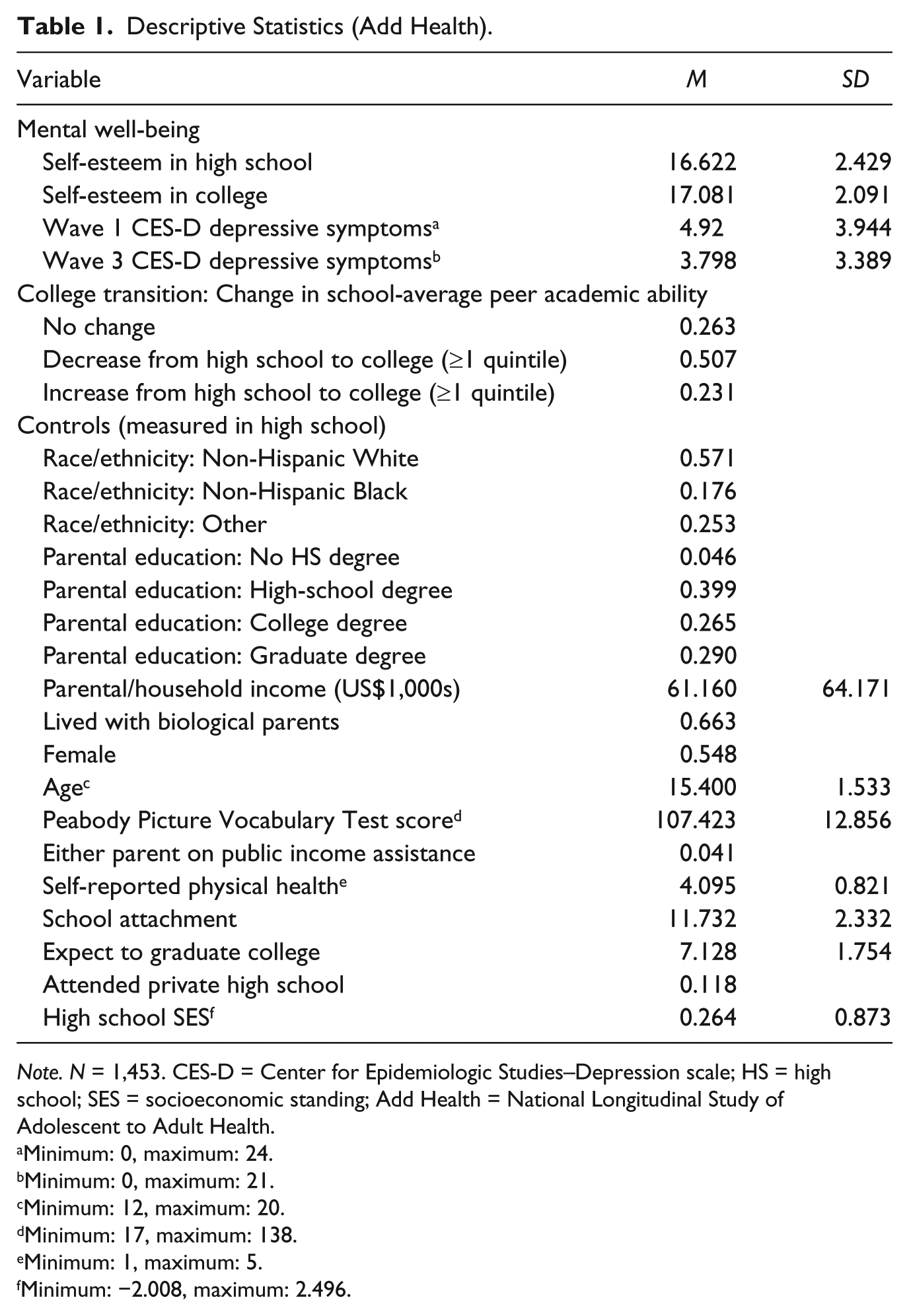
Note. N = 1,453. CES-D = Center for Epidemiologic Studies–Depression scale; HS = high school; SES = socioeconomic standing; Add Health = National Longitudinal Study of Adolescent to Adult Health.
Minimum: 0, maximum: 24.
Minimum: 0, maximum: 21.
Minimum: 12, maximum: 20.
Minimum: 17, maximum: 138.
Minimum: 1, maximum: 5.
Minimum: −2.008, maximum: 2.496.
Analytic Approach: DMMs of Mental Well-Being
A linear regression that fits mental well-being as a function of average peer academic ability transitions from high school to college fails to control for differing origins (variation in high school average peer ability) and differing destinations (variation in college average peer ability), as transition is defined arithmetically as a difference between a destination and an origin. To solve this underidentification problem that severely biases ordinary regression estimates of transition effects (see Hendrickx, De Graaf, Lammers, & Ultee, 1993, for a detailed discussion), we use a DMM to obtain estimates of associations between ecological transitions and mental well-being (Sobel, 1981, 1985). A DMM achieves identification of transition effects by using nonmobile students who originate from or end up in schools of similar ability quintiles as the reference group for students who experience changes (i.e., mobility) in average peer academic ability from high school to college. That is, nonmobile students occupy the same peer ability standing across the college transition, and thus may be considered the best representatives of that rank or standing (Houle, 2011; Sorokin, 1959). The DMM accounts for a student’s high school average peer academic ability by adjusting for the average mental well-being of students who attend schools of that rank in both high school and college. Likewise, a student’s college average peer academic ability level is taken into account for the average mental well-being of students who attend colleges of that ability level and who also originate from similarly ranked high schools. For example, the DMM accounts for the high school origins and college destinations of students graduating from high schools in Quintile 1 and attending colleges in Quintile 3 by separately controlling for the average mental well-being of students who come from high schools and end up in colleges with quintile ranks of 1, and of students who come from high schools and end up in colleges with quintile ranks of 3.
The DMM is specified as follows:


where
Because we control for the precollege value of Y, we interpret the βs as changes in mental well-being from high school to college linked to experiencing mobility (increase or decrease) in peer academic ability. Because we control for individual PPVT score, we interpret the βs as the effects of mobility independent not only of origin and destination effects but also of individual cognitive ability. Estimates for q, known as the destination weight, range from 0 to 1, where values near 1 indicate that mobile individuals’ mental well-being resembles that of nonmobile individuals in the same college quintile rank (as opposed to high school).
For each well-being outcome, we estimate two DMMs using the Diagonal Reference (DREF) command from the general nonlinear models (GNMs) package in R (Turner & Firth, 2007): First, we estimate a model without the transition indicators to determine the degree to which mobile individuals resemble nonmobile individuals in their high school (origin) or college (destination) quintile ability rank with regard to the outcome. In a second model, we enter the mobility indicators to estimate the well-being effects of changes in peer academic ability. Here, multiple imputation on 10 datasets is used to replace missing data on any of the covariates, though results do not differ without imputation or when more limited sets of covariates are used. Household income (22%) and expectations for college graduation (29%) have the largest rates of nonresponse. We use unweighted estimation, which yields consistent and efficient estimates after controlling for the characteristics used in the sampling design (Winship & Radbill, 1994). Additional models revealed similar effects of transitions on mental well-being once time spent in college is controlled, and also revealed no statistical interactions of number of years in college with transition indicator variables (available on request).
Results
Descriptive Results: Cross-Tabulations of Well-Being by School-Average Peer Ability Quintiles
Table 2 shows mean standardized depression by high school and college peer academic ability quintile. Nonmobile students (on the shaded diagonal) report levels of depression near or below average (standardized depression score of 0). Meanwhile, students exposed to higher ability colleges relative to their high school (above the diagonal) report lower levels of depression (mean depression = 0.005) compared with students transitioning into lower ability colleges (below diagonal; mean depression = 0.095). Table 3 similarly gives a descriptive overview of self-esteem scores. Students exposed to increases in peer academic ability (above diagonal) report greater self-esteem (M = 0.027) than students exposed to lesser peer ability relative to high school (M = −0.040), though here the raw difference is smaller (0.067).
Depressive Symptoms (CES-D) in College (Add Health Wave 3), by Changes in School-Average Peer Academic Ability.
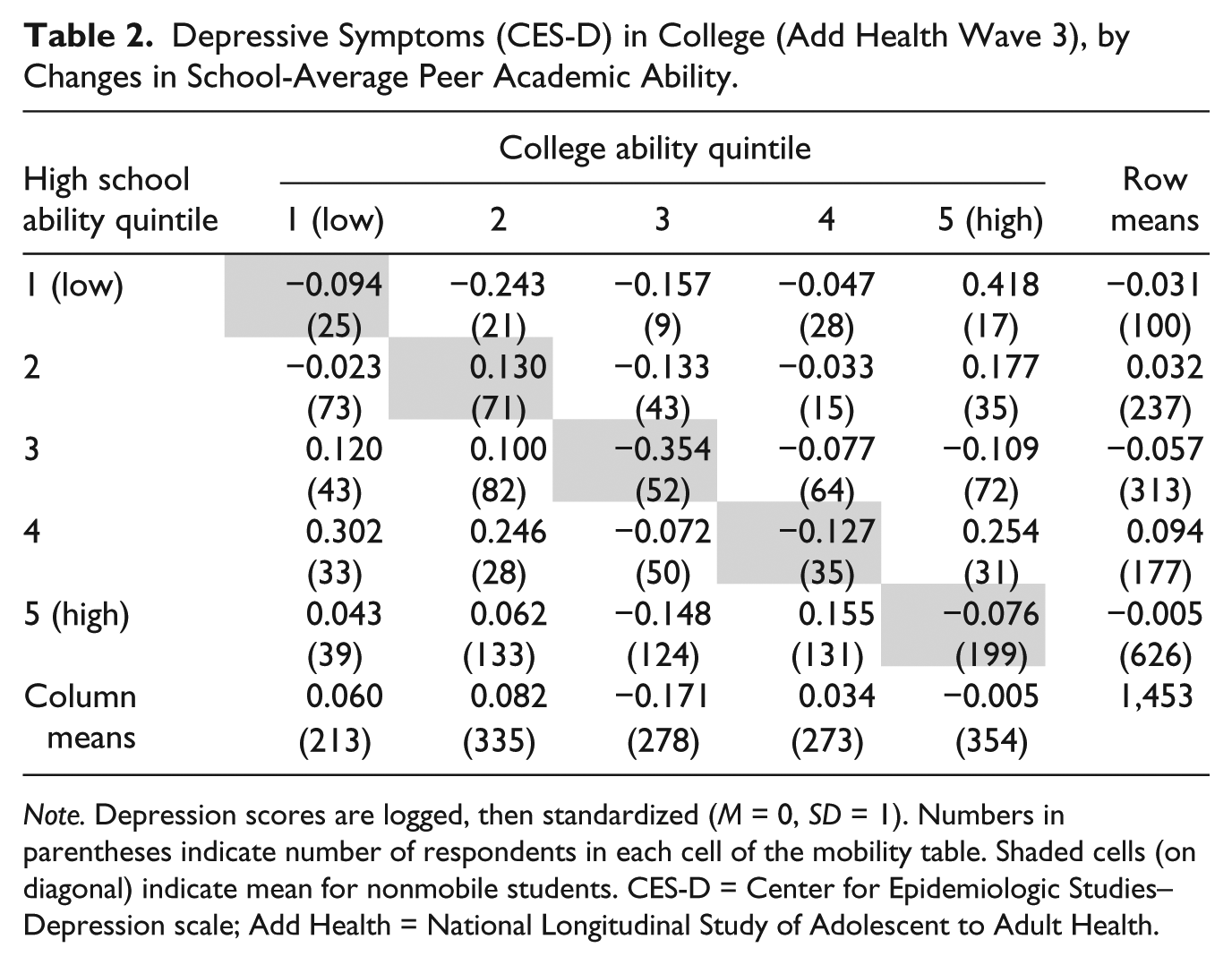
Note. Depression scores are logged, then standardized (M = 0, SD = 1). Numbers in parentheses indicate number of respondents in each cell of the mobility table. Shaded cells (on diagonal) indicate mean for nonmobile students. CES-D = Center for Epidemiologic Studies–Depression scale; Add Health = National Longitudinal Study of Adolescent to Adult Health.
Self-Esteem in College (Add Health Wave 3), by Changes in School-Average Peer Academic Ability.
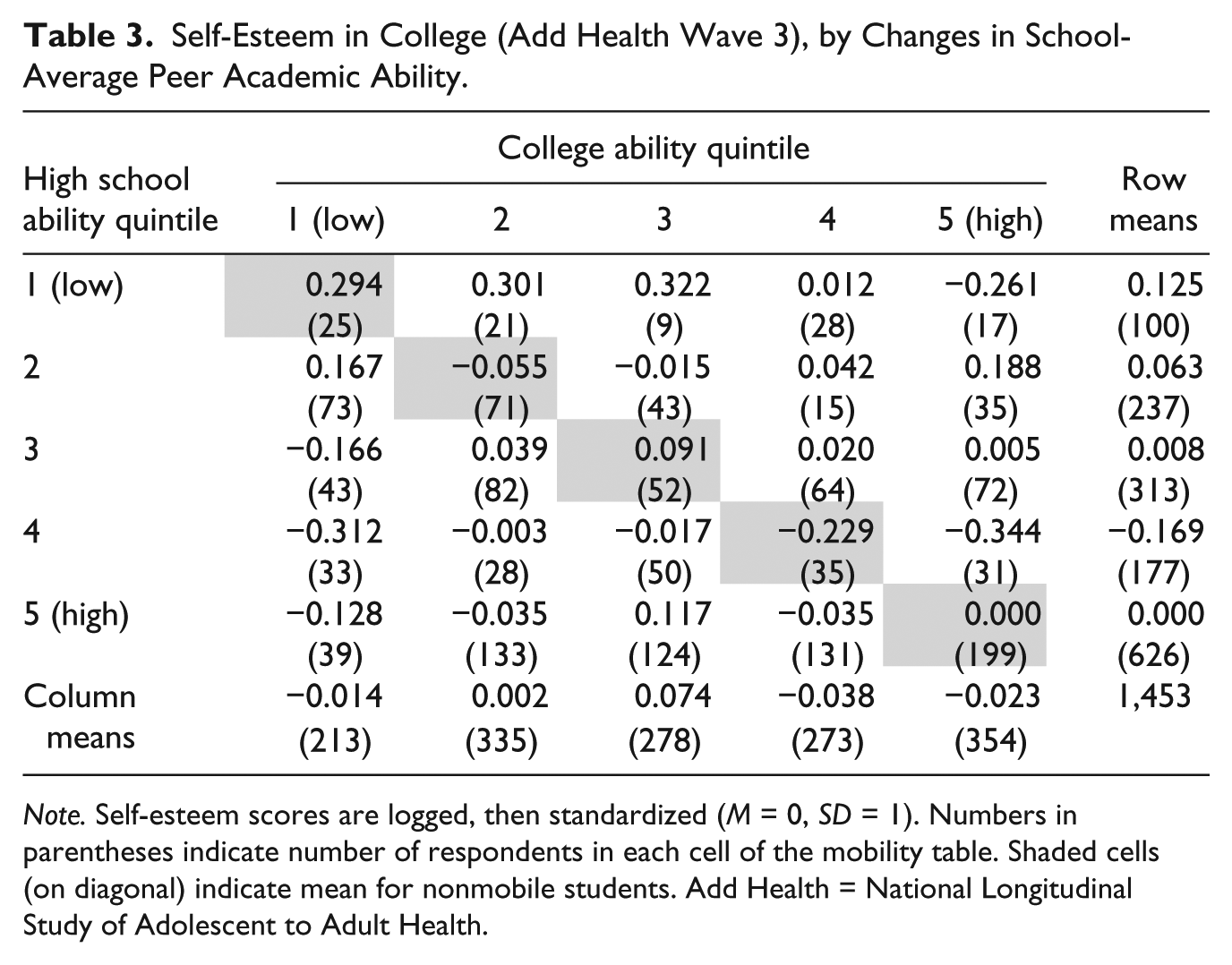
Note. Self-esteem scores are logged, then standardized (M = 0, SD = 1). Numbers in parentheses indicate number of respondents in each cell of the mobility table. Shaded cells (on diagonal) indicate mean for nonmobile students. Add Health = National Longitudinal Study of Adolescent to Adult Health.
DMMs of Mental Well-Being
Depressive symptoms (CES-D)
Table 4 summarizes results from lagged DMMs of depression during college. Model 1 shows results for the baseline DMM, which includes only the origin (high school) and destination (college) weights, and the precollege control variables. Here, the estimated college weight (q = 0.759) is close to 1, and it significantly differs from a weight of 0.5 (p < .05), revealing that mental well-being is more closely predicted by college peer academic ability than by high school peer academic ability.
Lagged Diagonal Mobility Models of Mental Well-Being During College (Add Health Wave 3).
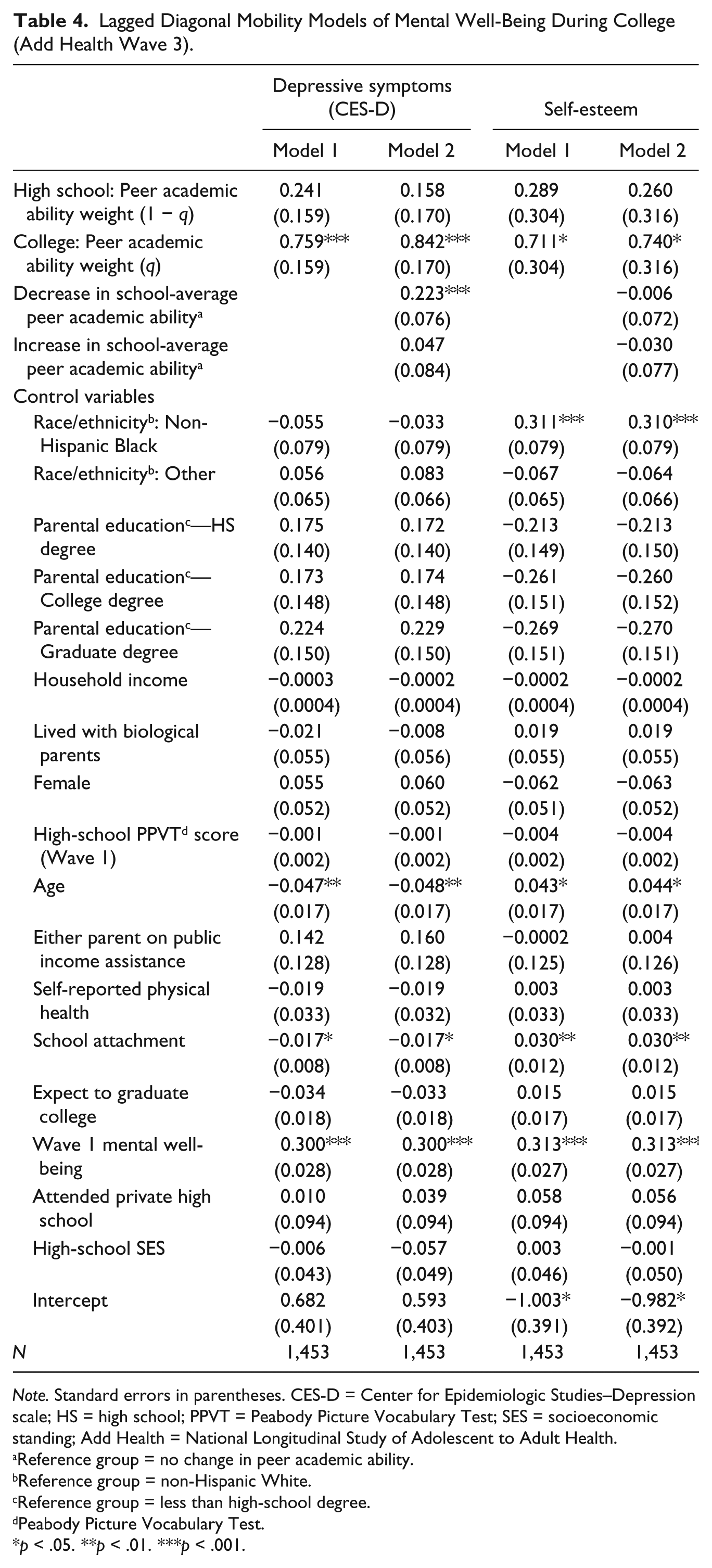
Note. Standard errors in parentheses. CES-D = Center for Epidemiologic Studies–Depression scale; HS = high school; PPVT = Peabody Picture Vocabulary Test; SES = socioeconomic standing; Add Health = National Longitudinal Study of Adolescent to Adult Health.
Reference group = no change in peer academic ability.
Reference group = non-Hispanic White.
Reference group = less than high-school degree.
Peabody Picture Vocabulary Test.
p < .05. **p < .01. ***p < .001.
Model 2 adds the transition indicator variables to the equation. This model tests whether ability transitions matter for student well-being change net of high school and college peer academic ability and a rich vector of precollege covariates. Transition estimates reveal that a peer ability decrease from high school to college is associated with increased depression (more than one fifth of a standard deviation; b = 0.223, p < .001), which translates into a 27% increase from the average CES-D score in terms of its original scale. A peer ability increase is not significantly linked to mental well-being relative to no change in peer academic ability (b = 0.047, ns).
Meanwhile, students who report stronger high school attachment report decreases in depressive symptoms during college (b = −0.017, p < .001). We also find that older students experience a decrease in depressive symptoms (b = −0.048, p < .001). To place the importance of changes in peer ability in the context of the other background variables, the effect of a downward ability transition (0.223) is nearly as large as the effect of a 1 standard deviation increase in prior depression levels (0.300) and more than 4 times as large as the effect of moving from the 25th (10) to the 75th (13) percentile on high school attachment ([13 − 10] × −0.017 = −0.051).
Self-esteem
The final two columns in Table 4 display results from lagged DMMs of self-esteem. Similar to depression, weights in the baseline self-esteem model (Model 1) demonstrate that college students report levels of self-esteem more closely resembling those of their collegiate peers (q = 0.711). As for depression, the college weight is statistically different from 0.5 (p < .05). Model 2 reveals no significant effects of peer ability transitions on self-esteem (ability decrease b = −0.006, ns; ability increase b = −0.030, ns). Among control variables, Blacks relative to Whites (b = 0.310, p < .001), older students (b = 0.044, p < .05), and students with greater high-school attachment (b = 0.030, p < .01) experienced higher self-esteem across the transition.
Discussion
While high school and college environments both matter for student adjustment, transitions between these environments may contribute powerfully to differences in mental well-being observed among today’s college students. Using national longitudinal data, we analyzed associations between changes in student mental well-being and changes in school-average peer academic ability from high school to college. An increase in school-average peer ability may decrease student well-being through less favorable social comparisons or more restricted access to academic resources. In contrast, gains in peer ability across the transition may translate into increased mental well-being through prestige conveyed by membership in a higher status academic community. We find, however, that students enrolled in higher ability colleges relative to high school show no significant changes in either depressive symptoms or self-esteem linked to the transition itself. Therefore, gains in peer ability may bring about a combination of interpersonal processes—resulting in countervailing influences on mental well-being—and an overall null association of school ability gains with student well-being.
We also examined changes in well-being linked to decreases in school-average peer ability. Students experiencing a decrease in peer ability may experience gains in well-being through more favorable social comparisons or more attention from faculty. We find, however, elevated depressive symptoms among students at colleges where average peer academic ability is lower relative to high school. Elevated depressive symptoms due to lower school-average ability may reflect unmet or failed expectations for attending a rigorous college. Students attend lower ability colleges relative to high school for a variety of reasons, including parental unfamiliarity with the college application process, and a desire to live close to family and precollege friendship networks (Deutschlander, 2017; Turley, Desmond, & Bruch, 2010). In addition, families are sensitive to financial-aid packages and tuition costs, which are more financially attractive in public universities, even after controlling for family income (Baryla & Dotterweich, 2001; Mixon & Hsing, 1994). In short, families may voluntarily trade academic prestige for lower financial burden, but family financial savings may incur emotional costs in the form of lowered student well-being.
At the same time, however, peer ability transitions do not foreshadow any significant changes in self-esteem according to our national findings. Apparently, students matriculating into a lower ability academic setting relative to high school still seem to regard themselves as academically competent, resulting in no significant changes in overall self-esteem linked to ability transitions themselves. Targeted measures of academic self-esteem would help evaluate this interpretation (Rosenberg, Schooler, Schoenbach, & Rosenberg, 1995). Regardless, students who remain convinced of their academic competence and overall worth nonetheless may become frustrated with suddenly restricted access to the types of academic resources and relationships they experienced while in high school, which may generate depressive symptoms even as self-esteem does not change due to the transition itself.
In this regard, it is important to note that our findings shed light on the relative importance of high-school versus college academic environments for shaping student well-being, beyond any well-being changes linked to different types of academic transitions. Specifically, our findings for depression as well as self-esteem indicate that students’ mental well-being comes to resemble that of others attending colleges with similar academic ability. This is a valuable and new finding, as prior research had not made it clear to what extent college students’ well-being reflects prior schooling experiences versus current ones, and to what extent these differences may be due to transitions rather than academic environments themselves. This finding falls in line with recent work on intragenerational (personal) social class mobility among adults, which finds that destination or final social class exerts stronger effects on well-being than does origin or initial social class (Houle, 2011).
Findings here should be considered within the study’s limitations: First, other ecological characteristics aside from general school-average academic ability may contribute to changes in well-being across the college transition. For instance, at similar levels of school-average peer ability, school cultures may vary due to student body composition, segmentation of students into majors or concentrations, or institutional heritage or traditions. Moreover, narrower ecologies developed through social or extracurricular commitments, such as part-time work, athletics, romantic relationships, or groups or clubs, may establish social networks that may differ in salience depending on personal academic performance (Armstrong & Hamilton, 2013; Lareau & Weininger, 2008). Exploring how these variations in school cultures and school-linked ecologies influence mental well-being represents a valuable direction for future research, one that would shed more light on school-based and developmental mechanisms underlying our national findings. In addition, college transitions often occur around the same time as other social transitions such as leaving home and shifting peer relationships, which may also influence depressive symptoms. However, these contemporaneous changes involving family and friends are normative, and thus likely to be present across a range of peer ability transitions. Although longitudinal, our findings do not reveal growth trajectories of symptoms after college, which is an important avenue for future research. Adult transitions involving work, family, or community may be pivotal in the long term for redirecting mental health trajectories after college (e.g., Pearlin & Bierman, 2013; Schulenberg, Sameroff, & Cicchetti, 2004).
Conclusion
Our study breaks new ground by bringing attention to the important role that shifting academic environments may play in influencing adjustment among today’s college students. Changes in academic environments matter for predicting student adjustment, net of the individuals composing them and net of school environments themselves. Because school change is defined by academic environments as well as by differences between environments, future research should continue to utilize diagonal mobility techniques to gain greater insights into the transition to college and into well-being during early adulthood more generally.
Footnotes
Declaration of Conflicting Interests
The author(s) declared no potential conflicts of interest with respect to the research, authorship, and/or publication of this article.
Funding
The author(s) received no financial support for the research, authorship, and/or publication of this article.