







Abstract
Many youth experiencing homelessness (YEH) are surprisingly hopeful. We propose a typology of the hopes for the future (HFTF) of YEH, based on a qualitative study employing grounded theory. YEH fell into four categories: (a) nonmainstream HFTF youth who wished to escape the mainstream, (b) mainstream HFTF youth who wished to integrate into the mainstream, (c) marijuana-economy HFTF youth who aspired to escape homelessness by entering the marijuana economy, and (d) no HFTF youth who did not or could not envision the future. Our finding that some YEH transition between different HFTF suggests a modifiable point of intervention. We share novel findings regarding how the perceived trajectories of some YEH may have been influenced by the evolving legal status of marijuana. Our emic approach to constructing a typology may inform the design of more acceptable/effective interventions. We suggest implications, including ethical quandaries, raised by our findings.
Introduction
By nearly every metric, youth experiencing homelessness (YEH) have extraordinarily difficult lives. Most YEH are homeless due to factors outside of their control, including poverty, abuse, family conflict, mental health, and traumatic events (Embleton, Lee, Gunn, Ayuku, & Braitstein, 2016). Once on the streets, they face the elements, poor diets, irregular sleep patterns, and stress (van Wormer, 2003). They encounter social stigma (e.g., daily microaggressions) and structural stigma (e.g., policies targeting YEH) (Gaetz, 2004; Kidd, 2004; Kidd & Davidson, 2007). YEH have poorer physical and mental health outcomes than their housed peers (Auerswald, Beharry, & Warf, 2016). They have higher mortality and rates of chlamydia/gonorrhea, hepatitis C, abuse, depression, bipolar disorder, anxiety disorder, posttraumatic stress disorder (PTSD), substance use disorder, and suicidality (Auerswald, Beharry, et al., 2016; Auerswald, Lin, & Parriott, 2016; Auerswald, Sugano, Ellen, & Klausner, 2006; Edidin, Ganim, Hunter, & Karnik, 2012; Puri et al., 2014; Roy, Haley, Boudreau, Leclerc, & Boivin, 2010).
Except in our title, we have elected to refer to youth as YEH, rather than “homeless youth” because of the stigma attached to the latter term.
Despite persistent disparities, it has been our experience that many YEH remain surprisingly hopeful. The YEH we have served and studied create goals, adapt to the unexpected, and have hopes for their futures. Our observations coincide with a recent shift in YEH research from a focus on negative health status and risk behaviors toward strengths and resilience (Bender, Thompson, McManus, Lantry, & Flynn, 2007; Rew & Horner, 2003; Thompson et al., 2016). Documented strengths include using resources for survival, coping with loneliness through social networks, and having a desire for self-improvement, which helps YEH consider a different future (Bender et al., 2007; Cleverley & Kidd, 2011; Kidd & Davidson, 2007; Rew & Horner, 2003).
Although seen as part of youth’s resilience in several papers, the sense of hope itself has not been well described among YEH (Crawford et al., 2014). Existing studies examine hope as a protective factor, rather than elucidating why YEH are hopeful in the face of enormous hardships. In one study of the relationship between coping strategies/general beliefs and suicidal ideation/attempts, only belief in a better future was linked to less suicidal ideation, fewer suicidal attempts, and feeling less helpless (Kidd & Carroll, 2007). In another study of protective factors for risky sexual behaviors in YEH, positive expectations for the future were predictive of fewer sexual partners. The authors hypothesized that YEH with positive expectations may perceive risky sexual behaviors as potentially compromising of their future (Tevendale, Lightfoot, & Slocum, 2009). In a study of resilience in YEH, researchers found strong relationships between hopelessness with life-threatening/suicidal behaviors. The authors suggested that hopelessness may lead to YEH engaging in life-threatening risk behaviors because of negative feelings about the future (Rew, Taylor-Seehafer, Thomas, & Yockey, 2001).
We defined hope as “the perceived capability to derive pathways to desired goals, and motivate oneself via agency thinking to use those pathways” (Snyder, 2002, p. 18). Given the lack of research into the underpinnings of hope in YEH, we initially sought to explore the factors positively and negatively associated with hope. However, participants more readily spoke about their hopes for the future (HFTF) as opposed to the underpinnings of this hope. A model with several distinct types of HFTF emerged during interviews and ongoing analysis. Thus, we propose a typology to capture perspectives on HFTF among YEH in Berkeley, California.
Typologies are developed for multiple purposes: theoretical functions, such as understanding the etiologies of homelessness; clinical functions, such as facilitating appropriate matching of YEH with services; and policy functions, such as informing policy making, resource distribution, and interventions (Jahiel & Babor, 2007; Knopf, 2013). A review of the literature regarding interventions for YEH found that most unidimensional interventions are ineffective. Effective interventions must be multidimensional and take into account the diversity of YEH (Slesnick, Dashora, Letcher, Erdem, & Serovich, 2009). Typologies can inform intervention development by attempting to capture this diversity.
Researchers have historically taken different approaches in the construction of YEH typologies. YEH are commonly classified according to the circumstances precipitating their entry into homelessness: situational runaways (who leave home briefly due to disagreements with parents/caretakers), runaways (who leave home for an extended period or permanently due to neglect, abuse, or serious conflict with parents/caretakers), throwaways (whose parents/caretakers have abandoned them or asked them to leave), and systems youth (who exit or age out of an institutional system) (Farrow, Deisher, Brown, Kulig, & Kipke, 1992). Kuhn and Culhane (1998) classified YEH according to level of shelter utilization: transitional (spend a short time in shelters before transitioning to permanent housing), episodic (frequently utilize shelters for short periods of time), and chronic (use shelters as long-term housing). Other researchers have classified YEH according to treatment needs: (a) minimal treatment, (b) therapeutic housing with emphasis on substance abuse, (c) therapeutic housing with emphasis on behavior management, and (d) comprehensive treatment (Bucher, 2008). Milburn et al. (2009) created a needs-based typology of newly homeless adolescents based on risk and protective factors, with two groups: protected (exhibiting fewer risk behaviors than protective behaviors) and unprotected (exhibiting more risk behaviors than protective behaviors).
A limitation of past typologies is that they generally represent an etic perspective, that is, a researcher and service provider perspective on YEH’s needs. This is reflected in the data selected in creating these typologies to assign YEH to varying levels and types of interventions, such as epidemiologic data on risk behaviors, risk factors, and mental/physical health. The goal of many of these typologies is to reduce the burden of physical and mental illness by modifying YEH’s behaviors or moving YEH toward housing. These goals, however, do not always align with YEH’s own perspectives on their needs and HFTF, that is, an emic perspective. This study addresses this mismatch by asking YEH about their own HFTF and their perception of their peers’ HFTF.
The need for inclusion of YEH’s own perspectives is underscored by UNICEF and World Health Organization (WHO; Auerswald, Akemi Piatt, & Mirzazadeh, 2017; Ozer & Piatt, 2017). A 2014 WHO report regarding the health of adolescents worldwide emphasized that for “programmes and policies [to] meet [adolescents’] needs, adolescents must be heard and must contribute to the planning, implementation, monitoring, and evaluation of services” (WHO, 2014). Qualitatively derived typologies offer the alternative of constructing emic explanatory models of marginalized YEH’s experience (Auerswald & Eyre, 2002). The urgency of this work is heightened by unprecedented attention to the needs of YEH, motivated, in part, by the Federal goal to end youth homelessness, proclaimed by the United States Interagency Council on Homelessness (2010).
In brief, this article will (a) propose a hope-based typology of YEH, (b) describe substance use and service utilization in the context of this typology, and (c) describe the transition of some YEH from one HFTF to another. We will conclude with a discussion of the implications and challenges of our findings for youth-centered care.
Method
Setting
Berkeley, California, is regarded as a refuge for people experiencing homelessness, symbolized by People’s Park, a space often at the center of tension and protest (Mitchell, 1995). Closely preceding the time of this study, an ordinance to ban sitting on sidewalks was debated and eventually defeated as an effort to criminalize homelessness (Cooter, Meanor, Soli, & Selbin, 2012; Raguso, 2012).
Study Design and Target Population
We conducted street-based interviews as part of a participant observation study of YEH in Berkeley, California, from June 2013 to December 2014 at venues frequented by YEH, including streets, parks, and service organizations. The first author and lead researcher was an Asian male in his mid-20s with more than 5 years’ experience providing services to YEH in Berkeley. We began with a 3-month period of participant observation prior to initiation of interviewing. During field visits, the lead researcher observed and interacted with YEH in target venues, focusing his attention on YEH who appeared to fit the target age range, to be transient, and to be involved in the street economy (Auerswald & Eyre, 2002). Participants were observed at identified venues, “spanging” (asking for spare change), “busking” (playing music for spare change), accessing services/meals, and interacting with each other, the researcher, service providers, and pedestrians. Data from the participant observations were recorded in the form of field notes.
Semistructured Interviews
Field notes from these observations informed the creation of an interview guide constructed by the lead researcher with all the coauthors. After the interview guide was developed, YEH were approached by the lead researcher or were referred by other participants, and screened for eligibility. Youth were eligible if they were 15 to 24 years old and homeless, defined as
having to stay two nights or more in the last six months in a place that is not your own home or you did not have a home, including having to stay in one of the following places: a shelter, outdoors, a squat, with a stranger or someone you did not know well, a car, on public transportation, or SRO/hotel. (Hickler & Auerswald, 2009, p. 2)
Eligible YEH provided verbal informed consent. Two YEH who were under the influence or otherwise unable to provide informed consent were not interviewed. Three YEH declined to participate. Participants received a US$20 gift card to a convenience store.
Semistructured interviews followed an interview guide, which included topics such as entry into homelessness, day-to-day life, survival strategies, service utilization, health-related behaviors, and HFTF. Interviews lasted 1 hour and were conversational in tone to allow exploration of new areas. All activities were reviewed by and approved by the Berkeley Committee for the Protection of Human Subjects.
Analysis
Data collection and analysis were informed by grounded theory, a qualitative and inductive approach to theory development (Charmaz, 2014; Glaser & Strauss, 2009). Data collection and data analysis took place iteratively, with each influencing and focusing the other.
Field notes were summarized in memos, which, in turn, informed our specific focus on HFTF and the development of the study interview guide.
The lead and senior researcher conducted preliminary open coding of seven interview transcripts to develop a codebook. We then used the initial codebook to recode the seven transcripts as well as three new transcripts to ensure consistent coding. The lead researcher coded the remaining 11 transcripts with checks by the senior researcher. All coding was completed using Atlas.ti. The interview guide was continually revised to include emerging codes. The researchers then drafted memos and concept maps from the code reports. For validity, the lead researcher conducted member checking regarding interim analyses with the five longitudinal key informants and multiple other interviewees (Charmaz, 2014). During fieldwork and data analysis, the lead researcher discussed his prior experience and how it influenced data collection and analysis with all members of the team.
Results
Study Sample
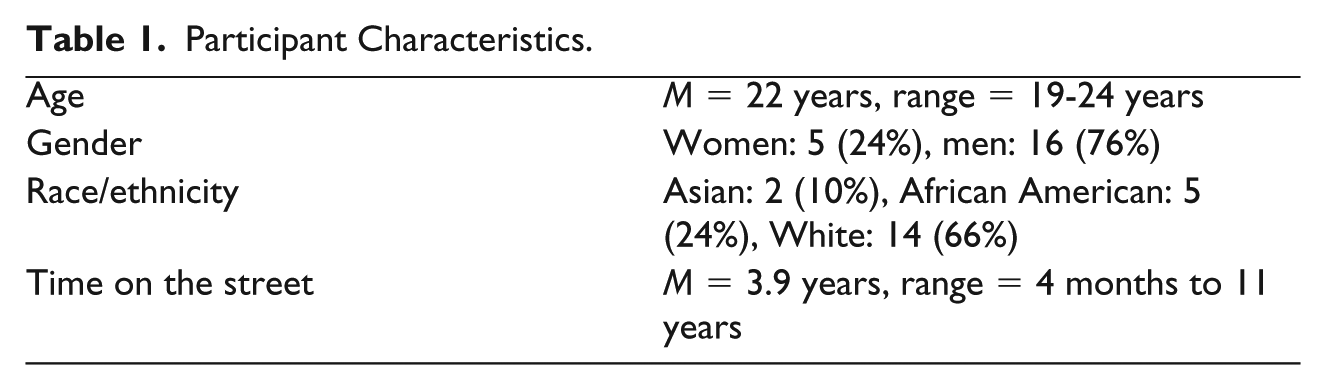
A description of our study sample is included in Table 1.
Participant Characteristics.
Hope-Based Typology
Our typology describes four main HFTF. Participants with nonmainstream HFTF wished to escape mainstream society. Participants with mainstream HFTF hoped to integrate into the mainstream to leave homelessness. Participants with marijuana-economy HFTF hoped to leave homelessness by joining the marijuana economy as growers. Participants with no HFTF did not envision a future, either because they had not spent time envisioning their futures or because of repeated trauma. Patterns of substance use and service utilization varied among participants with different HFTF.
Nonmainstream HFTF
Brian props his feet on the table at the YEH drop-in and looks up at the ceiling. “I don’t want to be part of the system,” he says, “I don’t want to buy oil or food from companies that run this country.” When I ask how he will accomplish this, he tells me, “It involves acquiring land and creating a commune where we can live from the Earth, away from government and industry.” (Field notes, 21-year-old man)
Like Brian, a majority of participants described rejecting a mainstream lifestyle and having nonmainstream HFTF. When speaking about the “mainstream,” participants referred to a specific life trajectory, including education, working, and becoming housed.
Hinted by Brian’s words and echoed in the words of other YEH with nonmainstream HFTF is the rejection of corporations or the government. YEH with nonmainstream HFTF often spoke about corporations as evil entities whose products harm people. They described the government as corrupt and oppressive, referring to city laws or a violent police force that discriminate against YEH.
During an open-mic night at a YEH drop-in, multiple YEH performed pieces about Berkeley police.
Turf plays on his banjo and sings: “I really like the cops. I think they’re really neat. I like it when they take my face and smash it in the street. I like to get arrested. I like to get beat. I like to get harassed, for sitting on the street!” (Field notes)
In this study, YEH with nonmainstream HFTF fell into two categories. YEH in the first category expressed a hope for land ownership in a remote part of the country to escape the perceived problems and influences of the mainstream. These participants, like Brian, explained that land ownership would allow for self-sufficiency and the ability to house and provide for their own families and other YEH. YEH in the second category of nonmainstream HFTF described wanting to participate in a revolution to fundamentally change society and rebel against the mainstream.
I want my future to be the true Garden of Eden where everybody is happy, taken care of, and healthy. It will take a revolution to get there. I’m starting off with spreading consciousness: our government isn’t truly our government. They are people looking to control us. (Interview, 24-year-old man)
Substance Use
YEH with nonmainstream HFTF reported predominantly marijuana and alcohol use. One 20-year-old man talks about the ubiquitous nature of marijuana among YEH, stating “Marijuana is a really big part of a lot of kids’ lives, especially those who live out on the streets.” Another 24-year-old man talked about his heavy alcohol use, explaining, “I had drinking tendencies when I was younger and they’ve been reinforced as I got older. Now, I’m an alcoholic.”
Service Utilization
YEH with nonmainstream HFTF reported only accessing services to meet basic needs (seen as food, clothing, and showers). None reported use of housing or employment services. In particular, YEH in the revolutionary category reported that their avoidance of housing and employment services was an extension of their antigovernment beliefs.
I try not to use resources except for free food because the system creating organizations for the homeless traps people in their strings of manipulation . . . and I wouldn’t be interested in a service that tried to get me a job. (Interview, 24-year-old man)
Mainstream HFTF
Morgan and I participate in a writing activity at a YEH drop-in. The topic is “what’s your Halloween costume?” Morgan reads his writing: “My costume would be a rich white woman. I would have a bank account, a home, I could buy Mama anything she wanted, and I could go to school. I would just have a better life.” Morgan’s “rich white woman” represents his HFTF: housing, financial security, and higher education. (Field notes, 23-year-old African American man)
The second group of participants, exemplified above by Morgan, had mainstream HFTF. These YEH embraced the mainstream and desired to reintegrate into mainstream society. Nearly all these participants discussed hoping to find employment and housing to extricate themselves from homelessness. Many of these YEH shared their hope to pursue postsecondary education as a path to their future, as exemplified by a 24-year-old-man who stated, “I want to go to college so I can get a job and have my own place.” Participants who were parents, and nearly all those who envisioned parenthood, expressed a hope to raise their kids in the mainstream. A 23-year-old father shared, “I want to live in a nice house with a white picket fence, near a park, with a dog and two kids.”
Substance Use
YEH with mainstream HFTF were least likely to report substance use, with the exception of marijuana. One study participant with mainstream HFTF talked about her thoughts regarding the substance use behaviors of other YEH.
Most of the kids out here just want to drink and smoke. They shouldn’t be doing that. They should go get an education. (Interview, 23-year-old woman)
When asked about her own patterns of substance use, she explains, “ . . . I have never done substances; I have never done drugs” (Interview, 23-year-old woman). Despite her antisubstance attitude, she does condone the use of marijuana as a “healing medicine.” Another woman explained that she had reduced her substance use to reduce risk to her HFTF.
I don’t hang around street kids because they do drugs and drink. If a cop came and searched everybody, I might get in trouble too and I don’t want to risk that because I need to get a job. (Interview, 23-year-old woman)
Service Utilization
YEH with mainstream HFTF reported using services to meet basic needs, and were the most likely to report accessing services to secure housing or employment.
I go to drop-in clinics for food and supplies, to see the doctor, mental health services, and even acupuncture . . . For employment, I go to a place where you get a certificate and food handler license, and they help you find a job. I’ve also used housing services. (Interview, 23-year-old woman)
Marijuana-Economy HFTF
I wait with Sam for food at People’s Park. Though he had traveled to work as a trimmer of marijuana leaves, the weather had been too demanding. “I’m back here selling weed,” he said, “Hopefully I can get to where I’m saving enough towards becoming a grower.” (Field notes, 20-year-old man)
Several YEH, including Sam, reported having marijuana-economy HFTF. They described hoping to exit homelessness by entering the marijuana economy as growers. These YEH differentiated themselves from YEH with nonmainstream HFTF by their detailed, goal-oriented descriptions of their hopes. Participants described a common trajectory where as “trimmers,” they would help prepare marijuana for sale, before learning and amassing enough income to become “growers” of marijuana themselves. A 23-year-old man described this trajectory: “You start with trimming and learn as you help the grower. If you make enough money, you can buy your own property.”
The increasingly favorable legal context in California was foremost in YEH’s discussions of the marijuana economy as a viable way to leave street life and/or to finance life on the street. At the time of the fieldwork, California had legalized medical marijuana, and had created regulations regarding legal quantities of plants, created guidelines for collective or cooperative cultivation, and allowed for local government regulation (Imler, 2009). YEH volunteered detailed, albeit sometimes flawed, understandings of these recent laws and guidelines.
Work in the marijuana economy was described as a lucrative, accessible, and rare opportunity.
[The marijuana economy] gives everyone an opportunity. You can put a seed in the ground and make something really valuable. There are not many opportunities like that in the world. (Interview, 24-year-old woman)
However, this same young woman and her partner returned to Berkeley a few months later, having faced the realities of a new gold (pot) rush, including “ . . . large numbers of [YEH] and people ‘from all over the world’” also looking for work in the marijuana economy (field notes, 24-year-old woman and 23-year-old man).
Substance Use
YEH with marijuana-economy HFTF reported patterns of alcohol and marijuana use. A 24-year-old man shared, “I smoke weed and drink beer occasionally . . . I don’t do anything else.”
Service Utilization
YEH with marijuana-economy HFTF reported use of services to meet their basic needs, but not for housing or employment. The same participant described, “Sometimes I eat at food services or go somewhere to get free socks. That’s pretty much it.”
No HFTF
Nikki and I were sitting at People’s Park and she laughed when I asked about future plans. “I try not to think that far ahead,” she said, “it all works out.” I asked if she planned ahead for getting food or for bad weather. “Not really,” she explained, “sometimes people will just offer me food, or I’ll meet people traveling. The universe has a way of directing me where to go.” (Field notes, 20-year-old-woman) “You want this?” Grant asks, holding out a USB stick with his tattoo-covered arm. He would often take meth at night before he went out to “find things,” i.e. looking through dumpsters for objects to keep or sell. He told me his use of meth was not only to escape the cold of the night, but also to escape his “ruined life.” “Don’t end up like me,” he said, rolling a marijuana joint, “don’t take drugs. They make you all schizophrenic and screwed up.” He noticed me again looking at the tattoos on his arms. “They’re demons,” he explained, rolling up his sleeves, “I have a lot of demons.” (Field notes, 23-year-old-man)
YEH with no HFTF could be divided into two subgroups. The first subgroup, like Nikki, explained that they did not plan for the future. The second subgroup, like Grant, described their absence of HFTF as a product of repeated traumas and structural barriers. Another young man in this second subgroup stated,
It’s difficult for me to envision an ideal future because there are too many things weighing down my life. I’m on probation and have a warrant out. I have a lot of anxiety about having to go back to jail. Now I can’t apply for financial aid for school. It’s really holding me back. (Interview, 22-year-old man)
Substance Use
Participants in the first subgroup, who had no HFTF because they did not envision the future, reported marijuana and alcohol use, including a 20-year-old man who explained, “I just smoke pot. Sometimes I drink.”
Participants in the second subgroup, who had no HFTF due to trauma, were notable for reporting the heaviest substance use of all the groups in the typology. Youth in this subgroup, like Grant, described using substances to cope with past and current trauma in their lives. Another participant described his daily activities:
I do things to make my daily life more tolerable. I’ll smoke weed or drink alcohol to distract myself. I also go to weed clubs, movies, and internet cafes. I want time to go by because there are a lot of minutes and hours in the day, and there are only so many things I can do to distract myself from reality. If I don’t have anything to do or I’m alone with my thoughts, I just get depressed. (Interview, 22-year-old man)
It was widely reported by other YEH and noted by observation that only members of this subgroup used “heavier” illicit substances such as methamphetamines or heroin. One participant with nonmainstream HFTF spoke about this phenomenon:
The kids with no hope seem to be the only ones who are using drugs like heroin or hard drugs . . . [they] got on heroin because their lives sucked and they wanted to escape it. (Interview, 23-year-old man)
Service Utilization
YEH with no HFTF because they did not envision the future reported use of basic needs services but not of housing/employment services.
The most useful services are the food ones. Sometimes I get clean socks or take a shower. I would not use a housing or job search service because I’m not interested in them. (Interview, 20-year-old man)
YEH with no HFTF due to trauma reported use of basic needs services, and no use of housing/employment services. These participants often reported giving up on housing/employment services because of multiple attempts resulting in failures. One participant explains that part of the reason he has no HFTF is because of past obstacles.
I’ve been to so many places. The waiting lists are years and have hundreds of people. I’ve filled out so many forms and nobody bothers to respond. My feeling of futility is because I’ve tried so much and nothing works out. It’s just hopeless and really devastating. (Interview, 22-year-old man)
Transitions Across Types
Several participants described a transition in their HFTF: some from having no HFTF to mainstream HFTF, and others from nonmainstream HFTF to mainstream HFTF. One study participant, who said she “used to be counter-culture” and self-categorized as formerly nonmainstream HFTF, describes herself as having transitioned to having a mainstream HFTF:
I used to believe that street life was the best life I could have, but now I think that’s wrong. My values have changed and now I really believe in hard work and feel the need and want to stay in one place. It’s a coming of age feeling. (Interview, 24-year-old woman)
Other participants described major events in their lives that resulted in changes in mind-set. A 23-year-old father described new parenthood triggering a need to be more mainstream and responsible, explaining “We quit pot. And we had to be more punctual and stop missing appointments. We conformed to what some people would call a parental image.”
Another study participant described having no HFTF when originally entering homelessness:
I felt like I didn’t get support and wasn’t loved. Nobody in my family would help. What’s a person to do in that situation? I wasn’t ready for employment or to find a place. I just didn’t want to be bothered. (Interview, 24-year-old man)
He then described an acute illness that made him transition to a mainstream HFTF.
I got very sick. The doctor told me that to keep from getting sick in the future, I should live indoors instead of on the streets, because I could die. That’s what made me change my life. (Interview, 24-year-old man)
Discussion
Our study of hope among YEH in Berkeley yielded an emic, hope-based typology with four types of HFTF: nonmainstream HFTF, mainstream HFTF, marijuana-economy HFTF, and no HFTF. Although marijuana use was universal, patterns of substance use otherwise varied among YEH with different types of HFTF. YEH with mainstream HFTF reported the least substance use. YEH with no HFTF due to trauma reported the heaviest substance use. They were the only group who were observed, reported, and reported by others to use substances such as methamphetamines or heroin. Patterns of service utilization also varied among YEH with different HFTF in our sample. Although YEH with mainstream HFTF reported a broad range of service utilization, including housing/employment services, YEH in all other types reported only using services to meet basic needs and rejected use of housing/employment services, though each for different reasons. Perhaps, most important, our results suggest that some YEH do transition across the different types of HFTF in response to major life events (e.g., parenthood, illness, or trauma) or maturation, among other reasons. Like other young adults, YEH are not static in their beliefs, goals, and hopes, which suggests these may be modifiable points of intervention.
Our qualitative, exploratory study has several limitations. First, the small sample size from a single geographic location means that the results of the study are not generalizable to all YEH. Second, we interviewed very few YEH with no HFTF; thus, much of the data about them were obtained from other participants. They may have been more likely to be among those who declined (three out of 26 approached), or who were ineligible to participate due to being under the influence (two out of 26 approached), or, finally, the proportion of no HFTF YEH may simply be low. A third limitation of this study is the lack of information regarding mental illness in relation to the typology, as a formal assessment of the mental health of participants was outside the scope of our study. A profound lack of HFTF could be a sign of depression or substance use disorder, as suggested by studies linking lack of hope to suicidality (Kidd & Carroll, 2007). Similarly, substance use could represent attempts at self-medication, though it is unclear whether it is caused by or resulting from a YEH’s HFTF. It is important to note that although typologies are useful in discussing YEH, there is no “typical” YEH and that these categories are artificially constructed (Moore, 2005).
Our findings regarding the focus of some YEH on the marijuana-economy HFTF are unexpected and a new finding in this team’s fieldwork over the last two decades. This finding likely reflects the recent policy shift in California and nationwide to further legalize the consumption and production of marijuana (Miech et al., 2015). In California, considering only the domestic industry, the marijuana industry represents an estimated US$7 billion market per year (Associated Press, 2017). To our knowledge, our finding regarding the ways in which some YEH’s perceived trajectories may have been influenced by the liberalization of public policy regarding marijuana use and distribution has not yet been reported in the literature. This finding warrants further exploration, particularly regarding the unintended negative effects of changes in these policies on youth, especially vulnerable youth.
Our results regarding the transitions of some YEH to having mainstream HFTF should be interpreted in the context of adolescent development of future orientation (Steinberg et al., 2009). Some of our participants were in the process of transitioning to a mainstream HFTF, which included formulating more concrete goals and steps toward achieving those goals. This is developmentally appropriate and is consistent with the literature on adolescent future orientation (Nurmi, 1991). We found specific examples of participants being prompted to change to a mainstream HFTF in response to major life events, consistent with Auerswald and Eyre’s (2002) hypothesis that YEH in a “disequilibrium” or crisis stage may be more amenable to interventions and leaving the street. Taken together, this body of work underscores the importance of supporting YEH through these critical, age-appropriate developmental changes.
The findings and narratives regarding youth with no HFTF echo existing research findings in adults experiencing homelessness regarding the erosion of hope and dignity and regarding the role of self-efficacy in exiting homelessness (Bazari, Patanwala, Kaplan, Auerswald, & Kushel, 2018; Epel, Bandura, & Zimbardo, 1999). Importantly, Epel et al. (1999) recognized that although important as a correlate of attempted extrication from homelessness, self-efficacy was not correlated with successful extrication, given local housing crises. Our study is also consistent with previous findings that hope increases among formerly homeless adults and among formerly homeless youth when they are housed (Kidd et al., 2016; Rhenter et al., 2018). A Vancouver-based study examining the effects of housing on hope found an initial decrease in hope among formerly homeless youth due to demoralization, but a longer term increase in hope among those youth who later experienced success (Kidd et al., 2016).
Our findings about the relationship between HFTF and substance use are also consistent with the results of other studies regarding the influence of hope on youth. In a study of middle school students considered at risk of substance use, researchers found an inverse linear relationship between hope and drug use (Wilson, Syme, Boyce, Battistich, & Selvin, 2005). Although the study was cross sectional, the results suggest that adolescents with a higher sense of hope may engage in fewer risky behaviors. One study of Mexican adolescents explored the relationship between risk behaviors and “anticipated social mobility,” an indicator of adolescent relative social position and of hope for improvement in social standing (Ritterman, 2010). The researchers found an inverse correlation between adolescents’ perception of upward mobility with their rates of risky behaviors and a positive correlation with healthy behaviors. This is consistent with our findings that youth with no HFTF were those engaged in the use of the highest risk substances—substances that youth with mainstream HFTF avoided because of the risk they posed to their future goals.
Implications for Practice and Future Directions
Our proposed typology complements existing typologies of YEH in the literature, and suggests a number of specific implications for practice.
First, our finding that YEH with different types of HFTF require and seek different types of interventions suggests that our typology may be useful to better triage and tailor interventions. For instance, given that YEH with mainstream HFTF may be more interested in housing/employment opportunities, these could be more intensely offered to this group. This would require confirmatory research in a distinct and larger group of youth as well as the development of a validated tool to assess YEH’s HFTF.
Second, at the individual level, strengths-based approaches that address hope are supported by our findings, as they are elsewhere (Thompson et al., 2016). One example is a street-based intervention, which Rew, Powell, Brown, Becker, and Slesnick (2017) have documented may increase hope among YEH.
Third, as for all youth, YEH’s HFTF are shaped by the sociocultural context of their lives. Thus, public health experts argue that successful interventions need to take place on multiple ecologic levels, from the individual to the societal (Smedley & Syme, 2001). At the upstream level, it may behoove public health professionals designing YEH interventions to consider not only YEH’s hopes but also the broader sociocultural context from which these hopes arise. Such interventions might integrate not only input from youth voices but also an approach guided by structural competency (Metzl & Hansen, 2014; Neff et al., 2017). Similarly, a focus on youth’s hopes and resilience may humanize youth, thereby decreasing the stigma toward them in policy circles and societally.
Fourth, our findings raise challenging ethical quandaries regarding individual agency in young adulthood and service provision. Given the firm commitment to a respect for agency in caring for individuals experiencing homelessness, how do youth’s HFTF translate to treatment plans? Current approaches such as motivational interviewing assume that the goal for the care of youth is a mainstream future. Indeed, research has clearly demonstrated that educational and vocational success translates to better health. But what of youth who do not seek such integration or who seek to integrate into the marijuana economy? In the context of youth-centered care, what are the obligations of service providers to partner with youth toward those goals, particularly if these goals may be transient or if they may have implications for their future?
Fifth, the concerns for youth who have no future, particularly those who have experienced trauma are clearly great. A youth’s inability to articulate any HFTF should be a red flag for the need for intensive attention.
Future research should include a longitudinal ethnographic study of YEH’s HFTF, as well as longitudinal quantitative studies of hope in larger samples of YEH in other communities. A better understanding of the origins and modifiers of YEH’s HFTF, including the role of mental health, may further contribute to more acceptable and effective interventions and policies to help us reach our national goal of ending youth homelessness.
Footnotes
Acknowledgements
We thank the participants, who generously shared their experiences and perspectives. We gratefully recognize the input of Rodolfo Mendoza-Denton, Sherilyn Adams, and Ilsa Lund on the project and article. This endeavor would not have been possible without the support of the UC Berkeley Suitcase Clinic volunteers.
Authors’ Note
An earlier version of this article was presented at the 2016 Society for Adolescent Health and Medicine Conference.
Declaration of Conflicting Interests
The author(s) declared no potential conflicts of interest with respect to the research, authorship, and/or publication of this article.
Funding
The author(s) disclosed receipt of the following financial support for the research, authorship, and/or publication of this article: This research was supported by a UC Berkeley–UCSF Joint Medical Program research grant and a Greater Good Science Center Hornaday Fellowship. Funding sources had no involvement in the study design, collection, analysis, interpretation of data, or decision for publication.
