







Abstract
School delinquency in public elementary, middle, and high schools has decreased in recent years, but is still a major issue that has negative mental health and academic implications for adolescents. Although research has focused on both individual-level and school-level explanations of school delinquency, it is not yet clear which macro-level criminological perspectives best explains it. Using 656 effect sizes nested within 75 studies and 30 unique datasets, this study addresses two questions using meta-analytic methods: Which macro-level criminological perspectives explain between-school differences in delinquency? Are effect sizes invariant across samples and research design? Results indicate that only concentrated disadvantage and social cohesion are significantly related to school delinquency. With the exception of concentrated disadvantage, effects are homogenous. This suggests that some school-level explanations are useful and future research should not exclude these factors. Practical implications suggest that improving social cohesion in schools may be more effective at preventing violence than target-hardening efforts.
Although school delinquency in elementary, middle, and high schools has decreased between 1992 and 2018 (Wang et al., 2020), this issue is of upmost importance. Data from the 2018 National Crime Victimization Survey show that the most common locations of adolescent victimization were connected with school, and 71% of public schools reported at least one violent incident in the 2017 to 2018 school year (Diliberti et al., 2019). School delinquency has many definitions, and researchers have conceptualized it to include a wide range of non-criminal misbehavior and criminal offending that take place on school campuses or in close proximity to school (Gottfredson, 2001; Smith-Adcock et al., 2013). These include both non-violent and violent behaviors. While most violent incidents in school involve physical bullying such as pushing and shoving, school delinquency also includes serious forms of violence including assault with a weapon and even murder. Twenty percent of students reported that they had been bullied at school in 2017, with higher estimates for females and LGBTQ+ students (Seldin & Yanez, 2019). Experiencing victimization at school may lead to long term implications, such as decreased academic achievement (Nakamoto & Schwartz, 2010) and increased internalizing problems, externalizing problems, and substance use (Ttofi et al., 2014). Those who commit acts of delinquency at school are at risk for dropping out of school (Peguero & Hong, 2019) and further involvement in crime (Hemphill et al., 2014).
Although rare, there were 66 school shootings in the 2018 to 2019 school year in the US (Wang et al., 2020). Widespread media coverage of these tragic events decreased perceptions of safety at school (Elsass et al., 2016), and policymakers were pressured to immediately address safety concerns. Funded by a $745 million federal grant, a situational crime prevention approach was quickly adopted in many schools, which focused on reducing problem behaviors by increasing surveillance and reducing opportunities for delinquency (Clarke, 1983). Methods included employing school resource officers (SROs), installing cameras and metal detectors, and using drug dogs to conduct locker searches (Jonson, 2017). However, public pressure for immediate attention to school safety led to situational crime prevention efforts to be enacted without empirical evidence to suggest that they were effective (Jonson, 2017). Additionally, they tend to focus on preventing rare forms of serious violence rather than more common forms of school delinquency (Gerlinger & Wo, 2016). While the climate of schools was also called into question, efforts to improve student-teacher relationships, authoritative school discipline, and connectedness were not enacted as readily, despite evidence that improving school climate decreased delinquency (Gerlinger & Wo, 2016).
Individual-level theories of crime have successfully explained a wide range of delinquent behaviors in school including violent crime, property crime, bullying, and general misbehavior (Chui & Chan, 2015; Popp & Peguero, 2012). However, school delinquency prevention efforts based on individual-level theories of crime may be difficult to enact, since the school may not be able to intervene with personal and family risk factors outside the school context (Rowan et al., 1983). School-level interventions are more malleable (Gottfredson et al., 2005), and might reach more students who have been placed at high-risk. Prior research suggests that using them in conjunction with individual-level interventions is more effective than individual-level interventions on their own (Tillyer et al., 2018). While a body of research has found that a range of school-level predictors can effectively reduce school delinquency, these concepts may be too broad. For example, the most effective school climate component in delinquency prevention has been found to be school connectedness, which is equivalent to a component of social disorganization theory’s concept of collective efficacy (Aldridge et al., 2018). Simply put, delinquency in schools might be better explained by theories designed to explain delinquency, rather than broader theories to might explain a variety of school outcomes not related to delinquency.
While individual-level predictors derived from criminological theory and broad categories of school-level variables have been found to explain delinquency, a much smaller volume of research exists that uses predictors derived from macro-level criminological theory. While the research that has been completed suggests that these explanations may be useful, it is not clear which predictors are the strongest, and estimates of the proportion of variance explained by macro-level factors vary. To shed some light on these issues, this study will use hierarchal meta-analytic methods to determine which macro-level criminological perspectives best explain delinquency in public elementary, middle, and high schools. Additionally, moderator analyses will be performed to determine whether effects are homogenous according to research design and sample characteristics.
Literature Review
While criminologists tend to focus on individual-level factors when explaining crime, there has been a renewed interest in using macro-level criminological perspectives to explain differences in crime rates between geographical areas such as neighborhoods, street segments, cities, and countries (Pratt & Cullen, 2005). Similarly, scholars studying delinquency in schools generally look at individual differences and close relationships, rather than school-level factors. While structural factors in neighborhoods and those in schools are not identical, scholars have successfully applied macro-level criminological perspectives to explain school delinquency (Plank et al., 2009). Research using multi-level models that include both individual and school-level factors have not consistently found similar variance accounted for at each level. Estimates range from 5.3% (Olsson et al., 2017) to 84% (Khoury-Kassabri et al., 2004) of variance attributed to school-level factors, depending on what variables are included.
Social disorganization theory posits that structural characteristics can explain differences in crime rates (Shaw & McKay, 1942), and has also been applied to schools. Schools that are more disorganized are more likely to have higher rates of delinquency due to a breakdown of informal social control. Prior research has found that schools with higher concentrations of poverty have higher rates of bullying victimization (Bradshaw et al., 2009) and violence (Adams & Mrug, 2019), however, this has been found to vary depending on school type (Bradshaw et al., 2009). Schools that are high in student mobility may make it difficult for students to form connections with others, which may inhibit the formation of social control (Wilson, 2004). However, higher mobility schools have also been found to have less bullying (Bradshaw et al., 2009). Schools that are ethnically heterogeneous are theorized to be more disorganized, as multiple social norms and cultures that co-exist may make bonding difficult, and students may be less likely to serve as a guardian to someone of a different race or culture than their own (Schreck et al., 2003). However, research is mixed, and relationships between heterogeneity and peer victimization has found to be dependent on immigrant status (Agirdag et al., 2011).
Along with the structural elements of social disorganization theory, collective efficacy has also been applied to schools. Cohesion and shared expectations of social norms among students invoke social control (Sampson et al., 1997), and students collectively intervene for the common good (i.e., enforcing school rules and preventing delinquency). Tests of collective efficacy in the school context have shown that social cohesion and normative beliefs have negative relationships with bullying (Olsson et al., 2017; Sapouna, 2010), and serious victimization (Zaykowski & Gunter, 2012). However, not all research has found direct effects of collective efficacy on outcomes. Some research has found no effect of social cohesion on misconduct when individual factors were controlled for (Demanet & Van Houtte, 2012; Tillyer et al., 2011), and some research has found mediating and moderating effects only. For example, the consensus of normative beliefs was found to mediate the relationship between student-teacher ratio and victimization (Gottfredson & DiPietro, 2011), and school efficacy was found to moderate the relationship between self-control and victimization (Tillyer et al., 2018).
Consistent with the broken windows perspective (Wilson & Kelling, 1982), signs of physical disorder in schools, such as graffiti, litter, and broken items send a message that “no one cares,” and decreases the likelihood that students will collectively influence social control, creating more opportunities for delinquency. Prior research has found that physical disorder in schools influenced students’ perceptions of delinquency in schools, which decreased social control and increased deviance (Johnson et al., 2017; Plank et al., 2009). However, inverse relationships have also been found, with schools with more vandalism having less instances of bullying. One explanation for this could be that older schools, which may be more likely to be vandalized, are more connected (Bradshaw et al., 2015).
Routine activity theory posits that a criminal event will happen when a motivated offender, a suitable target, and lack of guardianship converge in time and space (Cohen & Felson, 1979). Previous research on school delinquency has focused on the guardianship element and has measured this by the ratio of students to teachers. In schools with a high student-teacher ratio, it may be difficult to monitor the behavior of students, therefore increasing the opportunities that students have to commit acts of delinquency (Bradshaw et al., 2009). However, not all previous studies have found an effect of student-teacher ratio on bullying (Wei et al., 2010), suggesting that teachers may not be capable guardians.
Another form of guardianship may be provided by surveillance measures. Formal surveillance, including installing security cameras, employing school resource officers (SROs), and security guards shows mixed effectiveness. Some studies found that surveillance measures reduced delinquency in schools, as students might be deterred (Jennings et al., 2011; Theriot, 2009). However, others found that schools that employed SROs had higher incidents of delinquency (Fisher & Hennessy, 2016; Lesneskie & Block, 2017). This may be due to surveillance measures in schools contributing to a negative school environment and increasing feelings of fear at school, which erodes social control and increases delinquency (Fisher et al., 2018). Additionally, problem behaviors may be more likely to be detected in schools that use formal security, and these problems may be criminalized by SROs instead of being dealt with by school administration (Hirschfield, 2008).
Related to formal surveillance, Situational crime prevention (SCP) focuses on increasing risks and reducing opportunities for delinquency by manipulating the environment. Categories of SCP include access control (i.e., locking buildings, visitor sign in), controlling contraband (i.e., drug dogs, locker checks), and reducing anonymity (i.e., ID badges). Previous tests of SCP have found mixed effectiveness in preventing delinquency in schools. Some research has found that schools with more security measures have significantly less student delinquency (Gerlinger & Wo, 2016; Servoss, 2017). A larger volume of research exists that finds security measures have null effects in preventing violence (Sevigny & Zhang, 2018) and bullying (Blosnich & Bossarte, 2011), and may increase property crime (Tanner-Smith et al., 2018) and violence (Cuellar, 2018). Again, these target-hardening approaches may make the school feel institutionalized, promoting a sense of fear rather than safety. Because most research on security measures in schools is cross-sectional, it has been difficult for past research to disentangle its’ effect on school delinquency. It could be that schools with more delinquency are the ones where SCP methods are enacted (Fisher et al., 2018).
Current Focus
Schools have been quick to devote large amounts of resources toward preventing school delinquency, which is commendable. However, it is still not known exactly what the role of school-level variables are in explaining delinquency. Previous examinations of the effects of school factors on school delinquency are mixed, and it is not clear whether macro-level effects exist once individual-level explanations are controlled for. In order to get a better approximation of these mixed findings, this study will use hierarchal meta-analytic methods to estimate mean effect sizes of school level variables derived from macro-level criminological perspectives and their effects on school delinquency. These effects have been found to be heterogeneous, and vary depending school and student characteristics such as grade level (Bradshaw et al., 2009) and demographic composition of the school (Theriot, 2009). Based on gaps in previous research, several research questions were developed: (1) Can macro-level criminological perspectives explain school delinquency? (2) Which of these perspectives have the largest effect sizes? (3) Do these effect sizes vary according to research design and sample characteristics? Ultimately, better understanding how school factors influence delinquency will help school administrators enact policies to prevent it and ensure resources are used efficiently.
Data and Methods
Criteria for Inclusion
Several criteria were developed to search for studies suitable for inclusion. Both published and unpublished material, which includes theses and dissertations, were included. Studies from a variety of countries from a time range of 2001 to 2019 were included. Studies were limited to the English language. Both cross-sectional and longitudinal studies that used multivariate quantitative methods were included. Because the focus was on between-school differences, only studies that used the school (elementary, middle, high, or mixed) as the unit of analysis were included. The majority of studies used a hierarchal design and included both within-school and between-school differences. In these studies, only the level two effect sizes (between-school differences) were used. Some studies used non-hierarchal regression to look at between-school differences, and these studies were included as well. Studies had to have a predictor variable that was consistent with one of the following criminological perspectives: social disorganization theory, situational crime prevention, routine activity theory, and broken windows. Studies were included in they contained either a delinquency perpetration or victimization outcome.
Search Methods
The search for relevant materials took place between May 2020 and July 2020. The following electronic databases were searched: Criminal Justice Abstracts, Education Full Text, ERIC, Family Studies Abstracts, NCJRS, OpenDissertations, PsychArticles, PsychINFO, ProQuest, SocINDEX, and Sociological Abstracts. These databases were searched using the Boolean search terms “school” AND “bullying OR victimization OR crime OR violence OR theft OR delinquency OR aggression OR problem behavior OR shooting” AND “social disorganization OR collective efficacy OR school efficacy OR cohesion OR residential mobility OR poverty OR ethnic heterogeneity OR SRO OR school resource officer OR security OR disorder OR surveillance OR camera OR target hardening OR situational crime prevention OR metal detector.” These keywords were restricted to the abstract. Material was limited to journal articles, theses, dissertations, conference papers, and technical reports. The next step involved examining previous meta-analyses and review articles on school-level variables and delinquency (Azeredo et al., 2015; Fisher & Hennessy, 2016; Gonzalez et al., 2016; Johnson, 2009; Jonson, 2017; Saarento et al., 2015; Steffgen et al., 2013). In total, 2,554 items were identified. Out of these, 2,308 were eliminated once the title and/or abstract was read because it was clear that the study did not fit the search criteria. Two hundred forty-six full articles were accessed. Out of these, 68 were eliminated because they only examined between-individual differences, rather than between-school differences. Fifty-six were eliminated because they did not have a predictor variable that was associated with the criminological perspectives discussed. Thirty-three were eliminated because they had insufficient methods to be included in the meta-analysis, including having only bivariate statistics, not having the information to compute the standard error, or unstandardized coefficients that did not have the required information to transform into standardized coefficients. Fourteen studies were eliminated because the dependent variable did not measure some form of delinquency in an elementary, middle, or high school (i.e., fear of crime, perceptions of problems in school). In total, 75 studies were retained for coding from 30 unique datasets. Included studies are presented in Figure 1 and Table 1.
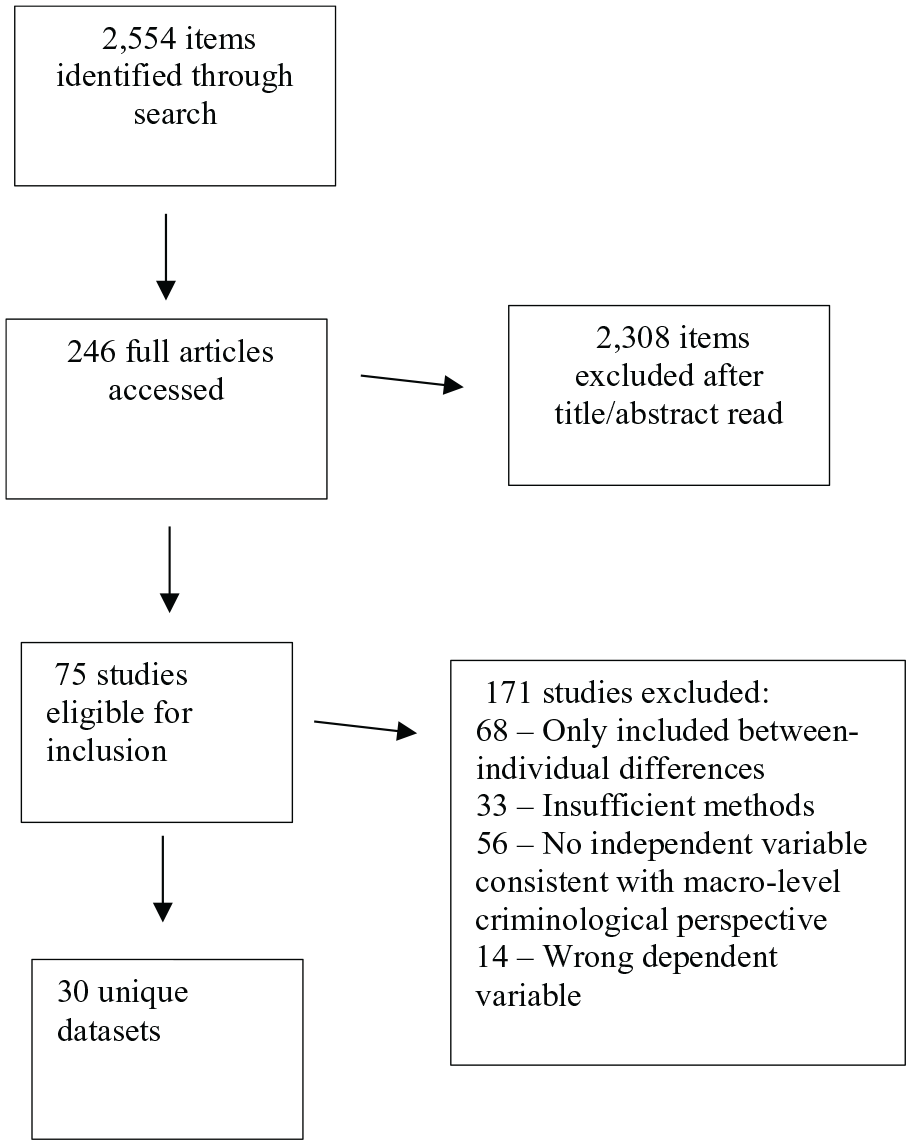
PRISMA flowchart of included studies.
Included Studies.

School Survey on Crime and Safety.
Maryland Safe and Supportive Schools.
Education Longitudinal Study 2002.
National Education Longitudinal Study 1988.
Rural Substance Abuse and Violence Project.
National Study of Delinquency Prevention in Schools.
Virginia High Schools.
Flemish Educational Assessment.
ADD Health.
Predictor Variables
The predictor variables explain between-school differences of delinquency and are separated into several domains that represent macro-level criminological perspectives.
Social disorganization theory
While originally used to explain crime at the neighborhood level, elements of social disorganization have been applied to schools as well. The measure of social cohesion comes from the collective efficacy in neighborhoods literature (Sampson et al., 1997). It is measured as a continuous variable and captures whether students have common goals and values, a sense of belonging to their school, and help one another, with higher scores indicating more social cohesion. Ethnic heterogeneity includes effect sizes that use several similar diversity indices that calculate the proportion of different ethnicities represented in the student population. It is expressed as a continuous variable with higher values indicating greater ethnic heterogeneity in the school. Studies that used the percentage of minority students as a measure of ethnic heterogeneity were not included, as this is not a true measure of heterogeneity. Student mobility was measured as the proportion of students that transfer in and out of the school during the school year, with higher values indicating more student mobility. Concentrated disadvantage was measured using the percentage of students that were eligible for a free or reduced-price lunch.
Situational crime prevention
Safety features was measured as the number of features used in a school that were consistent with situational crime prevention. Several categories of situational crime prevention were included, such as controlling access (visitor sign in, locked doors), controlling contraband (drug dogs, locker checks, metal detectors, clear bookbags), and reducing anonymity (ID badges). SRO measured whether the school employed a school resource officer, and formal surveillance measured whether the school used visible security guards and/or cameras. Both of these variables were measured dichotomously.
Broken windows
Consistent with the broken windows perspective, physical disorder was included. This variable was measured using Likert scale responses that indicated the amount of physical disorder in the school. Items included broken windows, vandalism, graffiti, broken desks, broken lights, etc., as well as signs of ownership (murals). Signs of ownership were reverse-coded. Higher scores indicated a higher level of physical disorder in the school.
Routine activity theory
While larger schools generally have more delinquency, the ratio of students to teachers has been found to be a more accurate measure of opportunity to offend than school size (Khoury-Kassabri et al., 2004). In schools with higher student/teacher ratios, it may be more difficult to monitor students, decreasing guardianship and creating opportunity for delinquency. Student-teacher ratio was included as a measure of the guardianship element of routine activity theory.
Moderating Variables
While the term school delinquency encompasses a wide range of misbehavior, it is likely that different forms of delinquency are not all best explained by the same predictor variables. In order to control for this, effect sizes were coded by outcome type: general delinquency included a mixed measure of criminal delinquency (i.e., studies that did not separate violence and theft) and misconduct that may not be criminal (substance use at school, incorrigibility). Violence included measures of violent acts and physical bullying. Theft included property crimes. Bullying included any bullying that was not physical in nature, and mixed measures of bullying. Each of the four outcomes types was coded for whether it was perpetration or victimization, therefore eight outcomes were included. While the vast majority of studies specified that the outcome had to take place on school property, several studies did not specify that outcomes occurred only at school. This was included as a moderator. Studies that explicitly stated that the outcome took place outside of school were eliminated from analysis. Some studies used self-reports from the students in the school, and some studies used reports by administrators. This was included as a moderator. All samples used in the studies were school samples, and studies were coded for whether they took place in elementary, middle, high, or a mix of more than one type of school. Additionally, studies were coded for whether they took place in North America (USA and Canada) or outside of North America. Studies from Belgium, Iran, England, and France, among others, were included, but there were not enough international studies to code each country separately. Studies were coded for whether they used a cross-sectional or longitudinal design, as well as whether they used multi-level models or not. Multi-level models control for the influences of between-individual differences as well as between-school differences, while the studies that only use the school as the unit of analysis do not. This was controlled for to determine if including the between-individual differences affects the mean effect size.
Multivariate models can vary widely depending on what controls are included. Several of the most salient predictors of school delinquency were included as controls. Each effect size was coded for whether or not it included each of several different controls: School size, since larger schools have been found to have more delinquency than small schools (Nickerson & Martens, 2008); Percent minority, as schools with higher proportions of minority students have been found to have more delinquency (Payne et al., 2003); Poverty in the neighborhood where the school is located, as delinquency has been found to be higher in impoverished neighborhoods (Bradshaw et al., 2009); Urban, suburban, or rural location, as urban schools have been found to have more delinquency (Payne, 2009); Neighborhood crime rate, as schools in criminogenic neighborhoods tend to have more delinquency (Jennings et al., 2011); and percent male students, as males are generally more involved in delinquency at school than girls (Servoss, 2017). Additionally, effect sizes were coded for whether or not they had a predictor from a competing perspective in the same model. For example, if an effect size for SRO also contained an effect size for student/teacher ratio, it was coded as “yes.”
Plan of Analysis
This meta-analysis used Fisher’s z scores as a measure of mean effect size. Fisher’s z scores are a common metric used in meta-analyses, as they provide a correction for the assumption that samples are normally distributed and sampling variances are known (Borenstein et al., 2011). Multivariate effect sizes, including odds ratios and standardized regression coefficients were converted into r correlation coefficients, and then Fisher’s z scores using established formulas (Peterson & Brown, 2005; Pratt et al., 2014). Studies that contained unstandardized coefficients were standardized using the formula provided by Rosenthal (1994). Standard errors were required to compute mean effect sizes, and if not provided, were calculated using p values and confidence intervals.
An important assumption of meta-analyses is that effect sizes are independent of each other. However, studies that use the same dataset and studies that contain multiple models violate this assumption. A solution to this is to aggregate common effect sizes so that one effect size per study is used. However, this decreases statistical power and masks important moderating differences. To address these issues, a hierarchal meta-analysis design was used in this study. This method assesses the variance at three levels: sampling variance of individual effect sizes (level 1), variance within datasets (level 2), and variance between datasets (level 3). Datasets, rather than studies, were used to assess variance since a number of studies in the meta-analysis used the same data. The School Survey on Crime and Safety (SSOCS) surveys a different sample of schools every 2 years. However, overlap of schools from one survey year to the next is around 50%, so about half of schools are surveyed in multiple years. Additionally, many of the studies used multiple years in their analyses (Fisher et al., 2019). Because of this, the decision was made to count every year of the SSOSC study as one dataset to ensure that some schools are not counted more than once. Since there are a large number of studies using the SSOSC data that are eligible for inclusion, this is favorable to eliminating SSOSC studies from the analysis completely.
Analyses were performed using the metafor package in RStudio (Assink & Wibbelink, 2016; Viechtbauer, 2010). First, mean effect sizes for each predictor were estimated and heterogeneity was assessed. Next, for each predictor variable that showed heterogeneity, variance was assessed at each level using likelihood ratio tests. Next, if sufficient variance at level 2 or 3 was found, moderating analyses were performed. Finally, publication bias was assessed by estimating trim-and-fill funnel plots for each predictor variable.
Results
Descriptive Statistics
In total, 656 effect sizes were included in the analysis. The descriptive statistics of the studies are presented in Table 2. Because most datasets included multiple studies, many of the descriptive statistics exceed 100%.
Descriptive Statistics.
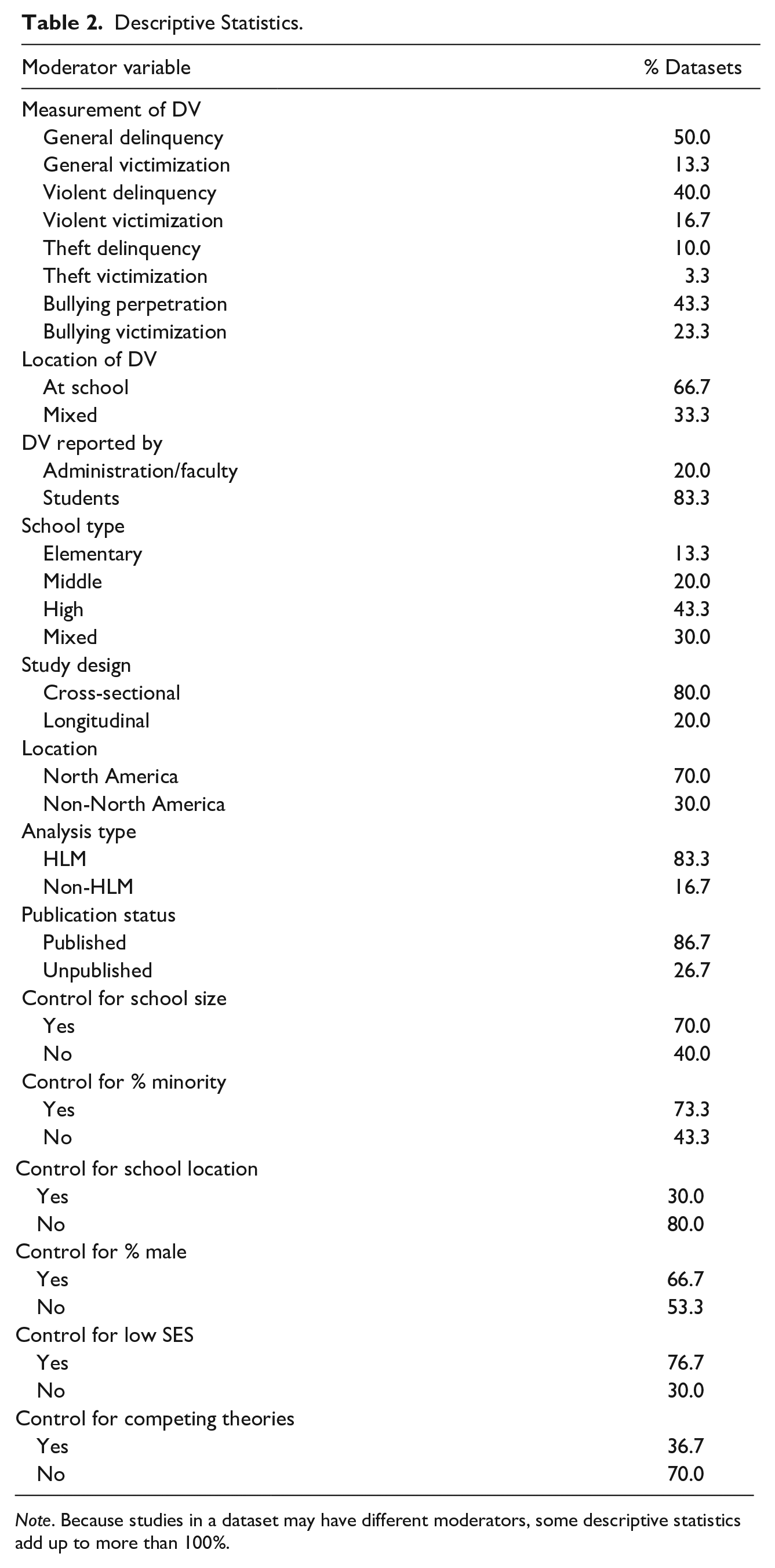
Note. Because studies in a dataset may have different moderators, some descriptive statistics add up to more than 100%.
Main Effects
Mean effect sizes and the percentage of variance at each level is presented in Table 3. Only two predictor variables had a significant relationship with school delinquency. Higher student/teacher ratios (z = 0.034, p < .001) and increased concentrated disadvantage (z = 0.044, p = .027) were associated with increased delinquency.
Mean Effect Sizes and Moderators.
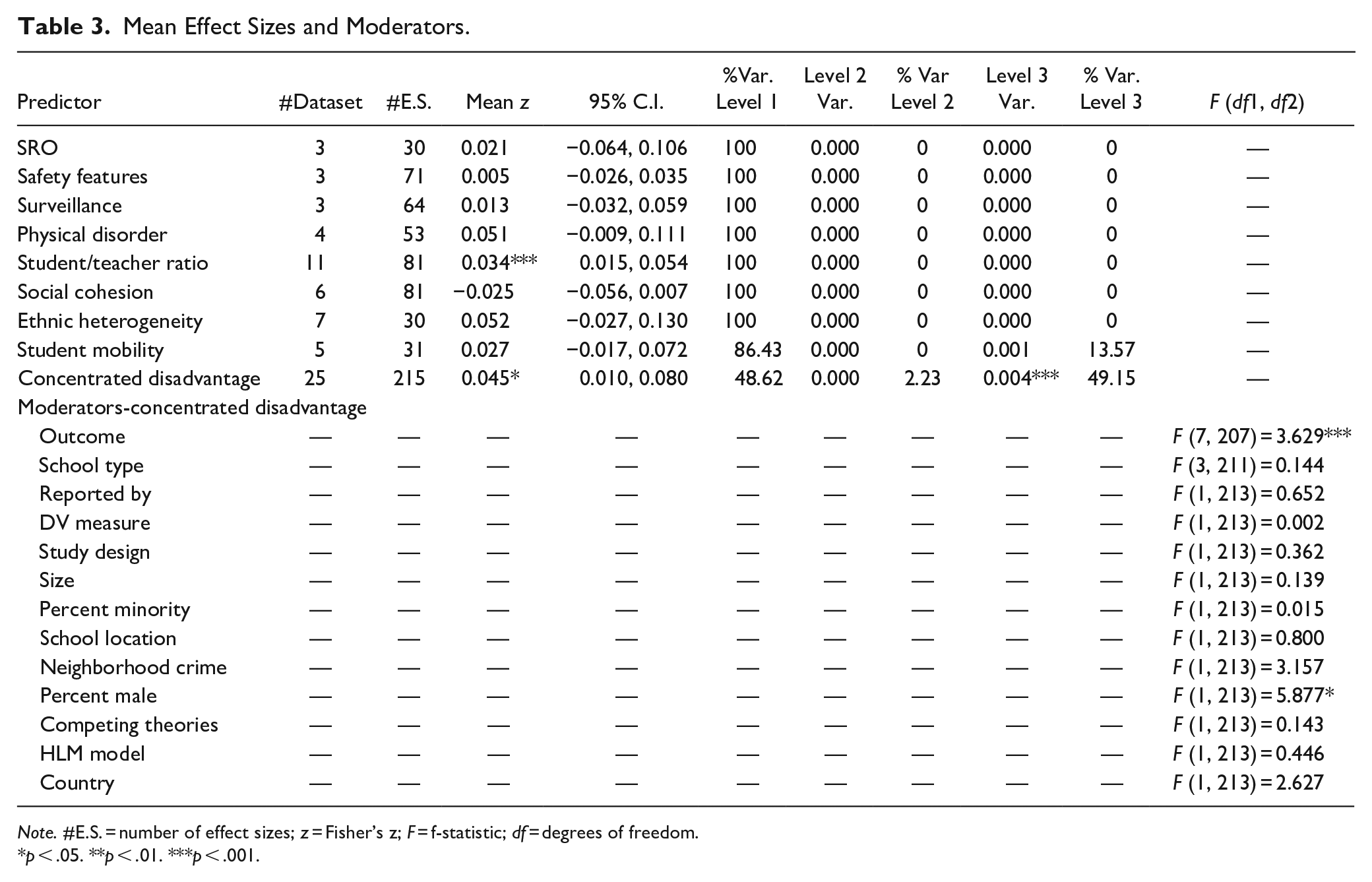
Note. #E.S. = number of effect sizes; z = Fisher’s z; F = f-statistic; df = degrees of freedom.
p < .05. **p < .01. ***p < .001.
Moderating Effects
The concentrated disadvantage predictor variable showed significant variance at level 3 (between studies) so moderating analyses were completed. Two moderating variables showed significant variation. First, relationships between concentrated disadvantage and school delinquency depended on the outcome used. This relationship was only significant for studies that used an outcome of general delinquency (F[7, 207] = 3.629, p < .001). Additionally, the relationship between concentrated disadvantage and school problem behaviors was only significant when studies controlled for the percentage of male students (F[1, 213] = 5.877, p = .016). Moderating analyses for concentrated disadvantage are presented in Table 3.
Publication Bias
A concern when conducting meta-analyses is the “file cabinet” effect, where studies that have null findings are less likely to be submitted for publication. This may artificially inflate the mean effect sizes in a meta-analysis (Rosenthal, 1979). To test for this bias, trim and fill funnel plots, which impute datasets that may be missing from the analysis, were estimated after completing the main analyses. The funnel plots for concentrated disadvantage, physical disorder, formal surveillance, situational crime prevention, SRO, and ethnic heterogeneity revealed imputed datasets on the left side, indicating that studies using these predictor variables may be positively biased. Social cohesion, student teacher ratio, and residential mobility did not show evidence of publication bias. However, because there are a small number of included datasets, these funnel plots should be interpreted with caution (Nakagawa & Santos, 2012). Because of space restrictions, funnel plots are available from the author upon request.
Discussion
This study used hierarchal meta-analytic methods to examine the effects of macro-level criminological perspectives on school delinquency. While each of the relationships between the predictor variables and outcomes were in the expected direction, only concentrated disadvantage and student/teacher ratio were significant. When the heterogeneity of effects was examined, only concentrated disadvantage showed heterogeneity, which suggested that moderator analyses be conducted. For moderating analyses, only studies that used an outcome of general delinquency and those that controlled for percentage of male students were significant, indicating that the effect of concentrated disadvantage differed depending on these two moderators. Implications for theory, future research, and practice, as well as limitations, are discussed.
Implications for Theory
The limited number of macro-level criminological perspectives that predicted school delinquency suggests that individual-level explanations may be more influential. This is consistent with other research that has found that once individual factors are controlled for, school-level factors become insignificant in explaining delinquency (Azeredo et al., 2015; Servoss, 2017). Criminological perspectives that look at individual differences, such as social bonds, low self-control, and general strain have had success in explaining delinquency in schools (Moon & Alarid, 2015; Patchin & Hinduja, 2011; Popp & Peguero, 2012). However, in this meta-analysis, only one element of social disorganization theory (concentrated disadvantage) and one element of routine activity theory (lack of capable guardianship) significantly predicted between-school differences. Scholars have had recent success integrating individual-level and macro-level criminological theories when explaining school delinquency. Some examples of this include routine activity theory with social bonds (Cecen-Celik & Keith, 2019), and situational crime prevention with social bonds (Fisher et al., 2019). Findings from this meta-analysis suggest that individual-level criminological perspectives should be integrated with macro-level perspectives in future research on school delinquency.
All in all, when comparing target hardening efforts and formal surveillance to teachers as capable guardians, teachers appear to be more effective. Mean effect sizes for situational crime prevention strategies, surveillance, and SROs did not reduce delinquency in schools. In fact, the effect sizes for these predictors had a positive relationship with delinquency, although they did not reach significance. This is not surprising, as employing these techniques in schools has been found to create a climate that is more like a prison than a school, effectively decreasing school connectedness and feelings of safety (Theriot, 2009). While there is some concern that this lack of effectiveness is simply due to the fact that delinquency is more likely to be detected in schools that use SCP and formal surveillance (Devlin & Gottfredson, 2018), this was not likely the case in this meta-analysis. Studies were coded for whether administrators or students reported the dependent variable, and if increased delinquency was an artifact of increased detection and reporting, the studies that used administrative data would have had larger effect sizes than those that used student self-reports. However, this moderating effect was not present.
Implications for Research
While previous research has found that relationships between school-level factors and delinquency differed according to demographic composition and research design (Bradshaw et al., 2009), in this meta-analysis, there was limited heterogeneity of effect sizes both within and between datasets. While this could be attributed, again, to individual-level differences being more important in explaining school delinquency, recent meta-analyses that examined risk factors for juvenile offending and victimization at the individual-level found limited heterogeneity as well (Moule & Fox, 2021; Myers et al., 2020). However, two moderators were significant for the concentrated disadvantage predictor variable. Concentrated disadvantage was significantly associated with general delinquency only, and not victimization, bullying, or violence. Additionally, the relationship was significant only when the percentage of males in the sample was controlled for. While this moderator examined if gender composition is controlled for, rather than different effects of concentrated disadvantage on gendered violence in school, previous research has found that girls were more likely to be victimized in schools with greater amounts of school-level poverty (Dhami et al., 2005). Future research should integrate school-level factors with individual-level factors to examine potential gender differences in delinquency.
In meta-analytic research, findings are only as good as the studies used. Measurement of school delinquency has several limitations. For one, student self-reports may be inaccurate, and data validity screening is not often used in large surveys that examine youth behaviors. Respondents may artificially inflate involvement in delinquency as a way to be socially desirable to their delinquent peers. Recently, surveys such as the California Healthy Kids Survey and the Arizona Youth Survey have begun to use validity assessment procedures, including asking respondents if they have used a fictitious drug to eliminate respondents who do not respond honestly. Additionally, wording and language used in surveys, recall periods, and a focus on severe violence instead of more common forms of delinquency may lead to very different pictures of the extent of violence in schools (Sharkey et al., 2011). Future research should use instruments that are valid and reliable to measure problem behaviors in schools.
Implications for Practice
The finding that situational crime prevention methods did not prevent school delinquency brings the costs and benefits of employing SROs and installing target-hardening devices into question (Fisher & Hennessy, 2016). Since the tragic events at Columbine High School, federal grant money has made over 1 billion dollars available to hire SROs, and $123 million available to purchase metal detectors and cameras for schools. The Stop School Violence Act, which will provide $100 million annually up to the year 2028, was enacted as a response to the Parkland school shooting in 2018 (Wilson, 2020). The finding that high student/teacher ratios are associated with an increase in delinquency suggests that teachers may be better monitors than target-hardening devices and SROs and may help reduce opportunities for delinquency in schools. Schools may be better off by reinvesting crime prevention resources into hiring more teachers in order to reduce the student/teacher ratio in schools. Along with increased monitoring, this may provide academic benefits as well (Whitehurst & Chingos, 2011).
While the protective effect of school cohesion on school delinquency only approached significance (p < .10) in this meta-analysis, it is not to say that fostering efficacy in schools is not important. Previous research has found that programs that enhance school cohesion by improving school climate may prevent delinquency. For example, the School Positive Behavioral Interventions and Support provides training to staff that aims to improve relationships between adults and students on campus. This program has been found to reduce suspensions and problem behaviors (Bradshaw et al., 2010). Additionally, restorative justice practices implemented in schools may also improve school climate by focusing on inclusion and communication, rather than punishment, when problems arise (González, 2012).
Along with addressing school climate, the small and insignificant effect sizes for school-level explanations suggest that individual risk factors must also be addressed. While many of these risk factors exist in the family and home life domains, the school domain can also be targeted at the individual level. For example, a recent meta-analysis found that attachment to school significantly protected boys from victimization (Pusch & Holtfreter, 2021), so focusing on fostering individual attachments to school may be beneficial. One way both school-level and individual-level risk factors can be addressed simultaneously is by using a multi-level programming response (Tillyer et al., 2011). This method uses school-contextual programming plus practices that target at-risk individuals for a whole school comprehensive approach. Especially useful at the individual level are programs that use cognitive behavior therapy that enhances self-control and teaches students to regulate emotions (Gottfredson, 2001). One such multi-level program is the Olweus anti-bullying program, which targets bullying risk at the individual, classroom, and school level (Olweus et al., 1999). Evaluations of the Olweus program have consistently found that it is among the most effective ways to reduce bullying in schools (Gaffney et al., 2019). The same type of program would likely be useful in addressing other types of school delinquency.
Limitations
While this study used variables derived from macro-level theories of crime, this study did not fully test the relationship between criminological theory and school delinquency. For example, in order to test collective efficacy, effect sizes would need to contain measures for both social cohesion and shared norms (Sampson et al., 1997), but the majority of the studies used contained one or the other. A related concern is that the predictor variables may span multiple criminological perspectives. For example, the monitoring component of the student/teacher ratio is consistent with the guardianship component of routine activity theory. However, on the individual level, the monitoring effect is also consistent with social bond theory. Additionally, not every macro-level criminological perspective was included due to lack of prior research. For example, it would have been beneficial to include macro-level strain theory and subculture perspective. However, a sufficient number of effect sizes in previous research could not be located.
Another limitation of this meta-analysis is the small number of datasets used in the analyses, which may potentially reduce statistical power. Unlike other types of analyses, no power analysis test exists to determine the power of three-level meta-analyses, and scholars are not in agreement as to how many unique studies and datasets are needed for the meta-analysis to be sufficiently powered (Assink & Wibbelink, 2016). While this meta-analysis had similar numbers of studies and datasets to other hierarchal meta-analyses (Steffgens et al., 2013; Welmers-Van De Poll et al., 2018), findings should be interpreted with caution.
There is a debate among researchers using meta-analytic methods as to whether it is appropriate to include unpublished work. Unpublished studies have not gone through the peer-review process, and thus methodologically quality has not been assessed (Pratt, 2010). However, including unpublished studies has been considered a best practice of meta-analytic research (McKenzie et al., 2021), and unpublished studies were included in this study for three reasons. First, meta-analyses aim to “take stock” of all research done on a topic. If too many restrictions are placed on inclusion criteria, the meta-analysis cannot examine the full body of evidence (Glass, 2015; Turanovic & Pratt, 2020). Next, excluding unpublished studies would eliminate four datasets that do not appear in any of the published studies. Related to the previous paragraph, this would potentially reduce statistical power even further (Turanovic & Pratt, 2020). Finally, although including unpublished work means that the analysis contains studies of various methodological rigor, this is controlled for with the use of moderating analyses for publication status and issues of methodological quality.
Conclusions
In sum, school delinquency continues to be a significant issue, and negative consequences can last into adulthood. The finding that situational crime prevention approaches did not prevent school delinquency offers some practical implications. An investment of resources to improve the climate of K-12 public schools, rather than install metal detectors and surveillance cameras, may be beneficial. Creating a climate that fosters trust, respect, and communication may help students feel safer and improve their behaviors, including reducing the occurrence of misbehavior and bullying (VanLone et al., 2019). While this study helped to shed some light on school-level predictors of school delinquency, research must continue, and should focus on examining both individual-level and school-level factors simultaneously. Hopefully, this whole-school approach will reveal the best way to use scarce school resources in order to make schools even safer than before.
Footnotes
Declaration of Conflicting Interests
The author(s) declared no potential conflicts of interest with respect to the research, authorship, and/or publication of this article.
Funding
The author(s) received no financial support for the research, authorship, and/or publication of this article.
