







Abstract
Based on the third-person effect hypothesis–people’s belief that the media influences others more than it influences themselves–we administered a questionnaire to Chinese teens (N = 1,538) to discover the impacts of exposure to internet pornography on perceptions of pornography and attitudes toward censorship of pornography. The results validated the third-person effect hypothesis and showed that teens’ subjective perceptions of what constitutes internet pornography and their exposure to it are critical variables for predicting perceptions of negative impacts of pornography on self and others and affirmative attitudes toward censorship. The study also found that the impact on self is the best variable for predicting attitudes toward censorship. The discussion is framed in the context of Chinese collective culture and conservative attitudes toward sex.
Introduction
In the internet age, teens are highly exposed to pornography, raising concerns about the negative consequences of this exposure (Ybarra & Mitchell, 2005). Some researchers hold that teens who often watch internet pornography are more likely to engage in extramarital sex and to accept rape myths, leading to negative sexual values or sexual assaults (Lo et al., 2008; Owens et al., 2012; Rostad et al., 2019; Stephen, 1967). Some researchers believe that there is no solid evidence of substantive damage caused by teens’ exposure to internet pornography (Posner, 1994), and thus no justification for legally regulating pornography (Dworkin, 2013; Hart, 1963).
Past studies overlook teens’ subjective perceptions of pornography (Chen et al., 2015; Hunter et al., 2010; Peter & Valkenburg, 2006), or are based in a Western context or specific Asian regions (Lee & Tamborini, 2005; Lo & Wei 2002; Wu & Koo, 2001). Few empirical studies have examined the impacts of internet pornography on Chinese teenagers(Chen et al., 2015). Participants in existing studies have come from a limited group, such as undergraduates, and the results of these studies may not be generalizable to other groups (Zhao & Cai 2008). While some countries and regions partially restrict pornography access, China has implemented full-scale restrictions on access to pornography. In Chinese culture public attitudes toward sex are reserved, and Chinese teenagers receive limited sex education. Thus, Chinese teens are exposed to pornography in a specific social environment and cultural context. It remains to be seen whether past findings on teens and pornography can be generalized to Chinese scenarios.
According to the 46th China Statistical Report on Internet Development, as of June 2020, there were 940 million internet users in Mainland China, an increase of 36.25 million compared to March 2020 (CNNIC, 2020). Users under age 10 accounted for 3.5% of users and those aged 10 to 19 accounted for 14.8% (CNNIC, 2020). The government of China has taken stringent measures to restrict access to internet pornography on the grounds that it is harmful, especially to minors. However, the effect of those measures is limited as China has no classification system for pornographic content, allowing websites to exploit the lack of a clear definition of pornography (King et al., 2013; Yan, 2014). These websites are driven by commercial interests, and their motivation to continue posting pornography after repeated sanctions is high (Endeshaw, 2004). Teenagers can easily access pornography online through proxy software or illegal leakage on social media and websites. Public concern about pornography influences policymakers more than the actual impacts of pornography (Lee & Tamborini, 2005).
To a certain extent, the third-person effect–the belief that pornography influences others more than oneself–can explain how an individual’s perceptions of negative impacts of internet pornography influence the person’s own attitudes toward restricted pornography access (Chen et al., 2015; Chia et al., 2004; Davison, 1983; Lo & Wei, 2002). We administered a printed survey to teens in seven provinces and regions of China in 2019, to examine their perceptions of the impacts of pornography and their attitudes toward pornography censorship. This paper discusses the results of the survey within the theoretical framework of the third-person effect. This study provides theoretical insights into how the third-person effect operates in the Chinese context with respect to teens’ perceptions of pornography and restricted pornography access.
Literature Review and Research Hypotheses
Third-person effect and pornography
Davison (1983) proposed the third-person effect hypothesis, which became a major topic of media effect research, to explain public perceptions of media information and judge its influence. This hypothesis maintains that people are inclined to believe that the influence of media information is greater on others (third persons) than on themselves. Many communication scholars have explored the relation between the third-party effect and perceived behaviors, covering pornography (Chia et al., 2004; Gunther, 1995; Lo & Wei 2002), television violence (Hoffner et al., 1999; Salwen & Dupagne, 2001), internet spoofing (Yu, 2008), internet information (Leung & Lo, 2015; Lim, 2017), and the political elections (Yin et al., 2020). The majority of the research supports Davison’s hypothesis (Chen et al., 2015; Chia et al., 2004; Lo & Wei, 2002; Tsfati & Cohen, 2003).
The third-person effect hypothesis has been validated for pornography. Gunther (1995) surveyed 648 American adults and found that the majority believed that others were more negatively influenced by pornography than themselves. With the development of the internet, Wu and Koo (2001) surveyed college students in Singapore, a conservative nation that frowns on sexuality in media, and found that they believed that internet pornography had a greater impact on others than on themselves. Lo and Wei (2002) conducted a survey among 2,713 Taiwanese male and female college and high school students and found that both genders believed that others would be more susceptible to the negative influence of internet pornography than themselves. Since a growing number of studies have supported the third-person effect hypothesis, the present study presupposes that this also applies to Mainland Chinese teens (Chen et al., 2015; Zhao & Cai, 2008). Thus, our first hypothesis is:
Subjective perceptions of pornography and the third-person effect
Accurate definition of key concepts is critical in empirical research. However, it is very difficult to give an accurate definition of “pornography” because it is at least in part a subjective concept, meaning that people have different understandings of what it is. The same content may be perceived as pornographic by some, but not by others. Lack of a clear definition of pornography may hinder research when respondents are asked if they watch pornographic content (Willoughby & Busby, 2016). Different understandings of pornography may lead respondents to make different choices on questionnaires and different behavioral choices (Daneback et al., 2009; Malamuth et al., 2000; Weinberg et al., 2010). Individuals’ subjective interpretation of the term “pornography” has been overlooked in studies on individual attitudes toward pornography and associated behaviors.
As the internet developed, a new generation of teens–“internet natives”―became increasingly exposed to pornography. In the absence of a clear definition of pornography, Chinese people are divided in their perceptions of it. Some content such as nonpornographic films with erotic scenes may be perceived as pornographic by some individuals, but this content is generally not identified as pornographic under Chinese law. Self-definition may negatively impact viewers’ mental health (Willoughby et al., 2019). Pornography is construed as negative among teenagers, who may experience guilt, anxiety, or other negative internal consequences, when they watch it (Flood, 2009; Patterson & Price, 2012). Theoretically, those with a lower subjective perception of pornography–interpreting behaviors such as kissing or nudity as pornography–might believe that pornography has a greater negative influence on themselves and others. Thus, our second hypothesis is:
Exposure to internet pornography and the third-person effect
People with more exposure to internet pornography may believe that pornography has a less negative influence on themselves and others (Lo & Paddon, 2001), referred to as the “desensitizing effect.” In the Czech Republic, Daneback et al. (2018) analyzed teenagers’ views on internet pornography and found that those with more exposure were more likely to change their views, resulting in desensitizing them to pornography. Watching internet pornography also carries a negative social stigma. To defend against loss of self-esteem, people who watch pornography tend to believe that they and others are less susceptible to its harmful effects. Thus, our third hypothesis is:
The third-person effect and attitudes toward censorship
Davison’s third-person effect hypothesis includes a perceptual and a behavioral component: people perceive that others are more susceptible to media information than they themselves, and this perception can influence their attitudes and behavior. The perceptual aspects of the third-person effect include the influence on oneself, the influence on others, and the gap between perceived first- and third-person effects. Communication scholars are interested in the third-person effect because it may reveal influences on attitudes and behavior (Lo & Wei, 2002).
Research on the influences on attitude and behavior focus on the third-person effect and attitudes toward censorship of pornographic media. One area of interest is the influence of the gap between perceived first- and third-person effects on affirmative attitudes toward censorship. Gunther (1995) interviewed 648 American adults through random sampling and found that among the independent variables that predict an affirmative attitude toward pornography censorship, “the gap between perceived first- and third-person effects” is highly significant. Wu and Koo (2001) also found that this gap has a positive influence on attitudes toward pornography censorship. Zhao and Cai (2008) conducted a survey among over 400 college students at an American university, measured the gap between perceived first- and third-person effects, and found a pivotal role of the gap between perceived first- and third-person effects in seeking self-improvement and supporting pornography censorship.
A second area of interest for researchers is the perceived influence of pornography on oneself and others (Salwen, 1998). Studies have confirmed that the third-person effect results from individual inclination to underestimate the influence of media on self and to overestimate the influence on others, or a combination of both (McLeod et al., 2001). Many scholars have found that the gap between perceived first- and third-person effects does not predict affirmative attitudes toward restricted pornography. For instance, following the method proposed by Gunther (1995), Salwen and Driscoll (1997) analyzed the gap between perceived first- and third-person effects and restricted media content, they concluded that there is no significant correlation between them. Lo and Wei (2002) also showed that the gap between perceived first- and third-person effects cannot differentiate between two other circumstances: individuals believe that pornography has a great influence on self and others simultaneously, or that it has less influence on self and others. They revealed that compared with the gap between perceived first- and third-person effects, influence on self and influence on others are reliable variables for predicting support for media restrictions. Gunther and Storey (2003) further proposed the “influence of presumed influence” and argued that effect on others is a significant variable for predicting behaviors. Recently, Chen et al. (2015) have only treated the influence of pornography on others as a variable to measure the third-person effect, and found that it is significantly correlated with affirmative attitudes toward restricting pornography.
Previous works have not examined how to measure the interdependence between the third-person effect and affirmative attitudes toward restricting pornography access. This paper compares the extent of the impact of influence on self and influence on others, and the gap between perceived first- and third-person effects of restricted pornography access, and examines the question. Do those three variables impact teens’ affirmative attitudes toward censorship, and if so, which is the strongest?
Perceptions of pornography may change individual behavioral patterns (Willoughby et al., 2019). Given frequent exposure to sexual content, people must decide which content is pornographic and what moral stance they should take toward it. Those who disapprove of pornography generally report lower use of it, while those with high acceptance of pornography report higher use and oppose restrictions on pornography (Willoughby et al., 2019). A lower subjective perception of pornography means lower acceptance of pornography. Thus, our fourth hypothesis is:
Exposure to internet pornography is highly correlated with an affirmative attitude toward censorship. As mentioned earlier, teens with more exposure to internet pornography may become less sensitive to it and more indifferent to sexual content (Daneback et al., 2018). American teens with more exposure to pornographic websites were found to have more than one sex partner, to have risky sexual behaviors, and to be more tolerant of sexual activity (Braun-Courville & Rojas, 2009; Brown & L’Engle, 2009). As a result, they tend to oppose restricted access to pornography. Individuals who are often exposed to pornography may be interested in it, so they oppose censorship of videos or websites (McLeod et al., 2001). Thus our fifth hypothesis is:
Method
Sampling
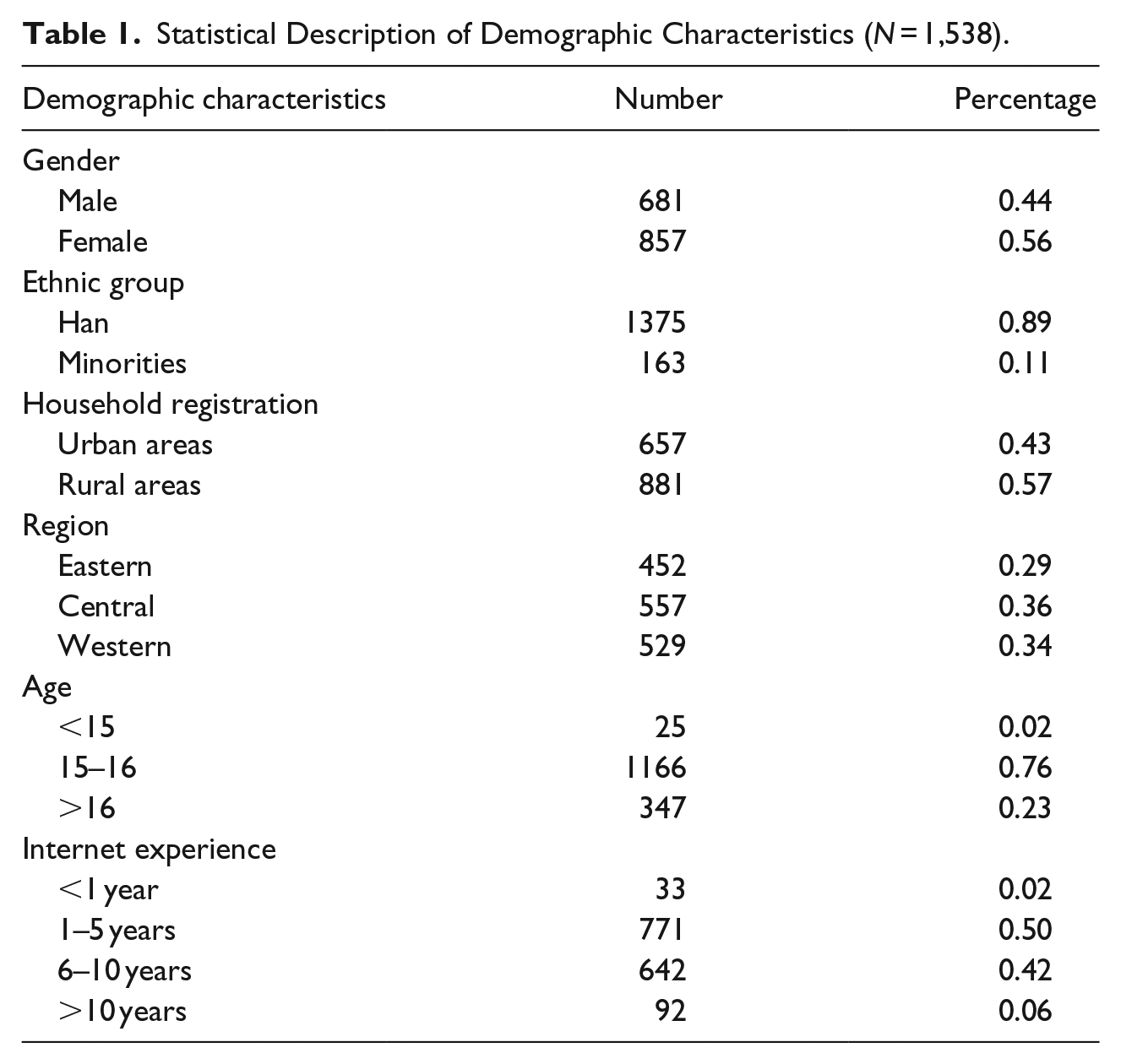
Considering the wide gap in the development of the internet economy across different regions of Mainland China, we conducted a questionnaire survey using a multi-stage stratified cluster random sampling method. Two or three provinces (municipalities or autonomous regions) were selected from the eastern, central, and western regions. A capital city was selected from each, and then a prefecture-level city or municipal district with a wide economic gap with the capital city was selected according to its 2018 provincial GDP. At each site the survey was administered to one or two randomly selected classes at a local public senior high school at the medium and high ranking of comprehensive strength. To ensure reliability and validity, 400 pretest questionnaires were distributed at community libraries, parks, and museums frequented by teens in Guangzhou, Guangdong: 14 adolescent respondents attended an intensive interview; and the questionnaire items were revised according to the interview responses and the research topic. The survey period was from August 20, 2019, to October 15, 2019. A total of 2,000 questionnaires were distributed and 1,538 (76.9%) were recovered. This survey covered the following regions and cites: (1) eastern region: Guangzhou (129 respondents) and Qingyuan (94) in Guangdong Province, Jinan (88) and Linyi (141) in Shandong Province; (2) central region: Changsha (161) and Huaihua (157) in Hunan Province; Zhengzhou (104) and Pingdingshan (135) in Henan Province; and (3) western region: Yongchuan (109) and Beibei (77) in Chongqing; Nanning (57) and Baise (119) in Guangxi Zhuang Autonomous Region; Kunming (83) and Qujing (84) in Yunnan Province. This distribution assured a representative sample across China. Students chose freely whether to participate and all respondents provided informed consent from their schools. The statistical description indexes of the samples are given in Table 1.
Statistical Description of Demographic Characteristics (N = 1,538).
Measurement
The research variables in this study include demographic variables, subjective perception of pornography, exposure to internet pornography, perceived third-person effect, and affirmative attitude toward censorship.
Demographic Variables
The demographic variables in this study include gender, age, urban and rural areas, and religious beliefs. Gender and age were filled out by respondents. Religious belief was filled out following Lo et al.’s (2008) study of teens’ exposure to internet pornography. The question about religion was “Do you have any religious beliefs?” The options were (1) No; (2) Yes, but not devout; (3) Yes, fairly devout; and (4) Yes, very devout. Demographic variables were treated as control variables (Table 1).
Subjective Perception of Pornography
The survey was based on Lo et al.’s (2008) scale measuring sexual behaviors. The scale was amended by considering Chinese teens’ perceptions of pornography and the extent to which their schools and parents could accept the questionnaire. Respondents were asked to indicate the extent of their agreement that the following five behaviors in online videos or films constitute pornography on a 5-point Likert scale, ranging from 1 = strongly disagree to 5 = strongly agree: (1) Holding hands; (2) Wearing revealing clothing (such as low-cut dresses or blouses); (3) Kissing; (4) Fondling with breasts and genitals exposed; (5) Having intercourse. These five items were reversely coded; the sum of the scores indicates the extent to which the respondents subjectively perceived the indicated behaviors as pornography. A higher score means a higher perception of the behaviors as pornography (M = 15.82, SD = 4.43, α = .77).
Exposure to Internet Pornography
Following Lo et al.’s (2010) scale measuring exposure to internet pornography, respondents were asked how often they watched internet pornography (with genitals exposed or people having sex). Responses included (1) Never; (2) Once or twice a year; (3) Once or twice a month; (4) Once or twice a week; (5) Almost every day (M = 1.36, SD = 0.83).
Perceived Third-Person Effect
The perceived third-person effect variable consisted of the perceived negative influence of internet pornography on self, the perceived negative influence on others, and the gap between perceived first- and third-person effects. In this study, Gunther’s (1995) scale was employed to measure the perceived third-person effect of internet pornography at two levels: moral values about sex and attitudes toward the opposite sex.
Perceived negative influence of internet pornography on self
Respondents were asked to assess the negative influence of internet pornography on themselves using a 5-point Likert scale ranging from 1 = strongly disagree to 5 = strongly agree. The two items were “Internet pornography would have a negative influence on your moral values about sex” and “Internet pornography would have a negative influence on your attitudes toward the opposite sex.” The sum of the scores for the two items is the assigned value for the perceived negative influence of internet pornography on self (M = 6.03, SD = 2.64, α = .91).
Perceived negative influence of internet pornography on others
Respondents were asked to assess the negative influence of internet pornography on others with a 5-point Likert scale ranging from 1 = strongly disagree to 5 = strongly agree. The two items were “Internet pornography would have a negative influence on others’ moral values about sex” and “Internet pornography would have a negative influence on others’ attitudes toward the opposite sex.” The sum of the scores for the two items is the assigned value for the perceived negative influence of internet pornography on others (M = 6.25, SD = 2.59, α = .93), as a variable assessed by the respondents.
The gap between perceived first- and third-person effects
The gap between perceived first- and third-person effects was derived by subtracting the perceived negative influence of internet pornography on self from the perceived negative influence on others (M = 0.23, SD = 0.89). This method has been used extensively in previous studies (Lo et al., 2010; Wu & Koo, 2001).
Affirmative attitudes toward censorship
This study used Rojas et al.’s (1996) scale to measure affirmative attitudes toward censorship from four perspectives. Respondents were asked to indicate their extent of agreement with four statements using a 5-point Likert scale ranging from 1 = strongly disagree to 5 = strongly agree: (1) All pornographic content in conventional media, such as TV, movies, and magazines, should be completely banned; (2) All pornographic content should be completely banned on the internet; (3) I think that China is taking a very strict attitude toward pornography; (4) Some pornographic content should be accessible to adults. Items #3 and 4 were reverse coded. The sum of the scores for the four items is the assigned value for a supportive attitude toward censorship of pornography (M = 12.91, SD = 2.93, α = .73).
Results
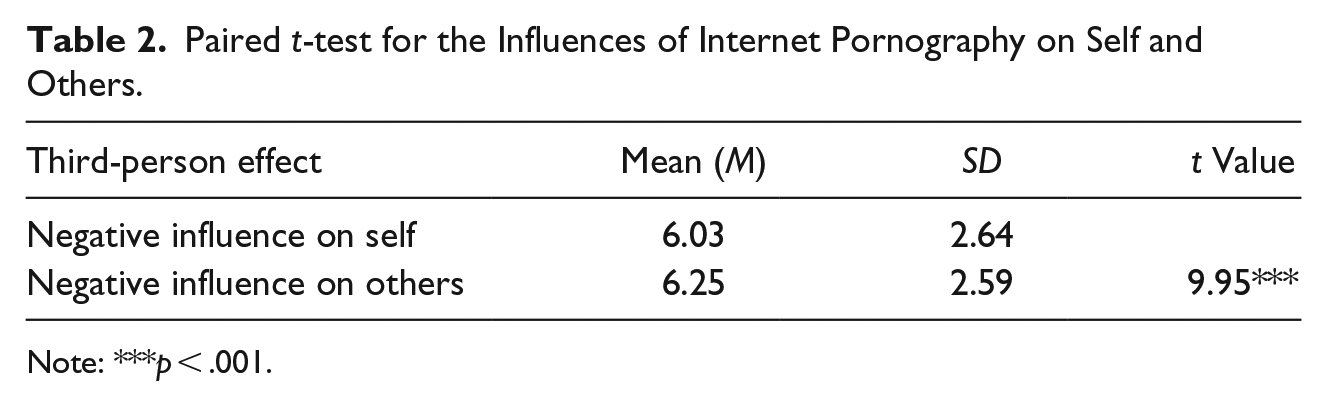
H1 hypothesized that Chinese teens believe that others are more susceptible to the negative influence of internet pornography than themselves. This hypothesis was checked by a paired t-test (Table 2). The results show that participants generally believed that internet pornography would have a greater negative influence on others (M = 6.25, SD = 2.59) than on themselves (M = 6.03, SD = 2.64; t = 9.95, p < .001). H1 was thus supported.
Paired t-test for the Influences of Internet Pornography on Self and Others.
Note: ***p < .001.
A least squares linear regression analysis was performed to test H2 and H3, with some demographic variables incorporated as control variables, including gender, age, urban and rural areas, and religious beliefs. These variables may influence individuals’ perceptions of pornography (Chen et al., 2015; Lo & Paddon, 2001). Subjective perceptions of pornography and exposure to internet pornography were treated as independent variables.
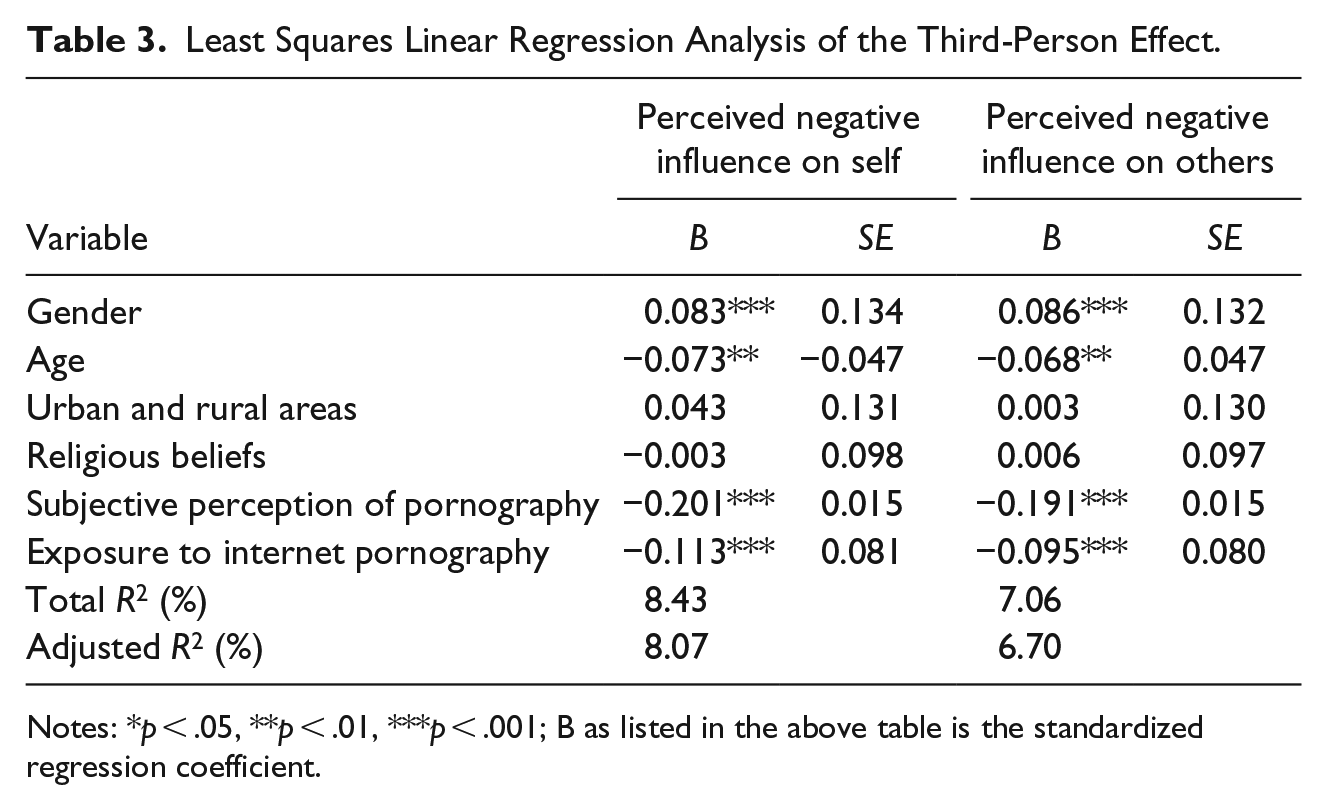
H2 hypothesized that teens with a lower subjective perception of pornography are more likely to believe that they and others would be more susceptible to the negative influences of pornography. According to the regression equation (Table 3), the subjective perception of pornography is a significant variable for predicting negative influence on self (B = −0.201, p < .001) and on others (B = 0.191, p < .001). This suggests that individuals with a lower subjective perception of pornography are more likely to believe that they and others would be more susceptible to the negative influences of pornography. H2 was thus supported.
Least Squares Linear Regression Analysis of the Third-Person Effect.
Notes: *p < .05, **p < .01, ***p < .001; B as listed in the above table is the standardized regression coefficient.
H3 hypothesized that teens with more exposure to internet pornography are more likely to believe that they and others would be less susceptible to pornography. According to the regression equation (Table 3), teens’ exposure to internet pornography is a significant variable for predicting the negative influence of internet pornography on self (B = −0.113, p < .001), and on others (B = 0.095, p < .001). This suggests that teens with more exposure to internet pornography are more likely to believe that they and others would be less susceptible to pornographic content. H3 was thus supported.
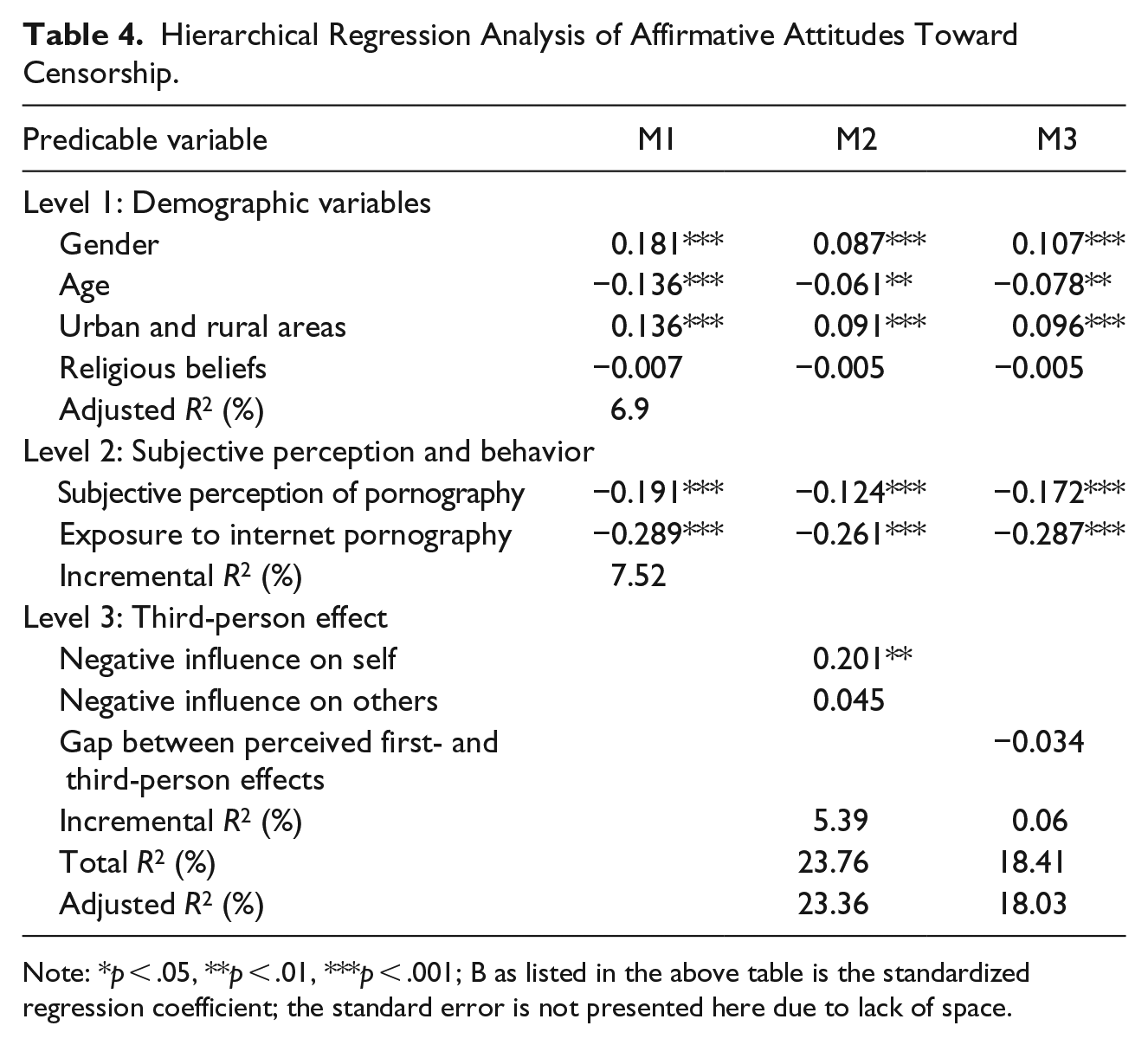
Hierarchical regression was performed to validate H4 and H5, with “an affirmative attitude toward censorship” as the dependent variable, demographic variables as control variables, and the subjective perception of pornography and exposure to internet pornography as independent variables. H4 hypothesized that teens with a lower subjective perception of pornography are more likely to support censorship. According to the first-level regression analysis (Column 1 of Table 4), the subjective perception of pornography is a significant variable for predicting affirmative attitudes toward censorship (B = −0.191, p < .001). In other words, teens with a lower subjective perception of pornography are more likely to support restricted access to pornography. H4 was thus supported.
Hierarchical Regression Analysis of Affirmative Attitudes Toward Censorship.
Note: *p < .05, **p < .01, ***p < .001; B as listed in the above table is the standardized regression coefficient; the standard error is not presented here due to lack of space.
H5 hypothesized that teens with more exposure to internet pornography would be more opposed to restricted access. A hierarchical regression analysis was also performed to validate this hypothesis. According to the results (column 1 of Table 4), exposure to internet pornography is a significant variable for predicting affirmative attitudes toward censorship (B = −0.289, p < .001). In other words, teens with more exposure to internet pornography are more opposed to restricted access to pornography access. H5 was thus supported.
This study examined whether influence on self, influence on others, and the gap between perceived first- and third-person effects of pornography would impact teens’ affirmative attitudes toward restricted access to pornography, and if so, what the best variable for predicting affirmative attitudes toward censorship is. Hierarchical regression analysis was performed with affirmative attitudes toward restricted access to pornography as the dependent variable. Given the high collinearity between the gap between perceived first- and third-person effects and influence on self/influence on others, and the absence of collinearity between influence on self and influence on others (VIF < 10), two regressions were run in order to better compare the influence of three variables on attitudes toward restricted access to pornography. First a regression model for influence on self and influence on others was constructed, and followed by a regression model for the gap between perceived first- and third-person effects.
According to the results of Regression Model 2 (column 2 of Table 4), perceived negative influences on self is a significant variable for predicting affirmative attitudes toward restricted access to pornography (B = 0.201, p < .01). This suggests that teens who perceive a greater negative influence on self would more strongly support restricted access to pornography. However, the regression of perceived negative influence on others to affirmative attitudes toward restricted access to pornography is not significant (p > .001), implying that perceived negative influence on others cannot predict teens’ affirmative attitudes toward restricted access to pornography. Furthermore, the regression of the gap between perceived first- and third-person effects to affirmative attitudes toward restricted access to pornography access is not significant, suggesting the absence of correlation between the two variables (Model 3). According to incremental R2, perceived negative influence on self (R2 = 5.39) has a greater impact on affirmative attitudes toward restricted access to pornography. It shows that perceived negative influence on self is the best variable of perceived third-person effect for predicting affirmative attitudes toward restricted access to pornography. Of the two impact models referred to above, exposure to internet pornography is the variable that has the greatest impact on affirmative attitudes toward restricted access to pornography (B = 0.26), followed by perceived negative influence on the self.
Discussion and Conclusion
Based on the latest empirical data on Chinese teens’ exposure to pornographic media, this study investigated how internet pornography influences teens’ third-person effect and attitudes toward censorship of pornography from their subjective perception of what constitutes pornography on the internet and their exposure to it. With the increased availability of the internet over the years, especially the rapid development of mobile internet in China, more and more teens are highly exposed to internet pornography. Thus this work has vital significance.
First, the research findings support the third-person effect hypothesis: Chinese teens are generally inclined to believe that others would be more susceptible to the negative influences of internet pornography than themselves. Teens are motivated to maintain a positive self-image and assert that they are able to guard against the adverse influences of media content when they perceive a negative influence (Gunther, 1995). For the sake of self-defense, self-protection, and self-esteem, people are inclined to believe that others would be more susceptible to negative information than they themselves would be (Gunther, 1991; Hoffner et al., 1999; McLeod et al., 2001). In addition, people are often overwhelmed by a sort of optimistic bias: they assert that others would be more susceptible to adverse consequences arising from healthy risks than themselves (Chapin, 2001). The findings of this study validated that the third-person effect is also present in the conservative environment, where sex culture is more reserved and pornography is fully restricted by Chinese law.
Interestingly, although the results confirmed the third-person effect, the gap between perceived first- and third-person effects was not large (M = 0.23). This might be expectable in China’s collectivist culture, where individuals are guided by interdependent rather than independent self-construal. They are unlikely to perceive themselves as different, cleverer, or better or worse than others as this would violate their interdependent self-construal, compared to people in Western countries where individualist culture prevails. The conclusion drawn by Lee & Tamborini (2005) in an empirical comparative study of Korean and American students was validated in this study: collectivism may reduce the gap between perceived first- and third-person effects.
Second, compared with previous empirical studies, which neglect different perceptions of pornography, a significant contribution of this study is that the perceived third-person effect and affirmative attitudes toward restricted access to pornography were framed from the perspective of the types of content that the participants perceived as pornographic. Teens with a lower subjective perception of what constitutes pornography were more likely to believe that they and others would be more susceptible to the negative influences of pornography, and they had a more affirmative attitude toward censorship.The results suggest that the individual perception of what is pornographic is a critical factor in perceiving the negative influences of pornography and attitudes toward censorship (compared to other independent variables, the standardized regression coefficient is higher). Chinese teens’ perceptions of pornography indeed reflect their understanding and acceptance of sex. Teens with a lower perception of pornography also had a lower acceptance of sex and were more likely to believe that they and others would be susceptible to the influences of pornography and to support restricted access to pornography. Such different perceptions and understandings of pornography may not come from their experience of sex, but rather stem from their culture, government policies, and media coverage (Dwulit & Rzymski, 2019). Chinese laws have explicitly banned pornography in any form, including hard and soft pornography, but the government has set no definitive standard for what pornography is exactly. Given that sex is pervasive on the internet in various forms, Chinese teens growing up in the internet age need some way of judging whether what they are exposed to is pornography. This judgment will in turn drastically influence their perceptions of the negative influences of pornography and their attitudes toward censorship.
Third, exposure to internet pornography reduces the perceived adverse influence on teens. Teens with more exposure are more likely to believe that they and others would be less susceptible to the harmful impacts of pornography. Exposure may also lead to desensitizing, so that teens believe that it is less harmful to themselves and others. In addition, exposure to internet pornography is correlated with behavioral intention, and teens who watch it frequently are often opposed to restricting access to pornography. This finding is consistent with previous studies on pornography, and may be attributed to the fact that exposure to internet pornography has a numbing effect and motivates those who watch it to support it and to oppose restricting access (Lo et al., 2010), or that individuals with more exposure to pornography are more interested in it, so they oppose restricting access and have easier access to it (Wu & Koo, 2001).
Fourth, researchers disagree about which variable should be used for the third-person effect to predict attitudes toward restricted access to pornography. In this study, only the perception of negative influences on self could predict attitudes toward restricted access. The other two variables did not have a significant influence on attitudes toward restricted access. This difference may be partly caused by the impact of other variables or perhaps other variables cannot predict attitudes and behavior (Salwen, 1998).
Teens are more concerned about the negative influence of pornography on themselves than on others (Wu & Koo, 2001), so they are more likely to support restricted access to pornography to prevent its harmful effects. One reason is associated with age characteristics. At this age, teens are self-centered and concerned about their own personal interests. Egoism has been found to stimulate individuals’ response to society for the sake of personal benefits, as a means of protecting themselves better (Gunther, 1995). Studies on social perception indicate that people tend to process information in the simplest, most immediate way possible (Price et al., 1998). When asking people to evaluate whether certain media content is appropriate, the extent of the influence of the information on self is one of the easiest and most reliable criteria to evaluate (Price et al., 1998). Another possible reason is related to traditional Chinese culture and social values. Chinese people are generally uncomfortable talking about sex, and the prohibition of pornography directly influences teens’ value, which makes them pay more attention to the negative effects of pornography on themselves (Jeffreys, 2015). In addition, sex education is limited, resulting in an imbalance between teens’ easy access to pornography and its perceived negative influence in Chinese culture, where sex remains a sensitive topic and “pornography” is a very negative word, making teens more aware of the negative effects of pornography (Zhang et al., 2007).
The results of this study have policy implications. Legislators need a clearer definition of pornography, so that audiences can recognize it and adopt personal attitudes toward it. It is also necessary for China to adopt a rating system for pornography, which would protect both minors and the freedom of adults. A clearer definition and rating system would reinforce teens’ tendency to support prohibition of pornography, since they believe it is harmful. This study has some limitations. First, because Chinese people are culturally reserved about sex and this survey was conducted among minors, the study did not use explicit definitions and illustrations of pornography in order to avoid making the participants feel uncomfortable. As the internet develops in China and as people become more open to discussing sex (Pan, 1994), future studies can gain further insight into target groups’ understanding of pornography and measure it more accurately. Second, this survey sought to discover the attitudes of minors toward censorship of pornography. Since teens cannot vote, they do not have the power to influence government policies. Future studies might investigate whether teens’ attitudes can influence policies when they become old enough to vote.
Supplemental Material
sj-pdf-1-yas-10.1177_0044118X211040095 – Supplemental material for Impact of Internet Pornography on Chinese Teens: The Third-Person Effect and Attitudes Toward Censorship
Supplemental material, sj-pdf-1-yas-10.1177_0044118X211040095 for Impact of Internet Pornography on Chinese Teens: The Third-Person Effect and Attitudes Toward Censorship by Shuhuan Zhou and Zhian Zhang in Youth & Society
Footnotes
Declaration of Conflicting Interests
The author(s) declared no potential conflicts of interest with respect to the research, authorship, and/or publication of this article.
Funding
The author(s) received no financial support for the research, authorship, and/or publication of this article.

Author Biographies
References
Supplementary Material
Please find the following supplemental material available below.
For Open Access articles published under a Creative Commons License, all supplemental material carries the same license as the article it is associated with.
For non-Open Access articles published, all supplemental material carries a non-exclusive license, and permission requests for re-use of supplemental material or any part of supplemental material shall be sent directly to the copyright owner as specified in the copyright notice associated with the article.
