







Abstract
The Circumplex of Identity Formation Modes (CIFM) is the latest approach designed to integrate the various concepts describing identity formation in the Erikson–Marcia tradition. The CIFM assumes the relationships between identity modes and personality traits. The process of identity formation emerges as a result of the interaction between dispositional traits and social demands. Presumably, it involves internal dialogs understood as juxtaposing different visions of oneself and evaluating matters from different perspectives. This paper aims to test whether internal dialogs mediate the relationships between traits and identity modes. Participants (aged 14–18; 217 men, 205 women) completed: International Personality Item Pool-Big Five Markers-50, Internal Dialogical Activity Scale-Revised, and Circumplex Identity Modes Questionnaire. It was established that self-reflective dialogs mediate the positive relationship between Intellect and Consolidation; additionally, self-reflective and defensive dialogs mediate the positive relationship between Intellect and Exploration. Moreover, defensive and disruptive dialogs mediate the negative relationships between Emotional Stability and Moratorivity, Defiance, and Diffusion.
Introduction
The psychological research on identity formation is very extensive. Ground-breaking for studies in this area was Marcia’s (1966) paradigm, which was the first attempt to operationalize Erikson’s (1959) ideas. Marcia (1966) proposed four identity statuses differentiated by the presence or absence of exploration and commitment. The presence of both exploration and commitment characterized the status of identity achievement, exploration without commitment—moratorium, commitment without exploration—foreclosure, and, finally, the absence of both processes—diffusion. This paradigm is referred to by all the major theoretical approaches prevalent in the field today, namely: the three-dimensional model by Crocetti et al. (2008), the five-dimensional model by Luyckx et al. (2006, 2008), and social-cognitive model of identity styles by Berzonsky (1989).
Although the above-mentioned models seem to be complementary, they are treated as quite independent of one another and individually aspire to describe the entire phenomenon of identity formation. This paper is based on the latest approach to identity—the Circumplex of Identity Formation Modes (CIFM) proposed by Cieciuch and Topolewska (2017; Topolewska & Cieciuch, 2017). There are at least three reasons to take the CIFM as a theoretical basis for the current study. They will be presented successively later in this Introduction. The first reason is that the CIFM integrates the various concepts describing identity formation in the Erikson–Marcia tradition. This means that each of the eight identity modes included in the CIFM refers to some construct from the above-mentioned models.
The authors of the CIFM, in line with Marcia (1980) and Berzonsky (2011), define identity as a personal cognitive structure which includes those elements that the person considers relevant to who he or she is (self-definition or self-identification) (Topolewska & Cieciuch, 2017). Interindividual differences in identity formation are described in the CIFM using the category of identity mode, which is understood as a type of identity management related to specific cognitive, affective, and behavioral mechanisms (Cieciuch & Topolewska, 2017; Topolewska & Cieciuch, 2017).
The eight identity formation modes proposed in the CIFM and their links to other contemporary approaches to identity are briefly outlined below.
These eight identity modes are arranged around a circumplex (Figure 1). A circular model implies that modes located next to each other are similar at some point, while those at opposite ends of the axes are the most different. Hence, the CIFM gives the possibility to capture nuanced relations between the modes. The circumplex is structured by two axes: (1) Exploration versus Petrification and (2) Socialization versus Defiance. The first axis corresponds to the personality metatrait of Plasticity also known as Beta, whereas the other axis corresponds to the personality metatrait of Stability also known as Alpha (DeYoung et al., 2002; Digman, 1997). Aside from the two above-mentioned axes, there are two others: Consolidation versus Diffusion and Normativity versus Moratorivity.
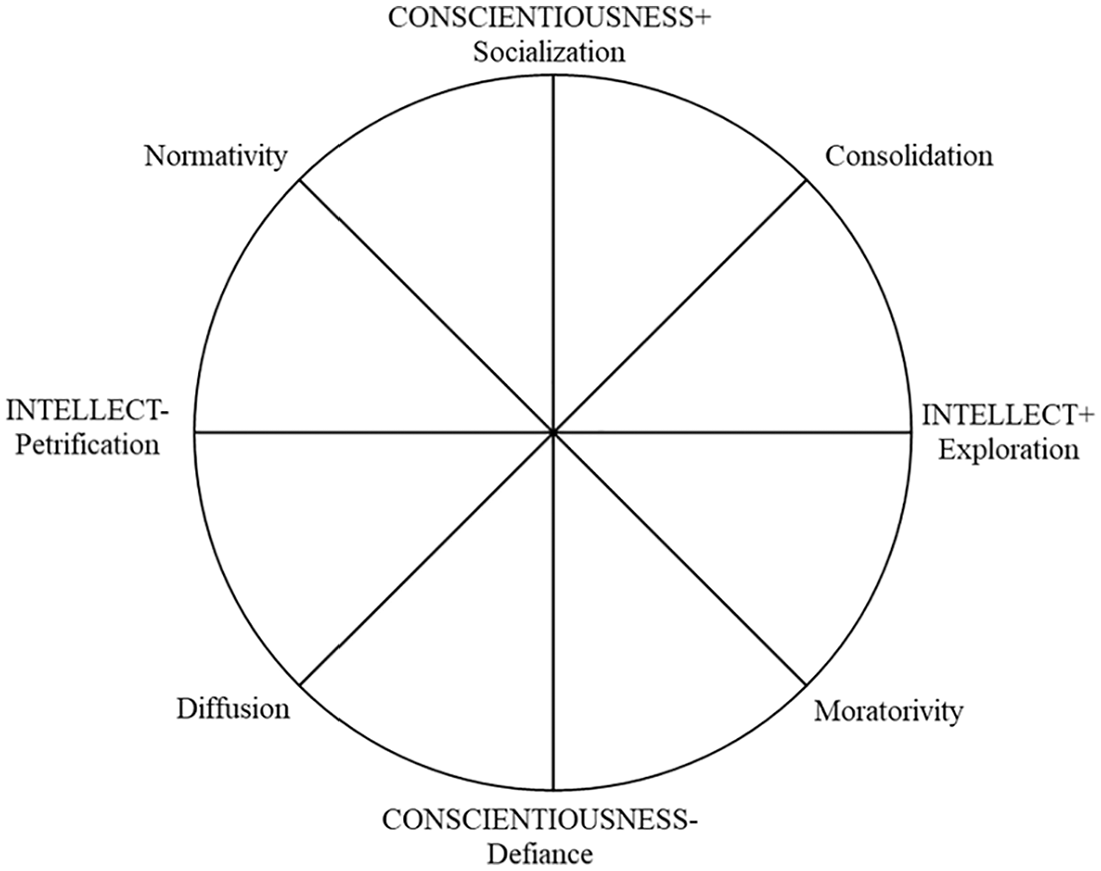
The Circumplex of Identity Formation Modes (CIFM) and its relationships with the traits of Intellect and Conscientiousness.
According to the CIFM different identity formation modes are underpinned by dispositional traits, which means that the way of identity formation is partially shaped by personality. Many studies have been conducted on the relationships between identity and personality (e.g., Clancy & Dollinger, 1993; Clancy Dollinger, 1995; Dunkel et al., 2008; Klimstra et al., 2013). While the above-mentioned researchers focus on the empirical results exploring the links between traits and identity, Cieciuch and Topolewska (2017) in their CIFM make the theoretical assumptions which enable us to predict the relationships between identity formation modes and personality traits. This is the second reason why the CIFM has become the basis for the empirical analyses presented further.
It is assumed that two particular personality traits are crucial for identity formation modes, namely: Intellect/Openness to Experience (a component of Plasticity/Beta) and Conscientiousness (an element of Stability/Alpha) (Topolewska-Siedzik et al., 2019). Between these two traits and identity modes there is a pattern of sinusoidal relationships. It means that if a given identity mode, for example Socialization, is positively correlated with Conscientiousness, then the mode located at the other extreme of this dimension, in this case, Defiance, should be correlated strongly negatively. The modes found between Socialization and Defiance (Consolidation, Exploration, Moratorivity and on the other side, Normativity, Petrification, and Diffusion) should show successively lower positive correlation values, and then gradually higher and higher negative correlations, up to Defiance, which will correlate with Conscientiousness most strongly negatively.
It was also established in empirical study that Emotional Stability was the strongest predictor of identity modes, but without a sinusoidal pattern of arrangements. Therefore, Emotional Stability is interpreted as a factor of maturity rather than differentiation in the identity formation process. Research conducted with three age groups (18–24, 25–39, 40–81 years) showed that for the Socialization and Defiance modes (stability dimension), the strongest predictors were Emotional Stability and Conscientiousness; for the former positive and the latter negative. For Exploration and Petrification (plasticity dimension), the strongest predictor was Intellect, for the former positive and the latter negative. Consolidation and Diffusion were predicted most strongly by Emotional Stability, Intellect, and Conscientiousness; the former positively and the latter negatively. Moratorivity and Normativity had no analogous predictors. For Moratorivity the strongest negative predictors were Emotional Stability and Conscientiousness. Normativity was primarily predicted positively by Agreeableness and negatively by Intellect. Additionally, it was negatively predicted by Emotional Stability, which was counter to the CIFM (Topolewska-Siedzik et al., 2019).
Identity modes are embedded in personality traits, albeit not fully determined by personality. Therefore, the individual may switch between different modes in the process of identity formation which is lifelong (Erikson, 1959; Marcia, 1980). This implies another advantage of the CIFM compared to other identity models—the possibility to describe identity development not only among adolescents but also among adults (see study discussed above) and to integrate knowledge on identity formation from the lifespan perspective. This is the third reason to take the CIFM as a theoretical basis for the present study.
The authors of the CIFM claim that modes are the result of the interaction between rather stable personality traits and rather changeable social environments (Cieciuch & Topolewska, 2017; Topolewska-Siedzik et al., 2019). They refer to the model proposed by McAdams (McAdams & Manczak, 2011; McAdams & Pals, 2006; cf. Cieciuch & Topolewska, 2017; Topolewska-Siedzik et al., 2019), which differentiates three layers of personality. The first layer is the most foundational and consists of dispositional traits, such as personality traits. The second layer contains characteristic adaptations arising from interactions between dispositional traits and the environment, whereas the third layer is a narrative story serving as a history of one’s life. Cieciuch and Topolewska (2017, p. 533) are of the opinion that identity formation modes are elements of the characteristic adaptation layer (McAdams & Manczak, 2011), since they are an effect of interplay between personality traits and social requirements. Presumably, such interaction can be accompanied by internal dialogs.
The phenomenon of internal dialog is explained by personality traits that are crucial for identity formation modes, namely: Openness/Intellect and Neuroticism/low Emotional Stability (Puchalska-Wasyl et al., 2008). It appears in adolescence thanks to the development of cognitive functions. The process of identity formation involves reconciling one’s abilities and aspirations, one’s needs and other’s expectations, confronting different visions of oneself, evaluating matters from different perspectives, and taking into account and considering the opinions heard about oneself (Batory et al., 2016). This implies taking different viewpoints, juxtaposing them, and consequently, conducting an internal dialog.
In this article, we examine internal dialogs as theorized by Hermans (2003; see also Hermans & Gieser, 2012) and operationalized by Oleś (2009; Oleś et al., 2020). According to Hermans (2003) the self can be understood as a dynamic multiplicity of I-positions, that is, different viewpoints/perspectives available for a person. Each I-position, shaped in a specific social context, represents a voice (e.g., the voice of a culture, a significant other, or one’s own voice) and is intertwined with other I-positions resembling people in social relationships (Hermans, 2003). As a result, apart from external dialogs, internal dialogs are also possible. Oleś defines an internal dialogical activity in terms of engagement in dialogs with imagined figures, continuation or simulation of social dialogical relationships in one’s own thoughts, and confrontation of the points of view representing different I-positions relevant for personal and/or social identity (Puchalska-Wasyl et al., 2008). Oleś (2009; Oleś et al., 2020) distinguished eight types of internal dialogs. There are: (a) identity dialogs, trying to answer questions regarding one’s identity, life priorities, and values; (b) supportive dialogs, for which the objective is to provide support and comfort, and sense of closeness; (c) social dialogs, which consist in continuing and ending discussion with others or preparing for a new conversation; (d) ruminative dialogs, in which a person recalls sad or annoying thoughts or memories about hurtful life experiences; (e) confronting dialogs, which focus on situations of disagreements or conflicts, often internal; (f) maladaptive dialogs, which interfere with the performance of tasks; (g) spontaneous dialogs which are the dialogical form of self-awareness; and (h) perspective-changing dialogs, conducted in order to see the difficult situations from different viewpoints. The advantage of this typology of dialogs is its scope (many types), while its drawback is the fact that the criterion of distinguishing dialogs was heterogeneous: only sometimes the criterion is the dialog function. For example, social dialogs, depending on their course, can fulfill supportive, or ruminative function. Oleś et al.’s (2010) theoretical considerations suggest that there are two major functions of internal dialogs: transgressive and palliative. The transgressive function serves to go beyond one’s own egocentric perspective. Thanks to this, it is possible to look at oneself from a distance, open to new ideas and other people. The palliative function is to defend the self. It is related to entering the world of other people’s thoughts in order to learn their opinions and prejudices, and thus, understand and/or remedy their negative reactions toward us. This distinction encourages us to further search for the function of internal dialogs in the development of identity formation modes.
Current Study
The first aim of this study is to replicate on a younger sample (14–18 years) the relationships between personality traits and identity modes established by Topolewska-Siedzik et al. (2019) and presented in the Introduction. The second purpose of the research is to identify the major functions of internal dialogs carried out by teenagers, or more precisely, to determine whether different dialog types conducted by adolescents cluster together to serve distinct functions that may contribute to identity formation modes. The third and most important objective of this paper is to test whether internal dialogs mediate the relationships between personality traits and identity modes, which would be consistent with the model proposed by McAdams (McAdams & Manczak, 2011; McAdams & Pals, 2006; cf. Cieciuch & Topolewska, 2017; Topolewska-Siedzik et al., 2019). Some types of internal dialogs (e.g., identity and perspective-changing) are mainly associated with high Intellect/Openness and other types (e.g., confronting and ruminative) are more strongly related to low Emotional Stability, however, most dialog types (except ruminative) correlate with these two personality traits (Oleś et al., 2010). In this context it has been hypothesized that dialogs mediate between the Intellect trait and Consolidation and Exploration; and between the Emotional Stability trait and Defiance, Diffusion, Moratorivity, and Normativity.
Method
Participants
Participants were 422 Polish adolescents aged between 14 and 18 (M = 16.34, SD = 1.31). Women constituted 48.6% of the sample. Among the respondents, 39.1% came from rural areas, 19.4% came from small towns, 32.7% came from cities between 20,000 and 100,000 inhabitants, and 8.8% came from large cities with more than 100,000 inhabitants. Participants attended high school (76.1%), technical school (19.7%), vocational school (2.6%), or other schools (1.7%). Indicators of respondents’ ethnic and cultural diversity were not included in this study because Polish society is fairly homogeneous in this regard.
Procedure
The data were collected through a web survey. Respondents were users of the Ariadna online research panel where Polish people’s opinions are collected on various topics (evaluation of products and services, and research questionnaires). By answering the questions, panel participants collect points which can then be exchanged for products of their choice available in the Ariadna store. The online survey consisted of the three methods presented in the Measures section and an additional two control items (e.g., I was born on February 30) to identify tendencies to respond insincerely. The informed consent of the respondents was implied through survey completion. The procedure was approved by the Research Ethics Committee at the Institute of Psychology at the university where the study was conducted (KEBN_3/2021).
Measures
Participants completed three measures in the order presented below. The Cronbach’s alpha indices calculated for the measures in this study are presented in Table 1.
Correlation Coefficients Between Study Variables, Mean Scores, Standard Deviations, and Internal Consistency.
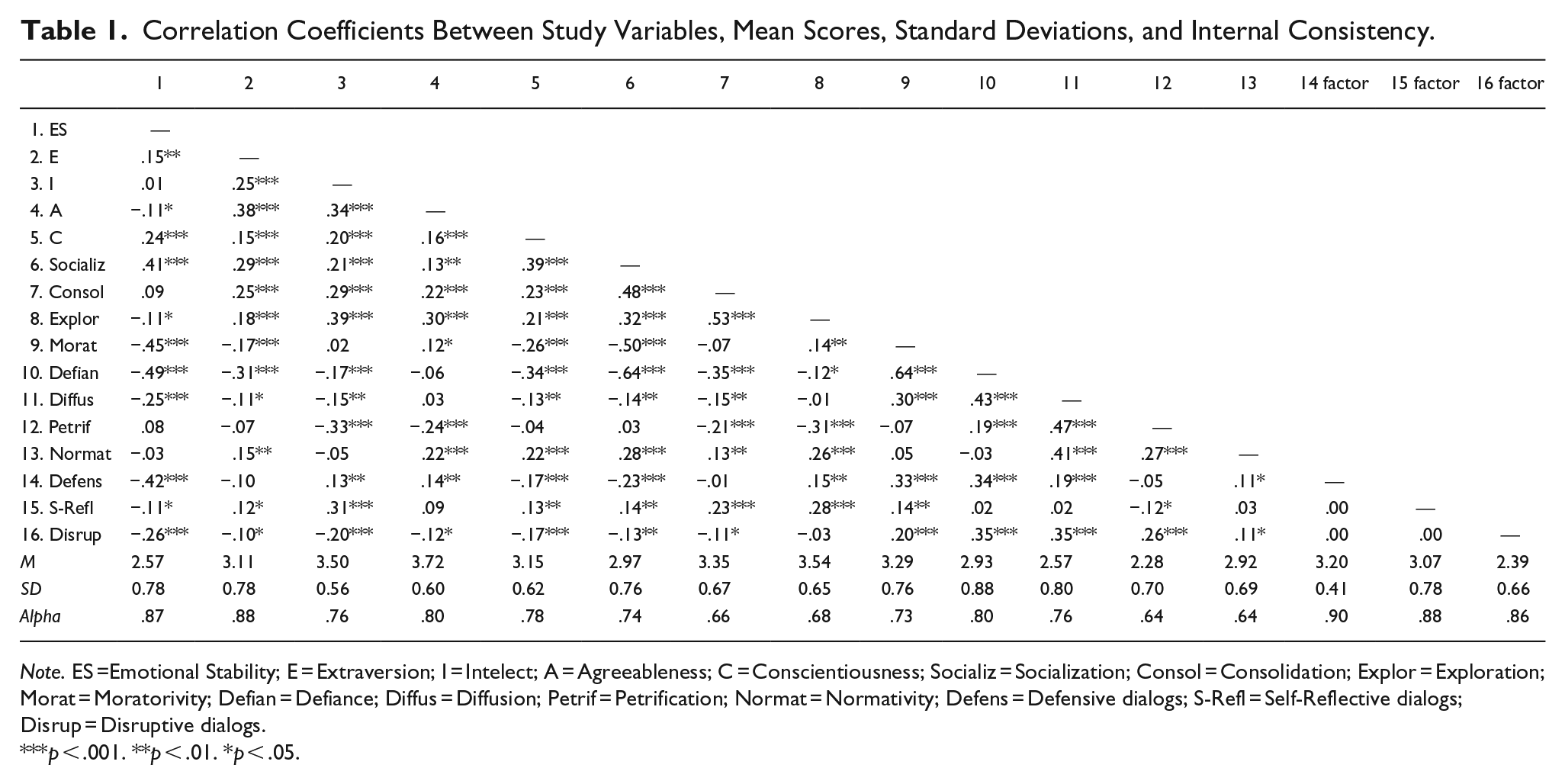
Note. ES =Emotional Stability; E = Extraversion; I = Intelect; A = Agreeableness; C = Conscientiousness; Socializ = Socialization; Consol = Consolidation; Explor = Exploration; Morat = Moratorivity; Defian = Defiance; Diffus = Diffusion; Petrif = Petrification; Normat = Normativity; Defens = Defensive dialogs; S-Refl = Self-Reflective dialogs; Disrup = Disruptive dialogs.
p < .001. **p < .01. *p < .05.
International Personality Item Pool—Big Five Markers—50 (IPIP-BFM-50)
A Polish adaptation (Strus et al., 2014) of this questionnaire, originally designed by Goldberg, 1992; Goldberg et al., 2006) was used in the current study. IPIP-BFM-50 measures five personality traits identified in the lexical tradition (Big Five; BF), hence, the method includes the five following factors with 10 items for each scale: (1) Emotional Stability (a sample item: “Get stressed out easily.”); (2) Agreeableness (e.g., “Have a soft heart.”); (3) Conscientiousness (e.g., “Am always prepared.”); (4) Extraversion (e.g., “Am the life of the party.”); and (5) Intellect (e.g., “Have a vivid imagination.”). Participants indicate their responses on a 5-point Likert scale ranging from 1 (very inaccurately describes me) to 5 (very accurately describes me). The Big Five traits listed above are largely consistent with the five personality traits comprising the Five Factor Model (FFM), which has been identified in the questionnaire research tradition. The names of three of the five traits (Agreeableness, Conscientiousness, and Extraversion) are identical in both models. With regard to the other two traits, it is generally accepted that Emotional Stability is the BF dimension corresponding to Neuroticism in the FFM. Similarly, Intellect (BF), which refers to intellectual openness, reflectivity, creativity, and imagination, is equivalent to Openness to Experience (FFM). 1
Internal Dialogical Activity Scale-Revised (IDAS-R)
This questionnaire was designed by Oleś (2009; Oleś et al., 2020) to measure intensity of engaging in internal dialogs. It contains 40 items rated on a 5-point Likert scale ranging from 1 (never) to 5 (very often). IDAS-R consists of eight subscales, corresponding to the eight types of dialogs presented in the Introduction: (1) Identity Dialogs (a sample item: “Through internal discussions I come to certain truths about my life and myself.”); (2) Maladaptive Dialogs (e.g., “The conversations in my mind upset me.”); (3) Social Dialogs (e.g., “I continue past conversations with other people in my mind.”); (4) Supportive Dialogs (e.g., “I carry on discussions in my mind with the important people in my life.”); (5) Spontaneous Dialogs (e.g., “I talk to myself.”); (6) Ruminative Dialogs (e.g., “After failures, I blame myself in my thoughts.”); (7) Confronting Dialogs (e.g., “I argue with that part of myself that I do not like.”); (8) Change of Perspective (e.g., “When I have a difficult choice, I talk the decision over with myself from different points of view.”).
Circumplex Identity Modes Questionnaire (CIMQ)
This measure was developed by Topolewska and Cieciuch (2017). It consists of 40 items, forming eight subscales, corresponding to the eight identity formation modes presented in the Introduction. Each subscale contains five items. The answers are given on a Likert scale ranging from 1 (not at all like me) to 5 (very much like me). The subscales are as follows: (1) Socialization (a sample item: “I have a feeling that I am fulfilling my life roles well.”); (2) Consolidation (e.g., “I have a clear idea of my goals, but I am also willing to consider other options.”); (3) Exploration (e.g., “When I am not sure what decision to make, I actively search for additional information and evaluate it critically.”); (4) Moratorivity (e.g., “I see myself as an enquirer, but I have not yet found my answers.”); (5) Defiance (e.g., “I am not sure where I am going in my life.”); (6) Diffusion (e.g., “I see myself as a person who adapts to others, even against my own views.”); (7) Petrification (e.g., “I do not care about having my own views.”); (8) Normativity (e.g., “When making decisions, I primarily rely on the advice of people close to me.”).
Results
Prior to the main analysis, the coefficients of skewness and kurtosis were calculated to each construct and the assumptions of normality were tested using the Kolmogorov–Smirnov test with Lilliefors correction. These analyses indicated that the distributions of scores for the three subscales of IPIP-BFM-50 (Extraversion, Agreeableness, and Intellect) as well as the four subscales of the IDAS-R (Identity, Social, Spontaneous, and Ruminative Dialogs) and the five subscales of the CIMQ (Exploration, Normativity, Consolidation, Moratorivity, and Socialization) were slightly negatively skewed (from −0.03 to −0.39). The distributions of scores for the other subscales were slightly positively skewed (from 0.01 to 0.32). All of the coefficients of skewness were in the range from −1 to 1, so the skewness was not strong enough to require further attention (George & Mallery, 2010). The kurtosis values for all variables were also within the acceptable range (from −0.71 to 0.33). Next, descriptive statistics, internal consistency and Pearson bivariate correlations for all variables were calculated (Table 1).
In order to conduct the path analyses AMOS was used (SPSS Version 25, IBM Corp., Armonk, NY, United States). All mediation analyses were performed using PROCESS, model 4 (Hayes, 2018). PROCESS is a path-analytic macro based on regression and estimates indirect effects and bias-corrected confidence intervals. Standardized indirect effects were computed for each of the 5,000 bootstrapped samples and the corresponding 95% confidence intervals were computed. Other analyses were carried out using SPSS v.27.
To address the first objective of the study, the path analyses were performed, where five personality traits predicted identity modes (Table 2). Similarly to the findings of Topolewska-Siedzik et al. (2019), for Socialization the strongest positive predictors were Emotional Stability and Conscientiousness. For Defiance (the opposite pole for Socialization) the strongest negative predictors were not only Emotional Stability and Conscientiousness, but also Extraversion. As expected, for Exploration and Petrification (plasticity dimension), the strongest predictor was Intellect, for the former positive and the latter negative. Consolidation (situated between Socialization and Exploration) was predicted positively by Intellect, and Conscientiousness, but—contrary to expectations—not by Emotional Stability; whereas Diffusion (between Defiance and Petrification) was predicted negatively by Intellect, and Emotional Stability, but unexpectedly not by Conscientiousness. As assumed, Moratorivity was the most strongly predicted by Emotional Stability and Conscientiousness (negatively); and Normativity was predicted by Intellect (negatively) and by Agreeableness (positively). Additionally, which was counter to the results by Topolewska-Siedzik et al. (2019), Normativity was most strongly predicted by Conscientiousness (positively), and not at all by Emotional Stability.
The Coefficients From the Path Analyses with Personality Traits as Predictors of Identity Formation Modes.
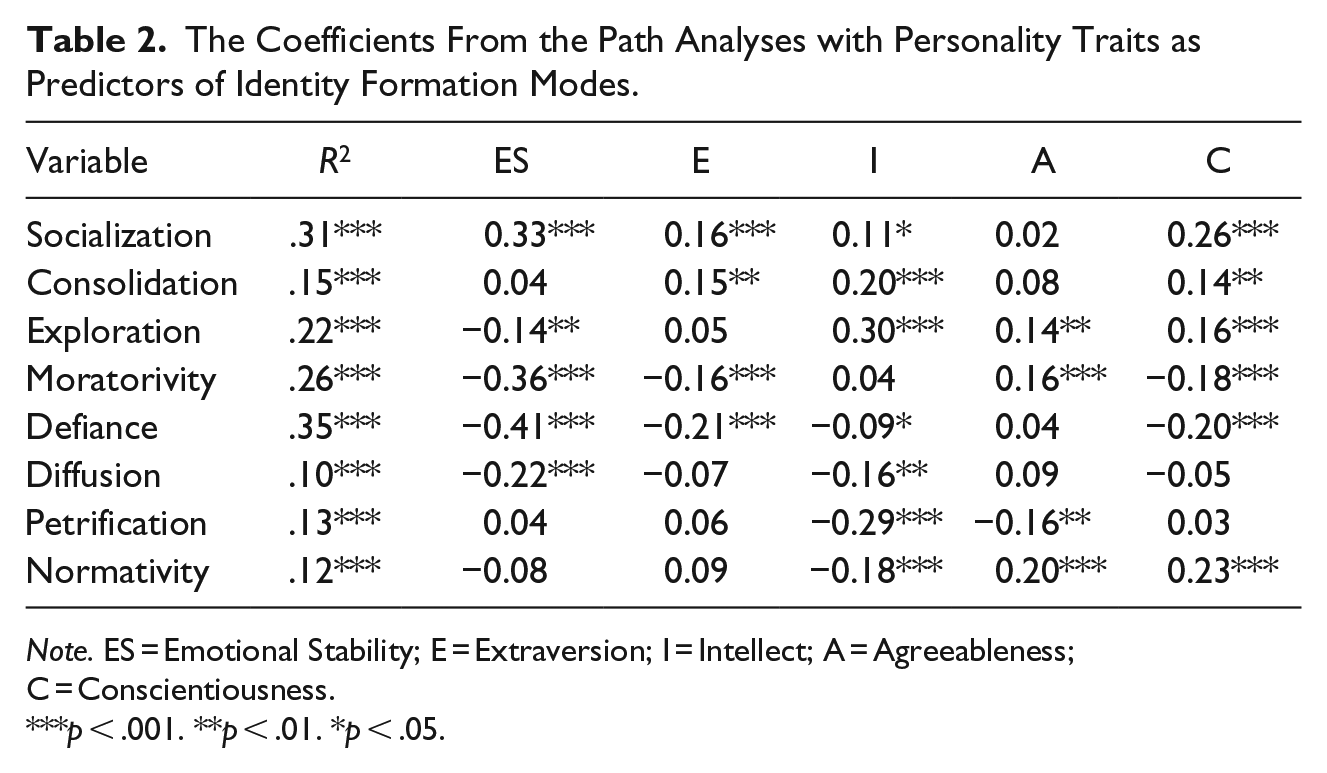
Note. ES = Emotional Stability; E = Extraversion; I = Intellect; A = Agreeableness; C = Conscientiousness.
p < .001. **p < .01. *p < .05.
In line with the second aim of the study it was checked whether different dialog types conducted by adolescents cluster together to serve distinct functions that may contribute to identity formation modes. For this purpose, a principal component analysis (PCA), followed by varimax rotation was performed, taking into account the scores on IDAS-R subscales. PCA was preceded by checking the sample adequacy (KMO = 0.87; Bartlett’s test of sphericity χ2[28] = 1853.49, p < .001). Dimensionality analysis based on the Kaiser criterion (eigenvalue > 1) showed two factors to be separated; they explained 71.69% of variance in the data pool. Analysis based on the Cattell criterion (scree plot) showed three factors to be separated; they explained 79.81% of the variance. Based on a content analysis of items comprising two and three factors, respectively, a three-factor solution was adopted. These three factors distinguished reflect three major functions of internal dialogs: (1) factor 1—defensive function (29.63% of variance explained); (2) factor 2—self-reflective function (28.02% of variance explained); (3) factor 3—disruptive function (22.16% of variance explained). The group of defensive dialogs consists mainly of social (factor loading 0.89), supportive (0.79), and ruminative dialogs (0.62). These are dialogs that aim to maintain the image of a person in their own eyes or in the eyes of others. This applies to dialogs that refer to both past situations (continuing conversations that ended contrary to the person’s expectations) and future ones (preventing embarrassment, anticipating an attack). Usually these are dialogs in which the internal interlocutor is another person. The second group is self-reflective dialogs, which include identity (0.89), spontaneous (0.71), and perspective-changing dialogs (0.62). These are mainly dialogs with oneself (part of the self) and not with the other person. The goal of these dialogs is self-development and self-knowledge, clarification of one’s own goals and values, and multifaceted assessment of difficult situations. Disruptive dialogs are the third group which consists of maladaptive (0.91) and confronting dialogs (0.67). These dialogs are non-adaptive: discussing the problem does not lead to constructive solutions, but only to breakdown, discomfort and negative emotions.
Self-reflective and defensive dialogs correlate positively with Intellect and negatively with Emotional Stability. However self-reflective dialogs correlate stronger with Intellect, whereas defensive dialogs correlate stronger with Emotional Stability. Disruptive dialogs correlate negatively with both these traits (Table 1). In this context the main aim of this paper was to test whether these three functional groups of internal dialogs mediate the relationships between the above-mentioned personality traits and some identity modes. Figure 2 shows the conceptual mediation model. It was hypothesized that mediations would exist between the Intellect trait and Consolidation and Exploration; and between the Emotional Stability trait and Moratorivity, Defiance, Diffusion, and Normativity. In fact, five not six mediation analyses were performed (Table 3), since Normativity in this study was not related to Emotional Stability. This result is inconsistent with the findings by Topolewska-Siedzik et al. (2019), but is consistent with the CIFM (Cieciuch & Topolewska, 2017; Topolewska & Cieciuch, 2017). In each of mediation analyses three functional types of internal dialogs were tested as parallel mediators in the relationships between the trait and identity modes.
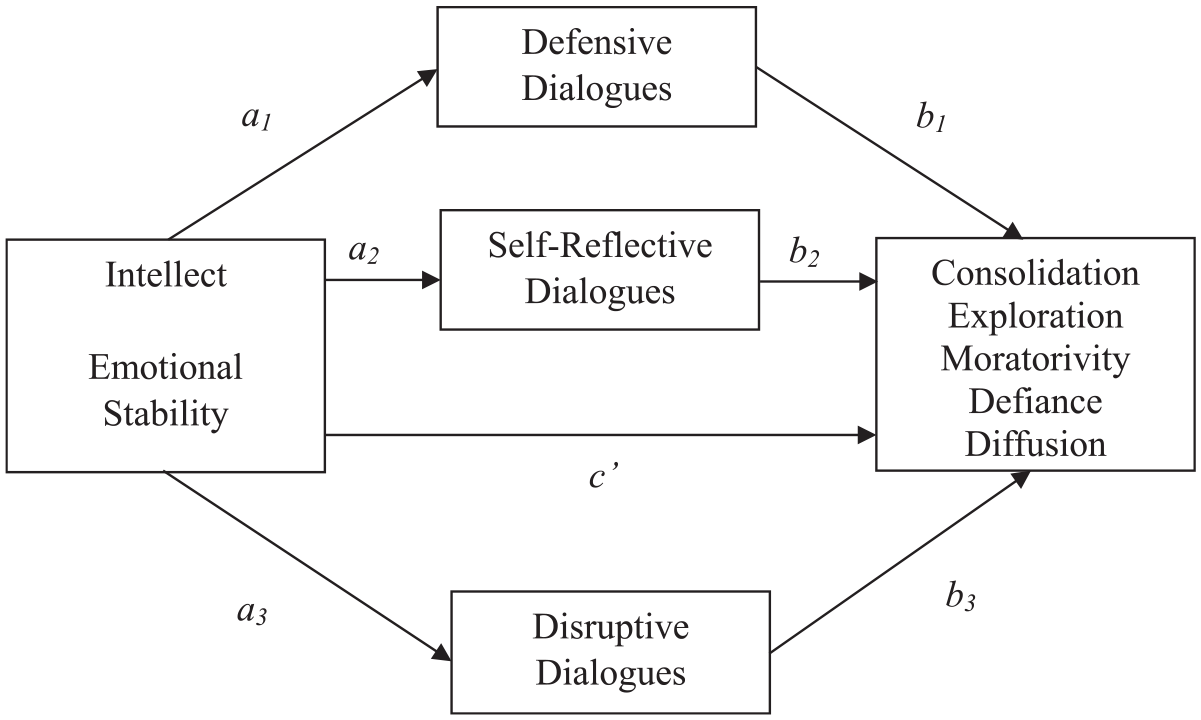
The conceptual model of how internal dialogs can mediate the effect of personality traits on identity formation modes.
Outcomes of Mediation Analyses From Traits to Identity Formation Modes Assessing Indirect Effects of Internal Dialogs.
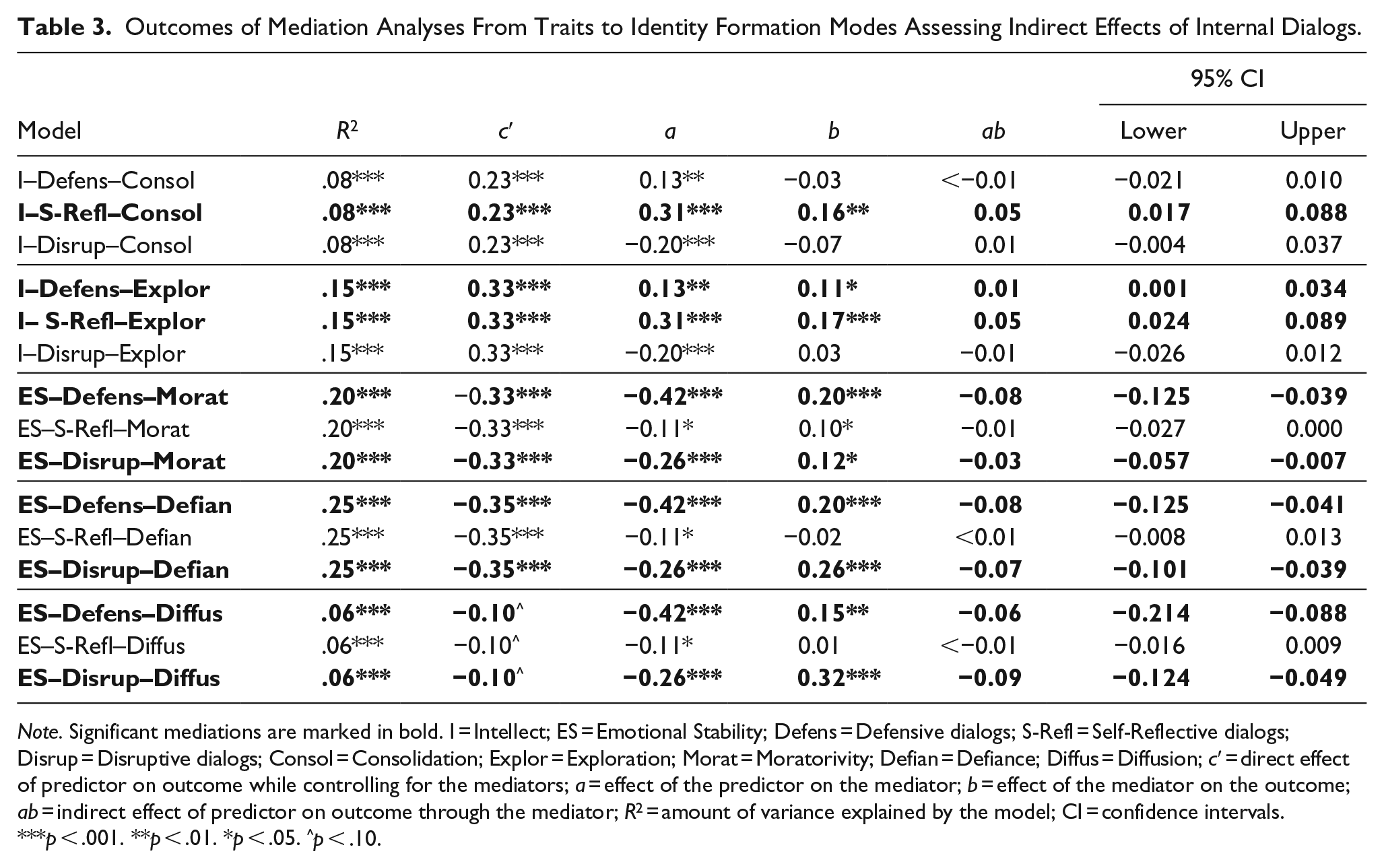
Note. Significant mediations are marked in bold. I = Intellect; ES = Emotional Stability; Defens = Defensive dialogs; S-Refl = Self-Reflective dialogs; Disrup = Disruptive dialogs; Consol = Consolidation; Explor = Exploration; Morat = Moratorivity; Defian = Defiance; Diffus = Diffusion; c′ = direct effect of predictor on outcome while controlling for the mediators; a = effect of the predictor on the mediator; b = effect of the mediator on the outcome; ab = indirect effect of predictor on outcome through the mediator; R2 = amount of variance explained by the model; CI = confidence intervals.
p < .001. **p < .01. *p < .05. ^p < .10.
The analyses revealed that there was a significant positive indirect effect of Intellect on Consolidation through self-reflective dialogs: Intellect was positively associated with self-reflective dialogs which in turn were positively related to Consolidation. Similarly, there were positive indirect effects of Intellect on Exploration through self-reflective and defensive dialogs, although the latter effect was very small. Additionally, significant negative indirect effects of Emotional Stability on Moratorivity, Defiance, and Diffusion through defensive and disruptive dialogs were found. It turned out that Emotional Stability was negatively associated both with defensive and disruptive dialogs, which in turn were positively related to these three above-mentioned identity modes. All the mediations were partial.
Discussion
The research presented here had three objectives. First, the findings by Topolewska-Siedzik et al. (2019), which concern the relationships between traits and identity modes, were to be replicated on a younger sample (14–18 years). The results of both studies are consistent. The differences observed are rather small. For Defiance, the strongest negative predictors were not only Emotional Stability and Conscientiousness, but also Extraversion. In fact, in the study by Topolewska-Siedzik et al. (2019) Extraversion also explained this identity mode, but only in one group (40–65 years) and was a weaker predictor than Emotional Stability and Conscientiousness. Consolidation (located between Socialization and Exploration) was positively predicted by Conscientiousness and Intellect, but—contrary to expectations—not by Emotional Stability. In turn, Diffusion (the opposite pole for Consolidation) was predicted negatively by Intellect, and Emotional Stability, but unexpectedly was not predicted by Conscientiousness. The fact that the relationships between traits and identity modes are somewhat different in adolescents than in adults may suggest that the formation of these relationships is a process that occurs over time and age may play a role here. Additionally, it was found that Normativity was not only predicted by Intellect (negatively) and Agreeableness (positively), but also by Conscientiousness (positively), and not at all by Emotional Stability. The latter two results were inconsistent with the findings by Topolewska-Siedzik et al. (2019), but were consistent with the theoretical assumptions of the CIFM (Cieciuch & Topolewska, 2017; Topolewska & Cieciuch, 2017), confirming this model. Analyzing the results obtained in the present study, it cannot be excluded that relatively low internal consistency indices of some subscales measuring identity modes (e.g., Consolidation or Normativity) may have contributed to the findings.
Three functional types of internal dialogs were distinguished according to the second objective of this research. Self-reflective and defensive dialogs are adaptive as opposed to disruptive dialogs. Two types of adaptive dialogs seem to correspond with the theoretical distinction proposed by Oleś et al. (2010) into transgressive and palliative functions of internal dialogs, respectively. The transgressive function serves to go beyond the egocentric self-centered perspective, enabling learning about new ideas and one’s own identity, and opening people to change and contact. The palliative function consists in trying to enter into the world of thoughts of other people in order to find out their opinions, to anticipate their negative reactions or to understand their critical attitude toward us. The third group of disruptive dialogs corresponds with self-critical self-talk discussed by Brinthaupt (2019) recently. In fact, the exploration of this function has a long tradition in clinical psychology in which dysfunctional self-talk was analyzed (e.g., Beck, 1976; Ellis, 1962).
In line with the third aim of this paper it was established that the three above-mentioned functional types of internal dialogs mediate between personality traits and identity formation modes. It was found that self-reflective dialogs mediate the positive relationship between Intellect and Consolidation; and together with defensive dialogs they mediate the positive relationship between Intellect and Exploration. On the other hand, defensive and disruptive internal dialogs mediate the negative relationships between Emotional Stability and Moratorivity, Defiance and Diffusion. As Topolewska-Siedzik et al. (2019) claim, the most functional and healthy identity modes are Socialization and Consolidation, while the less functional and less healthy modes are Defiance, Diffusion, and Moratorivity. In this context we can see that self-reflective dialogs are conducive to one of the two healthiest modes, whereas disruptive dialogs are positively related to less healthy modes, which is an indirect form of validation of these two distinguished functions of dialogs. Defensive dialogs seem to serve different functions depending on the trait they accompany. If they co-occur with low Emotional Stability, they may reinforce a sense of threat, pushing one into rebellion (Defiance) or dependence on others (Diffusion), or into an anxious moratorium (Moratorivity). Conversely, if accompanied by high Intellect, they can restore a sense of security, creating a safe base for seeking one’s place in life (Exploration).
Referring to the model which differentiates three layers of personality (McAdams & Manczak, 2011; McAdams & Pals, 2006), the major functions of internal dialogs can be interpreted as the three main outcomes of the clash of innate predispositions (traits) with the requirements of the social environment. Experiencing contradictory reactions and social responses can trigger self-reflection in a person that leads to moving beyond an egocentric perspective, to broadening self-knowledge, and potentially to self-development. Self-defense, on the other hand, maintains the status quo. These two effects are concurrent with the two personality metatraits: Plasticity/Beta and Stability/Alpha, respectively (DeYoung et al., 2002; Digman, 1997). Finally, when conflicting tendencies cannot be agreed upon or restrained, the person may experience all sorts of disruptions in functioning.
The present study has some practical implications for prevention and intervention efforts regarding positive youth development. Knowing that personality is related to identity formation is informative. However, given the low modifiability of personality traits, this knowledge is difficult to use by therapists who want to give a positive direction to identity development. Internal dialogs, on the other hand, may be more suited to therapeutic efforts toward change (e.g., CBT), and thus could provide new opportunities to create approaches specifically targeting positive identity development.
The study has also some shortcomings. First, the measures used in the present study were based on self-reports, and the response bias could not be controlled. At the same time it should be emphasized that certain processes such as internal dialogs necessitate this approach because they cannot be observed by others. Regarding those processes that can be observed (an expression of personality or identity modes) future studies might require to add collateral reports from parents, peers, and/or teachers to validate and overcome the limitations of relying solely on self-report. The second weakness of the study is related to the interpretation of mediation analyses in causal terms, although cross-sectional data were analyzed. Admittedly, the evidence suggests that personality traits are the most genetically related variables in this study. In this context, they seem to have the most basic character among the measured variables, which justifies treating them as an antecedent. In turn, the assumption that internal dialogs will mediate between the traits and identity modes is in line with the model proposed by McAdams (McAdams & Manczak, 2011; McAdams & Pals, 2006). However, given that it is the first study on the relationship between traits, internal dialogs, and identity formation modes, the results presented need replication. Retesting using longitudinal design would be particularly desirable. Additionally, further research would be worthwhile to explore how gender and sexual identity influence internal dialogs and identity modes. Adolescence and young adulthood are developmental periods in which these aspects of identity are normatively explored. They should be taken into account when thinking about the above-mentioned practical implications of this study, especially since non-heterosexual youth are more likely to experience difficulties in the course of identity development. In future research, it would also be useful to include indicators of participants’ ethnic and cultural diversity as they may be relevant to identity formation processes.
Conclusions
Taken together, this study aimed: (1) to replicate on a younger sample (14–18 years) the relationships between traits and identity modes proposed by the CIFM; (2) to identify the main functions fulfilled by internal dialogs in adolescents; and (3) to test whether internal dialogs mediate the relationships between personality traits and identity modes. The results of the study confirmed the CIFM in the youth group. Three functions of internal dialogs were distinguished: self-reflective, defensive, and disruptive. It was also established that self-reflective dialogs mediate the positive relationship between Intellect and the Consolidation mode. Self-reflective and defensive dialogs mediate the positive relationship between Intellect and Exploration. Finally, defensive and disruptive internal dialogs mediate the negative relationships between Emotional Stability and Moratorivity, Defiance and Diffusion modes. The results should be replicated in longitudinal research in which some limitations of the current study will be minimized.
Footnotes
Declaration of Conflicting Interests
The author declared no potential conflicts of interest with respect to the research, authorship, and/or publication of this article.
Funding
The author received no financial support for the research, authorship, and/or publication of this article.
