







Abstract
Rooted in scholarship of social connectedness and social support, this research raises the question: Can online chatting help mitigate the negative psychological influence of physical distancing during COVID-19? By a correlational and cross-sectional research design, the current study testified the mediating role of two factors—social connectedness and perceived social support in the relationship between online chatting and three indicators of psychological well-being (happiness, self-esteem, and loneliness) for adolescents. This research demonstrated the potential of online chatting in mitigating the severity of quarantine from the supplementary perspective of online communication effects on adolescents, which provided a further insight into understanding the ways in which adolescents use media during school closure. Possible contingent factors that should be paid special attention to in future researches are discussed.
Keywords
Introduction
Social interaction is considered as a basic human need and motivation in the research work made by pioneers (Baumeister & Leary, 1995). Studies have proved that feeling insufficient contact with others may have a lasting negative influence on mental well-being (Orben et al., 2020). Recently, the social and physical deprivation measures taken on a global scale to curb the spread of COVID-19 have fundamentally reduced the opportunities for adolescents to have face-to-face communication, the negative effects of which may be especially profound and serious for adolescents.
Indeed, the need for identifying practical and effective strategies to prevent mental problems for adolescents is of pressing concern. Existing research shows that there are several beneficial opportunities of online communication, such as enhancing self-esteem, building relationships, and enhancing friendship quality (Valkenburg & Peter, 2011). Nevertheless, little research has been conducted to examine the underlying effects of online activities like chatting on adolescents’ mental status with a few notable exceptions (e.g., Van Zalk et al., 2011). Therefore, the purpose of the present paper is to offer more unique insights into the function of online communication and chatting on adolescents’ psychological well-being. On the basis of predecessors’ studies (e.g., Prestin & Nabi, 2020), this study also reviews several emerging trends in communication as well as psychology literature: online chatting, social connectedness, and perceived social support.
Psychological well-being Concerns for Adolescents During Quarantine
Since the outbreak of COVID-19, a range of containment measures including travel restrictions and widespread quarantines have been implemented (Xiang et al., 2020). As previous studies have argued that people may face severe mental health problems during epidemics (Jalloh et al., 2018), research on the psychological challenges of COVID-19 has been motivated. For example, Kecojevic et al. (2020) found that COVID-19 increased the levels of mental health burden among undergraduate students, including causing academic difficulties, and feelings of distress. Also, the cancelation of peer support groups and face to face contact induced by school closures can be challenging for young people’s well-being (Lee, 2020).
At the meantime, quarantine offers adolescents a chance to engage in online communication, and active social contact can be conducted through digital applications like social media, video chatting or conferencing (Orben et al., 2020). Relational developmental systems model (e.g., Bronfenbrenner & Morris, 2006) and life-course theory (Elder & Shanahan, 2006) suggest that human behaviors result from mutual relations between the individuals and their changing context. As online interaction has become a central context during quarantine, it is crucial to investigate how it may influence adolescents during this critical period of development. Previous studies have suggested that online communication may increase perceived social attraction and stimulate abilities to provide support (Antheunis et al., 2010). However, considering the different features of online communication and various activities involved (e.g., chatting, posting, gaming, etc.), online benefits may not be directly transferable to offline outcomes (Dredge & Schreurs, 2020). Therefore, it would be of much more value to study the mechanisms behind the connection of which online communication may affect offline environments.
In light of facing COVID-19 social isolation in many countries around the world, the current study seeks to explore whether the increasing use of digital connections may have benefits on adolescent psychological well-being. Psychological well-being is an integrated and multi-faceted concept encompassing experience and affective states describing numerous facets of well-being (Khumalo et al., 2012). According to Ryff (1989), it includes both positive and negative dimensions of psychological functioning, the increases and decreases of which can be assessed by various indicators. In this study, we plan to examine three pivotal variables that have been shown to indicate psychological well-being in previous literature—happiness, self-esteem and loneliness (e.g., Costabile et al., 2021; Reer et al., 2019; Ryff, 1989). Happiness refers to the experience of positive affect and high life satisfaction which is reciprocally connected to school belongingness (Tian et al., 2016). As a study showed that community-level quarantine following COVID-19 is associated with decreased happiness, it would be necessary to include it in current research (Lu et al., 2021). Self-esteem is an emotional independent evaluation that indicates how highly one thinks of oneself, which has been regarded as a crucial indicator of well-being (e.g., Costabile et al., 2021). Earlier studies revealed that the effect of social media on self-esteem can be unique for each adolescent, and self-esteem can go up when they feel accepted by others, which offer new pathways for current research (Leary & Baumeister, 2000; Valkenburg, Beyens et al., 2021). As for loneliness, it is a negative feeling due to a discrepancy between ideal and achieved level of how one feels in relation to others (Perlman & Peplau, 1981), and it can occur even when one is surrounded by other people (Cacioppo et al., 2010). It should be noted that loneliness is different from solitude, where the former is a dissatisfaction with being alone, while the latter is labeled as affinity for aloneness which tends to be viewed more positively (Coplan & Bowker, 2014; Goossens et al., 2009). With happiness and self-esteem being the positive indicators of well-being, loneliness is assessed here as the negative side by contrast.
Effects of Online Chatting on Adolescents—A Supplementary Perspective
Online chatting refers to a direct and dyadic-based form of online communication which has consequences on adolescent emotional adjustment (Van Zalk et al., 2011). As a crucial component improving online interpersonal relationships, online chatting has been considered disadvantageous to psychological well-being by reducing offline communication time (Ong et al., 2011). Actually, when it comes to how online communication can affect adolescents, disagreeing interpretations are certainly not new (Valkenburg, Meier et al., 2021). The time displacement hypothesis and the cues filtered out elaboration represented the displacement perspective, which argued that media may distract people’s attention from interpersonal interaction in which communication skills can be practiced (Konrath, 2013; Putnam, 1995). As Siebers et al. (2021) examined, there are positive connections between social media use and distraction from interpersonal relationships for adolescents. Similarly, meta-analytic evidences showed that intensive social media users are caused more personal stress and lower self-esteem (Meier & Reinecke, 2021). However, on the other hand, from the stimulation perspective, online environments provide individuals with chances to practice social skills, and can increase the richness of social benefits especially for those who are sociable offline (Koutamanis et al., 2013; Kraut et al., 2002). For adolescents, online peer communication can indirectly and positively affect their self-concept as well as sense of identity through its positive influence on the quality of friendship (Davis, 2013). As Standlee (2019) has examined, social media allows for a techno-social world with which young adults engage deeply can shape their own social interactions and networks. Furthermore, the transformation framework, to which our study is germane, suggests that social media with features including publicness, availability, and permanence may allow new opportunities for compensatory behaviors (Nesi et al., 2018). As such, when individuals do not have access to offline social activities, the time may be diverted to use the internet so as to enhance existing social relationships and meet new friends. However, findings from a recent meta-analytic study do not fully support the above hypotheses, while suggest that contextual cues and other variables need further investigation (Dredge & Schreurs, 2020). Based on specification curve analysis, Orben and Przybylski (2019) also suggest that the negative association between digital technology and adolescent well-being can be too small to garner policy shift, and large-scale data may not match specific research questions well.
Essentially, extant scholarship is making progress in the direction of considering how online interactions generate whether positive or negative but important results for adolescents. However, this literature can be developed in many important ways. First, previous studies focusing on general social media use or online communication cannot rule out the possibility that some findings are a result of multiple influences by various online activities. It is argued that treating internet use as a one-dimensional concept may be theoretically problematic (Valkenburg & Peter, 2009b). In that research on the relation between specific online activities like chatting and well-being is relatively sparse, we aim to take the step forward. Second, some studies have explored the direct relationships between chatting and some dependent variables related with psychological well-being, for example, loneliness (Ong et al., 2011). However, possible mediating variables in the relation between online chatting and psychological consequences have not been studied so far. Therefore, it is our need to specify what the underlying mechanisms are that may underlie the relationship. Thirdly, in what aspects can psychological well-being be influenced is not clear cut in extant scholarship. Therefore, the third and final focus of our study is to bridge the gap and to estimate the potentially valid value of online chatting on adolescents’ psychological well-being.
Extending prior work mentioned above, we seek to test the positive effect of online chatting from the supplementary perspective, considering the potential of online chatting in mitigating the detrimental effect of quarantine on adolescents. Indeed, with more research focusing on the interpersonal impact of the internet, there is increasing evidence showing that online communication can contribute to positive subjective well-being by relieving stress or receiving positive feedback and support (e.g., Prestin & Nabi, 2020; Webster et al., 2021). For example, experimental studies have suggested that online communication between individuals may increase perceived social attraction and stimulate abilities to provide support (Antheunis et al., 2010). Compared with face-to-face interaction, online communication might bring greater enthusiasm for interaction, preference for online peers, and wider fields of communication (Valkenburg & Peter, 2009a). Schreurs and Vandenbosch (2021) also suggest that adolescents can interact with positive social media content relating to happy social life and exciting events. Both earlier and recent studies have confirmed that faced with physical isolation, engaging with instant message interactions can enhance people’s level of self-esteem and perceived relational value, and positive online experiences can predict lower loneliness for adolescents (Gross, 2009; Magis-Weinberg et al., 2021). Additionally, when a student is forced to be off school, online networks can be seen as a form of connection, companionship and attention—factors that can reduce loneliness (Webster et al., 2021).
Social Connectedness and Perceived Social Support
Social connectedness is conceptualized as the adolescents’ relationship with others in the surrounding environment, for example, family, and friends (Valkenburg & Peter, 2009a). When faced with social isolation and loneliness in adolescence, some protective factors are able to buffer the negative outcomes, among which social connectedness is considered as a major factor in positive youth development (Townsend & McWhirter, 2005). In particular, research has indicated that using social media to chat may give isolated people a sense of connection, which provides initial evidence that computer-mediated interaction can benefit the isolated (Sheldon et al., 2011). Based on data from Twitter, scholars found that people’s interactions within an online social network have a positive and direct effect on social connectedness (Riedl et al., 2013). For high school adolescents, social connectedness together with social acceptance were considered as important and positive predictive factors of subjective well-being (Arslan, 2018). Verduyn et al. (2017) also found that targeted one-on-one online exchanges predict well-being by stimulating feelings of social connectedness. Therefore, we suggest that digital social connections carried out by online chatting can mitigate the potentially harmful effects of social alienation among adolescents.
Besides, in the suggestions for the public to cope with mental problems during COVID-19, enhancing social support systems (e.g., families and friends) has been noted particularly (Bao et al., 2020). Recent studies have shown that online social interaction may appeal to those adolescents who have a low level of offline social support (Leung, 2011), which hinted that online social relationship may be a substitute when offline friendship are difficult to forge or maintain. It should be noted that core qualities of friendships in offline spaces like social support can persist in online interactions (Yau & Reich, 2018), and there is a positive correlation between seeking advice on social networking sites and social support, which indicated that online interactions can be a powerful tool for obtaining social support (Utz & Breuer, 2017). Frison and Eggermont (2016) suggested that active use of social networking can help adolescents perceive online social support and reduce depression. Another study focused on social networking sites indicated that using social networking service did contribute to the satisfaction and frequency of online social support (Pornsakulvanich, 2017).
Importantly, existing studies have suggested that the degree to which people connect with others may have an influence on their perceived social support. For example, by interacting with partners through online channels which provide people with access to peer connection, people can regain a sense of social inclusion, belonging, and social support (Newman et al., 2019). Despite evidence that social connectedness is related with people’s health, efforts to explore the effects of interventions designed to offer social support have produced mixed results (Small et al., 2011). Therefore, current study aims to explore whether social connectedness and perceived social support could affect adolescents’ psychological well-being jointly.
Current Study
In summary, the previous literature emphasized the potential relationships among the proposed constructs. For example, some studies have tested significant connections between subjective well-being and online interaction (e.g., Webster et al., 2021). However, some other research that explored similar variables found non-significant relationships or showed contradicting results (e.g., Reer et al., 2019). Thus, a general purpose of this study is to explore how three indicators of psychological well-being (happiness, self-esteem, and loneliness) are connected with adolescents’ online chatting, and we proposed the following research question:
As outlined previously, individuals’ psychological well-being and feeling of social connectedness are closely linked, which can be explained by their increased sense of belonging. Accordingly, it is hypothesized as follows:
The study by Sheldon et al. (2011) found that social connectedness was positively related to online chatting, and perceived social support can be predicted by increased online communication (Yau & Reich, 2018), so we hypothesized as follows:
As outlined in the section of social connectedness, we expect adolescents with a high level of social connectedness to more likely perceive social support. Thus, we hypothesized:
Mediation Analysis
In addition to studying the direct relationships between the different constructs, we will moreover explore the interplay between online chatting, social connectedness, perceived social support, and psychological well-being by conducting three different mediation analyses. We formulated the following hypothesis:
Method
Participants and Procedure
For current study, a sample of Chinese adolescents aged 11 to 17 years old was surveyed by an online questionnaire, recruited by trained researchers at online communities of social media, E-learning platforms and blogging. This research proposal has received certification of approval and would not cause any risk or discomfort. Every participant was given informed consent in advance and could quit the study at any time without any penalties, and the parental consent was also needed. The process of participant recruitment and data collection lasted around a month from April to May 2020, and a total of 285 participants took part in the study. Specifically, the mean age of the respondents was 15.19 years (SD = 1.46) and gender was distributed with 42.11% boys (n = 120) and 57.89% girls (n = 165). 64.56% (n = 184) of them lived in an urban setting. A power analysis showed that in order to detect the medium effect size of f2 = 0.16 at least, a sample of 93 participants was required at least. Therefore, the sample size of current research was adequate to ensure a sufficient statistical power as 0.9 to detect the p < .05 level relationship among research variables and reduce the possibility of Type One error.
Measures
Online chatting
We assessed online chatting by asking respondents to estimate the amount of time they spend on chatting with friends and peers online. Referring to the study conducted by Van Zalk et al. (2011), online chatting with friends and peers respectively were measured by assessing the average number of hours they spent on chatting each week during quarantine. Respondents answered these questions on a 7-point scale: 1 = never, 2 = 0 to 2 hours, 3 = 2 to 4 hours, 4 = 4 to 6 hours, 5 = 6 to 8 hours, 6 = 8 to 10 hours, and 7 = more than 10 hours (M = 4.01, SD = 1.56, α = .90). Prior researches have indicated that using such frequency measures have excellent consistency, distinguishability, and predictive validity (Van Zalk et al., 2011).
Social connectedness
Since the focus of this study is how adolescents connect with their peers and friends online when offline communication is impossible, we used the scale focusing on the dimension of social connectedness with friends developed by Carroll et al. (2017) to make the measurement. Example items are “My friends help me if I need it” and “I feel like I belong with my friends” (1 = strongly disagree, 7 = strongly agree). The scores were averaged to measure the level of social connectedness (M = 4.91, SD = 1.16, α = .97).
Perceived social support
Perceived social support was measured using the Multidimensional Scale of Perceived Social Support (Zimet et al., 1988). The total scale consists of 12 items, ranging from 1 (strongly disagree) to 7 (strongly agree). A sample question is: “I have friends with whom I can share my joys and sorrows.” This scale has been widely used to measure perceived social support with various samples, and has been shown strong validity (e.g., in Chou, 2000). We calculated the scores by averaging all the items to obtain the measurement of perceived social support for the current study (M = 5.25, SD = 1.18, α = .97).
Psychological well-being
Three different indicators of the participants’ psychological well-being were considered—happiness, self-esteem, and loneliness, which represent positive and negative dimensions of well-being.
Happiness was assessed using the Subjective Happiness Scale developed by Lyubomirsky and Lepper (1999), which contained four items. One example is that “Compared to most of my peers, I consider myself”: (1 = less happy to 7 = happier), and the average score was measured (M = 5.02, SD = 0.98, α = .70).
The scale of self-esteem included four items constructed from Rosenberg’s (1965) self-esteem scale. For instance, participants can read about “You have a lot of good qualities” and “You have a lot to be proud of,” and the answers ranged from “Strong disagree” (1) to “Strongly agree” (7). We calculated the mean scores across all items (M = 5.32, SD = 1.10, α = .90).
Loneliness was measured with a short-form UCLA Loneliness Scale (ULS-8) among Chinese adolescents developed by Xu et al. (2018). The scale consists of eight items (e.g., “There is no one I can turn to”; “I feel left out”; “I lack companionship”), which correspond to a 7-point scale ranging from 1 = never to 7 = always and the mean scores were calculated (M = 2.84, SD = 1.24, α = .94).
Results
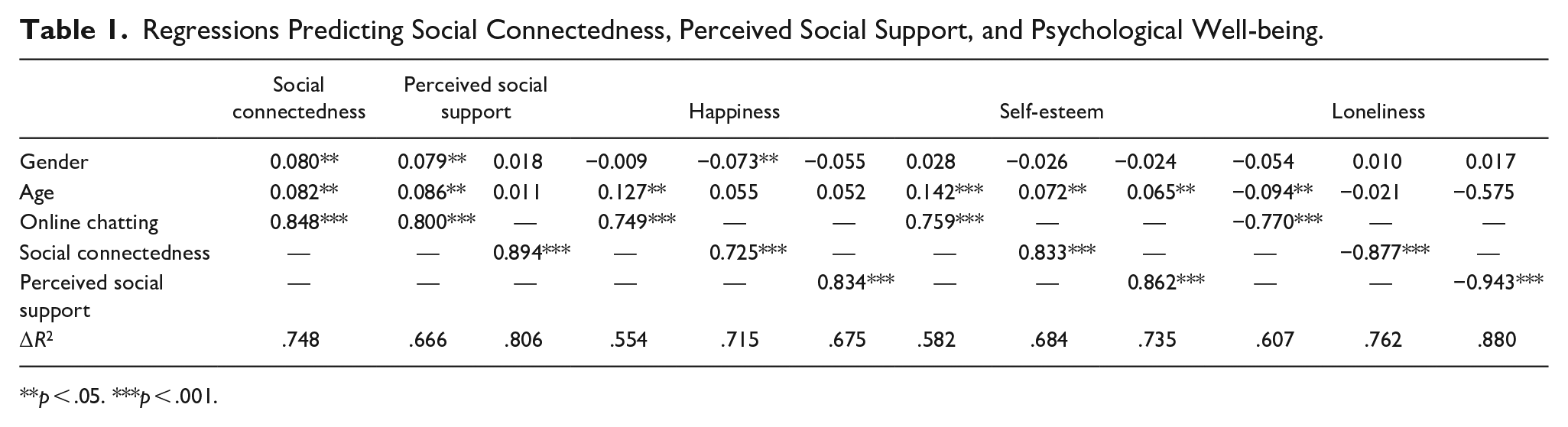
To answer RQ 1 and to test H1–H5, we ran a set of linear regressions. In examining these hypotheses, it is important to take into account individual differences. As some previous researches indicated that social connectedness, perceived social support and psychological well-being covaried with demographic factors (e.g., Reer et al., 2019), gender (coded with 0 = male and 1 = female) and age were added as control variables to all regression models (see Table 1).
Regressions Predicting Social Connectedness, Perceived Social Support, and Psychological Well-being.
p < .05. ***p < .001.
RQ1 addressed the question whether online chatting and three indicators of well-being are significantly related to each other. Results show that online chatting was positively associated with happiness (β = .749, p < .001) and self-esteem (β = .759, p < .001), yet negatively associated with loneliness (β = −.770, p < .001). Age predicted happiness and self-esteem positively and was negatively associated with loneliness, while the effect of gender was not significant (see Table 1).
In order to test hypotheses H1 and H2, social connectedness and perceived social support were regressed on happiness, self-esteem, and loneliness. Confirming H1, social connectedness was related with well-being: Happiness (β = .725, p < .001), self-esteem (β = .833, p < .001), and loneliness (β = −.877, p < .001). In accordance with H2, perceived social support also demonstrated significant correlations with psychological well-being (happiness: β = .834, p < .001; self-esteem: β = .862, p < .001; loneliness: β = −.943, p < .001).
H3 and H4 were tested by regressing social connectedness and perceived social support separately with online chatting. Supporting H3, online chatting showed a positive effect on social connectedness (β = .848, p < .001) with both gender and age demonstrating positive impact (see Table 1). And in line with H4, perceived social support was also positively predicted by online chatting (β = .800, p < .001). Age (β = .086, p < .05) and gender (β = .079, p < .05) also predicted perceived social support positively.
Finally, perceived social support was regressed on social connectedness. As predicted by H5, social connectedness showed a rather significant impact on perceived social support (β = .894, p < .001).
Mediation Analysis
The investigated mediation model was tested using SPSS Amos software package (maximum likelihood estimation). Three different variants of the model for three indicators of psychological well-being were calculated (Model 1: Happiness, Model 2: Self-esteem, Model 3: Loneliness; see Figures 1–3). Indirect relations were tested using the 5000 samples bootstrapping with 95% bias corrected confidence intervals (CI). Based on the regressions reported in the previous section, we decided to add age and gender to the path models and show the significant correlations in models. To evaluate the fit of models, established criteria including Tucker-Lewis index (TLI), comparative fit index (CFI), and root mean square error of approximation (RMSEA) were calculated, and all models showed a good fit (see Figures 1–3).
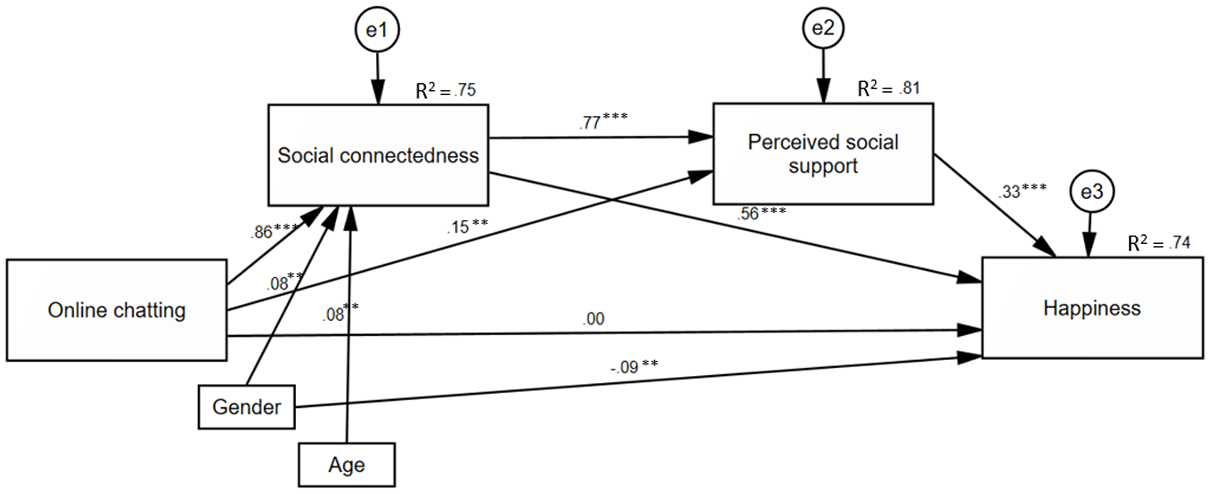
Estimated model for happiness (Model 1).
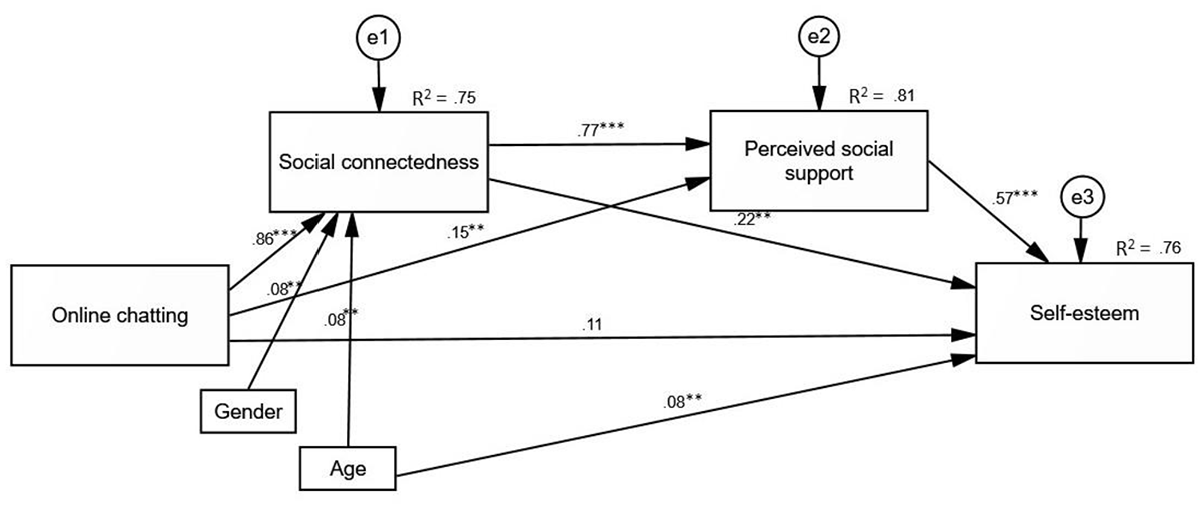
Estimated model for self-esteem (Model 2).
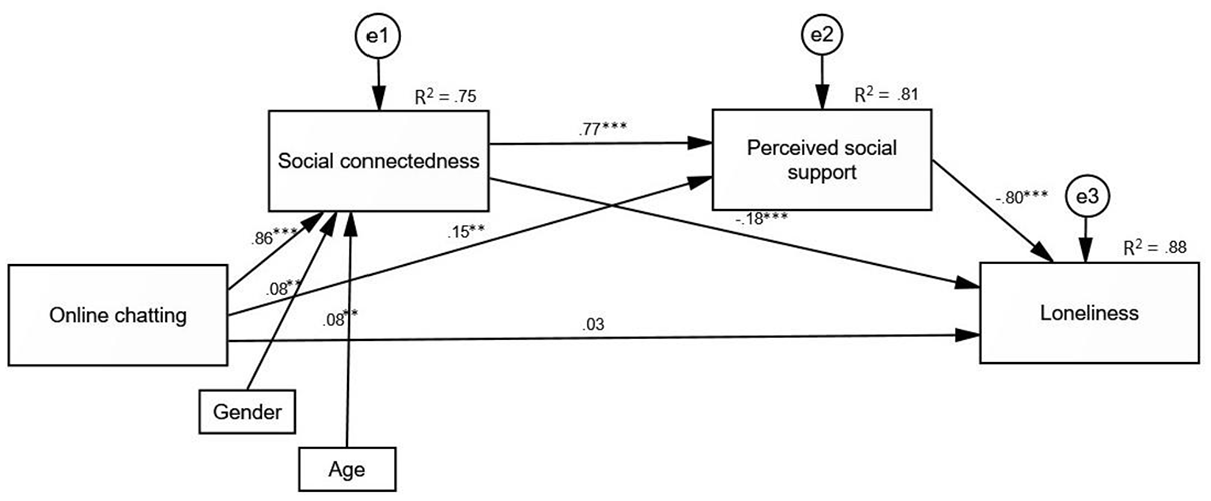
Estimated model for loneliness (Model 3).
H6 predicted that social connectedness can mediate the connection between online chatting and psychological well-being. Results showed that the connection between online chatting and social connectedness was significant within all models (Model 1: β = .86, p < .001; Model 2: β = .86, p < .001; Model 3: β = .86, p < .001). Moreover, social connectedness was positively related with psychological well-being (Model 1: β = .56, p < .001; Model 2: β = .22, p < .05; Model 3: β = −.18, p < .001). The indirect path from online chatting via social connectedness to psychological well-being was also significant within all models (Model 1: β = .30, CI = [0.22, 0.38], p < .001; Model 2: β = .13, CI = [0.04, 0.23], p < .05; Model 3: β = −.12, CI = [−0.18, −0.07], p < .001).
H7 predicted that perceived social support can mediate the connection between online chatting and psychological well-being. As expected, the connection between online chatting and perceived social support was found to be significant (Model 1: β = .15, p < .05; Model 2: β = .15, p < .05; Model 3: β = .15, p < .05). In addition, perceived social support was related with psychological well-being (Model 1: β = .33, p < .001; Model 2: β = .57, p < .001; Model 3: β = −.80, p < .001). The indirect path from online chatting via perceived social support to psychological well-being was also significant (Model 1: β = .03, CI = [0.01, 0.06], p < .05; Model 2: β = .06, CI = [0.02, 0.10], p < .05; Model 3: β = −.10, CI = [−0.16, −0.03], p < .05).
Finally, H8 predicted that social connectedness and perceived social support serially mediate the correlation between online chatting and psychological well-being. According to the mediation analysis results, H8 is fully supported (Model 1: β = .14, CI = [0.09, 0.20], p < .001; Model 2: β = .27, CI = [0.19, 0.35], p < .001; Model 3: β = −.42, CI = [−0.49, −0.35], p < .001). Social connectedness and perceived social support played completely mediating roles because no direct connection was found between online chatting and psychological well-being within all models.
Discussion
Faced with COVID-19 quarantine, adolescents are in danger of deleterious psychological impacts. Based on analysis concerning the effects of online chatting on three indicators of psychological well-being, this study revealed that online chatting was connected with increased happiness, self-esteem, and decreased loneliness, indicating that online communication may play a major role in alleviating adolescents’ psychological pressure during COVID-19 isolation. Confirming previous findings (e.g., Ahn & Shin, 2013), social connectedness and perceived social support have also been proved to be correlated with well-being. Therefore, we proposed that online chatting might be harnessed to improve mental well-being. In order to gain a deeper understanding of the link between online chatting and well-being, two potential mediators—social connectedness and perceived social support were additionally considered in this study. Based on mediation analyses, we found that social connectedness and perceived social support served as mediation roles in the connection between online interaction and mental well-being, playing a buffered role between life change events and psychological well-being. This finding corresponds with existing research stating that internet technologies may provide an additional opportunity to establish emotional connections with friends and schools (Wu et al., 2016), which in turn increase the level of social support and psychological well-being.
Compared with emerging adulthood, adolescence is accompanied by intense negative emotions and decreased parental social support because of fundamental alterations in cognitive, social, and emotional domains (Furman & Buhrmester, 1992; Silk et al., 2003). Therefore, seeking social relations with others to alleviate the emotional distress of disconnection becomes a factor of well-being (Diener & Seligman, 2002). This study demonstrated that school closures during COVID-19 have built a disconnected “island,” while social needs including connection and support induced by online interaction may lead to positive emotional status like increased happiness and decreased loneliness. We believed that during home quarantine, the internet might become a discursive space in which individuals can share information and develop understanding, which is beneficial to their mental health (Shepherd et al., 2015), and the use of digital means of connection can be helpful for adolescents’ well-being when they have to reduce face-to-face connection with peers (Orben et al., 2020).
Indeed, from 1990s when online communication first became popular, debating theories have been proposed and applied to understand the different relationships between online communication and offline interpersonal outcomes (Dredge & Schreurs, 2020). For example, the time displacement hypothesis and the cues filtered out elaboration point out the negative effect of media use on offline interpersonal connection (Konrath, 2013; Putnam, 1995), while others proposed that online communication as a medium can provide opportunities to practice internet-induced social skills (Koutamanis et al., 2013). This research also offers a more optimistic view of online chatting and conforms to contemporary work on the role of internet communication technologies in improving psychological well-being. The reason why the results of more recent studies are different from those of previous studies may be the high access to the internet for the adolescents, which gives them more opportunities to maintain their existing social networks through online chatting (Valkenburg & Peter, 2009a).
Notably, we put forward the supplementary hypothesis that during quarantine when face-to-face interactions are scarce, online chatting may serve as the carrier of connection and peer support between individuals and predict well-being. Being a supplement rather than a substitute, online communication does not develop at the expense of existing friendships, but can improve relational connection and peer support which improve psychological well-being. For adolescents, schools provide an environment to develop and consolidate the necessary emotional skills to establish social connectedness with their families, and peer groups (Bowen et al., 2001; Carroll et al., 2017), and it is glad to see that online interaction during quarantine times can also provide social and psychological benefits.
Despite the advantages of this research, this study is not without limitations. For example, with an aim to conduct an exploratory study during COVID-19 rather than examining generalizability, the majority of our sample is the female living in urban settings. Although this sample is not representative of Chinese population, it might resemble the major group engaged with online communication actively in China (China Internet Network Information Center, 2012, 2020). Nevertheless, examining similar relationships with more diverse samples and living settings will be valuable. Secondly, the analyses are based on self-reported data because many research variables are internal states that are difficult to assess outside of self-reports. As Chan (2009) has suggested that the reporting bias does not happen all the time especially when using well-established measurements with high validity as we did, we suppose that the self-report measure provided insights into how adolescents were affected during quarantine and demonstrated the value of online chatting. However, additional sources and types of data (e.g., log-based measurement) is warranted to get stronger construct validity considering the possible reporting bias. Thirdly, the cross-sectional data we used does not allow testing for causality. However, our dataset was large enough to minimize the likelihood of Type One error considering the result of power analysis, which made the findings more valid and reliable. As Spector (2019) has identified, the cross-sectional design can be well positioned to indicate the relationships among research variables, and including control variables to rule out spurious relationships can remedy some limitation of the method, which we have done to optimize our design. Therefore, we are utilizing cross-sectional data because of its correctness instead of simplicity given our purpose. Useful techniques for improving the methodology might be to include in-depth interviews involved with more interpretation on the effects of online chatting and to use retrospective report with multiple data sources (e.g., parents). We also think current findings can be a valuable reference for research intending to infer a more robust relation with a longitudinal study in regions practicing COVID-19 school closure. Although our research is not flawless, we believe our findings are reliable and can provide essential perspectives as a starting point to answering research questions and informing how subsequent research designs can be formulated.
Furthermore, by understanding the relationships between an extended pattern of internet use and its influence on adolescents, we aim to lay foundation for future research. For example, it is unknown if quarantine measures were taken in the longer term, would online communication still bring about benefits. Future studies are encouraged to build upon the foundational data in current study and explore more specific psychological symptoms and media variants. In addition, considering the complexity of psychological status, future research could consider how discrete positive emotions induced by online chatting might be more or less effective in improving adolescents’ psychological well-being. Nowadays, the internet serves as an interactive context in which socialization takes place and adolescents can undertake various activities, so another important research orientation is to investigate how different behaviors on social networks such as posting, receiving feedbacks, or sharing are connected to well-being, and issues of type and dosage can be considered to yield best outcomes. Furthermore, it should be noted that adolescence is a period of significant changes in personal development, during which adolescents have limited self-regulation abilities and an increased danger of making risky connections online unwittingly (Webster et al., 2021). Therefore, the impact of excessive or risky use of internet is a topic that warrants future study. Since the internet has become prevalent and influential during epidemics as well as in the future, it is vital for us to continue to extend current knowledge and to make the internet play more positive parts in the socialization of adolescents.
Footnotes
Authors’ Contributions
All authors contributed to the study conception and design. Material preparation, data collection and analysis were performed by all the authors. The first draft of the manuscript was written by Yulei Feng and all authors commented on previous versions of the manuscript. All authors read and approved the final manuscript.
Declaration of Conflicting Interests
The author(s) declared no potential conflicts of interest with respect to the research, authorship, and/or publication of this article.
Funding
The author(s) disclosed receipt of the following financial support for the research, authorship, and/or publication of this article: This project is sponsored by National Social Science Foundation of China (18ZDA312) and National Key R&D Program of China (2020YFF0305300).

Availability of Data and Material
The data that support the findings of this study are available from the corresponding author upon reasonable request.