







Abstract
This study extends the general understanding of the antecedents of academic dishonesty by examining what can happen when students are treated unjustly by teachers, a phenomenon referred to as teacher injustice. Based on Conservation of Resources theory (CoRT), the study investigates the mediating role of classroom connectedness and the moderating role of trait conscientiousness in the teacher injustice–academic dishonesty relationship. Self-report data were collected in three waves from Pakistani secondary school students to test the moderated-mediation model. Findings demonstrate that teacher injustice is positively related to academic dishonesty through classroom connectedness and that conscientiousness buffers the negative effects of teacher injustice on classroom connectedness. Given the results, this study suggests certain potentially effective measures to educational institutions to control the incidence of teacher injustice and cultivate conscientiousness in students. It also hopes to inspire future research, and advance education management theory and practice.
Introduction
Academic dishonesty refers to a group of intentional unethical behaviors (including plagiarism, cheating, and unauthorized help) breaching accepted standards and defined rules in academia, whereby students get an unfair advantage in academic assessments (Velliaris, 2016). Academic dishonesty is a long-known malady with dire consequences that has plagued the global education sector. However, empirical research on this issue is somewhat inadequate and fragmented. Past research has studied the academic dishonesty phenomenon through different theoretical lenses like planned behavior theory, deterrence theory, neutralization theory, situational ethics theory, and the Big Five personality model (DiPietro, 2010). Given that the cheating crisis is on the rise (Bos, 2020), more research from unique theoretical perspectives needs to be undertaken to examine its potential antecedents. Furthermore, past research has focused primarily on individual differences among learners as antecedents of academic dishonesty, such as personality, morality, and emotionality (Marques et al., 2019). The contextual and interpersonal factors leading to academic dishonesty remain largely understudied and hence poorly understood.
Considering the knowledge gaps in academic dishonesty research, we adopt the theoretical viewpoint of the Conservation of Resources Theory (CoRT; Hobfoll, 1989) to study the influence of instructorship on academic dishonesty. Frequently applied to academia (e.g., Nelsen et al., 2021; Yablon & Itzhaky, 2021), CoRT explains the etiology of stress and predicts motivation and behavior (Hobfoll, 1989). The education sector is characterized by various stress-inducing stimuli, such as intense competition, rigorous learning, competing demands, and peer pressure. Such conditions can consume students’ limited resources and harm their wellbeing, which may in turn trigger dysfunctional behavioral responses—like academic dishonesty—that can threaten the balanced psycho-social development of students and the sanctity of education system. The academic dishonesty literature views teachers’ (mis)conduct as an interpersonal stressor that can influence students’ attitudes, intentions, and behaviors (e.g., Marcin et al., 2019). Teacher injustice, a kind of teacher-to-student victimization (Donat et al., 2018), makes students feel ignored, excluded, and isolated (Jiang et al., 2018), which may deplete their resource reserves, induce stress, and lower their interest and investment in studies. In reference to CoRT, students strive to build a reservoir of their valued reserves (e.g., autonomy, self-esteem, and social support) to respond to current and future academic challenges (Frisby et al., 2020). Teacher injustice can deplete those resources which may impair students’ regulatory capacity, hence making behavioral control difficult. Consistent with this reasoning, this study’s first purpose is to explain why teacher injustice increases students’ engagement in academically dishonest behaviors.
Bearing in mind the fundamental characteristics of teacher injustice, we argue that teacher injustice may not only directly influence students to commit academic dishonesty but also indirectly by emotionally weakening their connection with the classroom. Classroom connectedness is a way for students to learn motivationally and socially (Glaser & Bingham, 2009). Unfair treatment by teachers impairs students’ individual and social functioning, and causes them to experience various psychological and somatic problems (Mameli et al., 2018), thus making them more vulnerable to resource loss and cognitive stress. Such students are also unable to fulfill their basic psychological needs of belongingness and relatedness (Marcin et al., 2019). Eventually, they will come to believe that their classroom is not a great platform to express themselves and realize their self-esteem, hence weakening the classroom connectedness. Furthermore, students with little classroom connection cannot obtain support and comfort from peers and teachers, which may affect their capacity to cope with academic stressors (Frisby et al., 2020), for example, homework and exams. In order to reduce their own psychological stress and respond to these unfavorable conditions, they may engage in academically dishonest behaviors. Based on this reasoning, this study’s second purpose is to analyze the mediating role of classroom connectedness in the teacher injustice‒academic dishonesty relationship.
Given the deleterious effects of teacher injustice, examining variables that can mitigate them would be worthwhile. As research suggests that students uniquely appraise the adversities of victimization depending upon their personalities (e.g., Calvete et al., 2016), conscientiousness—a Big Five personality trait—may serve as a potential moderator. Conscientious people are known for being persevering, hardworking, dutiful, and self-disciplined (Costa & McCrae, 1992). They have a strong sense of accomplishment, and tend to focus on their duties even when confronting constraints (Wang & Erdheim, 2007). Given such attributes, it is reasonable to assume that when experiencing teacher injustice, highly conscientious students would direct more resources they have into dealing with that injustice, in order to stay connected with class and meet their academic performance requirements. For example, they may keep their head up, adopt a positive attitude, study harder, and increase classroom involvement to show the teacher that they do not deserve to be treated unfairly. Hence, the study’s final purpose is to examine conscientiousness as a boundary condition under which teacher injustice’s direct impact on classroom connectedness and indirect impact on academic dishonesty may be weaker.
Literature Review and Hypotheses Development
Conservation of Resources Theory (CoRT)
CoRT offers a multileveled motivation framework to understand psychological stress and coping. It propagates that stress occurs when resources are threatened, actually lost, or not regained after their investment. Further, it is the individuals’ desire to acquire, maintain, and defend those resources which influences their behavior in face of adversities (Hobfoll, 1989). As per CoRT, when confronted with stress, individuals with sufficient resources perceive the situation as less taxing and perform successful coping, while those lacking resources perceive the situation as more strenuous, adopt maladaptive coping strategies, and lose further resources in process (Hobfoll, 1989). CoRT is founded on Lazarus and Folkman’s (1984) transactional theory of stress and coping (TTSC), according to which, coping is a phenomenon that involves both cognitive and behavioral responses that people use to manage internal and/or external stressors. Coping produces an outcome: either favorable, unresolved, or unfavorable. Favorable resolution of stressors generates positive affect, whereas unfavorable or unresolved resolution generates distress, causing the person to reconsider his/her coping strategy to manage the stressor.
Teacher Injustice and Academic Dishonesty
Based on CoRT (Hobfoll, 1989), this study postulates that teacher injustice can increase academic dishonesty in two ways. First, unjust teachers are not neutral in their decision making: they do not give students equal opportunity to participate in classroom discussions or freely act as they wish in school activities (Marcin et al., 2019). Also, unfair teachers make exceptions for and give unearned privileges to students they like, and give an impression that students must please them in order to be treated respectfully (Rightmyer, 2011). Hence, teacher injustice is a toxic stressor that may drain students’ personal resources (e.g., self-esteem; Jiang et al., 2018) and keep them from securing other resources (e.g., sense of belongingness; Frisby et al., 2020) by hindering the development of a healthy teacher–student relationship (Marcin et al., 2019). When subsequent stressors like assignments and quizzes put pressure on the remaining resources, students’ regulatory capacity may exhaust which will make it difficult for them to override the temptation of engaging in academic dishonesty.
Second, unjustly treated students may be less likely to get teacher support (Donat et al., 2018; Frisby et al., 2020), which is essential for academic achievement (Yu & Singh, 2018). Further, students may have to consume more resources to not only endure the injustice but also to determine the reason behind it and please the teacher in hopes of receiving fair treatment in future. Prolonged experience of teacher injustice may thus exhaust students’ psycho-emotional resources which are especially helpful in coping and recovery, and induce negative affective states like burnout. According to CoRT, burnt-out individuals suffer in their performance due to a lack of resources to meet all role demands simultaneously (Peasley et al., 2020). Hence, students who experience burnout due to teacher injustice may adopt maladaptive coping strategies, like academic dishonesty, since they lack adequate cognitive resources to handle academic pressures. Taking this argument into consideration, this study hypothesizes the following:
Hypothesis 1: Teacher injustice is positively related to academic dishonesty
The Mediating Role of Classroom Connectedness
Considering the tenets of CoRT and the unique characteristics of teacher injustice, this study contends that teacher injustice can diminish students’ sense of classroom connectedness. Teacher injustice hinders the development of a teacher–student rapport (Marcin et al., 2019), in the absence of which students are neither able to gain personal resources (e.g., trust and respect; Jiang et al., 2018) or institutional resources (i.e., student services and academic support; Sidelinger et al., 2016), nor meet their basic psychological needs (i.e., autonomy, relatedness and competence; Frisby et al., 2020). When resources cannot be acquired and needs remain unsatisfied, students invest their available resources (e.g., time and energy) to acquire more resources and satisfy needs themselves. This situation will signal a resource crisis, due to which students may experience psychological distress and adopt maladaptive coping strategies, like psychological withdrawal and behavioral disengagement (Schneider et al., 2018), which may consequently lower their classroom connectedness levels and effort in studies.
Further, this study postulates that diminished classroom connectedness is linked with increased academic dishonesty. As per the resource-generation perspective of CoRT (Hobfoll, 1989), engagement in academic dishonesty can provide students with more resources, including a sense of self and sense of control. Specifically, reduced classroom connectedness is a stressor under which students may not be able to fully express themselves in the class (Frisby et al., 2020; Sidelinger et al., 2011) but are still required to follow the institutional and academic rules, thus undermining their sense of self. Conversely, when students engage in academic dishonesty, they govern their own behavior and shape their education-related experiences themselves. This may enhance students’ autonomy (Patall & Leach, 2015), which may help them regain their lost sense of self. Similarly, the amount of resources needed to cope with the stress of diminished classroom connectedness will put pressure on students’ remaining resources, which may make them change their academic performance strategy, such as using unauthorized help to clear exams. This may restore students’ sense of control over their academic life, and make them feel mentally refreshed and physically energetic (Ruedy et al., 2013), thus leading to greater resource recovery.
Based on the above discussion, the following is hypothesized:
Hypothesis 2: Classroom connectedness mediates the positive teacher injustice–academic dishonesty relationship
The Moderating Effect of Conscientiousness
Drawing on CoRT (Hobfoll, 1998), this study contends that conscientiousness serves as a psychological resource which may offset the adverse outcomes of teacher injustice. Highly conscientious individuals tend to be intrinsically motivated, hardworking, well-organized, and achievement-oriented (Chamorro-Premuzic, 2016). They are better at utilizing their other resources, and use adaptive and proactive coping strategies to respond to stressors and contextual adversities (Straud et al., 2015). Thus, when being treated unfairly by teachers, conscientious students will find some effective way to deploy their other existing resources to maintain classroom connectedness, and overcome academic pressures and challenges. Further, considering the nature of this personality trait, highly conscientious individuals have a significantly bigger resource pool to rely on when faced with resource depletion (Zellars et al., 2006). Hence, such students will be more motivated to invest their extra resources to remain engaged, involved, and connected with their class despite teacher injustice. In light of this discussion, this study puts forward the following moderation hypothesis:
Hypothesis 3: Conscientiousness moderates the negative teacher injustice–classroom connectedness relationship, such that the relationship is less pronounced when students have higher levels of conscientiousness
If hypotheses 1‒3 are taken together, it is logical to expect that conscientiousness may also moderate the strength of the mediating mechanism of classroom connectedness in the teacher injustice–academic dishonesty relationship. Hence, this study proposes a moderated-mediation framework that is specified in the hypothesis below:
Hypothesis 4: Conscientiousness moderates the indirect relationship between teacher injustice and academic dishonesty via classroom connectedness, such that the relationship is less pronounced when students have higher levels of conscientiousness
Methodology
Participants and Procedures
Prior to data collection, the approval of the Research Ethics Committee of a university in Islamabad (Pakistan) was obtained. Thirteen branches of three private secondary schools in Rawalpindi and Islamabad (Pakistan) were randomly targeted and sent invitation letters for participation in this study; eight accepted. Their respective Principal offices provided the authors with lists of their full-time grades 10, 11, and 12 students, from which around 60 to 90 students from each school branch were randomly selected. Only students who received parental consent and who assented themselves were allowed to participate. To minimize the threat of common method variance bias, data was collected through three time-lagged surveys.
In time-one survey (T1), students were administered questionnaires inquiring about their basic demographical details and perceptions of teacher injustice. Total 710 questionnaires were administered, and 624 properly complete ones were returned. In time-two survey (T2), conducted a month later, students had to rank their feelings of classroom connectedness and provide information on trait conscientiousness. Out of the 624 distributed, 537 fully filled questionnaires were received. In time-three survey (T3), performed after another 1 month, students were asked to rate their academically dishonest behaviors. From the 537 circulated questionnaires, 433 were submitted. Out of the returned questionnaires, 21 were invalid and thus discarded; generating an overall 58% useable response rate. The final sample consisted of 412 students, among whom females were 66%, average age was 16.94 (SD = 1.44) years, and part-time jobs holders were 7%.
Measures
The questionnaire was composed of four scales that were adapted from past research. Since participants were fluent in English, scales were not translated into the local language. To ensure that items were relevant to this study’s theme and context, the questionnaire was pilot tested with 15 students of one school branch. Some minor changes were incorporated based on their feedback. Unless stated otherwise, all items were rated on a five-point Likert Scale with options ranging from strongly disagree (1) to strongly agree (5).
Teacher injustice was measured through the nine-item “treatment of individual pupils by teachers” subscale of Gorard’s (2012) questionnaire. Sample items included: “I am always treated fairly by my teachers” and “my marks usually reflect the effort I make.” This scale’s Cronbach alpha was .90. Conscientiousness was assessed using six items from International Personality Item Pool (IPIP; Goldberg, 1992). Sample items included: “I get chores done right away” and “I pay attention to detail.” This scale’s Cronbach alpha was .80. Classroom connectedness was measured with the 10-item subscale of Rovai (2002). Sample items included: “I feel connected to others in this class” and “I feel that I can rely on others in this class.” This scale’s Cronbach alpha was .78. Lastly, academic dishonesty was quantified through the nine-item Scholastic Dishonesty Scale of Eve and Bromley (1981). Responses on this scale were rated on a five-point Likert-type scale whose options ranged from never (1) to more than five times (5). Sample items of this scale included: “over the past month, I have copied answers from another student during exam” and “over the past month, I have used notes or books during a test when prohibited.” This scale’s Cronbach alpha was .84. Each of the scales discussed here were statistically significant as they had sound descriptive properties, and were also valid as they demonstrated reasonable fit to the data (see Table 2).
Results
Measurement Model
The CFA was performed to test the appropriateness of the measurement model, and evaluate its convergent validity, internal reliability, and discriminant validity. The results (see Table 1) showed that the proposed measurement model was consistent with the collected data as all values of the fit indices were within the permissible limits (χ2(521) = 1135.58, CFI = .91, TLI = .91, IFI = .91, RMSEA = 0.05, SRMR = .05). Apart from this, factor loadings between the items and their respective constructs were between .52 and .88, coefficients of average variance extracted (AVE) ranged from .50 to .59, and the composite reliability (CR) values were in the .80 to .94 interval (see Table 2). Since all the aforementioned estimates satisfied the recommended cutoffs, the convergent validity of the model’s factors was secured (see Table 2). Furthermore, to check the discriminant validity, multiple CFAs were conducted through which the fit of the baseline four-factor model was compared against the fit of five plausible alternative models. The comparison revealed that the baseline model was significantly better fit than the alternative models, hence the discriminant validity was also established (see Table 1).
Results of the Confirmatory Factor Analysis.
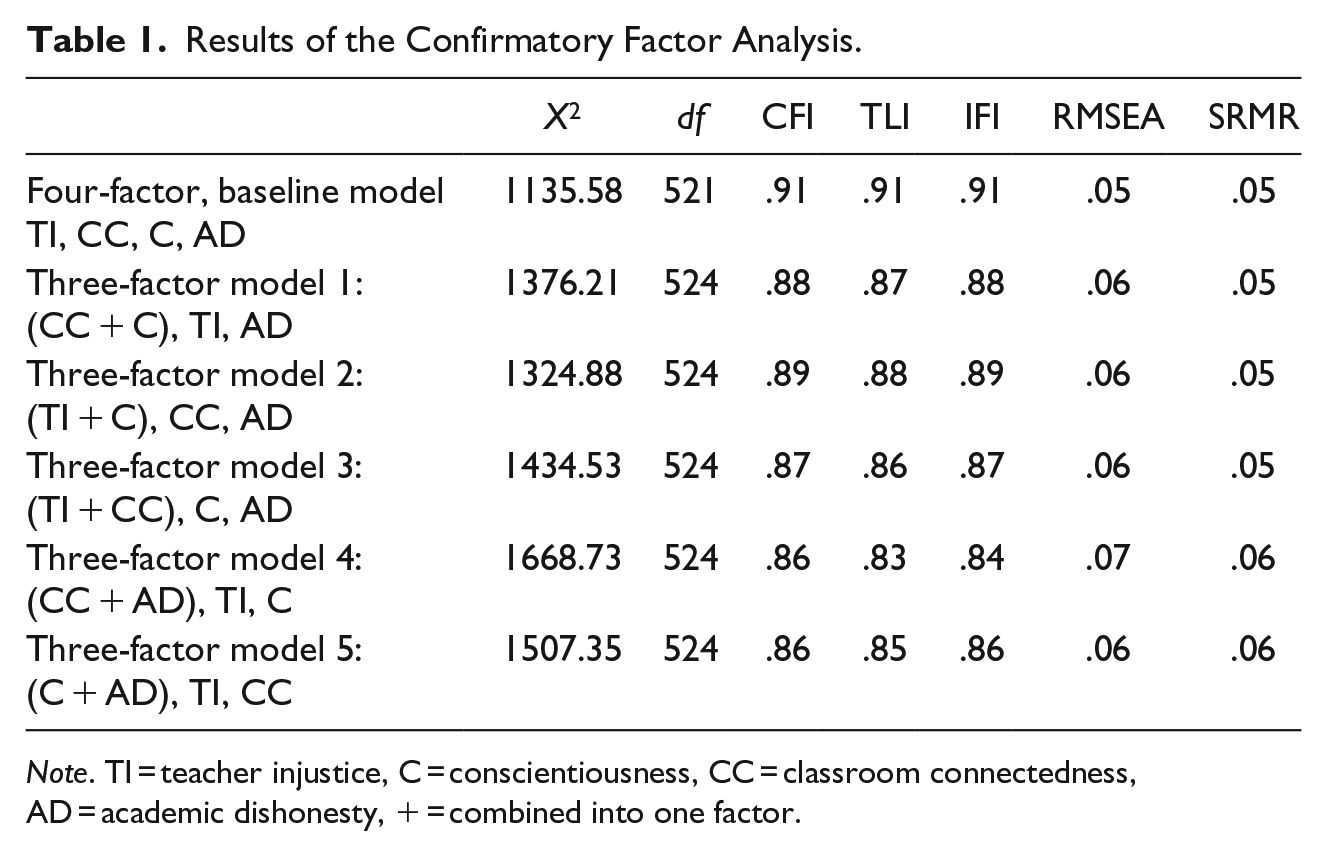
Note. TI = teacher injustice, C = conscientiousness, CC = classroom connectedness, AD = academic dishonesty, + = combined into one factor.
Results of Descriptive and Correlation Analyses.
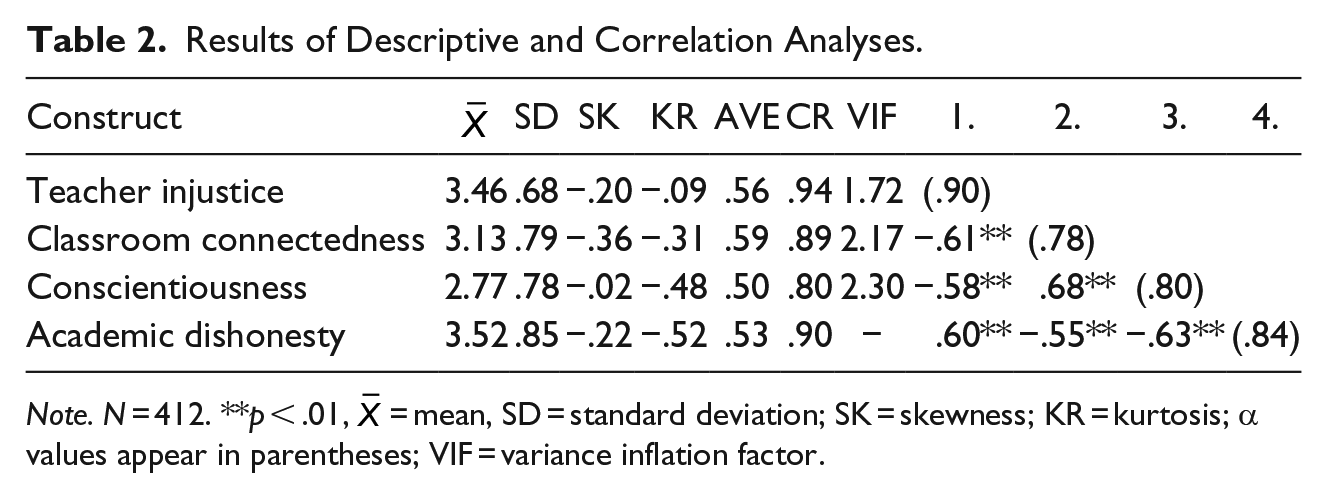
Note. N = 412. **p < .01,
Descriptive Statistics
A correlation matrix was computed which showed that all correlations were statistically significant in the expected directions, and multicollinearity was not a concern because all intercorrelations were below Mason and Perreault’s (1991) recommended cutoff. In particular, results exhibited that teacher injustice correlated positively with academic dishonesty (r = .60, p < .01) and negatively with classroom connectedness (r = ‒.61, p < .01). Classroom connectedness and academic dishonesty were also negatively correlated (r = ‒.55, p < .01). Besides, Cronbach’s alpha values calculated for each construct ranged from .78 to .90; demonstrating sound internal consistency (see Table 1).
Hypotheses Testing
The mediation effect was verified using PROCESS Model 4 on SPSS (See Figure 1). Results indicated that teacher injustice had a significant positive main effect on academic dishonesty (b = .53, p < .01); thus, offering support for Hypothesis 1. The indirect effect was estimated through bootstrapping method with 95% bias-corrected confidence intervals (CI) with 5,000 bootstrapping resamples. It was found that the teacher injustice → classroom connectedness → academic dishonesty pathway was significant as the CIs were above zero (b = .22, CI [0.15, 0.30]), indicating a partial mediation of classroom connectedness. Hence, Hypothesis 2 was supported.
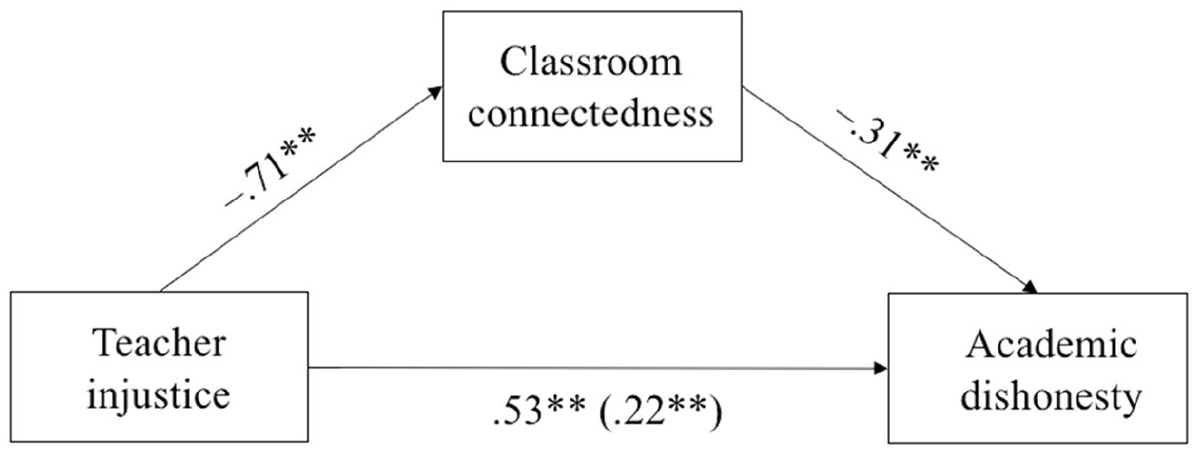
The main and mediation effects.
The moderation effect was analyzed using PROCESS Model 7 with bootstrapping (see Table 3). To reduce the problematic collinearity between the main effect and interaction term, and facilitate the interpretation of the interaction, all variables were mean-centered. It was observed that the interaction effect of teacher injustice and conscientiousness was positive and significant (b = .22, p < .01). Consistent with Hypothesis 3, simple slope test showed that teacher injustice was more negatively related to classroom connectedness when conscientiousness was low (b = ‒.56, SE = .05, CI [‒.68, ‒.44]) than when it was high (b = ‒.20, SE = .05, CI [‒.31, ‒.10]). On this account, Hypothesis 3 was supported.
Simple Moderation and Moderated-Mediation Hypotheses Testing Results.
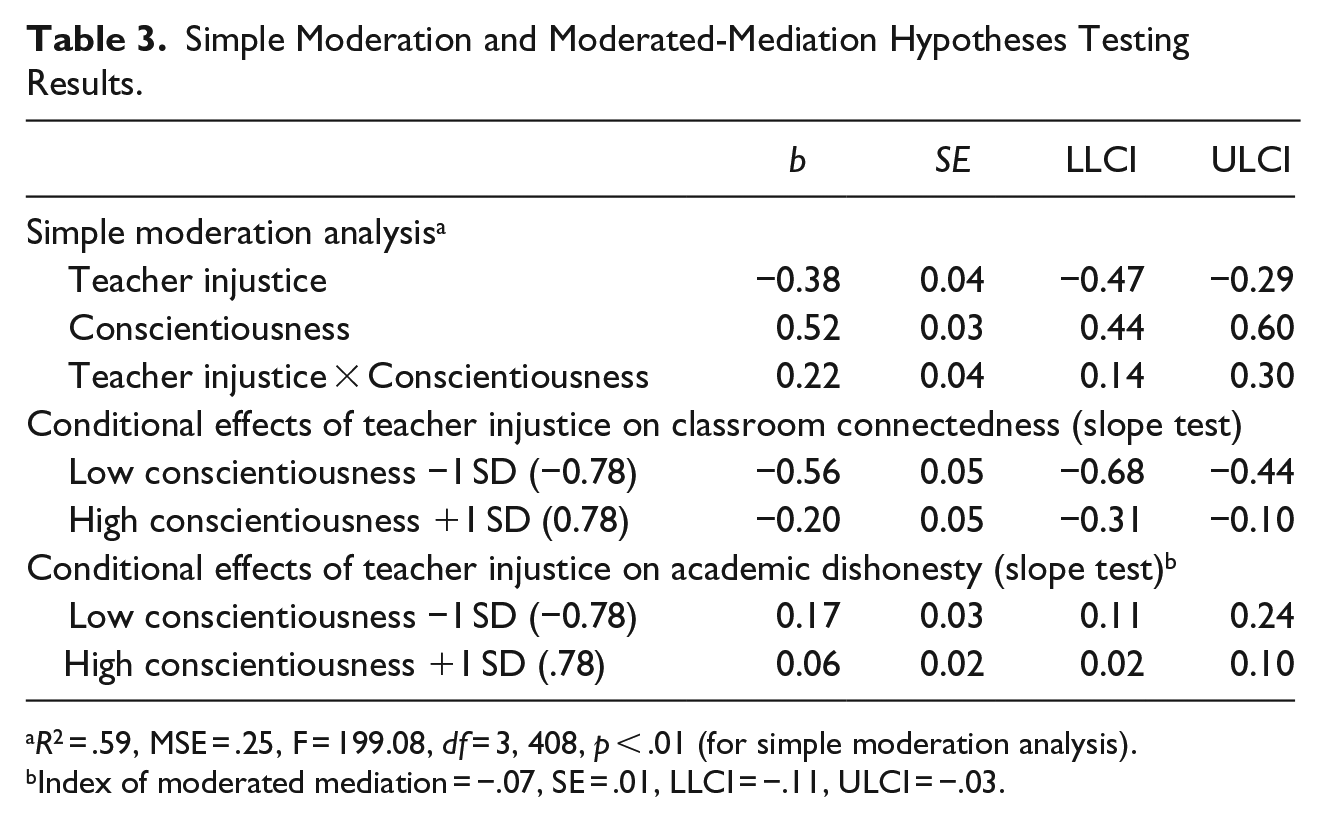
R2 = .59, MSE = .25, F = 199.08, df = 3, 408, p < .01 (for simple moderation analysis).
Index of moderated mediation = −.07, SE = .01, LLCI = −.11, ULCI = −.03.
Finally, the conditional indirect effect of teacher injustice on academic dishonesty via classroom connectedness at different levels of conscientiousness was examined using PROCESS Model 7 with bootstrapping (see Table 3). The index of moderated mediation was found to be significant (index = −0.07, SE = 0.01, CI [−0.11, −0.03]). Slope test exhibited that the indirect relationship between teacher injustice and academic dishonesty was stronger when conscientiousness was low (b = 0.17, I = .03, CI [0.11, 0.24]), and weaker when conscientiousness was high (b = 0.06, SE = .02, CI [0.02, 0.10]). Hence, results supported Hypothesis 4 as well (see Table 3).
Overall, the parameters found through data analysis were statistically significant and well-within Hair et al.’s (2010) and Byrne’s (2001) recommended limit of acceptance. All four study hypotheses were thus proven.
Discussion
This study adopted the lens of CoRT to examine why, how, and when teacher injustice is related to academic dishonesty by treating classroom connectedness as a mediator and conscientiousness as a moderator in this relationship. The results derived from a time-lagged data collected from Pakistani secondary-school students illustrated that classroom connectedness partially mediates the teacher injustice–academic dishonesty relationship. Further, conscientiousness mitigates teacher injustice’s direct effect on classroom connectedness, and indirect effect on academic dishonesty through classroom connectedness.
Theoretical Implications
The study makes few valuable additions to the relevant research. First, it advances the academic ethics literature by establishing teacher injustice as an antecedent to academic dishonesty, and offering unique insights into this antecedent by focusing on a particular student personality trait. By doing so, this study responds to Simkin and McLeod’s (2010) call for examining how professors influence academic dishonesty. In agreement with CoRT (Hobfoll, 1989), students value certain features of teacher justice (e.g., respect, dignity, and trust) as important resources which help them cope with academic stress and serve as a resource-replenishing mechanism to protect against future resource depletion. Students who lack these resources have a fragile sense of oneness and connectedness with classroom. Most importantly, they invest less effort in studies, and are therefore more likely to resort to academic dishonesty in times of need.
Second, this study unravels the mechanism of the impact of teacher injustice on academic dishonesty from the psychological perspective of CoRT which has not been adopted previously in research. It, thus, enriches the teacher justice literature by developing and validating a framework that portrays classroom connectedness as a critical path linking teacher injustice and academic dishonesty. Findings elucidate that the disrespect, rejection, and exclusion signaled through teacher injustice drains students’ personal resources, which in turn causes psychological stress that weakens their sense of connection with the classroom. Reduced classroom connectedness further impedes students’ functioning and threatens their school-specific wellbeing, due to which they cannot devote full effort in studies and eventually engage is dishonest activities to regain their sense of self and meet academic demands.
Third, this study advances the literature by adopting the person–situation interactionist approach (Mischel, 1973) to analyze the moderating effect of conscientiousness on both direct and indirect effects of teacher injustice on academic dishonesty. From the lens of CoRT (Hobfoll, 1989), it shows that high conscientiousness is a personal resource that students can draw upon to combat feelings of classroom disconnectedness and the urge to commit academic dishonesty that may arise from teacher injustice. This study concurrently examines the process via which teacher injustice motivates academic dishonesty along with the mitigating effect of conscientiousness on this process, and is therefore an improvement over previous research which has largely adopted a piecemeal approach to understand academic dishonesty.
Practical Implications
Considering the findings that teacher injustice is a driving force behind academic dishonesty, this study suggests certain measures to educational institutions that may help them control this deplorable phenomenon. First, they should develop a code of ethics outlining the principles they expect their faculty to uphold—specifically, dignity, truthfulness, and fairness. Second, teachers should be encouraged to seek training for emotion regulation and stress tolerance. This will help them to strengthen their interpersonal skills, control temper, conduct classes better, develop rapport with students, and thus avoid the potential display of teacher injustice. Third, a whistleblower hotline should be created to establish a safe and confidential reporting system against teacher injustice. To increase effectiveness, the hotline should be promoted through newsletters, email reminders, and posters. All anonymous calls should be taken seriously and investigated properly, and unfair teachers should be held accountable.
The findings also highlight the beneficial role of trait conscientiousness in maintaining classroom connectedness levels despite teachers’ unfair behavior. Accordingly, to help students develop conscientiousness and provide support to those low in it, educational institutions should first require students to frequently submit self-reports about personality traits. Second, they should try to cultivate conscientiousness through the implementation of different health promotion and stress management interventions such as school wellness programs, peer-support programs, mindfulness-based stress reduction programs, and relaxation exercises. Besides, educational institutions should foster an encouraging culture that gives room for individual discretion, and does not confine students to a limited range of approved behaviors.
Limitations and Future Research Directions
This study has some limitations that offer opportunities for future research. First, all variables were assessed through a single-source self-report survey, which may raise concerns for common method bias. Future research should use a longitudinal design or multi-source data to study this phenomenon more deeply and precisely. Second, the potential effects of other kinds of negative teacher behavior (e.g., incivility, harassment, and power abuse) were not investigated. Future researchers are advised to explore other misbehaviors using same or different methods to achieve more sound results that could provide better educative and preventive guidance for managing academic dishonesty. Third, although CoRT is a helpful theoretical framework to understand how students perceive, interpret, and respond to relational and contextual stressors, there are theories that could also be used to understand the same in future research—namely, Affective Events Theory and ego depletion theory. Last, since classroom connectedness only partially mediates the teacher injustice–academic dishonesty relationship, future research should consider other variables as mediators, for example, burnout and procrastination. Similarly, apart from personality traits like conscientiousness, factors like moral disengagement or social support are potential boundary conditions under which teacher injustice could be less or more aversive. Exploring such moderators in future studies would be worthwhile.
Conclusion
Teacher injustice has dire effects on students’ motivation, wellbeing, attitude toward, and behavior at educational institutions. However, a sound theory that could be applied in a systematic way to explain how teacher injustice influences students’ school-specific outcomes is still lacking. Accordingly, the present study used the theoretic lens of CoRT to examine teacher injustice’s relationship with academic dishonesty. It concludes that teacher injustice reduces classroom connectedness, which consequently increases students’ engagement in academically dishonest activities. Furthermore, students high in trait conscientious are likely to remain connected with classroom despite receiving unjust treatment from teachers. The study hopes to inspire future research, and advance education management theory and practice.
Footnotes
Declaration of Conflicting Interests
The author(s) declared no potential conflicts of interest with respect to the research, authorship, and/or publication of this article.
Funding
The author(s) received no financial support for the research, authorship, and/or publication of this article.
Ethical Approval
All procedures performed in studies involving human participants were in accordance with the ethical standards of the institutional and/or national research committee and with the 1964 Helsinki declaration and its later amendments or comparable ethical standards.
