







Abstract
Bullying is a goal-directed behavior that has long been in the spotlight of worldwide school mental health programs and research. However, the role of popularity goals in bullying and its potential mechanisms are unclear for adolescents in a non-Western cultural context. Based on 333 Chinese adolescents (52% female), the current study was the first to explore the potential moderating roles of popularity status and cognitive empathy in the association between popularity goals and early Chinese adolescents’ bullying behaviors. Moderated moderation analyses indicated that popularity status and cognitive empathy significantly moderated the positive relationship between popularity goals and Chinese adolescents’ bullying behaviors. Specifically, the statistically significant three-way interaction revealed that low popularity status and low cognitive empathy strengthen the positive links between popularity goals and bullying. The significant two-way interaction showed that the positive relations between popularity goals and bullying were stronger for low popularity among Chinese adolescents.
School bullying is a serious and widespread public concern with lifelong detrimental consequences for both bullies and victims (Arseneault, 2018; Powell & Ladd, 2010). Therefore, much effort has been devoted to explaining why bullying happens at school (e.g., Ferreira-Junior et al., 2021; Hunt, 2015). Recently, a growing number of studies have examined the association between popularity goals (PG) and school bullying from the perspective of motivation theory. According to this perspective, adolescents are preoccupied with popularity (Adler & Adler, 1998; Dawes & Xie, 2014), and they will carry out various behaviors such as bullying to meet PG (Dawes & Xie, 2014). This is because bullying, which is characterized by aggression and power asymmetry (Dawes & Xie, 2014; Monks & Smith, 2006; Taylor et al., 2010), could make an individual visible and feared, which would help individuals attain high status within peer group (Hartl et al., 2020). Indeed, previous studies have consistently found that higher PG are related to greater usage of bullying behaviors (Dawes & Xie, 2014; Wright et al., 2014). However, not all adolescents with a high popularity goal engage in aggression. Some adolescents accumulate their social dominance through cooperation and social alliances (Hartl et al., 2020). This raises an important question of when adolescents with PG would engage in bullying behaviors.
Popularity Goal and School Bullying
Individuals’ behaviors are guided by their goals (Crick & Dodge, 1994; Košir et al., 2022; Wright et al., 2014). Specifically, after setting goals for themselves, individuals select and order the courses of action that may produce the desired goal and create self-incentives to continuously strive to achieve this goal (Bandura, 2001). Adolescents are concerned about popularity, even endorsing it as an important goal and prioritizing it over others (e.g., friendships and romantic relationships; Dawes & Xie, 2014; LaFontana & Cillessen, 2010). Nevertheless, the desire to be popular should not be equated with being popular. There are only a few social positions at the top of the status hierarchy in the peer group, which suggests that popularity is a limited resource (Dawes & Xie, 2014). Therefore, they may engage in any behavior to attain their PG (Wright et al., 2014). Bullying as a goal-directed behavior can effectively obtain limited social resources (Košir et al., 2022). Thus, adolescents regard bullying as an effective way to promote popularity (Košir et al., 2022; Pouwels et al., 2016). In addition, a product of bullying is to gain dominance over peers through fear. This is consistent with the defining feature of the popularity goal—the desire for social dominance (Parkhurst & Hopmeyer, 1998; Wright et al., 2014). Therefore, adolescents with high PG are more likely to engage in bullying behaviors.
The Moderating Role of Popularity Statues
Although PG are positively related to aggression, adolescents with this goal do not necessarily engage in bullying behaviors (Košir et al., 2022). Therefore, understanding when PG would increase bullying behaviors has important implications for interventions aimed at reducing school bullying. Bullying is a group process (Salmivalli et al., 1996); group-level factors, such as popularity status (PS), are also relevant to bullying behaviors (Caravita & Cillessen, 2012). Researchers have argued that high PS may intensify the impact of PG on bullying behaviors. On the one hand, the benefits of high status make popular adolescents more motivated to maintain their position (Caravita & Cillessen, 2012). On the other hand, compared with low-status adolescents, high-status adolescents possess more resources and skills for initial bullying behaviors (Dawes & Xie, 2014). Thus, bullying behavior is an effective strategy for adolescents with high PG and high PS, rather than adolescents with high PG and low status. Indeed, Caravita and Cillessen (2012) investigated the associations among agentic goals (consistent with the conceptual framework of popularity goal), PS, and bullying, based on data from a middle childhood sample and an early adolescent sample. They found that children with higher PS and higher agentic goals reported are more likely to be perceived as bullies. Similarly, Dawes and Xie (2014) and Košir et al. (2022) found that for high-status individuals, higher PG were related to greater use of social aggression.
However, one caveat of the aforementioned studies is that they were conducted in a Western sample. Given that cultural norms and values inevitably affect the interpretation of social behaviors and social status (Bond, 2010) and that the Chinese highly value interpersonal harmony and collectivism, which is far different from the values emphasized in Western society (X. Chen, 2010; Wright et al., 2014), the function of PS may differ in the Chinese context. As personality education in China is deeply rooted in Confucianism philosophy, the Junzi personality, a Confucian ideal personality trait, has a far-reaching impact on Chinese people’s social relationships (Ge, 2020). Specifically, Ren, defined as benevolence or humanity, is one of the key elements of the Junzi personality (Ge, 2020) and is associated with high social status in China. This is embodied in an old Chinese saying 德高望重 (degao wangzhong), which means individuals with noble characters have high prestige, and 以德服人 (yide furen), which means individuals win people by virtue and merit. Therefore, Chinese adolescents with high PG and social status are more likely to use prosocial behaviors rather than aggressive behaviors to increase or maintain their status.
The Moderated Moderating Effect of Cognitive Empathy
Cognitive empathy (CE) is an important trait of individuals related to the bullying process (Salmivalli et al., 1996; van Noorden et al., 2015); thus, how group-level factors (i.e., popularity goal) moderates the association between popularity goal and bullying behaviors may vary depending on the level of CE. However, while theorists consistently argue that CE is associated with the bullying process, they also dispute the function of CE in school bullying (Caravita et al., 2009). Some researchers propose that the lack of empathy is one of the traditional stereotypes of bullies (Gini et al., 2007). In contrast, adolescents who can recognize others’ emotions and perspectives may have a better understanding of the adverse consequences of bullying behaviors (Jolliffe & Farrington, 2006). Thus, for adolescents who keenly desire popularity but have low status, a high level of CE can be a protective factor to reduce the likelihood of bullying. Other researchers indicated understanding others’ minds as a strategy to manipulate others (Sutton et al., 1999). Bullies with socially competent use empathy in a Machiavellian way to satisfy their personal benefits. Thus, adolescents who keenly desire popularity but have low status may use cognitive empathic skills to achieve their popularity goal. However, to date, no research has investigated the moderating effect of CE on the relationship between popularity goal, PS, and bullying behaviors. The moderation patterns of CE remain unclear.
The Current Study
School bullying, a serious public concern, has attracted growing attention in the past four decades (Hymel & Swearer, 2015). Recently, researchers have provided new insights into why bullying emerges at school based on motivation theory. However, the existing work has been limited in its reliance on primarily Western samples. Therefore, we sought to extend this work to China, a country with distinct interpersonal relationship norms and unique Junzi personality education. In particular, based on 333 Chinese junior high school students, the current study (a) examined the direct effects of popularity goal on bullying behaviors among Chinese adolescents, (b) tested the moderating effect of PS on the relationship between PG and bullying behaviors, and (c) explored the three-way interaction between popularity goal, PS, and CE in the prediction of adolescents’ bullying behaviors.
Methods
Participants
The university’s institutional review board approved this study prior to the data collection. The data of this study were part of a larger bullying survey program. Participants were recruited from one junior high school in Changsha, China. Students received information consent letters describing the current research program and took them home to obtain parental permission for their participation. Informed consent forms were obtained from both the parents and adolescents. The data were collected in 2019. A total of 335 students participated in the survey and two male participants were excluded because they provided the same answers to all items. Therefore, the final sample consisted of 333 adolescents (181 males, 54.40%), who were in Grade 7 with an average age of 13.10 years (SD = 0.50).
Measures
Popularity Goals
Popularity goals (PG) were assessed using the six self-reported questionnaire items (Wright et al., 2014). Participants reported how often they thought about the situation described in each sentence on a 5-point Likert scale (1 = never to 5 = all the time). Sample items for the questionnaire included “I want to be socially central among my peers” and “I want to be popular among my peers.” The mean score was computed with higher scores indicating higher levels of PG. Cronbach’s α for the questionnaire in current study was set at .90.
Popularity Status
The present study used the procedure of Coie et al. (1982) to measure PS. First, the participants nominated up to three names of peers in their class whom they believed fit the description of “peers who are the most popular.” and “peers who are the least popular.” Second, the standardized “least popular” item was subtracted from the standardized “most popular” item. Third, the standardized PS score for each participant was calculated by standardizing the subtraction scores in the second step by class (Cillessen & Marks, 2011; Coie et al., 1982; Li & Wright, 2014). This method has been widely used in previous studies (Cillessen & Marks, 2011).
Cognitive Empathy
In line with the methods used in previous studies (Van Lissa et al., 2014), CE was measured using the perspective-taking (PT) subscales from the interpersonal reactivity index (IRI; Davis, 1983). PT subscale (e.g., “I try to look at everybody’s side of a disagreement before I make a decision”) is a seven-item self-rating scale (0 = does not describe me well to 4 = describes me very well) to reflect an individuals’ CE ability. Cronbach’s α for PT in our study was .74.
Bullying Behaviors
Bullying behaviors were assessed by peer nomination adapted from the self-reported bullying behavior scales by Konishi and Hymel (2009). The scale had three items to measure three types of traditional bullying (physical, verbal, and social exclusion bullying). The participants were asked to identify and nominate classmates of both genders who best fit the description. Up to three peers could be nominated for each item (sample item: “Who has taken part in physically bullying another student?”). Moreover, for each nomination, participants rated each nominated peer’s frequency of bullying behavior in the past year on a 5-point Likert-type scale (1 = not at all, 5 = many times a week). Bullying behaviors were computed by averaging all the nominated frequency points across all three items. Higher scores indicated more bullying behaviors.
Covariates
Considering that gender (Walker & Jeske, 2016), age (Pozzoli & Gini, 2010), parental educational level (Alajbeg & Kovačević, 2019; H. Yang et al., 2010), affective empathy (Farrell et al., 2020), and victimization (A. Yang & Salmivalli, 2013) have been found to be closely related to bullying behaviors, we used these variables as covariates. The participants were asked to report their gender (coded as 0 = female, 1 = male) and biological age at the beginning of this investigation (McGrath & Brown, 2008; Robinson & Piff, 2017; Saarento et al., 2015).
Parental educational level was collected by asking students to self-report their fathers and mothers’ highest education levels separately on a 5-point Likert scale: 1 = primary school or less, 2 = junior high school, 3 = senior high school, 4 = college education, and 5 = master’s or doctorate. Mean scores for the fathers’ and mothers’ educational levels were calculated, wherein higher scores represent a higher socioeconomic status (H. Yang et al., 2010).
Affective empathy (EC) subscales from the interpersonal reactivity index (IRI) was used to assess affective empathy (Davis, 1983). Sample items for the questionnaire included, “I am often concerned about people less fortunate than me.”. Cronbach’s α for EC in current study was set at .64.
We adopted the revised peer-nomination items to assess adolescents’ experiences of bullying (Salmivalli et al., 1996). Adolescents nominated peers in their class who had been bullied during the last 6 months and reported the frequency of bullying from their observation on a 3-point Likert scale (0 = never, 1 = sometimes, and 2 = always). Participants who were nominated by 30% or more of their peers were recognized as having experienced victimization. To gain continuous variables, each participant’s victimization score was computed by adding all the nominated frequency points from peers.
Procedure
Participants completed the online questionnaires in the computer classroom during school hours (30 minutes) and were supervised by a school teacher who had been trained by researchers and was given detailed instructions prior to conducting the survey. Following previous research, the standard definition of bullying was explained by the teacher before beginning the survey (Salmivalli & Voeten, 2004). After completing the survey, the teachers thanked the students for their participation.
Analysis Plan
Analyses were conducted using IBM SPSS Statistics (version 23.0; SPSS, Inc., Chicago, IL, USA). To examine the main effects and three-way interaction effects, the models were tested using the PROCESS macro in SPSS (PROCESS model 3, moderated moderation model), which can examine two moderators simultaneously (Hayes, 2009). All independent variables and moderators were grand mean centered before further analyses. Gender, age, parental educational level, affective empathy, and victimization were entered as covariate variables. First, descriptive statistics and correlations among variables were analyzed. Second, we adopted Model 3 of the PROCESS macro in SPSS with 5,000 bootstrap samples to test the direct effect hypothesis, the moderating effects of popularity, and the moderating effects of popularity and CE on the relationships between PG and bullying behaviors (three-way interaction moderation model; S. Chen et al., 2020; Liu et al., 2020; Walters, 2021). When the interaction effects were significant, the simple slope analyses were conducted.
Results
Preliminary Analyses
The means, standard deviations, and correlations are listed in Table 1. PG was significantly and positively correlated with bullying behaviors (r = .16, p < .01) and CE (r = .29, p < .001). The associations between PS, CE, and bullying, were not significant (p < .05).
Descriptive Statistics and Correlations Among Variables.
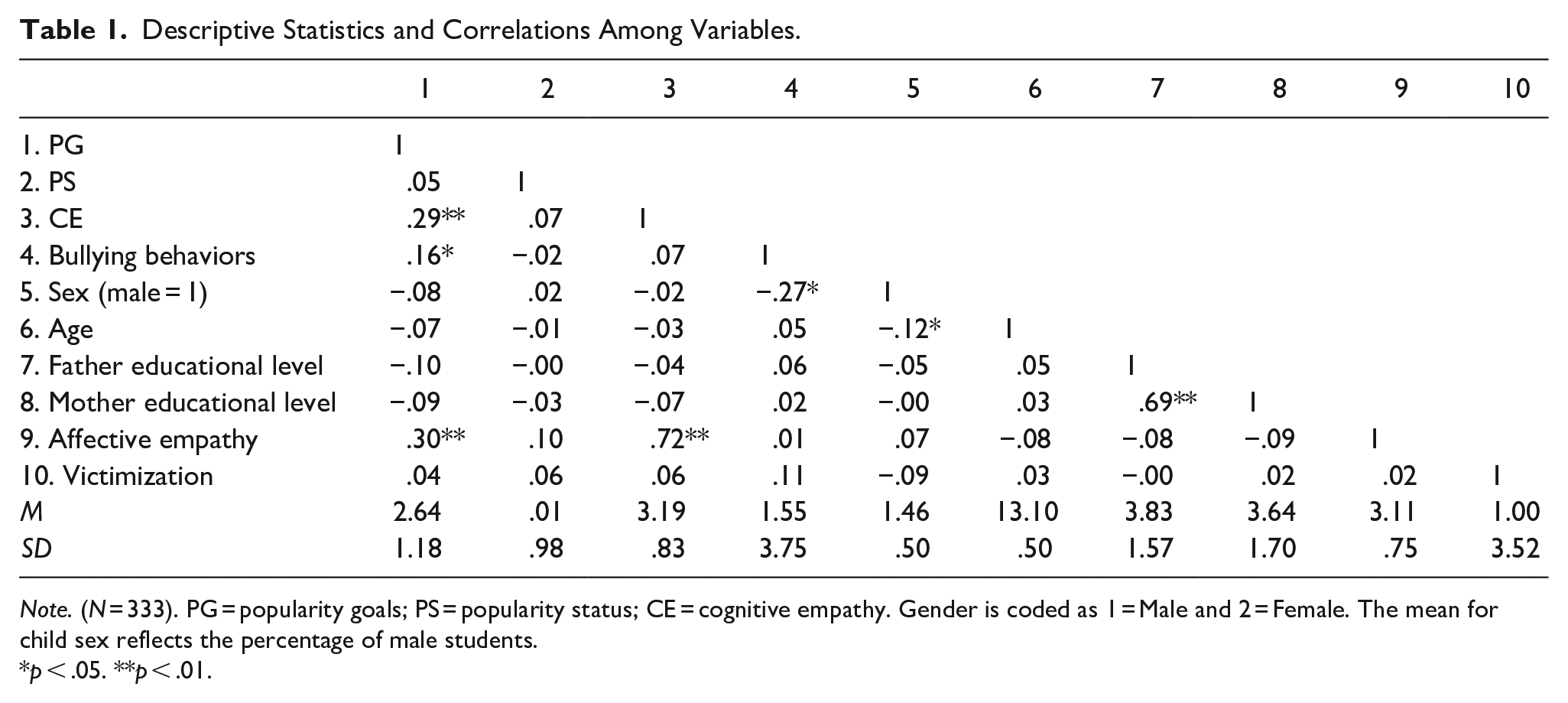
Note. (N = 333). PG = popularity goals; PS = popularity status; CE = cognitive empathy. Gender is coded as 1 = Male and 2 = Female. The mean for child sex reflects the percentage of male students.
p < .05. **p < .01.
The moderating effect of popularity status
We used Model 1 of the SPSS Hayes PROCESS macro to test the direct effect and moderation analyses (Hayes, 2013). As seen in Table 2, PG was significantly related to bullying behaviors (β = .53, SE = 0.21, 95% CI [0.12, 0.94], t = 2.54, p < .01). As shown in Table 2 and Figure 1, the results also indicated that PS significantly moderated the positive relationship between PG and Chinese adolescents’ bullying behaviors (β = .−66, SE = 0.22, 95% Cl [−1.11, −0.22], t = −2.96, p < .001). The simple slope analysis showed that among unpopular adolescents (i.e., 1 SD below the mean), adolescents with higher PG significantly positively predicted their bullying behaviors (bsimple = 1.06, 95% CI [0.47, 1.65], t = 3.53, p = .001). However, when popularity status was high (i.e., 1 SD over the mean), the relationship between PG and bullying was not significant (bsimple = 0.11, 95% CI [0.21, 0.39], t = 6.51, p < .001).
Model Summary of the Moderated Moderating Effect of Popularity Status (PS) in the Relationship Between Popularity Goals (PG) and Bullying Behaviors (N = 333).
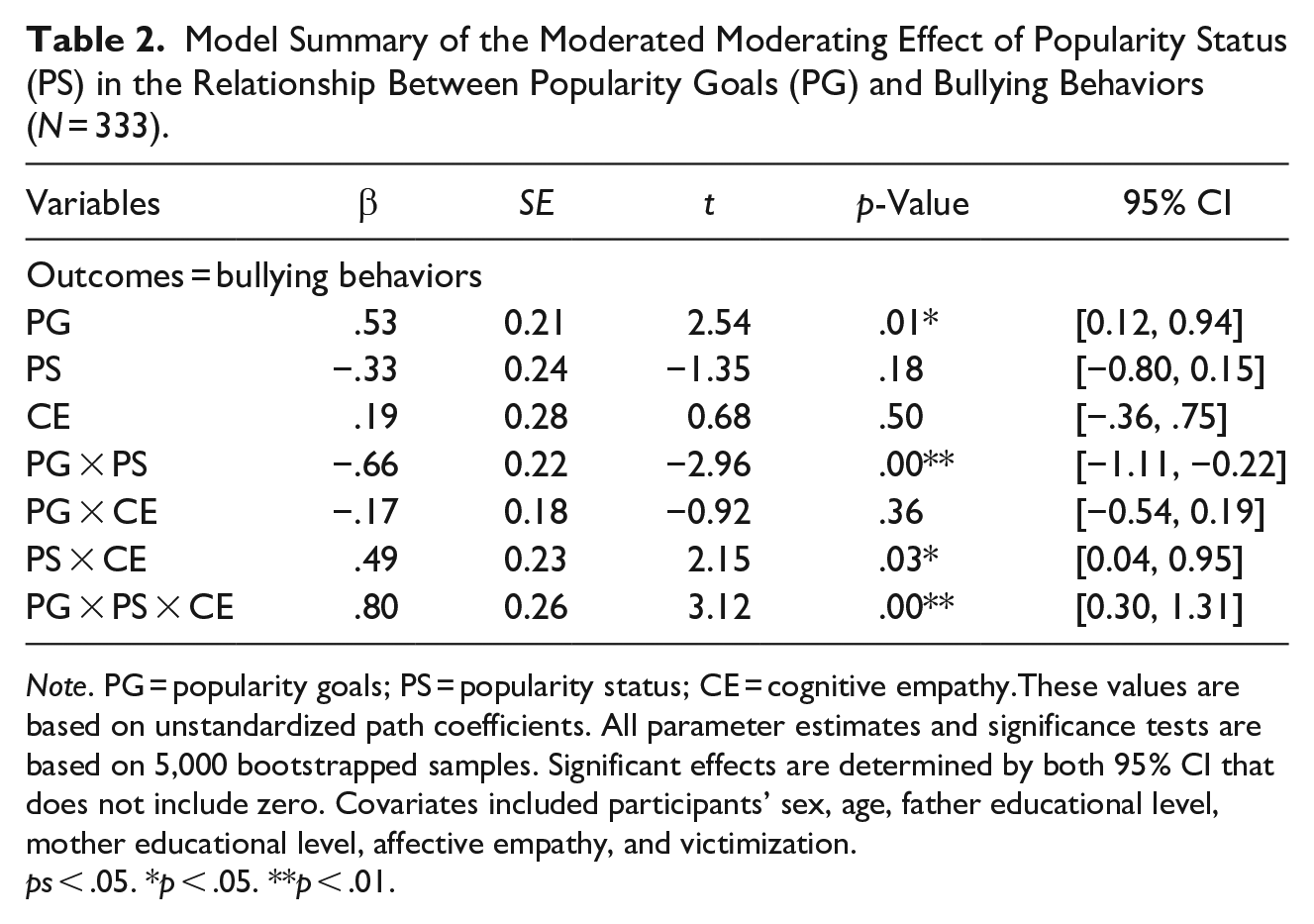
Note. PG = popularity goals; PS = popularity status; CE = cognitive empathy.These values are based on unstandardized path coefficients. All parameter estimates and significance tests are based on 5,000 bootstrapped samples. Significant effects are determined by both 95% CI that does not include zero. Covariates included participants’ sex, age, father educational level, mother educational level, affective empathy, and victimization.
ps < .05. *p < .05. **p < .01.
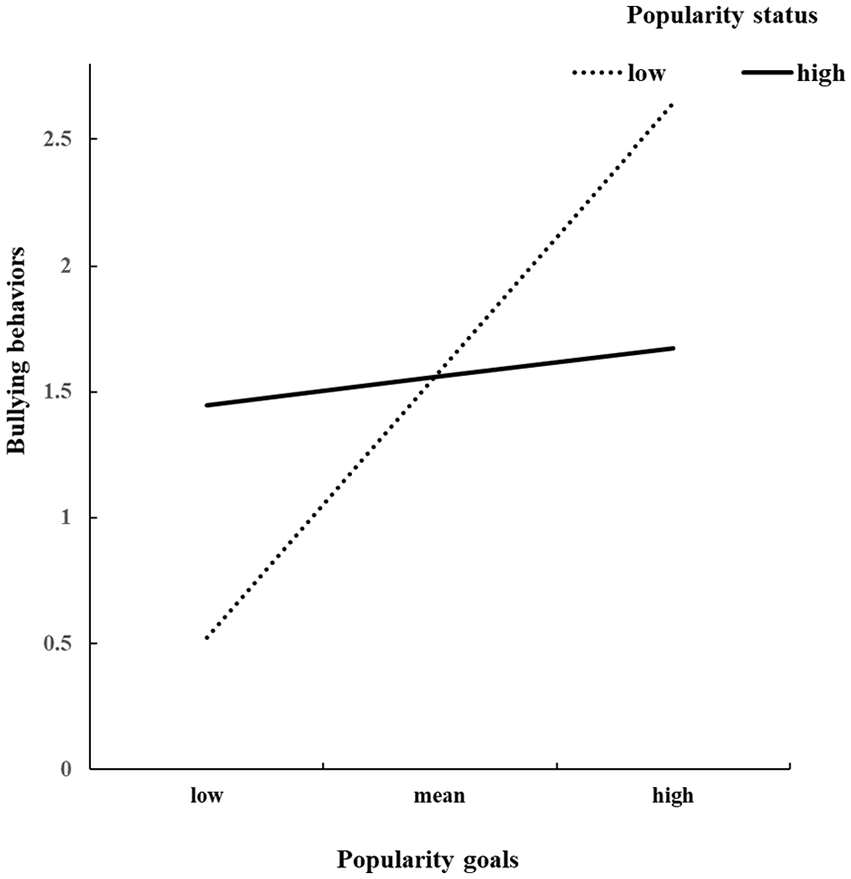
The interaction between popularity goals (PG) and popularity status (PS) in adolescents’ bullying behaviors.
Moderated moderating effect analyses
To test our hypotheses, we adopted the PRPCESS macro (MODEL 3) for SPSS to examine the three-way interaction between PG, PS, CE, and bullying behaviors. As shown in Table 2, after controlling for covariates, the three-way interaction of PG × PS × CE was significant (β = .80, p < .01, 95% CI [0.30, 1.31]). A simple slope test was conducted, as depicted in Figure 2. Results indicated that the association between PG and bullying behaviors was only significant when the adolescents had low levels of popularity and low CE (bsimple = 2.12, t = 5.10, p < .001, 95% CI [1.30, 2.94]). There were no significant associations between PG and bullying behaviors for those reporting high PS and low CE (bsimple = −0.75, t = −1.43, p = .16, 95% CI [−1.78, 0.28]), high CE and low PS (bsimple = 0.23, t = 0.58, p = .56, 95% CI [−0.55, 1.01]), or for those who reported consistently high PS and high CE (bsimple = 0.50, t = 1.27, p = .21, 95% CI [−0.27, 1.27]).
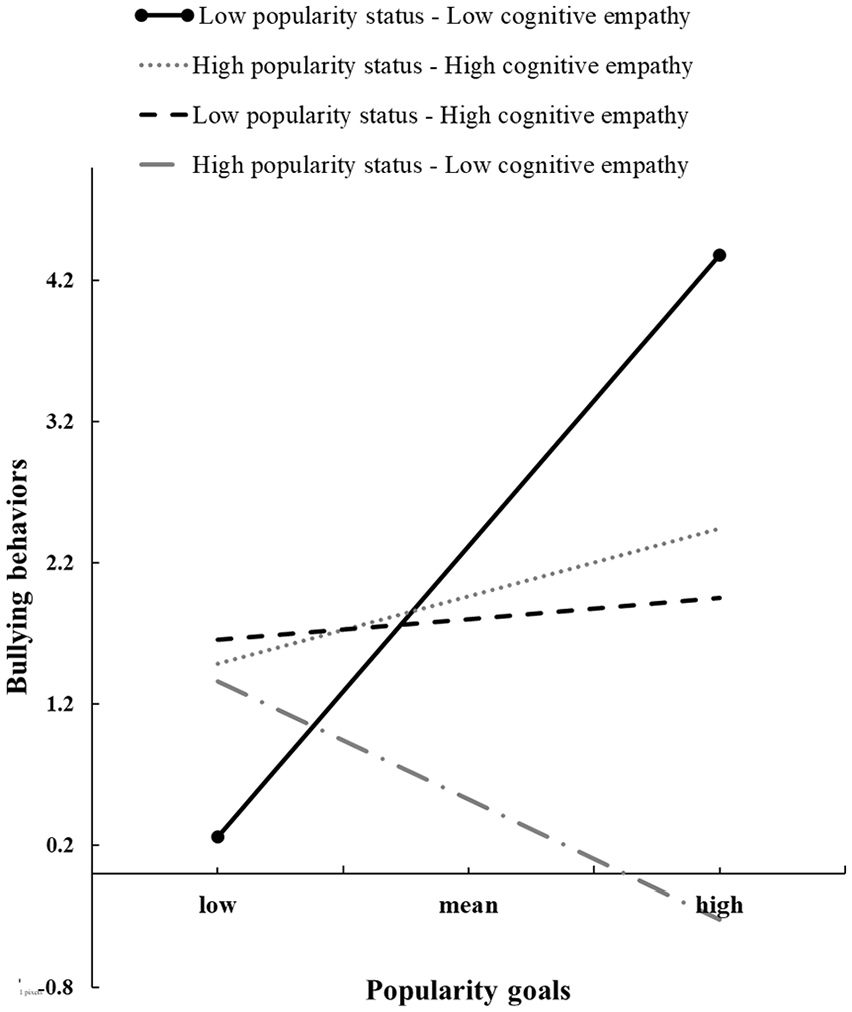
Three-way interaction effects of popularity goals (PG) by popularity status (PS) and CE for adolescents’ bullying behaviors.
Discussion
To our knowledge, the present study is among the first to examine the associations between popularity goal and school bullying among Chinese adolescents and determines how such an association is moderated by the combinations of the group-level (i.e., PS) and individual-level factors (i.e., CE). Using a cross-sectional dataset, we found the moderating role of PS on the relationship between popularity goal and bullying among Chinese adolescents and revealed that this moderating effect is further moderated by adolescents’ CE.
Consistent with prior studies (e.g., Smalley & Banerjee, 2014), the current study found that the more adolescents endorsed the popularity goal, the more likely they were to personate bullying behaviors at school. Peer relationships begin to play a more prominent role in the lives of youth as the peer social world rapidly expands during adolescence (Corsaro & Eder, 1990; Dawes & Xie, 2017). The change is consistent with the growing desire for popularity, which increases during the transition to middle school and peaks during the late middle and early high school grades (Hartl et al., 2020; LaFontana & Cillessen, 2010). Thus, adolescents who are motivated toward power and dominance (i.e., popularity goals) are expected to engage in behaviors that help them attain and maintain their social position and power in the peer group (Caravita & Cillessen, 2012). Bullying is a goal-oriented strategy to achieve prestige or power (Caravita & Cillessen, 2012; Olweus, 1993), wherein bullies select and target peers with less power or those who threaten their social status (i.e., a social competitor) in front of others to gain or maintain status (Cillessen & Rose, 2005; Dawes & Xie, 2014; Salmivalli & Peets, 2009). Therefore, helping adolescents have a reasonable understanding of PG and finding alternative prosocial ways to achieve this goal could be efficient in reducing school bullying among adolescents.
Inconsistent with prior work in western contexts, the current study found that high PS attenuates rather than exacerbates the association between popularity goal and Chinese adolescents’ bullying (Caravita et al., 2009; Košir et al., 2022). This finding provided primary evidence that the moderating role of PS in the context of China may differ from that in the context of Western culture. Deeply influenced by Confucianism, the Junzi personality is highly appreciated in China (Ge, 2020). People with high status are expected to protect the weak members and engage in prosocial behaviors. In contrast, people with high status engage in aggressive and antisocial behaviors, such as 暴君 (baojun), meaning tyrant, are opposed and despised by the people. Therefore, Chinese adolescents with high status are more likely to enact prosocial behaviors that cater to cultural norms and peer groups’ expectations to meet their PG. Indeed, a previous study found that individuals with high social status (i.e., popular individuals in China) are more likely to engage in pro-social behavior and maintain group harmony (Lu et al., 2018; Niu et al., 2016) and the relationship between peer status and prosocial behaviors were stronger among Chinese early adolescents than their American counterparts (Zhang et al., 2018). In contrast, unpopular adolescents are not sensitive to social norms and have biased social information processing patterns (Ranney & Troop-Gordon, 2020), which makes them engage bullying behaviors as an effective way to achieve PG (Crick & Dodge, 1994).
In addition, the current study found that among adolescents with low popularity and low CE, the higher popularity goal was associated with greater use of bullying behaviors. Namely, lack of CE is a risk factor that increases the likelihood of engagement in bullying among low-status adolescents, which meets their popularity goal. This may be because individuals with low CE are more likely to be unconcerned about the adverse impact of their actions on others (Salavera et al., 2021). Thus, when they desire popularity but in low PS, they would actively enact bullying behavior to acquire popularity regardless of the adverse impact of bullying behaviors. Moreover, compared to adolescents with high CE, adolescents with low CE may be deficient in the social skills needed to attain popularity in a prosocial way, such as emotional support and cooperation. Thus, unpopular adolescents with low CE enact bullying, such as physical aggression, to gain recognition from peers, which meets the popularity goal.
Limitations and Future Directions
Despite its significant contributions, this study has certain limitations. First, we relied on adolescents’ reports of bullying behaviors; however, they may underestimate bullying behaviors due to peer pressure and social desirability. Although the current study used an anonymous survey to reduce these biases, future work must implement multi-informant (e.g., self-reported, parent-reported, and teacher-reported) and multi-approach (e.g., behavioral observation) methods. Second, although the cross-sectional design does not provide evidence for a causal relationship between PG and bullying, our findings are consistent with prior studies and theoretical hypotheses that have demonstrated the association between PG and bullying in the non-Western context (Crick & Dodge, 1994; Košir et al., 2022; Wright et al., 2014). Future research with longitudinal or experimental designs can clarify the proposed causal pathway and deepen our understanding of this issue. Lastly, inconsistent with evidence observed in Western countries, the current study found that high PS could weaken the effect of PG on Chinese bullying behaviors. Future studies could adopt a cross-cultural design to compare the differences in moderating effects of PS between Chinese and Western adolescents and explore its potential mechanisms to replicate and extend our findings.
Our findings have two implications for school mental health practitioners. First, our findings indicated that unpopular adolescents with high PG and low CE are more likely to engage in bullying behaviors. Therefore, early assessment and intervention could benefit these adolescents. Second, the significant interactions observed in the current study suggest that bullying prevention programs should consider multiple variables to improve the program’s effect size. Specifically, the current study provides a possible solution by suggesting that counselors prioritize training unpopular adolescents’ CE ability and guide them to change their PG (agentic goals) to communal goals (Hartl et al., 2020).
Conclusion
The current study explored how PG affects bullying behaviors among Chinese adolescents by considering the potential interpersonal and trait-level factors. Our findings underlined that high CE is a protective factor against bullying behaviors among unpopular Chinese adolescents who desire high popularity. Further, unpopular adolescents with high PG and CE are at risk of increased bullying behaviors. Therefore, the current study contributes to the literature by deepening our understanding of the complex mechanism (combined interpersonal factors and trait factors) involved in the effects of social cognition factors on bullying in non-Western cultural contexts (Crick & Dodge, 1994).
Footnotes
Declaration of Conflicting Interests
The author(s) declared no potential conflicts of interest with respect to the research, authorship, and/or publication of this article.
Funding
The author(s) received no financial support for the research, authorship, and/or publication of this article.
