







Abstract
The aim of this research is to examine associations of adolescent sexting with gender, being in a romantic relationship, and other online or offline sexual behaviors, using the adolescent sexting scale A-SextS as a standardized measure. Data were collected from a sample of 579 Spanish secondary school pupils (47.3% girls), between the ages of 11 and 18 (interquartile range: 13–15 years; median = 14 years). Multinomial regression models revealed that having had sexual intercourse was the most relevant predictor variable, especially for high-frequency sexting. Adolescents involved in a romantic relationship were more likely to engage in high-frequency sexting with someone known in person. Pornography consumption was mainly associated with high-frequency explicit sexting with someone known only on the internet. Lastly, females were more likely to engage in low-frequency, non-explicit sexting as well as high-frequency explicit sexting with someone known only on the internet.
Keywords
Introduction
Adolescence is an important period of cognitive, physical and sexual development in which adolescents develop their social relationships, including the romantic ones. Information and communication technologies (ICTs) have broadened the ways in which this age group may fulfill some of their sexual-affective developmental needs, through practices such as sexting. Sexting, broadly defined as the exchange of self-made sexual content (“sexts”) via ICTs, is a common practice among adolescents (Choi et al., 2019; Madigan et al., 2018). Nowadays, this practice forms part of the adolescents’ relational and sexual development, allowing them to fulfill affective-sexual needs, such as learning to filter, to initiate a sexual activity or to strengthen intimate relationships (Bianchi et al., 2016). However, it can also be a risky practice with potentially highly negative consequences such as the non-consensual distribution of such sexts, which may lead to other forms of harassment (e.g., unwanted sexual solicitations) (Gassó et al., 2019), greater discomfort, symptoms of depression, anxiety, and suicidal ideation and attempts (Gámez-Guadix et al., 2022). Due to its potential implications for adolescents, sexting receives special attention from parents, educational and health practitioners, and even legislators.
The definition of sexting and, in turn, its prevalence rates and sociodemographic correlates are still inconclusive, due to certain conceptual and methodological shortcomings (Molla-Esparza et al., 2021). Previously, literature has distinguished active sexting (e.g., sending or posting) from passive sexting (e.g., receiving or being asked for), and primary sexting (e.g., sending one’s own material) from secondary sexting (e.g., sending someone else’s material) (Hunter et al., 2021; Molla-Esparza, Nájera et al., 2020). As Molla-Esparza et al. (2022) have stated, active and primary sexting behaviors are particularly relevant, since adolescents directly partake in the production and distribution of their own sexts as a means of exploring, managing, and sharing their sexual intimacy. Furthermore, deficiencies and differences in sexting addressees, media formats and sexual explicitness have also been observed, and have led to relevant conceptual distinctions between empirical studies (Barrense-Dias et al., 2017; Klettke et al., 2014). A review of measures carried out by Molla-Esparza, Nájera et al. (2020) revealed that most empirical studies on adolescent sexting did not make relevant aspects explicit in their measures, such as the purpose of sexting (e.g., amorous, body image reinforcement) or the addressee of sexts (e.g., partners, friends, person only met online), asking mainly about the frequency of exchange of images and videos characterized by general adjectives such as sexy, sexual or provocative. Such conceptual divergences, along with other methodological factors (e.g., sample representativeness, use of non-standardized measures), have led to high variability in sexting prevalence estimates among adolescents, with a recent meta-analysis finding the prevalence of sending and receiving sexts ranging from 12% to 17%, and 26% to 36%, respectively (Molla-Esparza et al., 2020). However, recent studies have developed and administered validated instruments in an effort to overcome the aforementioned measurement issues (see A-SextS scale: Molla-Esparza et al., 2022; Molla-Esparza, Nájera et al., 2020). The relevance of considering and distinguishing frequencies by which sexting is practiced, different addressees and degrees of sexual explicitness of sexts is also justified by their potential implications for adolescents. Indeed, adolescents are more vulnerable the more frequently they exchange sexts, the higher the degree of explicitness of the sexts (e.g., nude or in only underwear), and the less they know addressees (e.g., someone only known online).
Besides prevalence rates, demographic correlates have also been affected by how sexting has been conceptualized across studies (Klettke et al., 2014). Whereas empirical and meta-analytical studies consistently support that sexting rates increase with age, there are still no consistent results regarding gender differences (Casas et al., 2019; Kim et al., 2020). It has been found, for example, that gender differences vary according to sexting’s conceptual reference elements such as the sexting addressee or sexual explicitness. In a study by Gámez-Guadix et al. (2015), gender differences were not seen when considering the global prevalence of sexting, but only when considering the addressee: sending sexts was significantly more prevalent in males when they were sent to people known only online, though similarly prevalent in males and females when sent to a romantic partner. With respect to this last point, Patchin and Hinduja (2019) found clear gender differences as to whether the sexting was established with a romantic partner: boys were significantly more likely to have received sexual messages from a romantic partner, while girls were more likely to have received sexually explicit images from someone who was not a romantic partner than from someone who was. A study by Burén and Lunde (2018) found receiving sexts significantly more prevalent in girls compared to boys. De Graaf et al. (2018) found no gender differences when considering global sexting scores, but only when analyzing specific items that implied more sexual explicitness. For example, significantly more boys than girls showed intimate body parts during a video chat. Both the relational distance between participants (e.g., an established partner, or someone known only online) and degree of explicitness are key aspects when studying sexting, yielding notable differences in correlates (Burén & Lunde, 2018). A richer understanding of the recipients of sexts and their relationship types (Burén & Lunde, 2018), and the sexual explicitness of sexts, may help explain gender differences in sexting and add insight into the expectations, experiences and outcomes for each participant.
The relational-sexual nature of sexting and its potential opportunities and negative consequences has led a growing number of studies to dedicate special interest to examining sexual interactions and online and offline sexual activities (De Graaf et al., 2018; Gámez-Guadix & Mateos-Pérez, 2019; Gámez-Guadix et al., 2022), though similar conclusions have not always been reached (Klettke et al., 2014). The motivations for sexting mainly correspond to sexual objectives (e.g., to feel sexually aroused, to initiate sexual activity) (Bianchi et al., 2021; Cooper et al., 2016). The exchange of erotic content through digital media could be interpreted as an indicator of sexual development in terms of availability and willingness to engage in sexual experimentation activities (van Oosten & Vandenbosch, 2017). Several empirical studies found that adolescents engaging in sexting were more likely to have both begun dating and having sex (Handschuh et al., 2019; Mori et al., 2019; Temple et al., 2012). Specifically, young people who sext were more likely to report past or current sexual intercourse and have had multiple sexual partners (Handschuh et al., 2019; Mori et al., 2019). However, not all studies point in this direction. Temple and Choi (2014), in a longitudinal study, found that “being asked” and “asking” for a sext were not significantly correlated with sexual intercourse over time. Other studies found no association between sexting and the number of sexual partners (Ferguson, 2011; Gordon-Messer et al., 2013). However, sexting appears not only to be associated with more sexual activity, but also with related behaviors such as pornography consumption (Crimmins & Seigfried-Spellar, 2014; Stanley et al., 2018). Pornography consumption is an influential factor in understanding adolescents’ sexual development and their intimate relationships (Peter & Valkenburg, 2016; Raine et al., 2020). Research has demonstrated that porn use has an impact on sexual attitudes and behaviors carried out both online and offline, being related to, for example, more permissive sexual attitudes, stronger gender-stereotypical sexual beliefs and acquisition of sexual standards about how people are supposed to be and behave sexually (Peter & Valkenburg, 2016; Raine et al., 2020). In this regard, pornography-related sexual patterns may be adopted by adolescents as a model to produce their own sexual self-presentations. However, again, study of the association between pornography use and sexting has led to somewhat disparate conclusions (Raine et al., 2020). For example, Van Ouytsel et al. (2014) found that pornography use was significantly associated with sending sexts, underwear or half-naked pictures, asking a familiar person for a sext, and receiving sexually suggestive pictures or videos from someone. Furthermore, Morelli et al. (2017) found significant associations between sexting and pornography consumption when considering the experiences of sending, receiving and posting of sexually suggestive messages, pictures and/or videos. However, other studies suggest no significant relationship (Vandenbosch et al., 2015).
The Present Study
Though a growing body of research has examined the relationship between sexting, demographics, and online and offline sexual behaviors in adolescents, various gaps in the literature remain. With the exception of a few studies (e.g., Temple & Choi, 2014; Van Ouytsel et al., 2014), the majority of the abovementioned studies have focused on analyzing sexting correlates without differentiating the statistical significance of their predictive variables according to different sexting behaviors taking into account the abovementioned conceptual sexting elements. For example, the distinction of different addressees or different levels of sexual explicitness may reveal substantial differences in the assessment of its predictors. Therefore, a more precise characterization of sexting would help better delineate sexting’s correlates. Moreover, the predictive power of certain sexual behaviors regarding sexting are still inconclusive, with the varied findings unsurprising given the variety of sexting definitions. In light of the above, additional studies are needed to further explore patterns of sexting and sexual behaviors among adolescents.
Thus, the aim of the present study was to explore how sexting experiences are associated with gender, being in a romantic relationship, having had sexual intercourse, and pornography consumption, among Spanish adolescents. The current study makes a unique contribution by employing a standardized measure of adolescent sexting that focuses on examining the frequency of active and primary sexting, and that objectively distinguishes both different addressees and levels of sexual explicitness of sexts. Research into these associations in a disaggregated form will illustrate the predictive power of the most common demographic and sexual correlates in relation to sexting. Findings from this research will provide important knowledge for the design of school-based interventions addressing the intersection of technology, healthy social relationships, sexuality, and sexting, because of the implications for adolescent development.
Method
Participants
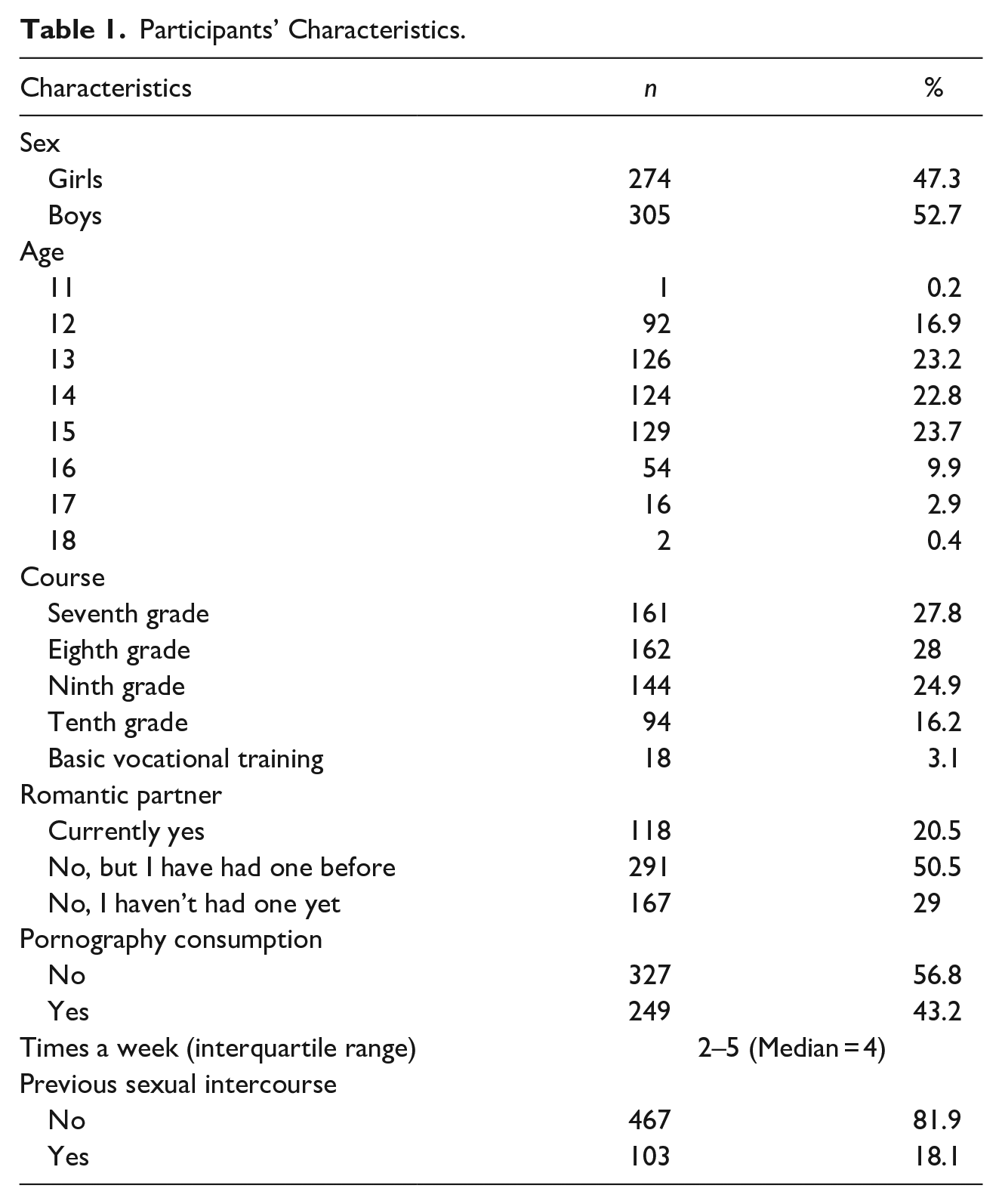
Data was collected from a convenience sample of 579 secondary school pupils (47.3% girls), ages 11 to 18 (interquartile range: 13–15, Median = 14 years), attending two state schools in the Spanish province of Valencia. Approximately, one-fifth of the sample had a romantic partner at the time of the survey (20.5%), while half had had one previously (50.5%). 43.2% of the sample consumed pornography 4.4 times a week. Only 18.1% reported having had sexual intercourse. Participants’ characteristics are presented in Table 1.
Participants’ Characteristics.
Procedure
This was a cross-sectional study administered over March and April 2020. The school principals and school counselor were contacted by email to arrange meetings and explain the study’s goals. The researchers provided them both written and verbal explanations about the study’s scope, procedure, and ethical guidance. In each case, the school decided whether or not to participate. Letters of information and consent were then forwarded via tutors to all parents of the pupils; four (0.69%) parents refused participation of their children in the study.
Self-completion paper and pencil questionnaires were administered by a researcher during a regular class period. A video recorded by a professional speaker was displayed to provide the pupils with information on the purpose of the study, how to complete the questionnaire, and ethical issues, such as the voluntary, anonymous and confidential nature of their responses and the option to abandon the questionnaire at any time. No adolescents rejected or abandoned completion of the questionnaire. The pupils returned their questionnaires to the researcher by placing them in a box. During the administration procedure, which took approximately 40 min, teachers remained out of the classroom. The research was conducted in compliance with Institutional Review Board (IRB) regulations.
Measures
Data Analysis
Four multinomial regression models were conducted to explore which variables had a relevant effect on different forms of sexting, with four dichotomous predictor variables included in each model: (1) gender (female/male); (2) relationship status (i.e., currently in a romantic relationship; no/yes); (3) sexual activity (i.e., having had sexual intercourse; no/yes); and (4) pornography consumption (no/yes). A different multinomial regression model was conducted on each of the following forms of sexting: (a) exchange of explicit sexts (e.g., pictures showing the individual naked or in underwear) with someone known in person (EK); (b) exchange of non-explicit sexts (e.g., dressed but sexy pictures) with someone known in person (NK); (c) exchange of explicit sexts with someone unknown in person (i.e., someone known or interacted with only online) (EU); and (d) exchange of non-explicit sexts with someone unknown in person (NU). All the sexting variables were coded using three categories: non-sexters, low-frequency sexters (i.e., between 1 and 3 times a month), and high-frequency sexters (i.e., more than once a week). Predictor and criterion variables were selected and determined based on both the literature review and their practical relevance (see the Introduction section). In all the models, the effect of predictor variables was controlled by age, since literature on sexting among adolescents has consistently shown that sexting behavior increases with increasing age (Madigan et al., 2018; Molla-Esparza et al., 2020).
For each multinomial regression, the model fit was evaluated by a likelihood ratio test, Cox-Snell’s R2 (R2CS), and Nagelkerke’s pseudo-R2 (R2N). For the first, good model fit is indicated by a significant test, while a R2 > 0.50 is often used as a cut-off point for the two other tests. Once the model fit had been assessed, regression coefficients were interpreted with an odds-ratio (OR) scale. Statistical significance and confidence intervals (CI) were reported for each coefficient. Lastly, the probability of endorsing low or high-frequency sexting behaviors for each possible combination of the predictor variables was calculated for each regression model.
All analyses were conducted in R software version 4.1 (R Core Team, 2021) using the nnet package version 7.3 (Venables & Ripley, 2002). Plots were generated using the ggplot2 package version 3.3 (Wickham, 2016). All the coding used is can be made available upon request.
Results
Table 2 shows the model fit statistics for each multinomial regression model. The likelihood ratio test was significant for all models (p < .001). The explained variance was higher for the models concerning known in person addressees (R2CS ≥ 0.30; R2N ≥ 0.35) compared to that of the regressions on sexting behaviors with unknown in person addressees (R2CS = 0.23; R2N ≤ 0.33).
Multinomial Regression Model Fit.
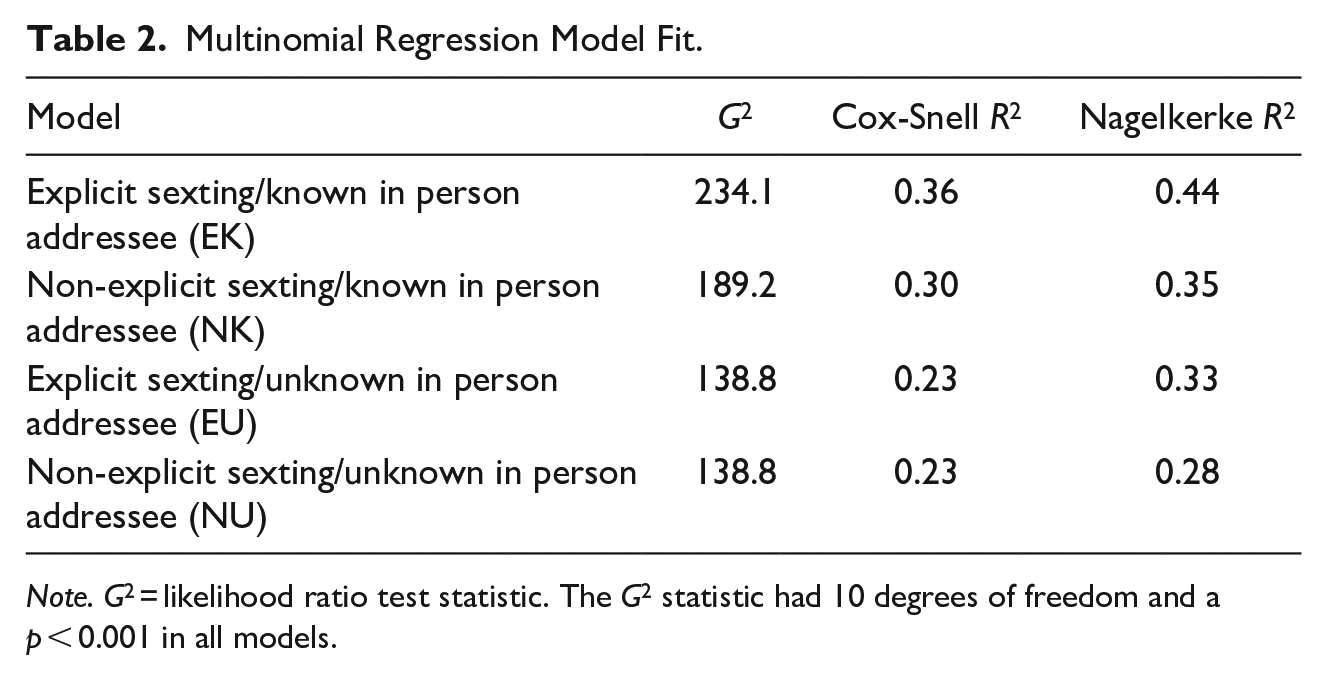
Note. G2 = likelihood ratio test statistic. The G2 statistic had 10 degrees of freedom and a p < 0.001 in all models.
Regression coefficients in an odds-ratio scale are shown in Table 3. Here, an OR > 1 indicates either that males endorse to a higher degree that specific form (and frequency) of sexting compared to females, or that adolescents that are currently in a relationship, that have had sexual intercourse, or that consume pornography endorse to a higher degree that specific form (and frequency) of sexting compared to those that are not or do not. For instance, the odds of endorsing explicit sexting with a known addressee (EK) at a high frequency for those adolescents that have had sexual intercourse are 9.29 times (or 828.9% higher than) those for adolescents that have not had sexual intercourse yet, with a confidence interval ranging from 4.59 (359.0%) to 18.80 (1,779.7%). The odds-ratio is usually interpreted in terms of risk: the risk of endorsing explicit sexting behaviors with someone known in person at a high frequency for those adolescents that have had sexual intercourse is 9.29 times that for adolescents who have not.
Multinomial Regression Models Coefficients.
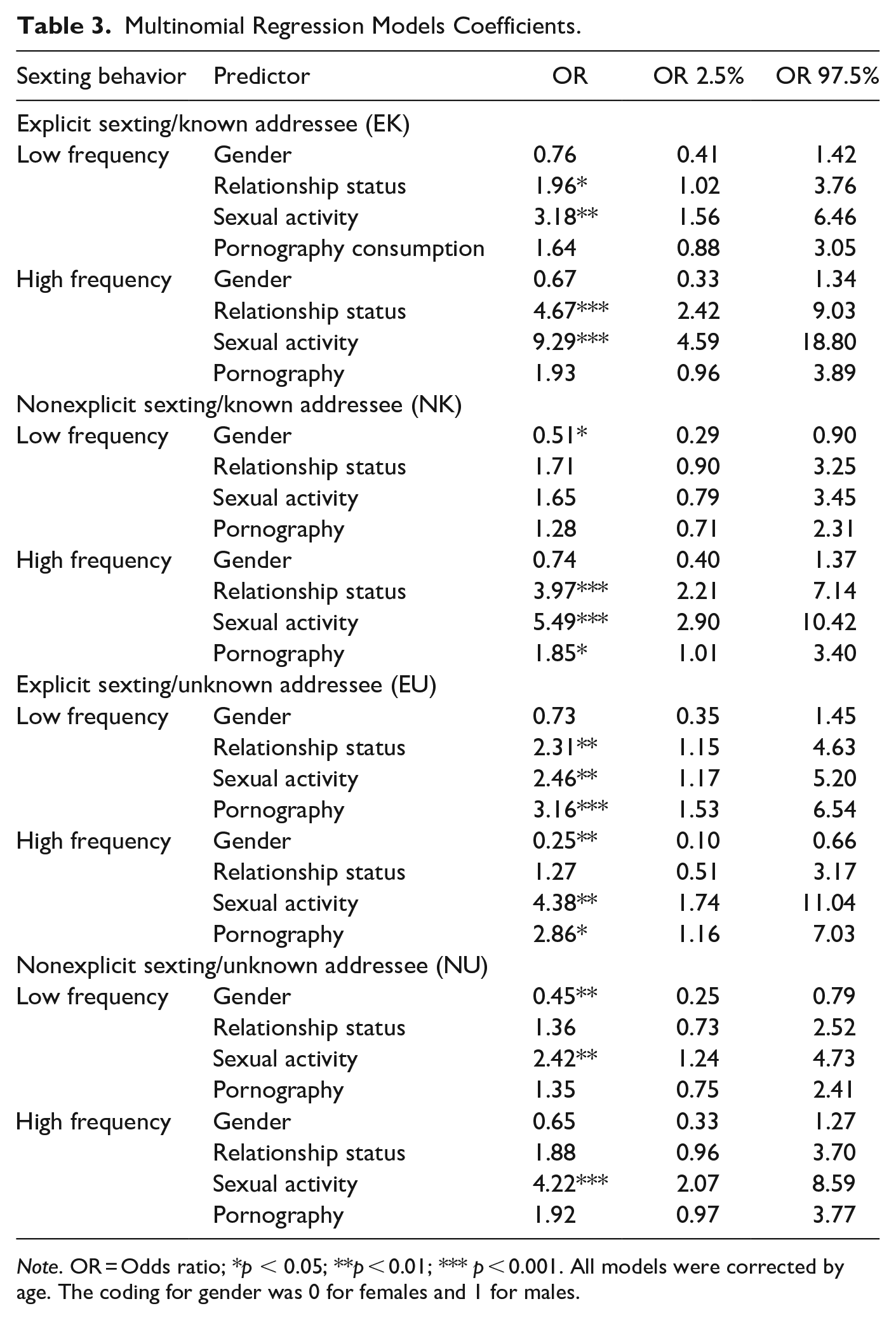
Note. OR = Odds ratio; *p < 0.05; **p < 0.01; *** p < 0.001. All models were corrected by age. The coding for gender was 0 for females and 1 for males.
In general, having had sexual intercourse was the most relevant predictor variable, having the largest effect on most models, especially in high-frequency sexting behaviors. Namely, the statistically significant effects of this variable ranged between 2.42 (95% CI [1.24, 4.73]) in the NU model with low frequency to 9.29 (95% CI [4.59, 18.80]) in the EK model with high frequency. The only non-significant effect occurred in the NK model with low frequency sexting. On another note, and expectedly, being currently in a romantic relationship showed significant effects on the models concerning sexting with a known in person addressee. This was especially true for high frequency sexting, where the OR of this variable was as high as 4.67 (95% CI [2.42, 9.03]) for the EK model, and 3.97 (95% CI [2.21, 7.14]) for the NK model. Less expected was the fact that this variable tended to show a positive effect on sexting concerning not known in person addressees, although it only achieved a significant effect on low-frequency EU sexting (OR = 2.31; 95% CI [1.15, 4.63]). Regarding pornography consumption, even though a positive tendency was observed in all models, the largest significant effects were found in low and high-frequency EU sexting, with an OR of 3.16 (95% CI [1.53, 6.54]) and 2.86 (95% CI [1.16, 7.03]), respectively. The other significant effect occurred in high-frequency NK sexting (OR = 1.85; 95% CI [1.01, 3.40]). Finally, females showed a higher tendency for sexting behaviors than males in all models, with significant effects on low-frequency NK sexting (OR = 0.51; 95% CI [0.29, 0.90]), high-frequency EU sexting (OR = 0.25; 95% CI [0.10, 0.66]), and low-frequency NU sexting (OR = 0.45; 95% CI [0.25, 0.79]).
Model predictions for each adolescent profile are displayed in Figure 1. The probability of endorsing these forms of sexting at a low or high frequency is shown for each variable of gender, being in a romantic relationship, having had sexual intercourse, and pornography consumption. The left panel reflects the effects of these variables on high-frequency NK sexting. For instance, while the model predicts a probability of 0.06 for endorsing high-frequency NK sexting for a male who is not in a romantic relationship, has not had sexual intercourse, and does not consume pornography, this probability is as high as 0.67 for females that are in a romantic relationship, have had sexual intercourse, and do consume pornography. In comparison with these values, the probability of endorsing high-frequency EU sexting is much lower. The right panel of the plot shows that the effect of the relationship status variable is not as high as in the previous case, which is aligned with the non-significant effect in the multinomial regression model (see Table 2). On the contrary, gender becomes more relevant in this form of sexting: females who have had sexual intercourse and consume pornography have a probability of endorsing high-frequency EU sexting behaviors of 0.26, more than double compared to males (0.10).
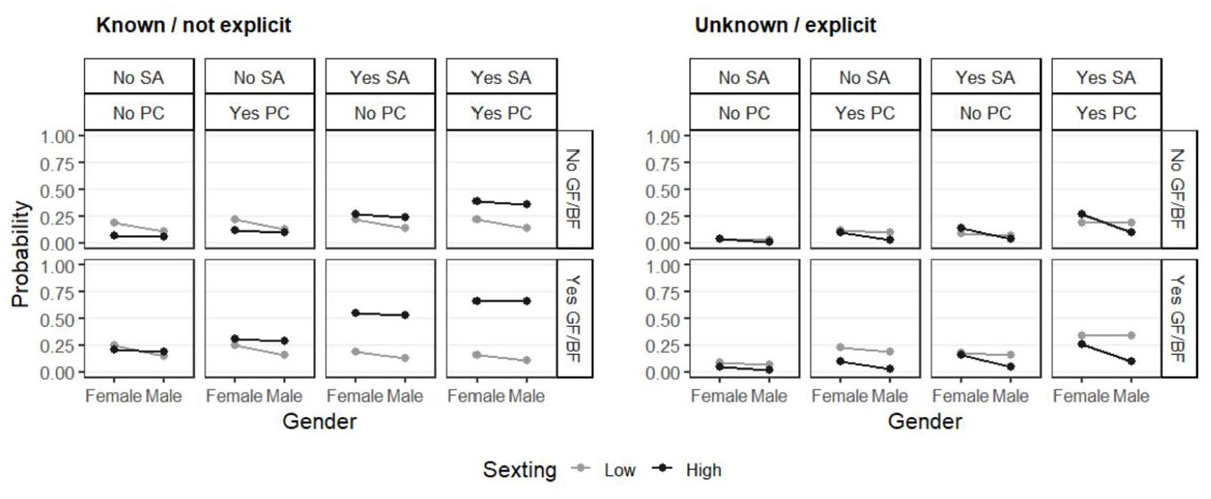
Probability of endorsing sexting behaviors as a function of the four predictor variables.
Discussion
The aim of this research was to examine the associations of sexting frequency with gender, being in a romantic relationship, having had sexual intercourse, and pornography consumption among adolescents, and to shed light on the importance of considering two particular conceptual reference elements of the definition of sexting, namely, the addressee and the sexual explicitness of the sexts exchanged. Adolescence is an essential period for the development of social and romantic relationships, and young people frequently use ICTs to satisfy their needs for communication. Sexting plays a very important role in this (Choi et al., 2019; Madigan et al., 2018): it can facilitate the development of sexual-affective relationships in the short term, but it can also become a risky behavior with potentially negative future consequences that an adolescent can’t foresee. Sexting can also predict future sexual behavior (Hicks et al., 2021), and is significantly associated with a higher probability of viewing online pornography, coercion, and sexual abuse (Stanley et al., 2018). An important contribution of this research has been the use of a standardized sexting measure specifically for adolescents, which is very rarely seen in empirical literature in this field. Equally important, because of its potential implications, is that this study was focused on examining associations with adolescent active and primary sexting behaviors. The relevance of active and primary sexting behaviors lies in the fact that such behaviors constitute the origin of the “raw materials” of sexting (i.e., sexts) (Molla-Esparza et al., 2022). In active and primary sexting behaviors, youths directly partake in the production and/or exchange of sexts in which they themselves appear, thus exposing themselves to the inherent risks, such as the non-consensual distribution of such contents. However, perhaps the most significant contribution of this research was in examining associations with sexting behaviors differentiated by sexting addressee, sexual explicitness and frequency. Undoubtedly, all these aspects have relevant implications in terms of sexual self-presentation and exposure to risks (Gámez-Guadix & Mateos-Pérez, 2019; Gámez-Guadix et al., 2022; Hunter et al., 2021), especially considering the important developmental stage of adolescence. Additional theoretical and practical implications are discussed in subsequent lines of this article.
The results of this study showed that the predictive power of the most common demographic and sexual correlates examined in the sexting literature varied in relation to the two conceptual reference elements of sexting that were analyzed (i.e., addressee, and sexual explicitness of sexts). In this regard, the findings indicated a variety of significant results that merit discussion. Regarding gender, our results showed that females and males were equally likely to have exchanged explicit sexts with someone known in person. This result conforms with studies that found no significant gender differences concerning the sending of explicit sexts to a romantic partner (Burén & Lunde, 2018; Van Ouytsel et al., 2021). However, in our study, females were more likely than males to exchange low-frequency, non-explicit sexts with someone known in person. A possible explanation for this finding is that females experience more pressure to sext than males (Burén & Lunde, 2018). Nonetheless, our results do not coincide with those reported by Patchin and Hinduja (2019), indicating that males were significantly more likely to have sent sexual (i.e., nude or semi-nude) sexts, both to a romantic partner and to someone who was not a romantic partner. Other studies did not find gender differences in terms of sending sexual content to a partner (Gámez-Guadix et al., 2015; Quesada et al., 2018), or found that males were more likely to send sexual contents to some, such as a friend or an acquaintance, they knew offline (Gámez-Guadix et al., 2015). It is remarkable to see in our study that females were more likely to exchange low-frequency explicit sexts with both known in person and unknown in person addressees, and high-frequency non-explicit sexts with unknown in person addressees. Our results differ from previous studies suggesting that adolescents sending sexts to someone met only online was significantly more common in males (Gámez-Guadix et al., 2015). In any case, potential interactions between minors and adults via the internet are of particular concern for practitioners and researchers. Other studies with similar addressee classifications did not manage to analyze gender differences taking into account the addressee (Dolev-Cohen & Ricon, 2020; Gregg et al., 2018). Comparisons between empirical studies should be made with caution considering the differences in the conceptualization of sexting, specifically concerning the terms used to refer to sexting addressees or explicitness. An analysis of gender differences that disaggregates the main conceptual elements of sexting could help dispel the inconsistent patterns found to date, and produce more comparable correlates between empirical studies. The terms used to refer to sexting addressees and explicitness in the A-SextS scale were held by adolescents themselves to offer a good and objective characterization of these aspects (Molla-Esparza, Nájera et al., 2020). Nonetheless, more research is needed to continue elucidating an adequate nomenclature for such conceptual aspects. The distinction of different addressees and degrees of sexual explicitness of sexts is also justified by their implications. For example, the psychological and social consequences of the non-consensual dissemination of explicit sexts (e.g., nude or in only underwear) among adolescents only known online adds to their vulnerability, and may, in certain cases, be extremely severe. Considering that sexting is relevant to the intimacy and sexual development of youths, an important aspect that educational interventions should address is providing youths with strategies to engage in sexting as safely as possible. It would thus be useful to inform adolescents, for example, about messaging apps that prevent screenshots or the saving or forwarding of contents, that allow them to control the viewing time of a picture or video, or allow viewing only with a password (e.g., Private, DiscKreet). It could also be useful to inform them about strategies to anonymize their own sexts, for example, by covering or not including recognizable contents such as their faces, tattoos, birthmarks, other decorative elements, or the furniture of their bedroom or surroundings.
Our results also showed that the relationship status of participants correlated with sexting. Being involved in a romantic relationship correlated positively with exchanging both explicit and non-explicit sexts with someone known in person, and had a high predictive power in the case of high frequent sexting. These results are in line with previous studies that have shown significant differences by relationship type or dating status in youths and young adults (Samimi & Alderson, 2014; Temple et al., 2012; Weisskirch & Delevi, 2011). The finding supports the understanding of sexting as a form of sexual expression in the context of romantic relations with a sexual or amorous purpose (as specified in A-SextS). Sexting can be used as a way to generate a deeper level of intimacy and eroticism in the case of committed relationships (Cooper et al., 2016; Klettke et al., 2014). However, that the purpose of exchanging sexts is sexual or amorous does not imply that it is always in a fully voluntary or consensual way. Due to the various implications of sexting, measuring the spectrum of willingness and of willingness of consent in adolescents remains a challenge for researchers in the field of sexting, also when practiced with a known partner for amorous or sexual reasons (Molla-Esparza, Nájera et al., 2020). Indeed, adolescents may exchange sexts for insalubrious reasons in the context of new or established relationships. For example, qualitative studies have found that adolescents may exchange sexts to put an end to the insistence of another party, for fear of losing the interest of the other party, or to demonstrate an interest by meeting the expectations of the other party (Setty, 2019, 2021). Educational interventions on sexting should provide youths with assertive communication strategies to recognize and manage attempts to pressure, blackmail or coerce them (e.g., by asking for a sexts as a present, or as a dare to demonstrate their love, such as “You don’t love me unless you send me a nude pic”). A surprising finding was that being in a relationship seems to increase the probability of engaging in a low-frequency exchange of explicit sexts with someone unknown in person. This finding invites us to reflect on the communications adolescents can establish not only through private channels, but also through media shared with wider audiences such as social networks. Posting or live-streaming of sexual content on social media may be seen by an audience whose real identity has not been verified by the adolescent. Therefore, sharing such content on social networks may lead to more contacts with individuals known only online, regardless of whether the adolescent is in a romantic relationship or not. Again, this alerts us to the potential risks of adolescents interacting with people they do not know in person. In this respect, it would be opportune that educational measures inform adolescents about different types of relationships that can be established in the practice of sexting (i.e., physical-personal versus virtual relationships) and their particular characteristics, such as the possibility of acting under anonymity (e.g., behind a nickname), of verifying the veracity of demographic information (e.g., location, family members), or of leaving the social network without other possible forms of contact form (Molla-Esparza et al., 2022).
Our results have also shown that the most important predictor of adolescent active and primary sexting was having had sexual intercourse, being positively associated in seven out of the eight regression models, showing consistent and robust associations. Such consistency suggests that the exchange of erotic content through digital media may be interpreted as an indicator of sexual development in terms of availability and willingness to initiate or acquire further experience regarding sexual relationships. This is in line with the findings of two meta-analyses suggesting that adolescents involved in sexting were more like to report sexual activity than those who were not involved in sexting (Handschuh et al., 2019; Mori et al., 2019). Although the research design of this study did not allow us to ascertain the temporal sequencing between sexting and sexual activity, various studies have found that sexting was related to changes in sexual behavior over a 1-year period (Hicks et al., 2021; Ševčíková et al., 2018; Temple & Choi, 2014), and not the other way around (Hicks et al., 2021). Temple and Choi (2014) found that the sending of sexts was positively associated with being sexually active a year later. On the other hand, passive or non-primary sexting experiences such as being asked or asking for a sext did not appear to predict sexual intercourse. In light of the abovementioned results, sexting might be seen as an experimental sexual activity prior to establishing sexual or affective relations (Temple & Choi, 2014). To obtain a finer-grained picture of longitudinal relationships between sexting and sexual activity, future research should examine the frequency and sexual explicitness of sexts exchanged between participants, considering the different types of sexual-affective relationships (e.g., casual, stable) as an complex process, from flirting right through to different ways of having sex. This would contribute to better understanding sexting behaviors in the relational context of adolescents.
Lastly, our findings showed associations between pornography consumption and sexting. Specifically, the predictive power of pornography use was significant and slightly greater in the case of both low and high-frequency explicit sexting with addressees unknown in person, being also significant in frequent, non-explicit sexting with someone known in person. Finding stronger associations when sexting is practiced with an addressee unknown in person led us to discuss the potential influence of relationship preferences. According to Vendemia and Coduto (2022), relationship preferences may influence an individual’s sexually explicit media consumption. In this research, relationship preferences were associated with sexting practice and pornography consumption: individuals who sought exclusively casual (vs. romantic) relationships (e.g., casual sex, cybersex) were more likely to both sext with others and watch pornography, since they were likely focused on obtaining more immediate gratification than on building an intimate relationship. Such associations also led us to reflect on the potential influence of pornography on relational activities including adolescent sexting and its derivative sexual behaviors. For example, in a European study by Stanley et al. (2018), adolescent sexual coercion and abuse perpetration was significantly associated with regular online pornography viewing; viewing pornography online was also associated with a significantly higher likelihood of having sent sexual images/messages to children in almost all countries. That is to say, pornography can lead adolescents to integrating a distorted perception of healthy sexual relations. Moreover, pornography use has been associated with lower self-esteem, permissive attitudes to risky sexual behaviors (e.g., unprotected sex), the setting and projecting of fanciful sexual expectations, the reinforcing of gender stereotypes (Alexandraki et al., 2018; Peter & Valkenburg, 2016) and the reproduction of sexist behaviors typical of pornography, such as control and humiliation (Stanley et al., 2018).
Limitations
The findings of this study should be considered taking into account some of its limitations. First, we analyzed cross-sectional data, and, therefore, temporal inferences cannot be made. Second, this is also an exploratory study with a local sample: we cannot generalize these findings beyond a sample of secondary school pupils from a certain Spanish province. Third, due to the relatively small number of occurrences of certain sexting experiences, we could not perform a more detailed analysis, for example, by disaggregating addressees or considering the three levels of explicitness that A-SextS provides for. Fourth, we considered a limited set of demographic and relationship status variables. Future research should better characterize the sample under study in both aspects, including such variables as ethnicity, sexual orientation, age of sexting partners, relationship length, satisfaction, and degree of attachment. A final limitation of this study was the use of single-item and self-reported measures. Asking adolescents about sensitive sexual online and offline experiences can lead them to provide what they see as socially desirable responses. Future studies must ensure data collection strategies that maximize their privacy and confidentiality. It is possible, for instance, that a questionnaire administered online or away from the school context may encourage more honest responses.
Conclusions
This study showed that gender, being in a romantic relationship, having had sexual intercourse, and consuming pornography differently influenced sexting frequencies when the sexting addressee and sexual explicitness were taken into account in defining sexting behavior. Females were more likely to engage in low-frequency, non-explicit sexting, as well as in high-frequency, explicit sexting with addressees known only on the internet. Adolescents involved in a romantic relationship were more likely to engage in high-frequency sexting with addressees known in person. Having had sexual intercourse was the most relevant and consistent predictor variable, especially for high-frequency sexting. Lastly, pornography consumption was also mainly associated with high-frequency explicit sexting with addressees known or interacted with only online. This study puts forward several theoretical and practical implications for researchers, educators and policymakers. The results of this paper also invite researchers of future studies aimed at examining the variety of demographic, relational and sexual variables influencing sexting to distinguish between different sexting behaviors according to relevant conceptual elements as the sexting addressee and the level of sexual explicitness of the exchanged sexts. In itself, sexting cannot be considered single behavior but rather several behaviors, or part of a complex process, according to the main conceptual elements that define and characterize it. Studies profiling adolescent sexting with accuracy are needed in order to design targeted prevention programs and interventions that help adolescents to: manage their internet safety; distinguish between different types of relationships; obtain detailed information on potential positive and negative outcomes of sexting, and to promote respectful and safe affective and sexual relationships.
Footnotes
Acknowledgements
We are grateful to the young people who participated in our research.
Declaration of Conflicting Interests
The author(s) declared no potential conflicts of interest with respect to the research, authorship, and/or publication of this article.
Funding
The author(s) disclosed receipt of the following financial support for the research, authorship, and/or publication of this article: This work was supported by Grant PGC2018-100675-B-I00 funded by MCIN/AEI/ 10.13039/501100011033 and by “ERDF A way of making Europe”, and under Predoctoral Grant DOGV No. 7943 (ACIF 2017), from the Government of the Valencian Community of Spain.

Data Availability Statement
The datasets generated and analyzed in this study are available from the corresponding author on reasonable request.