







Abstract
Although previous studies have identified the effect of social environment and individual behavior on adolescent obesity in the field of social science, much less is known about the association between adolescent educational expectations and obesity. This article draws on China Education Panel Survey (CEPS) 2013 to 2014 to examine the relationship between adolescent educational expectations and BMI/obesity. Results show that adolescents with college expectations have higher BMI and higher risk of obesity. Learning time partially mediates the relationship between adolescent college expectations and obesity. Additionally, the association between adolescent college expectations and BMI/obesity is stronger for males and urban students. The findings indicate that higher educational expectations may lead to health problems. School and family should perceive the health cost of high educational expectations to promote adolescent all-around development.
Introduction
The obesity epidemic in adolescents has long been a public health problem in developed countries. For example, the number of overweight children and adolescents has doubled in the last two to three decades in the United States (Deckelbaum & Williams, 2001). The prevalence of obesity was 18.5% among American adolescents in 2015 to 2016 (Hales et al., 2017). However, along with economic development and social transformation, the number of obese adolescents in developing countries is catching up with that of developed countries at an alarming rate (Das et al., 2018). In particular, the proportion of overweight and obesity increased from 5.0% and 1.7% in 1991 to 1995 to 11.7% and 6.8% among children and adolescents in China in 2011 to 2015 (Guo et al., 2019).
Obesity increases the risk of cardiovascular disease and metabolic syndrome in adolescents (Sinha & Kling, 2009). In addition, adolescent obesity has long-term effects and will cause an increase in the incidence of chronic disease in adults (Inge et al., 2013). Therefore, speculating on the determinants of obesity to reduce and prevent adolescent obesity has been a major focus of numerous researchers.
On adolescent obesity, the existing literature is mainly from two aspects of social environment and individual behavior in the field of social science. On the one hand, previous studies investigate the impact of the family (Goodman, 1999; Marteleto et al., 2017; Martin et al., 2012), neighborhood (Schwartz et al., 2011), and school characteristics (Miyazaki & Stack, 2015; O’Malley et al., 2007; Richmond & Subramanian, 2008) on obesity. On the other hand, extant literature examines the effect of adolescent TV viewing (Mota et al., 2006; Schneider et al., 2007), regular participation in sports (Duncan et al., 2010; Maziekas et al., 2003), and lack of sleep (Marshall et al., 2008; Taheri et al., 2004) on obesity.
However, much less is known about whether adolescent educational expectations as a psychosocial factor associate with obesity. Educational expectations refer to the educational degree that adolescents think they are realistically likely to attain given their assessment of the situation in school (Dochow & Neumeyer, 2021). Future expectations can motivate an individual’s everyday thinking and decision-making and will generate patterns of behavior (Li, 2020). Empirical research reveals that adolescents with college expectations are more likely to have a healthy lifestyle and engage in healthy behaviors in adulthood. However, adolescents with high educational expectations are more likely to study harder (Domina et al., 2011) and have sedentary behavior, which increases the risk of obesity in the short term. Therefore, the association between educational expectations and adolescent obesity needs to be investigated comprehensively.
From the empirical angle, high educational expectations among adolescents can improve academic achievement and educational attainment (Khattab & Modood, 2018; McCulloch, 2017), but it is imperative to note the negative effects of high educational expectations. Studies have found that adolescents have lower self-esteem and higher levels of depression when they believe they are not capable of achieving their educational expectations or when their educational expectations do not match those of their parents (Chen & Hesketh, 2021; Man et al., 2021). Therefore, it is imperative to examine whether adolescent educational expectations are positively associated with BMI and obesity.
This study aims to explore the association between adolescent educational expectations and BMI/obesity. First, we apply the OLS and ordered logit model to investigate the relationship between adolescent college expectations and BMI/obesity and adopt a series of approaches to test the robustness of this association. Second, this paper uses the KHB method to examine the mechanism linking adolescent college expectations with BMI and obesity. Finally, we analyze the heterogeneous relationship between adolescent college expectations and BMI/obesity across gender and hukou status.
Our study contributes to the literature in several ways. On the one hand, we present a detailed examination of the association between adolescent educational expectations and BMI/obesity from the psychosocial perspective. The paper argues for a positive association between adolescent college expectations and BMI/obesity and examines the mechanism and heterogeneous relationship across gender and hukou status. This expands the understanding of the source of obesity in adolescents. On the other hand, the findings could provide scientific evidence for public policy aiming at promoting adolescent all-around development. We reveal a positive association between adolescent college expectations and BMI/obesity. This requires school and family to pay attention to the health cost of adolescents’ high educational expectations while focusing on its positive effects on academic achievement and educational attainment.
Background and Hypotheses
The Tradition of Chinese Attention on Education
Confucianism is the cornerstone of Chinese traditional culture, which has influenced and shaped Chinese educational thought and practice since 200 BCE (Deng, 2011). Emphasis on education is a key principle of Confucianism (Hofstede & Bond, 1988). Since presuming everyone is educable and perfectible (Lee, 1996), Confucianism promotes the idea of providing education for all people without discrimination (Chen & Chung, 1994). In addition, Confucian philosophy associates educational institutions and examinations with qualifications for highly prized civil service jobs (Hannum et al., 2019; Ornatowski, 1996).
Under the influence of Confucianism, Chinese parents are known to attach great importance to their children’s education (Leung, 1998) and have high educational expectations for their children. Empirical research indicates that parents’ educational expectations are much less dependent on family background in China than in the West. This is because Chinese parents tend to hold high educational expectations irrespective of their family socioeconomic status (Li & Xie, 2020). Influenced by social culture and family atmosphere, Chinese adolescents are also convinced that education can achieve upper social mobility and generally have high educational expectations for themselves. This results in a significant gap in academic achievement between Chinese and Western 15-year-olds (OECD, 2019). However, high educational expectations have brought about a highly competitive educational environment and a high level of academic pressure on students (Hannum et al., 2019).
Research Hypotheses
In the field of education, educational expectations are the concrete representation of expectancy which is an important theoretical element of modern expectancy-value theory. This theory is based on Atkinson’s (1957) seminar work and broadens the original definitions of expectancy and value. Expectancy refers to individuals’ beliefs about their ability to achieve different goals in a given domain, and value means the motivation and rationale for choosing a specific goal (Eccles & Wigfield, 2002). Modern expectancy-value theory holds that individuals’ expectancy and value directly influence their achievement choices, effort, persistence, and performance (Wigfield, 1994; Wigfield & Eccles, 2000).
The theoretical explanation is supported by empirical studies indicating that students with high educational expectations spend more time on homework, study harder (Domina et al., 2011; Levi et al., 2014), perform better (McCulloch, 2017), and are less likely to drop out of school (Fan & Wolters, 2014). Educational expectations during adolescence also have long-term effects. Researches reveal that adolescent college expectations have a beneficial impact on health in adulthood. Specifically, high educational expectations in adolescents increase adult physical activity and vegetable and fruit consumption (Whitehead et al., 2015), reduce smoking (McDade et al., 2011), reduce weekly fast food consumption and sugar-sweetened beverage consumption (Li, 2020) and improve health (Almroth et al., 2018).
In summary, individuals could adjust and plan their behavior to achieve their goals in line with expectations for success. Expectancy beliefs predict behavior toward academic activities over alternative activities (Galla et al., 2018). Therefore, adolescents with college expectations may change their time use pattern and spend more time learning to achieve educational success. Learning as a sedentary behavior requires adolescents to sit for a long time at their desks. Compared with standing or light activity, sitting requires less muscle activity and has been shown to result in lower energy expenditure (Júdice et al., 2016). Consequently, learning for a long time increases the BMI and the probability of obesity risk (Hu, 2003; Liao et al., 2014; Rey-López et al., 2008). The following hypotheses are proposed.
H1: Adolescent college expectations are positively associated with BMI and the risk of obesity.
H2: Learning time partially mediates the relationship between adolescent college expectations with BMI and the risk of obesity.
The traditional gender-role attitudes are still quite widespread in contemporary China. Males are expected to take on more economic responsibilities in the family, while females are supposed to take care of their children and husbands (Hu & Scott, 2014; Koo et al., 2020; Qing, 2020). Under the influence of the gendered separate spheres, men have developed corresponding perceptions and behavior patterns. They expect to obtain a high level of education to achieve a high occupational status in the future labor market. As a result, college expectations provide a stronger incentive for men to spend more time studying, leading to increased BMI and the risk of obesity. The following hypothesis is proposed.
H3: The association between adolescent college expectations and BMI/obesity is stronger for males than females.
In addition, the relationship between college expectations and BMI/obesity may vary across the adolescent hukou status. Compared to parents of rural students, urban parents are more inclined to perceive education as a vital component of human capital within the labor market, believing it to be pivotal in achieving higher social status (Huang, 2017). Therefore, urban parents have higher educational expectations for their children (Liu et al., 2014). The alignment between urban students and their parents’ high educational expectations leads to a stronger positive relationship between adolescent college expectations and learning time. This leads to a greater relationship between college expectations and BMI/obesity among urban students. The following hypothesis is proposed.
H4: The association between adolescent college expectations and BMI/obesity is stronger for urban students than for rural students.
Data and Variable
Research Data
The data analyzed in this study are drawn from China Education Panel Survey (CEPS), a nationally representative large-scale panel survey conducted by the National Survey Research Centre at the Renmin University of China. Using the 2013 to 2014 academic year as the baseline, Grade 7 and Grade 9 cohorts as the starting point, the population’s average education level, and the proportion of the floating population as stratification variables, CEPS applied the multistage probability proportional to size (PPS) sampling method. The survey randomly selected 438 classes in 112 schools from 28 counties in the sampling frame. All students in the selected classes were included in the sample, with a total of 19,487 students surveyed in the baseline survey (Sun et al., 2020; Wu & Huang, 2017). The CEPS 2013 to 2014 had a high response rate and contained widespread information on individual, household, and school level characteristics. This data fits well with the purpose of this study.
The analytic sample is restricted to those having no missing data on variables involved in the analysis. After the removal of missing values for all variables, a total of 15,891 cases are entered into the analysis.
Variables
Dependent Variable
The first dependent variable is body mass index (BMI). We calculate it based on the self-reported weight and height collected in the student’s questionnaire and use the equation: BMI = weight/height2 (kg/m2). Meanwhile, this study, relying on the screening for overweight and obesity among school-age children and adolescents published by the Health and Family Planning Commission of the People’s Republic of China in 2018, categorizes adolescent BMI into normal, overweight, and obesity.
Independent Variable
The core explanatory variable is adolescent educational expectations. The CEPS baseline survey interviewed seventh graders and ninth graders about their educational expectations. The corresponding question is “What is the highest level of education you expect yourself to receive?” It has 10 options: “Drop out now,” “Graduate from junior high school,” “Go to technical secondary school or technical school,” “Go to vocational high school,” “Go to senior high school,” “Graduate from junior college,” “Get a bachelor degree,” “Get a Master degree,” “Get a Doctor degree,” and “I don’t care.” Based on existing literature (Wu & Huang, 2017), we delete those who chose the “I don’t care” option. 1 A total of 593 cases are deleted, accounting for 3.30% of the sample. Drawing from the previous study (Bozick et al., 2010), this paper classifies adolescent educational expectations into college expectations (code as 1) and below college expectations (code as 0).
Mechanism Variable
The mediating variable in this study is adolescent learning time. Learning time consists of four components: time spent completing homework assigned by teachers at midweek and weekend, time spent completing homework assigned by parents at midweek and weekend, time spent attending out-of-school tutoring classes at midweek and weekend, and time spent reading extracurricular books at midweek and weekend. The average daily learning time in adolescents is calculated based on the above four indicators. To reduce the effect of outliers, we winsorize the learning time at the bilateral of 1% quantile and transform it into logarithm.
Moderator Variable
The moderator variables in this study are adolescent gender (male = 1) and hukou status. The project team compiled hukou status from student and parent questionnaires, dividing it into two categories: rural students (as the reference group) and urban students.
Control Variable
Based on previous studies (Martin, 2008; Martin et al., 2012; Miyazaki & Stack, 2015), we consider the below control variables. (1) individual characteristics, including age (continuous variable) and Grade (Grade 9 = 1). (2) family characteristics, including family occupational category, parental education level (college education or above = 1), ethnicity (Han = 1), siblings (continuous variable), and family structure (two-parent residence = 1). The family occupational category variable is based on the father’s occupation. If the father’s occupation is missing, the mother’s occupation is used to fill in the gaps. The value of the father’s occupation in the “management” category (administrator in state organs, public institutions, and enterprises) or “professional” category (teachers, engineers, doctors, lawyers, etc.) is set as 1, and that of other occupation is set as 0. (3) school characteristics, including school socioeconomic composition, school location (urban school = 1), and school ranking. School socioeconomic composition is measured by the proportion of “management” or “professional” categories within each school. School ranking is a principal’s self-assessed ranking of the school in the county. It has five options: worst, lower middle, middle, upper middle, best. In this article, school ranking is considered a continuous variable in the empirical analysis.
Analytic Strategy
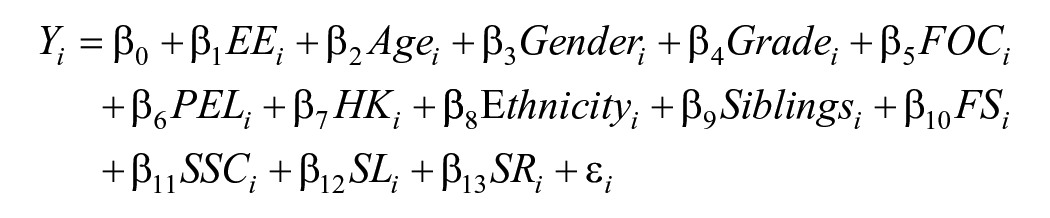
First, since the first outcome variable, BMI, was a continuous variable, this study applied the OLS model to test the association between adolescent educational expectations and BMI. The corresponding expression was:
The second outcome variable, obesity, was an ordinal variable, this study used ordered logit model to examine the relationship between adolescent educational expectations and obesity. The corresponding expression was:
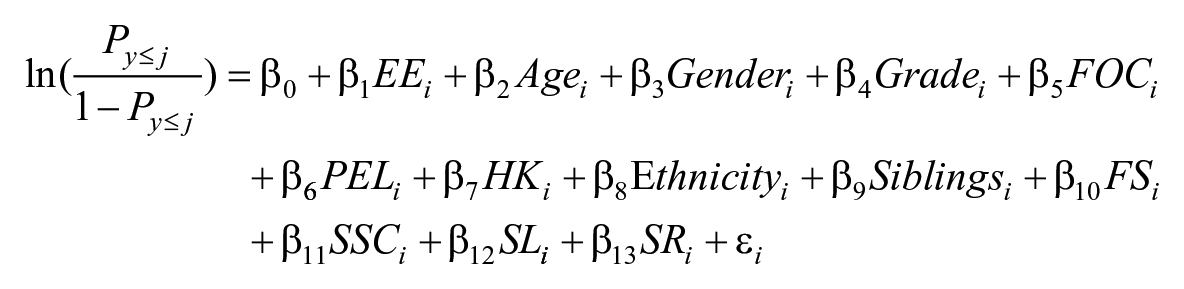
Unlike the OLS model, the coefficients of the ordered logit model represented the odds ratio. For example, if
Since the CEPS data are nested, with individuals nested within schools, standard errors clustered at the school level were calculated when conducting the analysis.
Second, we tested the robustness of the findings by replacing the measure of the dependent variable, adding control variables, and reducing the effect of outliers of the dependent variable.
Third, this study employed the KHB method to investigate the mechanism linking adolescent educational expectations with BMI/obesity. This method can be applied to the analysis of mediating effects in non-linear probability models (Breen et al., 2013).
Finally, we constructed interaction terms between adolescent education expectations and gender/hukou status to examine the association between adolescent education expectations and BMI/obesity across gender and hukou status.
It should be noted that we only used baseline data from CEPS and considered this data to be adequate for the purpose of the study. The second round of the survey followed up with seventh graders. The number of missed cases in the second round of the survey was 830 and the number of newly enrolled cases was 471, with a total of 9,920 eighth graders surveyed. Short panel data and insufficient variation in adolescent educational expectations and BMI/obesity make us fail to examine the complex relationship between trajectories of adolescent educational expectations and trajectories of BMI/obesity.
Results
Descriptive Analysis
The mean value of adolescent BMI is 18.760 (Min = 8.071, Max = 36.677). 8.1% of the sample is overweight and 3.2% is obese. Chinese adolescents have high educational expectations, with 83.5% of adolescents having college educational expectations. The mean value of learning time is 1.377(Min = −5.347, Max = 4.564). The proportion of females (50.2%) and males (49.9%) is roughly equal. Over half of the respondents are rural students (54.8%).
We also presents the comparisons between adolescents with college expectations and adolescents with below college expectations on key variables. We can find that adolescents with college expectations have higher BMI and risk of obesity. Furthermore, students with high educational expectations learn longer.
Benchmark Regression Results
We initially employ the OLS method to investigate the association between college educational expectations and BMI. In Table 1 Model 1, only the independent variable of educational expectations and individual characteristic control variables are considered, revealing a positive correlation with BMI. In Model 2, family characteristic control variables are introduced, demonstrating a decreased correlation between educational expectations and BMI. Subsequently, Model 3 incorporates school characteristic control variables, showing a further decrease in the correlation between educational expectations and BMI. These findings suggest a positive association between adolescent educational expectations and BMI.
Results for the Association Between Adolescent Educational Expectations and BMI/Obesity.

Note. Standard errors clustered at the school level are in parentheses.
p < .1. *p < .05. **p < .01. ***p < .001.
We then examine the relationship between college educational expectations and obesity using ordered logit regression. Table 1 Model 4, with only the independent variable educational expectations and individual characteristic control variables, shows that educational expectations are positively associated with obesity. Model 5 incorporates family characteristics control variables, indicating a decreased relationship between educational expectations and obesity. In Model 6, school characteristic control variables are introduced, revealing a further decline in the relationship between educational expectations and obesity These findings suggest that students with high educational expectations are more likely to be obese. Hypothesis 1 is supported.
The above results suggest that high educational expectations pose health risks for adolescents. On the contrary, previous studies have shown that high educational expectations during adolescence motivate young adults to adopt healthy behaviors (Li, 2020; McDade et al., 2011; Whitehead et al., 2015) and improve their health (Clarke et al., 2013; Halleröd, 2011; Kim & Kim, 2020; Li, 2020). A possible reason for the discrepancy is that in China’s highly competitive academic environment, students with high educational expectations are more likely to adopt sedentary lifestyles, such as long hours of studying, to excel in high-stakes exams, making them more prone to obesity.
In addition, studies have shown that adolescents with high educational expectations tend to achieve higher academic performance (Khattab, 2015; McCulloch, 2017) and educational attainment (Fan & Wolters, 2014; Khattab & Modood, 2018). Therefore, while high educational expectations are beneficial for academic success, we must also be mindful of the potential health risks associated with high educational expectations.
Robustness Tests
Although the above results demonstrate a significant correlation between adolescent educational expectations and BMI/obesity, we still need to conduct a series of robustness tests to examine this relationship.
First, replace the measure of the dependent variable. Drawing on the research of Martin et al. (2012), we classify adolescents as overweight or obese (BMI ≥85th percentile) versus normal. Table 4 Model 1 suggests that adolescents with high educational expectations are more likely to be obese.
Second, add the control variable. The region has a significant impact on adolescent educational expectations (Meece et al., 2014). There are also significant differences in BMI and obesity status among adolescents by region (Lutfiyya et al., 2007). Therefore, the region is the confounding variable. After the inclusion of this variable, Models 2 and 3 show that the relationship between adolescent educational expectations and BMI/obesity does not change significantly. In addition, since parents’ educational expectations could affect their children’s educational expectations and BMI/obesity, we also include parents’ educational expectations in the model. The results in Models 4 and 5 reveal that the association between adolescent educational expectations and BMI does not change significantly and the association between educational expectations and obesity enlarges.
Third, reduce the effect of outliers. This study winsorizes the BMI at the bilateral of 1% quantile. We find that the results obtained from samples without outliers (Models 6 and 7) are very close to those we reported in Table 2 Model 4 and Table 3 Model 4.
Results From Robustness Test.

Note. Standard errors clustered at the school level are in parentheses.
p < .05. **p < .01. ***p < .001.
The KHB Results for the Mediation of Learning Time Between Adolescent Educational Expectations and BMI/Obesity.

Note. Standard errors clustered at the school level are in parentheses.
p < .1. *p < .05. **p < .01. ***p < .001.
In conclusion, there is a robust relationship between adolescent educational expectations and BMI/obesity.
Mechanism Analysis
This paper employs the KHB method to investigate the mechanism linking adolescent educational expectations with BMI/obesity. Table 3 reports the mediation role of learning time in the association between adolescent educational expectations and BMI/obesity. Model 1 reveals that the mediation effect is not statistically significant. Model 2 suggests that adolescents with college expectations learn longer and longer learning time increases the risk of obesity. The mediation effect transmitted by learning time accounts for 11.4% of the total effect. Hypothesis 2 is partially supported. This finding is consistent with existing research showing that students with high educational expectations tend to have longer homework hours and study more diligently (Domina et al., 2011; Levi et al., 2014; Schoon & Ng-Knight, 2017). Moreover, a sedentary lifestyle is known to increase the risk of obesity (Hu, 2003; Liao et al., 2014; Rey-López et al., 2008).
Heterogeneity Analysis
The above analysis only shows a homogeneous relationship between educational expectations and BMI/obesity in the full sample, but this relationship may differ across sub-samples. Next, we will investigate the relationship between educational expectations and BMI/obesity across gender and hukou status. Table 4 Models 1 and 2 reveal that the association between college expectations and BMI/obesity is stronger among males compared to females. This implies that males with high educational expectations are more likely to devote more time to their studies, consequently increasing their risk of obesity. Hypothesis 3 is supported.
Regression Analysis for the Association Between Adolescent Educational Expectations and BMI/Obesity Across Genders and Hukou.

Note. Standard errors clustered at the school level are in parentheses.
p < .1. *p < .05. **p < .01. ***p < .001.
Table 4 Models 3 and 4 demonstrate that the association between college expectations and BMI/obesity is stronger among urban students compared to females. This implies that urban students with high educational expectations, influenced by their parents (Huang, 2017; Liu et al., 2014), are more likely to recognize the importance of education in the labor market and therefore study harder, which in turn leads to a higher risk of obesity. Hypothesis 4 is supported.
Discussion
The prevalence of adolescent obesity is increasing rapidly worldwide. Obesity is associated with several diseases, metabolic abnormalities, social discrimination, and low self-esteem (Aronne, 2002). Therefore, it is imperative to explore the various causes of adolescent obesity to reduce and prevent obesity. The existing literature mainly explains adolescent obesity from the view of social environment and individual behavior, neglecting the association between educational expectations as a psychosocial factor in adolescent obesity. This paper uses the China Education Panel Survey (CEPS) 2013 to 2014 to investigate the association between adolescent educational expectations and BMI/obesity.
First, this study adopts the OLS and ordered logit model to examine the association between adolescent educational expectations and BMI/obesity. We find that there is a positive relationship between adolescent educational expectations and BMI/obesity. This finding is contrary to existing research. Previous studies have indicated that high educational expectations during adolescence incentivize young adults to adopt healthy behaviors (Li, 2020; McDade et al., 2011; Whitehead et al., 2015) and improve their health (Clarke et al., 2013; Halleröd, 2011; Kim & Kim, 2020). One potential explanation for this inconsistency is the competitive academic milieu in China, where students with high educational expectations are inclined toward sedentary routines, such as prolonged study sessions aimed at excelling in high-stakes exams, thereby increasing their susceptibility to obesity.
Second, we employ the KHB method to reveal that learning time partially mediates the relationship between adolescent college expectations and obesity. This supports the modern expectancy-value theory, which posits that expectations can motivate decision-making and produce behavioral patterns (Eccles & Wigfield, 2002; Wigfield, 1994; Wigfield & Eccles, 2000). Under the influence of Confucian culture, Chinese adolescents are convinced that upper social mobility can be achieved through education. Therefore, they generally have high educational expectations irrespective of their family background. In the Chinese educational system, academic achievement is universally believed to be attainable through hard work for all (Li & Xie, 2020). Examinations play a pivotal role in student academic success, which causes extreme stress for students (Kirkpatrick & Zang, 2011). These force students with high educational expectations to increase their learning time to achieve high academic achievement.
Finally, the association between adolescent college expectations and BMI/obesity is stronger for males and urban students.
Limitations
This study has some limitations. First, this article employs the OLS and ordered logit model to examine the association between adolescent educational expectations and BMI/obesity. However, these methods cannot establish the causal relationship between educational expectations and BMI/obesity. Nonetheless, methodologically, this study included individual, family, and school level control variables in the model to control for confounders and used double robust estimation to re-examine in an attempt to obtain a causal relationship. Theoretically, this study explains adolescent obesity from a psychosocial perspective, suggesting that adolescents with high educational expectations are at higher risk of obesity, thereby providing a novel theoretical contribution to existing research. Despite challenges in establishing causality, the theoretical insights of this study remain significant.
Second, due to the limitation of data, the adolescents’ weight and height in this article are self-reported, which could increase the instability of accuracy. However, we consider this negligible. On one hand, secondary school students undergo annual physical examinations and are typically very aware of their height and weight, allowing them to recall these measurements accurately. On the other hand, the large sample size of this study ensures that individual intentional or unintentional data biases do not significantly affect the overall data quality.
Third, this study shows that learning time cannot explain the relationship between educational expectations and BMI and learning time can only explain 11.4% of the relationship between adolescent educational expectations and obesity. Limited by the data available, this paper does not allow us to comprehensively examine the mechanisms linking adolescent educational expectations with BMI and obesity. Despite this, we have partially explained the relationship between educational expectations and obesity from an adolescent behavioral perspective. This supports the modern expectancy-value theory, which posits that expectations can motivate decision-making and shape behavioral patterns (Eccles & Wigfield, 2002; Wigfield, 1994; Wigfield & Eccles, 2000). This study provides a new psychosocial perspective and offers explanatory mechanisms for the study of adolescent obesity.
Conclusion
This study finds that adolescents with high educational expectations are at a higher risk of obesity. This is partly because these adolescents devote more time to their studies, and long hours of study are more likely to cause obesity. Additionally, males and urban students with high educational expectations are at a higher risk of obesity compared to females and rural students.
Theoretically, this study extends the applicability of expectancy-value theory by applying it to the field of adolescent health. It offers a new explanation for adolescent obesity from the perspective of educational expectations. In detail, we present the positive association between adolescent educational expectations and BMI/obesity and examine the mechanism and heterogeneous relationship across gender and hukou status. This expands the understanding of the determinants of adolescent obesity.
This article also has practical implications. Previous studies show that educational expectations have a significant positive impact on academic achievement and educational attainment (Hauser et al., 1983; McCulloch, 2017), but we should also emphasize the health cost of educational expectations, especially for male and urban students, to achieve a balance between adolescent schooling and health and to enhance adolescent all-around development.
Footnotes

Declaration of Conflicting Interests
The author(s) declared no potential conflicts of interest with respect to the research, authorship, and/or publication of this article.
Funding
The author(s) received no financial support for the research, authorship, and/or publication of this article.
Ethics Approval Statement
The data source for this paper is secondary data and there are no human experiment.